Rewardful Review (2026): What You Need To Know Before Paying
Rewardful is affiliate software built for one specific job. It helps SaaS companies, online courses, memberships, and digital products run an affiliate program without wrestling with spreadsheets and payout headaches.
The pitch sounds simple, and in most cases it delivers. Setup takes minutes, the Stripe connection is native, and the 0% transaction fee means you keep every dollar of referred revenue apart from the commissions you pay out.
There are tradeoffs to know about before you pay, though. Starter is limited to one campaign, and the price climbs fast once your referred revenue passes a few thousand dollars a month.
Here is the short verdict. Rewardful is a strong pick for SaaS founders and creators who want deep Stripe integration and very little setup work.
It is a poor fit for physical product stores on Shopify, since the platform is built around subscription billing.
Disclosure: Some of the links I share might be affiliate links. If you click on one and make a purchase, I may earn a small commission as a thank you. But don’t worry, it won’t cost you anything extra. I only recommend stuff I genuinely believe in. Your support helps me keep creating awesome content. You can read my full affiliate disclosure in my disclaimer page.
If you want to save a lot of hours searching for high-paying affiliate programs, check out our exclusive list of 2500+ affiliate programs. You’ll find all the information about the programs inside the list. This list is perfect for affiliate bloggers and influencers.
Rewardful Features
1. Assets Library
Most affiliate programs fail quietly because partners cannot find what they need to promote you. A logo sits in one drive, a PDF sits in an email thread, and the copy snippet lives in a doc nobody has opened in six months.
The problem grows quietly. A partner asks for the logo, you send one version, and a week later another partner posts an older file.
Two affiliates end up saying different things about the same product, and neither version matches your current pricing.
Rewardful fixes that with an Assets tab inside the dashboard. You upload files, save links, and store text snippets, and every affiliate sees the current version the moment you publish it.
The Assets tab appears in the upper navigation bar of your dashboard. Inside it, you manage brand files, bookmarked resource links, and copy snippets in one workspace rather than a pile of browser tabs.
Three asset types are supported. Files cover logos, images, and PDFs up to 25MB each, with drag and drop upload.
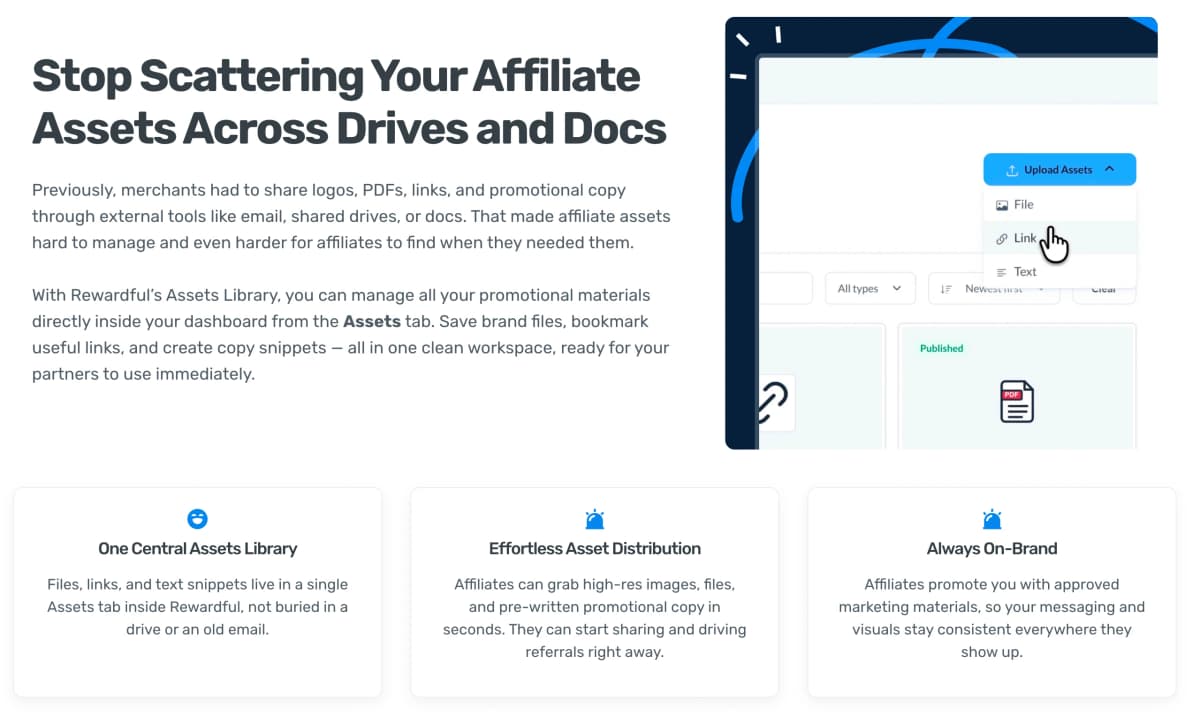
Links take a title and a URL, so resource pages are one click away. Text stores ready made promotional copy for emails, ads, and blog posts.
The workflow is simple. Open the Assets tab, click Upload assets, and pick the type.
Save as a draft to review later, or publish so affiliates can grab it right away. Assets list newest first, so fresh material stays at the top.
Affiliates pull high resolution images, files, and pre written copy in seconds. A creator filming a video at short notice can grab a fresh logo and the current offer copy, then post the same day.
The payoff is consistency. Affiliates promote with approved logos and approved messaging, so your brand looks the same everywhere it shows up.
If you have fought with scattered shared drives before, this feature alone can justify the subscription.
The practical tip here is to keep asset names boring and descriptive. A file called winter-promo-banner-final-v3.png helps nobody, while a file called 2026-annual-discount-banner tells an affiliate exactly what it is.
2. Managed Payouts
Payouts are where most affiliate programs turn into a part time accounting job. Tax forms, invoices, bank details, and reconciliation all pile up, and mistakes surface months later.
Managed Payouts removes that work. You send one payment to Rewardful covering all commissions, and Rewardful distributes the money to your affiliates.
They log in, choose a payout method, and withdraw on their own schedule.
Several withdrawal options are available, including local bank transfer, SEPA transfer, wire transfer, PayPal, and check. Affiliates enter payment details once, then reuse them each cycle without refilling forms.
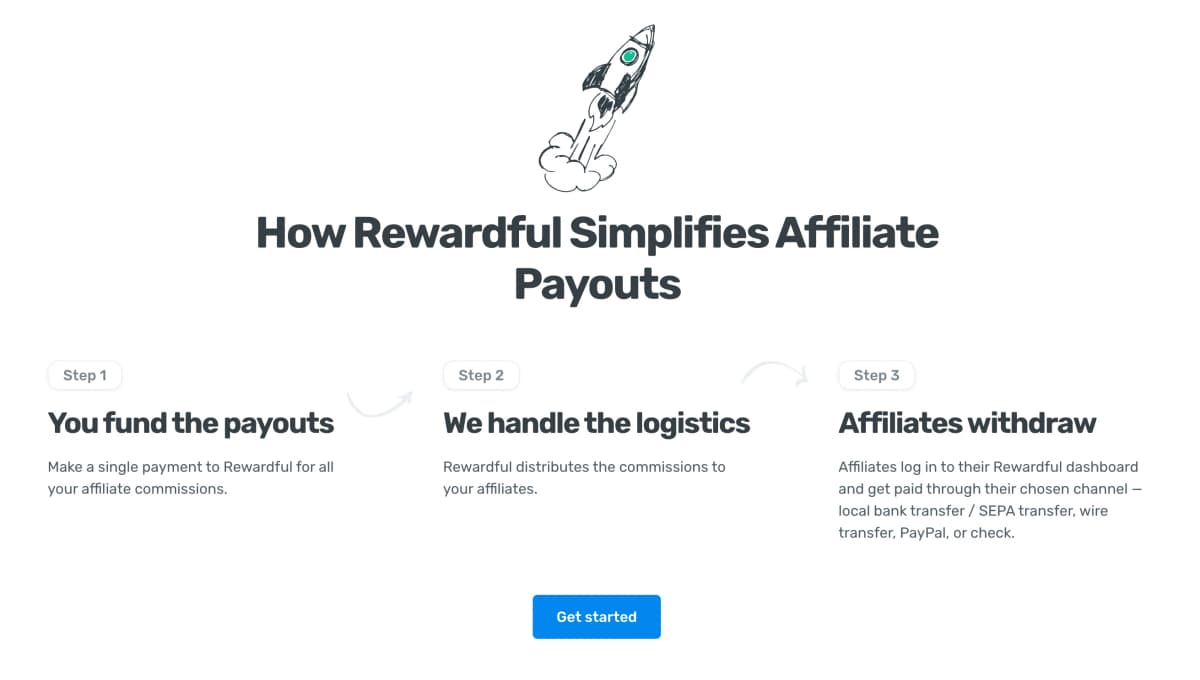
Affiliates also see withdrawal fees before they withdraw, so there are no surprises at the end. They can download invoices from the same dashboard where they track commissions.
The cost is a 3% processing fee on payouts, and Managed Payouts sits on every plan, including Starter. Merchants pay that fee.
Affiliates may pay a withdrawal fee based on method and location.
If payout volume is low, self serve withdrawal alone may be enough. Managed Payouts earns its keep when you have dozens of affiliates and a finance team that would rather not touch the process.
3. Coupon Code Tracking
Link tracking handles most programs well, but it falls apart in places where links are awkward. TikTok has no clean link field.
Podcasts have no place for a tracked URL. YouTube descriptions get buried.
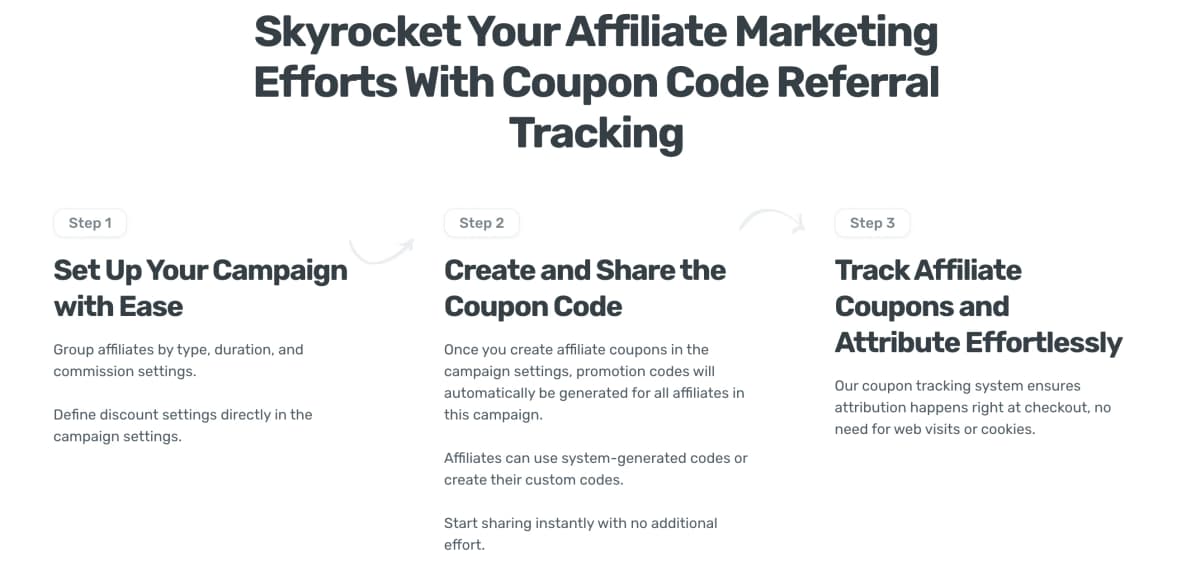
Coupon codes solve this, and Rewardful added them to its campaign tools. You define discount settings in the campaign, and codes generate automatically for every affiliate in that campaign.
Affiliates can use the system generated codes or create custom ones. Either way, they start sharing right away without asking you for anything.
Attribution happens at checkout rather than through cookies or web visits. That matters for shorter windows and for audiences that clear cookies fast, since the code itself carries the credit.
A practical note on incentives. Rewardful supports double sided incentives, so you can reward both the affiliate and the customer.
For a creator program, a discount for the new subscriber often converts better than a flat commission for the promoter.
Grouping matters here. You can group affiliates by type, duration, or commission settings, then let codes generate for everyone in that group at once.
A short campaign for podcast guests does not need the same discount as your evergreen creator program.
Custom codes give partners a little ownership, and a memorable code often travels further than a random string. Keep the naming simple, since a long code is harder to say out loud on a podcast.
4. PayPal and Wise Mass Payouts
Not every merchant wants Rewardful holding the payout process. Some prefer to push a batch file straight to PayPal or Wise and keep control in house.
A mass payout replaces the loop of sending individual transfers one at a time. You gather the payment details, upload them in a batch, and let the provider run the whole list.
That flow works well too. Download the payment detail list from the Rewardful dashboard, upload it to PayPal or Wise, and process the transfer in bulk.
A single batch can cover up to 5,000 affiliates.
Wise suits international programs where local transfer costs eat into margins. PayPal suits programs with a mix of recipients across many countries, since PayPal handles currency conversion for the sender.
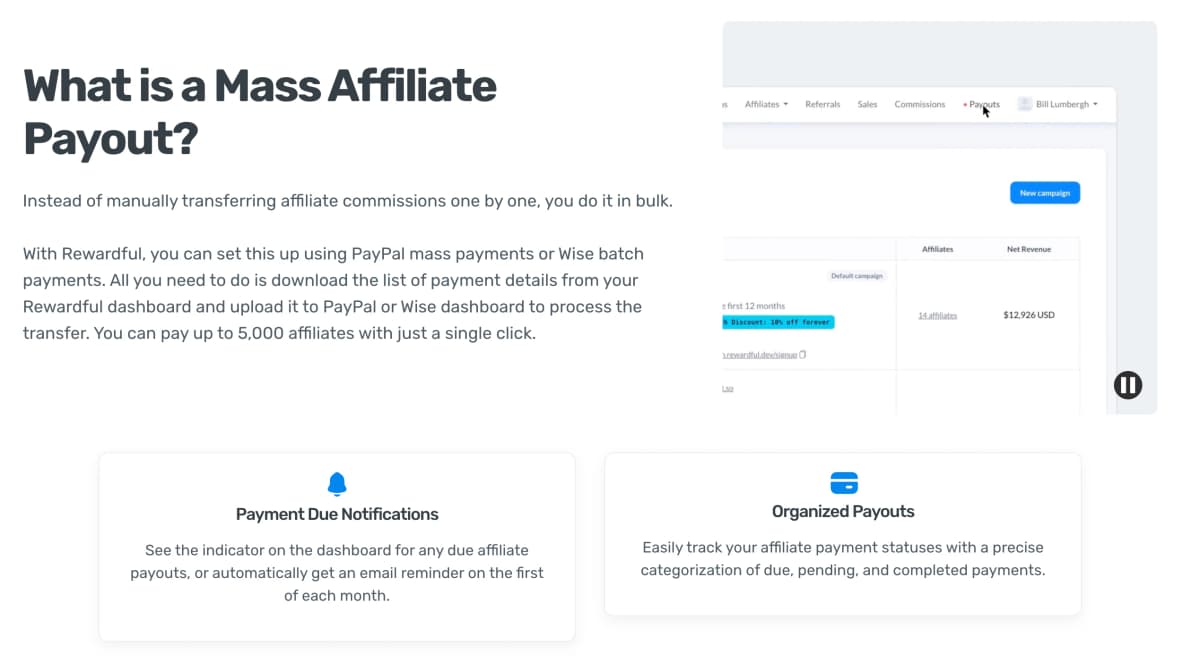
Status tracking keeps the picture clear. Due, pending, and completed payments are separated so you always know what still needs to go out.
A dashboard indicator shows payouts due, and an automatic email reminder arrives on the first of each month.
Batching also cuts transfer fees, since one transaction costs less than hundreds of small ones. Multiple campaigns and multiple currencies are supported, so regional affiliates are not a blocker.
Use mass payouts when you want to stay hands on. Use Managed Payouts when you want the admin gone.
Plenty of programs run both at different stages.
5. Two Way Stripe Integration
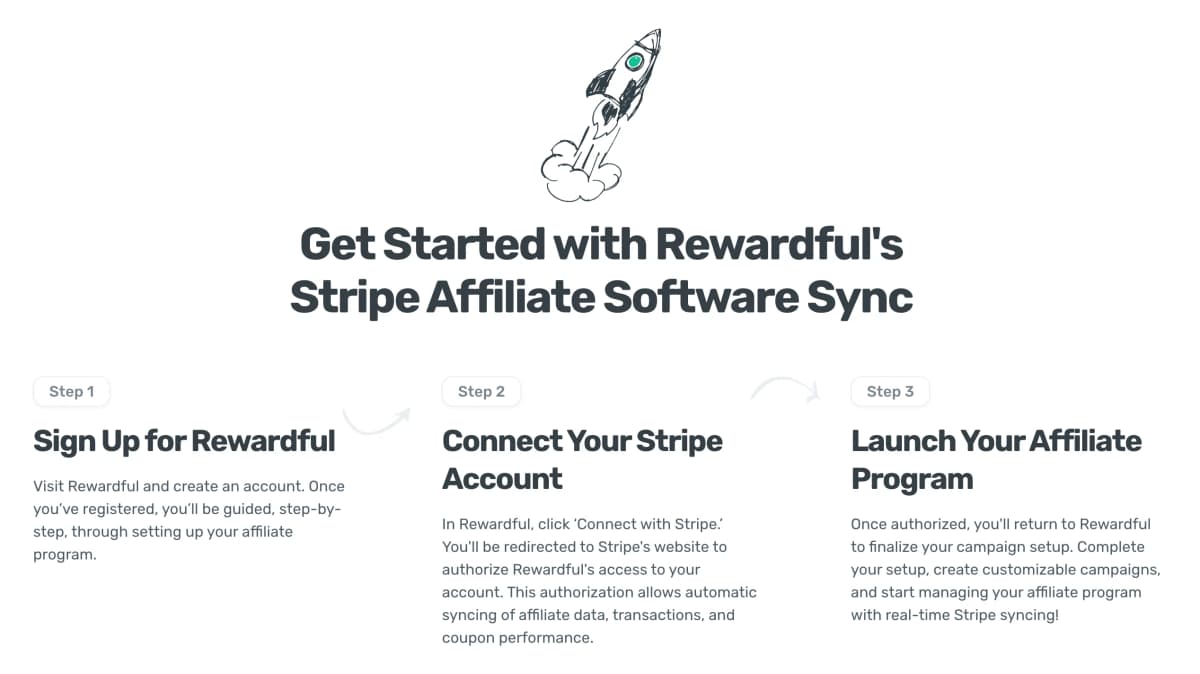
The two way Stripe sync is the core of the product. Change affiliate data in Rewardful and it updates in Stripe, and change it in Stripe and it updates in Rewardful.
That covers coupon codes, transaction details, and affiliate records. The two systems stay aligned without scheduled exports or duplicate data entry.
Changes appear in real time, so reports on coupon performance and affiliate contribution stay current. Commission structures can be custom, with flexible rates by product or plan, and tiered rewards for top performers.
Cross domain tracking is supported through a small script, so a referral that starts on a landing page and finishes on a subdomain still counts.
For teams that need programmatic data, REST API access comes with every plan, including Starter.
Rewardful holds Stripe Premier Partner status, which means the sync is a supported relationship rather than a community connector. Updates move in both directions, so a coupon created inside Rewardful shows up in your Stripe dashboard without an export step.
Reports stay current because nothing sits in a separate tool waiting for a nightly sync. You can check affiliate contribution and coupon performance against live Stripe numbers at any point in the month.
6. One Click Integration
Rewardful connects to Stripe with a click, and it lists more than 20 other integrations. MemberStack and LaunchPass cover membership businesses, while Userlist and Customer.io handle email marketing automation.
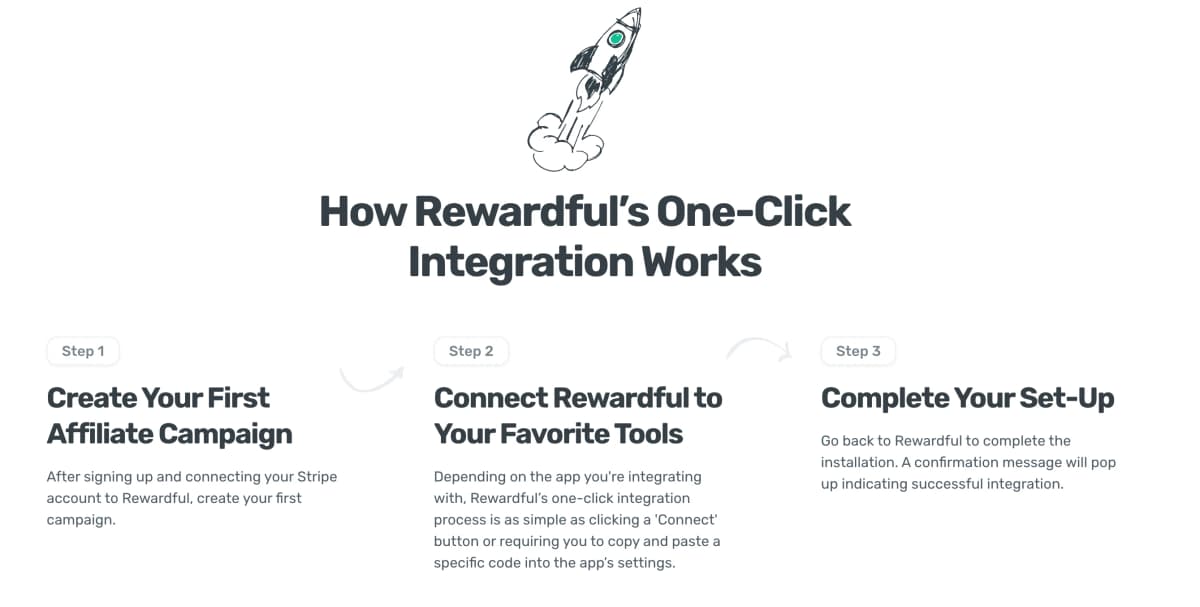
The process is the same for each app. Connect it, or paste the snippet or API key into the integration settings of the other tool, then confirm inside Rewardful.
No coding is required for the standard path, and users report launching a working program in around 15 minutes. That speed is a real difference when you are comparing tools that need an engineer to set up.
Setup starts by creating a campaign, which is where you set the commission rate and the cookie window. After that, you connect the apps your program depends on, one at a time.
Membership tools like MemberStack and LaunchPass matter for anyone selling access to a paid community. Email tools like Userlist and Customer.io matter for new affiliate onboarding, since both can trigger a welcome sequence the moment someone joins.
Copy a snippet or paste an API key for anything without a one click option. The confirmation message inside Rewardful tells you when the connection is live.
A caution worth noting. A one click connection only handles the data flow.
You still decide what happens after the referral lands, so budget time for the offer and the follow up email.
7. Live Customer Support
Support runs through the message icon in the bottom right of every Rewardful page. You can search the Help Center first, or start a live chat and reach a person.
Response times are advertised at under four minutes for live chat. Email support is included on every plan, and phone support comes with Enterprise.
Setup help is part of the deal, so a team can walk through the integration step by step. Support also answers questions about tracking configuration, payment settings, and program growth.
The people who lean on support most are early stage SaaS teams, ecommerce brands setting up their first program, and agencies juggling several client programs at once.
Starting a chat is the fastest route when you are stuck mid setup. The Help Center covers setup, affiliates, campaigns, and integrations, and you can search it by topic before you type anything.
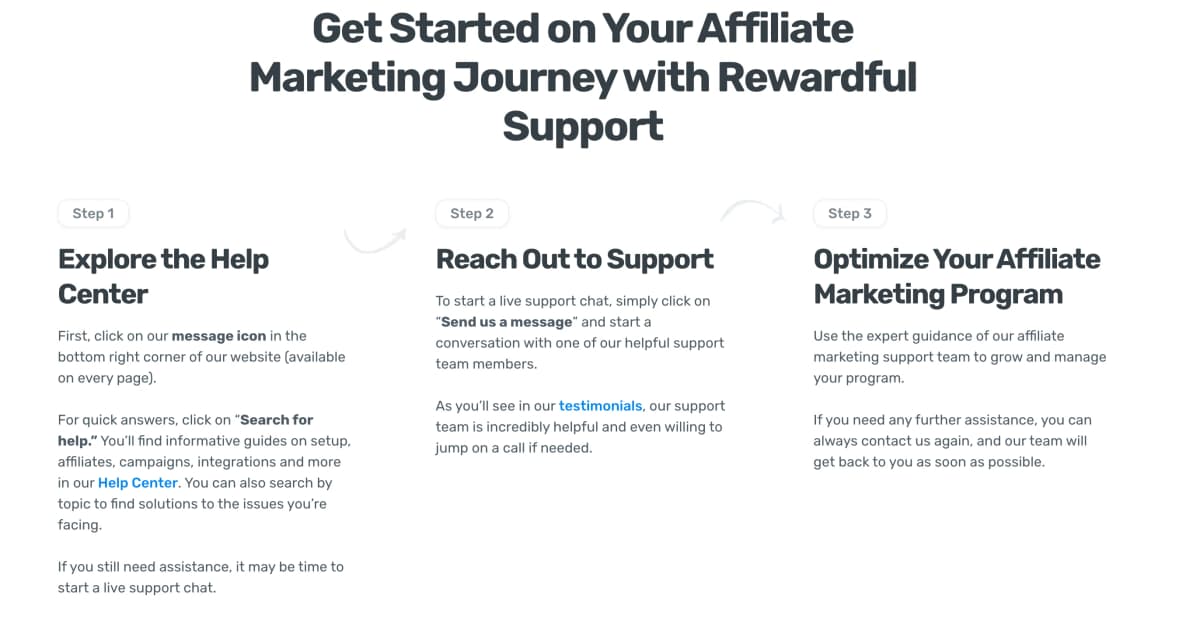
Support will also jump on a call when a question turns out to be bigger than chat. That is useful during the first week, when campaign settings and tracking rules are still fresh.
Growth advice comes with the same channel. If a program is running but not converting, support can look at your commission rate and cookie window with you.
8. Automated Refund Handling
Refunds break naive commission systems. A partner gets paid for a sale, the customer refunds 40 percent a month later, and the ledger no longer matches reality.
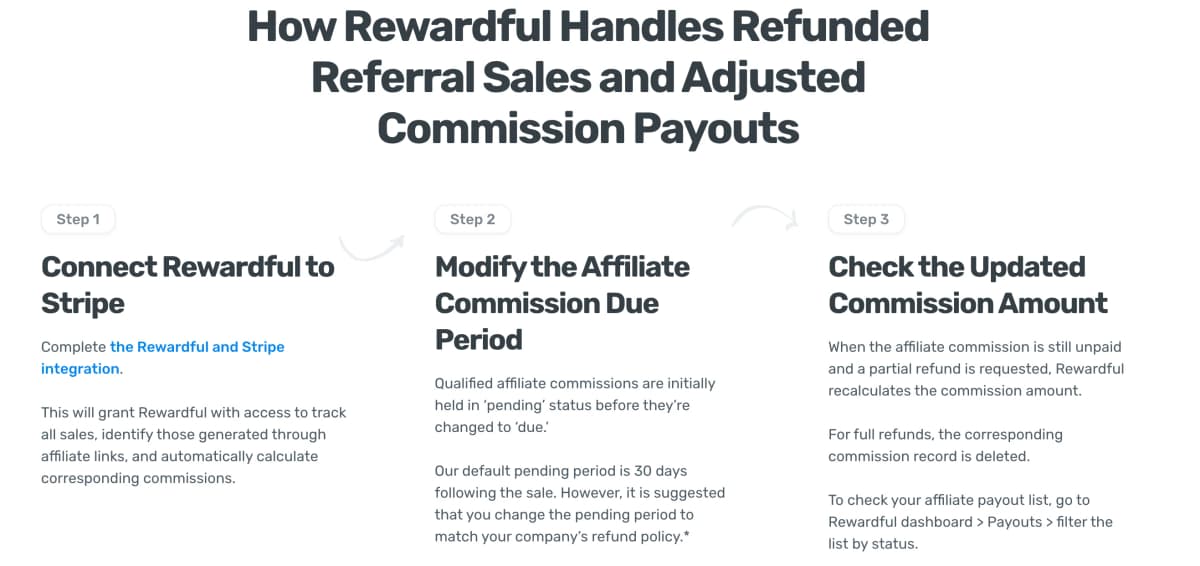
Rewardful recalculates commissions when a transaction changes. Partial refunds adjust the commission amount.
Full refunds delete the commission record before payment goes out.
The pending commission period is adjustable per campaign. Match it to your refund policy, and the chance of paying out on a sale you later refund drops sharply.
Automated recalculation keeps the payout list current, so the numbers you approve match what actually happened. Accounting gets cleaner, and affiliates see fair treatment that builds trust over time.
Subscriptions add another wrinkle, since an upgrade or a downgrade changes what the affiliate earned. Rewardful adjusts for those events too, not just refunds.
To check a figure yourself, open the dashboard, go to Payouts, and filter the list by status. That view shows what is pending, what is due, and what has already been paid.
Getting the pending window right is the single most useful setting here. A 90 day refund policy needs a 90 day pending window, otherwise you can pay a commission on a sale that gets refunded a month later.
9. Self Referral Fraud Detection
Self referral fraud happens when affiliates buy your own product using their own link. The customer numbers look fine, and the revenue is not real.
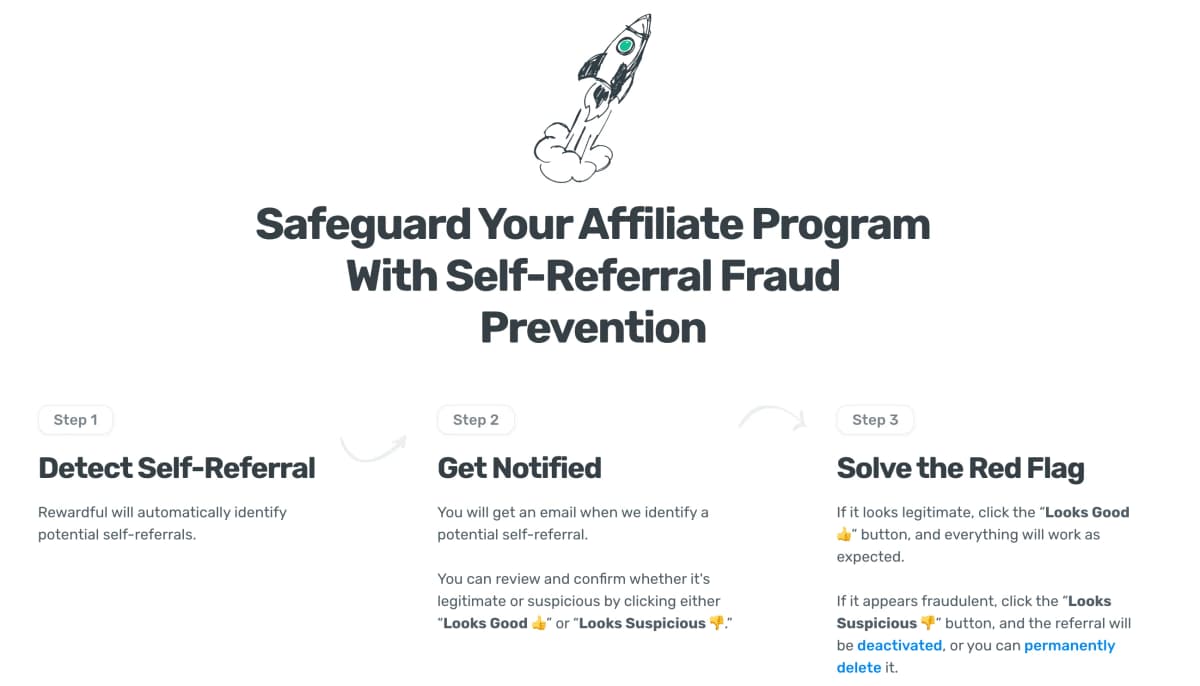
Rewardful watches for this pattern and flags suspected cases. You get an email when a referral looks questionable, and you confirm or reject it from that email with a clear response.
Legitimate cases, such as a company buying on behalf of a client, get approved with a single click. Fraudulent referrals get the affiliate deactivated, or removed permanently.
Alerts arrive automatically, so you do not have to audit the whole program by hand. Reports also reveal abuse patterns that help you spot repeat behavior from the same account.
That protection matters most for subscription products, where a fake signup can sit in a commission queue for weeks before the money moves.
The scale of the problem is worth a close look. A program with 200 affiliates and no fraud checks can quietly lose a meaningful slice of its commission budget to a handful of accounts.
Nobody notices until the payout report looks wrong.
Course owners hit the same problem when affiliates buy seats for themselves. Communities see it when members refer their own membership.
Wellness and tech platforms see it whenever a reward is valuable enough to tempt someone.
Approving a legitimate case takes one click, so the feature is not a burden on your week. Detection runs in the background, and your only job is to answer the emails that arrive.
10. Customizable Cookies and Commissions
Tracking rules are adjustable per campaign. Cookie duration defaults to 60 days, and you can change it in the Campaigns page by opening a campaign, choosing Edit campaign, and updating the cookie window.
Match the window to your sales cycle. A product that closes in five days does not need a 60 day window, and a product with a long evaluation period does.
Cross domain tracking is available through a script with a data domains attribute, so referrals follow a visitor across subdomains.
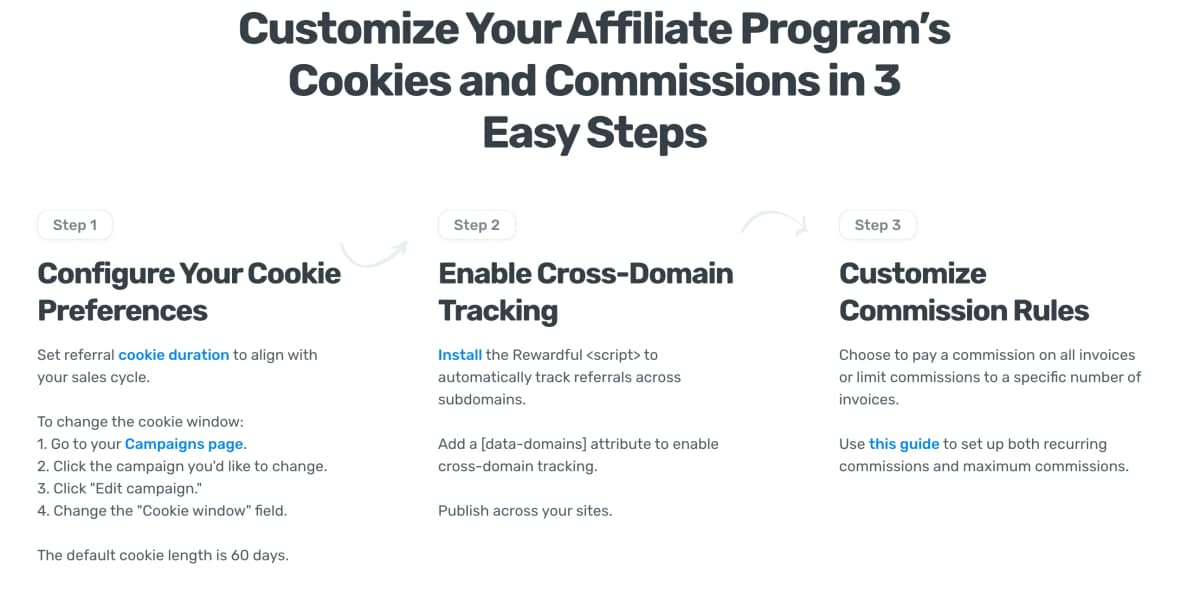
Commission rules are flexible as well. Pay on all invoices, or limit commissions to a set number of invoices.
Choose percentage rates, recurring commissions, or tiered rates by product and plan.
If you outgrow a cookie cutter tool, this is where Rewardful proves its worth. SaaS companies with several products, course creators on hosted platforms, and agencies running multiple client programs all benefit from the control.
Cross domain tracking needs a small script on each site that sends the referral, plus a data domains attribute on the Rewardful script itself. Once that is in place, a visitor can land on one subdomain and check out on another.
Tiered rates reward the affiliates who actually produce. Set a higher percentage once an affiliate passes a revenue threshold, or pay a different rate on your higher priced plan.
11. Affiliate Attribution
Customers often meet several affiliates before buying. Someone discovers you through a blog, and someone else closes the deal with a discount link.
First touch attribution pays the first affiliate who introduced the customer. Last touch attribution pays the affiliate who had the final click before purchase.
The right choice depends on your goal. First touch favors awareness and content creators who introduce new people to your brand.
Last touch favors coupon sites and reviewers who close sales.
New campaigns default to first touch. You can switch models under Advanced Settings in the campaign editor, and set the cookie length in the same place.
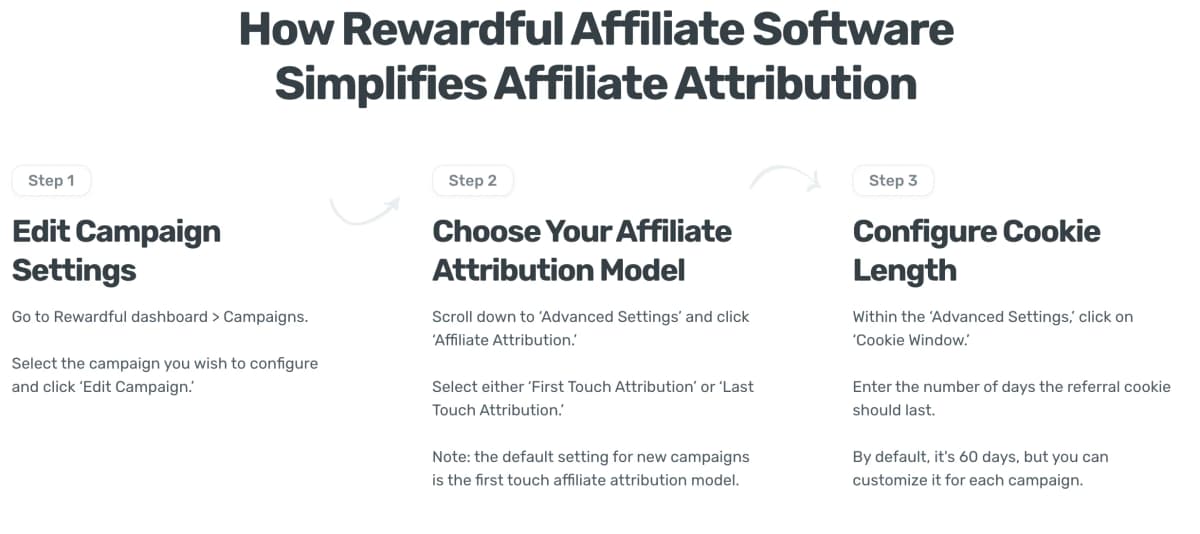
Both models give you a clearer view of the customer journey, and the choice directly shapes how your program reports performance.
Getting the model right prevents the arguments that show up later. When a content creator says the customer came from their blog, the attribution model decides if that claim pays out.
First touch suits awareness programs. Last touch suits a business where the final coupon or link is what closes the sale.
Many programs run first touch at launch, then test last touch once the sales data exists.
One more detail worth knowing. Coupon codes carry their own attribution, so a code based sale credits the affiliate who owns that code regardless of which model you picked.
Rewardful Pricing Plans
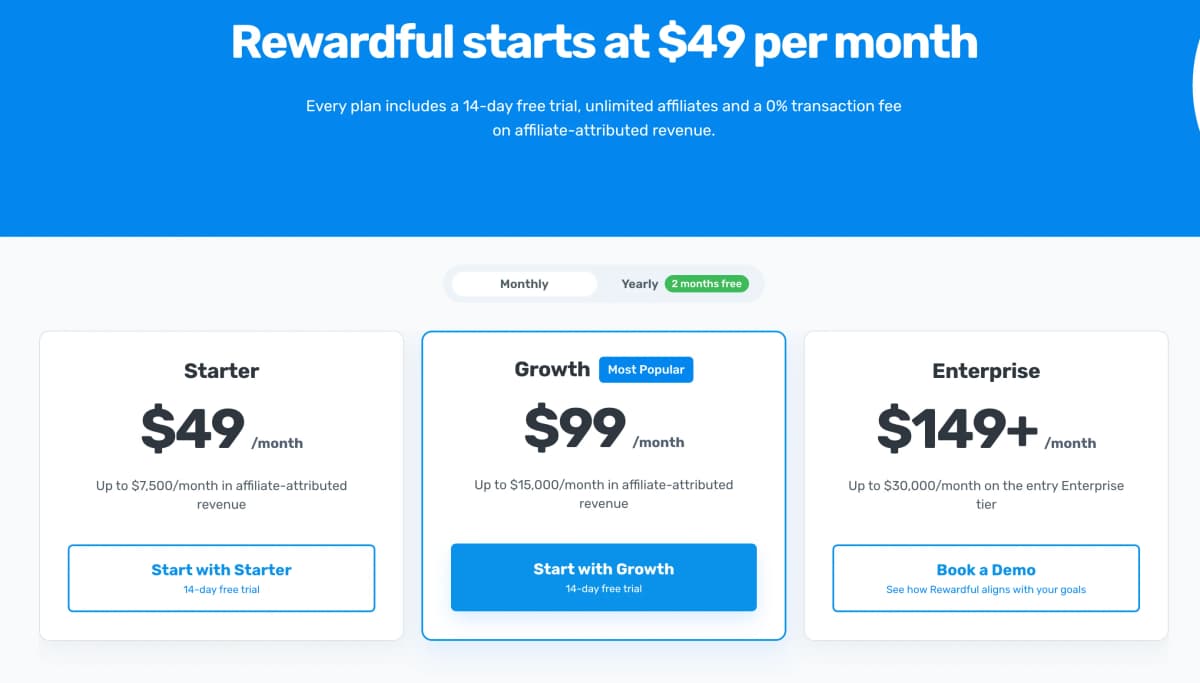
Rewardful charges a subscription based on monthly affiliate attributed revenue, and takes 0% of that revenue. Revenue limits sit at $7,500 a month on Starter, $15,000 on Growth, and $30,000 on the entry Enterprise tier.
Starter costs $49 per month, or $490 per year. It covers one campaign and up to two team members.
Unlimited affiliates and unlimited visitors are included, along with all integrations, REST API access, multiple currencies, attribution controls, coupon tracking, fraud detection, and both payout options.
Growth costs $99 per month, or $990 per year. It raises the revenue limit to $15,000 a month, removes the campaign limit, and gives you unlimited team members.
You also get a branded affiliate portal, a custom domain, private invite only campaigns, and custom rewards.
Enterprise starts at $149 per month, or $1,490 per year, with the entry tier covering $30,000 a month. It adds phone support and one click PayPal payouts, and higher usage moves into higher tiers on a published schedule.
Annual billing gives you twelve months for the price of ten, which works out to a real saving if you plan to stay.
Costs outside the subscription are worth noting. Your own affiliate commissions are set by you and paid by you.
Managed Payouts adds 3% when you use it, affiliates may pay withdrawal fees, and payment providers charge their own rates.
One example makes the math clearer. A SaaS company with $10,000 in referred monthly revenue sits above the Starter limit, so it needs Growth.
At $99 a month, the tool costs about 1% of referred revenue. A company on Starter at $7,000 in referred revenue pays $49, or a bit less than 1%.
The cost stays low as long as referred revenue stays under the plan ceiling.
Every plan includes a 14 day free trial, so the safest move is to test with real traffic first.
One more cost worth planning for sits outside the software. Affiliates get paid by you, so a program at $50 commission on a $49 plan needs real referred revenue before the tool cost is anything more than a rounding error.
Set the commission rate first, then look at the subscription as a small share of the same budget.
Annual billing is the sensible choice for most teams. Twelve months for the price of ten saves roughly 17%, and an affiliate program is rarely something you test once and drop.
Keep monthly billing for the trial period, then switch once the program shows referrals coming in.
Tier jumps are the one thing to watch. A launch month can produce a spike in referred revenue, and a spike above $7,500 on Starter pushes you to Growth for that month.
Forecasting a quarter ahead keeps the surprise bill small, and the difference between plans is small enough that most teams plan for the higher tier from the start.
Who Is Rewardful Best Suited For
Rewardful fits SaaS companies that bill through Stripe or Paddle. The native sync and automatic commission adjustments handle upgrades, downgrades, cancellations, and free trials without a coder.
If you have not run a program before, our first 30 days affiliate marketing guide covers the launch sequence.
Online course creators fit well too. Coupons work for podcast and social promotion, and Mass Payouts or Managed Payouts cover a large student base.
Membership and community businesses benefit from invite only campaigns and the custom rewards on Growth, which lets you reward members who bring in other paying members.
Course creators fit the model too, especially when checkout happens on a hosted platform rather than your own site. The Rewardful script and cookie settings keep the referral attached to the right person even when the sale closes several weeks after the first click.
Agencies running several client programs get value from unlimited campaigns and team members on Growth, along with private campaigns that keep clients separate.
Agencies also like the branded portal on Growth. A client with their own domain and logo sees a portal that looks like their product rather than a generic Rewardful page, and the agency can hand over day to day management without paying for extra seats.
Ecommerce brands on Stripe also work, especially brands using influencer and coupon models rather than physical fulfillment. A fashion label that ships weekly but takes monthly payments fits better than a store selling single items.
A quick note on team seats. Starter allows two team members, which covers a founder plus one person.
Growth lifts that limit, so check it before you add contractors or an agency partner.
If your product charges a recurring fee, Rewardful is a natural fit. The platform was designed for that billing model.
Who Rewardful Is Not For
Physical product stores on Shopify are the main mismatch. Rewardful is built around Stripe and Paddle subscriptions, and a catalog of one time purchases needs different tracking.
Very new projects with no referred revenue yet should be cautious. You pay from month one, and Starter caps you at one campaign, so a multi product launch can hit the ceiling fast.
Teams that need a huge catalog of integrations outside the Stripe ecosystem may find the list too short. Rewardful lists more than 20 integrations, which is solid, yet it is smaller than some general purpose platforms.
Anyone who wants unlimited phone support on a small budget will notice that phone support starts at Enterprise.
One more group should look elsewhere. Marketers who want to run an affiliate program across several billing systems at once will find Rewardful narrow, since the tracking model assumes a single Stripe or Paddle account as the source of truth.
Agencies that resell tracking to clients on their own infrastructure also fall outside the product. The tool assumes you are the merchant of record, which fits a SaaS founder and misses a consultancy that runs programs on behalf of other brands.
Rewardful Alternatives
Rewardful is not the only good option, and the right comparison depends on your billing setup. Two things decide it for most people: if Stripe runs your revenue, and if you need signed partner agreements.
First Promoter is the option for merchants who want self hosted control. You manage the server yourself, so setup is heavier, yet every piece of tracking data stays on your own infrastructure.
Tapfiliate takes the opposite approach, with a clean interface and a generous free plan. It suits smaller programs that do not need deep Stripe data flow, and you can try Tapfiliate at no cost before you commit.
PartnerStack is worth a look for companies that run affiliate and partner programs side by side. It handles contracts and onboarding well, so it wins on paperwork rather than on payment automation.
A SaaS team that needs signed partner agreements gets more from PartnerStack than from Rewardful. That is the one gap in the Rewardful feature set that matters at scale.
Refersion handles recurring commissions well and plays nicely with Stripe through its own app. Commission data stays less tightly bound to your billing account than it does in Rewardful, so reconciliation takes a manual step.
Commission Junction and Impact sit on the other end of the market. They run large affiliate networks with existing publisher relationships, which is useful when you want reach and useless when you want control over your own tracking rules.
The practical comparison comes down to billing. If Stripe runs your revenue, Rewardful wins on integration depth.
If you run something else, or you need the data to live on your own server, a self hosted tool wins on control.
Migration is the other question. Moving into Rewardful is quick, since a campaign and a Stripe connection take minutes.
Moving out means exporting your affiliate list and rebuilding tracking, so treat a switch as a last step rather than a first one.
The fastest way to decide is to list your must have features, then check which tool covers them without a workaround. We break down more of these tools in our affiliate marketing tools roundup, where the setup differences matter more than the feature lists.
A 14 day free trial is worth taking seriously before you commit to any tool, including the ones above. Real referred revenue teaches you more in two weeks than a feature comparison does in an afternoon.
Rewardful Use Cases
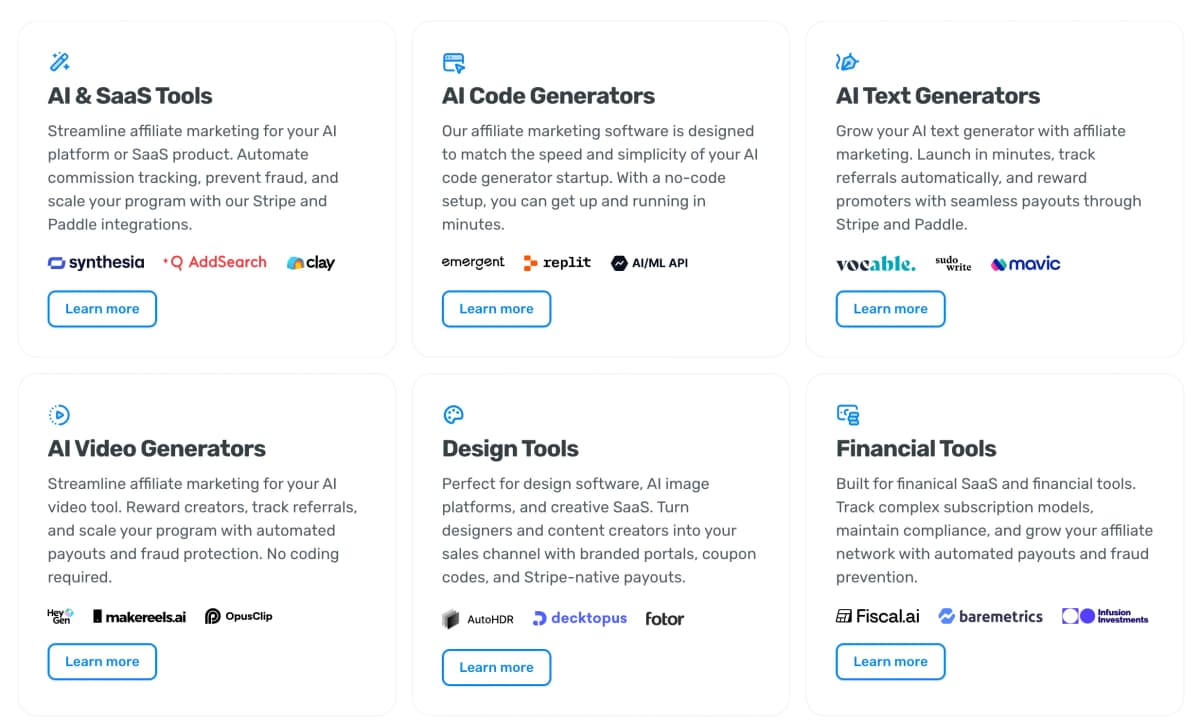
AI and SaaS tools are the core audience. Code generators, text generators, and video tools all bill subscriptions, and coupon codes fit the influencer promotion these products rely on.
Design tools also fit well, since creators promote through visual content where links are hard to place. Coupons and a branded portal keep the messaging tight.
Financial tools handle complex subscription models, where accurate commission tracking matters and fraud attempts are more common.
Health and wellness platforms use Rewardful for referral programs, where trust and brand consistency matter across a slower buying cycle.
Online communities turn members into affiliates, which is a natural fit for products with recurring subscription revenue.
Newsletter tools fall into the same bucket. A product billed monthly through Stripe can hand each subscriber a personal referral code, and the discount lands at checkout without a link ever being clicked.
Dev tool companies get a lot out of this model. Developers publish tutorials, repos, and conference talks, and coupon codes track every one of those mentions back to a signup.
A tool with a free tier can reward the affiliate only when the free user upgrades, which keeps wasted commissions down.
The pattern across all of them is recurring billing and a promo that happens somewhere other than your own website. When those two conditions hold, the platform does the heavy lifting.
When neither holds, a simpler tool usually costs you less.
Newsletter and email tools fit the model too. A product billed monthly through Stripe can hand out referral codes inside an email campaign, and Rewardful attributes the sale at checkout without touching the link.
Template and plugin businesses work well, since a purchase from a creator's video lands in Stripe and the commission calculates itself. The creator never has to build a landing page or wait for a report.
Final Thoughts On Rewardful
Rewardful does a small set of things very well. It connects to Stripe, tracks referrals, calculates commissions, handles refunds, detects fraud, and pays affiliates.
The two way sync is smooth, and the 0% transaction fee keeps the math friendly.
The features lean practical rather than flashy. The Assets Library, Managed Payouts, and automated refund handling each remove a task that real programs have to do by hand.
The pricing model is the part to think about carefully. Base your plan on peak referred revenue, not average, since crossing a tier boundary mid month can raise the bill.
Starter is a reasonable trial tier, and Growth is the sweet spot for most SaaS companies.
Setup speed is the sleeper advantage. Many teams report a working program in about 15 minutes, which shortens the distance between deciding to run affiliates and having real data.
For SaaS, courses, and memberships on Stripe, Rewardful is an easy recommendation. Start with the 14 day trial, connect your live account, and see how the tracking and payouts feel with your own data.
Rewardful FAQ
1. Is Rewardful a good fit for a brand new SaaS product?
It works, and the 14 day free trial lets you try it before paying. Plan your tier around projected referred revenue rather than current revenue, since Starter stops at $7,500 a month and covers a single campaign.
2. Do I need a developer to set Rewardful up?
No. Setup is two scripts, or a one click Stripe connection, and Rewardful guides you through campaign creation.
Many teams report a working program in about 15 minutes.
3. Does Rewardful work with Shopify?
Rewardful is built around Stripe and Paddle subscriptions, so Shopify stores with one time purchases are a poor match. Shopify has its own affiliate tools, and those fit physical catalogs better.
4. How does Rewardful track refunds?
Commission amounts recalculate when a transaction changes. Partial refunds adjust the amount, and full refunds remove the commission record before it reaches payout.
5. Can Rewardful handle recurring subscription commissions?
Yes. That is the core use case.
Commissions stay pending through your refund window and then move to due, and upgrades, downgrades, cancellations, and free trials adjust the amount automatically.
6. What does Rewardful charge in fees?
The subscription starts at $49 a month, the transaction fee on referred revenue is 0%, Managed Payouts costs 3% when you use it, and affiliates may pay withdrawal fees based on method and location.
7. Do affiliates get their own dashboard?
Yes. Affiliates log in, see their commissions, download invoices, and withdraw earnings on their own.
Growth and Enterprise add a branded portal and custom domain.
8. Can I use first touch or last touch attribution?
Both options sit under Advanced Settings in the campaign editor, along with the cookie window. New campaigns default to first touch.
9. Does Rewardful detect affiliate fraud?
Self referral detection flags suspicious referrals and emails you to approve or reject them. Fraudulent cases get the affiliate deactivated or removed.
10. Is there a free trial?
Every plan includes 14 days, and no card is needed to look around. Card details come at the point where you pick a plan.