5 Signals a Niche Has Room for a New Affiliate Site
Every new affiliate asks the same scary question before they build anything. Is this niche too crowded for a brand new site like mine?
Most people answer it with a feeling. They search their topic, see a few big names, and either panic or ignore the problem completely.
A better answer comes from reading the search results the way a mechanic reads an engine. You look for specific signs, count them, and write the numbers down.
In this guide you will learn five signals that show a niche has room for a new affiliate site. You will also set up a simple check, score each signal from 0 to 2, and read the total out of 10.
None of this needs paid tools or special training. A browser, a notebook or spreadsheet, and about an hour per niche are enough.
One thing to say up front: these signals are a practical rule of thumb from reading search pages, not a scientific study. They help you make a calmer choice, and they cannot promise results for any site.
If you have not picked a topic yet, start with our guide on how to choose a profitable niche. If you already have a broad topic and wonder how narrow to go, our article on niche down or diversify covers that choice.
Disclosure: Some of the links I share might be affiliate links. If you click on one and make a purchase, I may earn a small commission as a thank you. But don’t worry, it won’t cost you anything extra. I only recommend stuff I genuinely believe in. Your support helps me keep creating awesome content. You can read my full affiliate disclosure in my disclaimer page.
If you want to save a lot of hours searching for high-paying affiliate programs, check out our exclusive list of 2500+ affiliate programs. You’ll find all the information about the programs inside the list. This list is perfect for affiliate bloggers and influencers.
Why Room Matters More Than An Empty Field
Beginners often hunt for a niche with no competition at all. That hunt usually ends in one of two places, and neither one is good.
The first is a niche that really has no competition because nobody wants to buy anything in it. The second is a niche that looks empty because you searched the wrong words.
Competition is often a good sign. When other sites publish about a topic and keep doing it, it tells you that readers show up and that someone is making money.
The real question is not if other sites exist. The question is if there is a gap a new site can fill with the time and skill you have.
Room has three parts. You need readers who search, you need a way to earn from those readers, and you need a path to the first page of results that does not run through the biggest sites on the web.
The five signals below cover all three parts. Signals one, two, and five are about the path in, signal three is about readers, and signal four is about money.
Think of it like opening a small food stall. A busy street full of stalls is a good sign, as long as you can find a spot, sell something a little different, and set a price that works.
You do not need to beat every stall on the street. You need one corner where customers are already walking by and nobody is serving them well.
Set Up Your Check Before You Start
Before you read any signals, build a tiny research kit. It takes ten minutes and keeps you honest later.
Open a spreadsheet with one row per niche and seven columns. Use one column for the niche name, five for the signals, and one for the total score.
Next, pick three to five search phrases that a real buyer in this niche would type. Use phrases with buying intent, such as "best," "versus," "review," or "how to choose."
Do not use the broadest word in the niche for this test. A search for a single word like "yoga" tells you about the whole topic, while a search for "best yoga mat for sweaty hands" tells you about a place you could actually compete.
Now open a private or incognito window. That keeps your past searches from changing the order of results too much, so what you see is closer to what a stranger sees.
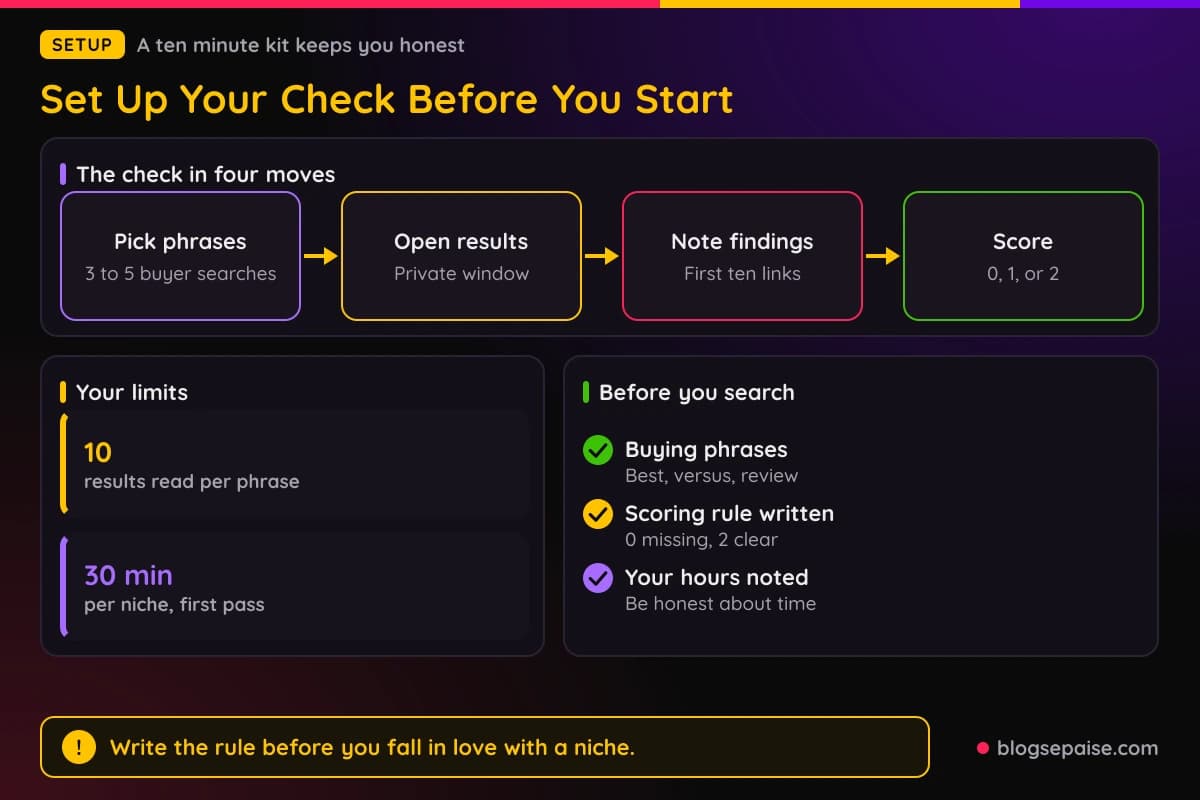
For each phrase, look at the first ten organic results. Skip the ads, the video boxes, and the shopping carousels for now, and write down what you see in the ten normal links.
You will study those ten links in several ways across the next five signals. Keep the tab open so you do not have to search again each time.
Give yourself a rule about time. Spend about thirty minutes per niche on the first pass, and stop there even if you feel curious, because a long search often ends in a wrong conclusion.
Also decide your scoring rule now. Each signal earns 0 if it is missing, 1 if it is partly there, and 2 if it is clearly there.
Writing the rule first matters because people bend rules after they fall in love with a niche. A rule written in advance is harder to argue with.
Finally, write down your own starting position. Note how many hours a week you can spend, if you know the topic well, and how long you can wait for results.
A niche with room for a full time team may not have room for you at four hours a week. Be honest in that note, because every later score depends on it.
Signal 1: Small Sites Already Rank On Page One
The first signal is the easiest to check and among the strongest. Look at your ten results and count how many come from small or young sites.
A small site is one that looks like it was built by a person or a tiny team. Think of a blog with one author, a niche site with a plain design, or a forum thread, instead of a giant brand with a huge newsroom.
If a few such sites sit on page one, the page is not locked. It proves that search engines will rank a smaller site when the page answers the question well.
Here is a simple way to sort the ten results. Give each link one of three labels: giant, mid-size, or small.
Giants are household names, large retailers, and big media outlets.
Mid-size sites are established brands in the niche with many pages and a clear team. Small sites are everything else that looks personal or new.
Look for clues on each page. An about page with one name, a handful of posts in the menu, and a simple layout all point toward a small site.
You can also check how fresh the site seems. If the home page shows posts only from the last year or two, the site is probably young, and it has already reached the first page.
Forums and question sites count as a bonus clue. When a discussion thread ranks in the top ten, search engines are telling you that they could not find a better answer from a publisher.
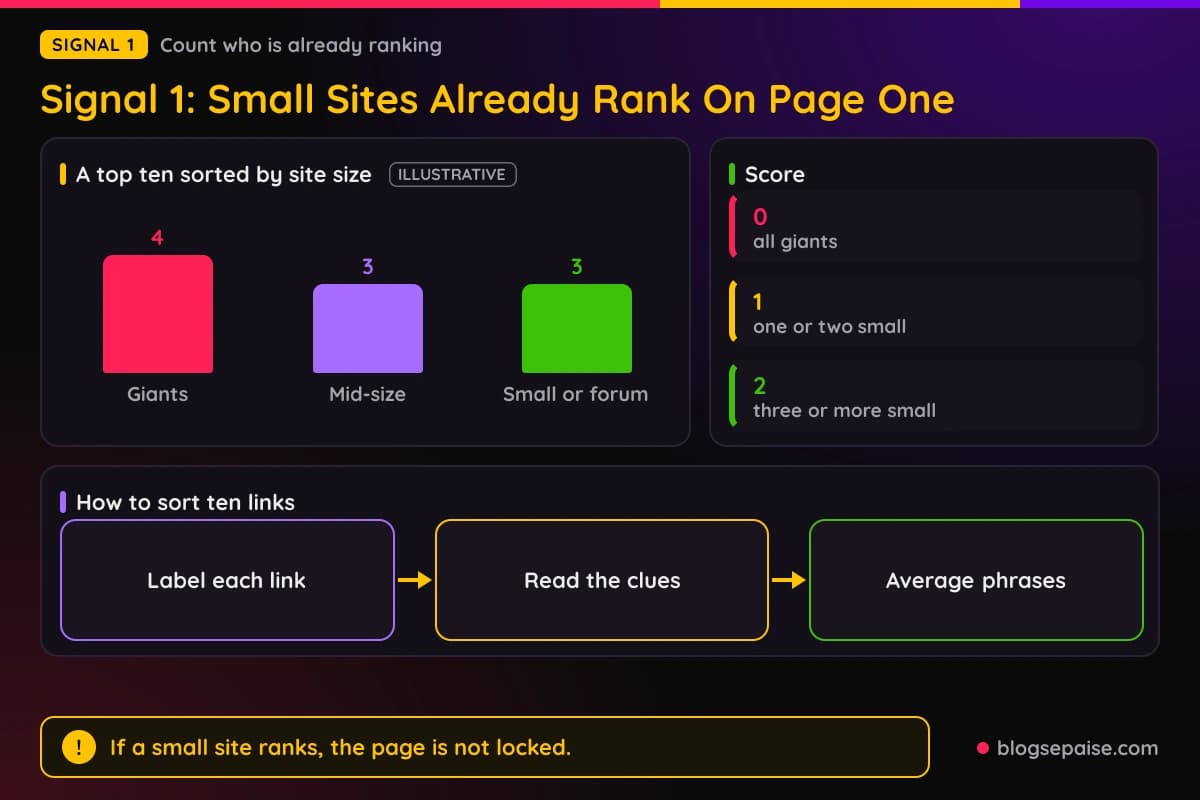
Now score the signal. In my rule of thumb, 0 means all ten results are giants, 1 means one or two results come from small sites, and 2 means three or more come from small sites or forums.
These cutoffs are a judgment call and not a law. You can tune them after you have checked a few niches and seen how they spread.
Repeat the check for each of your three to five phrases and use the average. One phrase may look crowded while another in the same niche is wide open.
That difference is useful by itself. It tells you which sub-topics to write first.
Watch out for one trap. A small site on page one might be there because of a rare link or a strange history, and it may not mean the page is easy to beat.
To reduce that risk, open two or three of the small sites and read them like a customer.
If the page is thin and still ranks, good. If it is clearly excellent, treat it as a giant for your purposes.
When this signal scores 2, you are looking at a niche where the door is open. When it scores 0, you can still enter, but you will probably need a narrower topic, which is exactly what our article on niche down or diversify helps you decide.
Signal 2: The Top Results Are Old, Thin, Or Off Target
The second signal looks at quality instead of size. Even a page full of well-known names can have weak content on it.
Search engines want to show the best answer, but the best answer does not always exist yet. If you can write something clearly better, you have room.
Read the top ten results with three problems in mind. Those problems are age, thinness, and mismatch with what the searcher wanted.
Age is the simplest. Check the date on each article, and notice how many were last updated two or more years ago in a topic where things change quickly.
An old guide to software, gadgets, or prices is often wrong in small ways. Readers notice, and a fresh page that fixes those errors has a real edge.
Thinness takes a little more reading. Scan the page and ask if it answers the question in detail, with steps, examples, and photos, or if it spends most of its length on a short list and a sales pitch.
A page that lists ten products with two lines each is thin, even if it is long on the screen. A page that explains how to choose, who each product suits, and what goes wrong is deep.
Mismatch is the sneakiest problem. Sometimes the top result is about a nearby topic, and it ranks because nothing better exists.
If you search "best planner for shift workers" and the top pages are general planner lists that never mention shift work, you have found a mismatch. A page written for that exact reader could win.
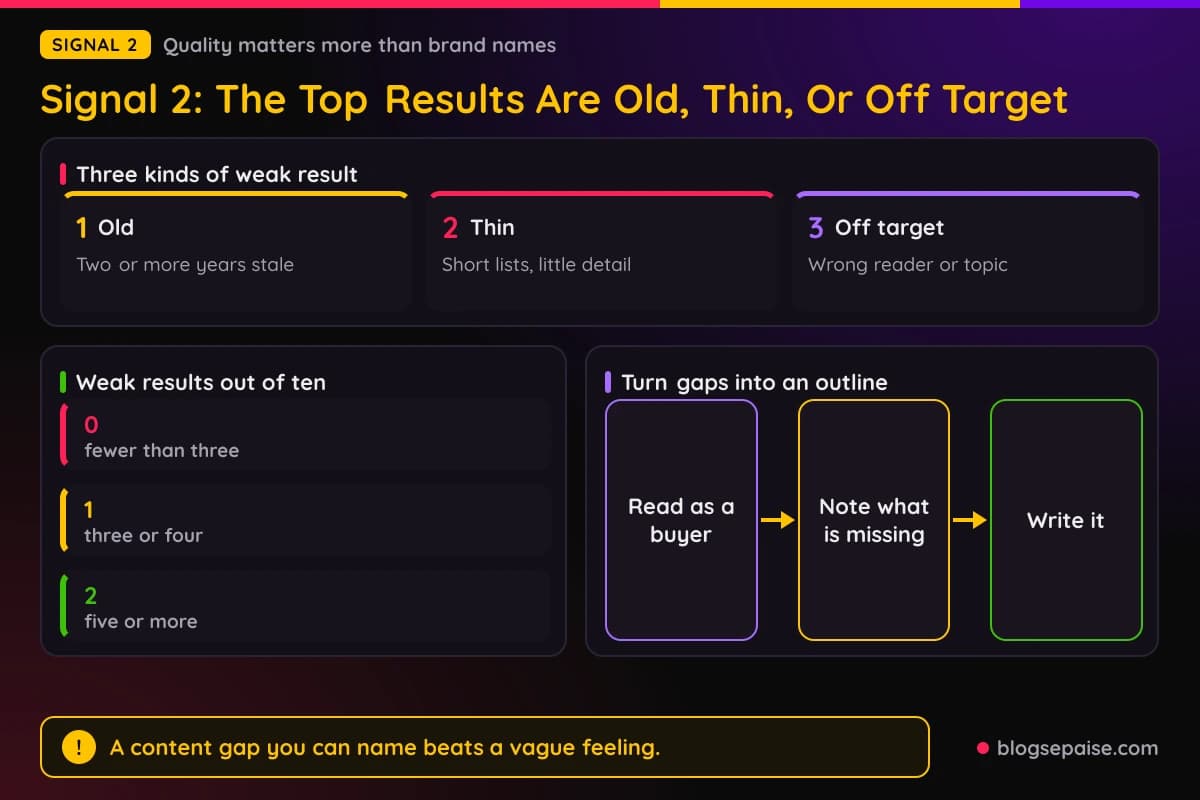
Count the weak results out of the ten. A result counts as weak if it fails on at least a single problem.
My rule of thumb is 0 when fewer than three results are weak, 1 when three or four are weak, and 2 when five or more are weak. Again, the line is a guide and not a rule from any search engine.
Be fair when you judge. A page that looks plain may still be useful, and a page with a lovely design may still say very little.
It helps to read as a customer who has a credit card in hand. Ask yourself if you would trust the page enough to buy what it recommends.
Take notes on exactly what is missing. If five pages skip the same question, such as how long a product lasts or what it costs after a year, write that question down.
Those notes become your outline later. A content gap you can name is far more useful than a general sense that the page could be better.
A word of caution about quality. Do not judge a page weak just because it does not match your taste.
Use the reader's goal as your guide, and ask if the page helps a person finish the job they searched for. If it does, it is strong, no matter how it looks.
A strong signal two also lowers your risk in another way. It tells you that the bar to beat is within reach of a careful beginner.
Signal 3: Demand Spreads Across Many Related Searches
The first two signals are about the competition. Signal three is about readers, because a weak field is worthless if nobody is searching.
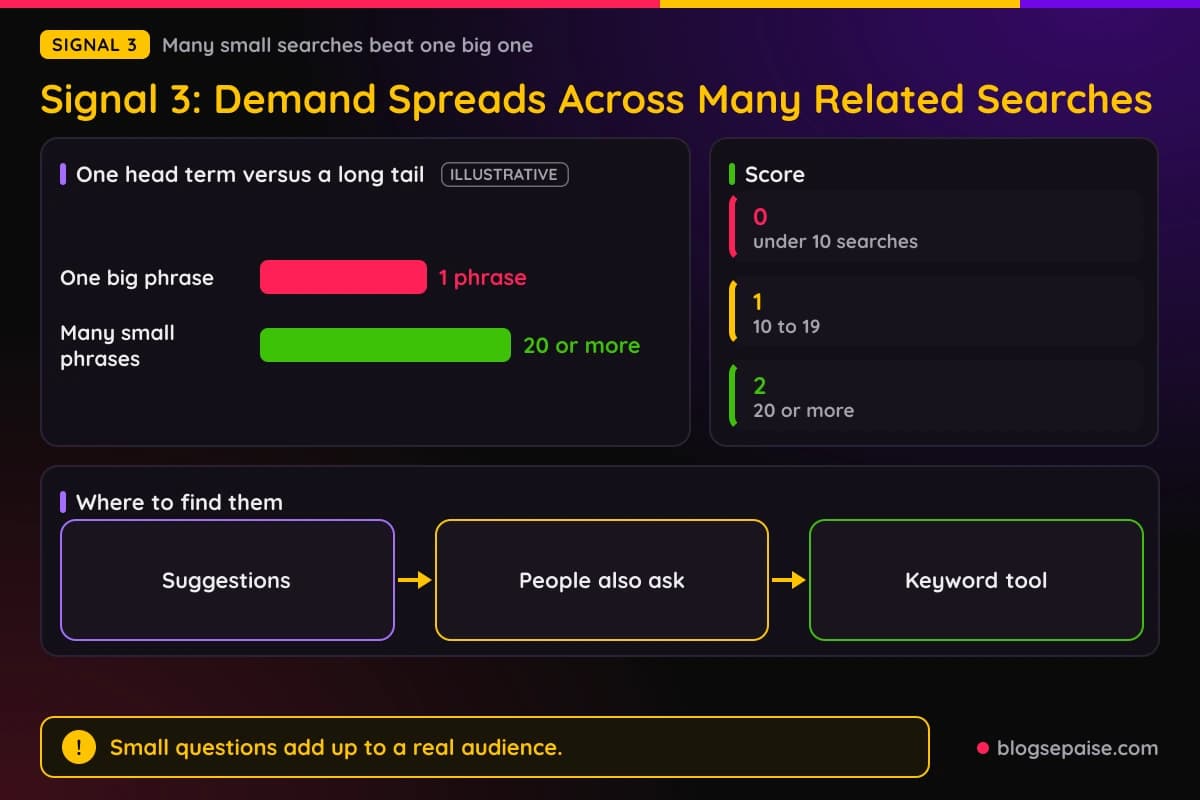
You want to see demand that is spread across many specific searches, not packed into one big word. A niche with one famous keyword is fragile, while a niche with hundreds of small questions is a place where a new site can pick up traffic one post at a time.
Start free. Type your main phrase into a search bar slowly and watch the suggestions that pop up under it, then repeat with each letter of the alphabet after the phrase.
Next, open a results page and scroll to the "people also ask" box and the related searches at the bottom. Click a few questions in the box, because it often grows with new questions each time you click.
Copy every distinct question or phrase into your spreadsheet. If you can reach twenty related searches without strain, the topic has breadth.
Then add a number to the picture. A keyword tool like KWFinder can show rough monthly search counts for your phrases, and these numbers are estimates, not exact counts.
Do not chase the biggest number. Look instead at how many phrases show a modest, steady count, because a group of small phrases often adds up to more than one giant phrase.
If you have never done keyword research, our guide on how to do keyword research walks through it in plain steps. You can start with the free suggestions and add a tool later.
Look for buying phrases in your list. Words like "best," "versus," "alternative," "price," and "review" show that the person is close to a decision.
A niche that has both questions and buying phrases is healthy. Question searches build trust, and buying searches earn the commissions.
Check the trend as well. A simple free trend chart can show if interest is steady, growing, or fading over several years.
Be careful with spikes. A chart that jumps for one month and drops back often shows a news event, not a lasting audience.
Here is my scoring rule of thumb. Score 0 if you cannot find ten related searches, 1 if you find ten to nineteen, and 2 if you find twenty or more with a steady or growing trend.
Treat any single search count as a rough guess. Tools disagree with each other, and small niches are the hardest for them to measure.
A better test is to look for the same question in several places. If readers ask it in search suggestions, in forums, and in video comments, the demand is probably real.
One more check helps. Search a few of your phrases and look at the ads at the top of the page, because advertisers pay for clicks only where visitors turn into customers.
Signal 4: People Spend Money And Programs Pay You
Traffic does not pay the bills by itself. Signal four asks if readers in this niche spend money, and if you can earn a share of it.
Start with products. List the things people buy in this niche, and sort them into physical goods, software, courses, and services.
Variety is a good sign. A niche with only one product has a single point of failure, while a niche with a dozen products gives you many posts to write and many ways to help a reader.
Then look for affiliate programs. Search the product names plus the words "affiliate program" or "partner program," and see how many are open to new sites.
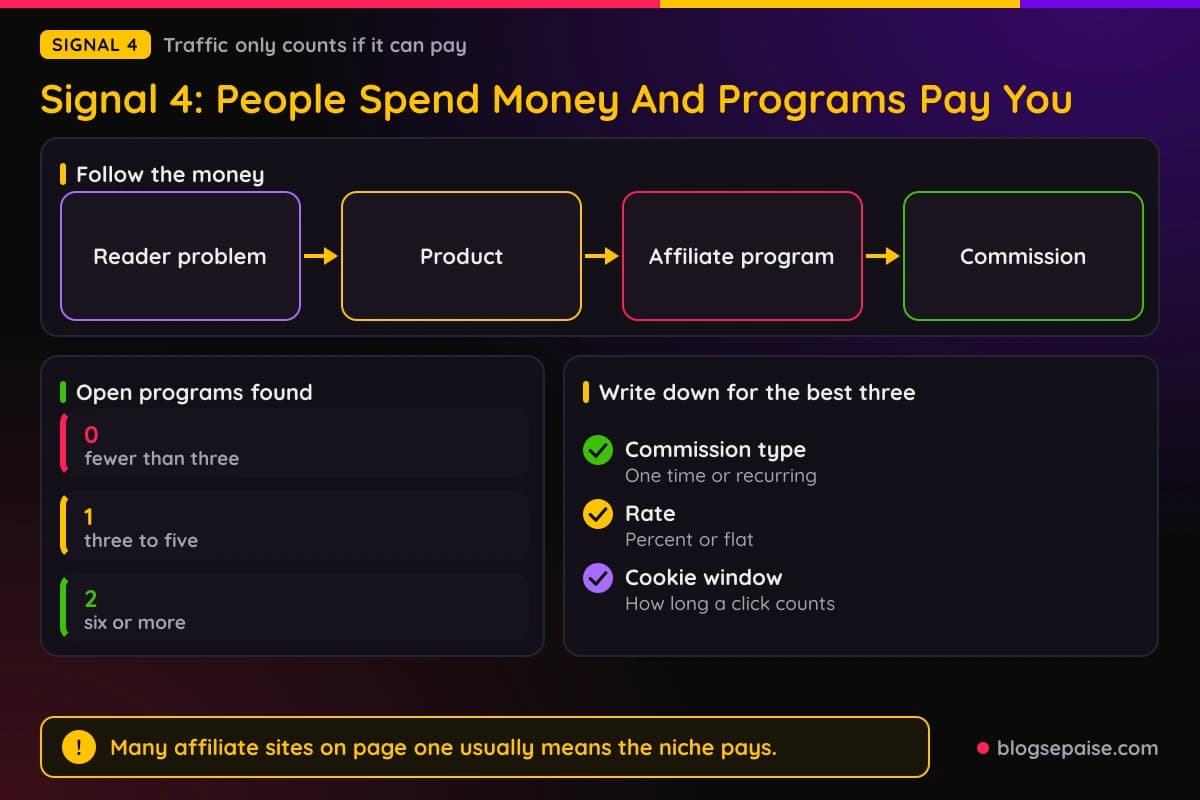
Write down the commission type, the rate, and the cookie window for the best three programs. Our page on how to choose a profitable niche explains why those details change the math.
Price matters too. A niche where the average purchase is a few dollars needs huge traffic to earn anything, while a niche with items in the hundreds of dollars needs far fewer buyers.
Recurring programs deserve extra credit. When a customer keeps paying each month, one good post can pay you again and again.
Next, look for proof that sites in the niche already earn. Affiliate links in the top results, comparison tables, and "best of" lists are all signs that other publishers found it worth their time.
Here is where beginners flip their thinking. Seeing many affiliate sites in the top ten is not a warning, because it often shows the niche pays.
Check the sponsors as well. Search the niche on a video site and look at how many creators mention paid partners, or scan newsletters in the topic for sponsor slots.
When companies pay to reach these readers, the readers have money to spend. That is the whole point of the exercise.
Here is my rule of thumb for scoring. Give 0 if you find fewer than three open programs, 1 if you find three to five that look fair, and 2 if you find six or more with at least one that pays a recurring or high-ticket commission.
Do not skip the quality check on the products themselves. A niche where every popular product has angry reviews will be harder to promote with a clear conscience.
If a program requires you to ask for approval, read the terms before you commit to a niche. Some programs ban certain traffic sources, and that can cancel your plans before you start.
It helps to picture the reader's whole journey. A person who buys a product often needs add-ons, refills, upgrades, or related services later.
Each of these steps is another chance to earn and another post to write. A niche with a long buying journey gives a young site many ways to grow.
Signal 5: The Field Leaves A Gap You Can Fill
The last signal is the most personal. It asks if you can offer something that the current top results do not.
Even in a crowded niche, there is usually a group of readers that nobody serves well. They might be beginners, people on a tight budget, people with a special need, or readers in a certain place or job.
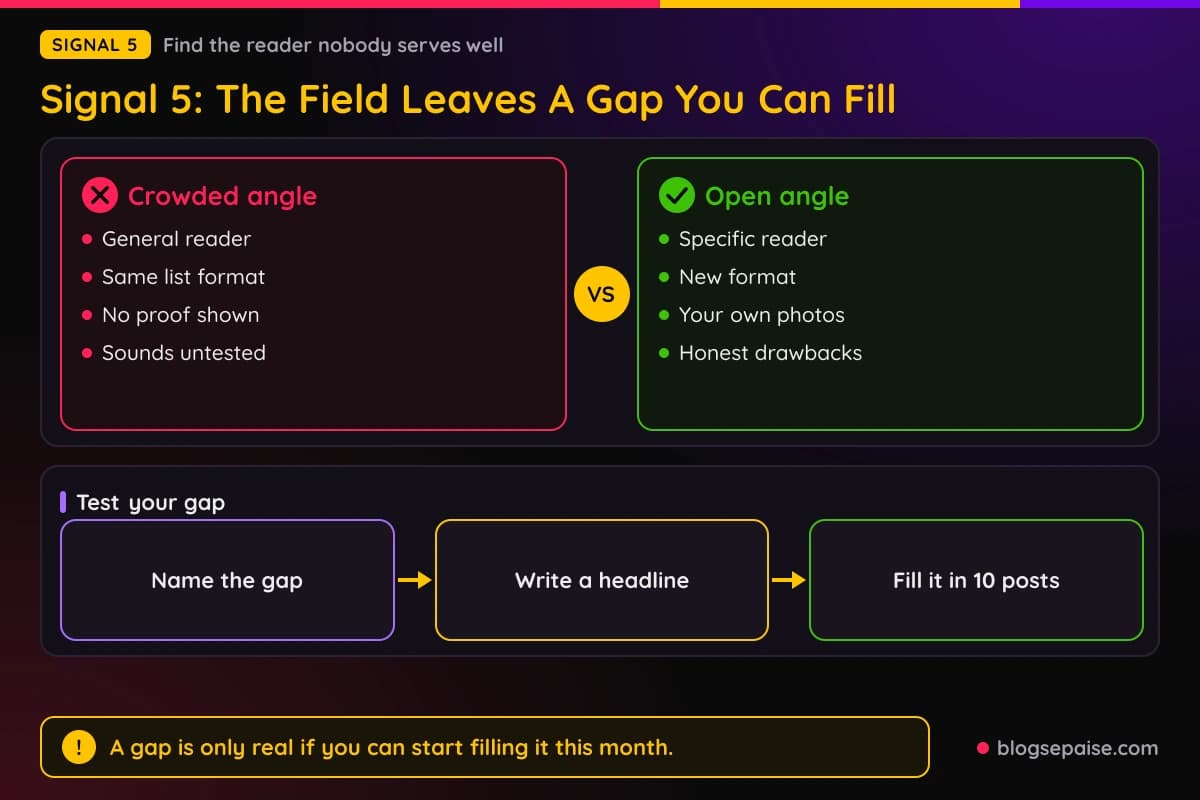
Study the top ten once more, and ask who each page seems to be written for. Most pages aim at an average reader, which leaves everyone else a little underserved.
Then look at the format. If every result is a list, a how-to with photos or a personal test could stand out.
If every result is long text, a clear chart or a checklist could stand out.
Look at the angle too. A page may be about the best product overall, while readers really want the best one for a specific use, such as a small apartment or a long commute.
Voice and proof are also gaps. Many pages sound like they were written by someone who never used the product, so real experience, honest drawbacks, and your own photos can set you apart.
A good test is to finish this sentence: "Everyone else covers the topic for general readers, but I will cover it for a specific reader by doing a specific thing." If you can finish it without stretching, you have a gap.
Your own background counts here. A teacher, nurse, parent, or hobbyist knows details that outsiders miss, and that knowledge is a gap in itself.
The gap should also match your effort. A plan to test fifty products with lab tools is a fine gap on paper, but it may be a poor fit for a part-time beginner.
Pick a gap you can fill with the next ten posts. If it takes a year of work before the first useful page goes up, the gap is too large for now.
Scoring this signal takes some honesty. Give 0 if you cannot name any gap, 1 if you can name one but it needs skills or money you lack, and 2 if you can name a clear gap and you could start filling it this month.
Do a final test with the gap you named. Write a headline for the first post, and see if a stranger would click it over the current top result.
If your headline is a copy of what already ranks, the gap is not real yet. Sharpen it until the promise is different and clear.
It also helps to notice how fast the niche changes. New products, new rules, and new questions keep a niche open, because old pages go stale and fresh ones rise.
A slow, never-changing niche can still work, but you will rely more on your angle and less on timing. A fast-changing one rewards sites that update often.
Score All Five Signals Together
Now bring the numbers into one place. Add the five scores in your spreadsheet to get a total out of 10.
My reading of the total is simple. A score of 8 to 10 is a green light, 5 to 7 means narrow your topic or wait, and anything under 5 means look at a different niche.
Those bands are rules of thumb, and you should adjust them as you learn. They are meant to turn a vague feeling into a plain next step.
Look at the pattern as well as the total. A niche with strong scores on signals one, two, and five but a weak signal four is a niche with an open path and no money, which is a trap.
A niche with strong signals three and four but weak signals one and two has readers and money but a wall in front of it. That niche may still work if you go much narrower.
If you want a second opinion on your numbers, the site has two tools for that. Try the niche viability scorecard and the niche profitability scorer and compare their answers with yours.

Also decide what you will do with each result. A green light means you start your first ten posts, while a yellow light means you test a narrower topic and score it again.
A red light is not a failure. You learned in an hour what could have cost you six months, and that is a good trade.
Keep your sheet. Over a few weeks you will have a row for each niche you checked, and the best choice will often be obvious.
Once you pick a niche, the next problem is getting your first visitors. Our guide on how to get traffic to a brand new affiliate site picks up from there.
A Made Up Example: Maya Checks Indoor Herb Gardening
Here is a story to show the process in action. Maya is a made up beginner, and indoor herb gardening is a made up pick for this example, so none of the numbers below come from real research.
Maya works full time and can spend six hours a week on a site. She chooses four search phrases with buying intent, opens a private window, and studies the first ten results for each.
For signal one, she finds that two of ten results come from small blogs and one is a forum thread. She scores it 1 on the first phrase and 2 on the second, and rounds her average to 1.
For signal two, she notices that six of ten results are weak. Several were last updated years ago, and a few lists give two lines per product, so she scores it 2.
For signal three, she collects twenty-six related questions from suggestions, the people also ask box, and a free keyword tool. The trend looks steady, so she scores it 2.
For signal four, she finds four fair programs and none that pay monthly. She scores it 1, since the money is real but not rich.
For signal five, she sees that every top page speaks to general gardeners. She could write for people in small apartments with little light, and she has already grown herbs that way, so she scores it 2.
Her total is 1 plus 2 plus 2 plus 1 plus 2, which makes 8 out of 10. Under her rule, that is a green light.
Notice what the score did and did not tell Maya. It did not promise income, but it pointed her toward apartment growers as her first reader and showed her that the money signal was her weakest part.
So her next step is to look for a better program, perhaps one with a recurring payment. She also writes her first ten post ideas straight from the weak results she noted.
That is the real value of this method. The score is helpful, but the notes you take along the way become your content plan.
Common Mistakes When Reading Room In A Niche
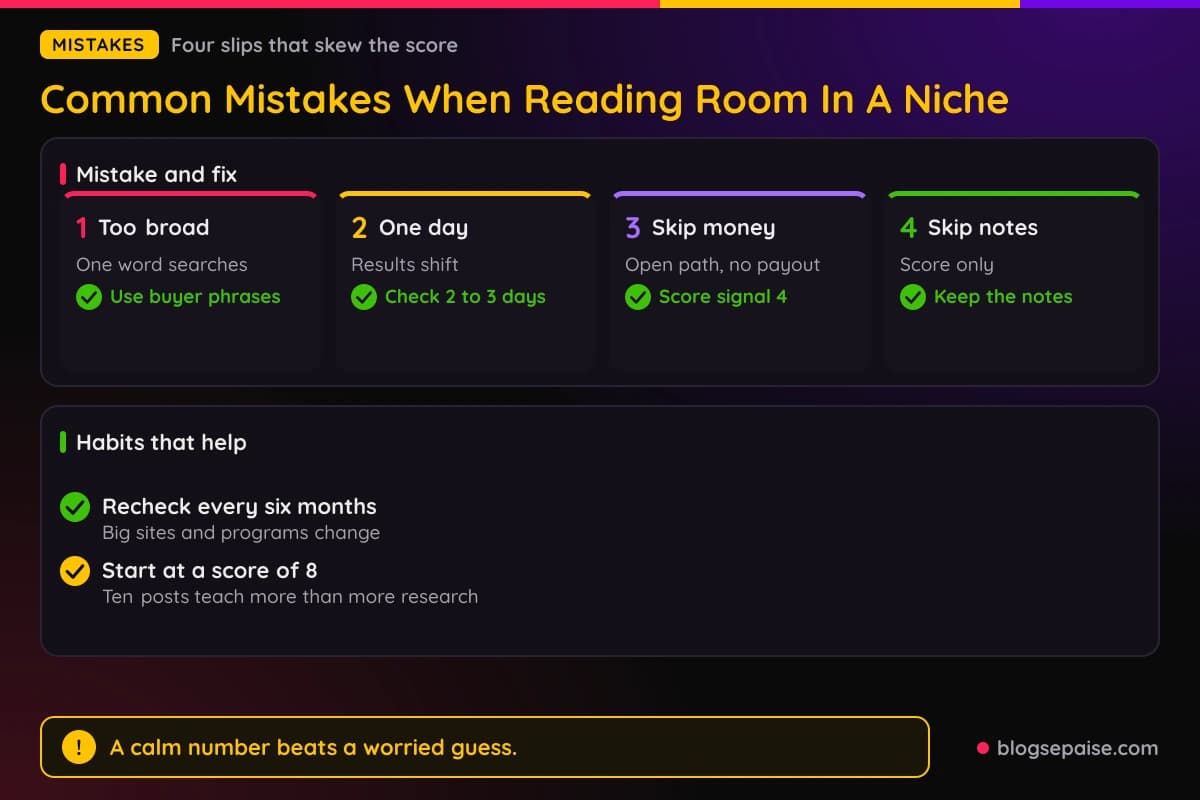
The first mistake is searching a phrase that is too broad. A one word search will always look crowded, so test the specific phrases a buyer would use.
The second is trusting a single day of results. Search results shift, so check the same phrases on two or three different days before you settle.
A third mistake is counting every big brand as a wall. Some giants rank for a page but do not serve the topic well, and your detailed page can still beat them.
Many beginners also skip signal four. They find an open niche with an easy path, build a site, and discover too late that nobody pays for anything in it.
Another trap is judging by your own taste. A niche that bores you may be a great business, and a niche you love may have no buyers at all.
Some people stop at the score and never write the notes. The notes are the useful part, because they show what to write and who to write it for.
Others expect the signals to hold forever. Check again every six months, since big sites arrive, programs change, and new gaps open.
The last mistake is waiting for a perfect score. A niche that scores 8 is good enough to start, and you will learn more from your first ten posts than from a tenth round of research.
Final Thoughts
A niche has room when small sites rank, the top results are weak, readers search in many ways, money moves, and a gap is open to you. You do not need all five at full strength, but you need enough of them to see a path.
Run the check on paper first. Spend an hour per niche, score each signal from 0 to 2, and keep the notes you take along the way.
Remember that a crowded niche is often a paying niche. The goal is to find the corner of it that is not served well, and then serve it better.
Start tonight with one niche and one search phrase. Write down the first ten results and sort them into giants, mid-size sites, and small sites, and you will already have signal one done.
Then keep going until you have a total. A calm number on a screen beats a worried guess every time.
Frequently Asked Questions
1. How many signals does a niche need to have room?
Aim for a total of 8 out of 10, which usually means at least four signals are clearly present. A total of 5 to 7 can still work if you narrow the topic.
2. Is a niche with big brands in the top ten off limits?
No, not by itself. Look at the rest of the page, because small sites, forums, and weak results beside the big brands are signs of room.
3. Do I need a paid tool to check these signals?
You can do most of the work with a browser and a spreadsheet. A paid keyword tool makes the demand check faster but is not required.
4. How do I know if a search result is a small site?
Look for one author, a short menu, a plain design, and fresh posts only from the last year or two. A quick read of the about page usually settles it.
5. If the niche scores well but I have no experience, should I still start?
Start with signal five and pick a gap you can fill by learning in public. Test products, take notes, and show honest results, and your experience grows with every post.
6. How often should I repeat the check?
Repeat it every six months, and also before any big change in your site. Search pages and programs shift over time.
7. Should I avoid a niche with lots of affiliate sites?
Not necessarily. Many affiliate sites in the top results often show that the niche pays, so the question is if the pages are weak and if you have an angle.
8. Which signal matters most?
Money and gap matter most for a part-time beginner, since a path with no payout and a payout with no path both fail. Still, no single signal should decide alone.
9. Can I use these signals for a niche I already started?
Yes. Score it honestly and use the weak signals to decide what to fix, such as a narrower topic or a better program.
10. How long until I see results after picking a good niche?
It varies a lot, and no score can promise a date. Plan on months of steady posting, and use our guide on getting traffic to a brand new site to plan the early weeks.