Should You Niche Down Or Diversify From Day One
Every new affiliate hits the same fork in the road before they publish a single post.
Do you pick one narrow topic and go deep, or do you cover a few topics so you have more chances to earn? Both sides have loud fans, and both sides can point to a success story.
Our view is that the choice depends on your hours, your budget, and how fast you need proof that the model works. Most beginners have little of all three.
Below is a seven step process you can follow in order. By the end you will know if you should niche down, diversify, or start narrow and widen later.
If you have not chosen a topic yet, our guide to choose a profitable niche pairs well with this one. You can also read why most new affiliate sites fail.
Disclosure: Some of the links I share might be affiliate links. If you click on one and make a purchase, I may earn a small commission as a thank you. But don’t worry, it won’t cost you anything extra. I only recommend stuff I genuinely believe in. Your support helps me keep creating awesome content. You can read my full affiliate disclosure in my disclaimer page.
If you want to save a lot of hours searching for high-paying affiliate programs, check out our exclusive list of 2500+ affiliate programs. You’ll find all the information about the programs inside the list. This list is perfect for affiliate bloggers and influencers.
Niche Down Or Diversify: The Short Answer
Start with one niche. Stay there until the site proves it can earn, then widen on purpose.
Diversifying on day one feels safe because it looks like spreading risk. In practice it spreads your hours so thin that no topic gets enough work to rank, and a site that never ranks cannot tell you anything.
A single niche gives you a clean test. If the traffic shows up and the clicks turn into commissions, you have proof, and if it does not, you learn that sooner.
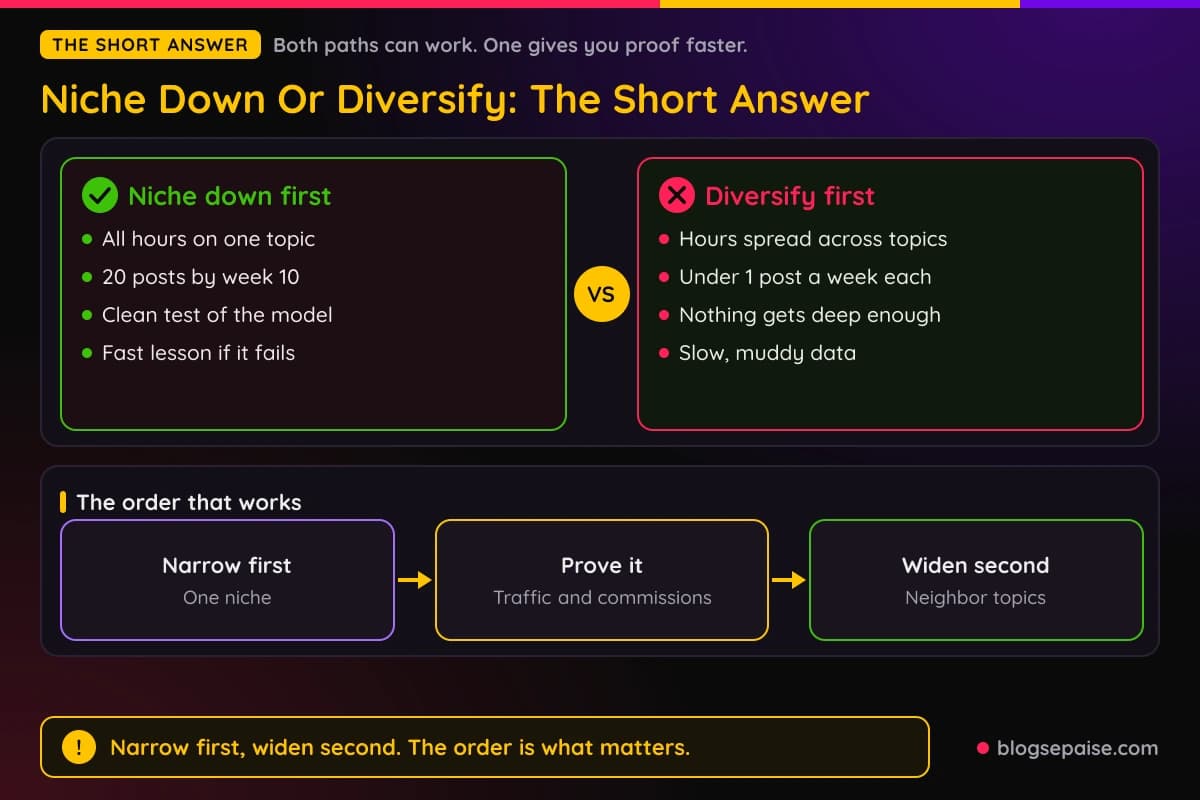
That does not mean you must stay in one niche forever. It means the order matters, which is narrow first and widen second.
Think of it like opening a shop. A shop with one clear product line gets known for that line, while a shop that sells a little of everything is harder to describe in a few words.
Step 1: Learn What Each Choice Really Means
Many beginners argue about niching without agreeing on the words. Clear definitions save a lot of confusion.
Niching down means one site covers one tight topic for one type of reader. A site about budget standing desks for home offices is a niche, a site about office furniture is wider, and a site about home products is wider still.
Diversifying means you cover several topics, either on one site or across a few sites. A blog with posts on web hosting, pet supplies, and travel gear is diversified.
Between those two sits a middle path. You pick one main topic, then add closely related topics that share the same reader.

Here is a quick way to sort any idea. Ask who the reader is, what problem they have, and what they will buy to fix it.
If one site can answer all three in a single breath, you are looking at a niche. If you need three different answers, you are looking at three niches.
Niching down describes your topic, not your audience size. A tight topic can still have plenty of searches, so do not confuse small with weak.
Step 2: Count Your Hours Before You Pick
Time is the real cost in this decision, so count it first.
The numbers below are a generic illustration, not a measured result. Suppose a post takes you 5 hours from research to links and you can give the project 10 hours a week, which is two posts a week.
Put all of those hours into one niche and you reach 20 posts in 10 weeks. Now split the same 10 hours across three niches, and each niche gets roughly three hours a week, which is less than one post a week.
To reach 20 posts in every niche you would need 60 posts in total. At two posts a week that takes 30 weeks, so the first niche gets its 20 posts in week 30 instead of week 10.
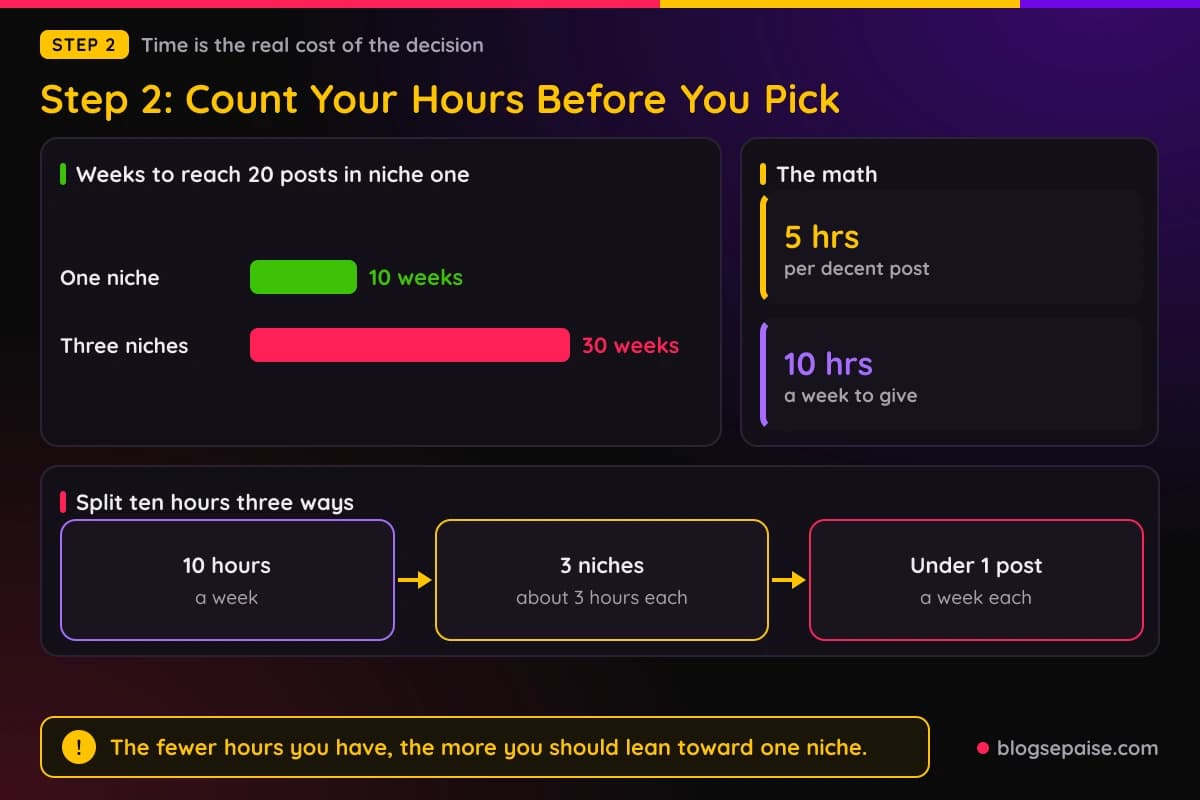
Plug in your own numbers. The fewer hours you have each week, the more the gap grows, and the more you should lean toward a single niche.
Ranking takes time as well. Ahrefs studied 1 million random URLs and found that only 1.74% of newly published pages reached the top 10 of Google within a year, while a second sample of 2 million English language pages put the figure at about 6.11%.
Starting that clock in three niches at once pushes your first real data further back. Source: Ahrefs, how long it takes to rank.
Money works the same way as time. A small budget spent on one topic buys more depth, such as a keyword tool and an email service that actually gets set up, than the same budget split three ways.
Our guide on affiliate marketing with no money shows how to stretch a tiny budget, and the same logic applies to a tiny schedule.
Step 3: Run The Money Test On Your Niche
Before you commit, check that the niche can actually pay you. Interest alone does not pay bills.
Look for several real products you could recommend. Each one should have an affiliate program, a commission worth the effort, and a reader who might buy it.
Next, look for buyer searches. Searches with words like best, review, versus, or alternatives usually come from people comparing options, while a general question often comes from someone still learning.
Then read each program's own terms for the commission rate, the cookie window, and if the commission repeats. Rates differ by program and change over time, so check the live page instead of trusting a rule of thumb.
A niche that passes all three checks is safe to commit to. A niche that fails even one of them is closer to a hobby than a business.
Do a quick sanity check on payouts as well. Divide the monthly income you want by the commission per sale, and the result is the number of sales you need each month.
Also look at who already writes in the space. If the first page of results is full of giant brands, consider a smaller corner of the topic.
Our niche viability scorecard walks you through similar checks with a score at the end.
Step 4: Pick A Starting Niche You Can Stay With
Now choose the niche you will start in. Pick the one that passes the money test and still interests you.
You will write about this topic for months before you can judge the results. A topic you dread will not survive that long, no matter how well it pays.
Keep the topic tight enough to name in one short sentence. If you need a long sentence to explain what your site covers, it is probably too wide.
Write down your reader as a person, with a problem and a budget. If you can picture that person clearly, you can write for them, and if your reader is everyone who likes technology, you will write for no one.
Every time you plan a post, ask if that reader would search for it. If the answer is no, the post belongs on a different site or nowhere at all.
Finally, check that the niche has room to grow. A narrow topic should still have plenty of related questions around it, because those questions become your later posts and, one day, your second niche.
Use a keyword tool to confirm that. Our guide on how to do keyword research shows how to spot a topic with enough searches.
Step 5: Build A Cluster Before You Add Anything
A cluster is a group of posts that all cover one corner of your niche and link to each other.
Plan the cluster before you write. Pick one main guide, then list the review posts, comparison posts, and how to posts that support it.
Publish on a steady schedule you can keep. Link each new post to older posts that relate to it, so readers can move around the site easily.
Keep a simple spreadsheet with the post title, the date, the main keyword, and the affiliate link used. After a few months it turns into a map of what works.
Do not add a second niche while the cluster is unfinished. Every hour spent on a new topic is an hour taken from the one that is closest to paying.
Start with the review and comparison posts, since those sit closest to a sale. Check your search stats regularly and write more on the topics that earn impressions.
Our post on the truth about passive income in affiliate marketing also explains why early, focused work pays off late.
Step 6: Know The Signs You Are Ready To Add A Second Niche
Widening makes sense once the first niche has proven itself. Look for clear signs instead of a gut feeling.
The first sign is traffic. Your best posts should be bringing in steady search visits.
The second sign is money. You should have some commissions, even small ones, which shows the offers and the readers match.
The third sign is a finished cluster. If your planned posts are live and you are running out of strong ideas, the niche is giving you a natural signal to expand.
The fourth sign is spare time. If maintenance now takes only a few hours a week, you have room to start something new without hurting the first project.
If you cannot tick most of these four, wait. A site that is still climbing deserves your full attention, and boredom alone is not a sign.
Also set a review date. Decide with data on that day instead of reacting to a slow week.
Our blog income tracker makes that review easy because the numbers are already in one place.
Step 7: Diversify The Right Way
When the signs say yes, add the next topic with some care. The goal is to widen without starting from zero.
The best second niche sits next to the first one. If you built a cluster about home office desks, you could add chairs, lighting, and monitor arms, since the same reader may buy all of those.
A far away niche is the riskier move. A site about home offices that suddenly covers pet food may confuse readers, and it forces you to learn a brand new market from scratch.
If you still want a far away topic, consider giving it its own site. That keeps each site clear and keeps one weak project from dragging down a strong one.
Spread your programs as well as your topics. A program that changes its terms or shuts down can hurt a site that depends on it too heavily.
Add the new niche one cluster at a time, and treat it as a fresh project with its own review date. Keep your tracking separate for each niche, so a strong niche does not hide a weak one.
When Diversifying From Day One Can Work
The advice above fits most beginners, but there are a few cases where starting wide is reasonable.
If you already have a large audience, such as an email list or a social following, you can test several topics quickly. The audience gives you feedback that replaces some of the wait for search traffic.
If you have a team or a real budget, you can hire writers and run several niches at once. The hours problem from step 2 shrinks when other people supply the hours.
Beginners with a small budget, few hours a week, and no audience do not fit these cases. For them, a single niche is usually the better start.
Common Mistakes With The Niche Decision
The first mistake is choosing a niche because it pays well and ignoring if you can stand to write about it. Burnout is a real risk when the money is slow to arrive.
The second mistake is going too narrow. A topic with only a handful of searches a month cannot feed a site, no matter how well you write.
The third mistake is adding niches because progress feels slow. Slow is common at the start, and a new niche only resets the clock.
The fourth mistake is judging too early. Ahrefs data shows most new pages do not reach the top 10 within a year, so one bad month tells you almost nothing.
The fifth mistake is ignoring the middle path. A main topic with close neighbors is often a better fit than a razor thin niche or a random mix.
The last mistake is never reviewing. Without a review date, it is easy to drift for a year and then quit.
Another trap is copying someone else's setup. A creator with a big audience can run many topics at once because of trust built over years, so copy the stage you are at, not the stage they reached.
Final Thoughts
For most beginners the answer is simple. Niche down first, prove the model, then widen with neighbor topics.
You lose very little by starting narrow, because a niche that works can always grow. Thin work in many places is more likely to produce nothing in all of them.
Count your hours, run the money test, pick a topic you can stay with, and build a full cluster. Then use real numbers, not a mood, to decide when the second niche is ready.
Frequently Asked Questions
1. Is it better to niche down or diversify in affiliate marketing?
For most beginners, niche down first. A focused site gives clearer data and needs fewer hours before you can judge it.
2. How narrow should my first niche be?
Narrow enough to describe in one short sentence, and wide enough to hold plenty of post ideas. If you cannot list many post ideas, the topic is probably too tight.
3. Can I run more than one niche on a single site?
Yes, but keep the topics close. A site about home offices can cover chairs and lighting, while a site that mixes home offices with pet food is harder for readers to follow.
4. When should I add a second niche?
Add it once the first one shows steady traffic, some commissions, and a finished cluster. The timing depends on your own data, not a fixed month.
5. If my first niche does not work, what should I do?
Check the money test again. If the niche has no buyer searches or weak offers, switch to a better one instead of stacking a second weak niche on top.
6. Do I need a separate site for each niche?
Not for close neighbor topics. A far away topic is often better on its own site, so each project stays clear.
7. How long should I wait before judging a niche?
Give it months of steady publishing. Ahrefs found that only 1.74% of newly published pages reached the top 10 within a year in one sample, so early results say very little.
8. Does a narrow niche limit how much I can earn?
Not necessarily. A narrow niche with strong buyer searches can pay well, and you can widen with neighbor topics once the first cluster works.
9. Should I start with a niche I already know?
It helps, because you can write faster and spot real reader problems. Still run the money test, since knowing a topic does not mean it has products people buy.