Can You Use Affiliate Links On Quora? Rules, Risks, And Safer Ways
You wrote a great answer about the best budget laptop, and your affiliate link would fit in perfectly. Then you stop and wonder if Quora will let it stay.
People ask this all the time, in questions such as "Are affiliate codes in links allowed on Quora?" and "What are good places to post affiliate links?" Both deserve a straight answer.
The short answer is no for answers. Quora's Question and Answer Policies state that affiliate links are not allowed.
Quora's rule is only one of three you have to pass, though. The affiliate program has its own terms, and the Federal Trade Commission cares about how you tell people you earn a commission.
The 7 steps below cover all three, then compare 4 places to put a link: an answer, your profile, a Space, and your own blog. A worked example, common mistakes, and an FAQ close things out.
Disclosure: Some of the links I share might be affiliate links. If you click on one and make a purchase, I may earn a small commission as a thank you. But don’t worry, it won’t cost you anything extra. I only recommend stuff I genuinely believe in. Your support helps me keep creating awesome content. You can read my full affiliate disclosure in my disclaimer page.
If you want to save a lot of hours searching for high-paying affiliate programs, check out our exclusive list of 2500+ affiliate programs. You’ll find all the information about the programs inside the list. This list is perfect for affiliate bloggers and influencers.
Why The Answer Depends On Three Rule Books
Quora does not work like your own blog. You do not own the page, so Quora's rules sit on top of everything you write.
Affiliate programs add a second layer. Each program decides where your links may appear, and a break in that rule can cost you commissions.
The FTC adds the third layer. It sets the rules for telling people you earn money when they click.
A link has to pass all three layers. When the rules disagree, the strictest one wins.
On Quora, the strictest rule is Quora's own. Its Question and Answer Policies say affiliate links are not allowed, so the answer to the headline question is no for answers.
That does not make Quora useless for affiliates. Quora's policies allow self-promotion when it is part of a direct and helpful answer to the question.
Many guides on how to promote affiliate links on Quora skip this rule book. Learning it first saves you from wasted effort and lost answers.
The real skill is learning what you can do. You can give a full answer, show your expertise, and point to your own site where the extra detail lives.
Your own site is the key idea. A guide on your blog can hold the affiliate links, the disclosure, and the tracking, all under your rules.
Do not expect Quora to pay you directly either. Its invite-only Partner Program, which paid for traffic from questions, closed in English on September 1, 2022.
Here is the plan in one line. Check the program rules, read Quora's rules, learn how moderation works, choose the placement, disclose, track, and keep safer options ready.
Take the steps in order. Each one answers a question that the next one depends on.
Step 1: Check The Affiliate Program's Rules First
Start with the program, because it can end your account faster than any website can. Open the terms and search for the words site, social media, ads, and messages.
Amazon Associates is the best-known case. Its Operating Agreement lets you earn from a website, social media user-generated content, an app, or an Alexa skill.
Amazon calls each of those your Site. The Participation Requirements say you must identify your Site or Sites in your application.
A Site must also have original content and be publicly available at the address you give. Your own blog meets both tests easily, because you control every page on it.
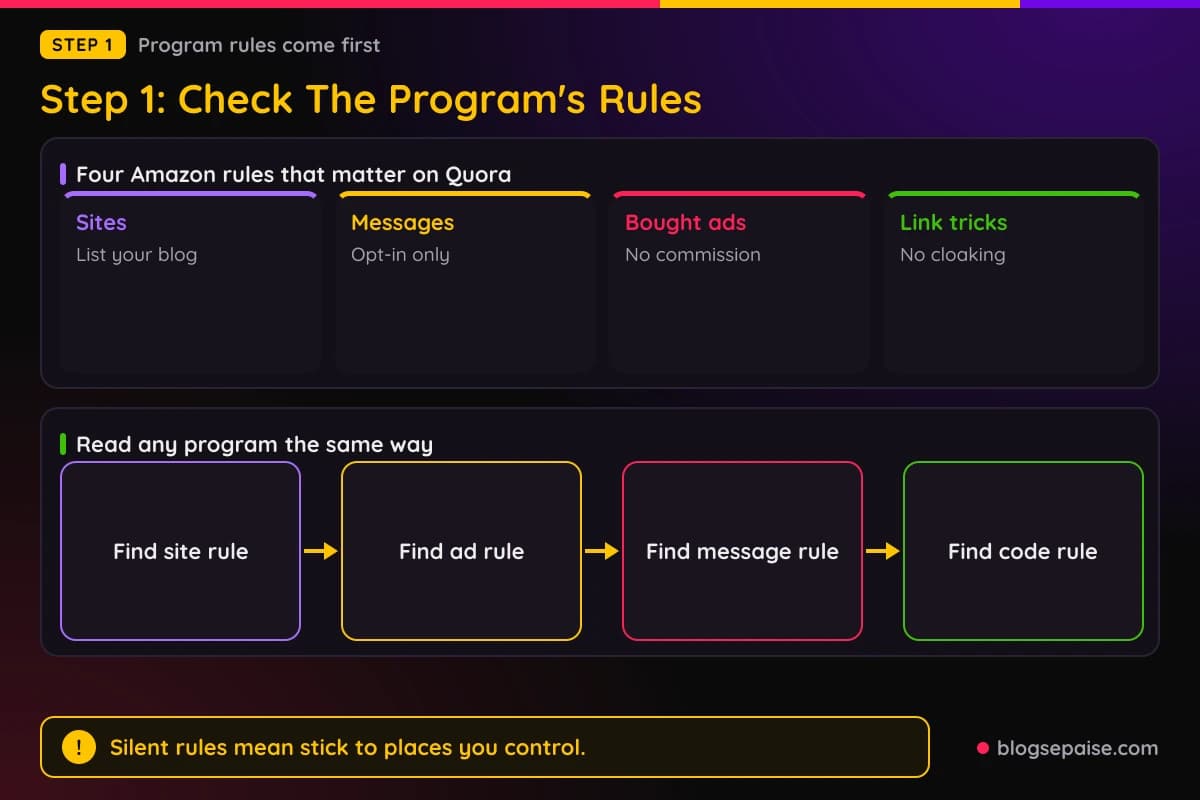
Amazon's rules also limit who you can contact. Tagged links in emails, SMS, and direct messages from your social media Sites are fine only when the person opted in.
That matters on Quora, because Quora lets members send messages. A tagged link sent to a stranger who never asked breaks the opt-in rule.
Another rule covers ads. Amazon does not pay commission on a purchase by a customer who reached Amazon through an advertisement you bought.
Quora sells ads, so promoted answers can tempt you. A paid click on a tagged Amazon link earns nothing.
Amazon bars link tricks too. You cannot cloak, hide, or spoof the web address of your Site that contains tagged links, and a shortener cannot make it unclear that you are linking to Amazon.
One more rule says you cannot create or display your tagged links on a site that is not your Site. Quora is a site you do not run, which is another reason to send readers to your own blog first.
Amazon's list of Sites names social media user-generated content, but it never names Quora. When a rule is silent, stick to places you control and ask Associates support.
Read the pricing rule too. Amazon sets conditions on showing prices and availability, so a typed price in an answer can cause trouble.
Look for the disclosure section as well. Amazon requires the statement "As an Amazon Associate I earn from qualifying purchases" to appear clearly and prominently on your Site.
Networks work the same way. If you join through a network such as Awin, each brand inside it can set its own rules about social sites, forums, and ads.
Some programs list banned traffic sources in their terms. Search for forums and social sites, and write down what you find.
Affiliate codes work like links. A code that earns you credit is a tracked offer, so the program's terms cover it too.
Programs differ on coupon codes as well. Read that clause before you share a code anywhere.
Keep a short note of each rule with the date you read it. The note makes it easy to check your answers later.
If a rule is unclear, email the program manager. Save the reply, because a written answer protects you later.
Programs can close accounts for rule breaks. Our page on how to avoid getting banned from affiliate programs lists the habits that cost people their accounts.
Step 2: Read Quora's Rules On Promotion And Spam
Quora publishes its rules in the Help Center, and two pages matter most. The Platform Policies cover spam, and the Question and Answer Policies cover answers.
Start with the spam section. Quora says spam negatively impacts interaction on the platform, reduces trust, and inhibits authentic engagement.
The policy lists behaviors that count as spam when the goal is to drive traffic to an external site or to earn money. Irrelevant answers or comments are on the list.
Editing your own questions to add links or irrelevant information is on it too. So is posting questions to promote a business.
Excessive promotion of the same product or service is named as well. One mention can be fine, but a pattern of pushing the same offer is not.
Repetition has its own line. Quora bars posting the same content repeatedly and sending the same messages repeatedly.
The help article on plagiarism adds a related point. Posting the same answer to many questions counts as spam, especially when you do not customize it for each question.
Deceptive links are listed too. A link that imitates Quora's interface and sends people to an unexpected site breaks the rule.
Quora also lists coordinated inauthentic activity, such as vote manipulation. Selling accounts or engagement metrics is banned as well.
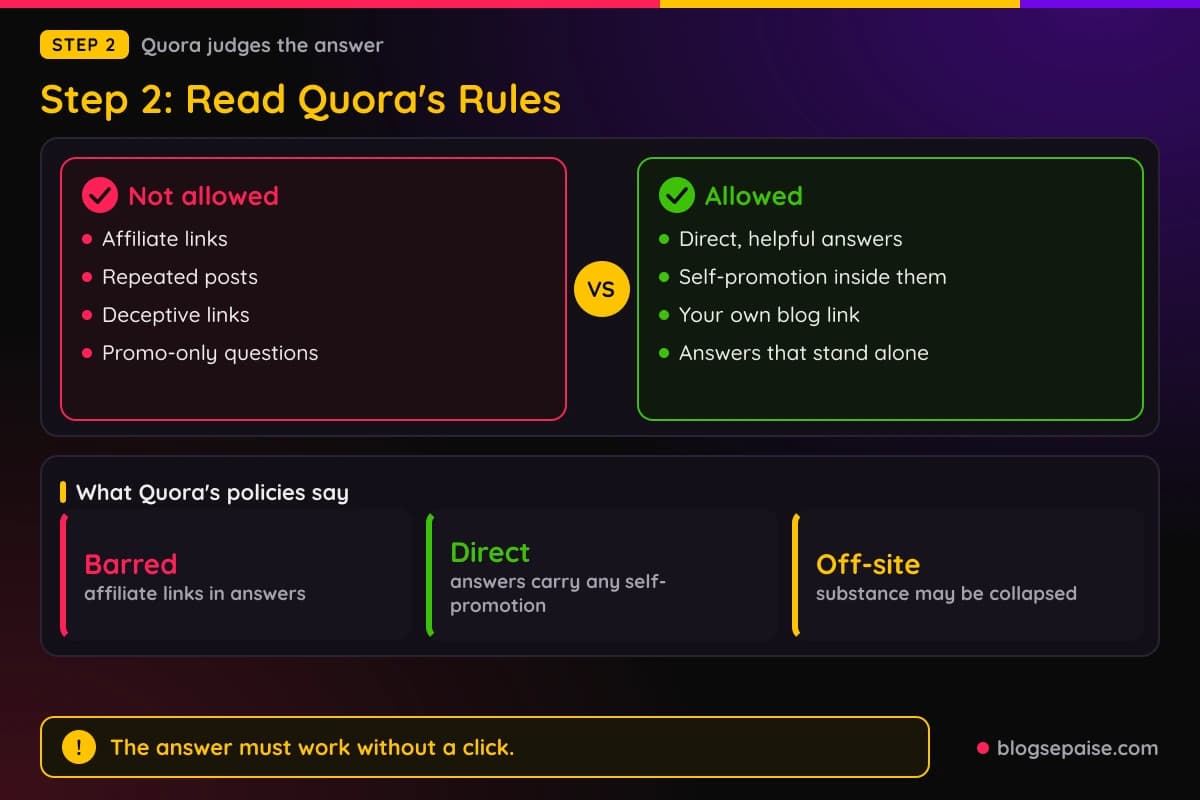
Now the rule that answers your question. Quora's Question and Answer Policies say affiliate links are not allowed.
The same page deals with self-promotion. It must be part of a direct and helpful answer to the question.
Self-promotional links that do not form part of that direct, helpful answer are not allowed. A bare link with one line of text fails the test.
Quora also wants answers to stand on their own. An answer whose substance sits off Quora and that looks promotional may be collapsed or removed.
So the answer must make sense without a click. Put the full tip, steps, or comparison in the answer, then offer your site for extra depth.
Some blogs quote a magic link percentage. No such number appears in the spam rules above, so do not plan around one.
Treat every affiliate link and tracked URL as covered by the ban. A discount code that earns you credit sits in a gray area, so keep it out of answers too.
Do not try to dodge the rule with a shortener or a redirect. Amazon bars hiding where the link goes, and Quora bars deceptive links, so the trick breaks both.
Do not link to a page that holds nothing but an affiliate link either. Send readers to a real article that helps them.
Quora Spaces have their own policy page. It says Quora mostly moderates at the content level, but repeated or serious violations may lead to removal of the whole Space.
Space admins may also set stricter rules for their own Spaces. Read each Space's rules before you post, because the admin's rule can be tighter than Quora's.
Posting a question only to promote your business is on the spam list. Do not ask a question just to answer it with your link.
Quora can update its rules at any time. Read the Help Center pages again every few months.
Step 3: Learn How Moderation Works On Quora
Rules matter more when you know how they get enforced. On Quora, enforcement starts at the answer.
Quora's Question and Answer Policies say promotional answers can be collapsed or removed. Either way, your answer stops earning views.
Both outcomes cost you reach. A collapsed or removed answer cannot bring a reader to your blog.
Quora judges the substance of the answer. A short reply that is mostly a link looks like spam, while a full explanation with a source at the end looks like help.
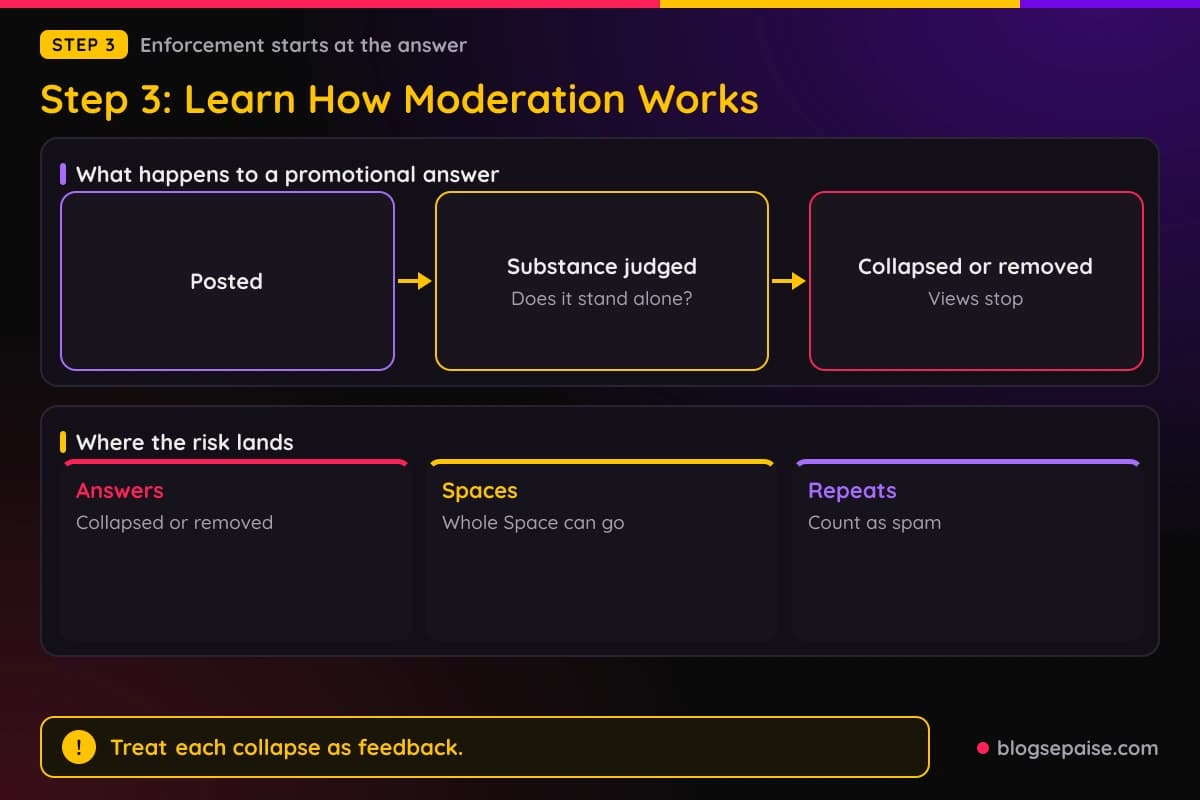
Spaces face enforcement too. Quora says repeated or serious violations may lead to removal of the entire Space.
That risk is bigger than one answer. A Space you spent months building could vanish.
Members can report content they think is spam. Write as if a stranger is checking every line.
No published formula tells you how many links are too many. You cannot count your way to safety.
Patterns draw attention. The same text posted again and again, links in every answer, and answers off topic all look like the spam behaviors Quora lists.
Write each answer for its question. Add your own experience, a detail that only a real user would know, and a clear opinion.
Keep a mix. If every answer you write links out, readers and moderators see a promotion account, not an expert.
Aim for most answers with no link at all. A profile full of helpful answers makes the few links you add look natural.
If an answer gets collapsed, do not repost it. Read the policy again, fix the cause, and edit the answer if Quora lets you.
Do not make a second account to repost the same thing. That only repeats the pattern Quora lists as spam.
Save a copy of every answer in a document. If Quora removes one, you still have your work to reuse.
That habit pays off in another way. A removed answer can become a blog section, and you keep the value.
Good answers can keep getting views long after you post them. That is why following the rules is worth the effort.
Treat moderation as feedback. Each collapse tells you where Quora draws the line, and the next answer should stay well inside it.
Step 4: Choose Between An Answer, Your Profile, A Space, And Your Blog
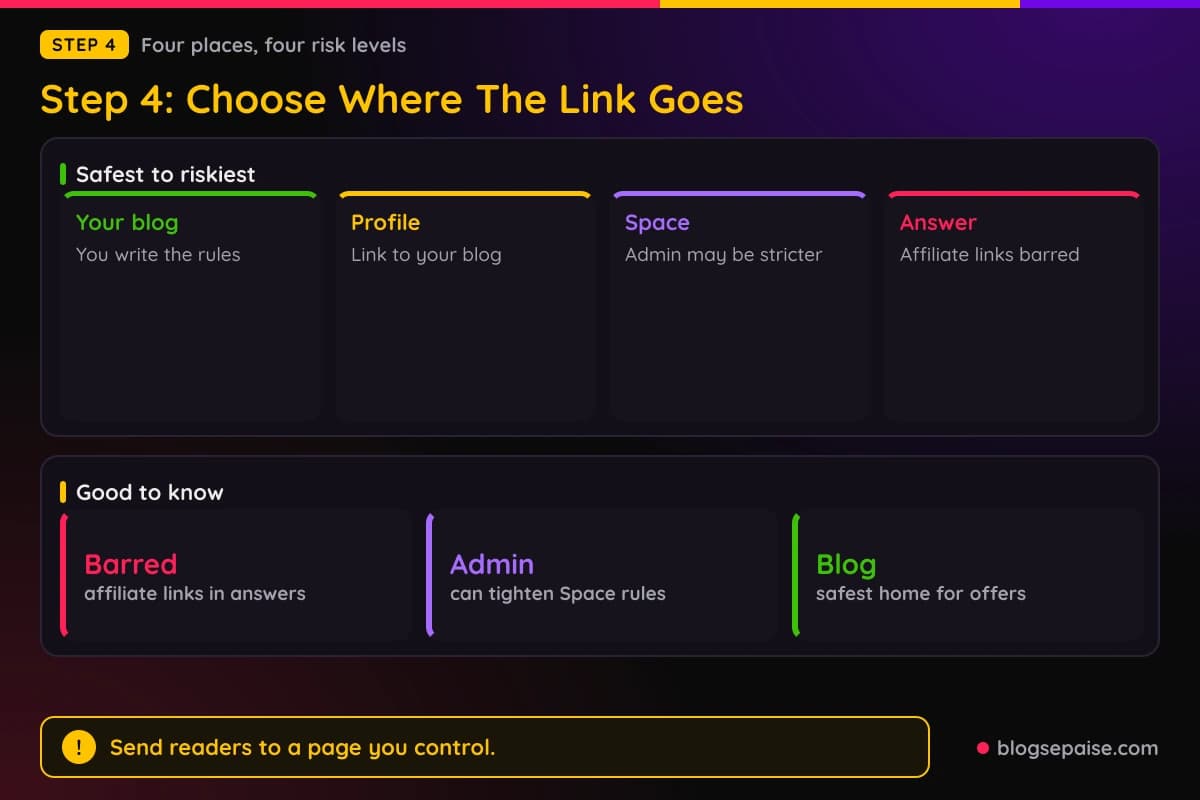
Now pick where the link goes. You have 4 options on or near Quora, and they carry very different risk.
Start with the answer itself. Quora's rule is clear, so a direct affiliate link in an answer is the riskiest option.
It breaks Quora's ban, and it may break the program's rule on displaying tagged links on a site that is not yours. Skip it.
A plain link to your own blog post is a different thing. Quora allows self-promotion that sits inside a direct and helpful answer.
Make the answer complete first. Then add one line such as "I wrote a longer guide with photos on my blog" and place the link after it.
That link goes to a page you control. On your page you can add the affiliate links, the disclosure, and the tracking.
Count the links, too. One link to a relevant guide is easier to defend than three links to three different pages.
Next comes your profile. Quora's policies say affiliate links are not allowed in answers, and nothing in them gives a clear green light for a bio.
So link to your blog in the bio, not to an affiliate offer. Keep the wording honest, such as "I write about home coffee gear."
Spaces are the third option. A Space is a group with its own page, and you can run one or post in someone else's.
Quora's Spaces Policies apply the spam rules there too. Admins may also make their own rules stricter, so in a Space you do not run, follow its admin.
In your own Space you set the rules. Write a clear rule about links and disclosure, and follow it yourself.
Still, treat your Space like a showcase for useful posts. Link to your blog guides, because nothing in Quora's policies gives Spaces a free pass on affiliate links.
Your own blog is the fourth option and the safest. You own it, you write the rules, and the program can list it as your Site.
A blog also solves the disclosure problem. You can place a clear note at the top of every page, right before the first link.
If you have no blog yet, start with one small site. Our guide to choosing a profitable niche helps you pick a topic you can answer questions about for a long time.
Match each answer to a page. A question about the best budget laptop for students sends readers to your laptop guide, not to your home page.
Keep the page worth the click. It should give more than the answer did, such as photos, a comparison, or a full test.
Do not count on Quora links to boost your rankings. The real gain is readers who click through.
Email is another route. A reader who clicks to your blog can join your list, and then you can share offers where the rules are yours.
Direct messages are risky. Amazon allows tagged links in direct messages only when the person opted in, and Quora bars sending the same message repeatedly.
So never message a stranger who asked a question with your affiliate link. Answer in public and let them come to you.
Here is the ranking from safest to riskiest. Your blog first, a profile link to your blog second, a Space link to your blog third, and a direct affiliate link in an answer last.
For a second view, read our chapter on content seeding on Quora, Medium, and forums. It covers how to write answers that build trust, and this guide adds the rules.
Step 5: Disclose Every Link The Right Way
Even a link to your own blog needs honesty. The FTC cares about how people learn that you earn money from a recommendation.
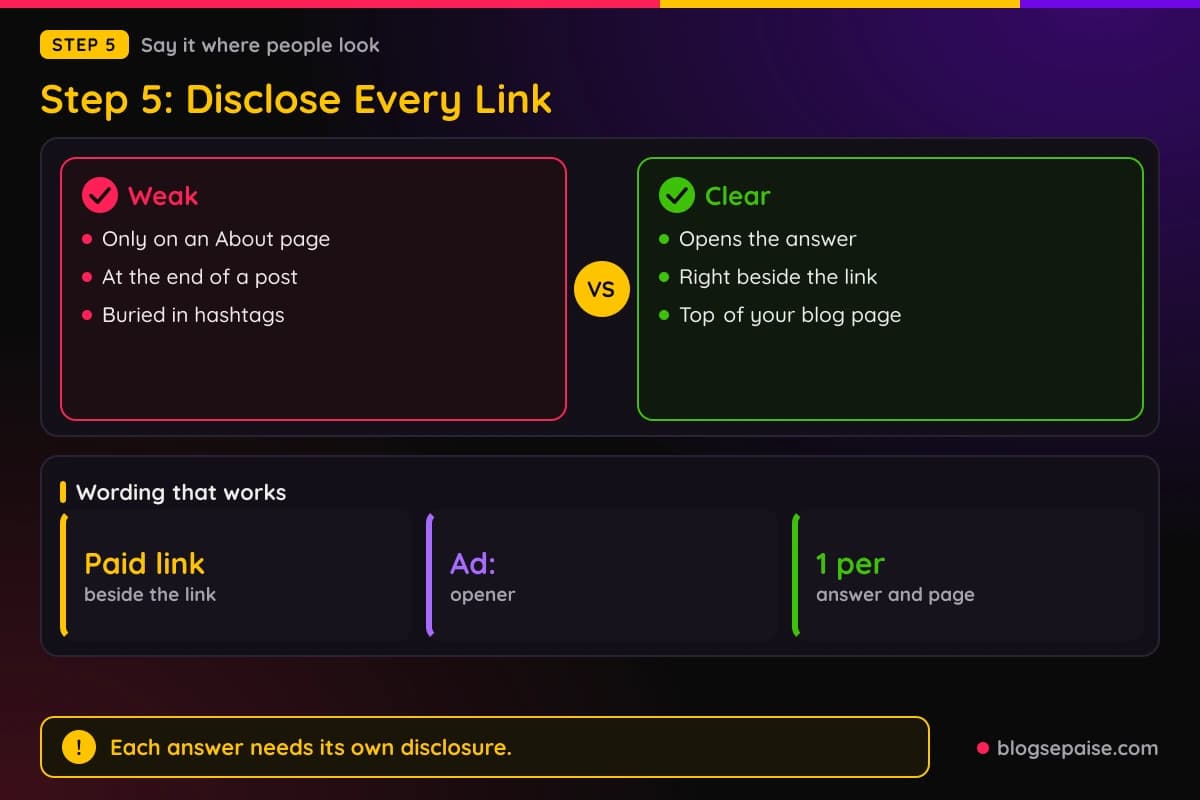
The FTC says people must see and understand a disclosure. It belongs with the endorsement, not on an About page, at the end of a post, or behind a MORE link.
The FTC also says to keep the disclosure out of a pile of hashtags or links. Put it where eyes land first.
For affiliate links, the FTC says the words paid link right next to the link should be an adequate disclosure. The words affiliate link alone may not be understood, and commissionable link is probably not clear.
On Quora, your answer links to your blog, not to an affiliate offer. If the answer recommends a product that you earn from, say so in the answer in plain words.
A line such as "I earn a commission if you buy through links on my blog" works. Place it near the mention of your site.
Each answer needs its own disclosure. The FTC says an influencer cannot assume followers will read more than one post and connect them.
Your blog needs the strongest disclosure of all. Put a clear note at the top of the page, before the first affiliate link, and repeat it beside links in the text.
Amazon adds its own wording. Its Operating Agreement requires the statement "As an Amazon Associate I earn from qualifying purchases" to appear clearly and prominently on your Site.
Use our guide to legal disclosures and the affiliate disclosure generator to build one clean line. Paste it on every page that has links.
Your bio should not hide anything either. If you earn from product reviews on your blog, a short line in your bio says so.
Do not claim experience you do not have. A fake story about owning a product turns an honest answer into a deceptive one.
Keep claims specific and honest. Say what you tested, what you liked, and what annoyed you.
The responsibility is yours. The FTC says the ultimate responsibility rests with the influencer and the brand.
Write in plain words. Short beats clever, and a teenager should get it at a glance.
Place the disclosure before the link, not after. A reader should see the words first and the link second.
Use the same wording every time. A habit keeps you from forgetting, and readers learn to spot it.
Edit old answers when you add a link later. Add the disclosure at the same time.
Step 6: Track What Your Quora Traffic Does
Tracking tells you which answers send readers and which ones waste your time. Without it you are guessing.
Your blog and your affiliate dashboard give the numbers that matter. Quora itself is only the starting point.
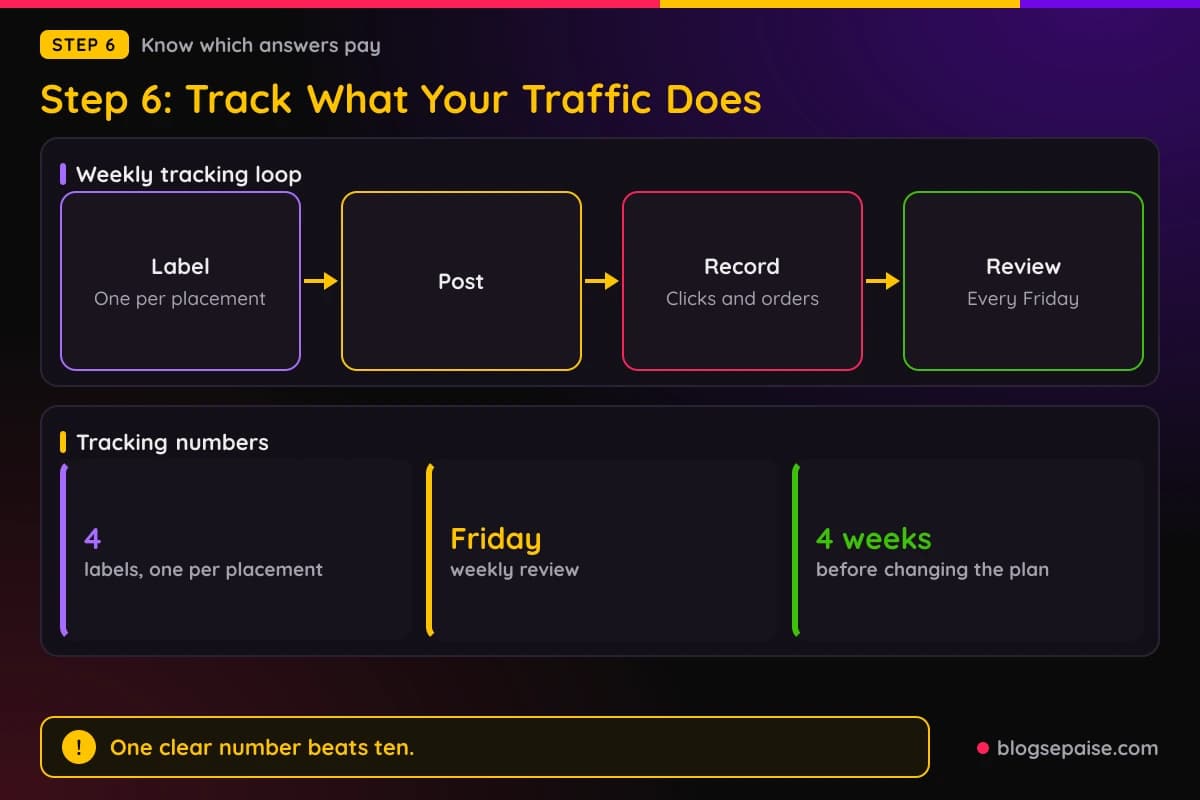
Give each placement its own label. Use one for answers, one for your profile, one for your Space, and one for your newsletter, for 4 labels in all.
Add a short tag to the link you place on Quora, such as utm_source=quora. Your analytics then shows how many visits came from Quora.
Inside your blog, give each article its own label on the affiliate links. That way the program report shows which guide earned the sale.
A link manager helps. Tools such as Pretty Links or ClickMagick count clicks on links you control.
Check the program's rules on shorteners and redirects before you use one. Amazon bars a shortener that makes it unclear you are linking to Amazon.
Record each answer in a simple sheet. Write the date, the question, the page you linked, clicks, orders, and commission in dollars.
Review the sheet every Friday. After 4 weeks you will see a pattern worth acting on.
Watch removals as well. Note any answer Quora collapsed or removed, and write down which rule it likely broke.
Compare clicks to orders. Lots of clicks and no orders may mean the question attracts casual readers, or that your page does not match the answer.
Pick one number to watch first, such as clicks per answer. One clear number is easier to act on than ten.
Update your plan every month. Drop topics that send nobody and write more on the ones that do.
Save a screenshot of each disclosure. If anyone asks, you can show what the answer and the page said.
Our page on link tracking software compares tools that count clicks. Pick one that fits your budget.
Step 7: Pick Safer Alternatives For Affiliate Links
If you still want affiliate links in front of people, other places are built for it. Choose platforms that publish a clear path for creators.
Your blog comes first. Everything else on this list can send readers to it.
An email list is second. Readers who join your list have asked to hear from you, which also fits the opt-in rule for messages.
Pinterest is a good third. Our guide to affiliate links on Pinterest covers its rules by pin type.
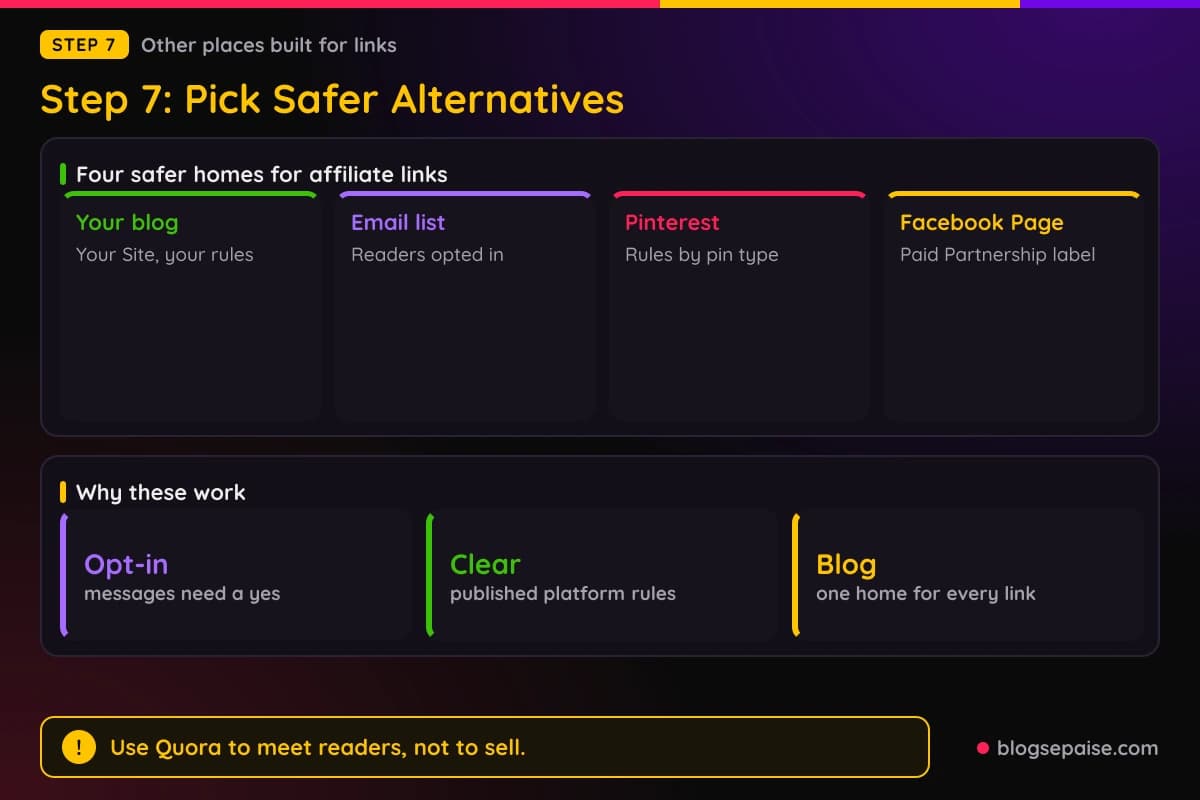
Facebook is another place. Our guide to affiliate links on Facebook shows where Meta and the programs draw the line.
YouTube works for people who like talking on camera. A video lets you show a product and say the disclosure out loud.
Pick platforms whose rules you can read. A clear policy lets you check each step instead of guessing.
Check each platform's rules on affiliate links before you post. The answer can differ a lot from one site to the next, as Quora shows.
Forums and communities set their own rules. Read the pinned rules and watch how moderators treat other members' links.
Do not abandon Quora just because affiliate links are out. Helpful answers still build your name and bring readers to your blog.
Treat Quora as a way to meet readers, not as a store. The sale happens on your page.
Use Quora to find questions for your blog. Questions people ask are ideas for articles that match search.
That is how this article began. Real questions on Quora asked if affiliate codes are allowed and where to post links.
Once you write the article, answer the question on Quora and link to it. You earned the link by giving a real answer first.
Be patient. A slow, honest start beats a fast ban.
Whichever platform you choose, run the same 7 steps. Check the program, the platform, and moderation, then pick the placement, disclose, track, and keep a backup plan.
A Worked Example: Dev Answers Questions For Four Weeks
Here is a made-up example, with made-up numbers, that shows the steps in action. Dev runs a small home coffee blog and has an Amazon Associates account.
Dev reads Amazon's rules first and confirms the blog is listed as a Site. Then Dev reads Quora's policies and writes down 3 rules: no affiliate links in answers, no repeated text, and answers that stand alone.
Dev plans 4 routes: answers that link to a blog guide, a profile link to the blog, posts in a Space Dev runs, and direct affiliate links in 2 answers. A friend swore the direct links work, so Dev tests them once.
Each route gets its own tag. Every blog page opens with a plain note that Dev earns commission from links on the page.
Over 4 weeks Dev writes 12 full answers that link to blog guides, adds 1 profile link, posts 4 times in a Space, and tries the 2 direct affiliate links.
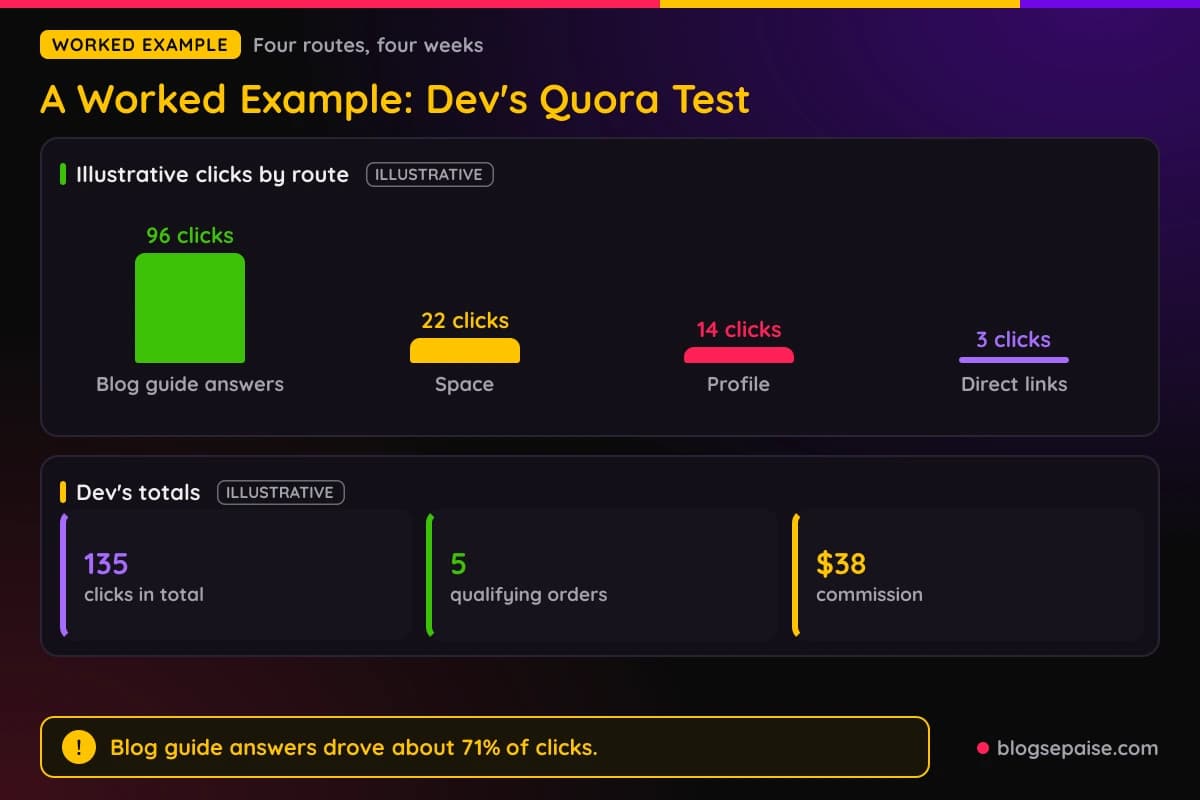
The 12 answers send 96 clicks to the blog. The Space posts send 22 clicks, the profile sends 14 clicks, and the 2 direct links send 3 clicks.
Both direct-link answers get collapsed within the first week. Dev reads the policy again and never repeats the move.
The routes add up to 135 clicks. The blog guide answers deliver about 71% of them.
The tracked results come to 5 qualifying orders and $38 in commission. All of them came through the blog guides.
Dev saves a copy of every answer. When the 2 collapsed answers drop out of view, Dev turns them into short sections on the blog.
Dev checks the sheet every Friday and writes one line about each answer. By week 3 the coffee grinder questions are clearly ahead, so Dev plans more of them.
Dev answers every comment by hand. Dev buys no ads, so the test costs time and nothing else.
After 4 weeks Dev drops the direct links for good and writes 12 more answers. The plan changes because the numbers showed what worked.
Nothing here is a promise of results. The numbers are invented, so run your own test and expect different clicks, orders, and dollars.
Common Mistakes When Using Affiliate Links On Quora
Posting a direct affiliate link in an answer is mistake number one. Quora's Question and Answer Policies say affiliate links are not allowed.
Writing a thin answer that is mostly a link is the second. Quora wants the answer to stand on its own.
Copying one answer into many questions is the third. Quora's rules treat repeated posting as spam.
Skipping the program rules comes next. Amazon wants your Sites identified and your tagged links on places you run.
Hiding the link behind a shortener or redirect is another. Amazon bars cloaking, and Quora bars deceptive links.
Buying ads for tagged Amazon links wastes money. Amazon pays no commission on purchases from ads you bought.
Messaging links to strangers breaks the opt-in rule. Amazon allows tagged links in direct messages only when the person opted in.
Forgetting disclosure on your blog is a quiet mistake. The FTC says the disclosure belongs with the endorsement, where people see it.
Asking questions only to answer them yourself is a trap. Quora lists posting questions to promote a business as spam.
Ignoring Space rules gets posts removed. Admins can set rules stricter than Quora's.
Chasing search value from Quora links is a weak plan. Aim for readers who click, not a ranking boost.
Skipping tracking is the last one. Without labels you cannot tell which answers earn.
Final Thoughts
So, can you use affiliate links on Quora? Not in answers, because Quora's Question and Answer Policies say affiliate links are not allowed.
You can still use Quora well. Write full, helpful answers, link to your own blog when it adds value, and keep the affiliate links and disclosure on your site.
Start small. Write 1 honest answer this week, link to a guide you wrote, and track what happens.
Then grow from what works, and keep a safer backup plan ready. Programs and platforms change their rules, so read Quora's Help Center and your program's terms again every few months.
Frequently Asked Questions
1. Are affiliate links allowed on Quora?
Not in answers. Quora's Question and Answer Policies say affiliate links are not allowed.
2. Are affiliate codes in links allowed on Quora?
A link that carries your affiliate code is an affiliate link, so the ban covers it. Keep codes and tracked URLs out of answers.
3. Can I put an affiliate link in my Quora bio?
Nothing in Quora's policies gives a clear yes. Link to your own blog instead and keep the affiliate links there.
4. Can I use affiliate links in Quora Spaces?
Quora's Spaces Policies apply its spam rules, and admins can add stricter ones. Nothing in them gives Spaces a free pass for affiliate links.
5. Can I link to my own blog in a Quora answer?
Yes, when the link is part of a direct and helpful answer. The answer must still make sense without a click.
6. What are good places to post affiliate links?
Your own blog, your email list, and platforms with clear rules. See our guides to affiliate links on Pinterest and affiliate links on Facebook.
7. Does Amazon allow affiliate links on Quora?
Amazon's agreement lets you earn from your Site, including social media user-generated content, and it requires disclosure. Quora's ban still applies, and the strictest rule wins.
8. Will Quora ban me for affiliate links?
Quora's policies say affiliate links are not allowed and that promotional answers can be collapsed or removed. Repeated or serious violations can lead to removal of a whole Space.
9. Do I have to disclose that I earn a commission?
Yes. The FTC says to disclose clearly and conspicuously, and it calls paid link next to the link an adequate disclosure.
10. Can I run Quora ads to affiliate links?
Amazon pays no commission on purchases from ads you bought. Other programs set their own ad rules, so read them first.
11. Can I message affiliate links to people on Quora?
Only to people who asked. Amazon allows tagged links in direct messages when the person opted in, and Quora bars sending the same message repeatedly.
12. How often can I link to my blog on Quora?
Quora gives no number. Its policies bar excessive promotion of the same product or service and repeated posting, so mix linked answers with answers that have no link.
13. Does Quora still pay through its Partner Program?
Quora closed the English version of its Partner Program on September 1, 2022. It stayed active in other languages.
14. Do Quora links help SEO?
Do not count on it. Treat Quora as a way to meet readers, and judge a link by the visitors it sends.