Using AI To Find Keyword Cannibalization
Keyword cannibalization is one of those SEO problems that hides in plain sight.
Your site might have twenty articles all fighting for the same keyword, and none of them ever quite makes it to the top.
You keep writing new content, hoping the next piece will finally break through, but instead you just add another page to the pile that is already competing with itself.
The frustrating part is that nothing about this looks broken from the outside.
Your traffic charts might even look fine at a glance, since the combined traffic across several competing pages can still add up to a decent number.
The real cost of this problem becomes clear only when you dig into which single page could have been ranking far higher on its own.
Finding this problem by hand is slow and easy to miss. A site with a few dozen pages is manageable to check manually.
A site with a few hundred pages is a different story entirely.
Scanning huge amounts of content quickly and spotting patterns a person would take days to notice is exactly the kind of task AI tools are good at, which is why this specific job has become such a natural fit for AI assisted SEO work over the past couple of years.
Let's walk through what keyword cannibalization really looks like, why it hurts your rankings, and how to use AI tools to find it across your whole site.
We will also cover how to fix it once you find it, and how to keep it from creeping back in over time.
For a complete overview of how AI fits into every stage of search engine optimization, read our complete AI SEO guide. It covers how AI tools handle everything from keyword research to technical audits.
Disclosure: Some of the links I share might be affiliate links. If you click on one and make a purchase, I may earn a small commission as a thank you. But don’t worry, it won’t cost you anything extra. I only recommend stuff I genuinely believe in. Your support helps me keep creating awesome content. You can read my full affiliate disclosure in my disclaimer page.
If you want to save a lot of hours searching for high-paying affiliate programs, check out our exclusive list of 2500+ affiliate programs. You’ll find all the information about the programs inside the list. This list is perfect for affiliate bloggers and influencers.
What Keyword Cannibalization Really Means
Keyword cannibalization happens when two or more pages on your site are trying to rank for the same keyword or the same search intent.
Instead of one strong page competing against other websites, you end up with several of your own pages competing against each other.
Search engines are built to show the most relevant single page for a given search.
When your site has multiple pages that all seem relevant to the same query, the search engine has to pick one, and it often ends up splitting attention between them instead of putting full weight behind the best one.
Your ranking signals, like backlinks and clicks, get spread thin across several pages instead of stacking up on one strong page.
That kind of overlap is different from having several pages that cover a broad topic from different angles.
A site about home fitness might have one page about beginner workouts and another about advanced workouts, and those can coexist just fine since they serve different searches.
Cannibalization is specifically when two pages are chasing the exact same search intent, not just a related topic.
Understanding how your content fits together is essential for effective workflows. Our guide on what content clusters are explains how pillar pages and supporting articles work together to build topical authority.
Why Keyword Cannibalization Hurts Your Rankings
A lot of site owners do not realize cannibalization is happening because nothing about it looks like a technical problem.
There is no error message. Nothing is broken.
The pages just sit there, each one performing a little worse than it should, with no obvious alarm bell telling you anything is wrong at all.
When two pages compete for the same keyword, search engines sometimes swap which page ranks from one week to the next.
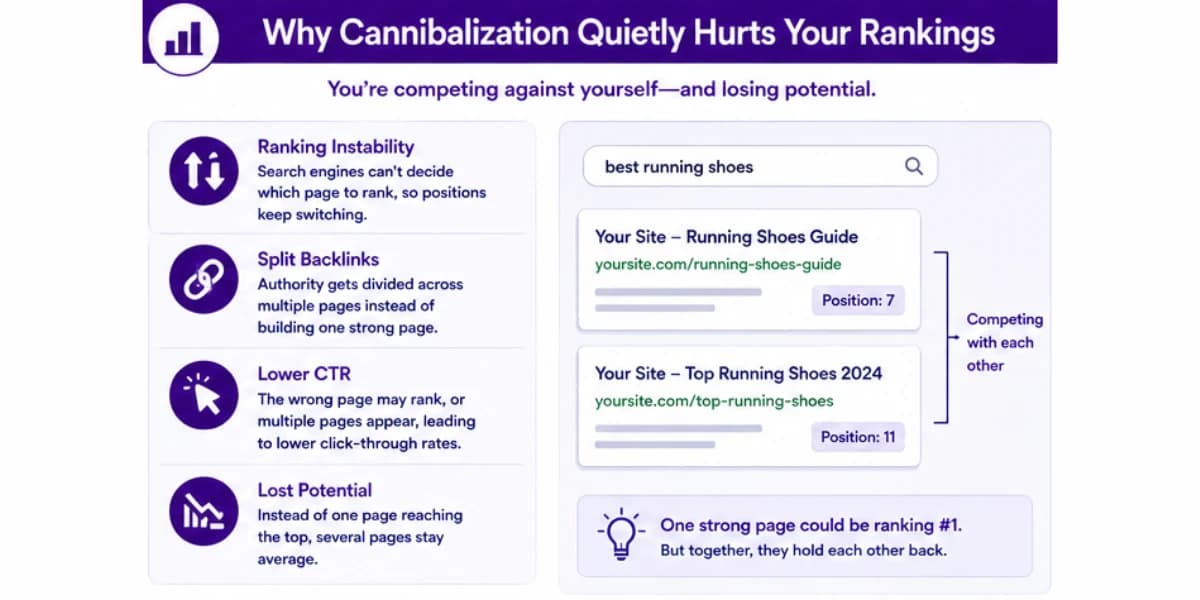
That kind of ranking instability is a common sign of cannibalization, since it suggests the search engine cannot decide which of your pages deserves the spot.
Backlinks get split too.
If other sites link to different pages on your site for the same topic, instead of all linking to one strong page, your overall authority for that keyword ends up divided instead of combined.
A page with fifteen backlinks usually outranks two pages with seven or eight backlinks each, even though the total link count is similar.
Click through rate also takes a hit.
If two of your pages show up close together in search results, or if the wrong page keeps showing up instead of your best one, readers get a less useful experience, and that shows up in lower engagement over time.
Learning how to do keyword research properly helps you understand the kind of structured data that reveals cannibalization patterns before they become a bigger problem.
How Keyword Cannibalization Happens In Real Life
Most cannibalization is not intentional. It builds up slowly, usually for a few common reasons worth knowing about.
Publishing new content without checking your existing site first is the biggest cause.
If you do not check what is already published before writing something new, it is easy to accidentally write a second version of a piece you already have, especially on a site with hundreds of articles built up over several years.
Keyword research done in isolation is another common cause.
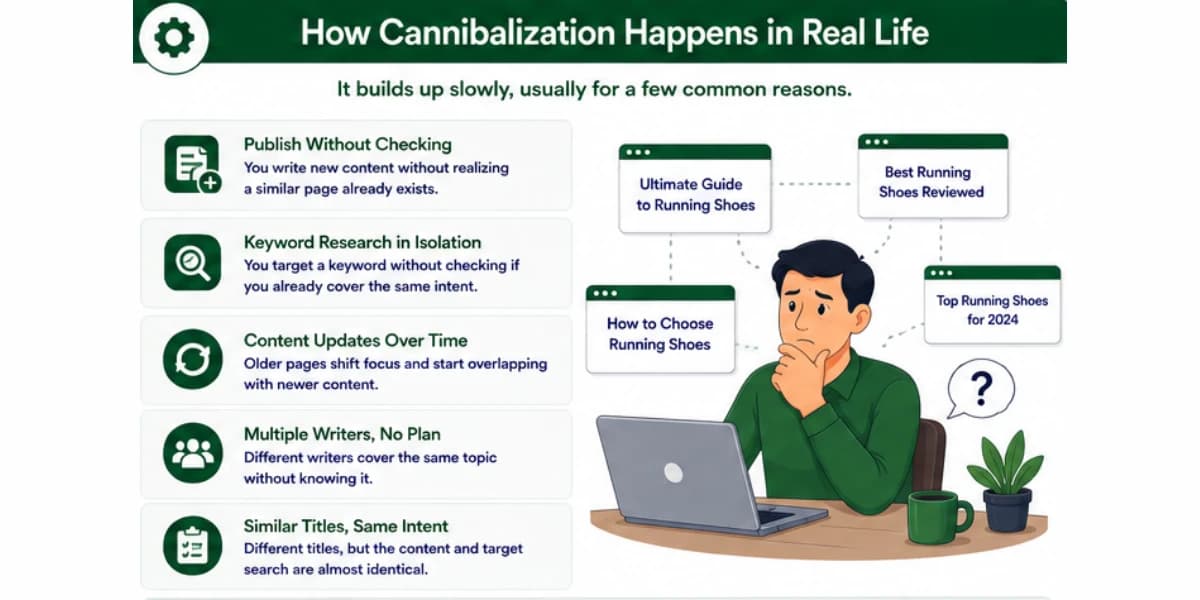
If you find a keyword idea and write content for it without checking if a similar keyword on your site already targets nearly the same intent, you end up creating overlap without meaning to.
Content updates over time can also cause this.
A page written two years ago might have shifted focus as you added new sections, and now it accidentally overlaps with a newer page that was written for a slightly different angle on the same topic.
Multiple writers or team members working without a shared content plan run into this constantly.
If nobody has a clear view of everything already published, different writers end up covering the same ground more than once.
Turning your keyword research into a consistent publishing schedule is easier when you have a solid plan. Our guide on how to create a content plan for affiliate marketing walks through exactly how to structure your workflow.
Why This Is Hard To Catch By Hand
Spotting cannibalization manually means comparing every page on your site against every other page, checking if they target similar keywords and similar search intent.
On a small site, this is doable in an afternoon. On a bigger site, it becomes close to impossible to do carefully.
The human brain is not great at holding hundreds of page topics in memory at once and comparing them all against each other.
You might remember that you wrote something about meal prepping for beginners, but you probably will not remember that a different article from a year ago also drifted into covering beginner meal prep in its middle section, even though its main topic was something else.
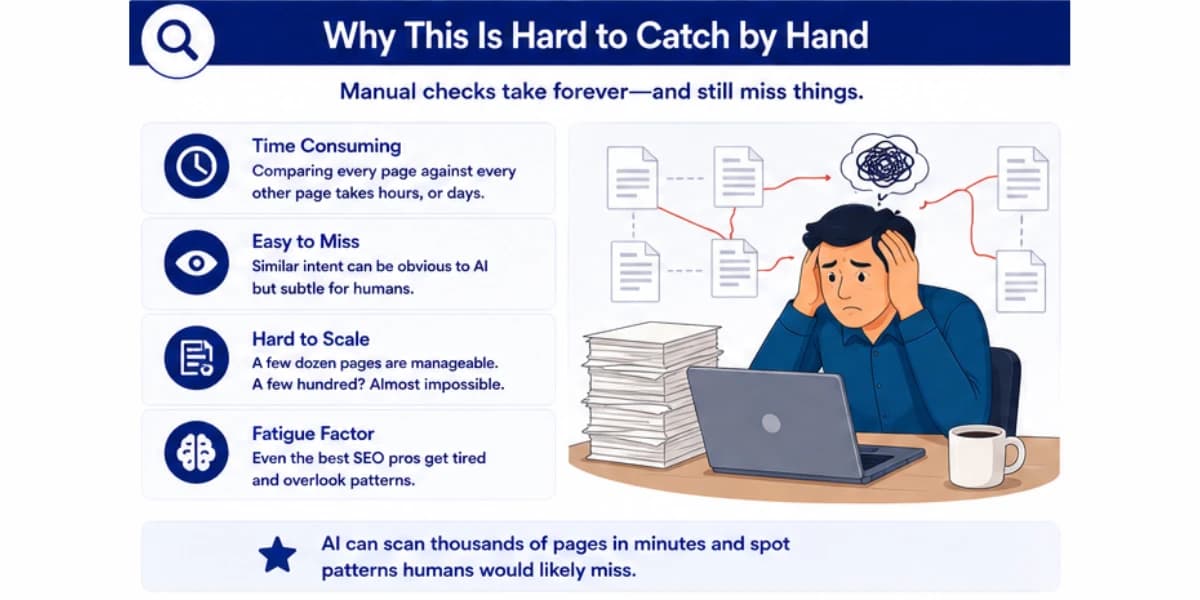
Cannibalization also hides in subtle overlaps. Two pages do not need to have the same title to compete for the same keyword.
One page titled best budget laptops and another titled top laptops under five hundred dollars can easily be fighting for nearly the same search results, even though the titles look different at first glance.
A person scrolling through a spreadsheet of page titles would likely never connect these two, since nothing about the wording signals they are really chasing the same reader with the same question in mind.
How AI Tools Help Find Cannibalization
AI is well suited to this specific task, since finding cannibalization mostly comes down to comparing large amounts of text and spotting overlapping meaning, which is something language based AI models are naturally good at.
AI can read through your full list of published pages and group them by topic and intent, flagging any pages that seem to be aiming at the same search the reader would type in.
It does this by looking past exact keyword matches and picking up on meaning, so it catches overlaps a simple keyword search would miss entirely.
AI can also process a much larger volume of content than a person can manually review in a reasonable amount of time.
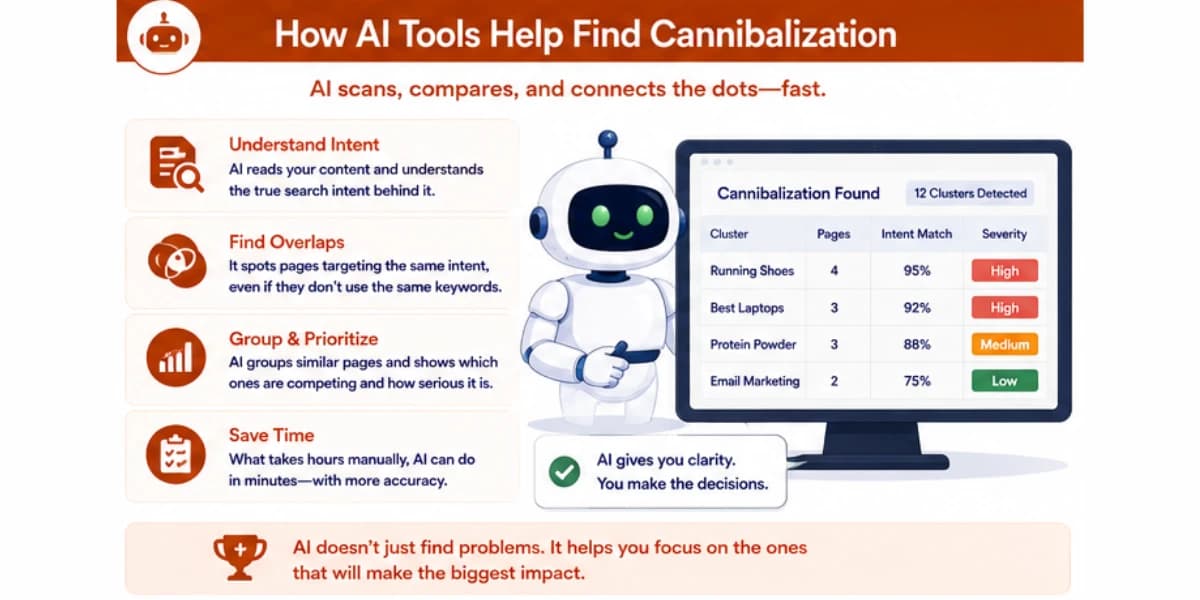
Feeding a list of two hundred page titles and summaries into an AI tool and asking it to flag likely overlaps takes minutes, while doing the same check by hand could take days.
AI is also useful for explaining why it thinks two pages overlap, not just flagging that they do.
A good prompt will ask the AI to state the shared keyword or search intent behind its suggestion, which helps you quickly judge if the flagged overlap is a real problem or just two pages that are loosely related but fine to keep separate.
Running a regular AI content audit helps you identify pages that may be competing with each other before the problem grows into a bigger issue.
Different Flavors Of Cannibalization Worth Knowing
Not every case of cannibalization looks the same, and knowing the different shapes it can take helps you spot it faster when you are reviewing AI flagged pairs.
Recognizing which type you are looking at also saves time later, since each type tends to call for a slightly different fix.
Exact Match Cannibalization
Exact match cannibalization is the easiest kind to spot. Two pages target the literal same keyword phrase, word for word, and cover it in nearly the same way.
A pattern like this often happens when a writer forgets a page already exists and writes a near duplicate months or years later.
Intent Match Cannibalization
Intent match cannibalization is trickier, since the pages might use different words but are still answering the same underlying question.
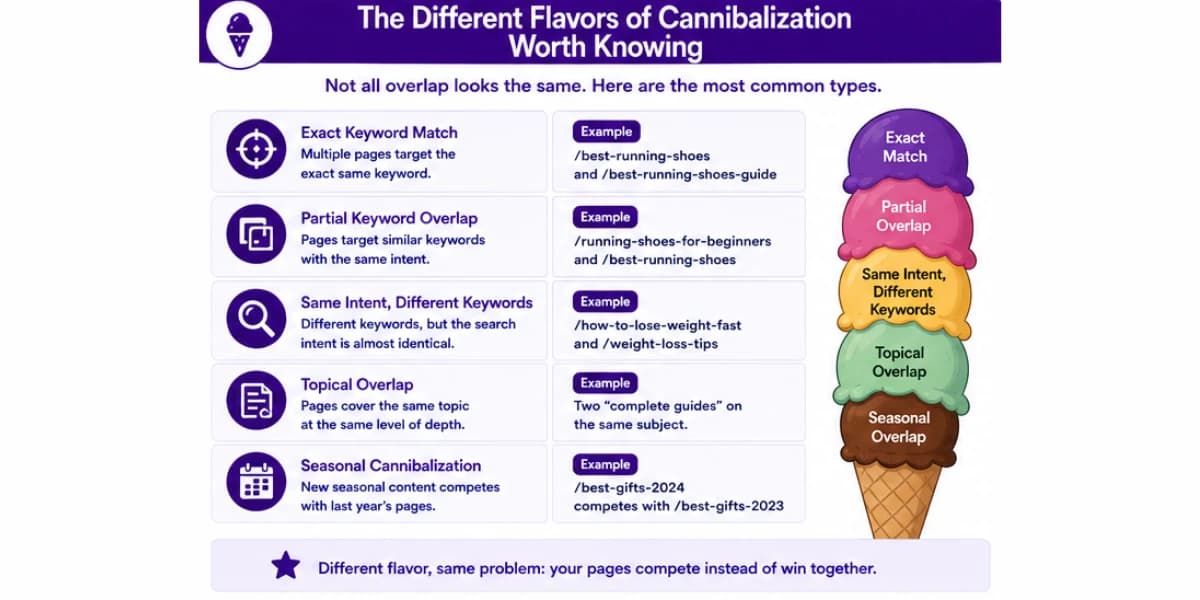
A page about how to lower a water bill and a page about saving money on utilities might phrase things differently, but a reader searching either term is often looking for the exact same kind of advice.
Partial Overlap Cannibalization
Partial overlap cannibalization happens when only part of one page competes with another.
A long guide covering ten subtopics might have one section that overlaps heavily with a separate, dedicated page on that single subtopic, even though the rest of the long guide covers different ground entirely.
Seasonal Or Updated Content Cannibalization
Seasonal or updated content cannibalization shows up when a site publishes a fresh version of an article each year, like a yearly roundup or a yearly buying guide, without properly redirecting or updating the older version.
Both the old and new versions stay live, quietly splitting rankings for a keyword that should really only need one strong, current page.
Knowing which flavor you are dealing with helps you pick the right fix faster.
Exact match cases usually call for a straightforward merge. Partial overlap cases might just need a trim of the overlapping section rather than a full merge.
Seasonal cases almost always call for a clean redirect from the old version to the new one.
Building topical authority in a niche depends heavily on keeping your content organized and non-overlapping, since search engines use clarity of structure to determine which pages deserve to rank.
Writing Prompts That Get Better Results From AI
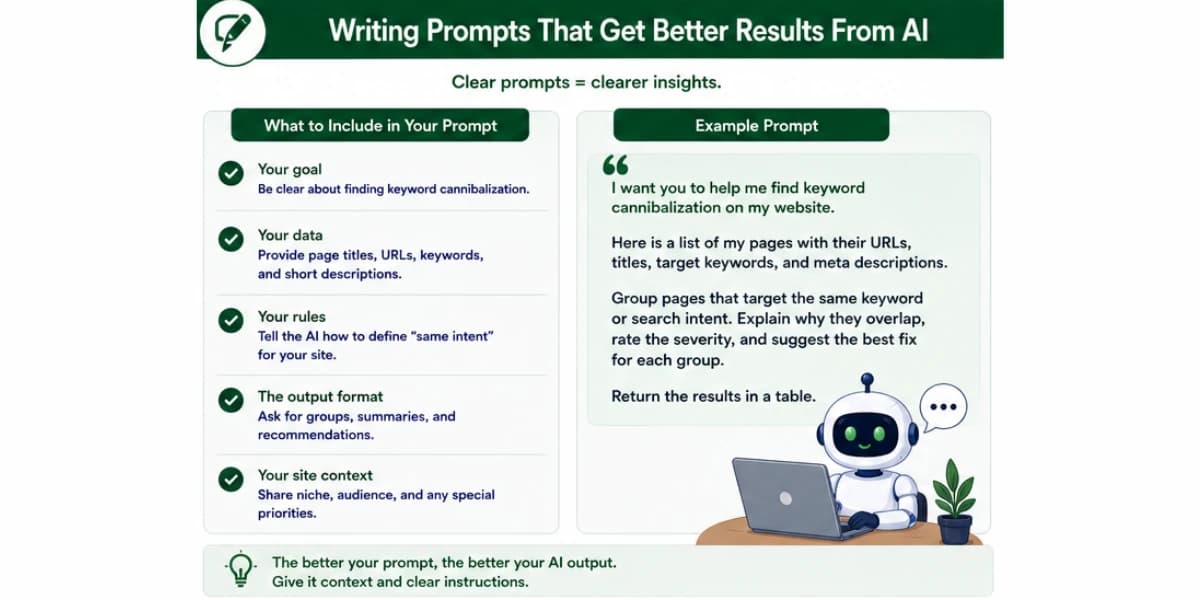
The quality of your cannibalization check depends heavily on how you prompt the AI tool doing the work, so it helps to know what makes a prompt effective for this specific task.
Give the AI real content, not just vague topic labels.
Instead of telling it these pages are both about marketing, paste in the actual titles and summaries so it can compare the real substance rather than guessing from a broad category name.
Vague input leads to vague, less useful flags.
Ask for the reasoning behind every flag, not just a yes or no answer.
A prompt that asks explain why you think these two pages overlap, including what specific keyword or question both seem to answer forces the AI to show its work, which makes it much easier for you to judge if the flag is worth acting on.
Break large sites into smaller batches rather than feeding in your entire site at once.
Comparing fifteen or twenty pages at a time tends to produce more careful, accurate results than asking an AI tool to compare hundreds of pages in a single pass, where it is more likely to miss subtle overlaps buried in a huge list.
Ask the AI to rate its confidence for each flagged pair, not just list them all with equal weight.
A prompt asking for a confidence level, like high, medium, or low, for each flagged overlap helps you prioritize checking the high confidence flags first, saving your limited review time for the cases most likely to be real problems.
Learning prompt engineering for SEO helps you write the kind of clear, specific instructions that give AI tools a much better starting point for their work.
Using AI To Find Keyword Cannibalization
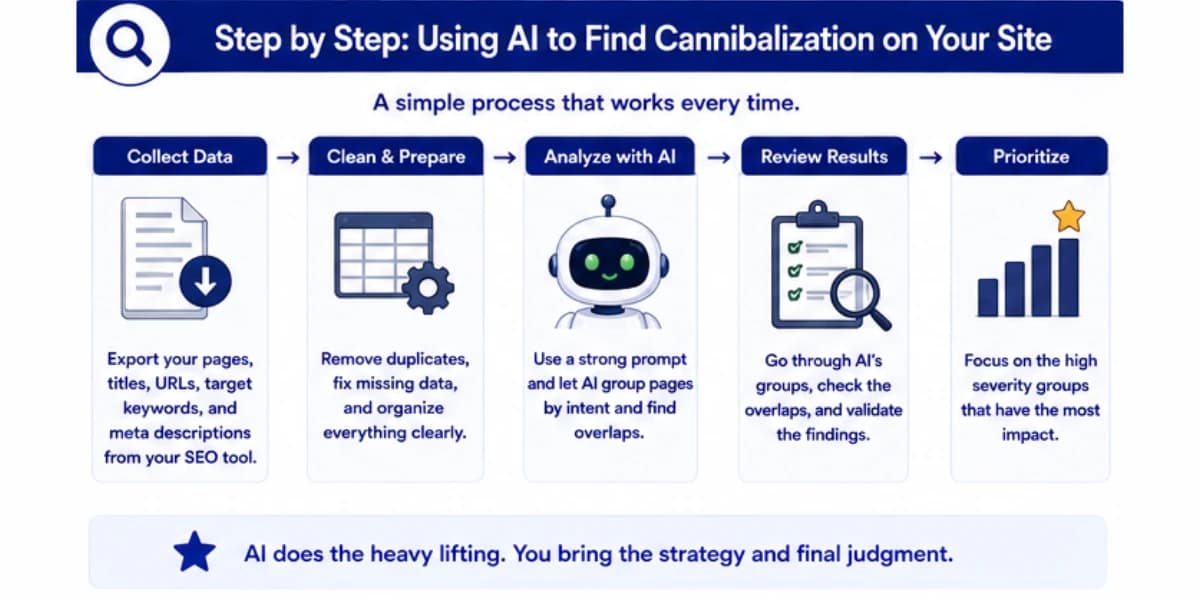
Here is a practical process you can follow, using AI tools at each step where they genuinely save time.
Step One: Build A Full Content Inventory
Before you can find overlaps, you need a complete list of everything published on your site.
Pull every URL, title, target keyword if you have one recorded, and a short summary of what each page really covers.
Spreadsheet tools or your site's content management system can usually export this fairly quickly.
If you do not have short summaries already written for each page, an AI tool can help generate these quickly by reading the content and producing a one or two sentence summary for each page.
That step matters a lot, since the quality of your cannibalization check depends heavily on how clearly each page's real topic is captured in this list.
Step Two: Group Pages By Broad Topic First
Before running a detailed cannibalization check, it helps to sort your pages into broad topic buckets.
A fitness site might sort pages into categories like nutrition, strength training, cardio, and recovery.
Sorting this way narrows down the comparison work, since pages in completely different buckets are unlikely to be competing for the same keyword anyway.
An AI tool can help with this sorting step too, especially on a large site, by reading through your list of titles and summaries and suggesting logical groupings based on shared themes.
Step Three: Run A Detailed Overlap Check Within Each Group
Once your pages are grouped, feed each group into an AI tool and ask it to identify any pages within that group that appear to target the same keyword or the same search intent.
Ask it to explain its reasoning for each flagged pair, including what specific keyword or question both pages seem to be answering.
A good prompt for this step might look like this. Here is a list of ten articles from my site, each with a title and a short summary.
Look through this list and tell me which pairs of articles seem to be targeting the same keyword or the same search intent.
For each pair you flag, explain what shared keyword or question you think both articles are competing for.
Step Four: Confirm With Real Search Data
AI suggestions are a strong starting point, but it helps to confirm them against real ranking and search data before making any changes.
Check your search console data or a keyword tracking tool to see if the flagged pages are really ranking for the same or similar keywords in real search results.
That step catches any AI suggestions that looked like overlap on paper but are not really competing in practice.
Step Five: Decide How To Fix Each Confirmed Case
Once you have a confirmed list of cannibalizing pages, you need to decide the right fix for each case, since not every case gets solved the same way.
Our free blog topic cluster mapper and competitor gap finder tools can help you organize your content structure and spot where overlaps are most likely to occur.
Main Ways To Fix Keyword Cannibalization
Merging two pages into one is often the strongest fix when both pages are genuinely trying to answer the same question.
Combine the best content from both into a single, stronger page, then redirect the weaker page to the merged one so any existing links and rankings carry over instead of getting lost.
Differentiating the pages works well when both pages have some value but are currently too similar in focus.
You might narrow one page to cover beginners specifically while the other focuses on advanced readers, giving each page a clear, separate reason to exist instead of quietly competing with each other.
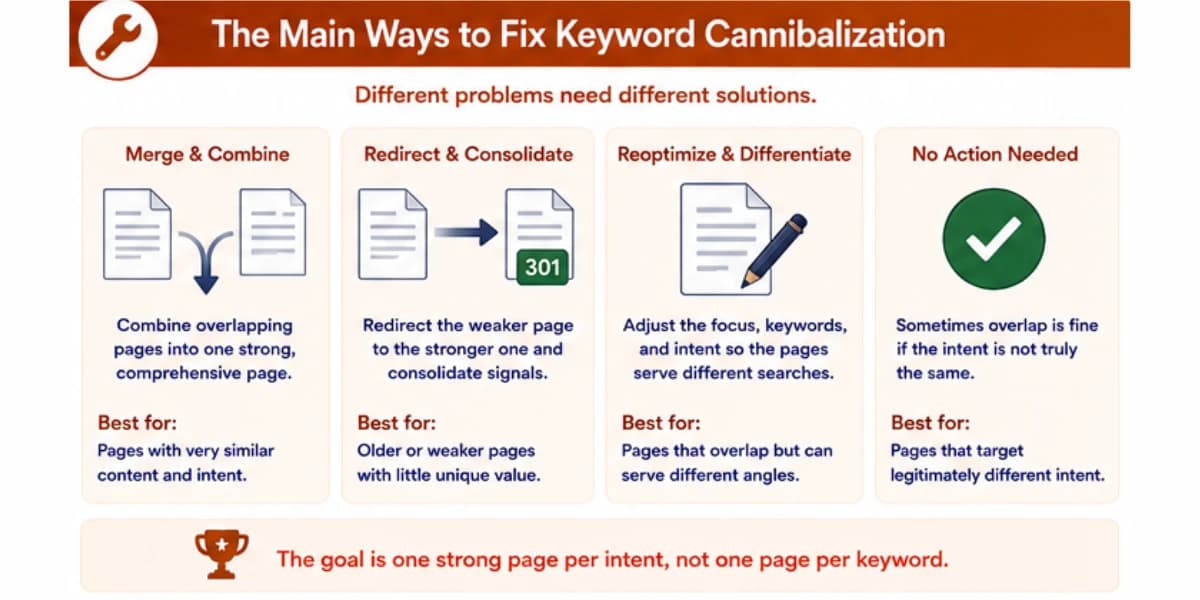
Choosing one page as the primary target and de-emphasizing the other is useful when one page is clearly stronger, with more backlinks or better rankings already, but a weaker duplicate page is still holding it back.
Update internal links across your site to point to the stronger page, and consider trimming or repurposing the weaker one so it stops competing for the same search.
Deleting or redirecting a page entirely makes sense when a page adds no real extra value beyond what a stronger page on your site already covers.
A clean redirect passes along any link value the weaker page had built up, so removing it does not waste the SEO value it already earned.
If you need help finding where to add links in your existing content, try our internal link opportunity finder tool. It scans your pages and highlights where new internal links would add the most value.
Using AI To Help Decide Which Fix Makes Sense
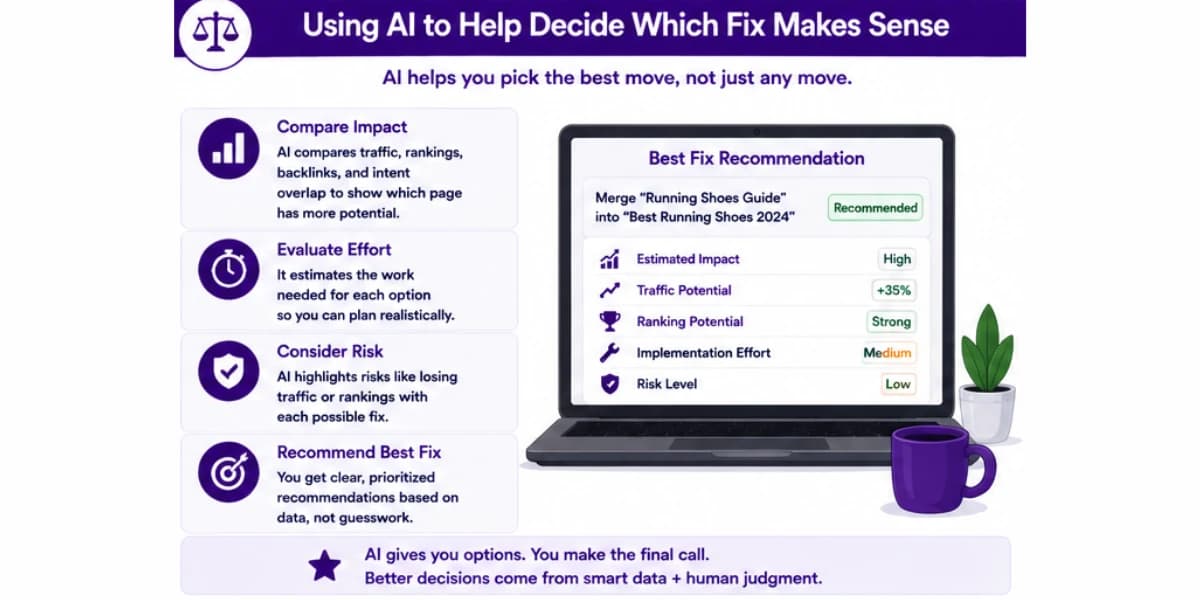
Deciding between merging, differentiating, or redirecting takes some judgment, but AI can help you think through the decision faster once you have gathered the real data.
Feed the AI tool the traffic, ranking position, and backlink count for both pages in a confirmed cannibalization pair, along with a short summary of what each page currently covers.
Ask it to suggest which page looks like the stronger candidate to keep as the main target, and if merging or differentiating seems like the better direction based on how much unique value each page currently offers.
A prompt like this tends to work well. Here are two pages from my site that appear to target the same keyword. Page one has this traffic, this ranking position, and this many backlinks.
Page two has this traffic, this ranking position, and this many backlinks.
Based on this data, which page should I keep as the main target, and should I merge these pages or narrow their focus to make them more distinct.
The AI's suggestion is a starting point, not a final answer.
You still know your business and your readers better than any AI tool does, so use its suggestion as one input into your decision rather than the whole decision itself.
Tools That Work Well Alongside AI For This Task
AI does the heavy lifting on comparing content and spotting overlaps, but a few other tools round out a full cannibalization workflow, and it helps to know how each one fits into the bigger picture rather than relying on AI alone for every part of the process.
Search console data is essential for confirming any AI flagged overlap.
It shows you the real keywords each page is really ranking for, along with impressions and clicks, giving you hard evidence instead of relying purely on an AI guess based on titles and summaries.
A site crawler tool helps build your initial content inventory quickly, pulling every published URL and title in one pass rather than manually copying links from your content management system one at a time.
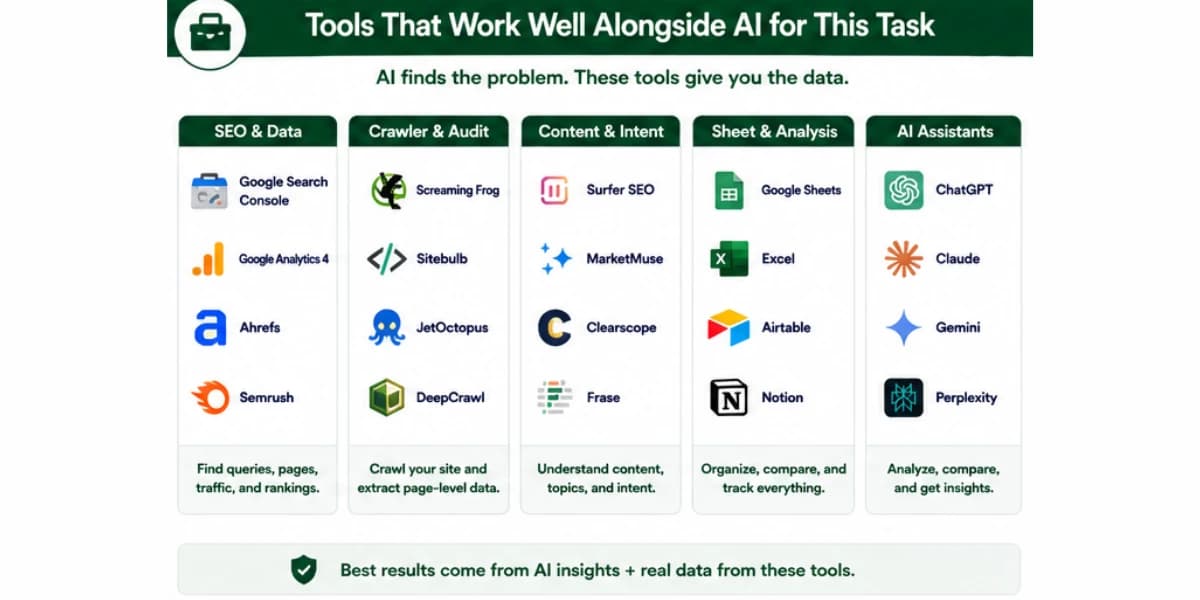
Most crawler tools can also export this list in a format that is easy to feed into an AI tool for the next step.
A keyword tracking tool that shows historical ranking data over time is useful for spotting the kind of ranking instability that often signals cannibalization, where a keyword bounces between two different pages on your site from week to week instead of settling on one clear winner.
A simple spreadsheet remains among the most useful tools in this whole process, even with AI involved.
Keeping your content inventory, your AI flagged pairs, your confirmation data, and your fix decisions all in one organized sheet makes the whole project far easier to track and revisit later.
Tracking these engagement signals properly is where tools like Databox and other data analytics platforms become genuinely useful for understanding how your content is actually performing.
How To Measure If Your Fix Really Worked
After merging, differentiating, or redirecting a cannibalizing pair, it helps to have a clear way to check if the fix really improved things, rather than just assuming it worked and moving on.
Watch the ranking position for your target keyword over the following four to eight weeks.
A successful fix usually shows the remaining page settling into a more stable, and often higher, position than any of the individual pages managed before the fix.
Check total organic traffic for the keyword cluster as a whole, not just the single page you kept.
Since you likely reduced the number of pages competing for this keyword, comparing combined traffic before and after gives you a clearer picture than looking at just one page in isolation.
Look at backlink consolidation if you set up redirects properly.
The page you kept should show a growing backlink count over time as the links that used to point to the removed pages get counted toward the surviving page instead.
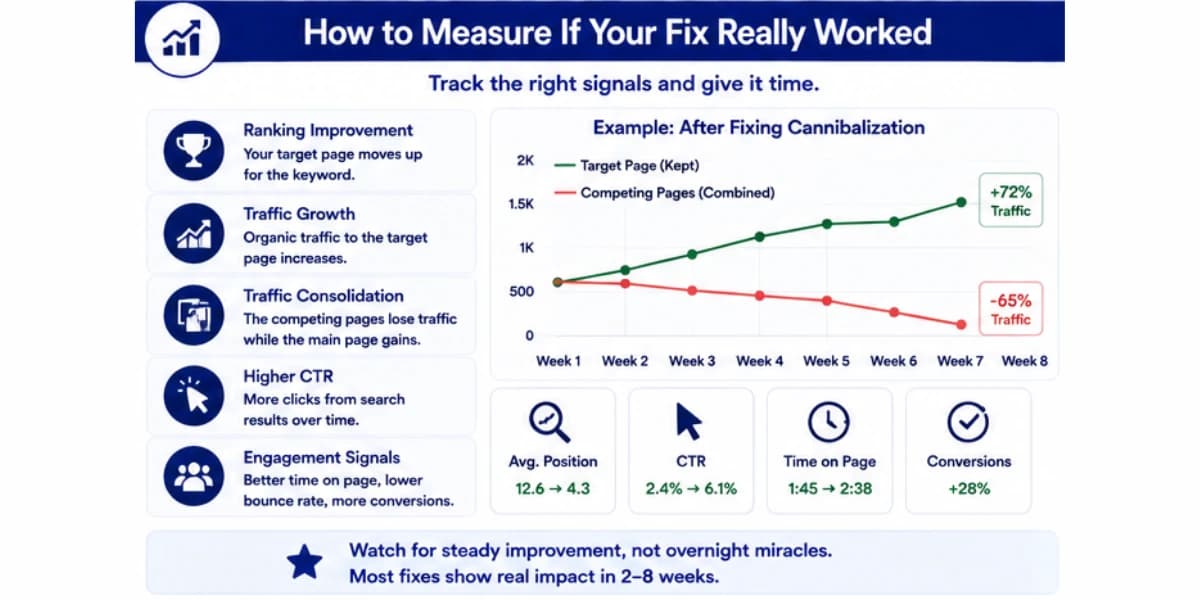
Keep an eye on bounce rate and time on page for the surviving article, especially if you merged content from multiple sources into it.
A well executed merge should read smoothly and keep readers engaged, not feel like several separate articles awkwardly stitched together.
If bounce rate goes up after a merge, it might be worth revisiting the merged page to check if it reads clearly and covers its topic in a logical order.
Give the fix real time before judging it a failure.
Just like with any content change, search engines need time to recrawl and reassess your pages, so checking results after only a few days rarely tells you anything reliable.
A month or two is a more realistic window for judging if a cannibalization fix really paid off.
When Cannibalization Is Really A Good Sign
It is worth mentioning one situation where finding overlapping pages is not really a problem at all.
If you run a large site and an AI check flags two pages as similar, but a closer look shows they are both genuinely strong, ranking for slightly different long tail variations of a broader keyword, you might not have a real cannibalization problem.
You might just have solid topical coverage that happens to look similar on the surface.
The real test is always the same.
Check if the two pages are truly competing for the same search intent, or if they are serving genuinely different searches that just happen to sit close together in topic.
Not every flagged pair needs a fix, and forcing a merge on two genuinely distinct pages can end up reducing your overall coverage of a topic rather than improving it.
Understanding the difference between informational and commercial content helps you decide which pages are genuinely distinct and which are really competing for the same reader.
Common Mistakes When Using AI For Cannibalization Checks
Trusting AI flagged overlaps without checking real data is a common mistake.
Two pages can look very similar in a summary but rank for slightly different keywords in practice, so skipping the confirmation step in real search data can lead you to merge or delete pages that were not really competing.
Running the check only once and never again is another common issue.
Cannibalization creeps back in over time as new content gets published, so a site that grows and adds new articles regularly benefits from running this kind of check every few months rather than treating it as a one time project.
Merging pages without redirecting the old URL properly can waste the SEO value those pages had already built up.
Always set up a proper redirect from the removed or merged page to the page you are keeping, so any backlinks and ranking history are not simply thrown away.
Ignoring internal links after a fix is another mistake that undoes a lot of the benefit.
Even after merging or choosing a primary page, old internal links across your site might still point to the page you demoted or removed.
Update these links so your whole site consistently points toward the page you really want to rank.
For a complete overview of how AI fits into every aspect of search engine optimization, including content audits, read our AI content audit guide to understand how to find what's underperforming on your site.
How Often Should You Run This Check
For a small site publishing content occasionally, checking for cannibalization once or twice a year is usually enough to catch problems before they build up too much.
For a larger site publishing content weekly or more often, a quarterly check tends to work better, since new overlaps can form faster on a site adding lots of new pages regularly.
It also helps to run a quick check any time you are about to publish something new on a topic you have covered before.
A fast prompt asking an AI tool to compare your new draft against a short list of existing related pages can catch an overlap before it even goes live, which is a lot easier than fixing it after the fact.
Using the right SEO plugins for your website can help you manage and monitor your content alongside other on-page optimization tasks.
Building Cannibalization Checks Into Your Regular Workflow
Rather than treating this as a one time cleanup project, it works best as an ongoing habit built into how you plan and publish content.
Before writing anything new, check your existing content inventory for anything that already covers a similar topic or keyword.
That single habit prevents most new cannibalization from happening in the first place, since it catches the overlap before you spend time writing a page that was never going to have a fair shot at ranking on its own.
Keep your content inventory updated as you publish, so it always reflects what is really live on your site.
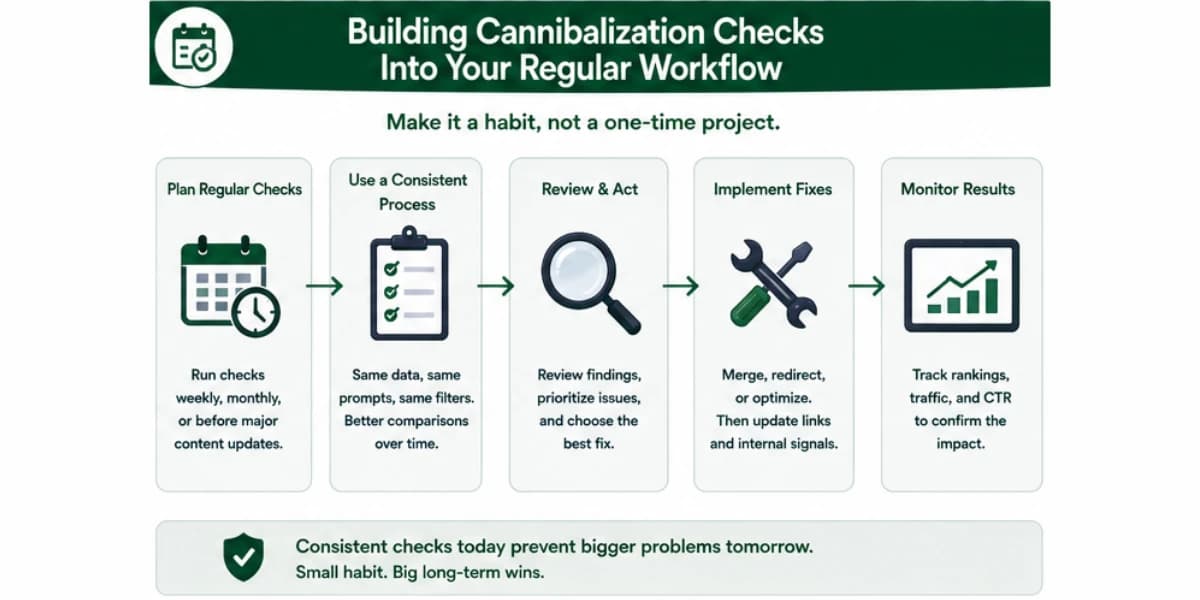
An outdated inventory makes every future check less accurate, since AI tools and any manual review both depend on that list being a true reflection of your site.
Set a recurring reminder to run a full site check every few months, treating it the same way you would treat any other regular maintenance task on your site.
Sites that build this into a routine tend to catch small overlaps early, before they grow into a bigger problem affecting several pages at once.
Building a topical map for AI SEO gives you the content structure that makes cannibalization checks much easier, since you already know which pages should support which others.
A Simple Example Of The Whole Process
Picture a site that covers personal finance topics.
Over three years, the site published one article about saving for retirement in your twenties, another about early retirement saving strategies, and a third about how much to save for retirement by age thirty.
All three articles were written at different times by different writers, and none of them realized how closely the other two overlapped.
Running an AI assisted cannibalization check flags all three articles as likely competing for a similar search intent, specifically around retirement saving advice for younger readers.
Checking real search data confirms it. All three pages show up ranking for overlapping keywords, with rankings shifting between them from month to month instead of settling on one clear winner.
The site owner reviews traffic and backlinks for all three pages.
One article, the one about saving for retirement in your twenties, has the most backlinks and the strongest existing traffic.
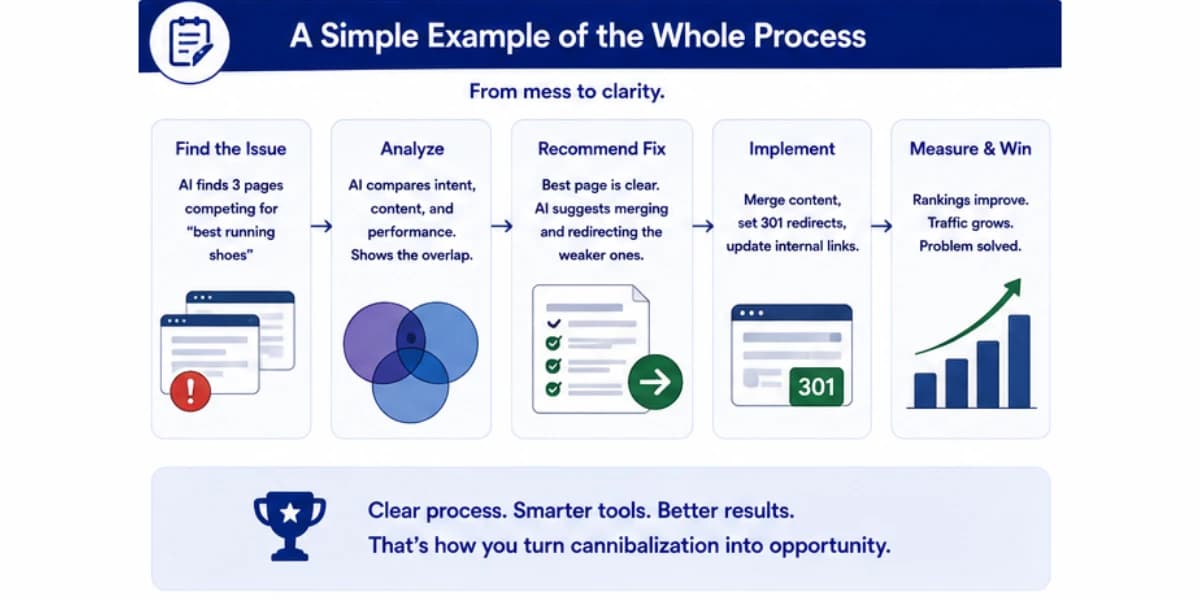
The other two get merged into it, pulling in their best sections and unique points, then both get redirected to the strongest page.
Internal links across the rest of the site get updated to point to the merged article instead of the two that were removed.
Within a couple of months, the merged page climbs several positions higher than any of the three separate articles had managed on their own.
The site now has one strong page carrying all the combined authority, instead of three weaker pages quietly working against each other.
The writers on the team also gain something less obvious but just as valuable, a clear, shared reference showing what topics are already covered, making this exact mistake far less likely to happen again on future articles.
Creating content that stays relevant for years requires a different approach than chasing trends. Our article on creating evergreen content explains how to write articles that continue driving traffic long after publication.
Final Thoughts
Keyword cannibalization is among the sneakier problems in SEO, since it does not show up as an obvious error and often builds up slowly over months or years of publishing.
AI tools make it a lot easier to catch, since they can scan large amounts of content quickly and spot overlapping intent that would take a person far longer to notice by hand.
Use AI to build your content inventory, group your pages, and flag likely overlaps, but always confirm with real search data before making any changes.
Decide on the right fix for each case, no matter if that means merging, differentiating, or redirecting, and build a regular habit of checking for new overlaps as your site keeps growing.
Done consistently, this kind of process helps every page on your site pull its own weight instead of quietly competing with pages you already own.
Start small if this feels like a big project to tackle all at once.
Pick your ten highest traffic pages, run them through an AI check, confirm any flags against your real search data, and fix whatever you find.
Once that feels manageable, expand the check to cover more of your site.
A little steady progress here tends to add up to a much stronger, more organized site over time, one that lets each page carry its own full share of ranking power instead of quietly splitting it with pages you never meant to compete with.
If you are exploring how AI agents fit into this picture, our guide on AI SEO agents explains where automated tools genuinely help and where they still need a human in the loop.
Frequently Asked Questions
1. Can two pages targeting a similar topic always be considered cannibalization?
No. Pages covering related topics from genuinely different angles can coexist just fine. Cannibalization specifically means two pages are competing for the same search intent, not just a broadly similar subject.
2. How do I know if AI has correctly flagged real cannibalization?
Always confirm with real search data before making changes. Check if the flagged pages really rank for the same or similar keywords in your search console or ranking tool, since an AI suggestion is a starting point, not a final confirmation on its own.
3. Should I always merge cannibalizing pages instead of keeping both?
Not always. Merging works well when both pages genuinely answer the same question. If both pages offer distinct value to different types of readers, narrowing their focus to make them more clearly different can be a better fix than merging them together.
4. Which problems show up if I ignore cannibalization on my site?
Your pages will likely keep competing against each other, splitting backlinks, traffic, and ranking signals that could otherwise be combined into one strong page. Over time, this tends to hold back your overall rankings for that topic compared to a site with one clear, strong page per keyword. The gap tends to widen the longer it goes unnoticed, since new content keeps getting published on top of an already crowded topic without anyone realizing the crowding is the actual problem.
5. Can new content accidentally create cannibalization even on a well organized site?
Yes. Cannibalization can creep back in anytime new content gets published without checking it against what already exists, which is why a regular recurring check matters even for sites that started out well organized.
6. Is keyword cannibalization the same as duplicate content?
No. Duplicate content means the same or very similar text appears in more than one place. Cannibalization can happen even when every page has completely unique writing, as long as they are all aiming at the same search intent. A site can have zero duplicate text anywhere and still suffer from heavy cannibalization, simply because too many uniquely written pages are all trying to answer the exact same question.
If you are producing informational content at scale, using the right AI writing tools can help you draft faster, but our Rytr review and ContentBot AI review show why a human editing pass still matters for the best results.