AI Hallucinations In SEO Content: How To Catch Them
An AI hallucination happens when an AI tool states something false with total confidence. No warning sign shows up. No hesitation in the tone.
The sentence reads just as smoothly as every accurate sentence around it. That is exactly what makes hallucinations so dangerous for anyone using AI to help produce SEO content.
The term itself sounds almost dramatic, but the actual problem is quiet and easy to miss.
A hallucination rarely announces itself. It sits inside an otherwise well written paragraph, surrounded by accurate information, looking exactly like every true statement around it.
For content creators, this is a real problem, not a minor annoyance. A hallucinated statistic in a blog post can mislead thousands of readers.
A wrong product spec in an affiliate review can cost you a sale and a reader's trust in one shot.
A fabricated legal or medical claim can cause real harm.
Let's take a look at why hallucinations happen, the specific patterns they tend to follow in SEO content, and practical ways to catch them before anything goes live.
For a complete overview of how AI fits into every stage of search engine optimization, read our complete AI SEO guide. It covers how AI tools handle everything from keyword research to technical audits.
Disclosure: Some of the links I share might be affiliate links. If you click on one and make a purchase, I may earn a small commission as a thank you. But don’t worry, it won’t cost you anything extra. I only recommend stuff I genuinely believe in. Your support helps me keep creating awesome content. You can read my full affiliate disclosure in my disclaimer page.
If you want to save a lot of hours searching for high-paying affiliate programs, check out our exclusive list of 2500+ affiliate programs. You’ll find all the information about the programs inside the list. This list is perfect for affiliate bloggers and influencers.
What Causes AI Hallucinations
It helps to know the basic mechanics behind hallucinations, since that knowledge shapes how you catch them.
AI language models do not actually look things up the way a person does when they are not using a live search tool.
They generate text by predicting what word is likely to come next, based on patterns learned from huge amounts of text during training.
Most of the time, this produces accurate, useful answers.
But sometimes the model produces a very confident, very fluent sentence that simply is not true, because the pattern felt statistically likely even though the actual fact behind it was wrong or never existed.
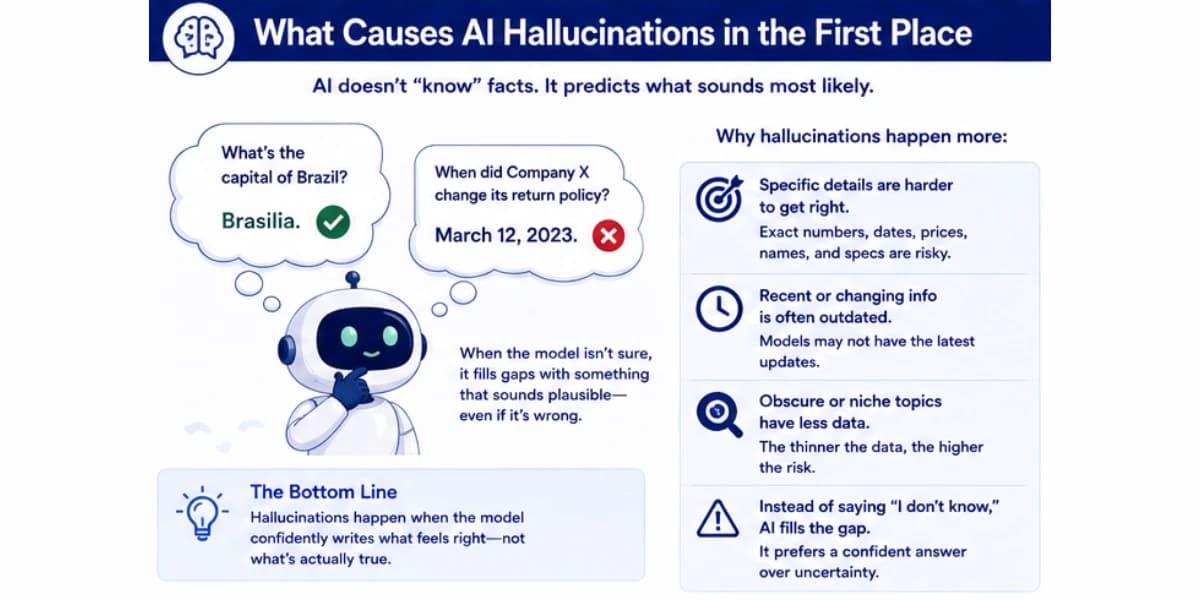
That pattern tends to happen more often with specific details than with general concepts.
An AI tool explaining what SEO means will rarely get that wrong, since that concept appears constantly and consistently across its training data.
An AI tool stating the exact current price of a specific product, or the exact date a company changed its return policy, is working with much thinner, more specific information, and that is exactly where hallucinations show up most.
Hallucinations also increase when a question pushes the AI toward information it genuinely does not have, especially anything recent, anything obscure, or anything requiring a very precise number.
Rather than saying it does not know, the model often fills the gap with something that sounds plausible, since sounding plausible is closer to what it was trained to produce than admitting uncertainty.
Why SEO Content Is Especially Vulnerable
SEO content has a few specific qualities that make it a prime target for hallucination problems, more so than some other types of AI generated writing.
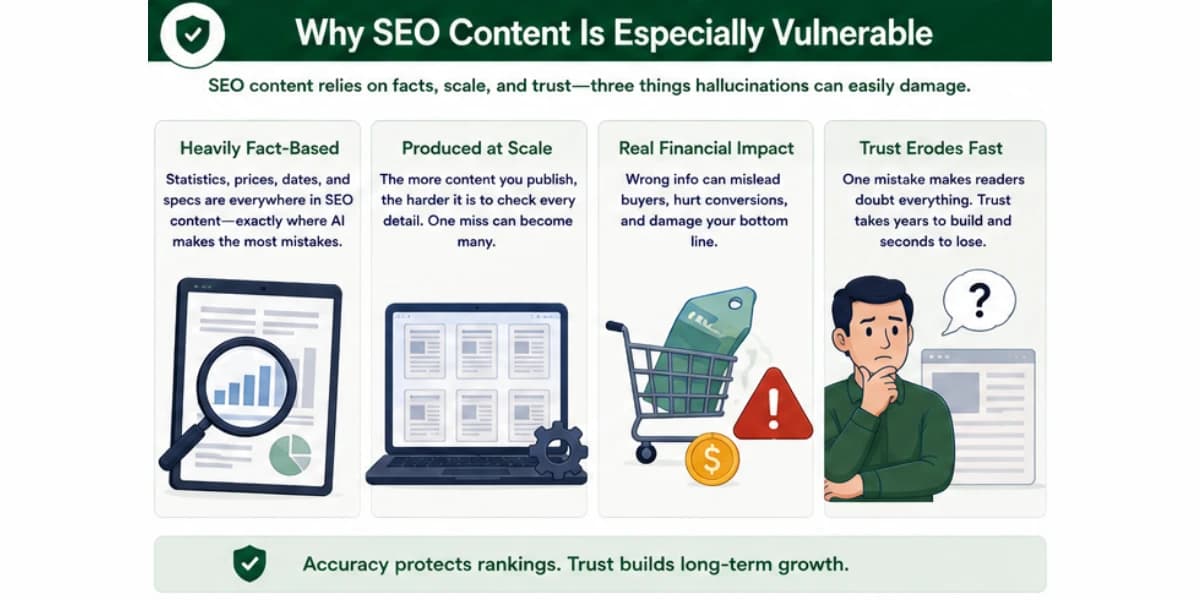
SEO content leans heavily on specific facts. Product comparisons, statistics, pricing, dates, and technical specifications show up constantly in the kind of content that ranks well.
Every one of these specific data points is exactly the kind of detail where AI hallucinations are most likely to appear.
SEO content often gets produced at scale.
When a site publishes dozens or hundreds of AI assisted articles quickly, the sheer volume makes careful, line by line fact checking harder to maintain consistently.
A single missed hallucination is bad. Dozens of missed hallucinations across a large content library is a real, compounding problem.
SEO content often covers commercial topics where accuracy has real financial consequences. A hallucinated feature on a product review can mislead a buyer directly.
A wrong statistic in a comparison article can shape a reader's decision in a way that costs them money or leads them to a worse choice than the one that actually fit their needs.
There is also a compounding trust issue specific to sites publishing regularly.
A reader who catches one factual mistake on a site often starts questioning everything else that site has ever published, not just the one article where the error appeared.
That pattern makes hallucinations especially costly for sites building a long term audience, since the damage rarely stays contained to a single page.
Running a regular AI content audit helps you identify pages that may contain hallucinated details before readers catch them first.
A Real Example Of A Hallucination Slipping Through
It helps to see this play out in a concrete example rather than just in theory.
Picture a site publishing a comparison article about wireless earbuds, using AI to help draft the piece quickly.
The draft states that a specific pair of earbuds offers ten hours of battery life on a single charge.
That number reads smoothly, sits right next to several other accurate specifications, and gets no special treatment in the text that would suggest anything is wrong with it.
The writer, reading through quickly before publishing, has no obvious reason to doubt it.
In reality, the actual product page lists eight hours of battery life, not ten.
The AI likely blended this detail from a similar product in the same brand's lineup, a newer model with genuinely longer battery life, and presented the wrong number as if it belonged to the product actually being reviewed.
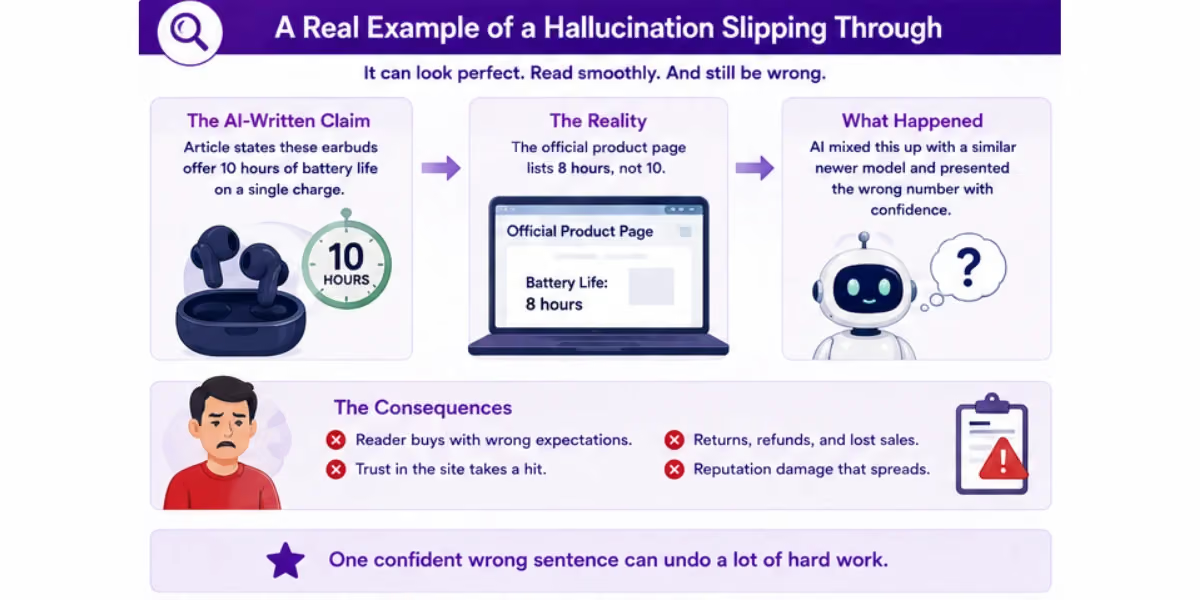
A reader who buys the earbuds based on that article, expecting ten hours of use, ends up genuinely disappointed when the real number turns out lower.
If enough readers notice the mismatch, some might leave a comment pointing out the error, or worse, simply stop trusting the site's other reviews without saying anything at all.
A single number, wrong by two full hours, quietly costs the site both a reader's trust and, over time, some of its credibility as an accurate source.
That same kind of error, a real but slightly wrong number blended from a similar product, ranks among the most common hallucination patterns in affiliate and review content specifically.
It rarely looks suspicious on a quick read, which is exactly why a dedicated fact checking step matters so much, and it is worth keeping this exact scenario in mind the next time a review draft comes back looking clean and complete.
This is exactly why our software reviews, like the GetResponse review, AWeber review, and ClickMagick review, are built around real hands-on testing rather than just spec sheets pulled from product pages.
Common Types Of Hallucinations Found In SEO Content
Knowing the specific patterns hallucinations tend to follow makes them much easier to catch during a review pass.
Fabricated Statistics
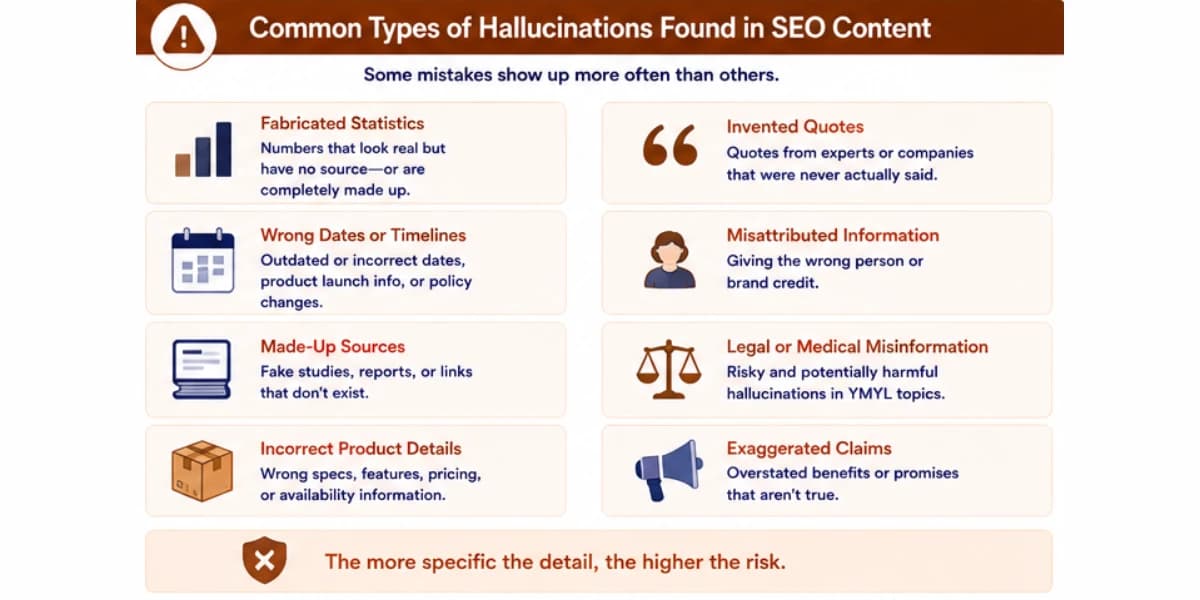
Fabricated statistics rank among the most common hallucination types in SEO content.
An AI tool might state a specific percentage, a survey result, or a research finding that sounds entirely plausible but does not actually exist anywhere.
The number often looks reasonable, sits within a believable range, and gets stated with total confidence, which makes it especially easy to miss during a quick read through.
Wrong Product Details
For affiliate and review content specifically, AI tools sometimes state incorrect pricing, wrong feature lists, or specifications that belong to a different model of the same product line.
That kind of mix up happens especially often with products that have several similar versions, since the AI can blend details from different versions into one confused, inaccurate description.
Made Up Sources & Citations
When asked to back up a claim, an AI tool might invent a study, a survey, or an expert quote that sounds completely credible but was never actually published anywhere.
Fake citations are particularly dangerous because they add a false layer of authority to content that a careless reader, or a careless writer, might trust without checking.
Incorrect Dates & Timelines
AI tools sometimes state the wrong date for when a company launched a product, changed a policy, or reached a milestone.
These errors often come from blending information about similar events or similar companies together into one incorrect timeline.
Wrong Attributions
An AI tool might attribute a quote, a statistic, or a specific claim to the wrong person or the wrong company entirely.
That kind of error can be especially embarrassing since it often involves a real person or a real brand being misquoted or misrepresented.
Confidently Outdated Information
Not every hallucination involves something completely invented. Sometimes the AI states information that was once true but has since changed, presenting it as current fact with no indication that anything might be outdated.
Pricing, features, and company policies are especially prone to this, since these details change often and the AI's underlying training data has a cutoff point.
Keeping time sensitive content fresh and accurate is where a solid AI content refresh workflow becomes genuinely valuable, since it helps you catch outdated details before they hurt your credibility.
A Practical System For Catching Hallucinations
Rather than trying to catch every hallucination through willpower and careful reading alone, it helps to build an actual system around this problem, since hallucinations are predictable enough to catch systematically.
Flag Every Specific Claim As It Gets Written
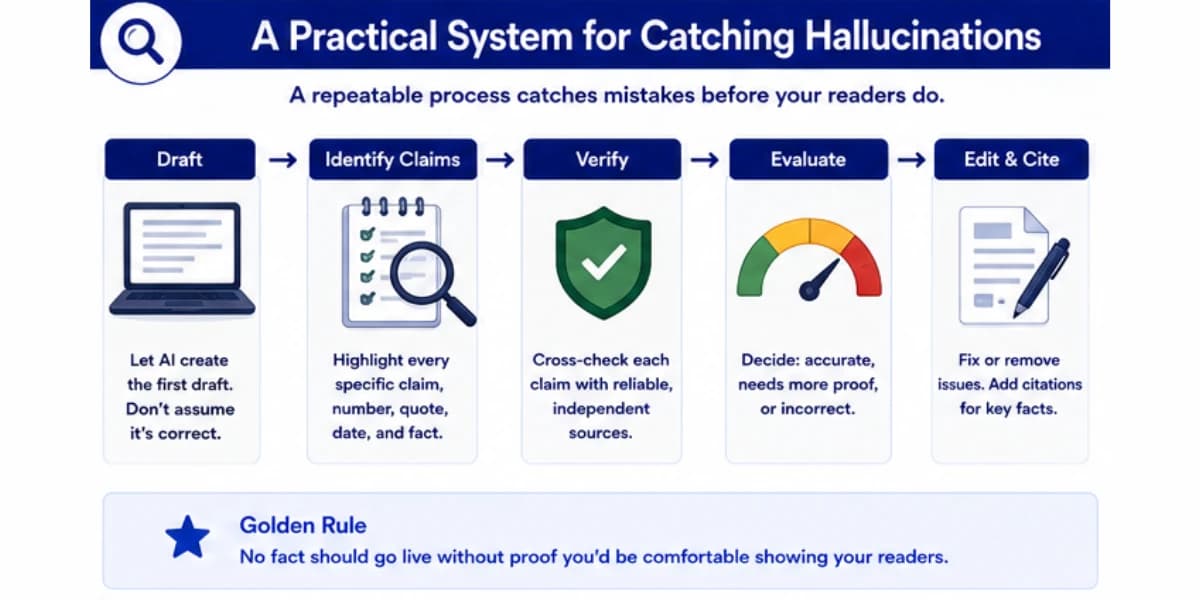
Before publishing, go through the draft and highlight every specific number, date, name, statistic, and factual claim.
Doing this alone forces you to notice exactly how many specific claims a piece actually contains, which is often more than people expect once they start counting.
Verify Each Flagged Claim Against A Real Source
For every flagged item, check it against a real, current, reliable source. That check does not need to take long for most claims.
A quick check of the actual product page, the actual company website, or a well known reference source usually confirms or corrects a claim within a minute or two.
Pay Extra Attention To Anything That Sounds Impressively Specific
A strange pattern shows up often with hallucinations.
The more oddly specific a number sounds, the more likely it is to be either completely accurate or completely made up, with very little middle ground.
A claim like 67% of users prefer this feature deserves a closer look precisely because that level of specific precision often signals either a real cited study or a confidently invented number.
Ask The AI Tool Directly How Confident It Is
Many AI tools will give a more honest answer if you specifically ask them to flag anything they are not fully certain about, rather than assuming every sentence carries equal confidence by default.
A prompt like go back through this draft and mark anything you are not fully sure is accurate often surfaces problems the AI would not have flagged on its own in the original draft.
Cross Check Any Cited Source
If the AI mentions a study, a survey, or a specific source, search for that source directly rather than trusting the citation at face value.
If you cannot find the source anywhere, or if the source exists but says something different from what the AI claimed, that is a clear sign of a hallucinated citation.
Use A Second AI Tool As A Cross Check
Running a suspicious claim through a second, different AI tool, ideally one with live web search enabled, can help confirm or catch an error the first tool introduced.
That approach is not a perfect method, since a second tool can hallucinate too, but it adds a useful extra layer of scrutiny, especially for claims that feel uncertain.
Learning prompt engineering for SEO helps you write the kind of clear, specific instructions that give AI tools a much better starting point for their work, which reduces hallucination risk from the very beginning.
Specific Checks For Common SEO Content Types
Different types of SEO content carry different hallucination risks, so it helps to know exactly what to check for depending on what you are producing.
For Product Reviews & Comparisons
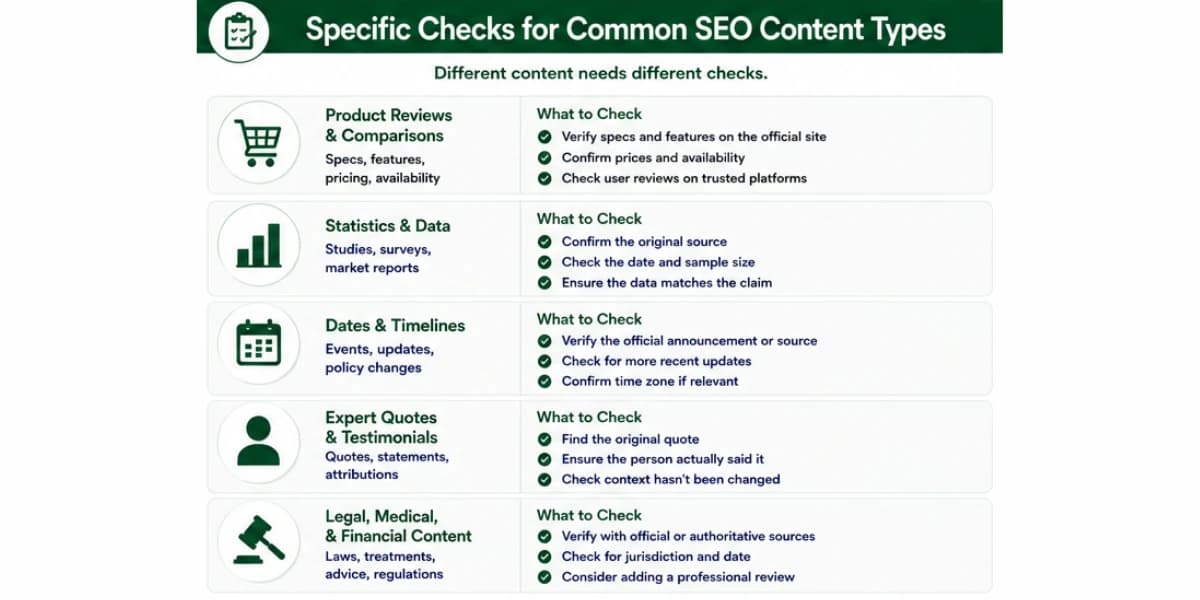
Check every price against the actual current listing on the retailer or brand's own site, not against what the AI states.
Check every feature claim against the official product page or manual.
Pay close attention to model numbers and version names, since AI tools often blend details from similar products in the same lineup.
For Statistical Or Data Heavy Content
Trace every statistic back to its original source rather than trusting a secondhand mention.
If the AI cannot point you to a specific, real, checkable source for a number, treat that number as unverified until you find one yourself or remove the claim entirely.
For How To Guides & Technical Content
Test the actual steps yourself whenever possible, especially for anything involving software, settings, or a specific process.
AI tools sometimes describe steps that sound logical but do not actually match the current version of a tool or platform, especially after a recent update changed the interface.
A guide that walks through outdated menu names or a button that has since moved will frustrate readers quickly and signal that the content was never actually tested against the real product.
For Local Or Business Specific Content
Verify addresses, phone numbers, hours, and any other business specific detail directly against the business's own website or a reliable local listing.
AI tools have no reliable way to know if a business relocated, closed, or changed its hours recently, so this category deserves special caution.
For Health, Legal, Or Financial Content
Treat every specific claim as needing professional verification before publishing, given how much harm a wrong claim could cause in these areas.
Dosages, legal deadlines, and financial figures all deserve the highest level of scrutiny, ideally reviewed by someone with real qualifications in that specific field.
Understanding how Google evaluates expertise and trust is essential here. Our guide on whether AI can write E-E-A-T content breaks down what Google actually checks when deciding which pages deserve to rank.
Why Hallucinations Feel So Convincing
It helps to understand why hallucinations are so easy to miss, since knowing this makes you naturally more careful during a review pass.
AI generated text carries the same tone of confidence no matter if the underlying claim is completely accurate or entirely made up.
There is no shift in phrasing, no hedge word, no subtle change in sentence structure that reliably signals uncertainty.
A hallucinated statistic reads exactly like a verified one, word for word similar in style and delivery.
That pattern happens because the model is not actually tracking, sentence by sentence, if each specific claim is grounded in something real.
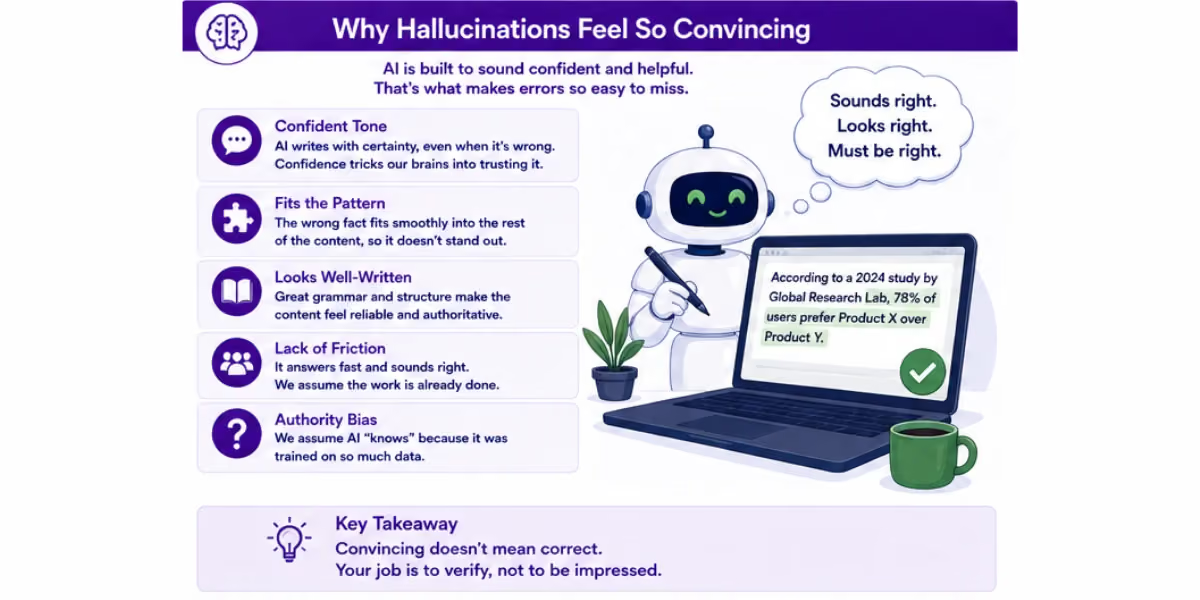
It is generating text that fits the pattern of confident, informative writing, and confident, informative writing is exactly what both accurate and hallucinated claims tend to look like on the surface.
There is no internal alarm bell going off inside the tool when it states something false, because the tool has no reliable internal sense of true versus false in the way a person does.
All of this is also why simply reading a piece of content carefully, without actively checking specific claims against outside sources, often fails to catch hallucinations.
A careful reader is checking for things like clarity, flow, grammar, and overall coherence, all of which a hallucinated sentence usually has in full.
The problem sits one level deeper than what careful reading alone can catch, which is exactly why a dedicated, separate fact checking step matters so much, rather than folding fact checking into a general editing pass and hoping it gets caught along the way.
Training Your Team To Spot Hallucinations Faster
If more than one person on your team works with AI generated content, building a shared sense of what to watch for makes the whole process faster and more consistent.
Share real examples of hallucinations your team has actually caught, rather than only discussing the concept in the abstract.
A specific, real example, like the earbuds battery life mix up described earlier, tends to stick in people's minds far better than a general warning to be careful with AI generated numbers.
Set a clear, simple rule that every specific number, date, name, or citation gets checked before publishing, with no exceptions made for time pressure or a tight deadline.
Exceptions made under pressure are exactly when hallucinations tend to slip through, since a rushed check is often no real check at all, and a rule with built in exceptions tends to erode quickly once the first deadline crunch arrives.
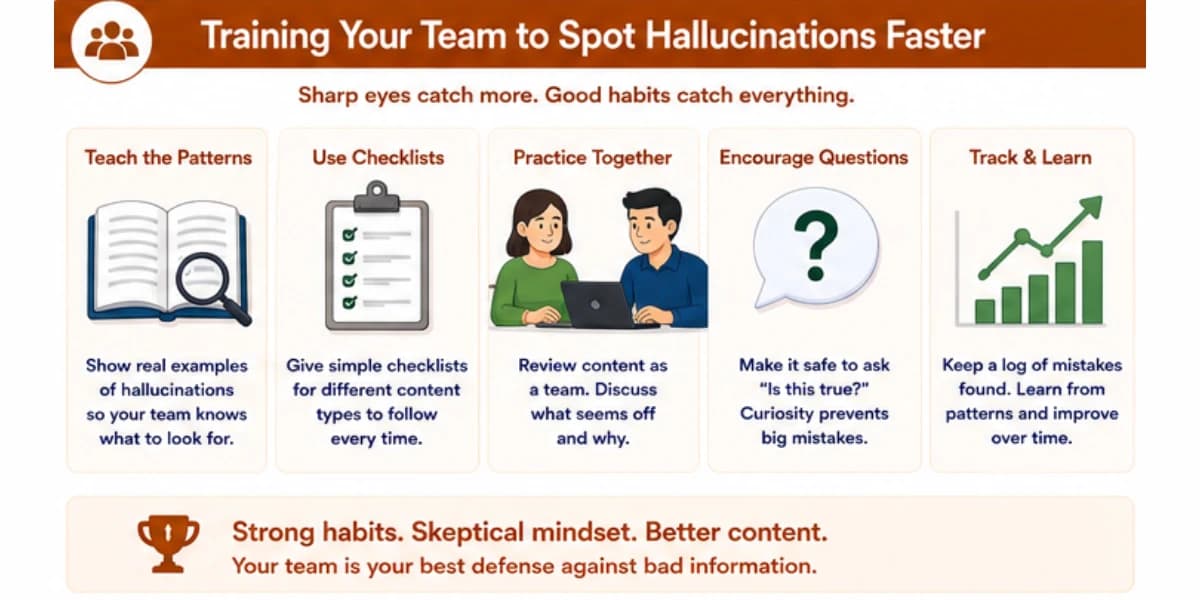
Rotate who does the fact checking pass on a given piece, rather than always having the same person check their own work.
A second set of eyes catches things the original writer, already familiar and comfortable with the draft, might read past without noticing, since familiarity with a piece tends to make small errors blend into the background rather than stand out.
Keep a simple, shared log of hallucinations your team has caught over time, noting what kind of claim it involved and how it got caught.
Patterns tend to emerge from this kind of log, showing you which specific content types or claim types deserve extra attention going forward based on your own team's actual experience, not just general advice from an article like this one.
Building Fact Checking Into Your Regular Workflow
Catching hallucinations works much better as a built in habit than as an occasional afterthought squeezed in when someone remembers.
Add a dedicated fact checking step to your actual content workflow, treated with the same seriousness as an editing pass rather than optional extra work.
Skipping this step to save time tends to cost far more time later, once a mistake gets caught by a reader instead of by your own process.
Keep a running list of sources you trust for your specific niche, so checking common claims does not require starting a fresh search every single time.
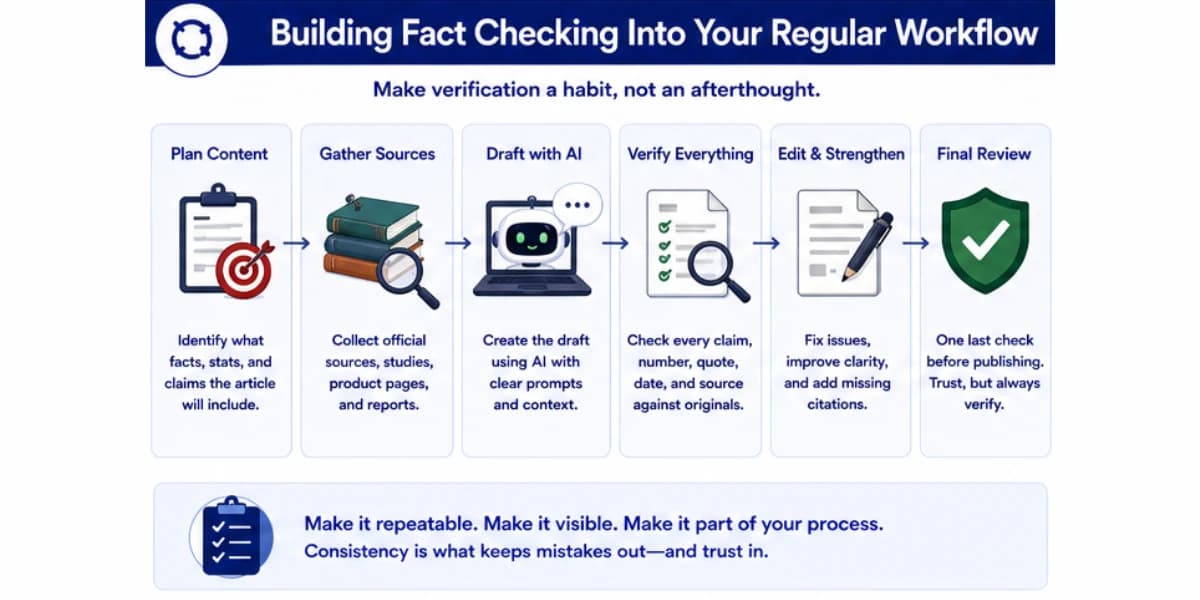
A short, well organized list of reliable references speeds up the whole process significantly once you have used it a few times.
Train anyone on your team who works with AI generated content to recognize the common hallucination patterns described earlier, especially oddly specific statistics and confident sounding citations.
Recognizing these patterns quickly makes the whole review process faster and more reliable over time.
Build a simple checklist specific to your content type, like product reviews, statistical content, or local business guides, so nothing important gets missed during a rushed review pass on a busy day.
Using the right SEO plugins for your website can help you manage and monitor your content alongside other on-page optimization tasks.
Why Hallucination Rates Differ Between AI Tools & Situations
Not every AI interaction carries the same hallucination risk, and knowing what raises or lowers that risk helps you know where to focus your review effort most carefully.
Tools with live web search access generally hallucinate less on current, checkable facts than tools relying purely on training data, since they can pull real, current information directly rather than generating an answer purely from learned patterns.
Even so, search enabled tools can still misread a source, blend two different pages together, or pull an outdated cached version of a page, so verification still matters even with search enabled.
Longer, more open ended prompts tend to produce more hallucination risk than short, tightly scoped ones, since a broader request gives the model more room to fill gaps with plausible sounding invention.
Asking for a narrow, specific piece of information tends to produce a more reliable answer than asking for a broad overview that touches on many specific facts at once, since a narrow question leaves far less room for the model to wander into unsupported territory.
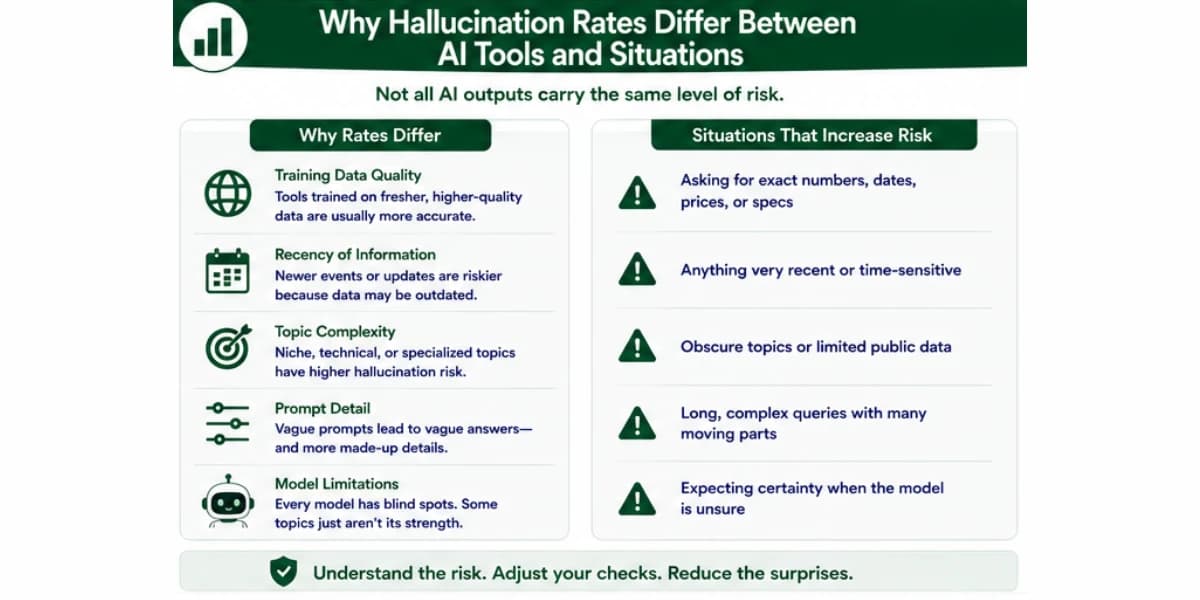
Topics with thin, sparse coverage across the training data tend to produce more hallucinations than well documented, widely discussed topics.
A well known, widely covered product or company gives the model much more reliable pattern data to draw from than a small, obscure brand with limited information available about it anywhere online, which is exactly why niche and small brand content deserves extra scrutiny during review.
Requests that push toward very recent information carry particularly high risk, since the model's core training data has a fixed cutoff point.
Anything asked about recent launches, recent policy changes, or current pricing deserves extra scrutiny specifically because this is exactly the kind of information the model is most likely to guess at rather than genuinely know.
If you are producing informational content at scale, using the right AI writing tools can help you draft faster, but our Rytr review and ContentBot AI review show why a human editing pass still matters for the best results.
Why It Is So Easy To Trust AI Output
A big part of the hallucination problem is not really about the AI at all.
It is about a very natural, very human tendency to trust confident, well written text, and it helps to name this tendency directly so you can guard against it more deliberately.
Fluent writing feels trustworthy to most readers, almost automatically.
A sentence with clean grammar, a natural rhythm, and a confident tone reads as more credible than a hesitant, poorly worded one, even when the actual content behind both sentences is equally uncertain.
AI tools are extremely good at fluent, confident writing, which means the normal signals people use to judge trustworthiness stop working reliably when the writer is a machine rather than a person.
Repetition also builds a false sense of confidence.
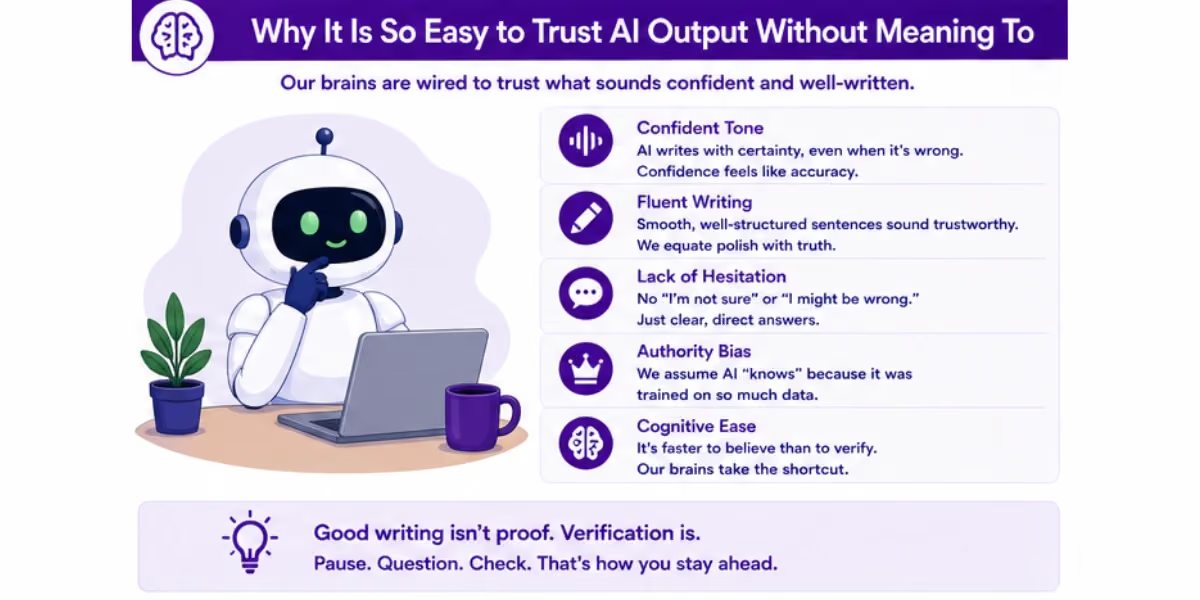
If you ask an AI tool the same question twice and get a similar answer both times, it is tempting to treat that consistency as proof of accuracy.
In reality, the model can produce the same hallucinated answer consistently, since it is drawing from the same underlying patterns each time, not actually rechecking a fact against reality.
Time pressure makes this worse.
When a deadline is close and a draft otherwise reads well, it is tempting to skip a careful fact check on the assumption that a tool this fluent probably got the small details right too.
That exact assumption is where most hallucinations that make it to publication actually slip through, not through carelessness exactly, but through a reasonable seeming shortcut that turns out to be unreliable.
Recognizing these tendencies in yourself is the first step toward building the kind of deliberate, systematic fact checking habit described throughout this article, rather than relying on a gut feeling about if a piece of AI generated content seems trustworthy on the surface.
Red Flags That Should Always Trigger A Closer Look
A handful of specific signals tend to show up right before a hallucination gets caught, and it helps to know what to watch for.
A claim with no clear source ever mentioned, stated as plain fact, deserves a second look.
Real facts usually trace back to somewhere specific, even if that source is not mentioned directly in the sentence itself.
A statistic that seems a little too convenient for whatever point the content is making deserves extra scrutiny.
If a number lines up perfectly with the argument being made, it is worth checking if that number is real or if it was generated to support the point a little too neatly.
Any claim involving a very recent event or a very recent product deserves extra caution, since AI tools without live search access are working from training data with a cutoff date and may not actually know about anything that happened after that point.
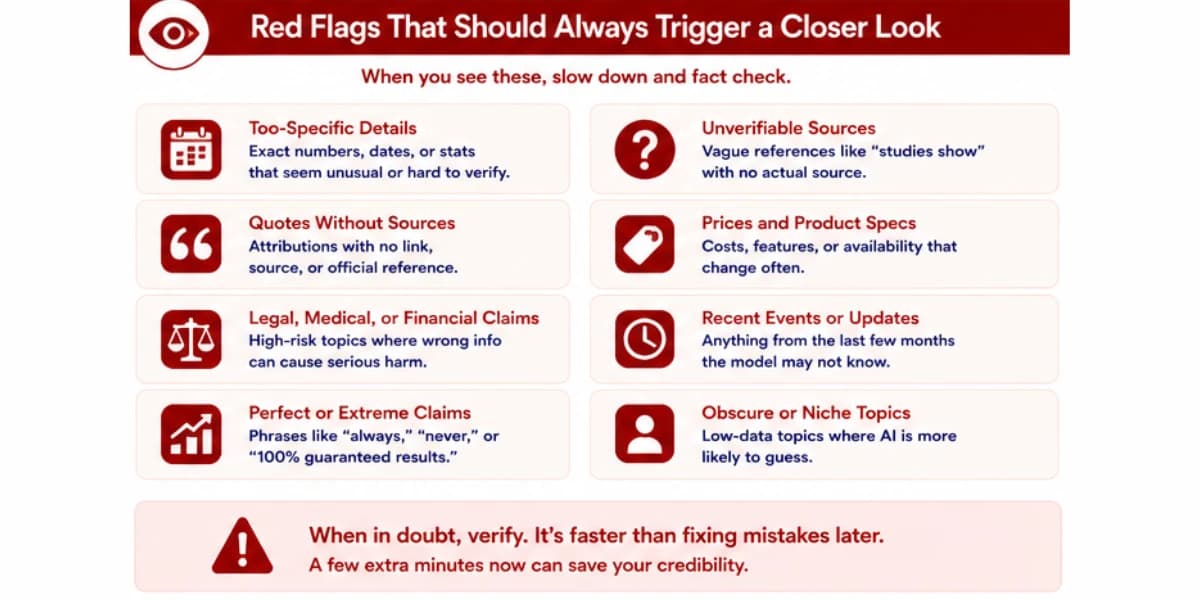
A quote attributed to a specific named person, especially without a clear source link, deserves direct verification.
Fabricated quotes rank among the more damaging types of hallucination, since they misrepresent a real, identifiable person.
Any number that seems oddly precise, like a percentage carried out to a strange decimal point, deserves a second look.
Real statistics from real studies are sometimes precise like this, but so are confidently invented numbers that just sound scientific.
The only way to tell the difference is tracing the number back to an actual source, not guessing based on how precise or scientific it happens to sound.
What Happens If A Hallucination Gets Published Anyway
Even with a careful process, mistakes sometimes slip through, so it helps to have a plan for when that happens rather than treating it as something that can never occur.
Fix the error as soon as it gets caught, if you catch it yourself during a later review or a reader points it out.
Speed matters here, since a wrong claim sitting live longer means more readers potentially seeing and trusting incorrect information.
Consider adding a brief, honest note if the correction is significant enough that a returning reader might notice the change.
That kind of transparency tends to build more trust over time than quietly editing something and hoping nobody noticed the original mistake.
Readers generally respect a site more, not less, for openly acknowledging and fixing a mistake quickly, rather than pretending the error never happened in the first place.
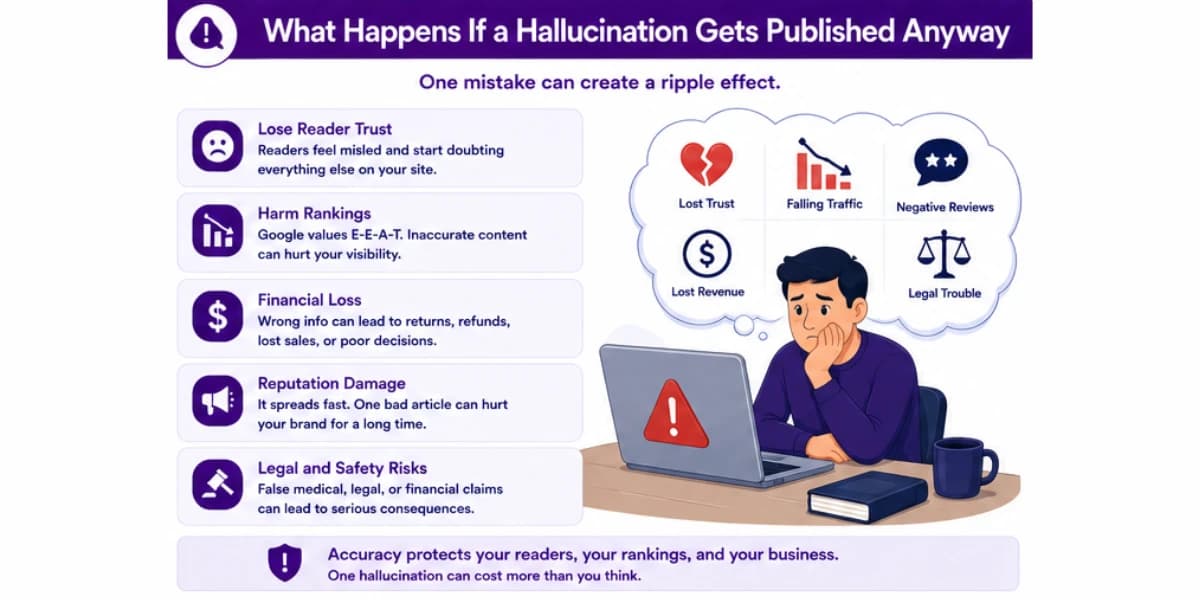
Look at how the hallucination made it through your process in the first place, and adjust your workflow accordingly.
If a specific type of claim keeps slipping through, like product pricing or statistics, that is a signal to add a more specific check for that exact category going forward, rather than just resolving to be more careful in general next time.
Do not panic or overcorrect by abandoning AI tools entirely after one mistake.
A single caught error is a normal part of using any tool that generates content quickly, and the goal is a better process going forward, not eliminating AI assistance altogether out of an overreaction to one slip.
Plenty of careful, well run sites catch and quietly correct a small factual error now and then, and that is a very different situation from a site with no fact checking process at all.
Creating content that stays relevant for years requires a different approach than chasing trends. Our article on creating evergreen content explains how to write articles that continue driving traffic long after publication.
Tools That Can Help With The Fact Checking Process
While no tool catches every hallucination automatically, a few practical approaches can make the process faster and more reliable.
AI tools with live web search enabled tend to hallucinate less often than tools working purely from training data, since they can pull current information directly rather than relying only on patterns learned during training.
Still, always verify anything that matters, since even search enabled tools can occasionally misread a source or blend information incorrectly.
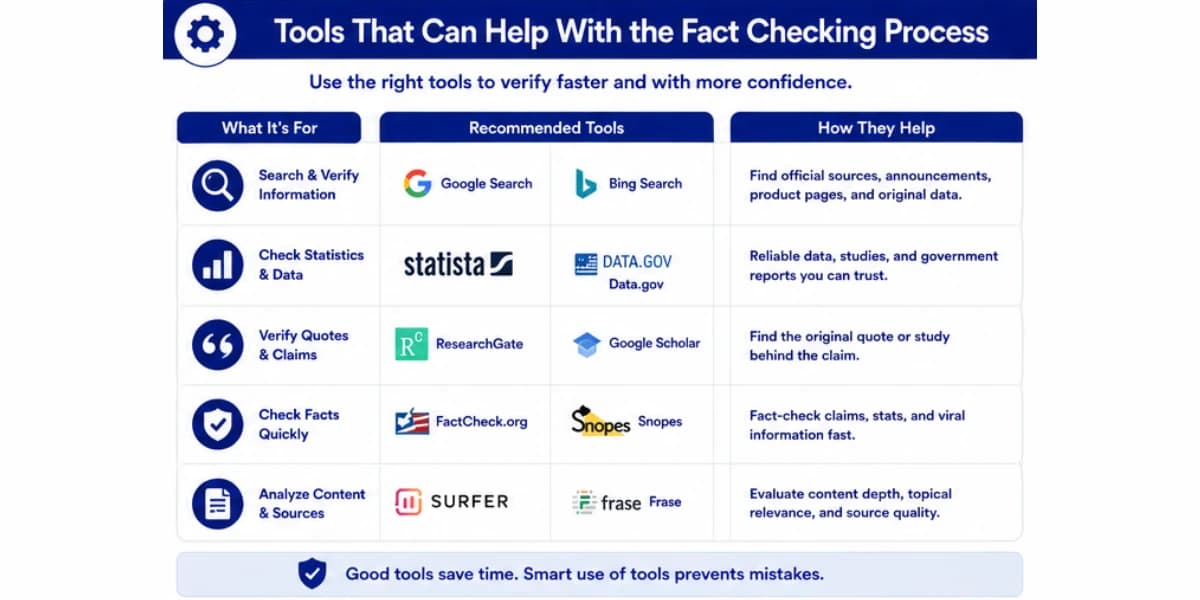
Browser extensions and plugins built specifically for fact checking can speed up verification for common claim types, though they work best as a first pass rather than a full replacement for a careful human check on anything important.
A simple shared spreadsheet tracking verified facts for your niche, updated regularly as prices and details change, can save enormous time across a team producing content regularly, since the same core facts often get referenced across many different articles.
Once a fact gets verified once and logged, nobody on the team needs to look it up again from scratch, which speeds up every future piece that touches the same product or topic.
Using content optimization tools like Frase or Surfer SEO can help you catch some of these issues before publishing, though they still do not replace a careful human read through.
A Quick Reference Checklist Before Publishing
Before any AI assisted piece goes live, running through a short, focused checklist catches most hallucination problems without requiring a huge time investment.
Every specific number has been checked against a real, current source.
Every named source, study, or citation has been verified to actually exist and say what the content claims it says.
Every product detail, including pricing and features, has been checked against the official current listing.
Every date and timeline has been checked for accuracy.
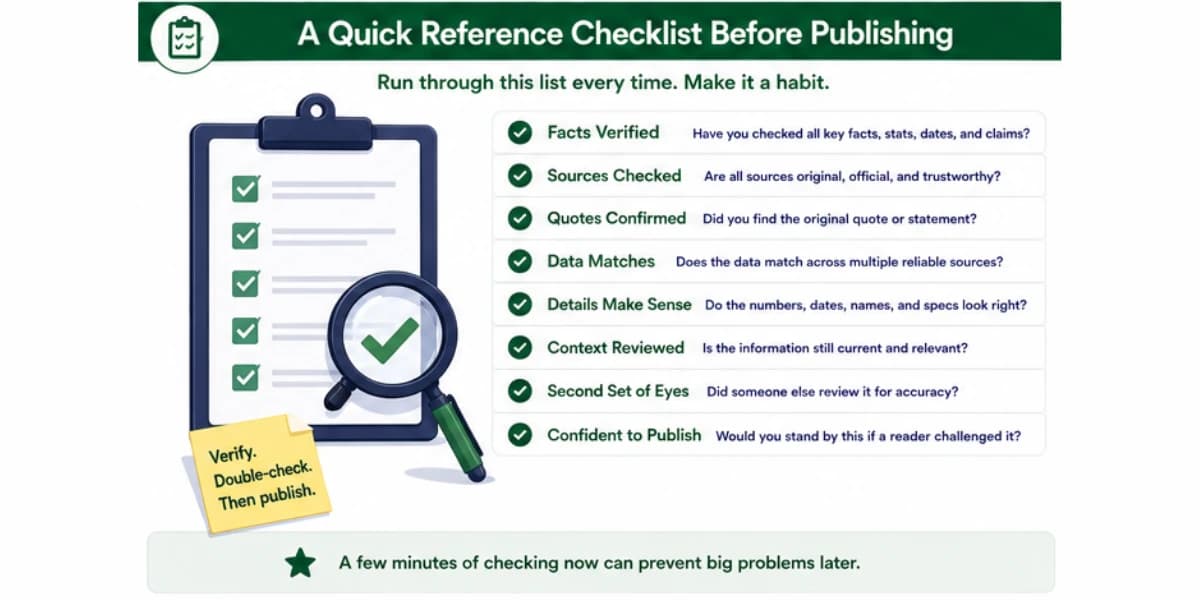
Every quote has been checked against its actual original source.
Anything that could not be verified has either been fixed with correct information or removed entirely rather than left in as an unconfirmed guess.
Running through this same short list every single time, rather than treating fact checking as a one off task you remember only occasionally, is what turns a good intention into an actual reliable habit.
Our free publishing checklist tool helps you build a consistent pre-publish review habit, and the keyword density checker and meta title and description checker are useful free tools for verifying on-page details before content goes live.
Final Thoughts
AI hallucinations are a real, predictable risk in SEO content, not a rare edge case you can safely ignore.
They tend to follow recognizable patterns, showing up most often in specific numbers, citations, product details, and dates rather than in general explanations.
Once you know these patterns, catching them becomes a matter of building a consistent habit rather than relying on luck or a quick skim before publishing.
The sites that use AI well are not the ones that avoid hallucinations by accident.
They are the ones that built a real process around catching them, treating every specific claim as something to verify rather than something to trust automatically.
Build that habit into your workflow, and AI becomes a genuinely reliable tool for speeding up your content, rather than a hidden source of quiet, damaging mistakes.
A process like this does not need to feel heavy or slow once it becomes routine.
Most experienced teams get faster at spotting likely hallucination candidates the more practice they get, since the same handful of patterns keep showing up again and again.
A specific number, a named source, a recent event, a quote from a real person, these five categories cover the vast majority of hallucination risk in typical SEO content, and checking just these five things consistently catches most problems before they ever reach a reader.
None of this means treating AI with suspicion at every turn or avoiding it out of fear.
It means giving specific, checkable claims the exact same scrutiny you would give a fact from any other source you had not personally verified yet, human written or otherwise.
That single shift in mindset, treating fluent and confident as separate from accurate, is really the whole foundation this entire article has been building toward.
If you are exploring how AI agents fit into this picture, our guide on AI SEO agents explains where automated tools genuinely help and where they still need a human in the loop.
Frequently Asked Questions
1. Can AI hallucinations be completely eliminated?
Not entirely, at least not with current tools. The goal is not perfect elimination but a reliable process that catches hallucinations before they go live, reducing the risk to a manageable level rather than assuming any tool will produce perfectly accurate content on its own every time.
2. Are hallucinations more common with certain AI tools than others?
Yes, and this can change over time as tools get updated. Tools with live web search access generally hallucinate less often on current facts than tools relying purely on older training data, though no tool is completely immune to the problem.
3. How much time should fact checking actually add to a content workflow?
It varies by content type, but a focused fact checking pass on a typical article usually adds somewhere between fifteen minutes and an hour, depending on how many specific claims the piece contains. That time investment is almost always worth it compared to the cost of publishing and later correcting a factual error a reader caught first.
4. Is it safe to trust AI generated citations without checking them?
No. Fabricated citations rank among the most common and most damaging types of hallucination, since they add a false sense of authority to a claim. Every citation needs a direct check to confirm the source actually exists and says what the content claims.
5. Do hallucinations happen more with longer AI generated content?
Generally yes, simply because longer content contains more specific claims overall, giving more opportunities for a hallucination to appear somewhere in the piece. Breaking a long piece into smaller sections and fact checking each one separately tends to catch more errors than trying to review a long piece all at once, since fatigue sets in during a long, unbroken review pass and small errors become easier to skim past near the end.
6. Which habit is the single most effective way to catch hallucinations?
Treating every specific, checkable claim as unverified until you personally confirm it against a real source. That one habit, applied consistently, catches the vast majority of hallucinations before they ever reach a reader.
Understanding the difference between informational and commercial content helps you decide which type of content deserves more human investment and which can safely lean on AI assistance.