Blogsepaise Vs PageRadar: €39 SEO Suite Or $19 Link Toolkit?
PageRadar and Blogsepaise can both watch your affiliate links. Past that point, they are very different products.
PageRadar is an SEO alert tracker. It watches rankings, Core Web Vitals, HTML changes, status codes, sitemaps, robots.txt, visual changes, Reddit mentions and affiliate links.
Blogsepaise is built only for affiliate sites. It pairs an Affiliate Program Database with a Link Health Monitor that scans your pages for broken, hijacked and undisclosed affiliate links.
PageRadar's paid plans start at €39 a month. Blogsepaise's first paid plan costs $19 a month, and both offer a way to start for free.
We built Blogsepaise, so keep that in mind as you read. Where PageRadar does more, we say so plainly.
Disclosure: Some of the links I share might be affiliate links. If you click on one and make a purchase, I may earn a small commission as a thank you. But don’t worry, it won’t cost you anything extra. I only recommend stuff I genuinely believe in. Your support helps me keep creating awesome content. You can read my full affiliate disclosure in my disclaimer page.
Search 1,500+ affiliate programs in the Blogsepaise Program Database and filter them by category, network and commission type, compare them side by side and track the ones you join. The Link Health Monitor then checks your posts for broken, hijacked and undisclosed affiliate links, and paid plans run those checks for you every week or month.
See every feature or pick a plan, from a free account to Pro →
What Each Tool Does
PageRadar is an SEO alert tracker that runs around the clock. It catches problems on your site, such as a slow page, a changed title or a broken status code, before they hurt your rankings.
Every PageRadar plan includes unlimited websites. The plans differ in how many keywords, URLs, sitemaps and affiliate link checks you get.
Affiliate link monitoring is one module inside that suite. PageRadar checks links from 167 countries through residential proxies and alerts you when a link breaks, its redirect chain changes, or it gets blocked.
484 brands use PageRadar. Its users include web performance freelancers, publishers, SEO consultants and affiliate site owners.
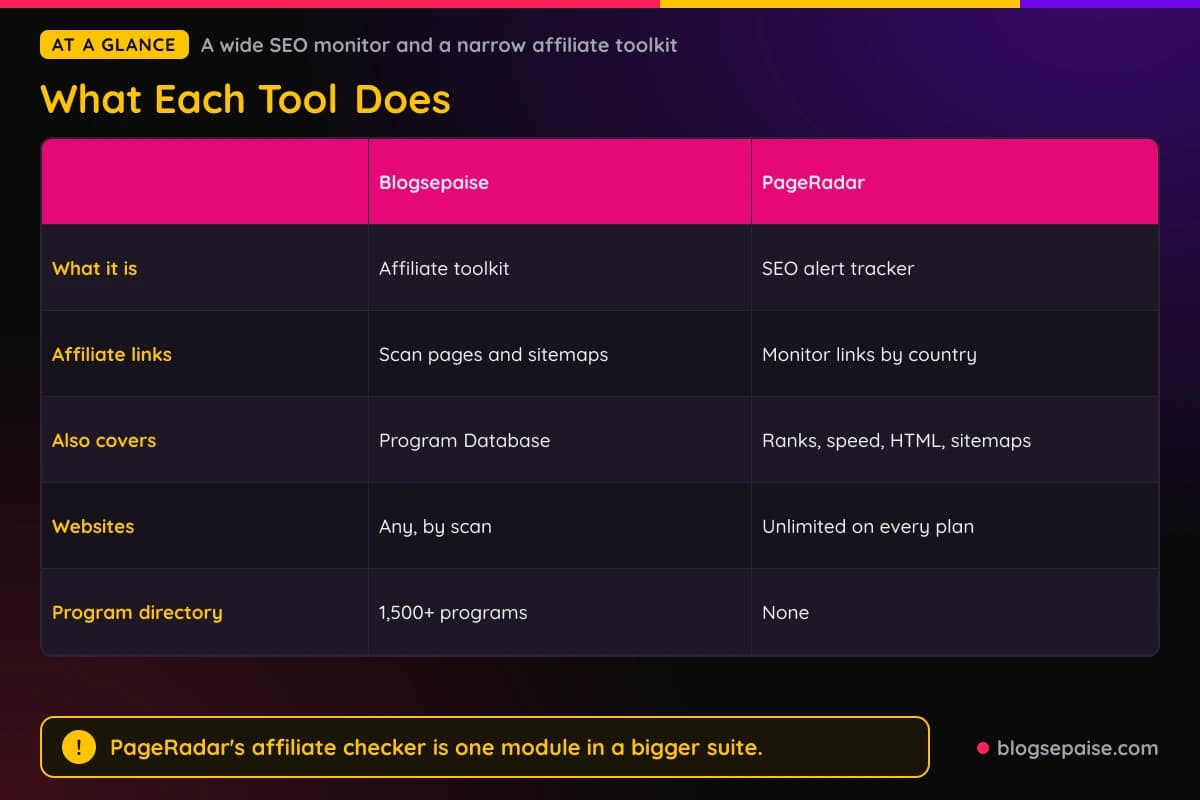
Blogsepaise focuses on one job, keeping affiliate income flowing. You paste a page URL or a sitemap URL, and the Link Health Monitor checks every affiliate link it finds.
The second Blogsepaise tool is the Affiliate Program Database. It lists more than 1,500 affiliate programs across 26 categories, with links to each program's own signup page.
So PageRadar is a wide SEO monitor with an affiliate module. Blogsepaise is a narrow affiliate toolkit that also helps you choose programs.
Checking Affiliate Links
PageRadar's affiliate link checker follows redirect chains of up to ten hops. It alerts you when links break, chains change, the final domain changes, or a country gets blocked.
The country angle is PageRadar's standout feature. It checks links from 167 countries, so you see geo-blocking, country-specific redirects and regional limits.
PageRadar monitors all kinds of affiliate links, including Amazon Associates, eBay Partner Network and other marketplaces. It detects out-of-stock products and invalid links.
It works with links made by Pretty Links, ThirstyAffiliates, Bitly, Short.io, ClickMeter, Geniuslink and Link Management Plus, plus direct affiliate links. A REST API covers its affiliate trackers.
Blogsepaise checks links from its own servers rather than from many countries. Each scan follows every affiliate link hop by hop, up to eight redirects, and records every site in the chain.
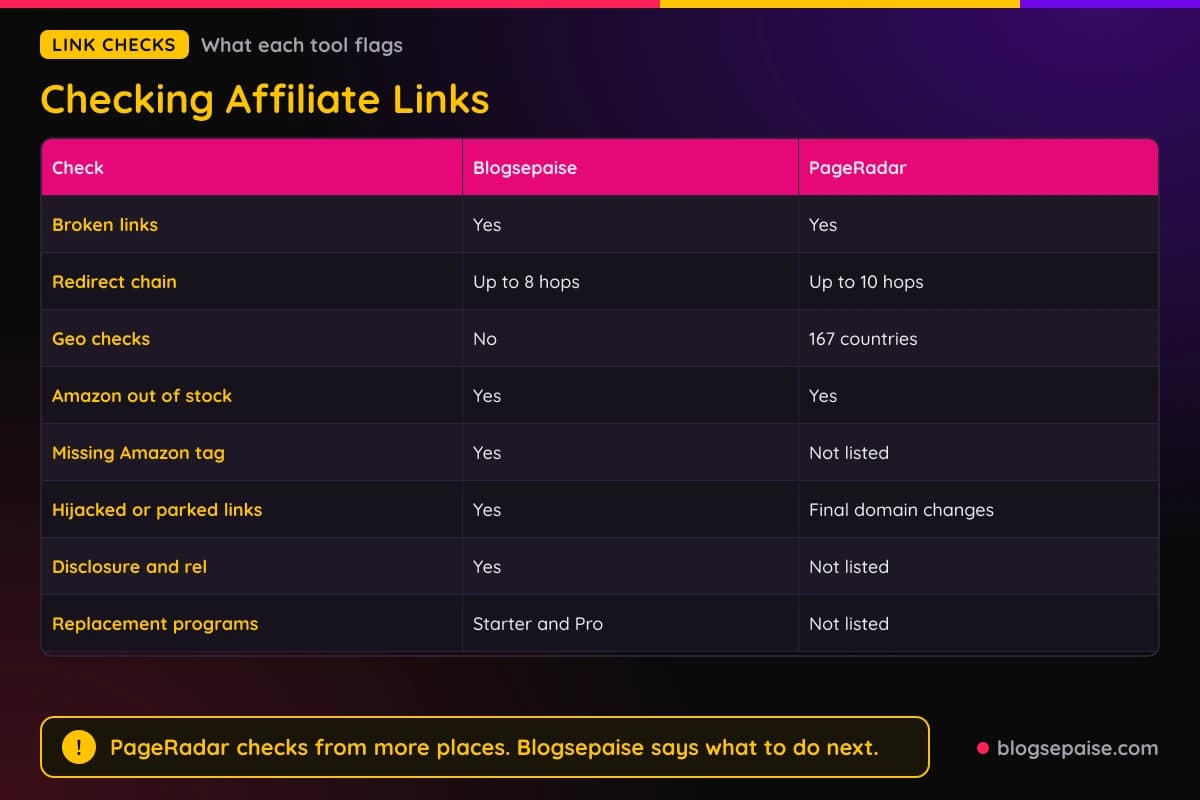
A Blogsepaise scan flags not found pages, server errors, too many redirects, and links that now land on a homepage. It also flags links that still use http.
Hijack checks are built in. Blogsepaise warns you when a link bounces through unrelated sites or ends on a parked or for-sale domain.
Amazon links get extra checks for out-of-stock products, product pages that are gone, and links that lost their tracking tag.
Starter and Pro compare each scan with your last scan of the same page. You see new problems, links you fixed, and links that now go somewhere else.
When a link dies, Blogsepaise suggests live programs in the same category from its database. Starter shows three per link and Pro shows ten.
So PageRadar checks a link from more places. Blogsepaise tells you more about what to do once a link fails.
How Monitoring Is Counted
PageRadar counts affiliate monitoring in checks. One credit equals one check, and watching a link in ten countries uses ten credits each cycle.
Starter includes 6,000 affiliate link checks a month, Agency 20,000 and Enterprise 50,000. You can set the check frequency per link.
Blogsepaise counts scans instead. One scan can cover a single page or a whole sitemap, and every affiliate link on those pages gets checked in that scan.
Starter gives 50 scans a month, each up to 75 pages and 500 links. Pro gives 300 scans a month, each up to 500 pages and 3,000 links.
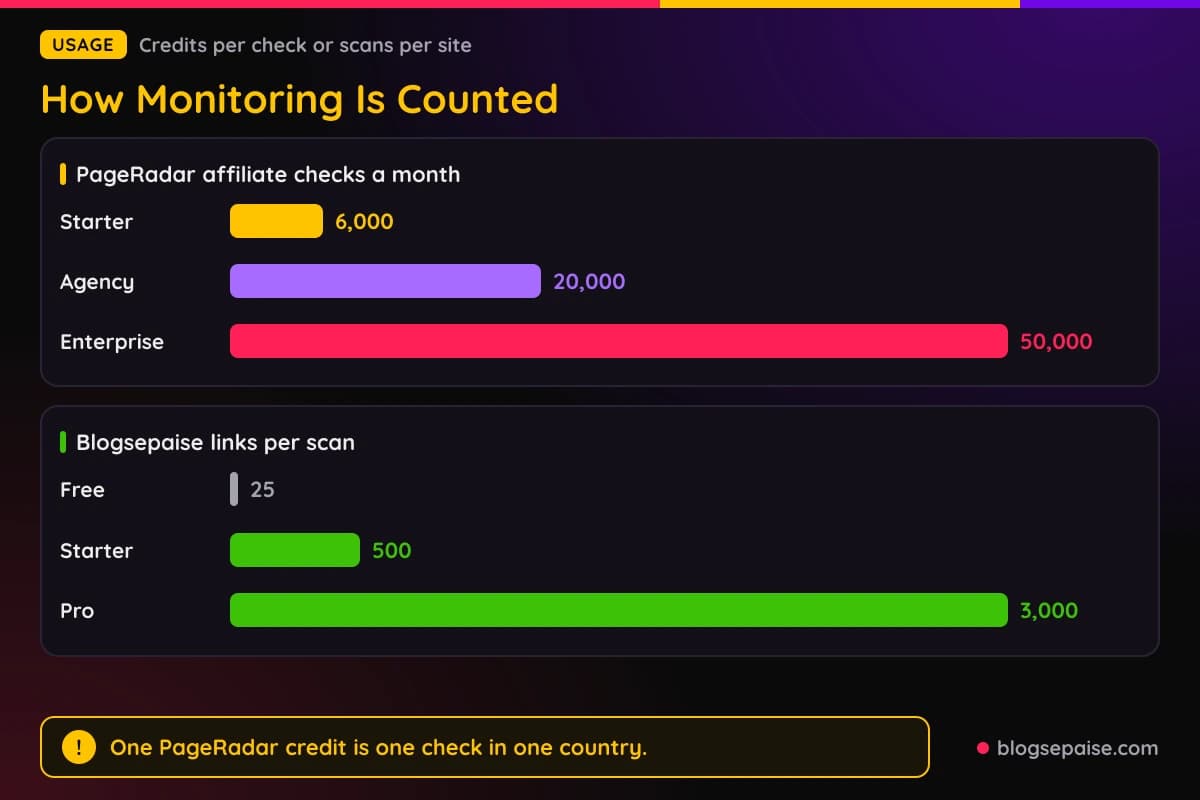
The free Blogsepaise plan gives five single-page scans a day, with up to 25 links each. No credits or country multipliers apply.
If you need to watch a few money links from many countries, PageRadar's credit model fits. If you want to sweep a whole site at once, Blogsepaise's scan model goes further per dollar.
How A Blogsepaise Scan Works
A Blogsepaise scan starts with one URL. A sitemap URL brings in the page list from the sitemap, and a page URL checks that page alone.
The scan pulls every link from those pages and keeps the ones that look like affiliate links. Network domains, tracking parameters and paths such as /go/ or /recommends/ all count.
Each affiliate link is opened from Blogsepaise's servers and followed one hop at a time. The scan writes down every site in the redirect chain, so a detour is easy to spot.
A link that takes longer than ten seconds to answer counts as a failed connection. A site that blocks the check is marked as could not check, with a note to open it by hand.
The report sorts links into broken, needs a look, could not check and healthy. Every row explains the issue in plain words and lists the pages where the link appears.
Starter and Pro can download any scan as a CSV file. Reports stay in your history for 90 days on Starter and 12 months on Pro, and free accounts keep the last five.
PageRadar works on a schedule per link instead. You add the links you care about, pick the countries and the frequency, and it keeps checking them.
Disclosure And Compliance Checks
Google asks for rel="sponsored" on paid links. The FTC asks for a clear disclosure near affiliate links.
Blogsepaise checks both in every scan. It lists affiliate links with no rel="sponsored" or rel="nofollow", and links marked nofollow but not sponsored.
It also reads each page for disclosure wording such as "affiliate link", "we may earn a commission" or "As an Amazon Associate". Pages with affiliate links and no such wording get flagged.
Free accounts see the counts. Starter and Pro see the exact pages and links.
PageRadar's affiliate checker does not list a disclosure or rel attribute check. Its HTML monitoring can alert you when page code changes, which is a different job.
Finding Affiliate Programs
PageRadar does not offer a directory of affiliate programs. Its focus is monitoring sites and links you already have.
Blogsepaise's Program Database lets you search 1,500+ programs by name, niche, network and commission type. Paid plans add filters for instant approval, cookies of 60 days or more, low payout thresholds and PayPal payouts.
Many program cards show the cookie length, minimum payout, payment methods and approval type. Those details come from each program's own affiliate page.
You can compare programs side by side. Free compares two at once, Starter four and Pro six.
The My Programs tracker stores each program you apply to, with its status, your affiliate link and notes. Free tracks five programs, Starter 25 and Pro has no limit.
Paid plans can watch a program and get an alert when its commission, cookie or signup page changes. Saved searches send an alert when new programs match a niche you care about.
Blogsepaise Pro adds a missed-money finder. It spots plain links to brands that run an affiliate program, pages where you send readers but earn nothing yet.
SEO Monitoring Beyond Links
Here PageRadar is far ahead, since Blogsepaise does not do general SEO monitoring at all.
PageRadar's Starter plan tracks 200 keywords on Google, Bing and Yandex. It also covers Core Web Vitals on 100 URLs and status codes on 50 URLs.
Starter adds HTML monitoring on 50 URLs, 20 sitemaps, visual testing on 10 pages, five robots.txt files and 25 Reddit keywords.
Agency and Enterprise raise every limit. Enterprise tracks 2,000 keywords and 1,000 URLs for Core Web Vitals and status codes.
PageSpeed checks run daily on all plans. Uptime checks run every hour, and HTML checks run hourly or daily.
If you want one dashboard for rankings, speed and site changes, PageRadar covers it. Blogsepaise stays with affiliate links and programs.
Alerts, Reports And Automation
PageRadar sends alerts by email with detailed context. Its plan lists include Slack alerts too.
You can trigger a manual check from the PageRadar dashboard at any time. Checks also run on the schedule you set.
Blogsepaise scans saved sites on a schedule. Starter scans one site every month, up to 75 pages, and Pro scans five sites every week, up to 500 pages.
Scheduled scans do not use your monthly scan quota. Results, watchlist changes and new saved-search matches arrive in one email a week, and stay on your dashboard.
For agencies, Blogsepaise Pro builds a branded client report. It carries your brand name, the summary, the disclosure checks and every link to fix.
You can print the report, save it as a PDF, or share a read-only link that works for 30 days. Your client does not need an account.
More PageRadar Tools
PageRadar also offers free tools on its site, such as a redirect checker and a cloaking checker. They work without an account.
The free live link tester shows how an affiliate link redirects in real time from a chosen country. Signing up opens 130 more countries.
Reddit keyword alerts are part of every plan. Starter watches 25 keywords, Agency 100 and Enterprise 200.
Visual monitoring compares how pages look over time. Starter covers 10 pages, Agency 50 and Enterprise 100.
Sitemap monitoring covers 20 sitemaps on Starter, 50 on Agency and 120 on Enterprise. Robots.txt monitoring covers 5, 20 and 50 files.
Blogsepaise has none of these SEO tools. Its free tools section covers other jobs, while its paid plans stay focused on affiliate links and programs.
Pricing Compared
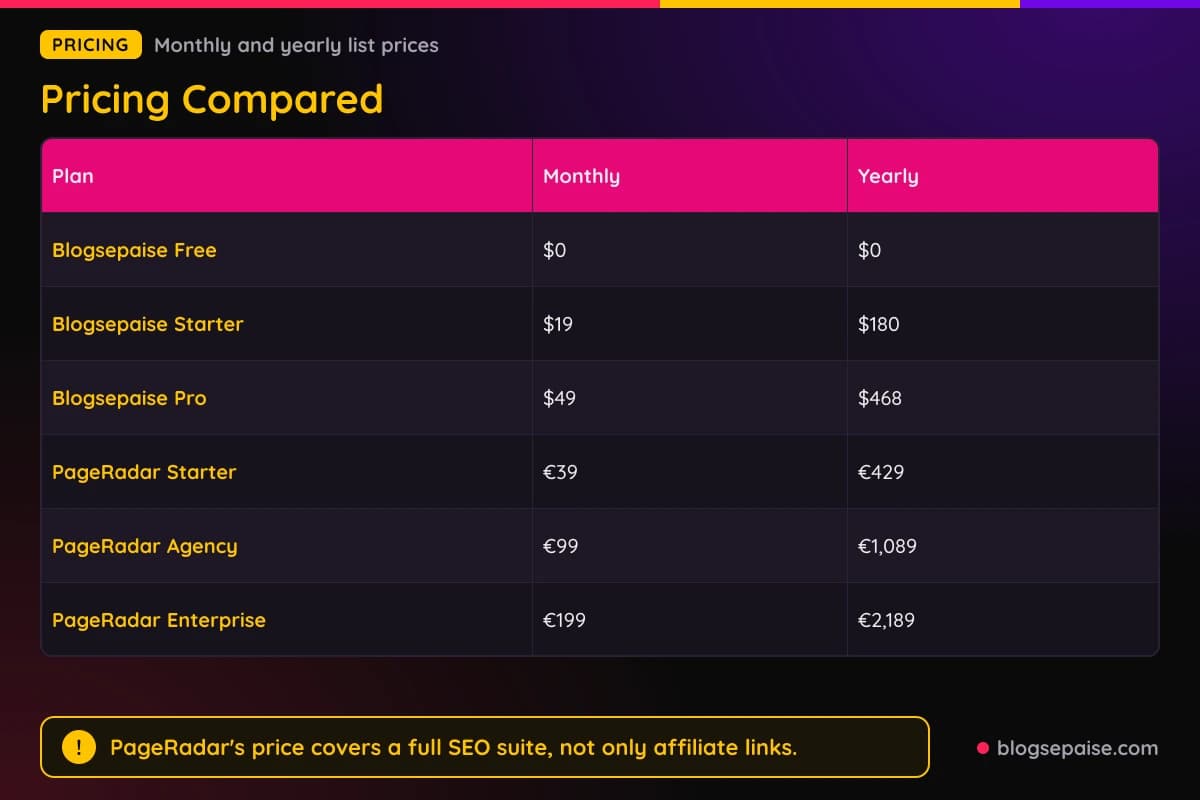
PageRadar prices its plans in euros. Starter costs €39 a month or €429 a year, Agency costs €99 a month or €1,089 a year, and Enterprise costs €199 a month or €2,189 a year.
The yearly price gives you one month free. Custom pricing is available through PageRadar's sales team.
PageRadar has a freemium version with access to every feature. It also offers a free live link tester with no signup, which tests a link from 30 countries.
Payments go through Stripe, and you can cancel or change your plan at any time.
Blogsepaise has three plans in US dollars. Free costs $0, Starter costs $19 a month or $180 a year, and Pro costs $49 a month or $468 a year.
Payments go through PayPal, with a PayPal balance or a card. You can cancel from your dashboard, and your plan stays active until the end of the period you paid for.
So Blogsepaise Starter costs about half of PageRadar Starter each month. Blogsepaise Pro costs less than PageRadar Agency.
The comparison is not apples to apples, though. PageRadar's price covers a full SEO monitoring suite, while Blogsepaise's covers affiliate tools only.
Free Plans Compared
PageRadar's freemium version opens every feature so you can try it. Its free live tester lets anyone check a link's redirects from 30 countries without an account.
Blogsepaise Free is a full account that you can keep forever, with no card. It includes the Program Database with the first 48 results of every search.
It gives five single-page scans a day, with up to 25 affiliate links each. Scans include the broken link, redirect, hijack and Amazon checks, plus counts for disclosure and rel problems.
A free account also tracks five programs, compares two side by side, and keeps your last five scans.
Which One Wins
For affiliate sites on a budget, Blogsepaise wins. It costs less, checks links on the free plan, and adds disclosure checks, hijack warnings and replacement suggestions.
It also helps you find programs. PageRadar has no program directory, compare view or application tracker.
For checking a link from many countries, PageRadar wins. Its 167 countries and residential proxies show problems that a single location cannot see.
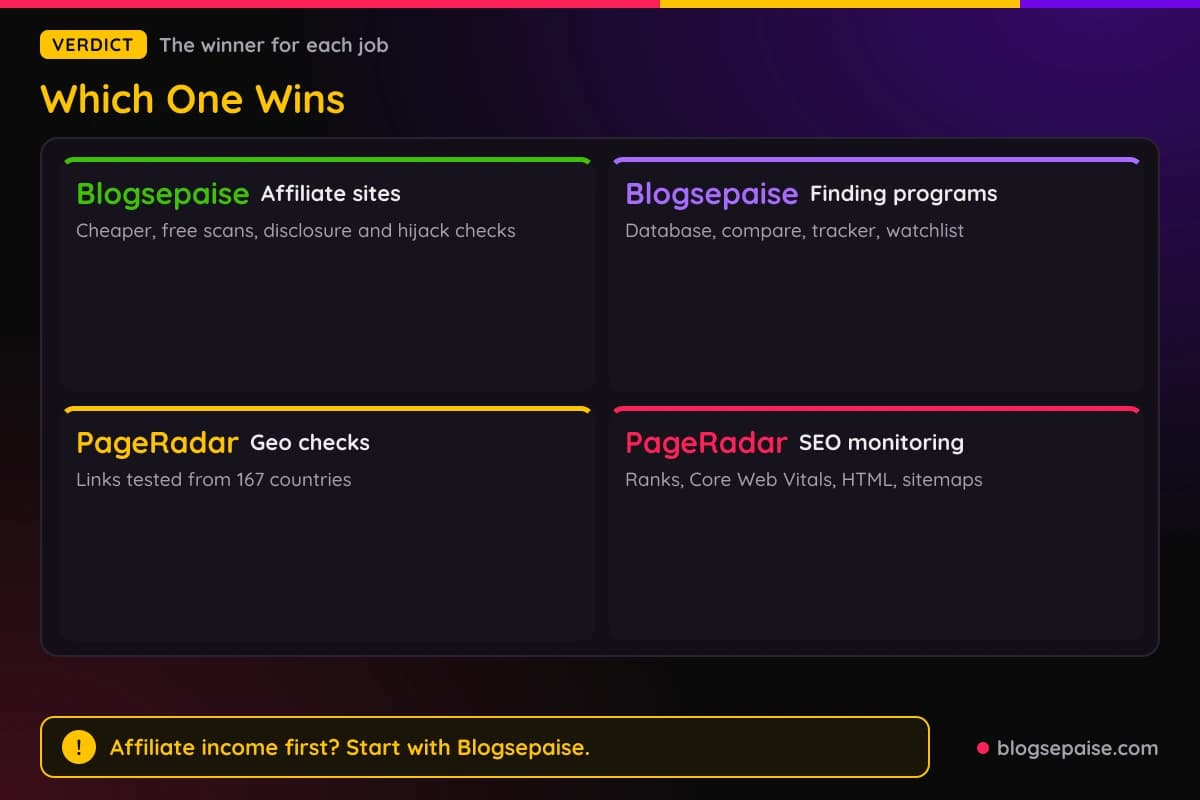
For SEO monitoring beyond affiliate links, PageRadar wins easily. Rankings, Core Web Vitals, HTML changes and sitemap checks are outside what Blogsepaise does.
Who Should Pick Which
Pick PageRadar if you run several sites and want one tool for rankings, speed, site changes and affiliate links. Agencies with SEO clients get the most from it.
PageRadar also suits casino and betting sites, where links behave differently by country. Its geo checks catch those cases.
Pick Blogsepaise if your income comes mainly from affiliate links. You get link checks, disclosure checks and program research in one account for $19 a month.
Blogsepaise also suits beginners who are still choosing programs. The database, compare view and tracker make that research easier.
Freelancers who audit affiliate sites for clients will like Blogsepaise Pro. Weekly scans of five sites and branded client reports cost $49 a month.
Final Thoughts On Blogsepaise Vs PageRadar
PageRadar is a full SEO alert tracker with a strong affiliate module. Its country checks are hard to match.
Blogsepaise is a lighter, cheaper toolkit made only for affiliate sites. It checks links, checks compliance, and helps you find and track programs.
If affiliate links pay your bills, start with a free Blogsepaise account and scan your best page. If you later need rankings and speed tracking, PageRadar can sit alongside it.