Programmatic SEO With AI: A Practical Workflow
Programmatic SEO means building many web pages at once using a template and a set of data.
AI tools have made this process much easier than it used to be.
Instead of hiring a big team to write thousands of pages by hand, one person with the right AI tools can now build a strong batch of pages in a fraction of the time.
That shift has opened the door to smaller teams and even solo site owners tackling projects that used to require serious budgets and large staff.
Projects that once felt out of reach for anyone without a big content team now feel achievable for a lot more people, as long as they follow a careful, well-organized process rather than just throwing AI at the problem and hoping for the best.
The guide walks through a real, step-by-step workflow for using AI at every stage of a programmatic SEO project.
We will cover finding data, cleaning it up, building templates, writing content for each page, checking quality, and publishing the whole batch.
By the end, you will have a clear plan you can follow for your own project, not just a list of loose ideas.
For a complete overview of how AI fits into every stage of search engine optimization, read our complete AI SEO guide. It covers how AI tools handle everything from keyword research to technical audits.
Disclosure: Some of the links I share might be affiliate links. If you click on one and make a purchase, I may earn a small commission as a thank you. But don’t worry, it won’t cost you anything extra. I only recommend stuff I genuinely believe in. Your support helps me keep creating awesome content. You can read my full affiliate disclosure in my disclaimer page.
If you want to save a lot of hours searching for high-paying affiliate programs, check out our exclusive list of 2500+ affiliate programs. You’ll find all the information about the programs inside the list. This list is perfect for affiliate bloggers and influencers.
Why AI Changes The Programmatic SEO Game
Programmatic SEO has always relied on data and templates. AI adds a new layer on top of that, helping with the parts that used to need a human writer sitting at a keyboard for hours.
Before AI tools became common, most programmatic SEO pages were built from raw data with very little extra writing.
A page might show a table of numbers and a short, robotic sentence stitched together from the data fields.
These pages worked in a basic way, but they often felt cold and empty to real readers.
That gap between a working page and a genuinely helpful page used to be very expensive to close.
Closing it meant hiring writers, editors, and researchers, all working through a huge stack of pages one at a time.
Most site owners simply could not afford to do this at any real scale, so they either skipped programmatic SEO entirely or accepted the thin, robotic version as the best they could manage.
AI tools can now write natural-sounding paragraphs around that same raw data.
Instead of a stiff sentence like the average price in this city is $400, AI can turn that same fact into a paragraph that reads as if a real person wrote it, explaining what the price means and how it compares to nearby areas.
That shift matters a lot for search engines too. Pages that feel more natural and more useful tend to perform better over time.
Search engines reward pages that genuinely help readers, and AI gives site owners a practical way to add that extra layer of real, readable value across thousands of pages at once.
If you are producing informational content at scale, using the right AI writing tools can help you draft faster, but our Rytr review and ContentBot AI review show why a human editing pass still matters for the best results.
The Full Workflow At A Glance
Before digging into each step in detail, it helps to see the whole path from start to finish.
The full workflow has seven main stages, and each one builds on the step before it.
Skipping around or rushing through an earlier stage tends to create extra work later, so it pays off to follow the order laid out here, at least for your first project.
The first stage is picking a topic and confirming real demand exists for it.
The second stage is gathering and organizing your data. The third stage is building your page template.
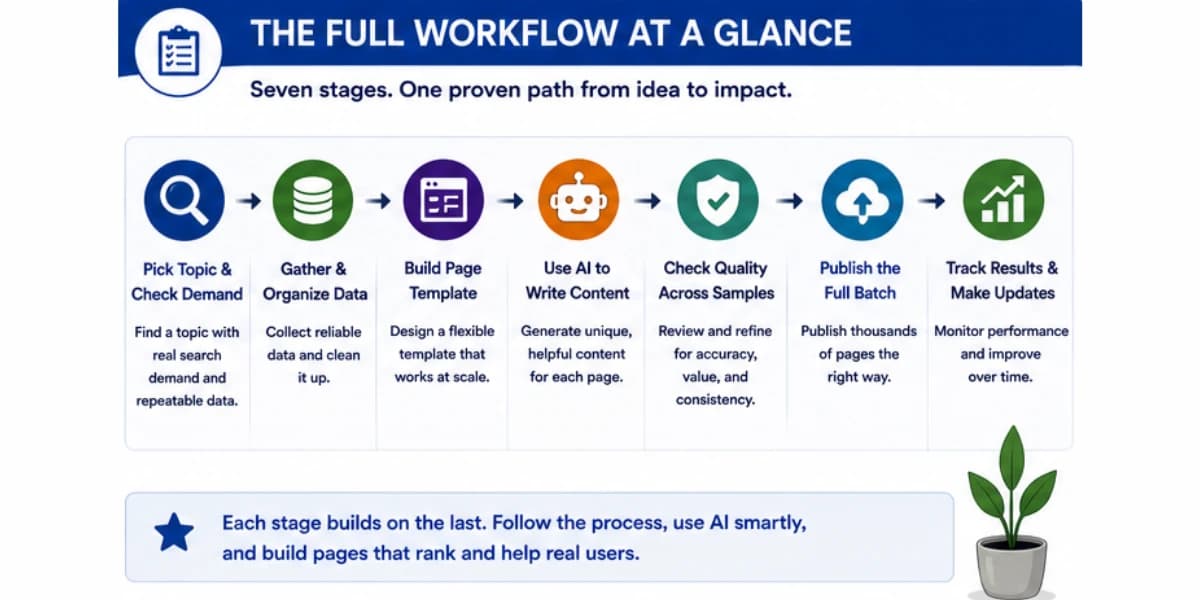
The fourth stage is using AI to write the unique text for each page. The fifth stage is checking quality across a sample of pages.
The sixth stage is publishing the full batch. The seventh stage is tracking results and making updates over time.
Each of these stages can use AI in some way, but the amount of AI involvement and the amount of human review changes at every step.
Some stages lean heavily on AI. Others need much closer human attention.
Stage One: Picking A Topic & Checking Real Demand
Every strong programmatic SEO project starts with a topic that has real, repeatable data behind it and real search demand from actual people.
Skipping this early research step ranks among the most common reasons a programmatic SEO project fails to gain any real traction later on.
AI tools can help with this early research step.
You can ask an AI tool to suggest topic ideas based on your industry, then ask it to explain why each idea might work well for a programmatic approach.
A good prompt here might sound like this. I run a site about home improvement.
Suggest ten topic ideas that would work well for programmatic SEO, meaning topics with a repeatable pattern and enough public data to build hundreds of pages.
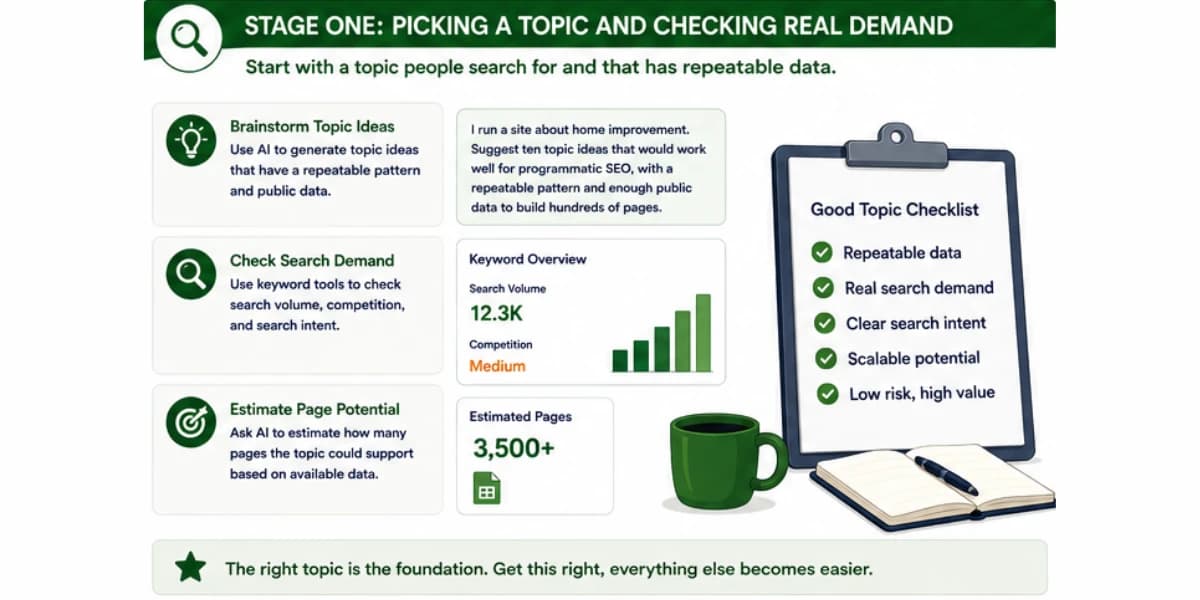
Once you have a list of ideas, use a keyword research tool to check real search volume for a sample of the pages you would build.
AI can help summarize this data quickly, pulling together search volume, competition level, and search intent into a short, clear summary for each topic idea you are considering.
It helps to ask AI for a rough estimate of how many total pages a topic could support.
A topic like plumbers by city might support thousands of pages if your data covers every city in the country.
A narrower topic might only support a few hundred. Knowing this number early helps you judge if the topic is worth the setup effort.
Learning how to do keyword research properly helps you identify the kind of small, specific searches that programmatic SEO pages are built to capture.
Stage Two: Gathering & Organizing Your Data
Good data sits at the heart of every programmatic SEO project.
Weak or messy data leads to weak, messy pages, no matter how good your template or your AI writing turns out to be.
Spending real time here pays off far more than rushing ahead to the more exciting parts of the process.
AI can help you find data sources you might not have thought of on your own.
Ask an AI tool where you could find public data related to your topic, and it can point you toward government sites, industry reports, or common public data sets that fit your needs.
Once you have raw data, AI becomes very useful for cleaning it up.
Messy spreadsheets often have mismatched formats, missing values, and small spelling errors scattered across thousands of rows.
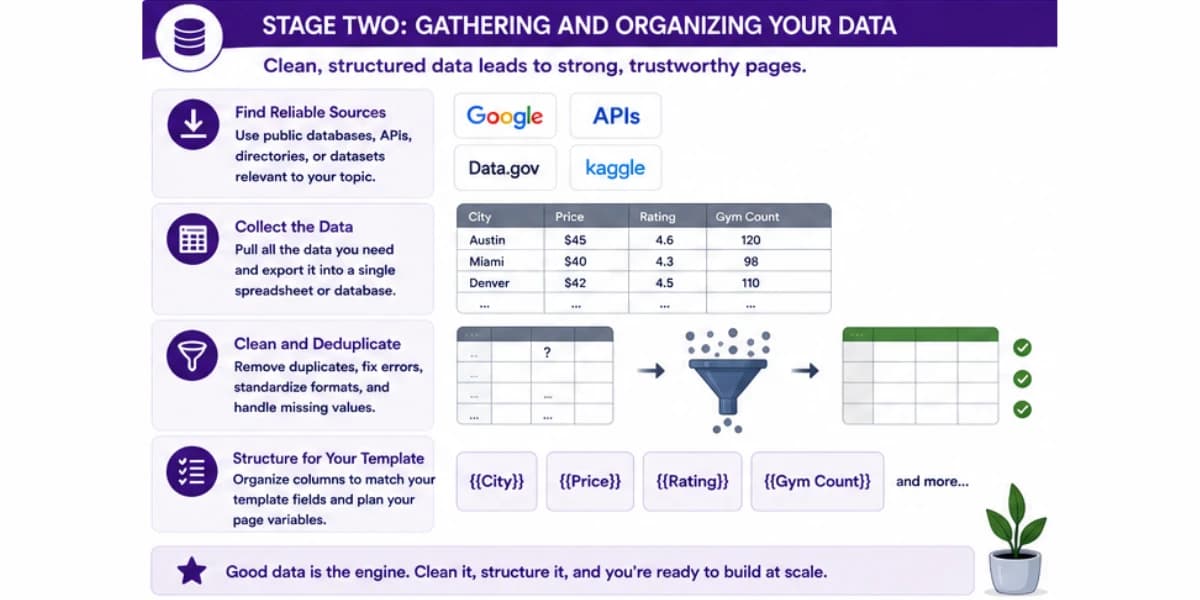
AI tools can scan a data set and flag rows that look incomplete or inconsistent, saving you from checking every single row by hand.
A helpful prompt for this stage looks something like this. Here is a sample of my data set.
Look through it and flag any rows that seem to be missing important details, along with any values that look like they might be typos or formatting mistakes.
AI can also help organize raw data into a cleaner structure.
If your data came from several different sources with different column names, AI can help you match up similar columns and merge everything into one clean, consistent spreadsheet ready for the next stage.
Our free CSV to Excel converter and Excel to CSV converter tools can help you manage and organize your data files as you prepare them for your programmatic SEO project.
Stage Three: Building Your Page Template
The template is the shared design every page in your project will follow.
AI can help you draft this template quickly, but a human still needs to guide the process and make the final decisions.
Getting this one piece right early saves a huge amount of rework later, since every single page in your batch inherits whatever choices get baked into this template.
Start by describing your goal to an AI tool in plain language.
Explain who your reader is, what question they are trying to answer, and what pieces of data will fill in the template.
Ask the AI to suggest a page structure based on this information, including a title format, an opening paragraph, a middle section, and a closing section.
A strong prompt for this step might read like this.
I am building a template for pages about the best coffee shops in each city.
Each page will use data including the city name, the number of coffee shops, the average price of a coffee, and a list of the top three shops.
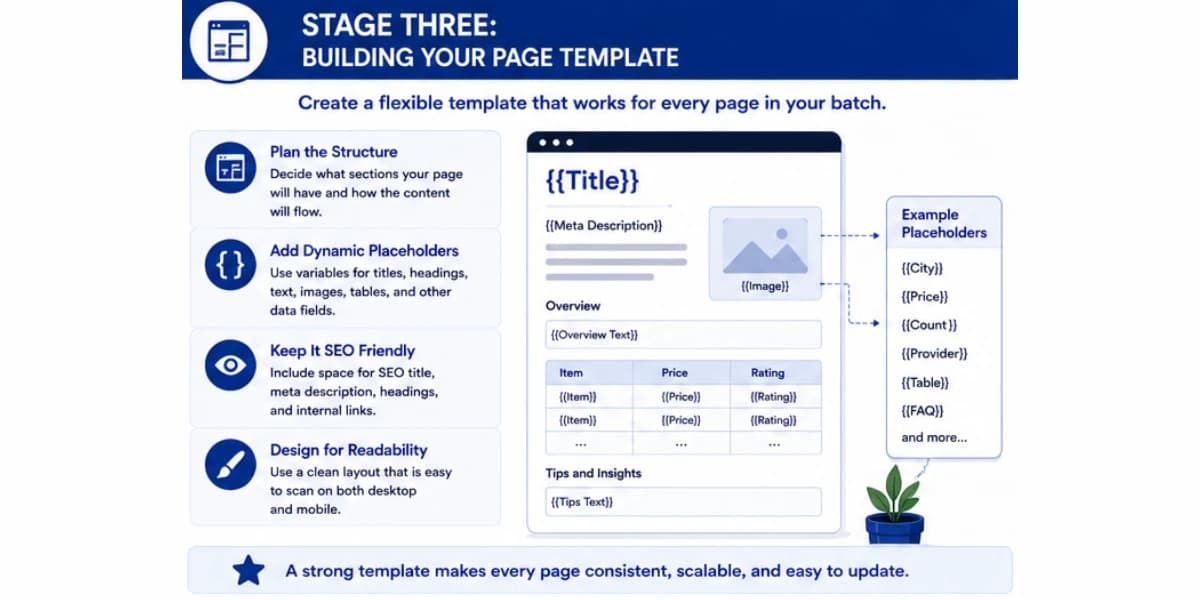
Suggest a page structure, including a title format and a paragraph outline, that would feel genuinely useful to someone searching for this information.
Once AI gives you a first draft of the structure, review it closely and adjust anything that feels off.
AI is good at suggesting a reasonable starting shape, but small details like tone, word choice, and the exact order of sections often need a human touch before the template feels right.
Test your draft template using two or three very different rows from your real data.
Pick one row with rich, full data and one row with thinner data. If the template still reads well on your weakest data row, it is likely strong enough to handle the rest of your data set too.
Understanding how your content fits together is essential for effective workflows. Our guide on what content clusters are explains how pillar pages and supporting articles work together to build topical authority.
Stage Four: Using AI To Write Unique Text For Each Page
AI provides the biggest boost in speed right here.
Writing a unique, natural-sounding paragraph for every single page by hand simply is not realistic once you are dealing with hundreds or thousands of entries.
AI can generate this text quickly, following the pattern set by your template.
The key to this stage is feeding AI clean, specific data for each page, not vague instructions.
Instead of asking AI to write about this city, feed it the exact numbers and facts for that specific city, then ask it to turn those facts into a natural paragraph following your template's tone and structure.
A strong prompt for this stage looks like this. Using the template structure below, write the unique content for this page.

Here is the data for this specific entry. Keep the tone friendly and clear, matching this sample paragraph from an already finished page.
Including a sample paragraph from an already approved page helps keep the tone consistent across your whole batch.
Without this kind of anchor, AI-generated text can start to drift in tone from one page to the next, especially across a very large batch.
It helps to generate pages in smaller batches rather than all at once.
Generating fifty pages, checking a sample, then generating the next fifty tends to produce more consistent quality than generating five thousand pages in one giant pass with no check in between.
Learning prompt engineering for SEO helps you write the kind of clear, specific instructions that give AI tools a much better starting point for their work, which is especially useful when generating template variations at scale.
Stage Five: Checking Quality Across A Sample Of Pages
Skipping quality checks ranks among the fastest ways to ruin an otherwise strong programmatic SEO project.
AI can help with this stage too, but a human review still matters a great deal here.
No matter how good your template and your prompts are, a real person reading a real sample of pages catches things a checklist alone never will.
Pull a random sample of your generated pages, maybe twenty or thirty out of your full batch. Read through them the way a real visitor would.
Check if the facts are correct, if the writing flows naturally, and if the page really feels helpful rather than repetitive or robotic.
AI can help speed up this review process.
You can ask an AI tool to compare a batch of generated pages against your original data, flagging any page where the written text does not match the numbers or facts it was supposed to be based on.
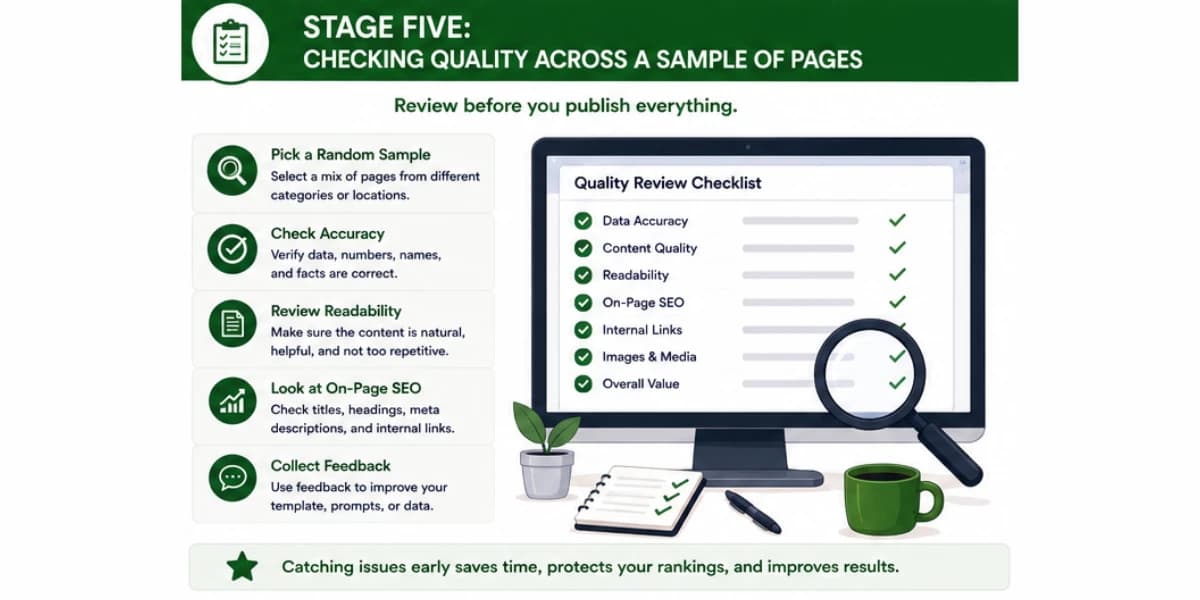
Doing this catches a common problem where AI accidentally states a slightly wrong number or mixes up details between two similar entries.
A useful prompt for this stage sounds like this. Here are ten generated pages along with the original data used to create each one.
Check each page against its matching data and flag any place where the written text does not match the facts, or where the wording feels too similar to another page in this batch.
Check for repeated phrases across your sample pages too.
AI sometimes falls into a pattern of reusing the same sentence structure or the same phrase over and over, which can make a large batch of pages feel copied even when the underlying facts are all different.
Catching this early, on a small sample, saves you from having to fix the same problem across your entire batch later.
Running a regular AI content audit helps you identify pages that may be too thin or repetitive before the problem grows into a bigger issue.
Stage Six: Publishing The Full Batch
Once your sample pages pass quality checks and your template feels solid, it is time to generate and publish the rest of your batch.
Break this stage into smaller waves rather than publishing everything at once.
Publishing five hundred pages in one wave, checking how they perform, then publishing the next five hundred tends to be safer than launching ten thousand pages all in a single day.
Working this way gives you a chance to catch any lingering problems before they spread across your entire site.
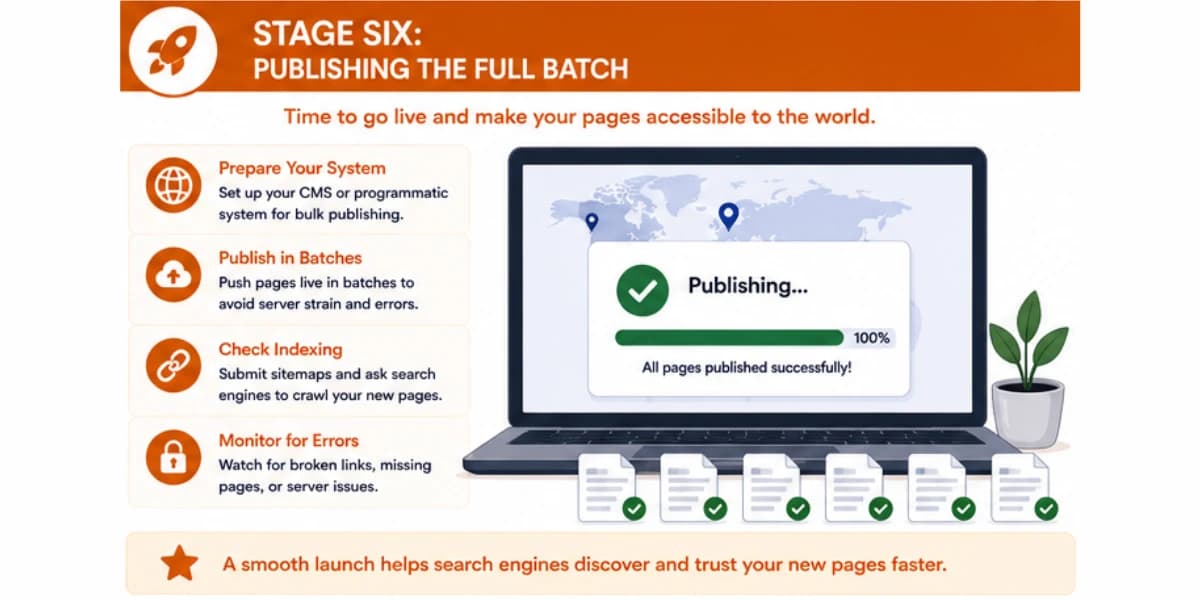
Make sure every new page connects to your site properly before publishing.
Check that internal links point to and from related pages, that your sitemap includes the new pages, and that basic technical details like page titles and meta descriptions are filled in correctly across the whole batch.
AI can help generate these smaller technical details too, like page titles and meta descriptions, following a consistent pattern across your batch.
Just like with the main page content, it helps to review a sample of these smaller elements before trusting AI to generate them across your full data set.
If you need help finding where to add links in your existing content, try our internal link opportunity finder tool. It scans your pages and highlights where new internal links would add the most value.
Stage Seven: Tracking Results & Making Updates
Publishing your pages is not the finish line. Tracking how they perform, and updating them as your data changes, keeps your programmatic SEO project healthy for the long run.
Watch how many of your pages really get indexed by search engines in the weeks after publishing.
If a large share of your pages never get indexed, that often signals a quality problem search engines are picking up on, even if your own quality checks looked fine at first glance.
Track overall traffic across your whole batch of pages, not just a few of your top examples.
Since programmatic SEO usually works by adding up traffic from many smaller pages, looking at the combined total tells a clearer story than focusing on just one or two individual pages.
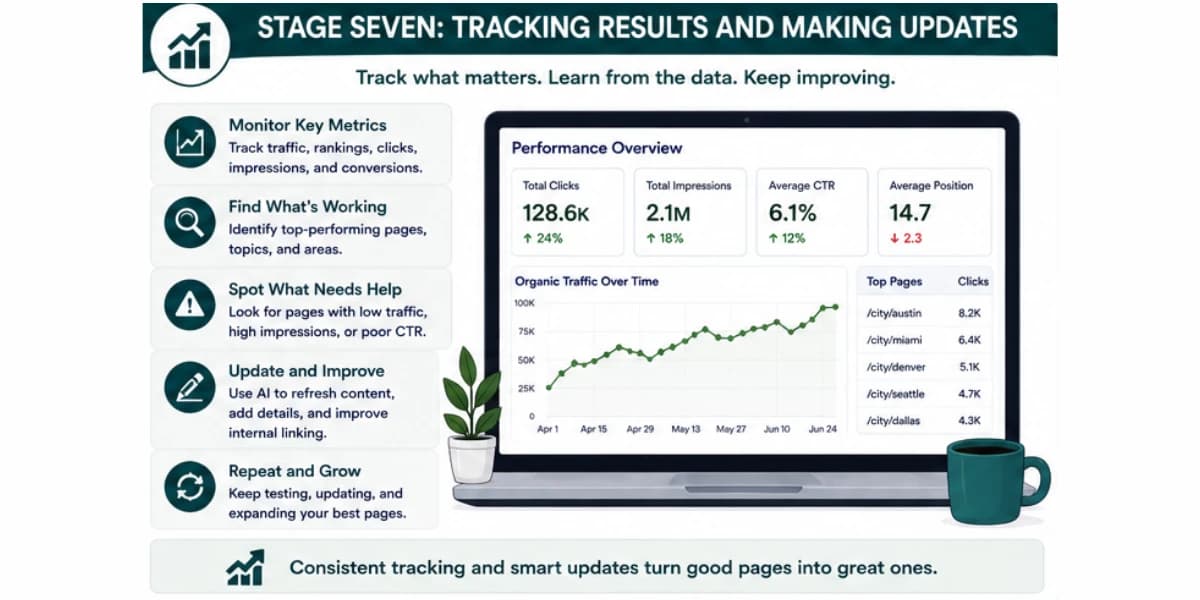
AI can help here too by summarizing performance data across a large batch of pages and pointing out patterns.
You might ask an AI tool to look at your traffic data and flag which types of pages are performing best and worst, helping you understand what parts of your template or your data might need improvement.
Keep your data fresh over time. Prices change. Availability shifts. New entries appear, and old ones become outdated.
Set a regular schedule, maybe every few months, to refresh your data and regenerate any pages that need updated numbers or facts.
Tracking these engagement signals properly is where tools like Databox and other data analytics platforms become genuinely useful for understanding how your content is actually performing.
A Full Example Walkthrough From Start To Finish
Seeing this whole process play out on one real example helps tie every stage together, so let's walk through a full project from beginning to end.
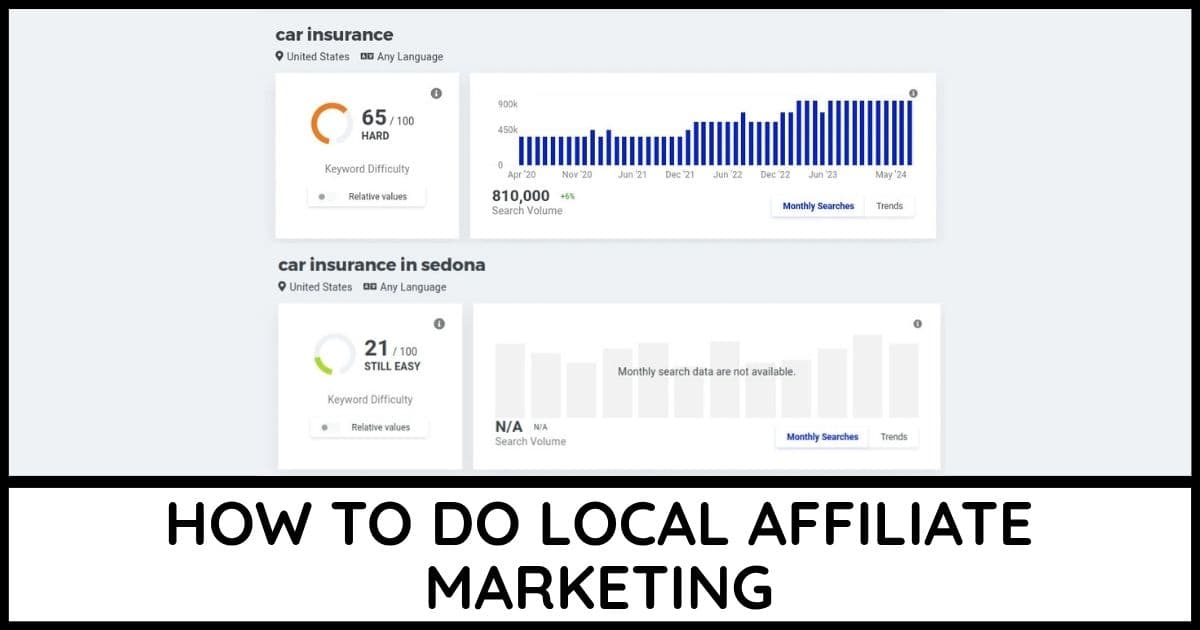
Picture a site that wants to build pages comparing car insurance rates by state.
In stage one, the site owner asks AI for topic ideas and confirms that car insurance rates by state has strong search demand, with people in nearly every state searching for local rate information.
In stage two, the site owner gathers public rate data from a few different sources, then asks AI to help clean and merge this data into one spreadsheet, with one row for each state showing average rates, top providers, and a few other useful details.
In stage three, the site owner describes the goal to AI and asks for a suggested page structure.
AI suggests a title format like car insurance rates in followed by the state name, an opening paragraph explaining the average rate, a table comparing top providers, and a closing paragraph with tips for lowering rates.
The site owner reviews this structure and tweaks the wording to sound more like their own brand voice.
In stage four, the site owner feeds AI the real data for each state, one at a time, along with the approved template and a sample paragraph from an already finished page.
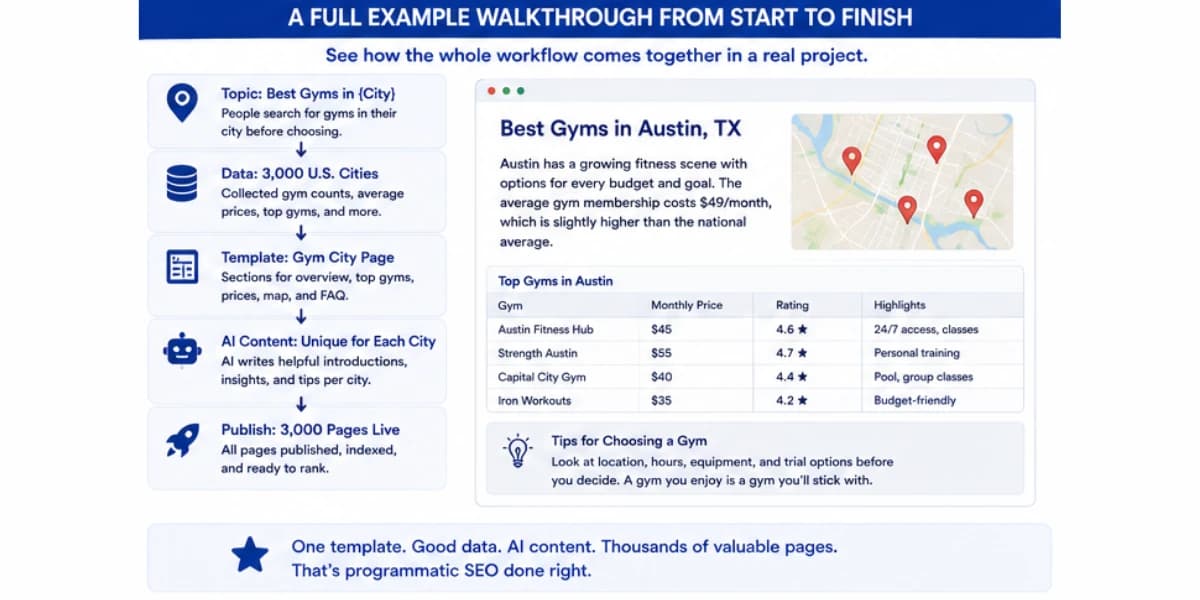
AI generates the unique paragraph for each state, using the real numbers from that state's row in the spreadsheet.
In stage five, the site owner pulls twenty finished pages and reads through them closely, checking that every number matches the original spreadsheet.
AI helps by comparing a larger sample against the source data, flagging two pages where a rate got mixed up between two neighboring states.
In stage six, the site owner publishes the first batch of twenty-five states, checks that internal links and technical details look correct, then publishes the remaining states in a second wave two weeks later.
In stage seven, the site owner tracks indexing and traffic over the following months, noticing that a handful of states are not performing as well as the rest.
A closer look shows those states had thinner original data, so the site owner goes back, gathers stronger data for just those states, and regenerates those specific pages using the same process.
Choosing The Right AI Tools For Each Stage
Different stages of this workflow benefit from slightly different kinds of AI tools, so it helps to know what to look for at each point in the process.
For research and topic ideas, a general-purpose AI chat tool works well, especially one with the ability to search the web for current information.
That kind of search ability helps you check real, current demand rather than relying on older training data alone.
For cleaning and organizing data, tools built specifically for spreadsheet work tend to shine, since they can process large data sets quickly and spot patterns across thousands of rows at once.
Some general AI tools can also handle smaller data sets directly, especially once cleaned up into a simple format.
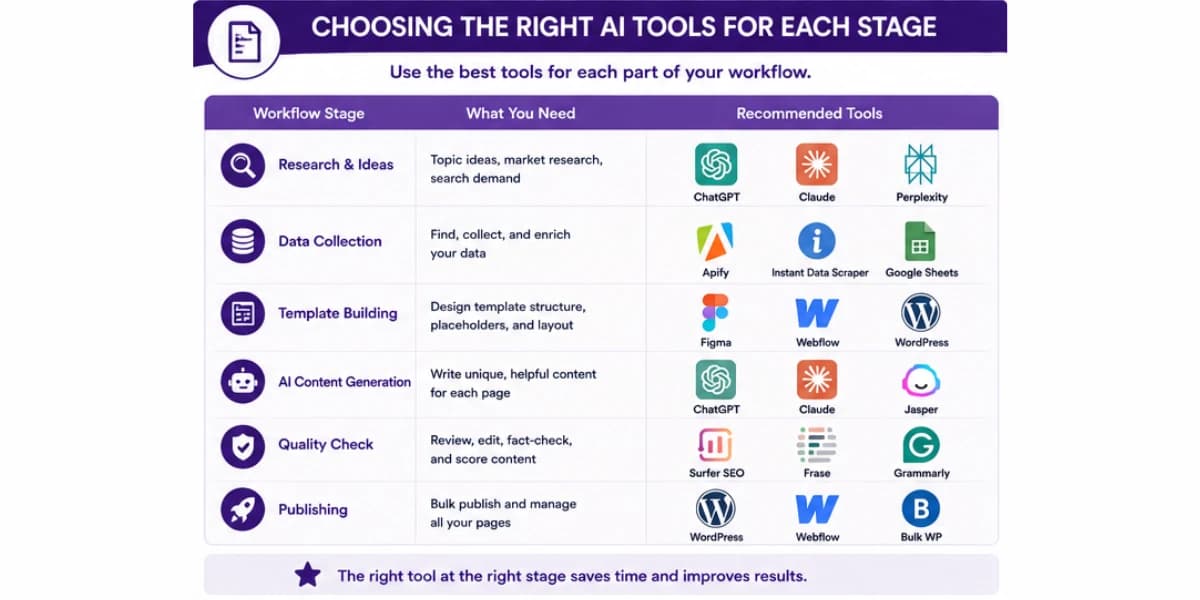
For writing the unique content on each page, a tool that lets you feed in structured data alongside clear instructions works best.
Being able to paste in a template and a data row together, then get back a finished paragraph, is the core skill you need at this stage.
For quality checking, a tool with strong reasoning ability helps the most, since it needs to compare written text against source data and catch subtle mismatches rather than just generating fresh content.
That stage benefits from a careful, methodical tool more than a fast, creative one.
No single tool needs to handle every stage perfectly.
Many successful projects mix a general AI assistant for most of the writing and reasoning work with a dedicated spreadsheet or database tool for the heavier data organizing tasks.
Using content optimization tools like Frase or Surfer SEO can help you catch some of these issues before publishing, though they still do not replace a careful human read through.
Building A Simple Prompt Library For This Workflow
Since you will likely repeat this whole process more than once, it helps to save your best-performing prompts in one place rather than rewriting them from scratch every time.
Keep a document with your proven prompts for each stage of this workflow, from topic research through quality checking.
Leave clear blank spots in each prompt where you will fill in details specific to your current project, like your topic, your data fields, or your target reader.
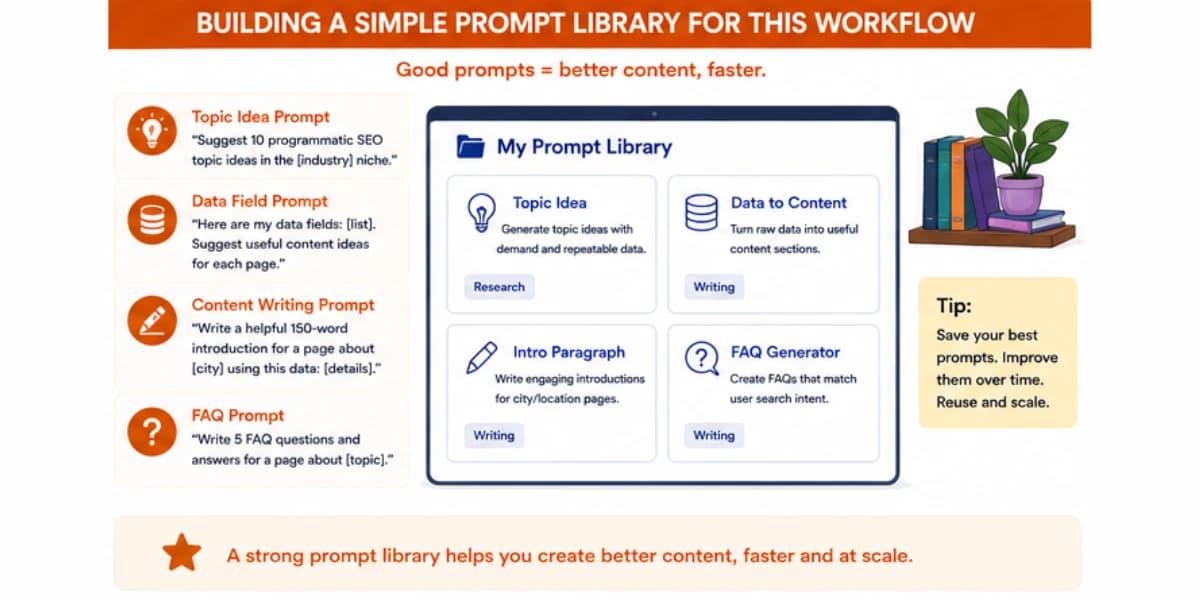
Update this document every time you learn something new.
If a small tweak to a prompt produces noticeably better results, save that improved version so your next project benefits from what you learned this time around.
Share this prompt library with anyone else on your team working on similar projects.
A well-built prompt library saves a huge amount of trial and error for anyone starting a new programmatic SEO project after you, turning hard-won lessons into something the whole team can benefit from right away.
Keeping AI-Generated Pages From Feeling Thin
A common worry with this whole approach is that AI-written pages will feel thin or fake to a real reader. That worry is fair, but a few habits go a long way toward solving it.
Give AI more than just the bare minimum data for each page. The more specific facts you feed into the prompt, the more specific and useful the finished paragraph tends to be.
A page built from just a name and one number will always feel thinner than a page built from five or six real, specific details.
Ask AI to include a small piece of practical advice or context on every page, not just a restatement of the raw numbers.
A page about coffee prices in a city feels more useful when it includes a quick tip about what a fair price range looks like, not just a flat statement of the average number.
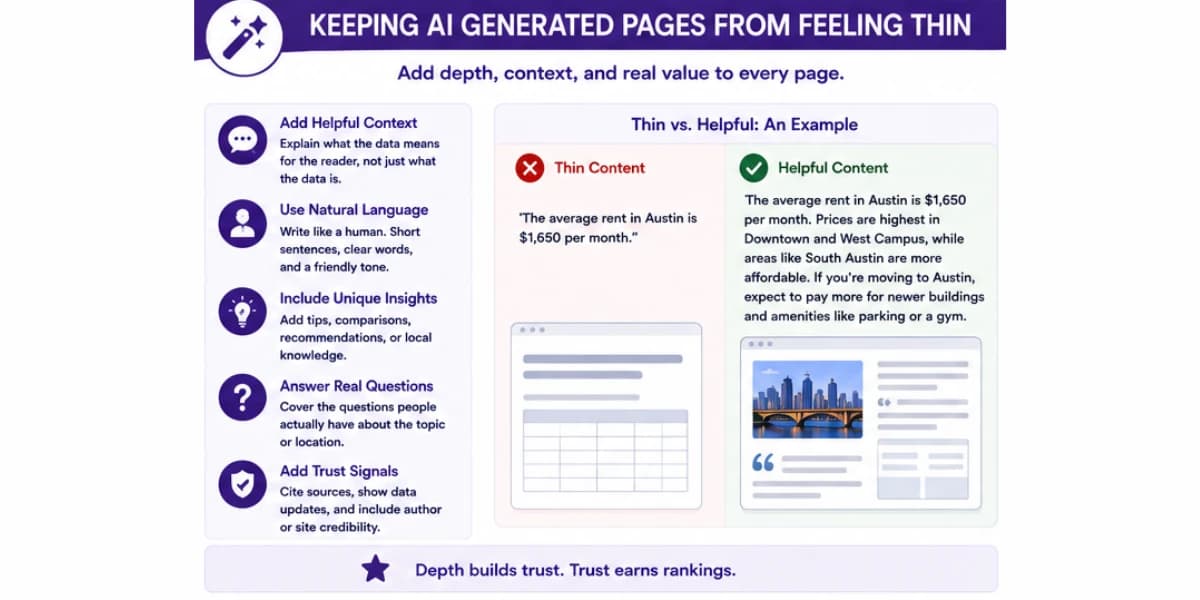
Mix in a few unique touches per page that come from something other than your core data set.
A small unique touch might be a local landmark, a nearby comparison, or a small seasonal note.
Even one small unique detail per page can make a big difference in how genuine the page feels to a real reader.
Read a handful of pages out loud during your quality check stage.
Reading out loud is a surprisingly effective way to catch stiff, robotic phrasing that can slide past a normal silent read-through without anyone noticing.
Avoid publishing pages built from extremely thin data rows.
If a handful of entries in your data set only have one or two fields filled in, it is often better to leave those specific pages out of your first batch rather than publishing a weak page just to hit a bigger page count.
Understanding how Google evaluates expertise and trust is essential here. Our guide on whether AI can write E-E-A-T content breaks down what Google actually checks when deciding which pages deserve to rank.
Scaling Up Beyond Your First Successful Batch
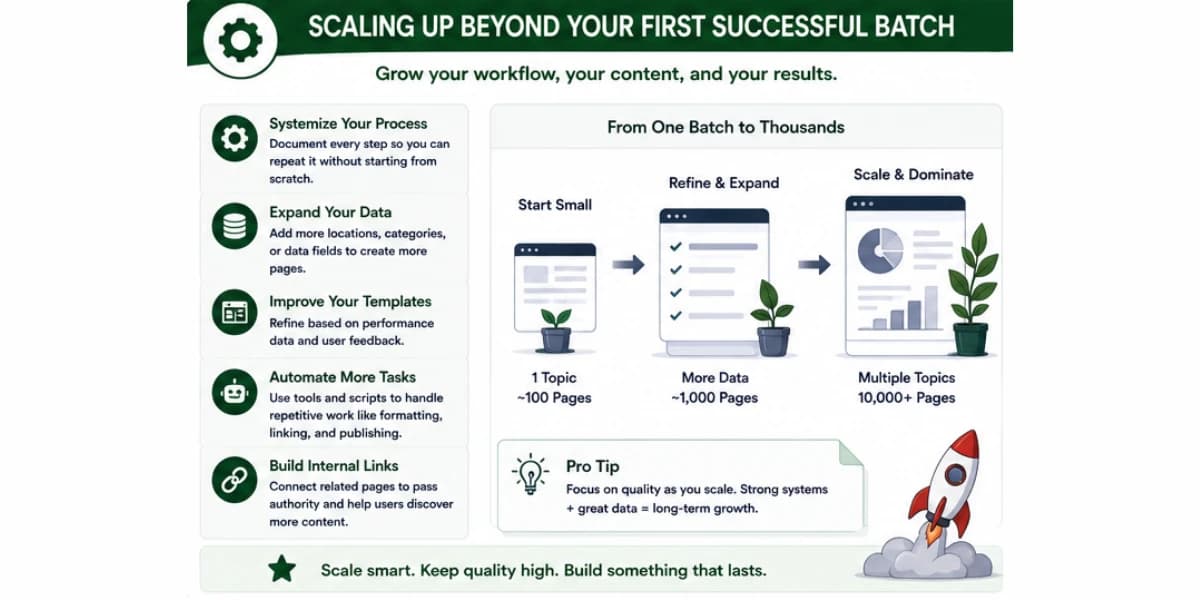
Once your first batch proves itself with solid traffic and few problems, it is natural to want to grow the project further. A few habits keep that growth healthy instead of risky.
Expand into closely related topics before jumping to something totally different.
If your first batch covered car insurance rates by state, a natural next step might be car insurance rates by city, using a very similar template and workflow you already know works well.
Reuse your proven template structure whenever the new topic allows it.
Building a brand new template from scratch for every single expansion wastes time you could spend improving what already works.
Small tweaks to a proven template usually beat starting over completely.
Keep your prompt library updated as you expand, adding any new lessons learned from each new batch.
Over time, this growing library becomes among the most valuable assets tied to your whole programmatic SEO effort, saving real time on every future project.
Watch your site's overall health as you keep adding new batches of pages.
A site that grows too fast, publishing wave after wave without pausing to check quality and performance, risks diluting the trust it built with its earlier, well-tested batches.
Slower, steadier growth tends to protect the gains you have already made.
Set a recurring review schedule across your entire programmatic SEO footprint, not just your newest batch.
As your site grows to include several different programmatic projects, it becomes easy to lose track of older batches that might need a data refresh or a template update.
A simple calendar reminder, checked every few months, keeps every part of your project healthy over the long run.
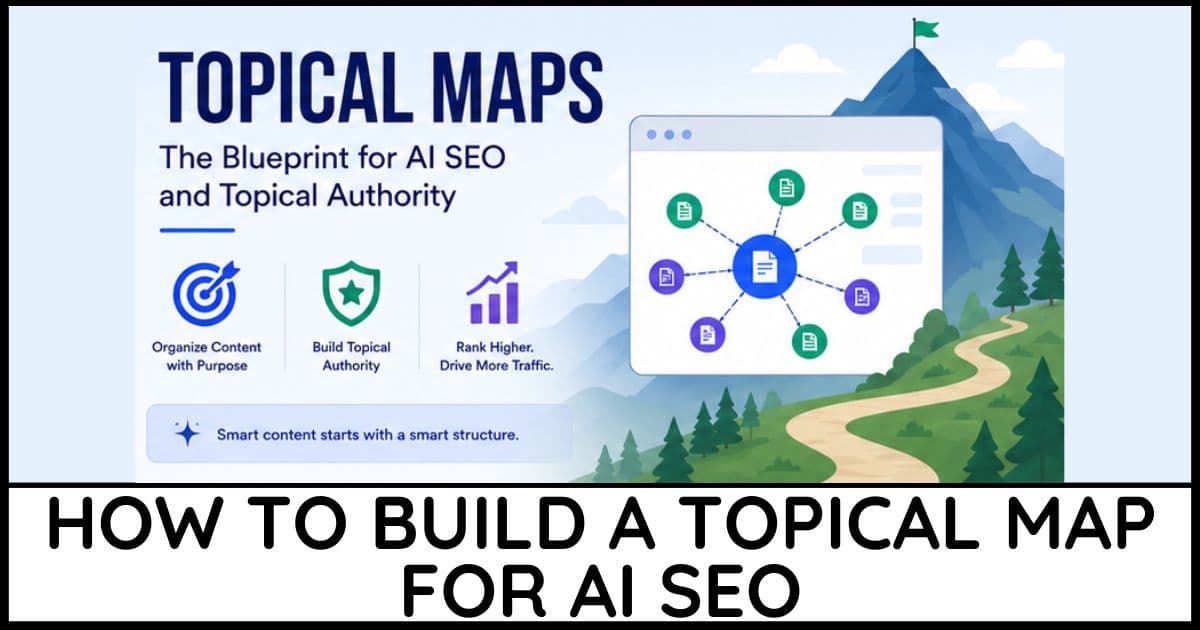
Building a topical map for AI SEO gives you the content structure that makes planning programmatic pages much easier, since you already know which pages should support which others.
Common Mistakes When Using AI For Programmatic SEO
A frequent mistake is trusting AI-generated facts without checking them against your real data.
AI can occasionally state a number slightly wrong or mix up details between two similar entries, so a quick check against your source data protects you from publishing quiet mistakes across your whole batch.
These small mistakes rarely announce themselves, which is exactly why a deliberate check matters so much here.
Another mistake is generating your entire batch in one giant pass without any checks along the way.
Small problems in your prompt or your template can multiply fast once they get copied across thousands of pages, so smaller batches with checks in between catch these problems while they are still easy to fix.
A problem caught in a batch of fifty pages takes minutes to correct. The same problem caught only after five thousand pages have already gone live can take days to fully clean up.
Skipping the human review stage entirely is a serious mistake many people make once they get comfortable with AI tools.
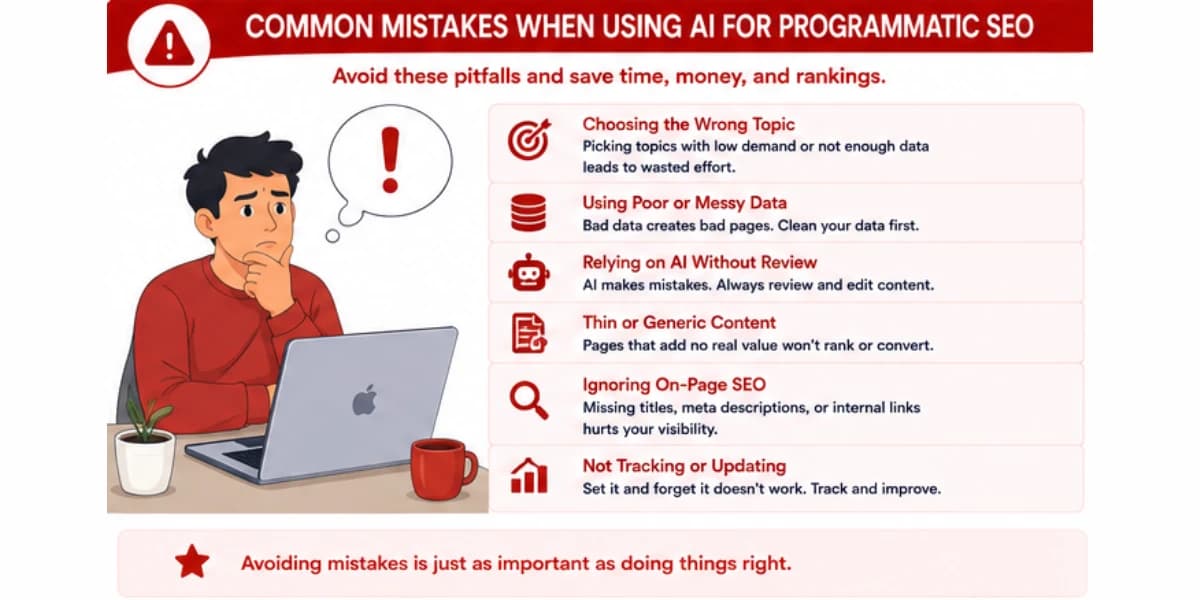
Even a strong AI workflow still benefits from real human eyes checking a sample of pages before the full batch goes live, since comfort with a tool can quietly turn into overconfidence if nobody stays in the habit of double-checking its output.
Using the exact same prompt with no variation across every single page is another common issue.
Feeding AI slightly different framing or slightly different sample sentences here and there helps keep your batch feeling less repetitive, even when the underlying template structure stays the same.
A little variety in how you prompt goes a long way toward avoiding the copied, robotic feel that hurts weaker programmatic SEO projects.
Forgetting to update your data over time is a mistake that quietly hurts results months after launch.
A page that was accurate on the day it was published can become wrong and unhelpful a year later if nobody goes back to refresh the numbers behind it, and by then the drop in performance often looks like a mystery unless someone remembers to check the data first.
Keeping time sensitive content fresh and accurate is where a solid AI content refresh workflow becomes genuinely valuable, since it helps you catch outdated details before they hurt your credibility.
How Much Human Time This Workflow Really Saves
It helps to have a realistic sense of the time savings this kind of workflow can bring, since expectations that are too high often lead to disappointment.
Knowing roughly how much faster this process really is, compared to a fully manual approach, helps you set fair goals for your own project timeline.
Writing one thousand pages by hand, even simple ones, could easily take a small team several months of steady work.
Using the AI-assisted workflow described here, a single person can often move through data gathering, template building, content generation, and quality checks for a similarly sized project in a matter of weeks, not months.
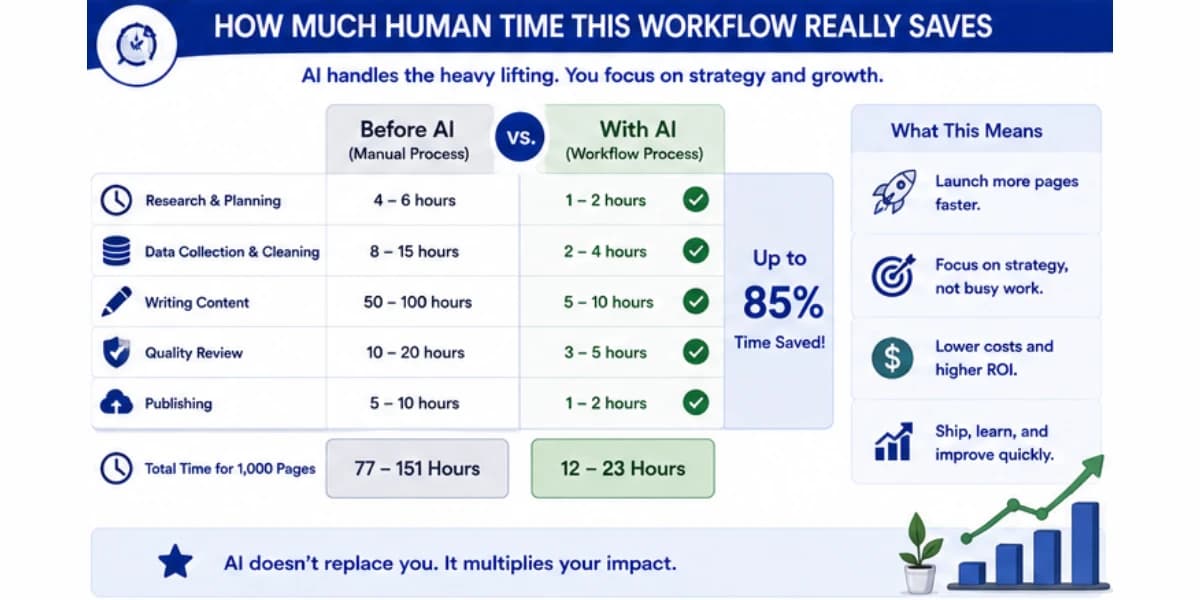
The biggest time savings show up in the writing stage, where AI can generate the unique text for hundreds of pages far faster than any human writer could type them out by hand.
The time that still takes real human effort is quality checking, template design, and ongoing updates, which is exactly where human judgment matters most anyway.
A realistic expectation is that AI removes most of the repetitive typing work, while a person still needs to guide the process, check the results, and make the judgment calls that keep the whole project trustworthy.
If you are exploring how AI agents fit into this picture, our guide on AI SEO agents explains where automated tools genuinely help and where they still need a human in the loop.
Final Thoughts
AI has made programmatic SEO faster and more practical for site owners of almost any size.
A workflow that once needed a large team of writers can now run with a much smaller team, using AI to handle research, writing, and quality checks at each stage while a human guides the process and makes the final calls.
The key to doing this well is treating AI as a powerful helper, not a fully hands-off machine.
Feed it clean, specific data. Build a strong template first. Check quality on small samples before scaling up. Keep your data fresh over time.
Follow this path, and you can build a programmatic SEO project that genuinely helps readers, instead of one that just floods the internet with thin, forgettable pages.
If you are starting your first project, resist the urge to rush straight to a huge batch of pages.
Work through each stage carefully, even if it feels slower at first.
A small, well-built batch of one hundred genuinely useful pages will almost always beat a rushed batch of ten thousand thin ones, both in how readers respond and in how search engines treat your site over time.
The workflow described here rewards patience at the start, and that patience tends to pay off many times over as your project grows.
Creating content that stays relevant for years requires a different approach than chasing trends. Our article on creating evergreen content explains how to write articles that continue driving traffic long after publication, which is just as important for programmatic pages as it is for hand-written ones.
Frequently Asked Questions
1. Can AI handle the entire programmatic SEO process without any human involvement?
Not reliably. AI speeds up research, writing, and quality checking a great deal, but human review still catches mistakes AI misses, especially factual errors and awkward wording that only becomes obvious when a real person reads the page. Treating AI as the whole team, with nobody double-checking its work, is where most failed projects go wrong.
2. How much data do I need before starting a programmatic SEO project with AI?
Enough to build at least a few hundred pages worth trying, since setting up templates and prompts takes real time that is easier to justify with a larger data set. A handful of entries usually is not enough to make the setup effort worthwhile.
3. Will AI-written pages all sound the same across a big batch?
They can, if you use the exact same prompt with no variation. Adding sample sentences, slightly different framing, and real specific details from your data helps keep pages feeling distinct even across a very large batch.
4. How do I stop AI from stating wrong facts on my pages?
Feed AI the exact, verified data for each page rather than asking it to guess or recall facts on its own. Also run a check comparing generated text against your source data before publishing, catching any mismatches early.
5. Is it safe to publish thousands of AI-written pages at once?
It is safer to publish in smaller waves, checking quality and performance after each wave before moving on to the next. Publishing everything in one giant batch makes it much harder to catch and fix problems early.
6. How often should I update pages built with this workflow?
It depends on how fast your underlying data changes. Pages built on pricing or availability data often need updates every few months, while pages built on more stable facts might only need a check once or twice a year.
Understanding the difference between informational and commercial content helps you decide which types of programmatic pages to build first and how to structure them for the right search intent.