Affiliate Marketing Vs Sponsorships: Which Pays Better
Sponsorship deals and affiliate links both pay creators for the same core work, an audience that trusts what they say.
A sponsorship pays a flat fee the moment the post or video goes live. Affiliate marketing pays a small cut every time a reader buys through your link.
Plenty of creators run both at once and earn more because of it. Plenty of others pick a side early, stick with it for a year, and wish they had gone the other way.
Neither model wins by default. The better deal depends on your audience size, your niche, and how much work you want to do after publish day.
The guide below runs through five steps that settle the question for your own situation. Each step builds on the one before it, so run them in order.
Think of it as a worksheet for your own numbers instead of a ranking list. The model that wins for a beauty creator with a million followers can lose badly for a niche blogger with five thousand readers.
By the end you will know what each model pays, what it costs you in hours, and which one fits the stage you are at right now.
Both paths have made people rich, and both have disappointed people who expected easy money. The difference between those outcomes was usually fit instead of effort.
If the affiliate half of this is new territory, read our guide on what affiliate marketing actually is first.
Our page on how affiliate marketing works also shows how a commission travels from a merchant to your bank account.
None of the five steps needs a big budget or a huge following. An honest look at your own numbers is the only raw material required.
The whole exercise also works with rough numbers. Precision matters less than using your own figures instead of borrowed averages from someone else's income report.
Disclosure: Some of the links I share might be affiliate links. If you click on one and make a purchase, I may earn a small commission as a thank you. But don’t worry, it won’t cost you anything extra. I only recommend stuff I genuinely believe in. Your support helps me keep creating awesome content. You can read my full affiliate disclosure in my disclaimer page.
If you want to save a lot of hours searching for high-paying affiliate programs, check out our exclusive list of 2500+ affiliate programs. You’ll find all the information about the programs inside the list. This list is perfect for affiliate bloggers and influencers.
How To Use This Comparison
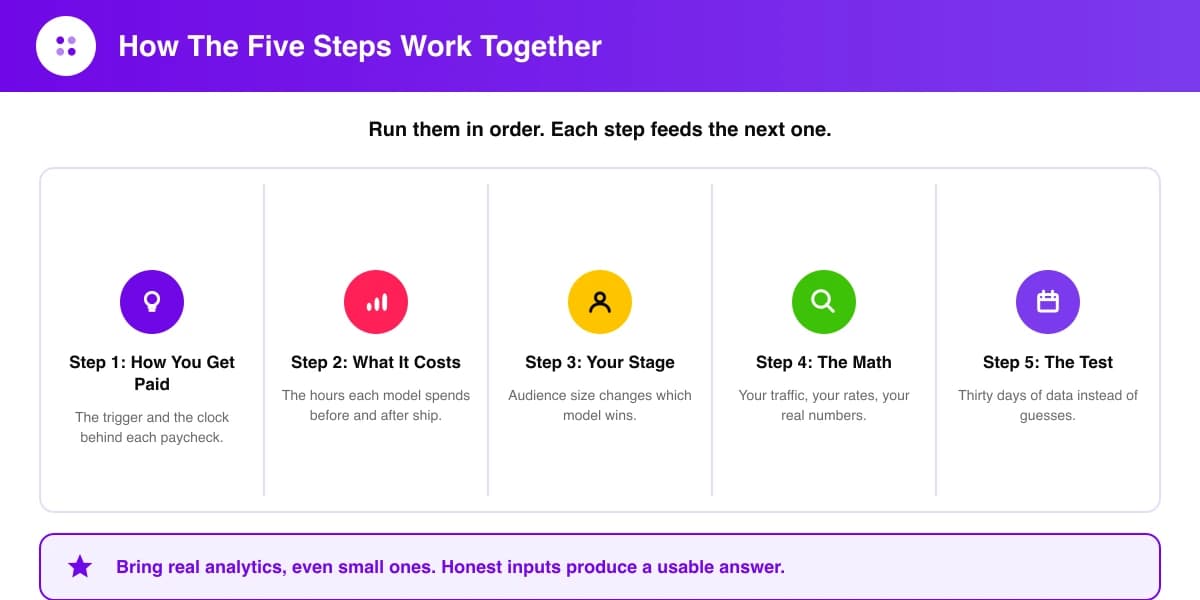
The five steps run in a specific order, and each one feeds the next.
Step one explains how the money moves in each model, and step two puts a price on your time in both.
Step three matches each model to your stage, step four does the math on your real traffic, and step five runs a short test so you pick with data instead of guesses.
Skipping ahead is tempting. A reader who jumps straight to the math usually plugs in invented numbers, then picks whichever model sounded better anyway.
Treat the steps like a worksheet and keep a notes app open while you work. Write a real answer for each one instead of skimming.
Two people can finish this exercise and pick different answers, and both can be right. An email list of twenty thousand completely changes the math when compared with a brand new blog.
There is no trophy for picking the bigger sounding model either. The winner is the one your current audience can support this quarter, and you can switch sides whenever the numbers say so.
Bring your real analytics to the table, even if the numbers look embarrassing. Small honest inputs produce a usable answer, while flattering inputs produce a plan built on sand.
Nothing here requires a spreadsheet wizard either. A notes app and a calculator handle every step, and the whole exercise takes an afternoon.
The comparison sticks to income you earn online from your own audience. Brand ambassador contracts and long term consulting deals live in a different world.
Our guide on affiliate marketing vs dropshipping covers another popular either-or choice if you are still lining up options.
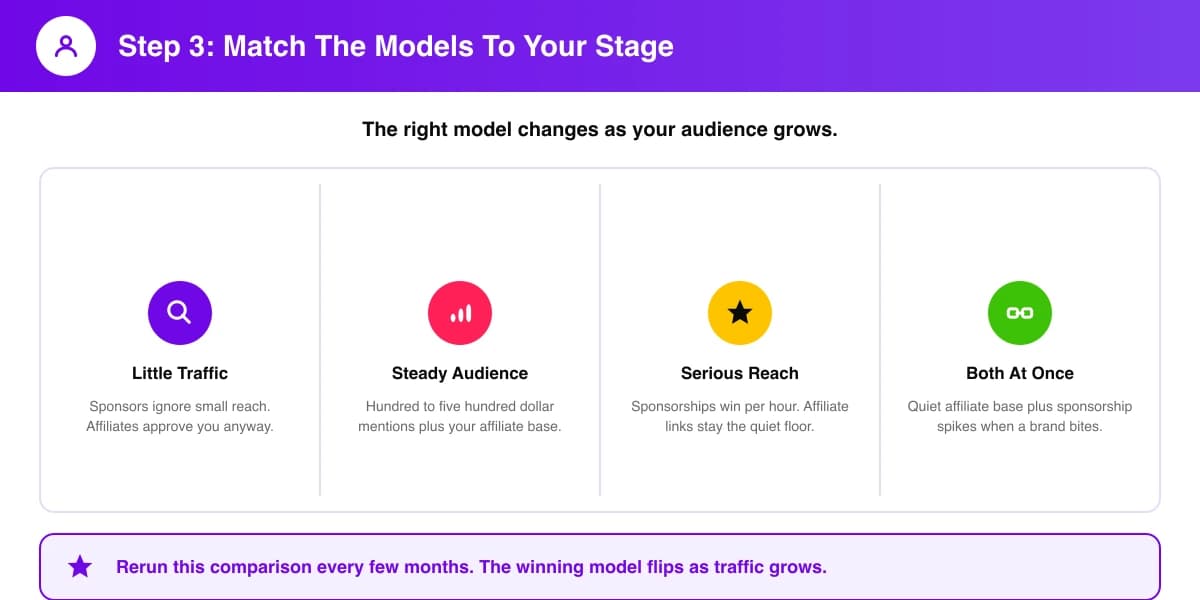
Come back to the steps every few months too. Traffic, audience size, and offer payouts all drift over time, and the winning model can flip.
A quick rerun after every traffic milestone keeps the answer current. The math that favors affiliates at five thousand readers often flips toward sponsorships at fifty thousand.
Step 1: Learn How Each Model Pays
Payout numbers mean little until you know when the money arrives and what has to happen first. That difference matters more than the headline percentages.
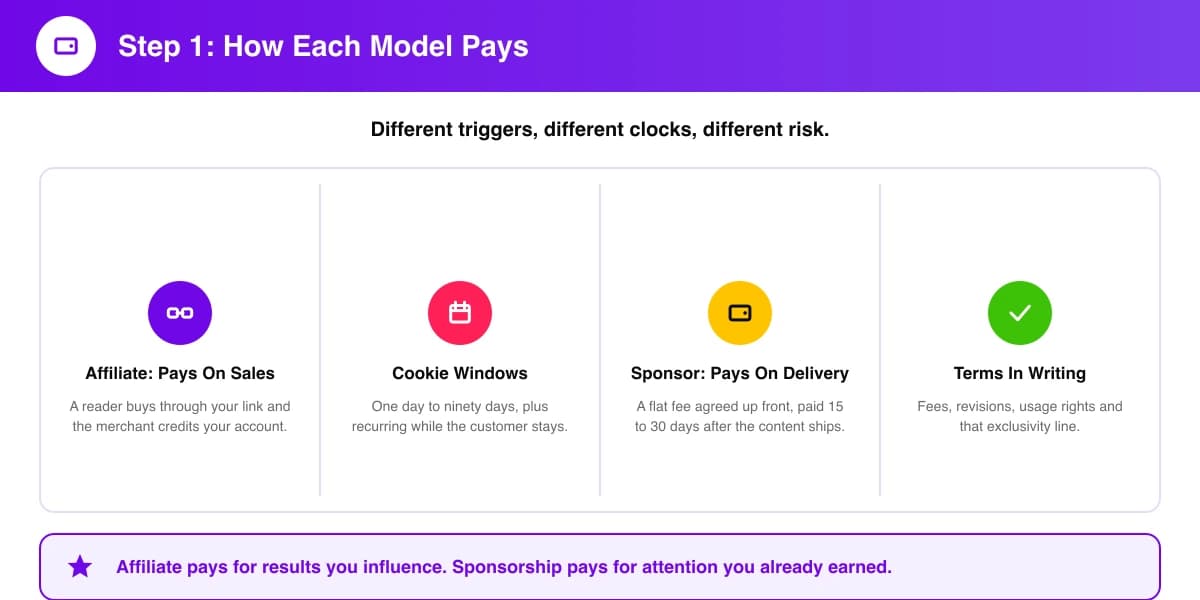
The two models also run on completely different clocks. Sponsorships pay on delivery, while affiliate income pays on results.
How Affiliate Marketing Pays
An affiliate link is a tracked pointer to a product you recommend. The merchant tags the click with your ID, and if the visitor buys inside a set window, your account gets credited.
Cookie windows run from a day to ninety days depending on the program. Recurring software offers keep paying every month the customer stays subscribed, and that is where small commissions turn into real income.
Rates vary widely. Digital products often pay twenty to fifty percent, physical goods run one to ten percent, and high ticket programs can pay hundreds for a single sale.
Recurring offers deserve special attention. A fifteen dollar monthly commission sounds small until the same customer pays it for two years, and the page that referred them keeps collecting without any new work.
Nothing lands in your account until someone buys. That is the trade, no sales and no checks.
Programs also come in three flavors: in house offers run by the merchant, big networks that host thousands of deals, and referral codes from tools you already use. Each tracks differently and pays on its own schedule.
Managers change the rules without warning too. A program can cut its rate from thirty percent to ten overnight, and your best page earns less from the very next click.
How Sponsorship Deals Pay
A sponsorship is a paid placement. A brand pays a flat fee for a post, a video, a newsletter slot, or a simple mention.
The fee gets negotiated before any work starts, and it does not move based on how many sales happen after launch.
Some brands bundle a discount code into the deal, so you collect a fee plus a bonus per sale. Most brands do not.
Payment usually arrives fifteen to thirty days after the content ships. Large brands sometimes run net sixty, so cash flow timing matters if you depend on the money.
Ask for the terms in writing either way. A handshake deal at a hundred dollars is a small gift, and a handshake at three thousand is a headache waiting to happen.
Pricing is anchored to reach. Brands think in subscriber counts, monthly readers, and cost per thousand impressions, so your rate card starts with your own numbers.
Watch for hybrid deals while you negotiate. A flat fee plus a small commission per sale pays you for the work and rewards you for the results too.
Deliverables define the job. A typical deal names the format, the publish date, the number of revisions, and how long the brand can keep using your footage, and every extra line in that list adds hours.
Read the exclusivity clause before you sign anything. One line can lock you out of every competing affiliate program for a year, which quietly costs more than the fee pays.
Retainers change the picture again. A brand that books you every month gives you predictable income, and you stop paying the pitch tax on every single deal.
So the affiliate model pays for results you can influence but never fully control. The sponsorship model pays for attention you have already earned.
Step 2: Count What Each Model Costs You
Payouts tell only half the story. The other half is the work each model demands before and after the content ships.
Affiliate content is a slow burn. You research and record once, and the piece can bring clicks for years if the page ranks and the offer stays alive.
That curve frustrates people in month two. The same honest page that earned nothing in March can pay your phone bill in November once it climbs into the top three results.
The hidden costs add up quietly. Honest testing, time with the product, updates when pricing changes, and the occasional commission cut when a merchant trims its rates.
The dependency risk sits underneath all of it. One merchant can close its program next Tuesday, and your income from that page drops to zero no matter how good the review is.
The work never fully ends either. Links rot, programs close, and a page that earned last year can earn nothing this year if nobody checks it.
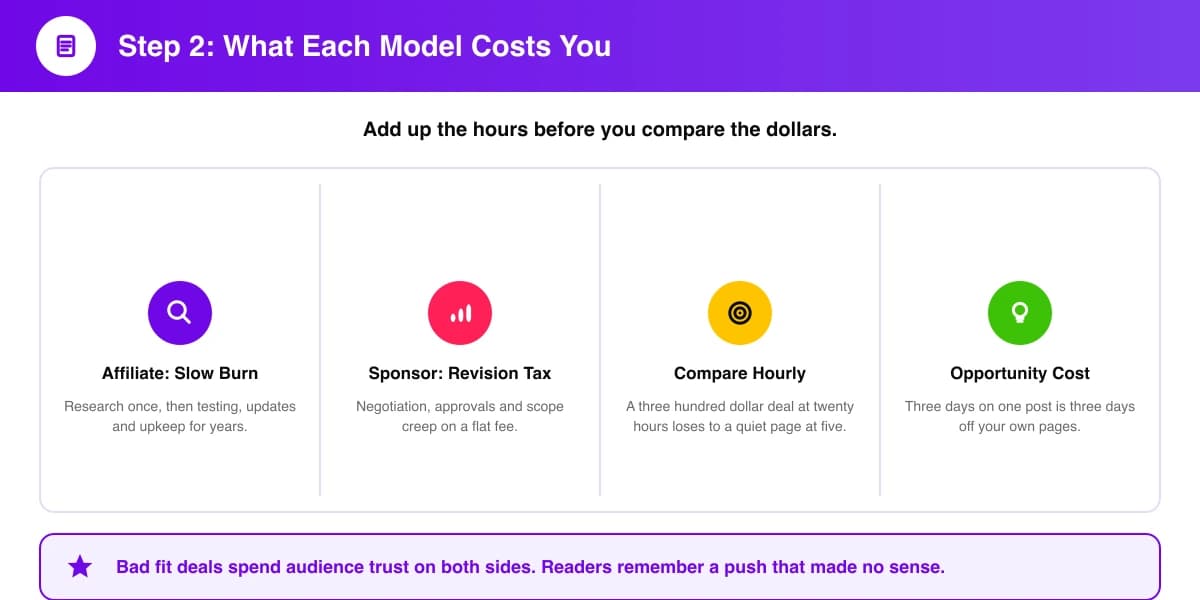
Sponsorships are front loaded and heavy. Pitches, rate negotiation, drafts, brand revisions, legal approvals, and disclosure rules all arrive before anything goes live.
One deal can eat a full week of your calendar, and then the brand owns a piece of your schedule every time renewal season comes around.
Every deal also restarts the machine. You pitch again, negotiate again, and wait on approvals again, so a chunk of the calendar belongs to the brand as much as to you.
Scope creep is the other tax. The brand adds another revision, another format, another quick mention, and the flat fee stays flat.
Sponsorships also spend audience trust when the fit is bad. Readers forgive an honest recommendation that flops, and they remember a paid push for a product that made no sense for you.
Brands ghost too. A deal that looked solid in email can vanish when the budget freezes, and the week you held for it is already gone.
Affiliate marketing carries the same trust risk if you attach a commission link to everything. Our list of high quality affiliate programs shows what a selective shortlist looks like.
Add up the hours for both models before you compare the dollars. A three hundred dollar sponsorship that takes twenty hours pays worse than a quiet affiliate page that earns a hundred a month from five hours of upkeep.
Opportunity cost counts here too. Three days spent on one sponsored post are three days you did not spend building a page that could rank for years.
Step 3: Match The Models To Your Stage
Audience size changes everything about this decision. The same two models offer a completely different deal to a beginner and to an established publisher.
Starting Out With Little Traffic
With a new site or channel, you have almost nothing to sell to sponsors. Brands buy reach, and a thousand monthly visitors does not move their needle.
Affiliate programs, by contrast, will usually accept you once you have a live site with real content. Approval is easier, and the pages you build now compound for years.
Programs also care about activity more than size. A small site that publishes steadily and answers its email looks safer to a manager than a dormant channel with a bigger number attached.
Affiliate fits awkward niches too. If brands in your topic never buy sponsorships at all, affiliate links may be the only paid path your audience will ever support.
The early play is honest volume: publish helpful answers, apply to a handful of good programs, and let search bring in visitors who already want to buy. Our guide on how to do keyword research keeps that targeting sharp.
Growing With A Steady Audience
Once you pull a few thousand visitors a month or hold a few thousand email subscribers, sponsors start returning your emails.
Deals at this stage pay small fees, often a hundred to five hundred dollars for a mention, and the brand cares more about fit than raw numbers.
Local businesses and smaller software brands live in this range. They care about relevance and a good fit, and they move faster than the agencies that handle bigger budgets.
That overlap is worth keeping. Your affiliate links inside the best content keep earning while you pitch a couple of sponsorship slots each month.
Sponsor fit matters more here than a bigger follower count. A brand whose product solves your audience's exact problem will pay for the match, and a famous brand with no connection will not.
Established With Serious Reach
Past fifty thousand monthly readers or a six figure email list, sponsorship becomes the faster earner per hour worked.
Enterprise brands bring agencies into the process too. Expect contracts, invoicing portals, and approval chains that stretch a two day job into two weeks.
A single sponsored newsletter can beat a whole quarter of affiliate commissions, and you can repeat it every month with the same happy advertiser.
Even at the top, affiliate income stays valuable. It needs no contract, no invoice, and no round of revisions before the money arrives.
The honest summary is simple: start with affiliate marketing, add sponsorships when brands begin coming to you, and keep both once the checks overlap.
Step 4: Run The Numbers On Your Traffic
Time to get concrete. Use your real numbers instead of someone else's case study.
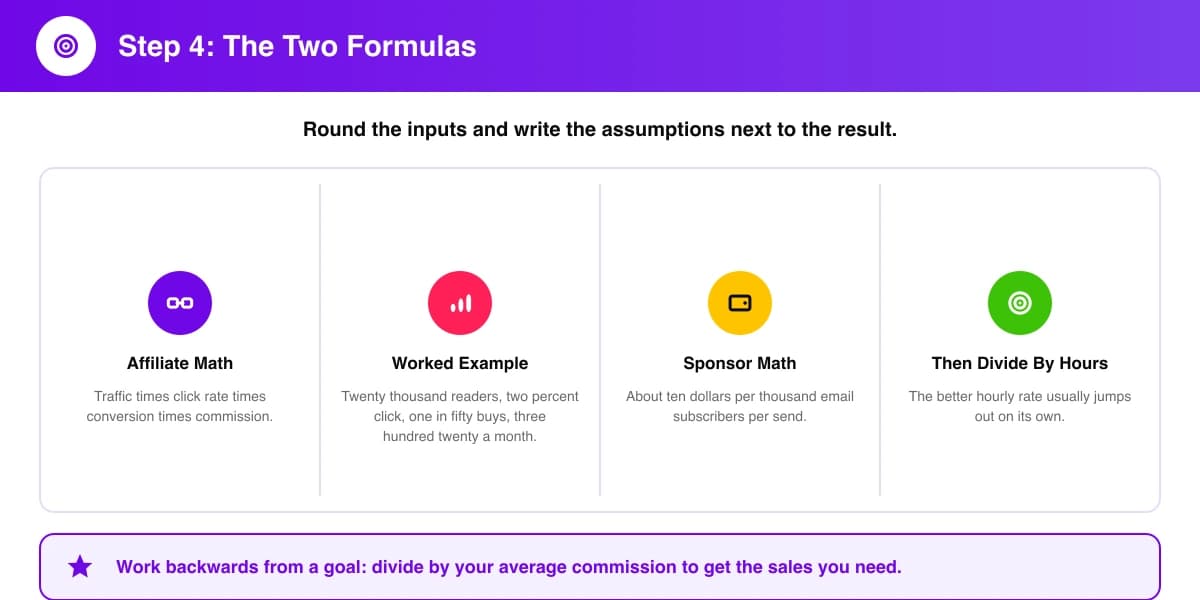
Two formulas do all the work here, and each one maps straight to a model.
The Affiliate Math
Start with monthly traffic, then multiply by your link click rate, your conversion rate, and the average commission.
Say your site pulls twenty thousand readers a month and two percent of them click an affiliate link. That is four hundred clicks, and if one in fifty buys, you land eight sales.
Eight sales at forty dollars each is three hundred twenty a month from a single page, and that page can keep working long after you stop touching it.
Work backwards from a goal once the example makes sense. If you want two thousand a month from affiliate links alone, divide by your average commission, and you have the number of sales your pages need to produce.
Change one variable and the answer swings hard. A recurring software offer at sixty dollars a month, or a high ticket program that pays three hundred per sale, turns the same traffic into four figures.
Two tools keep the inputs honest: a keyword research tool shows the search volume you can realistically capture, and a link tracker shows which pages actually convert.
The Sponsorship Math
Sponsorship math starts from your audience. Newsletter mentions often price near ten dollars per thousand subscribers, and social posts run from five to twenty dollars per thousand impressions depending on the niche.
An email list of eight thousand readers in a niche brands pay for can command two hundred to four hundred dollars per send. Two sends a month puts four to eight hundred in your pocket.
A blog with thirty thousand monthly readers lands in a similar range when the topic is commercial, like finance, software, or home and garden gear.
Social rates work the same way. A twenty thousand follower account in a paying niche can ask a hundred to two hundred a post, while a general account often struggles to clear fifty.
Now put the two results side by side and subtract the hours from step two. Divide each figure by the time it takes to earn it, and the better hourly rate usually jumps out.
Round every input and write the assumptions next to the result. A model built on rough numbers still beats a gut feeling, and you can rerun it next month with real data.
Step 5: Test Both Models For 30 Days
The spreadsheet gets you close. A short live test settles the question for good.
A test also kills the debate in your head. Guesses about what your audience wants survive forever, and real clicks die on contact with the first week of data.
Record your baseline before day one. Traffic, subscriber count, and current monthly earnings give the test something to be measured against.
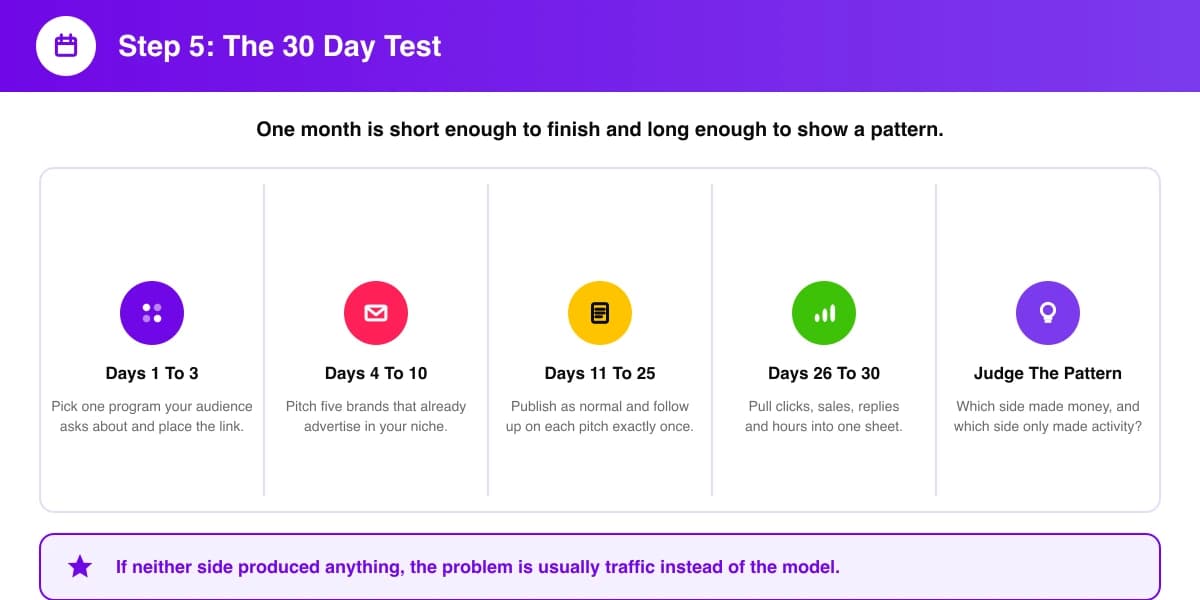
Days one to three: pick one affiliate program your audience already asks about, grab your link, and place it in your three best pieces of content.
Days four to ten: write one short pitch email to five brands that already advertise in your niche, and send it with your real numbers attached.
Make the pitch easy to answer. Name the placement, the price, and the publish window in the first three lines, because busy marketing managers skim everything.
Days eleven to twenty five: publish as normal, share the pieces carrying your links, and follow up on each pitch exactly once.
Days twenty six to thirty: pull the numbers. Affiliate clicks, sales, sponsorship replies, and hours spent on each side all go into one sheet.
Our affiliate marketing in your first 30 days guide works as a day by day template if you want the schedule spelled out.
One month is short enough to finish and long enough to show a pattern. Watch which side produced money and which side only produced activity.
Keep a short journal beside the numbers too. Note what you pitched, what you published, and how long each task took, because the sheet alone rarely explains a strange week.
If neither side produced anything, the problem is usually traffic instead of the model. Grow the audience first, then rerun the same test next month.
Run a second round if the first month looks confusing. Two months of clean data beat one noisy week every time, and the pattern gets easier to trust.
Keep the test small on purpose. Pushing hard in both directions at once muddies the results and burns you out before week four.
What Results To Expect From Each Model
Affiliate income starts slow and stacks. Month one usually brings clicks and no sales, and the first real commissions tend to land between week four and week ten.
Sponsorships are lumpy by nature. One month can bring three deals and the next can bring zero, so treat that income like a pipeline instead of a salary.
Small audiences still produce results on both sides. A hundred true fans who trust your picks can outspend ten thousand passive followers who scroll past everything.
Trust converts better than traffic anyway. A reader who has taken three of your recommendations before will take the fourth, and brands notice that pattern when they study your numbers.
Seasonality moves both incomes as well. Holiday shopping, tax season, and back to school spikes lift commissions and ad budgets at the same time, so a slow January proves nothing.
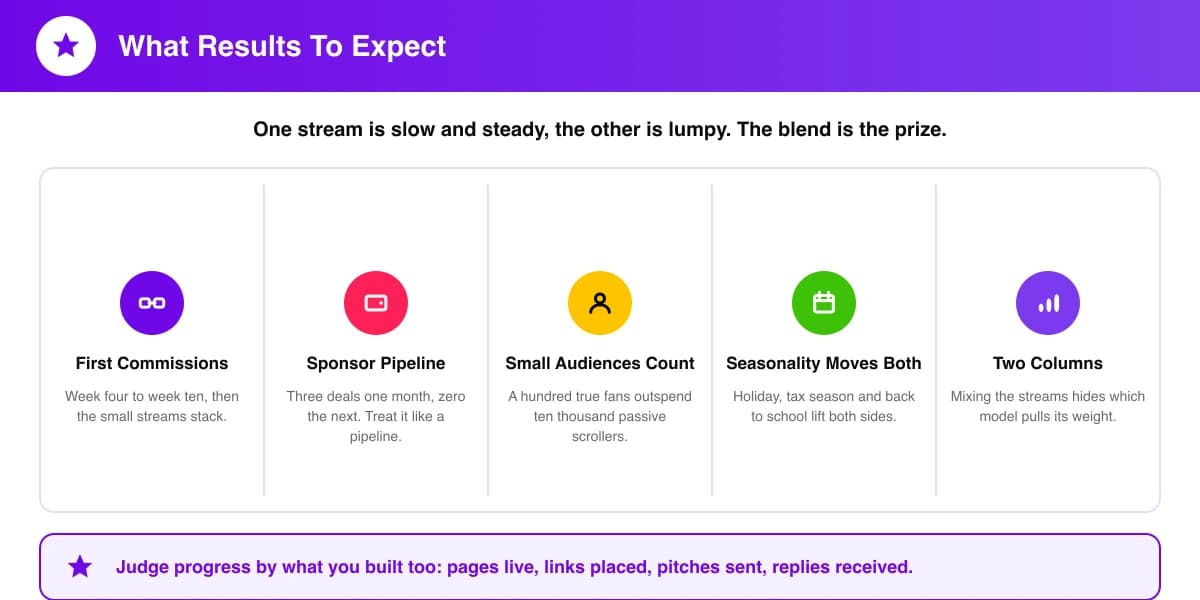
Most creators who stick with both end up with a blend: a quiet affiliate base that grows every month, plus sponsorship spikes when the right brand bites.
Expect the affiliate half to look boring on a weekly basis. Growth there arrives in small steps that only become obvious when you compare this quarter with the last one.
That blend is the real prize. The predictable half keeps the lights on, and the lumpy half funds the big purchases.
Judge progress by what you built as much as by what got deposited: pages live, links placed, pitches sent, and replies received.
Keep the two streams in separate columns on your tracker as well. Mixing them hides which model is actually pulling its weight, and hidden weakness never gets fixed.
Common Mistakes When Comparing The Two
Comparing gross payouts instead of hourly rates is the most expensive error in this whole exercise.
Chasing sponsorships before you have an audience inverts the order. Brands pay for reach, and without reach you have little to sell them.
Promoting anything with a commission attached burns the trust both models share. Readers can tell when a recommendation was written for the payout.
Skipping disclosure is the one mistake with real legal consequences. Both models need a clear, visible disclosure from the very first post, and ours sits on our legal disclosures page.
Quitting the test in week two is equally common. Affiliate income especially needs a few months before any pattern becomes visible.
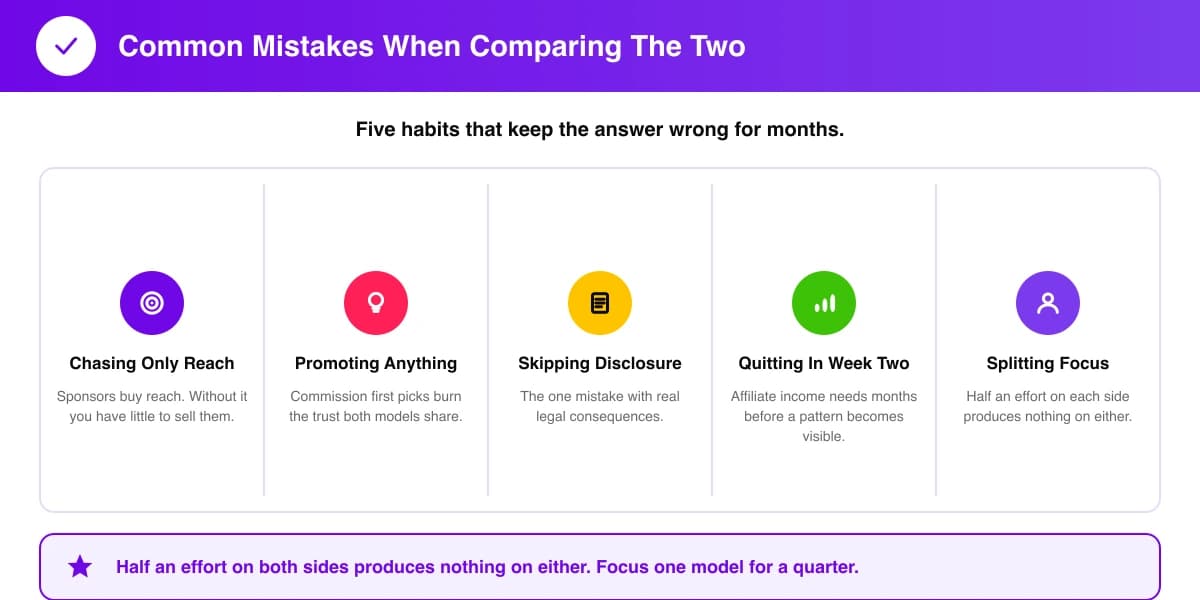
Splitting your focus down the middle fails too. Half an effort on each side produces nothing on either, while full focus on one side for a quarter produces something you can measure.
Waiting for perfect traffic numbers before choosing wastes months too. The math in step four works fine on rough estimates, and a rough answer today beats a precise one in July.
Changing your price after every rejected pitch undercuts you as well. Set a rate from the math in step four, then hold it until your own numbers change.
Copying another creator's rate card hurts for the same reason. Their audience, their niche, and their engagement are different numbers, so their price tells you almost nothing about yours.
Final Thoughts
Sponsorships pay faster per hour once you have real reach. Affiliate income compounds more slowly and keeps earning while you sleep, with no invoices and no renegotiation.
Neither path is passive in the beginning, and both reward people who show up for months. The creators who win are usually the ones who picked one first and refused to switch every time a new tactic trended.
For most beginners the answer lands in the same place: start affiliate marketing today, and let sponsorships become an offer you receive instead of a hunt you run.
Run the five steps, keep the notes, and revisit the whole exercise in ninety days.
If the answer still feels close after the test, keep earning from both. The blend is not a tie, it is a portfolio, and portfolios survive slow months better than single bets.
Both models reward the same thing anyway, an audience that believes you when you speak.
Frequently Asked Questions
1. Which model pays more for a beginner?
Sponsorships pay more per hour on paper, but they rarely come to a beginner at all. Affiliate marketing pays smaller amounts much sooner because programs approve new creators every day and sales can start within weeks.
The smaller amounts also stack. Every new page adds a small stream, and those streams keep flowing while you chase sponsorships for a month.
2. Can you run both models at the same time?
Yes, and most mature creators do. Keep your sponsored posts separate from your evergreen affiliate pages so readers always know which content carries a paid placement.
3. How do you set a sponsorship rate?
Start from the math in step four: divide your audience by a thousand, then multiply by ten to twenty dollars depending on your niche. Adjust that number up for strong engagement and down until brands start saying yes.
4. Do you need a website for either model?
A website helps both sides and compounds over time. Creators who live on social platforms alone can still land deals, but they rebuild their reach from scratch every time a platform changes its rules.
5. How long until the first payment arrives?
Affiliate commissions usually land between week four and week ten, and the payout often clears a month later. A sponsorship can pay faster if you pitch actively, since the clock starts the moment the contract is signed.
6. Which details belong in a sponsorship pitch?
Lead with your numbers, your audience description, and one specific idea for the brand. Keep the whole thing under two hundred words, attach your media kit if you have one, and follow up once after a week.
7. Which model works better for a brand new channel?
Affiliate wins on day one because almost any program will take you, while sponsors want proof of reach first. Start there, publish steadily, and treat the first sponsorship offer as a milestone instead of a plan.
8. Do sponsorship deals affect your affiliate income?
Only when the brand asks for exclusivity and you sign it without reading. Keep non exclusive clauses in place, and a sponsored post can sit beside your affiliate pages without hurting either.