AI SEO: The Complete 2026 Guide
Search for the term "AI SEO" today and you'll quickly notice that people use it in several different ways. Some people use it when talking about writing blog posts with ChatGPT.
Others use it while discussing ways to help their websites appear inside Google AI Overviews or answers generated by ChatGPT and Perplexity. Another group uses the phrase for something much broader.
They focus on using artificial intelligence to handle keyword research, content planning, technical audits, internal linking, and many other SEO tasks that once took countless hours.
Each meaning is connected, yet every approach serves a different purpose. A lot of confusion comes from treating them as if they are exactly the same.
Clear definitions make every SEO decision much easier because every goal requires a different strategy.
AI makes each step faster, yet success still depends on good decisions made by real people.
Writing articles has never been the biggest challenge for successful websites. Finding valuable topics, organizing content correctly, updating older pages, and measuring results usually consume much more time.
Artificial intelligence now helps website owners complete those jobs much faster than before.
AI works in two different ways during the SEO process. First, AI serves as a tool that helps you perform SEO tasks more efficiently.
Second, AI has become part of your audience because many people now discover information through AI generated answers instead of traditional search results.
Both sides matter.
Content written only for AI summaries may become too short or too simple. Content created only for traditional search rankings might miss new opportunities inside AI powered search experiences.
Strong websites balance both goals while keeping readers as the highest priority.
AI should never replace solid SEO practices. Great keyword research, helpful content, clean site structure, and trustworthy information still matter today.
Artificial intelligence simply makes many parts of the process faster and easier. Good habits become even more powerful with AI. Poor habits become easier to repeat at a larger scale.
By the time you finish this guide, you'll understand how AI fits into every stage of SEO and how to use it without sacrificing quality.
Disclosure: Some of the links I share might be affiliate links. If you click on one and make a purchase, I may earn a small commission as a thank you. But don’t worry, it won’t cost you anything extra. I only recommend stuff I genuinely believe in. Your support helps me keep creating awesome content. You can read my full affiliate disclosure in my disclaimer page.
If you want to save a lot of hours searching for high-paying affiliate programs, check out our exclusive list of 2500+ affiliate programs. You’ll find all the information about the programs inside the list. This list is perfect for affiliate bloggers and influencers.
What Is AI SEO?
AI SEO combines artificial intelligence with search engine optimization. A simple definition sounds easy enough, yet the phrase actually describes several different activities.
Separating those activities helps remove much of the confusion surrounding AI SEO.
First comes AI assisted SEO work.
Artificial intelligence can speed up many everyday SEO tasks. Keyword research, topic clustering, content briefs, internal linking suggestions, technical audits, and performance analysis all benefit from AI.
Instead of spending hours sorting spreadsheets or reviewing hundreds of pages, AI can complete much of the heavy work within minutes.
Many SEO professionals use AI for exactly this purpose. Rather than replacing their skills, AI handles repetitive jobs so they can spend more time making important decisions.
Another meaning focuses on AI powered search platforms.
Google AI Overviews, ChatGPT, Claude, Gemini, and Perplexity have changed how people find answers online. Many users now receive direct responses before clicking a website.
Content creators now need to think about how AI systems read, understand, and reference their pages.
A growing number of marketers call this approach Answer Engine Optimization, often shortened to AEO. Others prefer the term Generative Engine Optimization, or GEO.
Both ideas center around making content easier for AI systems to understand and reference.
A third meaning involves AI generated content.
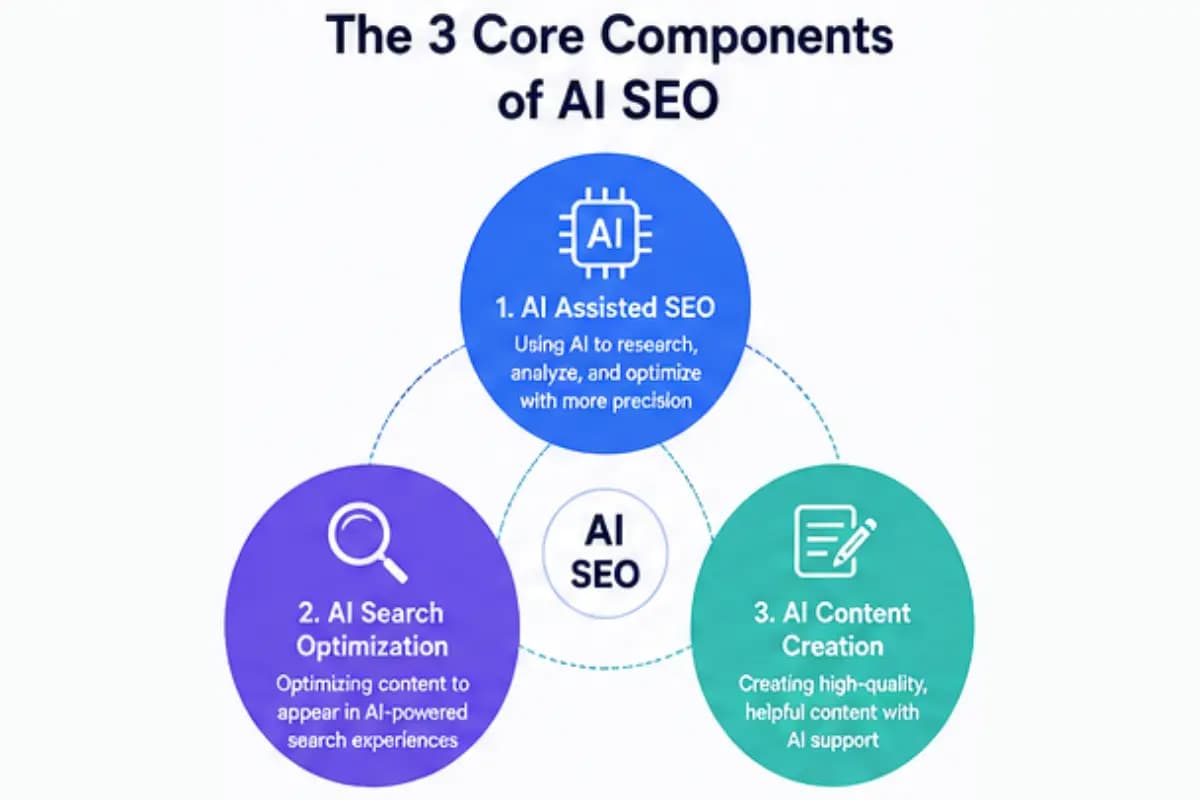
Many writers use ChatGPT or similar tools to create first drafts, improve grammar, organize outlines, or rewrite sections. Some rely heavily on AI during content production, while others use it only for brainstorming.
Google has made its position clear. High quality content matters much more than the tool used to create it.
Low effort articles created simply to chase rankings remain a poor choice regardless of who or what wrote them.
Looking at all three meanings together creates a much clearer picture.
AI SEO means using artificial intelligence to improve SEO work while creating content that performs well across traditional search engines and modern AI search experiences.
Many software companies blur these ideas together when promoting their products.
A keyword clustering tool may advertise itself as helping your content appear inside ChatGPT. Another platform may promise better AI visibility even though it mainly creates articles.
Marketing pages often mix every benefit together because the phrase "AI SEO" attracts attention.
Reality works differently. Keyword clustering solves a research problem. Internal linking tools solve a website structure problem.
Content generators solve a writing problem. AI search optimization solves a visibility problem.
Each area deserves its own strategy. Knowing exactly which challenge you're trying to solve makes choosing the right tools much easier.
For a complete walkthrough of how to structure your content around pillar topics, read our guide on how to build an AI topical map.
It explains how to organize subtopics and entities to fully cover a broader subject in your niche.
Why AI SEO Matters More Than Ever
Search has changed dramatically during the past few years.
Blue links still exist, yet they no longer receive every click. Google now places AI generated summaries above many search results. ChatGPT answers millions of questions every day.
Perplexity combines AI responses with citations. More people expect quick answers instead of scrolling through page after page of websites.
Traffic patterns continue to shift because of these changes.
Many informational searches end without a website visit because users receive their answers immediately.
Website owners must now think about earning visibility inside those AI generated responses while continuing to rank well in traditional search.
Another major change involves content production.
Artificial intelligence has made writing much faster than ever before. Thousands of articles appear online every hour. Many cover similar topics using nearly identical wording.
Standing out has become much harder because readers already have endless choices.
Search engines recognize that problem too.
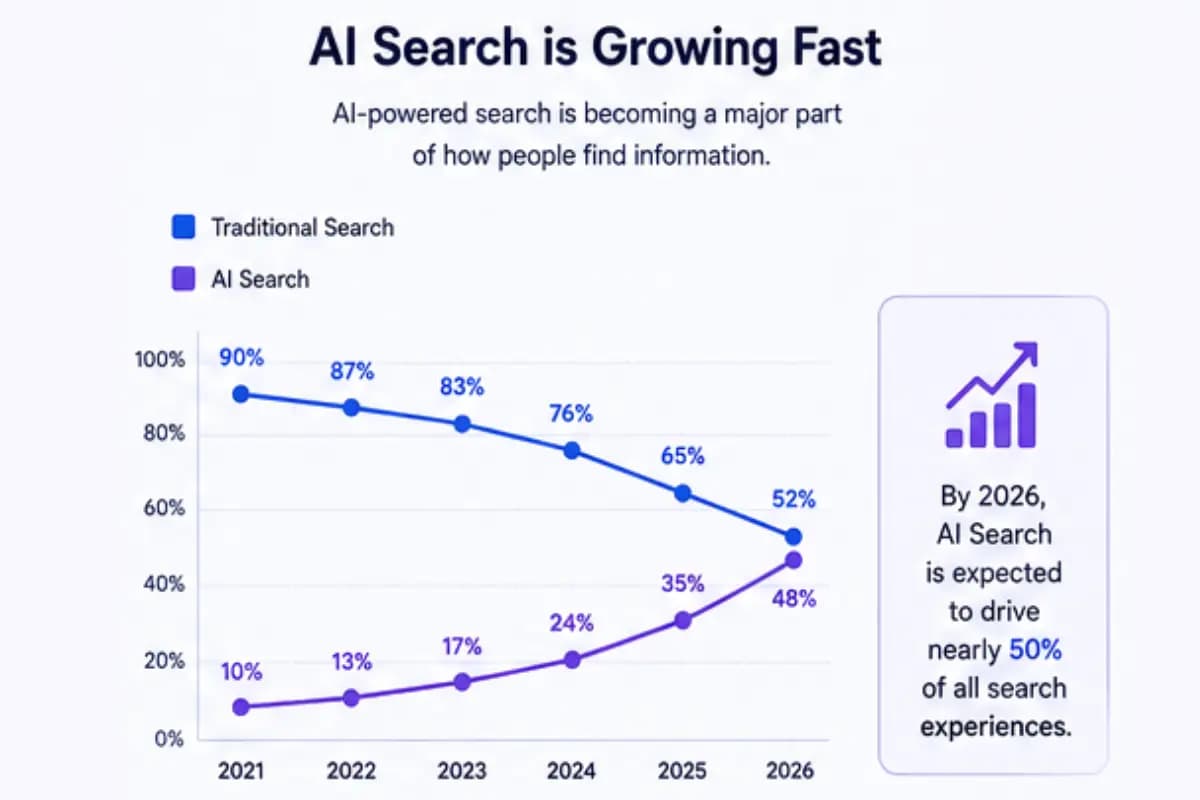
Google continues improving its ability to identify content that offers little value. Pages written with little effort often struggle over time because search systems reward useful information rather than mass production.
Quality matters even more today.
Fresh ideas, personal experience, original research, and useful examples help separate excellent content from average content.
Artificial intelligence has also become much better at handling large amounts of data.
Reviewing thousands of keywords once required long hours inside spreadsheets.
AI now groups similar keywords, identifies search intent, highlights content gaps, and organizes information in a fraction of the time.
Pattern recognition has become another major advantage.
AI can quickly spot declining traffic, missing internal links, duplicate content, and keyword cannibalization across hundreds or even thousands of pages.
Finding those issues manually would take far longer. Ignoring AI no longer gives websites a competitive advantage.
Many businesses now use AI to improve research, planning, reporting, and optimization. Teams that refuse to adopt helpful AI tools often spend extra hours completing work their competitors finish much faster.
Speed alone does not create success.
Fast execution without a smart strategy still leads to weak results. Strong planning supported by AI creates a much stronger foundation for long term growth.
Building topical authority in a niche is one of the most effective long-term SEO strategies.
When your site demonstrates deep expertise across related subjects, search engines reward you with better rankings and sustained visibility.
A Brief History Of AI SEO
Looking back makes today's SEO landscape much easier to understand. Early AI writing tools focused almost entirely on content generation.
Many marketers believed faster writing would automatically lead to more traffic. Articles appeared in huge numbers across countless websites.
Large content libraries grew almost overnight because AI could produce thousands of words with very little effort.
Results looked promising at first.
Many websites enjoyed temporary ranking improvements because search engines had not fully adapted to the flood of AI generated content.
That success did not last forever.
Search engines improved their quality systems. Thin articles, repetitive wording, and low value pages gradually lost visibility. Large collections of generic content stopped producing reliable results.
Many website owners learned an important lesson. Publishing faster was never the real challenge.
Finding valuable topics, creating trustworthy information, and building strong content structures mattered much more.
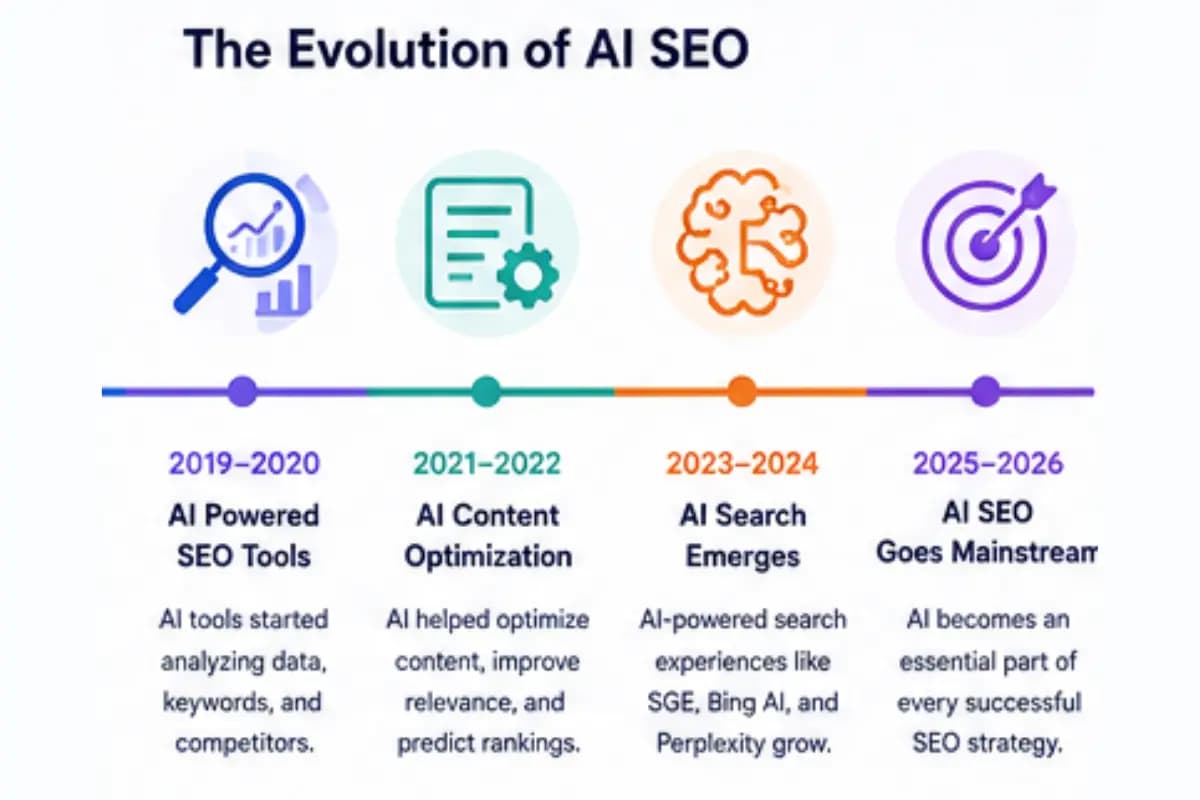
A second stage soon appeared.
Artificial intelligence shifted away from simple writing tasks and started helping with research and analysis.
SEO professionals began using AI for keyword clustering, competitor research, content planning, topical maps, and technical audits.
Many experts found greater value in those tasks than in automatic writing. AI became an assistant instead of a replacement.
Human strategy remained at the center while AI handled repetitive work behind the scenes.
Today's stage adds another major change. Artificial intelligence now influences both sides of SEO.
Website owners use AI during content creation and optimization. Users rely on AI when searching for information.
Content must satisfy both search engines and AI powered answer systems.
Success now depends on producing trustworthy information that readers enjoy while making pages easy for AI systems to understand.
Every improvement in AI continues changing SEO, yet the foundation remains familiar. Helpful content earns attention.
Clear website structures improve navigation. Strong topical authority builds trust.
Useful internal links connect related information. Regular updates keep pages accurate.
Artificial intelligence simply helps complete those tasks with greater speed and better organization.
How AI Has Changed The SEO Workflow
Artificial intelligence has changed SEO in many ways. Many tasks that once took several hours can now be completed in minutes. Research moves faster.
Planning becomes more organized. Large amounts of data become much easier to understand.
None of those changes mean SEO has become automatic.
Successful websites still need a clear strategy. Every decision still needs human judgment.
AI simply removes much of the repetitive work so SEO professionals can spend more time improving quality and making smart decisions.
Years ago, most SEO projects followed a slow and manual process. Teams exported keyword lists, sorted spreadsheets, reviewed competitors page by page, and created content plans from scratch.
Every step demanded careful attention because software could only provide raw data.
Today's workflow looks very different.
Modern AI tools organize keywords by search intent, suggest content ideas, build topic clusters, recommend internal links, and even identify pages that need updates.
Much of the heavy lifting happens automatically, allowing marketers to focus on building better content instead of organizing endless spreadsheets.
Speed alone does not guarantee better results.
A faster process simply gives you more time to improve quality. Teams that treat AI as an assistant often produce stronger websites than teams trying to automate every decision.
Traditional SEO Workflow Versus AI Powered SEO
A look at both workflows makes the difference much easier to understand.
Traditional keyword research usually started with exporting thousands of keywords from SEO tools.
Someone then spent hours removing duplicates, grouping similar phrases, and deciding which keywords belonged together.
AI now handles much of that work automatically.
Modern tools recognize patterns between keywords, identify search intent, and organize thousands of search terms into logical groups within minutes. Human review still matters, yet the hardest part is already complete.
Content planning has improved in a similar way.
Older workflows relied heavily on personal experience. SEO professionals built content calendars by studying competitors and making educated guesses about topic relationships.
AI speeds up that process by suggesting related subjects, identifying missing content, and organizing pages into logical clusters.
Final decisions still belong to the content strategist, yet creating the initial framework takes far less effort.
Content briefs have changed as well.
Many writers once started with a blank document. They researched competitors, collected important questions, listed headings, and created outlines manually.
AI now creates a solid first draft for many content briefs.
Search intent, recommended headings, related questions, keyword suggestions, and supporting topics can all appear within seconds.
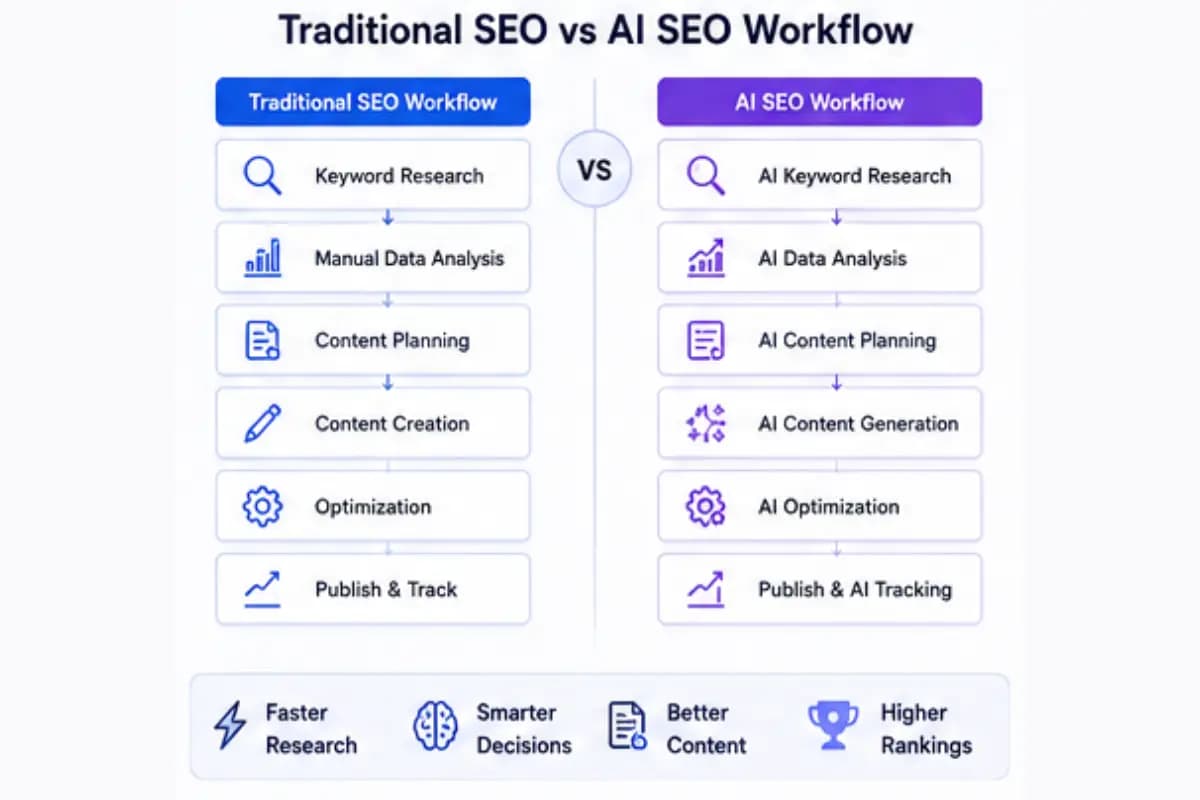
Editors simply review the suggestions, improve weak areas, and add business specific information.
Writing follows the same pattern.
Many content creators use AI to draft introductions, organize sections, improve readability, or rewrite awkward paragraphs. Human writers continue adding expertise, original insights, and personal experience before publishing.
Internal linking has become much easier too.
Large websites often contain hundreds or even thousands of pages. Finding every relevant linking opportunity manually can become overwhelming.
AI scans existing content, identifies related pages, and recommends natural internal links. Editors then review those suggestions before adding them to the site.
Content audits have improved dramatically.
Manual audits often happened only once or twice each year because they required so much time.
AI continuously watches website performance. Pages losing rankings, declining traffic, or missing optimization opportunities appear much sooner, allowing faster improvements.
Rank tracking follows a similar pattern.
Older reports often contained little more than keyword positions.
Modern AI tools explain ranking changes, identify unusual trends, and highlight possible reasons behind performance gains or losses.
Every improvement saves valuable time.
Time saved through automation can then be invested in stronger research, better writing, and smarter long term planning.
Where AI Delivers The Biggest Benefits
Artificial intelligence performs especially well when handling large amounts of information.
Large keyword lists provide a perfect example.
Sorting five thousand keywords manually requires patience and careful attention. AI completes the same task within minutes while identifying relationships that many people would overlook.
Search intent analysis has become much more accurate because of those capabilities.
Keywords that appear different on the surface often satisfy the same user need. AI recognizes those similarities and groups them together, helping marketers avoid creating unnecessary duplicate content.
Competitor research has also become much easier.
Reviewing dozens of competing websites manually consumes a significant amount of time. AI summarizes major themes, identifies missing topics, and points out content gaps much faster.
Content planning benefits from those insights.
Rather than creating isolated articles, marketers can build connected content clusters that cover an entire subject. Search engines appreciate that structure because related pages support each other naturally.
Technical analysis has improved too.
Artificial intelligence quickly spots broken internal links, duplicate content, missing metadata, orphan pages, and other technical problems across large websites.
Many businesses discover issues they never knew existed.
Performance monitoring has become another valuable application.
AI identifies unusual traffic changes before they become major problems. A sudden ranking drop, declining impressions, or lower click through rates can trigger alerts that help website owners respond quickly.
Pattern recognition remains one of AI's strongest abilities. Humans naturally struggle to compare thousands of data points at once.
Artificial intelligence performs that task effortlessly.
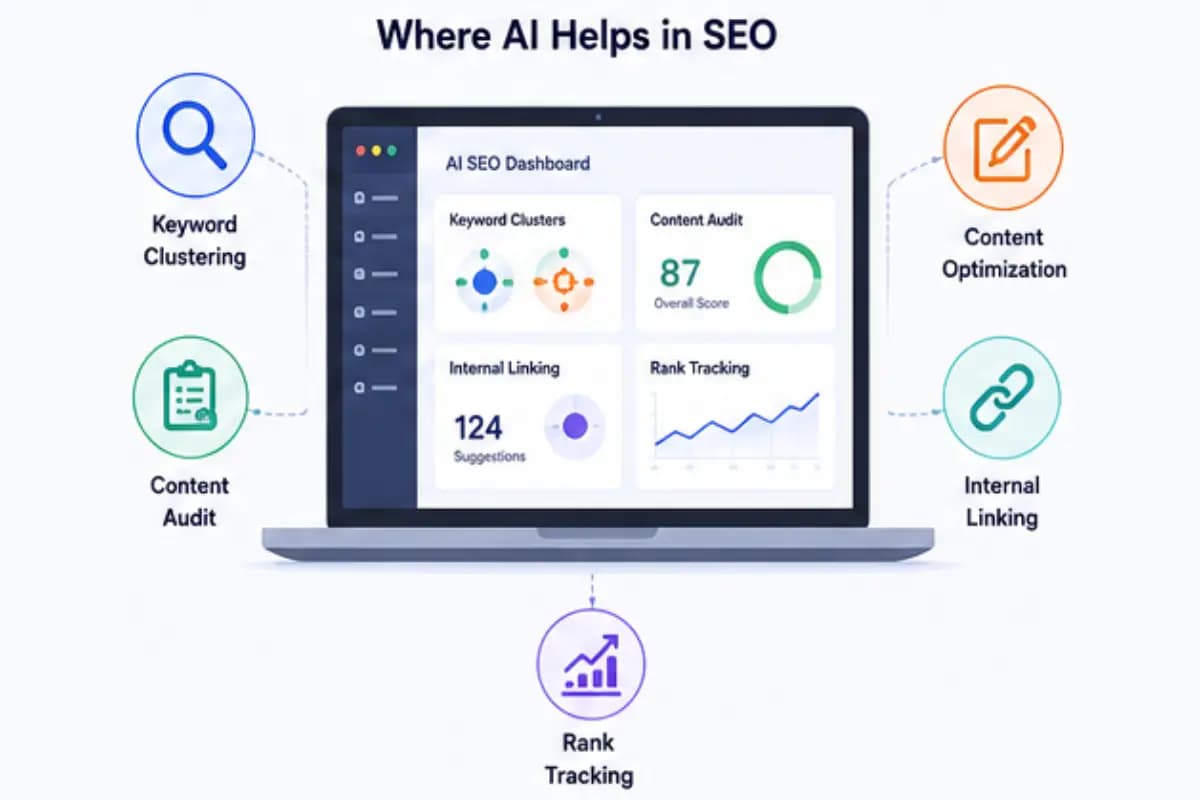
Large websites gain enormous value from those capabilities because manual reviews simply cannot match that level of speed.
Learning how to do keyword research effectively helps you identify the search terms that matter most for your audience and uncover content gaps that AI can help you fill.
AI Still Has Important Limitations
Many people expect artificial intelligence to replace SEO professionals completely.
Reality looks very different. AI lacks business knowledge.
Every company serves different customers, sells different products, and follows different goals. AI cannot automatically understand those priorities.
A keyword may generate hundreds of thousands of monthly searches. That number looks impressive.
Search intent may have little connection to your products or services.
Ranking for that keyword could produce plenty of visitors while generating almost no sales.
Human judgment recognizes that problem. AI usually does not.
Industry experience creates another challenge. Artificial intelligence learns from existing information across the internet.
Personal experience comes from real people. A mechanic repairing engines every day understands problems that AI has never experienced.
A doctor treating patients develops practical knowledge beyond published articles.
A travel blogger visiting dozens of countries shares observations that AI cannot create from scratch.
Readers notice that difference. Search engines notice it too. Brand voice presents another limitation.
Many AI generated articles sound similar because they follow familiar writing patterns.
Successful businesses develop unique voices that reflect their personality, values, and audience.
Human editors shape those qualities. Artificial intelligence often struggles to maintain them consistently.
Context creates additional challenges. AI may recommend combining two articles because they target similar keywords.
An experienced SEO strategist may realize those pages satisfy different audiences.
Following the AI recommendation could reduce overall traffic instead of improving it. Recommendations should always receive human review before becoming permanent changes.
Confidence does not always equal accuracy. AI frequently presents incorrect information in a convincing way.
Careful fact checking remains essential. Publishing inaccurate advice damages credibility regardless of how impressive the writing appears.
Human Skills Matter More Than Ever
Many people worry that artificial intelligence will reduce the value of SEO professionals.
The opposite has happened. Mechanical tasks continue becoming easier. Strategic thinking becomes even more valuable.
Prompt writing has become an important skill. Better prompts produce better research, better outlines, and better recommendations.
Small improvements in instructions often create much stronger AI output. Editorial judgment matters even more today.
AI produces huge amounts of information very quickly. Someone must decide which suggestions deserve attention.
Someone must recognize weak arguments, missing context, and incorrect information. Editors perform that role.
Content strategy has become another critical skill. Artificial intelligence generates ideas easily.
Choosing the right ideas remains far more important. Successful websites rarely publish everything they can.
They publish content that supports clear business goals. Prioritization separates experienced SEO professionals from beginners.
Every website has limited time and resources. Choosing the next project wisely often creates greater results than simply working faster.
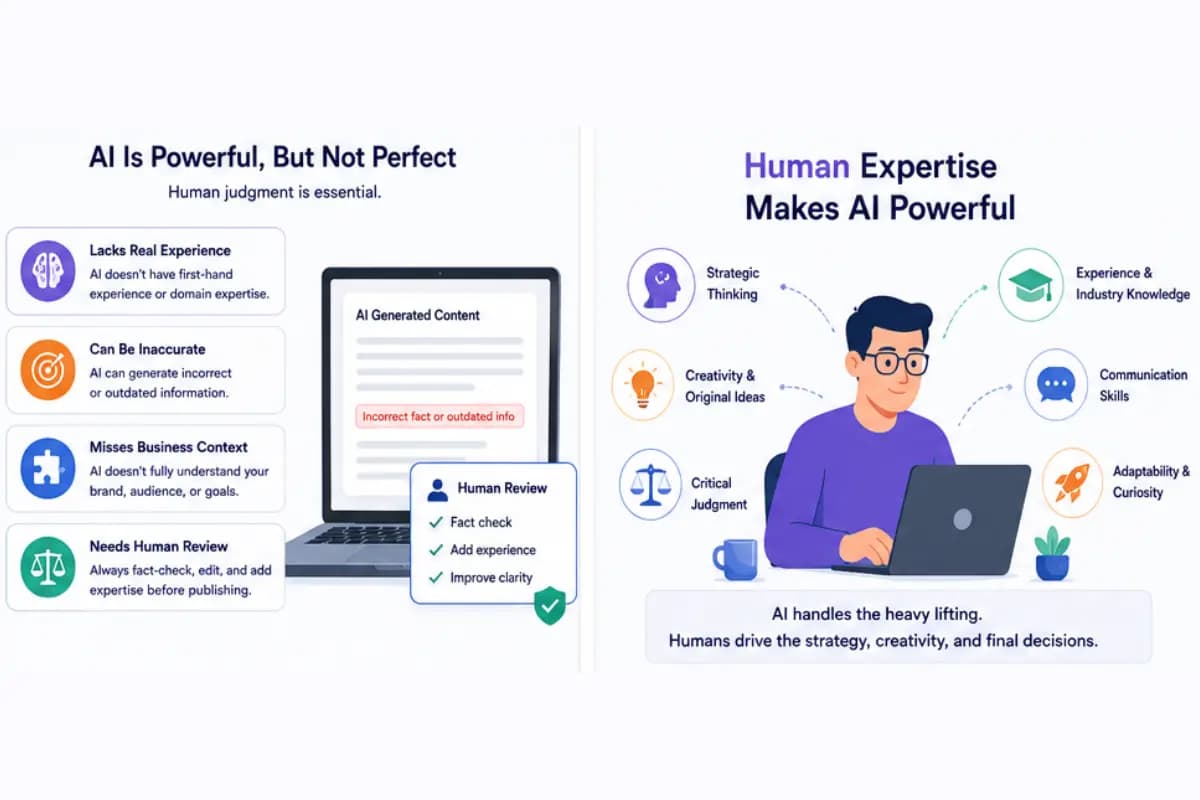
Communication skills remain valuable as well. SEO professionals explain technical concepts to business owners, writers, designers, and developers.
Clear communication helps entire teams work together more effectively. Creativity continues playing an important role.
Artificial intelligence learns from existing material. Original ideas still come from people.
Fresh examples, unique opinions, personal stories, and creative approaches help content stand apart from thousands of similar articles published every day.
Curiosity deserves attention too. Search continues changing rapidly. New AI models appear regularly.
Google introduces new features. User behavior evolves.
Professionals willing to keep learning adapt much faster than those relying only on old habits. Artificial intelligence should strengthen human skills instead of replacing them.
Treat AI like a knowledgeable assistant. Ask it to organize information. Ask it to summarize research. Ask it to identify patterns.
Allow experienced people to make the final decisions. That balance creates stronger SEO strategies and much better long term results.
The Core Components Of An AI SEO Strategy
Artificial intelligence delivers the best results when every part of your SEO process works together.
Many beginners make the mistake of focusing only on AI writing tools. Strong SEO requires much more than creating articles quickly.
Keyword research, content planning, internal linking, audits, content updates, and performance tracking all contribute to long term growth.
AI helps improve every stage, creating a system that becomes more effective over time.
Think of your SEO strategy as a connected cycle instead of a collection of separate tasks. Every improvement supports another part of your website.
Better keyword research leads to stronger content. Better content creates more internal linking opportunities.
Better internal links improve rankings. Better rankings generate more data, making future improvements even smarter.
Each section below introduces an important part of that process.
If you are new to organizing content around broad topics, our article on what content clusters are provides a clear foundation for understanding how pillar pages and supporting articles work together.
AI Keyword Research
Keyword research remains the starting point of every successful SEO strategy.
Without knowing what people search for, creating helpful content becomes much more difficult.
Traditional keyword research often involved downloading massive spreadsheets filled with thousands of search terms.
Marketers sorted every keyword manually, removed duplicates, grouped similar phrases, and tried to identify user intent.
That process consumed hours.
Artificial intelligence has transformed keyword research into a much faster experience.
Modern AI tools examine thousands of keywords almost instantly. Instead of grouping phrases based only on matching words, AI recognizes search intent and semantic meaning.
Similar searches naturally fall into the same category even when the wording looks different.
Consider someone searching for "best AI SEO tools." Another person searches for "top AI SEO software."
Someone else types "AI software for SEO." Older keyword research methods might treat those as separate opportunities.
AI recognizes that all three searches reflect nearly the same goal.
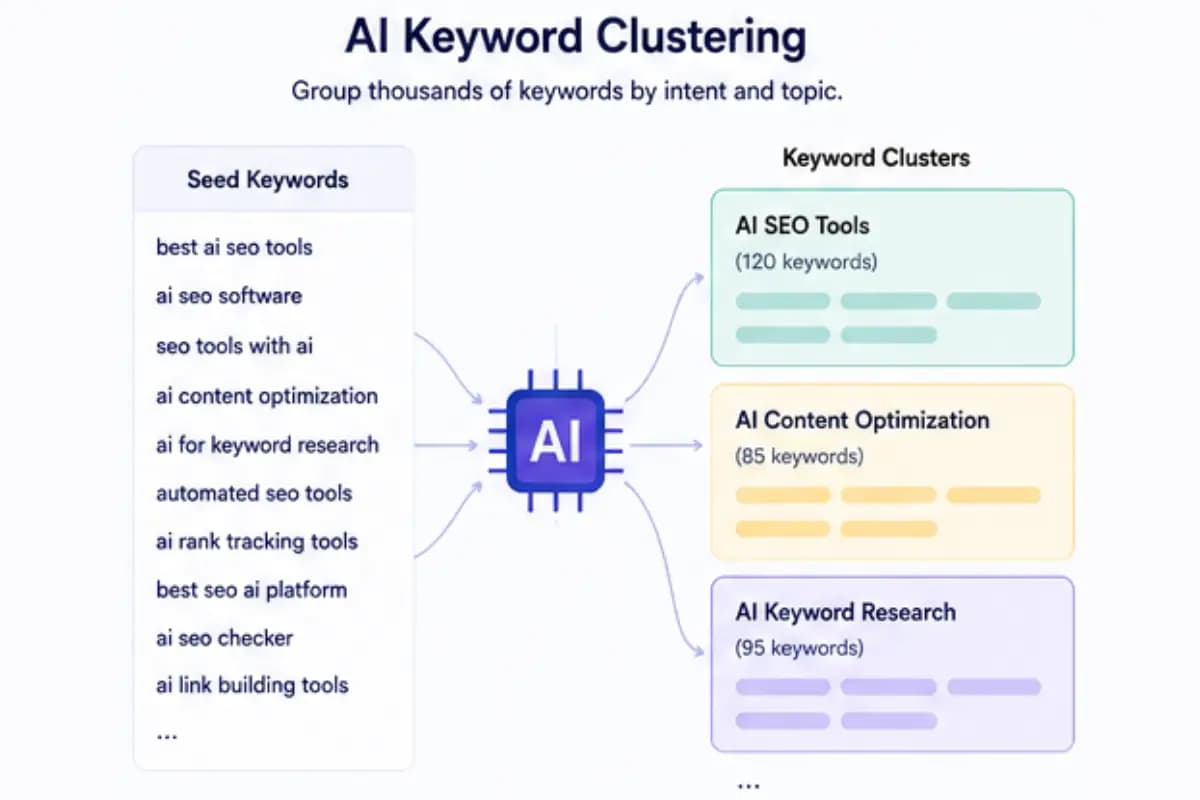
Grouping similar keywords together prevents duplicate content and creates stronger pages capable of ranking for multiple search terms.
AI also identifies content gaps.
After reviewing competitors and your existing website, AI highlights valuable topics your site does not currently cover.
Finding those missing opportunities manually often takes several days. Artificial intelligence completes that analysis much faster.
Search intent has become another area where AI performs exceptionally well. Every keyword represents a different user goal.
Some visitors want information. Others want product comparisons. Some are ready to make a purchase. Others simply need a quick answer.
AI helps organize keywords based on those goals, making content planning much easier.
Human review still matters. Search volume alone should never determine your priorities.
Business goals, customer needs, competition, and conversion potential deserve equal attention. Artificial intelligence provides valuable recommendations.
People decide which opportunities deserve attention first.
For keyword research, you can use KWFinder or Ubersuggest to discover search intent and content gaps with AI-powered insights.
For a comprehensive list of tools that can help at every stage, check out our roundup of best keyword research tools for affiliates.
Many of these platforms include AI-powered clustering and intent analysis features.
AI Topical Maps
A website filled with unrelated articles rarely builds authority. Search engines reward websites that cover subjects thoroughly.
Topical maps help organize your content into connected groups that support each other. Think of a topical map as the blueprint for your website.
Every major topic becomes a pillar page. Supporting articles cover smaller subjects connected to that main page.
Internal links connect every piece naturally. Visitors enjoy a better experience because finding related information becomes much easier.
Search engines benefit as well because they understand your expertise more clearly. Creating topical maps manually often requires extensive competitor research.
Artificial intelligence speeds up the process considerably.
AI reviews existing search results, identifies common themes, suggests supporting topics, and highlights missing content.
Suppose your website focuses on AI SEO. Your pillar page might explain AI SEO as a complete topic.
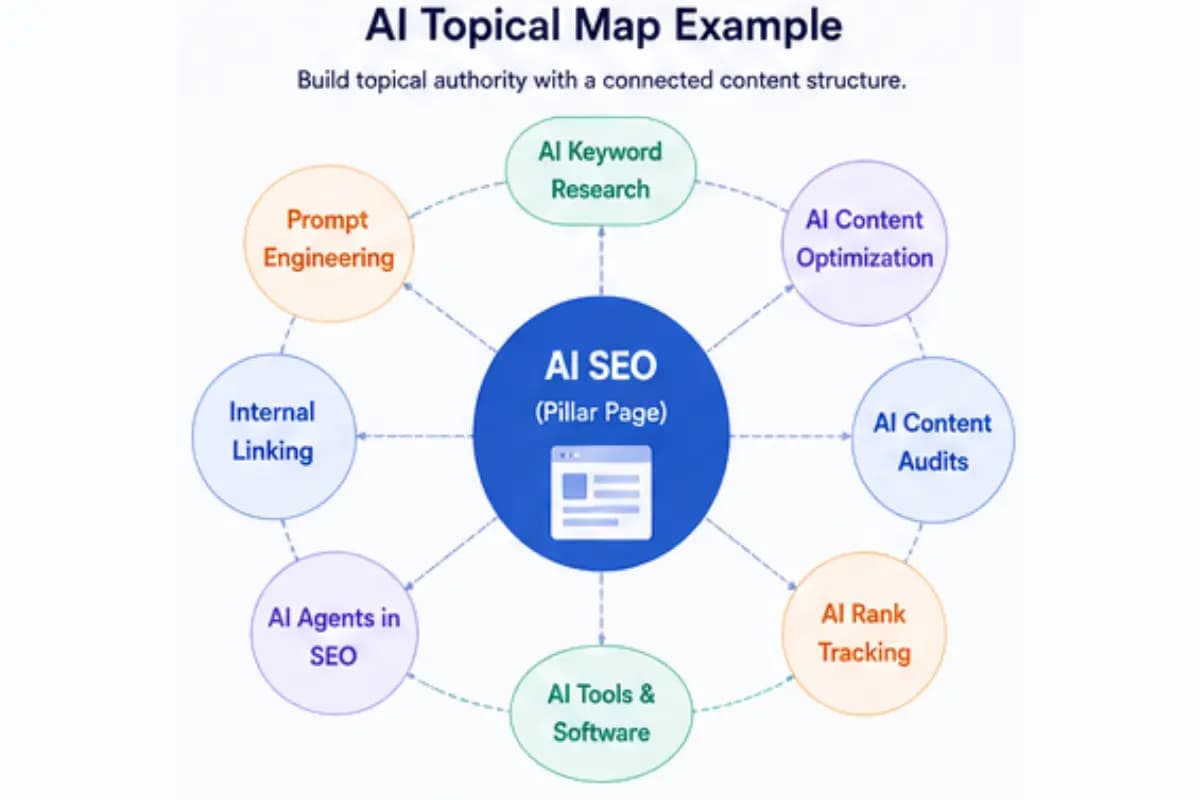
Supporting pages could explore keyword research, content audits, prompt engineering, internal linking, rank tracking, AI agents, topical authority, and content refresh strategies.
Every article supports the main topic while providing valuable information independently.
Strong topical maps create several important benefits. Content becomes easier to organize. Future planning becomes much simpler.
Internal linking improves naturally. Visitors spend more time exploring related pages. Search engines recognize your growing authority within a subject.
Artificial intelligence makes building that structure much faster. Human strategy keeps the structure useful.
AI Internal Linking
Internal links often receive less attention than they deserve. Many website owners publish articles without thinking about how those pages connect.
Strong internal linking helps both readers and search engines. Visitors discover related information without returning to Google.
Search engines understand relationships between pages more clearly. Authority flows naturally throughout the website.
Managing internal links becomes increasingly difficult as websites grow. A site containing twenty articles remains fairly simple.
A site containing two thousand articles presents a much bigger challenge. Finding every relevant linking opportunity manually becomes almost impossible.
Artificial intelligence solves much of that problem. AI scans existing content and identifies pages discussing related subjects.
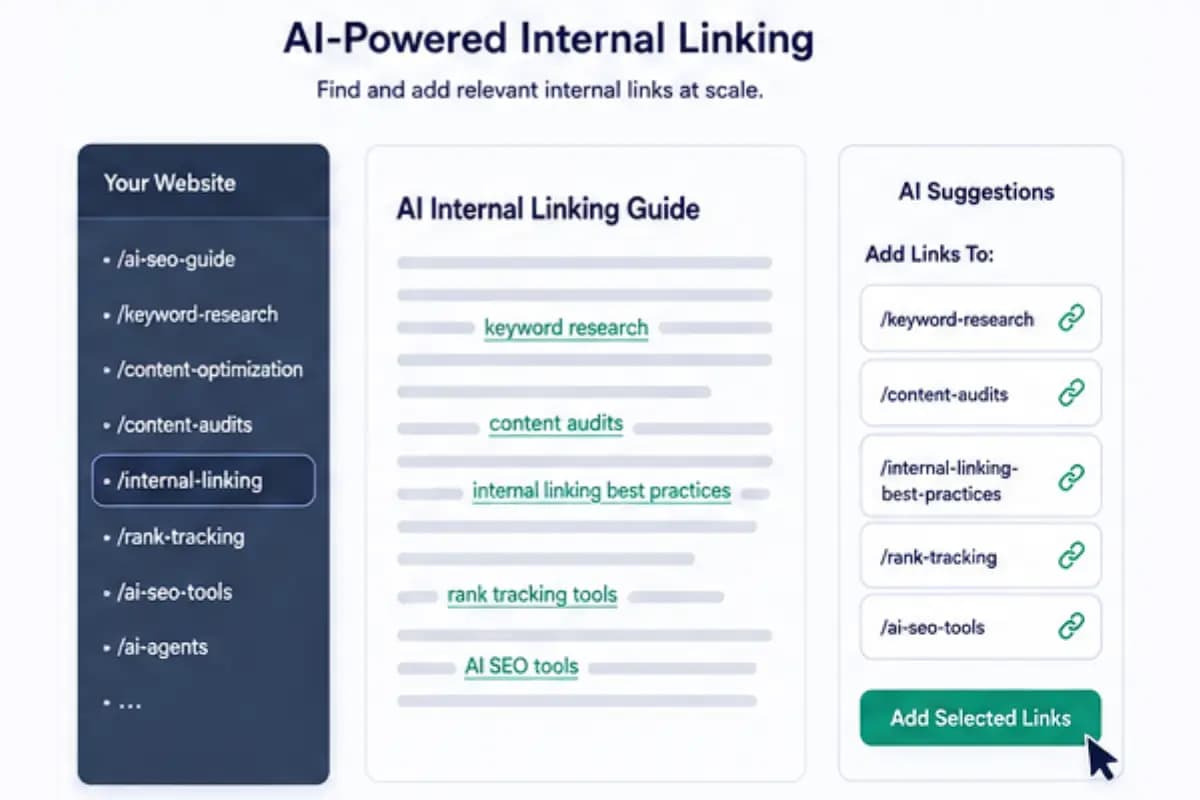
Instead of reading hundreds of articles yourself, AI recommends logical internal links that fit naturally within the content.
Editors then review each suggestion before publishing. Quality still matters more than quantity.
Adding dozens of unnecessary internal links creates a poor reading experience. Every recommendation should provide genuine value for readers.
Anchor text deserves careful attention as well. Artificial intelligence often suggests descriptive phrases that help both visitors and search engines understand the destination page.
Natural wording always works better than forcing exact keyword matches into every sentence. Regular internal link audits help maintain healthy website architecture.
AI quickly identifies orphan pages with few incoming links. Pages receiving too much attention become easy to spot as well.
Balanced linking creates stronger navigation throughout the site.
If you need help finding where to add links in your existing content, try our internal link opportunity finder tool. It analyzes your pages and suggests relevant linking opportunities you may have missed.
AI Content Refresh Workflows
Publishing new content remains exciting. Updating older content often creates even better results.
Many websites contain articles that performed well several years ago but gradually lost rankings.
Information becomes outdated. Competitors publish stronger content. Products change. Statistics become inaccurate. Search intent evolves.
Refreshing existing content helps recover lost visibility without creating entirely new pages.
Artificial intelligence makes identifying those opportunities much easier. AI reviews traffic trends, ranking data, and user engagement.
Pages showing declining performance appear quickly. Editors can then decide which articles deserve updates.
Refreshing content involves much more than changing a few dates. Fresh examples improve usefulness.
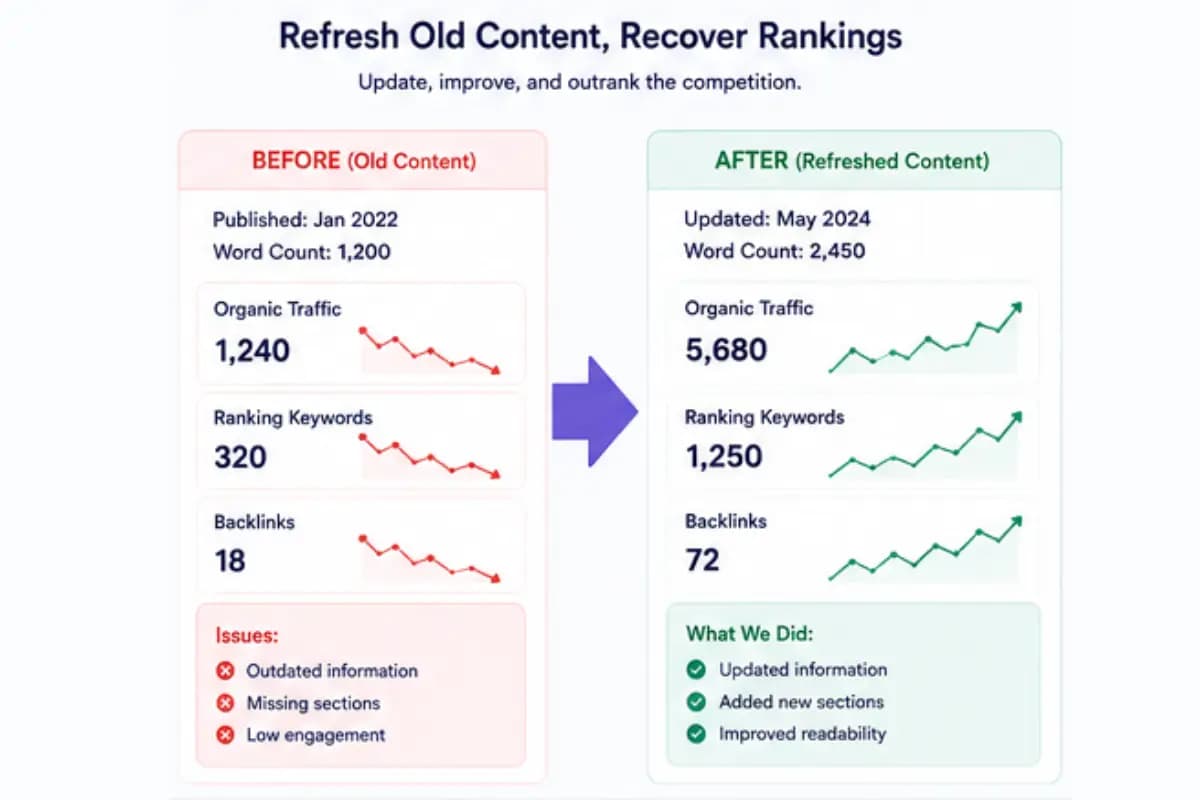
Updated statistics increase trust. New screenshots provide accuracy.
Additional sections answer questions that did not exist when the article was first published.
Competitor analysis often reveals missing information worth adding. Artificial intelligence can suggest update ideas after reviewing competing pages.
Human editors verify accuracy before making changes. Affiliate websites benefit especially from regular refreshes.
Product prices change frequently. Features receive updates.
Old recommendations become outdated. Keeping those pages current improves both user experience and search performance.
Regular refresh schedules prevent valuable content from becoming stale.
Creating content that stays relevant for years requires a different approach than chasing trends.
Our article on creating evergreen content explains how to write articles that continue driving traffic long after publication.
AI SEO Workflows
Every SEO task connects with another. Keyword research leads to content planning. Content planning creates writing assignments. Published articles need internal links.
Performance tracking identifies future improvements. Managing those activities manually becomes difficult as websites expand. AI helps organize the entire workflow.
Content briefs can move directly into writing. Finished articles receive internal linking suggestions. Performance reports highlight pages requiring updates.
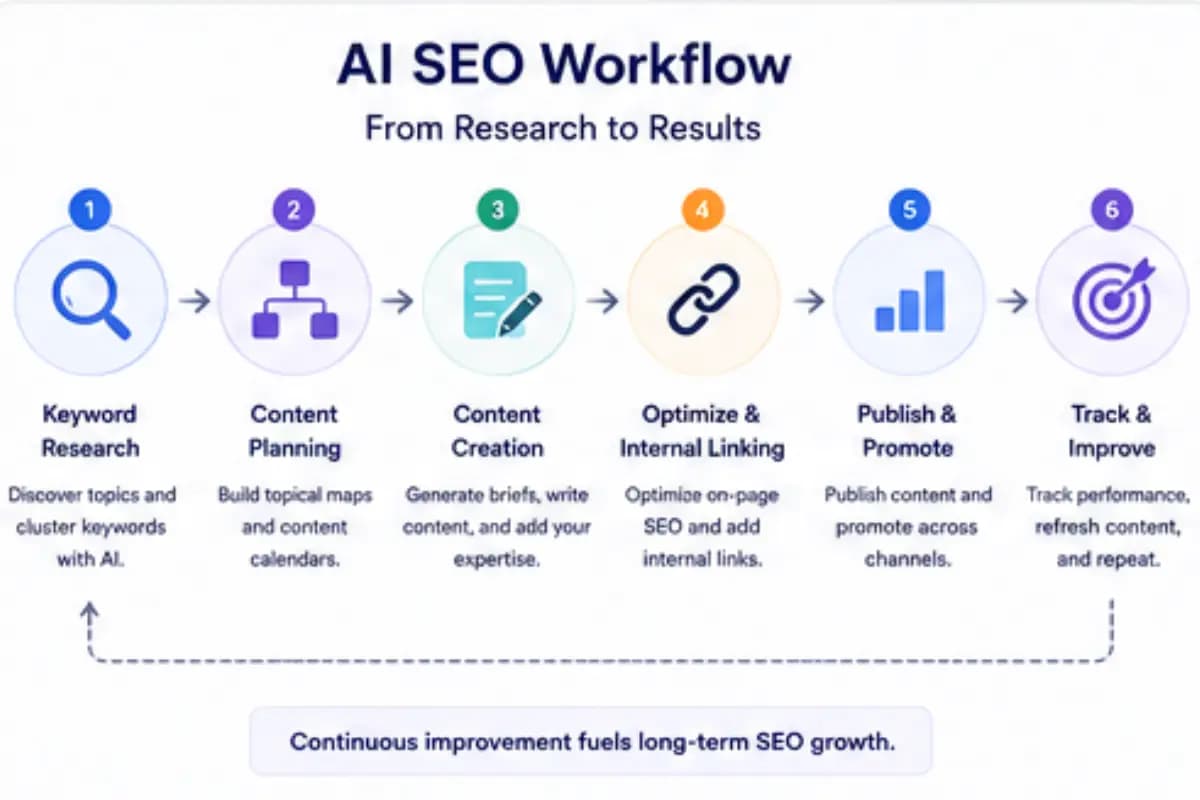
Each step feeds naturally into the next. Automation reduces repetitive work while keeping projects organized. Teams spend less time moving information between tools.
More time becomes available for improving quality. Human oversight remains important throughout the process.
Every workflow benefits from review before publication. Artificial intelligence handles organization.
People handle decisions. That balance produces better results than complete automation.
Turning your topical map into a consistent publishing schedule is easier when you have a solid plan.
Our guide on how to create a content plan for affiliate marketing walks through exactly how to structure your workflow.
AI Content Audits
Every website contains pages performing below their potential. Finding those pages creates opportunities for growth.
Traditional content audits required reviewing hundreds of pages manually.
Traffic reports, ranking data, backlinks, engagement metrics, and technical issues all needed careful examination.
Large websites often postponed audits because they required so much time. Artificial intelligence changes that completely.
Modern AI tools analyze entire websites within minutes. Weak pages become easy to identify.
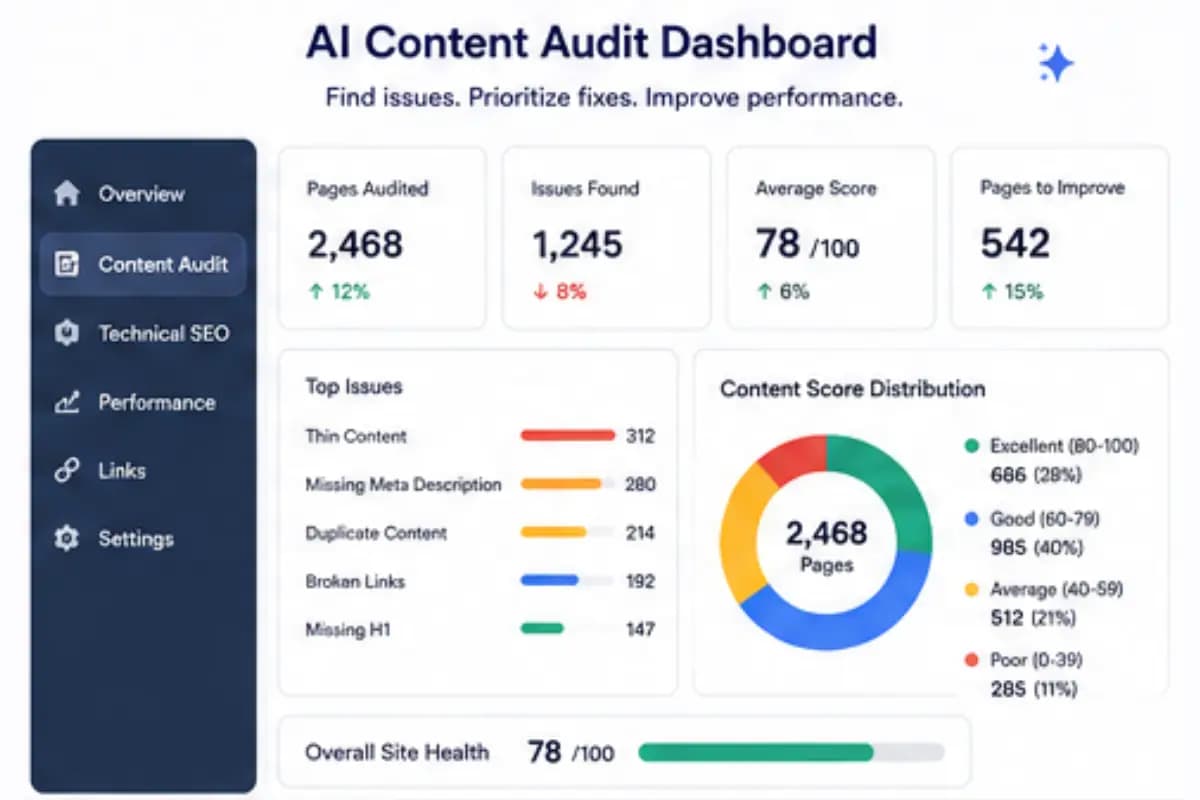
Content gaps appear clearly. Duplicate topics receive attention. Missing metadata, broken links, thin content, and declining rankings all become visible much faster.
Tools like TextCortex and Frase can help you audit existing content and identify optimization opportunities using AI.
Audits should answer several important questions.
Which pages generate the most traffic? Which articles lost rankings recently? Which content needs updating?
Which pages compete against each other? Which articles deserve stronger internal links?
Artificial intelligence provides those answers quickly. Human experts decide how to solve each problem.
Regular audits prevent small issues from becoming larger ones.
Many successful websites perform content audits every few months instead of waiting until traffic declines dramatically.
Small improvements made consistently often create significant long term growth.
AI Rank Tracking
Watching rankings has always been an important part of SEO. Simple ranking reports no longer tell the whole story.
Modern SEO requires understanding why rankings changed. Artificial intelligence adds valuable insights to traditional rank tracking.
Instead of showing only position changes, AI highlights possible explanations. A competitor may have improved their content.
Search intent may have shifted. Technical issues may have affected visibility.
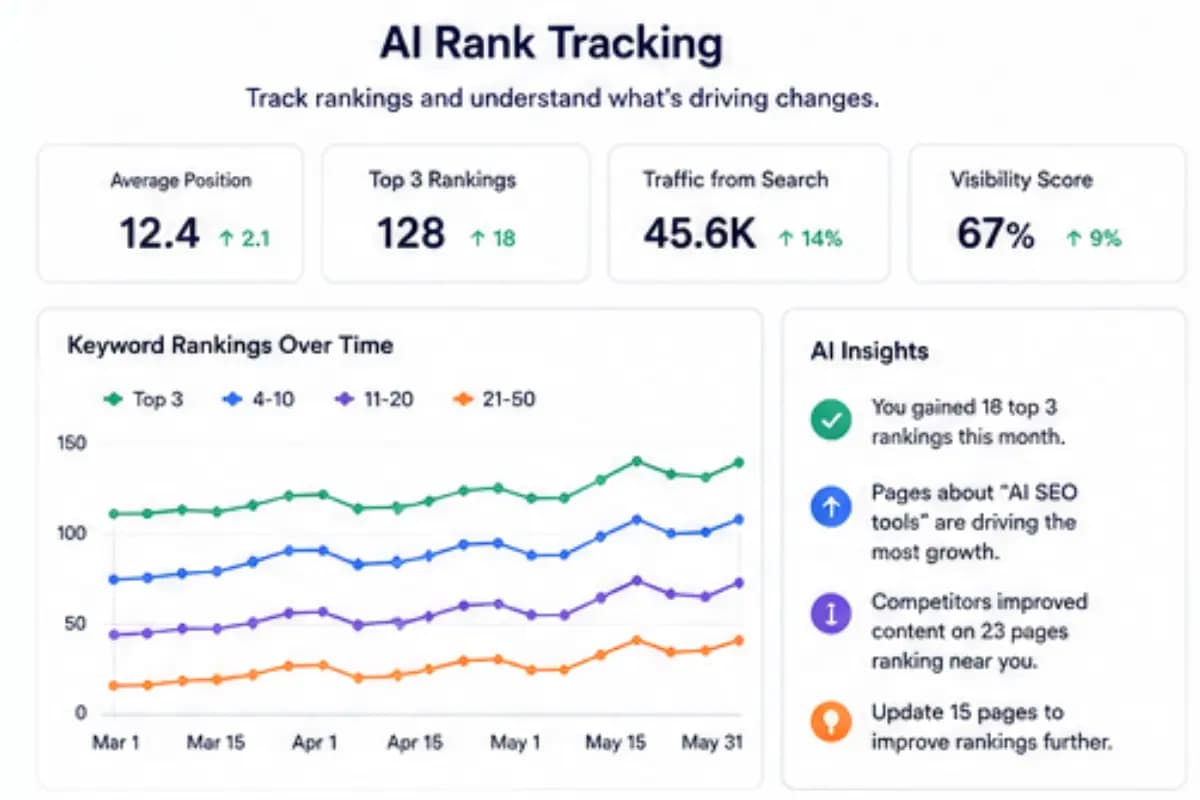
Google may have introduced new search features. Traffic patterns become easier to understand when AI identifies unusual behavior automatically.
Many modern tools also monitor visibility inside AI powered search experiences.
Appearing inside Google AI Overviews, ChatGPT citations, or Perplexity responses creates additional opportunities beyond traditional rankings.
Platforms like SE Ranking and Surfer SEO provide AI-driven rank tracking with insights into ranking changes and content optimization recommendations.
Tracking those appearances becomes increasingly valuable. Performance reports should support decision making.
Collecting data alone creates little value. Turning data into useful actions creates real improvement.
Artificial intelligence helps bridge that gap.
Using the right SEO plugins for your website can simplify many of the technical tasks discussed in this section, from on-page optimization to rank tracking and performance monitoring.
Prompt Engineering For SEO
Artificial intelligence performs only as well as the instructions it receives. Many disappointing results come from weak prompts rather than weak AI.
Clear instructions produce stronger content. Specific requests generate more useful research.
Detailed prompts improve outlines, keyword analysis, competitor reviews, and content planning.
Instead of asking AI to write an article, experienced marketers provide clear context.
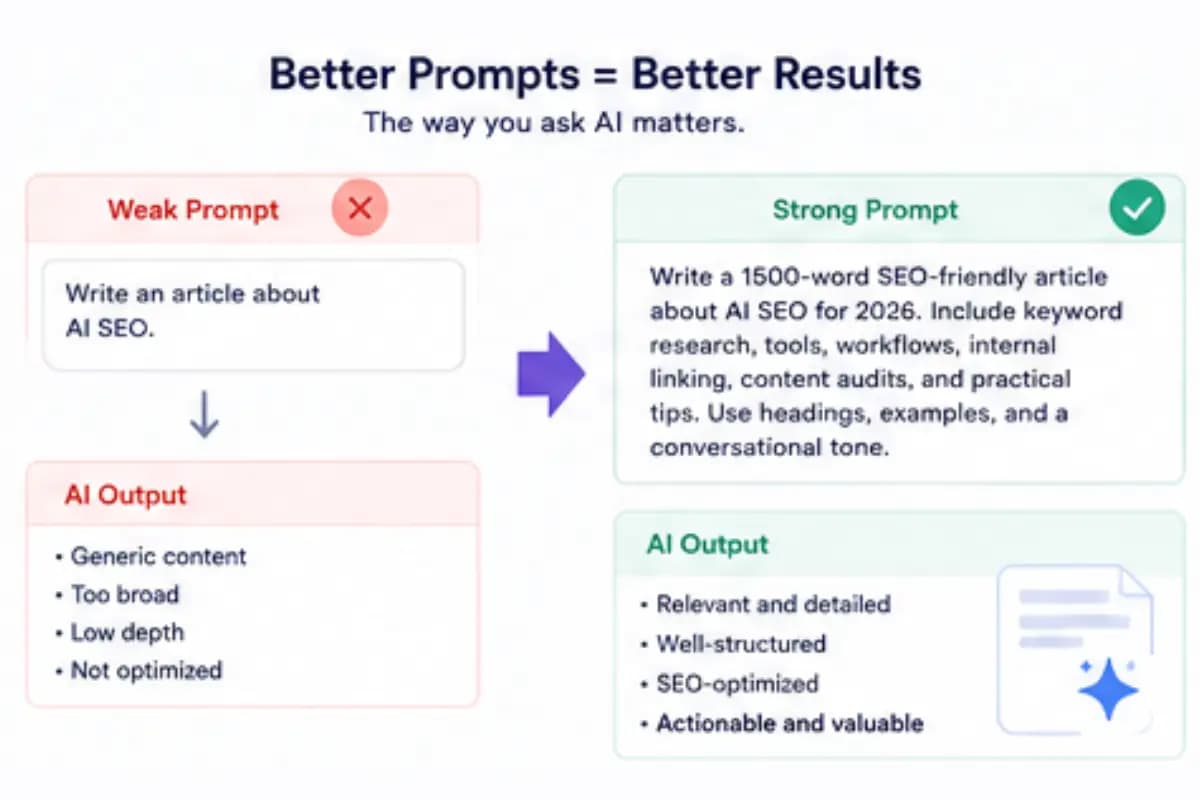
They explain the audience. They describe search intent. They define the desired tone. They include important keywords.
They request original examples. Every extra detail improves the final result.
Prompt writing has become an important SEO skill because better prompts consistently produce higher quality work.
You can use ContentBot to experiment with AI-powered content generation and refine your prompting skills across different use cases.
Practice makes a noticeable difference. Small improvements often create dramatically better output.
AI SEO Agents
AI agents represent another major development. Unlike simple chat assistants, AI agents perform multiple connected tasks automatically.
A single workflow might begin with keyword research. Next, the agent creates a content brief. Afterward, it drafts an outline.
Another step suggests internal links. Finally, the completed project moves into your publishing workflow.
Many companies find those systems exciting because they reduce manual work even further. Current AI agents still require supervision.
Incorrect assumptions, inaccurate research, and poor recommendations remain possible.
Human review protects quality throughout the process. Expect AI agents to improve rapidly over the next several years.
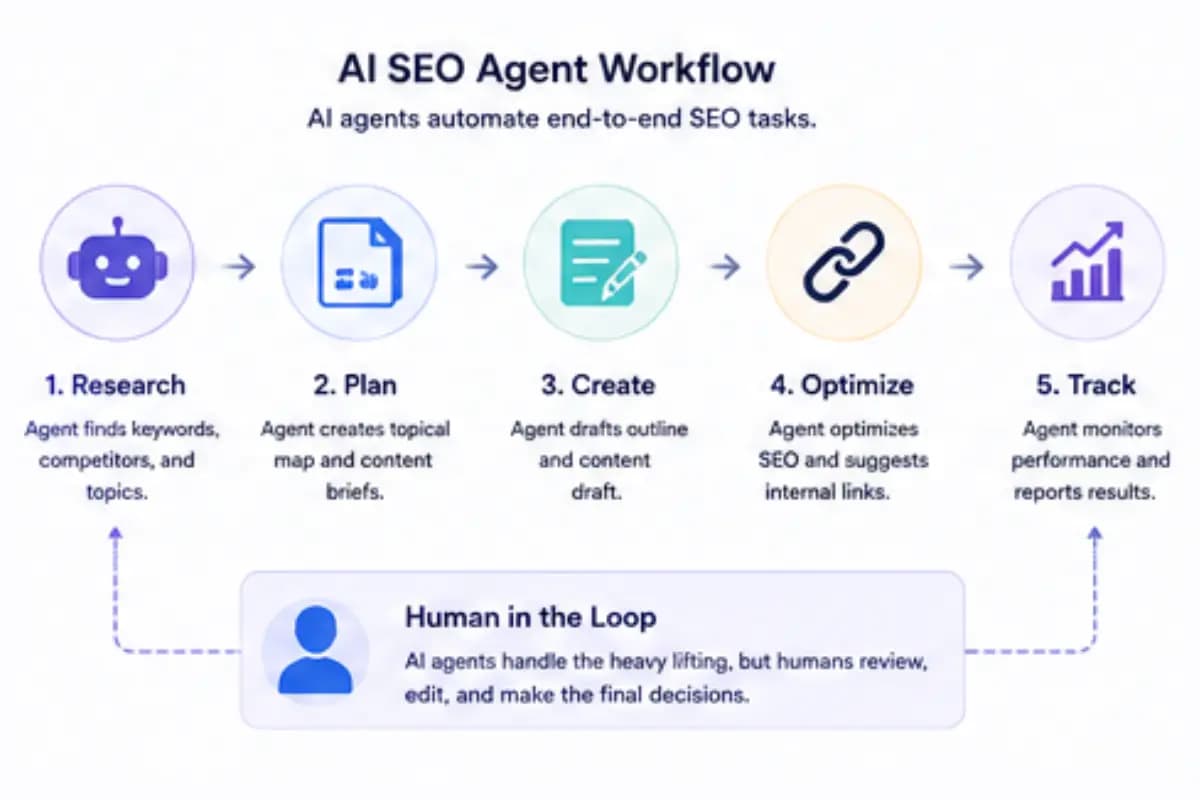
Businesses that understand their strengths and limitations will benefit the most. AI agents should support experienced marketers rather than replace them.
ContentStudio is one example of an AI-powered platform that helps automate content planning, publishing, and performance tracking across multiple channels.
Every part discussed in this chapter works together to create a complete AI SEO system.
Keyword research identifies opportunities. Topical maps organize content. Internal links connect related pages.
Content refreshes protect rankings. Audits uncover hidden problems. Rank tracking measures progress.
Prompt engineering improves AI output. AI agents help automate repetitive work.
Optimizing For AI Search Surfaces
Search engine optimization no longer focuses only on Google search results. Millions of people now use AI powered tools to find information every day.
Google AI Overviews, ChatGPT, Perplexity, Gemini, and Claude have changed how users discover websites.
Many searches now end before someone clicks a webpage.
A person asks a question. An AI system reads information from multiple sources. A short answer appears immediately.
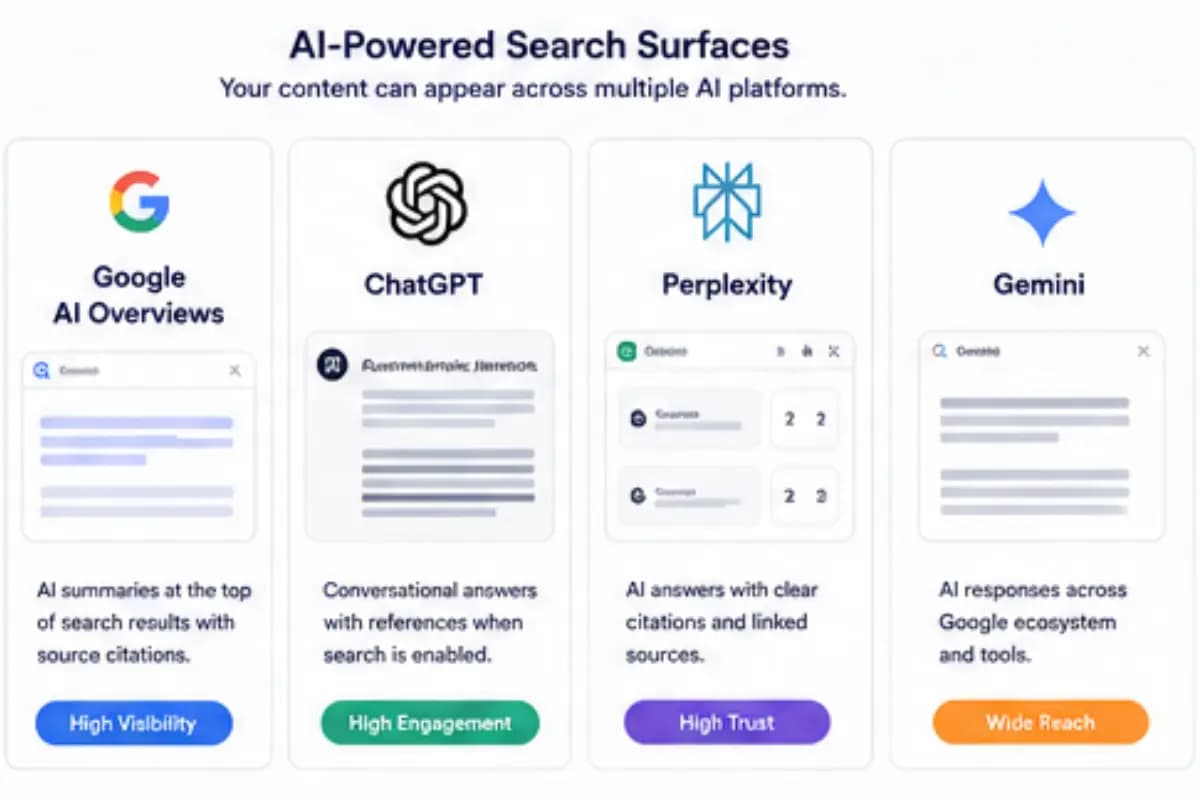
Sometimes users continue reading. Sometimes they never visit another website.
Content creators now face a new challenge. Ranking on Google still matters, yet earning visibility inside AI generated answers has become equally valuable for many industries.
Good news comes from the fact that many SEO best practices still work well for AI search.
Helpful content, accurate information, logical structure, and trustworthy sources continue to play a major role.
Small adjustments can improve your chances of appearing inside AI generated responses without changing your entire content strategy.
AI Search Works Differently From Traditional Search
Traditional search engines rank complete webpages.
AI search systems often work differently.
Instead of recommending an entire page, AI extracts specific information from different sources before creating a summarized answer.
Readers may only see a few sentences from your article. Every section of your content should therefore provide value on its own.
A visitor should understand the main point of a section without reading several paragraphs beforehand.
Clear writing makes that much easier.
Short paragraphs, descriptive headings, and direct explanations help AI systems understand your content while making the article easier for people to read.
Pages filled with confusing structure often become difficult for both readers and AI. Simple organization usually performs much better.
Answer Engine Optimization
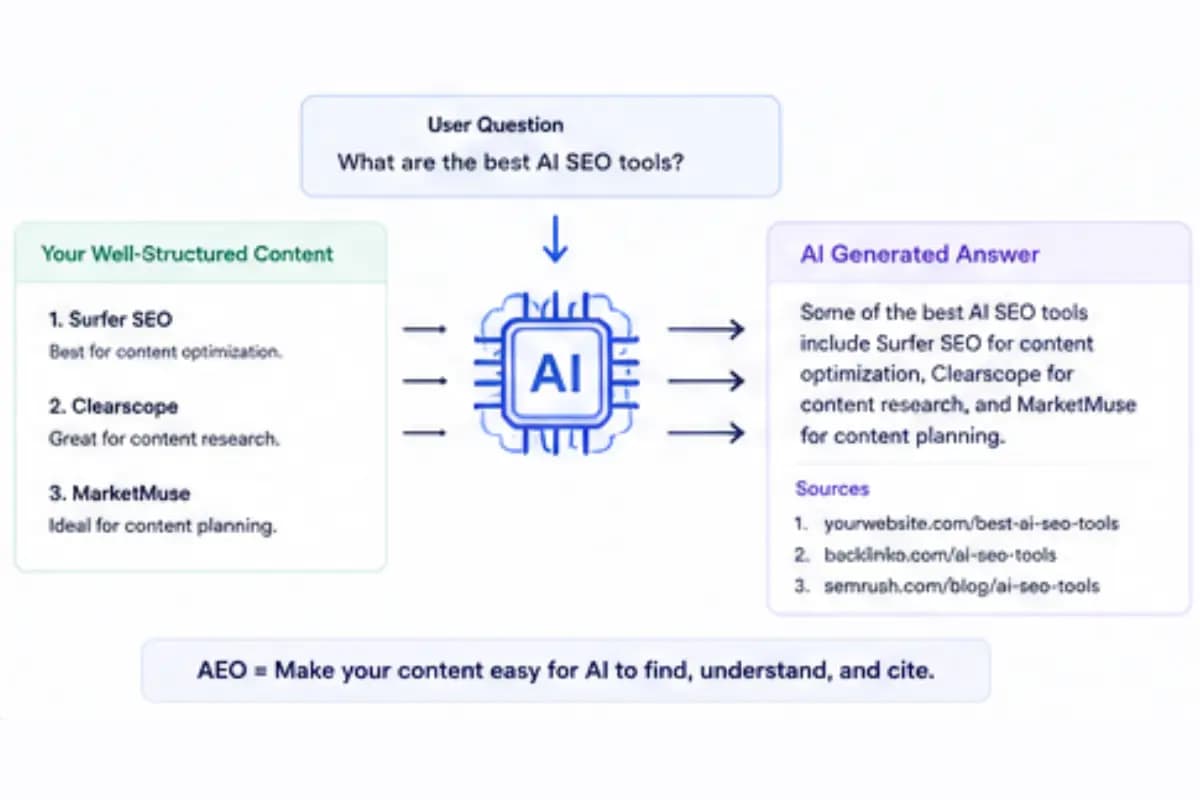
Many marketers now use the term Answer Engine Optimization, often shortened to AEO.
AEO focuses on helping AI systems find, understand, and reference your content. People no longer search only through Google.
Many ask questions directly inside ChatGPT. Others use Perplexity because it provides citations.
Google AI Overviews answer millions of questions before users scroll through traditional search results.
Every platform needs reliable information.
Creating content that answers questions clearly improves your chances of appearing inside those responses.
Think about how people naturally ask questions. Someone may search for: How does AI SEO work?
Another person may ask: Can AI improve keyword research? Someone else may type: Is AI SEO worth using for a small business?
Your content should answer those questions naturally instead of forcing keywords into awkward sentences.
Useful writing always comes first. Optimization follows naturally.
Generative Engine Optimization
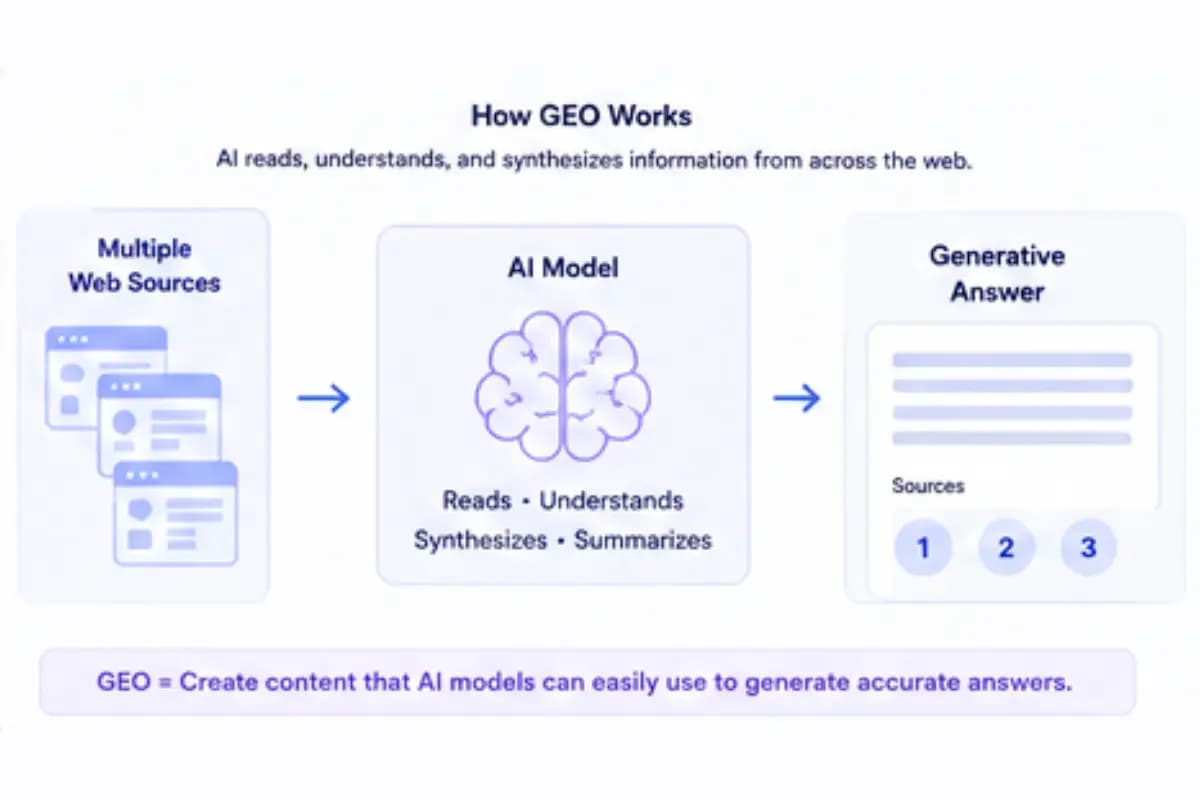
Generative Engine Optimization, commonly called GEO, shares many similarities with AEO.
Both approaches focus on helping AI systems understand your content. GEO places additional attention on how generative AI models summarize information.
Large language models prefer clear facts, logical explanations, and well organized content. Messy formatting makes their job harder.
Clear structure improves readability for both machines and people. Many marketers debate the difference between AEO and GEO.
Practical differences remain fairly small today. Both encourage creating useful content that answers real questions with accurate information.
Rather than worrying about labels, focus on producing pages that genuinely help readers.
That approach supports every search platform.
Google AI Overviews
Google AI Overviews have changed search results dramatically.
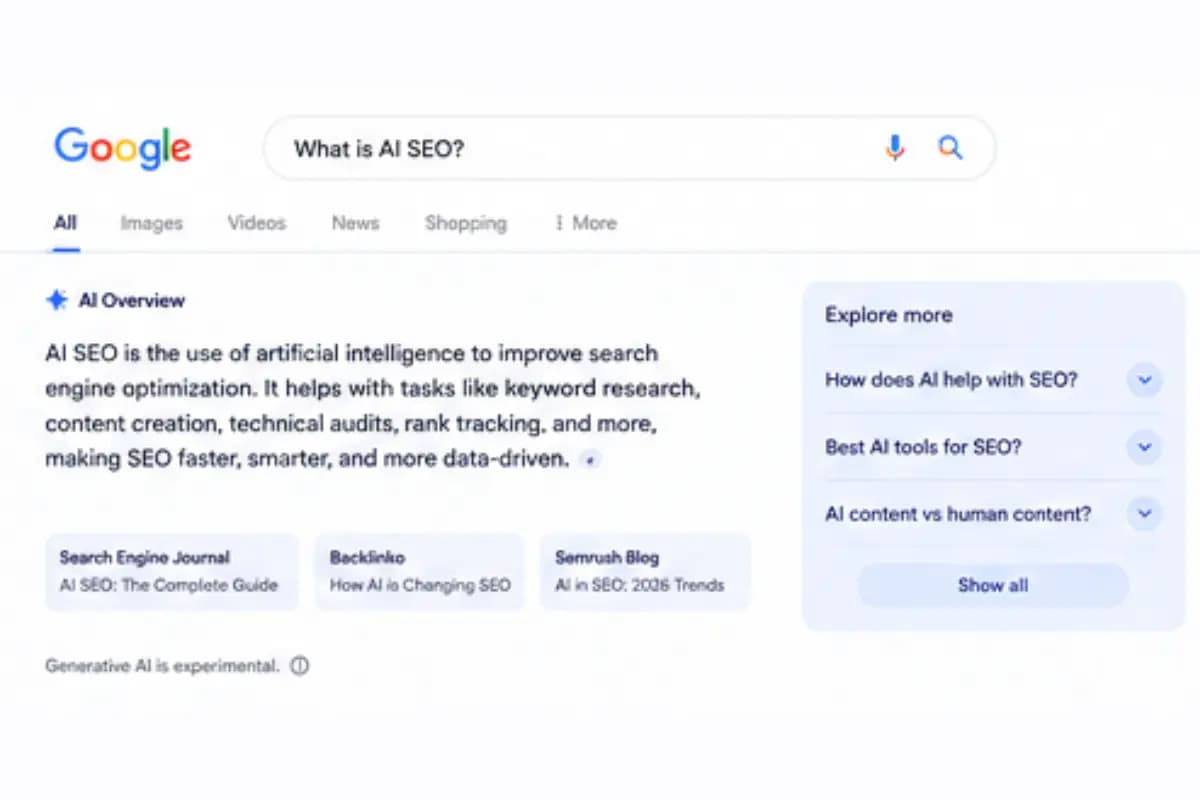
Instead of showing only traditional rankings, Google now displays AI generated summaries for many informational searches.
Users often receive an immediate answer at the top of the page. Several websites may appear as sources beneath the summary.
Appearing inside those citations creates valuable exposure. Many users continue clicking source links after reading the overview.
Others remember the website name for future searches. Visibility still creates value even when click behavior changes.
Google looks for trustworthy information.
Pages demonstrating expertise often perform better than pages repeating information already available elsewhere.
Original examples help. Fresh research adds value. Accurate statistics improve credibility.
Clear explanations make information easier to understand. Every improvement increases the usefulness of your content.
ChatGPT & AI Assistants
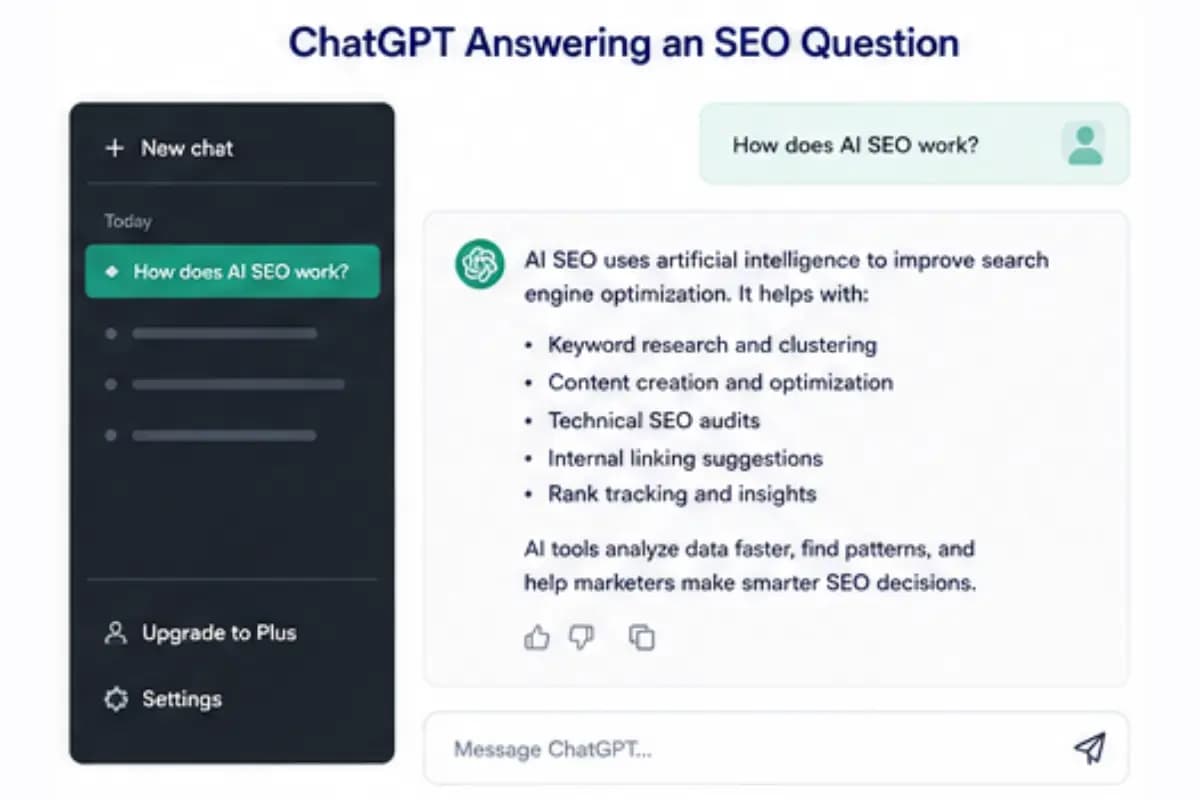
ChatGPT has become a common research tool for students, professionals, business owners, and everyday users.
People ask questions that once belonged exclusively to Google.
Instead of reviewing ten different websites, users often expect a complete answer immediately.
ChatGPT frequently references reliable information gathered during its search process when search features are available.
Helpful articles have a better chance of being mentioned. Pages offering original insights often stand out because they contribute something unique.
Generic articles rarely receive the same level of attention. Writing with clarity benefits both readers and AI systems.
Avoid unnecessary introductions. Explain important ideas early. Support every claim with useful details.
Readers appreciate that style. AI models benefit from it as well.
Perplexity & Citation Based Search
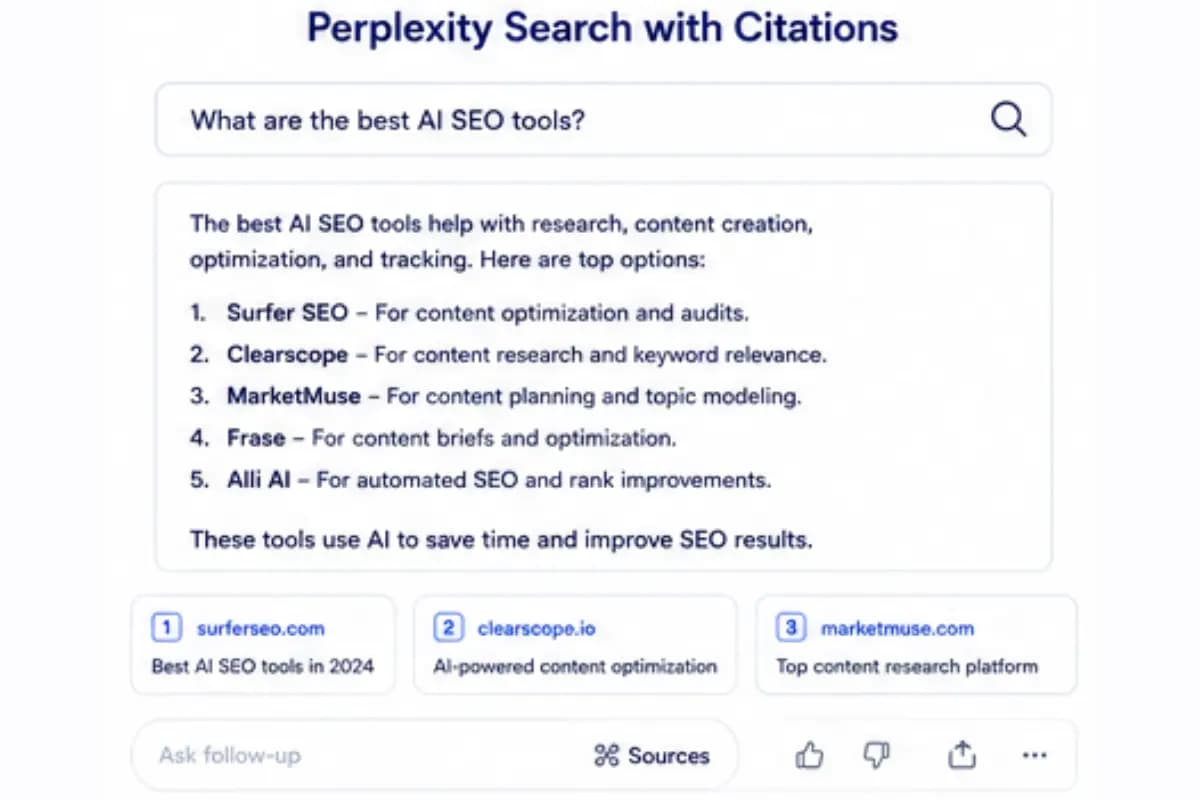
Perplexity has gained popularity because it combines AI generated answers with visible citations.
Users can easily see where information comes from. Reliable sources become especially valuable on platforms like this.
Trust plays a significant role.
Articles supported by accurate facts, current information, and strong explanations naturally become better references.
Website authority still matters. Quality matters even more.
Publishing content people actually want to read remains the strongest long term strategy.
Structure Content For Easy Understanding
Good organization improves every article.
Readers find information faster. Search engines understand your topic more easily.
AI systems identify useful sections without confusion. Begin each section with a direct answer.
Explain the idea before adding extra details.
Many readers appreciate quick answers. Additional explanations satisfy visitors wanting deeper information.
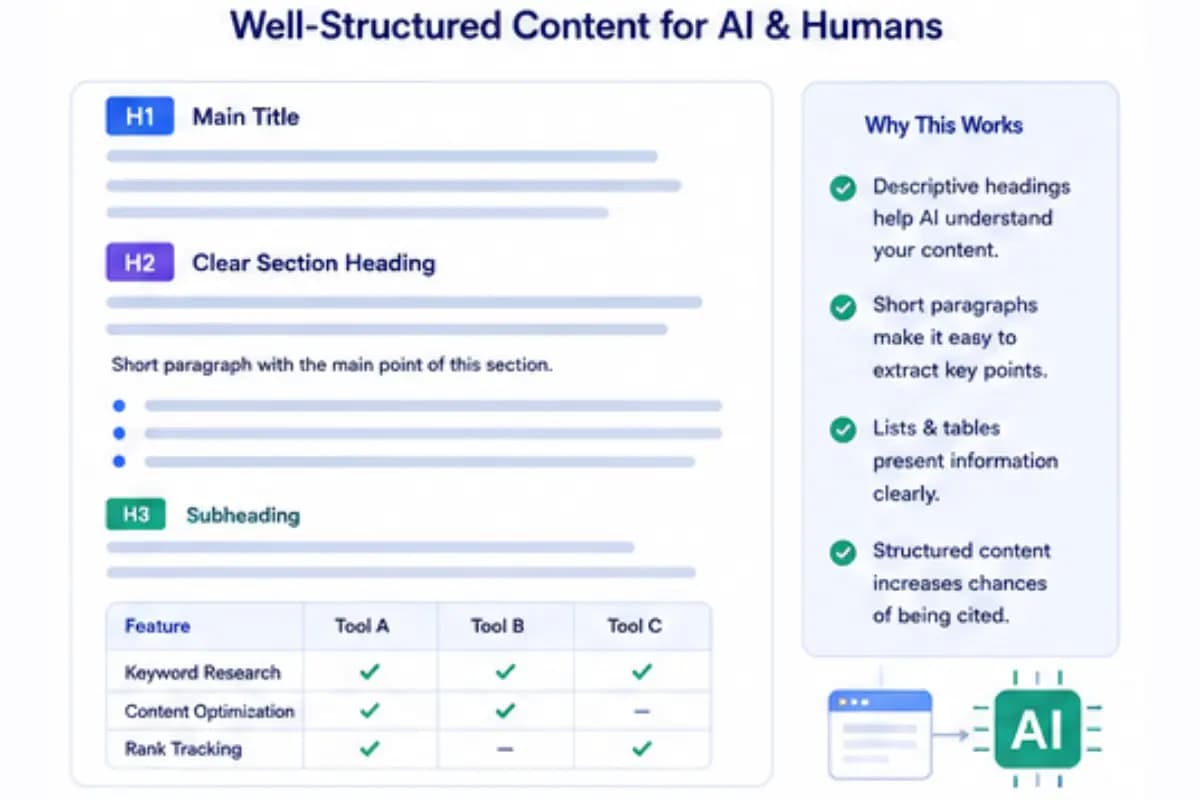
Descriptive headings create another advantage.
A heading such as "How AI Improves Keyword Research" immediately tells readers what the section covers.
Creative headlines may sound interesting, yet descriptive headings help readers scan long articles much faster.
Tables can improve clarity when comparing tools, features, or processes. Short lists work well when discussing several related ideas.
Large blocks of text often feel overwhelming.
Breaking information into manageable sections creates a better reading experience.
Every formatting decision should improve understanding. Never add lists or tables simply because they look attractive.
Use them when they genuinely help explain an idea.
Original Information Creates Stronger Content
Artificial intelligence has made publishing easier than ever. Original information has therefore become much more valuable.
Readers quickly recognize articles repeating ideas found everywhere else. Fresh examples capture attention.
Personal experience builds trust. Original screenshots help explain complicated topics.
Case studies provide practical value. Unique research separates your content from countless similar articles.
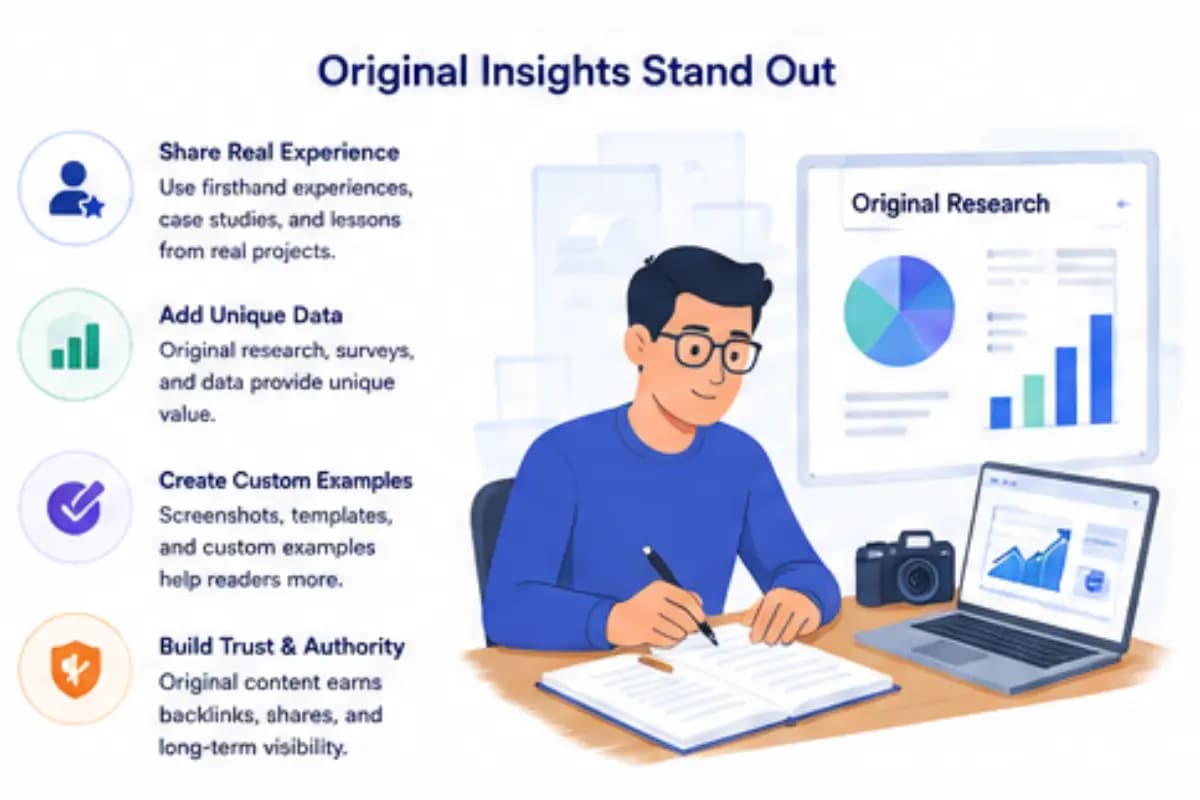
Search engines appreciate originality.
AI systems benefit from it as well because fresh information expands the knowledge available online.
Even simple observations based on your own experience make an article more useful.
Sharing lessons learned from real projects often creates stronger content than repeating common advice.
Demonstrate Experience & Trust
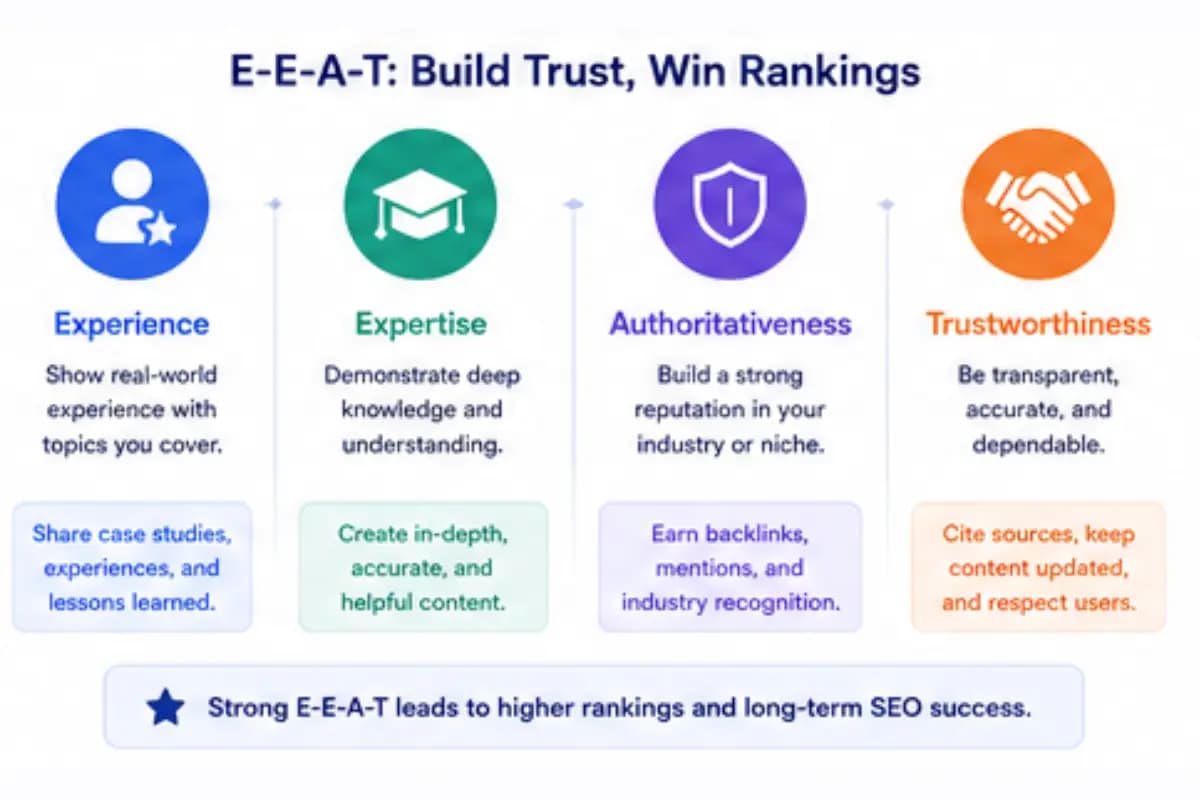
Google continues emphasizing experience, expertise, authoritativeness, and trust.
Many people refer to those ideas as E-E-A-T.
Every part supports long term SEO success. Readers trust content written by people with genuine knowledge.
Detailed explanations often reveal practical experience. Accurate examples build confidence.
Honest recommendations strengthen credibility. Trust grows over time.
Avoid making claims without evidence.
Avoid copying information from multiple competitors without adding value. Create content because it helps readers solve problems.
Search performance usually follows.
Balance AI Optimization With Human Readability
Some writers become so focused on AI optimization that they forget about real people.
Articles filled with repetitive headings, robotic wording, and unnecessary keyword repetition create a poor reading experience.
Readers leave quickly. Strong content always places people first.
Artificial intelligence should never become your primary audience. Real visitors remain your most important readers.
Write naturally.
Explain difficult topics using simple language. Guide readers from one idea to the next.
Allow AI optimization to support your writing instead of controlling it. That balance creates articles readers enjoy and search platforms understand.
Traditional SEO & AI Search Can Work Together
Many beginners believe they must choose between traditional SEO and AI optimization. That assumption creates unnecessary confusion.
Both approaches support each other far more often than they compete. Helpful articles perform well in Google search.
Helpful articles also perform well inside AI powered search experiences. Clear headings improve rankings.
Clear headings help AI systems understand your content. Accurate information builds trust with readers.
Accurate information improves AI citations. Useful internal links strengthen website structure.
Useful internal links also help search systems understand relationships between topics. Every improvement benefits multiple areas at the same time.
Think of AI search as another way people discover your content rather than a replacement for traditional SEO.
Strong websites prepare for both. Future search experiences will continue changing.
Readers will continue looking for accurate answers.
Building trustworthy content remains the smartest long term strategy regardless of how technology evolves.
The AI SEO Tool Landscape
AI SEO tools continue improving every year. New platforms appear almost every month, each promising faster rankings, better content, or smarter automation.
Finding the right tool can feel overwhelming because every company claims to offer the perfect solution.
Reality looks much simpler.
Every tool serves a different purpose. Choosing software becomes much easier after you understand exactly what problem you want to solve.
Some tools focus on research. Others specialize in content planning. Many concentrate on writing.
Another group helps with technical SEO, internal linking, or performance tracking.
Very few platforms handle every task equally well.
Building an effective SEO workflow often means combining several specialized tools instead of relying on a single all in one solution.
Keyword research tools help you discover search opportunities.
Modern AI platforms do much more than provide search volume. Many organize keywords into clusters based on search intent.
Others identify content gaps between your website and your competitors. Some even recommend content calendars built around your target topics.
Good keyword research tools save hours of manual work while making planning much more organized.
Planning content becomes much easier with AI.
Many platforms generate topical maps, pillar page ideas, supporting articles, and content clusters within minutes.
Instead of starting with an empty document, marketers receive a complete roadmap showing how different pages connect together.
Planning tools help reduce duplicate content because every article serves a clear purpose inside the larger content strategy.
Large websites benefit especially from this level of organization.
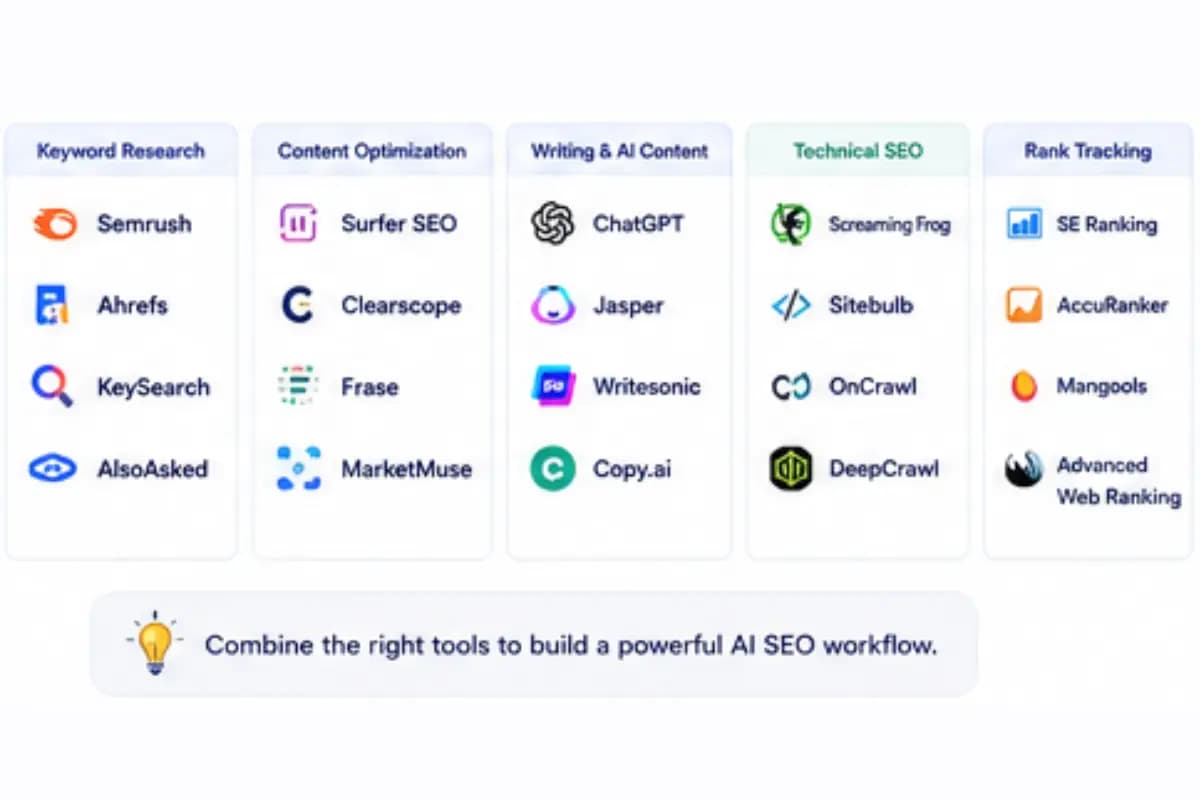
Writing assistants remain the most popular category.
Many people think of ChatGPT immediately when discussing AI SEO. Writing tools can create outlines, introductions, headlines, summaries, and first drafts.
Some platforms include SEO recommendations while writing. Others analyze competitor content before generating suggestions.
Quality depends heavily on the instructions you provide. Generic prompts often produce generic articles.
Detailed prompts usually create much stronger results. Editing remains essential.
AI can write quickly. Editors ensure accuracy, improve readability, and add personal experience before publishing.
Internal linking often receives very little attention. Many website owners simply add links whenever they remember. Growing websites need a much better system.
Internal linking software scans your existing articles and recommends related pages worth connecting.
Large websites containing hundreds or thousands of articles benefit tremendously from this automation.
Editors still decide which suggestions deserve approval. Natural links always outperform forced connections.
Every website contains pages that deserve attention. Finding them manually takes considerable time.
AI audit tools identify declining traffic, outdated articles, duplicate topics, broken links, thin content, and missing optimization opportunities.
Many platforms even explain possible reasons behind ranking losses. Regular audits help maintain steady organic growth instead of waiting for major traffic declines.
Ranking reports have become much smarter. Older tools simply displayed keyword positions.
Modern AI powered platforms explain ranking movements, identify unusual trends, and recommend possible improvements.
Several tools also monitor AI visibility. Appearing inside Google AI Overviews or other AI powered search platforms has become another valuable performance metric.
Tracking those opportunities gives website owners a more complete picture of search visibility.
Common AI SEO Mistakes
Artificial intelligence creates amazing opportunities. Using it incorrectly often creates equally large problems.
Many website owners repeat the same mistakes because they focus entirely on speed. Quality should always come first.
Publishing AI Content Without Editing
Many beginners copy AI generated text directly onto their websites. That shortcut rarely produces strong results.
Tools like Originality.ai can help you detect AI-generated content and ensure your published material includes enough human editing to maintain quality.
Artificial intelligence occasionally creates incorrect information. Generic examples appear frequently.
Repetitive wording also becomes common. Editing improves every article. Adding personal experience creates even greater value.
Readers notice the difference immediately.
Chasing Quantity Instead of Quality
Publishing ten average articles rarely outperforms publishing two excellent ones. Many websites flood their blogs with content simply because AI makes writing easier.
Search engines continue rewarding helpful information. Creating useful resources should remain the priority.
Quality builds trust. Trust creates long term growth.
Ignoring Search Intent
High search volume looks attractive. Traffic alone does not build a successful business.
Every keyword should match the needs of your audience.
Someone searching for educational information may have no interest in purchasing your product.
Understanding intent helps you choose better opportunities. Artificial intelligence provides recommendations.
People make the final decision.
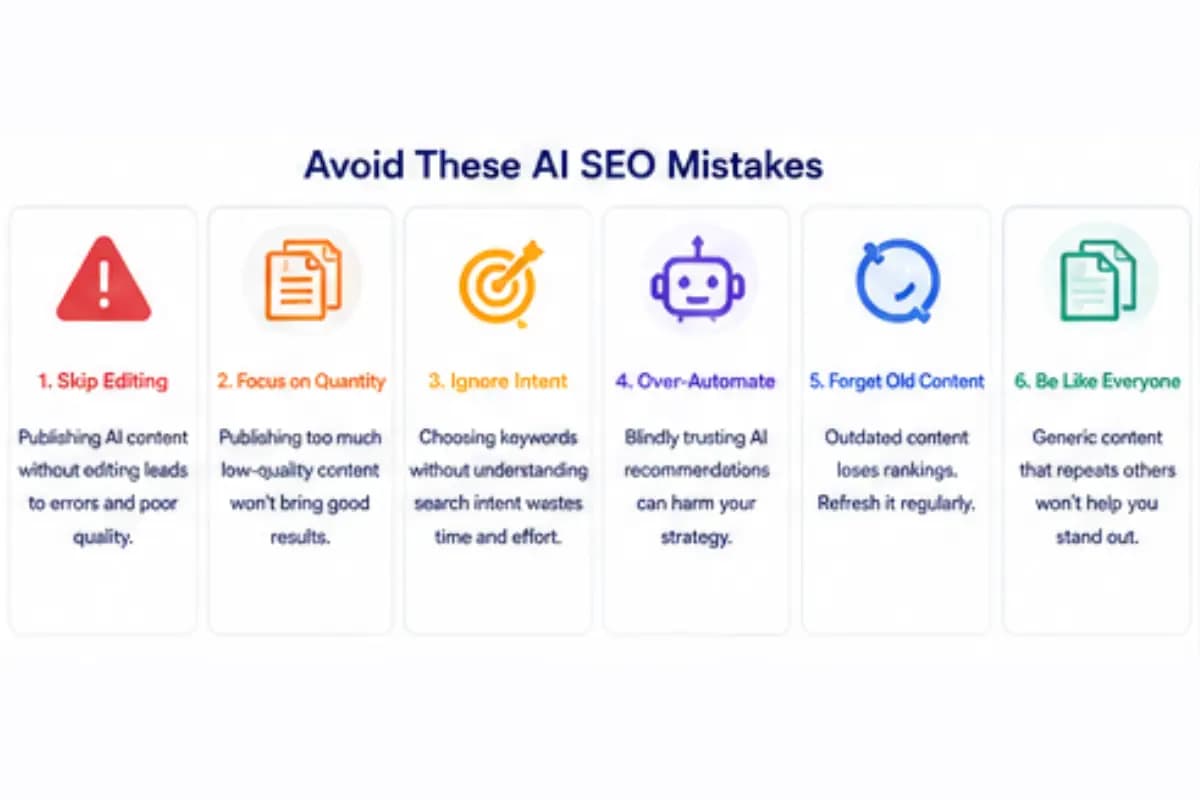
Depending Completely On Automation
Automation saves time. Blind trust creates problems. AI recommendations deserve review.
Keyword clusters may need adjustment. Internal linking suggestions may not fit naturally.
Content outlines sometimes overlook important ideas. Automation should support decision making instead of replacing it.
Forgetting Existing Content
Many marketers become excited about creating new articles. Older content quietly loses rankings.
Statistics become outdated. Examples lose relevance. Competitors publish stronger resources.
Refreshing existing articles often produces faster results than publishing another new page. Successful websites balance both activities.
Writing Like Every Other Website
Artificial intelligence learns from existing content. Following the same prompts produces similar articles across countless websites.
Readers quickly notice familiar wording. Unique experiences make your content memorable.
Share lessons learned. Include real examples. Explain mistakes you have encountered.
Offer practical advice based on actual work. Originality remains a powerful advantage.
Building Your AI SEO Stack
Building an effective AI SEO system does not require dozens of expensive tools. Starting with a simple workflow often produces better results.
Begin by understanding your existing website. Review current traffic. Study rankings.
Identify pages already performing well. Look for content that needs improvement. Skipping this step often leads to duplicate work.
Next, build your topical map.
Organize major subjects into logical categories. Plan supporting articles before writing anything new.
Strong organization saves significant time later. Continue with keyword research. Search for opportunities supporting your topical map.
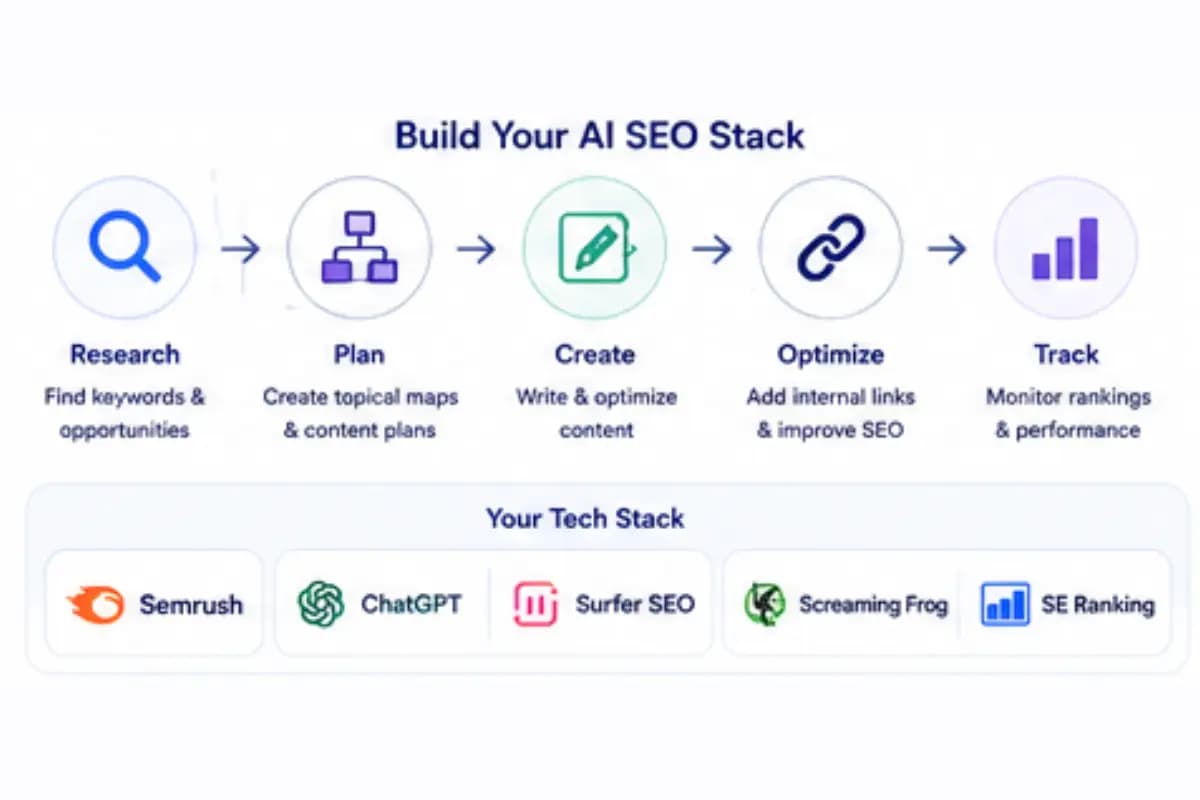
Choose keywords matching both user intent and business goals. Avoid chasing every popular search term.
Quality matters far more than quantity. Create detailed content briefs before writing.
Clear instructions improve writing quality regardless of who creates the article. Include target keywords, user intent, important questions, and internal linking opportunities.
Using RankMath alongside AI tools helps you optimize your content for on-page SEO while keeping search intent and readability in focus.
Use AI during drafting. Allow it to create outlines, organize ideas, or improve grammar.
Add your own experience throughout the article. Personal knowledge transforms average content into valuable resources.
Publish carefully. Review every page before making it live. Check facts.
Improve readability. Verify internal links. Confirm every section provides value. Track performance after publication.
Monitor rankings. Review traffic. Watch user engagement. Identify opportunities for future improvements.
Repeat the process consistently. SEO works best as an ongoing system instead of a single project.
Final Thoughts On AI SEO Guide
Artificial intelligence has changed SEO in remarkable ways. Research happens faster. Planning becomes more organized.
Content production moves more efficiently. Website audits require much less manual work. Performance tracking now provides deeper insights than ever before.
None of those improvements replace good SEO fundamentals.
Helpful content still wins. Strong website architecture still matters. Trust continues influencing long term success.
Artificial intelligence simply helps you complete important work more efficiently. Think of AI as a reliable assistant instead of a replacement for expertise.
Allow technology to organize information, identify patterns, and reduce repetitive work.
Invest the time you save into creating better content, improving user experience, and building stronger authority within your niche.
Search will continue changing. New AI models will appear. Search engines will introduce additional features. User behavior will evolve.
Websites focusing on quality, accuracy, and genuine value will remain successful regardless of those changes.
Long term SEO has always rewarded people who solve real problems for real readers. Artificial intelligence gives you better tools to accomplish that goal.
Use those tools wisely, keep learning, and continue improving every part of your workflow. Growth follows consistency much more often than shortcuts.
Frequently Asked Questions
1. Is AI SEO suitable for beginners?
Yes. Beginners can use AI to simplify keyword research, content planning, and writing. Learning basic SEO principles first makes every AI tool much more useful because you'll know how to evaluate the suggestions it provides.
2. Can AI completely replace SEO professionals?
No. Artificial intelligence excels at processing data and automating repetitive tasks. Strategy, creativity, business decisions, and editorial judgment still require human expertise.
3. How often should I update AI generated content?
Review important pages every few months. Update outdated facts, improve examples, refresh screenshots, and add new information whenever search intent or industry trends change.
4. Does Google know if content was written with AI?
Google focuses primarily on content quality instead of the writing method. Helpful, accurate, and trustworthy articles have a much better chance of performing well than low effort content created only to rank.
5. Should every article be written with AI?
No. Artificial intelligence should support your workflow instead of controlling it. Many successful writers use AI for brainstorming, outlining, editing, or research while creating the final content themselves.
6. Which AI SEO task saves the most time?
Keyword clustering and content planning usually save the greatest amount of time. Organizing thousands of keywords manually takes many hours, while AI completes the same work within minutes.
7. Are AI Overviews reducing website traffic?
Some informational searches receive fewer clicks because users find answers directly inside search results. Helpful, trustworthy content still attracts visitors, especially when people need detailed explanations or want additional information beyond the summary.
8. Can small websites compete with larger brands using AI SEO?
Absolutely. Smaller websites often move faster and publish more focused content. AI helps reduce the gap by giving smaller teams access to research and planning capabilities that once required much larger budgets.
9. How many AI SEO tools do I really need?
Most website owners can build an effective workflow using two or three reliable tools instead of subscribing to every platform available. Focus on solving your biggest challenges first, then expand your toolkit only when necessary.
10. Will AI SEO continue changing after 2026?
Yes. Artificial intelligence continues improving rapidly, and search engines regularly introduce new features. Building strong SEO fundamentals while learning new AI capabilities will help you adapt successfully as the industry evolves.