Programmatic SEO: The Complete Guide
Programmatic SEO is a way to build many web pages at once using a template and a set of data.
Instead of writing each page by hand, you build one page design, then fill it with different information over and over.
Doing this can create hundreds or even thousands of pages in a short time.
Big sites use this trick all the time. A site that lists apartments for rent might have a page for every city.
A site that reviews software might have a page for every tool it compares. Each page looks similar, but the details inside are different.
You have probably visited pages built this way without even knowing it.
Weather sites, price comparison sites, and job listing sites almost all rely on this method behind the scenes.
It looks like magic from the outside, but the idea behind it is pretty simple once you break it down piece by piece.
The guide below will explain what programmatic SEO is, how it works, and why it can help a site grow fast.
We will also talk about the risks, since doing this the wrong way can hurt your site instead of helping it.
For a complete overview of how AI fits into every stage of search engine optimization, read our complete AI SEO guide. It covers how AI tools handle everything from keyword research to technical audits.
Disclosure: Some of the links I share might be affiliate links. If you click on one and make a purchase, I may earn a small commission as a thank you. But don’t worry, it won’t cost you anything extra. I only recommend stuff I genuinely believe in. Your support helps me keep creating awesome content. You can read my full affiliate disclosure in my disclaimer page.
If you want to save a lot of hours searching for high-paying affiliate programs, check out our exclusive list of 2500+ affiliate programs. You’ll find all the information about the programs inside the list. This list is perfect for affiliate bloggers and influencers.
What Programmatic SEO Means
Programmatic SEO means using a system to create many pages that follow the same pattern.
The word programmatic just means done by a program or a set of rules, instead of done by hand one at a time.
Once you see this pattern once, you will start noticing it on all kinds of websites you visit every day.
Picture a site that helps people find gyms near them. Instead of writing a new article for every city by hand, the site owner builds one template.
The template has spots for the city name, the number of gyms, average prices, and a few other details.
Then a spreadsheet or database fills in those spots for every city in the country.
The result is hundreds of pages, each one built from the same template but showing different information.
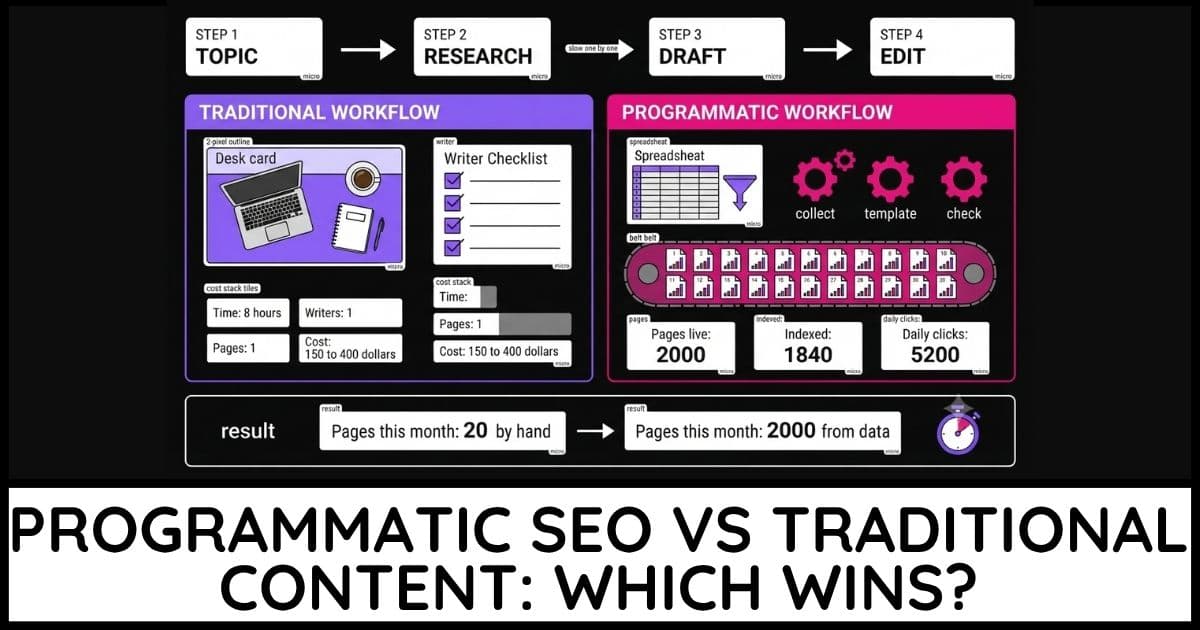
Programmatic SEO is quite different from normal content writing, where a person writes each article by hand from start to finish.
It works more like filling in a form over and over, using real data each time.
Building topical authority in a niche depends heavily on keeping your content organized and non-overlapping, which becomes especially important when you are generating pages at scale.
Why Companies Use Programmatic SEO
The biggest reason companies use this method is speed. Writing one thousand articles by hand could take a team of writers many months.
Building one good template and filling it with data from a spreadsheet can create those same one thousand pages in a much shorter time.
Another reason is that this method works really well for topics that repeat in a pattern.
Think about a site that shows weather forecasts for every city, or a site that lists car prices for every model and year.
These topics are perfect for this method, since every page follows the exact same basic structure, just with different numbers and names filled in.
Programmatic SEO also helps a site show up for many small searches at once.
Instead of trying to rank for one big, competitive keyword, a site can rank for thousands of smaller, specific searches.
A single page about hotels in one small town might not get much traffic on its own, but when you add up traffic from a thousand town pages, the total can be huge.
Learning how to do keyword research properly helps you identify the kind of small, specific searches that programmatic SEO pages are built to capture.
How Programmatic SEO Works
Every programmatic SEO project needs three main pieces working together. Knowing these three pieces makes the whole idea much easier to picture.
The first piece is the data. It holds the information that will fill in each page.
It could be a list of cities, a list of products, a list of job titles, or anything else that repeats across many entries.
The data usually lives in a spreadsheet or a database, with each row holding the details for one page.
The second piece is the template. It is the page design that stays the same every time, with blank spots where the data will go.
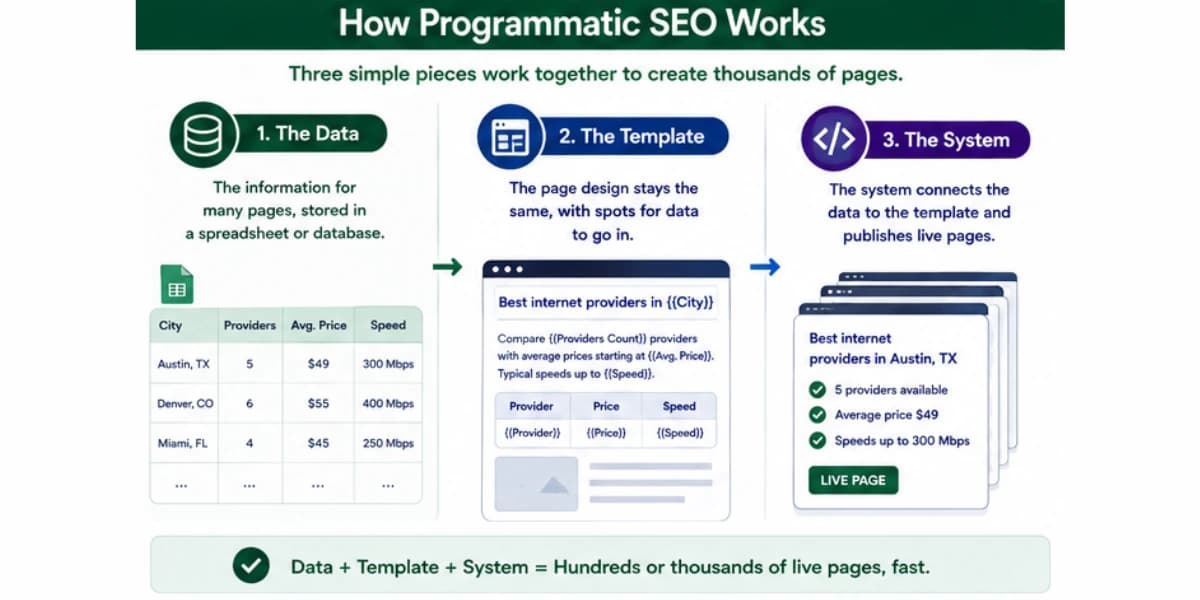
A template might have a spot for a title, a spot for a short paragraph, a spot for a table, and a spot for a few extra facts.
The template controls how the page looks and how the words are arranged, no matter what data gets placed inside it.
The third piece is the system that connects the data to the template and builds the actual pages.
It could be a plugin on a website, a piece of custom code, or a no-code tool built for this exact purpose.
That system takes each row of data, plugs it into the template, and creates a finished, live web page.
Understanding how your content fits together is essential for effective workflows. Our guide on what content clusters are explains how pillar pages and supporting articles work together to build topical authority.
A Simple Example To Make This Clear
Let's walk through one clear example so this idea sticks. Picture a site that helps people compare internet providers in different cities.
The data might include a list of five hundred cities, along with the internet providers available in each one, their average prices, and their average speeds.
All of it sits in a spreadsheet, one row per city.
The template might say something like this. The title starts with best internet providers in, followed by the city name.
The first paragraph explains how many providers are available and what the average price looks like in that city. Below that, a table lists each provider along with its price and speed.
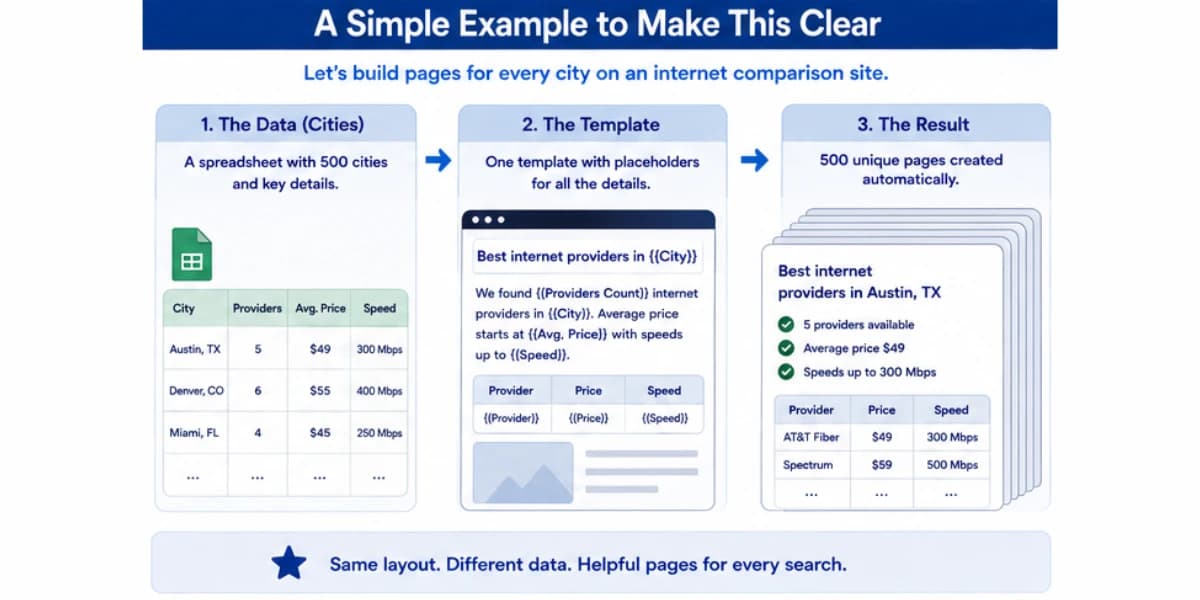
At the bottom, a short paragraph gives tips for choosing a plan.
Once the data and template are ready, the system builds one page for every single city in the spreadsheet.
Each page follows the same layout, but the actual details change based on the city.
A reader searching for internet providers in a specific town finds a page built just for that search, even though nobody wrote that exact page by hand.
Building a topical map for AI SEO gives you the content structure that makes planning programmatic pages much easier, since you already know which pages should support which others.
Real World Examples You Might Already Know
Programmatic SEO is all around you, even if you never noticed it.
Looking at real examples helps this idea feel less abstract, since seeing how big sites use this method makes it much easier to picture how it could work for your own project.
A big travel website might have a page for every hotel in every city. Each page follows the same layout.
It shows the hotel name, a photo, the price, and guest reviews. Nobody wrote each page by hand.
The site pulled hotel data from its database and built each page using one shared template.
Millions of travelers use pages like these every single day to plan their trips, never once wondering how each listing came together.
A job search website often does something similar. It might have a page for every single job title in every single city, like nurse jobs in Dallas or plumber jobs in Denver.
Each page shows current job listings, average pay, and helpful tips. The page design stays the same, but the job title and city change every time.
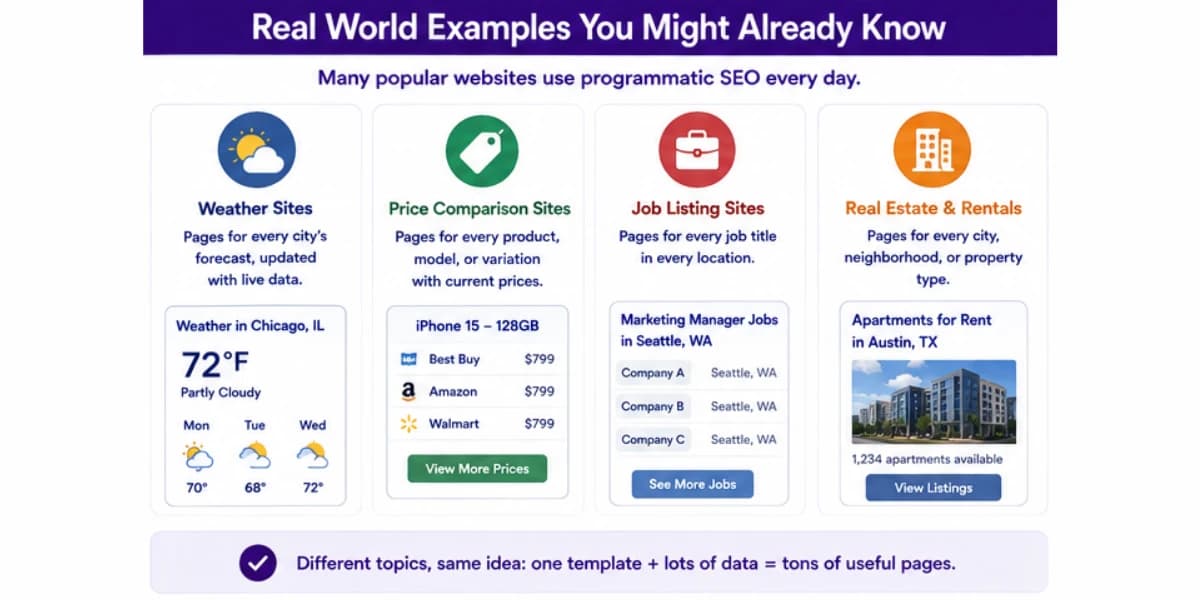
A job seeker searching for a very specific role in a very specific place often finds exactly what they need, thanks to a page built just for that combination.
A shopping comparison site might build a page for every product it tracks. Each page shows the current price, a chart of price history, and links to buy the product.
With thousands of products, writing each page by hand would take forever. A template and a live database make it possible instead.
Shoppers land on these pages every day without ever thinking about how they were made, which is really the whole point of doing this well in the first place.
These examples show a clear pattern.
The most successful programmatic SEO projects pick a topic with real, useful data behind it, then build a page design that genuinely helps someone make a choice or find an answer.
A Closer Look At Good Data
Since data sits at the center of this whole method, it helps to slow down and talk about what good data really looks like in practice.
A lot of programmatic SEO projects fail not because the idea was bad, but because nobody spent enough time on this one important step before rushing ahead.
Accurate Data
Good data is accurate. Every number, name, and detail should be checked and correct.
A single wrong price or wrong address might not seem like a big deal, but when that mistake gets copied across a thousand pages, it becomes a thousand mistakes instead of one.
Complete Data
Good data is complete. Missing pieces create empty, weak spots on your pages.
If half of your rows are missing a key detail, half of your pages will feel thin and unfinished compared to the other half.
Fresh Data
Good data stays fresh. Some data barely changes, like the definition of a word. Other data changes often, like prices or stock levels.
Knowing how often your data needs a refresh helps you plan how often you need to update your pages too.
Large Enough Data
Good data is large enough to matter. Building a whole system for just ten pages is usually not worth the setup time.
Programmatic SEO shines when you have hundreds or thousands of entries that follow the same basic pattern.
Keeping time sensitive content fresh and accurate is where a solid AI content refresh workflow becomes genuinely valuable, since it helps you catch outdated details before they hurt your credibility.
Benefits Of Doing Programmatic SEO Well
When this method is done carefully, it brings real benefits that are hard to get any other way.
These benefits show up most clearly on sites that stick with the process long enough to build real scale, rather than sites that try it once and give up after a small first batch.
Scale
Scale is the biggest benefit. A small team can publish far more pages than they ever could by hand.
That kind of scale matters a lot for topics where thousands of small, specific pages add up to a large amount of total search traffic.
Consistency
Consistency is another benefit. Since every page comes from the same template, they all follow the same clear structure.
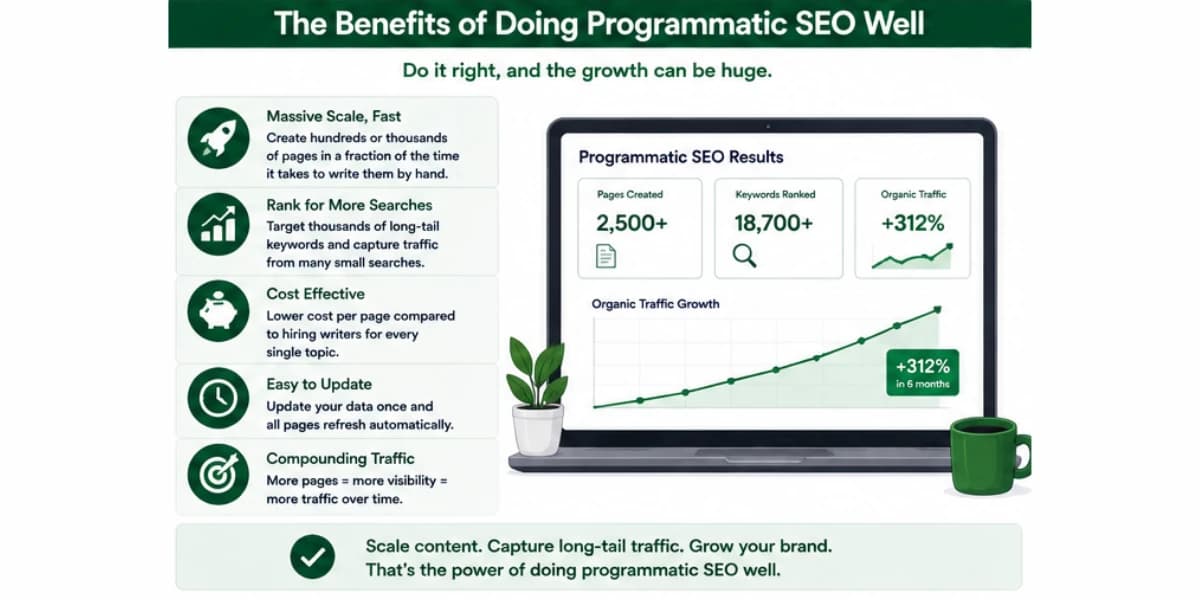
Readers know what to expect, and search engines can understand the pattern across your whole site more easily.
Speed To Market
Speed to market matters too. If a new trend appears, a site using programmatic SEO can react fast, building a huge batch of new pages around that trend in days instead of months.
Programmatic SEO also helps smaller or newer sites compete with big brands on a wide range of specific searches, even if they cannot compete on the biggest, most competitive keywords.
Owning a huge number of smaller searches can add up to more total traffic than chasing just a few giant ones.
Real Risks Of Programmatic SEO
Programmatic SEO is powerful, but it comes with real risks that many people ignore until it is too late.
Knowing these risks ahead of time is the best way to avoid learning them the hard way, after a big batch of pages has already gone live.
The biggest risk is publishing thin, low value pages. If your data is weak or your template does not add much real value, you end up with thousands of pages that barely help anyone.
Search engines are built to spot this pattern, and sites full of thin pages often get pushed down in rankings or removed from search results entirely.
Duplicate feeling content is another common problem.
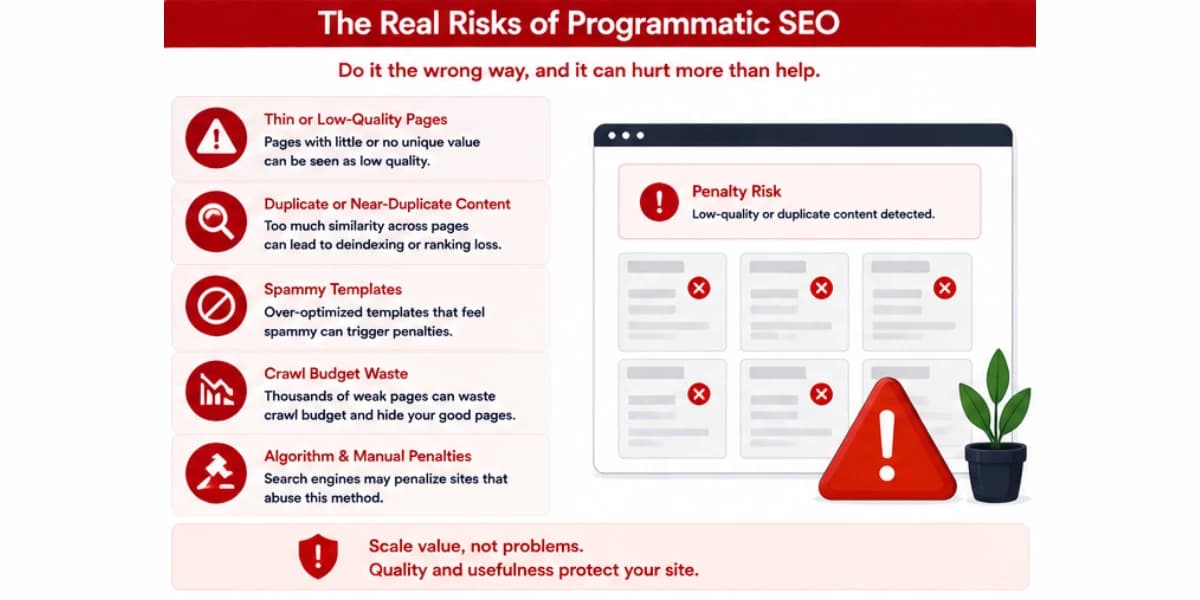
If every page only changes a name or a number while everything else stays exactly the same, the pages can feel repetitive and empty to a real reader, even if they are technically unique.
Poor data quality causes real damage too. If your data has mistakes, missing details, or outdated numbers, those mistakes get copied across every single page built from that data.
A tiny error in your spreadsheet can turn into thousands of wrong pages in just a few clicks.
Search engines can also flag a site if it seems to be built only for search traffic instead of for real people.
If your pages offer little real help beyond a few swapped words, this pattern becomes obvious fast, both to readers and to search engines.
Running a regular AI content audit helps you identify pages that may be too thin or repetitive before the problem grows into a bigger issue.
What Makes A Programmatic SEO Page Truly Good
The gap between a great programmatic SEO project and a bad one almost always comes down to how much real value each page provides.
Answer A Real Question
A good page answers a real question a real person is likely searching for.
Before building any template, it helps to ask what a reader truly wants to know when they search for this topic, and then make sure the template really answers that question clearly.
Use Solid Data
A good page uses solid, accurate data. Data that is outdated, wrong, or too thin will always produce a weak page, no matter how nice the template looks.
Strong data is the real foundation this whole method depends on.
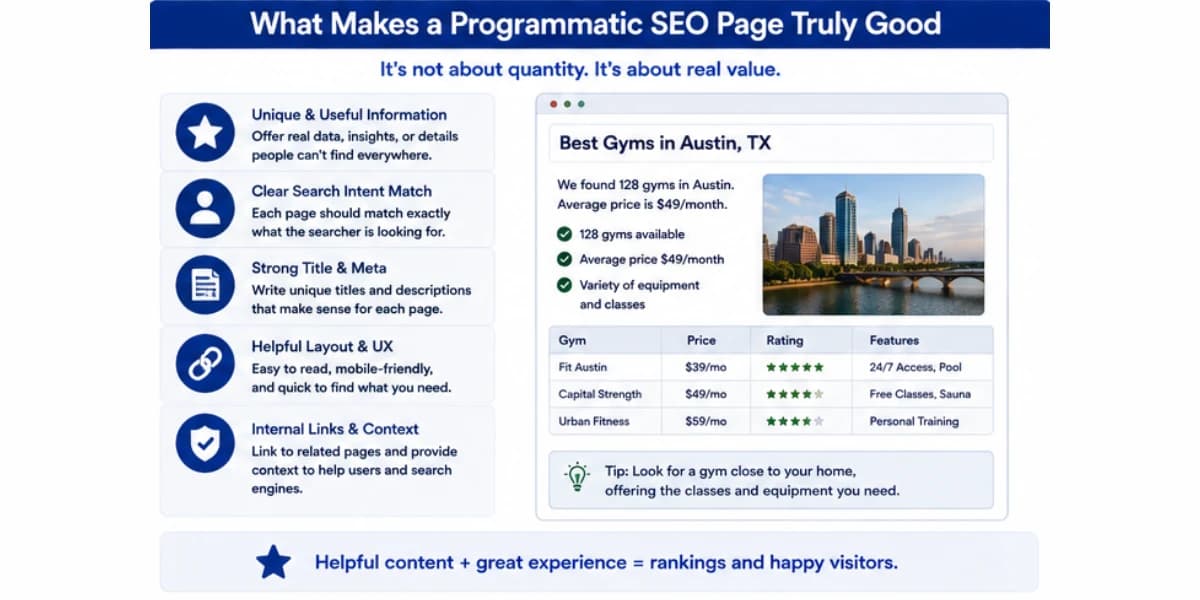
Include Unique Detail Per Entry
A good page includes enough unique detail per entry that it does not feel like a copy of every other page on the site.
Adding specific numbers, specific local details, or specific comparisons that genuinely change from one page to the next helps a lot here, not just swapping the name at the top.
Get A Real Design And Editing Pass
A good page still gets a real design and editing pass, even though it was built by a system.
Templates should be tested, reviewed, and improved over time, just like any other important page on your site.
How To Write A Template That Does Not Feel Empty
A weak template ranks among the fastest ways to ruin an otherwise good programmatic SEO project, so it deserves its own close look.
Start With A Real Question In Mind
Start with a real question in mind, not just a blank page you need to fill.
Before writing a single word of the template, write down the exact question a reader has when they land on this type of page.
A city page about internet providers should answer things like which providers are available, what they cost, and which one is worth picking.
Every part of your template should trace back to answering that question.
Mix Data With Guidance
Mix data driven sentences with a few sentences that explain or guide the reader. A page that shows nothing but a table of numbers can feel cold and hard to use.
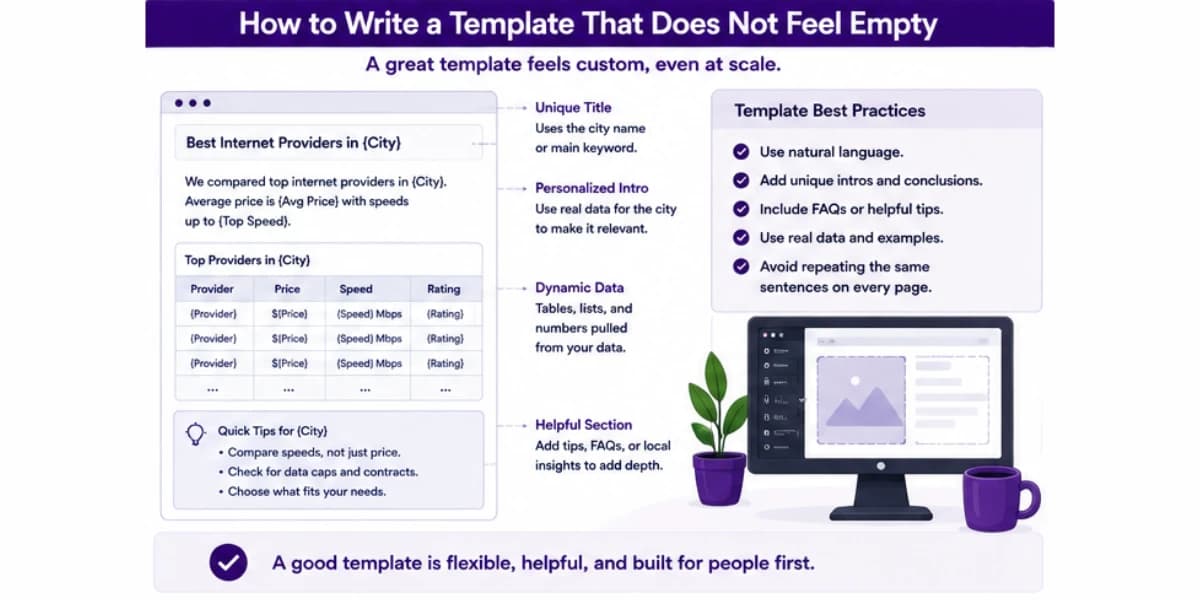
Adding a short paragraph that explains what the numbers mean, or gives a simple tip, makes the page feel like it was built for a real person instead of just a machine.
Leave Room For Real Differences
Leave room for real differences between entries. If your template only leaves one small blank space for a name, every page will feel almost identical except for that one word.
Build in a few more spots where real, specific facts can shine through, like a specific number, a specific comparison, or a specific detail that only applies to that one entry.
Test Your Template
Test your template on a few very different entries before finalizing it. Try it on the entry with the most data and the entry with the least data.
If the template still reads well and makes sense on your weakest data entry, it is probably strong enough to handle the rest of your data set too.
Step By Step Walkthrough Of Building Your First Project
Seeing all the pieces fit together in order can make the whole process feel much less overwhelming, so here is a full walkthrough from start to finish, written in plain steps you can follow even if this is your very first programmatic SEO project.
Step One: Pick Your Topic and Confirm Real Data Exists
First, pick your topic and confirm real data exists for it. Spend a few hours checking if you can really gather clean, accurate data covering at least a few hundred entries.
If the data is thin or hard to find, this might not be the right topic for this method.
Step Two: Gather And Clean Your Data
Second, gather and clean your data in a spreadsheet. Fix spelling mistakes, fill in missing details where you can, and remove any entries that are too incomplete to use.
Cleaning up data often takes longer than people expect, but skipping it causes problems later that are much harder to fix.
Step Three: Sketch Your Template
Third, sketch your template on paper or in a simple document before building anything live.
Write out exactly what each section of the page will say, using one real example from your data to test the wording.
Step Four: Build The Template With A Sample
Fourth, build the template in whatever tool you are using, like a no-code page builder, a plugin, or custom code.
Connect it to a small sample of your data first, maybe ten or twenty entries, rather than your full data set.
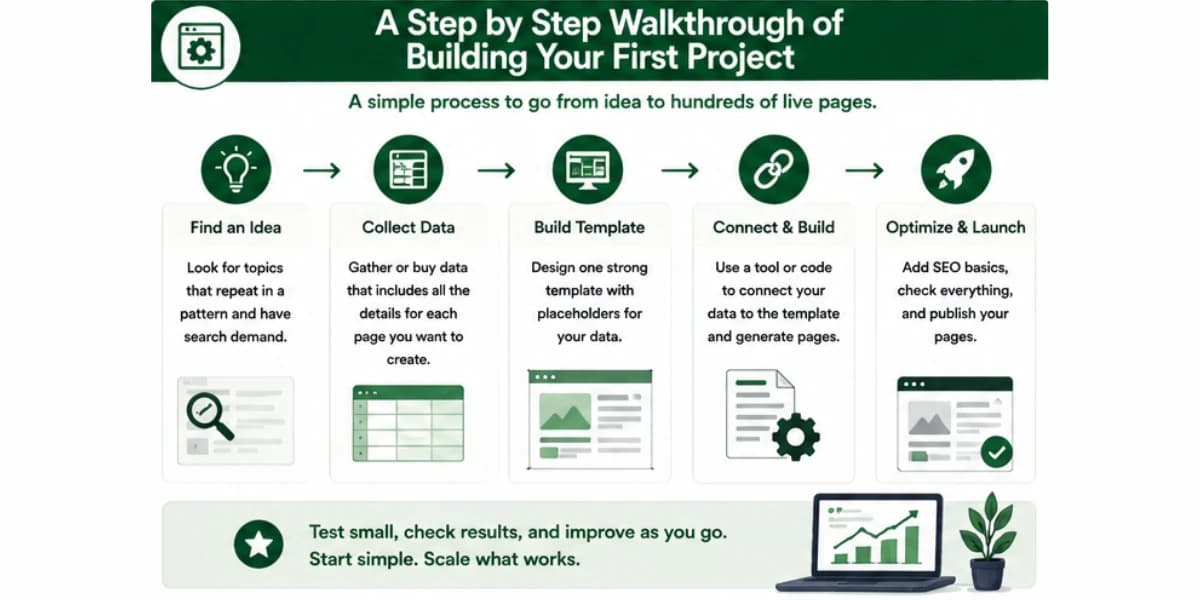
Step Five: Review The First Batch Closely
Fifth, review those first ten or twenty pages closely. Read them like a real visitor would.
Check if they make sense, if the facts are correct, and if the page really feels helpful rather than repetitive.
Step Six: Run A Bigger Test Batch
Sixth, fix any problems you find in the template, then run a slightly bigger test batch, maybe fifty pages this time.
Review again, since problems that were not obvious in the first small batch sometimes show up once you see more variety.
Step Seven: Launch The Full Batch
Seventh, once the bigger test batch looks strong, launch your full batch of pages.
Keep watching how they perform over the following weeks, since real search data will teach you more than any amount of guessing beforehand.
Step Eight: Set A Reminder To Revisit
Eighth, set a reminder to revisit your data and your template every few months.
Data goes stale, search habits shift a little over time, and a fresh look often reveals small improvements you missed the first time around.
Common Types Of Programmatic SEO Pages
A few common patterns show up again and again across successful programmatic SEO projects, and looking at these patterns helps spark ideas for your own project.
Chances are, at least one of these patterns fits something you already have data for right now, sitting in a spreadsheet you have not yet thought to turn into a full set of pages.
Location Based Pages
Location based pages are extremely common. These are pages built around a specific place, like a city, state, or neighborhood.
A site might have a separate page for every city where it offers a service, each one filled with local details like pricing, availability, or nearby options.
Comparison Pages
Comparison pages are another common pattern. These pages compare two or more things against each other, like two software tools, two car models, or two types of insurance.
The template stays the same, but the two things being compared change from page to page.
Product Or Listing Pages
Product or listing pages work well too.
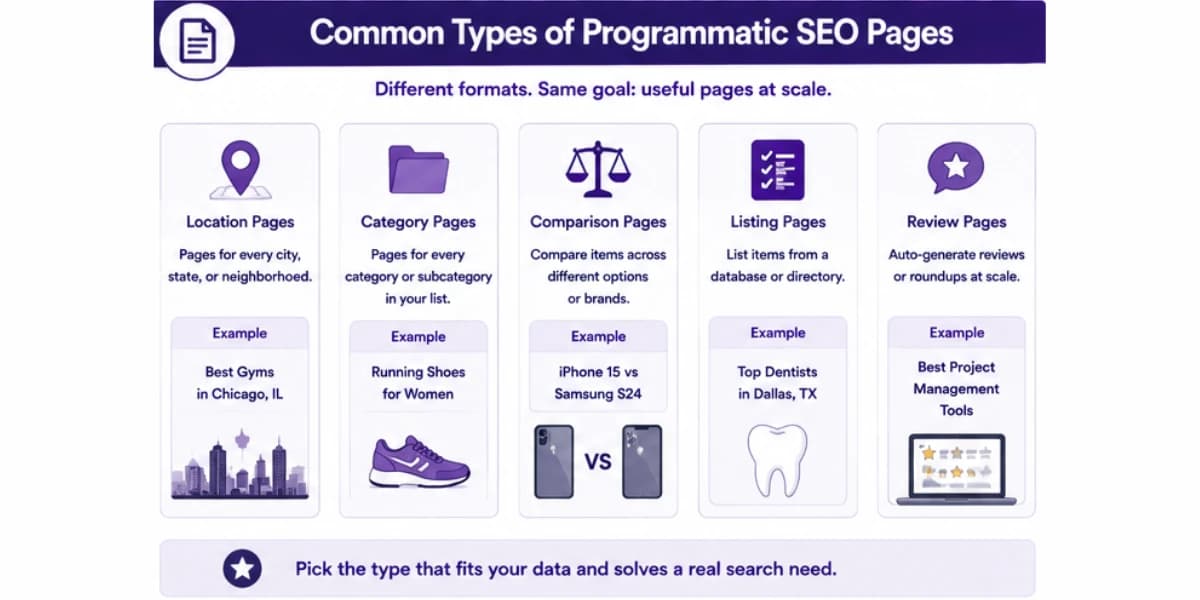
A site with a huge catalog, like real estate listings or job postings, often uses programmatic SEO to create a dedicated page for every single listing, following the same layout each time.
Definition Or Glossary Pages
Definition or glossary pages are a simpler pattern, often used by educational or reference sites.
Each page defines and explains one specific term, following the same basic template across hundreds or thousands of terms.
Calculator Or Tool Result Pages
Calculator or tool result pages are a more advanced pattern, where each page shows results based on a specific input, like a page showing loan payments for a specific loan amount and interest rate.
If you are building comparison pages for software products, our software reviews like the GetResponse review, AWeber review, and ClickMagick review are built around real hands-on testing that gives each page genuinely unique detail.
How To Plan A Programmatic SEO Project From Scratch
Planning carefully before you build anything saves a huge amount of wasted effort later, so it helps to follow a clear sequence of steps.
Start by picking a topic where real, repeatable data really exists. Without solid data, this whole method falls apart before it even begins.
Spend real time confirming your data source is accurate, complete, and large enough to be worth the effort.
Next, research if people are really searching for this kind of page. Just because you can build a thousand pages does not mean anyone wants to read them.
Check search volume and real search intent for a sample of your planned pages before committing to the full project.
After that, design your template around real reader needs, not just around what data you happen to have.
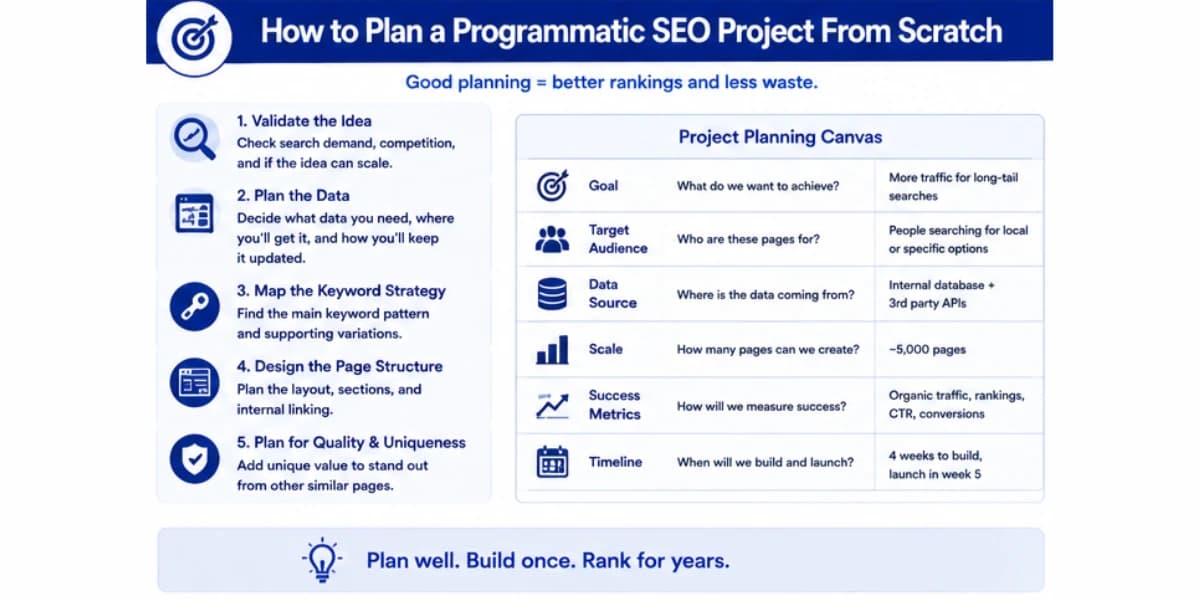
Think through what question a reader has when they land on this kind of page, and make sure your template answers that question clearly and directly.
Build a small test batch before scaling up to the full project.
Publish twenty or thirty pages first, check how they perform, and fix any problems in the template before generating thousands more pages from the same flawed pattern.
Once your test batch looks strong, scale up carefully, watching your site's overall performance as you add more pages.
Growing too fast without checking results along the way ranks among the most common mistakes in this entire process.
Understanding the difference between informational and commercial content helps you decide which types of programmatic pages to build first and how to structure them for the right search intent.
Tools Commonly Used For Programmatic SEO
A range of tools can help build a programmatic SEO project, and the right choice depends on your comfort level with code and the size of your project.
Picking the right tool early saves you from having to rebuild your whole setup later once your project grows bigger than you first planned.
Spreadsheet Tools
Spreadsheet tools, like simple spreadsheet software, are often used to store and organize the data before it gets turned into pages.
Even advanced programmatic SEO projects usually start with a clean, well organized spreadsheet at the very beginning.
No-Code Website Builders And Plugins
No-code website builders and plugins let you connect a spreadsheet to a template without writing any code yourself.
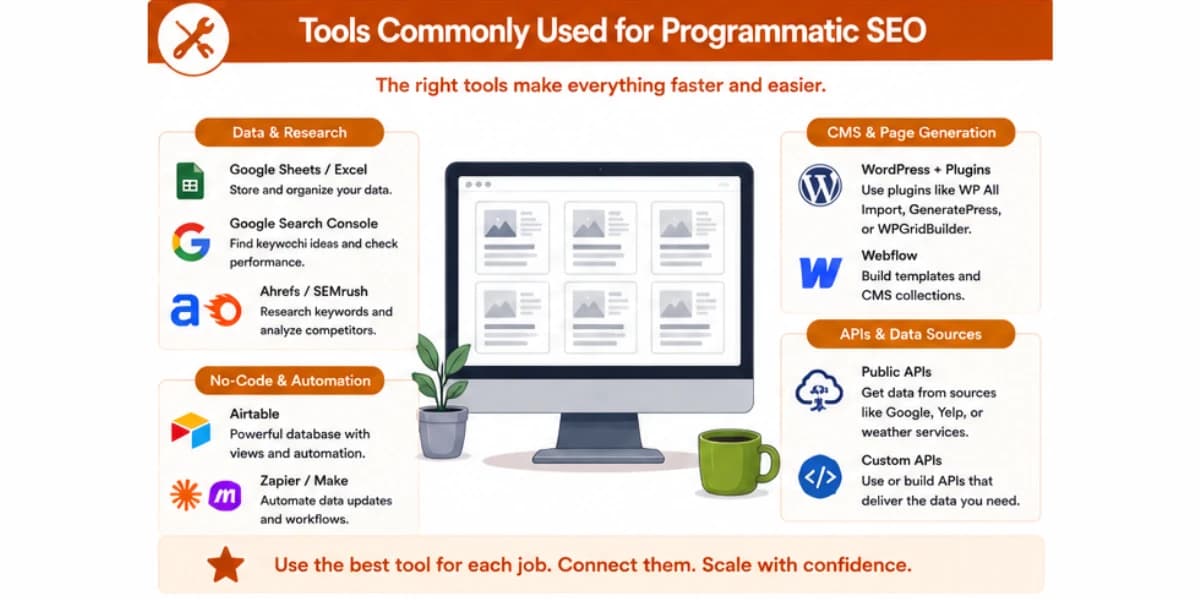
These tools are a great starting point for beginners, since they lower the technical bar needed to get a project off the ground.
Custom Code Setups
Custom code setups, often built with a programming language and a content system, give the most control and flexibility.
Larger companies with a development team often build custom systems so they have full control over exactly how pages get created and updated.
Database Tools
Database tools help manage very large data sets that would be too messy for a simple spreadsheet.
Once a project grows past a few thousand entries, a proper database often becomes necessary to keep everything organized and easy to update.
If you need help automating parts of your content production, using the right AI writing tools can help you draft template sections faster, but our Rytr review and ContentBot AI review show why a human editing pass still matters for the best results.
How Search Engines View Programmatic SEO
Search engines do not automatically punish programmatic SEO just because pages were built using a template and data.
Plenty of large, trusted sites use this exact method and rank very well, which shows that the method itself is not the problem search engines are trying to catch.
Search engines mainly care if a page provides real value to the person searching for it.
A page built from a template can absolutely provide real value, as long as it answers a real question with real, accurate information.
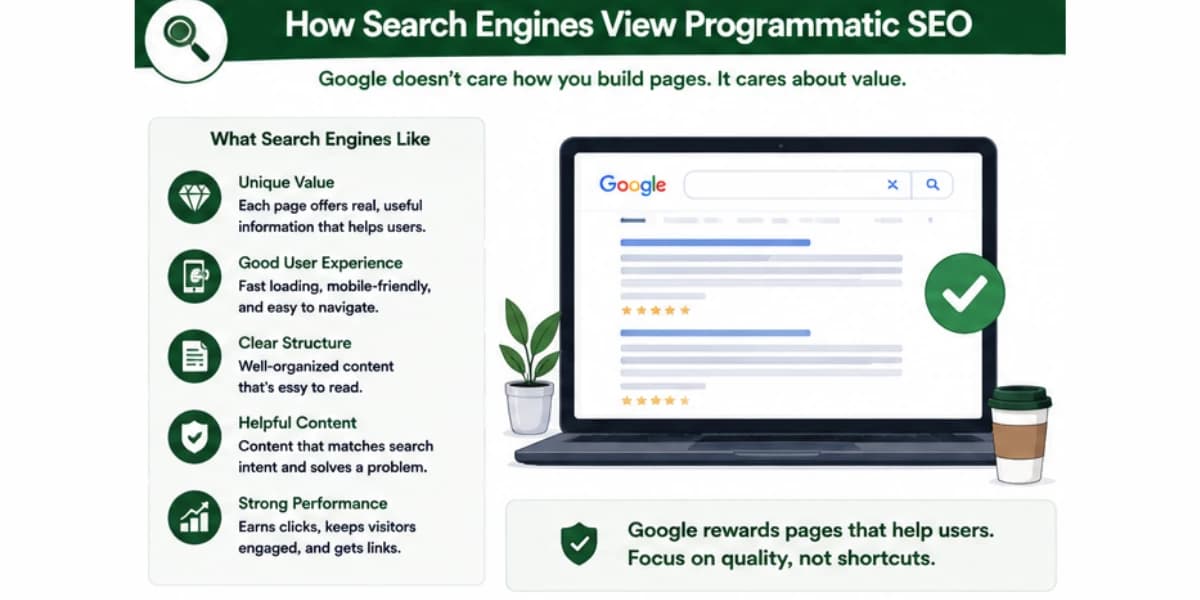
The pattern that gets penalized is publishing huge batches of thin, low value pages purely to grab search traffic, without any real thought given to what a reader truly needs.
People sometimes call this pattern doorway pages or thin content, and search engines have gotten quite good at spotting it across a whole site.
The safest approach is treating every programmatic page with the same care you would give a normal article.
Just because a page was built through a system does not mean it should skip quality checks, accurate data, or a real effort to help the reader.
Understanding how Google evaluates expertise and trust is essential here. Our guide on whether AI can write E-E-A-T content breaks down what Google actually checks when deciding which pages deserve to rank.
Common Mistakes To Avoid
A frequent mistake is skipping keyword research before building the template.
Some site owners assume that just because they can create thousands of pages, all of those pages will bring in traffic.
That assumption ranks among the most costly ones in this whole process.
Checking real search demand before building the full batch saves a lot of wasted effort on pages nobody is really searching for.
Another mistake is neglecting the quality of the data itself.
A beautiful template built on top of messy, outdated, or incomplete data still produces a weak final product.
Spend real time cleaning and checking your data before it goes anywhere near your template.
Publishing everything at once, without a smaller test batch first, is a common and costly mistake.
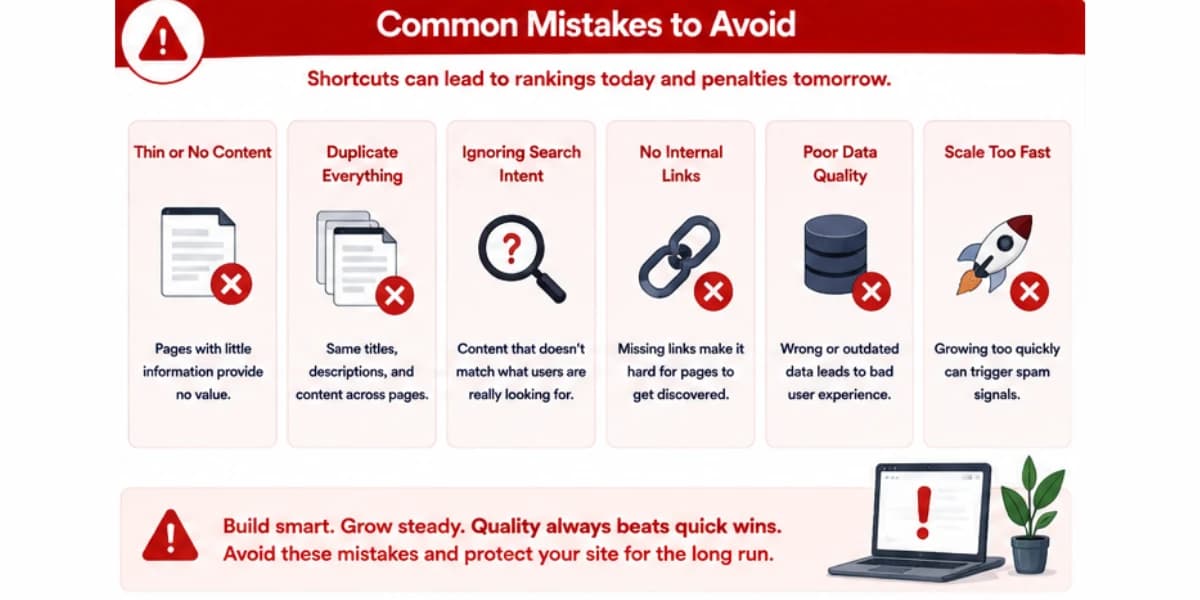
Small problems in a template can multiply into huge problems once they get copied across thousands of pages all at the same time.
Forgetting to update the pages over time is another mistake that quietly hurts results.
Data changes. Prices go up. Availability shifts.
A page that was accurate on the day it was published can become wrong and unhelpful a year later if nobody goes back to refresh it.
Ignoring internal links between the new pages is a mistake that limits how well the whole project performs.
Pages built from a template should link to related pages within the same project, helping both readers and search engines understand how the pages connect to each other.
If you need help finding where to add links in your existing content, try our internal link opportunity finder tool. It scans your pages and highlights where new internal links would add the most value.
How AI Fits Into Programmatic SEO Today
AI tools have made parts of this process faster and easier than they used to be.
AI can help write the unique text sections inside a template, especially the parts that need some natural sounding language around the raw data points.
AI can also help clean and organize messy data before it goes into a template, spotting missing details or strange entries that would otherwise slip through unnoticed.
That step saves a lot of manual review time on large data sets.

AI can help generate variations in wording across pages, so the writing does not feel too repetitive even though the underlying template stays the same.
Doing this helps address a major risk in this whole method, which is content that feels copied and empty from page to page.
Even with AI involved, human review still matters a lot.
A person should still check the data, review a sample of the finished pages, and make sure everything genuinely helps a real reader before the full batch goes live.
Learning prompt engineering for SEO helps you write the kind of clear, specific instructions that give AI tools a much better starting point for their work, which is especially useful when generating template variations at scale.
Measuring If Your Programmatic SEO Project Is Working
After launching a batch of pages, it helps to track a few clear numbers to see if the project is really paying off.
Checking these numbers on a regular basis also helps you spot small problems early, long before they turn into a much bigger drop in traffic across the whole batch.
Watch how many of your new pages get indexed by search engines.
If a large share of your pages never get indexed at all, that is often a sign search engines see them as low value and are choosing to ignore them.
Track total organic traffic across the whole batch of pages, not just a few individual ones.
Since each page might bring in a small amount of traffic on its own, the real story shows up when you look at the combined total across the whole project.
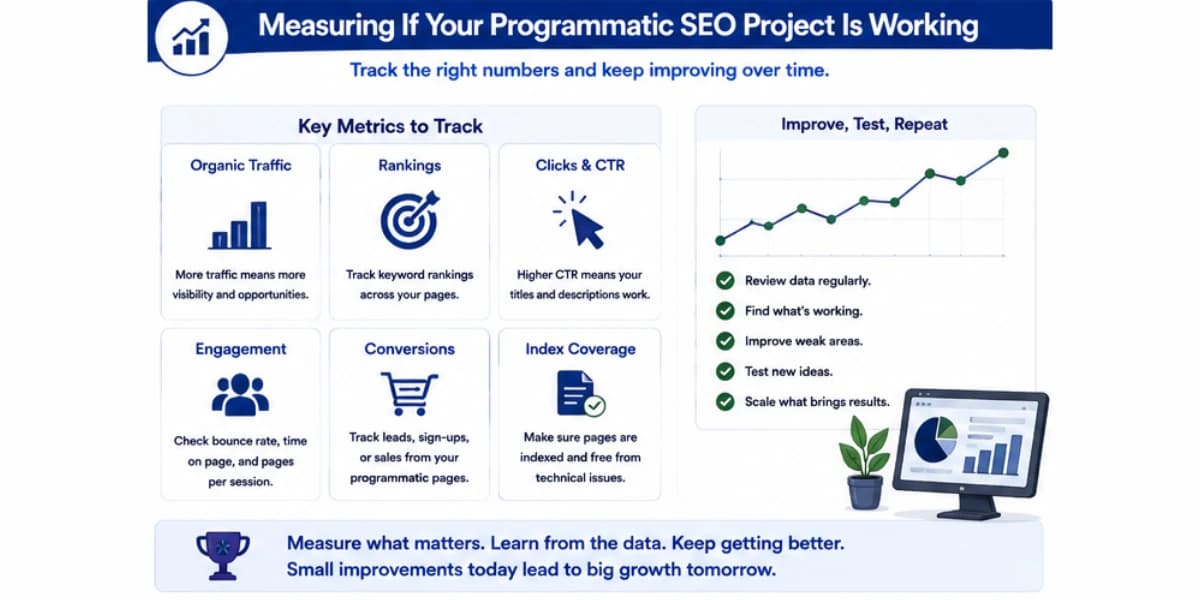
Check engagement numbers like time on page and bounce rate for a sample of your pages.
If readers land on a page and leave right away, that often signals the page is not answering their question well enough, even if the page technically ranks in search results.
Keep an eye on your site's overall health too, not just the new pages.
A poorly executed programmatic SEO project can sometimes drag down trust for the whole site, so watching your existing pages for any drop in performance after a big launch is a smart habit to build.
Tracking these engagement signals properly is where tools like Databox and other data analytics platforms become genuinely useful for understanding how your content is actually performing.
Final Thoughts On Programmatic SEO
Programmatic SEO is a smart way to build many useful pages at once, using a shared template and real data.
Done well, it can help a site grow fast, reach searches a normal content plan would never cover, and compete on a huge range of small, specific topics.
Done poorly, it can flood your site with thin, empty pages that hurt trust and rankings instead of helping them.
The real key to success is treating every page, even ones built by a system, with the same care you would give a page written by hand.
Start with strong, accurate data. Build a template that genuinely answers a real question. Test on a small batch before scaling up.
Keep your pages updated over time. Follow this path, and programmatic SEO can become among the strongest tools in your entire content strategy.
If you are just getting started, do not feel like you need a huge team or a fancy tech setup to try this out.
A single person with a clean spreadsheet and a simple no-code tool can build a solid first project.
Start small, learn what works on your own site, and grow from there.
The sites that get the most out of programmatic SEO almost always started with one careful, well tested batch of pages, not a rushed launch of thousands of pages all at once.
If you are exploring how AI agents fit into this picture, our guide on AI SEO agents explains where automated tools genuinely help and where they still need a human in the loop.
Frequently Asked Questions
1. Is programmatic SEO the same as spam?
No. Programmatic SEO is just a method for building pages at scale using a template and data. It becomes spam only when the pages fail to provide real value to readers, which usually happens because of weak data or a lazy, thin template.
2. How many pages should I build in my first batch?
Start small, often around twenty to fifty pages, so you can check quality and performance before scaling up. Publishing a huge batch right away makes it much harder to catch and fix problems early.
3. Do I need coding skills to do programmatic SEO?
Not always. No-code tools and plugins let beginners build simple programmatic SEO projects without writing any code. Larger or more complex projects often benefit from custom code, but it is not a requirement to get started.
4. Can a small site really compete using programmatic SEO?
Yes, especially on smaller, specific searches that big sites often ignore. A small site with clean data and a well built template can rank well across many small searches, even without competing directly against much bigger brands.
5. How often should programmatic SEO pages be updated?
It depends on how fast your underlying data changes. Pricing or availability data might need monthly updates, while more stable data like definitions might only need a check once or twice a year.
6. Which single factor matters most for success in programmatic SEO?
Data quality. Every part of this method depends on accurate, useful data. A great template built on bad data still produces a weak result, while even a simple template built on strong, accurate data can perform very well.
Creating content that stays relevant for years requires a different approach than chasing trends. Our article on creating evergreen content explains how to write articles that continue driving traffic long after publication, which is just as important for programmatic pages as it is for hand-written ones.