Affiliate Marketing On Substack: Rules, Setup, And What Works
You like writing, and you have heard that a newsletter can pay you through affiliate links. So you search for affiliate marketing on Substack and hope for a straight answer.
Writers keep asking the same things. Does Substack allow affiliate links, how do I disclose them, and does anyone really earn this way.
Here is the short version. Substack does not ban affiliate links in its content rules, but it does shut out publications that exist only to push offers.
The seven steps below cover the rules, the fit, the setup, the offers, the links, the audience, and the review. A worked example, common mistakes, and a short FAQ follow.
Disclosure: Some of the links I share might be affiliate links. If you click on one and make a purchase, I may earn a small commission as a thank you. But don’t worry, it won’t cost you anything extra. I only recommend stuff I genuinely believe in. Your support helps me keep creating awesome content. You can read my full affiliate disclosure in my disclaimer page.
If you want to save a lot of hours searching for high-paying affiliate programs, check out our exclusive list of 2500+ affiliate programs. You’ll find all the information about the programs inside the list. This list is perfect for affiliate bloggers and influencers.
Why Writers Ask About Affiliate Marketing On Substack
Substack is a place where readers come for writing. That makes it feel friendlier than a plain sales page, and many bloggers want to try it.
A newsletter also lands in an inbox. A reader who signs up has said yes to hearing from you, and that is a warmer audience than a stranger on a search page.
Money is the next question. Substack takes a cut only when you charge for subscriptions, so a free newsletter with affiliate links costs nothing to run.
That sounds like a simple win, but two groups of rules sit between you and a payout. One group comes from Substack, and the other comes from each affiliate program you join.
Add the law to that. In the United States the Federal Trade Commission expects you to tell readers when you earn from a link.
Many guides on this topic repeat claims without a source. Some say Substack bans affiliate links, and others say it allows everything.
Neither is true. The rules are narrower than the rumors, and the sections below show where each one comes from.
If you already write for a blog, you may know the feeling from other platforms. Our guide to affiliate links on Medium covers a similar set of questions for that site.
Treat a newsletter as a long game. You earn trust first, and the commissions follow from honest recommendations.
Do not expect quick money. Most small newsletters earn modest amounts from affiliate links, and a few earn nothing for months.
The upside is control. You own a list of real people who want your writing, and you can test offers one at a time.
Keep one idea in mind as you read. A newsletter that helps readers will earn more than a newsletter that sells to them.
Step 1: Read The Substack And Program Rules
Start with the rulebooks, because a ban costs more than any commission. Two sets of rules apply to you: Substack's and each affiliate program's.
Substack's content guidelines are short. They say the platform is for high quality editorial content and not for conventional email marketing.
They also say a publication cannot exist mainly to advertise an outside product or service. The same goes for a publication built to send traffic elsewhere, share offers and promotions, or boost search rankings.
Read that last point twice. It does not ban a link, but it does ban a newsletter whose whole purpose is the link.
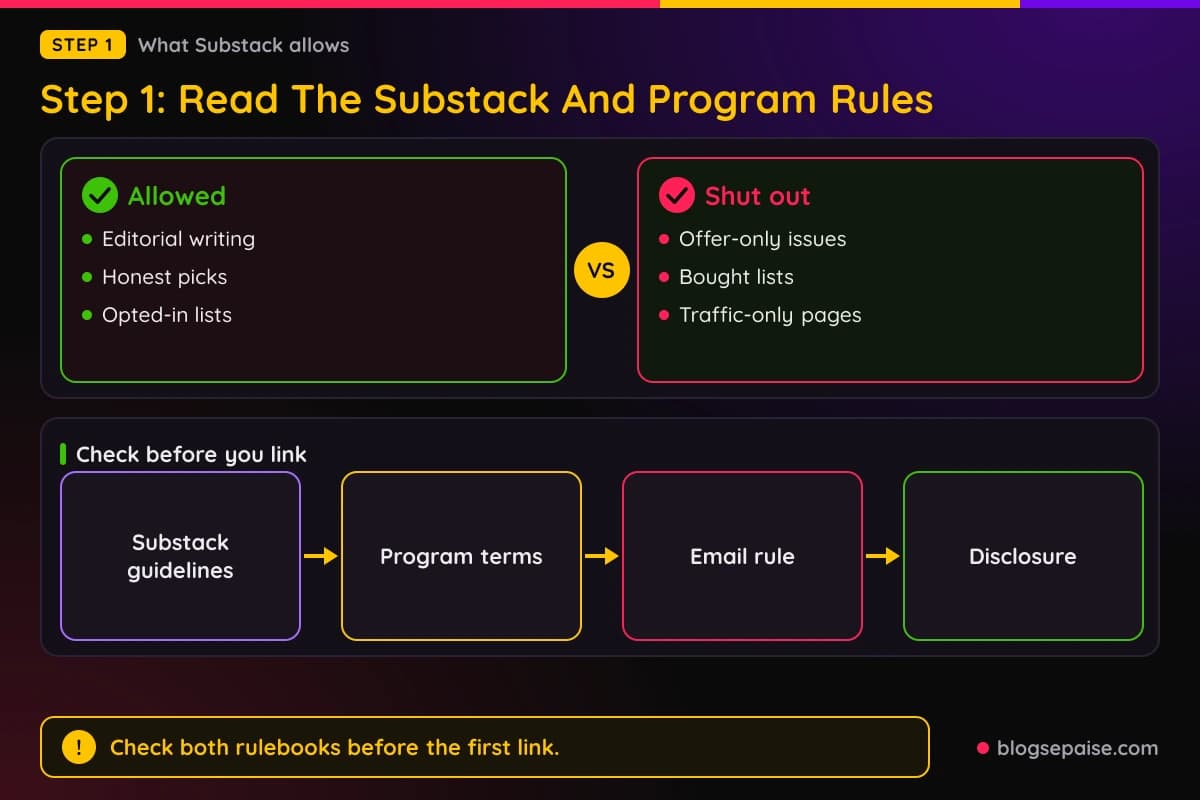
The guidelines contain no separate section on affiliate links. Reports from writers say Substack lets you use them and builds no special tools for them.
Substack's terms add a few more limits. They bar spam and auto-responder style mail, and the guidelines say imported email lists must hold only people who agreed to hear from you.
Bought, scraped, or harvested addresses are not allowed. If you plan to move a list over from another tool, make sure each person opted in.
Brands and businesses may face extra checks, according to the guidelines. If you run a company newsletter, read that section before you publish.
Now turn to the affiliate programs. Each one has its own terms, and they can be stricter than Substack.
Amazon Associates is the best known example. Amazon's program policies say you may include Special Links in emails, as long as the readers opted in to receive them.
That rule changed on March 1, 2024. Before that date the agreement barred promotion in any offline manner, and email counted.
The same policies bar Special Links in printed material and ebooks. They also bar Amazon logos and marks inside email.
Some third-party guides claim Substack removes Amazon links from the email version of a post. Substack's own pages do not confirm that, so treat it as a rumor and test your own post.
Other programs set their own limits. Some ban links in email, some ban coupon style promotion, and some ban paid ads that use their brand name.
Open each program's terms and look for the words email, newsletter, and social media. Our page on how to read affiliate program terms shows which clauses to look for.
When a rule is unclear, write to the program. A short email with your question and a saved reply protects you later.
Keep a simple record of what you find. A notes file with the program name, the date, and the rule you checked takes five minutes to build.
Programs update their terms, so check again every few months. A link that was fine in spring can break a rule by fall.
Step 2: Decide If Substack Fits Your Goal
Not every writer should put affiliate links on Substack. Ask yourself why you want a newsletter in the first place.
If you want to build an audience around ideas, Substack fits well. The writing comes first, and a few honest recommendations can sit inside it.
If you only want a place to post deals, it fits badly. Substack's rules call out publications that exist to share offers, and readers do not subscribe for coupon lists.
Next, think about who you are writing for. A newsletter about home coffee or budget travel can mention products in a natural way.
A newsletter about poetry has a harder time. Readers expect craft and not product links, and a forced recommendation will cost you trust.
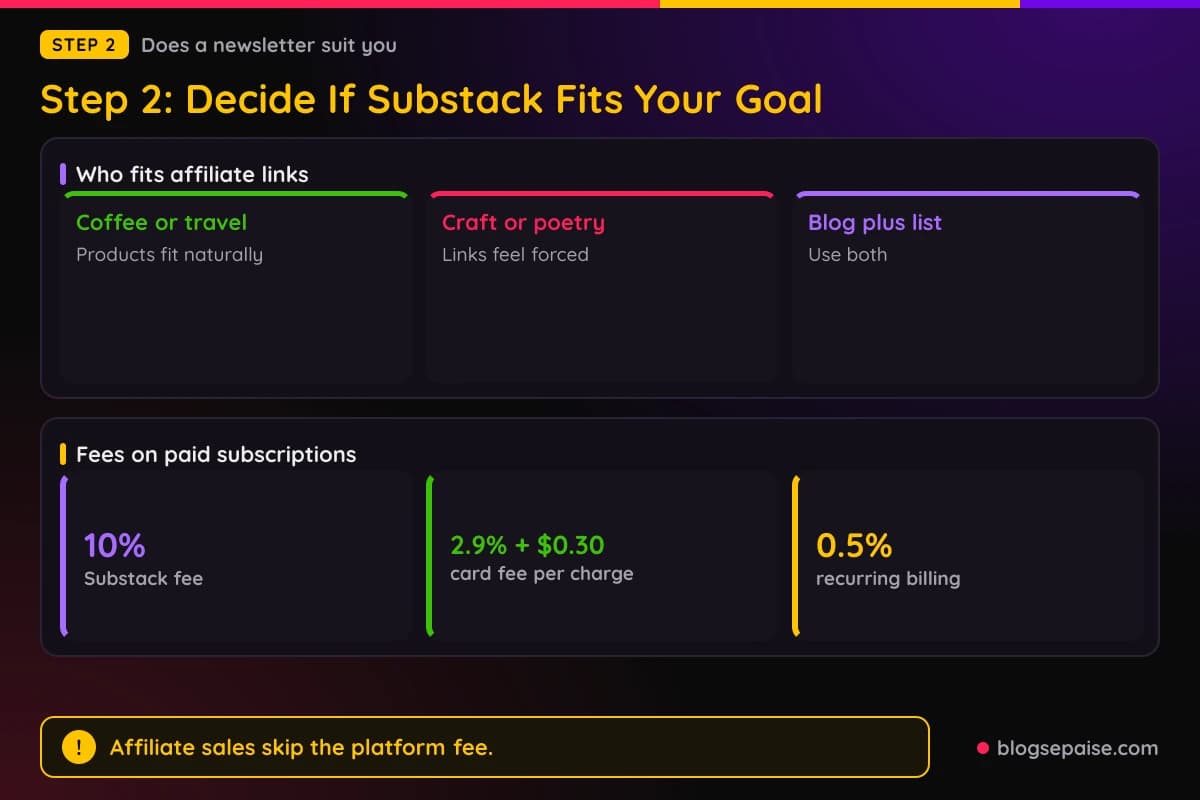
Money matters here too. Free publishing is the default, and Substack charges a 10% fee only if you turn on paid subscriptions.
The payment processor adds its own fee. Substack's help center lists Stripe at 2.9% plus $0.30 per charge, and a recurring billing fee of 0.5% that can differ by account.
Affiliate links skip those fees. A reader who clicks a link and buys from the brand pays you through the program, and Substack takes nothing from that sale.
The two models can live together. Many writers keep the main newsletter free, add affiliate links when they truly help, and offer a paid tier for extra posts.
Be careful with a paid tier. Readers who pay for a subscription expect fewer sales pitches, so keep the affiliate links light there.
Think about the other option too. A blog with search traffic can earn from links all year, while a newsletter depends on people opening each issue.
Many bloggers use both. The blog brings in new readers from search, and the newsletter keeps them coming back.
A common mistake is to leave a blog behind for a newsletter because it feels simpler. Your own site gives you full control, and Substack gives you a good inbox and a built-in reader network.
Consider your time as well. A weekly issue with careful research can take six or seven hours, so pick a pace you can keep for a year.
Do a quick fit test before you commit. Can you name five products you already use and trust, and would your readers care about them.
If the answer is yes, go on to the setup. If it is no, build your topic and your knowledge for a few months before you add any offers.
Step 3: Set Up Your Newsletter And Disclosure
Setting up a newsletter takes an afternoon. Create the publication, pick a name that tells readers what they will get, and write a short About page.
A clear name helps both readers and Substack. A title like Brew Better At Home says editorial, and a title like Best Coffee Deals says sales.
Write your About page in plain words. Say who you are, what you write, and how often readers will hear from you.
Write a welcome note too. It is the first message each new reader sees.
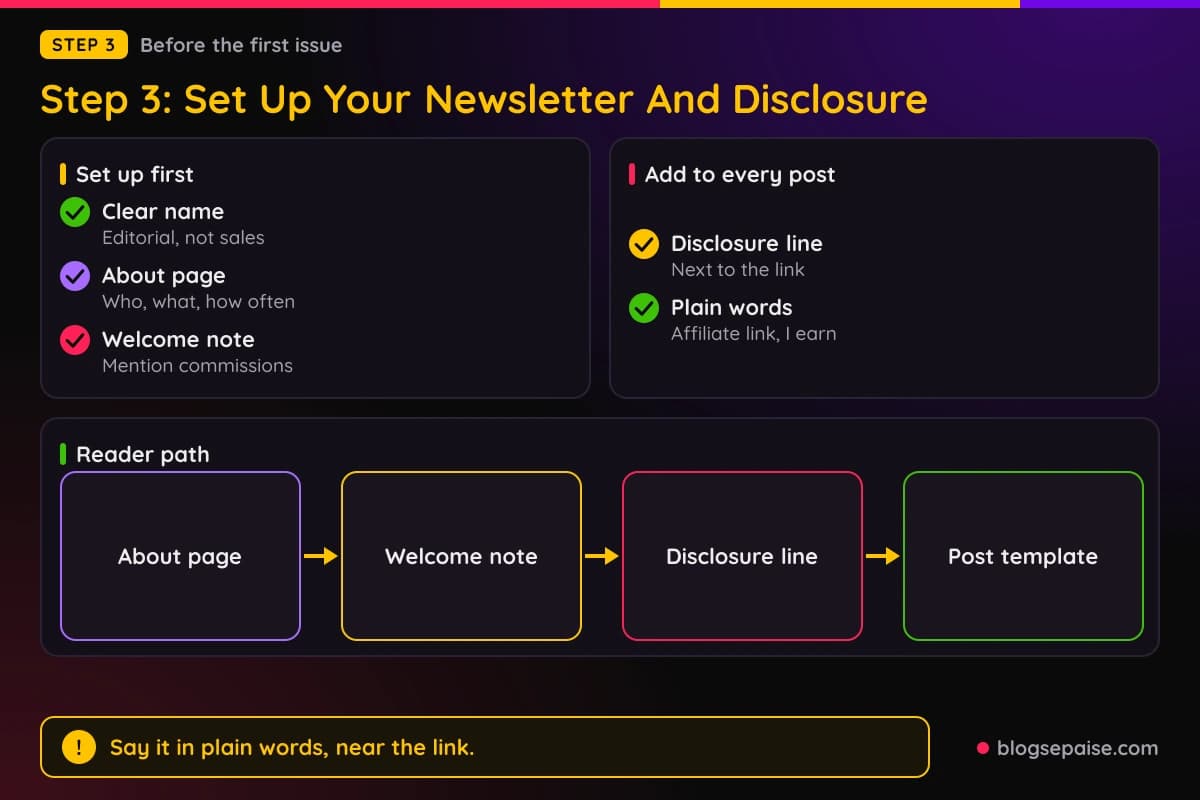
Keep the welcome note warm and honest. Tell readers you sometimes share products you like and may earn a commission when they buy.
That sentence is your first disclosure. It sets the tone, and readers who stay after reading it are readers who accept how you earn.
The Federal Trade Commission requires more than one sentence on an About page, though. Its guidance for influencers says to disclose any financial relationship with a brand.
A free product, a discount, or a commission all count. The disclosure must sit close to the endorsement, where a reader cannot miss it.
The agency says a notice buried on a profile page, at the end of a post, or behind a more link is easy to overlook. So place a note near each link or group of links.
Plain words work best. Phrases such as affiliate link, ad, or I earn a commission if you buy are clear, while vague tags such as sp or collab are not.
Write the note in the same language as the post. A reader in English should see English, in a line they can read without hunting.
The FTC also says not to assume a platform's own disclosure tool is enough. Substack has no special affiliate label, so write your own line in each post.
A short sentence under the first link in the issue works well. Something like these links are affiliate links, and I earn a small commission if you buy, does the job.
For a deeper look at the rules, read our page on legal disclosures for affiliates. It covers wording and placement in more detail.
You can also build a ready-made notice with our affiliate disclosure generator. Paste the result into your About page and your post template.
Outside the United States other laws apply. Check your local advertising rules if most of your readers live elsewhere.
Test your setup on a friend before you launch. Ask them to read the About page and find the disclosure, and fix anything that confuses them.
Finally, decide on a post template. Add a disclosure line, a spot for the offer, and a closing note, so every issue follows the same pattern.
Step 4: Choose Offers And Affiliate Links
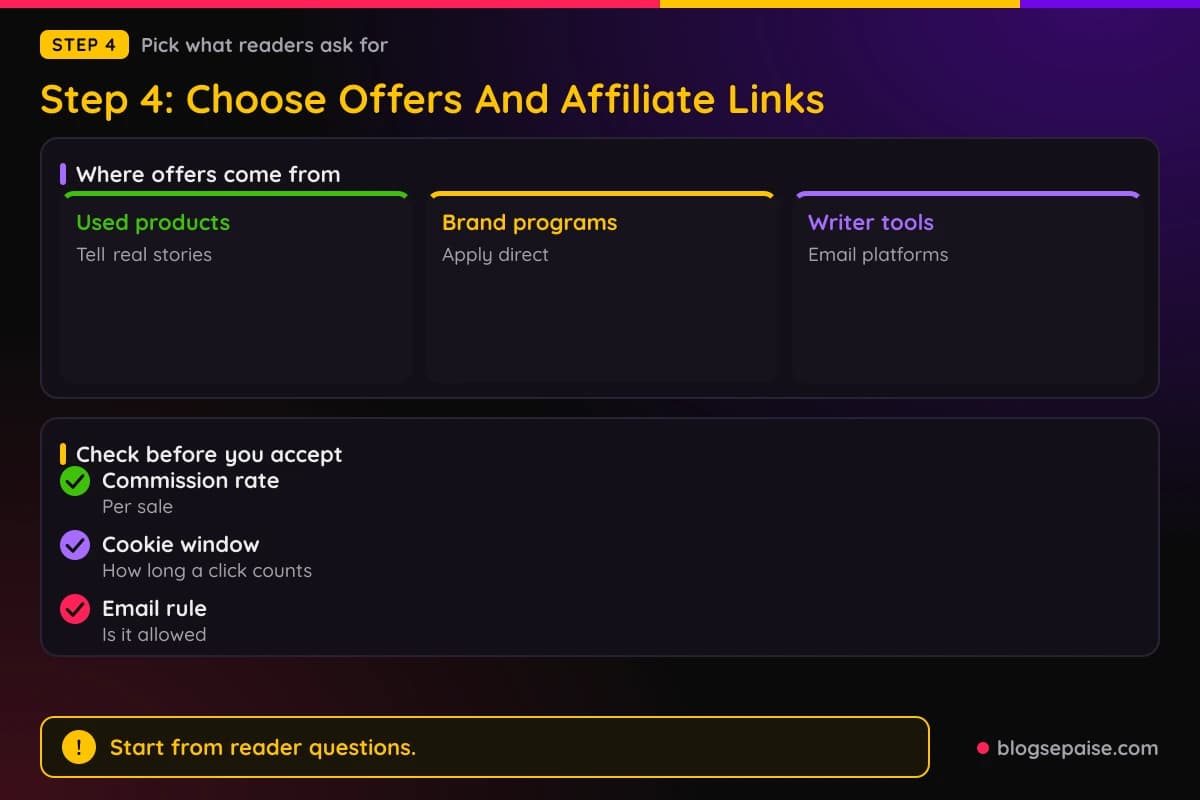
Pick offers that match what your readers already ask you about. Start from their questions and not from a list of high paying programs.
Scan your last ten posts for products you named. If readers replied about a tool or asked where you bought a thing, that is a hint.
Then look for the affiliate program behind that product. Many brands run their own, and others sit inside a network.
Joining a network means you apply once and then request each brand. Some brands accept you at once, and some review you by hand.
Be honest in applications. State that you write a newsletter, name the topic, and give your readership size if the form asks for it.
A small list is no reason to hide it. Many brands accept small publishers, and a truthful application avoids trouble later.
Check three details before you accept an offer. Look at the commission rate, the cookie window, and the rule about email promotion.
The cookie window is how long a click stays on record. If it is short, a reader who clicks today and buys next week may not pay you.
Email rules matter most here. Amazon allows links in email to opted-in readers, but other programs ban them, so read each one.
Next, check that the product is any good. A refund-heavy product will hurt your readers and your name.
Prefer products you have used. Honest detail beats a rewrite of the sales page, and readers can tell the difference.
Digital tools and courses often pay recurring commissions. Physical products usually pay once, and the rate depends on the category.
You can also promote tools for writers. Email platforms such as MailerLite and GetResponse run affiliate programs for people who want a list outside Substack.
Our guide to the best email marketing affiliate programs compares more of them. Read each program's terms before you add a link.
Do not promote ten things at once. Choose one or two offers per issue, and add more only after you see results.
A short list of offers also makes your records easier. You will know which link earned which sale.
Keep affiliate offers away from topics that need extra care. Health claims, money advice, and legal advice draw stricter scrutiny, and you cannot say things you cannot prove.
Step 5: Place And Track Your Links
Where you put a link changes how many people click it. The best spot is inside a sentence that helps the reader do something.
Say a reader asks how to grind coffee at home. Your answer can name the grinder you use, with a link and a plain note that it is an affiliate link.
Put one main link near the top and, if it fits, one more near the end. Three links in a short issue feels pushy, so keep it to three at most.
Use words that describe the product and not words that push. Phrases such as the grinder I use work better than click here now.
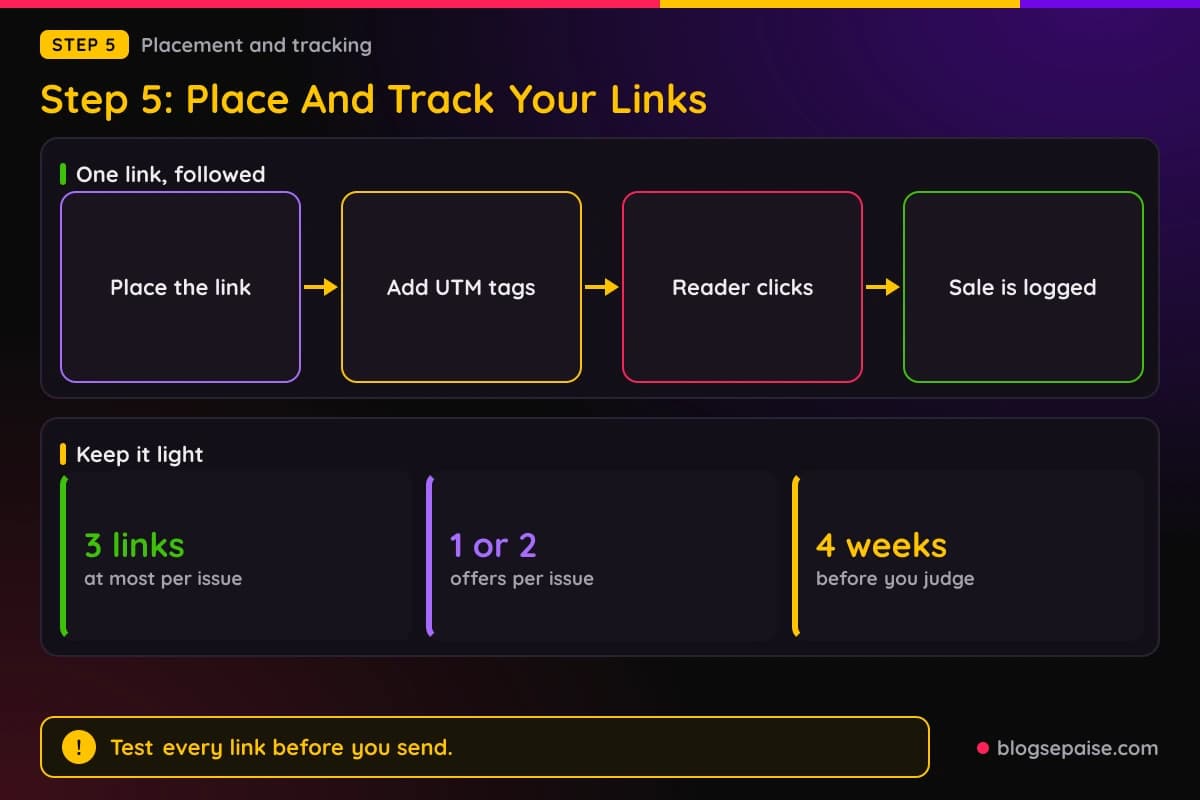
Never hide a link. Tell readers it is an affiliate link, and keep the real destination clear.
Substack handles links in its own way. A third-party guide reports that Substack wraps links in a tracking redirect, and a writer's post claims you cannot switch that off.
Substack's own pages do not explain this, so test it. Send a draft to yourself and click the link to see where it goes.
Tracking tells you what works. The simplest method is to add UTM tags to your own links, such as utm_source, utm_medium, and utm_campaign.
Keep the names the same every time. If you write substack in one issue and Substack in another, your reports will split one source into two.
Our UTM parameter builder makes the tags for you. Be careful, though, because some affiliate links already carry their own code and should not be changed.
Most affiliate programs show clicks and sales in a dashboard. Pair that with the date of each issue and you can see which post sent the traffic.
A simple sheet works well. Make a row for each issue, and note the date, the offer, the clicks, the sales, and the commission.
If you also run a WordPress blog, a link plugin such as Pretty Links can manage the links on your site. Our page on link tracking software lists more options for a larger setup.
Test every link before you hit send. A broken link earns nothing, and a wrong link can send readers somewhere you did not mean.
Check how the issue looks in the email and on the web. Links, line breaks, and the disclosure line should read well in both.
Think about the reader's day too. Most people skim an inbox between tasks, so a short issue with one clear idea gets read more often.
Be careful with email frequency. Sending a sales note every day wears out readers, so most writers keep affiliate mentions to a few issues each month.
Step 6: Grow Your Subscriber List
Affiliate income depends on how many people read your issues. Ten readers cannot give you much, so growth is part of the job.
Substack has built-in ways to grow. One is the recommendations feature, where writers point readers to other publications they like.
Substack describes recommendations as a simple way to cross-promote writers. A third-party guide says the feature is on by default and prompts a newsletter to recommend back.
Pick publications that fit your topic. A coffee newsletter that is recommended by a travel newsletter will bring in readers who might care.
Reach out to writers you admire. A short, kind note with a real reason works better than a mass message.
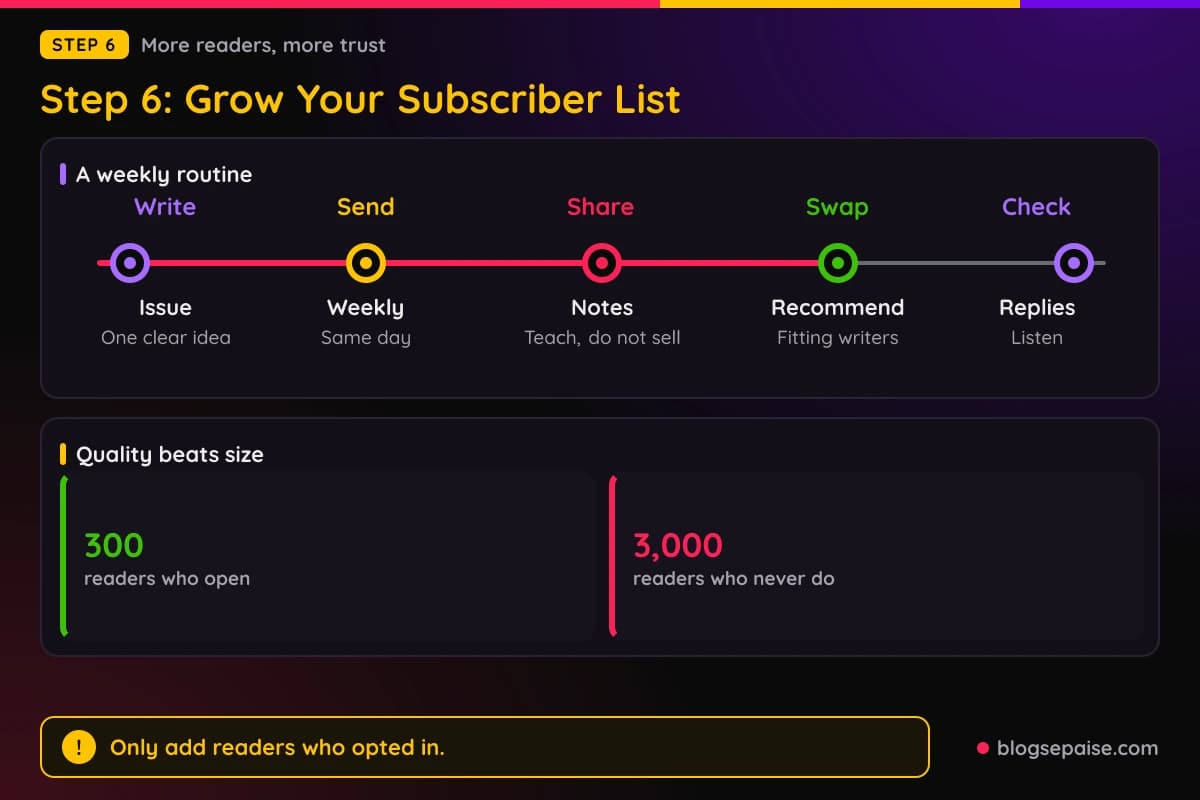
Notes is another tool. It is Substack's short post feed, and it lets you share quick thoughts and links to your issues.
Use Notes to teach and to talk, not to sell. A helpful Note about a mistake you made does more than a Note full of links.
Your own site and social pages help too. Add a sign-up link to your blog, your bio, and the end of your best posts.
Our guide to affiliate links in guest posts covers another way to reach new readers. A guest post with a sign-up link can bring in the right audience.
Offer a reason to subscribe. A free guide, a checklist, or a weekly tip is a clear promise that a vague newsletter cannot match.
If you want an automated welcome series, our welcome email sequence planner can help you map one. Plan the first few messages so a new reader hears from you right away.
Sending only to people who opted in is a rule on Substack and a rule at Amazon. Never add addresses you bought or scraped.
Quality beats size. A list of 300 readers who open every issue can earn more than a list of 3,000 who never do.
Keep a steady schedule. Weekly works for most writers, and a reader who knows when to expect you is a reader who opens.
Some writers also run a second list outside Substack for more control. Our page on the email service provider options explains the choices if you ever want to move.
Step 7: Review Results And Adjust
Give each test enough time. One issue tells you almost nothing, so wait four weeks before you judge an offer.
Look at three numbers. Count the clicks, the sales, and the commission for each offer.
Compare clicks to your list size. If you sent an issue to 500 readers and got 10 clicks, you can see if the link caught their attention.
Low clicks often mean a weak placement or a weak fit. Try a different spot, a clearer sentence, or a product that matches the topic better.

Clicks without sales point to the offer. The landing page, the price, or the product may not suit your readers.
Read the replies and comments from readers. They tell you which recommendations helped and which felt like ads.
Watch your unsubscribe rate after issues with links. A spike means readers felt sold to, and you should cut back.
Keep what works and drop what does not. Two strong offers are worth more than a dozen weak ones.
Check your income against your effort. If an hour of writing about a product earns less than you hoped, test a new topic.
Also check your standing with each program. Look for warnings, changes in terms, and any note about email use.
Write down what you learned each month. A short note on what worked, what failed, and what you will try next keeps you improving.
Share what you learn with your readers when it fits. A short note about a product you tried and dropped builds more trust than ten glowing reviews.
Review the numbers in the same place each month. A calm routine beats a panic when one issue underperforms.
After three months, you should know your best topic, your best offer, and your best placement. Build the next quarter around those.
A Worked Example: Jules Runs A Coffee Newsletter For Twelve Weeks
Jules writes a weekly newsletter about brewing coffee at home. The numbers below are made up to show how the steps fit together.
Jules starts with 400 subscribers from a small blog. The first move is to read the rules, so Jules checks Substack's content guidelines and the terms of two affiliate programs.
One program allows email links for opted-in readers, and the other does not. Jules keeps the first and skips the second.
Jules then writes a short About page and a welcome note. Both say that some links are affiliate links and that a small commission may come back.
Next, Jules picks two offers that readers have asked about. One is a hand grinder, and the other is a subscription for coffee beans.
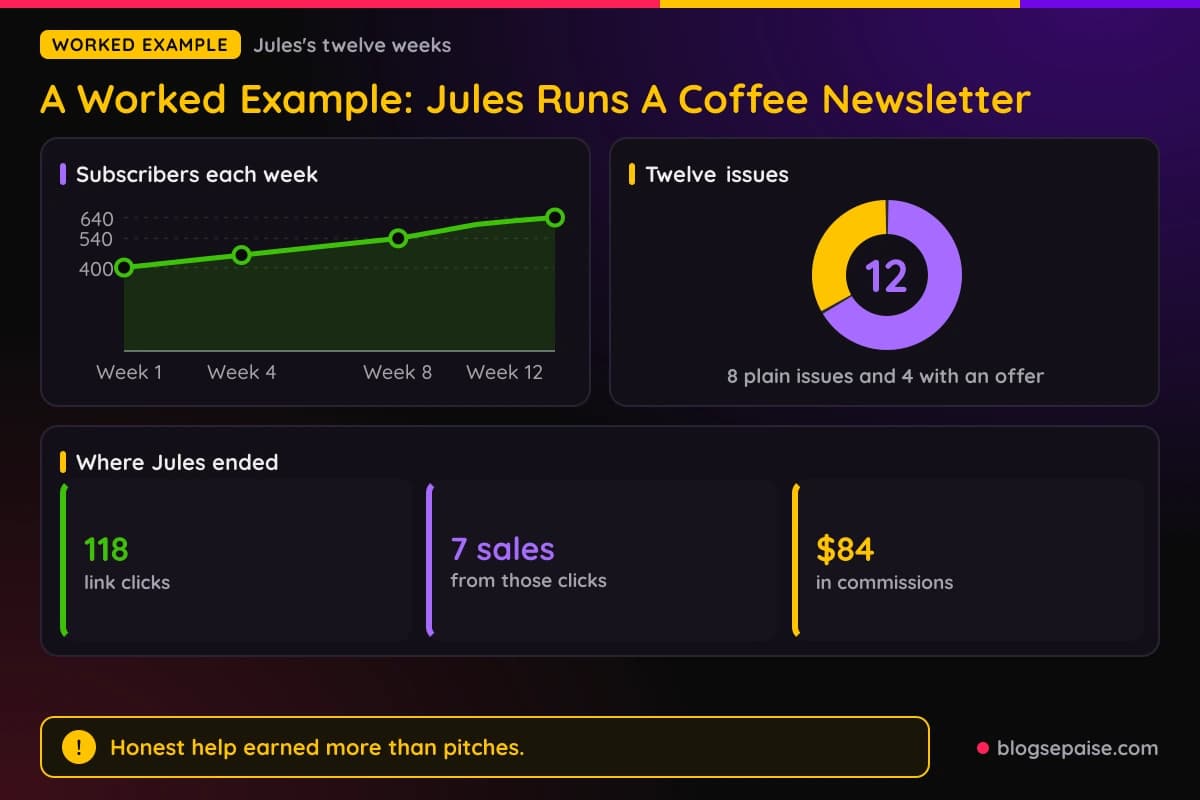
Jules plans to send 12 issues in 12 weeks. Only 4 of them will carry an offer, and the other 8 will be plain writing.
Each offer issue has a disclosure line under the first link. Jules tags the links with utm_source, utm_medium, and utm_campaign so the clicks are easy to sort.
Jules also joins a few recommendation swaps with other food writers. The list grows from 400 in week one to 460 in week four, 540 in week eight, and 640 in week twelve.
Across the four offer issues, the links draw 118 clicks. Those clicks lead to 7 sales.
The commissions add up to $84. That is not a salary, but it is a fair start for a small list and a new habit.
Jules reads the numbers and sees that the grinder issue did best. It came from a question a reader had asked, and the link sat inside a real answer.
The bean subscription issue did worse. Jules had pushed it too hard, and two readers unsubscribed right after.
For the next quarter, Jules plans more answers to reader questions and fewer pitches. The plan is to keep the offers to 1 in 3 issues.
Jules also keeps the notes file up to date. When one program changes its email rule, the file shows exactly where to look.
The lesson is simple. Jules earned from honest help, kept the disclosures clear, and let the list grow before asking for more.
Common Mistakes With Affiliate Marketing On Substack
Plenty of writers lose trust or accounts in the first months. Most of the mistakes are easy to avoid once you know them.
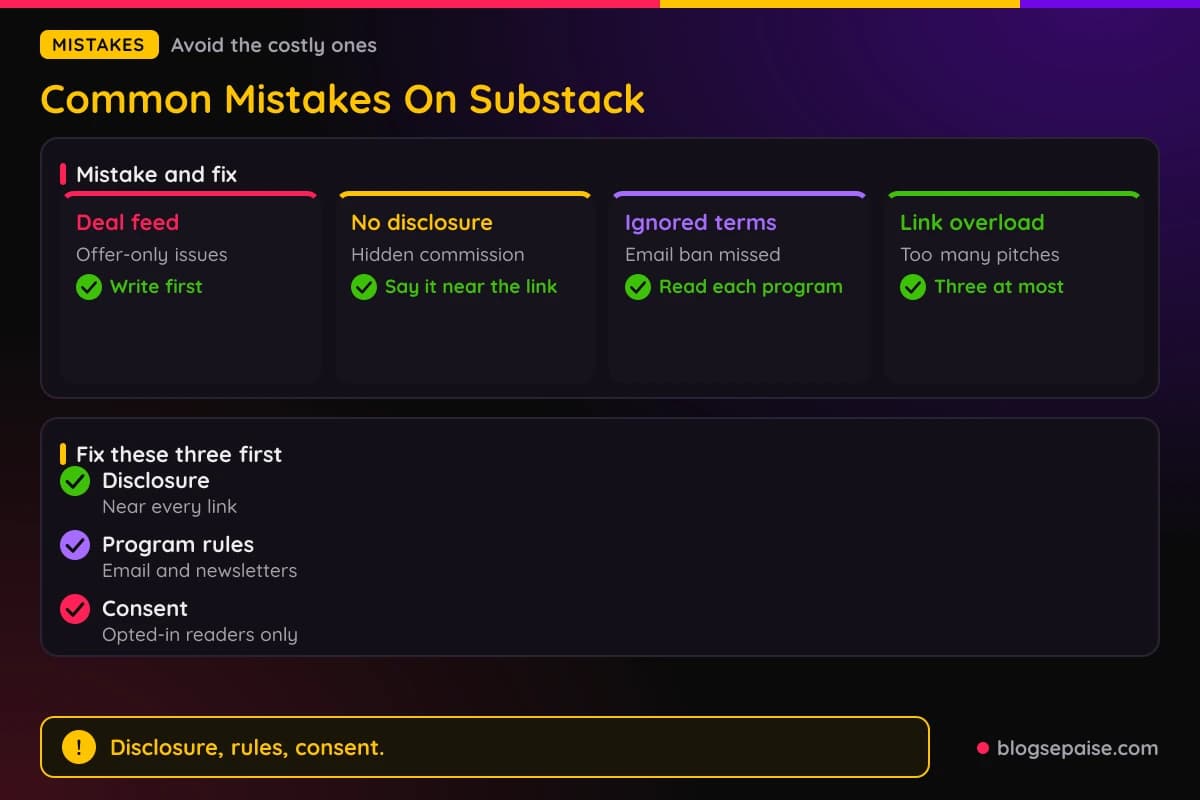
The first mistake is turning the newsletter into a deal feed. Substack's guidelines call out publications built to share offers, and readers leave a feed of coupons fast.
The second mistake is skipping the disclosure. The FTC expects clear notice near the link, and an About page alone is not enough.
The third mistake is ignoring the program rules. A program that bans email links can close your account, and a closed account takes your earnings with it.
The fourth mistake is assuming all programs work like Amazon. Amazon allows links in email for opted-in readers, but another program may not.
The fifth mistake is adding people to your list without their consent. Substack bars bought or scraped addresses, and so do most programs.
The sixth mistake is stuffing every issue with links. Three links in a short issue is plenty, and more makes the writing feel like an ad.
The seventh mistake is promoting products you have not used. Readers notice, and the FTC says you cannot describe an experience you did not have.
The eighth mistake is judging an offer after one issue. Give each test four weeks and compare it against your notes.
The ninth mistake is hiding or disguising the link. Cloaked links that mislead readers can break program rules and your readers' trust at once.
The tenth mistake is forgetting to check the numbers. Without a simple sheet of clicks and sales, you cannot tell what to keep.
A last mistake is relying only on Substack. Keep a copy of your list and your best posts somewhere you control, in case rules change.
If you fix just three of these, fix the disclosure, the program rules, and the consent. Those are the ones that cost you the most when they go wrong.
Final Thoughts
Affiliate marketing on Substack is allowed, but it works best as a side of good writing. The platform wants editorial content, and readers want help.
Read the rules first. Check Substack's content guidelines, then read each program's terms on email and newsletters, and keep notes.
Disclose every affiliate link in plain words near the link. That one habit protects you with readers, programs, and the law.
Then pick a few honest offers, track the clicks, grow your list slowly, and review the results each month. Small, steady numbers beat a big promise.
Start this week by writing your About page and your first disclosure line. When you are ready for more, read our guide to affiliate links on Pinterest to see how the same ideas work on another platform.
Frequently Asked Questions
1. Does Substack allow affiliate links?
Yes in practice. Substack's content guidelines have no ban on affiliate links, but they do not allow a publication whose main purpose is to advertise outside products or share offers.
2. Do I need to disclose affiliate links on Substack?
Yes. The FTC expects you to disclose a financial tie to a brand in clear words near the link, and Substack has no built-in label for it.
3. Can I use Amazon affiliate links on Substack?
Amazon's program policies allow Special Links in emails if readers opted in to receive them. Check the current terms, and note that Amazon bars its logos in email.
4. Does Substack take a cut of affiliate income?
No. Substack's 10% fee applies to paid subscriptions, and sales through your affiliate links go through the brand's program.
5. How much does Substack cost?
Publishing is free. Substack takes 10% of paid subscription revenue, and the payment processor adds its own card and billing fees.
6. Can I make money with a free newsletter?
Yes, through affiliate links, sponsors, or your own products. Income depends on your list size, your topic, and how well the offers fit your readers.
7. How many affiliate links should one issue have?
Keep it to about three at most. One or two links tied to a real reader question tend to feel more natural.
8. Where should I put the disclosure?
Put it close to the first affiliate link in the issue and add a general note on your About page. Clear words such as affiliate link or I earn a commission work best.
9. Can I track affiliate clicks on Substack?
Yes, through the affiliate program's dashboard and through UTM tags on your links. Some reports say Substack also wraps links in its own redirect, so test your links.
10. Can I import my email list to Substack?
You can, but each person must have opted in. Substack does not allow purchased, scraped, or harvested addresses.
11. Is Substack better than a blog for affiliate marketing?
Each has strengths. A blog earns from search traffic all year, while a newsletter builds a direct line to your readers.
12. What if a program bans email links?
Do not use that program in your newsletter. You can still link to it from your blog if its terms allow, and you can ask its support team about options.
13. How long before I see affiliate income?
It varies a lot. Most writers need several months of steady issues before the numbers add up, and some programs pay only after a minimum balance.
14. Can Substack remove my publication for using affiliate links?
Affiliate links alone are not named as a violation, but a publication built mainly to push offers can break the guidelines. Keep the writing first.
15. Should I use sponsors instead of affiliate links?
They can work together. Sponsors pay a flat fee for a mention, while affiliate links pay when readers buy, and each needs its own disclosure.
16. Do I need a big list to start?
No. Many brands accept small publishers, and a small honest list is a good place to test offers.