Exclusivity Clauses In Affiliate Programs: What They Actually Restrict
Most affiliate agreements let you promote other brands, but some add an exclusivity clause that limits what you can promote. That one line can change how much you earn from your site.
Below you will find what exclusivity means, where it hides, what programs offer in return, and how to negotiate it. The facts come from published agreements and from guidance by Track360, Digistore24, Creator Essentials, and Matt McWilliams.
Pair it with reading affiliate program terms, which covers the other sections of an agreement.
Disclosure: Some of the links I share might be affiliate links. If you click on one and make a purchase, I may earn a small commission as a thank you. But don’t worry, it won’t cost you anything extra. I only recommend stuff I genuinely believe in. Your support helps me keep creating awesome content. You can read my full affiliate disclosure in my disclaimer page.
If you want to save a lot of hours searching for high-paying affiliate programs, check out our exclusive list of 2500+ affiliate programs. You’ll find all the information about the programs inside the list. This list is perfect for affiliate bloggers and influencers.
How Exclusivity Works
Track360, an affiliate tracking platform, defines an exclusivity deal as an arrangement where an affiliate promotes one operator, or avoids promoting rivals, within a set vertical, market, or product type. In exchange, the affiliate gets better terms.
Not every agreement works that way. HubSpot, for example, states in its affiliate agreement that it does not create an exclusive agreement between you and HubSpot, and both sides may recommend similar third-party products.
Digistore24 says affiliate appointments are typically non-exclusive, so a merchant can work with several affiliates and an affiliate can promote several merchants. It warns that an exclusivity clause buried in the definitions section can restrict your ability to promote competing offers.
Impact.com uses the word for something different. Its article describes exclusivity between a brand and an affiliate platform, where the platform can block a brand from working with competing providers.
Keep that distinction in mind when you search. This guide covers exclusivity that limits you as the publisher.
Creator Essentials says the word exclusive is incomplete unless the contract states what is exclusive, to whom, where, and for how long. Use those four questions on every clause you read.
Step 1: Learn The Main Kinds
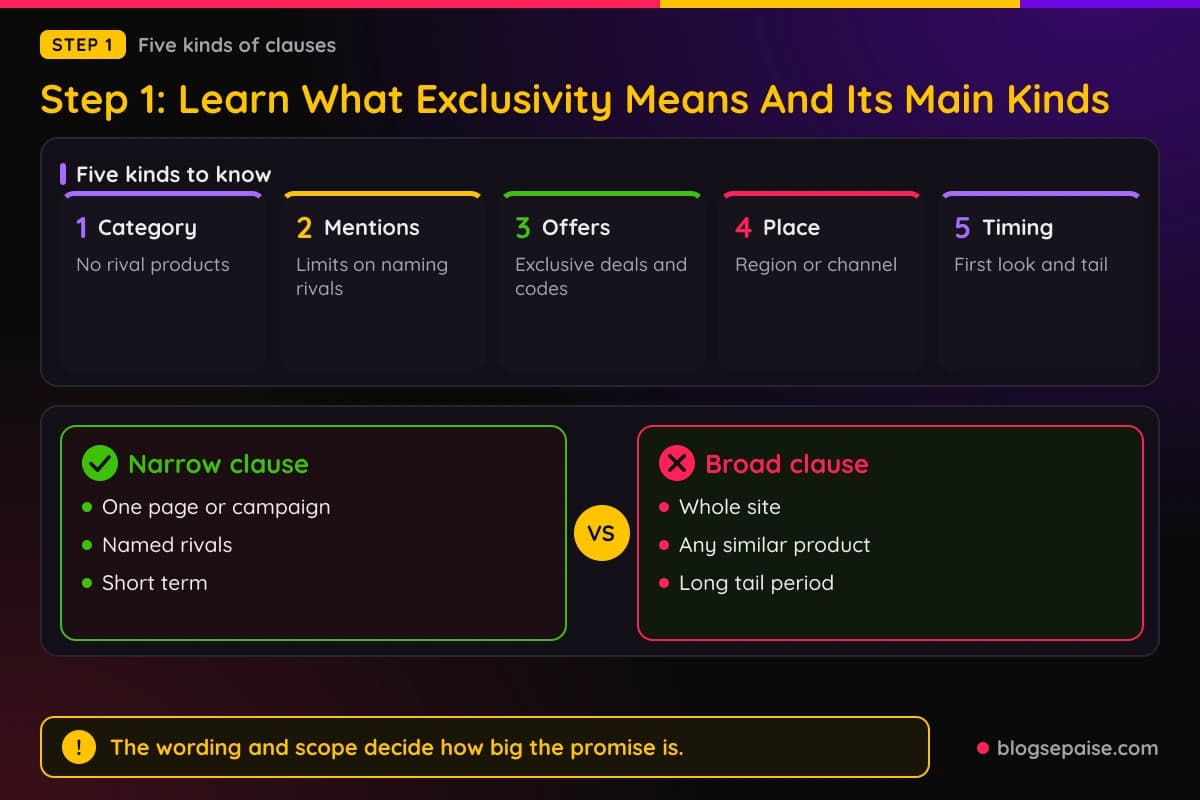
Creator Essentials lists the common scopes in creator contracts. A category clause blocks sponsors within a defined product or service category.
A named competitor clause blocks specific listed brands, and the contract should say if parent companies, subsidiaries, and acquired brands are covered. A full brand clause blocks most or all other sponsorships during the term, which is much broader.
Other clauses limit the platform, such as YouTube only, or a format such as livestreams, podcasts, or newsletters. Duration and territory should also be fixed or measurable.
Track360 adds that a clause can be tied to a vertical, a geography, or a content type, and can run for a set period, sometimes only during an event.
Write down which kind you are looking at. A narrow clause and a broad one carry very different costs.
Step 2: Find The Exclusivity Clause In The Agreement
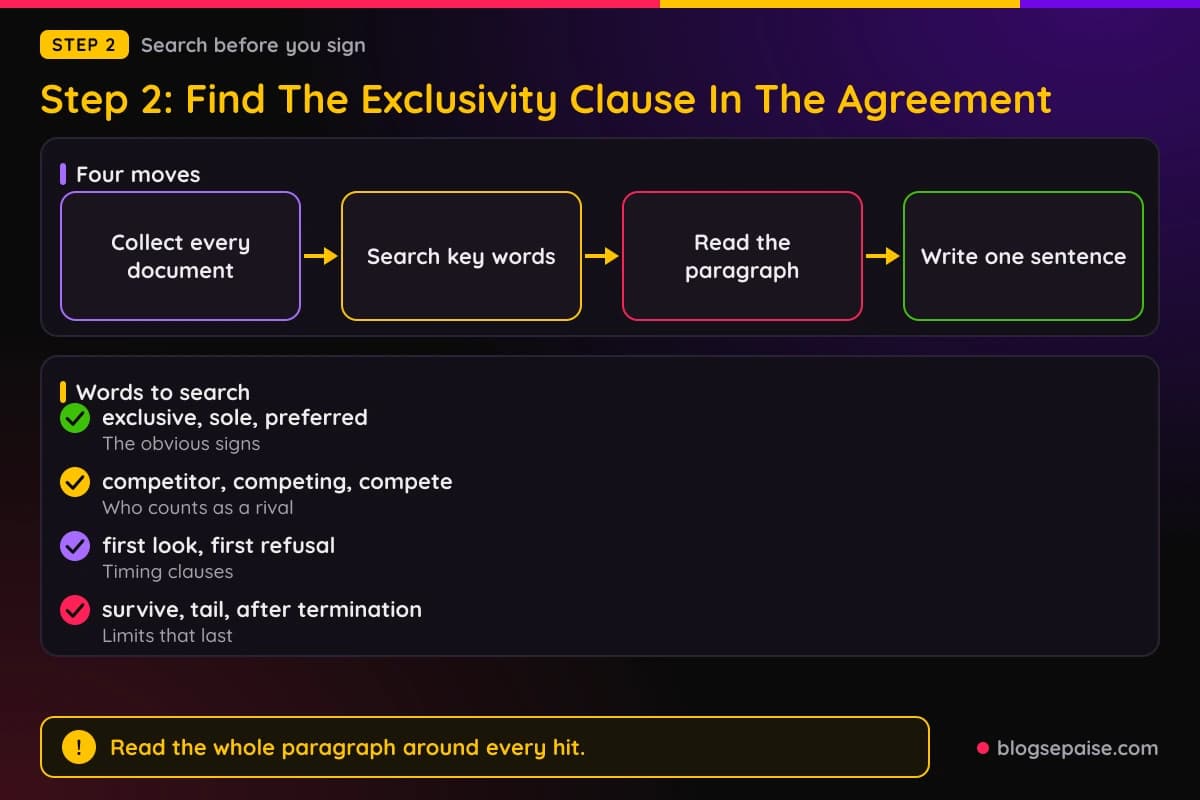
Start with the section that defines the relationship. HubSpot puts it under a heading called Non-Exclusivity, which makes it easy to find.
Digistore24 advises confirming that the appointment is non-exclusive and looking for exclusivity language in the definitions. Do not stop at the headline sections.
Search the document for the words exclusive, competitor, similar, and compete. Read every sentence that contains one.
Creator Essentials flags undefined terms like similar business as a risk. If a term is vague, ask the program to define it in writing.
Also read the termination section. HubSpot states that both sides may end its agreement on 15 days written notice, which shows how quickly some agreements can end.
Step 3: See What It Restricts In Your Content
A clause can cover more than competing affiliate links. Creator Essentials lists platform limits, format limits, and restrictions on appearing in other brands ads.
Some restrictions are about marketing methods, not competitors. Digistore24 says limits on paid search, PPC, or domains can restrict your traffic and split testing.
HubSpot shows an example. Its agreement bars affiliates from buying ads that could compete with HubSpot own advertising, including on its branded keywords.
Creator Essentials also lists restrictions on honest editorial commentary as a risk. If a clause could stop you from writing a fair comparison, ask to carve it out.
Match each restriction against your own channels, such as your blog, your email list, and your social accounts. Note the ones you actually use.
Step 4: Weigh What It Costs You
Track360 lists the drawbacks for affiliates as less diversification and more dependence on one operator terms and stability. If that operator changes its rates or closes, your income depends on it.
Creator Essentials says exclusivity can justify a higher fee because it can block other work. It adds that there is no universal percentage and that a short, narrow restriction is not equivalent to a long, industry-wide one.
Its list of risks includes no firm end date, continuation after the brand cancels without compensation, and conflicts with existing contracts or affiliate programs. Check your current affiliate deals against the new clause before you sign.
Our commission earnings estimator helps you compare what you earn today with what the exclusive offer would pay.
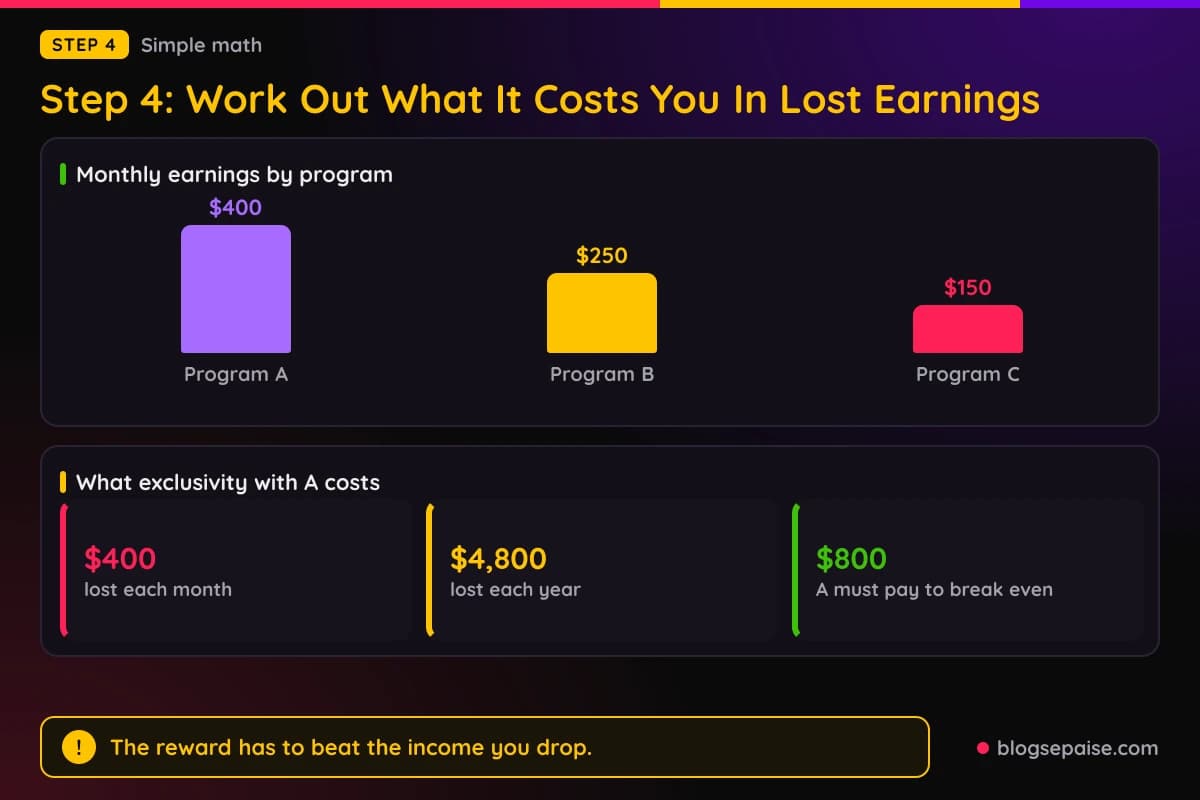
Write the two totals side by side, with the exclusive offer on one side and your current income on the other. Only the second number comes from your real data.
Step 5: See How Programs Reward Exclusivity
Track360 says exclusivity deals often come with enhanced commission rates, extra perks like custom creatives or dedicated support, and sometimes guaranteed minimum payouts. It also says affiliates can get higher earnings per conversion and better support.
Matt McWilliams, writing for program managers, says brands typically pay a retainer or a higher commission rate in exchange for exclusivity. He gives no dollar amounts.
He also says exclusivity is rarely worth using and that top affiliates often promote several products in a category. His alternative is a first look, where an affiliate promotes a brand launch before any competitor, instead of a legal restriction.
Ask what you get and compare it with what you give up. If the reward is vague, treat the clause as a cost with no payment.
Step 6: Negotiate It Or Decline It
Creator Essentials gives a checklist for negotiation. Define the restricted party, the covered brands, the category, the activities, the formats, the platforms, the territory, and the start and end dates.
Define terms like competitor precisely, and require any added competitors to be agreed in writing. It says an informal email may not override a signed agreement.
It lists common carveouts, including existing deals, evergreen affiliate links, older videos, unpaid editorial reviews, news or commentary, and personally purchased products. Write each carveout into the contract.
It also suggests an approval or waiver process, so you can ask permission before taking a new opportunity.
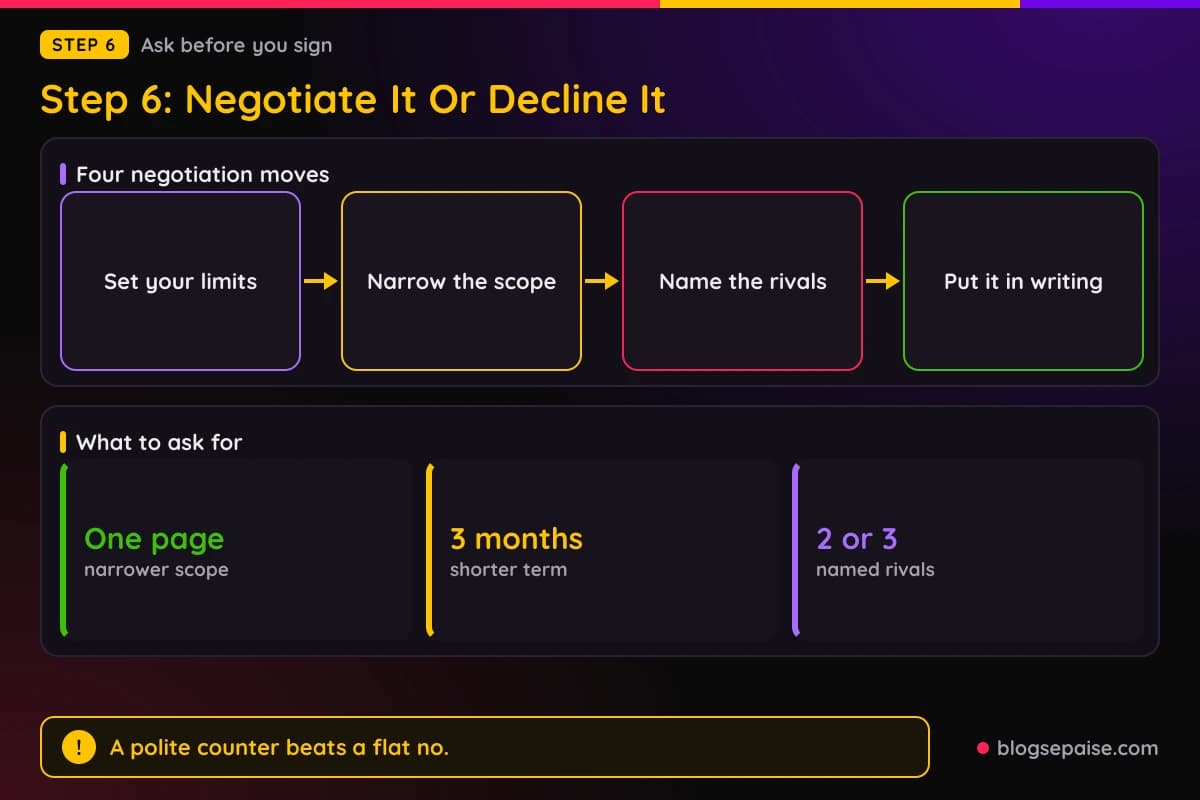
If the program will not narrow the clause and the reward is weak, declining is a reasonable answer. Digistore24 says the default is non-exclusive, so you are asking for the normal arrangement.
Step 7: Track What You Signed
Keep a copy of the signed agreement and a note of the scope, the dates, and the notice period. Track360 says a deal should also state the termination conditions and the rules for accrued commissions when the exclusivity ends.
Digistore24 advises confirming that earned commissions are protected after termination. HubSpot shows why: its agreement ends the right to commissions on the termination date in some cases, and keeps them in others.
Add the end date to your calendar. Check any new content against the clause before you publish it.
Also read how to avoid getting banned from affiliate programs, since breaking a clause can be grounds for removal.
Final Thoughts
An exclusivity clause trades some of your freedom for something the program offers. The trade works only when on how wide the clause is and what you receive.
Look for it in the definitions, define every vague term, compare the reward with your current income, and carve out what you need.
If you want a safe default, the usual arrangement is non-exclusive. Ask for that, and sign an exclusive deal only when the scope, the pay, and the end date are clear in writing.
Frequently Asked Questions
1. Are most affiliate programs exclusive?
Digistore24 says appointments are typically non-exclusive. HubSpot is an example, since its agreement states that it does not create an exclusive agreement.
2. What does a program usually offer for exclusivity?
Track360 lists enhanced commission rates, extra perks like custom creatives and dedicated support, and sometimes guaranteed minimum payouts. Matt McWilliams says brands typically pay a retainer or a higher commission.
3. Can I negotiate an exclusivity clause?
Creator Essentials says yes, and it lists carveouts and a waiver process to ask for. It also says any added competitors should be agreed in writing.
4. Where do I find the clause?
Digistore24 says an exclusivity clause can be buried in the definitions section. Search the whole agreement for the words exclusive and competitor.
5. Does exclusivity affect my existing affiliate links?
It can. Creator Essentials lists conflicts with existing contracts or affiliate programs as a risk, and common carveouts include existing deals and evergreen affiliate links.
6. Is exclusivity between a brand and a network the same thing?
No. Impact.com describes exclusivity where a platform can block a brand from working with competing providers, which is a different issue from limits on you as a publisher.