How To Build A Topical Map For AI SEO
Most websites publish content like they are throwing darts in the dark.
A blog post here, a product page there, a random article because someone saw a keyword tool light up green. There is no plan tying it all together, and search engines can tell.
A topical map fixes that problem by giving your content a clear structure instead of a pile of unrelated pages.
A topical map is a visual and structural plan that lays out every subtopic, entity, and content piece you need to fully cover a broader subject in your niche.
A topical map is where those keywords stop being a random list and start becoming a real content plan.
Once your map is built, it becomes the foundation for the internal linking strategy, since you cannot link pages together in a smart way if you never planned how they relate to each other in the first place.
In this article, we'll learn how to turn a scattered list of topics into a map that search engines and AI answer engines can both understand.
Disclosure: Some of the links I share might be affiliate links. If you click on one and make a purchase, I may earn a small commission as a thank you. But don’t worry, it won’t cost you anything extra. I only recommend stuff I genuinely believe in. Your support helps me keep creating awesome content. You can read my full affiliate disclosure in my disclaimer page.
If you want to save a lot of hours searching for high-paying affiliate programs, check out our exclusive list of 2500+ affiliate programs. You’ll find all the information about the programs inside the list. This list is perfect for affiliate bloggers and influencers.
What Is A Topical Map?
Let's slow down and define this properly, because a lot of bloggers and marketers use the term loosely without knowing what it actually includes.
A topical map is a structured representation of all the subtopics, entities, and individual content pieces needed to cover a broader topic in a complete way.
Instead of guessing what to write next, you have a document (or a visual chart) that shows every piece of the puzzle and how each piece connects to the others.
Think of a topical map as the blueprint for your entire content strategy.
Just as an architect would never build a house without detailed plans, you should never build a website without mapping out how your content fits together.
A topical map ensures every article serves a purpose and supports your broader goals.
If you are new to this concept, you might also want to read our guide on what content clusters are to understand how they relate to topical maps and why both matter for modern SEO.
Topical Map vs. Content Calendar vs. Site Structure
People mix these three up all the time, so let's clear the confusion.
A content calendar is about timing. It tells you what gets published and when, week by week or month by month. It answers the question of scheduling, not strategy.
A site structure is about navigation and technical layout. It deals with menus, categories, and how a user physically clicks through your website.
A topical map sits above both of these. It defines the actual subject matter your site should cover before you ever think about scheduling or navigation.
Once your topical map exists, it can inform both your content calendar and your site structure, but it is not the same thing as either one.
For a deeper look at how scheduling fits into the bigger picture, check out our guide on how to create a content plan for affiliate marketing.
It explains how to turn your topical map into a publishing schedule that keeps you consistent.
Core Components Of A Topical Map
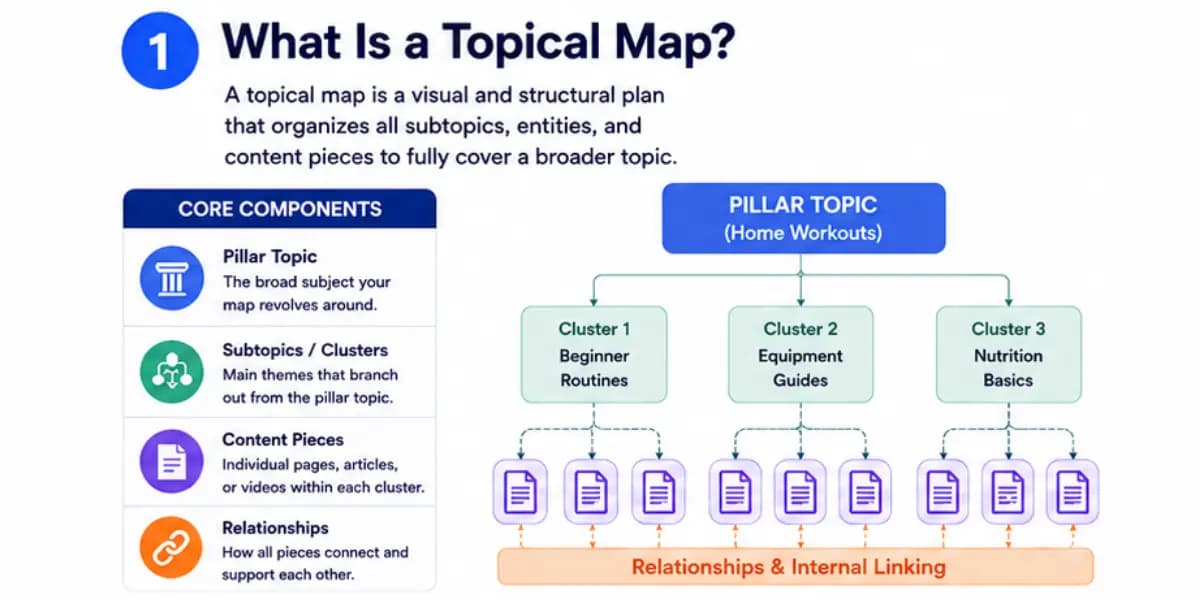
Every solid topical map is built from four parts working together.
The pillar topic is the broad subject your whole map revolves around. For a fitness site, that might be something like home workouts.
The subtopics or clusters are the smaller themes that branch out from the pillar. Under home workouts, you might have clusters like beginner routines, equipment guides, and nutrition basics.
The individual content pieces are the actual articles, videos, or pages that live inside each cluster.
A cluster like equipment guides might contain separate pieces on resistance bands, adjustable dumbbells, and yoga mats.
The relationships between all of these pieces show how they connect.
Some pages support each other directly, some are just loosely related, and knowing the difference matters a lot when you start linking pages together later.
Understanding these components is essential before you start building.
If you want to see how this structure works in practice, our article on how to build topical authority walks through real examples of pillar pages and their supporting clusters.
Why Topical Maps Matter For SEO
A lot of site owners skip this step because it feels slow compared to just writing articles. That is a mistake, and here is why.
Search engines have evolved significantly over the past few years. They no longer evaluate pages in isolation.
Instead, they look at your entire website to determine how much expertise you have on a given subject.
A topical map is the most effective way to demonstrate that expertise systematically.
Topical Authority As A Ranking Concept
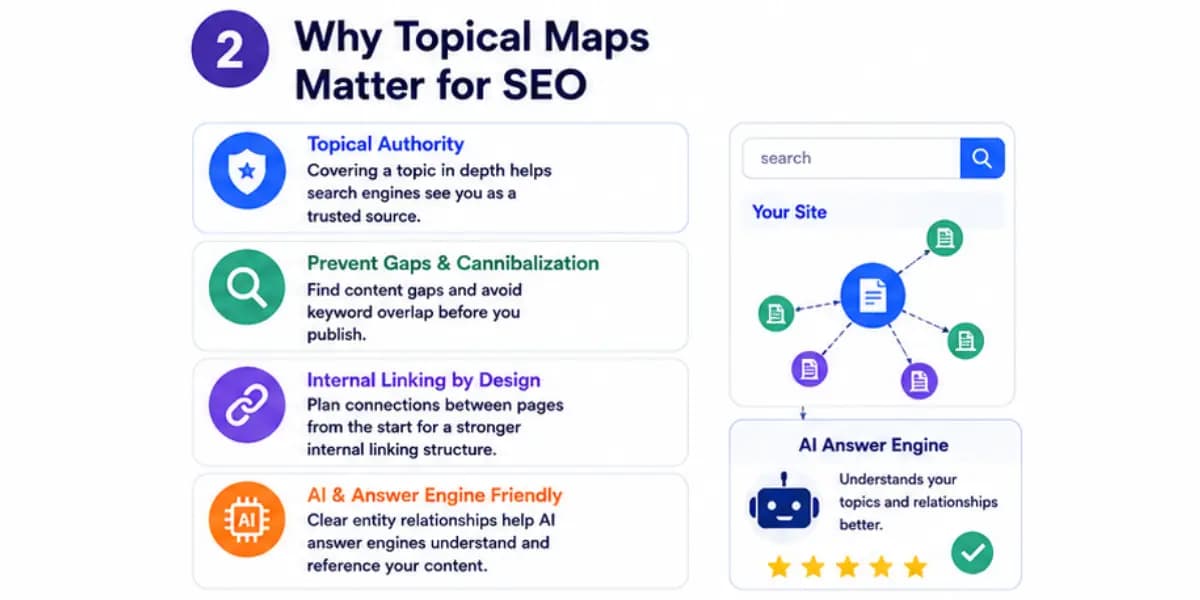
Search engines reward sites that show real depth on a subject instead of just one or two articles that happen to rank well.
When your site covers a topic from every angle, algorithms start treating your domain as a trusted source for that entire subject area.
A single great article can rank for a while, but a site with dozens of connected articles covering every angle of a topic tends to hold rankings much longer and rank for a wider range of search terms.
Topical authority is not something you achieve overnight. It requires consistent publishing across related subtopics over months and years.
But once established, it becomes a moat that competitors find very difficult to cross.
Preventing Content Gaps And Keyword Cannibalization
Without a map, it is very easy to accidentally write two articles that target almost the same keyword.
This creates a problem called keyword cannibalization, where your own pages compete against each other in search results instead of competing against other websites.
A topical map lets you spot these overlaps before you publish anything, saving you from wasted effort and confused rankings.
Content gaps are equally damaging. When you miss important subtopics that your competitors cover, you leave ranking opportunities on the table.
A well-built topical map reveals these gaps clearly, so you know exactly what to write next.
Learning how to do keyword research properly will help you identify these gaps with confidence.
Building Internal Linking Structure By Design
Sites that never planned their content usually end up with weak internal linking because writers try to force connections after the fact.
A topical map solves this before it becomes a problem, since you already know which pages relate to each other and how strongly.
Linking becomes a natural extension of the plan instead of an afterthought bolted on later.
Strong internal linking distributes authority throughout your site and helps search engines understand the relationships between your pages.
If you need help finding linking opportunities, try our internal link opportunity finder tool to spot gaps in your existing content.
Helping AI Answer Engines Understand Your Site
Search is changing fast, and AI powered answer engines now read your site differently than traditional search engines used to.
These systems look for clear entity relationships, meaning they want to understand how your topics connect to each other in a logical way.
A well built topical map makes those relationships obvious, which helps your content get picked up and referenced by AI generated answers, a concept closely tied to answer engine optimization and generative engine optimization.
AI search platforms like Google AI Overviews, ChatGPT, and Perplexity prioritize content that demonstrates clear topical depth.
When your site is organized around a well-structured topical map, these systems can more easily identify you as a reliable source.
Our complete AI SEO guide covers how to optimize for these emerging search surfaces in detail.
How AI Changes Topical Map Creation
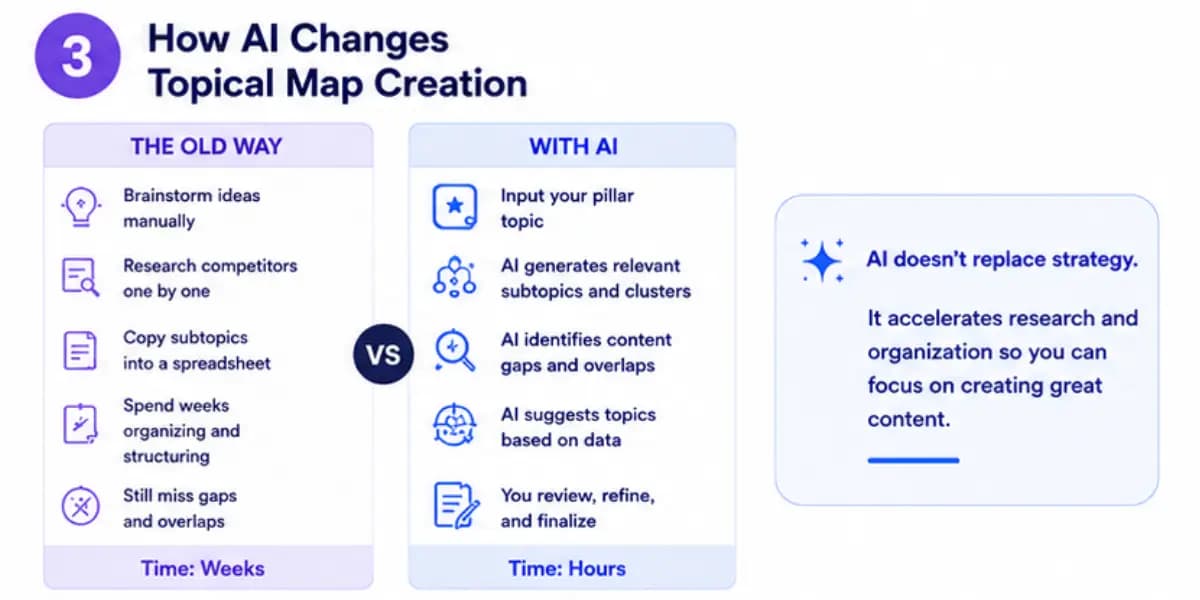
The process of building a topical map used to take weeks of manual work. AI has changed the timeline in a big way.
This shift is one of the most significant developments in SEO workflow over the past few years.
What once required a dedicated research team can now be accomplished by a single person with the right AI tools and a clear strategy.
The Old Way
Marketers used to build topical maps by brainstorming ideas around a whiteboard, manually reading through competitor blogs one by one, and copying every subtopic they found into a giant spreadsheet.
This process worked, but it was slow and it relied heavily on how thorough the person doing the research happened to be.
A tired researcher on a Friday afternoon misses subtopics that a fresh researcher on Monday morning would have caught.
The old way also suffered from confirmation bias. Researchers tended to find subtopics they already expected to see, while missing unexpected but valuable topics that fell outside their existing knowledge.
This limitation meant most topical maps were incomplete from the start.
The New Way
AI tools can now scan search engine results pages, extract entities from top ranking content, and detect gaps between what competitors cover and what you cover, all within minutes instead of weeks.
Instead of manually reading through fifty articles, you can feed AI a topic and get a structured list of related subtopics and entities almost instantly.
Modern AI tools also analyze search intent automatically, grouping keywords by whether users want information, comparisons, or purchases.
This saves hours of manual sorting and ensures your topical map aligns with what searchers actually need at each stage of their journey.
What AI Does Well Versus What Still Needs A Human
AI is excellent at surfacing subtopics and related entities at scale. It can pull hundreds of related terms from search results and organize them faster than any human team could manage.
But AI does not know your business. It cannot tell you which subtopics actually matter for your audience, your product line, or your revenue goals.
That judgment call still belongs to a human. A good topical map process uses AI for speed and a person for direction.
Tools like Frase and TextCortex can help you extract subtopics and related entities from search results using AI.
The best approach combines AI-generated suggestions with your own industry knowledge. AI might surface a hundred subtopics, but only you know which ten are most relevant to your audience.
This human-AI collaboration is where the real magic happens in modern SEO.
How To Build An AI Topical Map
Now let's get into the actual process. This is the part you can follow along with directly, step by step.
Each step builds on the previous one, so follow them in order. Skipping steps will leave gaps in your map that cause problems later when you start creating content.
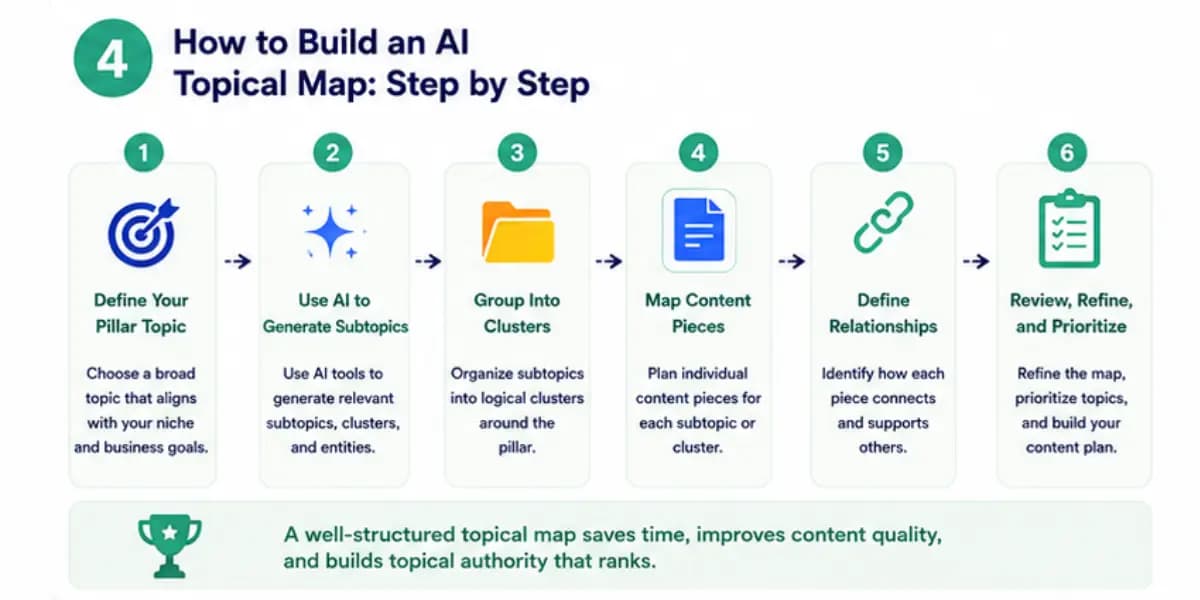
Step 1: Define Your Core Topic And Business Scope
Start by picking your pillar topic and being honest about your business boundaries.
If you run a site about home coffee brewing, your pillar might be something like home coffee brewing methods.
Keep your scope tight enough that you can realistically cover it in full, rather than picking something so broad that it becomes impossible to finish.
A common mistake is choosing a pillar topic that is too broad, like fitness or marketing. These topics contain hundreds of subtopics and would require thousands of articles to cover comprehensively.
Instead, narrow your focus to something like home workouts for beginners or email marketing for e-commerce stores. You can always expand later.
Step 2: Use AI To Extract Subtopics And Related Entities
Feed your pillar topic into an AI tool and ask it to pull related subtopics from search engine results, competitor websites, People Also Ask boxes, and forum discussions like those found on Reddit or Quora.
This step alone can generate more subtopic ideas in an hour than a manual process would generate in days.
You can use KWFinder to discover related keywords and subtopics that cluster naturally around your pillar topic.
When extracting subtopics, pay special attention to the People Also Ask section on Google. These questions represent real search queries that users are actively looking for answers to.
Each question can become a supporting article in your topical map.
Step 3: Cluster Subtopics By Intent And Relevance
Once you have your raw list, group similar subtopics together based on what the searcher actually wants when they type that term.
Someone searching for pour over coffee ratios wants a different kind of answer than someone searching for pour over coffee makers under fifty dollars, even though both mention pour over coffee.
Grouping by intent keeps your clusters focused and useful.
Search intent generally falls into four categories: informational, navigational, commercial, and transactional. Your topical map should include content that addresses each type of intent where relevant.
Informational content builds awareness, while commercial and transactional content drives conversions. A balanced map covers all stages of the customer journey.
Step 4: Identify Content Gaps
Compare your cluster list against what your top competitors already have published. Look for subtopics they cover that you have not touched yet.
These gaps often represent quick wins, since you already know the topic has search demand because someone else is already ranking for it.
Content gap analysis is one of the highest-ROI activities in SEO. Instead of guessing what to write, you are targeting topics with proven demand.
Competitors have already validated that people search for these terms. Your job is to create better, more comprehensive content than what currently ranks.
Step 5: Structure Into Pillar, Cluster, And Supporting Content
Arrange everything into a clear hierarchy.
Your pillar page sits at the top, your cluster pages sit underneath covering major subtopics, and your supporting content sits below the clusters covering narrower, more specific questions.
This hierarchy becomes the skeleton of your entire content plan.
A well-structured hierarchy makes it easy for both users and search engines to navigate your content. The pillar page provides a broad overview with links to each cluster.
Cluster pages dive deeper into specific subtopics and link to supporting articles. Supporting articles cover narrow questions and link back up to their parent cluster.
This creates a natural web of interconnected content.
Step 6: Map Internal Linking Relationships
Decide which pages should link to which other pages before you publish anything.
Cluster pages typically link back up to the pillar, and supporting pages typically link up to their relevant cluster.
Mapping this out ahead of time saves you from having to retrofit links later, which is far more tedious.
Pre-planned internal linking also ensures that link equity flows properly through your site.
Your pillar page should receive links from every cluster page, and each cluster page should receive links from its supporting articles.
This structure concentrates authority on your most important pages while still distributing it throughout the site.
Step 7: Prioritize What To Build First
Not every piece needs to be built at once.
Rank your content pieces by opportunity, meaning search volume and ranking difficulty, and by business impact, meaning how closely the topic ties to something you actually sell or promote.
Build the high opportunity, high impact pieces first.
A simple prioritization framework is to score each content piece on a scale of 1 to 5 for both opportunity and business impact.
Multiply the two scores together, and build the pieces with the highest combined score first. This ensures you are always working on content that has the best chance of driving traffic and revenue.
Tools for Building AI Topical Maps
You do not need to master every tool out there, but it helps to know the general categories.
AI clustering tools group large keyword lists into logical topic clusters automatically, saving you the manual work of sorting hundreds of terms by hand.
SERP analysis tools scan search results pages and pull out related entities, questions, and subtopics that are already ranking well.
Platforms like Surfer SEO and ContentStudio can help you analyze SERP results and organize your content clusters efficiently.
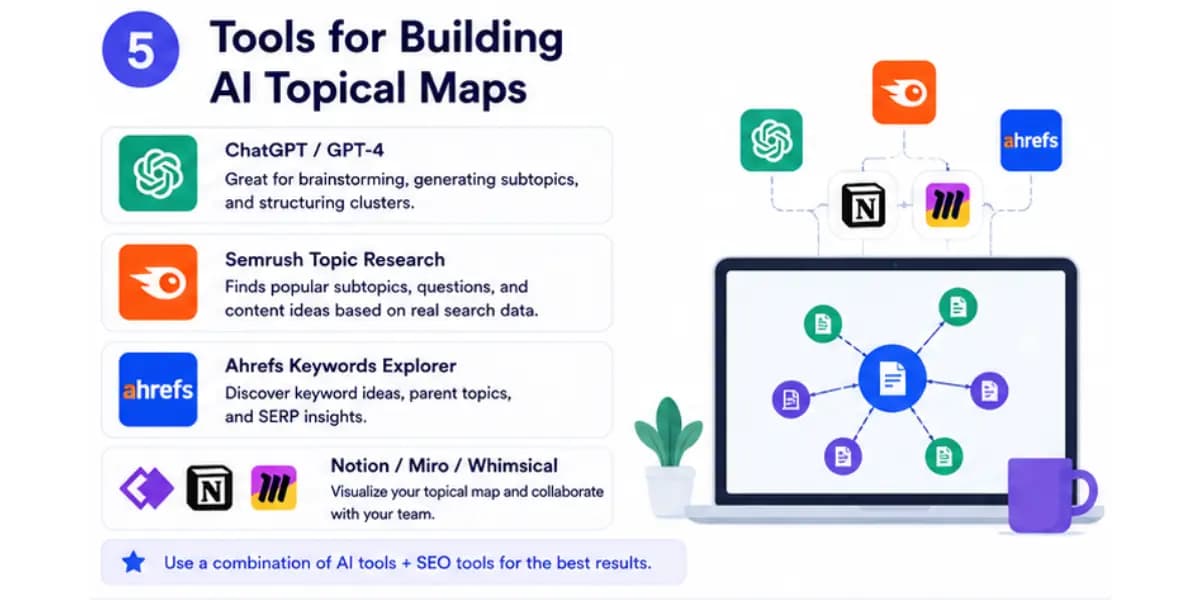
Spreadsheet and visualization tools help you turn your raw data into an actual visual map, whether that is a simple spreadsheet with color coded tabs or a full diagram showing every connection.
For a comprehensive list of tools that can help with every stage of the process, check out our roundup of best keyword research tools for affiliates.
Many of these tools include clustering and SERP analysis features that make topical map building much easier.
Common Mistakes When Building Topical Maps
Even with AI speeding things up, people still trip over the same problems again and again.
Being aware of these mistakes ahead of time will save you weeks of wasted effort and help you build a map that actually drives results.
Making The Map Too Broad
A common mistake is trying to cover an entire industry instead of picking a defined niche.
If your pillar topic is something as wide as fitness, you will never realistically finish mapping every subtopic underneath it.
Narrow your scope to something achievable, like home workouts for beginners, and expand later once that section is actually complete.
The best approach is to start small and expand over time. Pick one narrow pillar topic, build a complete map around it, create all the content, and then move on to the next pillar.
This incremental approach ensures you build real topical authority instead of spreading yourself too thin across too many topics.
Never Revisiting The Map
Search results change constantly, and new subtopics show up as trends shift.
A topical map built once and never touched again slowly becomes outdated.
Set a schedule to revisit your map every few months and check whether new subtopics have appeared that you should add.
Search trends, competitor strategies, and user behavior all evolve over time. A topic that had no search demand six months ago might be trending now.
Regular map reviews help you stay ahead of these changes and maintain your topical authority as the landscape shifts.
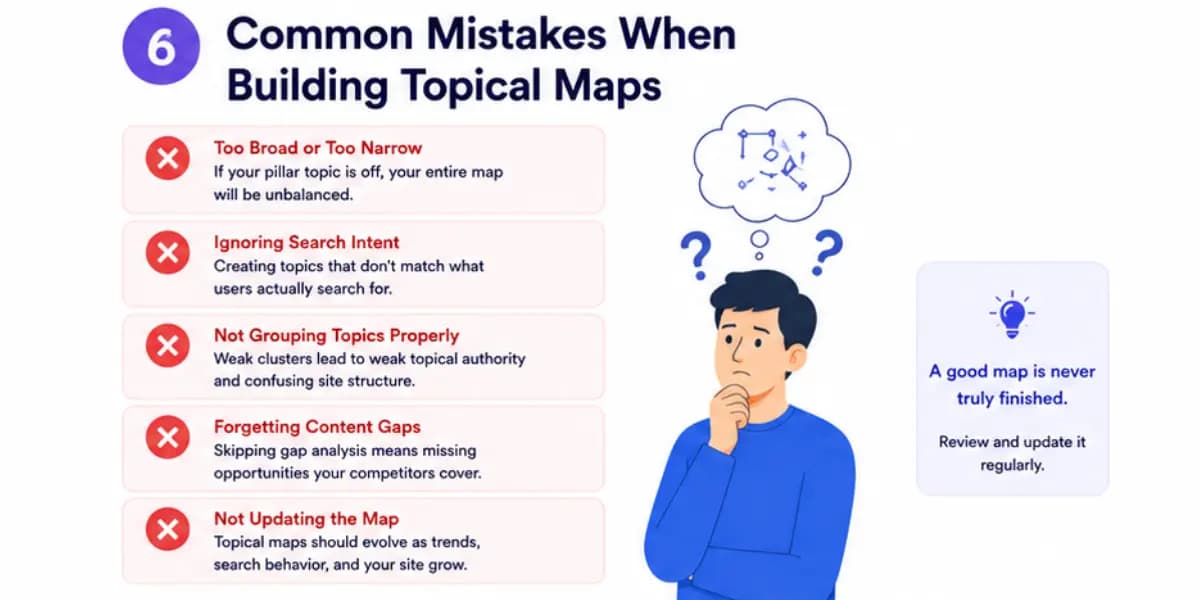
Prioritizing Volume Over Business Relevance
It is tempting to chase every high volume keyword AI surfaces, but volume alone does not mean the topic serves your business.
Mapping topics with no commercial or strategic value just wastes writing hours that could go toward pages that actually support your goals.
Using RankMath alongside your topical map helps you evaluate which topics align best with your business goals and search intent.
Before adding any topic to your map, ask yourself: Does this topic help my audience make a purchasing decision? Does it build trust that leads to conversions?
Does it position me as an authority in my niche? If the answer to all three is no, consider deprioritizing it regardless of search volume.
Skipping The Human Review Step
AI generated subtopic lists are a starting point, not a finished product.
Publishing the raw list without a human checking it for relevance and accuracy often leads to weird, irrelevant, or low quality clusters sneaking into your plan.
Always have a person review the final structure before building content around it.
A good review process involves checking each subtopic against three criteria: relevance to your pillar topic, alignment with your business goals, and actual search demand.
Remove anything that fails any of these checks. This human filter is what separates a useful topical map from a noisy list of random keywords.
Final Thoughts
A topical map takes the scattered pile of content ideas most sites are drowning in and turns it into an actual system built for topical authority.
Instead of guessing what to publish next, you have a clear structure showing your pillar, your clusters, and every supporting piece underneath them, all connected in a way that both search engines and AI answer engines can understand.
The effort you invest in building a proper topical map pays dividends for years. Every new article you create fits into an existing structure instead of existing in isolation.
Your internal linking becomes strategic instead of random. Your topical authority grows with every piece you publish instead of remaining flat.
Start with one pillar topic, build your map, create the content, and then expand to the next topic.
Over time, your website will transform from a collection of random articles into a comprehensive resource that search engines and readers both trust.
FAQ
1. What is a topical map in SEO?
A topical map is a structured plan showing every subtopic and content piece needed to fully cover a broader subject.
2. How is a topical map different from a content calendar?
A content calendar deals with timing and scheduling, while a topical map deals with subject matter and structure.
3. How is a topical map different from a site structure?
Site structure is about navigation and technical layout, while a topical map is about the actual topics you plan to cover.
4. Why do topical maps matter for SEO?
They help build topical authority, prevent content gaps, and create a natural internal linking structure.
5. What is topical authority?
Topical authority happens when search engines trust your site as a complete source on a given subject because of your coverage depth.
6. Can a topical map prevent keyword cannibalization?
Yes, mapping out your topics ahead of time helps you spot overlapping keywords before you publish duplicate content.
7. Do AI answer engines care about topical maps?
Yes, AI answer engines look for clear entity relationships, and a good map makes those relationships easy to spot.
8. What tools help build an AI topical map?
AI clustering tools, SERP analysis tools, and spreadsheet or visualization tools all play a role.
9. Can AI build a topical map on its own?
AI can surface subtopics and entities quickly, but a human still needs to judge what is relevant to the business.
10. What is the first step in building a topical map?
Defining your core pillar topic and your business scope is always the first step.
11. How do I find subtopics for my map?
You can pull them from search engine results, competitor sites, People Also Ask boxes, and forum discussions.
12. What does clustering by intent mean?
It means grouping subtopics based on what the searcher actually wants, not just shared keywords.
13. How do I find content gaps?
Compare your cluster list against competitor content to see what they cover that you do not.
14. What is the difference between a pillar, a cluster, and supporting content?
The pillar is the broad topic, clusters are major subtopics under it, and supporting content covers narrower questions under each cluster.
15. How do I decide what to build first?
Prioritize topics with strong opportunity and clear business impact over topics that just have high search volume.
16. What is the biggest mistake people make with topical maps?
Making the map too broad by trying to cover an entire industry instead of a focused niche.
17. Should I revisit my topical map over time?
Yes, revisit it every few months since search results and subtopics shift over time.
18. Is search volume the only thing that matters when mapping topics?
No, business relevance matters just as much as volume when deciding what topics to include.
19. Should I publish AI's raw subtopic list without checking it?
No, always have a human review the list for relevance and quality before building content around it.
20. How does a topical map connect to internal linking?
The relationships you map between pages become the foundation for the internal linking strategy built afterward.