How To Read An Affiliate Program's Terms So Nothing Bites You Later
It is tempting to click I agree without reading a word. The box is right there, the program looks good, and you want your tracking link now, so the terms feel like a speed bump.
Then a month later something odd happens. A commission disappears, a payout sits unpaid, or an email says your account is closed because of a rule you never saw.
The rule was written down the whole time. It sat in a long page of small print that you scrolled past, and the program is allowed to hold you to it.
In this guide you will learn how to read affiliate program terms in 8 steps.
You will look at commission and payment clauses, cookie and attribution rules, clawbacks and refund windows, prohibited methods, exclusivity, termination and changes to the terms, disclosure and compliance, and then a simple routine for saving and dating what you read.
You do not need a law degree for any of this. You need a pen and a spreadsheet, and the patience to read each program's terms before you promote it.
One honest note first. Treat this as a general guide for bloggers and not legal advice, and every program writes its own agreement, so the real wording on the real page always wins.
If a clause could cost you serious money, ask a lawyer who handles contracts.
If you are still deciding where to apply, read our guide on what affiliate networks look for before you apply first.
For the rules that get accounts closed, keep our page on how to avoid getting banned from affiliate programs open in another tab.
Disclosure: Some of the links I share might be affiliate links. If you click on one and make a purchase, I may earn a small commission as a thank you. But don’t worry, it won’t cost you anything extra. I only recommend stuff I genuinely believe in. Your support helps me keep creating awesome content. You can read my full affiliate disclosure in my disclaimer page.
If you want to save a lot of hours searching for high-paying affiliate programs, check out our exclusive list of 2500+ affiliate programs. You’ll find all the information about the programs inside the list. This list is perfect for affiliate bloggers and influencers.
Why Affiliate Program Terms Matter
An affiliate agreement is a contract. When you press the join button, you promise to follow a list of rules, and the program promises to pay you if you do.
Beginners can treat that contract like background noise. It is easy to assume that if the program looks friendly, the rules must be friendly too.
That assumption is where trouble starts. The agreement is written by the company, for the company, and it protects the company first.
Nothing about that makes the program a bad actor. A business needs rules about fraud, refunds, and advertising.
The point is that you should know the rules before you build a page around a product. A review post takes real time to write, and a hidden ban on one of your methods can make that time worthless.
Reading the terms also tells you how a company behaves. A program with clear, specific, plain language is easier to trust than one without.
A program with vague promises and rules scattered across five pages is telling you something too. Our guide to affiliate marketing red flags explains why that kind of mess deserves a slower look.
There is also a money reason. Commission rates get all the attention, but the small print decides how much of that rate you keep, how long you wait, and what can be taken back.
Two programs can both say they pay 20 percent.
One may pay it on every sale with a long tracking window, and the other may pay it only on the first sale with a short window and a long list of exclusions.
You cannot see that difference on the sign-up page. You can only see it in the terms.
So treat reading as part of the work, like keyword research or editing. It happens once per program, and it protects every hour you spend after it.
Where The Terms Live Before You Read Them
Before step one, you need to collect the right pages. Affiliate rules rarely sit in one tidy document.
Programs can split them across several places, and the clauses you care about may be spread out. If you read only one page, you can miss a rule that lives on another.
The first place is the main affiliate agreement, sometimes called the publisher terms or the partner terms. Look for it linked near the sign-up page or when you accept.
The second place is the program page or the offer details. Look here for the commission rate, the cookie length, and the products that are included or left out.
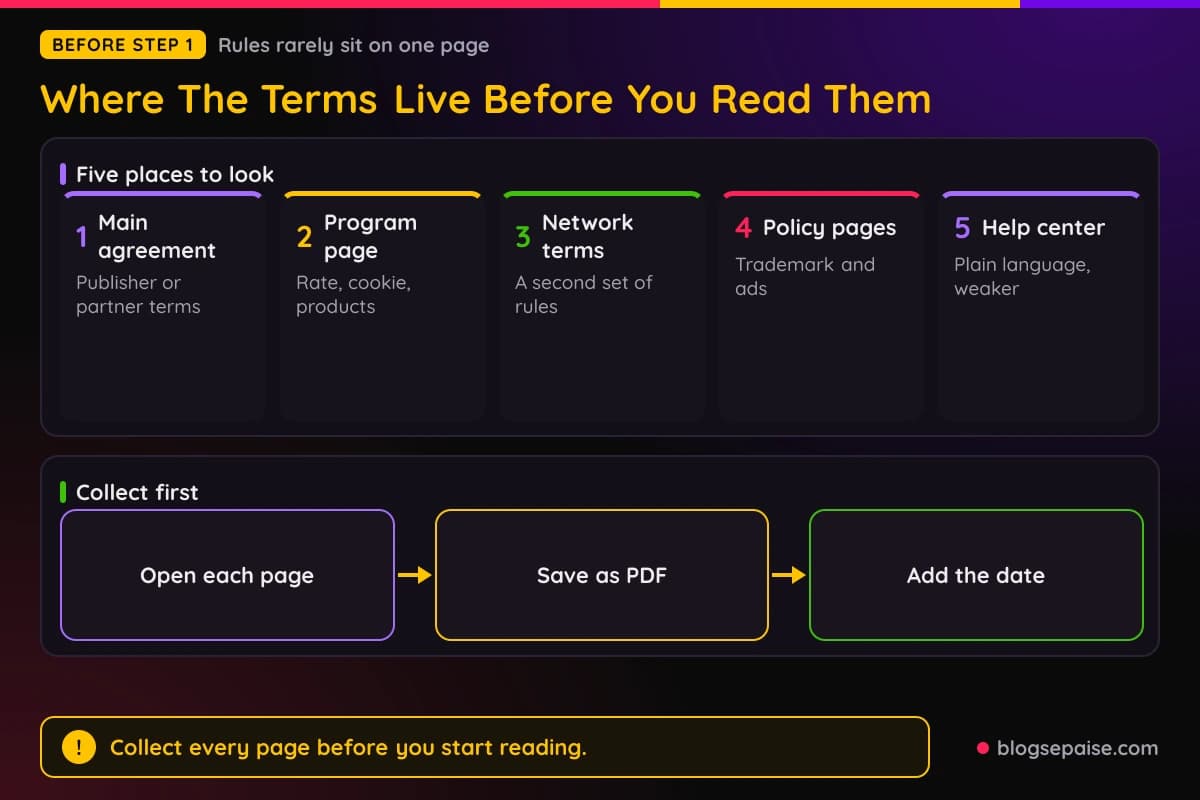
The third place is the network agreement, if the program runs through a network.
Networks such as Awin and PartnerStack sit between you and many brands, so you often accept one set of terms for the network and another set for each brand.
The fourth place is a policy page. Look for an acceptable use policy, a brand guidelines page, a trademark policy, or a page about paid search.
These pages can hold banned methods.
The fifth place is the help center or FAQ.
Programs may explain payouts, reversals, and approval in friendlier language there. If the FAQ and the signed agreement ever disagree, ask the program which one applies.
Save all of these before you begin. A quick way is to open each page, print it to a PDF, and name the file with the program name and the date.
When two pages disagree, write that down as a question. You can email the program and ask which one applies, and a clear answer in writing is worth keeping.
With your pages collected, you are ready to read. Use a highlighter or a notes app and mark every sentence that contains a number, a deadline, or the words must, may not, or at our sole discretion.
Those are the sentences that carry the weight.
Step 1: Read The Commission And Payment Clauses
Start with the money, because it is the reason you are here. Find the part that says how your commission is calculated, and read it slowly.
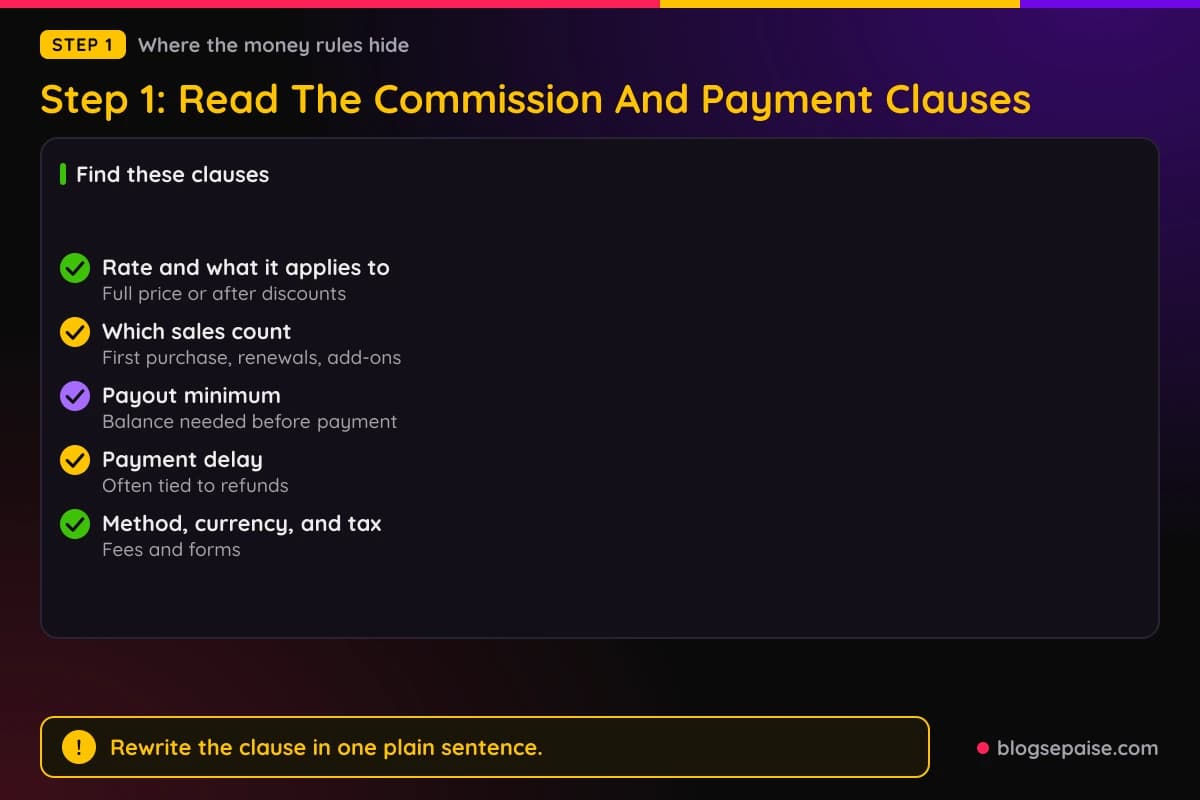
First, find the rate and what it applies to. Does the rate apply to the full price of the order, or to the price after discounts, taxes, and shipping are removed?
Programs can differ on this. Some pay on the pre-tax subtotal, some on the amount the customer actually paid, and some on a specific list of products.
Next, check which sales count. An agreement might say that only the first purchase counts, that renewals count for a set number of months, or that certain plans and add-ons are excluded.
Some software programs pay a recurring share, and the length of that share varies.
It may last for the life of the customer, for a set number of months, or only for the first payment, so read the exact wording.
Then find the payout rules. Look for a minimum balance you must reach before you get paid, and note how often payments go out, such as monthly or on a schedule.
Look for the delay too. A program may hold a commission for a period before it becomes payable, so a sale in January might not turn into cash until later.
That delay can exist to cover refunds, and we will return to it in step three. For now, write down the number of days and the minimum balance.
Check how you get paid. Programs list their own payment methods, and some charge fees or only pay certain countries.
Currency matters as well. If the program pays in a currency other than dollars, ask how it converts and who covers the fee.
Also look for tax language. Some programs ask you to submit a tax form, and payments may be held until you do.
Watch for the phrases that give the company wide room. Words like sole discretion, may withhold, or reserves the right to adjust mean the number you saw on the sign-up page can change.
Those words are normal, and they are not a reason to walk away. They are a reason to write the commission down with a date, which we will do in the last step.
Finally, look for a statement about unpaid balances. A good agreement says what happens to money you earned if your account closes, and a weak one stays silent.
If you want to see what a rate and a refund rate do to real income, try our commission earnings estimator. It makes the effect of small print easy to see before you commit.
A good habit is to rewrite the commission clause in one plain sentence.
Something like, I earn a set percent of the post-discount price on first purchases, paid after a waiting period once I pass the minimum.
If you cannot write that sentence, the clause is unclear. Mark it and ask the program to explain it in an email.
Step 2: Read The Cookie And Attribution Rules
Attribution is how a program decides that a sale came from you. It can quietly change what you earn.
Many programs use a cookie, which is a small file saved in the visitor's browser when they click your link. If that visitor buys later, the program checks for the cookie and credits you.
Find the cookie length first. It is stated in days or months, and the number can differ a lot from one program to the next.
Longer is not always better in practice. A long cookie helps only if the visitor keeps the same browser and does not clear their data.
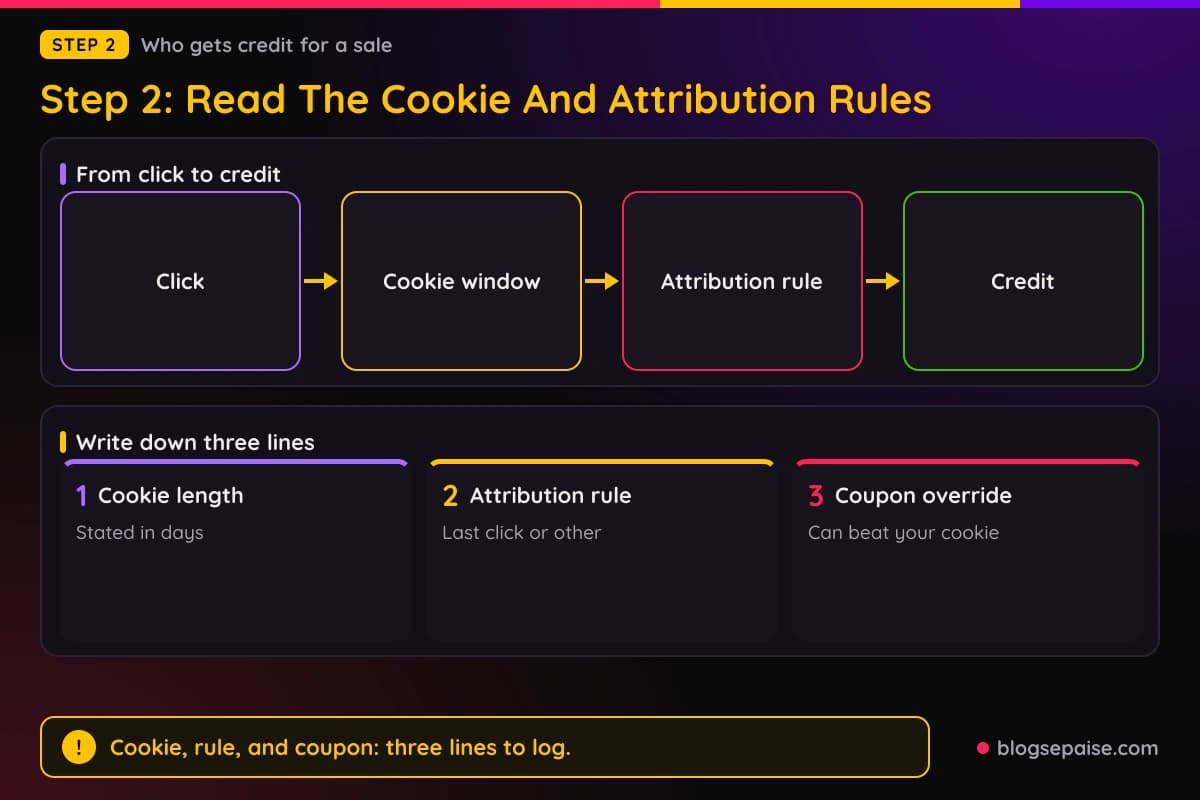
Next, find the attribution rule, which says who wins when more than one affiliate touched the sale. Some programs credit the last click, some credit the first, and some split the credit.
Under a last click rule, a coupon site or another affiliate can take the sale if their link was the final one clicked.
Our guide to attribution models explains how each rule changes who gets paid.
Look for what happens when the visitor uses a code or a coupon. Some agreements say that a sale made with a coupon from another source overrides your cookie.
Check what the agreement says about tracking limits. Browsers and privacy tools can block some cookies, and a program may say plainly that it cannot promise every sale will be tracked.
That is a fair statement, but it matters to you. If the terms say missed tracking is not their responsibility, expect that a few sales will never show up in your dashboard.
Look for rules about the link itself. Some programs require that you use their exact link, and they may ban link shorteners, redirects, or cloaking that hides where the link goes.
Pay attention to the rule on mobile apps and in-app browsers. Tracking can behave differently there, so check if the program offers other tracking methods.
Also check the rule on self-referrals. Programs commonly address buying through your own link, and some extend the rule to family and friends, so read the exact wording.
Last, find any minimum on what counts as a click, a lead, or a sale. A lead might mean a free sign-up, and a sale might mean a paid plan that passes a trial period.
For software, the trial rule matters a lot.
If a commission only becomes real when the free trial ends and the customer pays, then the number of trials you send is not the number of commissions you get.
Write down the cookie length, the attribution rule, and any coupon override. Those three lines tell you how likely it is that a sale will actually land in your account.
If the cookie is very short and your readers take a long time to decide, the program may be a poor fit for your kind of content.
A review that readers bookmark and return to a week later needs a longer window than a quick deal post.
Step 3: Read The Clawback And Refund Windows
A clawback is when a program takes a commission back after you were credited. It is the clause that can surprise you, because the money looked real until it vanished.
A common cause is a refund. If a customer returns the product or cancels within a set period, the company may refund them and reverse your commission.
Find the refund window first. Look for the number of days the customer has to ask for their money back, and the number of days the program waits before it treats your commission as final.
Those two numbers can be linked. A program that holds commissions for a period before paying may be waiting for the refund window to close.
Next, look at what else can trigger a reversal. Chargebacks, fraud checks, canceled orders, and failed payments can all be reasons, and some agreements list more.
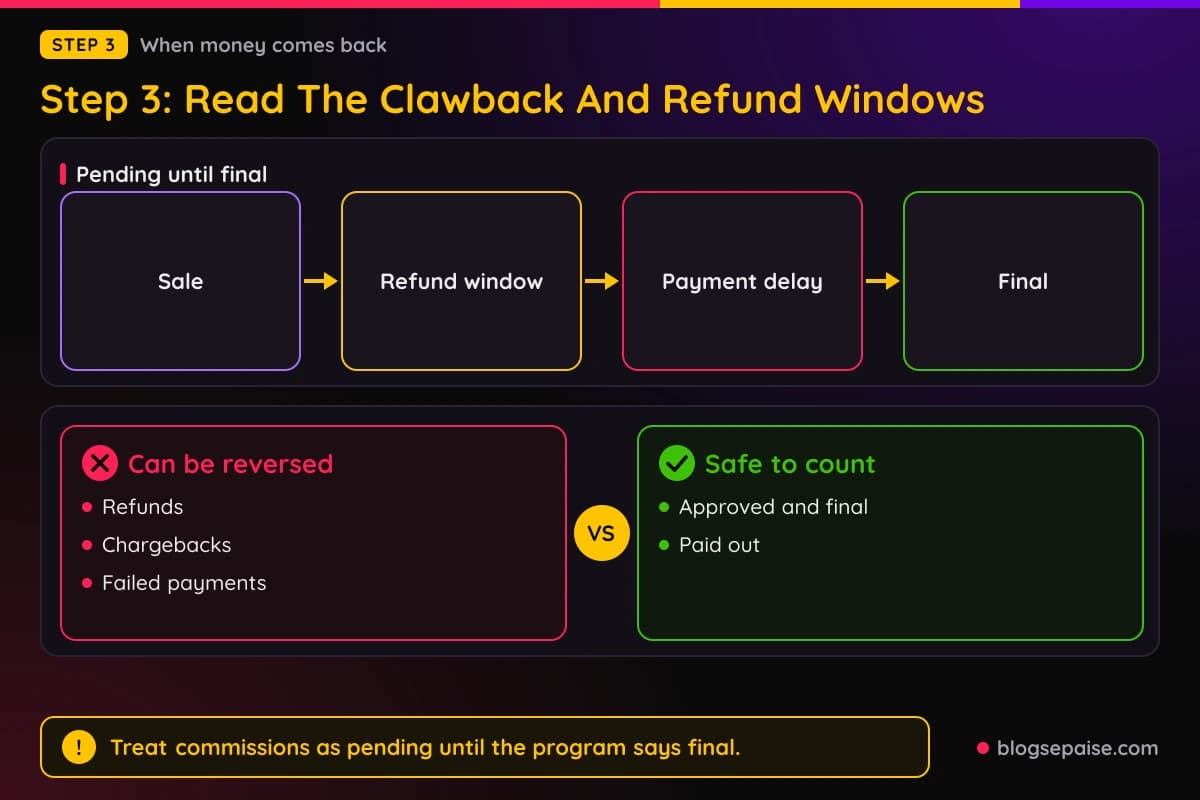
A chargeback is when a customer disputes the charge with their bank. A program may reverse the commission when that happens.
Pay special attention to the words that set no time limit. Phrases like at any time, or if the sale is later found to be invalid, mean the program can reverse a commission after you were paid.
When that happens, read what the agreement says about repayment. Some programs subtract the amount from your future earnings, and some can ask you to pay it back directly.
Negative balances are worth a close look. If a reversal pushes your balance below zero, find out if the debt carries forward and if it blocks you from being paid on later sales.
Also check what counts as a sale that can be reversed.
An agreement may say that a sale made with a banned method is not eligible, and that gives the program a reason to take it back.
Here is the clause that ties your behavior to your income. A rule you break by accident, such as a banned coupon, can turn a month of earnings into a reversal.
A simple way to protect yourself is to treat commissions as pending until the program calls them final. Do not spend money you have not been paid, and do not count it in your income report.
Our guide on how to read an affiliate income report shows how to separate pending, approved, and paid numbers, which keeps your records honest.
If the refund window is long, expect your earnings to arrive late. That is a cash flow issue to plan for, especially if you pay for hosting or tools each month.
Step 4: Read The Prohibited Methods
Step four covers the rules that can get an account closed, so give it extra time. Programs spell out what you may not do, so read the whole list.
One restriction to look for is brand bidding. That means paying for search ads on the company's own name, or on close variations of it, so that your ad shows up above the official site.
A program may dislike it because it is already paying to be found by people searching its name.
If you take that click and then collect a commission, you earned money from a sale they would have made anyway.
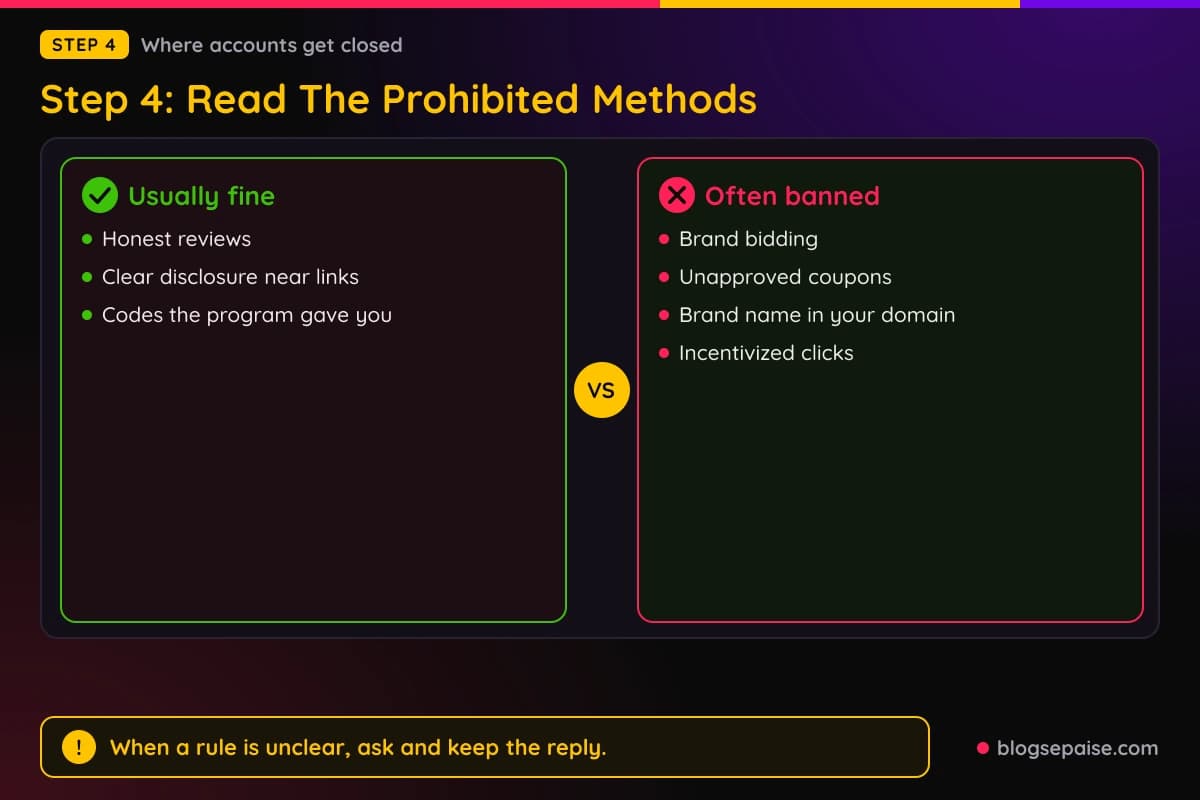
The agreement may ban the brand name, the misspellings, and the brand name with words like review or discount. Read the exact list, since some programs allow some of those and ban others.
A second restriction can be on coupons and deal sites. A program may forbid coupon codes unless you are approved as a coupon publisher, or forbid codes that were not issued to you.
Posting a code you found on a forum can be a violation, even if the code works. Read if the program gives you a code of your own, and what you may say about discounts.
A third is trademark use. An agreement may say that you may not put the company's name or logo in your domain, your social handle, or your ad text without permission.
Under that kind of rule, a site named after the product could get a partner removed. If you plan to name a site or an account after a product, read the brand guidelines first or pick a different name.
A fourth group covers how you describe the product. Programs can ban false claims, fake urgency, and promises the company has not made, such as results or income guarantees.
Check the rules on email and social media as well. A program might forbid links in unsolicited email, forbid links in certain kinds of ads, or require you to name your channels.
Look for bans on incentives. If you offer a gift, cash, or points for clicking or buying through your link, an agreement may treat it as a violation unless you were told it is allowed.
Look for bans on certain kinds of sites too. Agreements can exclude categories of content, and some exclude sites that copy the company's own pages.
Watch for rules about toolbars, browser extensions, and pop-ups. A program might forbid software that adds or replaces affiliate links as someone browses.
Finally, check the rule on paid traffic in general. A program might allow it with limits, want approval first, or ban it entirely.
When a rule is unclear, ask before you act. A short email that says, may I run ads on this phrase, gets you an answer in writing, and that answer protects you later.
For a longer look at the habits that get partners removed, our page on how to avoid getting banned from affiliate programs goes deeper. Keep both tabs open while you read an agreement.
Step 5: Read The Exclusivity Terms
Exclusivity means the program asks you to promote it and no one else. The word sounds big, but the clause can be small or large, so you have to read what it covers.
Exclusivity is not in every agreement. Still, some programs ask for it, and a few may offer better rates in return.
Start by finding any sentence that mentions competitors, exclusive, or sole. These words can show up inside the agreement and also inside a side offer made by email.
Check the scope of the rule. Does it cover your whole site, a single page, a single post, or one channel like your newsletter?
An exclusive deal on one landing page is very different from a ban on mentioning any rival anywhere on your site. The first is easy to live with, and the second can wreck a comparison blog.
Check how competitors are defined. A vague phrase like any similar product can reach further than you expect, while a named list is easy to follow.
Look at the length of the commitment. Does it last as long as you are in the program, for a set number of months, or for a period after you leave?
A clause that keeps limiting you after you end the relationship deserves a hard look. It can stop you from earning with other companies in the same niche for a while.
Next, find what you get in return.
If you give up the freedom to promote others, look for a higher rate, a bonus, or a guaranteed term, and make sure it is written in the agreement and not just in an email.
Also check how exclusivity fits your content plan. If your site is built on honest comparisons, a rule that keeps you from naming rivals defeats the purpose of the site.
Take the honest route when a program asks. You can say no, or you can ask them to limit the clause to one page.
Related to this is the idea of a non-compete. An agreement might add language that limits other work, and that sort of wording is a good moment to ask a professional to read it.
For a small blog, a safe default is simple. Skip exclusivity unless the deal is clearly better in writing and the limit fits the way you already work.
Step 6: Read The Termination Clause And Changes To The Terms
Step six covers how the relationship can end and how the rules can change while you are in it.
Both matter, because affiliate income can depend on one program staying friendly.
Start with termination. Find who can end the agreement, for what reasons, and with how much notice.
Some agreements let the program end things at any time, with or without a reason. Others give you a notice period, and some say the end is immediate.
Look for what happens to your money. Does the program pay out what you earned up to the end date, or can it keep the balance if you broke a rule?

Some agreements say that commissions earned in breach of the terms are forfeited. That is why the banned methods in step four matter so much.
Check if the agreement keeps paying on past referrals. In recurring programs, you want to know if commissions continue on customers you already sent, or if they stop the day you leave.
Check what you must do after termination. An agreement may require you to remove links, logos, and banners, and the program may check that you did.
Now move to changes. Find the clause that says how the program can update the terms, and how it will tell you.
Some agreements allow changes at any time. A program might promise an email notice, post the update on a web page, or say that continuing to use the program means you accept the new version.
That last version is the one to note. If you are bound by changes you never saw, then checking back is your job, and a calendar reminder is the easy fix.
Look for any sign that rates can change without notice. A program might commit to a notice period before cutting a commission, or keep the right to change it immediately.
If the agreement gives a window, such as a number of days, before a change takes effect, write it down.
Finally, check the dispute rules. Look for the governing law, where disputes are heard, and if you waive the right to join a group lawsuit.
You are unlikely to ever need that section, and it is still worth a glance. It tells you where the company is based and how far you would have to go to settle a disagreement.
Set one reminder to reread the terms on a schedule. Programs change their rules, and the date you saved is the proof of which version you agreed to.
Step 7: Check The Disclosure And Compliance Rules
Many affiliate agreements include a section on disclosure and legal compliance. Read it, because the program may pass its obligations down to you.
In the United States, the Federal Trade Commission says a disclosure of a material connection should sit right next to the endorsement and be easy to notice. Placing it on a profile page, at the end of a post, or behind a link is not enough.
A program may repeat that expectation in its own words, and some add rules.
They may require a specific sentence, a certain placement, or a disclosure in every video, post, or email that carries a link.
Find the exact wording the agreement asks for. If it supplies a sentence, use it, and keep a copy of where you placed it.
Look at the rules on privacy and data. A program might ask you to follow privacy laws, post a privacy policy, and get consent before using cookies if your readers live in places that require it.
If you have visitors from Europe or other regions with strict rules, those clauses can matter more.
Our GDPR cookie notice builder can help you draft a notice, and a lawyer can confirm it fits your situation.
Check the rules on content accuracy. A program might require that your claims about the product be true and that you do not make health, income, or safety promises the company has not approved.
Look for rules on reviews. A program might ban paid or incentivized reviews or require you to say when you got a product for free.
Check what the agreement says about your own legal status. A program might ask you to confirm your age, your right to work in your country, and that your details are accurate.
Keep your side of this clean. Our full guide to legal disclosures covers wording and placement in plain English, and it pairs well with this step.
Disclosure is also a good habit that helps your readers. A short, honest note builds trust, and trust is what turns a click into a sale.
When in doubt, disclose more clearly, not less. A clear note near the top of a post costs you nothing and removes a whole class of risk.
Step 8: Save And Date The Terms With A Checklist Routine
The last step turns reading into a habit. A dated record of the terms is the best protection you have, because pages change and memory fades.
Start with a folder. Make one folder per program, and inside it save a PDF or a screenshot of every page you read, with the program name and the date in the file name.
Add a short notes sheet next to the folder. A plain spreadsheet works well, with one row per program and a column for each item you collected in the earlier steps.
The columns should cover the commission rate and what it applies to, the payout minimum, the payment delay, the cookie length, and the attribution rule.
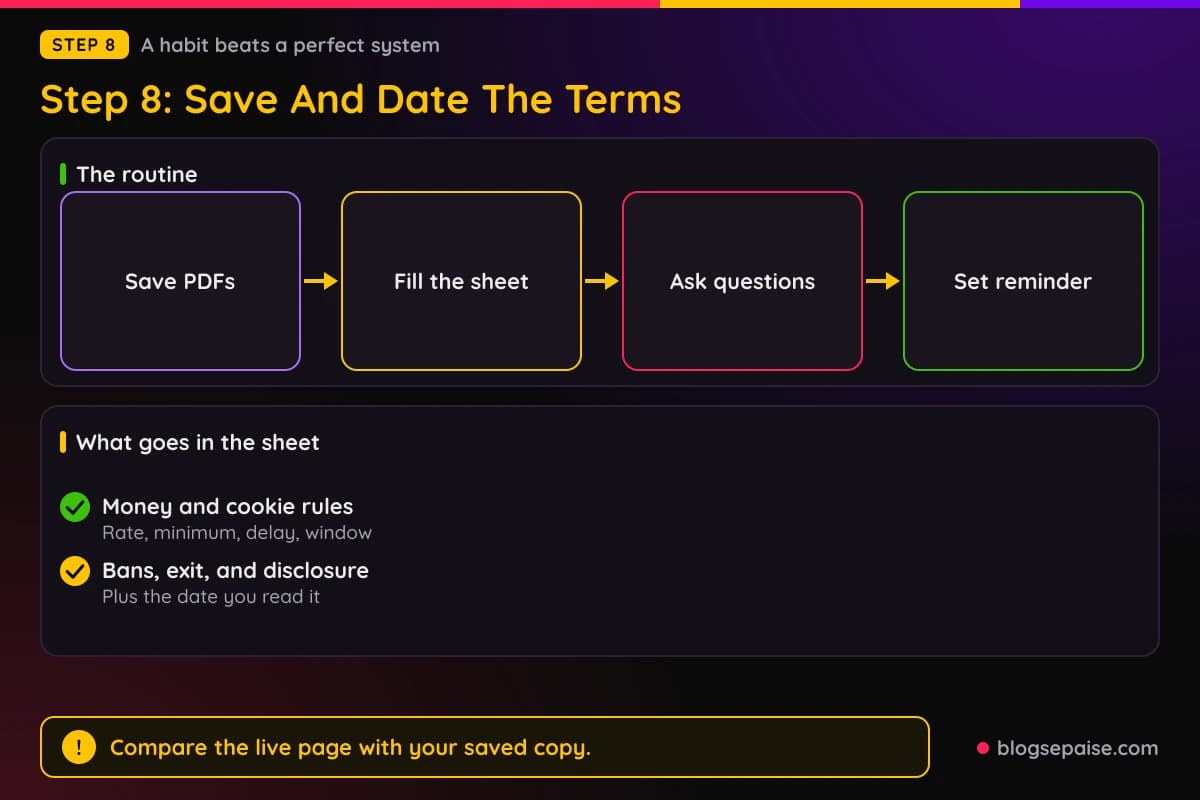
Add the refund window, the reversal triggers, and the banned methods.
Then add exclusivity, the notice for termination, the notice for changes, and the disclosure wording. Finish with the date you read the terms and a link to the page.
Next, add a column for your questions. Anything you could not understand goes here, and you send those questions to the program in a single email.
Save the reply with the rest of your files. A written answer from the program is useful if a dispute ever comes up.
Now set reminders. Pick a rhythm that fits your life, such as every three or six months, and add a calendar note to reread each active program's terms and compare them with your saved copy.
Check again before big moves. If you plan a large launch, a paid ad test, or a new site section, reread the prohibited methods and the commission clause first.
Use a two-minute check each time. Open the live page, compare the key numbers with your sheet, and update the date if nothing changed.
If something did change, write it down and decide what to do. You might adjust your content, send the program a question, or move your effort to a better program.
Keep the habit light. A routine you actually follow beats a perfect system you abandon after a week.
If you also track income, put the terms sheet beside it. Seeing the rules next to the numbers makes it easy to spot why a month came in lower than you expected.
Common Mistakes When Reading Affiliate Terms
The first mistake is skipping the reading altogether. The next few come from rushing.
People often read only the commission rate. They miss the cookie, the refund window, and the banned methods, which decide how much of the rate they actually keep.
Another mistake is trusting a blog post or a video about the program. Those can be old or wrong, so check the program's own pages.
A friendly email from a manager is nice, but if the promise is not in the agreement or in writing, it may not hold when someone else takes over.
Another error is assuming the terms stay the same. Programs can update their rules, and an old habit can turn into a violation without you noticing.
Another is ignoring the policy pages. The agreement may say you must follow the brand guidelines, and then the real ban on your method sits in a separate document.
Some people also forget to save a copy. If the page changes or disappears, you have no proof of what you agreed to.
Finally, do not treat an unclear clause as probably fine. A better habit is to ask, keep the answer, and move on once you have it.
Final Thoughts
Reading affiliate program terms is a small job with a big payoff. It takes time to build the habit, and it helps you avoid surprises that can cost months of work.
The path is short.
Gather the pages, read the money clauses, check the cookie and attribution rules, learn the clawback window, note the banned methods, check for exclusivity, see how the deal can end and change, follow the disclosure rules, and save everything with a date.
You do not have to catch every word. Focus on numbers, deadlines, and bans, rewrite each clause in plain language, and ask the program about anything that stays fuzzy.
Keep in mind that this guide is general information and not legal advice. For a clause that could cost you real money or limit your future work, get a professional to read it.
Once you have a few programs on file, comparing them gets easy. Our page on high quality affiliate programs is a good next stop when you want to choose where to spend your time.
Frequently Asked Questions
1. Do I really need to read the terms of every affiliate program?
Yes, at least once per program. You do not need to memorize them, but you should read the money, refund, and banned method sections before you promote anything.
2. Is this article legal advice?
No. It is a general guide for bloggers, and every agreement is different.
If a clause could cost you serious money, ask a lawyer who handles contracts.
3. What is a clawback in an affiliate program?
A clawback is when the program takes back a commission it already credited, for example because of a refund, a chargeback, or a sale that did not meet the rules.
Check the agreement for the triggers and the time limit.
4. How long should a cookie window be?
There is no single right number, because programs vary. Read the stated length, compare it with how long your readers take to decide, and check the current terms for the exact figure.
5. What is brand bidding, and why do programs ban it?
Brand bidding means buying search ads on a company's own name so your ad appears above theirs.
Programs may ban it because they would have won that sale anyway, so check the exact list of banned phrases.
6. Can a program change its terms after I join?
Some agreements say yes. Look for how they notify you, if there is a notice period, and if using the program after a change counts as accepting it.
7. Do I have to promote only one company in a niche?
Not necessarily. Some programs ask for exclusivity, so read the scope, the length, and the definition of a competitor before you agree.
8. What should I save from an affiliate agreement?
Save the agreement, the program page, and any policy pages as dated PDFs. Add a short notes sheet with the key numbers, the date you read them, and any answers you got by email.
9. How often should I reread the terms?
Every few months is a sensible rhythm, and also before a big launch or an ad test. Compare the live page with your saved copy and update the date.
10. What if two pages from the same program disagree?
Email the program and ask which one applies. Save the written answer with your files, since it can help if a dispute comes up later.