What Companies Allow Affiliate Marketing And How To Find Them
You want to earn commissions, but you do not know which companies will actually pay you. A quick search gives you a hundred lists, and half of them are out of date.
Here is the plain answer: thousands of companies run affiliate programs. They sit in software, retail, hosting, travel, finance, and online courses.
Some run their own programs on their own sites. Others list programs on networks such as Awin, Impact, CJ Affiliate, and Rakuten Advertising, or on marketplaces such as PartnerStack, ClickBank, and Digistore24.
The hard part is not finding one company. The hard part is a repeatable method, so you can check any brand in a few minutes and skip the ones that waste your time.
Below you get seven steps, a worked example with made-up numbers, common mistakes, and a short FAQ. Every fact about a network comes from that network's own site.
Disclosure: Some of the links I share might be affiliate links. If you click on one and make a purchase, I may earn a small commission as a thank you. But don’t worry, it won’t cost you anything extra. I only recommend stuff I genuinely believe in. Your support helps me keep creating awesome content. You can read my full affiliate disclosure in my disclaimer page.
If you want to save a lot of hours searching for high-paying affiliate programs, check out our exclusive list of 2500+ affiliate programs. You’ll find all the information about the programs inside the list. This list is perfect for affiliate bloggers and influencers.
Why Some Companies Run Affiliate Programs And Others Do Not
An affiliate program is a pay-for-results deal. A company pays you a commission only when someone you sent buys, signs up, or takes another action the company wants.
That setup is attractive for a brand because it carries little risk. The company pays after a result, not before.
Companies with high margins and online checkouts usually like the idea best. Software subscriptions, hosting plans, and online courses cost little to deliver once they are built, so a commission is easy to afford.
Retailers use programs too, but they pay thinner commissions because their margins are thinner. A store that earns a few dollars per sale cannot hand most of it to you.
Some companies skip affiliate marketing on purpose. A small local shop may not want the setup work, and a brand with a tiny budget may prefer to spend it elsewhere.
Others had a program once and closed it. Programs get paused, rebuilt, or moved to a new network, which is why old lists are risky.
So the question is never only which companies allow affiliate marketing. The better question is which ones allow it today, for your kind of site, on terms you can accept.
That is why this guide teaches a method instead of handing you a list. A list expires, but a method keeps working.
If you are brand new to the idea, read our guide on what affiliate marketing is first. Then come back here and start with Step 1.
Step 1: Know Which Kinds Of Companies Run Programs
Start by thinking in categories, not in brand names. Six categories hold a large share of the programs beginners can join.
Software comes first. Email tools, design tools, page builders, and writing tools often pay a commission for each paid signup, and some pay again every month the customer stays.
Hosting and domain companies are next. They sell something nearly every site owner needs, and some pay a flat amount for each new customer.
Online courses and training sites form the third group. Their products cost a lot to learn from but little to deliver, so the commission can be large.
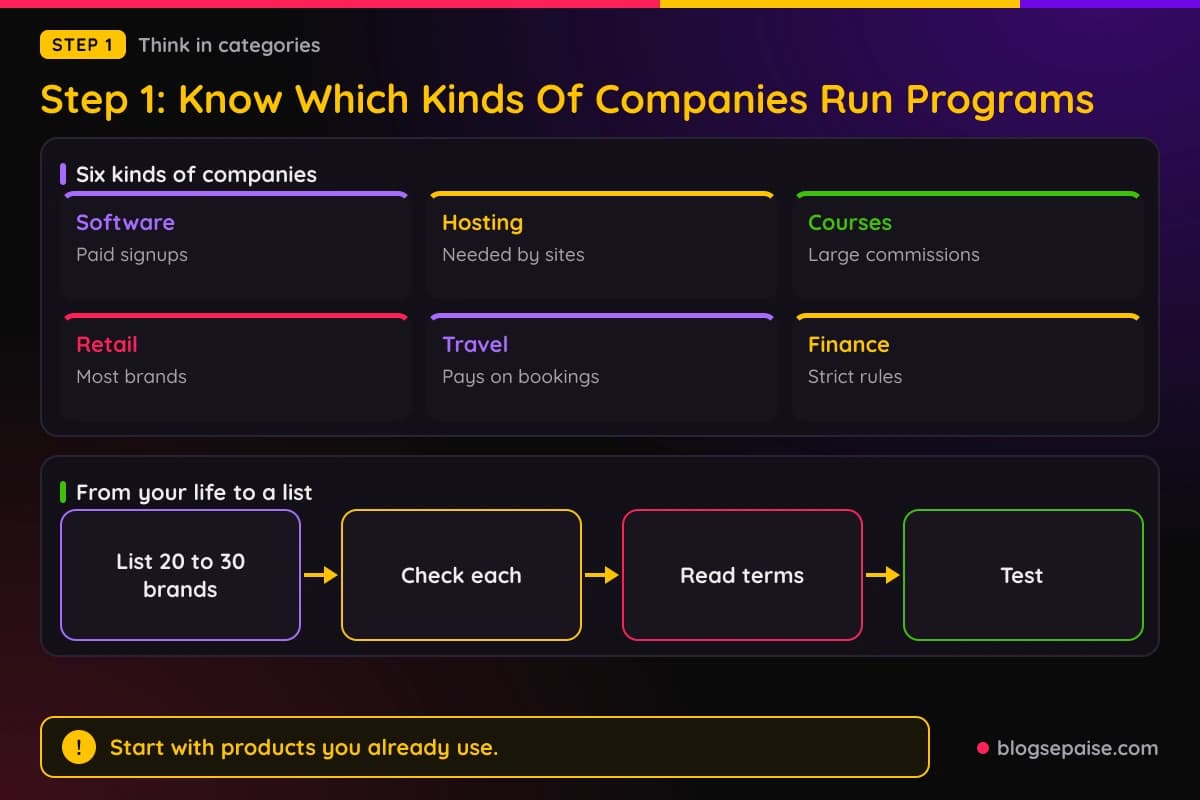
Retail and ecommerce is the fourth group, and it is the biggest by brand count. You will find fashion, home goods, electronics, and beauty brands here, usually with lower percentages per sale.
Travel companies are fifth. Hotels, booking sites, and tour sellers pay when a reader books, though the rules often limit where you can post links.
Finance is the sixth group. Banks, card issuers, and money apps may run programs, but they often add strict rules about what you can say, so read those terms with extra care.
Pick the category that fits your site before you search. A blog about home offices should look at software, retail, and courses, not at hotel booking sites.
Next, match the category to your reader. Ask what your reader already buys or plans to buy in the next month.
Your own bills are a great source of ideas. List the tools you pay for and the stores you shop at, because you already know how those products feel to use.
Honest recommendations of products you use convert better than links to products you only read about. That makes your own list the best starting point.
Write that list now, with 20 to 30 company names. The next steps turn that list into a shortlist.
Do not worry if some names turn out to have no program. A long first list protects you from running out of options.
Keep the list in a small spreadsheet. Give it columns for brand, category, program link, and the date you checked.
Step 2: Run The Three Quick Checks
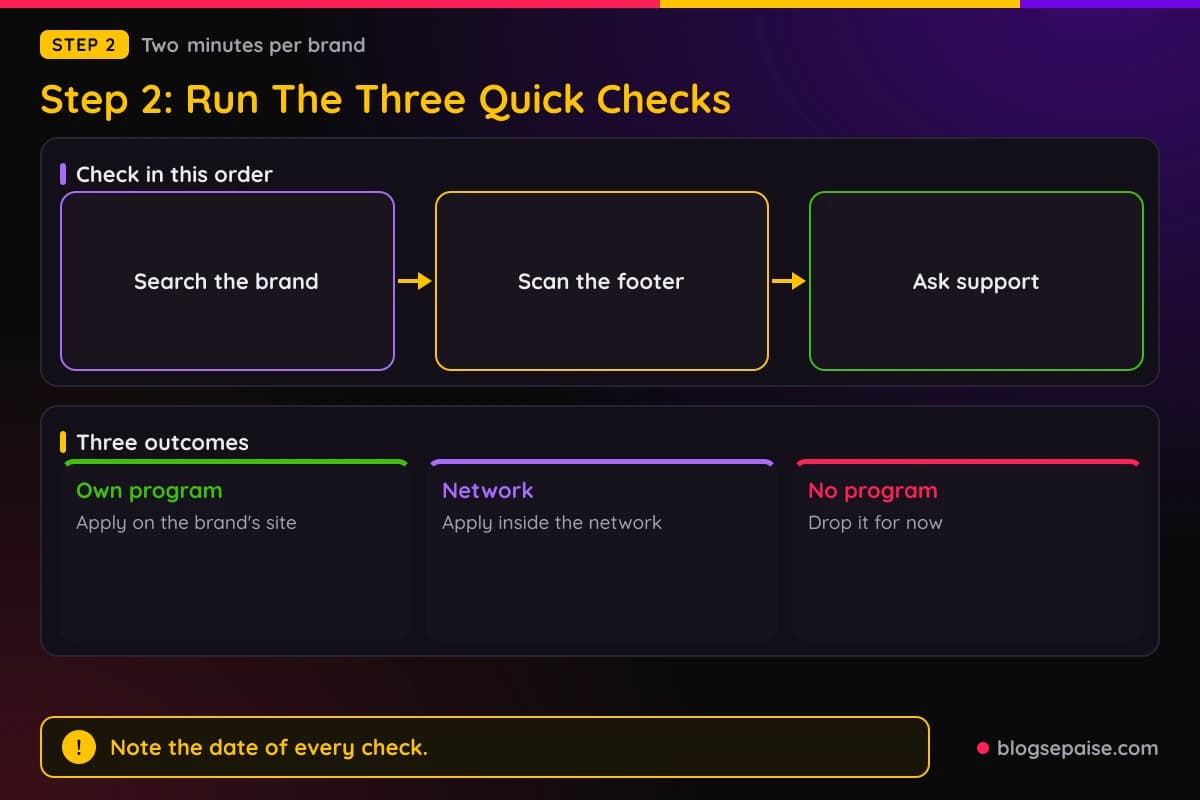
Now test each name on your list with three quick checks. Each one takes about two minutes, and together they catch most real programs.
Check one is a search. Type the brand name plus affiliate program into a search engine, such as Notion affiliate program, and read the first few results.
Look for a page on the brand's own domain. A result on the company's site is far more trustworthy than a blog that says the program exists.
Try small variations if nothing shows up. Search for the brand plus partner program, referral program, or become a partner.
Check two is the website footer. Scroll to the bottom of the brand's homepage and look for links named Affiliates, Partners, Referral, or Earn.
Many companies tuck the link into the footer next to Careers and Press. Some place it under a menu named Company or Resources.
Check three is asking support. If the search and the footer turn up nothing, send a short message through the contact form or chat.
Keep that message simple. Ask if the company has an affiliate or referral program for blogs and where to apply.
Support teams often answer within a day or two, and a reply that says no is useful too. It saves you from writing content for a brand that cannot pay you.
Expect three outcomes. The brand runs its own program, the brand uses a network, or the brand has no program at all.
Sort your list into those three piles as you go. Own-program brands go straight to the application page.
Network brands go to a second list, which Step 3 covers. Brands with no program drop off the list, at least for now.
Note the date you checked. Programs change, so a check from last year may be wrong today.
Also note the commission and the cookie window if the page shows them. A cookie window is how long a click stays linked to a later purchase.
Do not give up after one weak search. Many programs hide behind names such as creator program, ambassador program, or refer a friend.
Step 3: Search The Major Affiliate Networks
An affiliate network is a middleman. You create one account, and then you apply to many brands inside it.
Networks handle the tracking links, the reporting, and the payments. That means one login and one tax form instead of a new signup for every brand.
Awin is a big one. Awin says you can partner with 30,000+ brands, and it lists no publisher sign-up fee.
You can start with Awin through its publisher signup, which it describes as a guided wizard.
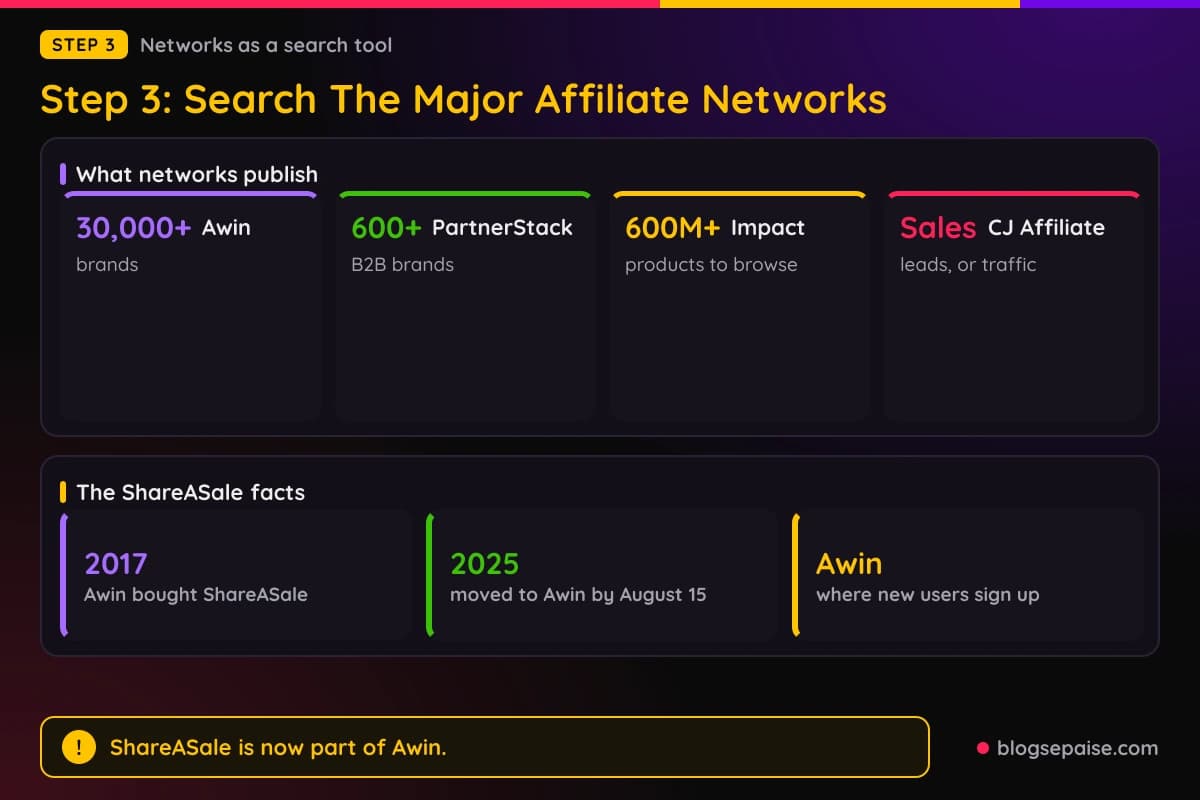
ShareASale needs a note, because many older guides still list it as a separate network. Awin has owned ShareASale since 2017, and Awin says all active ShareASale customers were moved to its platform by August 15, 2025.
Visit shareasale.com today and it redirects to Awin, where new customers are invited to launch directly with Awin. Awin's own pages give no exact closing date for the old ShareASale login, so treat ShareASale as part of Awin.
Impact is another large network, run by impact.com. Its partner side offers a marketplace where you find brands, and its Product Marketplace lists 600M+ products where you can apply to partner from a product page.
Impact lists no publisher price and no brand count for partners. Check inside your account to see which brands you can join.
CJ Affiliate is built for people with an audience. Advertisers there pay partners commissions on sales, leads, or traffic, and CJ lists no signup cost and no advertiser count.
Rakuten Advertising has a publisher registration page. Rakuten lists no brand count or fee for publishers, so you learn which brands are available after you register.
PartnerStack focuses on software. Partners get free access to its Marketplace, and PartnerStack says it works with 600+ B2B brands.
If you promote business tools, start with PartnerStack. If you cover shopping topics, start with Awin, Impact, or CJ.
Every network works in two stages. First you apply to the network itself, and then you apply to each brand inside it.
Brands inside a network can still say no. A network approval does not guarantee a brand approval.
For a full side by side look at these networks, read our guide on affiliate marketing platforms. Here we only use the networks as a search tool.
Use the network search box the way you would use a search engine. Type each brand from your list and see if it appears.
Then browse by category to find brands you did not think of. Add the good ones to your list and run the quick checks on them.
Payment options differ by network. Awin lists SEPA, BACS, ACH, and domestic payments in several currencies, and international wire transfers go through Payoneer.
Look at the payment options before you join any network. They decide how and when the money reaches you.
Step 4: Browse The Marketplaces And The Amazon Program
A marketplace works a little differently from a network. You browse products or offers made by many sellers, and you promote the ones you pick.
Amazon Associates is the best known program in this group. Anyone with a qualifying website or mobile app can apply, and Amazon reviews each application.
Amazon says you can earn up to 10% in commissions, and the rate depends on the product category. Commissions are paid about 60 days after the end of the month in which they were earned.
Amazon lists no joining fee. Influencers with a strong social following are pointed to a separate Amazon Influencer Program.
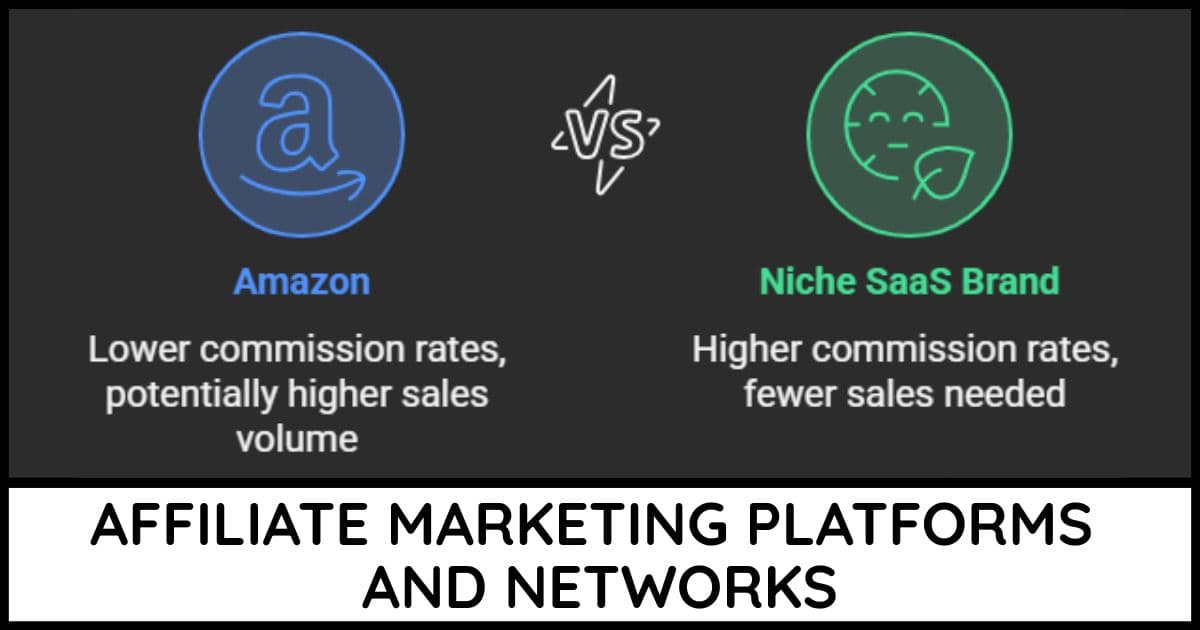
The upside is the size of the catalog, since almost any reader has bought something from Amazon. The downside is the low rate, so you need many sales to earn a meaningful amount.
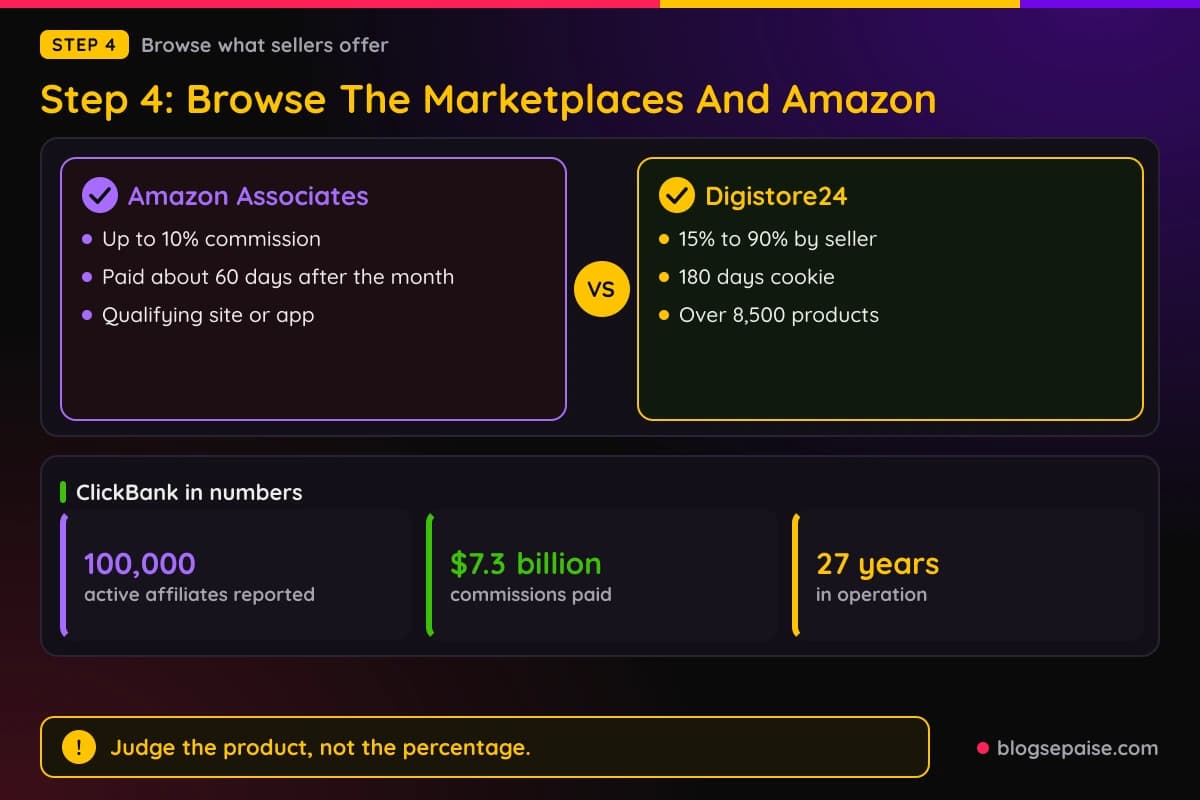
ClickBank is a digital product marketplace. Sign up is free, and ClickBank reports more than 100,000 active affiliates and more than $7.3 billion in commissions paid over its 27 years.
ClickBank pays twice weekly and offers two commission types, revenue share and cost per action. It lists no commission rates on its main page, because each seller sets its own.
Digistore24 is a second digital marketplace. Registration is free, and the marketplace lists over 8,500 vetted products across 44 niches.
Sellers on Digistore24 set the commission, typically 15% to 90%. The cookie window is 180 days, and payouts come in two parts: 90% after 14 days and 10% after 60 days.
Digistore24 shows two different affiliate counts on its own site, so no reliable figure for that number is available. Skip that stat and judge the offers one by one.
Marketplaces can show you large percentages, and that can be tempting. A 75% commission on a weak product still earns nothing if nobody buys it.
Look at the product first. Ask if you would be comfortable recommending it to a friend.
Many marketplace products are digital courses and tools sold with big promises. Test the sales page, read the refund terms, and be ready to say no.
Use marketplaces as a source of leads, not as a shortcut. The same checks from Step 5 and Step 6 apply here.
Amazon is a simple start for a shopping style site, but the low rate means a slow first month. Pair it with a higher paying program as soon as you can.
A balanced plan often mixes one big catalog program with a few specific programs. For example, you might use Amazon for gear and a network or marketplace program for software.
Step 5: Read The Program Terms Before You Apply
Finding a program is only half of the job. The terms decide if you can actually earn from it.
Open the terms page and read it from top to bottom once. It takes ten minutes, and it can save you months of wasted work.
Start with who can join. Some programs accept only blogs, some accept social accounts, and some ask for a minimum traffic level.
Next, check where links may go. Many programs ban links in email, paid ads, or certain places, so match the rules to how you plan to promote.
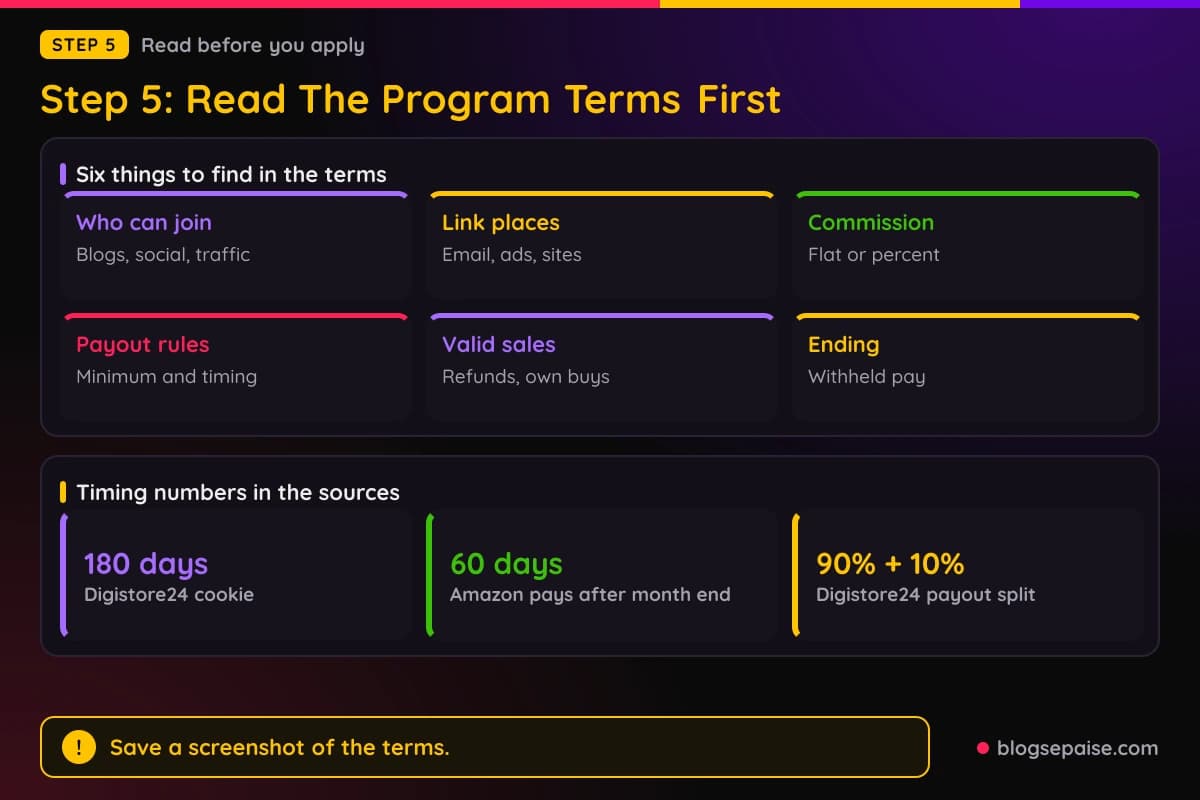
Then check the commission. Note if it is a flat amount or a percentage, and if it repeats each month or pays once.
Look at the cookie window next. A short window, such as a day, gives you less credit than a long one, such as the 180 days Digistore24 lists.
Find the payout details. Look for the minimum payout amount, the payment methods, and how long the company waits before paying.
Check what the company counts as a valid sale. Refunds, cancellations, and your own purchases may not earn a commission.
Search the terms for bidding on brand keywords. Many programs ban you from buying ads on the company's own name.
Look for rules about coupons and discount sites. Some programs pay nothing if a reader clicks your link and then uses a code from another site.
Finally, find the section on ending the deal. You want to know if the company can cancel your account and withhold unpaid commissions.
The FTC also matters. Its guidance says a material connection, such as a financial relationship with a brand, should be disclosed, and the disclosure should sit with the endorsement itself.
Put the disclosure next to your links, and do not leave it on an About page alone. Use plain words such as ad or sponsored.
If a rule is unclear, ask support and keep the answer in writing. A clear answer today beats an argument about commissions later.
Keep a short note for each program with its rules and the date you read them. That note will help you compare programs later, and it proves what you agreed to.
Save a screenshot of the terms page too. Pages change, and you may need proof of what they said on the day you joined.
Step 6: Avoid Scams And Fake Programs
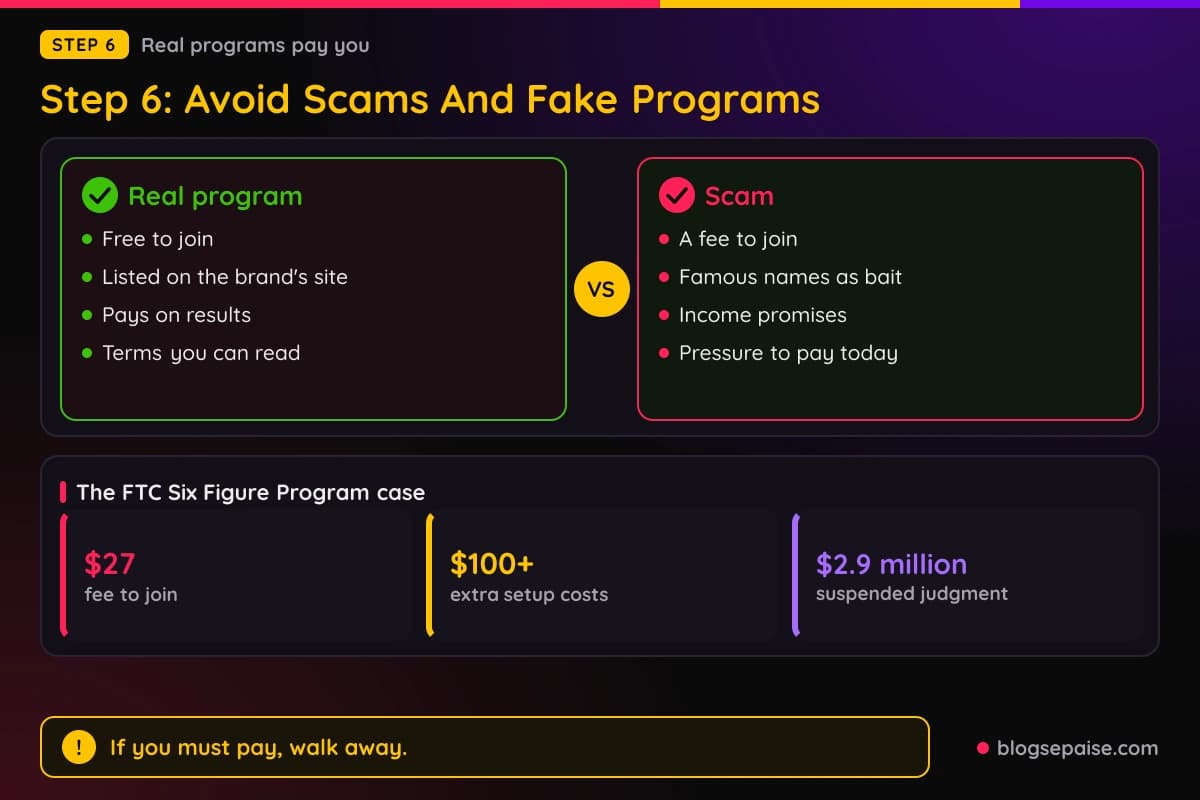
Real affiliate programs pay you. Scams ask you to pay, and that single difference catches most of them.
The first red flag is a fee to join. A real brand or network wants you to send customers, not to buy access.
The Federal Trade Commission has acted on exactly this trick. In one case, sellers charged $27 for a Six Figure Program that claimed to let buyers join affiliate programs with brands such as Prada, Sony, Louis Vuitton, and Verizon.
Buyers then had to pay $100 or more in extra costs to set up their sites. A court halted the practice, froze the sellers' assets, and placed the companies in receivership.
In March 2014, those companies settled, and a suspended judgment of more than $2.9 million was entered. The sellers are permanently barred from selling business and work-at-home opportunities.
The second red flag is a big name used as bait. A seller may claim to offer programs from famous brands, but only the brand's own site or a known network can confirm that.
Check the claim at the source. Go to the brand's real website and find its own affiliate page, or search for the brand inside the network.
The third red flag is income promises. Any pitch that promises a fixed income, fast cash, or no work should end your interest.
Watch for pressure too. Countdown timers, limited seats, and calls that demand a payment today are sales tactics, not signs of a real program.
A fourth red flag is a program that wants your sensitive data too early. A real program asks for tax details for payment, but only inside its own signup flow on its own domain.
Check the web address carefully. A look-alike address with an extra word or a different ending is a common trick.
Never send your password, your bank login, or your ID number to someone who contacted you first. Real programs do not ask for these over chat or email.
Be careful with email offers. If a message says a brand wants you as a partner, go to the brand's site yourself and confirm it.
For more warning signs, read our guide on affiliate marketing red flags. It covers the patterns that show up again and again.
Ask who gains if you pay. If the answer is the person selling access, and not a brand paying you for sales, you have your answer.
When in doubt, walk away. There are thousands of real programs, so you never need to risk a shady one.
Step 7: Build A Shortlist And Test It
By now your long list has shrunk. Turn what remains into a shortlist of five to eight programs.
Rank them with three questions. Does my reader want this, does the program pay a fair amount, and are the terms safe for how I work?
Give each program a score from one to five on each question. Add the scores and keep the top ones.
Do not apply to everything at once. Some programs approve quickly, and a few say no to new sites, so apply in small batches.
Our guide on how to get approved for affiliate programs covers the application itself. Use it for the trust pages and the application text.
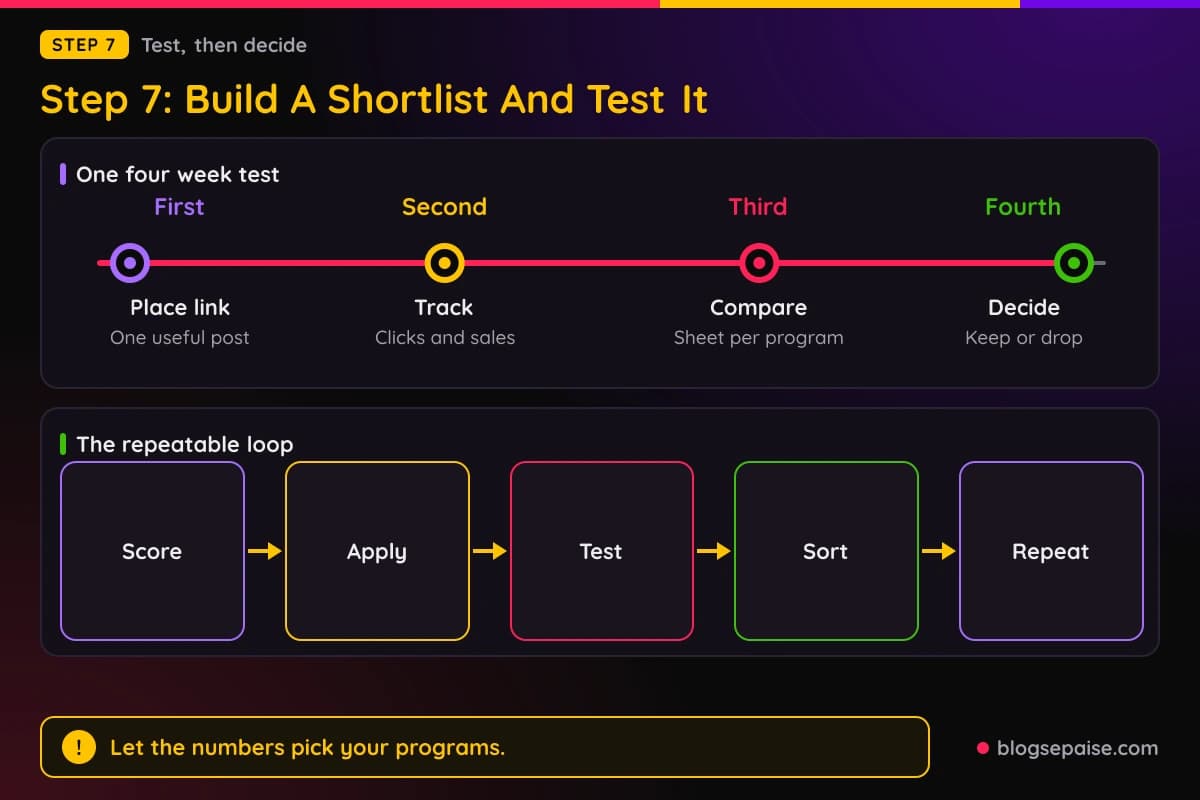
Once you are approved, start testing with real content. Pick one useful post per program and place the link where it helps the reader.
Give each test four weeks. Shorter than that, and the numbers are too small to mean anything.
Track clicks, signups or sales, and commissions for every program. A simple sheet with one row per program is enough.
Look at conversion rate, which is sales divided by clicks. A program with fewer clicks but more sales beats a program with many clicks and no sales.
After four weeks, sort the sheet by commission earned. Keep the winners, improve the middle, and drop the programs that did nothing.
Then add new programs from your long list and repeat. That loop is the repeatable method.
Over time you build a small group of programs that fit your site. That group will earn more than a long list of links nobody clicks.
Review the group every few months. Programs change their rates and terms, and a program that once paid well may no longer fit.
Write one lesson from each test in a short note. Writing it down makes the next round faster.
Remove dead links when a program closes. A link to a closed program looks careless and earns nothing.
A Worked Example: Maya Finds Programs For Her Home Office Blog
Maya runs a small blog about home office setups. The numbers below are made up to show the method, and they are not real results.
She starts with Step 1 and writes down 30 companies she already uses or would recommend. They include a standing desk seller, a chair brand, a few software tools, an online course site, and some shops.
In Step 2 she runs the three quick checks on all 30. Search, footer, and support turn up 18 brands with a program and 12 with none.
For Step 3 and Step 4 she searches the networks and marketplaces for the 12 brands that came up empty and for similar ones. That adds a handful of names, but she keeps her list tight and moves on.
She reads the terms for the 18 brands in Step 5. Eight have rules she cannot follow, such as a ban on blog content or a minimum traffic level she does not meet, so 10 remain.
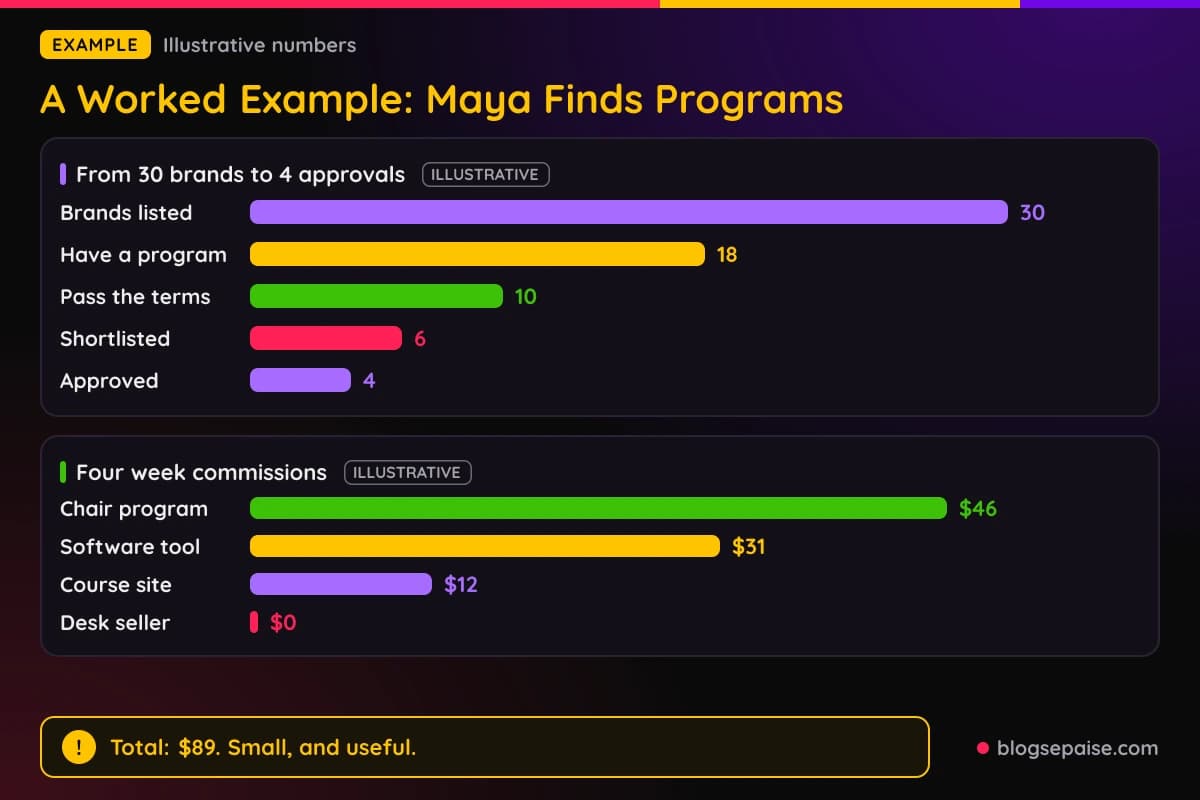
In Step 6 she confirms each of the 10 on its real site or inside a network. All 10 are free to join, and she deletes two email offers that asked for a fee.
Her shortlist in Step 7 has 6 programs after she scores them. She applies in two small batches, and 4 approve her.
She writes one helpful post for each approved program and tests for four weeks. She tracks clicks, sales, and commissions in a simple sheet.
After four weeks the made-up results come in. The chair program earns $46, the software tool earns $31, the course site earns $12, and the desk seller earns $0.
The total is $89, which is small, and that is normal for a first test. The win is that she now knows where to focus.
She drops the desk seller and improves the course post. Then she adds two new programs from her long list and starts another four weeks.
Notice what she did not do. She did not buy a list of programs, and she did not pay anyone to get access.
She also did not apply everywhere at once. A small batch and a clear test gave her useful answers.
Maya also saves a screenshot of each terms page. That way she can show what she agreed to if a rule changes later.
Your numbers will differ, because niche, traffic, and content change everything. The steps stay the same.
Common Mistakes When Looking For Companies With Affiliate Programs
The first mistake is trusting old lists. A list of programs from a few years ago may include closed programs and networks that no longer exist, such as ShareASale as a separate network.
Always confirm on the brand's own site or inside the network that the program is open today.
The second mistake is chasing the highest percentage. A big commission on a product readers do not want earns less than a small commission on a product they buy.
The third mistake is skipping the terms. Many people click apply and find out later that their way of promoting was never allowed.
The fourth mistake is paying to join. A real program does not charge you, so a fee is the strongest sign that something is wrong.
The fifth mistake is applying to dozens of programs with a thin site. Rejections pile up and waste time, so build content first.
The sixth mistake is promoting products you have never looked at. Readers can tell, and a bad product can cost you trust that took months to build.
The seventh mistake is forgetting to disclose. Put a clear note near your links, because the FTC expects readers to know about the financial relationship.
The last mistake is never testing. Without numbers, you will keep promoting programs that look good on paper and earn nothing.
Final Thoughts
So, which companies allow affiliate marketing? Thousands do, and you can find them with a simple method: list the brands you know, run the three quick checks, search the networks and marketplaces, read the terms, avoid scams, and test.
No list can replace that loop, because programs open, close, and change all the time. The method keeps working when the lists go stale.
Start today with a list of 20 to 30 brands from your own life. Check five of them before the day ends.
Then keep going at a steady pace, and let your four week tests decide which programs stay. If you want a bigger picture of the networks, read our guide on affiliate marketing platforms and pick your next one to try.
Frequently Asked Questions
1. Which companies allow affiliate marketing?
Thousands of companies do, mostly in software, hosting, retail, travel, finance, and online courses. Check each brand with a search, the website footer, or its support team.
2. How do I find companies with affiliate programs?
Search the brand name plus affiliate program, look for Affiliates, Partners, or Referral in the footer, and browse networks such as Awin, Impact, CJ Affiliate, and Rakuten Advertising.
3. Do I have to pay to join an affiliate program?
No, joining should be free. Awin, CJ, Rakuten, Impact, PartnerStack, ClickBank, and Digistore24 list no publisher fee, and a request for payment is a red flag.
4. Is ShareASale still a separate network?
No. Awin says all active ShareASale customers were moved to its platform by August 15, 2025, and shareasale.com now redirects to Awin.
5. Which network has the most brands?
Awin says you can partner with 30,000+ brands, and PartnerStack says it has 600+ B2B brands. Impact, CJ, and Rakuten list no brand count for publishers, so no fair ranking is possible.
6. Can I join Amazon Associates with a new site?
Anyone with a qualifying website or mobile app can apply, and Amazon reviews each application. Amazon lists no joining fee and says commissions go up to 10% depending on category.
7. How do I know a program is real?
Find it on the brand's own website or inside a known network. Real programs are free to join and never promise a fixed income.
8. How long is a cookie window?
A cookie window is the time after a click during which a purchase still counts for you. Digistore24, for example, lists a 180 day cookie window.
9. How long should I test a program?
Give each program about four weeks with one useful post. Track clicks, sales, and commissions, and keep only the programs that earn.
10. Can a company say no after I join a network?
Yes. You apply to the network first and then to each brand, and every brand can approve or decline you.