7 Red Flags In Affiliate Marketing That Waste Your Money
Affiliate marketing is a real way to earn money online, and plenty of honest programs exist. The trouble is that the same space also attracts offers that take your money instead of paying you.
Below are seven red flags. Each one comes from guidance the Federal Trade Commission (FTC) publishes about job scams, pyramid schemes, and multi-level marketing.
Read them in order and check any program you are thinking about against the list. If you are still learning the basics, start with how affiliate marketing works.
You can also check if affiliate marketing is a pyramid scheme, since that question sits close to several flags below.
Disclosure: Some of the links I share might be affiliate links. If you click on one and make a purchase, I may earn a small commission as a thank you. But don’t worry, it won’t cost you anything extra. I only recommend stuff I genuinely believe in. Your support helps me keep creating awesome content. You can read my full affiliate disclosure in my disclaimer page.
If you want to save a lot of hours searching for high-paying affiliate programs, check out our exclusive list of 2500+ affiliate programs. You’ll find all the information about the programs inside the list. This list is perfect for affiliate bloggers and influencers.
The Short Answer
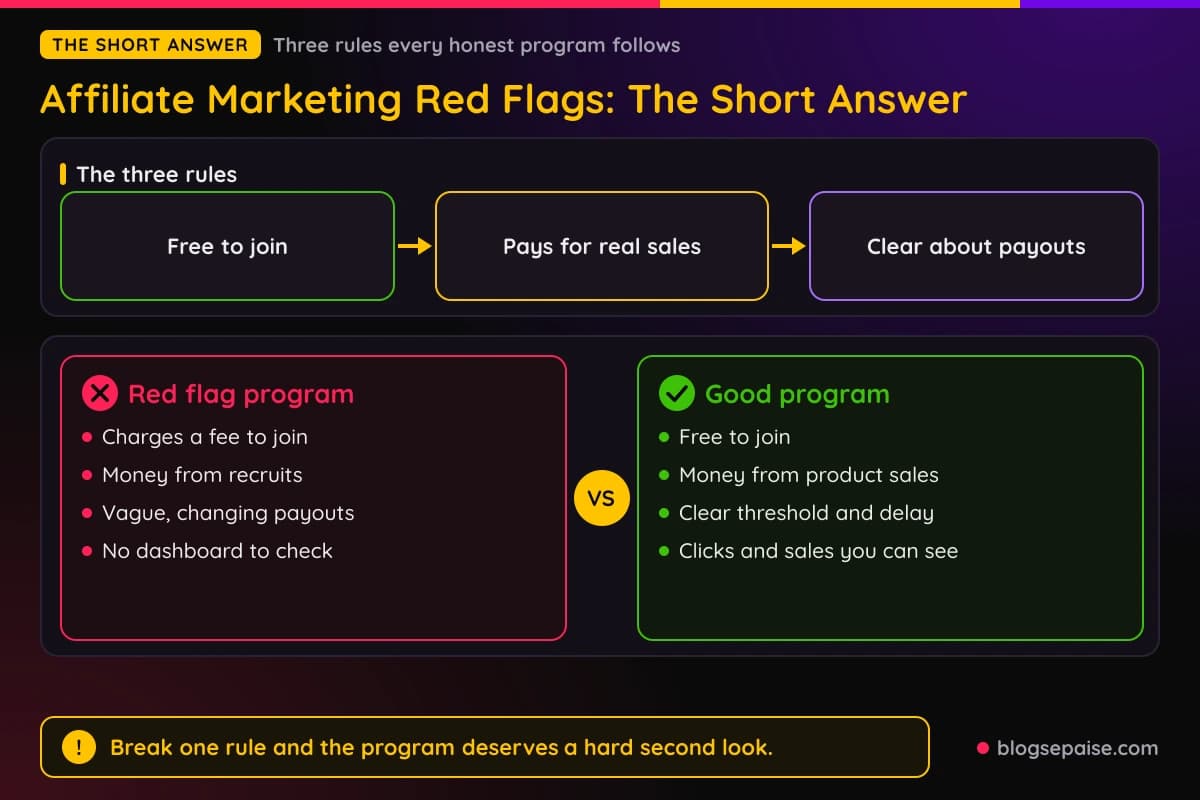
An honest program pays you for sales to real customers, and it does not charge you for the chance to earn. The FTC says a legitimate multi-level marketing business pays you based on your sales to retail customers.
Most of the red flags below describe the opposite: asking you to pay first, promising huge income, or paying mainly for recruiting. Each one is a reason to slow down and look closer.
The FTC also says a lack of complaints does not prove a company is legitimate. So a clean search is a start, not a green light.
A simple rule helps here. If a program breaks one of these rules, keep your money in your pocket until you get clear answers in writing.
Keep in mind that the FTC wrote these warnings about job scams and multi-level marketing in general. They apply to affiliate offers because those offers often use the same tactics.
The sections below take the flags one at a time. After them you will find how disclosure works, plus what to do if you already paid.
Red Flag 1: You Are Asked To Pay For The Chance To Earn
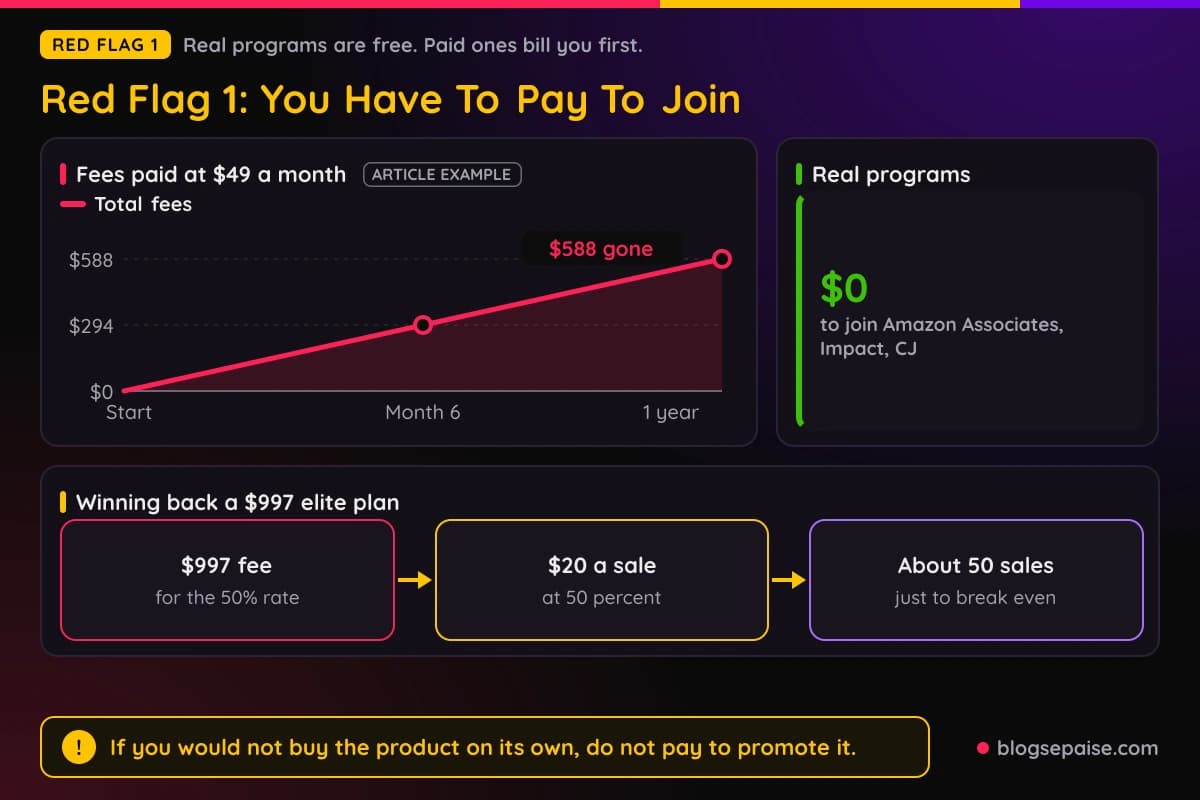
The FTC job scam advice has one core rule: do not pay for the promise of a job. It says honest employers do not charge you to get hired.
Affiliate offers can follow the same pattern with a different label. You might see a starter kit, a certification, or a paid training pack that you must buy first.
The FTC lists starter kits, training, and certifications that cost money and turn out to be useless as a warning sign. Treat any fee to join as a reason to ask what you actually get.
The FTC also says to understand all costs before you commit, including training, travel, and required purchases. Write the total down before you pay anything.
There is a fair exception. Some brands accept only affiliates who already use the product, and that can be fine when you would buy the tool anyway.
The test is simple. If you would not pay for the product without the affiliate program attached, do not pay for it just to earn commissions.
Red Flag 2: Huge Earnings Promises
The FTC says promoters of pyramid schemes make extravagant promises about earnings, and that those promises are false. Its job scam page says claims of thousands of dollars a month for little time or effort are almost certainly a scam.
A screenshot of big earnings is the usual way these promises show up. A screenshot cannot tell you what the person spent, how long it took, or if the number was typical.
The FTC suggests asking current and past participants for specifics. It lists income after expenses, borrowing, and the share of income that comes from outside sales as the details to ask about.
It also says to have an independent accountant, lawyer, or advisor check if the company can back up its earnings claims.
Be careful with the word guaranteed too. The FTC treats quick, large earnings for minimal work as almost certainly a scam.
For a realistic view of how income builds, read the truth about passive income in affiliate marketing.
Red Flag 3: Recruiting Pays More Than Selling
The FTC says that under a pyramid scheme, your income depends mainly on recruiting, not on selling. A legitimate multi-level marketing business pays you based on your sales to retail customers.
The pitch can sound a lot like affiliate marketing. You hear words like commissions and your own business, but the product is hard to find in the conversation.
The FTC names the slogan find two people who find two people as a hallmark of a pyramid scheme. It also says promoters who present recruiting as the real way to make money are a warning sign.
Ask who the buyers are. The FTC suggests asking what share of income comes from outside sales versus recruiting.
Walmart shows how a mainstream program treats this. Its affiliate terms list pyramid or Ponzi style schemes as objectionable content for sites in the program.
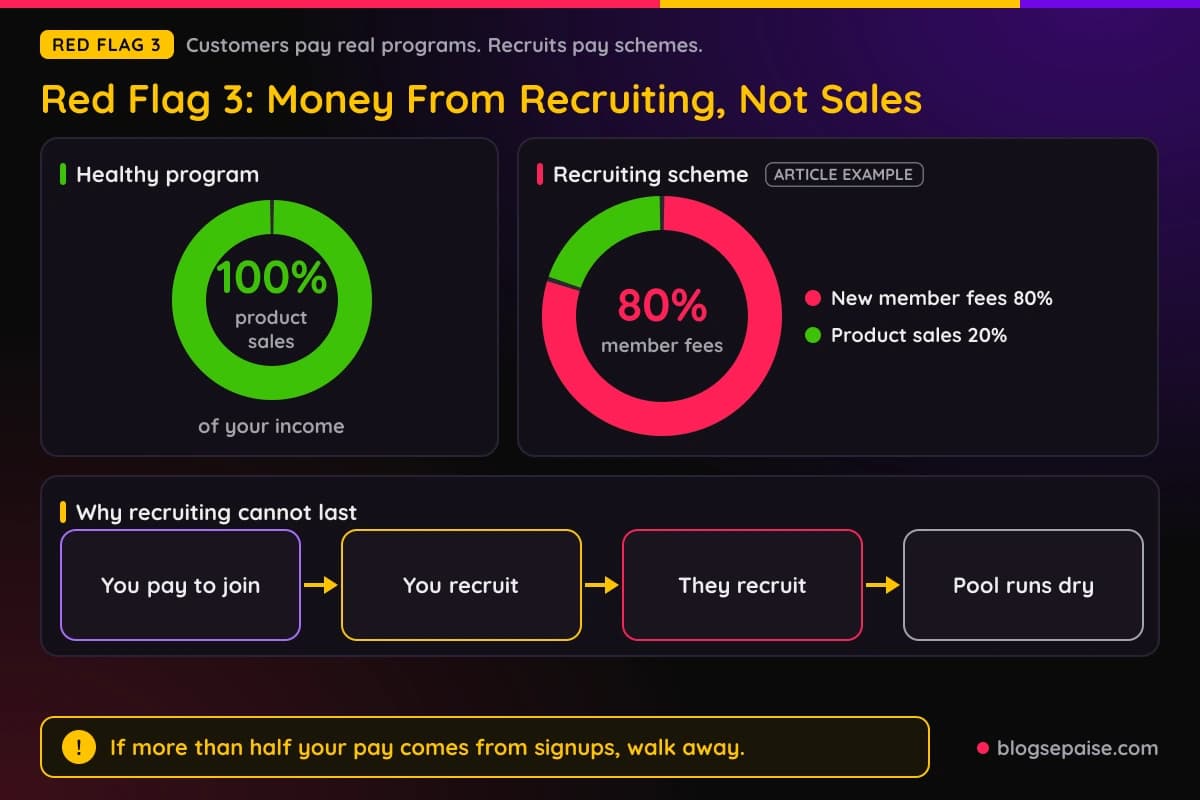
Most people in legitimate multi-level marketing make little or no money, according to the FTC, and some lose money. So even a legal program deserves a close look at what most participants earn.
Red Flag 4: High Pressure To Act Now
The FTC lists high-pressure tactics as a warning sign. Examples it gives include claiming you will miss out if you do not act now.
Countdown timers and only a few spots left are the online versions of that claim. A real opportunity will still be there after you read the terms.
The FTC also says promoters sometimes discourage you from studying the company. If someone gets annoyed when you ask for written details, that tells you plenty.
Give yourself time to research before paying. The FTC recommends checking reviews, complaints, and news coverage, and contacting your state attorney general.
Take screenshots of the offer and the terms the day you see them. If anything changes later, you will have a record.
Red Flag 5: You Must Keep Buying To Stay Qualified
The FTC says participants in multi-level marketing often must keep buying inventory, pay repeated fees for training or materials, and meet purchase goals to earn rewards. Few participants qualify for those rewards.
In affiliate marketing the version is a program that requires a monthly purchase or an upgrade to keep your account active. The money you spend then keeps flowing to the program instead of from customers to you.
The FTC warns about buying more product than you can use or resell just to stay active or qualify for bonuses. Its advice is to keep your money in that case.
Ask if optional purchases affect your eligibility for bonuses. The FTC lists that as a question to settle before you join.
The FTC also advises avoiding borrowing or using credit cards to fund the business, since interest charges can add up.
Red Flag 6: No Clear Costs Or Written Refund Terms
The FTC tells people to get the refund policy in writing, including the terms for returning unused products. If a seller will not put it in writing, treat that as a red flag.
Costs should be clear too. The FTC suggests listing training, travel, and any required purchases before you decide.
Reading payout terms matters just as much for free programs. Walmart states that commissions exclude returns, refunds, and cancellations, and that payment comes about 90 days after the end of each calendar month.
Walmart also says commissions are subject to a 60-day locking period, and returns during that period come off your next payment. Amazon says it may hold unpaid commission after termination to account for cancellations or returns.
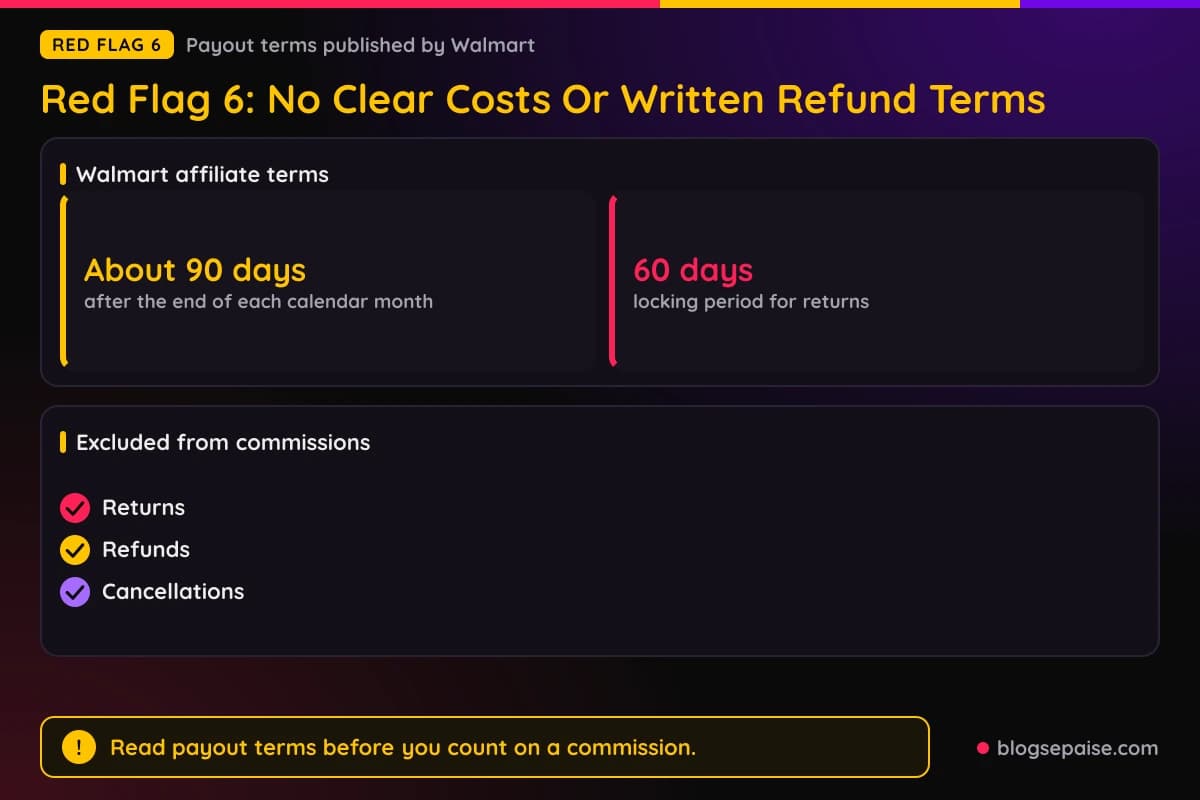
None of that makes either program a red flag. It shows why you should read payout terms before you count on any commission.
Our guide to reading affiliate program terms walks through the sections to check.
Red Flag 7: You Cannot Find Independent Information
The FTC recommends searching for reviews, complaints, and news coverage about any company before you join. It also says to check with your state attorney general.
If every result comes from the promoter, you have learned very little. Look for sources the company does not control.
Remember the FTC point that a lack of complaints does not prove legitimacy. A new company can look clean simply because it is new.
Ask for names of people you can contact. The FTC suggests talking to current and past participants about what they actually earned after expenses.
If you plan to promote a program, also read how to avoid getting banned from affiliate programs. Many bans come from rules buried in the terms.
How Disclosure Works In Honest Programs
Honest programs ask you to tell readers about the relationship. Amazon requires the statement As an Amazon Associate I earn from qualifying purchases, or a similar statement it previously allowed.
Walmart requires you to follow FTC endorsement rules and to place an advertising disclosure next to qualifying links. It also tells affiliates to label paid endorsements with the words paid link or a Walmart partner hashtag.
The FTC says to put the disclosure near the recommendation where it is hard to miss. It also says vague labels like affiliate link or buy now do not clearly signal payment, while paid link beside the link is adequate.
A program that asks you to hide the relationship is the opposite of these. Treat that as one more red flag.
Our guides on legal disclosures and the affiliate disclosure generator help you add clear wording.
If You Already Paid Or Joined
Stopping the losses comes first. Cancel any recurring charge and keep records of what you paid and what you were promised.
The FTC says to contact the company you used to send the money right away if you paid a scammer. It also says to report the fraud at ReportFraud.ftc.gov.
Keep screenshots of the offer, your receipts, and any messages. Those records help when you ask for a refund or file a report.
Then move your links to a program that passes the checks above, and write down which flag you missed so the next check is sharper.
Final Thoughts
Most red flags come down to one idea. Money should move from customers to the brand and then to you, never from you to the program.
Be wary of fees to join, huge earnings promises, recruiting pay, pressure to act now, required purchases, unclear refund terms, and a missing track record. Each flag comes straight from FTC warnings.
Before you join anything, read the terms, look for outside information, and keep copies of what you agreed to. Those three habits catch most of the problems described here.
Frequently Asked Questions
1. Do honest affiliate programs charge a fee to join?
The FTC says honest employers do not charge you to get hired, and it lists paid starter kits and certifications as scam signs.
2. How can I tell if a program is a pyramid scheme?
The FTC says your income under a pyramid scheme depends mainly on recruiting, not selling. A legitimate multi-level marketing business pays based on sales to retail customers.
3. Are all paid affiliate courses scams?
The FTC does not say that. Its advice is to understand all costs, get the refund policy in writing, and be skeptical of training that makes earnings claims.
4. Where do I report a scam?
The FTC says to report fraud at ReportFraud.ftc.gov. It also says to contact the company you used to send the money.
5. Is a long payout delay a red flag?
Not by itself. Walmart states a payment delay of about 90 days after each month ends, and it is still a large public program, so read the terms and plan around them.
6. Do I need to disclose affiliate links?
Yes. The FTC says to disclose the relationship clearly near the recommendation, and both Amazon and Walmart require disclosure in their terms.