What Affiliate Networks Look For: Traffic and Page Rules Before You Apply
A common frustration for new affiliates is a short email saying an application was not approved. You find a program that looks perfect, you fill in the form, and the email arrives without a reason.
So you guess, apply somewhere else, and start to wonder if affiliate marketing is closed to people without a big audience.
Programs set their own rules, and a missing privacy page, a thin site, or a form that says nothing useful about your visitors are gaps you can fix.
In this guide you will follow eight steps in order. You will learn the types of programs you will meet, the rules programs publish, the pages every site should have, how content counts, how traffic rules work, how to check current terms, how to write the application, and how to handle a no.
Networks change their rules, so check the current terms page of each program before you apply.
If your site is brand new, read our guide on how to get traffic to a brand new affiliate site alongside this one. For a ranked starting point on programs themselves, see our page on high quality affiliate programs.
Disclosure: Some of the links I share might be affiliate links. If you click on one and make a purchase, I may earn a small commission as a thank you. But don’t worry, it won’t cost you anything extra. I only recommend stuff I genuinely believe in. Your support helps me keep creating awesome content. You can read my full affiliate disclosure in my disclaimer page.
If you want to save a lot of hours searching for high-paying affiliate programs, check out our exclusive list of 2500+ affiliate programs. You’ll find all the information about the programs inside the list. This list is perfect for affiliate bloggers and influencers.
Why Programs Say No To New Sites
An affiliate program is a business that pays other people to send it customers. Before it hands over a tracking link, it wants some proof that you are a real publisher.
Programs also have to protect themselves. Amazon's Operating Agreement, for example, lets Amazon end your participation if the program is used for deceptive, fraudulent, or illegal activity.
Your job is to look finished, original, and trustworthy, and you do not need to be big to do that.
A disclosure and clear legal pages show a program that you plan to play by the rules.
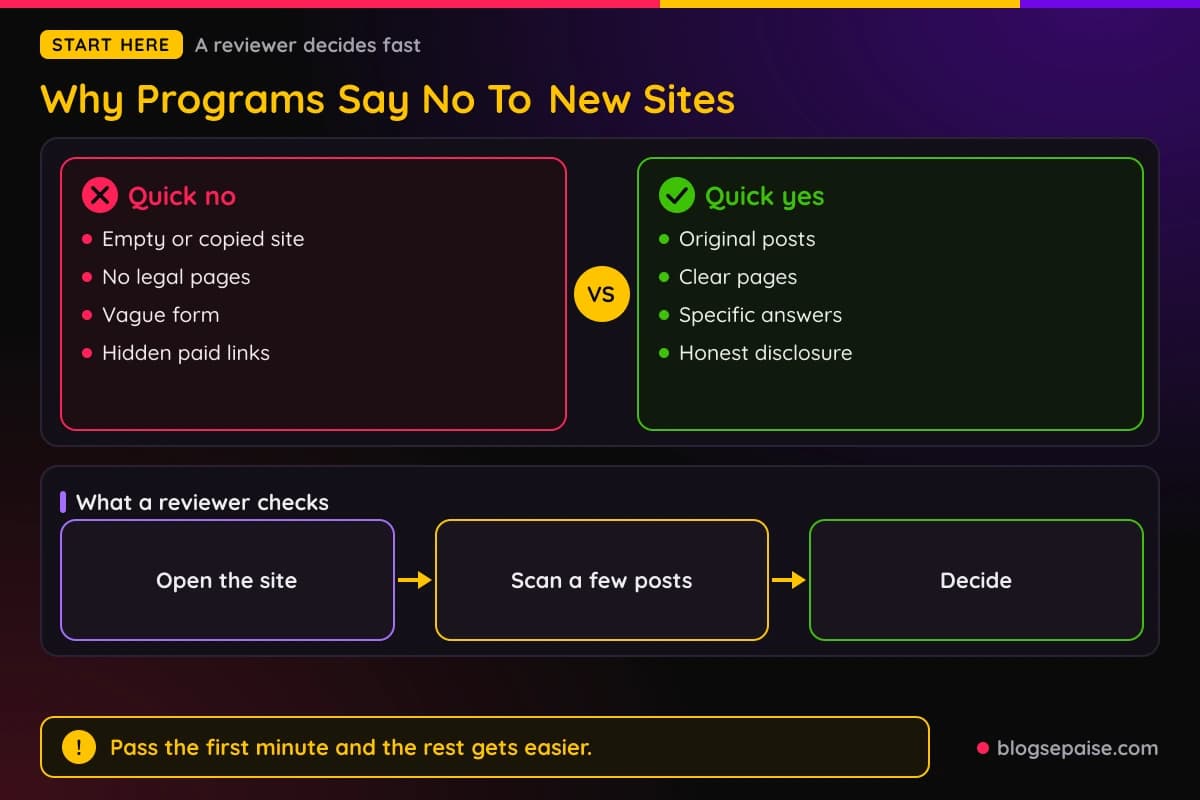
Treat each application as a quality check you can prepare for.
Step 1: Learn The Types Of Programs You Will Meet
Not all affiliate programs work the same way. Sort them into types, because each type can ask for different things.
The first type is the marketplace network. These sit between many brands and many publishers, and one account lets you apply to many brands.
Marketplaces can use two checks, a network check and then a brand check. PartnerStack and impact.com both work this way, as the section on real networks below shows.
The second type is the niche or industry network. These focus on one field, such as software, finance, or travel.
A focused site is easier to match to a niche network than a general one.
The third type is the in house program. A company runs its own affiliate page and manages applications itself, or uses a hosted tool that tracks the links.
Each in house program sets its own rules, so read them one by one.
The fourth type is the software partner program. Many software companies pay when someone you refer subscribes, so read the commission terms closely.
If a form asks how you plan to promote, answer with the kinds of posts you will write.
A fifth group is the invite only or high touch program. These may accept only publishers that the company chooses to invite or approve by hand.
You can often tell the type from the application page. A form that lists many brands points to a marketplace, and a form that names one product points to an in house or software program.
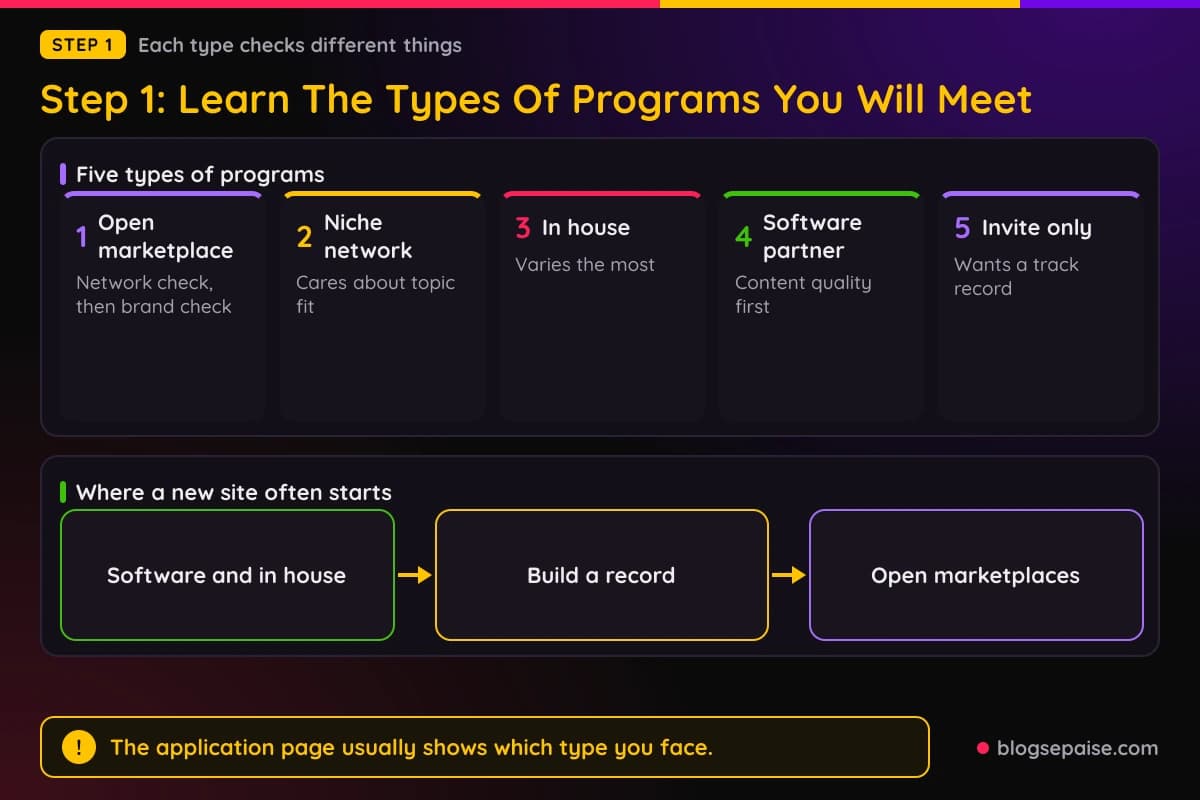
Knowing the type helps you decide where to apply first.
Stricter does not mean better. A relaxed program can pay just as well, and for a new site it can be the easier first win.
Step 2: Learn The Rules Programs Publish
Programs differ, but the rules you will meet tend to fall into a few groups. If you learn the groups, you can read a new application page quickly.
The first group is site age. Some programs may ask how long your site has been live, so look for that line on the page.
The second group is content. Look for any rule about how much you have published and how recently.
The third group is traffic. Some programs may state a monthly visitor level and others may not, so read the real terms.
Traffic is one check among several, and a program's own page tells you which ones it uses.
The fourth group is geography. A program may care where your visitors live, or limit the countries it pays in, so read the region line.
The fifth group is legal and disclosure pages. Amazon's Operating Agreement, for example, requires the line saying you earn from qualifying purchases.
The sixth group is banned traffic and banned methods. Each program sets its own list, so read it before you promote.
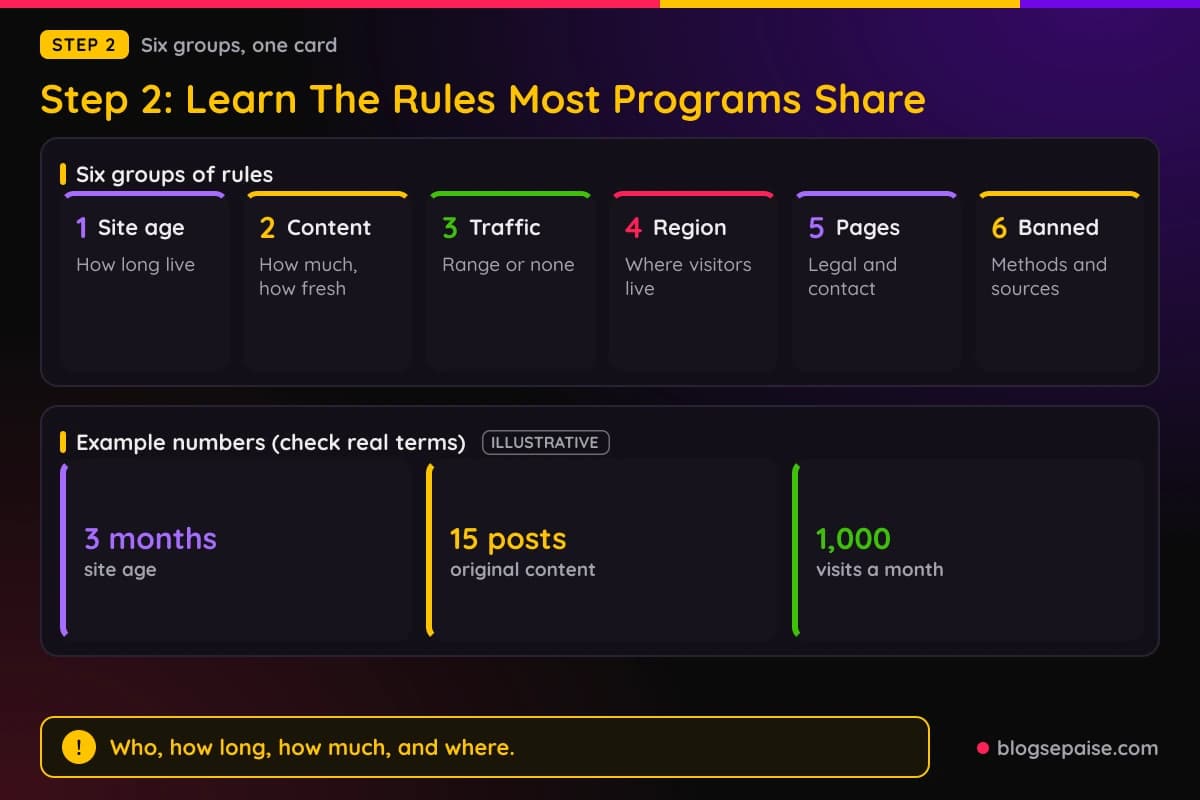
Write these six groups on a card. Every time you open a new program page, look for each one.
Click through your own site the way a visitor would, and fix any broken link, empty page, or blank section you find.
Step 3: Get Your Pages In Order
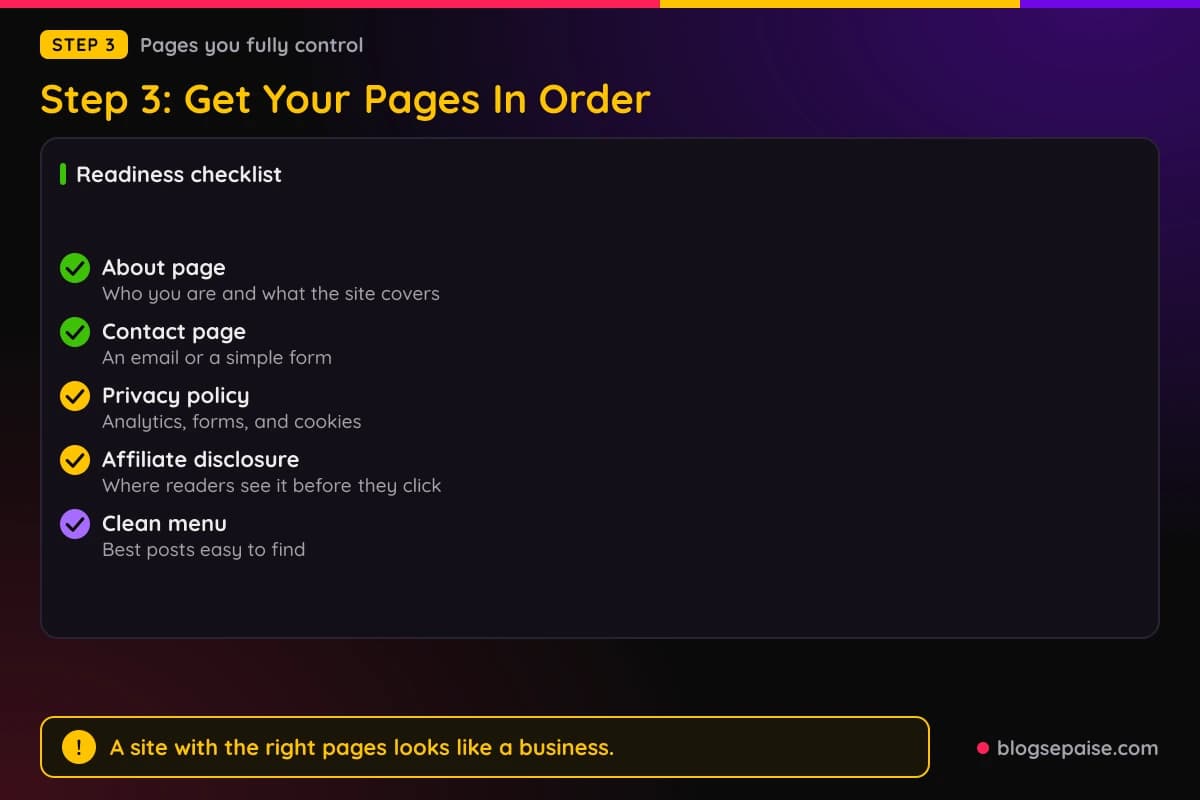
Pages are the cheapest way to pass a review, because you control all of them. A site with the right pages in place looks like a business, even when it is small.
Start with an About page. Say who you are, what the site covers, and why you write about it, in plain words and with a real name or a clear site name.
Add a Contact page next. A simple email address or a basic form shows a real person stands behind the site.
Then add a privacy policy. If your site uses analytics, email forms, or cookies, the policy should say so.
Write an affiliate disclosure and show it where readers will see it. The US Federal Trade Commission says a disclosure should sit with the endorsement where it is hard to miss, so a note near the top of each post is the safest habit.
For a full walk through of what to say and where to put it, read our guide to legal disclosures. It covers the wording that keeps both you and your readers on the right side of the rules.
You may also want a terms page and a simple cookie notice.
Next, check the basics of how the site looks. It should load, it should work on a phone, and it should not be buried in pop-ups or banner ads that push the content down.
Use a clean menu that links to your main sections so a reader can find your best posts quickly.
Finally, use a custom domain and a branded email address if you can, since they make the site look more settled.
Step 4: Build Enough Real Content
Content is how a reviewer sees what your site is about. Programs want to see that you have something worth reading, and that it is yours.
Start by counting your useful posts. Skip placeholders, empty categories, and copied text, since those hurt more than they help.
A good beginner aim is a small group of strong posts on one clear topic. A focused site is easier to judge than one that covers everything.
Make the posts original. Write in your own words, add your own examples, and avoid pasting text from the brand or from other sites.
Mix the types of posts you publish. A few how to guides, a couple of comparisons, and one or two honest reviews show range and give the reviewer a feel for your voice.
Show recent activity as well. A site that posted last week looks more alive than one that went quiet a year ago.
Add images that help the reader, such as simple charts or screenshots you made yourself.
Do not stuff the posts with links. If every other sentence points to a product, the site can look like it exists only to sell.
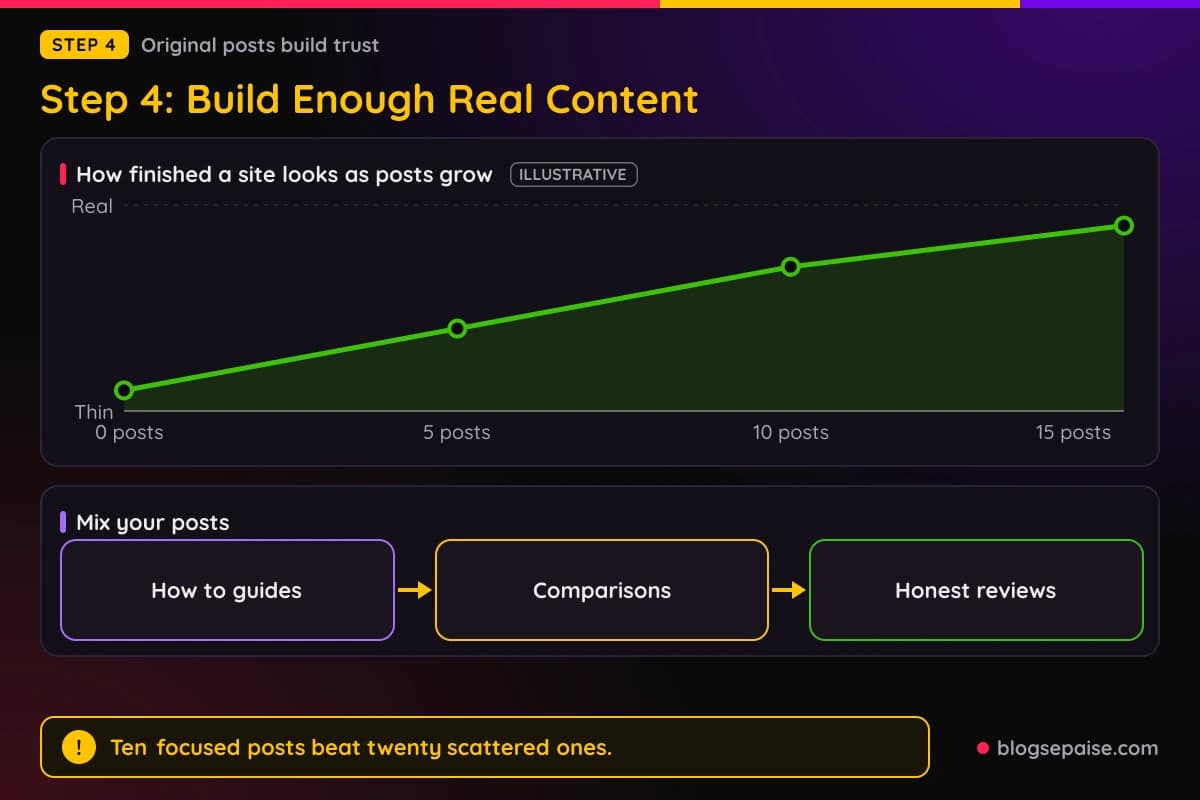
A useful check is to read your own site as a stranger. Ask if you would trust it, and publish more helpful posts before you apply if the answer is a hesitant maybe.
If you are still shaping the first weeks of your site, our plan for the first 30 days of affiliate marketing shows what to publish and in what order.
Keep your own traffic data in one place. Free analytics tools can show visits by source and country, and they give you honest numbers to quote on a form.
If you have no data yet, say that plainly.
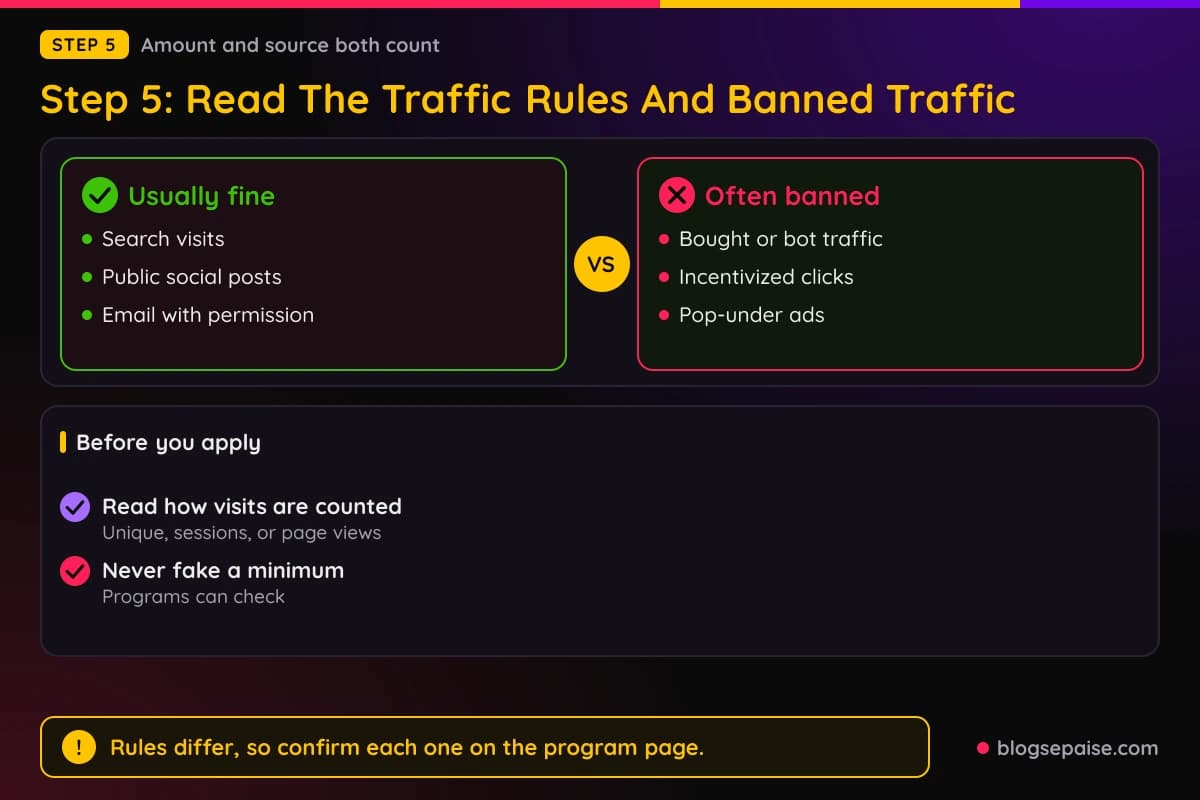
Step 5: Read The Traffic Rules And Banned Traffic
Traffic rules can come in two forms. One is a minimum amount, and the other is a list of sources the program will not accept.
Start with the amount. If a program states a minimum, the terms should say how it is counted, so read the exact wording.
Check if the program counts unique visitors, sessions, or page views, and if it looks at your site alone or at all your platforms.
If you fall short of a stated minimum, do not try to fake it. Programs can set rules against bought traffic, so an honest small number is the safer choice.
Now the source rules. A program's terms may list sources it does not allow, so read that list.
Sources worth checking against each program's list include bought or bot traffic, pop-under or forced redirect ads, paid search traffic, and the program's brand name used as a keyword.
Incentivized traffic is another rule to look for. Amazon's Operating Agreement, for example, bans incentivized reviews.
Programs may ask you to name the social accounts you plan to use. Be honest about those, and keep the accounts public and active.
If you plan to email links, check the program's email rules. Say that your list is built from people who signed up on their own.
When a rule is unclear, write to the program and ask. A short, polite question before you apply costs nothing.
Check how long approval is said to take. Awin's help pages say applications are typically processed within 24 hours, and impact.com says most partners are approved within 24 to 48 hours, so the time depends on the network.
Look at the payment rules as well. A high payout threshold or a long wait can matter to a small site, so know them before you invest time.
Five Real Networks And What They Publish
Here is what a few well known networks say in public, as of the time of writing. Treat it as a snapshot, because every one of these pages can change.
Awin has a self serve sign up. Its help article on joining as a publisher says you complete the sign up wizard, pick your primary region and promotion types, and enter the web address of the site you plan to promote from.
You also write a short description of the space, choose sectors, and accept the terms before you can submit. You can read about the network on the Awin publisher page, and a message confirms the status of your application once you join.
Impact.com sends new partners through a sign up checklist. Its help center says you add a property such as a website, verify ownership, and then select Next to submit the checklist for marketplace approval.
Impact also says it is mandatory to have at least one verified media property before you can submit a marketplace or direct application. While your marketplace application is pending, the dashboard shows the status as In Review.
Amazon Associates is different, because its rules live in the Operating Agreement. That agreement requires you to state that you earn from qualifying purchases, and it cites the prohibition of customer reviews created in exchange for compensation.
It also lets Amazon end your participation if the program is used for deceptive, fraudulent, or illegal activity. Read the agreement and the program policies yourself for the site and traffic rules.
Rakuten Advertising asks for site details when you sign up. A third party copy of Rakuten's FAQ says the form asks for your web address, when the site was established, monthly visitors and page views, and a short description of your business.
That FAQ lists no minimum number, so do not assume one exists. Check Rakuten's own sign up page for the current form.
PartnerStack works in two steps, according to its support articles. You first apply to the PartnerStack Network from the Discover partnerships tab, and after review you can apply to programs in its Marketplace.
Each company approves its own applications, so approval times vary by company. While an application is pending you can check its status in your Application tab and message the company.
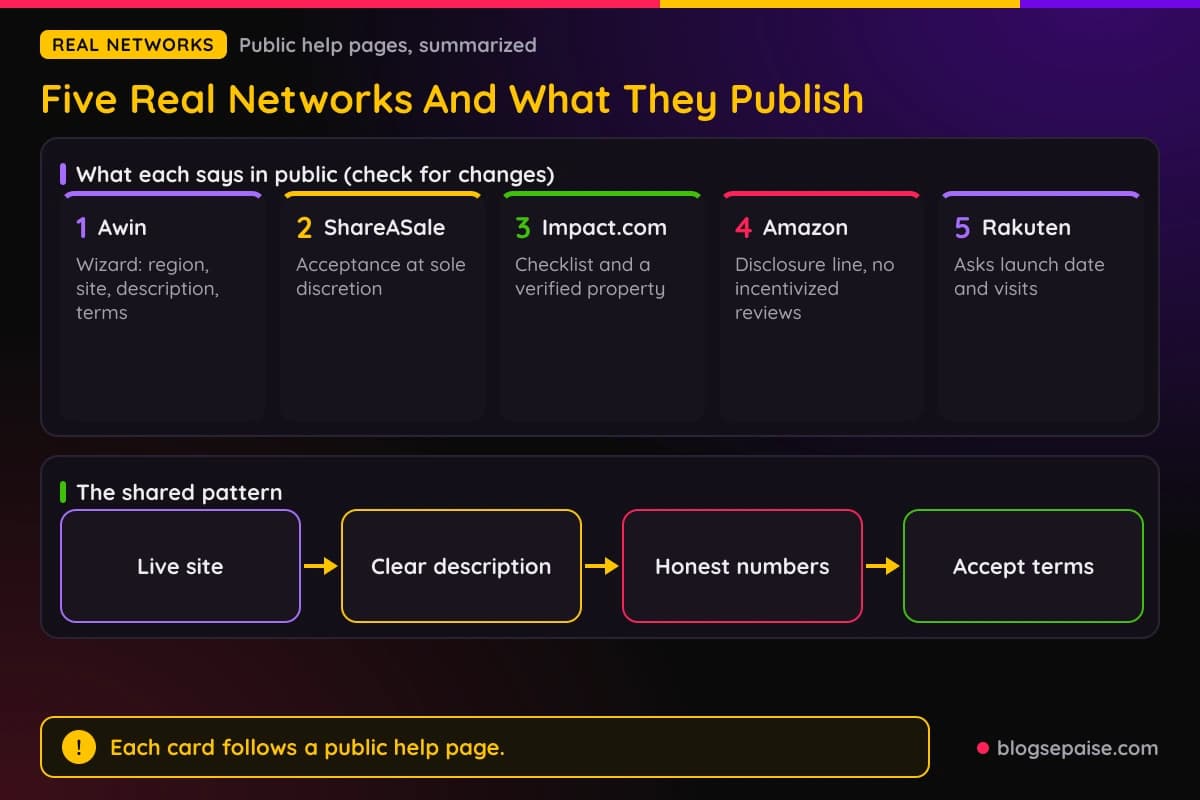
Notice the pattern. These networks ask for a site or property, a description, and agreement to the terms, and each decides who it accepts.
Step 6: Check Each Program's Current Terms
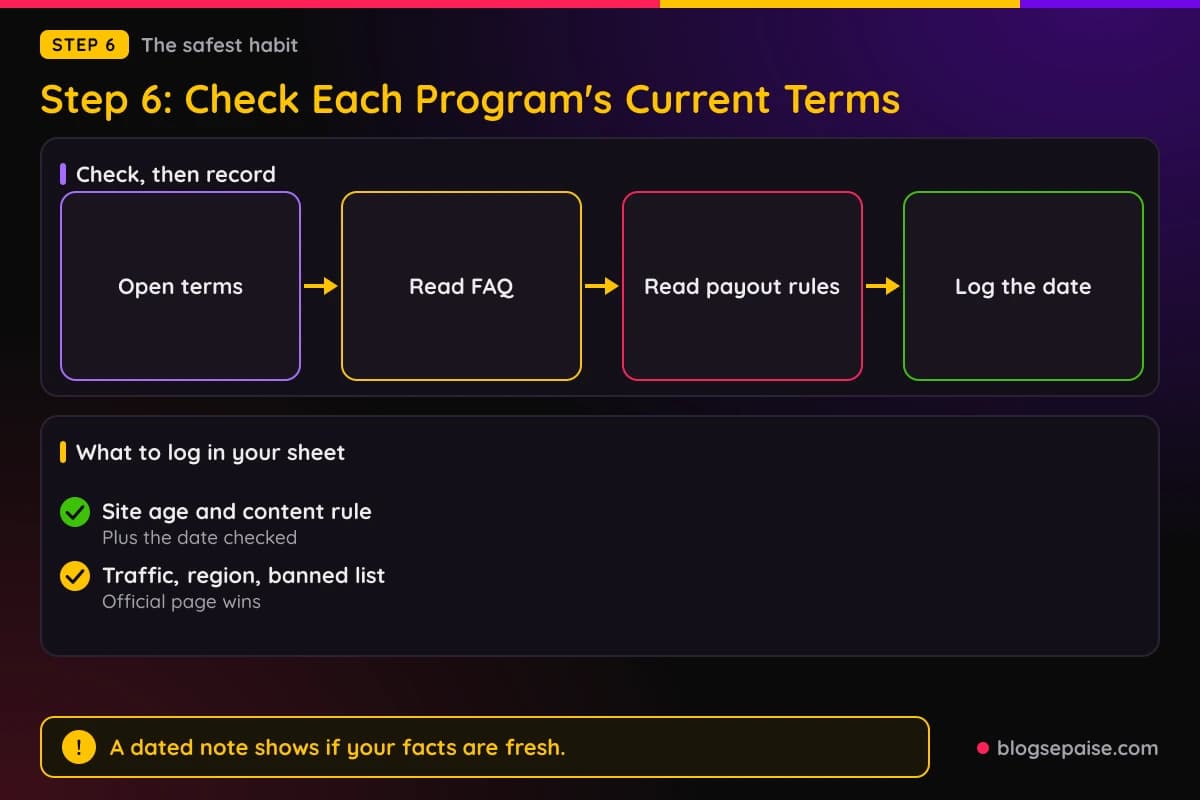
Checking terms is the step that keeps you safe. Because rules change, the only reliable source is the program's own page, read on the day you apply.
Look for the publisher or affiliate terms and conditions, which spell out who may join and what is banned. The sign up page is a good place to start looking.
Next look for a FAQ or help page for publishers, since programs may list their approval rules there.
Read the commission terms at the same time. Check the cookie length, the payout threshold, and when a sale counts, because those details shape how much a small site can earn.
Record what you find in a simple sheet. List the program, the date you checked, the site age rule, the content rule, the traffic rule, the region rule, and the banned list.
The date matters most. A note that says terms checked on a given day tells you later if your information is fresh or stale.
Be careful with third party lists. Blog posts, videos, and forum threads that quote minimums can be out of date, so use them only as a hint of what to look for and confirm on the official page.
Use them only as a hint of what to look for, and then confirm on the official page. If the official page and a blog disagree, the official page wins.
If you cannot find the rules, treat that as a signal too. Our guide to affiliate marketing red flags explains why hidden terms and vague payouts deserve a closer look.
Do this check for every program on your shortlist. It saves time you would spend applying where you were never going to qualify.
Think of the form as a short interview. You are answering the questions a manager would ask over coffee, and you want the answers to sound like a real person.
Read your answers out loud before you send them. If a sentence sounds stiff or empty, rewrite it in plain words.
Save a copy of every application you send. You can reuse the strong parts next time, and you will remember what you promised.
Step 7: Write The Application
Forms have a few fields where you can show who you are. Treat those fields as your pitch.
Start with the basics. Use your real name or business name, a working email, and the exact web address of the site, and double check the spelling.
Then comes the question about your promotion methods. Answer with specifics, such as the kinds of posts you write, the topics you cover, and the places your readers find you.
Say who your audience is in a sentence or two. A line like readers who are choosing their first email tool tells the reviewer that you know your people.
Mention your traffic honestly. If you are new, say so, and add what you are doing to grow, since a small and honest number beats a vague boast.
Link to two or three of your best posts rather than your homepage alone. Doing so gives the reviewer a short path to your strongest work.
Explain how you will use the product. Say that you will write honest reviews, show real steps, and add a clear disclosure on every page that carries a link.
Keep the tone friendly and short. A few clear sentences read better than a long essay, and typos suggest carelessness.
Never claim traffic, awards, or an audience that you do not have. Amazon's Operating Agreement lets Amazon end your participation for deceptive activity, so honesty protects you.
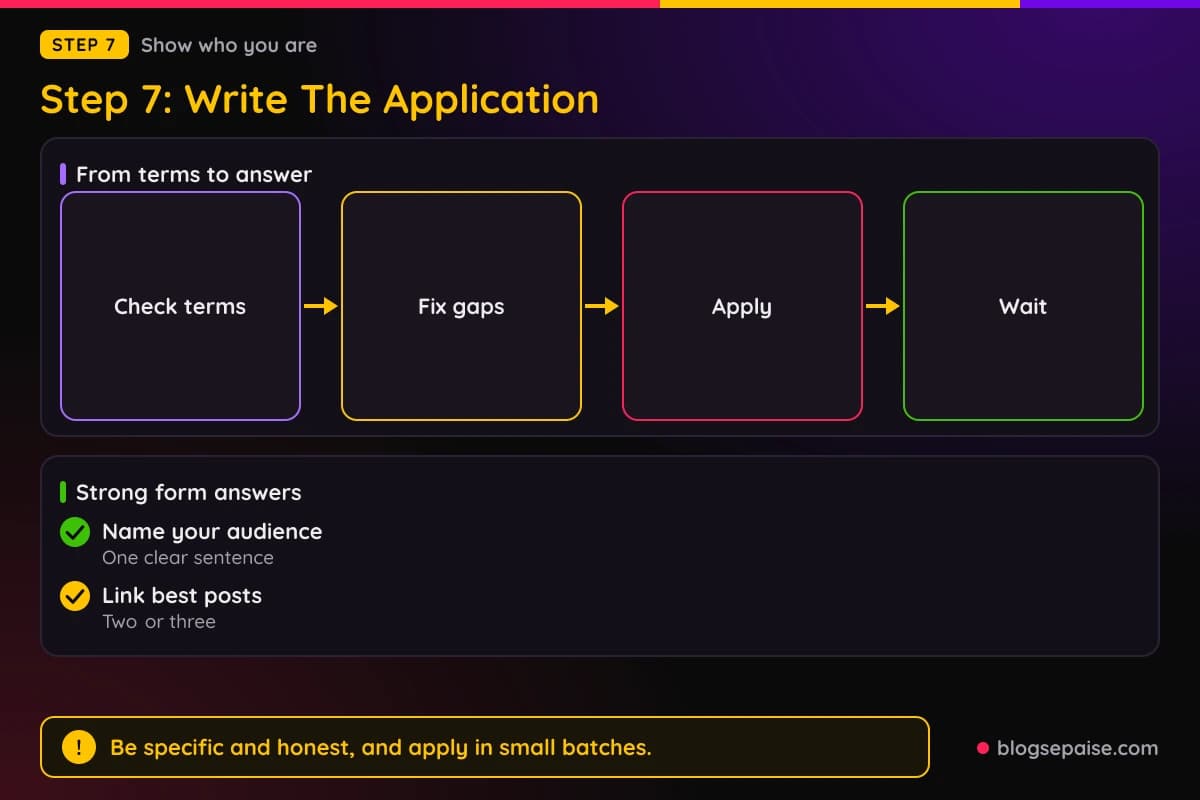
Apply to a few programs, not dozens in one afternoon. A small batch lets you learn from each answer and fix problems before the next round.
When you reapply, say what changed. A line such as I added a privacy policy and five new posts shows the reviewer that you listened.
If a program says no twice for the same reason, move on for now. Time spent on a poor fit is time not spent on your readers.
Step 8: Handle A Rejection
A no is information. Read the email slowly, because it may name a reason.
If the email gives no reason, ask. Awin's FAQ, for example, tells declined publishers to contact its compliance team with their Awin ID, email address, and website URL.
Compare the rejection against your sheet. Check if you missed a rule on site age, content volume, region, or pages, and fix the gap you can see.
Common fixes are quick ones. Add the missing legal page, publish a few more original posts, tidy the menu, and remove thin or copied pages.
Wait before you reapply, and change something first. Applying again the next day with no change gives the reviewer no new reason to say yes.
Keep a record of each application and its result. Over time, the pattern will show you which types of programs fit your site right now.
Some programs will be a poor fit for a while. That is fine, because other programs may suit your site as it grows.
Keep your spirits steady as well. A rejection says something about the site today, and nothing about your ability to build a good one.
Common Mistakes When Applying
One mistake is applying before the basics exist. Without a privacy policy, a contact page, and a disclosure, a good site can look unfinished.
Another mistake is applying everywhere at once. A few careful tries teach you more than a pile of rejections.
Trusting old lists of minimums is another. Rules change, so confirm every number on the program page.
Buying traffic to pass a traffic check is a costly error. Programs can set rules against it, and it teaches the program nothing good about you.
Writing a lazy application also hurts. Single word answers and a missing audience description give a reviewer little to go on.
Copying content is another way to fail. Write in your own words and add your own examples.
Ignoring the region and banned lists is a quiet mistake. You can meet every other rule and still lose because of where your visitors live or a method you used.
Finally, do not give up after one no. Treat each answer as feedback, fix what you can, and try the next program on your list.
Final Thoughts
Programs want honest publishers who will send real readers, and your job is to look like one.
The path is simple. Learn the types of programs, learn the rules, build the pages, publish real content, respect the traffic rules, check current terms, write a clear application, and learn from every answer.
Do not chase a list of minimums, because no list stays correct for long. Read the official terms on the day you apply and keep a dated record.
Start small and start with programs that suit your stage. As your site grows, you can apply to larger marketplaces and stricter brands.
If you are weighing which programs deserve your time, our page on high quality affiliate programs is a good next stop.
Frequently Asked Questions
1. Do I need a minimum amount of traffic to join an affiliate program?
Not always. Some programs state a minimum and others do not, so read the current terms on each program page before you decide.
2. How old does my website need to be?
It depends on the program, so check the terms and never rely on a number from a blog post.
3. How many posts should I have before I apply?
There is no single answer. A small set of original posts on one topic is a sensible aim, and the program page has the final word.
4. Which pages does a site need to pass a review?
An About page, a Contact page, a privacy policy, and a clear affiliate disclosure are sensible to have in place. Amazon's Operating Agreement, for example, requires a disclosure statement, and a terms page and a cookie notice can help too.
5. Can I apply with a free blog or a social media page only?
It depends on the program, so read what its form accepts. Impact.com, for example, says you need at least one verified property, such as a website.
6. Is it bad to apply to many programs at once?
Small batches let you learn from each answer. You can fix problems before the next round.
7. What should I do if my application is rejected?
Read the email, ask for a reason if none is given, fix the gaps you can see, and change something before you reapply. Keep notes so you can spot patterns.
8. Can I buy traffic to meet a minimum?
No. Programs can set rules against bought traffic, so build real visits instead.
9. Do blog lists of network minimums stay accurate?
They can go out of date. Treat them as a hint and confirm every rule on the official page, using the date you checked.
10. Should I start with a large marketplace or a single company program?
Start with the program types that suit your site and your stage. Check each program's terms before you apply.