Turbotic Review (2026): Self-Healing AI Automation Pricing
Turbotic is an automation company based in Stockholm, Sweden. Its main product, Turbotic Automation AI, builds workflows from plain English chat.
You describe a job and an AI assistant asks clarifying questions, generates code, tests it, and fixes it. Turbotic says users get no forms and no templates.
Turbotic says that if there is an API, it can automate it today. It adds that there is no waiting for integrations to be built.
A second product, Automation Orchestration, monitors AI agents and RPA from one place. It lists UiPath, Blue Prism, and Automation Anywhere as supported RPA platforms.
Turbotic also sells services. Its pages describe an AI-native transformation consultancy with stages for discovery, governance, build, and scale.
Logos on the Turbotic homepage include Ericsson, Volvo, Sony, SAS, LinkedIn, Xerox, and LeoVegas. Turbotic lists ISO 27001 and SOC 2 Type II certifications.
Plans start at $0. Basic costs $14.99 a month billed annually, Pro costs $79.99 a month billed annually, and Enterprise is priced through sales.
The Free plan gives 100 executions, 100 AI chats, and 3 automations. These prices sit in a Simple, Transparent Pricing section on the Automation AI page.
Turbotic AI is a separate AI assistant. It costs $25 per seat per month and includes 1,500 credits per month.
Turbotic compares its platform with Zapier, Boomi, UiPath, and Blue Prism in its own table. That table is Turbotic's view and not an outside test.
Turbotic lists four audiences on the Automation AI page. They are SMBs, enterprises, tech-savvy business users, and IT or DevOps teams.
Disclosure: Some of the links I share might be affiliate links. If you click on one and make a purchase, I may earn a small commission as a thank you. But don’t worry, it won’t cost you anything extra. I only recommend stuff I genuinely believe in. Your support helps me keep creating awesome content. You can read my full affiliate disclosure in my disclaimer page.
If you want to save a lot of hours searching for high-paying affiliate programs, check out our exclusive list of 2500+ affiliate programs. You’ll find all the information about the programs inside the list. This list is perfect for affiliate bloggers and influencers.
Turbotic Features
Turbotic lists six features as sections on its Automation AI page. They cover how you build, connect, fix, measure, and govern automations.
Turbotic says rule-based automation follows fixed steps and struggles when processes change. It says agent-driven workflows interpret context and adapt their execution path in real time.
Plan level sets the automation count. Free gives 3 automations, Basic gives 50, and Pro gives 100.
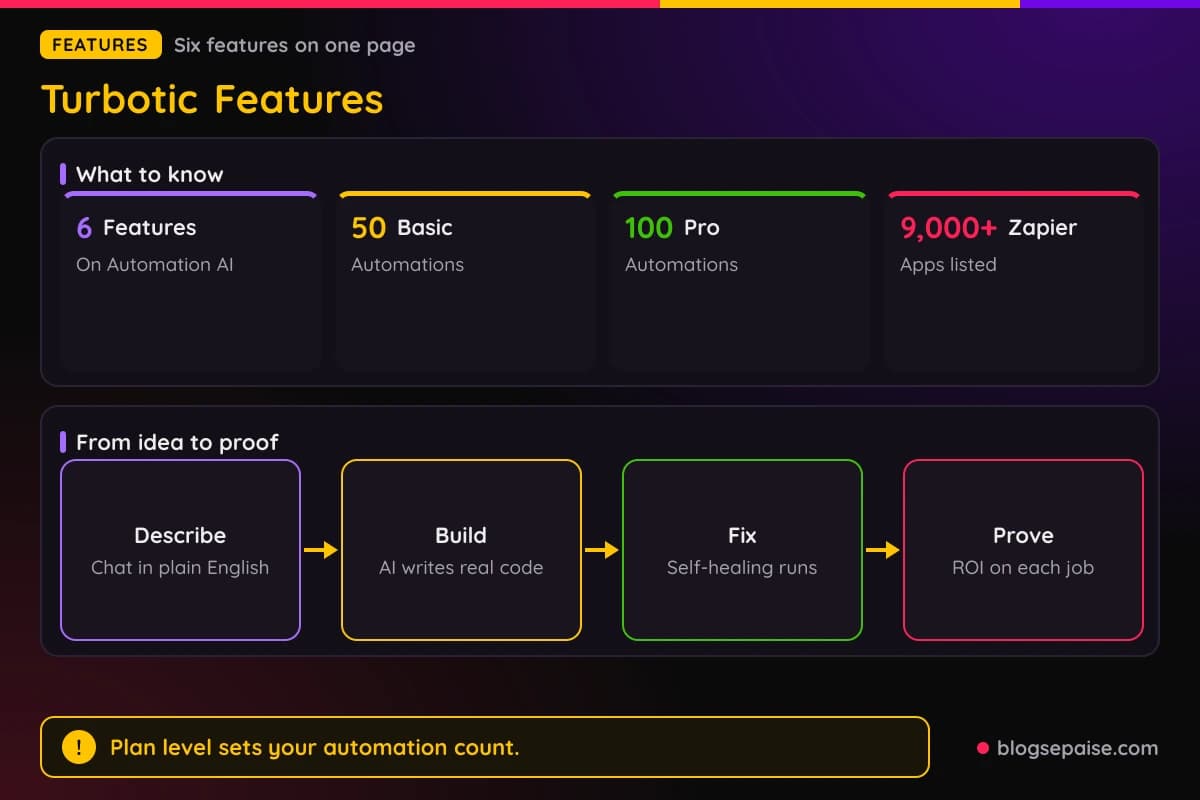
The sections below follow the order of the Automation AI page, with details from the orchestration, Turbotic AI, and service pages added in.
1. Automation As Simple As A Conversation
Automation as Simple as a Conversation is the first feature. Turbotic says you build complex workflows by chatting with your AI assistant.
Turbotic says there are no forms and no templates, and that you just describe it and go. It contrasts this with competitors that require manual configuration or technical diagrams.
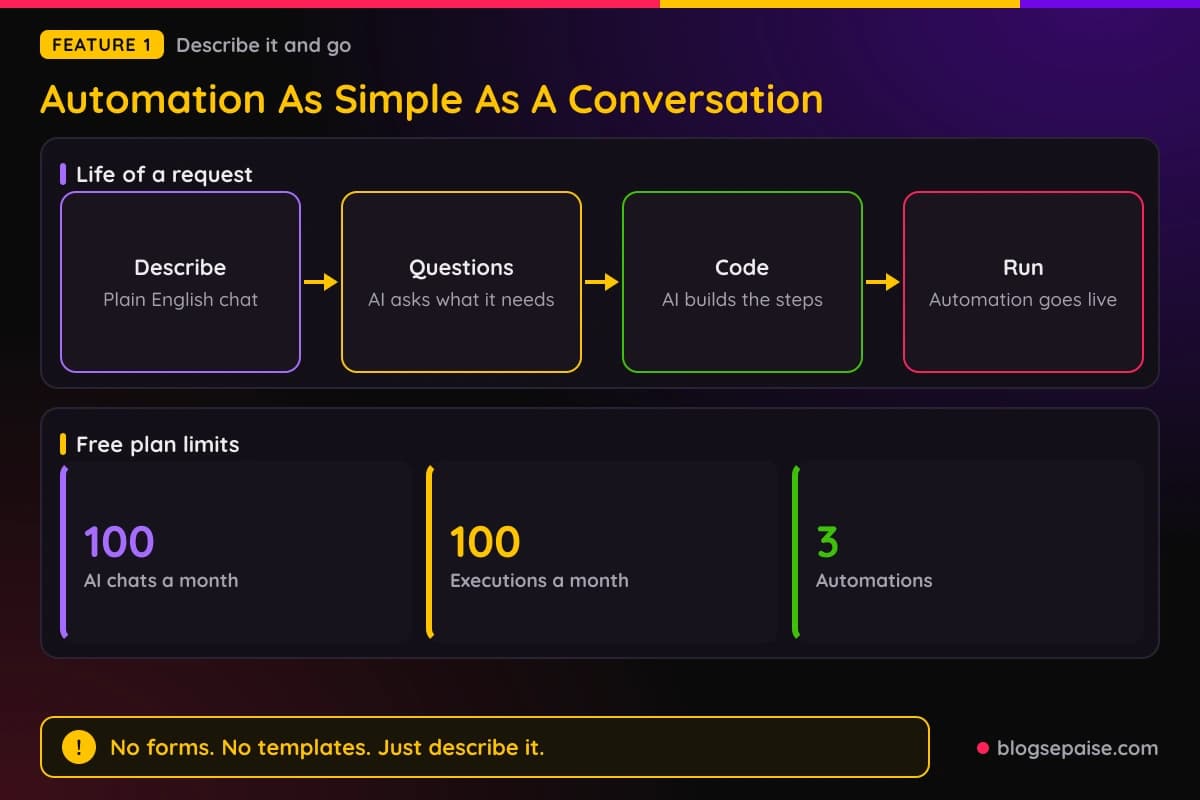
AI chats are metered. Free includes 100 chats a month, Basic lists 100 or 200, and Pro lists 1,000 or 1,500.
Enterprise lists no chat count. The page does not say which of the two Basic and Pro values applies to which billing choice.
Turbotic lists tech-savvy business users and IT or DevOps teams among its audiences. For the first group it says all the power of code, none of the hassle.
The Pegujo Capital case study describes meeting summaries, note-taking, and follow-up task generation built on the platform. The firm reports saving 10 hours a week.
2. Built By AI And Runs On Real Code
Built by AI. Runs on Real Code. Flexible Forever. is the second feature. Turbotic says alternatives are limited by pre-built app libraries and predefined connectors.
Its answer is that if there is an API, Turbotic can automate it today. It describes its connector reach as unlimited for any API or webhook.
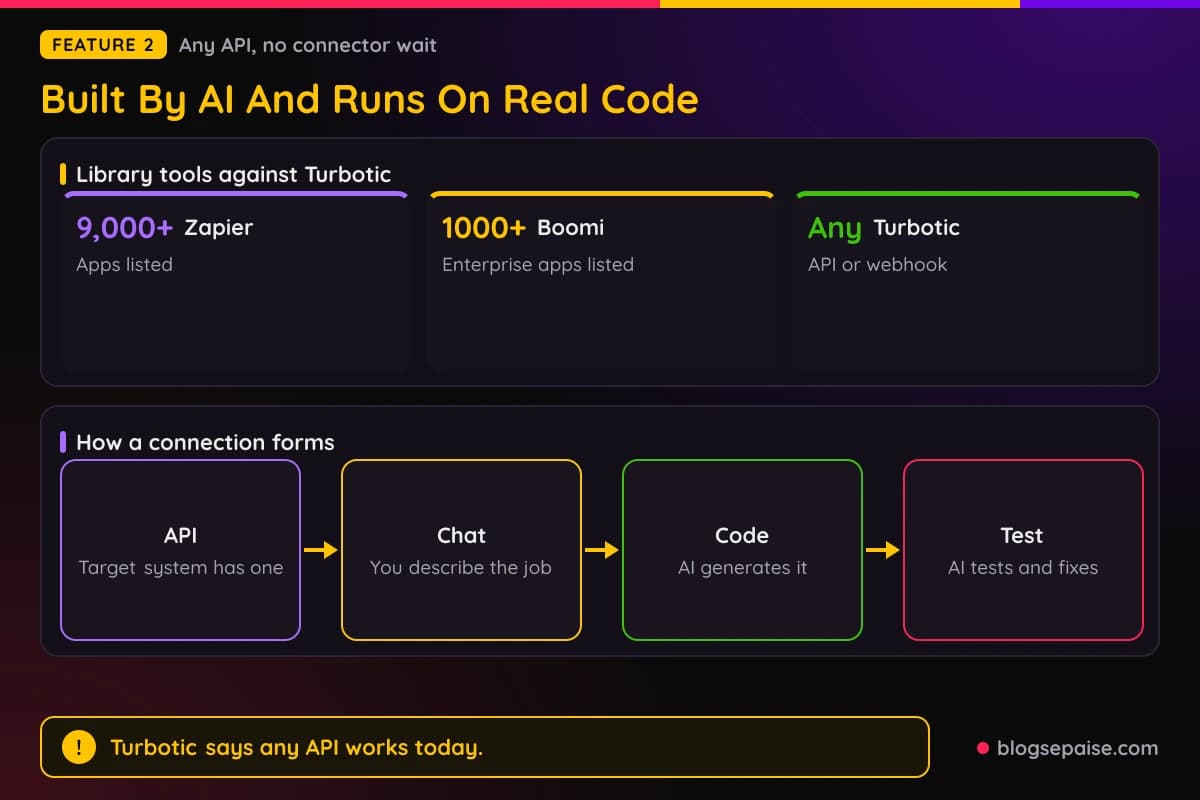
Competitors publish their own counts. Zapier says it connects any AI to 9,000+ apps, and Make lists 3,500+ applications.
n8n lists 500+ native integrations and says any API can be reached through HTTP. Boomi says Boomi Connect gives AI governed access to 1000+ enterprise applications.
Turbotic's comparison table gives different figures. It lists Zapier at 6,000+ apps and Boomi at 300k+ templates, while Boomi's homepage shows no template count.
The table also says Turbotic offers full programming power through AI-generated code. It marks Zapier as limited with no loops, and marks Boomi, UiPath, and Blue Prism as supporting loops and branching.
Turbotic does not publish a count of apps it connects to. Its claim rests on the API or webhook being available.
3. Your AI Automation Co-Pilot
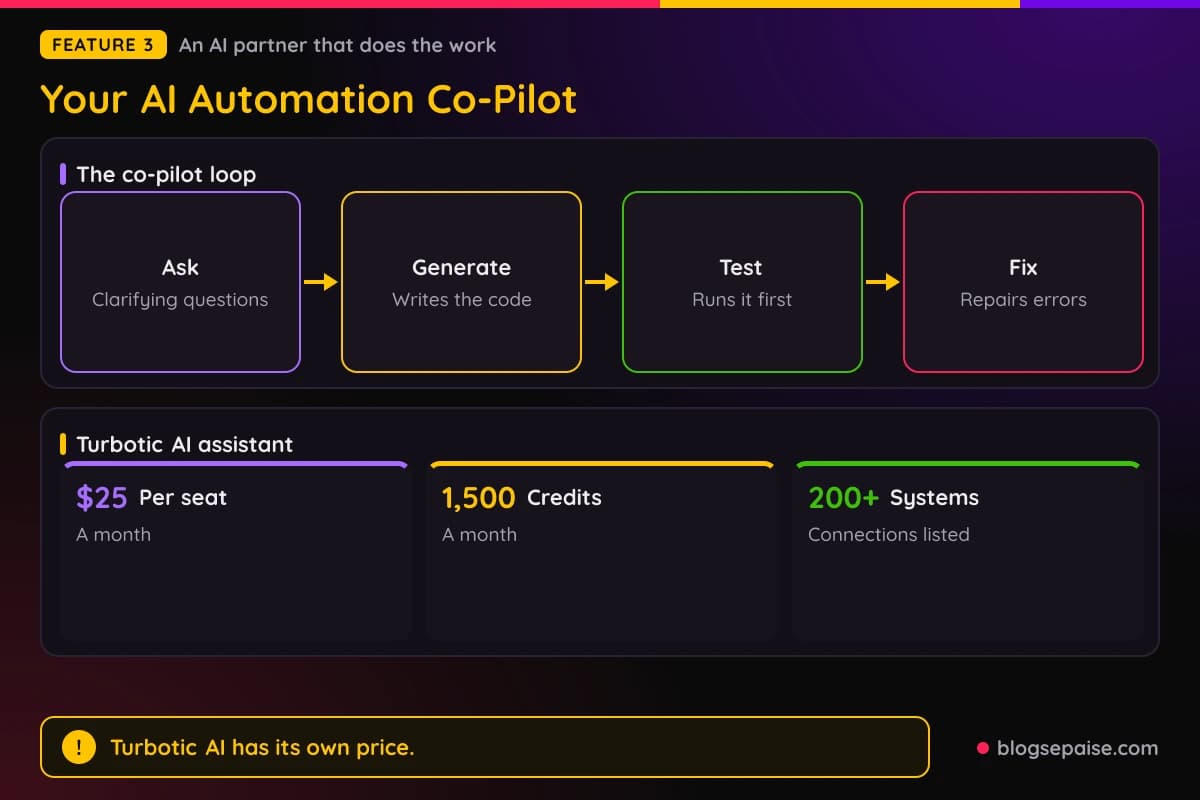
Your AI Automation Co-Pilot is the third feature. Turbotic says other tools give you AI suggestions, while it gives you an AI partner that asks clarifying questions, generates code, tests it, and fixes it.
The page adds that from build to fix, the AI does not just assist, it does the work.
Turbotic's comparison table lists a standalone AI agent column. It marks Turbotic as native and conversational, and lists Zapier as no, Boomi as basic on the roadmap, UiPath as through orchestrators, and Blue Prism as limited.
The separate Turbotic AI assistant covers meeting summaries with key points, action items, and sentiment analysis. It also lists automation planning, process documentation, and data analysis from enterprise systems and SaaS applications.
Turbotic says Turbotic AI connects to 200+ systems. It can be used standalone or combined with Turbotic's services.
Turbotic AI costs $25 per seat per month. It includes 1,500 credits per month, with additional credits available for purchase.
The listed inclusions are custom templates, user invitations, team collaboration tools, case governance, an unlimited meeting agent, workspaces, process documentation generation, and priority support.
The Turbotic AI page also lists claimed outcomes of up to 40% less process time and an average 30% cost reduction in automated functions. These are Turbotic's own claims.
4. Self-Healing Workflows
Self-Healing Workflows is the fourth feature. Turbotic says the platform detects changes and rewrites automations on its own, without human intervention for errors.
The tagline says Turbotic heals itself before anyone notices. The comparison table describes this as auto-fix and explain errors.
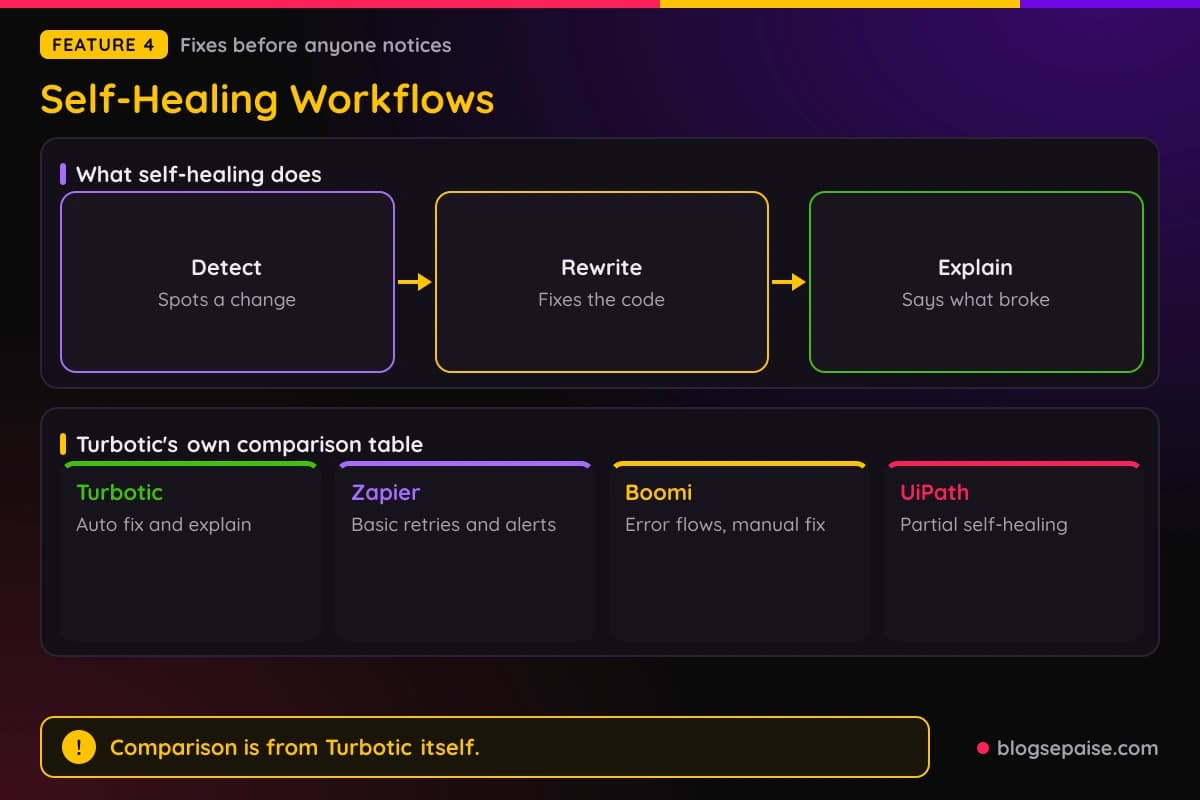
That table covers error handling for rivals. Zapier gets basic retries and alerts, Boomi gets error flows with manual fixes, and UiPath and Blue Prism get retry, logging, and exception handling.
On self-healing it marks Zapier and Boomi as no, UiPath as partial, and Blue Prism as emerging. Turbotic is the only platform marked yes, which makes this a vendor claim to test.
Orchestration adds an Anomaly Leaderboard that detects and ranks anomalies across the automation estate by impact. It also shows Error Categories in the Last Week to help identify root causes.
Turbotic also sells a managed service. It says it monitors, maintains, and improves automation across platforms, including Turbotic, UiPath, and Power Automate.
The service lists incident detection and resolution, platform and workflow health checks, and performance and uptime tracking.
5. Automation You Can Prove
Automation You Can Prove is the fifth feature. Turbotic says it shows hours saved, dollars earned, and the business value created on every automation.
Turbotic says competitors offer basic logs. Its tagline is, don't just automate, justify, and the comparison table lists live dashboards with cost and time saved reporting.
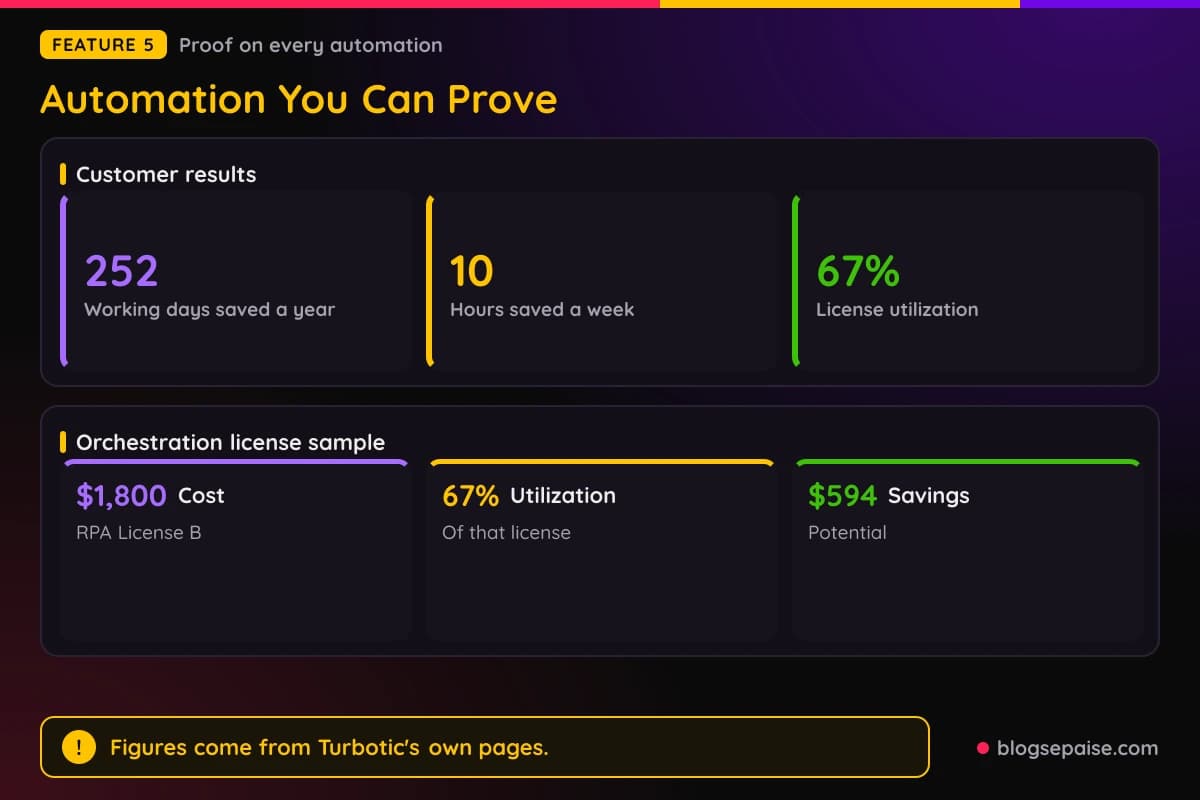
Orchestration extends reporting to licenses. A Turbotic table lists RPA License B at 67% utilization with a $1,800 cost and $594 in potential savings.
The page frames license optimization as finding underutilized licenses to reduce costs. It lists three other rows with utilization from 78% to 92%.
Turbotic's customer pages give figures. Svensk Cater found 252 working days saved per year across 4 processes, identified in 3 days, equal to 1.7 FTE.
Pegujo Capital saves 10 hours a week on meeting documentation across 20 to 30 client meetings a week. Evoke reports 40 automations in production, 3M+ automated transactions, 18 AI solutions, and £12 million in business value.
All of these figures come from Turbotic's own pages and not from outside audits. Your numbers will depend on your processes.
The scale and operate service adds a quarterly value review tied to real P&L impact. Individual wins roll up into a portfolio view of value delivered, cost avoided, and capacity created.
6. Enterprise-Ready Controls
Enterprise-Ready, without the Overhead is the sixth feature. Turbotic says some solutions are too basic for governance while others are too heavy, and that it offers team collaboration, approval flows, and governance.
Its tagline is to empower everyone to build automations without losing control. Turbotic lists ISO 27001 and SOC 2 Type II certifications.
The Enterprise plan lists unlimited automations, dedicated support, scheduling, custom workflows, an SLA guarantee, and an on-premise deployment option.
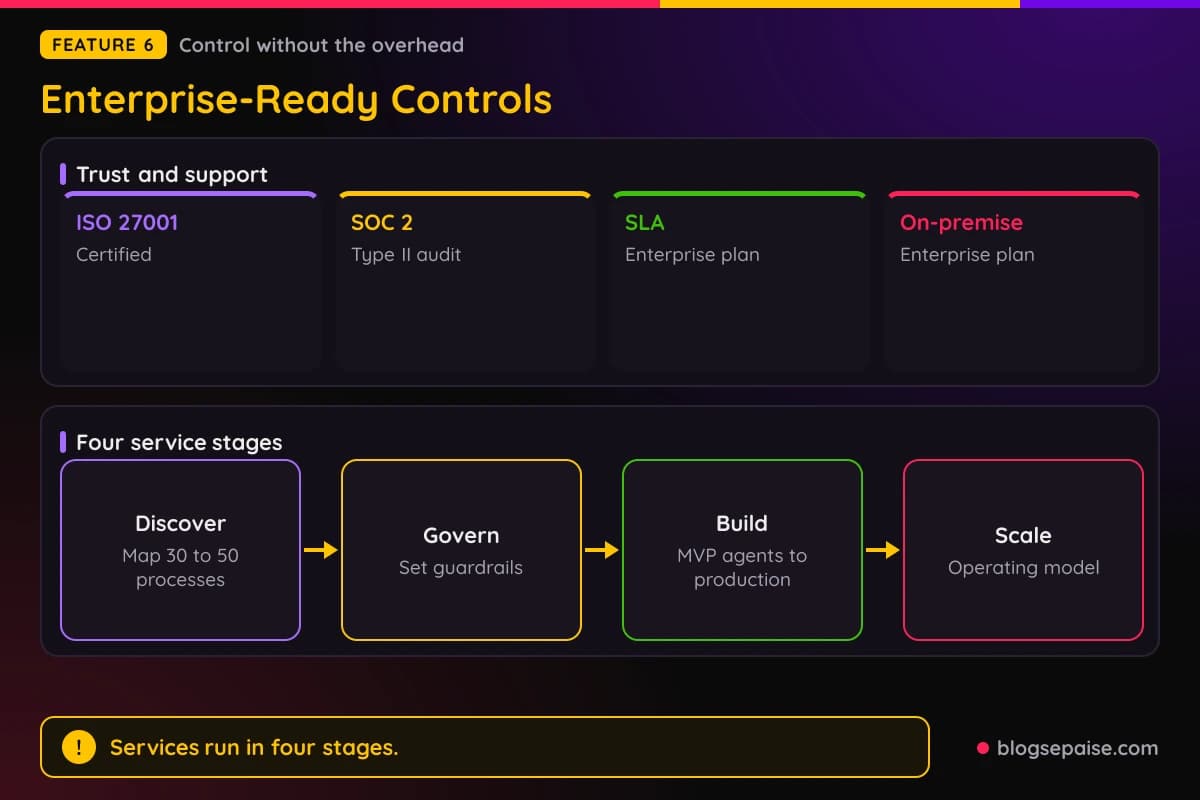
The governance and compliance service promises EU AI Act-ready guardrails. Turbotic says every automation gets clear accountability: who owns it, who supervises it, and who can stop it.
Human-in-the-loop and escalation points are defined per process. The page also describes compliance documentation and an audit trail, and a green light that legal and security teams gave.
The Turbotic homepage lists policy guardrails, model drift monitoring, and continuous compliance as themes.
Services run in four stages. Discovery typically maps 30 to 50 processes and scores each on value, complexity, and readiness in a prioritisation heatmap.
Stage 02 is governance and stage 03 is agent and automation build, which moves from MVP agents to production-grade automation. Stage 04 is scale and operate.
Turbotic also offers a ten question AI readiness assessment. Turbotic says it takes minutes and costs nothing, and returns a scored maturity read with a recommended next step.
Turbotic Pricing Plans
Turbotic.com/pricing opens a demo request form and shows no prices. The plans sit in a Simple, Transparent Pricing section on the Automation AI page.
The section says to start free, scale as you grow, and go enterprise when you need it. A billing choice advertises savings of up to 30% for yearly billing.
Free costs $0. It includes 100 executions a month, 100 AI chats a month, 3 automations, and community support.
Basic costs $14.99 a month billed annually, which comes to $179.88 a year. It includes 50 automations, standard support, and scheduling.
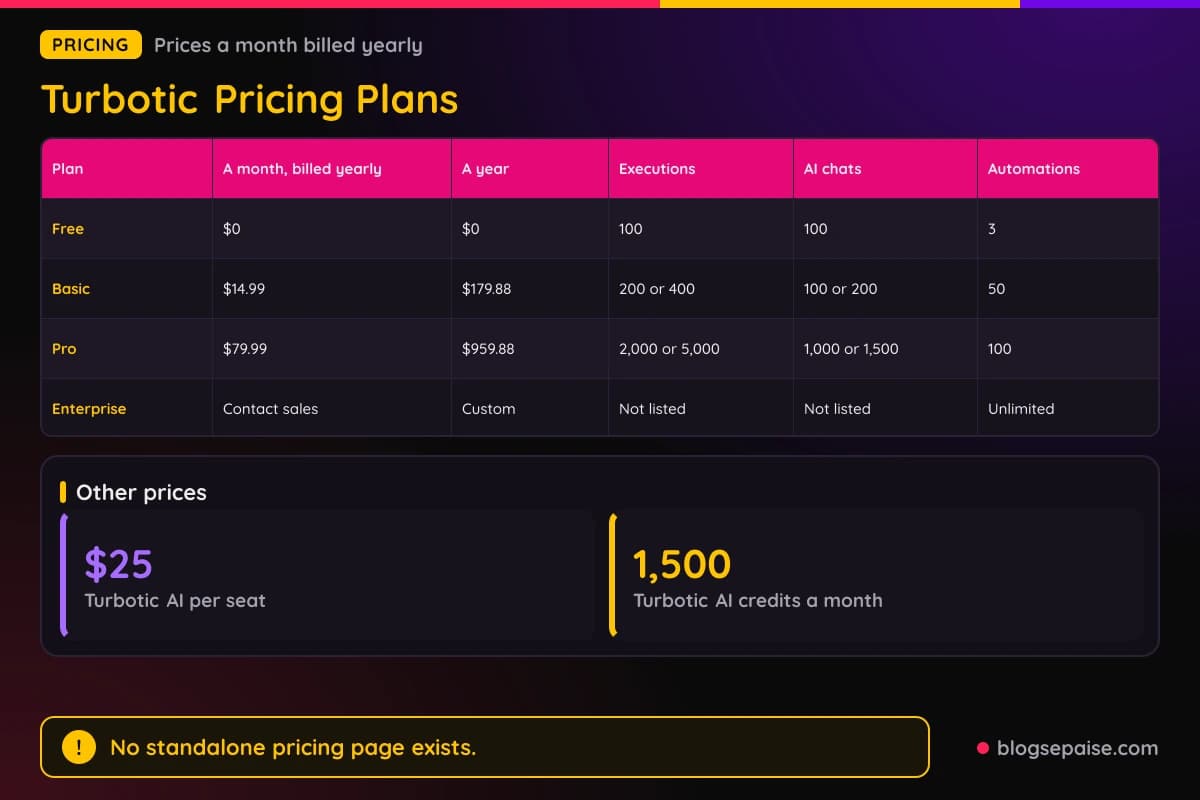
Basic lists two execution limits, 200 and 400 a month. It lists two chat limits too, 100 and 200 a month, and the page does not label which goes with which billing choice.
Pro costs $79.99 a month billed annually, which comes to $959.88 a year. Turbotic marks it as the Most Popular plan.
Pro lists 2,000 and 5,000 executions a month, and 1,000 and 1,500 AI chats a month. It includes 100 automations, priority support, scheduling, and custom workflows.
Enterprise has no public price and routes you to sales. It lists unlimited automations, dedicated support, scheduling, custom workflows, an SLA guarantee, and an on-premise deployment option.
The Automation AI page lists no execution or chat counts for Enterprise. It also lists no trial length or refund terms.
Turbotic AI is priced apart from the automation plans. It costs $25 per seat per month and includes 1,500 credits per month, which adds $300 a year for each person.
The Automation AI plans list no per seat price. Turbotic lists no price for its services.
The jump from Basic to Pro is $65 a month on annual billing. Pro adds priority support, custom workflows, and higher execution and chat limits.
Support grows with the plan. Free has community support, Basic has standard support, Pro has priority support, and Enterprise has dedicated support.
Custom workflows are listed on Pro and Enterprise, and scheduling is listed on Basic, Pro, and Enterprise. Free lists neither.
Who Is Turbotic Best Suited For
Turbotic lists four audiences on its Automation AI page. They are SMBs, enterprises, tech-savvy business users, and IT or DevOps teams.
For SMBs, Turbotic says it grows with you from startup to scale-up. Basic at $14.99 a month billed annually includes 50 automations.
For IT and DevOps it promises full-code flexibility built in seconds by AI. For enterprises it says enterprise-grade automation, AI-fast and IT-friendly.
Teams with systems that have an API but no ready-made connector are the clearest fit. That is the gap Turbotic says its approach closes.
Companies running UiPath, Blue Prism, or Automation Anywhere bots fit the orchestration product. It monitors performance, failures, cost, and behavior across agents and RPA from one place.
Teams with AI pilots stuck short of production are a target for the services side. A survey Turbotic commissioned found only 16% of UK businesses say they successfully deploy AI at scale.
The same survey named governance and compliance as the most cited barrier, at 37% of businesses. It was conducted by Research Without Barriers among 1,004 senior UK decision-makers.
Regulated companies are another fit. Turbotic offers EU AI Act-ready guardrails, named ownership, and audit trails in its governance work.
Leaders who must show value to finance may like the reporting. Turbotic ties a quarterly value review to real P&L impact.
Who Turbotic Is Not For
Turbotic is not for buyers who want a published app count. Zapier says 9,000+ apps and Make says 3,500+, while Turbotic lists none.
Buyers who need a public price for everything will hit a wall. Turbotic has no standalone pricing page, and Enterprise and services have no public price.
Basic and Pro list two values for executions and chats without a label. Planning a budget is harder when the real limit is unclear.
The Automation AI page lists no refund policy or trial length. Test on the Free plan before you pay for a year.
Heavy users of AI chat should watch limits. Free gives 100 chats a month, and Free also caps you at 3 automations and 100 executions.
Teams that need on-premise deployment need the Enterprise plan. Free, Basic, and Pro do not list that option.
Teams that want a self-hosted tool from a different vendor can look at n8n. It says you can deploy on-prem or with Docker, and that its source code is on GitHub.
Teams that want a drag-and-drop visual builder may prefer Make. It describes one visual environment to build, test, debug, and run scenarios.
Anyone expecting templates will not find them pitched. Turbotic says there are no forms and no templates.
Turbotic targets tech-savvy business users and developers in its own table. Zapier is listed there as targeting SMBs and non-technical users.
Turbotic Alternatives
The table below uses each vendor's own site. Turbotic's cells come from its pages, and the rest come from the competitor homepages and integration pages.
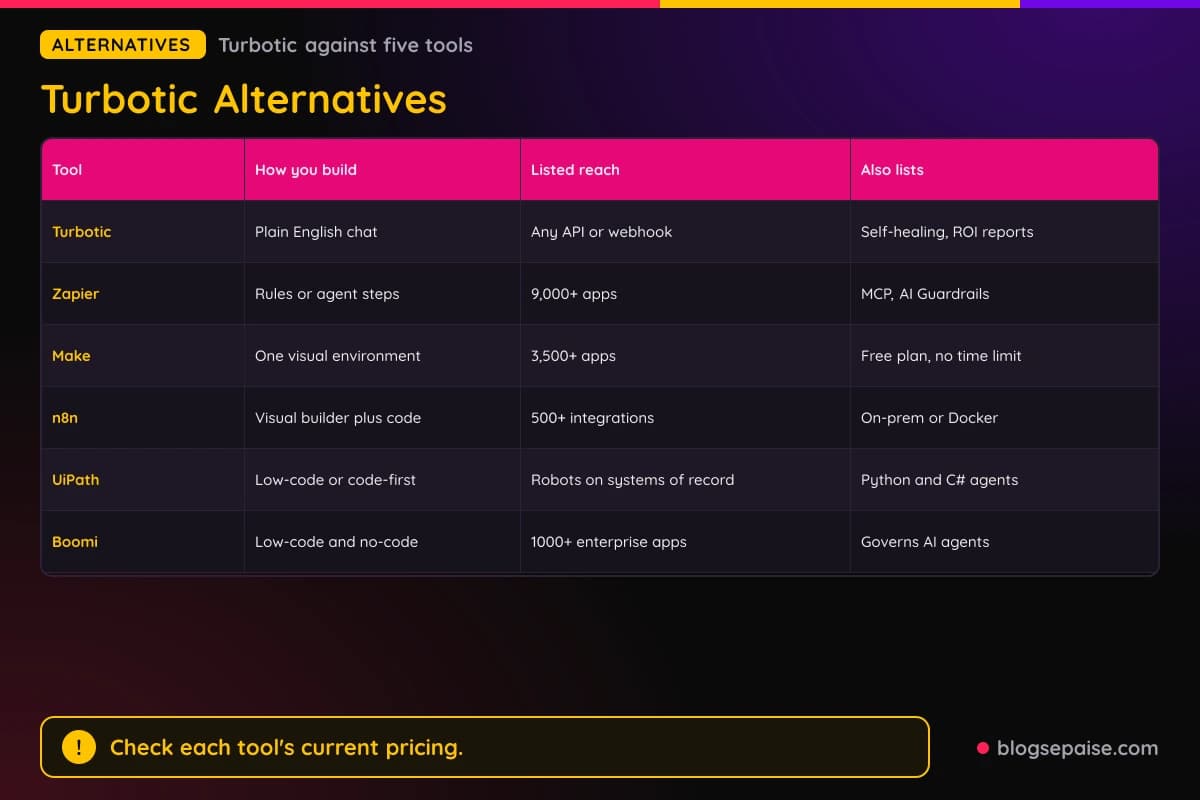
Zapier says it connects any AI to 9,000+ apps. It lets you decide how each step runs, from fixed rules to an agent, and lists MCP connections and AI Guardrails.
Make describes one visual environment to build, test, debug, and run. It lists 3,500+ applications and a free plan with no credit card and no time limit.
n8n describes a visual builder you can drop out of into code. It lists 500+ native integrations, on-prem or Docker deployment, and human-in-the-loop approvals.
UiPath describes a platform for business orchestration and automation. Its Studio supports low-code, code-first, and AI-assisted building, with coded agents in Python and coded automations in C#.
Boomi calls itself the data activation company. It describes a platform that connects systems, prepares data, and governs AI, with low-code Flow and no-code Task Automation.
Turbotic differs by building from chat. It also works alongside UiPath, since Orchestration monitors UiPath bots with other agents and RPA.
Price is another point. Turbotic has a Free plan at $0 and Basic at $14.99 a month billed annually for 50 automations.
Competitor prices change often, so check each pricing page before you decide. Match the tool to the systems you use.
For a similar AI tool, read our Emergent review.
You can also read our Mailmodo review for AI email automation, or browse the software reviews hub.
Turbotic Use Cases
The use cases below come from Turbotic's own pages and case studies. Each one is an outcome Turbotic describes.
Pegujo Capital uses Turbotic for meeting documentation. It reports 10 hours saved a week across 20 to 30 client meetings a week, with summaries, note-taking, and follow-up tasks automated.
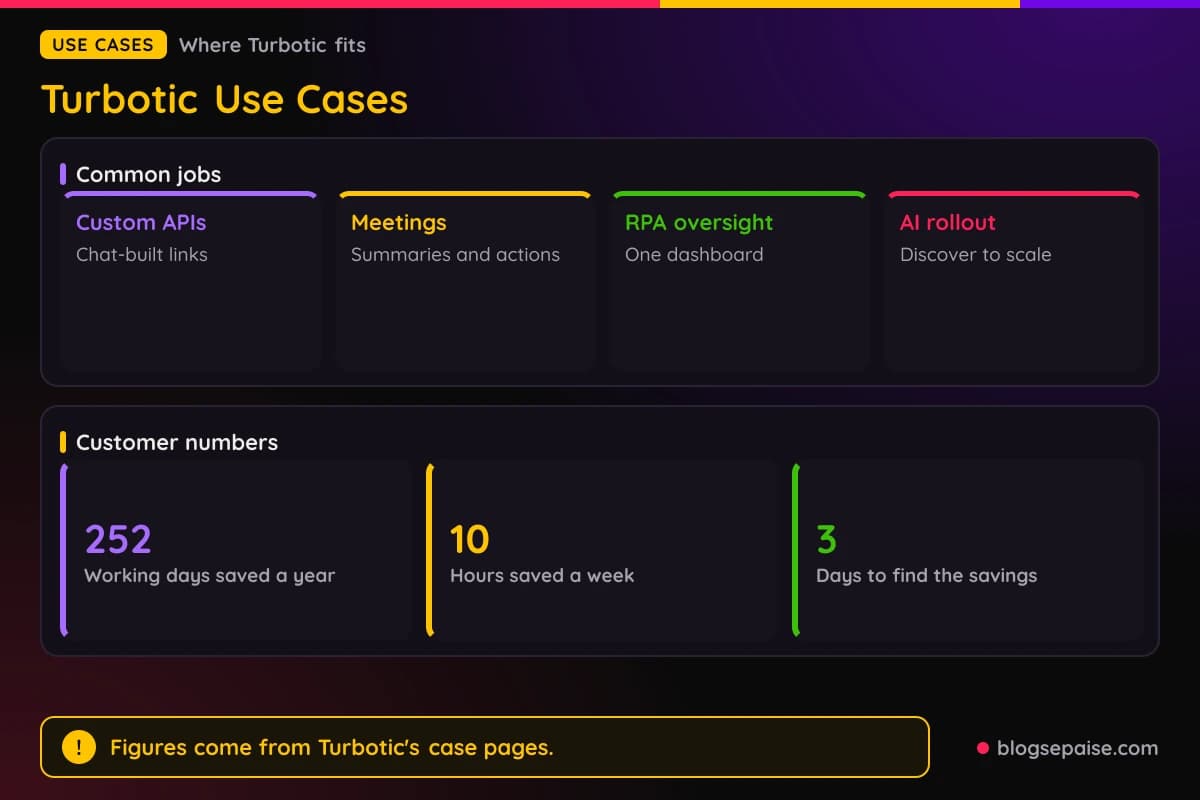
Svensk Cater, a foodservice distributor, ran a discovery across 4 processes. They were reminder invoicing, tender support invoicing, employee onboarding, and supplier invoices and purchase orders.
The result was 252 working days saved per year, identified in 3 days, with 3 processes at 100% automation potential. The page also lists about 2,000 hours saved annually and about 514,000 SEK in estimated implementation costs.
LeoVegas ran a group-wide diagnostic that Turbotic says found 20+ prioritized AI and automation use cases. Evoke scaled a Centre of Excellence and reports 40 automations in production and 500+ processes assessed.
Operations teams can watch UiPath, Blue Prism, and Automation Anywhere bots in one control plane. The homepage describes a unified view across UiPath and Automation Anywhere for a global managed service provider.
Finance teams can use license optimization to find underutilized licenses. The sample table lists $594 in potential savings on one RPA license at 67% utilization.
The agent and automation build service includes a migration path from brittle bots to agentic automation. It also hands over runbooks, on-call rotations, and handover documentation.
For pilots that never reached production, Turbotic describes assessing what can be salvaged and rebuilding to production standard. The rebuild includes logging, permissions, audit trails, and human-in-the-loop where needed.
Regulated companies can use the governance service for EU AI Act-ready guardrails. The page describes named ownership, escalation paths, and an audit trail.
Final Thoughts On Turbotic
Turbotic builds automations from plain English chat. Its pitch is generated code, self-healing, and ROI reporting on every automation.
Most of the proof is Turbotic's own. The comparison table and the customer figures come from its pages, so test them on your own process.
Pricing is easy to read once you find it. Free costs $0, Basic costs $14.99, and Pro costs $79.99 a month billed annually.
The catch sits in a few places. Turbotic has no standalone pricing page, and Basic and Pro show two limits with no label.
Enterprise and services have no public price. The Automation AI page lists no refund terms or trial length.
Start on Free. Build one real automation, count the executions, and see how many chats it took.
Turbotic AI adds an assistant at $25 per seat per month. Remember the two halves of Turbotic, the platform you can try free and the services you scope with a team.
You can browse more write-ups on our software reviews hub if you want to compare tools side by side.
Turbotic FAQ
1. What Is Turbotic?
Turbotic is a Stockholm-based automation company. Its Automation AI platform builds workflows from plain English chat.
2. Does Turbotic Have A Free Plan?
Yes. Free costs $0 and includes 100 executions a month, 100 AI chats a month, 3 automations, and community support.
3. How Much Does Turbotic Cost?
Basic costs $14.99 a month billed annually and Pro costs $79.99 a month billed annually. Enterprise is priced through sales.
4. Does Turbotic Have A Pricing Page?
The plans sit on the Automation AI page. Turbotic.com/pricing opens a demo request form with no prices.
5. What Is Included In The Basic Plan?
Basic lists 50 automations, standard support, and scheduling. It lists 200 or 400 executions and 100 or 200 chats a month.
6. What Is Included In The Pro Plan?
Pro lists 100 automations, priority support, scheduling, and custom workflows. It lists 2,000 or 5,000 executions and 1,000 or 1,500 chats a month.
7. What Does The Enterprise Plan Include?
Enterprise lists unlimited automations, dedicated support, scheduling, custom workflows, an SLA guarantee, and an on-premise option. Pricing needs a call with sales.
8. How Does Turbotic Build Automations?
You describe the job in chat. Turbotic says the AI asks clarifying questions, generates code, tests it, and fixes it.
9. Can Turbotic Connect To Any App?
Turbotic says that if there is an API, it can automate it today. Its table lists connectors as unlimited for any API or webhook.
10. What Are Self-Healing Workflows?
Turbotic says the platform detects changes and rewrites automations on its own. Its table describes this as auto-fix and explain errors.
11. What Is Turbotic AI?
Turbotic AI is an assistant for meeting summaries, automation planning, process documentation, and data analysis. It costs $25 per seat per month and includes 1,500 credits per month.
12. What Is Automation Orchestration?
It is a control plane for automation across vendors. It monitors performance, failures, cost, and behavior across agents and RPA, including UiPath, Blue Prism, and Automation Anywhere.
13. Is Turbotic Secure?
Turbotic lists ISO 27001 and SOC 2 Type II certifications. Enterprise adds an SLA guarantee and an on-premise option.
14. Who Uses Turbotic?
Logos on the Turbotic homepage include Ericsson, Volvo, Sony, SAS, LinkedIn, Xerox, and LeoVegas. Its case studies cover Evoke, Pegujo Capital, LeoVegas, and Svensk Cater.
15. How Is Turbotic Different From Zapier?
Zapier says it connects any AI to 9,000+ apps. Turbotic generates code for any API or webhook, and its own table marks Zapier as having basic retries and alerts and no self-healing.
16. Does Turbotic Offer Services?
Yes. Its services cover discovery, governance, build, and scale, plus a managed service that monitors automation across Turbotic, UiPath, and Power Automate.
17. Where Is Turbotic Based?
Turbotic is based in Stockholm, Sweden.