How to Validate a Niche Before Building (4 Checks That Save Months)
Most new affiliates pick a niche the way people pick a restaurant on vacation. They walk in because the place looked busy, or because the menu photo looked good.
Then they spend three months building a site around that idea. After a dozen posts they learn that few people search for the topic, or that nobody pays for anything in it.
A little testing up front removes most of that risk. You can run the whole test in about eight hours, and you do not have to publish a single post to do it.
In this guide you will follow six steps. Step one sets up a simple sheet, steps two to five run four checks on demand, reach, money, and staying power, and step six turns the results into a clear yes or no.
Each check gets a score from one to five. Add the four scores together and you get a number out of 20 that you can compare across ideas.
You do not need paid tools to begin. A browser, a spreadsheet, and honest answers are enough.
If you have no ideas yet, start with our guide on how to choose a profitable niche. If you already have a short list, the niche profitability scorer makes a handy second opinion once you finish the checks below.
Everything in this article is a test you can run on paper. Nothing here needs a website, a hosting plan, or a logo.
Disclosure: Some of the links I share might be affiliate links. If you click on one and make a purchase, I may earn a small commission as a thank you. But don’t worry, it won’t cost you anything extra. I only recommend stuff I genuinely believe in. Your support helps me keep creating awesome content. You can read my full affiliate disclosure in my disclaimer page.
If you want to save a lot of hours searching for high-paying affiliate programs, check out our exclusive list of 2500+ affiliate programs. You’ll find all the information about the programs inside the list. This list is perfect for affiliate bloggers and influencers.
Why Most Niches Fail Before Anyone Notices
A weak niche rarely fails with a bang. It sits there, quietly earning nothing, while you blame your writing, your theme, or your luck.
The slow part is the real cost. You can spend six weeks on content, wait another two months for search traffic, and only then learn that the topic had no buyers.
That is a lot of time to lose on a guess. It also hurts your confidence, and a beginner without confidence tends to quit right before things would have worked.
Most failed niches break in one of four places. Nobody searches for the topic, the search results are locked up by giants, the products pay too little or too rarely, or the writer runs out of steam after a month.
Each of those problems is easy to spot early if you know where to look. It is almost impossible to fix late, because by then you have a site, a name, and a pile of posts tied to the idea.
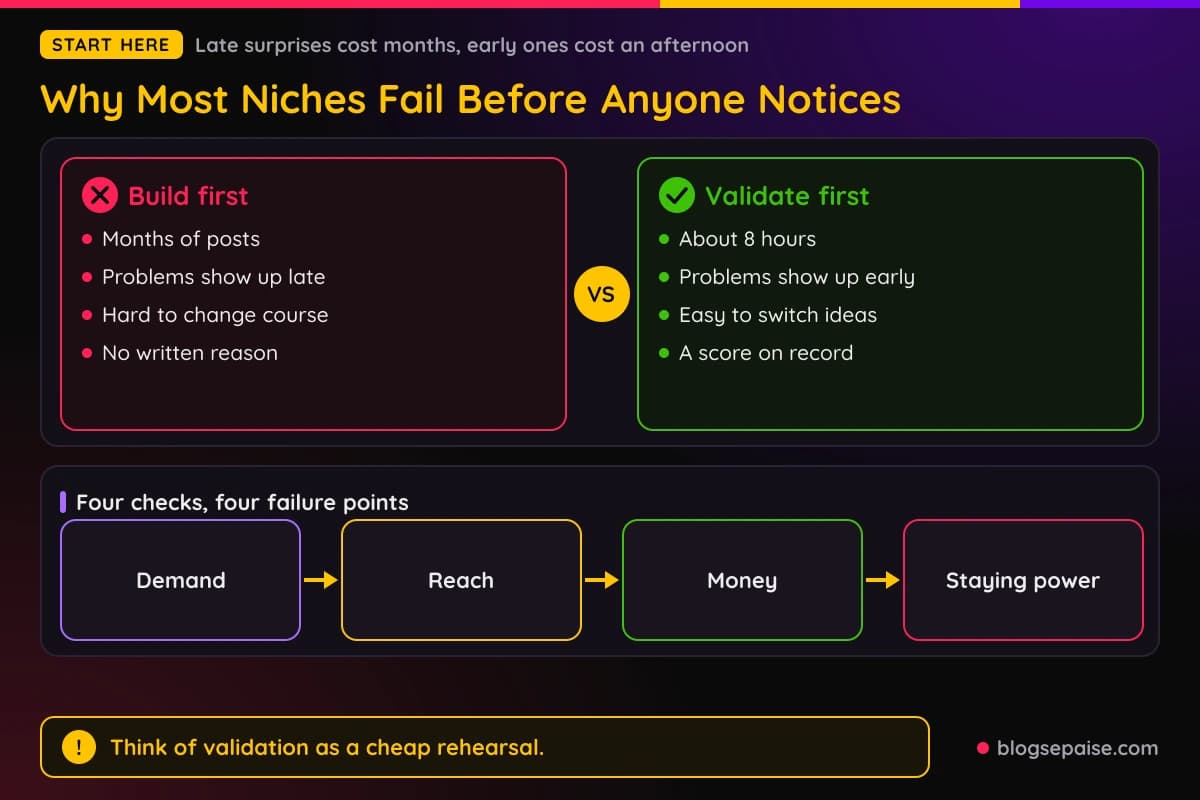
So the four checks in this guide map to those four failure points. Demand asks if people search, reach asks if you can show up in the results, money asks if the topic pays, and staying power asks if you can keep going.
Think of validation as a cheap rehearsal. You walk through the whole play on an empty stage before you pay for the theater.
A good validation also gives you something better than a feeling. It gives you a score and a short written record, so you can explain to yourself in six months why you picked the niche.
That record matters more than it sounds. When a slow month hits, and it will, a written reason to keep going is far stronger than a vague memory of being excited.
Step 1: Set Up Your Validation Sheet
Before you test anything, build the place where the results will live. Open a spreadsheet and give it one row per niche idea and a handful of columns.
The first column holds the niche name in plain words, such as a topic plus a reader. The next four columns are the checks, and the last column is the total.
Add a notes column too, because numbers alone hide the story. A score of two on reach means little until you write down that the first page was full of huge brand sites.
Score every check on the same scale from one to five. A one means the niche failed that check badly, a three means it was fine but unproven, and a five means it looked strong with clear evidence.
Four checks at five points each gives a top score of 20. Keep that number in mind, because every decision rule later in this guide uses it.

Next, set a time box. Give each check about two hours, which adds up to eight hours for the whole test.
A time box protects you from the most common trap, which is research that never ends. You can read about a niche for a year and learn less than you would from two focused evenings.
List three to five niche ideas before you start, and write each as a topic plus a reader. Something like budget travel for retired couples is a niche, while travel on its own is just a wide field.
If your ideas are still too wide, our guide on niche down or diversify can help you narrow them before you score. Narrow ideas are easier to test, because the evidence is easier to read.
Finally, write one honest sentence at the top of the sheet about why you want each idea. If the only reason is that it looks profitable, mark it, because the fourth check will test that reason hard.
Test at least three ideas, even if you love the first one. A single idea scored alone tells you very little, while three scored side by side show you which is truly strongest.
Step 2: Check One, Is There Real Demand
The first check asks the simplest question in business. Do real people want help with this topic right now?
You are not looking for a huge crowd. A small niche with eager readers beats a giant one where everyone is already served.
Start by collecting questions. Open a search engine, type your topic, and write down every suggestion the search box offers as you type.
Add the related searches at the bottom of the results page and the question boxes in the middle. Each one is a real thing a real person typed, which makes it free evidence.
Then visit places where your reader hangs out. Forums, community groups, and the comment sections under popular videos all show what people ask and what frustrates them.
Pay attention to the wording people use. If readers keep writing the same complaint in slightly different ways, you have found a pain point worth building a site around.
Your target is 20 different questions that you could answer in a full post. That is my rule of thumb, not a law, but if you cannot find 20 after two hours of looking, the topic is probably too thin.

Next, check search volume with a keyword tool. A tool like KWFinder shows rough monthly searches for each phrase, and even a few lookups tell you if the numbers are tiny or healthy.
Do not chase giant numbers. A phrase with a few hundred searches a month that matches a buying question is often worth more than a phrase with tens of thousands of casual browsers.
If you have never done this before, our walkthrough on how to do keyword research shows each step in order. Read it once and the numbers on your screen will make a lot more sense.
Look for signs of steady interest, not a spike. A topic that was loud for one month because of a news story can fade fast, while a topic people search every month is a safer base.
A quick way to check is to see if the questions you found are the kind that come back each year. Gift guides, repair problems, and how to start questions tend to return on a schedule.
Now score the check. Give one point if you found fewer than 10 questions and the numbers look tiny, three points if you found about 15 and the numbers look modest, and five points if you hit 20 or more with steady searches.
Write down your two best examples in the notes column. If the best question you found is vague, such as tips for beginners, that is a warning sign, because clear questions point to clear posts.
One more thing to watch for is demand that is really curiosity. People search for plenty of things they never buy, so keep a mental note of which questions sound like someone ready to solve a problem.
Step 3: Check Two, Can You Reach Your Reader
Demand tells you people care. Reach tells you if your new site has a fair chance of showing up when they search.
A new site cannot beat huge, trusted sites on their home turf. You do not need to beat them everywhere, only to find a corner where the door is open.
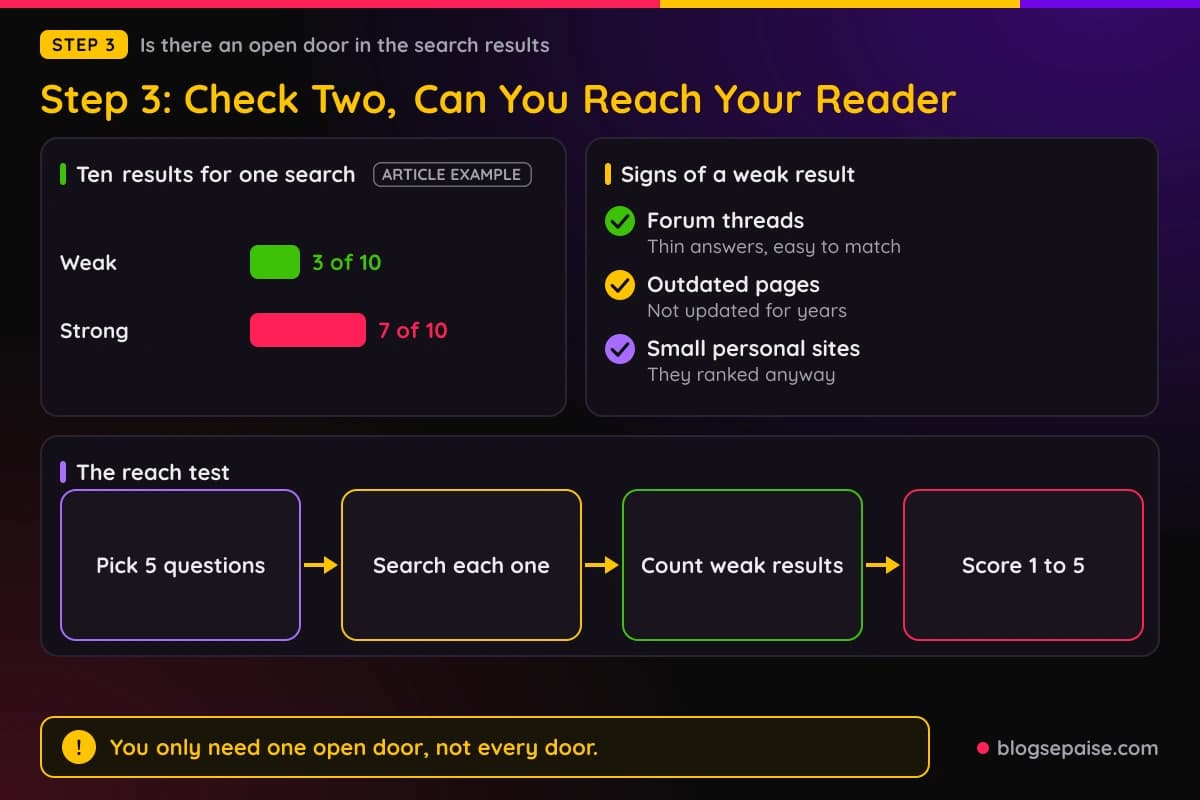
Pick five of the questions you collected in check one. Search for each one in a private browser window so your own history does not bend the results.
Look at the top ten results for each search and ask a simple question about every result. Could a small site with a good, honest post realistically sit next to this?
Strong results are easy to spot. They come from very large brands, they have deep guides that cover everything, and they have clearly been updated for years.
Weak results are just as easy to spot. They are forum threads, short posts with thin advice, pages that look outdated, or small personal sites that managed to rank anyway.
Count the weak results on each page. My rule of thumb is that at least three weak results out of ten means the door is open, and fewer than that means you are walking into a crowd.
Also look at how well the results match the question. If someone asks a specific question and the top pages give general answers, you can win by giving a direct and honest answer.
Check the format too. If every result is a long written guide, you can plan a long guide, while a page full of videos or shopping listings tells you a plain article may struggle.
Notice who is missing. If every top result comes from a company selling the product, there may be room for an independent voice that compares options without a sales pitch.
Do not let a high competition count scare you away on its own. Many strong niches have plenty of competitors, because competitors are a sign that money moves there.
The ideal pick is a niche with a long tail of smaller questions. Giants chase the big phrases, and the small, specific questions are where a new site can grow its first readers.
Now score the check. Give one point if almost every result is a giant, three points if you see two or three weak spots across your five searches, and five points if you find open doors on most of them.
Record the URLs of two weak results in your notes. When you return later to plan content, those pages become a model for what you need to beat.
Be honest about your own strengths here. If you can show real experience, real photos, or real results that the weak pages lack, add a point in your head, but keep the written score based on what you saw.
Step 4: Check Three, Does Money Actually Move Here
A niche can have eager readers and open search results and still pay you nothing. The third check asks if there is a fair way for you to earn from the topic.
Begin with products. List every product, tool, course, or service a reader in this niche might buy, and then find out which of them run an affiliate program.
Most companies post their program terms on a page of their own site. Search for the product name plus the words affiliate program, and read what comes back.
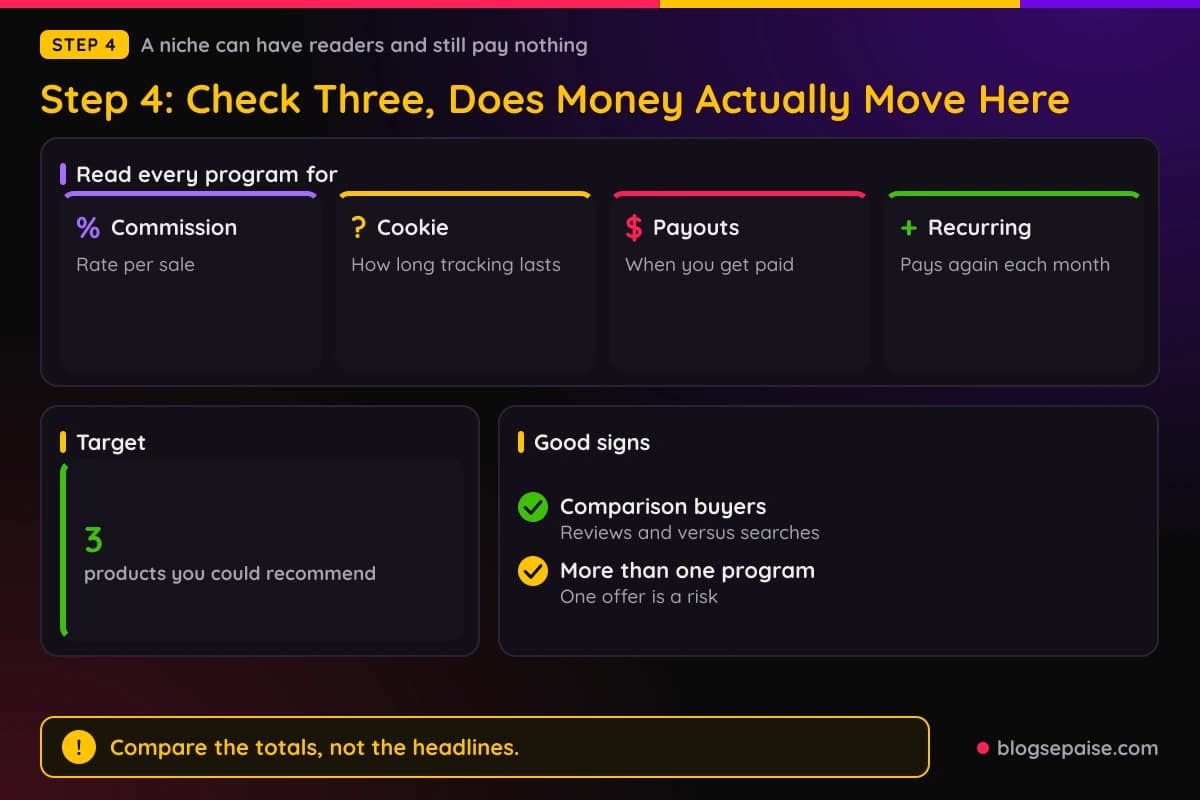
Your target is at least three products you could recommend with a clear conscience. Three gives you choice, so you are not stuck with one offer if its terms change.
Read the terms with care. Check the commission rate, how long the tracking cookie lasts, when payouts happen, and if the program pays once or again each month.
Recurring pay changes the math in a big way. A product that pays you every month a customer stays can beat a larger one time payout over a year, so compare the totals, not the headlines.
Next, look at the price of the products. A low price product needs many more sales to add up, while a higher price product needs fewer, though fewer readers will be ready to buy it.
Check how people buy in this niche. Do they compare options for weeks before paying, or do they buy on a quick impulse?
Comparison buyers are good for affiliates, because they search for reviews, best lists, and head to head posts. Those are the posts that bring readers close to a purchase.
Look at what other sites do to earn. If you see display ads, product links, courses, and email lists across several sites in the niche, that mix of income streams signals real demand for what the niche sells.
Be careful with niches where the only money comes from one program. If that single company changes its terms or shuts the program, your income disappears overnight.
Our guide on choosing your first affiliate product walks through the product side of this check in more detail. You can use it once a niche passes and you are ready to pick an offer.
Think about trust as well. Some topics, such as health or money, ask readers to trust you with serious decisions, and that raises the bar for what you must show and say.
Now score the check. Give one point if you cannot find even two usable programs, three points if you find three products with fair terms, and five points if you find several products with good terms and at least one that pays on a recurring basis.
Write the commission and cookie numbers for your top three products in the notes column. Having them in one place makes the final decision much faster.
Step 5: Check Four, Can You Keep Going
The first three checks test the market. The fourth check tests you, and it is the one beginners skip most often.
A niche is a long commitment. Affiliate sites tend to take months before they pay, so the topic has to hold your interest through the quiet stretch.
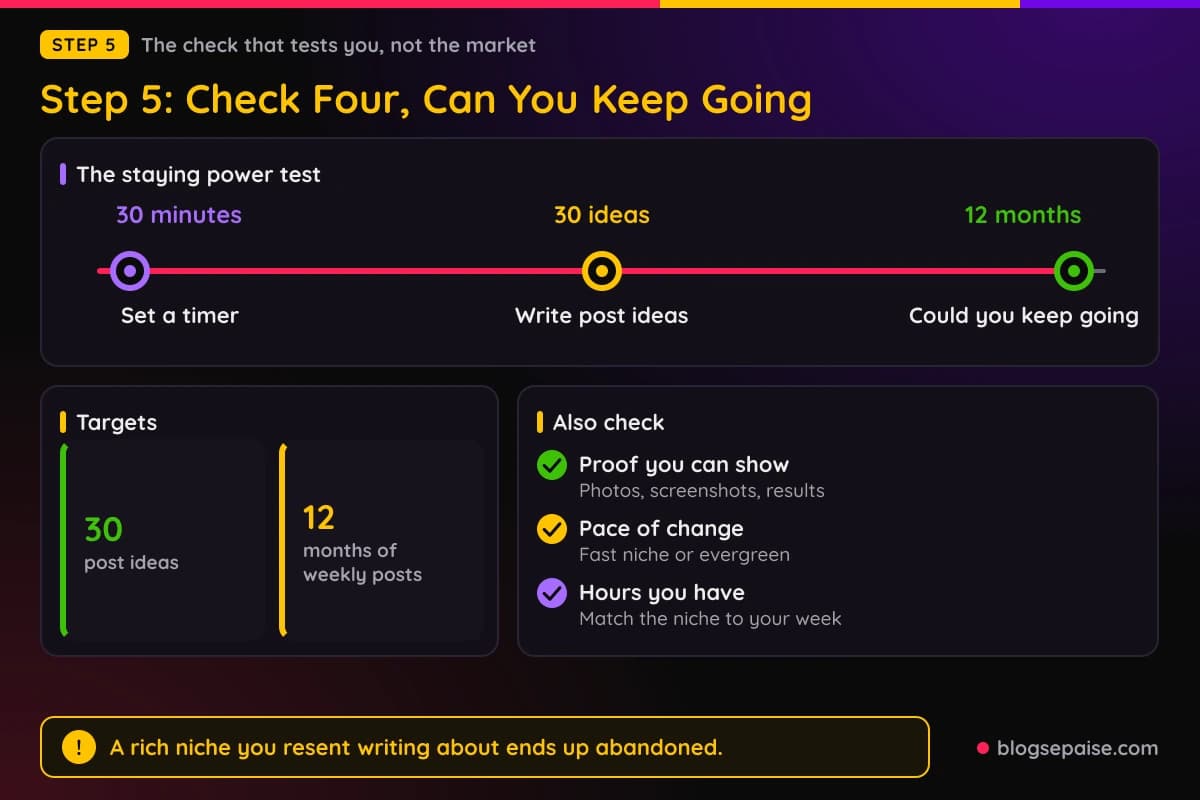
Run a simple test. Set a timer for 30 minutes and write down as many post ideas as you can for this niche.
If you reach 30 ideas without forcing it, you have enough material to publish for a long time. If you stall at eight and start repeating yourself, the niche may be too narrow for you or you may not know it well enough yet.
Next, ask yourself a blunt question. Could you write about this topic every week for 12 months without dreading it?
You do not need to be an expert. You do need to be curious enough to learn in public, and honest enough to say what you tested and what you did not.
Look at the kind of work the niche demands. A niche that needs constant product testing may cost real money, while one built on guides and comparisons can run on research and time.
Think about proof too. Readers trust a writer who shows real photos, real screenshots, and real results, so ask yourself what proof you could honestly collect for this topic.
Consider how fast the niche changes. A topic that shifts every month, such as software with weekly updates, asks you to refresh posts often, while an evergreen topic lets one good post work for years.
There is no right answer here, only a fit. Some people love the pace of a fast niche and get bored with a slow one.
Check your life as well. If you can only give four hours a week, choose a niche where a few strong posts can carry the site, not one that needs daily updates.
Now score the check. Give one point if you ran out of ideas quickly or felt bored, three points if you reached 30 ideas with some effort, and five points if the ideas flowed and you felt a pull to start writing.
A score of five here can rescue a niche that scored a little lower on the market checks. Energy turns into consistency, and consistency is what pays in this business.
On the other hand, a low score here is a real red flag even if the market looks great. A rich niche you resent writing about will end up as an abandoned site.
Step 6: Score The Four Checks And Decide
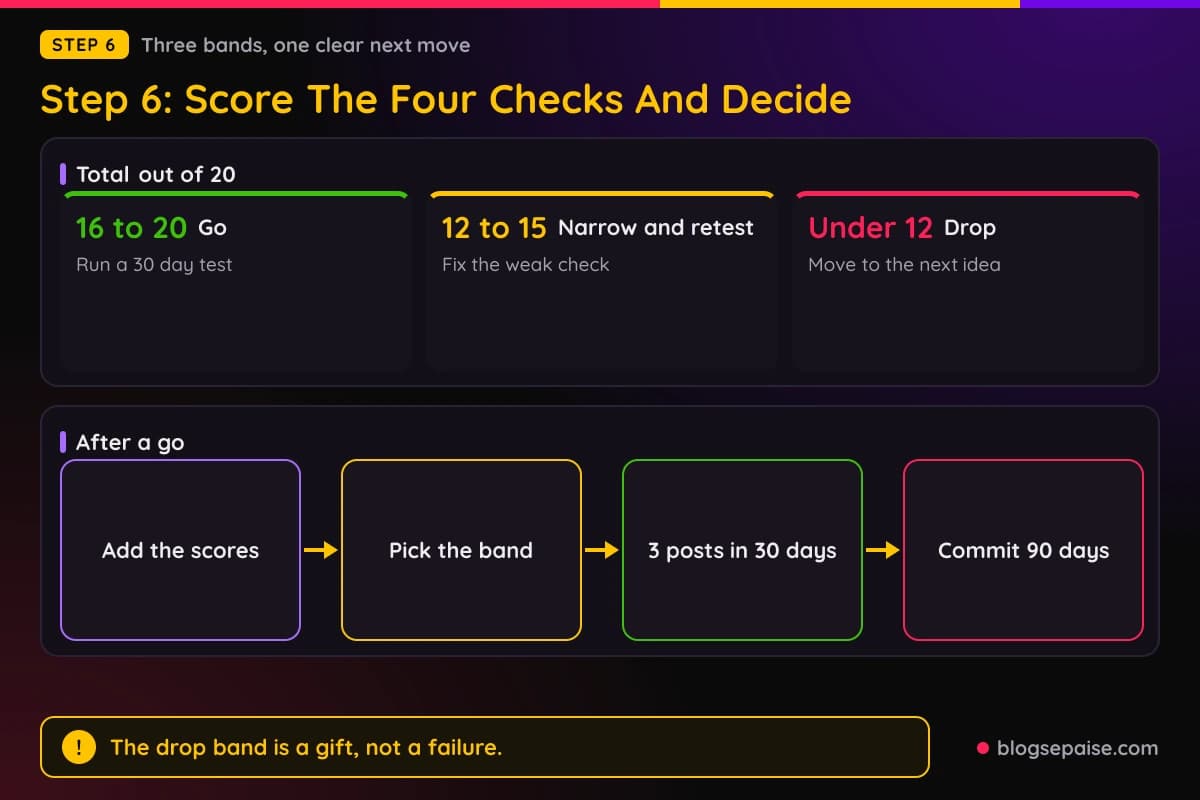
Now add up the four scores for each niche on your sheet. You will have a total from 4 to 20 for every idea.
Use three simple bands to decide. A total of 16 to 20 means go, a total of 12 to 15 means narrow the idea and test again, and a total under 12 means drop it.
The go band does not mean a sure win. It means the evidence points the right way, and the next step is a small real world test.
The middle band is where most niches land, and it is the most useful result. A score of 12 to 15 usually means one check is weak, so ask which one and if a narrower version of the idea would fix it.
For example, a niche with strong demand and weak reach often improves when you go narrower. Instead of a wide topic, pick a tight slice of it where the top results are thinner.
A niche that scores low on money may just be pointed at the wrong products. Look again for programs that sit next to the topic, such as tools or courses your reader would need along the way.
The drop band is a gift, not a failure. You spent eight hours instead of eight months, and you can now move to the next idea with a clear head.
Add one rule to protect yourself. If any single check scores a one, pause even if the total looks fine, because one broken link in the chain can sink the rest.
Once you have a go, run a small real world test before you buy anything. Plan three posts that answer three of your best questions, publish them over 30 days, and watch what happens.
Watch simple signs, such as the posts getting indexed, a few searches showing your pages, and early clicks in your search tools. Do not expect income this early, because the test is about signals, not money.
If the signals are decent after 30 days, commit to the niche for at least 90 days. A longer window gives the posts time to rank and gives you time to learn.
If the signals are poor, check which of your four scores was a guess and recheck it. You may find that your rating was too generous, and the fix is to adjust the score and the plan.
Keep the sheet after the decision. When you want to start a second site, the same sheet will let you compare a new idea against the one that worked.
You can also run your top ideas through the niche viability scorecard as a cross check. If both scores agree, you can move forward with more confidence.
A Made Up Example: Dana Tests Two Niches
To make the process concrete, here is a story. Dana is a made up person, and her two niches and all of her numbers are invented for this article.
Dana likes plants and also likes coffee, and she cannot decide which to build a site around. Her first idea is indoor herb gardening gear for small apartments, and her second is budget home espresso for beginners.
She sets up her sheet and gives herself two hours per check for each idea. Then she starts with demand.
For the herb idea she finds about 20 solid questions in search suggestions and a couple of community groups. Searches are modest but steady, so she gives it a four.
For the espresso idea she finds so many questions that she stops counting. Searches are strong and steady, and she gives it a five.
Next comes reach. For the herb idea, she finds three weak results on several searches, including forum threads and a thin post from a small site, so she scores it a four.
For the espresso idea, almost every first page is dominated by large brands and long guides, so she scores it a two. Dana notes that the specific questions near the bottom of her list might be easier, but the main phrases look like a crowd.
On the money check, the herb idea has a few products with programs, but the prices are low and none of them pay on a recurring basis, so she scores it a three. The espresso idea has several higher priced products with solid terms, and she scores it a four.
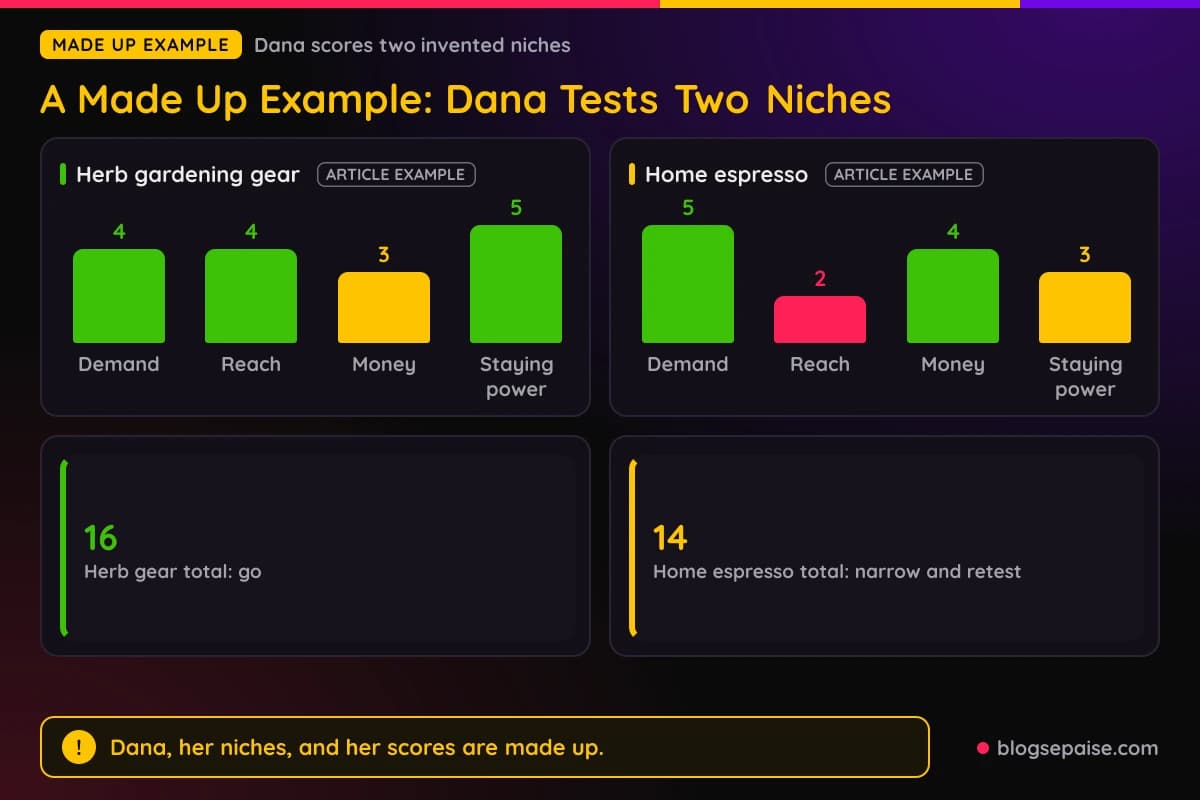
The last check is staying power. Dana lists 30 herb ideas in about 20 minutes and feels excited to write them, so she scores that niche a five.
For espresso she reaches 30 ideas too, but it takes the full half hour, and several ideas repeat. She also admits that she does not own much gear to test, so she scores it a three.
Now the totals. The herb idea scores 4, 4, 3, and 5, which adds up to 16, and the espresso idea scores 5, 2, 4, and 3, which adds up to 14.
By her own rules, the herb idea lands in the go band and the espresso idea lands in the narrow and retest band. The espresso idea is not dead, because its demand and money scores are strong.
Dana decides to start with the herb niche and to test three posts over 30 days. She also keeps a note to return to espresso with a narrower angle, such as small kitchen setups, since a tighter slice might fix its reach problem.
Notice what the sheet did for her. It stopped a coin flip, it showed her exactly where each idea was weak, and it gave her a plan for what to do next.
Remember that Dana, her niches, and her scores are made up for teaching. Your own numbers will be different, and that is the point of running the checks yourself.
Common Mistakes When Validating A Niche
The first mistake is falling in love with an idea before testing it. When you are excited, you score every check a little high, so write your evidence in the notes column and let the notes argue with your mood.
The second mistake is chasing big search numbers. A giant phrase with huge competition rarely helps a new site, while a smaller phrase with a clear buyer often does.
The third mistake is skipping the money check because the topic feels fun. Fun is great, but a hobby site that pays nothing for two years is a hobby, and that is fine only if you meant it to be one.
The fourth mistake is testing only one idea. With one idea you have no comparison, so you tend to talk yourself into it, and three ideas give you a fair contest.
The fifth mistake is letting the research run forever. Keep the eight hour time box, make a call, and run the 30 day test, because real feedback beats more reading.
The sixth mistake is treating a rule of thumb like a law. My numbers, such as 20 questions or three weak results, are starting points that make the work concrete, and you should adjust them as you learn.
The last mistake is forgetting to write things down. Without the sheet, you will remember the exciting parts and forget the warning signs.
Final Thoughts
Validating a niche is not glamorous work. It is a few evenings with a spreadsheet and a search box, and it can save you months of effort aimed at the wrong target.
The four checks are simple. Is there demand, can you reach the reader, does money move, and can you keep going.
Score each one honestly, add them up, and let the number guide you. A go means start a small test, a middle score means narrow and recheck, and a low score means move on without guilt.
You can finish the whole process this week. Pick three niche ideas tonight, write them as a topic plus a reader, and book your first two hour check on your calendar.
If you want a next step after you pick a niche, our guide on choosing your first affiliate product picks up right where this one ends. Good luck, and trust the sheet.
Frequently Asked Questions
1. How long does it take to validate a niche?
Plan on about eight hours, split into four checks of roughly two hours each. Add a 30 day test with three posts if the niche scores well.
2. Do I need paid tools to validate a niche?
No, free search suggestions, forums, and a spreadsheet can carry you through the first pass. A keyword tool helps with search numbers, but it is not required to begin.
3. What score means a niche is good enough?
In this guide, 16 to 20 out of 20 means go, 12 to 15 means narrow and retest, and under 12 means drop. Those bands are my own rule of thumb, so adjust them if your situation is different.
4. How many niches should I test at once?
Test three to five. Fewer than three gives you nothing to compare, and more than five tends to stretch your eight hours too thin.
5. What if my favorite niche scores low?
Look at which check dragged it down and ask if a narrower version would fix it. If the low score is on money or demand, be careful, because passion alone rarely fixes those.
6. Can a niche with big competition still work?
Yes, if you find a long tail of smaller questions where the results are weak. Competition often signals that money moves there, so it is a mixed signal, not a stop sign.
7. Should I build the website before I validate?
No, validate first. Every check in this guide works on paper, and a site built before the test can be a costly mistake.
8. What if the signals are poor after my 30 day test?
Recheck the scores that were based on guesses and see if one was too generous. Then narrow the idea, change the angle, or move to your next best niche.
9. How do I know if people will buy in a niche?
Look for buying questions, such as best, versus, and review searches, and check that products in the niche have real affiliate programs. If readers compare options before they pay, that is a good sign.
10. Can I change my niche later?
Yes, and many people do. The sheet makes the switch easier because you can compare the new idea against the old scores instead of starting from nothing.