Learning Affiliate Marketing Without a Mentor: The Self-Study Path
Most people who want to learn affiliate marketing do not have a coach, a mentor, or a friend who has done it before. They have a laptop, a few free evenings, and a browser with forty tabs open.
If that sounds like you, good news. You can learn this skill alone, and plenty of people have done it before you.
The catch is that self-study has no teacher to say what comes next. Without that guide, it is easy to bounce between videos, buy a course too early, and feel busy while nothing gets built.
So we put together a seven step plan you can follow in order. It fits into 12 weeks, asks for about 8 hours a week, and replaces the mentor with a simple system of feedback and records.
If you are brand new to the topic, start with our guide on what affiliate marketing is and then come back here. When you want a day by day view of the first month, our first 30 days plan pairs well with this one.
Disclosure: Some of the links I share might be affiliate links. If you click on one and make a purchase, I may earn a small commission as a thank you. But don’t worry, it won’t cost you anything extra. I only recommend stuff I genuinely believe in. Your support helps me keep creating awesome content. You can read my full affiliate disclosure in my disclaimer page.
If you want to save a lot of hours searching for high-paying affiliate programs, check out our exclusive list of 2500+ affiliate programs. You’ll find all the information about the programs inside the list. This list is perfect for affiliate bloggers and influencers.
Learning Affiliate Marketing Alone: The Short Answer
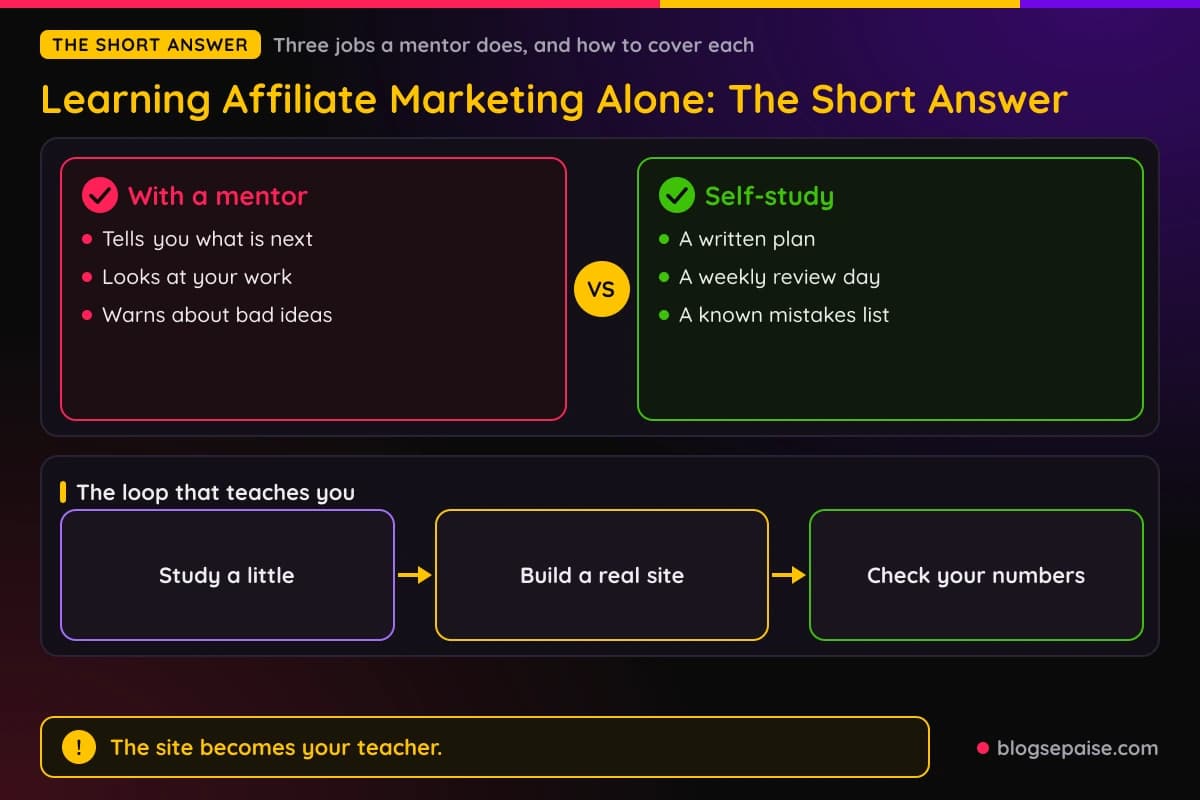
You can learn affiliate marketing without a mentor by studying a little, building a real site right away, and checking your own numbers every week. The site becomes your teacher, because it shows you what works and what does not.
A mentor mostly gives you three things. They tell you what to learn next, they look at your work, and they keep you from wasting months on bad ideas.
You can cover all three on your own. A written plan answers the first, a set review day answers the second, and a short list of known mistakes handles the third.
Self-study also has real strengths. You move at your own speed, you spend nothing on coaching, and you learn to solve problems yourself, which is the skill that pays off for years.
The trade off is time. A mentor can save you a few wrong turns, while self-study means you hit some of them yourself.
That is fine, as long as each wrong turn is small and you write down what it taught you. The steps below keep your mistakes cheap.
Many beginners worry that going solo means going slow. In practice, the people who stall are the ones with no plan, and a plan fixes that with or without a coach.
Think of it like learning to cook from a library of cookbooks. You can get good without a chef standing next to you, but you do need to actually cook the meals and taste the results.
Step 1: Set One Clear Goal And A 12 Week Window
Self-study falls apart when the goal is fuzzy. Words like "learn affiliate marketing" are too big to act on, because you can never tell when you are done.
Pick a goal you can check. A good first goal is to publish 12 helpful posts, join one affiliate program, and get your first click on an affiliate link.
Notice that the goal does not say "earn $1,000." Early on you do not control the money, but you do control the work, so you set goals around the work.
Next, choose a window of time. We suggest 12 weeks, which is long enough to see real progress and short enough to stay focused.
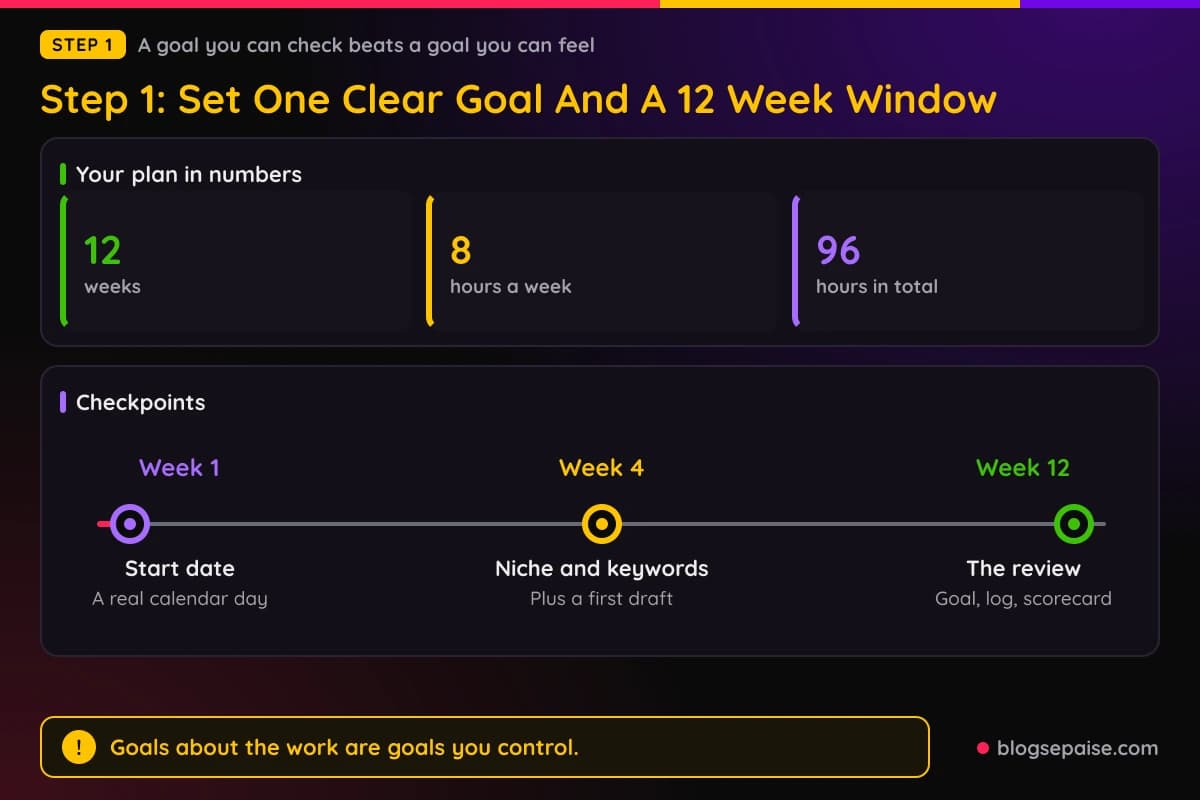
Then pick your weekly hours and protect them. Eight hours a week is a good target, which adds up to 96 hours across the 12 weeks.
If you can only give four hours, stretch the window to 24 weeks and keep everything else the same. Slow and steady beats a burst of energy that fades after ten days.
Write the goal, the window, and the weekly hours on one page. Put that page where you will see it, because you will be the only person asking if you did the work.
Also decide what counts as a pass. For the 12 week plan, a pass means you kept at least 80 percent of your planned hours and published at least 9 of your 12 posts.
That rule matters because it keeps you honest without making you perfect. Missing a week of hours is normal, and the rule lets you miss one and still count the run as a win.
Last, set a start date. Not "soon" and not "next month," but a real calendar day, since vague starts tend to turn into no starts at all.
Step 2: Build A Free Curriculum Instead Of Buying A Course
A mentor would hand you a lesson plan. You can build your own from free material in about two hours.
Start with the free training your affiliate networks and programs already publish. Most of them have help pages, setup guides, and short videos that explain links, reports, and payouts in plain language.
We also keep a list of free affiliate marketing training that you can pull from.
Add three types of sources. Pick a few blogs that teach SEO in plain words, one or two video channels that show real screens, and a book or two on writing for readers.
Resist the urge to collect fifty sources. Five good ones you actually finish beat fifty you never open.
Check each source before you add it to the list. Look at the date, because affiliate rules and search tools change fast, and a guide from six years ago can send you in the wrong direction.
Keep a short note beside each source that says what you will use it for. One source might teach keywords, another might teach writing, and a third might cover program rules, so you always know why each one is on the list.
Also check that the author shows real work. A teacher with a live site, screenshots of their own reports, and honest notes about failures is worth far more than a teacher with a flashy sales page.
Now split your 96 hours into three buckets. Put about 30 hours into studying, about 50 hours into building and writing, and about 16 hours into reviewing results.
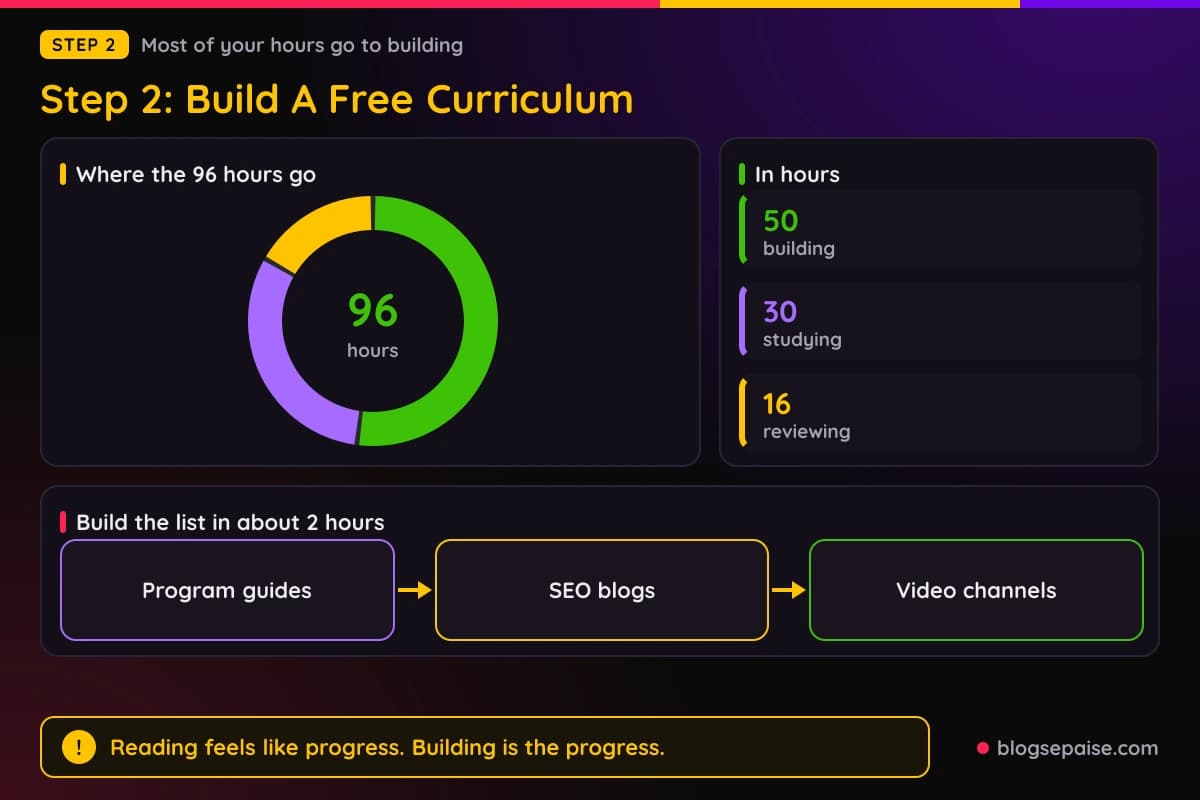
Notice how much of the plan is building. That is on purpose, because reading about affiliate marketing feels like progress but only practice teaches the skill.
Do not buy a paid course in the first 12 weeks. Once you have a live site and real questions, a course is easier to judge, since you know which gaps it needs to fill.
If your budget is tight, our guide on affiliate marketing on a tight budget shows which tools are worth paying for and which are not.
Step 3: Learn The Core Skills In The Right Order
The order of your lessons matters more than the number of lessons. Learn the next skill only after the last one has something to stand on.
Begin with how the model works. Learn who pays whom, what a commission is, how cookies track a click, and why programs approve or reject new sites.
Second, learn how to choose a niche. Our guide on how to choose a profitable niche walks through it, and you should finish it before you buy a domain.
Third comes keyword research, which tells you what people type into search when they want help. A keyword tool gives you search counts and difficulty scores, and our guide on how to do keyword research shows how to read them.
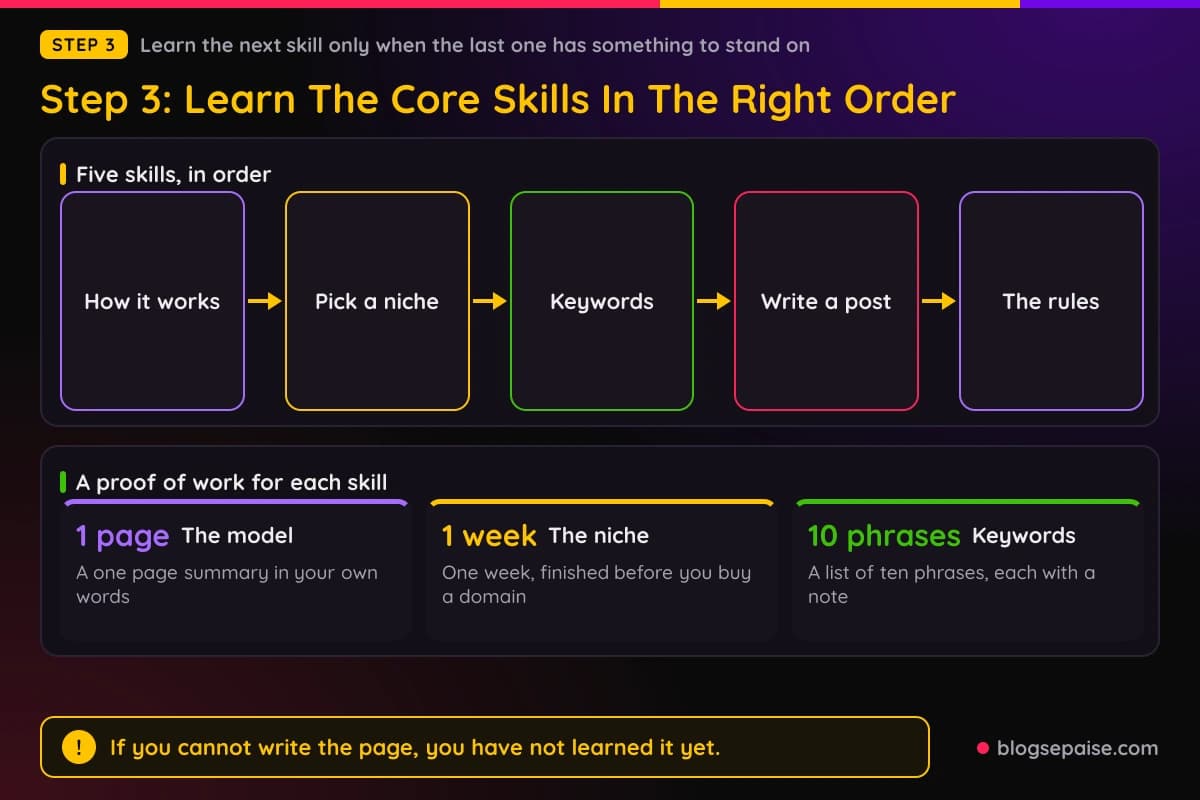
Fourth is writing a useful post. Learn how to match a search, answer the question fast, and place a product link where the reader is ready for it.
Fifth is the rules side, which covers disclosures and program terms. Skipping it can get you banned, so read our notes on affiliate disclosures early instead of late.
Spend roughly one week on each of the first three skills, and let the last two grow as you publish. By week four you should have a niche, a list of keywords, and a draft of your first post.
Give every skill a small proof of work. For the model, write a one page summary in your own words, and for keywords, build a list of ten phrases with notes on why each one fits a reader.
A proof of work turns a vague feeling of "I get it" into something you can check. If you cannot write the page, you have not learned the skill yet, and that is useful to know.
When you hit a skill that feels too hard, do not skip it. Cut it into a smaller question, such as "how do I find one keyword with low competition," and answer only that question today.
How To Study One Lesson The Right Way
Before we get to the build, a word on how to study each lesson. A simple routine keeps you from watching videos for three hours and remembering nothing.
Start with a question. Write down what you want to know before you open the lesson, such as "how does a cookie decide who gets paid."
Then read or watch with a pen in your hand. Pause every few minutes and write one sentence in your own words, since copying what the teacher said does not count.
After the lesson, do something with it right away. If you learned about link placement, open one of your drafts and move a link, and if you learned about titles, rewrite two.
Finally, teach it back. Explain the lesson out loud, or write three lines to a friend, because a lesson you can explain is a lesson you own.
The routine takes about 90 minutes for one lesson, which fits well inside an 8 hour week. Two or three lessons a week is plenty, and the rest of your time goes to building.
Step 4: Build A Practice Site While You Study
Here is the biggest difference between people who learn this alone and succeed and people who stall. The ones who succeed start a real site in the first two weeks.
A real site gives your studying a place to land. Every lesson becomes a task, and every task leaves proof that you did it.
Keep the setup simple. Pick a domain, choose a basic hosting plan, and install a clean theme, and our guide on how to set up WordPress covers each click.
Do not spend a week on the logo or the color scheme. Visitors care about answers, and search engines care about clear pages, so the design can stay plain for now.
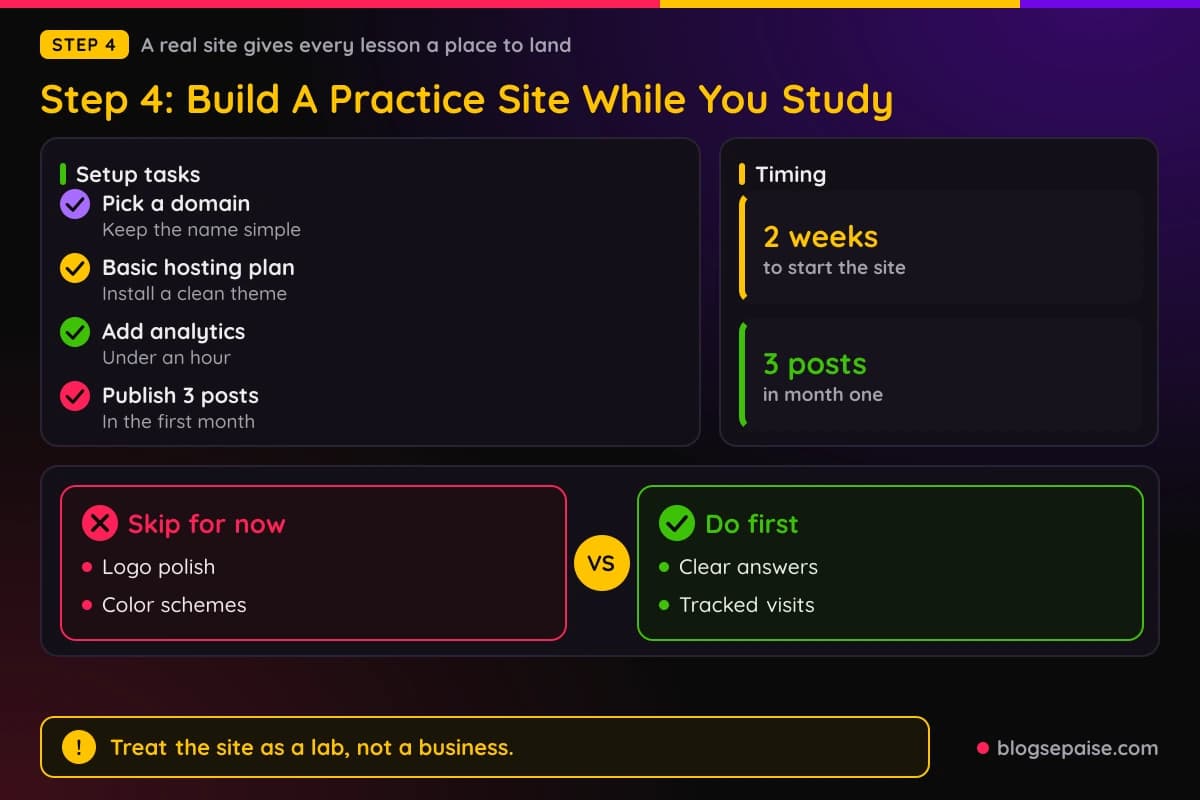
Add analytics from day one. Our walkthrough on Google Analytics set up takes less than an hour, and it means every visit from now on gets counted.
Then publish a small first batch. Aim for three posts in the first month, and make each one answer a single question that a real person would search for.
Treat the site as a lab and not as a business for now. Your job in these 12 weeks is to learn quickly, and a site you are allowed to get wrong helps you do that.
It is also fine if the site is not perfect. Most first posts are rough, and the fix is simply to write the second one.
Step 5: Replace The Mentor With Feedback Loops
A mentor looks at your work and says what is off. Without one, you need a loop that gives you the same answer from data and from other people.
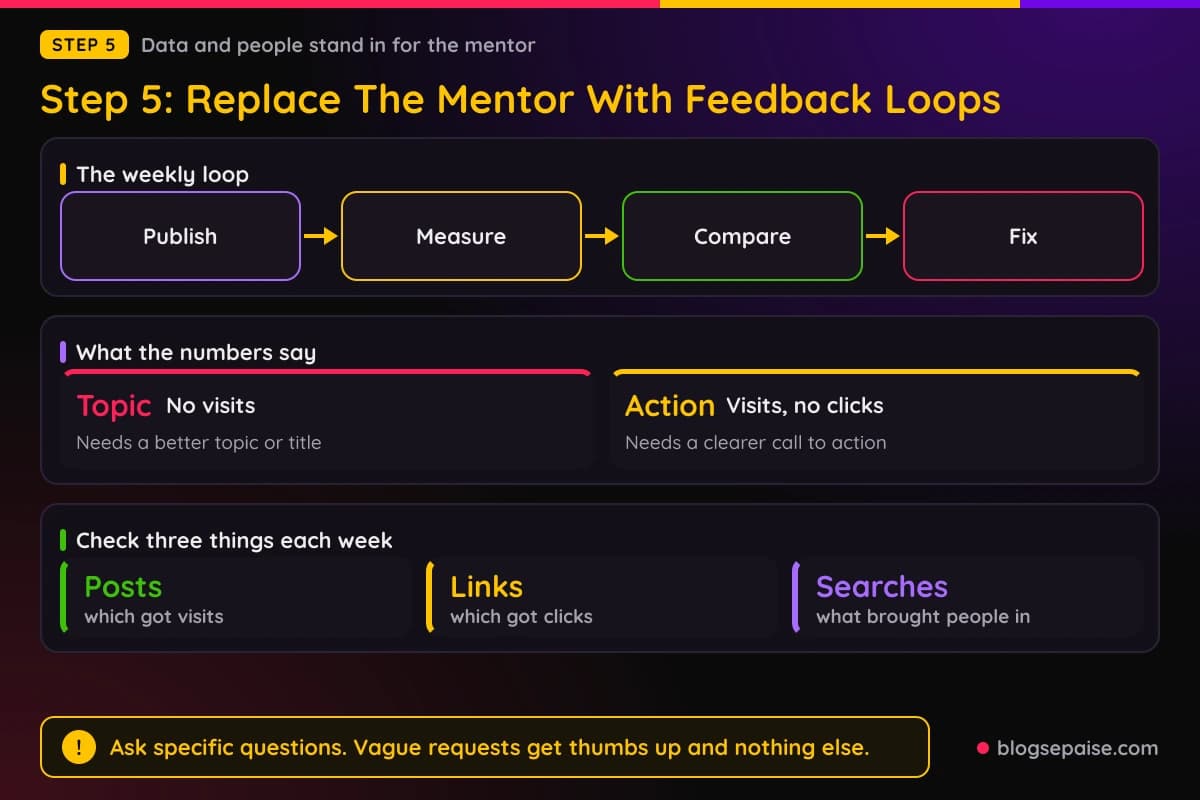
Start with data. Once a week, open your analytics and your affiliate dashboard, and look at three things: which posts got visits, which links got clicks, and which searches brought people in.
Those three answers are blunt and honest. A post with no visits needs a better topic or a better title, while a post with visits and no clicks needs a clearer call to action.
Next, add human feedback. Join one or two beginner communities, share a post, and ask a specific question instead of "what do you think."
A question like "does my intro answer the search in the first two lines" gets real replies. A vague request tends to get a thumbs up and nothing else.
Be careful with advice online. Take ideas from people who show their own results, check them against your own data, and ignore anyone who promises quick money.
You can also borrow structure from your own past work. Reread a post you wrote three weeks ago, and the weak spots will jump out the way they would for a mentor.
Another good habit is to set a weekly question for yourself. For example, ask which post has the weakest title, and then spend twenty minutes making it better.
Small weekly questions add up. After 12 of them you will have improved your site 12 times, and each fix came from your own judgment.
Finally, compare your page to the top results for the same search. Note how long they are, how they open, and what questions they answer, then ask what yours is missing.
Step 6: Keep A Learning Log And A Simple Scorecard
When you learn alone, your memory is your only record. A short log turns scattered lessons into something you can reuse.
Open one document or spreadsheet, and a note app like Notion works well for it. Create a new entry for each study session with three lines: what you learned, what you did with it, and what you still do not get.
The third line matters most. A list of open questions tells you what to study next, which is exactly the job a mentor does.
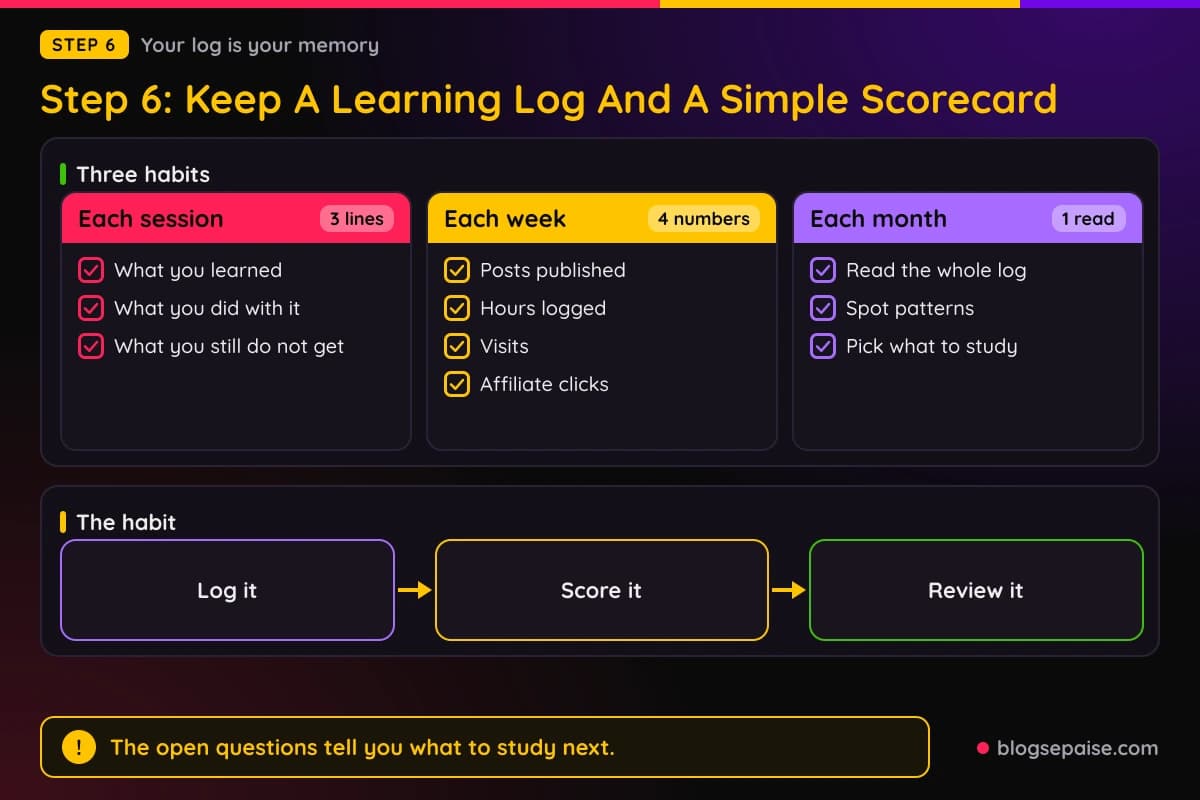
Add a weekly scorecard with a few numbers. Count the posts you published, the hours you logged, the visits you got, and the clicks on affiliate links.
Keep the numbers small and honest. Zero is a fine number in month one, as long as you write it down and watch it change.
If you want a system for the money side, our guide on tracking affiliate income when starting shows what to record and how.
Mark each log entry with one word for how it felt, like "easy," "stuck," or "bored." Those labels show which topics drain you and which ones give you energy.
Energy matters in a long project. If every keyword session feels easy and every writing session feels like pulling teeth, you now know where to ask for help.
Once a month, read the whole log from the top. You will spot patterns that are invisible in the moment, like the day of the week when you always skip your hours.
Step 7: Review At Week 12 And Pick Your Next Move
Your 12 weeks end with a review, which is the self-study version of a graduation talk. Sit down for one hour and go through your goal, your log, and your scorecard.
Ask four questions. Did you hit the goal, did your hours match the plan, what did the data show, and what do you want to learn next.
Then choose one of three moves. Keep going with the same plan if you are on track, adjust the plan if something clearly is not working, or pause and rest if life got in the way.
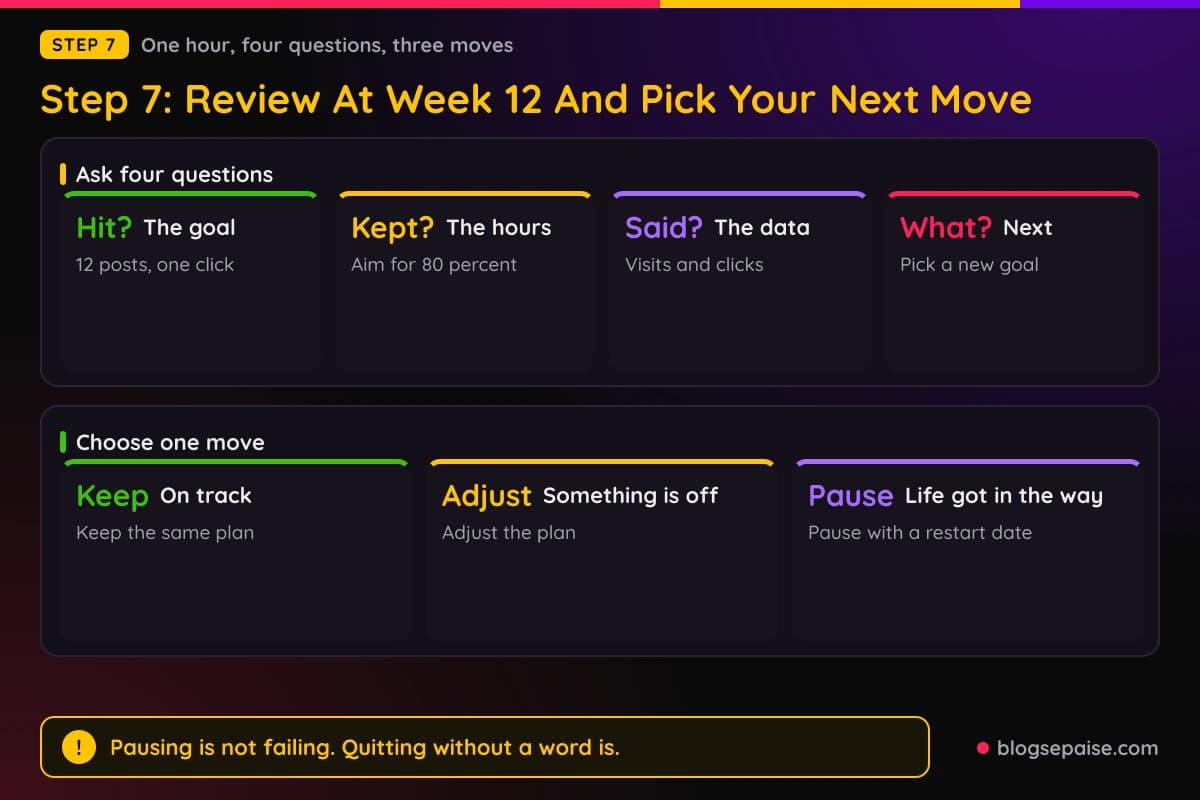
Pausing is not failing. A short break with a clear restart date is far better than quitting without a word.
If you hit your goal, set the next one. A fresh goal might be 24 posts, a first commission, or a second program, and a new 12 week window keeps the cycle going.
If you missed the goal, look at the hours first. Most missed goals come from missed hours and not from a lack of talent, so protect the schedule before you change anything else.
Share your results with someone. A friend, a community, or even a public post makes the next 12 weeks feel real.
What To Do When You Get Stuck
Everyone gets stuck, and without a mentor the stuck moments feel heavier. A short routine helps you get moving again.
First, shrink the problem. Write the exact thing you cannot do in one sentence, and then cut it in half until the question is small enough to search.
Second, search the exact question. Add the word "beginner" to your search, and read two sources instead of one so you can see where they agree.
Third, ask a person. Post the question in a beginner community, show what you already tried, and say what you expect to happen.
Fourth, set a timer. Give yourself 45 minutes to solve the problem, and if it is still unsolved, write it in your log and move to another task.
Many problems solve themselves after a night of sleep and a fresh look. Moving on is not quitting, it is a way to keep your weekly hours from leaking away.
A Real World Example: Maya's First 12 Weeks
Here is a made up example to show how the plan works in practice. Maya is not a real person, and the numbers below are for illustration only.
Maya works full time and has 8 hours a week. She sets a goal of 12 posts and one affiliate click, then picks a start date on a Monday.
In weeks one and two she studies and sets up a basic site. By week four she has a niche, ten keywords, and her first two posts live.
Over weeks five to eight she publishes one post a week, which puts six posts live by week eight, and she checks her numbers on Sunday night. She posts her third article in a beginner group and asks one clear question about the intro.
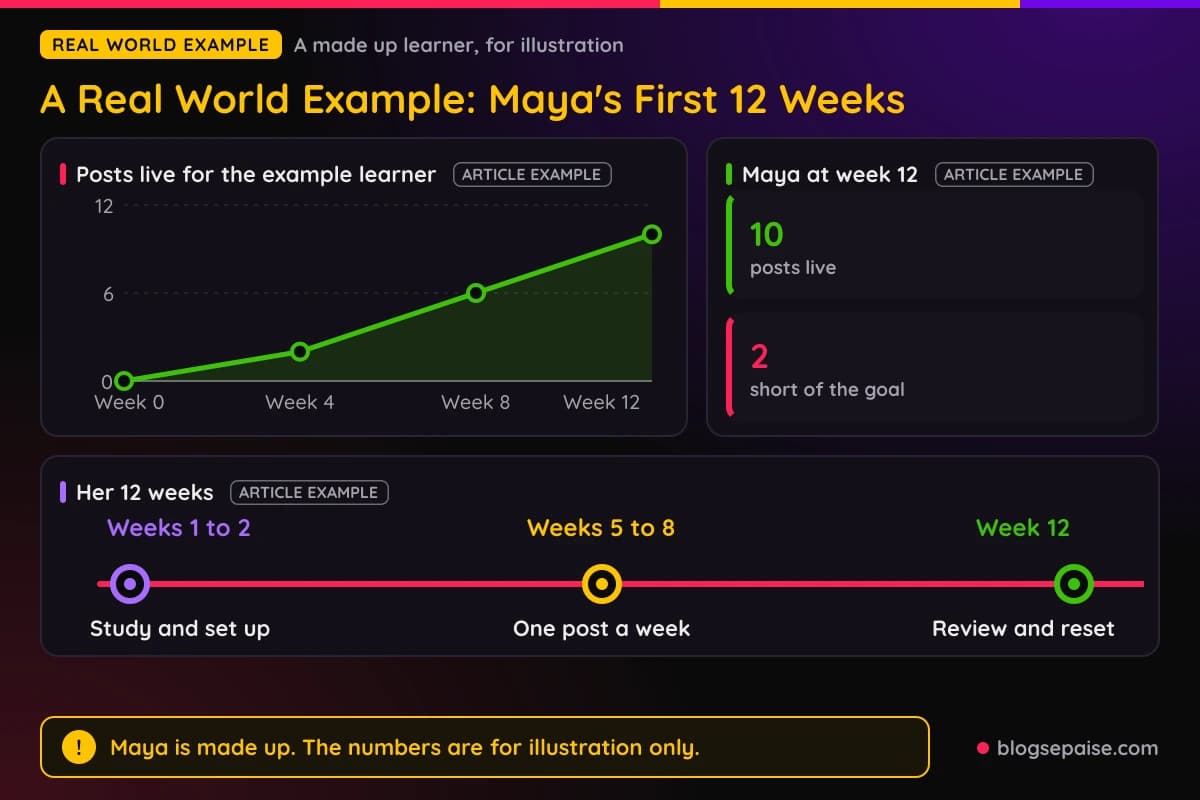
The feedback leads her to shorten her intros and add a link earlier in the post. In weeks nine to twelve she keeps publishing and also rewrites two older posts.
At the week 12 review, Maya has 10 posts live, her goal is missed by two posts, and she has her first affiliate click. She reads her log, sees that two weeks of low hours caused the miss, and picks a fresh 12 week window with the same plan.
Notice what Maya did not do. She did not buy a course, she did not switch niches in week six, and she did not skip her Sunday check.
The story is a small one, and that is the point. There is no big win, just a steady loop of study, build, check, and fix.
How To Tell That You Are Making Progress
When nobody grades your work, progress can feel invisible. You need a few signs that tell you the plan is working, even when the money is still at zero.
The first sign is speed. Your first post might take six hours, and by week eight the same kind of post takes three, which means your skill is growing.
The second sign is better questions. In week one you ask "how do I start," and by week ten you ask "why does this post get visits but no clicks." Sharper questions mean deeper learning.
The third sign is that you start spotting mistakes in other people's work. You see a weak intro, a buried link, or a missing disclosure on a popular blog, and you know exactly how to fix it.
The fourth sign is steady output. If you published nine of your twelve posts and kept most of your hours, you have built a habit, and a habit is worth more than any single tip.
Money shows up later. Most new sites need several months before search engines send steady visits, so judging the plan by early income is like judging a seed by how tall it is on day three.
Write these signs in your log. On a slow week, reading that your posts now take half the time is a good way to keep going.
Common Mistakes When Teaching Yourself
Self-study has a few predictable traps. Knowing them early lets you step around them.
The first trap is course hoarding. You buy three courses, finish none, and feel guilty about all of them, so keep to the free curriculum in step two until the site is live.
The second trap is waiting until you feel ready. Nobody feels ready, and a first post written at week one teaches you more than ten hours of reading.
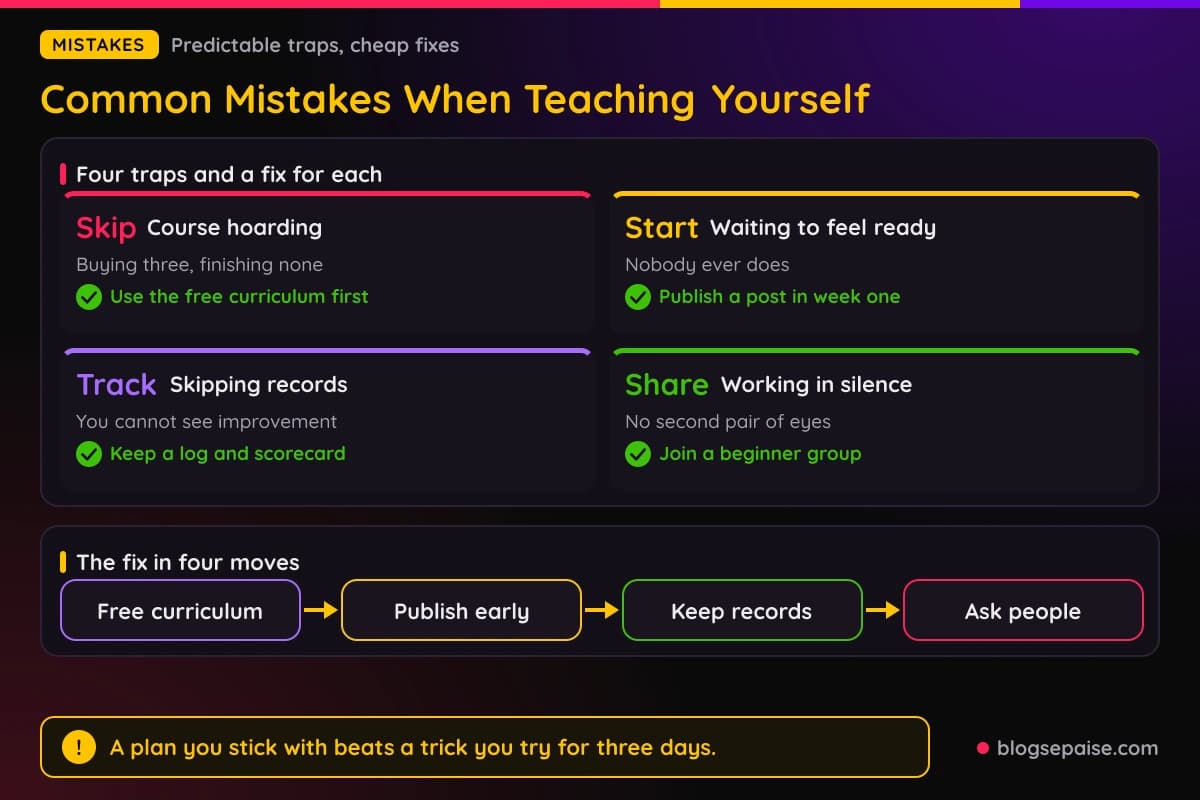
The third trap is skipping the records. Without a log and a scorecard, you cannot tell if you are improving, and you end up repeating the same errors.
The fourth trap is chasing every new tactic. Short videos promise a secret trick every week, but a plan you stick with will beat a trick you try for three days.
The fifth trap is working alone in total silence. Even a tiny community gives you a second pair of eyes, and a second pair of eyes is the main thing a mentor offers.
Another quiet mistake is polishing instead of publishing. Fixing the same paragraph for three hours feels like work, while a rough post that goes live starts collecting data.
Last, watch out for the comparison trap. Someone else's income screenshot says nothing about their hours, their budget, or how long they have been at it, so measure yourself against last month's you.
Free Tools That Make Self-Study Easier
You do not need a pile of paid software to learn this skill. A few free tools cover most of what you need in the first 12 weeks.
Use your analytics tool for traffic, your affiliate dashboard for clicks, and a spreadsheet for your scorecard. A note app holds the learning log, and a calendar holds your protected hours.
Add a keyword tool when you reach the research step. Many offer a limited free plan, and a paid keyword research tool only makes sense once you are publishing every week and hitting the free limits.
Resist new tools when you feel stuck. A fresh app feels like progress, yet the real fix is nearly always more practice on the basics.
Our list of affiliate marketing tools shows which tools earn a spot once the site is running. Until then, keep the setup light and your attention on the work.
Final Thoughts
You do not need a mentor to learn affiliate marketing. You need a goal, a plan, a real site, and a habit of checking what the numbers say.
Set your 12 week window, build a free curriculum, and learn the core skills in order. Launch a practice site, create feedback loops, keep a log, and hold a review at the end.
Some wrong turns will happen, and that is normal. Each one becomes a note in your log and a lesson you will not need to learn twice.
Keep your expectations kind. Twelve weeks will not make you an expert, but it will give you a working site, a set of habits, and a clear picture of what to learn next.
That picture is the real prize. Once you can see the road ahead, the next 12 weeks get easier, and the 12 after that get easier still.
Pick a start date today, and write it on your goal page. The best time to begin the first 12 weeks is the one you actually put on the calendar.
Frequently Asked Questions
1. Can you really learn affiliate marketing on your own?
Yes, because plenty of free lessons, program guides, and community posts exist, and the missing piece is a plan that puts them in order.
2. How long does it take to learn affiliate marketing alone?
Plan on 12 weeks at about 8 hours a week for the basics. Skills like writing and SEO keep growing for years after that.
3. Do I need to pay for a course?
Not at first. Use free training from programs and networks for the first 12 weeks, and buy a course later if you find a specific gap.
4. Where do I get feedback if I have no mentor?
Use your own analytics each week and a beginner community for human feedback. Ask specific questions and share real posts.
5. What should I learn first?
Start with how the model works, then niche choice, then keyword research. Writing and rules grow as you publish.
6. When should I start my site?
Start in the first two weeks. A real site turns every lesson into a task and gives you data to learn from.
7. How many hours a week do I need?
Eight hours is a solid target. With four hours, stretch the plan to 24 weeks and keep the same steps.
8. What if I fall behind?
Check your hours first, then reset the plan. Missing a week is normal, so restart on the next Monday instead of quitting.
9. Is it worth getting a mentor later?
Often yes, since after 12 weeks you know what to ask and a mentor can speed up the hardest parts. You also know your own numbers, which makes a mentor's advice far easier to judge.