How Are Affiliate Commissions Calculated And Paid? (2026)
You sent a reader to a product page, and the sale went through. Now you want to know when the money reaches your account and why the number looks smaller than you expected.
Most beginners learn how affiliate commissions are paid the hard way. They see a pending balance for weeks, then a reversal, then a payout date that feels far away.
The system is not random. Every program follows the same basic path of sale, wait, approval, and payment, with different rules at each step.
Below you will see how commissions are calculated, how long they sit on hold, and what to do when a payment runs late. Rules change, so check your own program terms before you plan around any number you read here.
Disclosure: Some of the links I share might be affiliate links. If you click on one and make a purchase, I may earn a small commission as a thank you. But don’t worry, it won’t cost you anything extra. I only recommend stuff I genuinely believe in. Your support helps me keep creating awesome content. You can read my full affiliate disclosure in my disclaimer page.
If you want to save a lot of hours searching for high-paying affiliate programs, check out our exclusive list of 2500+ affiliate programs. You’ll find all the information about the programs inside the list. This list is perfect for affiliate bloggers and influencers.
How Affiliate Commissions Are Calculated
A commission is the cut a program pays you for a sale or an action that you sent. The program decides the formula, and you find it in the program terms or inside your dashboard.
Most programs use three models. They pay a percentage of the sale, a flat fee for an action, or a recurring share of a subscription.
A percentage commission is the easiest to picture. If a program pays 6% and your reader buys a $200 blender, you earn $12.
Retail programs often pay low single digit percentages because stores run on thin margins. Software programs often pay much more, since a digital product costs little to deliver.
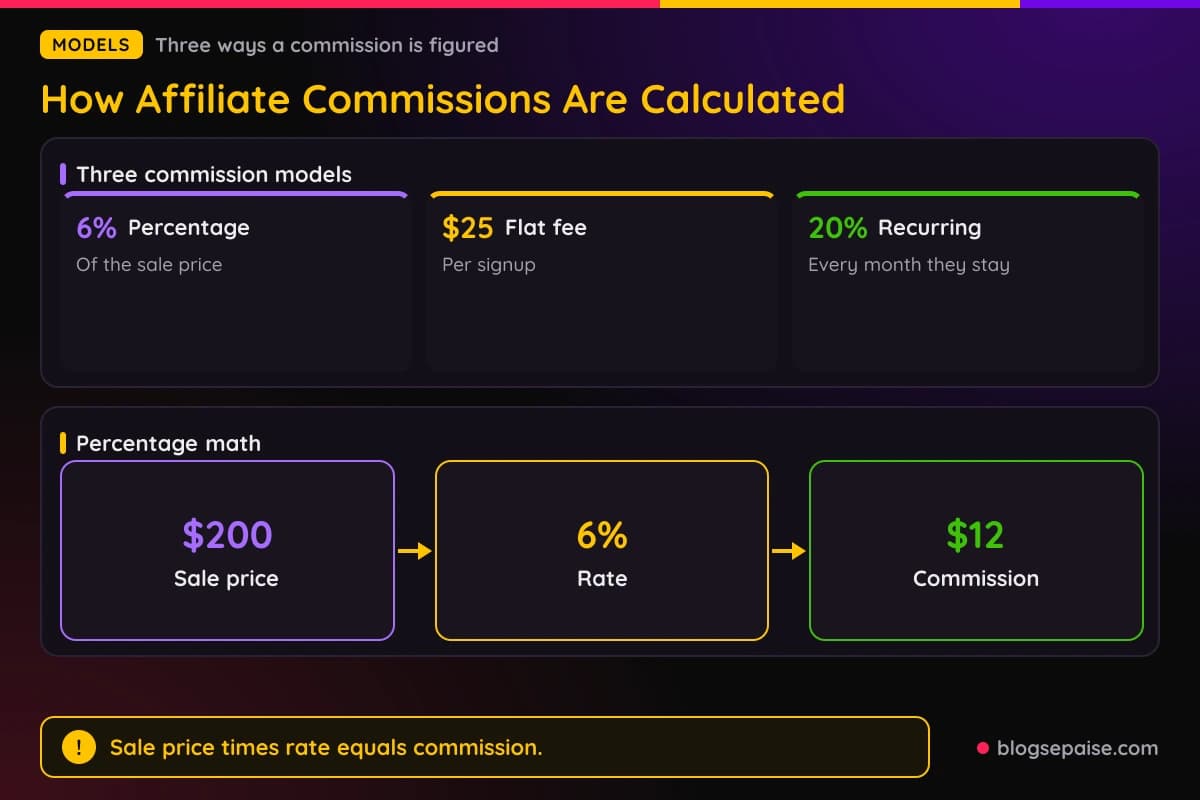
A flat fee ignores the price of the order. If a program pays $25 for every signup, you earn $25 on a cheap plan or an expensive one.
Flat fees show up with free trials, lead forms, and app installs. The action counts, not the dollar amount of the purchase.
A recurring commission pays you again each time the customer renews. If a plan costs $30 a month and the program shares 20%, you earn $6 every month the customer stays.
Our guide on recurring vs one-time commissions shows how that second kind of income stacks over a year. Recurring deals take longer to build, but they pay on work you did once.
Some programs also pay tiers. You might earn 5% on your first ten sales in a month and 7% after that.
The base for the percentage matters too. Many programs pay on the item price before tax and shipping, and some exclude discounts, gift cards, or certain product categories.
The formula to remember is simple. Sale price times rate equals commission, with the fine print deciding what counts as the sale price.
Always check how the program counts a sale. Some count the order total, and others count only the qualifying items in the cart.
Currency and rounding can shift the cents. Small gaps between your dashboard and your own math are normal.
If you want to test numbers before you join a program, try the commission earnings estimator on this site. It turns a rate and a sales count into a monthly total.
A Worked Example: Maya Earns Three Kinds Of Commission
Numbers stick better when you follow one person through a month. Meet Maya, who runs a small kitchen blog and promotes three programs at once.
In March, Maya sells ten blenders through a retail program that pays 6%. Each blender costs $200, so the sales add up to $2,000.
Ten sales at $12 each gives her $120 in percentage commissions. She did not touch any of that money yet, and it sits in her dashboard as pending.
Maya also promotes a recipe app that pays a flat $25 per signup. Four readers sign up in March, which gives her $100.
The third program is a meal planning tool with a 20% recurring share on a $30 monthly plan. Ten readers subscribe, and each one earns her $6 a month, so that stream adds $60.
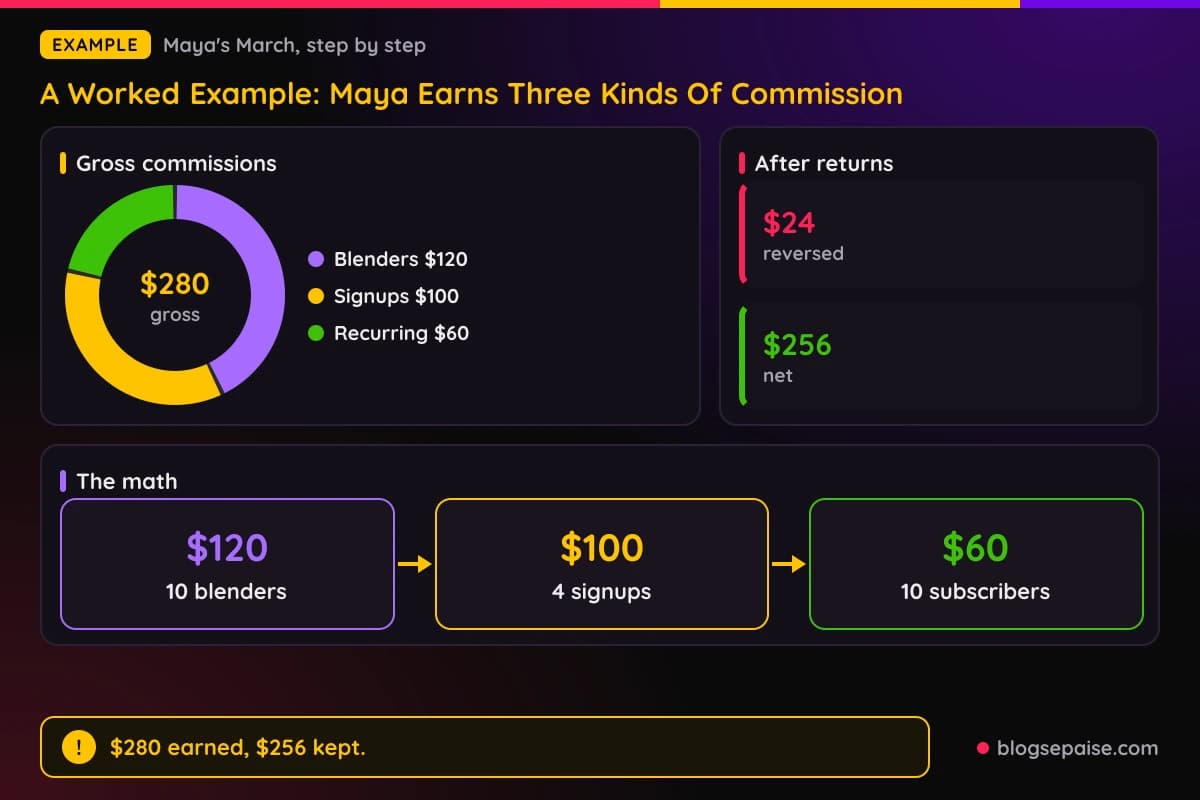
Add the three streams and her gross for the month is $280. That is the number she sees first, and it feels great.
Then the returns arrive. Two of the ten blenders go back to the store, and each one takes back its $12 commission, which is $24 in all.
Her net for March falls from $280 to $256. The $24 is not a mistake, because the program only pays on sales that stick.
Notice that the recurring $60 is not a one time gain. If all ten subscribers stay for a year, each one is worth $72 to Maya, and the stream adds up to $720.
Notice also that none of the $256 is cash yet. Maya still has to wait for the hold, the approval, and the payout date, which the next sections cover.
Now picture a slower month. If Maya sold only three blenders, her percentage income would be , and the signup and recurring streams would carry more of the weight.
Spreading income across models smooths the ups and downs. Recurring money keeps coming when sales dip, and flat fees add quick wins.
Track every stream in one place so you can see gross, reversed, and net side by side. Our post on how to track affiliate income when starting has a simple setup.
The Life Of A Commission From Click To Payout
Every commission moves through the same stages. The names differ from program to program, but the order does not.
First comes the click. A reader taps your link, and a tracking cookie records that you sent them.
The cookie has a lifespan, and our page on why cookie windows matter explains why a longer window helps you. If the reader buys inside that window, you get credit.
Next comes the sale, and the commission shows up as pending or locked. It is a promise, not money, because the sale can still be canceled.
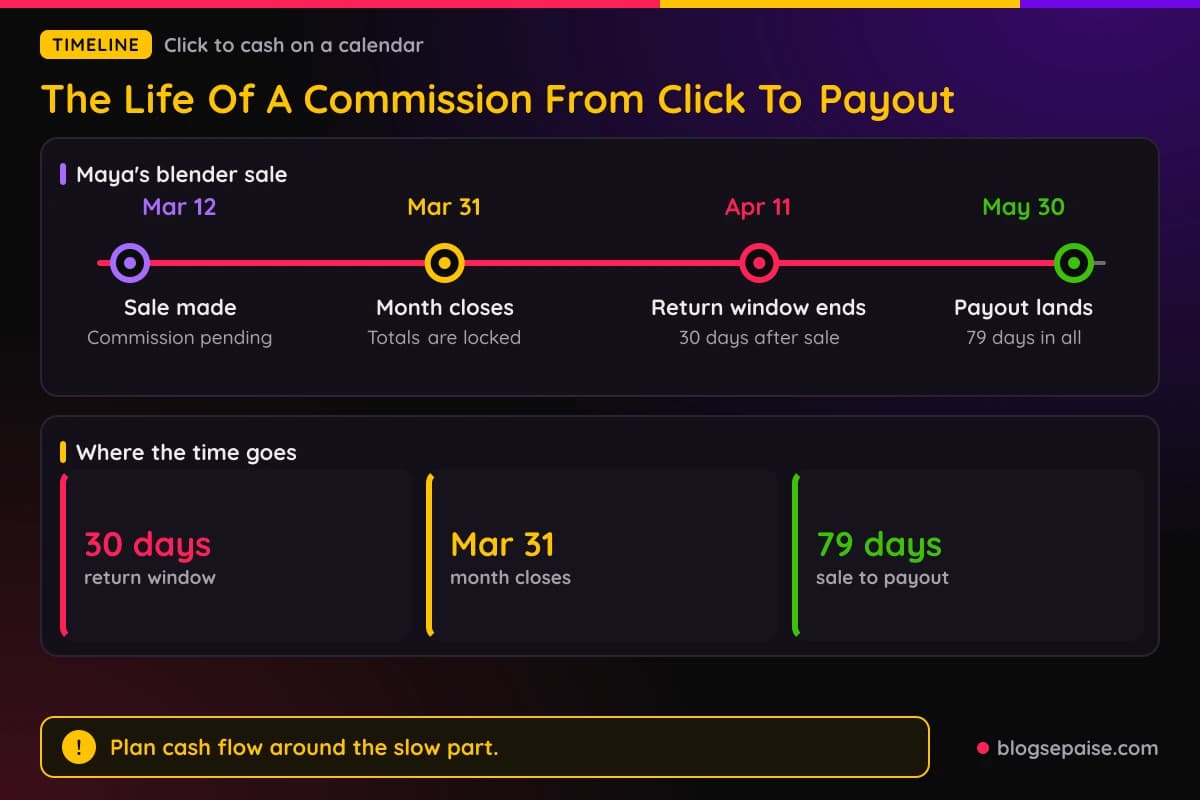
The program then waits for the return window to close. Many stores give shoppers around 30 days to send an item back, and the program waits at least that long.
After the wait, the commission becomes approved or payable. At that point the program agrees you earned it.
Then the payment cycle starts. Some programs pay on a fixed date each month, and others pay a set number of days after the month ends.
Here is Maya's blender sale on a calendar. She earns the commission on March 12, and the month closes on March 31.
The 30 day return window for that sale ends on April 11. The program then approves the money.
If the program pays 60 days after the end of the month, the payout date is May 30. From sale to cash, that is 79 days.
That gap surprises beginners more than any other part of the system. A sale in March can easily mean money in your bank in late May.
Plan your cash flow around the slow part. Never spend money you have only earned on paper.
Dashboards use different labels for the same stages. Look for words like pending, locked, approved, payable, and paid.
Only the last label means money is on its way. Everything before it is a forecast.
Reversals, Refunds, And Return Windows
A reversal happens when a commission you earned gets taken back. It is normal, and every program does it.
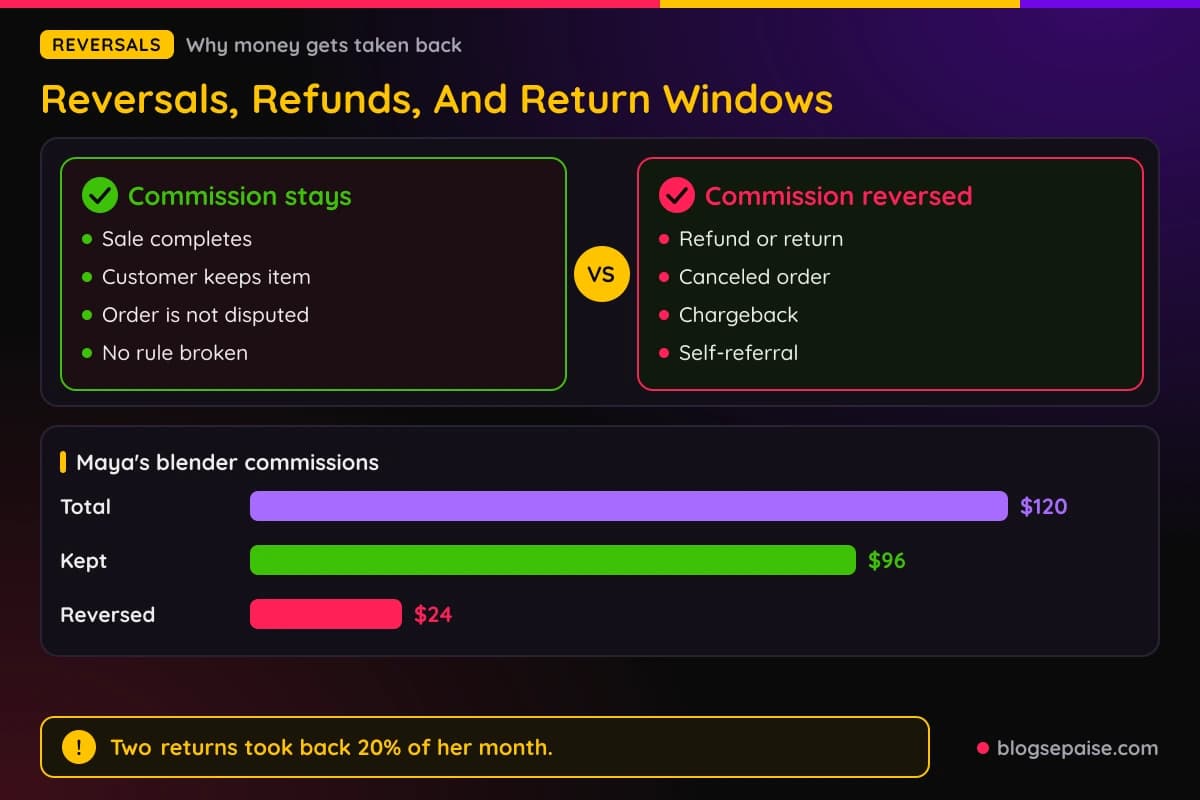
The usual causes are refunds, returns, canceled orders, and chargebacks. A chargeback is when a buyer disputes the charge with their bank.
Programs also reverse commissions for fraud, duplicate orders, and sales that break the rules. If you buy through your own link, the program may call that a self-referral and cancel it.
The refund window decides how long a commission stays at risk. A store with a 30 day return policy keeps your money in limbo for at least that long.
Digital products often have shorter windows, though some software gives 30 days for a full refund. Courses and subscriptions can have longer ones.
Reversals can reach back further than you think. A program may adjust a commission months after it was approved if a payment bounced or a customer disputed a charge.
Look at Maya again. Of her ten blender sales, eight stayed and two were returned.
Eight sales times $12 gives $96 that stays. Two returned sales take back $24, and that is 20% of her $120 for the month.
A 20% return rate is high, but it shows how a few returns can shrink a month. Bigger, bulkier items often come back more than small ones.
Our post on what happens to affiliate commissions on returned items goes deeper on the rules for returns. Read it before you promote products that people try on or assemble.
You cannot stop reversals, but you can lower them. Recommend products honestly, set clear expectations, and avoid pushing readers to buy things they do not need.
Also watch for negative balances. Some networks subtract a reversal from your next payment, and a few let your balance go below zero until later sales cover it.
Keep a reversal log with the date, the order, and the reason. Patterns show up fast, and you can raise questions with support if something looks wrong.
A run of reversals can also point to a problem with your content. If readers return a product often, your post may set the wrong expectations.
Hold And Lock Periods
A hold, also called a lock period or validation period, is the stretch when a program keeps your approved commission before it becomes payable. People search for this as the affiliate payment hold period.
The hold exists to cover refunds and fraud. The program does not want to pay you and then chase the money back.
Hold lengths vary. Some programs lock commissions for 30 days, some for 60, and some wait until the month closes and then add a payment delay on top.
The Walmart agreement describes a locking period of 60 days and a payment about 90 days after each month ends. We covered that in our guide on how to get approved for the Walmart affiliate program.
Amazon is another well known case. Published guides report that Amazon pays about 60 days after the end of the month in which you earned.
Hold time and payment time stack. A 30 day hold followed by a net 30 schedule means you wait about two months, plus the days left in the month you earned in.
Some programs shorten the hold for trusted partners. Over time, a clean record with few reversals can earn you faster payments or a lower threshold.
Other programs lengthen the hold for new accounts. If you are new, expect the slow version and be pleasantly surprised if it is fast.
Find the hold in your program terms before you promote. Search for words like locking period, validation period, pending period, and payment terms.
Our guide to reading affiliate program terms shows where those clauses hide. A ten minute read now saves you a lot of guessing later.
Ask support when the terms are vague. A short email about how long commissions stay locked usually gets a clear answer.
Write the answer in your notes with the date, since terms can shift later.
Minimum Payout Thresholds
A minimum payout threshold is the least amount your balance must reach before the program sends money. If you earn less, the balance rolls over to the next period.
Thresholds protect the program from tiny payments that cost more to process than they are worth. They can also trap a small blog for months.
The numbers vary a lot. Published guides report a $10 minimum for Amazon direct deposit and gift cards, and $100 if you want a check.
Many networks sit between $20 and $50. Some programs set the bar at $100 or higher, especially for wire transfers.
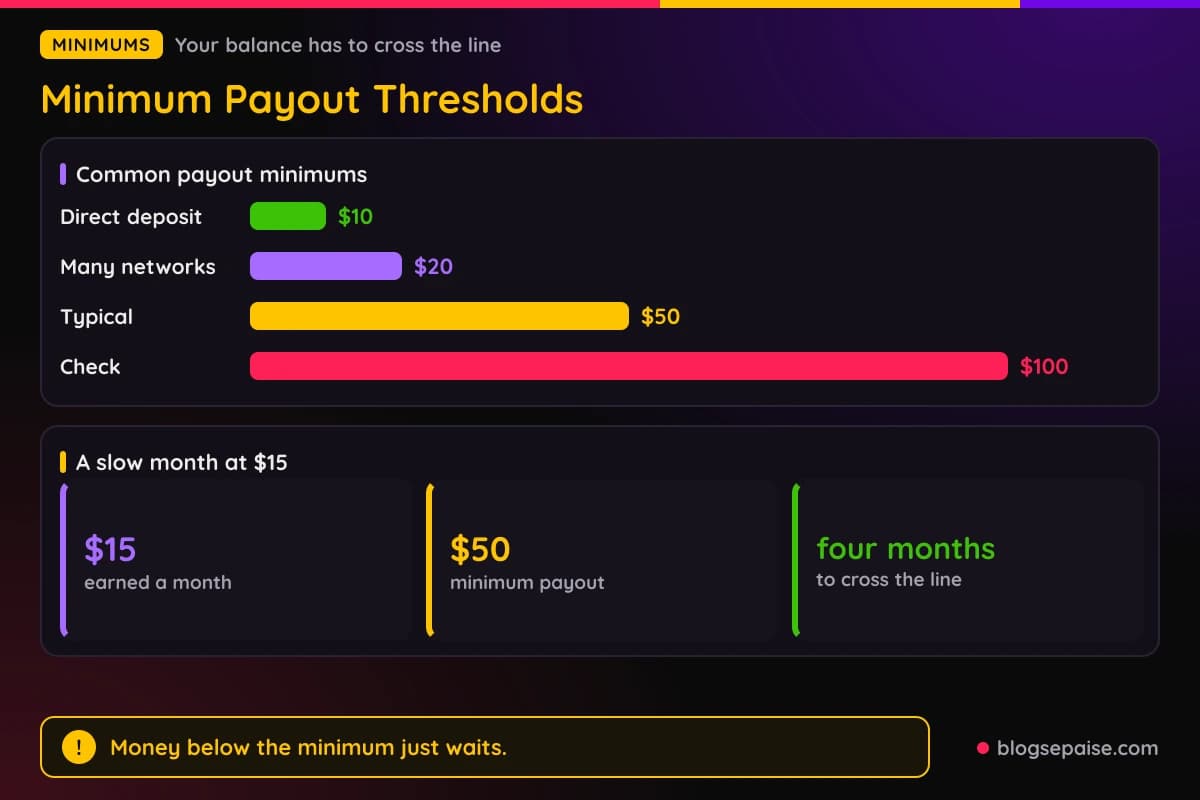
The threshold can change by payment method. A check often needs a higher balance than PayPal or direct deposit, since checks cost more to print and mail.
Do the math on how long you will wait. If you earn $15 a month and the minimum is $50, you need four months to cross the line.
After three months you hold $45, which is not enough. The fourth month brings you to $60, and then the payment finally goes out.
Currency matters too. A network may set a minimum in dollars for U.S. accounts and a different one for accounts paid in other currencies.
Watch for rules that expire an old balance. A few programs close inactive accounts or void balances that sit below the minimum for a long time.
If a program has a high threshold and you are small, think twice. A program that pays 30% but needs $100 can be worse for you than one that pays 10% with a $10 minimum.
Check the threshold before you pick which programs get your best content. Money you cannot withdraw is just a number on a screen.
Combine small streams when you can. A network that pools many brands into one balance helps you cross the line sooner.
Raising your traffic is the slow fix. Switching to a program with a smaller minimum is the quick one.
Payment Methods: PayPal, Bank Transfer, Checks, And Gift Cards
Programs pay in a few common ways. The best choice depends on where you live, how fast you want the money, and what fees apply.
PayPal is the most popular option for small publishers. It is fast to set up, and the money often arrives within a day or two of the payout date.
PayPal can take a fee, and it may convert currencies at its own rate. Check the fee schedule on your own account before you assume you keep every cent.
Bank transfer, often called direct deposit or ACH in the United States, usually costs little. It moves money straight into your checking account.
A wire transfer is faster and works across borders, but banks often charge for it. A $20 wire fee on a $256 payout leaves you $236.
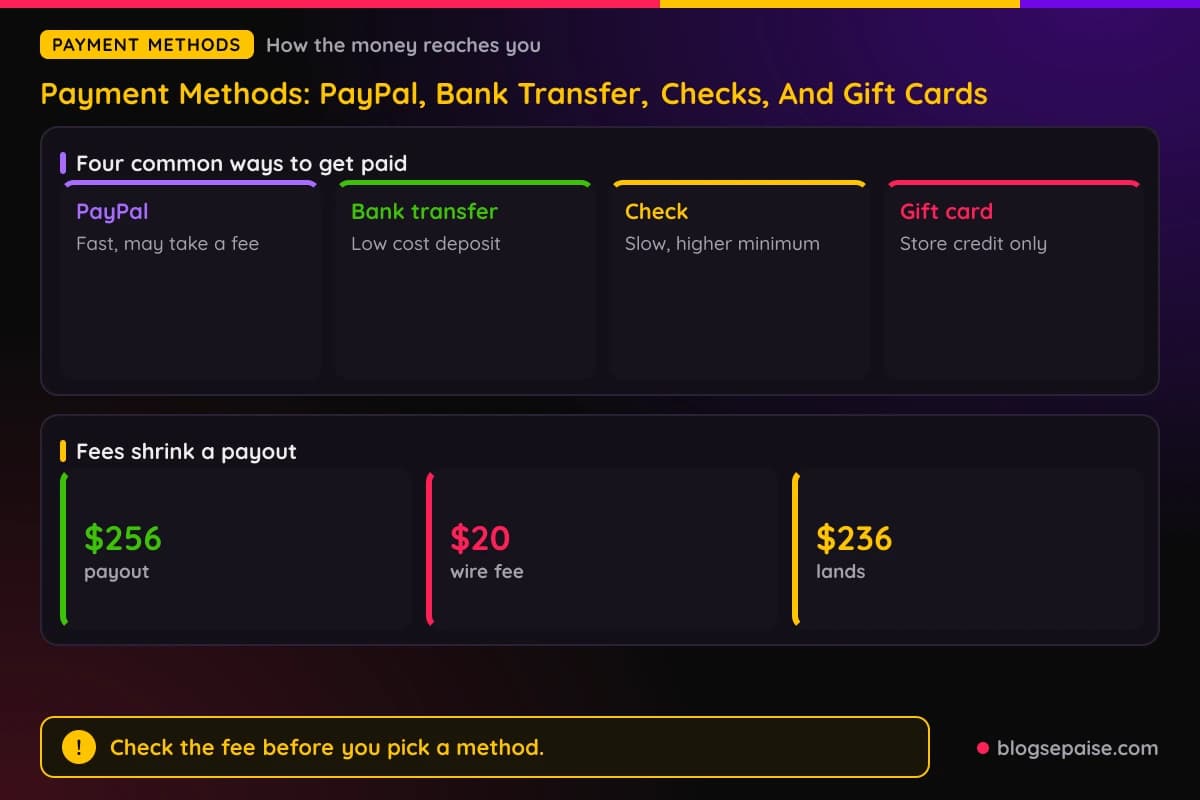
Checks still exist, mostly as a backup. They take longer, they can get lost in the mail, and some programs set a higher threshold for them.
Gift cards are a method for some programs, with Amazon as the best known case. The money comes as store credit, which helps if you shop there anyway and hurts if you wanted cash.
Some networks also offer prepaid cards or local payment options. Availability changes by country, so look inside your payment settings.
Set up your payment details before your first sale. A missing or mismatched PayPal email is a common reason a payment stalls.
Make sure the name on the payment account matches the name on your affiliate account. Mismatches can trigger a manual review.
Keep a small note of how each program pays you. When you run five programs, it is easy to forget which one sends a check.
Think about speed and cost together. A free transfer that takes five days can beat a fast one that costs .
Your own bank may also charge to receive an international wire. Ask before you pick that route.
Net 30 And Net 60 Payment Schedules
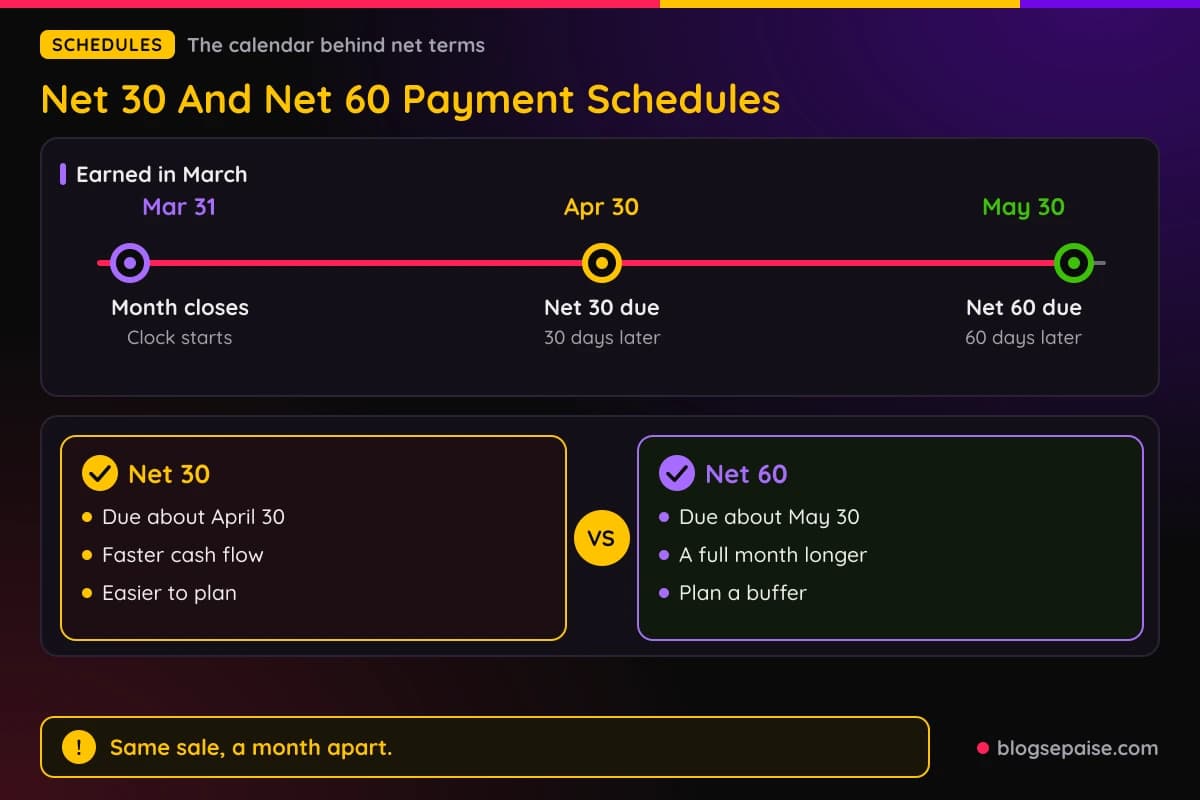
Net 30 means the program pays you 30 days after a set point, usually the end of the month in which you earned. Net 60 works the same way with 60 days.
The wording comes from business invoices. The program treats your commission like a bill it agrees to settle within a set time.
Say Maya earns her commission in March. On a net 30 schedule, the money is due around April 30, and on net 60 it is due around May 30.
The same sale pays a full month later under net 60. The commission is no different, but the wait is.
Some networks pay on fixed dates instead. They may run a payment on the 1st and 15th, or on a set day around the 20th, covering the commissions that have cleared.
Fixed dates are easy to plan around. Net terms can feel fuzzy, because the real date depends on when the month closes and when the program approves the batch.
Weekends and bank holidays add a day or two. A payment due on a Saturday often goes out the next business day.
Net terms often come from the brand, not the network. A network can offer a fast cycle and a brand can still set a slow one for its own program.
The terms for your own program are the ones that count. Look up the payment terms line before you rely on a number from a blog, including this one.
If cash flow matters, choose programs with shorter terms for your main income. Keep slow payers as bonus money you do not count on.
Watch for the words business days. A program that pays within 5 business days of the payout date is not the same as one that pays on the date itself.
Ask what the clock starts from. Thirty days from the invoice date is slower than thirty days from the sale date.
Tax Forms In Plain Terms: W-9 And W-8BEN
Many programs ask for a tax form before they pay you. I am not a tax professional, and this is general information, not tax advice.
In the United States, the form for most people is the W-9. You give the program your name, address, and a taxpayer number, such as a Social Security number or an EIN for a business.
The W-9 does not mean you pay tax to the program. It tells the program who you are so it can report what it paid you.
If the payer must report your earnings, it may send you a Form 1099-NEC at the start of the next year. The reporting threshold was $600 for years, and reports say it rises to $2,000 for payments made in 2026.
Rules and thresholds change, so check the current IRS guidance or ask a tax professional. Even if you get no form, income you earn is generally still income.
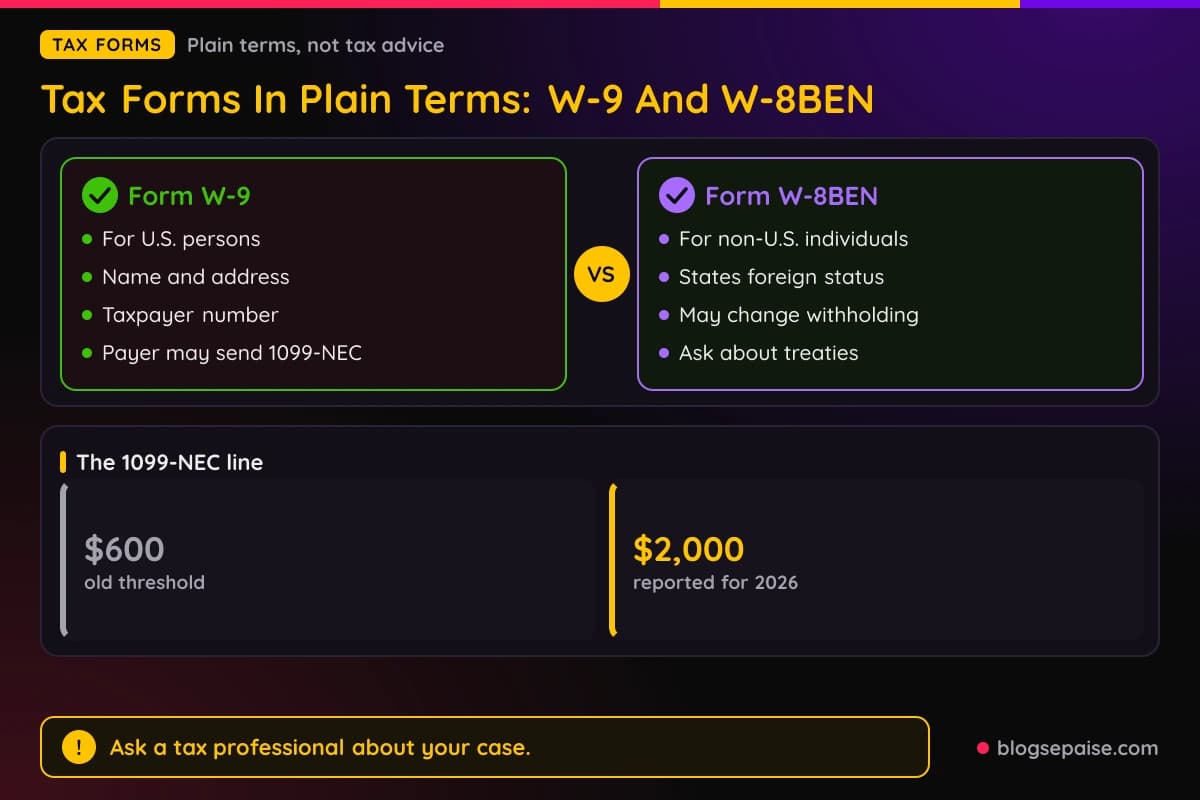
If you live outside the United States, the form is usually the W-8BEN. It tells a U.S. payer that you are not a U.S. person for tax purposes.
The W-8BEN can change how much tax the program withholds from your payments. Some countries have tax treaties that change the rate, so the details depend on where you live.
Programs and networks usually collect these forms inside your account settings. You fill in a web form, sign it electronically, and wait for approval.
A missing form is a common reason payments get held. Fill it in early so it never blocks a payout.
Keep copies of everything you submit. Save your payout reports too, because you will want them when it is time to file taxes.
Do not wait for a form to start tracking. Log every payment as it arrives, with the date and the source.
Some networks also ask for a state or foreign tax ID. Have your numbers ready before you sign up.
Talk to a tax professional about expenses, self-employment tax, and what to set aside. A good rule is to treat part of every payout as not yours until you know your number.
Networks Vs Direct Programs
You can earn commissions in two ways. You can join a network that hosts many brands, or you can join a program that a company runs by itself.
A network, such as Impact, Awin, or CJ, sits between you and the brand. It tracks sales, collects money from the brand, and pays you.
The big benefit is one login and one payment for many programs. You set up your tax form and payment method once, and a single payout can cover several brands.
The tradeoff is that the network follows each brand's rules. The brand sets the commission, the lock period, and the terms, while the network sets the payout method and minimum.
A direct program is run by the company, often through its own software or a tool such as PartnerStack or Rewardful. You deal with that company alone.
Direct programs can be friendlier to small partners. Some pay faster, and some pay on a set day with a low minimum.
The downside is paperwork. Every direct program may want its own tax form, its own payment details, and its own dashboard.
Amazon is its own direct program, and it sets its own schedule. Walmart runs through Impact, so its payment rules sit inside that network.
Neither route is better for everyone. Beginners often start with a network to learn the system, then add direct programs for the best rates.
Compare more than the headline rate. A 30% direct program that pays 90 days late can hurt more than a 15% network program that pays on time.
A network also gives you one place to chase a late payment. A direct program leaves you with one contact and no backup.
Fees differ too. Some networks take their cut from the brand, though a few charge publishers for wires or small balances.
For a big list of places to start, browse our page on instant approval affiliate programs. Check each program's payment terms before you apply.
How To Handle A Late Affiliate Payment
Late payments happen, even with honest programs. Before you panic, work through a short list of checks.
First, confirm the payment is actually late. Compare today's date with the payment terms, the hold period, and the threshold.
Many cases that feel late are only slow. A payment due on May 30 is not late on May 29, and it may not hit your bank until a few days after it is sent.
Second, check your balance. If it sits under the minimum, the program will not pay yet, and that is working as designed.
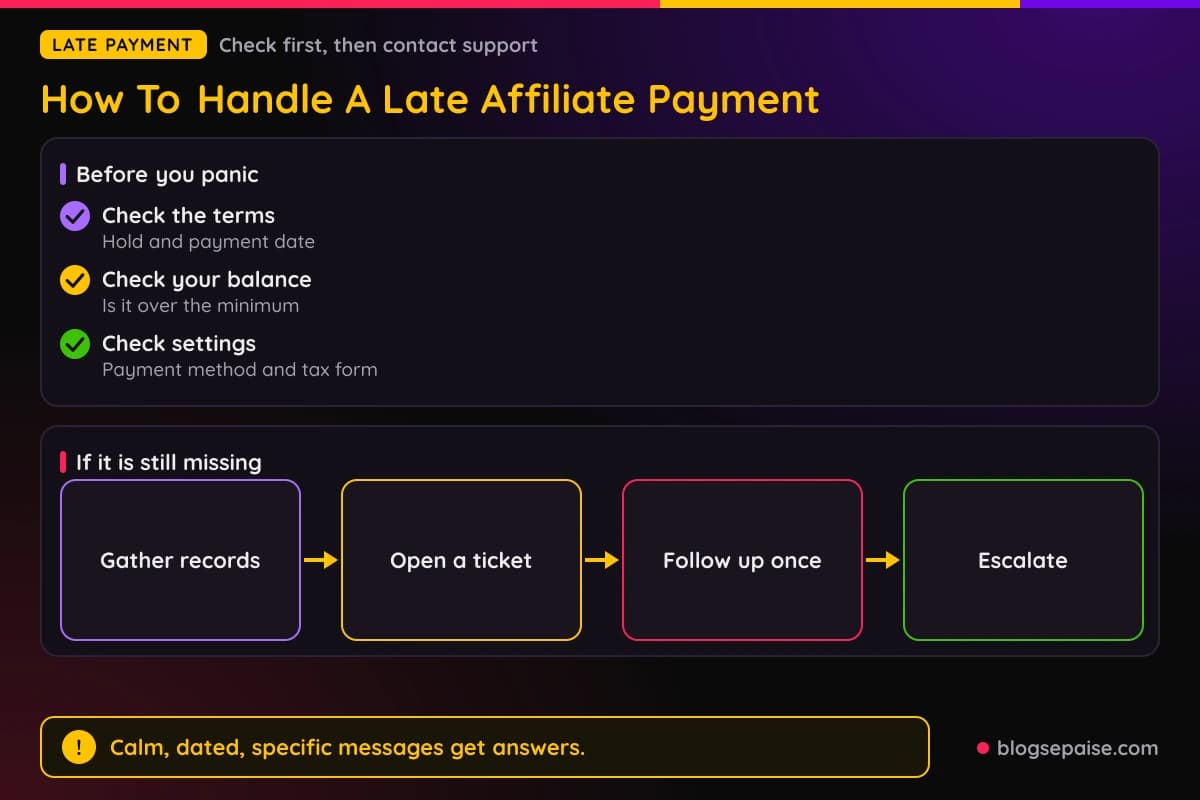
Third, look at your account settings. Make sure your payment method, your tax form, and your identity checks are all complete.
Fourth, read the status of each commission. If many are still pending or locked, the hold period has not ended.
Fifth, look for notices. Programs sometimes email about a failed payment, a closed PayPal account, or a request for more documents.
If everything checks out and the payment is still missing, contact support. Open a ticket with the program or the network, depending on who handles payments.
Be specific in the message. Include your affiliate ID, the payment period, the amount, the date it was due, and screenshots of your dashboard.
Stay polite and stick to facts. Support teams answer clear, calm messages faster than angry ones.
Give them time to reply, often several business days. If you hear nothing, follow up once, and ask for a named contact or an escalation path.
For a brand on a network, you can also write to the network. The network has a stake in keeping its publishers happy.
If a program keeps ignoring valid commissions, consider moving your traffic. Our page on avoiding bans from affiliate programs also covers the rule violations that can lead a program to withhold pay.
Keep your records either way. Dated screenshots and email threads are the best proof you have.
Know the difference between late and denied. A denied commission was rejected on purpose, while a late one is still owed.
Learn how long you have to dispute a missing commission. Many programs set a time limit for claims, so act early.
Final Thoughts
Affiliate commissions follow a clear path. You earn on paper, the program waits for refunds to clear, and then it pays on its own schedule.
Know your formula, your hold, your threshold, and your payment terms before you promote a program. Those four facts tell you what a sale is worth and when you will see it.
Plan for reversals and late months, keep your tax forms current, and never spend pending money. A small buffer turns the slow parts of the system into a minor annoyance.
Set a calendar reminder for each payout date. A simple alert helps you notice a missing payment while the trail is still fresh.
Start today by opening your dashboard and finding the payment terms for each program you use. Write the dates down, and you will never wonder where your money is again.
Frequently Asked Questions
1. How are affiliate commissions paid?
Programs pay by PayPal, bank transfer, check, or gift card after your commission clears the hold and your balance passes the minimum. The payout date follows the program's schedule, such as net 30 or net 60.
2. How are affiliate commissions calculated?
Most programs pay a percentage of the sale, a flat fee for an action, or a recurring share of a subscription. A 6% rate on a $200 sale pays $12.
3. How does an affiliate commission payout schedule work?
It is the calendar a program follows to send money. Some pay on fixed dates like the 1st and 15th, and others pay 30 or 60 days after the month ends.
4. How does an affiliate payment hold period work?
It is the time a program keeps your approved commission before it becomes payable. The hold covers refunds, returns, and fraud checks.
5. How long does it take to get paid?
Expect anywhere from about one month to three months after a sale. Maya's March 12 sale reached payout on May 30, which is 79 days.
6. How does a minimum payout threshold work?
It is the lowest balance a program needs before it sends money. Small balances roll over until they pass the line.
7. Can an affiliate commission be taken back?
Yes. Refunds, returns, canceled orders, chargebacks, and rule violations can all reverse a commission.
8. Does net 30 mean I wait 30 days?
Payment is due about 30 days after a set point, usually the end of the month you earned in. Net 60 works the same way with 60 days.
9. Do I need a W-9 to get paid?
Many U.S. programs ask for one before they pay you. It tells the payer your name and taxpayer number so it can report what it paid you.
10. Who needs a W-8BEN form?
It is a form for individuals outside the United States who are paid by a U.S. company. It states your foreign status, and it can affect tax withholding.
11. Do I owe taxes on affiliate commissions?
Commission income is generally taxable, even if you get no form. Ask a tax professional about your own situation.
12. Which payment method is best?
PayPal and direct deposit are usually the fastest and cheapest for small publishers. Wires can cost fees, and checks are slow.
13. Is a network better than a direct program?
Neither is better for everyone. A network gives you one login and one payout, while a direct program may pay faster or offer a better rate.
14. Why was my affiliate payment late?
Common causes are an unmet minimum, a hold that has not ended, a missing tax form, or a payment method problem. Check those first, then contact support.
15. How do I chase an affiliate program that does not pay me?
Confirm the terms, collect your records, and open a support ticket with dates, amounts, and screenshots. Follow up once, then escalate to the network if there is one.
16. Can I change my payment method?
Yes, most programs let you update it in your account settings. Change it well before a payout date so the new details are in place.