What Do Affiliate Marketers Actually Do All Day
Ask people what affiliate marketers do all day, and you will hear a funny guess. They picture someone on a beach with a laptop, sipping a cold drink while the sales roll in.
The day we describe here looks more like a small business owner at a desk. There is writing, research, email, number checking, and fixing things that broke.
Payout screenshots get shared a lot, and the hours of work behind them rarely do.
So in this guide we lay out a sample routine, hour by hour. You will see the five jobs that fill an affiliate day, how a full-time schedule compares to a part-time one, and how to build a daily plan of your own.
The hour counts below are a sample plan, not a measured average from a survey. Treat the numbers as a starting template and change them to fit your life.
If you are brand new, our plan for your first 30 days of affiliate marketing pairs well with this post. You can also read what affiliate marketing is if you want the basics first.
Disclosure: Some of the links I share might be affiliate links. If you click on one and make a purchase, I may earn a small commission as a thank you. But don’t worry, it won’t cost you anything extra. I only recommend stuff I genuinely believe in. Your support helps me keep creating awesome content. You can read my full affiliate disclosure in my disclaimer page.
Search 1,500+ affiliate programs in the Blogsepaise Program Database and filter them by category, network and commission type, then go straight to each program's signup page. The Link Health Monitor then checks your posts for broken, redirected and untagged affiliate links.
The Short Answer: Where An Affiliate Marketer's Hours Go
So, what do affiliate marketers do all day? The work usually falls into five jobs, and we suggest giving the biggest share of time to creating content, then splitting the rest between research, promotion, number checking, and admin.
Here is a sample split for a full-time eight hour day. It gives 3.5 hours to creating content, 2 hours to promotion and email, 1 hour to research, 1 hour to managing programs and admin, and 30 minutes to checking numbers.

A part-time schedule fits the same jobs into a smaller window. A sample two hour evening might hold 70 minutes of writing, 20 minutes of promotion, 15 minutes of research, 10 minutes on numbers, and 5 minutes of admin.
The mix matters more than the total. Two focused hours on the right job can be worth more than eight scattered hours.
Content gets the biggest slice in our plan because it is the asset your readers find. Every other job in the day either feeds the content, spreads it, or measures it.
The rest of this guide walks you through seven steps. Follow them in order and you can end up with a routine that fits your hours and keeps the right work at the front of the line.
Step 1: Learn The Five Jobs Inside Every Affiliate Day
Before you can plan a day, you need to know what goes into one. Almost every task an affiliate marketer does fits into one of five jobs.
Those jobs are research, creating, promoting, analyzing, and managing. Each one has its own feel, its own tools, and its own time of day where it works best.
Research is the planning job. You look for keywords people search, study the posts that already rank, and pick the products worth writing about.
Creating is the building job. You write reviews, comparisons, and guides, shoot videos, or design pins, and each piece becomes something that can earn for years.
Promoting is the sharing job. You post to Pinterest or social media, send your newsletter, answer questions in groups, and get fresh eyes on what you made.
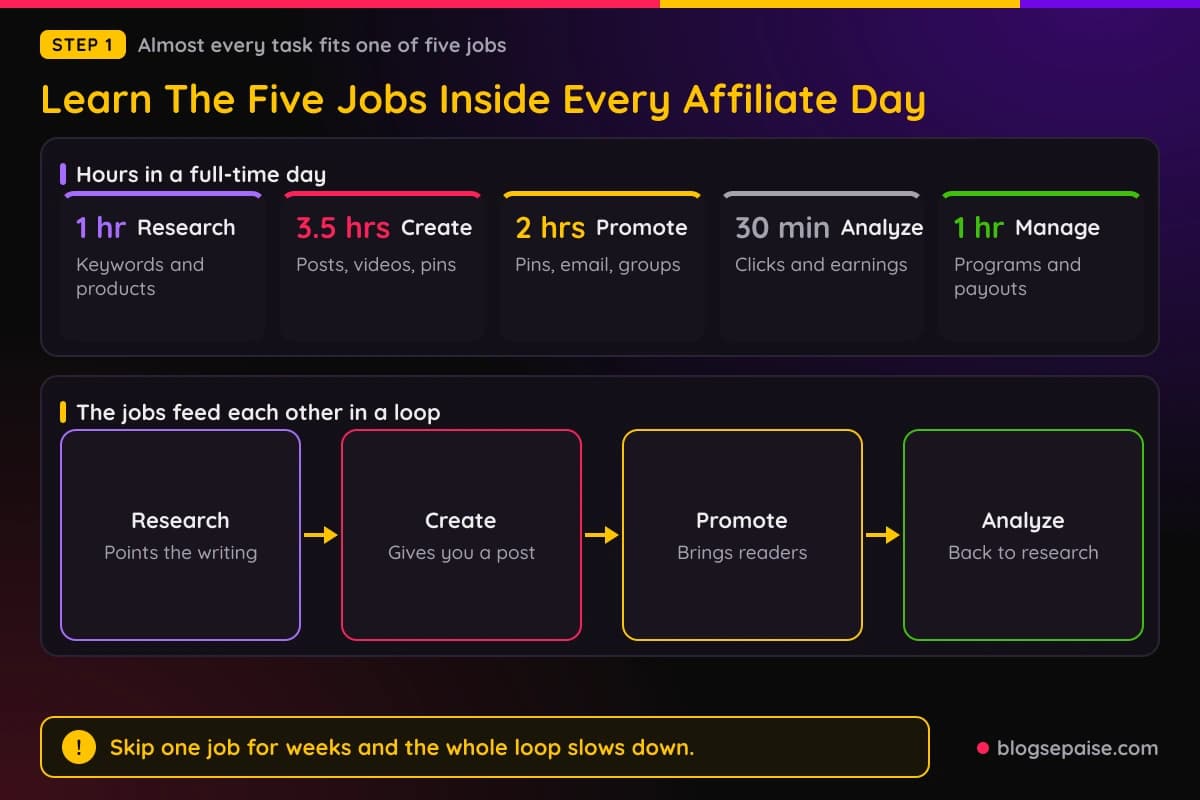
Analyzing is the checking job. You look at clicks, conversions, rankings, and earnings, then decide what to fix and what to do more of.
Managing is the business job. You apply to programs, reply to partner emails, track payouts, fix broken links, and keep your disclosures in place.
Here is the key idea. The five jobs feed each other in a loop, so research points your writing, writing gives you something to promote, promotion brings data, and data sends you back to research.
When one job gets skipped for weeks, the whole loop slows down. A site with great content and no promotion grows slowly, and a site with lots of promotion and thin content leaks readers.
Write the five job names on a sticky note and keep it near your screen. Each time you start a task, ask which job it belongs to, and you will soon see where your hours really go.
Tracking your time for a week is the easiest way to see where your hours really go.
Step 2: Map Out A Sample Day Hour By Hour
Now let us put the five jobs on a clock. Below is a sample full-time day you can copy and adjust.
From 8:00 to 8:30 AM, check your numbers. From 8:30 to 9:30, do research for the posts you will write next.
From 9:30 AM to 1:00 PM, write. Those 3.5 hours are the most important block in the whole day, so the phone stays in another room.
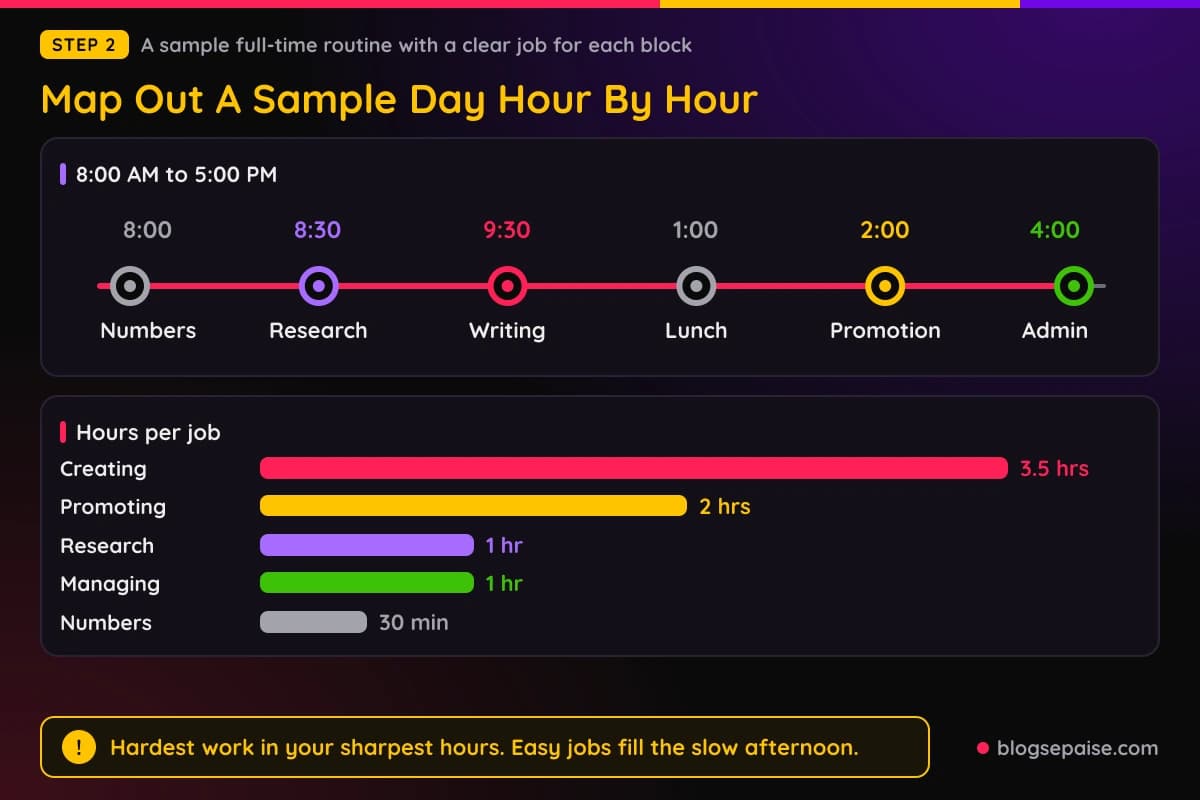
From 1:00 to 2:00 PM, take a real lunch away from the desk. Your brain needs the break after a long writing stretch.
From 2:00 to 4:00 PM, promote. You share new posts, schedule pins, write the newsletter, and answer readers.
From 4:00 to 5:00 PM, manage the business side. You check program dashboards, reply to partners, and handle small fixes on the site.
Add it up and you get eight working hours with a clear job for each block. Nothing in the plan is fancy, and that is the point.
The order follows your energy. If you think best in the morning, put the hardest work there and let promotion and admin fill the slower afternoon hours.
If you are a night owl, flip it around. Put the writing block at the time you feel sharpest and move the easy jobs around it.
Part-time affiliates can use the same order on a smaller scale. Open with 10 minutes on numbers, write for 70 minutes, then spend the last 40 minutes on promotion, research, and admin.
A free content calendar template makes the plan easier to stick to. When the next post is already chosen, the writing block starts on time instead of with 20 minutes of wondering what to write.
Treat the plan like a work shift, even if you work from your kitchen table. Start at the same time, end at the same time, and the habit will carry you on the days your motivation does not show up.
Step 3: Start Each Morning With Your Numbers
The first job of the day is a short look at your data. We suggest keeping it to about 30 minutes, because the numbers can turn into a time sink if you let them.
Start with yesterday's clicks on your affiliate links. Then look at conversions and earnings in each program you belong to.
Next, glance at your top 10 pages in Google Search Console. Your best pages are the ones where a drop costs you the most, so they deserve the first look.
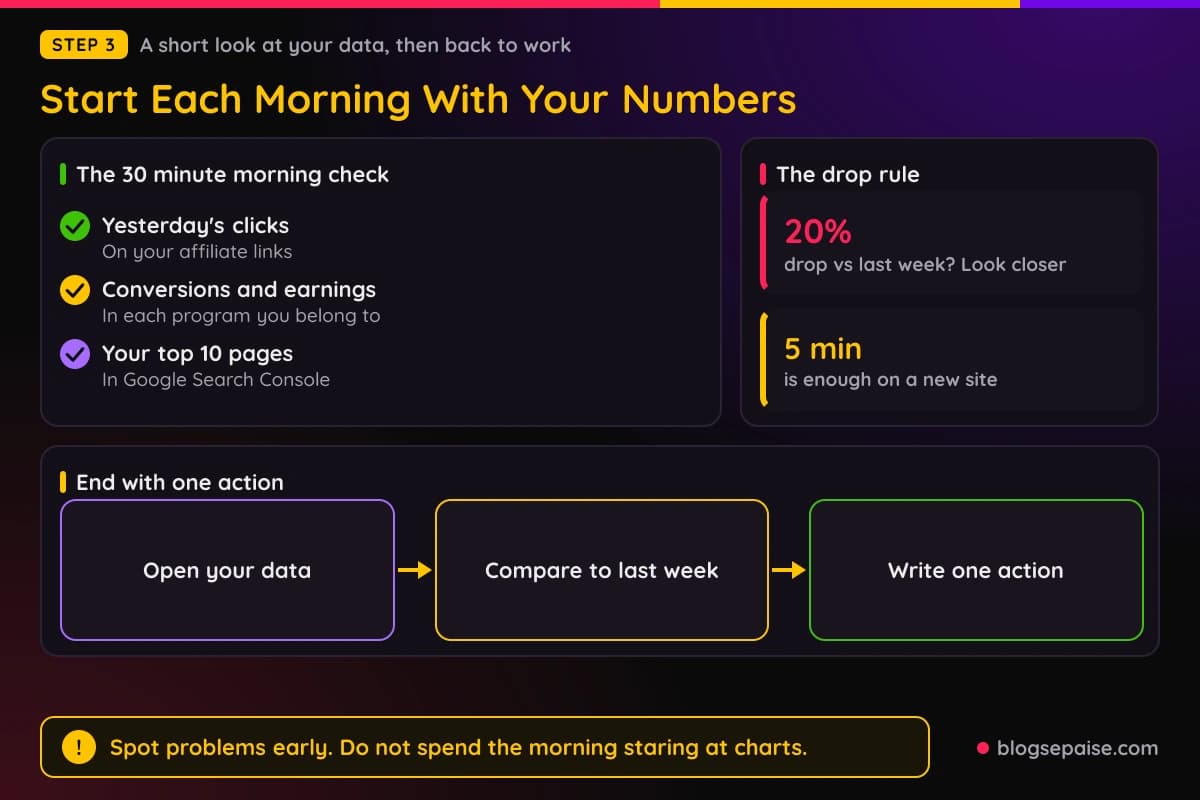
Here is a simple rule of thumb you can adopt. If a number falls by more than 20 percent compared with the same day last week, look closer, and if it falls less than that, treat it as normal noise.
Daily numbers bounce around. Weekends and holidays can push traffic up or down for reasons that have nothing to do with your site.
End the check by writing down one action. Maybe a post lost its ranking and needs an update, or a program changed its landing page and your clicks stopped turning into sales.
One action is enough for one morning. The goal is to spot problems early, not to spend the day staring at charts.
If you want to know which metrics deserve your attention, our guide to affiliate dashboard metrics breaks them down. Our blog income tracker also puts your earnings in one place, so the morning check takes minutes instead of an hour of logging into five dashboards.
A click tracking tool such as ClickMagick can help once your traffic grows. ClickMagick describes itself as an ad tracking and attribution platform that started as a link tracker.
A brand new site will not have much to look at yet. In that case, cut the check down to 5 minutes and give the saved time to writing.
Step 4: Protect Your Deep Work Hours For Content
Content is where the money comes from, so it gets the best hours of your day. Every review, comparison, and how-to guide you publish is a piece that can keep bringing readers to your links.
Writing speed differs a lot from person to person, so time yourself on your first few posts. Your own numbers will tell you how many posts a week your writing block can really support.
In our sample full-time day, 3.5 hours of writing five days a week adds up to 17.5 hours of writing time. A part-timer with 70 minutes a day, six days a week, has about 7 hours.
Divide those hours by how long a post takes you, and you have your weekly output. The rest of the time can go to updating old posts.
That is why the writing block must be protected. If email, social media, or small site fixes eat into it, your output drops and so does your growth.
A few habits can help. Close your inbox, silence your phone, and work in focused 25 minute sprints with a short break between each one.
Our free Pomodoro timer is built for that kind of sprint.
Plan the post before the block starts. Keyword research belongs in the research hour, so when you sit down to write, the topic, the main keyword, and the outline are already done.
A content editor like Surfer can speed up drafting and editing. Surfer says its Content Editor gives live guidelines while you write and helps you compare your pages against top competitors.
Not every writing block has to be a new post. Once your site has a pile of older posts, some of those hours should go to refreshing them, which we cover in step 7.
Writing is more than typing. Strong affiliate posts include real photos, honest pros and cons, and clear advice on who should skip a product, and that detail takes time to gather.
Our guide to writing reviews that sell shows where that time pays off most. A review that answers the buyer's real questions earns far more than one that only repeats the product page.
Step 5: Spend The Afternoon On Promotion And Email
A post nobody sees cannot earn a cent. Search rankings can take a while, so promotion is how you get readers to a new post in the meantime.
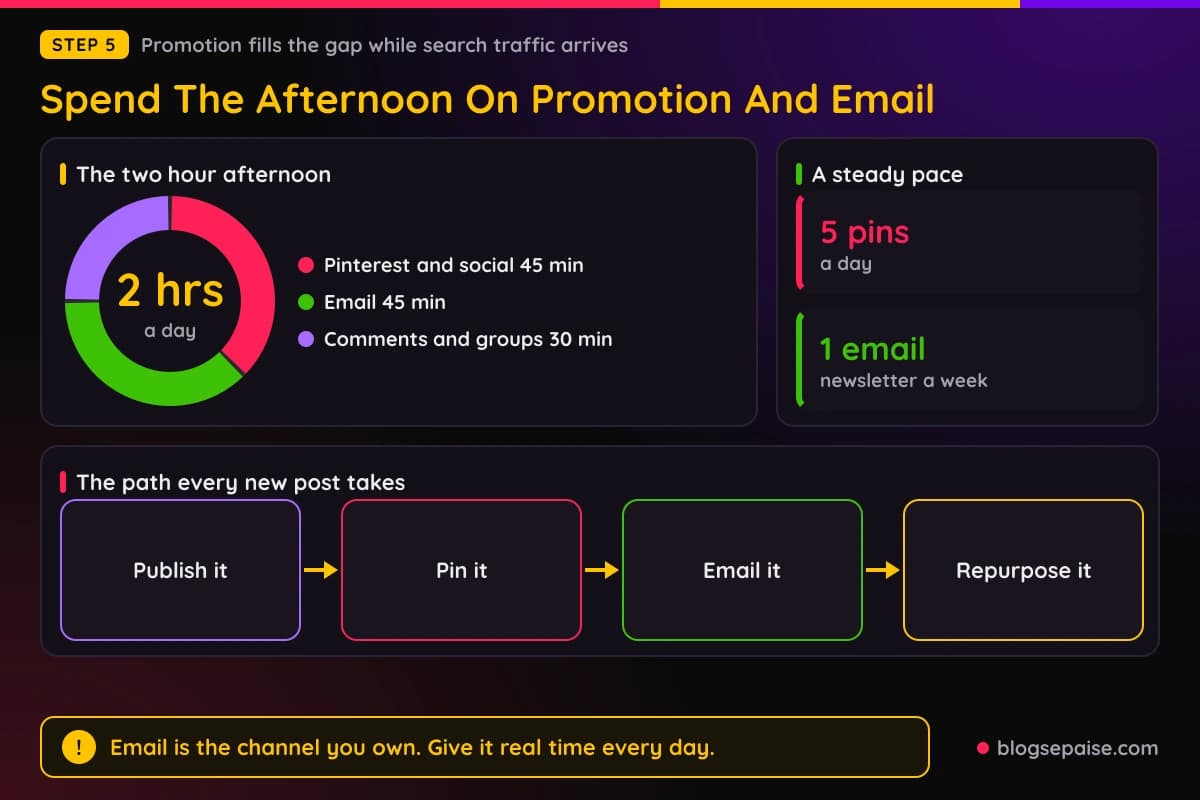
In our sample full-time schedule, promotion gets about 2 hours each afternoon. A simple split gives 45 minutes to Pinterest and social media, 45 minutes to email, and 30 minutes to comments, groups, and reader questions.
Pinterest can suit affiliate content because a Pin can keep picking up engagement for a long time. Pinterest's own help center says there is no set engagement window, so a Pin can gain engagement months or even years after it is published.
A scheduler such as Tailwind lets you plan Pins ahead. Tailwind describes itself as a Pinterest scheduling tool with drag and drop scheduling.
Email is the channel you own. Social apps can change their rules, while your list stays yours, so it deserves real time in the day.
A newsletter a week is a pace many beginners can plan around, and it is the pace our sample slot assumes. The 45 minute email slot covers writing it, plus welcome emails and replies to readers.
An email tool like MailerLite handles the sending. MailerLite lists signup forms and email automation among its features.
The last 30 minutes go to people. Answer comments on your posts, reply in the groups where your readers hang out, and help someone with a real question.
Each new post should go through the same promotion path. Publish it, pin it, send it to your list, and then turn it into a short video, a thread, or a set of pins.
Our guide to repurposing content shows how one post can turn into several pieces of promotion.
Be careful with how hard you sell. Readers who get real help are more likely to trust your next recommendation.
Step 6: Handle Programs, Partners, And Admin
The managing job is the least exciting part of the day, and it is easy to skip. Skipping it can cost you money, such as when a broken link sends readers nowhere.
In our sample full-time week, managing gets about 1 hour a day. Part-timers can bundle the same tasks into a single longer session once a week.
Start with programs. Applying to a few new programs that fit your niche gives you a backup when one program cuts its rates or closes.
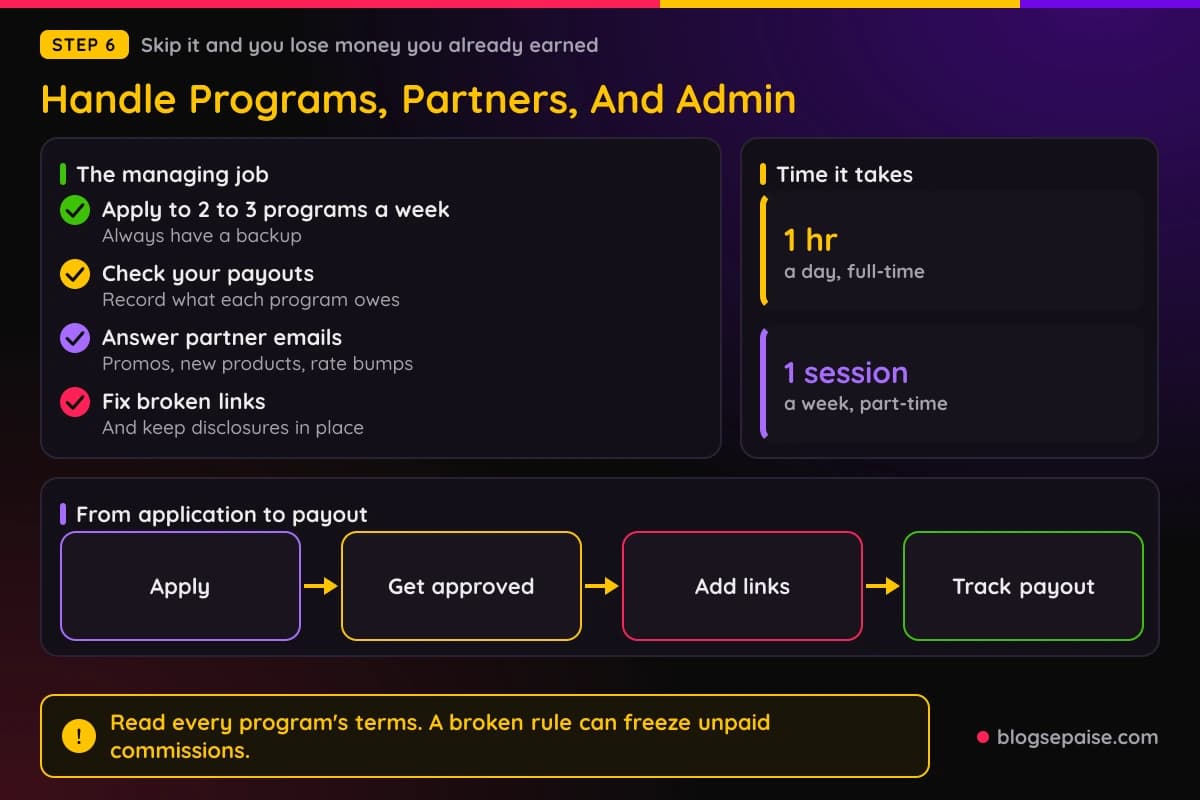
Then check your payouts. Programs pay on different schedules, so keep a simple record of what each one owes you and when the money should land.
Partner emails come next. Affiliate managers may send news about promos and new products, and a quick reply keeps you in the loop.
Next come the small site jobs. Fix broken links, swap out products that left the market, and make sure each page still shows your disclosure in the right spot.
A link manager like Pretty Links can help here. Pretty Links is a WordPress plugin that lets you manage your affiliate links from one central dashboard.
Rules are part of this job too. Read the terms of every program you join, because breaking a rule you never read can get your account closed and your unpaid commissions frozen.
Our guide on how to avoid getting banned from affiliate programs covers the rules affiliates need to know.
Keep a simple log of the admin work you do each day. When tax time comes, or a program asks a question about your traffic, you will have the answer ready.
A manager who knows your name may be more likely to share news about a bonus or a deal with you. It costs nothing to be friendly and professional.
Step 7: Run A Weekly And Monthly Rhythm
Some tasks do not belong in every day. They fit better on a weekly or monthly schedule, and putting them there keeps your daily plan clean.
Daily tasks are the ones you have already seen. Check the numbers, write, promote, and handle the urgent admin.
Weekly tasks are a little bigger. Set aside about 1 hour once a week to scan for broken links, send your newsletter, and plan next week's posts.
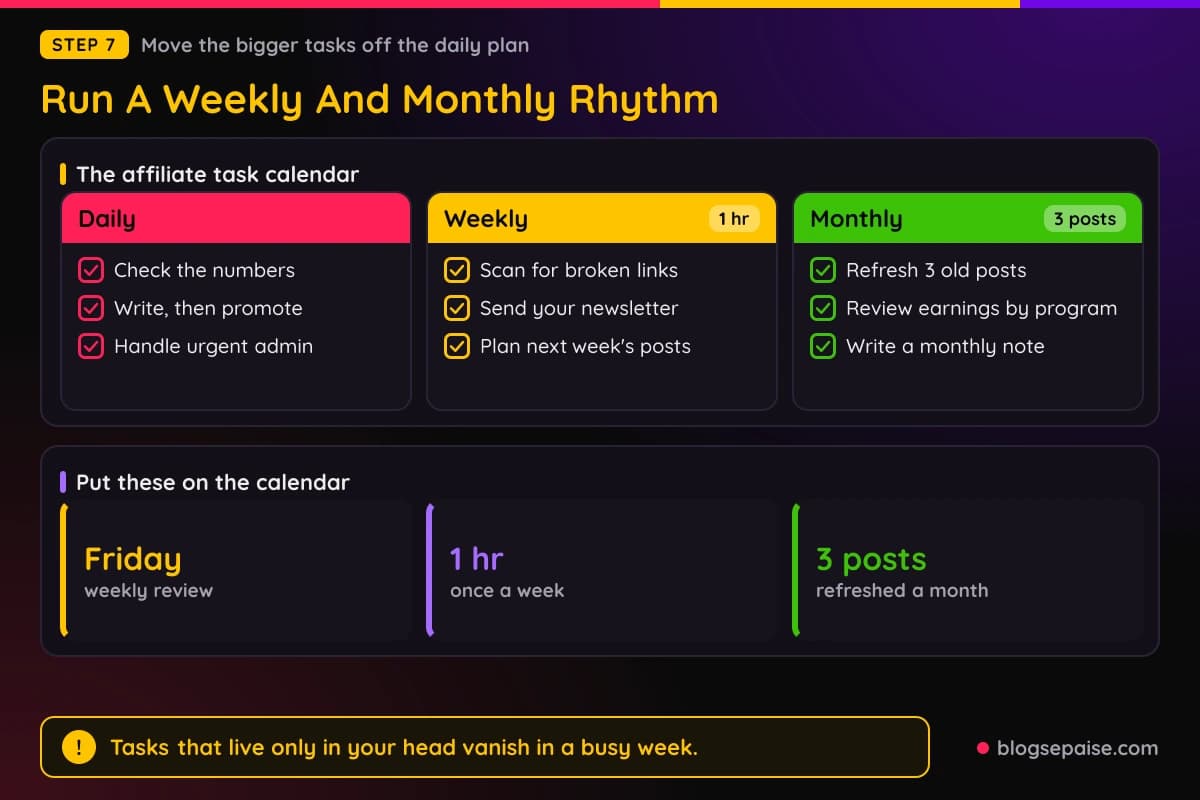
Friday afternoon is a handy slot for the weekly review. You look back at what you published, note what worked, and pick the topics for the week ahead.
Monthly tasks are about protecting what you built. We suggest refreshing a few old posts each month, starting with the ones that slipped in rankings or carry outdated prices.
Also review your earnings by program once a month. If one program brings in most of your money, look for a second one so a single change does not wipe out your income.
Our post on the truth about passive income explains why upkeep never fully goes away. Old posts can go stale, and a monthly refresh helps keep them useful.
Put the weekly and monthly tasks on your calendar as real appointments. If they only live in your head, they are the first thing to vanish when a busy week shows up.
A short note at the end of each month helps too. Write down what you published, what you earned, and the one change you want to try next month.
How The Daily Routine Changes As Your Site Grows
Your day will not look the same in year two as it does in month one. The five jobs stay the same, but the share of time each one gets can shift as the site grows.
Early on, almost everything is building. We suggest putting most of your time into new content, because a new site has little to promote, analyze, or update yet.
As the site grows, more hours can go to promotion and updates. The morning numbers check also starts to show real patterns.
Later on, updating old posts takes a bigger share of the day. The exact split depends on your site, so adjust it as your numbers change.
Your role can change with the numbers. You start as a builder, grow into a marketer, and may end up running something closer to a small media business.
Some affiliates hire help at that stage. A writer or virtual assistant can take on drafts, pins, or link checks, and your day shifts toward editing and planning.
Our guide to managing virtual assistants covers how to hand off tasks without losing quality. Start with the small, repeatable jobs and keep the strategy work for yourself.
Do not try to run a year two routine in month one. A brand new site needs the builder schedule, and heavy analytics work on a site with little traffic will only slow you down.
The reverse can hurt too. A site that still spends every hour on new posts may let its older winners slide down the rankings.
Tools That Save Time In An Affiliate Marketer's Day
The right tools will not do the work for you, yet they can cut out busywork. Each one should save you more time than it takes to learn.
For research, a keyword tool is a big time saver. KWFinder advertises exact search volumes and keyword difficulty scores, so the research hour can end with a clear list.
Our guide on how to do keyword research walks through the full process.
For writing, a content editor helps you cover a topic well. Surfer offers live SEO guidelines in its Content Editor and a SERP Analyzer for comparing pages.
For promotion, Tailwind handles Pinterest scheduling and MailerLite handles email.
For tracking and links, ClickMagick and Pretty Links keep your data and your affiliate links in order. Our roundup of link tracking software compares more options.
For planning, a simple notes app or Notion works well as a home base. Keep your content plan, program list, and weekly review all in one place.
Do not buy every tool at once. Start free where you can, and add a paid tool only when a task eats so much time that paying for help makes sense.
Our list of affiliate marketing tools covers the wider set. Pick one tool per job and learn it well before adding another.
Common Mistakes In An Affiliate Marketer's Routine
Even with a good plan, a few habits can quietly ruin your day. Here are seven to watch for.
The first mistake is checking stats all day. Opening your dashboard every hour feels productive, but it steals time from writing and makes normal ups and downs feel like a crisis.
The second mistake is letting email run the morning. If the inbox is the first thing you open, other people's requests take over the hours meant for your best work.
The third mistake is promoting before you have much to promote. A brand new site with three posts may gain more from writing more posts than from hours on social media.
The fourth mistake is skipping the admin job for months. Broken links, expired offers, and missing payouts pile up quietly until they cost real money.
The fifth mistake is copying a full-time routine on a part-time schedule. If you only have 2 hours, trying to fit all five jobs into every evening can leave each one too thin to matter.
The sixth mistake is having no shutdown point. Without a clear end to the day, affiliate work can leak into every evening and weekend.
The seventh mistake is chasing every new trend. A new app or tactic pops up each week, and jumping on all of them pulls hours away from the plain work that actually pays.
Our post on why most new affiliate sites fail looks at other reasons new sites stall.
Final Thoughts
So, what do affiliate marketers do all day? The work breaks into five jobs: research, creating, promoting, analyzing, and managing, and we suggest giving creating the biggest block of time.
The beach and laptop picture leaves out the steady desk work behind it. Our sample routine shows what that work can look like.
You do not need eight hours to get started. A fixed block for writing, a short morning check on your numbers, and a weekly session for the rest make a solid base.
Build your routine with the seven steps above. Learn the five jobs, map your day, guard the writing hours, and add the weekly and monthly tasks on top.
Then keep it going long enough to see results. A plain routine you keep beats a perfect plan you drop.
Frequently Asked Questions
1. How do affiliate marketers spend their day?
They can split the day between five jobs: research, creating content, promotion, checking numbers, and managing programs and admin. In our sample full-time day, content creation gets the biggest share at 3.5 hours.
2. How many hours a day do affiliate marketers work?
There is no standard schedule. Our sample full-time day runs 8 hours, and a part-time plan can start with 1 to 2 hours a day on the side.
3. Can I do affiliate marketing part-time?
Yes, you can do affiliate marketing part-time. A steady 2 hours a day is enough to run a small version of the routine above.
4. Which daily task matters most for an affiliate marketer?
Creating content is the job we put first. Posts, videos, and pins are what readers find, so the writing block should get your best hours and the fewest interruptions.
5. How long does it take to write an affiliate post?
It depends on you. Time your first few posts, including outlining, drafting, editing, and formatting, and plan your week around your own numbers.
6. How often should I check my affiliate stats?
Once a day for about 30 minutes is the pace we suggest. Look closer when a key number drops by more than 20 percent compared with the same day last week.
7. Do affiliate marketers work on weekends?
Some do, especially part-timers who use Saturday for research, promotion, and admin. Others keep normal weekends and let scheduled pins and emails run.
8. When should I start hiring help?
There is no set date. Many people wait until the site earns steady money, then hand off small, repeatable jobs like pin design or link checks.
9. Does the routine ever get easier?
It tends to get different more than easier. Over time you can spend less time building new posts and more time updating, promoting, and managing what you already have.