The Truth About Passive Income In Affiliate Marketing
Affiliate marketing gets sold as the dream setup. You write a post once, go to the beach, and wake up to commissions every morning for the rest of your life.
Some of that story is true. Most of it skips the part where you work for months before the first dollar shows up.
We have watched plenty of people start a site because of a screenshot. Somebody posted a payout dashboard, called it passive income, and left out the two years of writing behind it.
Then the new site owner works hard for six weeks, earns nothing, and decides the whole idea was a scam.
The honest answer sits in the middle. Affiliate income can become mostly hands off, but it starts as very active work and it never drops all the way to zero effort.
The good news is that you can plan for the gap. Once you know which parts of the business keep paying and which parts need you, the whole thing gets a lot less confusing.
So we broke it into seven steps. Each one moves your income a little closer to the passive end of the scale, and each step depends on the one before it.
By the end you will know what passive really means in affiliate marketing, how long the active phase lasts, and which habits keep a site earning while you are away.
If you are brand new to the model, start with our guide on what affiliate marketing actually is.
You can also read how affiliate marketing works to see how a single click turns into a commission in your account.
Disclosure: Some of the links I share might be affiliate links. If you click on one and make a purchase, I may earn a small commission as a thank you. But don’t worry, it won’t cost you anything extra. I only recommend stuff I genuinely believe in. Your support helps me keep creating awesome content. You can read my full affiliate disclosure in my disclaimer page.
If you want to save a lot of hours searching for high-paying affiliate programs, check out our exclusive list of 2500+ affiliate programs. You’ll find all the information about the programs inside the list. This list is perfect for affiliate bloggers and influencers.
Where The Passive Income Idea Comes From
The passive income promise did not come from nowhere. Affiliate sites really can earn money on days when the owner does nothing at all.
A blog post that ranks on page one of a search engine keeps showing up for every person who types that search. Some of those readers click your link, and a few of them buy.
You wrote that post once. The sale happened on a Sunday while you were asleep, and nobody asked you to answer an email or ship a box.
That moment is real, and it is the reason so many people love this business.
The trouble is the timeline that gets cut out of the story. The post that earned on Sunday probably took a full day to research and write.
It then sat on the site for three or four months before it ranked well enough to send any clicks at all.
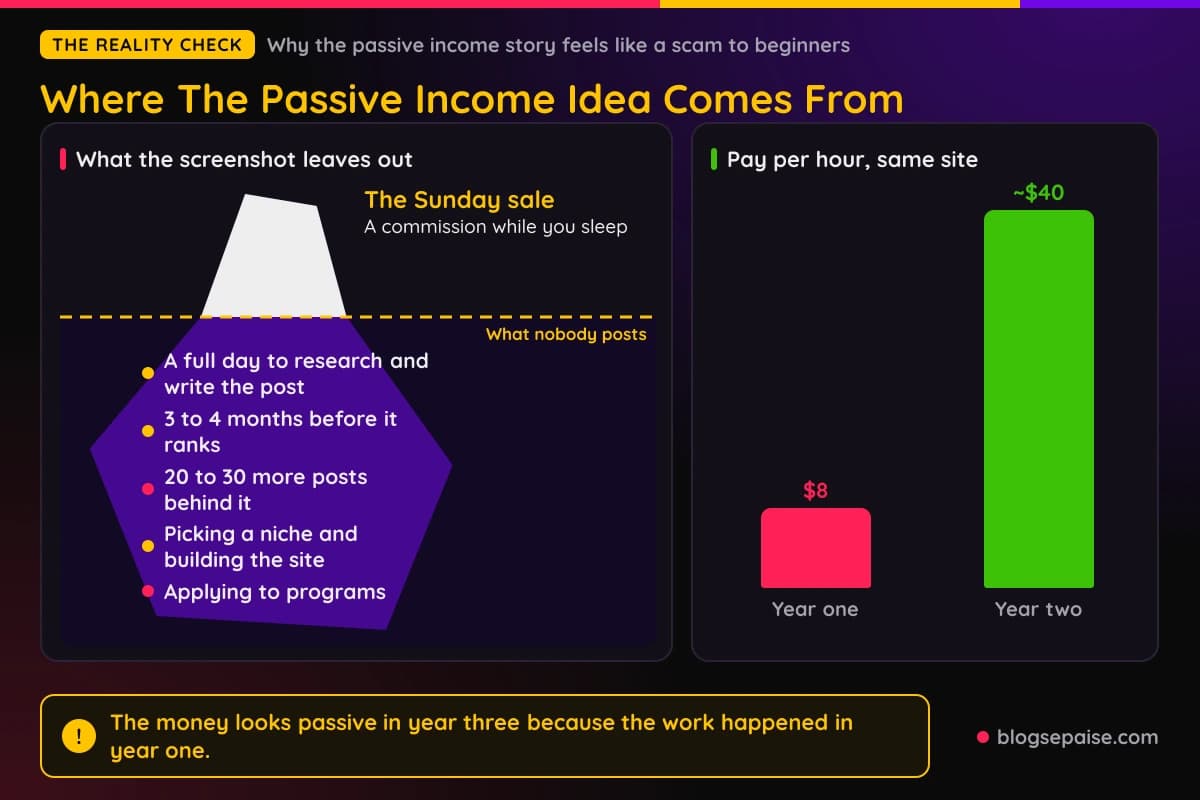
Behind that one post sit twenty or thirty more. A few of them earn, many of them earn a little, and some never earn a cent.
Add the time spent picking a niche, building the site, and applying to programs, and the first year looks a lot more like a part-time job than a beach holiday.
Think of it as delayed income first and passive income later. You trade a lot of hours up front for money that keeps arriving after the hours stop.
Some quick math helps here. Say you spend three hundred hours in your first year and earn nothing until month eight.
If the site earns five hundred dollars a month from then on, your first year paid you very little per hour. Year two and year three, with far fewer hours, pay a lot better.
Run the numbers and year one pays about eight dollars an hour. In year two, at three hours a week, the same five hundred dollars a month works out to almost forty dollars an hour.
The money looks passive in year three because the work happened in year one. Keep that picture in your head and the rest of this guide will make sense.
Step 1: Separate Passive Income From Delayed Income
The first step is getting the words right, because the wrong word sets the wrong expectations.
Passive income is money that arrives with little or no ongoing work from you. Delayed income is money that arrives long after the work was done.
Most affiliate income starts as delayed income. You write a review in March, it ranks in July, and it pays you in August.
That gap is normal, and it trips up almost every beginner who expected quick results.
Write down a simple split for your own site. On one side, list the work that pays you later, such as writing posts, building links, and growing an email list.
On the other side, list the work that never stops, such as checking links, updating prices, and answering reader questions.
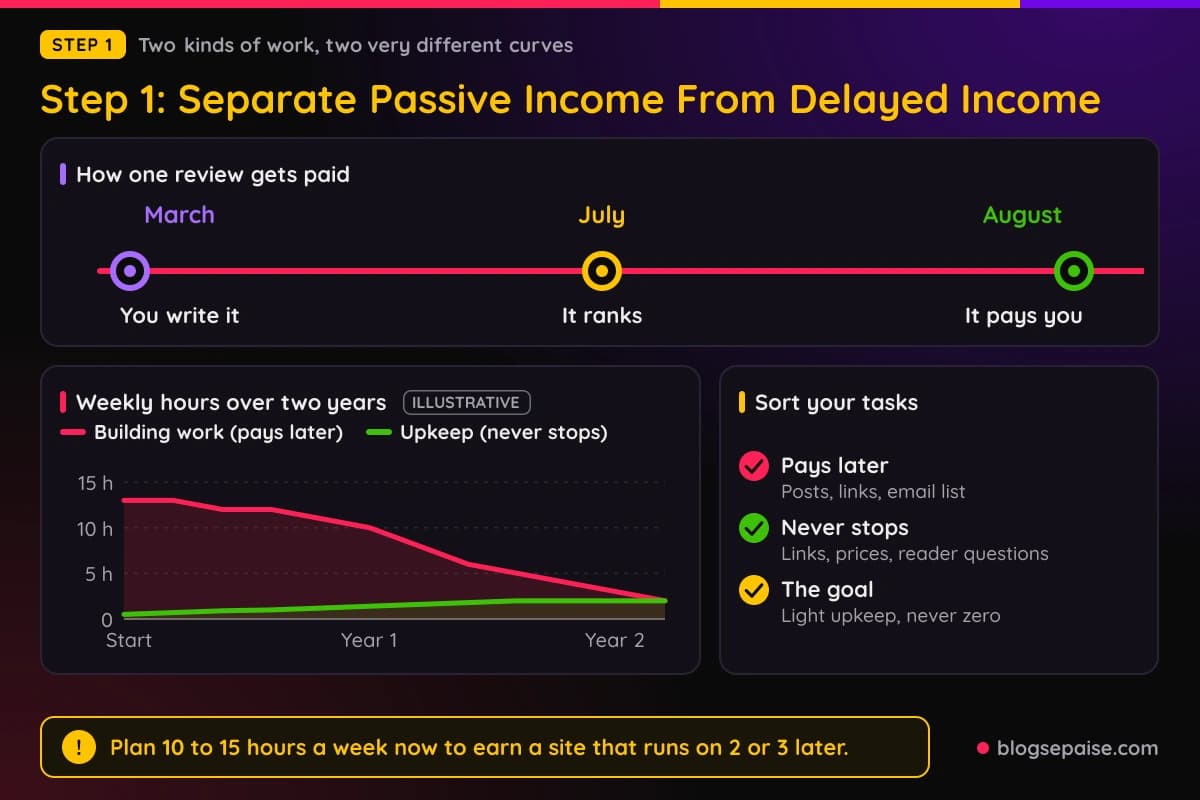
The first list is heavy at the start and shrinks over time. The second list starts small and grows a little as the site gets bigger.
A site becomes more passive when the first list slows down and the second list stays light. That balance is the real goal, and no site ever hits a perfect zero.
Be honest with yourself about the first year. Plan for ten to fifteen hours a week of building work if you want a site that can run on two or three hours a week later.
Our day by day plan for your first 30 days of affiliate marketing lays out the building work in the order it should happen.
One more way to think about it helps. Every post is a small machine you build once, and a working machine keeps running on very little fuel.
A broken machine needs constant repair, so the quality of what you build in step two decides how passive the business can ever become.
Step 2: Build Assets That Keep Ranking
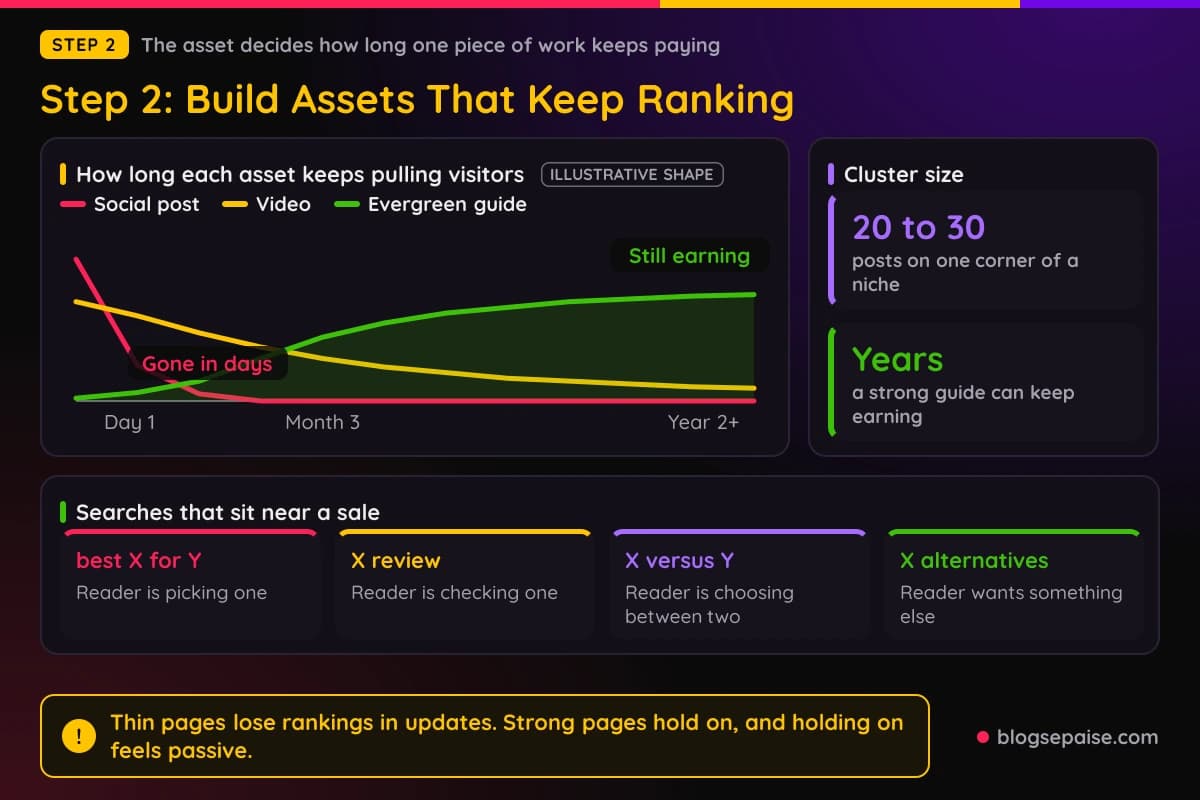
Passive income needs an asset that keeps working, and for most affiliates that asset is a page that ranks in search.
A social media post fades in a day or two. A video can last longer, and a well written blog post that answers a buying search can earn for years.
Pick topics that stay true for a long time. A guide to choosing a hiking backpack will still be useful in three years with a few small updates.
A post about a holiday sale will be useless by January.
Writers call this evergreen content, and it is the backbone of every affiliate site that earns while the owner rests.
Our guide on creating evergreen content shows how to pick topics that age well.
Focus on searches with buying intent. People who type best, review, versus, or alternatives into a search box are close to a purchase, and that is where your link earns.
Our walkthrough on how to do keyword research shows how to find those phrases without paying for anything.
When free tools stop being enough, a paid finder like KWFinder shows difficulty scores and competitor keywords on one screen.
That saves hours of guessing, and hours saved early are the hours that make the business more passive later.
Build in clusters instead of random posts. Twenty to thirty articles around one corner of your niche tell search engines that your site really knows that topic.
Our guide on building topical authority explains why clusters rank better than scattered posts.
Write every money post better than the pages already ranking. Add real experience, real prices, honest drawbacks, and a clear pick at the end.
Readers can tell when a writer has never touched the product. Photos you took yourself, real screenshots, and small details from actual use are hard to fake, and search engines reward them more every year.
Thin pages lose their rankings during search updates. Strong pages tend to hold on, and holding on is what makes the income feel passive.
Step 3: Pick Offers That Pay More Than Once
Your content decides how many people click. Your offers decide how much each click is worth over time.
Most affiliate programs pay once. A reader buys a product, you get a commission, and the story ends there.
Recurring programs work differently. Many software tools pay you a share of the monthly fee for as long as the customer stays subscribed.
One sale can pay you every month for a year or longer, and that is about as close to passive as affiliate income gets.
Here is a simple comparison. A one time commission of sixty dollars pays sixty dollars.
A thirty percent recurring commission on a forty dollar monthly plan pays twelve dollars a month. If the customer stays two years, that one sale pays you close to three hundred dollars.
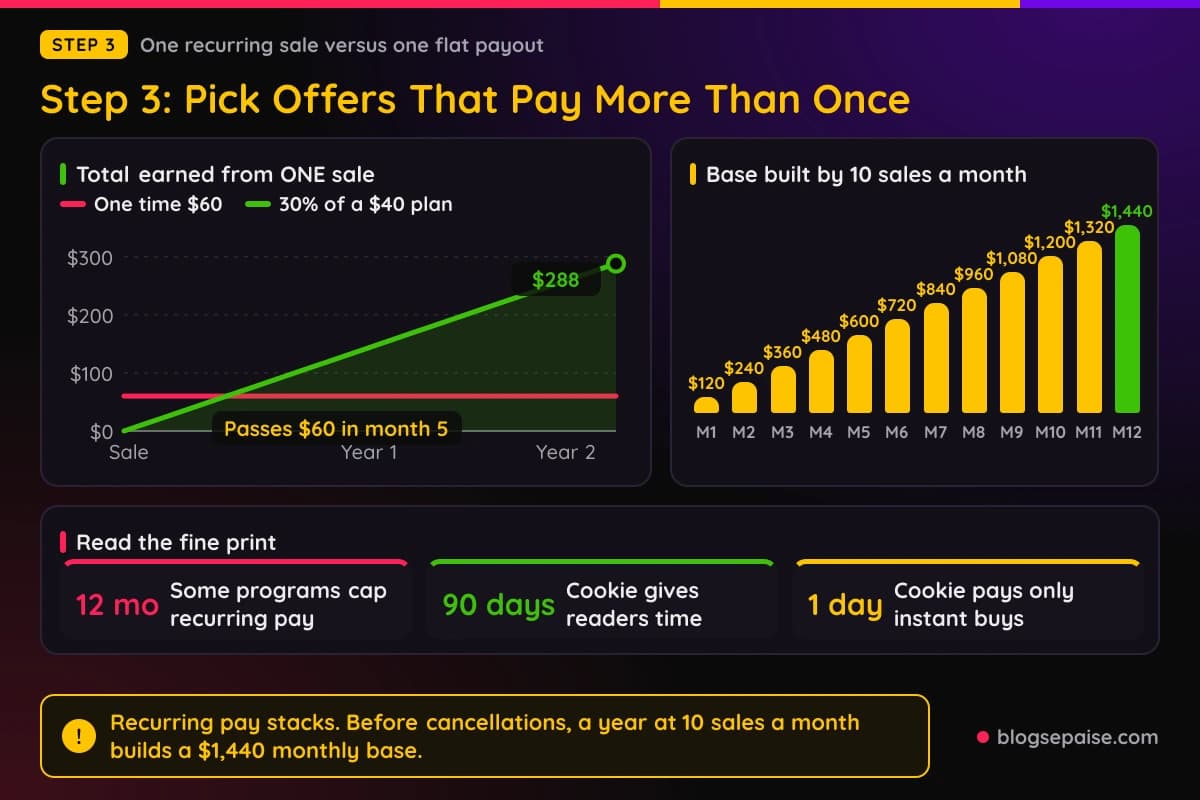
Recurring offers stack on top of each other. Ten new customers a month, each paying you twelve dollars, adds one hundred twenty dollars to your monthly base every month.
After a year, the base keeps paying even in a slow month when you send no new sales at all.
Before cancellations, twelve months at that pace builds a base of one thousand four hundred forty dollars a month.
Email tools are a classic example. A program like AWeber is a product that many creators keep for years, which makes it a natural fit for recurring income.
Check the fine print before you commit. Some programs cap recurring payments at twelve months, and some pay only while you stay an active partner.
Look at the cookie window too. A ninety day cookie gives readers time to think, while a one day cookie only pays if they buy right away.
Mix both kinds of offers in your niche. One time payouts from physical products bring cash now, and recurring software commissions build the base that keeps paying later.
Churn matters as much as the rate. A tool that customers cancel after two months pays far less than a slightly cheaper tool that people keep for years.
Read user reviews and forum threads before you promote anything recurring. Products that people complain about rarely keep customers long enough to build your base.
Step 4: Own The Audience With An Email List
Search traffic is rented. A single update to a search algorithm can cut your traffic in half overnight, and you have no say in it.
An email list is the part of the audience you actually own. People who join your list will still be there after a ranking drop.
A list also turns one visit into many. A reader who lands on your post once might never come back, but a subscriber hears from you every week.
Each email is another chance to recommend a product that fits their needs.
Start simple. Offer a useful freebie related to your niche, such as a checklist, a buying guide, or a short email course.
Place the signup box near the top of your best posts and again near the end.
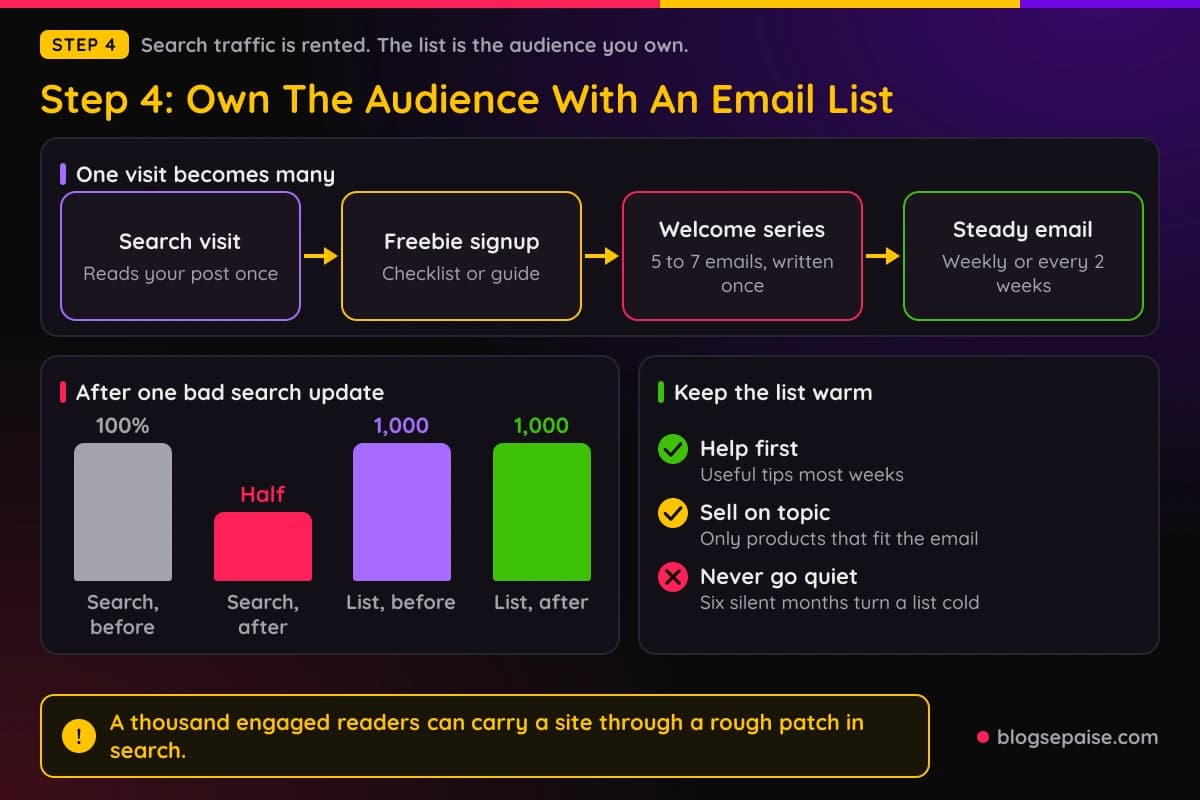
The passive part comes from automation. Write a welcome series of five to seven emails once, and every new subscriber receives it without any extra work from you.
The series can introduce your site, share your best posts, and recommend the tools you trust most.
Our welcome email sequence planner helps you map those first emails before you write them.
Our list of email marketing tools compares the platforms that can send the series for you.
Keep the list healthy with one regular email a week or every two weeks. Silence for six months turns a warm list cold, and cold lists ignore your recommendations.
Treat the list as insurance. Even a small list of a thousand engaged readers can carry a site through a rough patch in search traffic.
Respect the reader on the other end. Send useful tips most of the time and recommend products only when they fit the topic of the email.
A list that hears a sales pitch every week stops opening your emails. A list that gets real help keeps clicking for years, and those clicks are the passive income you were after in the first place.
Step 5: Plan For Maintenance Work
The part nobody puts in the screenshot is maintenance. Every affiliate site needs regular care, and skipping it slowly drains the income.
Prices change. Products get discontinued, programs close, and commission rates drop without much warning.
A page that ranks well but links to a dead product earns nothing. It still looks fine in your traffic reports, so the leak can run for months before you notice.
Broken links are the most common silent leak on affiliate sites.
A tool like Clicks watches every affiliate URL and warns you when one stops working. That turns a hidden problem into a five minute fix.
Our review of link tracking software covers more tools that check your links for you.
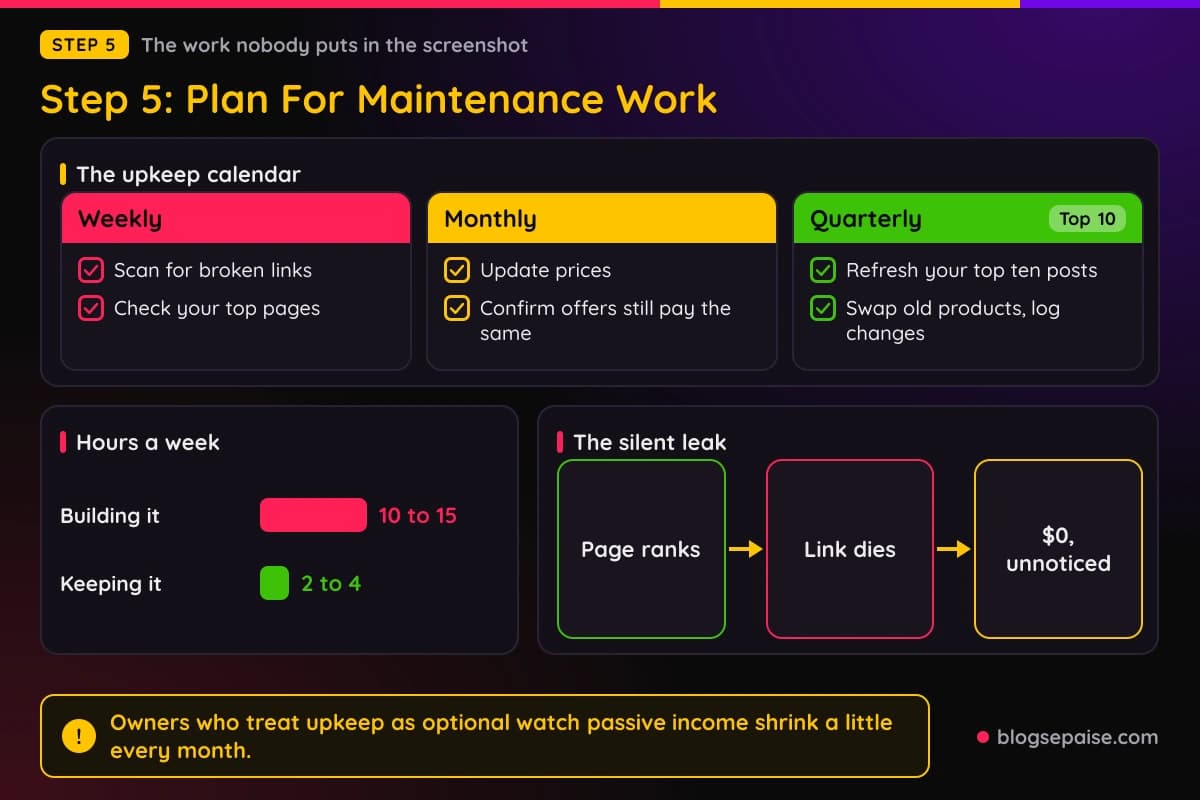
Set a fixed routine and stick to it. Once a week, check for broken links and look at your top pages.
Once a month, update prices and check that your best offers still pay the same rate.
Once a quarter, refresh your top ten posts. Update the year, swap out old products, add new details, and fix anything that no longer matches reality.
Keep a short log of every change you make. When a page jumps or drops in rankings a few weeks later, the log tells you what caused it.
Our guide to an AI content refresh workflow shows a faster way to keep older posts current.
A healthy site might need two to four hours a week once it is built. That is a lot less than the fifteen hours you spent building it, but it is not zero.
Plan for those hours on your calendar now. Owners who treat maintenance as optional usually watch their passive income shrink a little every month.
Step 6: Hand Off The Work You Do Not Need To Do
The next step toward passive income is getting yourself out of the jobs that someone else can do.
Most site owners do everything themselves at the start, and that makes sense when money is tight.
Once the site earns steady money, your time becomes the bottleneck. Every hour you spend formatting posts is an hour you are not spending on strategy.
Start by listing every task you do in a normal month. Mark the ones that need your judgment and the ones that only need a clear set of instructions.
Writing first drafts, finding images, formatting posts, and checking links can usually be handed off. Picking topics, choosing products, and approving final posts should stay with you.
Freelance marketplaces like Fiverr make it easy to test a writer or an editor on a single small job before you commit.
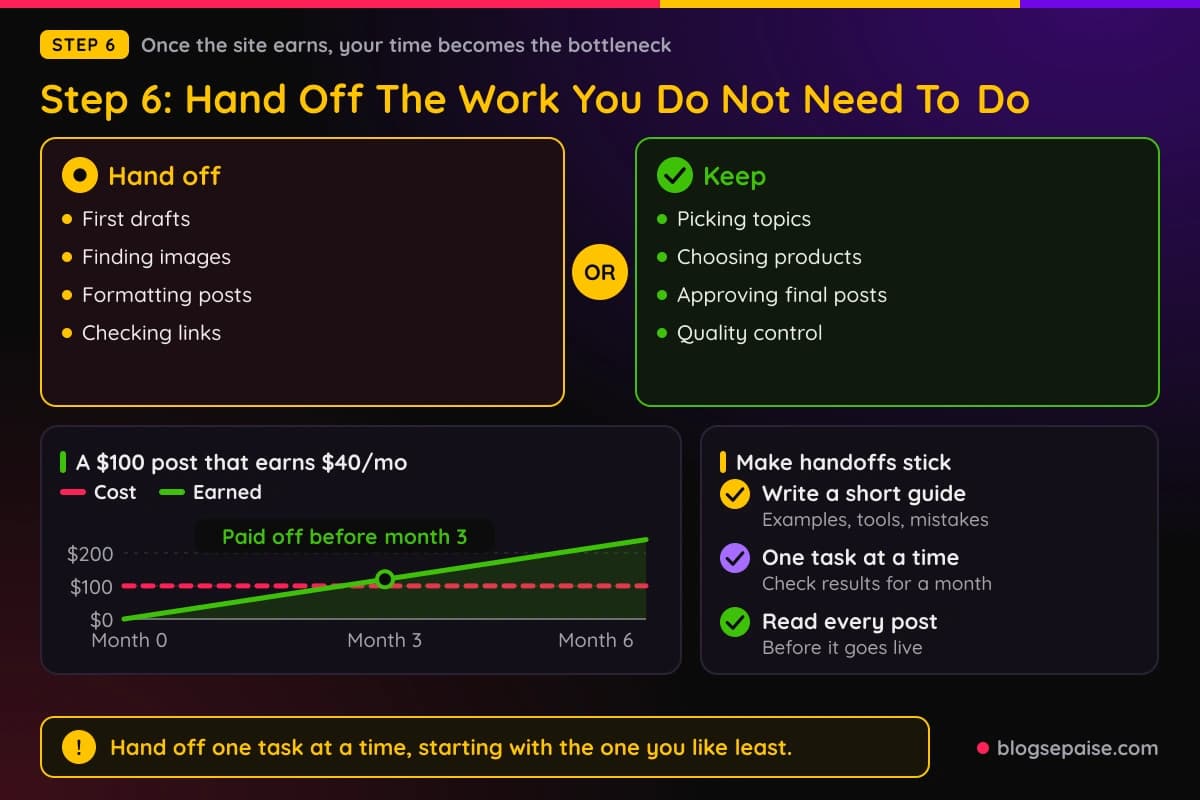
Write a short guide for every task you hand off. Include examples of good work, the tools to use, and the mistakes to avoid.
A clear guide saves hours of back and forth, and it lets you swap helpers without starting over.
Hand off one task at a time. Start with the one you like least, check the results for a month, and only then add the next one.
Pay fairly and give clear feedback. Good freelancers have plenty of clients, and the ones who stay with you for years save you far more than the cheapest option ever will.
Keep the money math in view. Paying a writer one hundred dollars for a post that earns forty dollars a month pays for itself in under three months.
Do not hand off your quality control. Read every post before it goes live, because one sloppy article with a false claim can damage the trust the whole site depends on.
The goal here is a site that runs on a few hours of your attention a week, not a site you never look at again.
Step 7: Spread The Risk Across Traffic And Programs
The last step protects everything you built. Passive income that depends on one source can disappear just as passively as it arrived.
Many affiliates learned that lesson the hard way. A single search update cut their traffic, or a single program slashed its rates, and the monthly income dropped by half in a week.
Spread your income across more than one program. If one product pays most of your commissions, find a solid backup you can link to if that program changes its terms.
Our notes on avoiding bans from affiliate programs list the shortcuts that cost people their accounts.
Spread your traffic too. Search will probably stay your biggest source, but an email list, a Pinterest account, or a small YouTube channel can each add a steady stream.
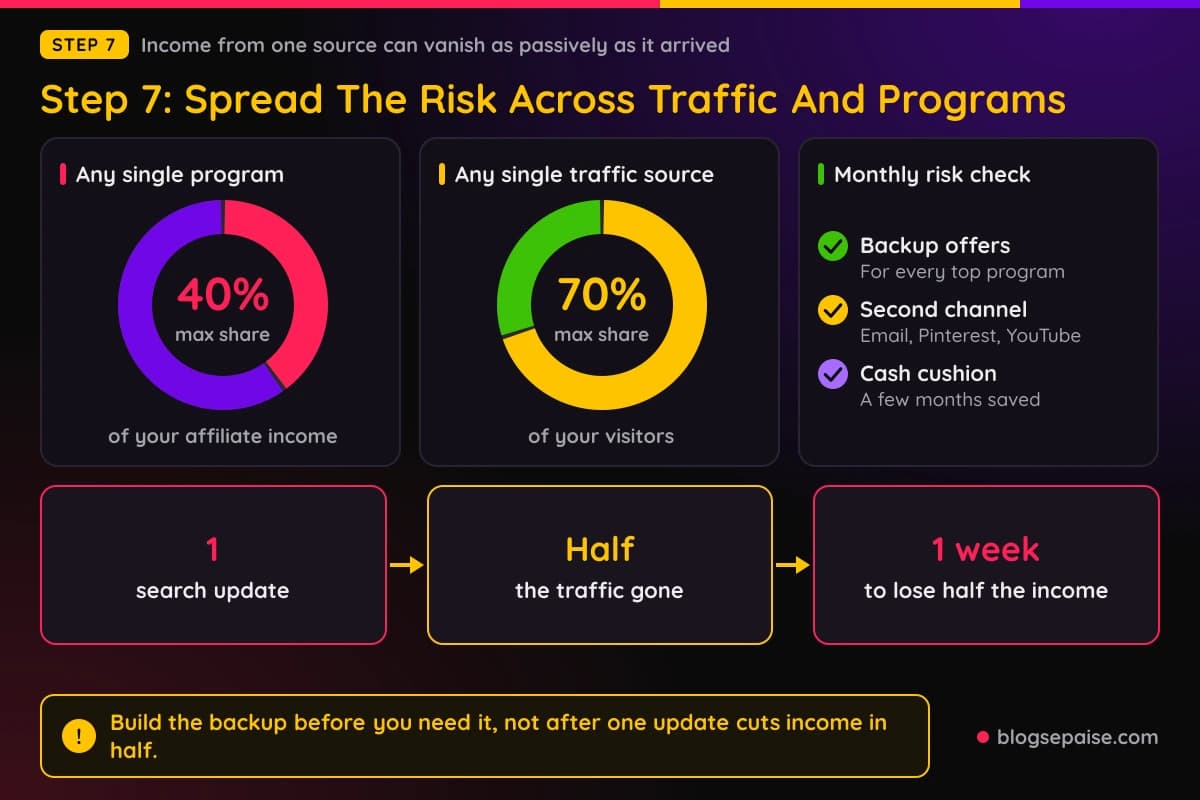
A simple rule works well. Try to keep any single program under forty percent of your income and any single traffic source under seventy percent.
You will not hit those numbers in year one, but they give you a target as the site grows.
Track everything in one simple sheet. Our blog income tracker makes it easy to see which programs and pages carry the most weight.
Check the sheet once a month. If one line keeps growing while the others stay flat, that is your signal to build a backup before you need one.
Keep a little cash aside as well. A few months of savings from your affiliate income means a bad month stays a bad month instead of a crisis.
Think about the format of your assets too. A site that earns from written reviews, comparison tables, and a short email course has three different ways to reach a buyer.
If one format loses favor, the other two keep the lights on while you adjust.
Results You Can Expect
Realistic expectations keep you working through the quiet months, so here is what the road usually looks like.
Every site moves at its own pace, so use these stages as signposts rather than deadlines.
Months one to three are almost all active work. You build the site, publish your first posts, and apply to programs, and income is usually close to zero.
Months four to nine bring the first commissions. A few posts start ranking, a few readers click, and the first payouts arrive in small amounts.
Months ten to eighteen are where the curve can start to bend. More posts rank, older posts climb higher, and recurring commissions start to stack.
Year two is when many owners first feel the passive part. The building slows down, the maintenance routine takes over, and income keeps arriving in weeks you barely worked.
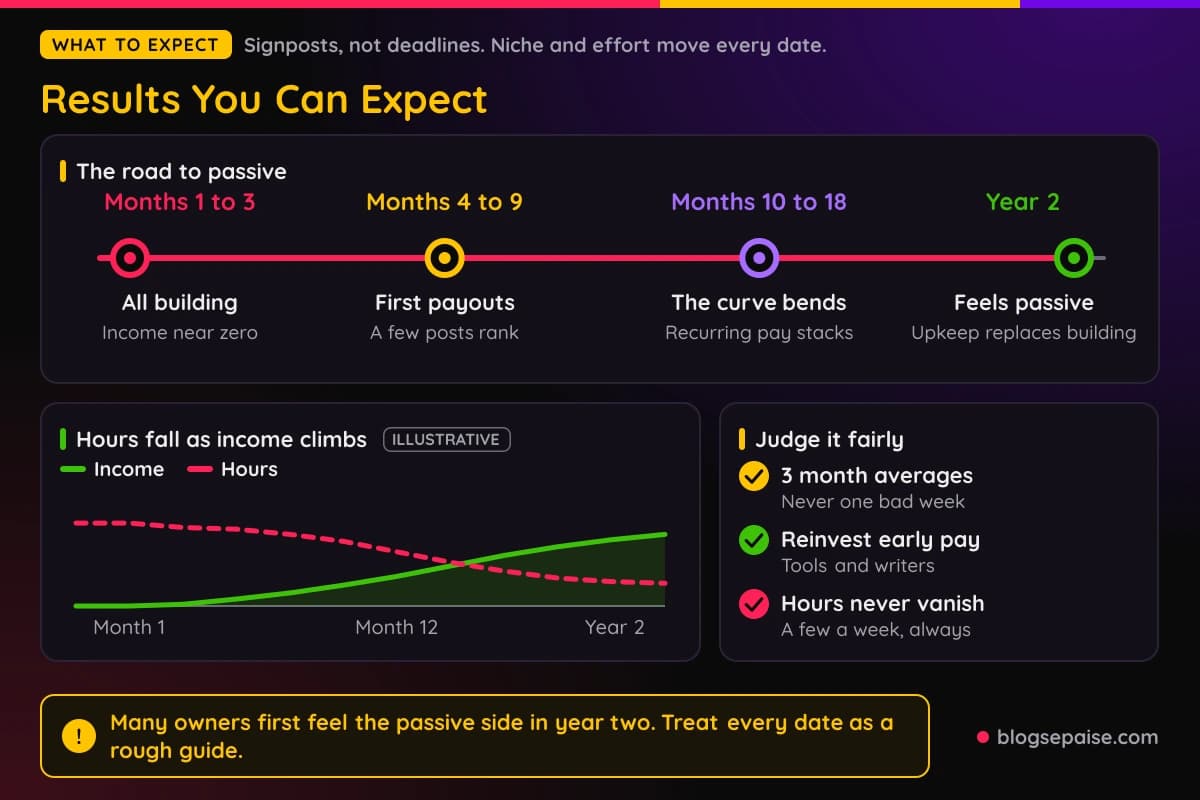
None of these dates are promises. A site in a crowded niche can take longer, and a site in a small niche with strong buying searches can move faster.
Expect lumpy months. One month might bring five sales and the next might bring none, so judge your progress by the three month average instead of a single bad week.
Expect to reinvest early income too. A first payout that buys a better keyword tool or a freelance writer is doing exactly its job.
Expect the hours to drop but never vanish. A mature site that earns well still needs a few hours of care each week.
Our affiliate income goal planner helps you work backward from a monthly target to the number of posts and visitors you need.
Common Mistakes With Passive Income
A handful of mistakes break more passive income plans than anything else, and every one of them is easy to avoid.
The first mistake is quitting in the delayed phase. Owners expect passive results in month two, see nothing, and walk away right before the first posts start ranking.
The second mistake is chasing quick traffic. Viral social posts feel exciting, but they fade in days and rarely build income that lasts.
The third mistake is ignoring maintenance. Dead links, old prices, and outdated product picks slowly eat the income of a site that still looks healthy in traffic reports.
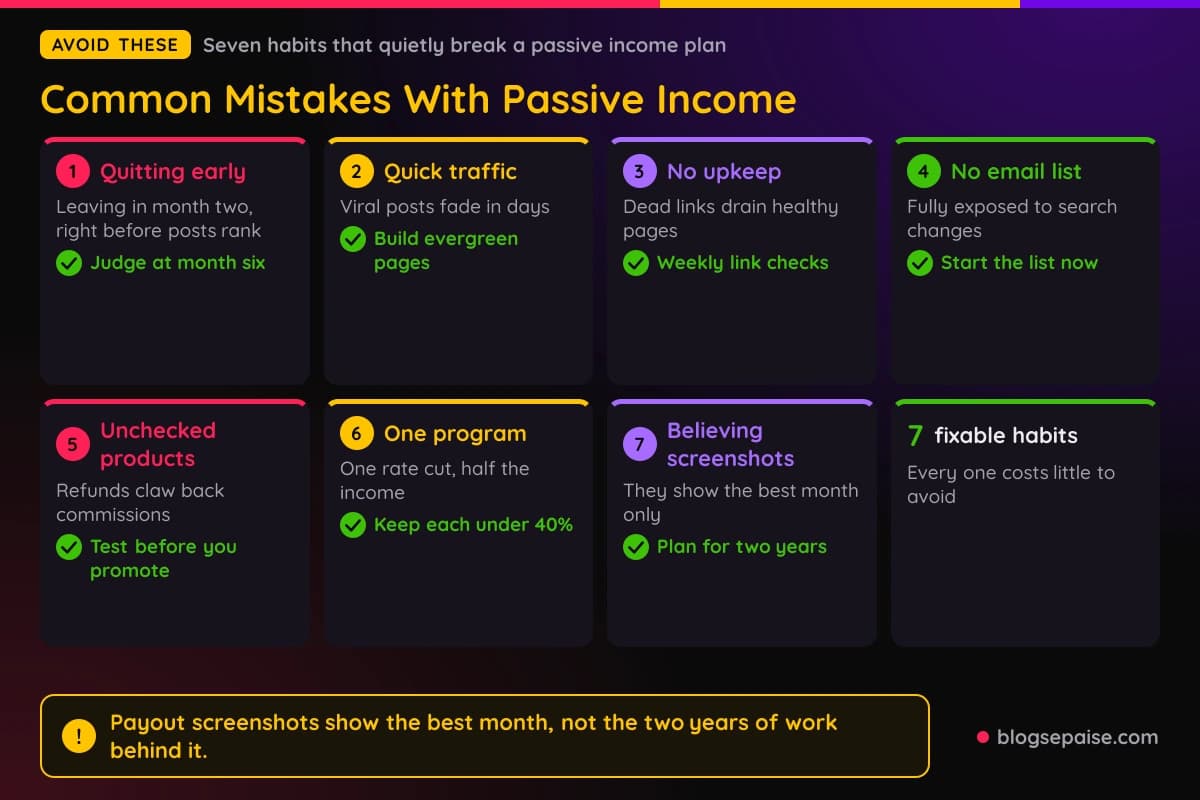
The fourth mistake is skipping the email list. A site with no list is fully exposed to every change in search, and it has no way to reach past readers.
The fifth mistake is promoting products you have never checked. Junk products bring refunds, refunds bring clawed back commissions, and readers stop trusting your picks.
The sixth mistake is leaning on one program for everything. A single change to rates or terms can wipe out most of your monthly income overnight.
The last mistake is believing the screenshots. Payout dashboards show the best month, not the two years of work or the slow months in between.
Our guide on why most new affiliate sites fail walks through the early mistakes in more detail.
Final Thoughts
Affiliate marketing can produce income that feels passive, and many people earn money on days when they do nothing at all.
The catch is that the passive part comes last. It sits on top of months of active building, a steady maintenance routine, and a few smart choices about offers and traffic.
Run the seven steps in order and each one makes the next one easier. Clear expectations keep you going, evergreen posts give you assets, and recurring offers make each sale pay longer.
An email list protects the audience, maintenance protects the income, handing off work protects your time, and spreading risk protects everything you built.
Start this week with step one. Write your own two lists of delayed work and ongoing work, and put a realistic number of hours next to each.
That one page will tell you more about your future passive income than any payout screenshot ever could.
Frequently Asked Questions
1. Is affiliate marketing really passive income?
Affiliate marketing can become mostly passive after the building phase. The first months need a lot of active work, and a mature site still needs a few hours of maintenance each week.
2. How long does it take for affiliate income to feel passive?
Many site owners start to feel the passive side somewhere in year two. Results vary by niche, effort, and competition, so treat any timeline as a rough guide.
3. How many hours a week does a passive affiliate site need?
A built site with steady traffic usually needs two to four hours a week. That time goes to link checks, price updates, content refreshes, and email.
4. Which affiliate programs are best for passive income?
Programs that pay recurring commissions tend to work best. Software tools with monthly plans can pay you every month for as long as the customer stays.
5. Can I build passive affiliate income without a blog?
You can, but a blog or a video channel gives you assets that keep ranking. Social posts fade quickly, so they work better as a support channel than as the main asset.
6. Do I need an email list for passive affiliate income?
You do not need one to start, but it helps a lot. An email list gives you an audience that stays with you even when search traffic drops.
7. Why did my affiliate income suddenly drop?
The usual causes are a search update, a broken link, a program changing its rates, or a product going out of stock. Check your links and your top pages first, since those are the fastest fixes.