Why Most New Affiliate Sites Never Make A Dollar
Most new affiliate sites die quietly before they ever earn a dollar. The owner picks a domain, publishes five or six posts, waits three weeks, watches the analytics sit at zero, and walks away.
That pattern repeats itself thousands of times every month. Nobody quits because affiliate marketing stopped working.
People quit because they built the site in the wrong order, targeted searches that were never going to pay, and gave the whole experiment less time than it needs to show anything.
We have seen the same failure points show up again and again across hundreds of new sites. The good news is that every one of them is avoidable once you know what to look for.
So we broke the whole thing into seven steps. Each step depends on the one before it, so the order matters as much as the work itself.
By the end you will know exactly why most new affiliate sites never make a dollar, and you will have a clear plan for making sure yours is not one of them.
Numbers tell the story better than opinions do. A site that launched with five posts and zero tracking has no way to learn, so the owner guesses, gets frustrated, and quits.
A site that launched with a paying niche, thirty targeted posts, and one spreadsheet can see exactly which lever to pull next.
The failure pattern is so consistent that you can predict a dead site from a screenshot. Thin content, no disclosure, random topics, and a theme that took three days to perfect while the articles took three hours.
If you are completely new to the model, read our guide on what affiliate marketing actually is first.
You can also skim how affiliate marketing works to see how a commission travels from a click to your bank account.
Disclosure: Some of the links I share might be affiliate links. If you click on one and make a purchase, I may earn a small commission as a thank you. But don’t worry, it won’t cost you anything extra. I only recommend stuff I genuinely believe in. Your support helps me keep creating awesome content. You can read my full affiliate disclosure in my disclaimer page.
If you want to save a lot of hours searching for high-paying affiliate programs, check out our exclusive list of 2500+ affiliate programs. You’ll find all the information about the programs inside the list. This list is perfect for affiliate bloggers and influencers.
How Most New Sites Fail
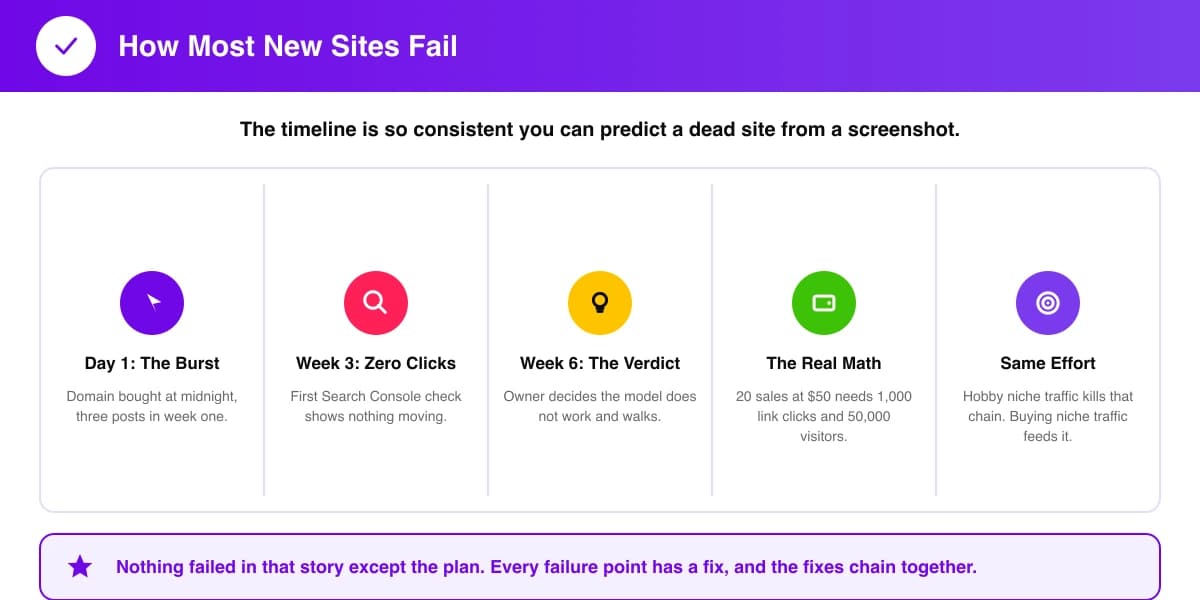
The typical new affiliate site follows a sad little timeline. The owner gets excited on day one, buys a domain that night, and publishes three posts in the first week.
Week two brings two more posts and a pile of forum answers with a link dropped in each one. Week three brings the first check of Search Console, which shows zero clicks.
Week six brings the decision that this whole thing does not work.
Nothing failed in that story except the plan.
New sites fail in the same handful of ways over and over. They pick a niche where nobody spends money, so there is nothing to promote no matter how good the writing gets.
They write about topics that only curious readers search for, so the traffic that does arrive never turns into clicks. They skip the trust pages that programs and readers both look for, then wonder why every application gets rejected.
They publish five posts and expect an income, then quit before search engines have even finished indexing the site.
There is also the quiet killer, which is broken or missing links. A brand new site can rank, get clicks, and still earn nothing because half the links point to expired offers or were never inserted properly in the first place.
One honest number helps to set the stage. A commission of fifty dollars per sale needs twenty sales to reach one thousand dollars, and twenty sales at a two percent conversion rate need one thousand link clicks.
One thousand link clicks at a two percent click rate need fifty thousand page visitors. That chain is brutal from a hobby niche with weak traffic and easy from a buying niche with steady rankings. Same effort, wildly different outcome.
Every one of those failures has a fix, and each fix sets up the next step in the chain. Rush ahead to step five before you have done step one, and you will simply rebuild the same problem in a new place.
Step 1: Pick A Niche That Can Actually Pay
Niche choice is where most sites are already doomed, and the owner does not know it yet.
A niche earns money when products in it are sold regularly, when affiliate programs exist for those products, and when commissions are big enough to matter.
A huge audience is worth nothing on its own. Ten thousand monthly readers looking for free trivia will always earn less than five hundred readers comparing hosting plans.
Before you buy a domain, list at least five products or services people in that space already pay for. Then confirm that real affiliate programs exist for them.
Digital tools usually pay 20 to 50 percent commissions because delivery costs nothing, while physical products pay a small percentage of a bigger price tag. Both can work. A niche with neither can not.
Watch for the hobby trap. Cooking, gardening, and fitness all have passionate audiences, and they also have millions of competing pages written by people who enjoy the topic and never plan to monetize it.
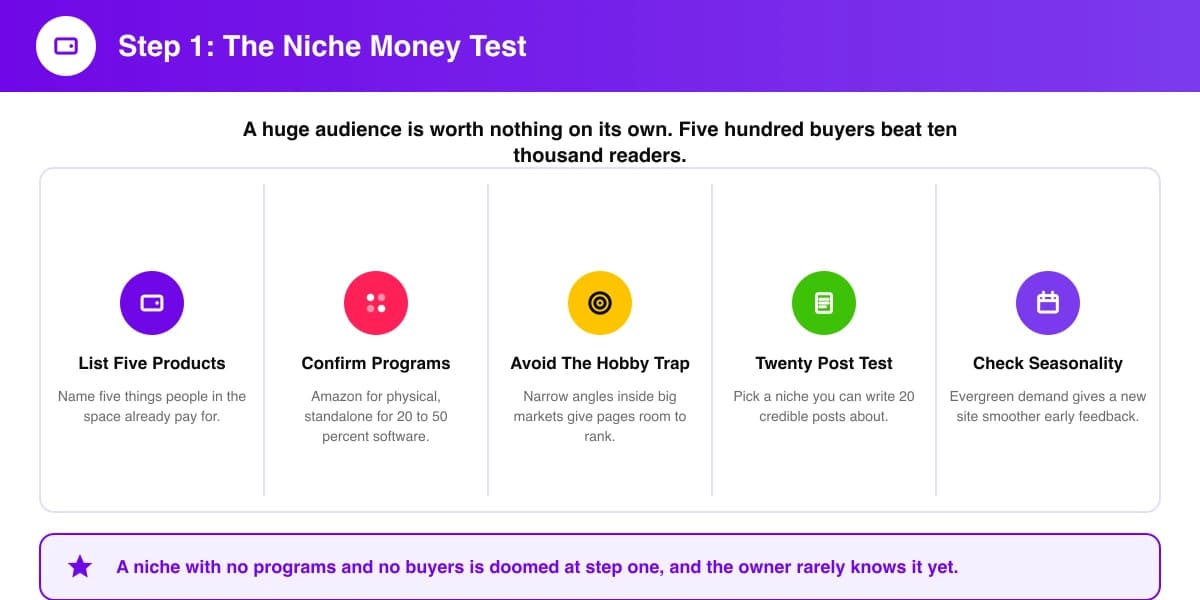
A narrower angle inside a big market, such as bread making for small kitchens or strength training over forty, gives you a room where your pages can actually rank.
Our guide on choosing a profitable niche walks through the money test step by step.
One more rule applies here. Pick the niche you can write twenty credible posts about without running out of things to say. Sites die at post eight all the time because the owner chose a topic they do not actually know or care about.
Check the programs before you commit. Search for your three to five likely products and see which networks carry them.
Amazon Associates covers almost every physical product at low rates, while standalone software programs often pay twenty to fifty percent with recurring commissions. A mix of both gives you stability and upside.
Watch the seasonality of the niche too. Gift heavy niches spike hard in one quarter and crawl through the rest, which makes early results look worse than they really are.
Evergreen niches with year round demand give a new site smoother feedback while you learn.
Step 2: Choose Keywords With Buying Intent
Once the niche can pay, the next job is finding the searches that lead to money, and this is the second place most new sites fall apart.
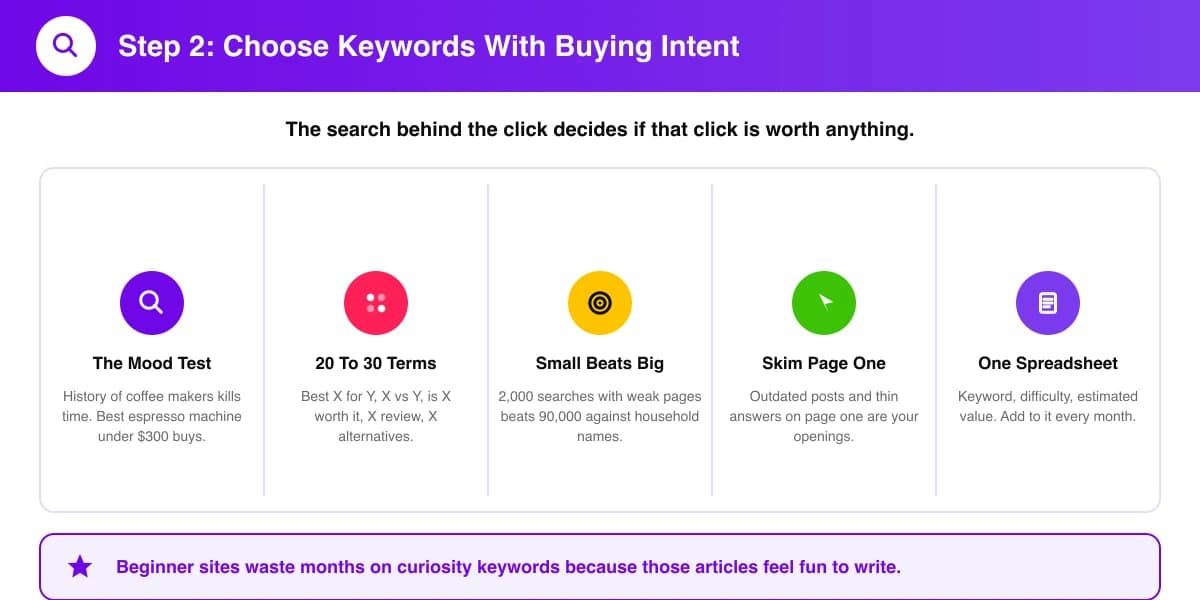
Every search has a mood behind it. Someone searching for the history of coffee makers is killing time. Someone searching for the best espresso machine under three hundred dollars has a card in hand.
The second search is worth roughly one hundred times the first one, and beginner sites waste months chasing the first kind because those articles feel fun to write.
You need a list before you write anything. Aim for twenty to thirty keywords with clear buying intent, such as best X for Y, X versus Y, is X worth it, X review, and X alternatives.
These phrases signal a reader who is close to a decision, and a decision is exactly where your link earns.
Free tools are enough to start. Type your seed topic into a keyword tool, look for terms with modest search volume and weak competition, and drop the ones that only spark curiosity.
Our list of keyword research tools covers the beginner friendly options, and our walkthrough on how to do keyword research shows the full process.
When free tools run out of runway, a paid finder like KWFinder shows difficulty scores and competitor terms in one screen, which saves hours of guesswork every month.
Keep the list in one spreadsheet with a column for difficulty and a column for estimated value. You will add to it every month, and it becomes the engine that drives everything after this.
Competition matters more than volume for a new site. A phrase with two thousand monthly searches and five strong competing pages will earn you more than a phrase with ninety thousand searches and a page one full of household names.
Small sites win small keywords first, then grow into bigger ones.
Skim the current page one results for each keyword before you write. If page one is stacked with government sites, massive review platforms, and brand pages, skip that term for now.
If you see outdated posts, thin answers, or forums with no real review, that is an opening you can beat.
Step 3: Build Trust Pages Before You Publish
New sites fail the trust test long before they fail the traffic test, and the fix takes an afternoon.
Programs reviewing your application look for four things: a live site, real content, an about page with a person behind it, and a clear disclosure.
Readers look for the same signals when they land on a review post and try to tell if the writer has ever used the product.
Skip these pages and you get rejected by programs, ignored by readers, and flagged by anyone who knows what a thin affiliate site looks like.
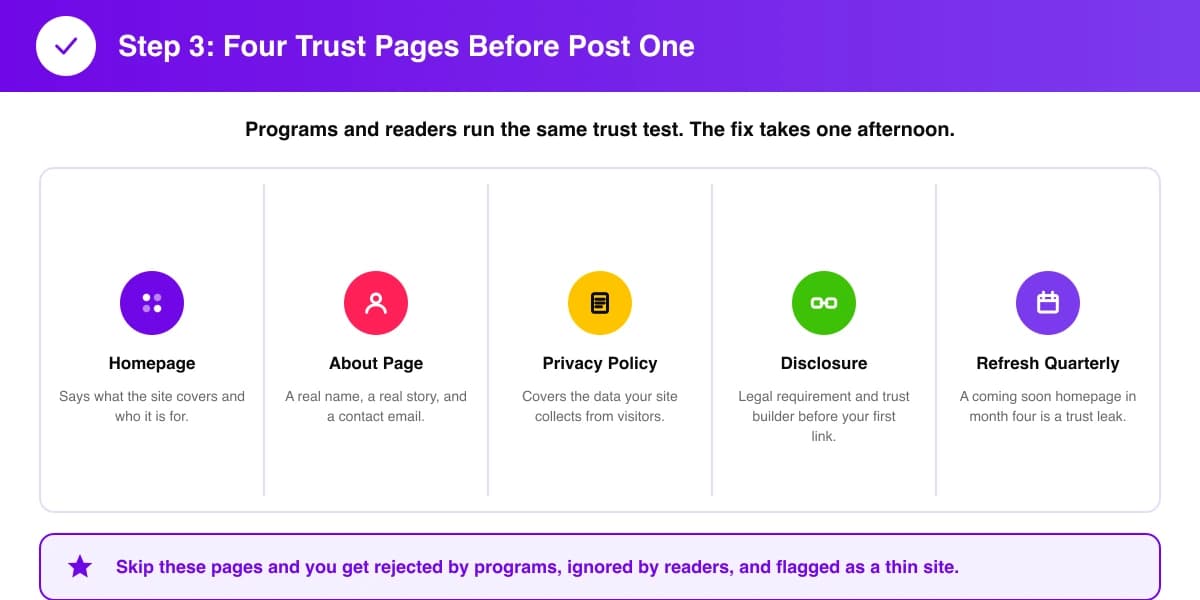
Build four simple pages before your first article goes live. Your homepage explains what the site covers and who it is for. Your about page carries a real name and a real story.
Your privacy policy covers the data your site collects. Your affiliate disclosure explains that links can pay you, which is a legal requirement and a trust builder at the same time.
Keep each page short. You are raising a skeleton you will improve later, not writing your best work. Two hundred honest words on an about page beat a blank template every time.
Our notes on trust building pages show what each page should include.
Our guide to legal disclosures for affiliate sites covers the rules you must follow before your first link goes public.
Add a contact method while you are in there. A simple email address on the about page signals that a real person runs the site, and program reviewers check for exactly that kind of detail.
Anonymous sites get extra scrutiny from affiliate managers who have seen thousands of thin spam pages.
Refresh these pages every few months. A homepage that still says coming soon in month four is a trust leak, and fixing it takes ten minutes.
Step 4: Publish Enough Of The Right Content
With a paying niche, a keyword list, and trust pages in place, you can finally publish, and this step is where patience decides who survives.
Five posts will not move the needle. Twenty scattered posts will not either. The approach that works is a focused cluster: twenty to thirty articles covering one corner of your niche so completely that search engines start treating your site as the place that knows that topic.
That reputation has a name, and you can read more about it in our guide on building topical authority.
Work from your keyword list and publish in the order of buying intent. Put your strongest comparison posts first, follow with reviews and alternatives, and mix in a few simpler answers only when they support a money post.
Every new article should link to at least one earlier article with a sentence that explains the connection, because internal links help readers move and help search engines understand your structure.
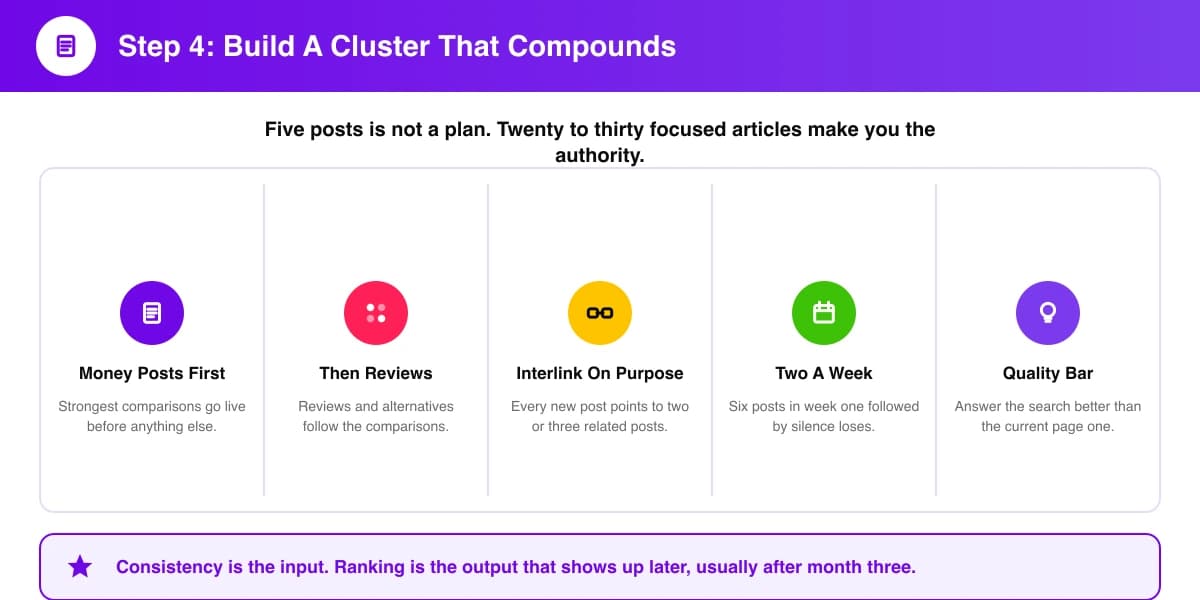
Set a pace you can hold. Two posts a week for three months beats six posts in week one followed by silence. Consistency is the input, and ranking is the output that shows up later.
If money is tight, our guide on starting affiliate marketing with no money shows how to get a site live on a near zero budget.
Quality still decides which posts survive the update storms. Search engines have gotten very good at spotting pages written only to rank, so each article should answer the search better than the current page one.
That means honest experience, real comparisons, clear prices when you can show them, and a recommendation you can defend.
Interlink on purpose as the cluster grows. Every new post should point to two or three related posts, and the strongest money pages should receive the most internal links.
Readers click those links, search engines follow them, and the whole cluster lifts together instead of each page fighting alone.
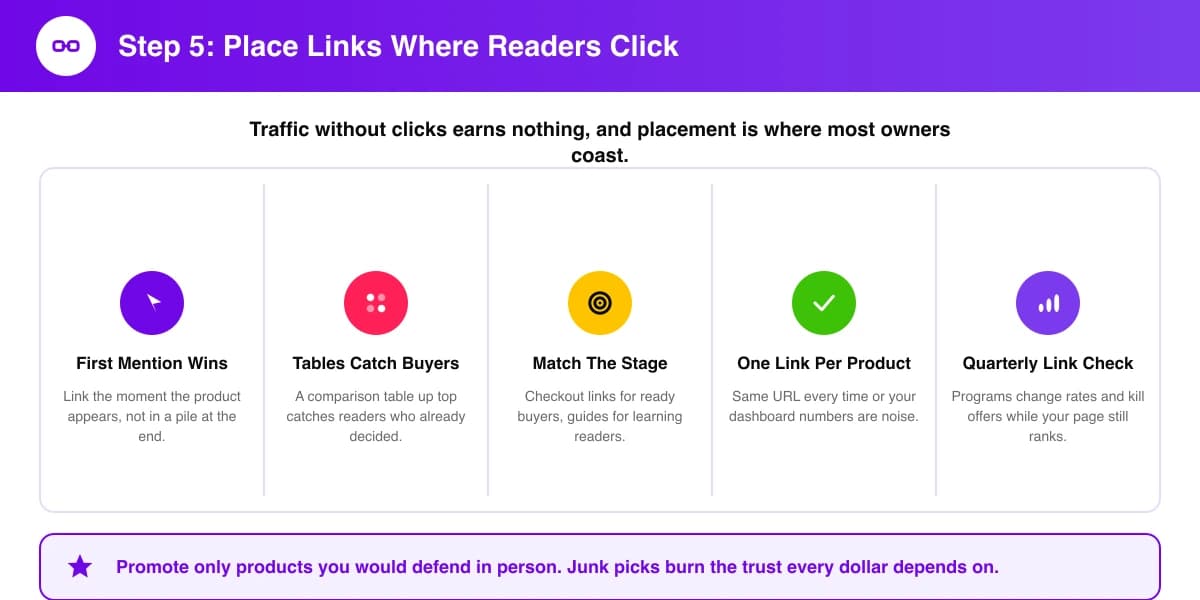
Step 5: Place Links Where Readers Actually Click
Traffic without clicks earns nothing, and link placement is the step most owners handle on autopilot.
Put a link at the moment you first mention a product, not in a pile at the bottom of the page. A reader who has to scroll past three hundred words to find the option they wanted often never scrolls at all.
Comparison tables near the top of a review work for the same reason, because they catch readers who already know what they came for.
Use the same link for the same product every time. Mixing tracking links turns your dashboard numbers into noise, and you will never know which post actually performed.
A simple link tracker keeps a live check on every URL so broken links show up as a problem to fix instead of a silent leak.
A tool like Clicks watches every affiliate URL and flags the dead ones, which turns a silent leak into a five minute weekly fix.
Recommend only products you would defend in person. Promoting junk for a quick commission burns the trust that every dollar you earn depends on, and it is the fastest way to get dropped by a program that would have paid you for years.
Our notes on avoiding bans from affiliate programs list the shortcuts that cost people their accounts.
Place the disclosure near the top of every post, before the first link. Short, plain, and impossible to miss.
Match the link destination to the reader's stage. A comparison table with pricing works for a reader ready to choose, while an honest how to guide works for a reader still learning.
Sending a confused beginner straight to a checkout page wastes the click, and sending a ready buyer to another article wastes the sale.
Review your links once a quarter. Programs change rates, cap commissions, and quietly shut down offers, and a page full of dead links will keep ranking while earning you nothing.
Our review of link tracking software covers tools that watch every URL for you.
Step 6: Track The Numbers That Matter
The fourth failure point is invisible, because a site with no tracking can not tell the difference between a slow start and a broken one.
Set up Search Console and analytics in week one, before you have traffic to measure. Search Console shows which pages search engines found, how often you appear, and where you rank on average.
Analytics shows who showed up and what they did next. Together they turn guesses into decisions.
Build one spreadsheet with a row per post: URL, words, clicks, impressions, average position, and affiliate link clicks. Update it once a week and leave it alone the rest of the time.
Three numbers deserve your attention. Impressions with no clicks means your titles need work. Clicks with no affiliate clicks means the offer or the placement is wrong.
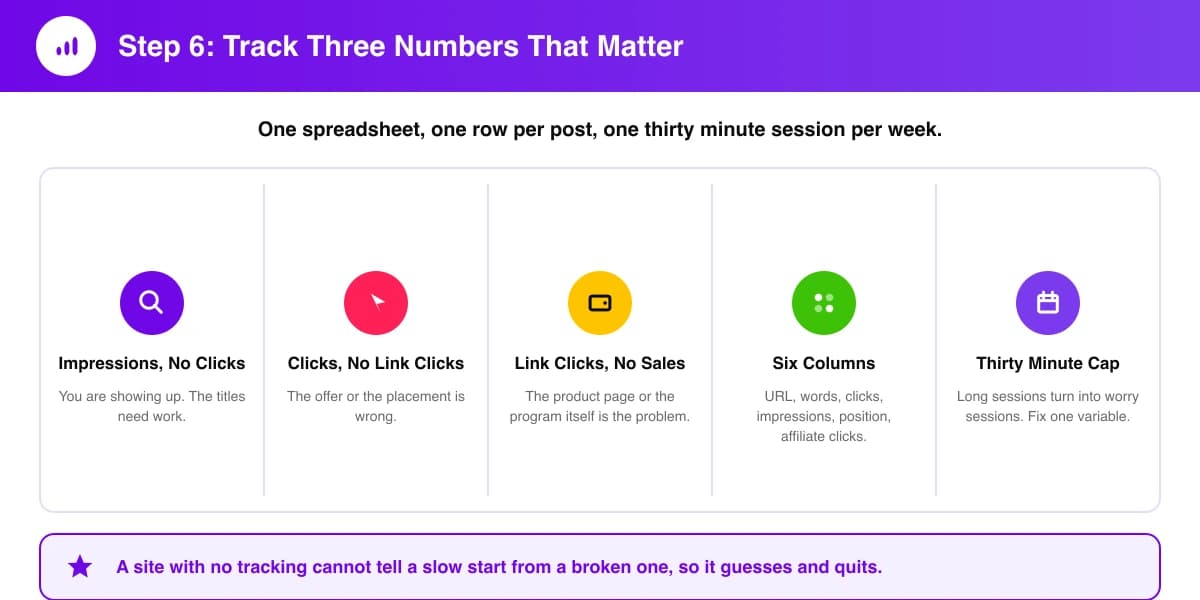
Affiliate clicks with no sales points at the product page or the program itself. Fix one variable at a time, or you will never know which change moved the number.
Keep a separate column for hours spent. Dividing earnings by hours shows if this niche respects your time, and a bad answer early is far cheaper than a bad answer in year two.
Free tools cover everything at the start. Search Console and a basic analytics install tell you most of what you need in month one, and a spreadsheet costs nothing.
Paid rank trackers and dashboards earn their price later, when you have fifty pages and cannot check positions by hand.
Review the sheet on the same day each week and cap the session at thirty minutes. Long weekly analysis sessions turn into worry sessions, and worry never fixed a title tag.
Step 7: Give It Six Months Before You Judge It
The final step is the one almost nobody completes, and it explains more failures than every other step combined.
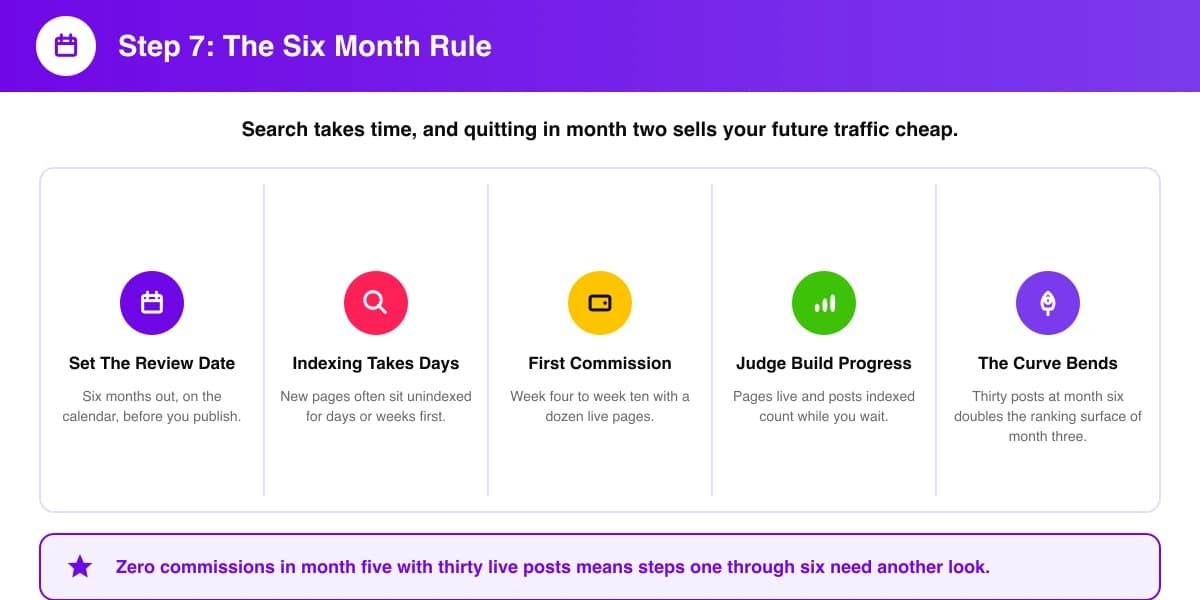
Search takes time. New pages often sit unindexed for days or weeks, and ranking positions drift for months after that.
Most first commissions land somewhere between week four and week ten, and sites that keep publishing through month six look completely different from the ones that stopped in month two.
Judge the site on build progress until the numbers arrive. Pages live, links placed, applications sent, and a growing list of indexed posts are all real.
Zero commissions in month one with four live posts is a normal Tuesday. Zero commissions in month five with thirty live posts is a signal that steps one through six need another look.
Set a review date on your calendar right now. Six months from today, open the spreadsheet, read the three numbers, and decide with evidence.
Sites that reach that date with a body of work almost always have something to build on. Sites that never reach it usually had a plan that could not fail for any reason other than quitting.
Our day by day plan in your first 30 days of affiliate marketing gives you the exact tasks for the opening month, in order.
Quitting early is expensive because of how compounding works. A site with thirty posts at month six has twice the ranking surface of the same site at month three, and the traffic curve usually bends upward right after that point.
Owners who quit in month two sold their future traffic for the price of their frustration.
Keep a simple habit while you wait. Two posts a week, one tracking update, one hour of outreach, and the rest of your attention somewhere else. The site needs time more than it needs your nerves.
What Results To Expect
Realistic expectations keep you working past the quiet weeks.
Expect your first indexed pages within the first couple of weeks and your first real clicks by the end of month one if your keywords were chosen well.
Expect the first commission around week four to week ten, with a good month looking like a handful of small sales rather than a windfall.
Expect growth to compound slowly. Twenty posts earn more than double what five posts earn, because every article adds ranking chances and passes links to its neighbors.
The jump from month three to month six is usually where owners who stayed start to see the shape of a real business.
Expect lumpy numbers too. Some weeks a single post will send ten buyers and other weeks nothing happens at all. Monthly totals are the honest measure, and daily checking only produces anxiety.
Also expect to reinvest. A first payout that buys a better tool, a course, or more content capacity is doing its job. The sites that scale are the ones that treat early earnings as fuel instead of a prize.
A realistic month three snapshot looks like this: fifteen to twenty posts live, a few hundred monthly visitors, your first couple of commissions, and a spreadsheet full of clues.
A realistic month six snapshot looks like thirty posts, a few thousand visitors, steady weekly clicks, and one clear winner post you can expand.
Neither snapshot is dramatic, and both are ahead of where quit in week six sites finish, which is exactly nowhere.
Common Mistakes New Site Owners Make
The same handful of errors account for most dead sites, and every one of them is cheap to avoid.
Quitting at week six is the classic. The owner never gave search engines enough time to index, rank, and send even a small trickle of traffic, so the experiment ended before the data started.
Skipping the disclosure to keep pages looking clean is another. Programs notice, readers notice, and regulators notice, and it is the one mistake with real legal consequences attached.
Chasing every new traffic trick instead of publishing is the third. An afternoon spent on a social hack rarely beats an afternoon spent finishing the article you already planned.
Applying to programs before the site is ready produces rejections that feel personal but are purely procedural. Live pages, trust content, and a filled in application turn the same request into an approval.
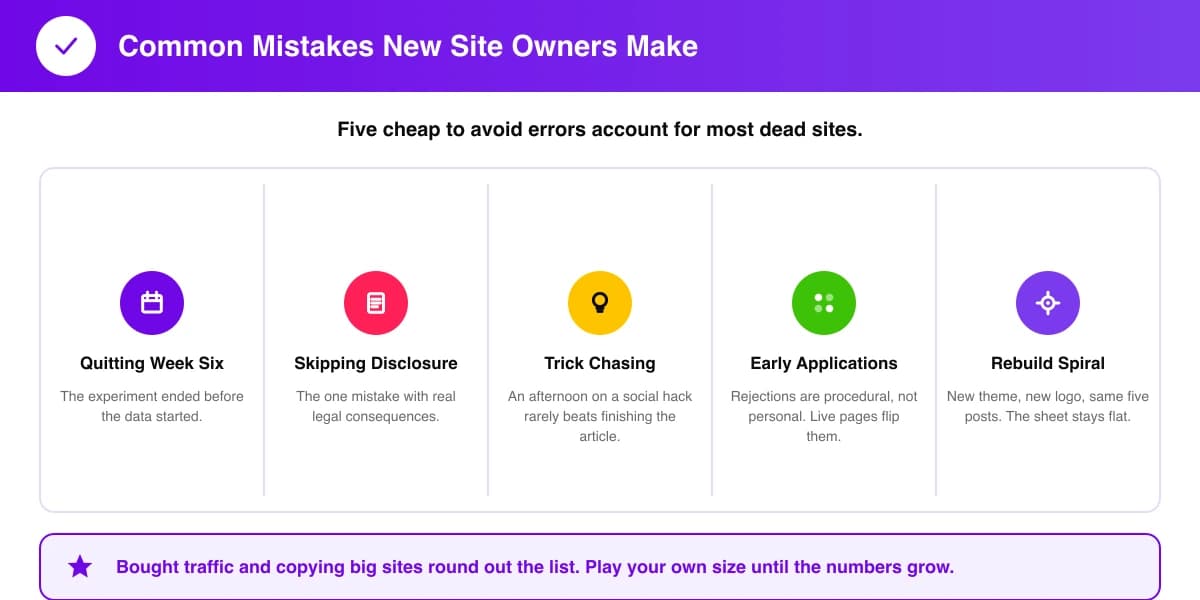
Finally, rebuilding the site instead of fixing it. New theme, new logo, new domain, same five posts. The rebuild feels like progress, and the spreadsheet stays flat.
One more trap is buying traffic to feel like things are moving. Paid clicks from broad networks land on your page, bounce in two seconds, and never convert, so the analytics chart looks alive while the account stays empty.
Earn your first visitors the slow way until the offer is proven.
Copying bigger sites is the last common error. A site with fifty thousand posts can rank for vague, hungry searches that a new site has no chance with. Play your own size until the numbers say you have grown.
Final Thoughts
Affiliate sites fail for boring, predictable, fixable reasons. The niche cannot pay. The keywords never had buyers behind them.
The trust pages came last, the content stopped early, the links leaked, the numbers were never tracked, and the whole thing was judged in week six.
Run the seven steps in order and each one carries the next. A paying niche makes keyword research worth doing. A solid keyword list gives your content a direction. Trust pages get applications approved.
A real cluster of posts gives links something to point at. Good placement turns traffic into clicks. Tracking turns results into decisions. Time turns all of it into compounding income.
Start with step one this week. Pick the niche, run the money test, and write the list of products people already buy. The rest of the chain grows from that single decision.
Frequently Asked Questions
1. Why do most new affiliate sites fail in the first six months?
Most new affiliate sites fail within their first six months because of wrong niche choice, keywords with no buying intent, thin content, and quitting before indexing and ranking can do their work.
2. How long before the first commission?
Roughly week four to week ten for a first commission, provided the site has a dozen or more live pages targeting buyer intent searches.
3. How many posts does a new site need before it can earn?
A site can earn with thirty posts, and five posts is not a plan. Twenty to thirty focused articles in one niche gives search engines a reason to treat you as an authority.
4. Is it normal for a site to earn nothing in the first month?
Yes. A site can run for months without earning while it builds rankings, and many owners keep it as a side project until the first commissions arrive.
5. Can social media traffic replace search traffic?
No. Social traffic skims, while search traffic arrives with intent. A few hundred targeted visitors who came to compare products will outearn thousands of casual scrollers.
6. How do you fix a site that is already failing?
Audit the niche for real buyer demand, cut or rewrite the posts that target curiosity searches, add the missing trust pages, and restart the publishing schedule.
Fixing step one first matters, because the rest of the chain inherits its quality.
7. How often should I check my numbers?
Once a week is enough. Daily checking produces anxiety without new information, and monthly checking hides small problems until they become expensive ones.