Promoting A Course As An Affiliate: 10 Checks Before You Link
A course link can earn you a commission, and it can also put your name next to a promise you cannot keep. A few checks before you publish can protect your readers and your account.
The ten checks below draw on FTC guidance, help center pages from course platforms, and the public pages of real affiliate programs. Where a program page leaves a detail out, the article says so.
Terms change, so confirm every number in your own affiliate dashboard before you rely on it.
Disclosure: Some of the links I share might be affiliate links. If you click on one and make a purchase, I may earn a small commission as a thank you. But don’t worry, it won’t cost you anything extra. I only recommend stuff I genuinely believe in. Your support helps me keep creating awesome content. You can read my full affiliate disclosure in my disclaimer page.
If you want to save a lot of hours searching for high-paying affiliate programs, check out our exclusive list of 2500+ affiliate programs. You’ll find all the information about the programs inside the list. This list is perfect for affiliate bloggers and influencers.
Check 1: Do You Have To Disclose Your Affiliate Link?
The FTC says a disclosure is needed when a connection exists that a significant minority of consumers would not expect and that would affect how they judge the endorsement. An affiliate commission fits that description.
The FTC's endorsement guidance gives sample wording for affiliate links: "I get commissions for purchases made through links in this post."
The FTC's brochure for influencers says a material connection covers a personal, family, or employment relationship, or a financial relationship with a brand. It adds that anything of value you receive for mentioning a product counts.
Free or discounted perks from a brand also trigger disclosure, the FTC says, even when you mention a different product from that brand. A free or discounted seat in a course is a perk of that kind.
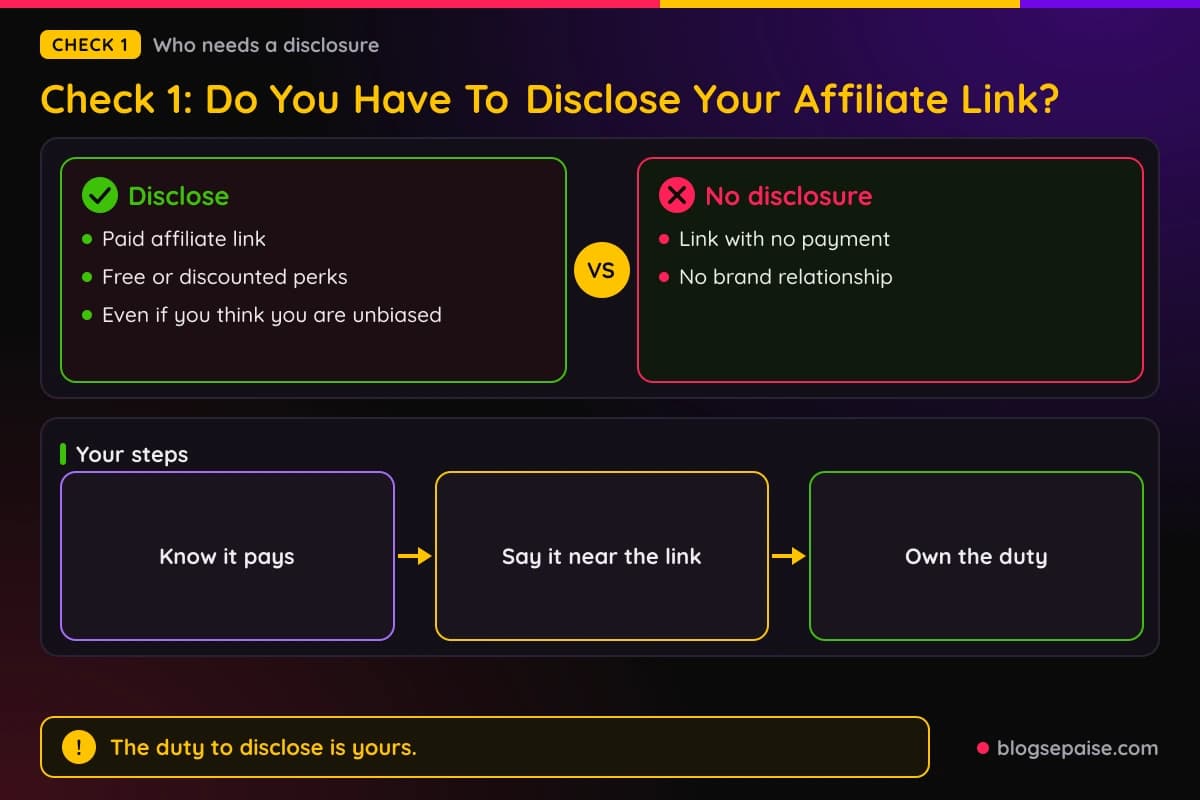
Disclosure is needed even if you believe your review is unbiased, the FTC says. If you have no relationship with a brand, you do not need to state that.
The FTC also says links offered only as a convenience, with no payment, need no disclosure. A link that pays you is different.
The brochure adds that posting from abroad still falls under U.S. law if the post will foreseeably affect U.S. consumers.
Our guide to legal disclosures for affiliates covers the wording in more detail. You can also draft a notice with the affiliate disclosure generator.
Check 2: Is Your Disclosure Clear And Easy To See?
The FTC brochure says disclosures should be hard to miss and should sit with the endorsement message itself.
A disclosure on an About Me or profile page is likely to be missed, the FTC says. It also says not to bury a disclosure in a group of hashtags or links.
The FTC's Q&A says the closer a disclosure sits to the endorsement, the better. A disclosure in comments, a single homepage notice, or a hyperlinked DISCLOSURE button is generally not clear and conspicuous.
On wording, the brochure calls for simple and clear language. It lists ad, advertisement, and sponsored as examples, and it warns against vague terms such as sp, spon, collab, and thanks.
For affiliate links, the FTC says the words Affiliate link alone and buy now buttons may not tell consumers that you are paid. It says Commissionable link is probably not clear either, while Paid link placed right next to an affiliate link should be sufficient.
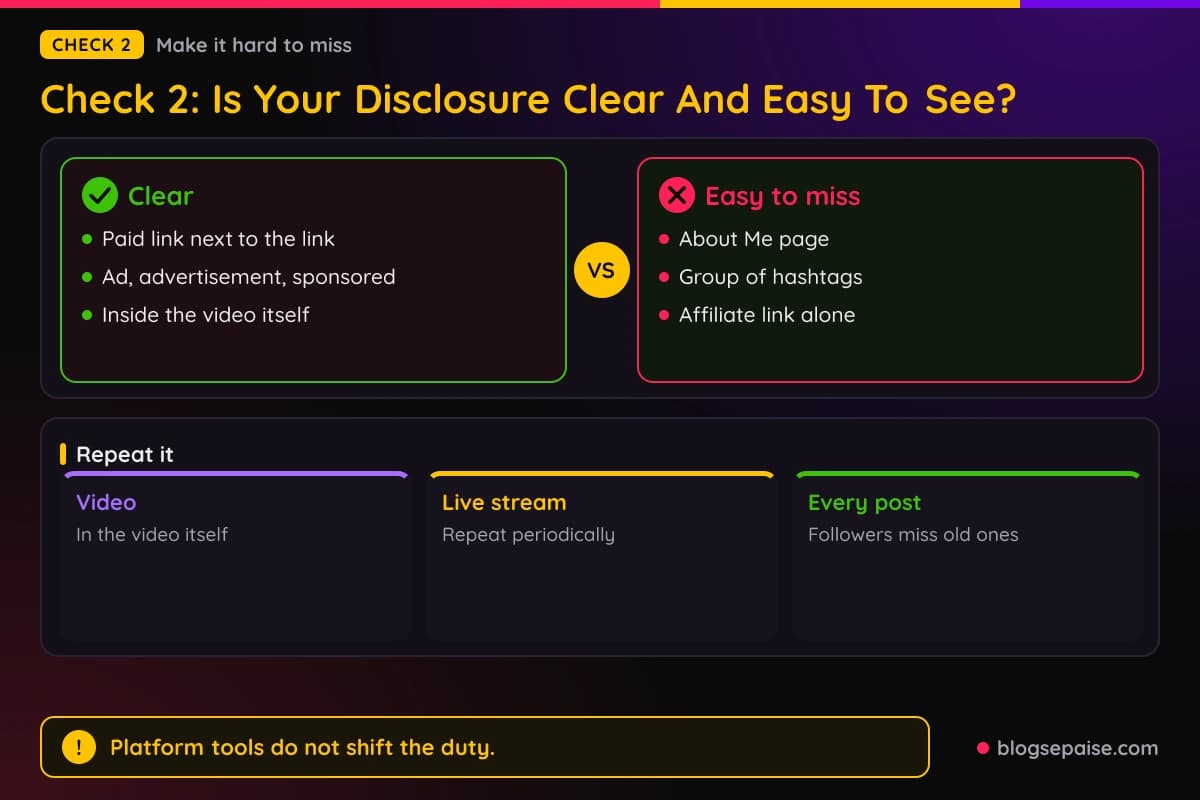
For video, the brochure says the disclosure should appear in the video itself and not just in the description. The Q&A adds that when an endorsement is both visual and audible, the disclosure should be both too.
In live streams, the brochure says to repeat the disclosure periodically.
A continuing relationship generally needs a disclosure in each post, the FTC says, since followers may not see earlier ones. If you were paid, saying you got something for free is not enough, and the word paid should be stated.
Built-in platform disclosure tools do not shift responsibility, the FTC says. The brochure states plainly that the duty to disclose is yours.
Check 3: What Earnings Claims Does The Course Make?
The FTC describes its Business Opportunity Rule as requiring written proof for any earnings claim. The seller must give that proof to buyers or to the FTC on request.
When a seller makes earnings claims, the rule also calls for a separate Earnings Claim Statement. The FTC says it must state the claim's specifics, the start and end dates, the number and percentage of buyers who achieved that result, and factors that may differ for new buyers.
The FTC says these requirements apply to claims made online, on TV, and in print.
Those details give you questions to ask a course creator. Ask for the written proof, and ask how many buyers reached the result the sales page shows.
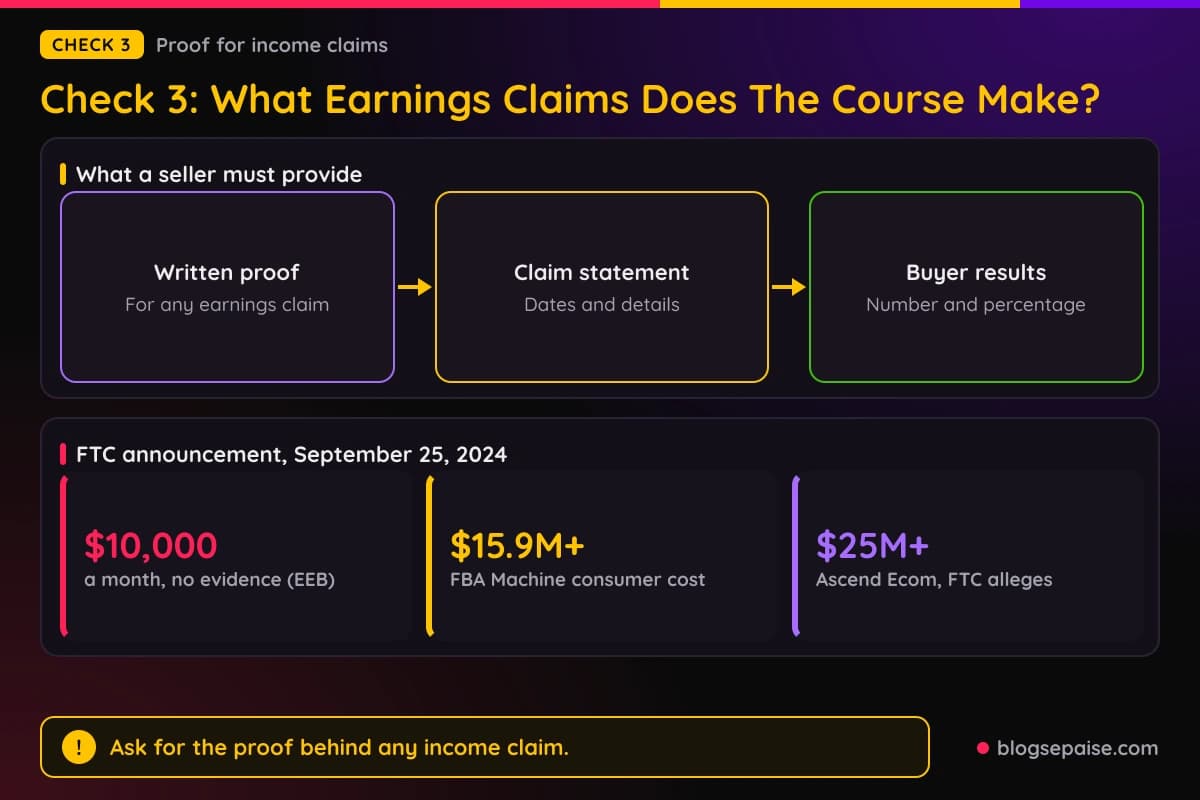
On September 25, 2024, the FTC announced actions against several online business schemes. It charged Ecommerce Empire Builders, whose training cost almost $2,000, and says the company had no evidence for its claim that clients could earn $10,000 a month.
The same announcement covers FBA Machine, which the FTC says cost consumers more than $15.9 million through earnings claims that rarely, if ever, materialize. It also covers Ascend Ecom, which the FTC says defrauded consumers of at least $25 million.
On January 13, 2025, the FTC announced proposals to extend the rule's ban on deceptive earnings claims to money-making opportunities such as business coaching or investment offers. The FTC's post describes them as proposals, so check ftc.gov for their current status.
Typical results matter too. The FTC says that when an endorser reports exceptional results and the advertiser cannot prove they reflect what people generally achieve, the ad must disclose the generally expected results.
The FTC adds that a results not typical disclaimer does not change that. If you cannot back a big result story with the creator's proof, leave it out.
Check 4: Have You Used The Course Yourself?
The FTC says an endorsement must reflect the endorser's honest opinion and actual experience.
Endorsers who are not experts can be liable for misleading or unsubstantiated claims, the FTC says. The risk is highest when statements conflict with their experience or go beyond it without the advertiser's approval.
The FTC says it usually targets advertisers, ad agencies, and PR firms. It adds that action against an individual endorser may occur.
On March 5, 2020, the FTC announced settlements with affiliate marketers who promoted MOBE, a business coaching program. The FTC alleged they earned commissions by steering consumers into mentoring programs that cost up to $60,000.
The FTC alleged the affiliates used false earnings claims and misleading testimonials. It says they advertised on social media, YouTube, online news sites, and at live events.
One defendant, Gar Leong Chow, faced a $3,350,000 judgment. The orders permanently banned each defendant from selling or marketing any business coaching program or money-making method.
Another pair of defendants, Michael Giannulis and Michael Williams, faced a $31.6 million judgment. The FTC says it is suspended once they pay $760,000 and turn over personal items obtained through MOBE.
FTC official Andrew Smith said the agency will hold you personally and financially accountable for false or unsubstantiated marketing claims. An FTC consumer alert says consumers lost more than $300 million in the MOBE scheme.
Our page on how to avoid getting banned from affiliate programs covers the program side of the same risk.
Check 5: Does The Offer Show Warning Signs?
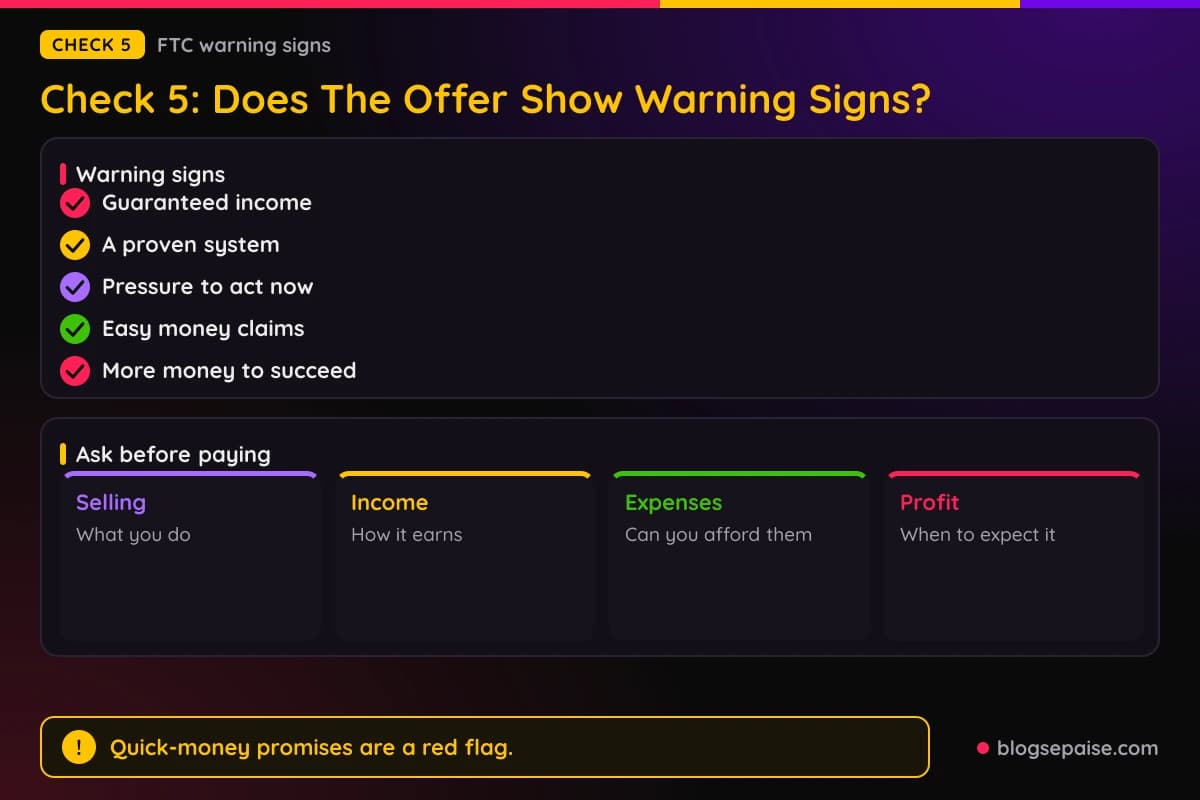
An FTC consumer alert on business coaching scams lists the signs. One is an ad promising that a training or coaching program will help you build a successful business or make large amounts of money investing in crypto, forex, or precious metals.
Another sign is a program focused on ecommerce, financial markets, or real estate that claims the money is easy to make.
A third is a promise of guaranteed income, large returns for little work, or a proven system to make money.
A fourth is pressure to act immediately or risk missing out. The FTC says nobody can guarantee you will make a lot of money with little to no risk.
The FTC's page on starting an internet business says a free or low-cost starter system can become costly quickly. It calls requests for more money to make the business succeed a major red flag.
The FTC says profitable turnkey businesses are rare, at best. Replies such as it is turnkey do not replace clear answers.
The FTC suggests asking what you would be selling, how the business makes money, what your expenses are, and when you could expect a profit. Those questions work for a promoter as well as a buyer.
The FTC also says that in a pyramid scheme, the money comes mainly from recruiting, not from selling products.
Check 6: What Do Reviews, Complaints, And Credentials Show?
The FTC suggests searching a company's name with words such as review, scam, or complaint. It also suggests checking with your state attorney general.
A lack of complaints does not prove a company is honest, the FTC says. Complaints can still be a warning sign.
The FTC says success stories and online reviews may be fake, misleading, or unrepresentative. Reviews may even come from made-up profiles.
Business coaching has no licensing requirement, the FTC says, and some credentials are misrepresented. It suggests checking any certification a coach claims and talking to past students.
The FTC also lists its Rule on the Use of Consumer Reviews and Testimonials, 16 CFR Part 465. The FTC says the rule targets the persistent problem of fake and false consumer reviews and testimonials.
You can report a suspected scam to the FTC at ReportFraud.ftc.gov, the consumer alert says.
Check 7: What Is The Refund Policy?
The FTC says a seller covered by the Business Opportunity Rule must tell buyers in its disclosure document if it has a cancellation or refund policy. If it does, the seller must attach a statement describing it.
Refunds also affect what you earn. Kajabi's help center says a refund on a purchase made through an affiliate link results in a $0.00 commission credit.
Kajabi adds that partial refunds are not reported as partial amounts. They carry the same commission as a full refund.
Skillshare's affiliate page and Coursera's affiliate page do not mention refunds or chargebacks.
A program that stays quiet on refunds is a reason to ask its support team in writing. Our page on commissions on returned items explains why returns matter.
Check 8: How Is Your Commission Calculated?
Skillshare states that affiliates earn 20% commission, up to $34, for each new customer they refer. It says the 20% applies to revenue from each new customer who starts a paid membership.
Coursera states baseline commissions of 15% to 45%, with bonuses for strong performance. Its page says up to 45% on 4,000+ courses and Specializations.
Coursera lists degrees as excluded. Its page also lists professional certificates as eligible in one place and excludes Degrees and Certificate purchases in a footnote, and it does not resolve the difference.
For monthly subscriptions on Coursera, only the first month's transaction earns a commission. The page states there is no recurring payout.
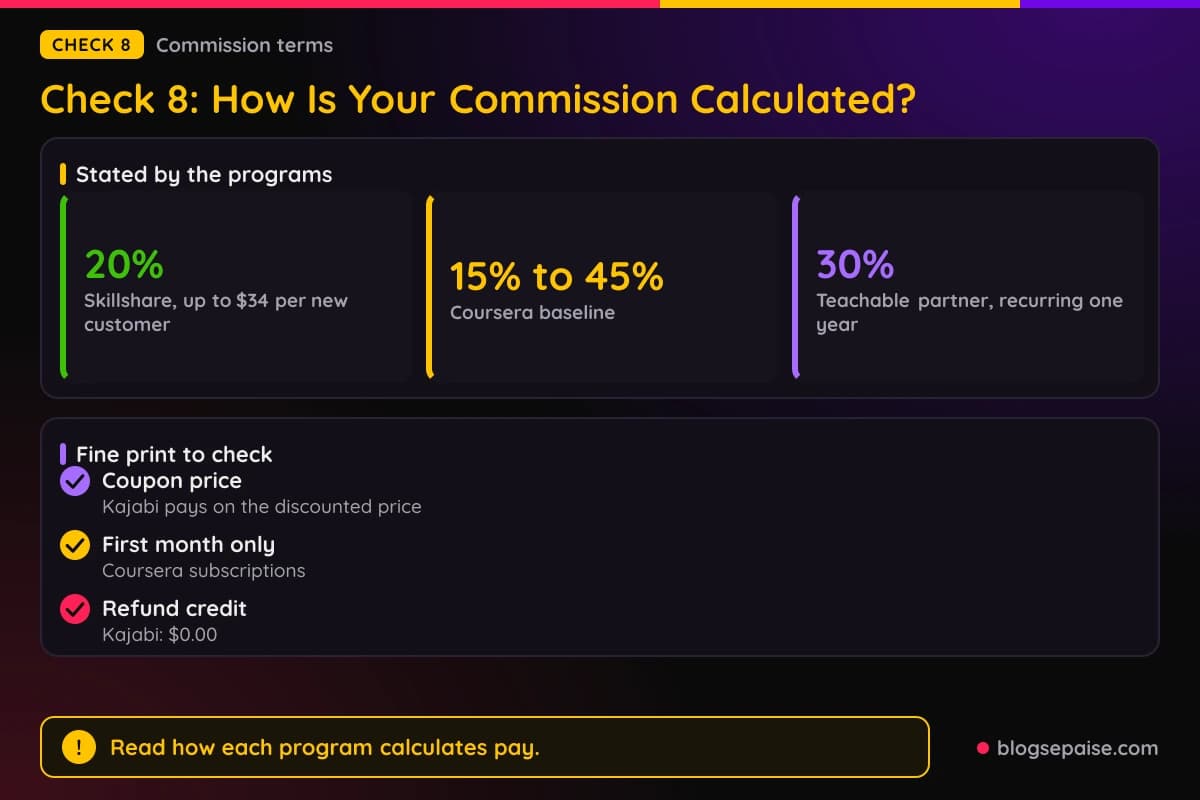
Kajabi's help center says commission is based on the price after a coupon code is applied. It also says the rate comes from either the percentage set on each offer or an affiliate's percentage override.
Coursera pays commission for each eligible product a user buys through your links. If a user clicks a link for one course but buys a different eligible product within the cookie window, you still earn a commission.
Teachable's partner page, which promotes Teachable software and not courses, shows another structure: a 30% recurring commission paid for one year per referred sale. Our page on recurring versus one-time commissions compares the two models.
Kajabi also says an affiliate counts as expired if they have not accepted their invitation, logged in, or generated a transaction. Expired affiliates do not earn commission until they accept a resent invitation.
Check 9: How Long Is The Cookie, And Who Gets Credit?
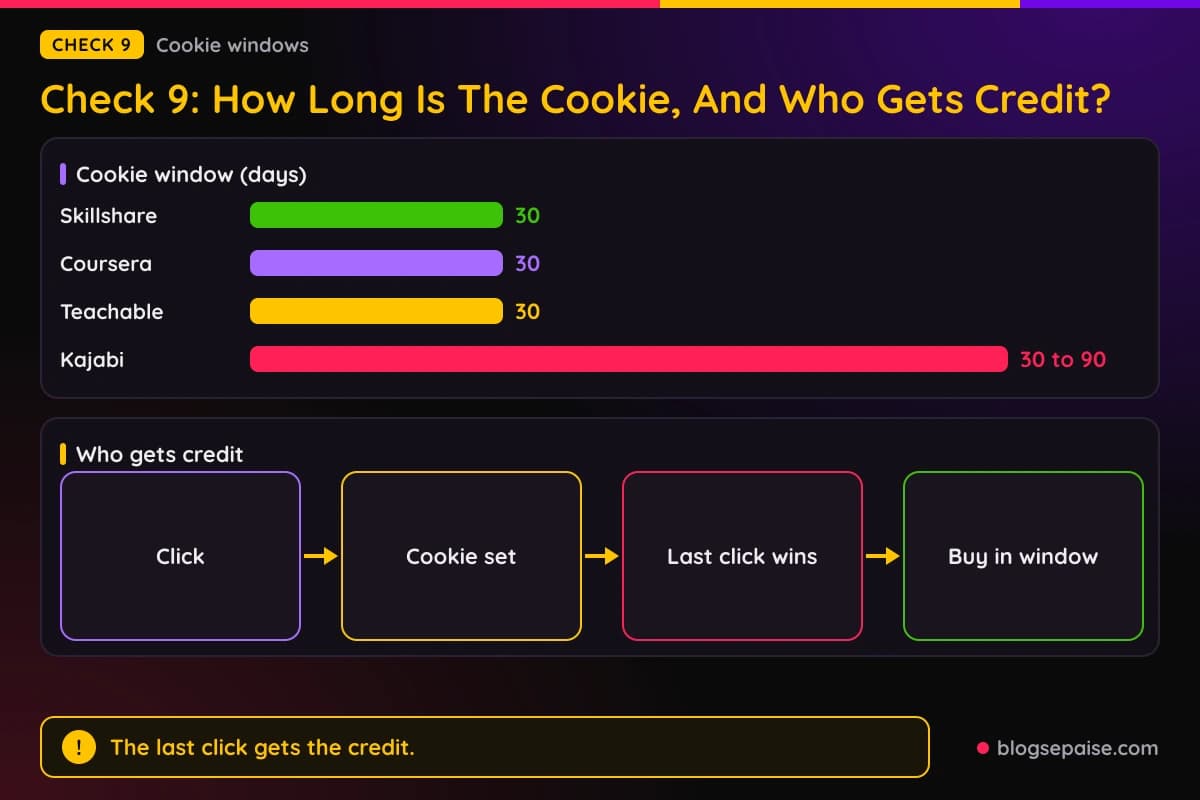
Skillshare states a 30 day cookie. A referral must sign up for a Skillshare membership within 30 days of using your link to qualify.
Coursera pays on eligible purchases made within 30 days of a qualified click. When several affiliates refer the same sale, it credits the affiliate with the last qualified click before the purchase.
Kajabi says the cookie lasts as long as the Referral Conversion Window the creator sets, which can be 30, 60, or 90 days. The customer must buy within that window after clicking an affiliate link.
Kajabi also says that if a customer clicks another affiliate's link before buying, the most recently clicked affiliate gets credit. Each visit to an affiliate URL resets the cookie's duration.
Teachable's partner page states a 30-day cookie window and a unique tracking code for each affiliate. Because Kajabi lets each creator pick the window, two Kajabi courses can have different windows.
Skillshare says each affiliate gets a custom Impact account that tracks referrals in real time. The dashboard tracks traffic, referrals, and payouts.
Our page on why cookie windows matter explains how the window affects what you earn.
Check 10: When Do You Get Paid, And Through Which Network?
Skillshare states that payouts are monthly. Affiliates are paid 30 days after the end of the month in which the commission is locked, to the payment method set in Impact.
Skillshare's program is free to join. It asks for at least one demonstrated channel and audience aligned with its brand, and it lists blogs, Facebook groups, Pinterest, Instagram, Twitter followers, and email newsletters as examples.
Affiliates must create an account through Impact and also hold a free Skillshare account, the page states.
Coursera's affiliate page says enrollment is free and runs through Impact. It does not specify a payout schedule, minimum payout, or payment methods.
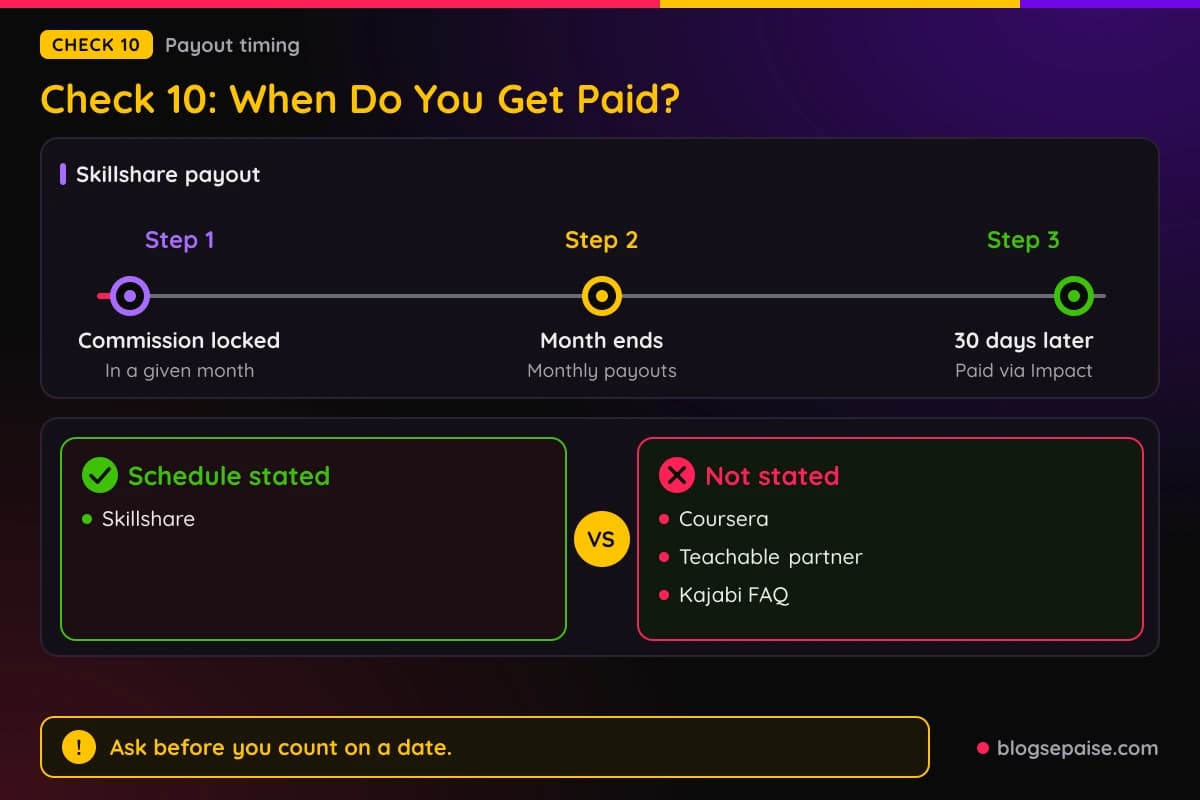
Teachable's partner page says PartnerStack handles payments securely and on time, but it gives no schedule or minimum. It says applications are reviewed within 2 to 3 business days and links to no formal terms.
Kajabi's affiliate FAQ does not address payouts or payout timing.
Among these four programs, only Skillshare's page states a payout schedule. For the rest, check the network dashboard or ask the affiliate team before you count on a date.
Our page on how affiliate commissions are paid explains the usual flow. For clause by clause help, read how to read affiliate program terms.
Final Thoughts
A course link is a recommendation with your name on it. The ten checks above come down to three things: tell readers you are paid, make only claims you can back, and read the program terms before you link.
Start with the FTC pages, since the duty to disclose sits with you. Then compare the program terms line by line, and write down anything the program page leaves out.
Where a page is silent on refunds, chargebacks, or payout timing, ask the program in writing. A short email now is cheaper than a surprise later.
Frequently Asked Questions
1. Do I need to disclose that I am paid for a course link?
Yes. The FTC says a financial relationship with a brand is a material connection that calls for a disclosure. Place it next to the link in simple, clear words.
2. Is the label "affiliate link" enough?
The FTC says Affiliate link alone may not tell consumers that you are paid. It says Paid link placed right next to the link should be sufficient.
3. Can I be held responsible for a course's claims?
The FTC says it usually targets advertisers, ad agencies, and PR firms, but action against an individual endorser may occur. In the MOBE case, the FTC took action against affiliate marketers over false earnings claims.
4. Can I share a student's big result?
Only with proof. The FTC says an ad that shows exceptional results must disclose the generally expected results unless the results are shown to be typical.
5. If a buyer asks for a refund, do I still get paid?
It depends on the program. Kajabi's help center says a refunded purchase becomes a $0.00 commission credit, while Skillshare and Coursera do not mention refunds on their affiliate pages.
6. How long do course affiliate cookies last?
The pages covered here state 30 days for Skillshare, Coursera, and Teachable's partner program. Kajabi lets creators set 30, 60, or 90 days.
7. Where can I report a misleading course?
The FTC's consumer alert points to ReportFraud.ftc.gov.