AI Content Refresh Workflow for Affiliate Sites
If you run an affiliate site, you already know that publishing new content is only half the job. The other half, and honestly the harder half, is keeping your old content accurate and useful.
Product prices change. Companies stop offering certain plans. Reviews get outdated. Rankings shift because a competitor wrote a better article last month.
Every single one of these small changes chips away at your traffic and your commissions if you don't catch them in time.
A content refresh workflow is simply a repeatable process for finding old pages that need work and fixing them before they lose too much traffic.
For years this was a slow, manual grind. Someone had to open every page, compare it against current information, check pricing, check if the affiliate links still worked, and then rewrite sections by hand.
On a site with even two hundred articles, that process could take months.
AI tools have changed how fast this can happen. They can scan large batches of content, flag pages that look outdated, pull in current pricing and product details, and even draft the updated sections for a human to review.
A process that used to take a team of writers several months can now take a couple of weeks, at least for the parts that involve scanning and gathering facts.
This guide walks through a full, practical workflow for using AI to refresh content on an affiliate site, step by step, along with the parts you should never fully hand off to a machine.
None of this means you can just point an AI tool at your site and walk away.
There are traps in almost every step of this process, from AI misreading a pricing page to AI writing a section in a tone that doesn't match the rest of your site.
The goal here is to show you exactly where AI saves real time and where a human still needs to take the wheel, so you can build a workflow that actually helps your site instead of quietly hurting it.
Disclosure: Some of the links I share might be affiliate links. If you click on one and make a purchase, I may earn a small commission as a thank you. But don’t worry, it won’t cost you anything extra. I only recommend stuff I genuinely believe in. Your support helps me keep creating awesome content. You can read my full affiliate disclosure in my disclaimer page.
If you want to save a lot of hours searching for high-paying affiliate programs, check out our exclusive list of 2500+ affiliate programs. You’ll find all the information about the programs inside the list. This list is perfect for affiliate bloggers and influencers.
Why Affiliate Sites Need Content Refreshes More Than Other Sites
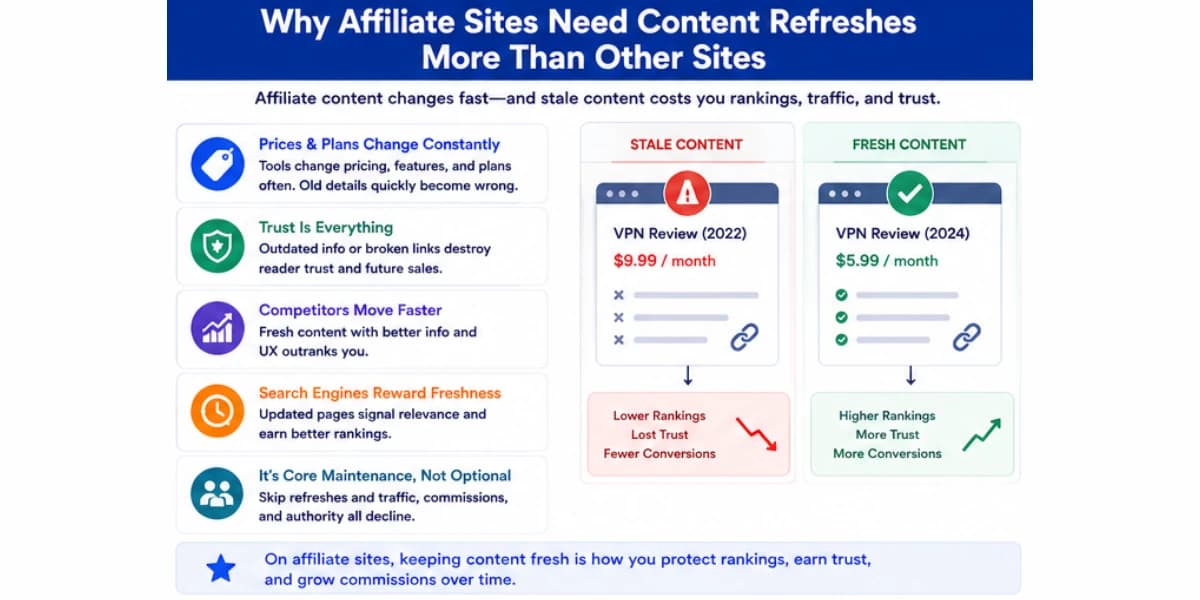
Affiliate content ages faster than almost any other type of content on the internet. A blog post about baking bread can stay accurate for years.
A review comparing five project management tools cannot, because pricing tiers change, features get added or removed, and companies rebrand or get acquired all the time.
There's also a trust problem hiding inside stale affiliate content.
When a reader clicks through to buy something you recommended and finds out the price is completely different from what you listed, or the product doesn't even exist anymore, they lose trust in your site immediately.
That lost trust doesn't just cost you one sale. It often means that reader won't come back, and it can also hurt your reputation if they mention it publicly.
That trust issue tends to snowball in ways that are hard to measure directly.
A reader who catches one outdated fact on your site often starts questioning everything else on the page too, even details that are still perfectly accurate.
Once that seed of doubt gets planted, they're far less likely to click through on any affiliate link on that page, and they're less likely to trust recommendations on other pages of your site as well, even ones they haven't visited yet.
Search engines have also gotten much better at noticing when content is stale.
Freshness is one of many signals used to judge if a page still deserves to rank well, especially for commercial queries where users expect current information.
A page that hasn't been touched in two years, sitting next to a competitor's page updated last week, is at a real disadvantage.
Think about how you shop online yourself.
If you're comparing credit cards or hosting plans and you land on an article that mentions a promotion from three years ago, you probably click back and pick a different result without even reading the rest of the page.
Your own readers do the exact same thing, and search engines have learned to notice that pattern too, even if they can't read the page the way a human can.
Add all of this up and you get a simple truth. On an affiliate site, refreshing content isn't a nice extra task you do when you have spare time.
It's core maintenance, the same way you'd change the oil in a car. Skip it long enough and things start breaking down in ways that are expensive to fix later.
For a complete overview of how AI fits into every stage of search engine optimization, read our complete AI SEO guide. It covers how AI tools handle everything from keyword research to technical audits.
What Counts As A Content Refresh
Before setting up any workflow, it helps to know what a refresh actually involves, because it's easy to think it just means updating a date at the top of the page and calling it done.
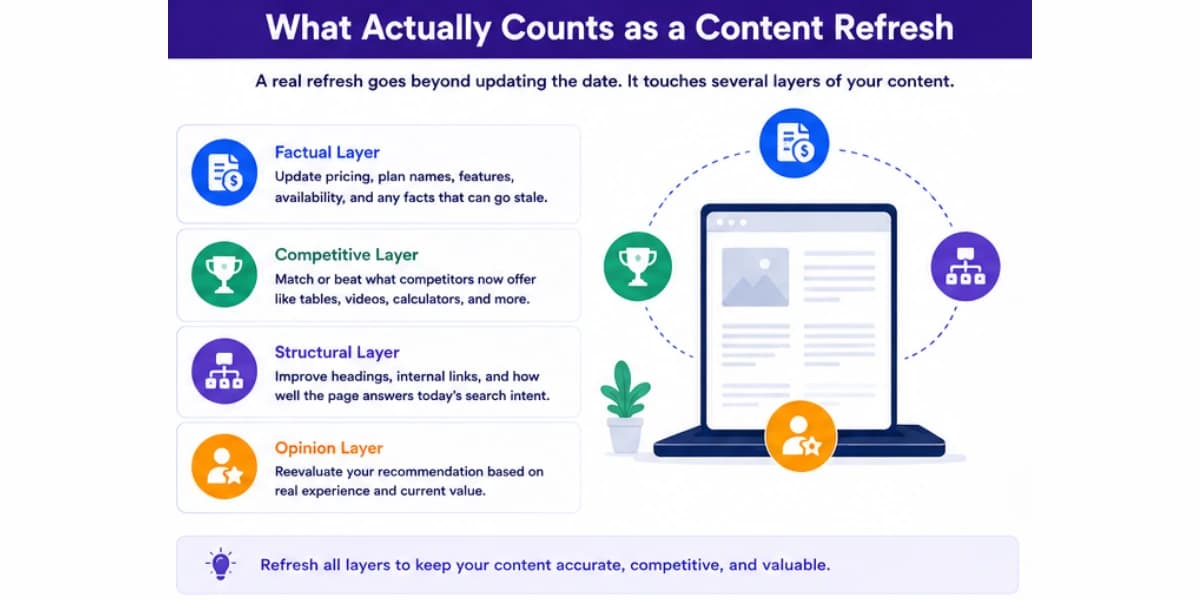
A real refresh usually touches several layers of a page.
The Factual Layer
The factual layer covers pricing, plan names, features, availability, and anything else that can go stale on its own even if your opinion about the product never changes.
That layer causes the most damage when ignored, since readers can spot outdated pricing almost instantly, and it tends to be the fastest layer to slip out of date because companies change their pricing far more often than most site owners expect.
The Competitive Layer
The competitive layer covers how your page compares to what else is currently ranking for the same keyword.
If five competitors have added a comparison table, a video, or a pricing calculator since you last touched your page, your article might technically still be accurate but no longer competitive in terms of user experience.
The Structural Layer
The structural layer covers things like headings, internal links, and how well the page answers the actual question people are searching for today, which sometimes shifts slightly over time as search behavior evolves.
The Opinion Layer
The opinion layer covers your actual recommendation.
Sometimes a tool that used to be your top pick genuinely isn't anymore because a competitor released something better, or because customer support quality dropped, or because pricing became less fair.
That layer requires real judgment and can't be automated away, and it's a point worth remembering as we get into how AI fits into this whole process.
A page can have every fact perfectly updated and still mislead readers if the actual recommendation at the top of the page is quietly out of date.
Understanding how your content fits together is essential for effective refreshes.
Our guide on what content clusters are explains how pillar pages and supporting articles work together to build topical authority.
Where AI Helps In A Content Refresh Workflow
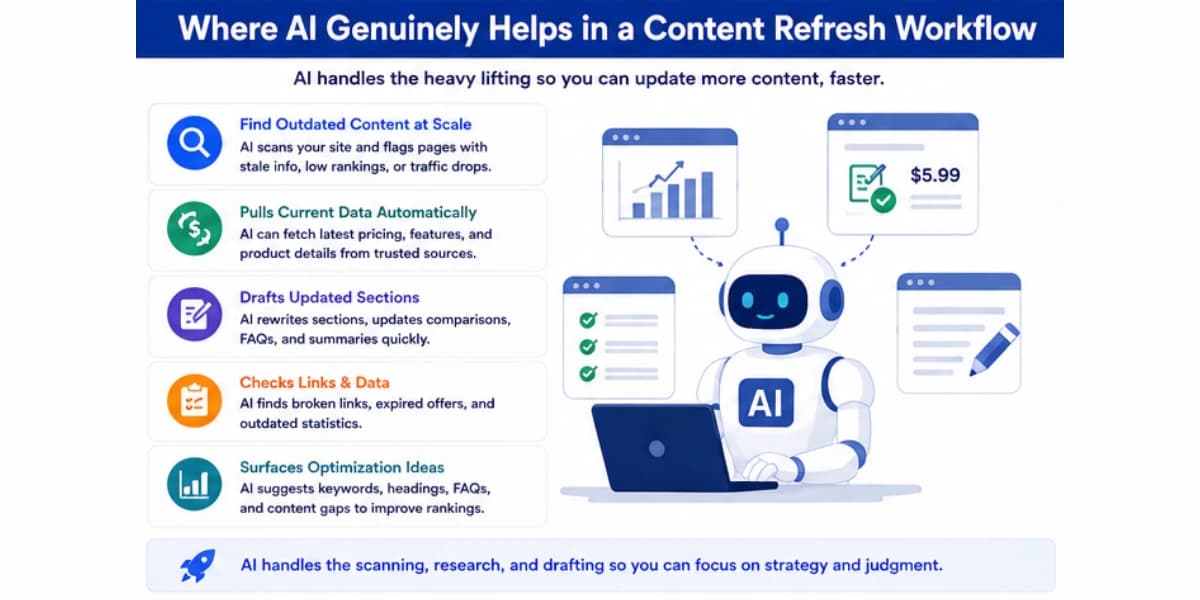
AI earns its place in this workflow mainly in the parts that involve scanning, comparing, and drafting rather than deciding. Here's where it tends to shine.
Large Scale Scanning
Large scale scanning is the clearest win.
Feeding a big batch of URLs into an AI powered tool and asking it to flag which pages mention outdated pricing, discontinued products, or old dates is something that would take a human days to do manually across a large site.
AI can do a first pass in a fraction of that time.
Pulling Current Information
Pulling current information is another strong use case.
Once a page is flagged, AI tools connected to live web search can pull current pricing, plan details, and feature lists for the products mentioned, saving you the trip of visiting five different company websites yourself.
Drafting Updated Sections
Drafting updated sections is where AI saves the most writing time.
Once you know what changed, AI can draft a new version of the affected paragraph using the current facts, in a style that matches the rest of your article, giving you a strong starting point instead of a blank page.
Writers who've spent years rewriting the same pricing paragraph over and over across dozens of articles know how draining that repetitive work can be, and handing the first draft of that work to an AI tool frees up energy for the parts of the job that actually need a human's full attention.
Spotting Patterns Across Many Pages
Spotting patterns across many pages at once is something AI does especially well.
It might notice that twelve of your articles all mention a company that recently changed its pricing structure, something that would be nearly impossible to catch by memory alone once your site grows past a hundred pages or so.
Pattern detection like this can also reveal bigger structural issues, like a whole category of your site that hasn't been touched in over a year, which is a lot easier to notice when a tool lays it out for you clearly instead of leaving it buried across dozens of individual pages you'd have to check one by one.
If you need help finding where to add links in your existing content, try our internal link opportunity finder tool. It scans your pages and highlights where new internal links would add the most value.
Where AI Falls Short and Needs a Human
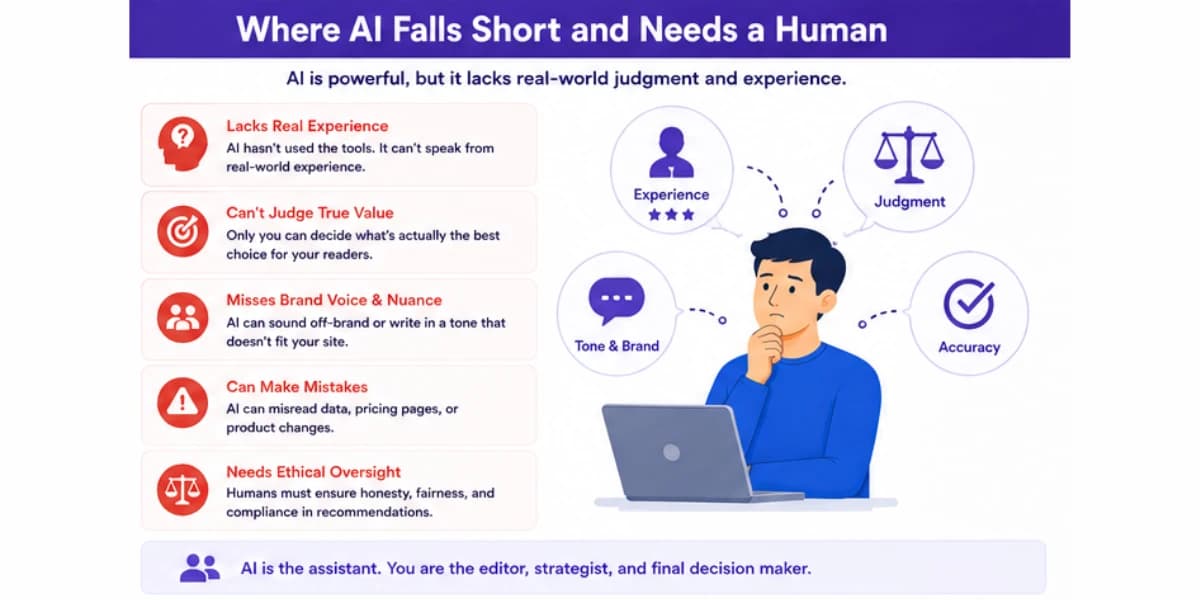
It's just as important to be honest about where AI struggles in this process, because trusting it blindly here is exactly how sites end up publishing outdated or even wrong information faster than before.
AI Doesn't Know If a Product Is Still Good
AI doesn't actually know if a product is still good. It can tell you the price changed, but it can't tell you if that price change makes the product a worse deal than a competitor's offering, or if customer reviews have quietly gotten worse over the past year.
That kind of judgment still needs a human who understands the market and who has actually watched how that product has performed over time, not just a snapshot of its current pricing page.
AI Can Confidently State Incorrect Information
AI can also confidently state incorrect information if its source data is outdated or if it misreads a pricing page.
That happens more often than people expect, especially with complex pricing structures that have multiple tiers, add ons, and regional differences.
A tool might grab the price shown for an annual plan and present it as the monthly price, or pull a promotional price that only applies to new customers and present it as the standard rate.
Every fact an AI tool pulls in during a refresh needs a quick human check before it goes live, particularly numbers.
Tone and Personality Are Another Weak Spot
Tone and personality are another weak spot. Readers come back to affiliate sites they trust partly because of a consistent voice.
AI drafted sections that get pasted in without editing often read slightly off compared to the rest of the article, even when the facts are correct, and readers notice that inconsistency more than you might expect.
AI Has No Real Stake In Your Business
Finally, AI has no real stake in your business.
It won't naturally flag that a product you're recommending has a much lower commission rate than a very similar alternative, or that a competitor just launched a better affiliate program you should be highlighting instead.
Those business level decisions still sit entirely with you.
That point is worth sitting with for a moment, because it's easy to forget in the middle of a busy refresh cycle.
A refresh that's purely about accuracy might leave your recommendations perfectly correct but financially worse for your business than they need to be.
Setting aside time during each refresh cycle to also check your own commission rates and affiliate terms, not just the product facts, is a habit that pays off in ways an AI tool simply won't remind you to do on its own.
Learning how to do keyword research properly helps you map which pages should target which queries, so you can spot cannibalization issues before they become structural problems.
Setting Up Before You Start
A little bit of setup before diving into the workflow saves a lot of headaches later. First, decide who on your team, even if that's just you, will own this process.
Content refresh work tends to fall through the cracks when nobody is clearly responsible for it, since it's rarely urgent on any single day but adds up to a real problem over months.
Next, gather access to whatever data you already have. Google Search Console, your affiliate network dashboards, and any analytics tool you use all hold pieces of the puzzle.
Search Console tells you which pages are losing impressions or clicks.
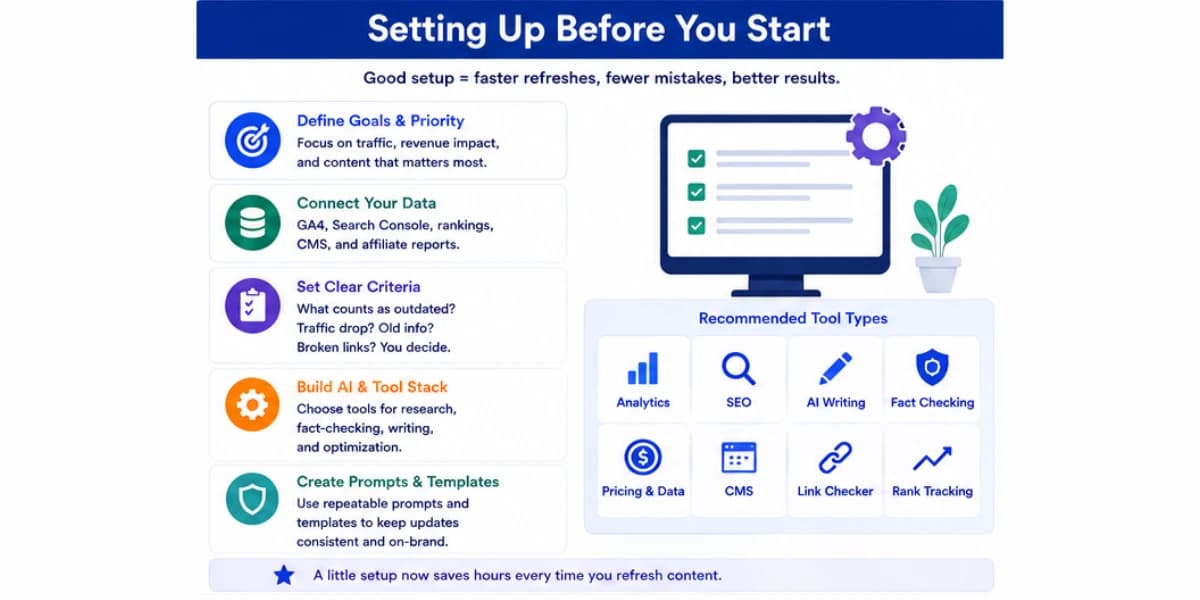
Your affiliate dashboards tell you which products are actually earning money right now, which helps you prioritize which pages matter most.
Analytics tools round this out with traffic trends over time.
Finally, pick the AI tools you plan to use for this process.
Some site owners use a general purpose AI assistant with web search enabled for the fact checking and drafting steps.
Others use dedicated SEO platforms that build content auditing and refresh suggestions directly into their product. Either approach can work well.
The specific tool matters less than having a consistent process that you actually follow, since even the best tool won't help much if the workflow around it is disorganized or inconsistent.
For a comprehensive list of tools that can help with every stage of the process, check out our roundup of best keyword research tools for affiliates. Many of these platforms include AI-powered clustering and intent analysis features.
Building the Actual Workflow
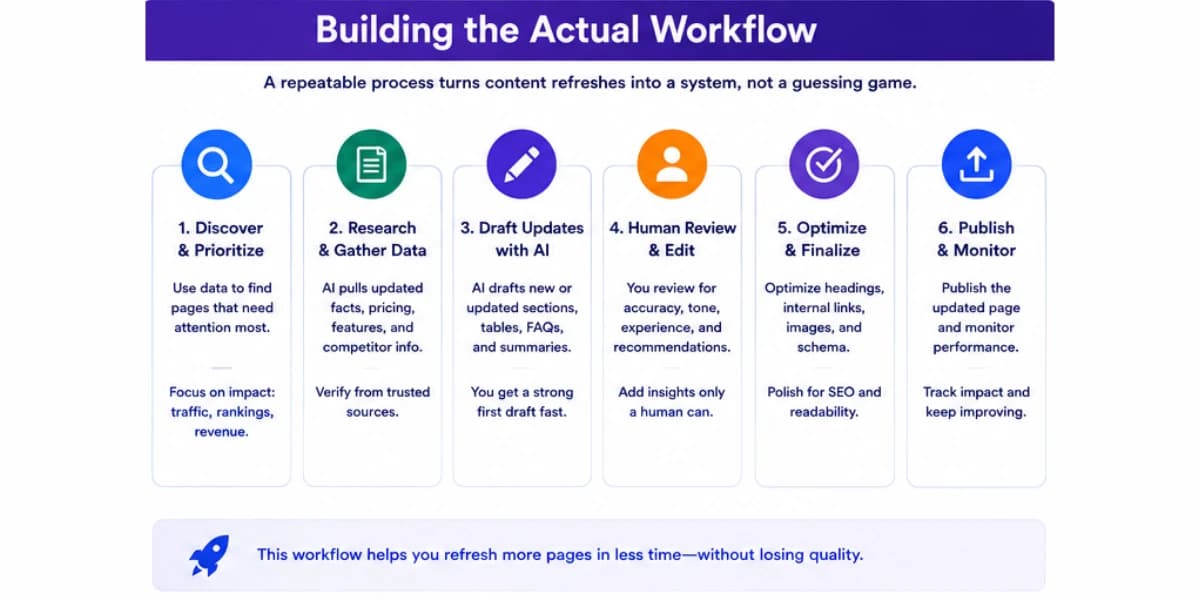
Now let's get into the practical part.
Below is a workflow that works well for most affiliate sites, no matter if you're running a small site with fifty articles or a larger operation with a few thousand.
Each step builds on the one before it, so it helps to follow them roughly in order the first time you run through this, even if you later adjust the process to fit your own team.
Step One: Build a Master Content Inventory
Start by creating a spreadsheet or database that lists every published article on your site along with a few key details.
Include the URL, the publish date, the last updated date, the primary affiliate products mentioned, current traffic and ranking data if you have access to it, and the target keyword the page was written for.
That inventory becomes the backbone of everything else in the workflow.
Without it, you're relying on memory to know what needs attention, and memory doesn't scale past a small handful of pages.
Once your site grows past even fifty or sixty articles, trying to remember which pages need attention just doesn't work anymore, and pages start slipping through the cracks for years without anyone noticing.
Step Two: Set Up Automated Flags for Aging Content
Once your inventory exists, set a rule for how often each type of page should be reviewed.
High traffic commercial pages, the ones actually driving affiliate revenue, should probably get reviewed every three to four months given how fast pricing changes.
Lower traffic informational pages can often go six months to a year between reviews without much risk.
AI tools can help automate part of this flagging process by periodically checking if specific facts mentioned on a page, like a price or a plan name, still match what's currently listed on the product's website.
When a mismatch is found, that page gets flagged for review rather than waiting for a scheduled check.
An automated check like this can run quietly in the background every week or two, so by the time you sit down to work on refreshes, you already have a ready made list of pages that need your attention most.
Step Three: Run an AI Assisted Fact Check Pass
For every flagged page, run an AI assisted pass that pulls current information about each product mentioned.
Ask the tool to compare what's stated in your article against the current pricing page, feature list, and any notable changes like a rebrand or an acquisition.
Good output from this step is a clear list of discrepancies.
Something like, your article says the starter plan costs twenty dollars a month, but the current price is twenty five dollars, or your article mentions a feature that has since been removed from the product entirely.
Step Four: Check Competitor Content for the Same Keyword
Before rewriting anything, take a quick look at what's currently ranking for the keyword your page targets.
AI tools can summarize what competing articles cover that yours doesn't, like a comparison table, more recent screenshots, a video walkthrough, or a more detailed pricing breakdown.
Doing this keeps your refresh from being purely reactive. You're fixing what's wrong, and you're also closing gaps that have opened up since competitors updated their own pages.
A refresh that only fixes old facts but ignores what competitors have added over the same period often ends up accurate but still losing ground in the rankings.
Step Five: Draft the Updated Sections With AI, Then Edit Heavily
With the fact check results and competitor gaps in hand, ask an AI tool to draft updated versions of the specific sections that need changes.
Give it the exact current facts you gathered in step three, along with a sample of your existing writing style so the tone matches.
Once the draft comes back, this is where your own editing matters most. Read through every changed section carefully.
Check that numbers are correct against your own research, not just what the AI generated.
Adjust the tone so it sounds like the rest of your site. And most importantly, revisit your actual recommendation.
If the facts changed enough that your top pick should change too, make that call yourself rather than letting the draft quietly keep an outdated recommendation in place just because nobody told it otherwise.
Step Six: Update Affiliate Links and Tracking
While you're refreshing a page, check every affiliate link on it.
Programs get discontinued, links expire, and commission structures change often enough that a quick check here can directly protect your revenue.
It's an easy step to forget when you're focused on content accuracy, but a broken affiliate link on a high traffic page can quietly cost you money for weeks before anyone notices.
A simple monthly link check across your top earning pages, separate from the full content refresh itself, is a small habit that pays for itself many times over.
Step Seven: Update the Publish Date and Note What Changed
Update the last modified date on the page once you're done, and consider adding a short note near the top of the article mentioning what was updated and when.
Readers who visited before and are coming back to check something specific appreciate knowing the article has been kept current, and it can build a surprising amount of trust over time.
Step Eight: Track the Results
After a refresh goes live, keep an eye on how that page performs over the following weeks.
Watch ranking position, traffic, and if you can track it, click through rate on the affiliate links themselves.
That data tells you if the refresh actually helped, and over time it also teaches you which types of pages benefit most from frequent refreshes versus which ones can safely go longer between updates.
Keeping a simple before and after log for each page you refresh makes this pattern much easier to spot after you've been running the workflow for a few months.
Turning your topical map into a consistent publishing schedule is easier when you have a solid plan.
Our guide on how to create a content plan for affiliate marketing walks through exactly how to structure your workflow.
A Realistic Cadence for Different Types of Pages
Not every page on your site needs the same level of attention.
Your highest earning comparison and review pages, the ones actually driving commissions, deserve the tightest refresh cycle, checked every three months if possible given how quickly pricing and features shift in most industries.
Mid tier pages that get decent traffic but aren't your top earners can usually be refreshed every six months without much risk of falling behind.
Lower priority informational pages, the ones that exist mainly to support your topical coverage rather than drive direct sales, can often go a full year between refreshes unless something major changes in that space.
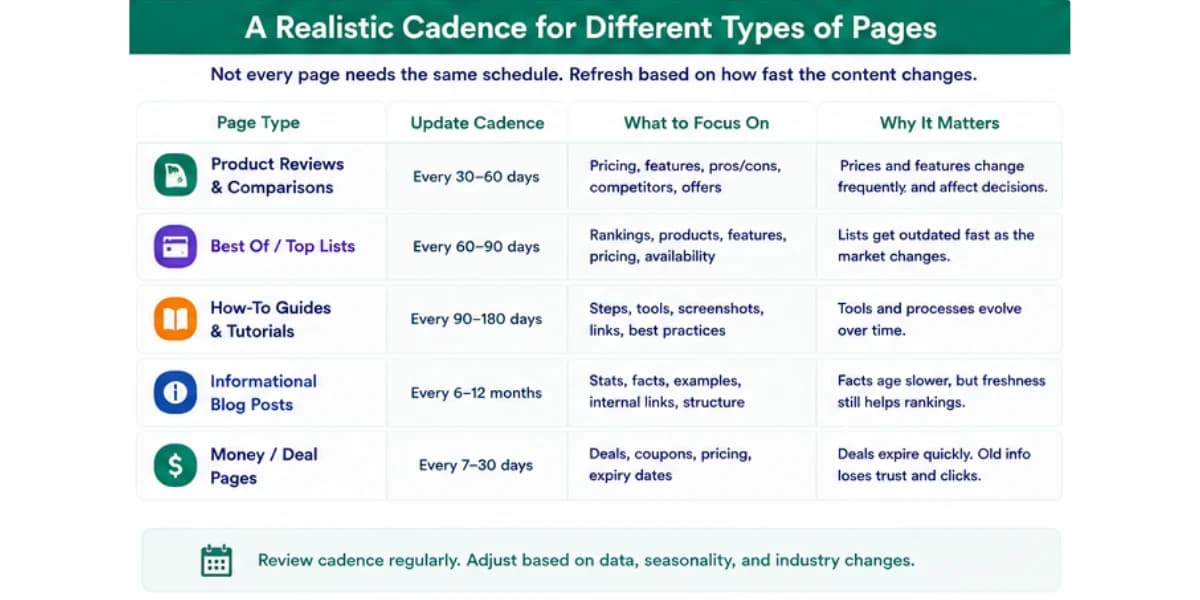
Setting this kind of tiered schedule from the start saves you from the common trap of treating every single page as equally urgent, which usually just leads to burnout and inconsistent updates across the board.
It also helps to think about seasonality when you're building this schedule.
Some affiliate niches, like tax software or holiday shopping guides, have a natural busy season where accuracy matters most right before that window opens.
If you run a site in one of those spaces, it makes sense to schedule your busiest refresh push a few weeks before your peak season rather than spreading refreshes evenly across the whole year without regard for when readers actually show up in large numbers.
Creating content that stays relevant for years requires a different approach than chasing trends.
Our article on creating evergreen content explains how to write articles that continue driving traffic long after publication.
A Simple Example of the Workflow in Action
Picture a site that reviews budgeting apps. An article on the site compares five different apps and was published two years ago.
The inventory system flags it because the automated pricing check noticed that one app in the lineup changed its monthly price from eight dollars to twelve dollars.
The fact check pass confirms the price change and also finds that a second app featured in the article was acquired by a larger company and rebranded under a new name six months ago.
That's a big deal, since readers clicking on a dead brand name would be confused right away.
The competitor check shows that three of the top five ranking articles for this same keyword now include a comparison table near the top of the page, something this article doesn't have.
That's a clear gap worth closing.
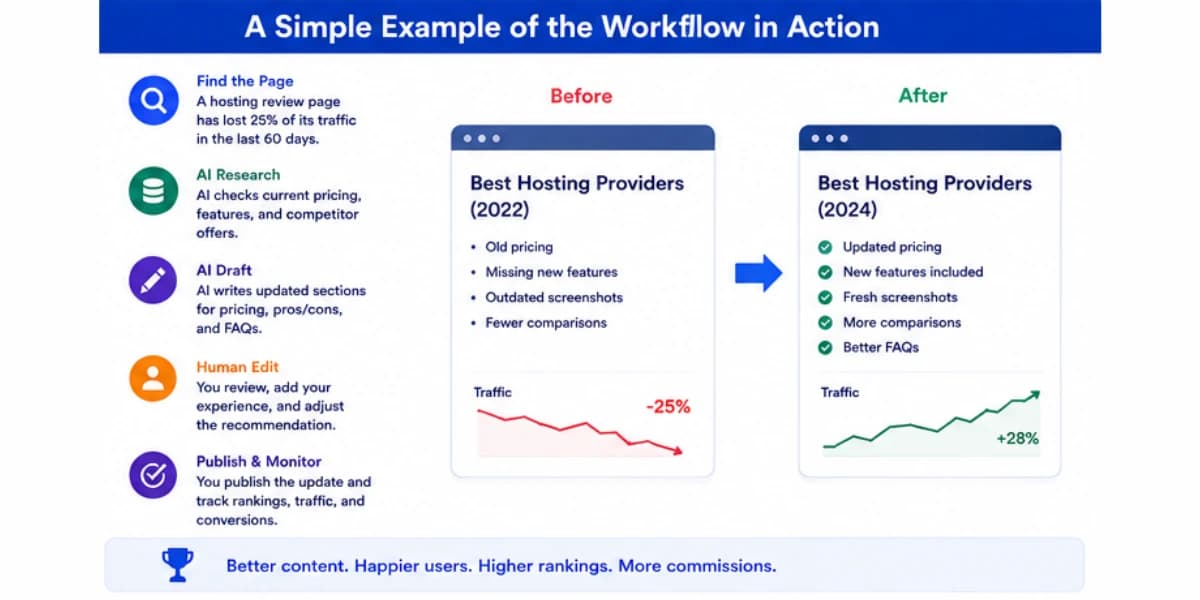
With all of that information gathered, the site owner asks an AI tool to draft an updated pricing section and a new comparison table using the current facts.
The owner reads through the draft, fixes a slightly awkward sentence, double checks the new pricing against the actual app websites, and decides that given the rebrand and price increase, the original top pick in the article no longer makes sense.
A different app, one that's kept a lower and more stable price, moves into the top spot instead.
Finally, the owner checks all five affiliate links, updates the last modified date, and adds a short note mentioning the article was refreshed with current pricing.
Three weeks later, the page's ranking improves slightly and traffic ticks up.
That whole process, done manually years ago, might have taken a full day. With AI handling the scanning and drafting, it took about ninety minutes of focused work.
Building a topical map for AI SEO gives you the content structure that makes refresh decisions much easier, since you already know which pages should support which others.
Getting Better Results From AI During This Process
The quality of what you get back from an AI tool during a refresh depends heavily on how you ask for it.
Vague requests like update this article tend to produce vague, generic edits that miss the specific problems your page actually has.
Instead, give the tool clear context every time.
Paste in the current text of the section you want checked, name the exact products mentioned, and ask it to compare specific details like price, plan names, and features against current information rather than giving a general opinion on the article.
A request like check if the pricing mentioned for these three products in this paragraph matches what's currently listed on their websites, and tell me exactly what's different tends to produce far more useful results than a broad request to review the whole article.
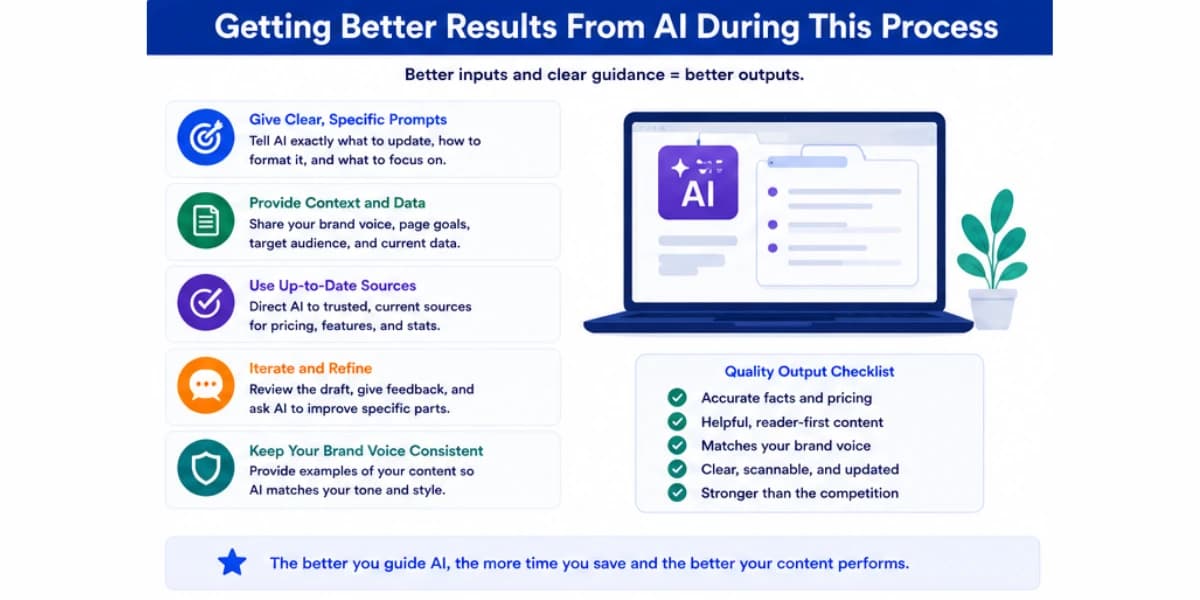
The same goes for drafting. Give the tool the corrected facts directly rather than asking it to find them on its own during the drafting step.
Also give it a short sample of your own writing style, maybe a paragraph or two from an article you're happy with, and ask it to match that tone.
That small extra step makes a noticeable difference in how much editing you'll need to do afterward, since the draft will already sound closer to your voice instead of reading like generic filler text.
It also helps to ask the tool to flag anything it's uncertain about rather than just filling in a best guess silently.
Pricing pages, especially ones with multiple tiers, sometimes confuse even careful readers, human or AI.
A tool that tells you I found two different prices listed on this page and I'm not sure which one applies is far more useful than one that just picks one number and states it confidently.
Using the right SEO plugins for your website can help you manage and monitor your content refresh process alongside other on-page optimization tasks.
Common Mistakes to Avoid
One common mistake is letting AI fully automate the recommendation itself.
Facts can be pulled and verified by a machine, but the actual opinion of which product deserves your top pick needs a human who genuinely understands the space and your audience.
Another mistake is refreshing content without checking the affiliate links themselves.
It's entirely possible to fix every fact on a page and still lose revenue because a link quietly broke months ago and nobody noticed until the refresh.
A third mistake is refreshing too many pages at once without a clear tracking system.
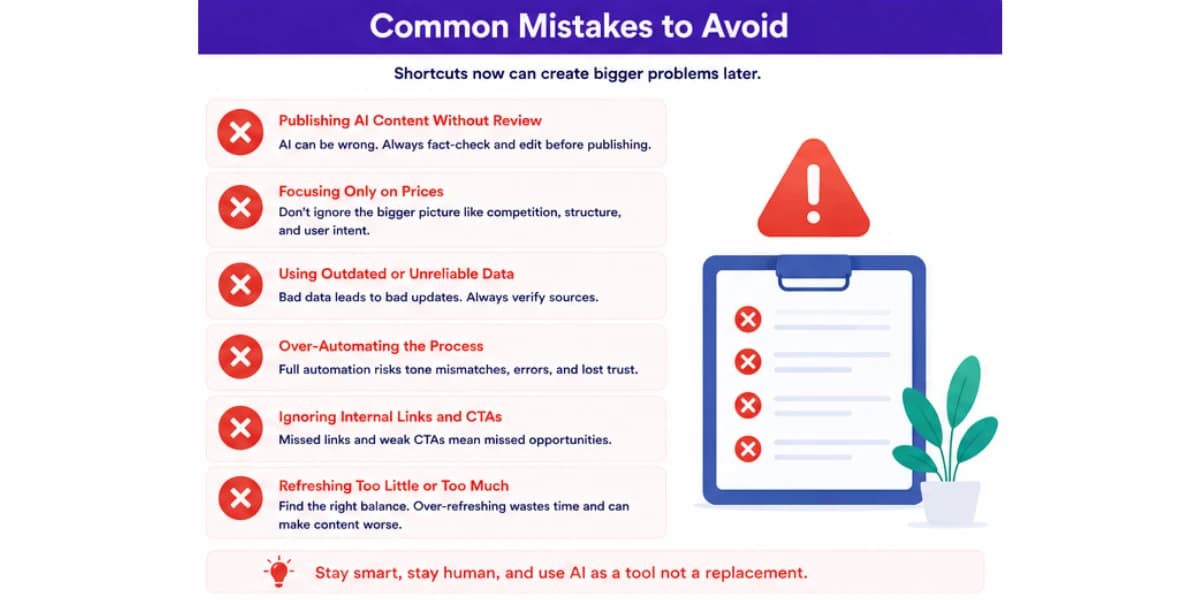
If you update fifty pages in one week without recording what changed on each one, you'll have no way of knowing later which specific updates actually helped and which didn't, which makes it hard to improve your process over time.
It's usually better to work through a smaller, focused batch each week and keep a simple log of what changed, rather than trying to refresh your entire site in one giant push that leaves no clear record behind.
A fourth mistake, and a subtle one, is trusting AI generated pricing without a second check.
Pricing pages can be confusing, with multiple tiers, regional pricing, and limited time promotions all mixed together.
AI tools sometimes pull the wrong number from a page like this, so a quick manual glance at the actual pricing page before publishing is always worth the extra minute.
Building topical authority in a niche depends heavily on keeping your content accurate and current, since search engines use freshness signals to determine which pages deserve to rank.
Signs A Page Needs an Immediate Refresh
Some issues shouldn't wait for your regular refresh cycle.
If a company you're recommending shuts down, gets acquired, or has a major public controversy, that page needs attention right away regardless of when it's scheduled for review.
A sudden, sharp drop in rankings or traffic on a previously strong page is another signal worth investigating immediately, since it often means something changed either on your page, on a competitor's page, or with the product itself.
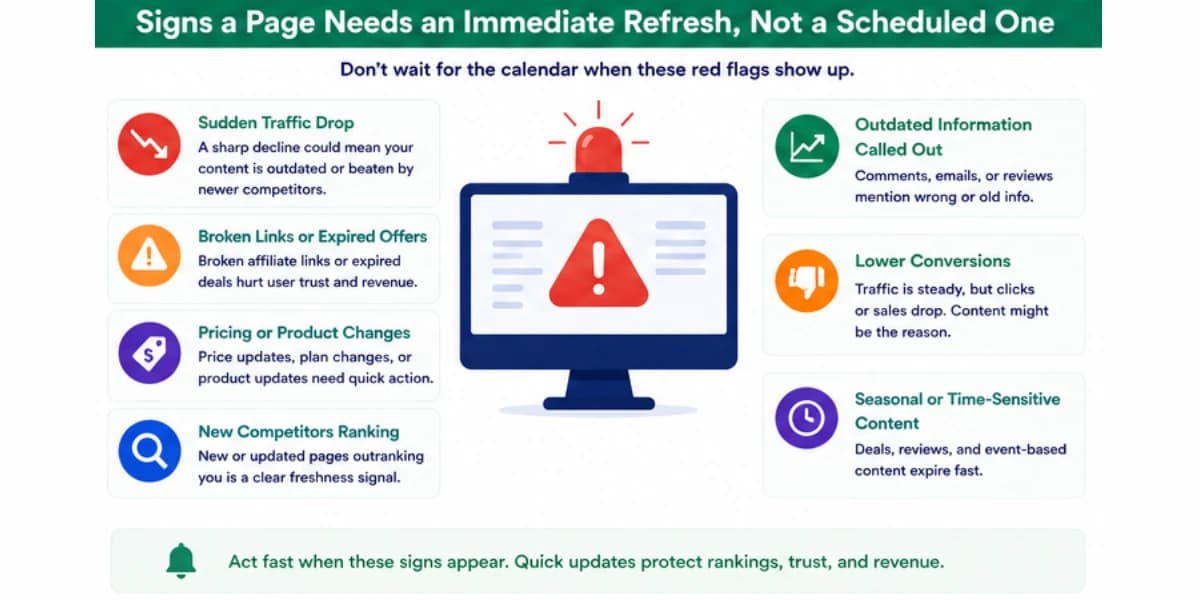
If readers start leaving comments or sending emails pointing out that pricing or details are wrong, treat that as a direct signal rather than something to batch into your next scheduled review.
Readers catching your mistakes before you do is a bad look, and it's usually a sign the page has been stale longer than your tracking caught.
For a complete overview of how AI fits into every aspect of search engine optimization, including content refresh workflows, read our AI internal linking guide to understand how link structures support your content strategy.
Final Thoughts On AI Content Workflows
A good content refresh workflow for an affiliate site doesn't chase perfection on every single page all the time.
It builds a repeatable system that catches the pages losing money or trust before too much damage is done, using AI to handle the slow, repetitive parts of that process so you can spend your own time on the parts that actually require judgment.
Start with a clean inventory of your content. Set a realistic review schedule based on how much each page actually earns or matters to your site.
Let AI handle the scanning, fact pulling, and first draft writing, but keep every final decision, especially your actual product recommendations, firmly in human hands.
Check your affiliate links every single time you touch a page.
And track what happens after each refresh so your process actually gets smarter over time instead of staying the same guesswork it started as.
Done consistently, this kind of workflow protects the revenue you've already built and often uncovers new opportunities you would have missed otherwise, like a competitor gap you can now fill or an old recommendation that's quietly become the wrong one.
None of this requires fancy tools or a huge team. It just requires a system, a bit of AI assistance to handle the heavy lifting, and enough human oversight to keep the final product trustworthy.
Most site owners who skip this kind of process aren't lazy.
They simply never built a system for it, so the work never happens consistently, even though everyone involved knows it matters.
Building the workflow described here, even in a simple form at first, turns content maintenance from a vague ongoing worry into a clear, manageable task with a schedule and an owner.
That shift alone, separate from any specific tool you choose to use, tends to be the biggest driver of long term success for affiliate sites that manage to stay accurate and competitive year after year.
Frequently Asked Questions
1. How often should an affiliate site refresh its content overall?
There's no single number that fits every site, but a reasonable starting point is reviewing your top earning pages every three to four months, mid tier pages every six months, and lower priority pages once a year. Adjust based on how fast your specific industry changes.
2. Can AI fully automate the entire refresh process without human review?
You can set it up that way, but it's not recommended. AI is very reliable at scanning and drafting, but it can make factual mistakes with complex pricing pages and has no real way to judge if your actual product recommendation still makes sense. A human check before publishing protects both your accuracy and your readers' trust.
3. What is the biggest risk of skipping content refreshes on an affiliate site?
Lost revenue from outdated pricing and broken affiliate links, combined with a slow decline in rankings as search engines and readers both notice the content hasn't kept up with current information. The damage tends to build up slowly, which is part of why it's easy to ignore until it becomes a real problem, often until a site owner suddenly notices a chunk of their top earning pages have quietly dropped out of the first page of results.
4. Should every page get the same refresh schedule?
No. Your highest earning and highest traffic pages deserve more frequent attention than pages that exist mainly for supporting topical coverage. A tiered schedule based on actual page performance is far more sustainable than treating every page the same.
5. How do I know if an AI tool pulled the correct pricing information?
Always do a quick manual check of the actual pricing page before publishing an update, especially for products with multiple pricing tiers or regional differences. That check takes only a minute or two, and it prevents the embarrassing situation of publishing incorrect pricing that a reader catches before you do.
6. Is it worth refreshing very old, low traffic pages at all?
It depends on why the page exists. If it supports your broader topical coverage or still gets a small but steady trickle of traffic, a light refresh once a year is usually worth the effort. If it's truly dead weight with no traffic and no strategic purpose, your time is often better spent elsewhere, or you might consider removing the page entirely rather than refreshing it.