Can AI Write E-E-A-T Content? What Google Actually Checks
E-E-A-T comes up in almost every SEO conversation about AI content. People ask if AI writing can ever pass Google's quality bar, or if using AI automatically hurts your rankings.
The short answer is not simple. AI can write content that shows real signs of E-E-A-T. It can also write content that fails badly.
The difference comes down to how the content gets made, not just what tool wrote it.
That distinction sounds small, but it changes almost everything about how you should actually approach using AI on your site.
The rest of this article breaks down what E-E-A-T actually means, what Google's own guidance says about it, and what really gets checked when a page gets evaluated.
Then we will look at where AI genuinely struggles, where it can actually help, and how to build a process that produces content strong enough to pass a real quality bar, not just look good on the surface.
Disclosure: Some of the links I share might be affiliate links. If you click on one and make a purchase, I may earn a small commission as a thank you. But don’t worry, it won’t cost you anything extra. I only recommend stuff I genuinely believe in. Your support helps me keep creating awesome content. You can read my full affiliate disclosure in my disclaimer page.
If you want to save a lot of hours searching for high-paying affiliate programs, check out our exclusive list of 2500+ affiliate programs. You’ll find all the information about the programs inside the list. This list is perfect for affiliate bloggers and influencers.
What E-E-A-T Actually Stands For
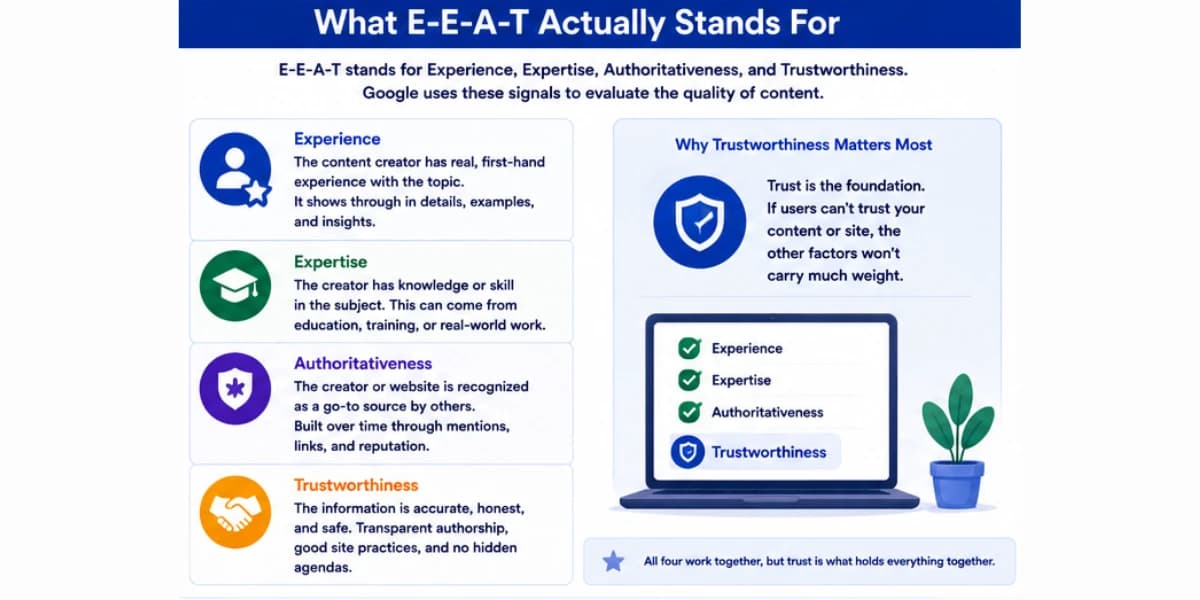
E-E-A-T stands for Experience, Expertise, Authoritativeness, and Trustworthiness.
It comes from Google's Search Quality Rater Guidelines, a long document given to human raters who review search results and rate how well pages serve searchers.
These ratings do not directly control rankings. They help Google understand and train its ranking systems over time.
Experience means the content creator has actual, real life experience with the topic.
Someone who has actually used a product, visited a place, or gone through a process has a different kind of credibility than someone who only researched it.
That piece got added most recently to the older E-A-T framework, and it is the piece that gives AI the hardest time, since AI has no lived experience of its own.
Expertise means the creator has real knowledge or skill in the subject.
It does not always mean formal credentials. A person who has spent years fixing cars can have real expertise even without a mechanic's license.
But for certain topics, especially medical, legal, and financial subjects, formal expertise matters a lot more, and Google's guidelines are explicit about this.
Authoritativeness means the content creator or the website is seen as a trusted source on the topic, both by other experts and by the wider web.
That kind of trust gets built over time through other sites linking to you, mentioning you, and treating you as a credible source.
Trustworthiness sits at the center of the whole framework. Google's own guidelines describe trust as the most important part of E-E-A-T.
A page can show experience and expertise, but if the information is not accurate, if the site hides who wrote it, or if it feels designed to trick people rather than help them, trust breaks down and the rest matters less.
All four parts of this framework work together, but trust is the piece that everything else ultimately builds toward.
E-E-A-T Is Not A Ranking Factor By Itself
That point gets missed a lot, so it is worth being clear about it early. E-E-A-T is not a single score that Google calculates and plugs into ranking math.
It is a framework used by human quality raters to judge search results, and those judgments help Google evaluate and improve its automated ranking systems over time.
In practice, this means there is no one signal you can fix to instantly boost your E-E-A-T score. Instead, E-E-A-T works more like a lens.
Google's systems try to detect signals connected to real experience, real expertise, and real trust, using things like author information, site reputation, backlinks, and the actual quality of the content itself.
Weak signals in these areas tend to correlate with lower rankings, especially for topics where accuracy really matters.
Knowing this distinction helps explain why some low effort content still ranks for a while, and why some carefully built content struggles anyway.
E-E-A-T is not a switch. It is closer to a pattern that gets reinforced through many smaller signals working together.
For a complete overview of how AI fits into every stage of search engine optimization, read our complete AI SEO guide. It covers how AI tools handle everything from keyword research to technical audits.
Why E-E-A-T Matters More For Some Topics Than Others
Google's guidelines put real weight on a category called Your Money or Your Life topics, often shortened to YMYL.
These are subjects where bad information could seriously harm someone's health, finances, safety, or wellbeing.
Medical advice, legal guidance, financial planning, and safety related content all fall into this bucket.
For YMYL topics, the bar for E-E-A-T sits much higher.
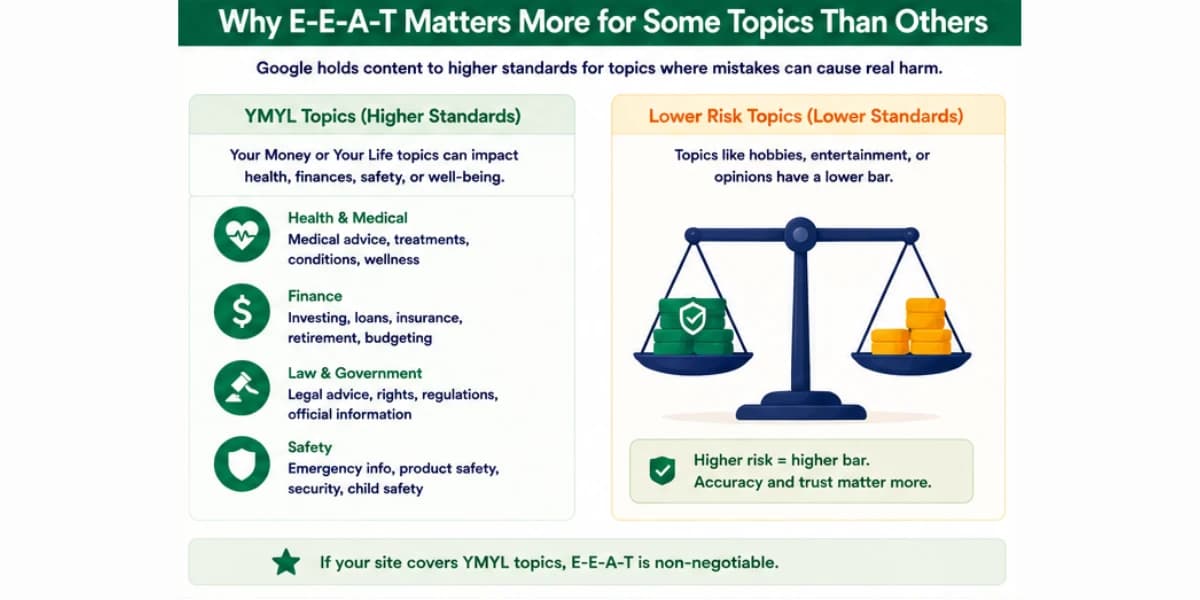
A blog post giving casual opinions about pizza toppings does not need the same level of scrutiny as an article giving advice about managing diabetes or investing retirement savings.
Google's raters are trained to hold YMYL content to a stricter standard, since getting it wrong can cause real harm.
All of this matters a lot for the AI content question, because AI struggles more with YMYL topics specifically.
A wrong recipe suggestion is annoying. Wrong medical dosage information can be dangerous.
If your site covers any YMYL subject, the stakes for getting E-E-A-T right go up significantly, and leaning on AI without careful human review becomes much riskier.
Where AI Genuinely Struggles With E-E-A-T
Let's be honest about the real weak points, since pretending AI has no limits here would be misleading.
AI has no personal experience. It cannot have actually used a product, visited a location, or lived through a situation.
When you ask an AI tool to write a review of a hiking trail, it can pull together facts from other sources, but it cannot describe the actual feeling of the trail underfoot or the specific view from a certain turn, because it was never there.
Readers and Google both pick up on this kind of generic, secondhand description over time.
AI can state wrong facts with total confidence. That mistake shows up more than almost any other problem in AI generated content.
A tool might state an outdated statistic, a wrong date, or a made up detail, and it will say it just as smoothly as it says something true.
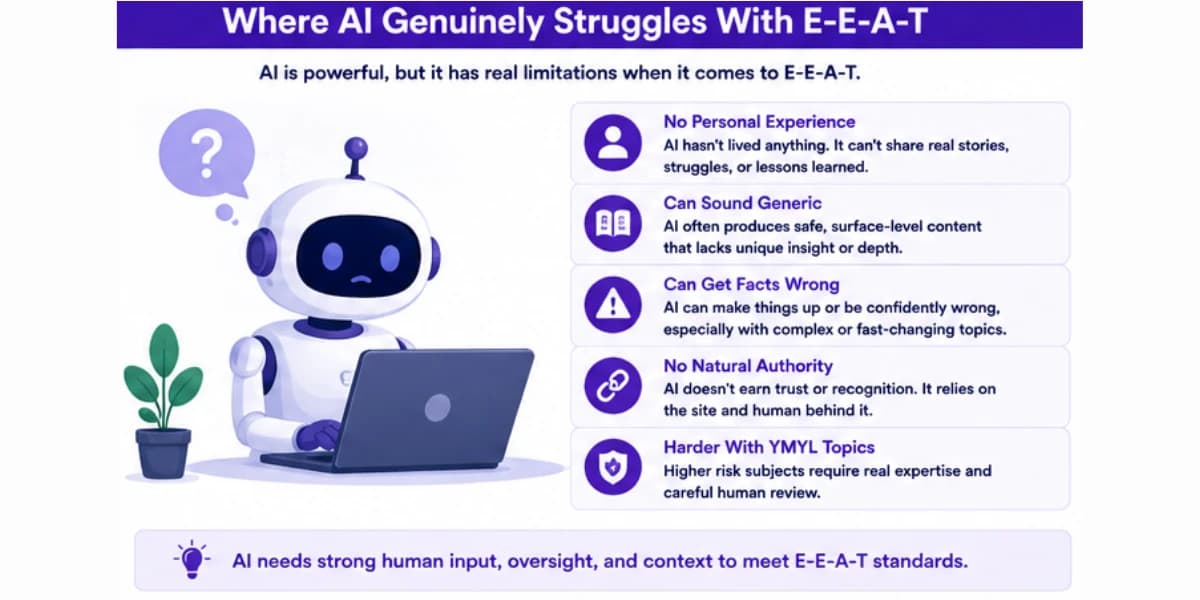
Nothing about the tone changes to warn you something might be wrong. AI has no accountability.
A human expert puts their name and reputation behind what they write. If a doctor writes bad medical advice, there are real consequences for their license and reputation.
AI has no such stake in getting things right, which is part of why human review matters so much before anything goes live.
AI content often reads as generic because it draws from broad patterns across huge amounts of text rather than from one specific, lived point of view.
Even when the facts are correct, the writing can feel like it could have been written by anyone, about anyone's product, in any city.
That lack of a specific voice is a real weakness when it comes to showing real expertise and real experience.
Where AI Can Actually Help Build E-E-A-T
None of this means AI has no place in content that passes a real quality bar. Used the right way, it can genuinely support strong E-E-A-T content instead of working against it.
AI is good at organizing information a human expert already knows.
If a real expert has years of hands on knowledge but struggles to structure it into clear, readable sections, AI can help turn scattered notes into an organized draft.
The expertise still comes from the person. The AI just helps shape it into something readable.
AI is useful for research and fact gathering, as long as every fact gets checked before publishing.
It can pull together background information quickly, saving a writer time before they add their own real insight and experience on top.
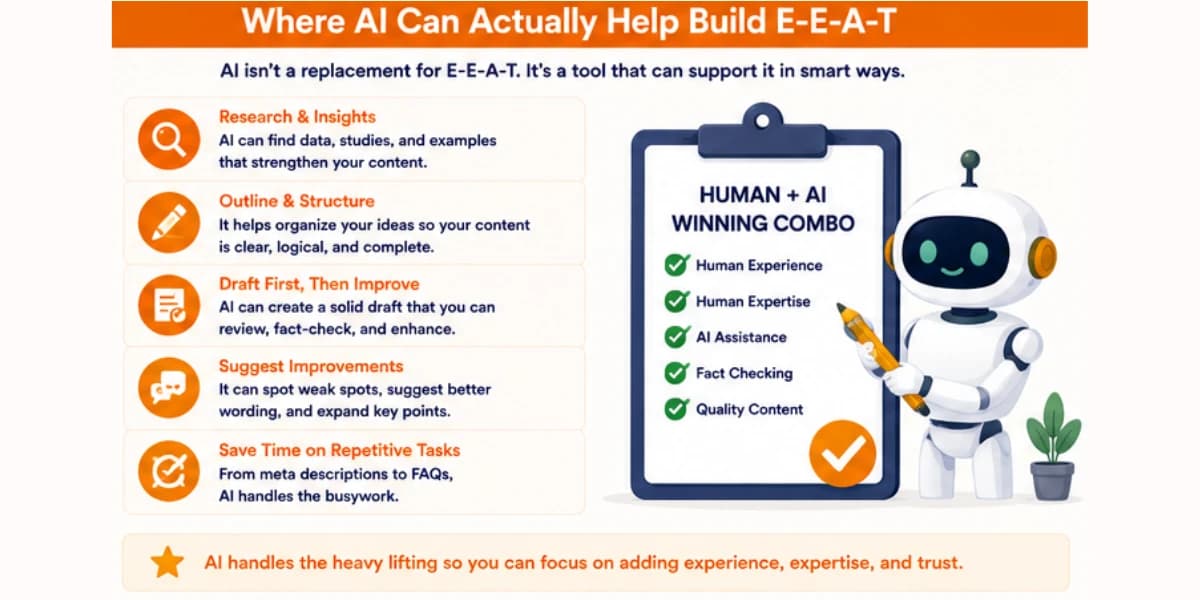
AI can help a real expert write faster without lowering quality, as long as a human stays in control of the actual claims and opinions in the piece.
A doctor who dictates their genuine clinical experience and lets AI help organize and polish that into readable prose is producing something very different from a doctor who lets AI invent the content entirely.
AI can also help with editing and clarity. Even strong expert writing sometimes reads awkwardly on a first draft.
AI can suggest clearer phrasing, catch repeated words, and tighten up sentences, all without touching the actual substance of what the expert knows and believes.
Learning how to use AI writing tools effectively helps you understand the right balance between AI assistance and human expertise.
What Google Actually Checks
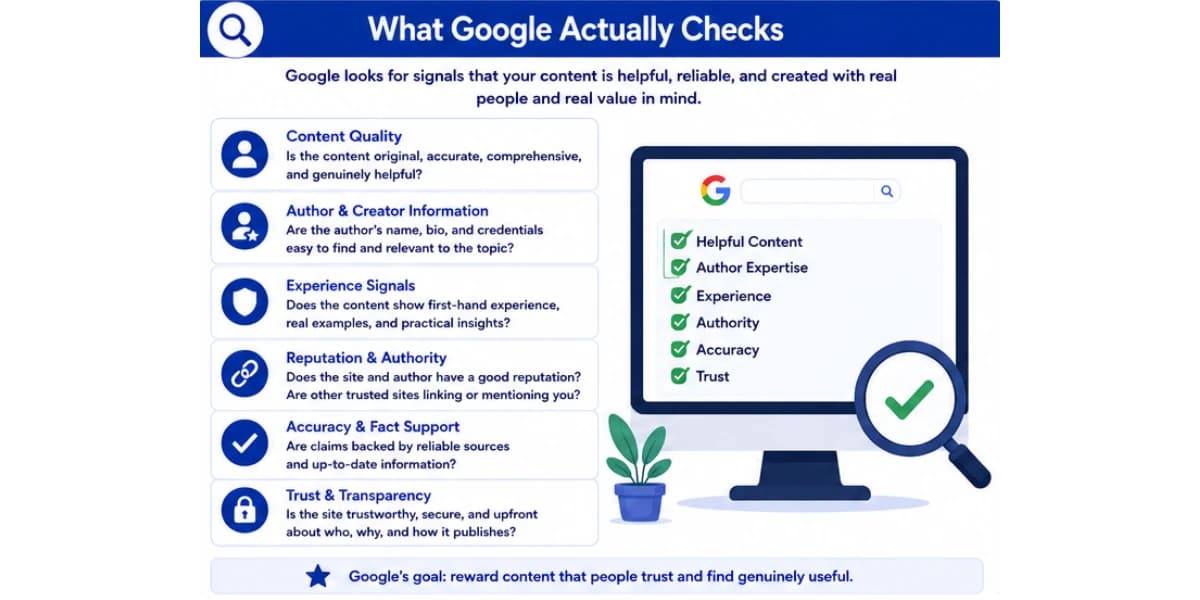
Google does not have a single button that scans a page and prints out an E-E-A-T score.
Instead, several different signals feed into how a page and a site get evaluated over time. Here is what genuinely matters based on Google's own public guidance.
Author Information
Pages that clearly show who wrote them, along with real background information about that person, tend to be viewed more favorably than pages with no visible author at all.
A short bio explaining relevant experience or credentials gives both readers and quality raters a reason to trust what they are reading.
All of that matters a lot for AI generated content specifically.
A page with AI written text but a real named expert reviewing and standing behind it is a very different situation than a page with no named author and content that was never reviewed by anyone.
Site Reputation
Other people's opinions of your site matter a lot. Reviews, mentions on other reputable sites, and general reputation across the web all play a part.
A site that other credible sources link to and mention positively sends a much stronger authority signal than a brand new site with no outside recognition at all.
Content Accuracy
Content accuracy is where AI hallucinations become a real liability.
Google's raters are trained to check if the actual information on a page is accurate, and pages with clear factual errors get rated poorly, especially on YMYL topics.
Accuracy checking is not optional if you are using AI in any part of your content process.
Depth And Usefulness
Content that genuinely answers a searcher's question, covering it with real depth rather than surface level filler, tends to perform better.
Google's guidelines specifically call out content that seems to exist mainly to attract clicks or ad views, without actually serving the reader's needs.
Thin, AI generated filler content built purely for search traffic fits this description closely, which is part of why it tends to underperform over time.
Original Insight
Google's guidelines mention rewarding content that offers something genuinely useful and original, not just a rehash of what is already available elsewhere on the web.
That is a real challenge for pure AI content, since AI naturally tends to summarize and blend existing information rather than add something new.
Original data, firsthand testing, or a genuinely fresh perspective all help here in a way pure AI summarization cannot replicate on its own.
Trust Signals Around The Whole Site
Security basics, clear contact information, an accurate about page, and transparency about who runs the site all feed into trust at a site wide level, not just a single page level.
A site that hides who is behind it, or gives no way to contact a real person, sends a weaker trust signal regardless of how good any individual article reads.
A Real Example Of Weak Versus Strong E-E-A-T
It helps to see this play out in a real example rather than just in theory. Picture two articles about the best running shoes for flat feet.
The first article was written entirely by AI, with no fact checking and no named author.
It lists five shoes, gives a generic paragraph about each one, and never mentions actual mileage, actual testing, or any specific detail that could not be pulled from a product page.
It has no author bio. It has no photos beyond stock images pulled from the brand's own website.
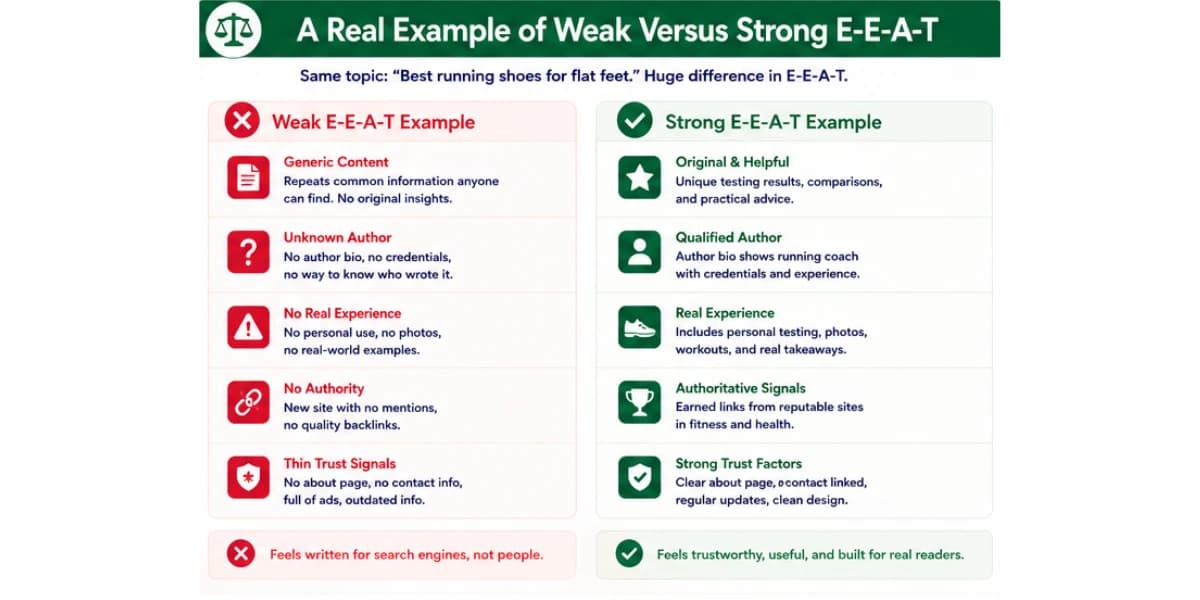
The second article was written with AI helping to draft and organize, but built on real input from a person who has actually run in each shoe for at least fifty miles.
That person is named at the top of the article, with a short bio mentioning they have run three marathons and worked at a specialty running store for years.
The article includes real photos of the actual worn shoes, notes about how the fit changed after a few weeks of use, and a clear opinion about which shoe fits which foot type best.
Both articles might use AI somewhere in the writing process. Only one of them shows real experience, real expertise, and real trust signals a reader can check.
That is exactly the gap Google's guidelines are trying to capture, and it has almost nothing to do with which tool typed the words on the page.
How Quality Raters Review Pages
It helps to know what the human side of this process actually looks like, since a lot of confusion comes from picturing E-E-A-T as something a computer scans for automatically.
Quality raters are real people, working from a very detailed guidelines document, who look at real search results and rate how well a page serves the person who searched.
They check things like if the page matches the intent behind the search, if the information seems accurate, if the page shows who is responsible for it, and if the overall experience feels trustworthy or feels like it is trying to trick the visitor.
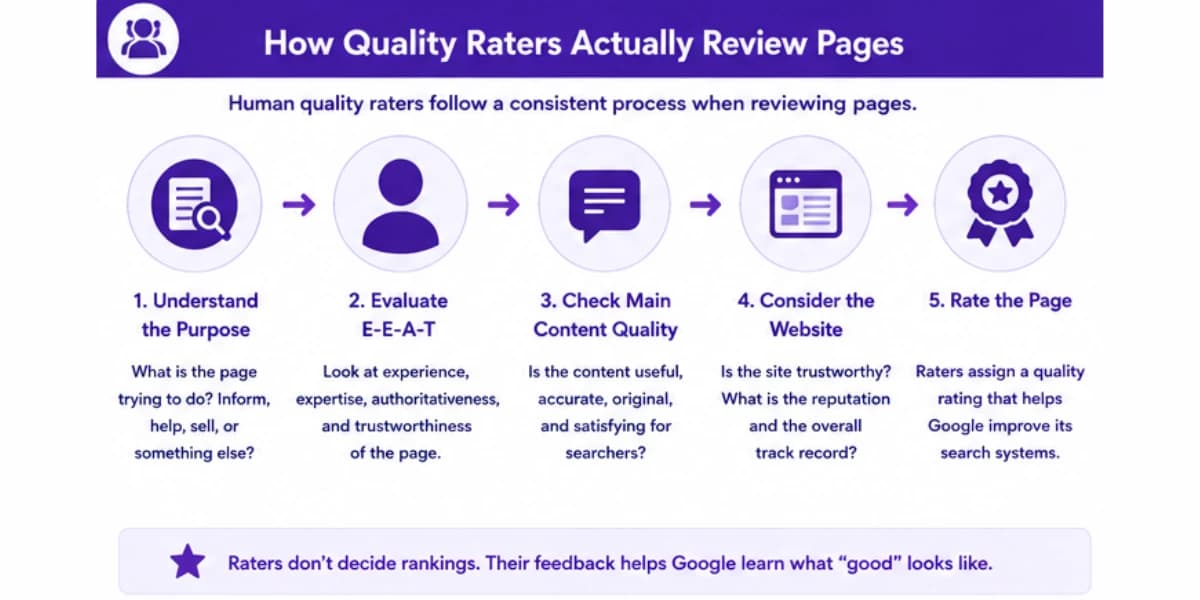
These ratings do not directly change any single page's ranking.
Instead, they get used in large batches to test and train Google's actual ranking systems, helping engineers know if their algorithms are doing a good job matching what a real human would judge as a quality result.
Over time, this creates pressure on the ranking systems to reward the same kinds of signals a human rater would reward, even though no single rater ever personally looks at your specific page.
That process is part of why chasing a fake version of E-E-A-T rarely works for long. You are not trying to trick one person reading one page.
You are trying to build a site that would genuinely earn a good rating if a careful, honest human sat down and reviewed it closely.
A Practical Test For Any AI Assisted Article
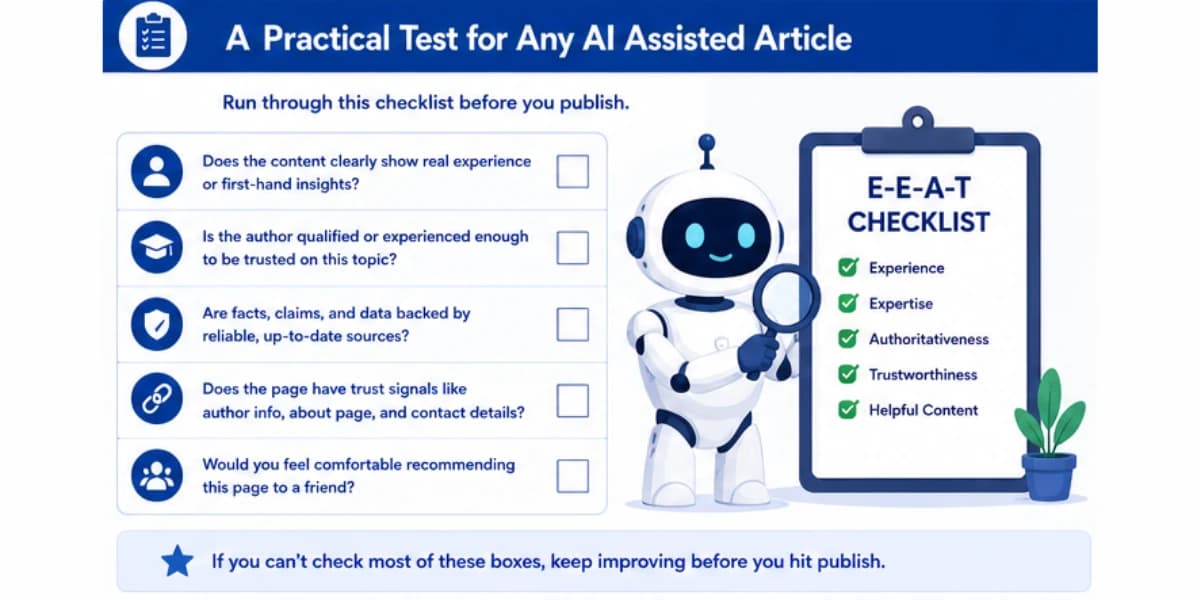
Before publishing anything with AI involvement, it helps to run it through a quick, honest gut check.
Ask if a real person's actual experience or expertise shaped this content, not just general knowledge pulled from public sources.
If nobody with real hands on knowledge touched this piece, that is a sign it probably falls short on the experience part of E-E-A-T.
Ask if every fact has been checked against a reliable, current source.
AI generated numbers, dates, and specific claims need verification before they go live, especially anything related to health, money, or safety.
Ask if the piece would read differently if written entirely by hand instead.
If the answer is not really, that might mean the content is missing a genuine, specific point of view that only a real person with real experience can add.
Ask if a reader can tell who actually wrote or reviewed this, and if that person has real relevant credibility on the topic.
Clear authorship with real credentials behind it is among the more visible, checkable trust signals a page can carry.
Building A Process That Works
Rather than treating this as a yes or no question, it helps to build a repeatable process around how AI gets used in your content.
Start with a real expert or experienced person, even if that person is not the one physically typing every sentence.
Their actual knowledge, opinions, and firsthand experience should shape the core content, not just a general prompt asking AI to write about the topic from scratch.
Use AI for structure, drafting speed, and editing support, not for inventing facts or opinions from nothing.
Feed it the real information and let it help organize and polish, rather than asking it to generate the substance on its own.
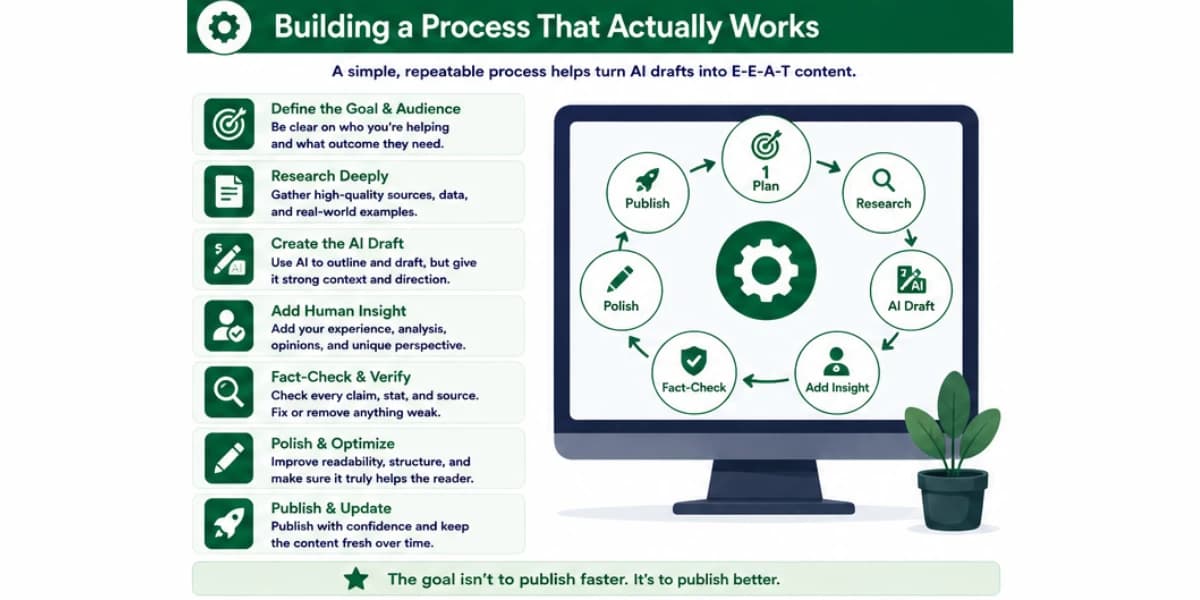
Fact check everything before publishing, treating every specific number, date, or claim as something that needs a second look, not something to trust just because it reads confidently.
Add real author information, including a short bio that explains why this person's word on this topic actually means something.
That one step alone addresses a big chunk of what Google's guidelines look for around authorship and trust.
Include genuinely original elements where possible, like real photos, real test results, or a specific firsthand story that could not have come from anywhere else.
These are the pieces that separate content with real E-E-A-T from content that just imitates the surface pattern of it.
Review the final piece with a critical eye before it goes live, checking specifically for the kind of generic, could-be-about-anything phrasing that tends to show up in AI heavy drafts, and rewriting those sections with something more specific and grounded.
Extra Care Needed For Medical, Legal & Financial Content
Since YMYL topics carry the highest stakes, it is worth spending more time on what extra care actually looks like in practice for these subjects.
For medical content, real review from a qualified professional matters a lot. That does not always mean a doctor has to write every word.
It often means a doctor or other qualified expert reviews the content before it goes live, checking specific claims like dosages, symptoms, or treatment advice against their own training and current medical guidance.
A site that publishes health content without this kind of review is taking on real risk, both for readers and for how Google's raters are likely to judge the page.
For legal content, the same idea applies. Laws vary a lot by location and change over time, so a general AI generated overview of a legal topic can easily be outdated or simply wrong for a specific state or country.
Real review from someone with legal training helps catch these gaps before a reader acts on bad advice.
For financial content, accuracy around numbers, tax rules, and investment advice matters just as much.
A wrong number in a tax article, or bad advice about retirement accounts, can cost a reader real money.
Financial content benefits enormously from review by someone with real credentials in that field, along with clear disclaimers about when a reader should talk to a licensed professional instead of relying only on an article.
Across all three of these areas, the pattern is the same.
AI can help draft, organize, and speed up the writing process, but a qualified human needs to check the actual substance before anything goes live.
Skipping this step on YMYL topics ranks among the riskiest things a site can do with AI content.
Tools & Habits That Help With Fact Checking
Since fact checking sits at the center of making AI content trustworthy, it is worth talking through some practical habits that make this easier to do consistently.
Keep a running list of sources you trust for your specific niche, such as government health sites, official pricing pages, or well known industry publications.
Checking AI generated claims against a short list of trusted sources is much faster than starting a fresh search every single time.
Ask the AI tool itself to flag anything it is not fully confident about, rather than assuming every sentence carries equal certainty.
Many AI tools will honestly note if a specific number or claim is likely outdated or hard to verify, if you specifically ask for that kind of flag in your prompt.
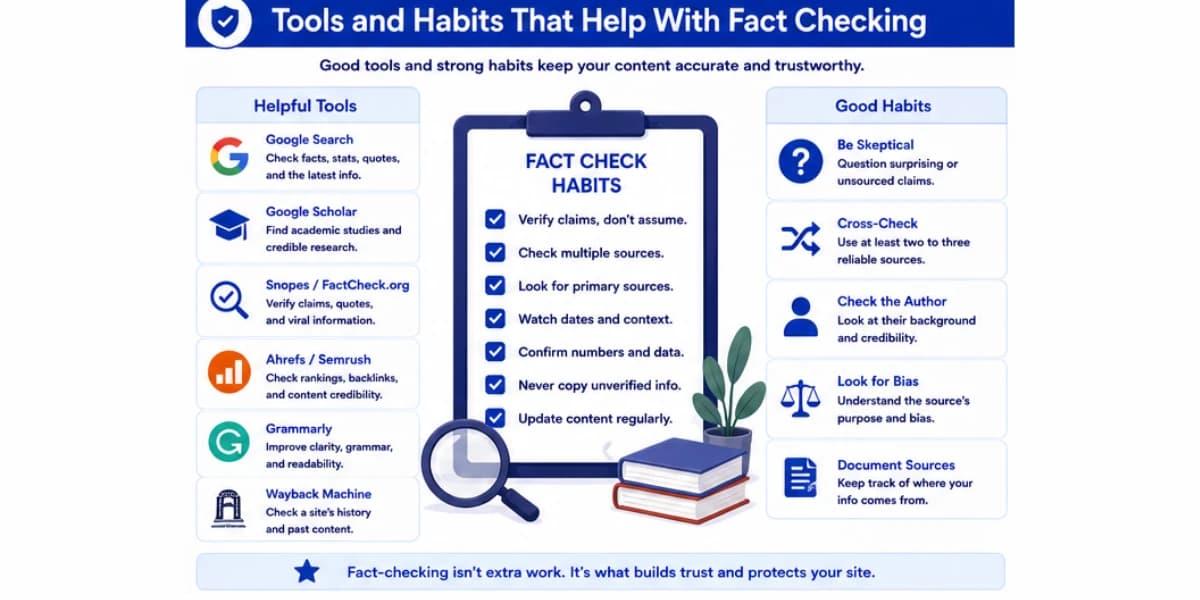
Build fact checking into your actual publishing checklist, not just something you do when you remember.
A simple rule like every specific number, date, or claim gets checked against a real source before publishing turns fact checking into a habit rather than an afterthought that gets skipped when deadlines get tight.
Pay closest attention to anything that could actually harm someone if wrong, like a dosage, a legal deadline, or a financial figure.
Not every fact needs the same level of scrutiny, but the ones connected to real world consequences deserve the most careful double check every single time.
Keep a record of who reviewed each piece and when, especially for YMYL content.
That record creates a clear trail showing real human oversight happened, which supports both your own internal quality process and your ability to show real accountability if a reader or a search engine ever questions the content.
Simple Ways To Add Real Experience Even With AI Help
A lot of site owners want to know how to actually add real experience to a piece, not just talk about why it matters. Here are some practical, doable ways to close that gap.
Take your own photos instead of using stock images.
A photo of the actual product you tested, the actual place you visited, or the actual result you got carries a kind of proof that no AI generated or stock image can match.
Readers notice the difference, and so do quality raters trained to spot generic content.
Write down specific details from your own experience before you even open an AI tool.
Small, specific things like the exact number of days a product lasted, an actual mistake you made along the way, or a specific moment that surprised you all add real texture that AI cannot invent on its own.
Feed these details into your draft rather than letting AI guess at them.
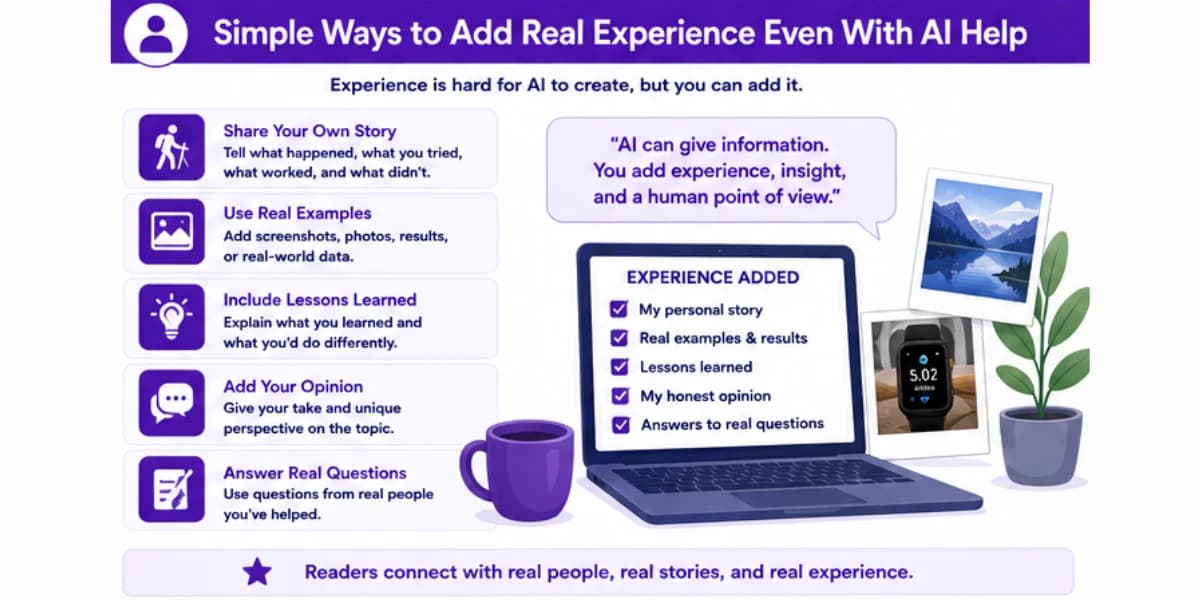
Record a short video or a few voice notes about your actual experience with the topic, then use those notes as source material for your written content.
Talking through what you know often surfaces details you would not think to type out cold, and it gives you real raw material that reflects your genuine point of view.
Include specific numbers from your own testing whenever possible, like exact measurements, exact times, or exact costs you personally paid.
Specific numbers read as far more credible than vague statements, and they are exactly the kind of detail that separates real experience from generic summary.
A reader who sees an exact number, like nineteen days of daily use before a seam started to wear, trusts that far more than a vague claim like the product held up well over time.
Mention things that did not go perfectly. Real experience almost always includes some kind of downside, limitation, or surprise.
A review that only lists positives, with zero nuance, tends to read as less trustworthy than one that gives a fair, balanced picture, including the parts that did not go as expected.
Readers are used to spotting overly positive reviews, and a piece that includes an honest downside often ends up feeling more credible overall, not less.
How This Applies To Small Sites and Solo Creators
A lot of the advice around E-E-A-T can feel like it is aimed at big brands with large teams, so it is worth talking about how this applies if you are running a smaller site or working mostly alone.
The good news is that solo creators often have an advantage here, not a disadvantage.
A single person with real, specific expertise in a narrow niche can build stronger E-E-A-T signals than a big brand publishing generic content across dozens of unrelated topics.
Depth and genuine specialization tend to matter more than size.
Build a clear, honest about page that explains who you are and why your opinion on this topic actually means something. It does not need to be long or fancy.

A few honest sentences about your real background carry more weight than a polished but vague corporate style bio.
Stay focused on topics where you actually have real knowledge or experience, rather than trying to cover everything under the sun.
A smaller site that covers one topic deeply, with real firsthand knowledge behind every article, tends to build stronger trust signals over time than a site that spreads thin across many unrelated subjects with no real expertise behind any of them.
Use AI to handle the parts of the process that eat up your time, like organizing research or tightening up a rough draft, so you can spend more of your own limited time on the parts only you can do, like actually testing the product or living through the experience you are writing about.
Common Mistakes That Hurt E-E-A-T When Using AI
A frequent mistake is publishing AI content with no human review at all, treating the first draft as the final draft.
That habit skips fact checking entirely and often leaves in generic phrasing that reads as clearly machine written.
Another mistake is hiding or skipping author information entirely, especially for YMYL topics where a reader genuinely wants to know if the advice comes from someone qualified.
A third mistake is letting AI invent specific claims, statistics, or product details rather than pulling from verified sources.
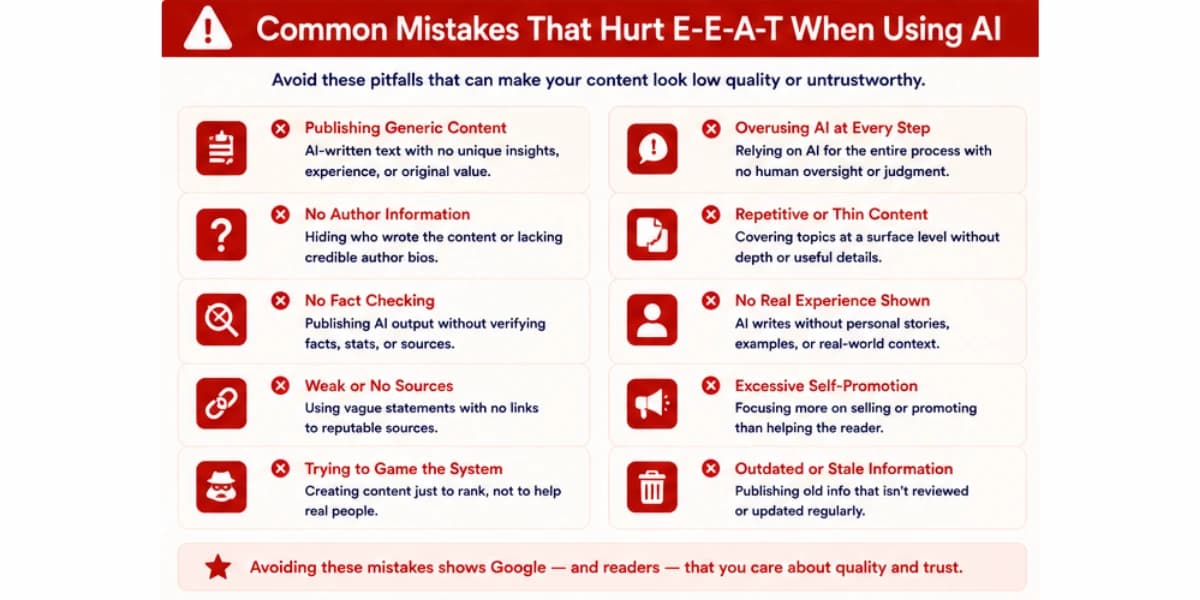
That is exactly the kind of error that damages trust the fastest, since a single caught mistake can make a reader doubt everything else on the page.
A fourth mistake is assuming that adding a fake author bio or a stock photo of a person fixes the problem.
Google's guidelines and human raters are looking for genuine signals of real expertise and experience, not surface level decoration that mimics the appearance of trust without the substance behind it.
Does Google Penalize AI Content Directly
People ask this question constantly, and the honest answer is more nuanced than a simple yes or no.
Google has stated publicly that it focuses on content quality and if content is genuinely helpful, rather than punishing content simply because AI was involved in producing it.
Content made primarily to manipulate search rankings, regardless of if a human or an AI wrote it, is treated as against Google's policies.
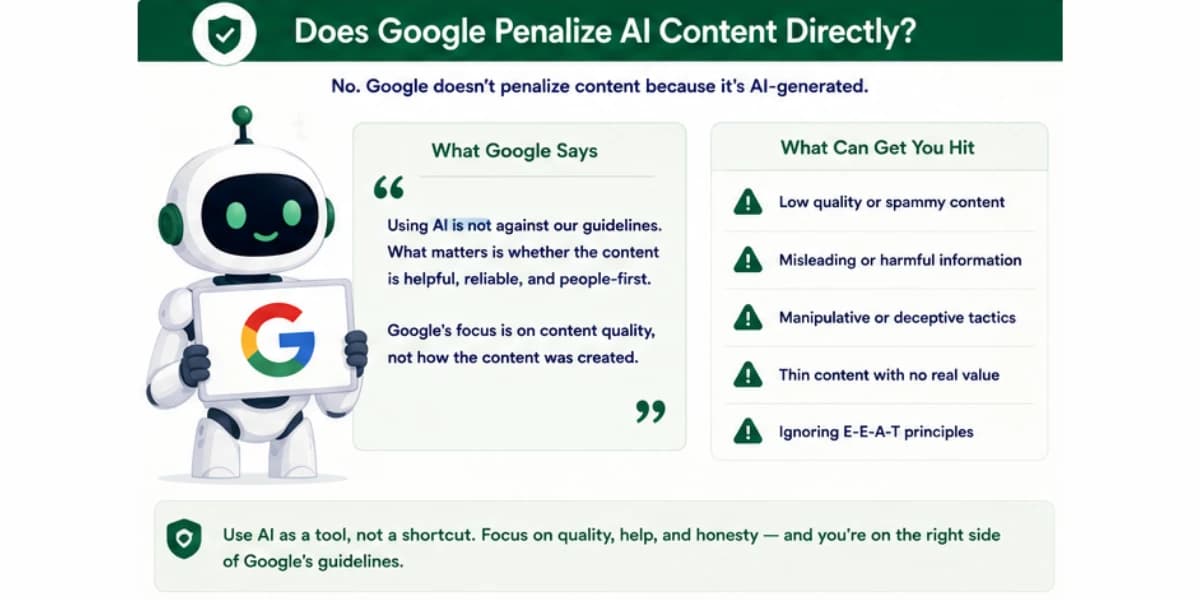
In practice, this means the production method itself is not the deciding factor.
A well researched, fact checked, genuinely useful piece that used AI assistance for drafting can perform just fine.
A low effort, unchecked, mass produced AI article with no real expertise behind it tends to struggle, for the same reasons a low effort human written article would struggle.
The quality bar is the real filter, not the tool used to clear it.
How to Tell If Your Content Actually Has E-E-A-T
A page can check every visible box, author name, bio, clean formatting, and still lack real E-E-A-T underneath.
It helps to look past the surface signals and ask harder questions.
Does the content say anything a knowledgeable person in this field would find genuinely accurate and useful, or does it just sound confident while staying vague?
Vague confidence is among the clearest tells of surface level content dressed up to look expert.
Would someone who actually works in this field read this and nod along, or would they spot obvious gaps and oversimplifications right away?
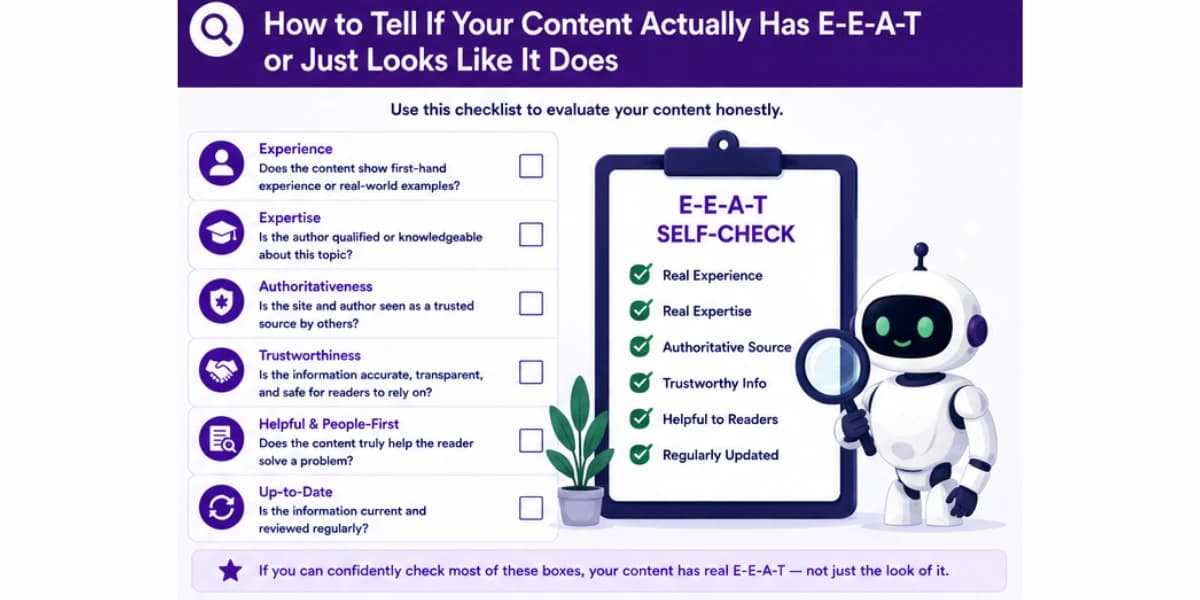
Real experts tend to notice thin content fast, even when casual readers do not.
Does the page offer anything a reader could not have found, slightly reworded, on five other similar pages?
If the honest answer is no, the content is probably closer to a summary of existing information than something with real, original authority behind it.
Final Thoughts
AI can write content that genuinely supports strong E-E-A-T, but only when a real person's knowledge, judgment, and firsthand experience shape what actually gets said.
AI on its own, with no human oversight, tends to produce content that looks polished but lacks the real experience, accuracy, and specific point of view that Google's guidelines are built to reward.
The real question is not if AI touched the content. It is if real expertise, real fact checking, and real accountability sit behind what gets published.
Build your process around that idea, and AI becomes a tool that speeds up strong content, not a shortcut that quietly weakens it.
Start small if you are not sure where to begin.
Pick one piece of content, add a real author bio, check every fact against a trusted source, and include one genuinely original detail that only you could have added.
Small steps like this, repeated consistently across your site, add up to the kind of real, checkable trust that both readers and Google's quality systems are built to reward over time.
Frequently Asked Questions
1. Can AI written content ever rank well on Google?
Yes, when it is fact checked, guided by real expertise, and edited to remove generic filler. The production method is not the main issue. Weak, inaccurate, or generic content is the issue, and that can happen with human writing too.
2. Does adding an author bio automatically fix weak E-E-A-T?
No. A bio helps show real credibility when the person actually has relevant experience, but adding a fake or exaggerated bio to thin content does not create real trust. Raters and readers both tend to notice when the substance does not match the claimed expertise.
3. Is AI content automatically worse for YMYL topics?
It carries more risk, since accuracy matters so much more on health, legal, and financial topics. AI generated claims on these subjects need extra careful fact checking and ideally review by someone with real qualifications in that field before publishing.
4. How much human involvement is actually needed for AI assisted content to pass a quality bar?
Enough that a real person's genuine knowledge, judgment, and fact checking clearly shaped the final piece. There is no fixed percentage, but content where AI invented every fact and opinion with no human oversight is the pattern most likely to fail.
5. Does Google's algorithm read author bios directly?
Google has not confirmed the exact mechanics, but author information and site reputation are part of what human quality raters evaluate, and those evaluations feed into how Google trains and improves its ranking systems over time.
6. Which E-E-A-T mistake do sites make most often with AI content?
Skipping fact checking and human review entirely. That one gap causes most of the real damage, since it lets factual errors, generic phrasing, and unverified claims go live without anyone catching them first.
For more on how AI content fits into your overall SEO strategy, read our guide to AI SEO agents and our AI content audit guide to understand how to find what's underperforming on your site.