AI Internal Linking: Can AI Actually Do This Well?
Internal linking has a reputation problem.
Every SEO knows it's one of the few ranking levers you control entirely, with no dependency on backlinks, algorithm updates, or competitor behavior.
And yet it's consistently the most neglected part of most sites' SEO process, because doing it well by hand on a site with hundreds or thousands of pages is genuinely tedious.
So when AI tools started promising to automate internal linking, the appeal was obvious: finally, a way to fix the thing everyone knows they should be doing but nobody has time for.
The honest answer to whether AI can actually do this well is: partially, and with important caveats.
AI is very good at the part of internal linking that's fundamentally a search-and-match problem, scanning hundreds of pages and surfacing contextually relevant linking opportunities a human would take days to find manually.
It's considerably weaker at the part of internal linking that requires strategic judgment, understanding which pages deserve the most link equity, how a linking structure should reinforce topical authority, and when a "relevant" link is actually the right link to include.
Let's look into where AI internal linking tools succeed, where they fail, what a realistic AI-assisted workflow looks like, and how to evaluate whether a given tool or approach is actually helping your site or just creating the appearance of a well-linked structure.
Disclosure: Some of the links I share might be affiliate links. If you click on one and make a purchase, I may earn a small commission as a thank you. But don’t worry, it won’t cost you anything extra. I only recommend stuff I genuinely believe in. Your support helps me keep creating awesome content. You can read my full affiliate disclosure in my disclaimer page.
If you want to save a lot of hours searching for high-paying affiliate programs, check out our exclusive list of 2500+ affiliate programs. You’ll find all the information about the programs inside the list. This list is perfect for affiliate bloggers and influencers.
Why This Question Keeps Coming Up
It's worth pausing on why "can AI do internal linking well" is even a live question, rather than an obvious yes or no.
Internal linking sits at an unusual intersection of tasks that are, on one hand, mechanically simple to describe, such as, find related pages, add a link, and on the other hand, deeply dependent on context that isn't visible in the content itself.
Two pages can be perfectly relevant to each other by any semantic measure and still be the wrong pages to link, because one of them is scheduled to be deprecated, or because linking them would reinforce a cannibalization problem, or because the business simply doesn't want to send more attention toward a lower-priority page right now.
This is precisely the kind of task that tends to produce mixed results from AI tools generally.
Strong performance on the part of the task that can be reduced to pattern matching, and much weaker performance on the part that requires outside context the tool was never given.
Internal linking is a near-perfect example of that split, which is why it's worth examining in detail rather than accepting either the "AI can automate this entirely" or "AI is useless for this" framing at face value, as neither is accurate.
For a broader look at how AI fits into every stage of search engine optimization, read our complete AI SEO guide. It covers how AI tools handle everything from keyword research to technical audits.
What Internal Linking Actually Does
Before evaluating whether AI can do internal linking well, it's worth being precise about what internal linking is actually for, because "add more internal links" is meaningless advice without this context.
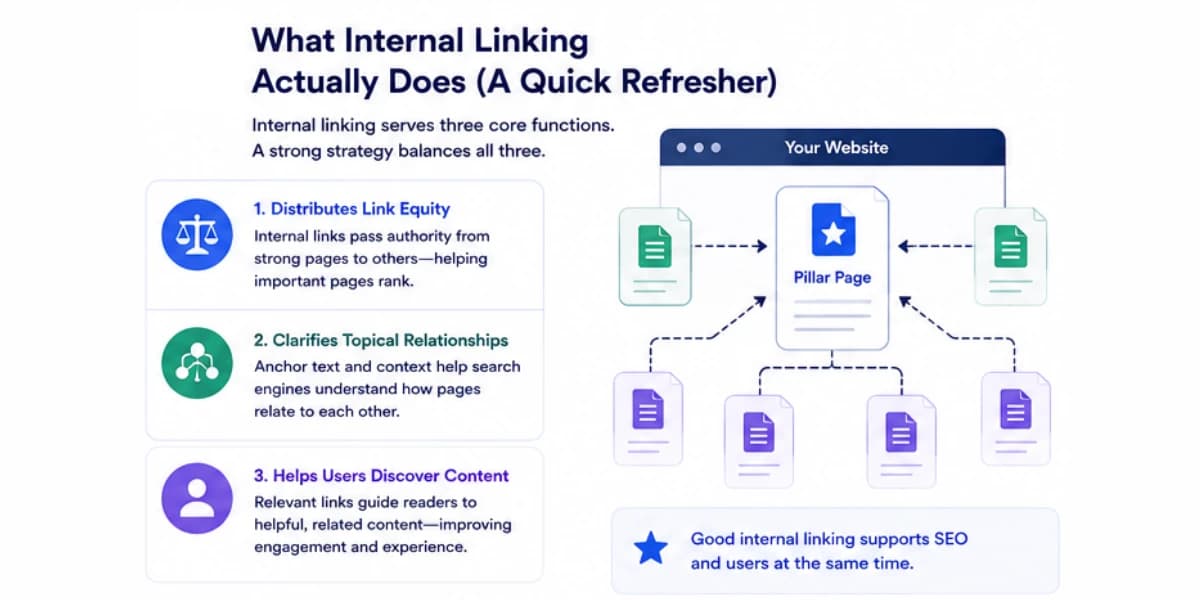
Internal linking serves three distinct functions, and they don't always point in the same direction:
1. Distributing link equity (PageRank-style authority) across a site.
Pages that receive more internal links, especially from other authoritative pages, tend to be treated as more important by search engines.
A page with zero internal links pointing to it, an orphaned page, is at a structural disadvantage regardless of how good the content on it is.
2. Helping search engines understand topical relationships between pages.
The anchor text and context surrounding a link tell a search engine what a linked page is about and how it relates to the linking page.
A cluster of pages that link to each other using varied, descriptive anchor text builds a much clearer topical signal than a cluster of pages that don't link to each other at all.
3. Helping actual users navigate to related content.
This is the function that's easiest to forget when optimizing purely for search engines, and it's the one that AI tools are, ironically, sometimes worse at than a thoughtful human editor.
Because a link that's semantically relevant isn't always a link a reader actually wants to click at that point in the content.
A good internal linking strategy serves all three functions simultaneously. A weak one optimizes for one function at the expense of the others.
For example, over-optimizing for equity distribution by adding links wherever technically possible, which harms the reading experience and can look manipulative to both users and search engines.
This three-function framing turns out to be the most useful lens for evaluating any internal linking tool, AI-powered or not.
A tool that's excellent at function two - helping search engines understand topical relationships, but weak at function three - genuinely serving readers, will produce a site that crawls well in an SEO audit tool while feeling cluttered or over-linked to an actual visitor.
Conversely, a purely editorial approach to linking, done entirely by feel with no data behind it, tends to under-serve function one, since equity distribution benefits from a systematic view of the whole site that's hard to hold in one person's head.
The strongest approach treats these as three separate checks to run on any proposed set of links, rather than assuming that satisfying one automatically satisfies the others.
Understanding how internal links fit into your broader content structure is essential. Our guide on what content clusters are explains how pillar pages and supporting articles work together to build topical authority.
Where AI Excels At Internal Linking
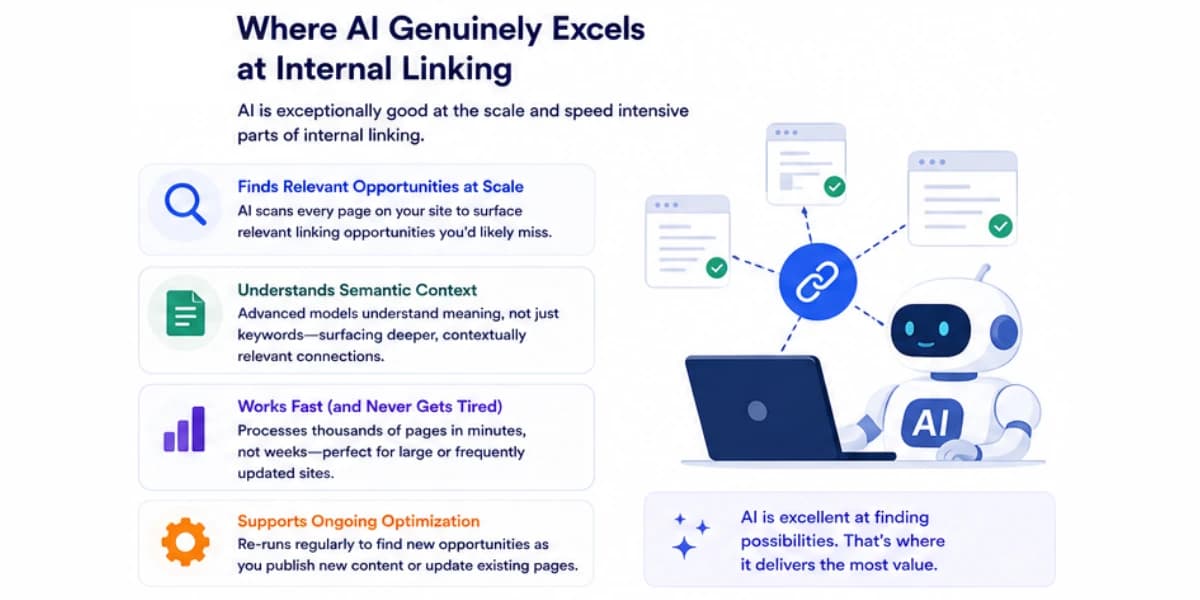
Despite the limitations discussed above, AI internal linking tools genuinely shine in specific areas where the task is fundamentally about processing large volumes of data efficiently.
Finding Relevant Linking Opportunities at Scale
This is the single strongest use case for AI in internal linking, and it's not a small thing.
On a site with a few hundred pages, manually identifying every place where an existing page could reasonably link to another relevant page is not realistic to do by hand with any consistency.
AI models are well suited to this specific task: given the full text of a page and a database of other pages on the site, they can identify semantically relevant matches, including matches that don't share obvious keywords, which is where manual, keyword-based internal linking tools have historically struggled.
For example, a manual or purely keyword-matching approach might miss that a paragraph discussing "reducing churn in subscription businesses" is a natural link candidate for a page about "customer retention strategies," because the exact phrase "customer retention" doesn't appear in the first paragraph.
An AI model working from semantic understanding rather than exact keyword matching catches this kind of relationship far more reliably.
This capability compounds as a site grows. On a 50-page site, a diligent human editor can plausibly hold most of the site's content in their head well enough to spot relevant linking opportunities from memory.
On a 2,000-page site, that's simply not possible.
No editor can reliably recall which of 2,000 pages might connect to the paragraph they're currently writing.
This is the scale threshold where AI-assisted matching stops being a nice-to-have efficiency gain and starts being close to a practical necessity for maintaining a genuinely well-linked site.
Identifying Orphaned and Under-Linked Pages
AI-assisted internal linking audits can process an entire site's link graph and quickly flag pages that receive few or no internal links.
This is one of the highest-value, lowest-risk applications of AI in this space, because it's a detection problem, not a judgment problem.
The tool doesn't need to decide anything difficult; it just needs to surface an accurate list, which is exactly the kind of task AI handles reliably.
If you want to find orphaned pages and missing linking opportunities in your own content, try our internal link opportunity finder tool. It scans your pages and highlights where new internal links would add the most value.
Suggesting Anchor Text Variation
Sites that have been manually link-built over years often develop a bad habit of reusing the exact same anchor text for a given target page across dozens of source pages, which looks unnatural and can dilute the topical signal the link is supposed to send.
AI tools can suggest varied, contextually appropriate anchor text phrasings drawn from the actual surrounding sentence, rather than forcing a generic exact-match phrase into every instance.
Processing Large-Scale Content Migrations and Redesigns
When a site undergoes a significant restructuring, merging categories, migrating a URL structure, or consolidating duplicate content, the internal link graph needs to be rebuilt to reflect the new structure.
Doing this manually across a large site is one of the more error-prone, time-consuming SEO tasks that exists.
AI-assisted tools can map old link relationships to new page structures far faster than a manual process, flagging broken internal links and suggesting replacements based on content similarity between the old and new pages.
Where AI Internal Linking Falls Short
For all the strengths AI brings to the detection side of internal linking, there are important areas where it consistently underperforms without human oversight.
It Doesn't Understand Strategic Priority
This is the core limitation, and it's worth dwelling on because it's the one most tool marketing glosses over.
An AI model can tell you that Page A and Page B are topically related and that a link between them would make semantic sense.
What it generally can't tell you, without being given significant additional context, is which of your pages should be receiving the most internal link equity given your actual business priorities.
Consider a site with a pillar page targeting a highly competitive, high-value commercial keyword, and a dozen supporting blog posts that happen to be more heavily linked to each other than to the pillar page, simply because they were published closer together in time and an AI tool found more surface-level topical overlap between them.
Left unguided, an AI internal linking tool might reinforce that existing pattern rather than correct it, because it's optimizing for relevance-matching, not for strategic link equity distribution toward the page that actually matters most to the business.
This is a judgment call that requires knowing which pages are strategically important.
This information usually lives in a marketing plan or a strategist's head, not in the text of the pages themselves.
AI tools can be given this context explicitly, but they don't infer it reliably on their own.
There's a deeper version of this problem worth naming: link equity is a zero-sum-ish resource within a site's overall structure.
Every internal link added is, in a loose sense, a vote of importance, and a page can't cast an unlimited number of votes without each individual vote counting for less.
An AI tool operating purely on relevance-matching has no inherent reason to conserve that resource carefully.
It will happily suggest a dozen relevant links from a single page if a dozen relevant targets exist, without weighing whether spreading equity that thin actually serves the site's three or four most commercially important pages.
A human strategist, by contrast, is naturally inclined to ask "given a limited number of links I can reasonably place on this page, which ones matter most" - a framing that requires holding the whole site's priorities in mind at once, not just the local relevance of any single potential link.
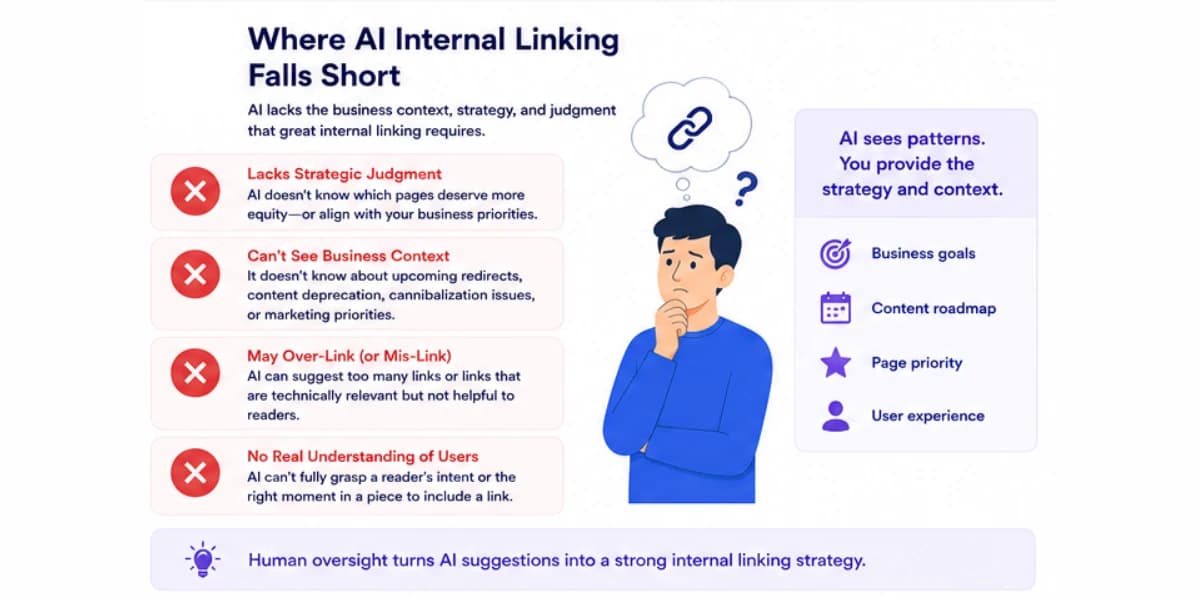
It Can Produce Technically Relevant But Contextually Awkward Links
A link can be semantically defensible: the two pages really are about related topics, while still being a poor fit for the specific sentence it's inserted into.
AI-suggested links, especially when applied with minimal human review, sometimes read as forced or interruptive, breaking the flow of a sentence to shoehorn in a link that a careful human editor would have either rephrased around or placed elsewhere in the paragraph.
This matters more than it might seem, and it's worth being specific about why.
An internal linking structure that reads as unnatural to human visitors undermines the user-navigation function of internal linking discussed earlier, and in more extreme cases, it can also raise the kind of manipulative-pattern flags that content quality systems are designed to catch.
There's also a subtler cost: readers who notice a pattern of forced, over-eager linking tend to develop a kind of link-blindness toward a site's internal links generally.
Readers click through less often even on the links that are genuinely useful, simply because the overall pattern has trained them not to trust the site's linking as helpful curation.
It Struggles With Nuanced Cannibalization Decisions
Sometimes two pages on a site legitimately compete for the same query, and the right fix isn't more internal linking between them, it's consolidating them into one page, or clearly differentiating their targeted intent so they stop competing.
An AI internal linking tool, left to its own devices, will often suggest heavy cross-linking between two cannibalizing pages because they're extremely topically similar, which can actually reinforce the cannibalization problem rather than solve it.
Diagnosing cannibalization and deciding how to resolve it is a strategic content decision that sits outside what a linking-suggestion tool is actually built to evaluate.
This is worth flagging specifically because cannibalization and internal linking opportunities can look identical from a pure topical-similarity standpoint.
Two pages that both rank for slightly different variations of the same core query will score just as highly on a semantic-relevance basis as two pages that are genuinely complementary and should be linked.
The tool has no built-in way to distinguish "these pages should link to each other because they cover related but distinct subtopics" from "these pages are actually competing for the same query and linking them just papers over a structural problem."
That distinction requires knowing what each page is actually trying to rank for: information that needs to come from a keyword mapping exercise done separately, not from the linking tool itself.
Learning how to do keyword research properly helps you map which pages should target which queries, so you can spot cannibalization issues before they become structural problems.
It Doesn't Reliably Know When Not to Link
Not every topically related pair of pages should be linked.
Sometimes a page is genuinely related to dozens of other pages on a site, and linking to all of them would create a cluttered, unfocused page that serves neither users nor search engines well.
Deciding which three or four of those dozen potential links actually deserve a place on the page, based on what's most useful to a reader at that specific point in the content, and what most needs the link equity, is an editorial judgment call.
AI tools tend to over-suggest rather than under-suggest, because flagging a plausible opportunity is a much easier task than deciding it isn't worth acting on.
A Realistic AI-Assisted Internal Linking Workflow
Given the strengths and limitations above, here's what a workflow that actually works in practice looks like, one that uses AI for what it's good at while keeping human judgment in the loop where it matters.
Step 1: Build or Export a Full Site Content Inventory
Before any linking suggestions can be generated, you need a structured inventory of every page on the site: URL, title, primary topic, target keyword (if applicable), and ideally a short summary of the content.
This inventory is the raw material an AI tool works from, and its quality directly determines the quality of every suggestion that follows.
A messy or incomplete inventory, missing pages, outdated titles, no clear topic tagging, produces correspondingly messy linking suggestions.
For sites without a clean existing content inventory, this step alone is often worth doing manually or semi-manually before introducing any AI tool into the process.
An AI tool asked to generate summaries or topic tags for hundreds of pages it hasn't been given clean source material will produce inconsistent results that then propagate errors into every later step.
Step 2: Define Priority Pages Explicitly
Before generating suggestions, identify which pages are strategically most important: the ones that should be receiving the most internal link equity.
This is the context an AI tool cannot infer on its own, so it needs to be provided explicitly, either as direct input to the tool or as a filter applied to its output afterward.
Without this step, the entire strategic-priority weakness discussed above goes unaddressed no matter how good the tool is at semantic matching.
A practical way to define this list is to rank pages by a combination of commercial value (does this page drive revenue, leads, or a core business goal), current ranking position (pages close to page one of search results often benefit disproportionately from additional internal link equity, since it can be the push that moves them into a higher position), and current link count (pages that are under-linked relative to their importance are the ones most in need of attention).
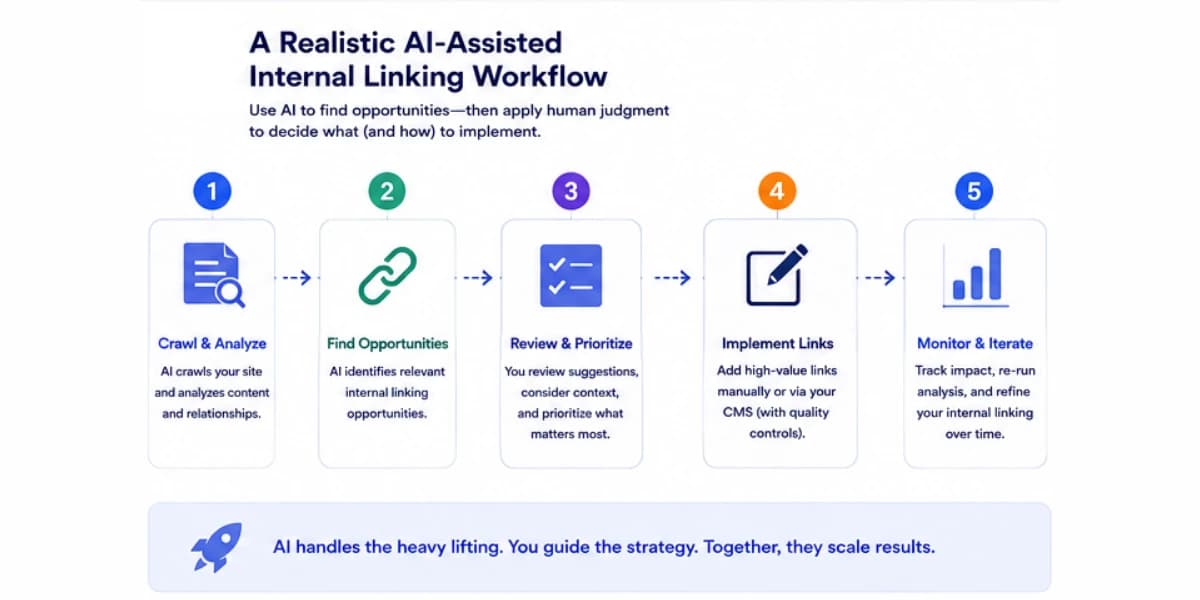
Step 3: Generate Linking Suggestions Per Page or Per Cluster
With the inventory and priorities defined, run the AI-assisted matching process to generate a list of suggested internal links, organized by source page.
Good output at this stage includes not just the target page but the specific sentence or section where the link would fit, along with a suggested anchor text variation drawn from the surrounding content rather than a generic exact-match phrase.
It's worth generating more suggestions than you intend to implement at this stage.
Since the goal of this step is casting a wide net for the human review pass that follows, an overly conservative suggestion list risks missing genuinely good opportunities, while a slightly over-generous list is easy to trim down during review.
The cost of reviewing and rejecting an extra suggestion is low; the cost of never generating a good suggestion in the first place is a missed opportunity that's unlikely to be caught any other way.
Step 4: Human Review for Relevance, Placement, and Priority Alignment
This is the step that's most often skipped when teams try to fully automate internal linking, and it's the step that makes the biggest difference in output quality.
A human reviewer should be checking three things for each suggested link: is it genuinely relevant, does it read naturally in context, and does it align with the strategic priorities defined in Step 2 - meaning, does it send equity where it's actually needed rather than reinforcing an already well-linked page just because it's an easy semantic match.
A reasonable heuristic during this review: if implementing a suggested link would require noticeably rewriting the sentence around it to make the link feel natural, that's usually a sign either the link doesn't belong there at all, or it belongs in a different sentence nearby that already discusses the target topic more directly.
Forcing links into place rarely produces good results for either readers or the topical signal the link is meant to send.
Step 5: Implement, Then Re-Audit Periodically
Internal linking isn't a one-time project.
As new content gets published, the link graph shifts, and pages that were adequately linked six months ago might become comparatively under-linked as newer content around them absorbs the majority of new internal links.
Re-running the audit and suggestion process on a regular cadence, quarterly is reasonable for most sites, keeps the link graph aligned with current priorities rather than reflecting decisions made months or years earlier.
It's also worth re-running Step 2 - the priority page list, at the same cadence as the broader audit, not just the linking suggestions themselves.
Business priorities shift, new commercially important pages get published, and older priority pages sometimes get deprecated or consolidated.
A linking audit that reuses a stale priority list from a year earlier will faithfully reinforce priorities that may no longer reflect where the business actually wants its link equity concentrated.
Building a topical map for AI SEO gives you the content structure that makes internal linking decisions much easier, since you already know which pages should support which others.
Signs AI Internal Linking Tool Isn't Working
A few warning signs are worth watching for, because they indicate the tool is optimizing for the appearance of thorough internal linking rather than genuinely useful linking:
Anchor Text That Reads As Obviously Inserted
If a sentence had to be restructured or a phrase awkwardly repurposed just to accommodate a link, that's a sign the suggestion was applied without sufficient editorial judgment.
Reading a page out loud, or having someone unfamiliar with the linking process read it, is a surprisingly effective way to catch this.
Inserted links tend to create a small stumble in the rhythm of a sentence that's easy to feel even when it's hard to articulate exactly what's wrong.
A Sudden Spike In Link Count On Pages With No Strategic Reason
If every page on the site gains a similar number of new internal links regardless of its actual importance, the tool is likely applying relevance-matching uniformly without any priority weighting.
A healthy link distribution should look uneven, roughly mirroring the actual importance hierarchy of the site's content, not flat.
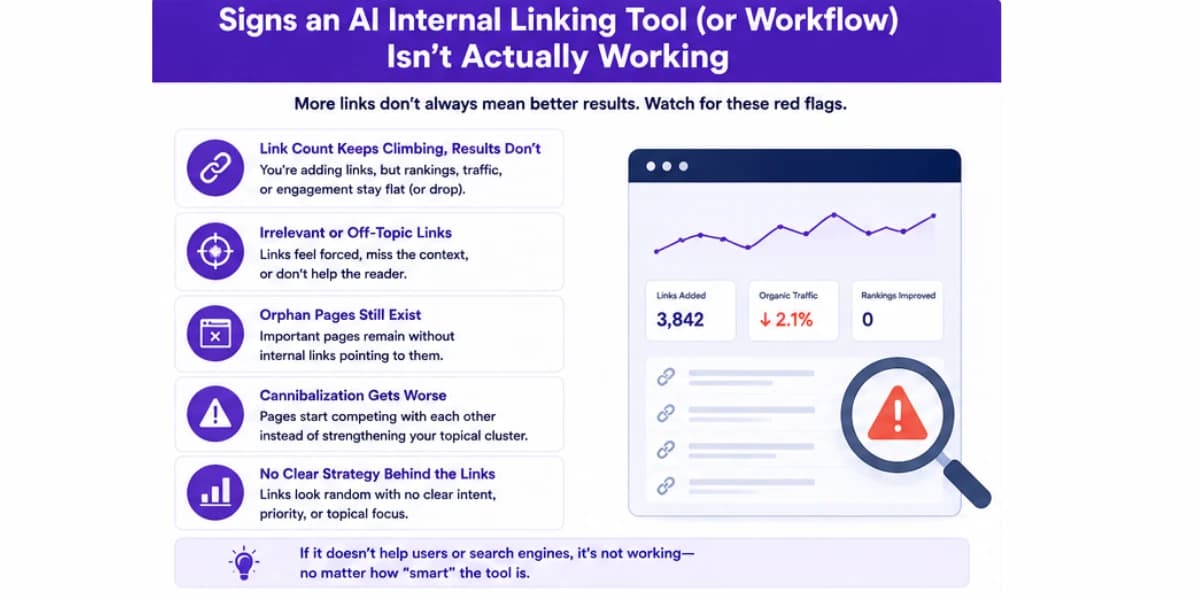
Increasing Link Density Without Improving Navigation
If a reader clicking through the suggested links doesn't actually end up somewhere genuinely useful relative to what they were reading, the links are serving the search engine (in theory) without serving the reader, which is a weaker signal than links that serve both.
No Clear Owner Reviewing Suggestions Before They Go Live
Fully automated implementation without a human review step is the single most common reason AI internal linking efforts produce mediocre or actively counterproductive results.
The tools are good enough to generate strong raw suggestions; they are not yet reliable enough to implement those suggestions without oversight.
A Growing Gap Between Crawl-Tool Link Counts And Perceived Navigability
It's possible for a site to look extremely well-linked according to an SEO crawler's link graph report while still feeling disjointed and hard to navigate to an actual visitor.
When these two measures diverge significantly, it's usually a sign that links are being added for the benefit of the link graph rather than the reader, which tends to be a short-lived strategy even from a pure rankings standpoint.
This is because search engines are increasingly getting good at distinguishing genuinely useful link structures from ones built primarily to game a link-equity signal.
Does This Mean AI Internal Linking Tools Aren't Worth Using?
No. The conclusion isn't that AI internal linking tools are unreliable and should be avoided.
It's that they're a significant time-saver for the detection and matching portion of the work, and they meaningfully underperform if treated as a fully autonomous replacement for the strategic and editorial judgment that internal linking also requires.
The practical framing that holds up: use AI to do the scanning, matching, and first-pass suggestion generation, since that's a task involving processing far more content than a person reasonably can by hand.
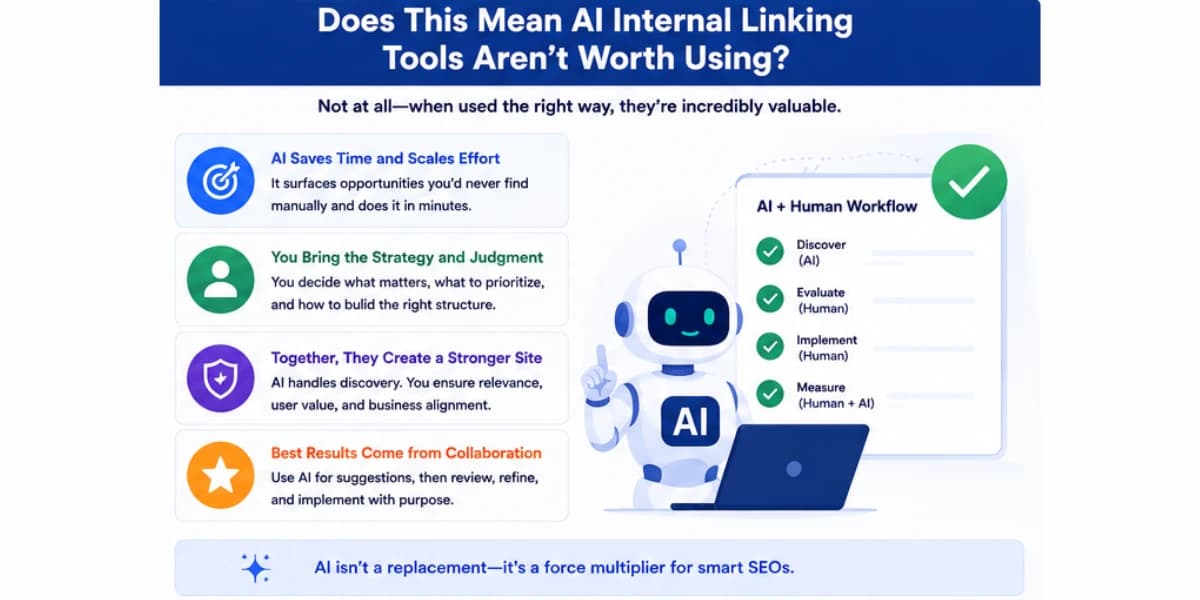
Keep a human in the loop for prioritization, placement, and final implementation decisions, since that's where strategic context and editorial judgment determine whether the resulting link structure helps or just looks thorough on the surface.
Sites that adopt this hybrid approach tend to see real, measurable improvement in how efficiently link equity flows to their most important pages, and in how comprehensively their topical clusters are interlinked.
Sites that skip the human review step tend to end up with a link structure that looks impressively dense in a crawl report but doesn't actually reflect what matters most to the business, which for internal linking specifically, defeats much of the purpose in the first place.
Using the right SEO plugins for your website can help you manage and monitor your internal linking structure alongside other on-page optimization tasks.
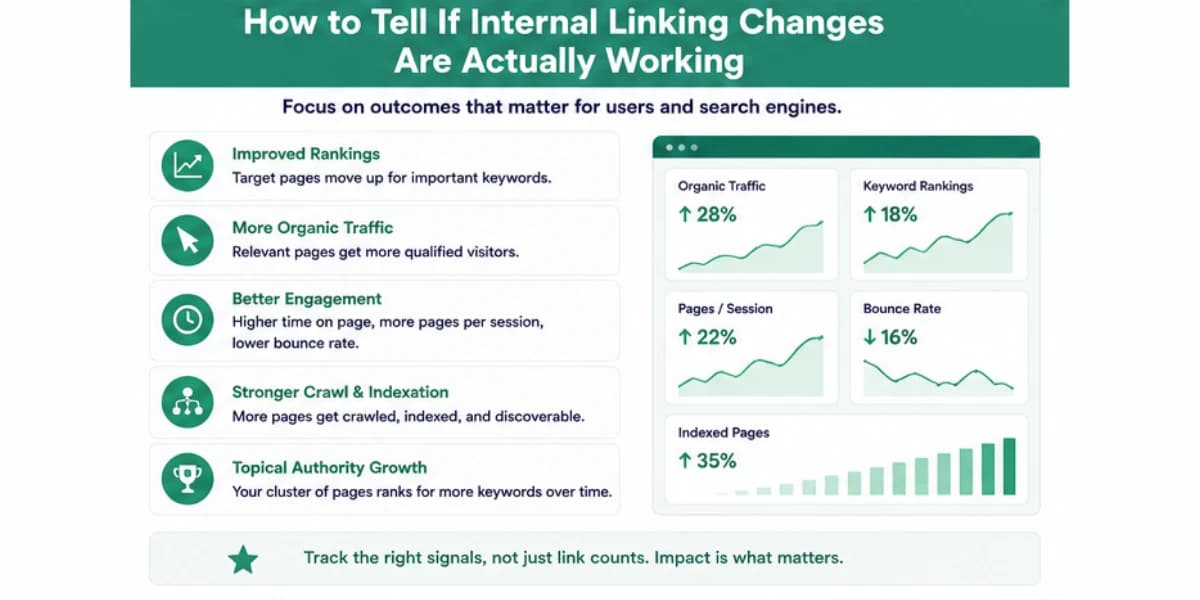
How to Tell If Internal Linking Changes Are Actually Working
Adding links, AI-suggested or otherwise, is only useful if it produces some measurable effect.
It's worth having a plan for evaluating impact before rolling out a large batch of changes, rather than assuming more links automatically equals better performance.
Track Ranking and Traffic Movement on Priority Pages Specifically
Since the goal of a well-executed internal linking effort is usually to concentrate more equity on a defined set of priority pages, the most direct way to measure success is tracking ranking position and organic traffic for exactly those pages before and after the linking changes go live, rather than looking at site-wide traffic in aggregate.
Site-wide numbers are affected by too many other variables like seasonality, new content publication, algorithm updates, to reliably isolate the effect of an internal linking change on their own.
Watch for Indexation and Crawl Changes on Previously Orphaned Pages
If part of the linking effort focused on fixing orphaned or under-linked pages, a reasonable early signal to check is whether those pages start showing up more reliably in search engine crawl and indexation reports.
A previously orphaned page that suddenly starts getting crawled more frequently is a good sign that the new internal links are being discovered and are having the intended structural effect, even before any ranking movement shows up.
Give Changes Enough Time Before Drawing Conclusions
Internal linking changes typically take longer to show a measurable ranking effect than more direct changes like a title tag update, because search engines need to recrawl the pages involved and reassess the link graph.
Evaluating results too early, within days of implementation, often leads to premature conclusions in either direction.
A four-to-eight week window is a more reasonable timeframe for a meaningful before-and-after comparison on most sites, though this varies with how frequently a given site is crawled.
Be Willing to Revert Changes That Don't Help
Not every batch of internal linking changes will produce a clear positive effect, and that's a normal part of iterating on this kind of work rather than a sign the underlying approach is flawed.
If a specific round of changes shows no meaningful movement, or worse, a negative one, on the priority pages being tracked, it's worth reviewing whether the changes actually followed the priority and placement guidance discussed earlier, rather than assuming internal linking itself doesn't work.
In practice, disappointing results are more often a sign that Step 2 (defining priorities) or Step 4 (human review) was skipped or done too loosely, not a sign that the underlying strategy is unsound.
Building topical authority in a niche depends heavily on a well-structured internal linking system, since search engines use your link graph to understand which pages matter most.
Final Thoughts On AI Internal Linking
AI can do a meaningful part of internal linking well. Specifically, the labor-intensive work of scanning large amounts of content and surfacing genuinely relevant linking opportunities that would take a human far longer to find manually.
It does not reliably handle the strategic and editorial judgment calls that determine whether those opportunities are implemented in a way that actually serves the site's priorities and its readers.
The honest answer to "can AI actually do this well" is that it does the detection work well and the judgment work poorly on its own, which means the tools are genuinely valuable, but only as part of a workflow that keeps a human making the final calls on priority, placement, and implementation.
Treated that way, AI-assisted internal linking is one of the more reliably useful applications of AI in SEO.
Treated as a fully autonomous solution, it tends to produce a link structure that looks thorough without actually reflecting what matters most to the site.
The practical takeaway is less about which specific tool to buy and more about the workflow surrounding it: define priorities before generating suggestions, review for naturalness and strategic alignment before implementing, and measure the results against the priority pages that actually matter to the business rather than against a generic link-count metric.
Get that workflow right, and the underlying tool becomes a genuine force multiplier rather than a source of mediocre, cluttered linking dressed up as thoroughness.
For a complete overview of how AI fits into every aspect of search engine optimization, including internal linking, read our best keyword research tools for affiliates to understand how to find the right queries for your content.
Frequently Asked Questions
1. Can AI internal linking tools work on a site with thousands of pages?
Yes. This is actually where they add the most value, since manually reviewing a site that large for linking opportunities isn't realistic. The larger the site, the more the time savings from AI-assisted detection matter, though the need for a defined set of priority pages (Step 2 above) becomes even more important at scale, since there's more room for the tool's suggestions to drift away from strategic priorities without that guardrail. Large sites also benefit from batching the audit by content section or category rather than attempting to review the entire site's suggestions in one pass, since a single undifferentiated list of thousands of suggested links is difficult for any human reviewer to work through carefully.
2. How many internal links should a single page have?
There's no fixed universal number. It depends on the length and depth of the content and how many genuinely related pages exist on the site. The more useful question isn't "how many" but "are these the most relevant and highest-priority links available for this specific page," which is exactly the judgment call that benefits from human review of AI-generated suggestions rather than a blanket rule. As a rough sanity check rather than a hard rule, if a page's internal link count starts to feel disproportionate to its length, many links crammed into a short page, for instance, that's usually worth a second look rather than assuming more links are automatically better.
3. Should I let an AI tool automatically implement internal links without review?
Generally not recommended, based on the failure patterns described above, awkward placements, misaligned strategic priority, and reinforcement of existing cannibalization issues are all more likely without a review step. A human review pass, even a relatively quick one, substantially improves the quality of the final output relative to the time it costs.
4. Do internal links from AI tools use the same anchor text every time?
It depends on the tool, but many modern AI-assisted linking tools are specifically designed to vary anchor text based on the surrounding sentence rather than forcing the same exact-match phrase repeatedly, which is an improvement over older, purely rule-based internal linking plugins that often defaulted to exact-match repetition.
5. Is AI internal linking a replacement for a dedicated site architecture or topical map?
No. Internal linking tools work best when they're implementing a linking structure that reflects an already-defined site architecture, rather than being asked to invent that structure from scratch. Without a clear sense of how content should be grouped and prioritized, an AI linking tool has no reliable way to know which relationships matter most, and it will default to pure semantic relevance as its only guiding signal, which, as discussed throughout this article, is necessary but not sufficient on its own.
6. How often should internal linking be re-audited?
A quarterly cadence is reasonable for most actively updated sites, though sites publishing content very frequently may benefit from a more frequent review, since the link graph shifts more quickly as new pages are added and absorb a share of the available internal linking opportunities.