How To Get Approved For The Shopee Affiliate Program
Shopee is a huge online marketplace across Southeast Asia, Taiwan, and Brazil, and its affiliate program pays creators who send shoppers to it. A short video, a Pinterest pin, or a blog roundup can turn into real commissions.
Joining sounds easy, but the rules change from one country to the next. Shopee runs a separate affiliate team and a separate help center for each market.
Many creators also get stuck on the same questions. Where do you apply, do you need followers, how long does the review take, and why do some applications come back rejected?
Here you get the answers in eight steps, plus a worked example with made up numbers and a list of mistakes to avoid. Every rule is tied to the country where Shopee published it.
You will also see where Shopee stays silent. Some numbers, like a follower minimum or a cookie length, are simply not published, and we say so plainly.
Disclosure: Some of the links I share might be affiliate links. If you click on one and make a purchase, I may earn a small commission as a thank you. But don’t worry, it won’t cost you anything extra. I only recommend stuff I genuinely believe in. Your support helps me keep creating awesome content. You can read my full affiliate disclosure in my disclaimer page.
If you want to save a lot of hours searching for high-paying affiliate programs, check out our exclusive list of 2500+ affiliate programs. You’ll find all the information about the programs inside the list. This list is perfect for affiliate bloggers and influencers.
What The Shopee Affiliate Program Is And What It Pays
The Shopee Affiliate Program lets you share product links from Shopee and earn a commission when a shopper buys through them. Signing up is free in the markets we checked.
You promote with social posts, Shopee Live, Shopee Video, messaging apps, or a blog. Each link carries your affiliate ID, so Shopee can tie an order back to you.
The program is regional. Singapore, the Philippines, and Brazil each have their own rules, and this guide covers those three because Shopee published them in its own help centers and blog.
Do not assume one country's rule fits another. If you live elsewhere, such as Malaysia, Thailand, Indonesia, Vietnam, or Taiwan, read your local Shopee affiliate page before you act on anything here.
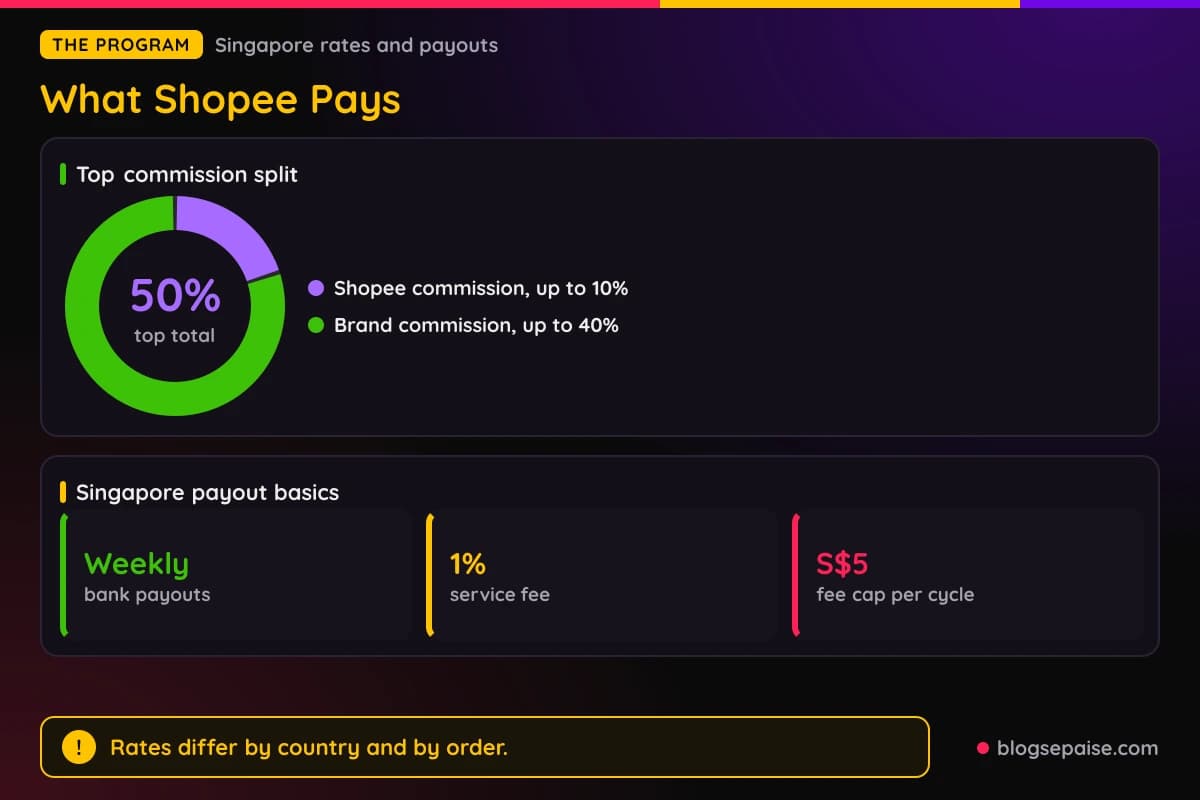
In Singapore, Shopee advertises up to 50 percent cash commission on every successful order made through your links. That figure combines two parts.
The first part is Shopee commission, which is up to 10 percent. The second part is brand commission, also called Commissions Xtra, which is up to 40 percent and is set by the seller.
Not every order reaches the top of that range. Social media orders in Singapore carry lower Shopee rates, and the brand part only applies to products that sellers put on the Xtra list.
Singapore pays commissions weekly into your bank account. Shopee also takes a service fee of 1 percent of your total commissions, capped at S$5 per payment cycle, starting 1 August 2025.
Amounts on Singapore pages are in Singapore dollars, shown as S$. Shopee does not publish a conversion rate on those pages, so we keep the local currency instead of guessing a USD figure.
The Philippines terms work from a different formula. Commission equals the commission rate times the net completed purchase value, which leaves out discounts, shipping fees, voucher fees, and rebates like Shopee Coins.
Brazil also runs a Comissão Extra program that pays a higher percentage when you promote items and stores that take part. Shopee Brazil does not publish the percentage in the blog we checked.
Many beginners expect big checks from day one. Most earn small amounts at first and grow as their posts find readers.
Think of the program as a ladder. You apply, get approved, add payment details, pick products, and then earn, and each rung depends on the one below it.
The steps below follow that ladder in order. Start at the top and do not skip ahead.
Step 1: Pick Your Market And Find The Right Portal
Shopee affiliate accounts belong to one country. You apply on the portal for the market where your readers shop and where you live.
The Singapore portal sits at affiliate.shopee.sg, and the Philippines has its own affiliate site and help center. Brazil lets you sign up on the program page, and approval comes by email.
Shopee Singapore also says that if your audience is mostly outside Singapore, you should contact the affiliate team for that market. The Singapore team only handles Singapore affiliates.
So the first question is simple. Where do your readers buy, and which Shopee site do they use?
A blogger who writes in English for readers in Manila applies in the Philippines. A creator who posts in Portuguese for Brazilian shoppers applies in Brazil.
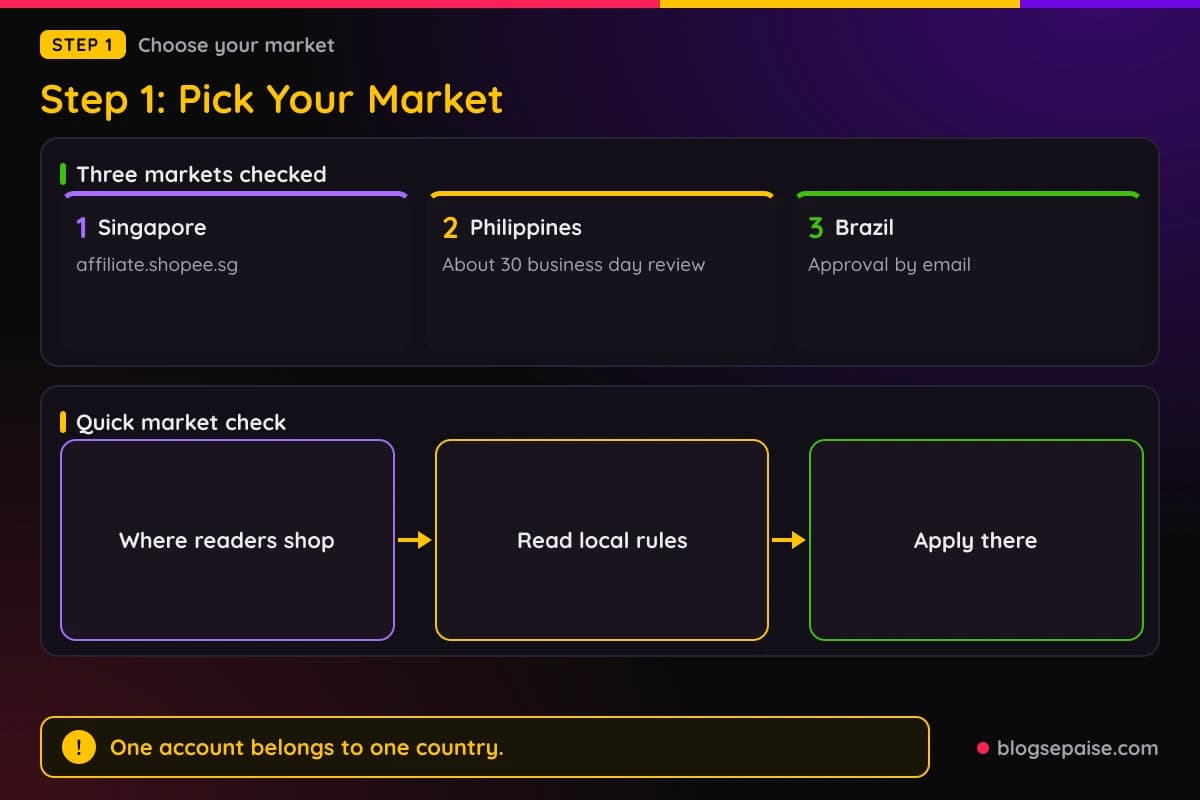
Your location can matter too. The Philippines requires applicants to be based in the country, so a creator abroad cannot apply there.
Shopee Brazil describes the program as open to anyone who wants to take part. Singapore does not list a location rule in the articles we checked.
If you are not sure, open the Shopee app, tap the Me tab, and look for the affiliate section. Singapore users see a Share And Get Cash area there once they are logged in.
Some networks also carry Shopee programs. Involve Asia lists Shopee conversion rules, for example, so you may see that name in guides.
Use the Shopee portal for your country as your main source. Third party blogs often copy old numbers and mix up countries.
Write down your target market before you move on. Every later step depends on it.
Also decide which language you will write in. Readers in each market shop in their own language, and your posts should match the storefront they land on.
Step 2: Check The Eligibility Rules For Your Country
Shopee does not use one global checklist. The rules you must meet depend on the country you pick.
The Philippines is the clearest case. Applicants must have posted at least once in the last 14 calendar days on any social media platform, and they must be based in the Philippines.
Sellers can apply too, as long as they also work as an influencer, vlogger, blogger, or TikToker and meet the same criteria.
Treat the entry rules as a floor and not a ceiling. Meeting them gets your application read, but a clean, useful channel is what makes a reviewer comfortable.

Notice what the Philippines rule leaves out. Shopee lists no follower count, no traffic number, and no engagement rate there.
Many blogs claim you need 500 or 1,000 followers. Shopee does not publish those numbers in the help center articles we checked, so treat them as guesses.
Singapore lists no eligibility criteria in its introduction to the program. It asks you to sign up for free and submit payment and tax details.
Brazil describes the program as open to everyone and mentions only registration and approval. It does not list a follower rule in the blog we checked.
That does not mean anyone gets in. Shopee says it may approve or reject applications at its sole discretion and for any reason.
Your content also has to be allowed. The Philippines terms bar applicants whose media contains prohibited content, such as illegal activity, gambling, tobacco, weapons, pornography, hate speech, or malware.
Shopee employees, interns, and affiliate staff earn no commission under the Philippines terms. Check that you do not fall into a restricted group before you apply.
If you promote on Facebook in the Philippines, use a fan page. The terms do not allow promotion from a personal page.
Put your answers in a note. For each rule, write yes or no, and fix any no before you apply.
Step 3: Prepare Your Social Accounts And Content
Shopee reviews the links you submit, so they should look like real, active channels. Start with the account you post on most.
Post something fresh right before you apply. The Philippines rule needs a post inside the last 14 calendar days, and a recent post helps in any market.
Keep your profile clear. Use a real name or brand, a short bio that says what you cover, and a profile photo.
Fill your feed with your own work. Involve Asia's Shopee rules list plagiarism as spam, so post original videos, photos, reviews, and tips.
Short videos work well on Shopee Video and social apps, because shoppers like to see a product in use. A thirty second clip that shows size, price, and one honest drawback does more than a long ad.
Pick a clear topic. A channel about budget home gadgets or skincare under a set price gives a reviewer an easy way to see which products you would promote.
Make your accounts public. The Philippines terms require your media to be publicly available as described in your application.
A blog or website can help if you have one. The Philippines form accepts your main social URL plus up to 9 other website links, for 10 links in total.
Add a few signs of life across those links. Recent posts, replies to comments, and steady uploads show a real person behind the account.
Keep the content clean. Avoid anything that falls under prohibited content, and do not run clickbait ads or lucky draws.
Think about what you will actually promote. Fashion, beauty, gadgets, home items, and baby products all sell on Shopee, but some items earn nothing.
Singapore excludes milk formula for stages I and II, the Tickets, Vouchers And Services category, and the ShopeePay Near Me category from commission. Plan your content around products that count.
Take screenshots of your profiles before you apply. They give you a record of what a reviewer saw.
Ask a friend to open each link on a phone. If the friend cannot tell what you post about within a few seconds, tighten your bio and pin your best post.
Step 4: Fill In The Application Carefully
Now you can apply. The Philippines process is spelled out step by step, and the other markets follow a similar pattern.
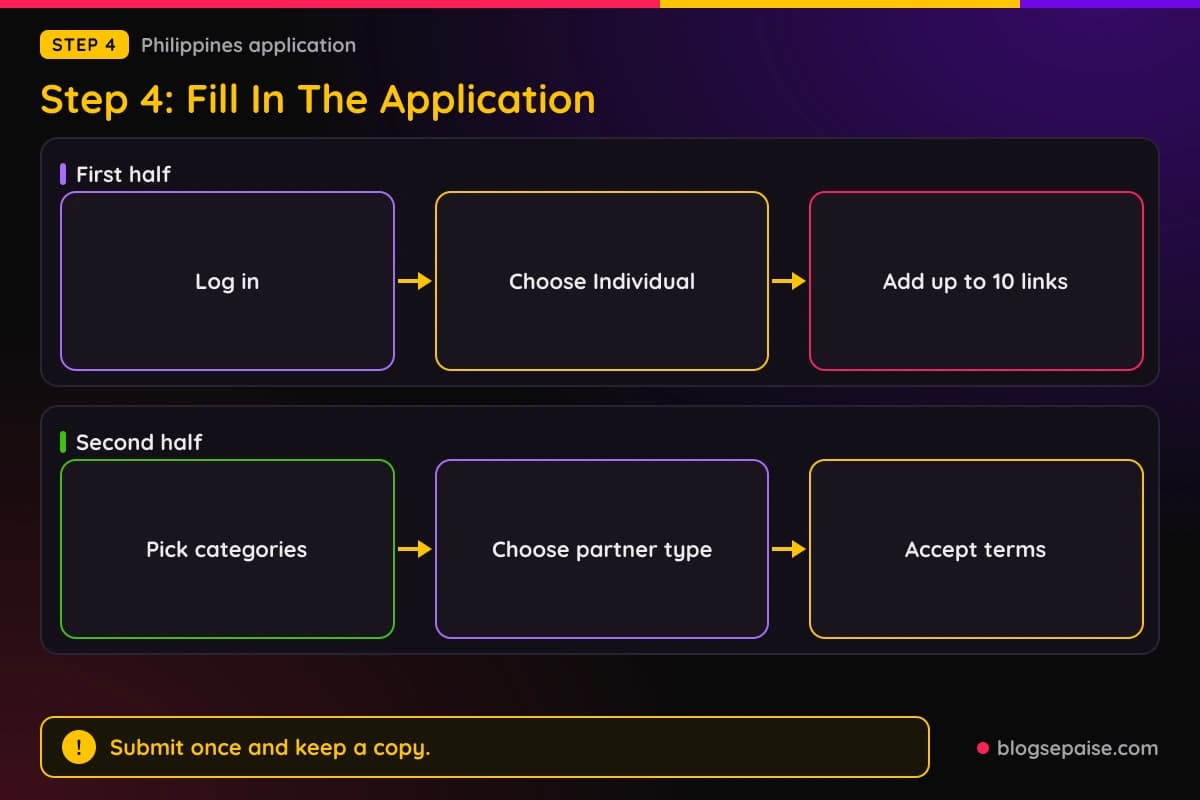
First, go to the affiliate website, choose Login, and enter your Shopee account. Then complete the required fields, choose Individual as your account type, add personal details, and verify your email.
Next, add your main social media URL and up to 9 other website links. Select one or more categories you want to promote.
Choose Blogger or Social Media as your partner type. Then tell Shopee how you heard about the program and accept the terms.
Read those terms before you tick the box. Accepting them is a real agreement, and our guide on reading affiliate program terms shows which clauses matter most.
Use accurate details everywhere. The terms allow Shopee to end your account if your registration information is false or inaccurate.
Create only one affiliate account. The Philippines help center says multiple accounts can lead to fraud tagging and the freezing of your affiliate account.
Be careful with the Shopee account you link. Singapore will not edit approved details, and moving to a new login means unlinking, creating a fresh affiliate account, and losing the earned commission on the old one.
Pick the categories that match your content. A beauty creator who ticks every category looks less focused than one who ticks two.
Read each field twice before you submit. A typo in your email address means you never see the decision.
Choose your strongest link as the main URL. That is the one a reviewer will open first.
Submit once and check your email. Shopee sends its decision there, so look in spam too.
Save a copy of your answers and a screenshot of the form. If you need to reapply, you can improve the weak spots.
Step 5: Wait For The Decision And Handle A Rejection
Review time varies. The Philippines help center says the review usually takes about 30 business days and can run longer when many people apply.
Singapore and Brazil do not publish an approval time in the articles we checked. Third party blogs quote anything from 48 hours to 30 business days, so none of those numbers is reliable.
While you wait, keep posting. A reviewer who opens your channel should find fresh content.
Do not send the same application again and again. Multiple accounts are not allowed in the Philippines and can lead to fraud tagging.
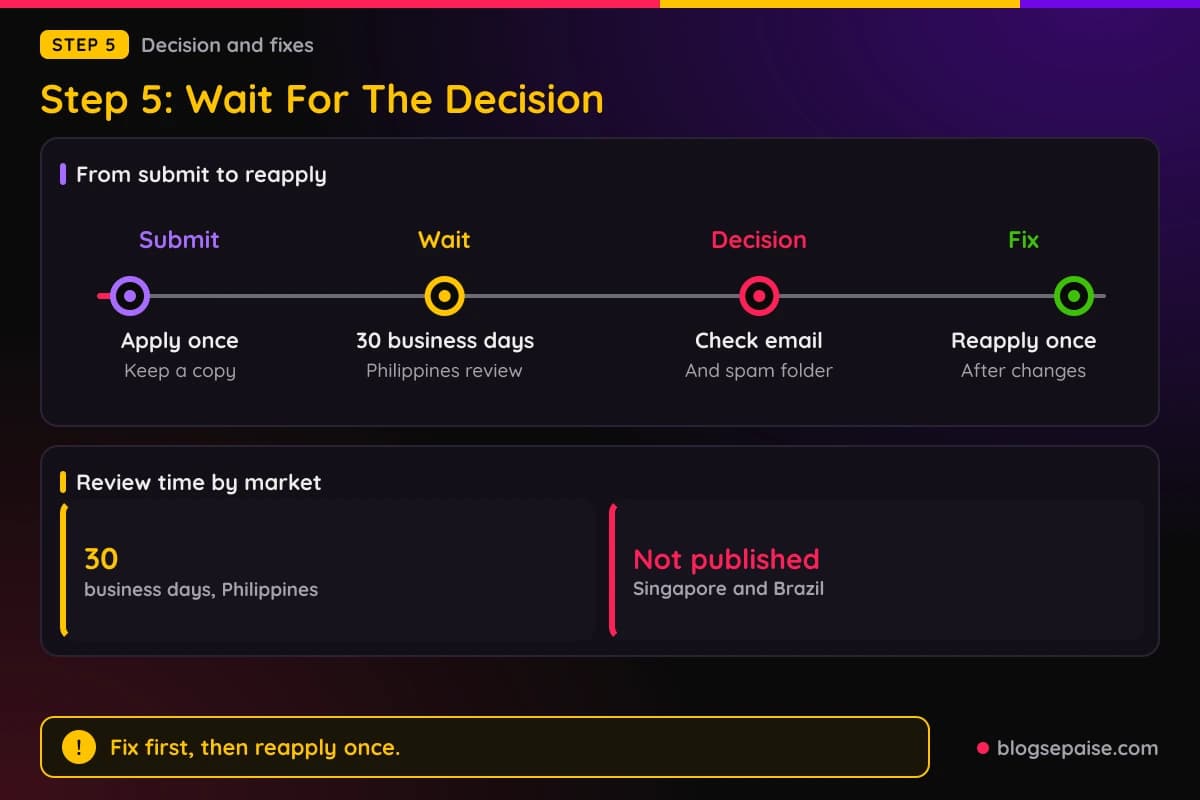
If you are rejected, Shopee's Philippines guidance says you may not have met a criterion, so review the requirements before reapplying. Shopee does not publish a detailed list of reasons.
Start with the basics. Check that you posted in the last 14 calendar days, that you live in the country, and that your links are public.
Check the age of your account too. A brand new account with a single post is harder to judge than one with a few weeks of steady activity.
Look for prohibited content next. Gambling, adult material, hate speech, and clickbait can all sink an application.
Then check that your details are true and consistent. False or inaccurate registration information is grounds for ending an account.
After you fix problems, apply again once. Our guide on affiliate network traffic requirements explains how programs think about small channels.
Shopee can reject applications for any reason, so a no says little about your worth. Many creators get in on a second try after they clean up their channels.
Do not argue with the decision in public. Stay calm, fix what you can, and keep building your audience while you wait to try again.
Keep a short log of changes and dates. It helps you see what worked and gives you facts if you contact support.
Step 6: Add Payment And Tax Details
Approval alone does not pay you. You also need payment and tax details in the affiliate platform.
Singapore asks you to submit those details as part of getting started, and its help center warns that wrong details can cause payout problems. Fill them in right after approval.
Use your legal name and a bank account in the same name. Wrong payment details are what the help center warns can cause payout problems.
The Philippines terms add a deadline. If Shopee does not receive your payment and tax information within six months of the commission date, it may forfeit that commission after written notice.
Payment also depends on documents there. Shopee pays against valid invoices or acknowledgement receipts, and withholding tax is covered by BIR Form 2307.
Timing differs by country. Singapore pays weekly into your bank account, while the Philippines terms add fees to your balance monthly and pay within 90 days of system approval.
Cross-border payouts in the Philippines need an account balance of at least $500 USD. Lower balances wait until the minimum is reached.
Brazil's blog does not describe payout timing, methods, or a minimum withdrawal. Shopee Singapore does not publish a minimum payout either.
Third party sites quote payout minimums like R$50 or $50. Those come from blogs, not from Shopee, so do not plan around them.
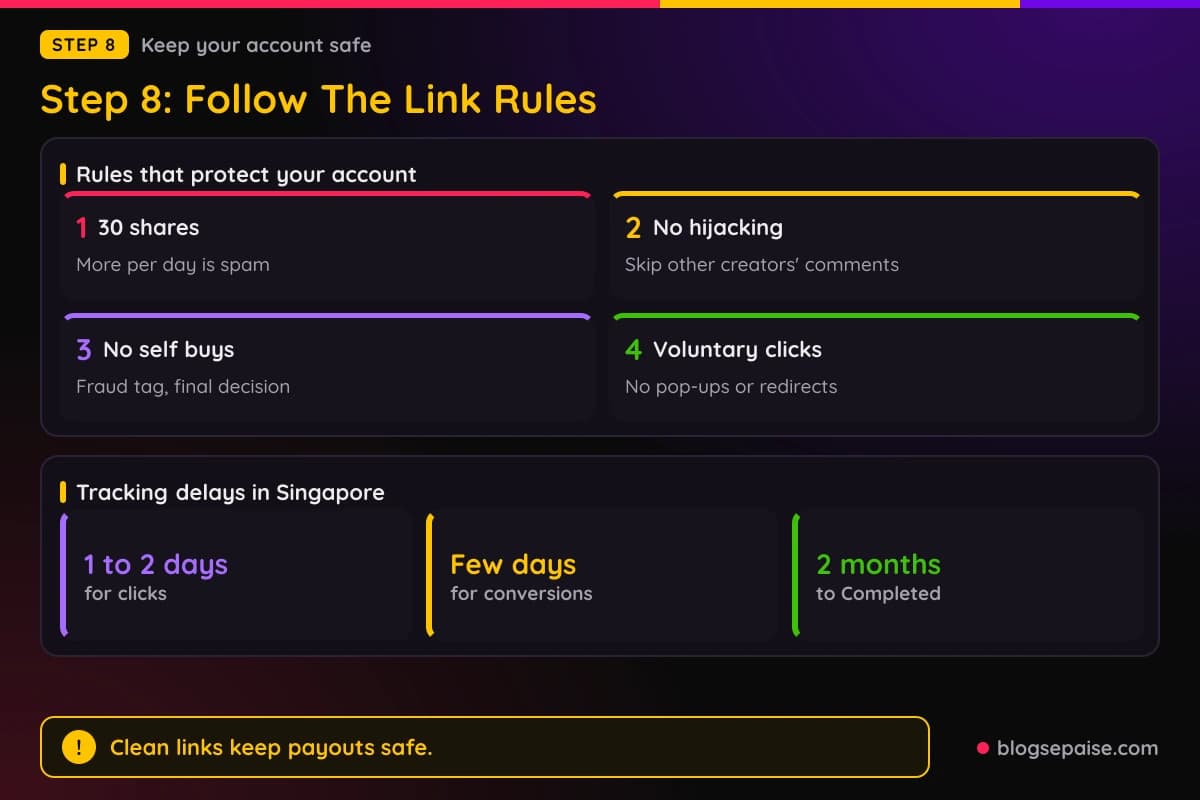
Singapore also notes that orders show as Completed only after validation, which usually takes 2 months. Expect a delay between a sale and the money.
Learn about tax too, since a local tax adviser can explain how your commissions count as income. Readers need to know about your links as well, and our guide to legal disclosures covers that.
Check your payment page every few weeks. Fix any warnings right away so one small error does not hold up all your earnings.
Keep your own records too. Save payment statements and note the date of each payout, because they help if you ever need to question an amount.
Step 7: Learn The Commission Structure Before You Promote
After approval, spend an hour on the rates. Singapore publishes the clearest table, effective 2 January 2026.
Shopee commission has a different rate for each source and tier. Social media orders that are direct Xtra orders pay 7 percent for Top KOL and 6 percent for KOL and KOC.
The standard Affiliate tier gets 5 percent on those direct Xtra orders. Each rate is capped at S$5 per order.
Social media orders that are not Xtra pay less. Top KOL gets up to 4 percent, KOL and KOC get 3 percent, and Affiliate gets 2 percent, again capped at S$5 per order.
Shopee Live direct Xtra orders pay 10 percent, capped at S$5 per order. Shopee Video direct Xtra orders pay 5 percent, also capped at S$5.
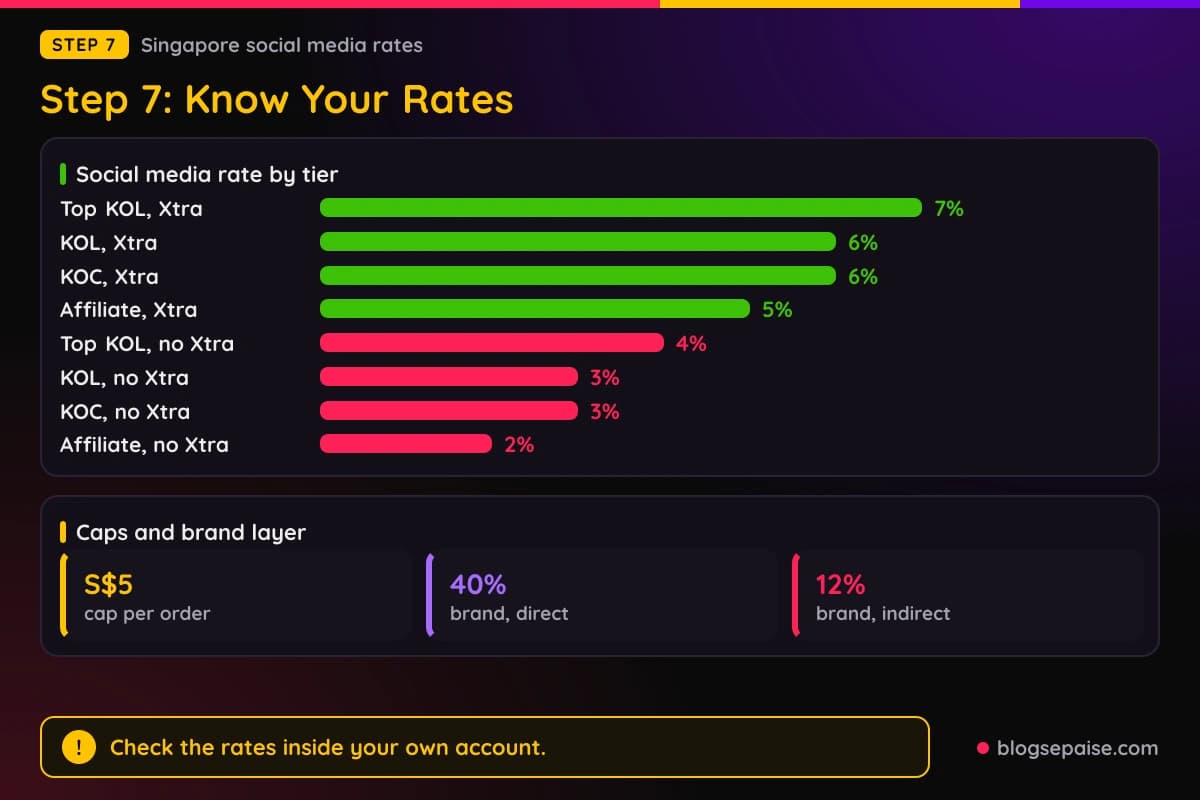
Brand commission is a separate layer. Direct Xtra orders pay up to 40 percent with no cap, while indirect Xtra orders pay up to 12 percent, which is 30 percent of the Xtra rate the seller sets.
A direct order means the shopper buys from the same shop as your link. An indirect order means the shopper clicks your link but buys from a different shop.
Tier names are Top KOL, KOL, KOC, and Affiliate. Singapore lists the names but not the rule for moving up, so a new creator should plan on the Affiliate tier.
Link type matters too. Singapore's help center says short links can earn stacked Shopee and Xtra commissions, while long links earn the Shopee base commission only.
Home page and category links do not earn the extra commission. Promote specific products that sit on the Xtra list.
Singapore also describes Xtra protection that lasts up to 7 days if a seller lowers a rate after your content goes live. Commission uses the rates in effect when the shopper placed the order.
Shopee does not publish a cookie length or attribution window in the Singapore articles we checked. Do not repeat a number from a blog as if it were official.
Ask yourself which products match your readers and which carry Xtra. A 5 percent rate on a S$40 order beats a 2 percent rate on a S$60 order.
Brazil and the Philippines do not publish rate tables in the sources we checked, so open the platform after approval to see your own rates.
Step 8: Build Links And Content The Way Shopee Allows
Generate your links inside the affiliate platform. You can create as many product links as you like, and a custom link tool covers other pages.
Use the sub ID field to tag each link by platform or post. Singapore reports show clicks and conversions by sub ID, which tells you where sales come from.
Check ownership on short links. Expand the link and confirm the code after utm_source=an matches your affiliate ID.
Follow the content rules in the terms. Shopee bans links on torrent or streaming sites and on prohibited content.
Do not link to other e-commerce platforms in the content that carries your Shopee links. The Philippines terms forbid it.
Do not spam. Involve Asia lists more than 30 shares per day in social media, chat groups, or community groups as spam.
Do not drop links in the comments of other creators, Shopee brands, or sellers. Involve Asia treats that as hijacking traffic.
Never buy through your own link. Purchases for yourself or your household are not allowed, and Singapore says such orders can be tagged as fraud and cancelled.
Fraud decisions are final in Singapore, and the team cannot overwrite them. A single self-purchase is not worth that risk.
Do not use pop-ups, auto-redirects, or forced installs. The Philippines terms allow cookies only when the shopper sees the link and clicks it on purpose.
Keep email honest. Unsolicited ad emails need written consent, and nothing should look like it came from Shopee Official.
Add a plain disclosure near your links. Our affiliate disclosure generator can draft one in a minute.
Use paid search with care. In the Philippines, brand keywords in paid search need Shopee added as a negative keyword.
Test every link on a phone before you post it. Click it yourself, confirm it opens the right product, and do not place an order through it.
Missing data is normal at first. Singapore says clicks can take 1 to 2 days to show, and missing conversions can take a few days.
Do not expect Shopee to track down a missing order for you. The Singapore FAQ says the team cannot investigate missing orders.
Review your numbers every week. Note which posts bring clicks, which bring completed orders, and which products carry the best rate.
Give each post a few weeks before you judge it. New content takes time to find readers, and early numbers are small for almost everyone.
Update old posts when prices or products change. A fresh post keeps your links accurate and keeps shoppers happy.
A Worked Example: Dina Applies As A Singapore Blogger
Dina runs a small blog about desk setups for people in Singapore. The numbers in this example are made up for teaching, and the rates come from the Singapore table above.
She has 20 posts, an Instagram account with weekly photos, and an about page. She creates her affiliate account, adds her details, and submits payment and tax information.
After approval she lands in the Affiliate tier. That means social media orders pay 5 percent on direct Xtra orders and 2 percent on orders without Xtra, each capped at S$5 per order.
She writes two posts. The first features a desk lamp with an Xtra offer, and the second features a cable organizer without Xtra.
In one week, each post sends 30 completed orders. Both items sell for about S$40.
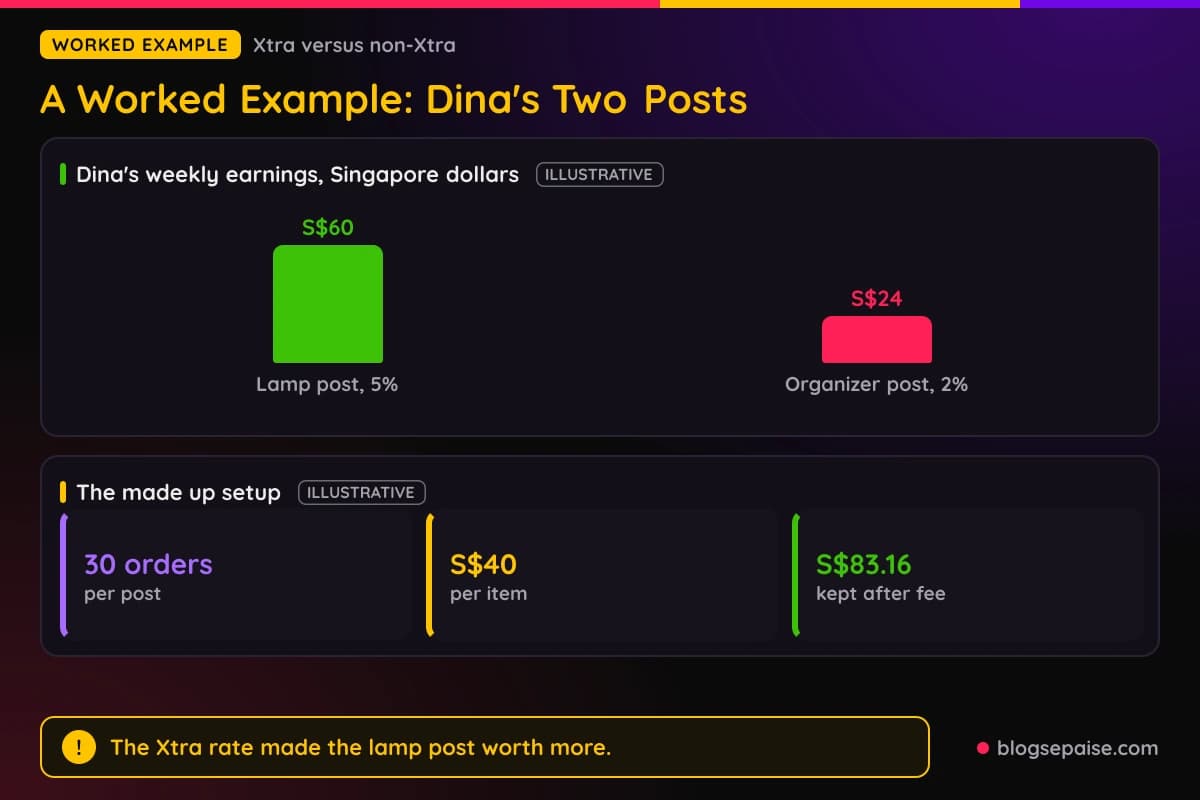
On the lamp post, 5 percent of S$40 is S$2 per order. Thirty orders earn her S$60.
On the organizer post, 2 percent of S$40 is S$0.80 per order. Thirty orders earn her S$24.
Her total is S$84 for the week. Shopee takes a 1 percent service fee, which is S$0.84, so she keeps S$83.16.
If an order goes over the cap, the cap wins. A S$400 order at 5 percent would be S$20, but Singapore caps social media orders at S$5, so Dina keeps S$5.
Both pages had the same traffic and the same order value. The Xtra rate made the lamp post worth two and a half times as much.
Dina learns to check the Xtra list before she writes. She also uses short links, since long links earn only the base rate.
She tags each link with a sub ID, so her report shows which post sells. Her next piece is a desk mat roundup built around Xtra products.
Remember that orders show as Completed only after validation, which usually takes 2 months. Her S$83.16 is a rough weekly figure and not cash in hand on day seven.
The whole journey took her a few weeks, mostly spent preparing her blog and channels. The application itself took under half an hour.
None of these numbers are a promise. Real earnings depend on traffic, trust, product choice, and the rates in your own account.
Common Mistakes When Applying To The Shopee Affiliate Program
The first mistake is applying on the wrong country portal. A Philippines application from outside the country fails the location rule.
Another is posting nothing for weeks. The Philippines rule needs a post in the last 14 calendar days, so a stale account can miss it.
Many people trust follower minimums from blogs. Shopee publishes none in the articles we checked, so a small channel can still apply.
Some creators use fake or inflated details. False registration information is grounds for ending an account.
Opening a second account after a rejection is a trap. Multiple accounts lead to fraud tagging and a frozen affiliate account.
Applicants also forget payment and tax details. The Philippines terms allow Shopee to forfeit commission if those details are missing after six months.
Others ignore the content rules. Prohibited content, clickbait, lucky draws, and links to other marketplaces can lead to chargebacks or termination.
Buying through your own link is the classic slip. Shopee flags personal and household purchases as fraud, and the decision is final.
Link spamming is another. More than 30 shares per day counts as spam on Involve Asia's list.
Using long links or home page links for Xtra products wastes the bonus. Short links to specific Xtra products are the ones that can stack.
A few creators also forget that rates change. Singapore lists its table as effective 2 January 2026, so recheck your account before you plan a big post.
Some people expect fast money. Orders show as Completed after about 2 months in Singapore, and payouts follow that.
Finally, many skip the disclosure. A plain line near your links protects your readers, your account, and your reputation.
Avoid these twelve and you are ahead of most applicants. Each fix costs time and not money.
Final Thoughts
Getting approved for the Shopee affiliate program comes down to applying in the right country with a real, active, public channel. The eight steps give you a clear order to follow.
Pick your market, check the local rules, prepare your accounts, and apply once with honest details. Then add payment and tax information and learn your rates.
Shopee leaves some numbers unpublished. Follower minimums, cookie length, and several payout terms are not in the help center articles we read, so ask your local team or check your account.
Start today with Step 1 and write down your target country. Then post something fresh and fix the weakest part of your channel before you apply.
A careful application beats a rushed one. Give it a good week of prep and you will be in far better shape.
Frequently Asked Questions
1. Where do I apply for the Shopee affiliate program?
You apply on the Shopee affiliate portal for your country, such as affiliate.shopee.sg for Singapore. The Philippines and Brazil have their own sign-up pages.
2. Is the Shopee affiliate program free to join?
Yes. Singapore says to sign up for free, and Brazil describes the program as open to anyone who wants to take part.
3. How many followers do I need?
Shopee does not publish a follower minimum in the help center articles we checked. The Philippines rule asks for at least one social post in the last 14 calendar days instead.
4. Which countries does this guide cover?
Singapore, the Philippines, and Brazil, because Shopee published rules for them. Other markets such as Malaysia, Thailand, Indonesia, Vietnam, and Taiwan have their own pages that you should read before you apply.
5. How long does approval take?
The Philippines help center says about 30 business days, and longer when applications pile up. Singapore and Brazil do not publish a time.
6. Why was my application rejected?
Shopee does not publish a full list of reasons. In the Philippines you may have missed a criterion, such as the 14 day post rule or the location rule, so review the requirements before you reapply.
7. Can I reapply after a rejection?
The Philippines help center tells you to review the requirements before reapplying. Fix the weak points first and send one new application, because multiple accounts are not allowed.
8. How much does Shopee pay?
In Singapore, rates run up to 10 percent from Shopee plus up to 40 percent from brands, for a total of up to 50 percent. Social media orders pay between 2 and 7 percent depending on tier and Xtra status, capped at S$5 per order.
9. When do I get paid?
Singapore pays weekly into your bank account after a 1 percent service fee capped at S$5 per cycle. The Philippines terms pay within 90 days of system approval, and Brazil does not publish payout timing.
10. Can I buy through my own link?
No. Shopee discourages personal and household purchases through your links and can tag such orders as fraud, and fraud decisions are final.
11. Does Shopee publish a cookie length?
Not in the Singapore articles we checked. Do not trust a number from a blog as official.
12. Do I need a website?
Not in the Philippines, where you add your main social URL and up to 9 other links. A blog can still strengthen your case.