Where To Learn Affiliate Marketing: Free And Paid Options
Affiliate marketing has plenty of teachers, and the prices run from nothing to hundreds of dollars. The hard part is knowing which sources are free, which cost money, and what each one says about refunds.
It covers training from Impact, Awin, PartnerStack, and Amazon, free courses from Ahrefs and HubSpot, and guides from Google and the FTC.
It also lists paid options, including Coursera and Wealthy Affiliate, with the prices and refund terms those providers state. Rules and prices change, so check the provider before you pay.
If you want a free plan to follow first, our page on free affiliate marketing training is a good place to start.
Disclosure: Some of the links I share might be affiliate links. If you click on one and make a purchase, I may earn a small commission as a thank you. But don’t worry, it won’t cost you anything extra. I only recommend stuff I genuinely believe in. Your support helps me keep creating awesome content. You can read my full affiliate disclosure in my disclaimer page.
If you want to save a lot of hours searching for high-paying affiliate programs, check out our exclusive list of 2500+ affiliate programs. You’ll find all the information about the programs inside the list. This list is perfect for affiliate bloggers and influencers.
Step 1: Start With Free Training From The Networks
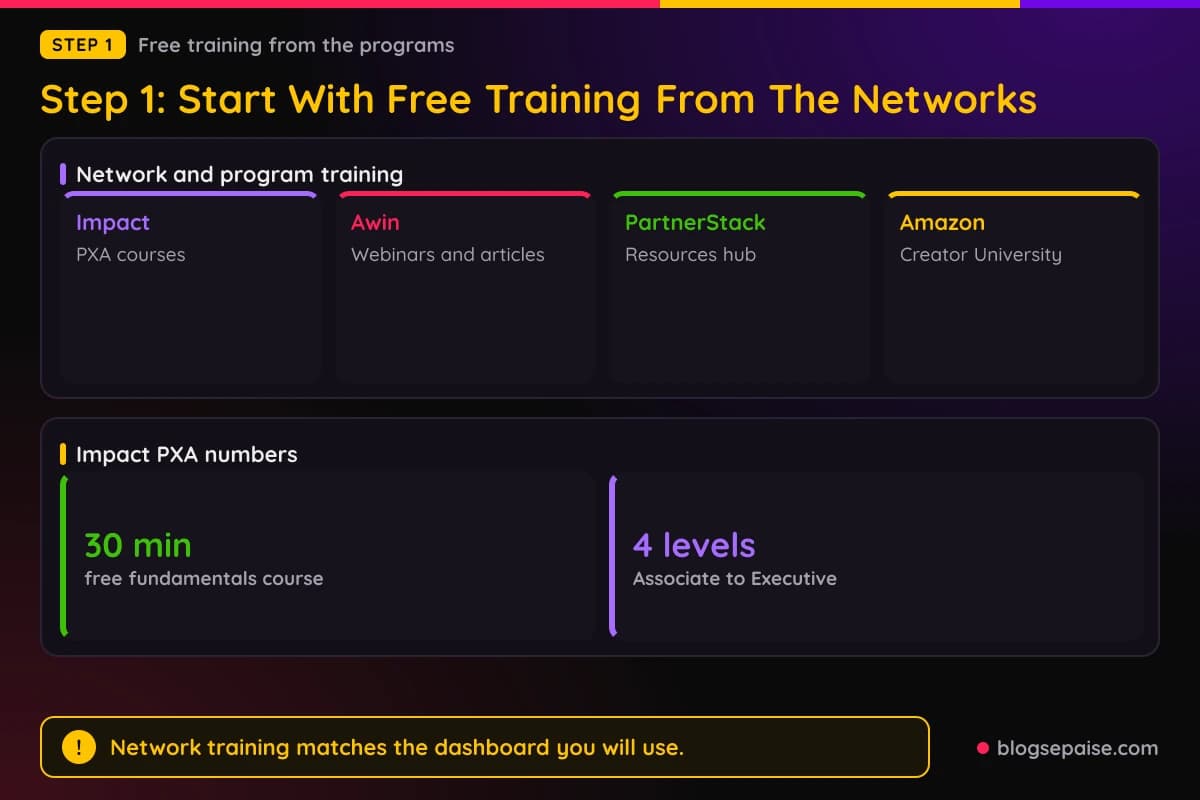
Most affiliate networks and programs teach their own publishers for free. That makes them the cheapest place to begin, and the lessons match the dashboards you will actually use.
Impact runs the Partnerships Experience Academy, called PXA. Impact offers free partnerships and affiliate marketing training and names the Introduction to Influencer Partnerships course as free.
PXA groups its material into 4 levels. The levels are Associate, Fundamentals, Expert, and Executive.
Under Fundamentals, Impact lists an Affiliate and Partnerships Industry Fundamentals Certification Path. It also lists a free course called Digital Partnerships Industry Training for Partners: Fundamentals.
That course runs about 30 minutes in total. The six lessons are Introduction at 1 minute, Being a Publisher that Gets Noticed at 10, Converting Users and the Consumer Journey at 7, How to Work with Brands at 2, How to Use a Technology Platform to Make Money at 8, and Setting Yourself Up for Success at 2.
Impact says the course suits affiliate marketers new to the industry who want to build skills. It also lists people interested in low-cost digital marketing channels as part of the audience.
Its stated goals include setting up as an affiliate partner, comparing payment types and attribution models, and mapping the consumer journey through a conversion funnel. Each lesson links to an enrollment page with a Get certified button.
The Expert level adds a publisher-focused product training path. Impact aims it at content creators, publications, coupon sites, loyalty publishers, and others who promote brands to their audiences.
Impact also keeps a Resource Center that it describes as a free library of templates, worksheets, and blog posts. It has separate sections for brands, agencies, publishers, and creators.
A partner basics collection features an ebook called Mastering Your impact.com Account as a Partner and a short lesson on viewing program terms as a partner. It also has a getting-started checklist for publishers.
Awin publishes training for new publishers too. Its newsroom lists two webinars, Getting Started on Awin and Getting started on Awin reports, plus eight written articles in a new publisher interface training series.
The articles cover completing your publisher profile, payment details, building links and finding creative, additional promotional tools, the payment process, and basic, advanced, and payment reporting.
Awin says it offers nine different reports to help publishers see their performance, and it pays publishers only on validated transactions. The listed items are dated February 12, 2019, and Awin states no cost there, so check Awin for newer material before you rely on the screens.
If you plan to join Awin, you can sign up through the Awin network once you have a site ready.
PartnerStack takes a different route. Its resources hub lists articles, guides, short plays from partnership leaders, podcasts, a research lab, customer stories, and a glossary, but it describes no formal courses.
Amazon offers Creator University. Amazon Associates Central lists it in the main navigation menu next to Home, Tools, Commission Income Statement, Reports, and Help.
Small Business Trends reported on February 9, 2023, that Amazon launched Creator University as a free resource for people who want to earn with Amazon. It described video tutorials, success stories from other creators, and tips on sharing affiliate links on Instagram Stories, blogs, and YouTube descriptions.
Amazon's own announcement for the India store, dated June 3, 2024, describes video tutorials, articles, and interactive workshops. Its topics include choosing products to recommend, producing engaging content, driving traffic, and building an audience, and it does not state a price.
Free network training has one limit. Impact teaches Impact, and Awin teaches Awin, so the lessons fit those platforms first.
Our guide on how to get approved for affiliate programs shows what to prepare before you apply.
Step 2: Take A Free Affiliate Course From A Tool Maker
Software companies publish free courses to teach their field. Three are worth checking for affiliate marketers, and each one is free to start.
Ahrefs Academy calls itself a place to get better at digital marketing with free video courses. Its Affiliate Marketing Course for Beginners has 16 lessons across 5 modules and runs 1 hour 49 minutes.
Sam Oh, the VP of Marketing at Ahrefs, teaches it. Ahrefs says it needs no sign-up and is absolutely free of charge.
Ahrefs states the audience as people who want side income, marketers diversifying revenue, and hobbyists who want to share knowledge online for income. The stated goal is steady affiliate income without hype about passive income.
Module 1 covers the basics and has four lessons. They are What is Affiliate Marketing and How Does it Work at 1:46, What You Need to Get Started at 2:33, How to Make Money with Affiliate Marketing at 1:56, and a blueprint for starting your website at 4:17.
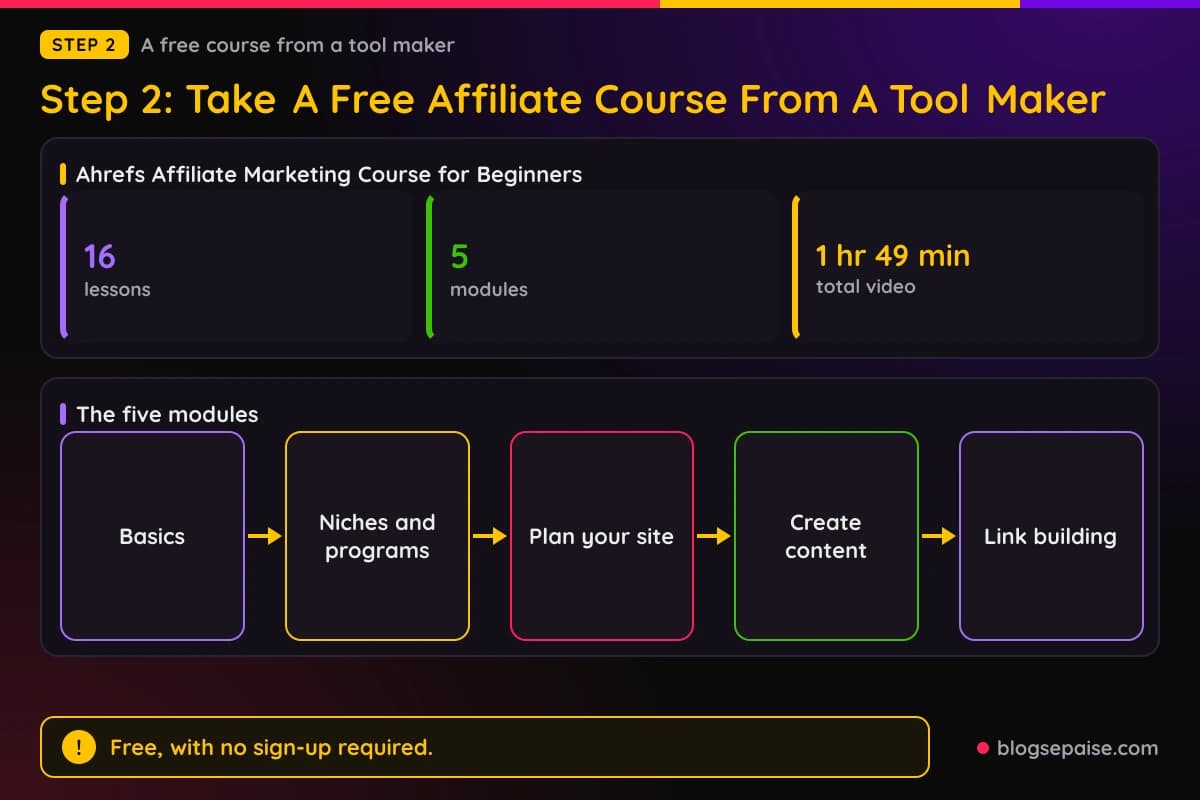
Module 2 is about niches and programs. Its three lessons are Keys to Choosing the Right Affiliate Marketing Niche at 6:00, How to Find the Perfect Niche for an Affiliate Marketing Site at 12:03, and Best Affiliate Marketing Programs for Any Niche at 10:21.
Module 3 covers planning the site. It has lessons on designing a strategy, keyword research at 10:22, content strategy at 10:15, and planning your homepage and navigation at 6:29.
Module 4 is about creating content. It teaches the affiliate content ratio between informational and commercial content, blog post templates, and how to write informational content for an affiliate site.
Module 5 covers link building in two lessons. They are an easy link building strategy at 4:25 and proven tactics for beginners at 8:33.
Ahrefs sells SEO software, so its courses come from a software company. The Ahrefs Academy also lists other free courses, including Blogging for Business with 40 lessons in 4 hours 56 minutes and SEO Course for Beginners with 14 lessons in 2 hours.
The SEO course covers keyword research, on-page SEO, and link building basics. The Blogging for Business course covers growing a blog past 100,000 visitors and turning readers into customers.
Great Learning lists a free Affiliate Marketing course of about 1.5 learning hours. You can enroll and access the course content for free.
A certificate costs a non-refundable fee, and the fee amount is not listed on the course page. Great Learning states that the certificate is a certificate of completion rather than a professional certification.
The skills listed for the course include affiliate marketing fundamentals, partnership management, campaign planning, traffic generation, commission models, and performance tracking. The visible outline shows one module called An Overview of Affiliate Marketing.
HubSpot Academy is the third option. Its courses page describes the Academy as completely free and online, and it says creating an account is 100% free.
HubSpot's catalog showed 1,184 results. Among the 12 courses it displayed were Developing a Social Media Strategy, a lesson of about an hour, and a Social Media Marketing certification of 5 hours.
HubSpot does not state certification fees on its courses page. None of the 12 visible courses covered SEO, content marketing, or email marketing, so search the catalog for those topics.
Semrush Academy also leads with free marketing courses. Semrush lists no course on affiliate marketing there, and it lists instructors such as Brian Dean, who has 5 courses, and Chima Mmeje, who focuses on topic clusters for SaaS companies.
Semrush says it is moving the Academy to a new platform on December 16. Unfinished progress resets after December 15, and My Certificates will not show previous certificates, though direct certificate links stay active.
Our own page on free step by step affiliate marketing training gives a plan you can follow beside these courses.
Step 3: Learn Search Basics From Google
Many affiliate sites depend on search traffic, so Google's own beginner material is a smart stop. Google Search Central publishes an SEO Starter Guide, and it is free to read.
Google describes it as an introduction to how search engines crawl, index, and understand a site. It also says no single tactic will automatically rank a site first.
The guide is written for website owners and creators, and it uses examples for business sites and recipe blogs. It mentions hiring a professional for readers who are short on time.
Its sections follow a clear order. They are how Google Search works, how long until you see impact, helping Google find your content, organizing your site, and making your site interesting and useful.
Later sections cover how your site looks in Google Search, adding images and optimizing them, optimizing videos, and promoting your website. A section on things Google believes you should not focus on closes the guide.
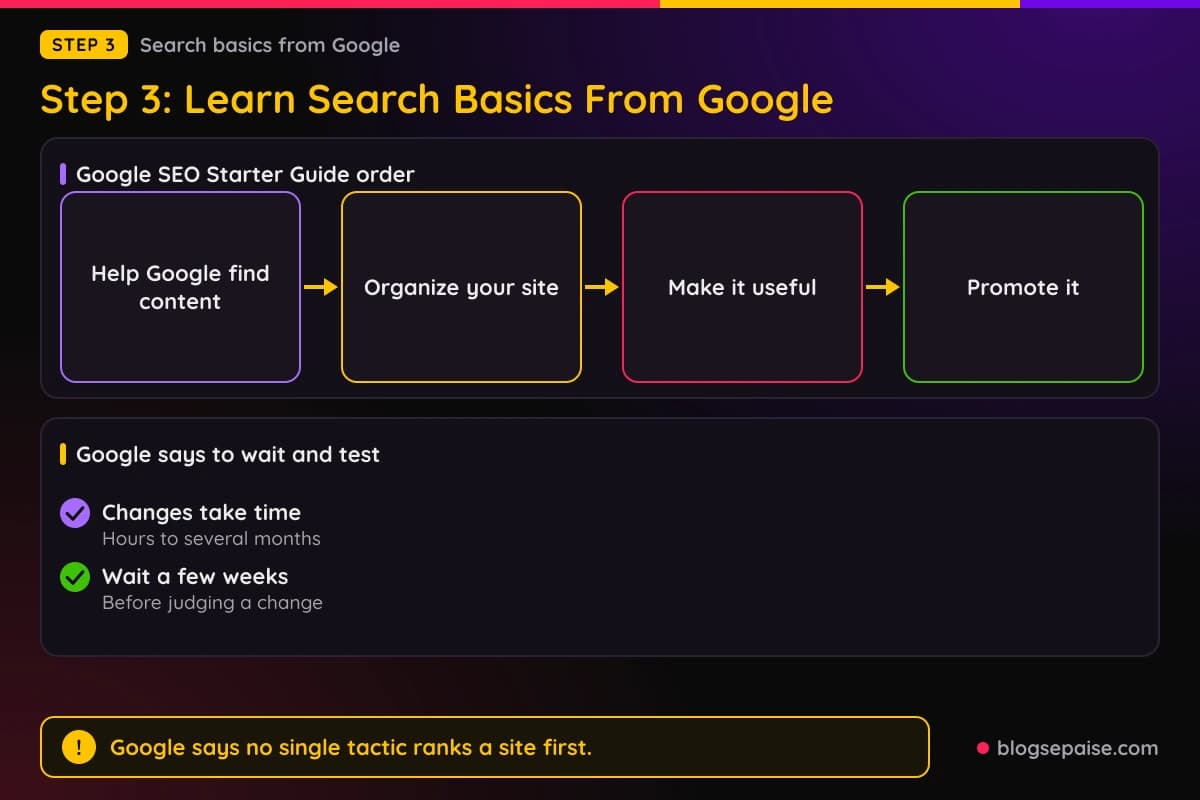
On timing, the guide says every change you make will take some time to be reflected on Google's end. Changes can show up within hours or take several months, and the guide suggests waiting a few weeks before judging if a change helped.
The guide tells you to think about the words a user might search for to find your content. People familiar with a topic may use different terms than beginners, so anticipating both can help your pages.
It adds that you do not need to cover every variation, because Google's language matching can connect a site to many related queries.
Promotion gets a warning. Google says that effectively promoting your content will lead to faster discovery, but you can overdo it and actually harm your site.
Google lists social media, community engagement, advertising, and word of mouth as options. It calls word of mouth among the most effective and lasting methods.
The section on things not to focus on busts several habits. Google says the meta keywords tag is ignored, keyword stuffing is against its spam policies, and heading order is not a ranking factor.
Google also says content length and the choice between a subdomain and a subdirectory matter little for rankings. Duplicate content is not penalized unless it is copied from others.
Google Skillshop is the other Google resource. Google describes it as a training platform where you can grow your skills on Google's products and solutions.
Its support page says signing up gives you access to the online courses at no cost, and you can finish them on your own schedule. The Skillshop home page lists Google Ads courses for Search, Display, Measurement, Video, Shopping, and Apps, along with Google Analytics.
The support page says content splits across two sites. Google Ads and Google Analytics sit on one, and Other Topics such as YouTube and Waze sit on the other.
Our guide on how to choose a profitable niche pairs well with the keyword lessons above.
Step 4: Learn The Disclosure Rules From The FTC
Every affiliate needs to know the disclosure rules before the first link goes live. The Federal Trade Commission publishes free guidance, and it is short and plain.
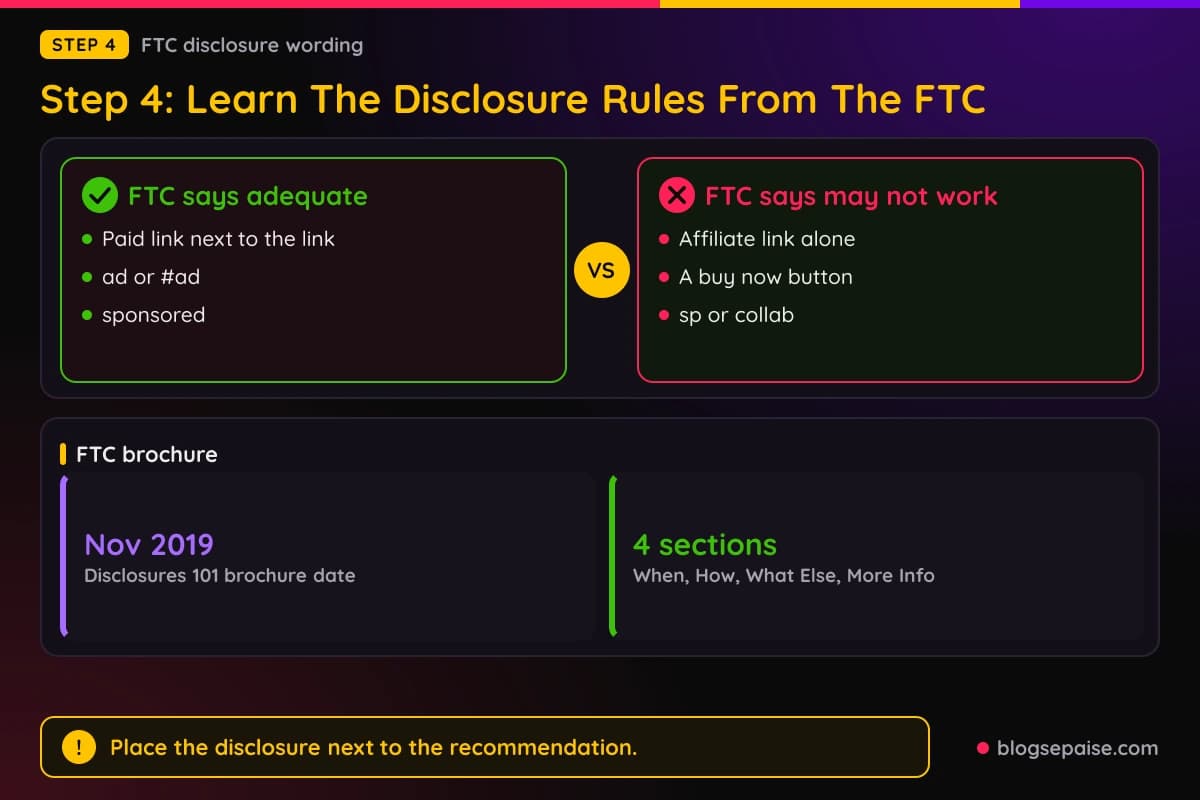
Disclosures 101 for Social Media Influencers is an FTC staff brochure dated November 2019. It has four sections called When to Disclose, How to Disclose, What Else to Know, and For More Information.
The FTC says to disclose when you have any financial, employment, personal, or family relationship with a brand. It says to make disclosures even if you think your evaluations are unbiased.
A material connection includes a brand paying you or giving you free or discounted products. The brochure also says to disclose if you received anything of value for mentioning a product.
On placement, the FTC says to place the disclosure so it is hard to miss. It should sit with the endorsement itself, not on a profile page, at the end of a post, behind a MORE link, or buried in hashtags or links.
The brochure says to superimpose the disclosure in images. For videos, it should be in the video itself and and not just in the description, and in live streams it should be repeated periodically.
It recommends simple, clear wording such as ad, advertisement, sponsored, and #ad. It names vague terms to avoid, including sp, spon, collab, and a stand-alone thanks or ambassador.
The FTC says to write the disclosure in the same language as the endorsement. Platform disclosure tools can be used, but they should not replace your own disclosure.
The brochure also warns against endorsing a product you have not tried. It says not to call a product terrific if you think it is terrible.
The FTC's endorsement guides Q and A speaks to affiliate links directly. It says you should disclose your relationship to the retailer clearly and conspicuously on your site.
The suggested wording is something like, I get commissions for purchases made through links in this post. The FTC says the closer the disclosure sits to the recommendation, the better.
It also says a single disclosure may not be enough if the review and the link are separated. The term affiliate link may not tell consumers that you are paid, and a buy now button is not an adequate disclosure.
Commissionable link is probably not clear, in the FTC's view. Paid link placed right next to an affiliate link is considered adequate.
For YouTube, the FTC says to disclose affiliate relationships both in the video and in the description near the links. The same Q and A says links included only as a convenience, with no payment, do not need a connection disclosure.
Our affiliate disclosure generator can help you draft wording, and the FTC pages above show what it should say.
Step 5: Look At Paid Options And What They Cost
Paid learning costs money, so check the price before you commit. The numbers below come from each provider's own pages unless a line says otherwise.
Coursera sells a Google Digital Marketing and E-commerce Professional Certificate. Coursera lists eight courses, from Foundations of Digital Marketing and E-commerce at 13 hours to Accelerate Your Job Search with AI at 6 hours.
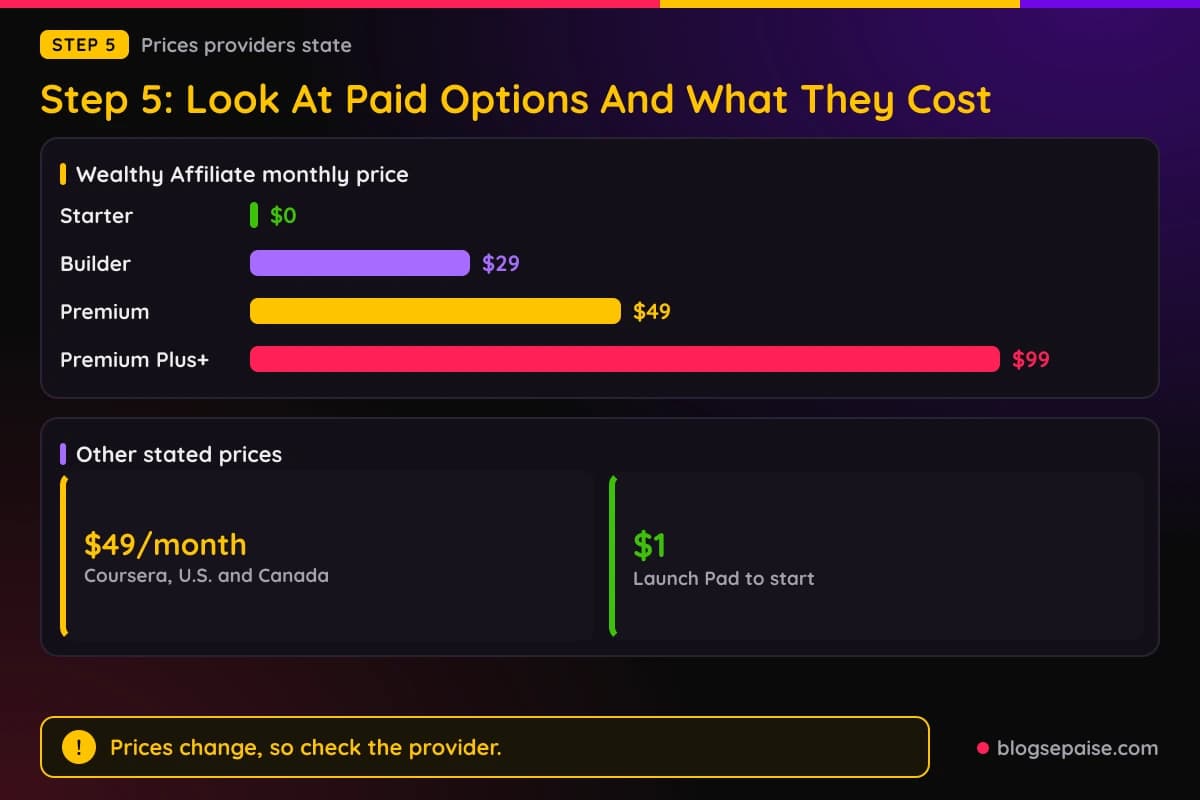
Coursera says the certificate can be completed in less than 6 months at under 10 hours per week. In the U.S. and Canada, it charges $49 per month after a 7-day free trial.
Coursera estimates that most learners pay less than $300 USD for the certificate. It also states that graduates can earn an ACE recommendation of up to 9 college credits.
Coursera Plus is the other route. Coursera describes unlimited access to 10,000+ online courses, with a 7-day free trial, and lists a 14-day money-back guarantee on the annual plan.
Coursera's catalog search for affiliate marketing returns titles such as Affiliate Marketing For Passive Income from Alex Genadinik, and an Affiliate Marketing Course from Simplilearn. Coursera says you can preview the first module of many courses at no cost.
Wealthy Affiliate is a membership with four tiers. The Starter tier costs $0, needs no credit card, and gives 4,000 starter credits and 1 practice site.
Builder costs $29 a month or $290 a year, and Premium costs $49 a month or $490 a year. Premium Plus+ costs $99 a month or $990 a year.
Builder includes 1 website, Premium includes 3, and Premium Plus+ includes 5. Extra websites cost $9 a month each on any paid tier, according to its pricing page.
Wealthy Affiliate says yearly plans give two months free, and every tier includes all Agents, all channels, and Ace. It says Starter includes your first Hub, 2 email accounts per site, and community access.
Wealthy Affiliate also says results vary and that it makes no income promises. Its credits system limits the output you get each month, such as about 25 articles a month on Builder.
Digistore24 describes a paid community called Launch Pad. Its blog says it costs $1 to start and offers a beginner affiliate system, weekly live coaching calls, and a private community.
The post was written by Digistore24's Director of Digital Strategy and Growth, and it says Launch Pad was created in partnership with Digistore24. Read it as a company describing its own partner product.
Udemy hosts paid affiliate marketing courses from individual instructors. Check current Udemy and Skillshare prices on their sites.
Step 6: Check Refund Terms Before You Pay
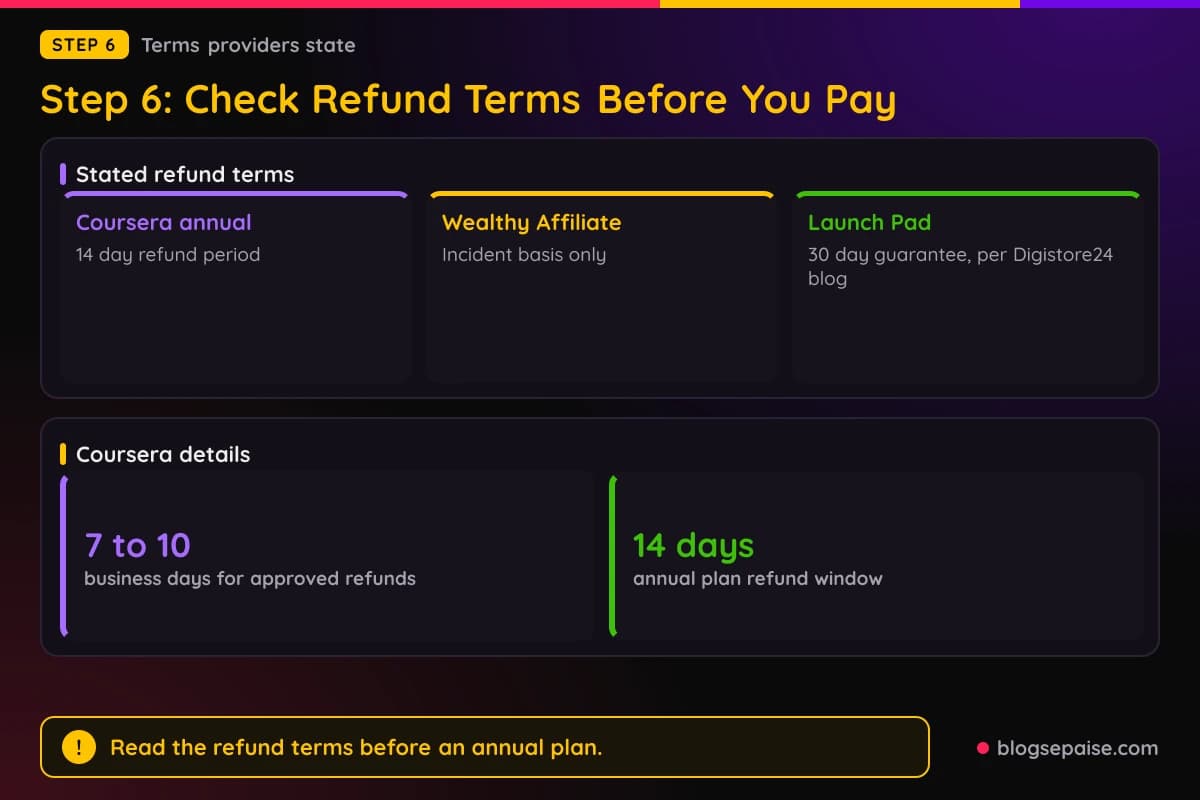
A refund policy decides how much risk you take. Coursera, Wealthy Affiliate, and Digistore24 each state different terms.
Coursera's terms say Coursera Plus Annual has a 14-day refund period. You must cancel within that window to receive a refund.
The terms add that renewal charges on annual plans are not refundable. For monthly plans, the terms list no refund window, and you must cancel before a free trial ends to avoid being charged.
Coursera also says cancelling does not automatically issue a refund. Cancellation stops future billing at the end of the current billing period, and a refund must be requested separately.
The terms say Coursera may deny a refund request when a significant portion of content has been accessed, requests repeat, or chargebacks have occurred. Approved refunds take 7 to 10 business days to appear.
For people in the EU and UK, Coursera says a 14-day statutory withdrawal right may apply from the start of the contract. Any free trial counts toward that period.
Wealthy Affiliate's pricing page says refunds are available only on an incident basis. It defines that as when something has gone wrong with your account or billing.
Wealthy Affiliate says a business not working out as hoped is not grounds for a refund. That wording is worth reading before you pay for an annual plan.
Digistore24's blog says Launch Pad carries a 30-day money-back guarantee. Confirm the term at checkout.
Great Learning says its certificate fee is non-refundable. The course content itself is free to access, so you can finish the lessons before you decide to pay.
Coursera ties its 7-day free trial to the U.S. and Canada on its Google certificate page, so check the terms shown in your region.
Our guide on how to read affiliate program terms covers the same habit for the programs you promote.
Step 7: Build A Simple Learning Plan
A plan keeps you from collecting courses and never finishing them. The listed lengths make it easy to size one.
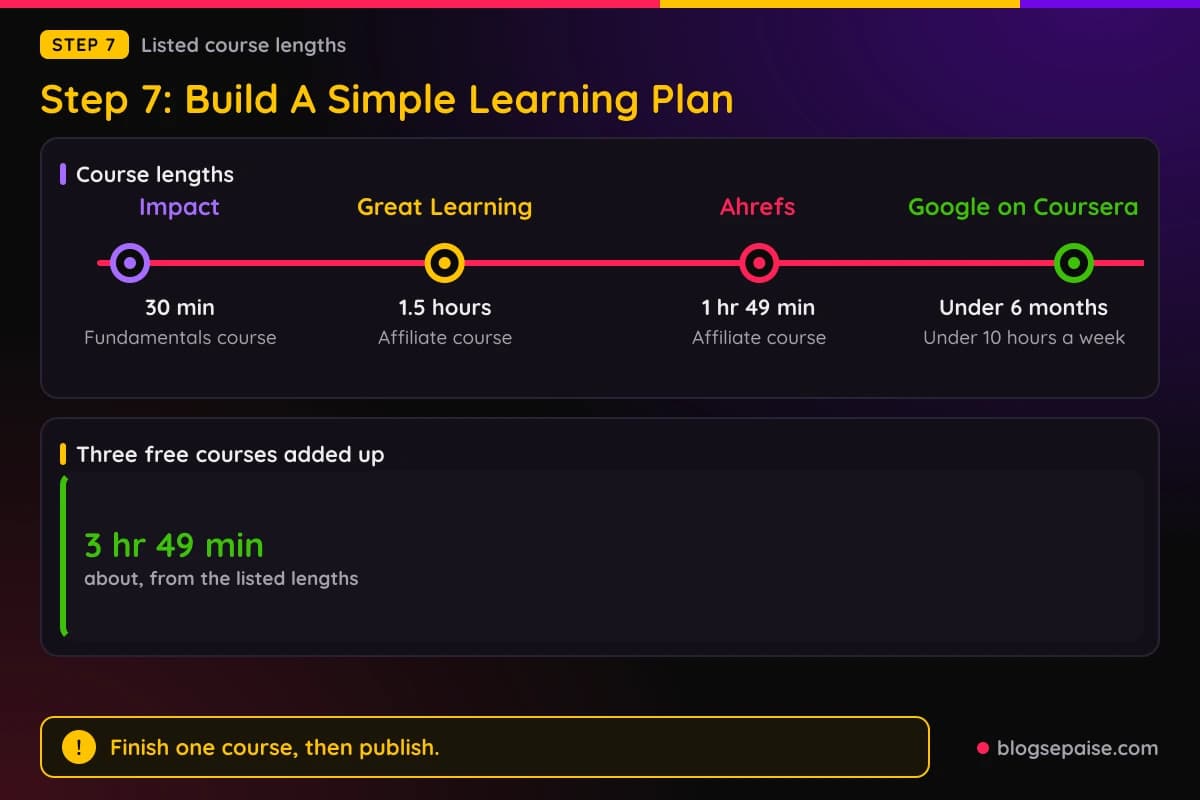
Three free options come with stated lengths. They are Impact's fundamentals course at about 30 minutes, Great Learning at about 1.5 hours, and Ahrefs at 1 hour 49 minutes.
Added up, those three come to about 3 hours 49 minutes. That is plain arithmetic on the listed lengths, and it does not count the time you spend on practice.
Start with the network you plan to join, since its training matches the dashboard you will use. Then take the Ahrefs course for the site and content side.
Add Google's SEO Starter Guide for search basics, and read the FTC pages before you publish a link. The Google certificate on Coursera is the longest option at under 6 months at under 10 hours a week.
If you want structured community help, compare Wealthy Affiliate's four tiers and its incident-only refund wording first. The Starter tier at $0 lets you look before you pay.
Practice matters, and the courses say so in their own way. The Ahrefs course states a goal of steady affiliate income without hype, and Google says results in search take time to show.
Set a review date a few weeks after you publish. Google suggests waiting a few weeks before judging if a change helped.
Final Thoughts
Plenty of good affiliate training costs nothing. Impact, Awin, and Amazon teach their own platforms, Ahrefs teaches the website side, and Google and the FTC cover search and disclosure.
Paid options add structure or community, and their prices and refund terms vary. Coursera lists $49 per month in the U.S. and Canada, Wealthy Affiliate lists $29 to $99 a month, and Launch Pad lists $1 to start.
Start with the free material, finish one course, and publish something. Then decide if a paid plan fills a gap you can name.
Prices, courses, and terms change, so check each provider's page before you pay. Our guide on your first 30 days in affiliate marketing shows what to do with what you learn.
Frequently Asked Questions
1. Where can I learn affiliate marketing for free?
Impact PXA, Ahrefs Academy, Great Learning, HubSpot Academy, Google Search Central, Google Skillshop, and the FTC all publish free material. Each is covered above with what it teaches.
2. Is the Ahrefs affiliate marketing course free?
Yes. Ahrefs says the Affiliate Marketing Course for Beginners needs no sign-up and is absolutely free of charge. It has 16 lessons and runs 1 hour 49 minutes.
3. Does Impact offer free affiliate training?
Yes. Impact's PXA offers free partnerships and affiliate marketing training, and its Digital Partnerships Industry Training for Partners course is listed as free at about 30 minutes.
4. Is Amazon Creator University free?
Small Business Trends reported in February 2023 that it is free. Amazon's own India announcement in June 2024 does not state a price.
5. How much does the Google certificate on Coursera cost?
In the U.S. and Canada, Coursera charges $49 per month after a 7-day free trial. It estimates most learners pay less than $300 USD for the certificate.
6. How much does Wealthy Affiliate cost?
Its pricing page lists Starter at $0, Builder at $29 a month, Premium at $49 a month, and Premium Plus+ at $99 a month. Yearly prices are $290, $490, and $990.
7. Does Wealthy Affiliate offer refunds?
Its pricing page says refunds are available only on an incident basis, when something has gone wrong with your account or billing. It says a business not working out as hoped is not grounds for a refund.
8. What is the refund policy for Coursera Plus Annual?
Coursera's terms give a 14-day refund period for Coursera Plus Annual. Renewal charges on annual plans are not refundable.
9. Do I need to learn FTC disclosure rules?
The FTC says it is your responsibility to make disclosures when you have a relationship with a brand. Its affiliate guidance says to disclose clearly and conspicuously on your site.
10. Does Google have a free SEO guide for beginners?
Yes. Google Search Central publishes an SEO Starter Guide that explains how Google crawls, indexes, and understands a site.