AI SEO Agents Explained And Whether You Need One
If you spend any time around SEO tools lately, you have probably run into the term AI SEO agent.
It gets thrown around a lot, and honestly, it gets used to describe a pretty wide range of things, from a simple chatbot that answers keyword questions all the way up to a system that can research, write, publish, and track a full article with almost no human involvement.
Part of the confusion comes from how quickly this category of tool has grown.
A term that barely existed in everyday SEO conversation a couple of years ago now shows up in the marketing copy for dozens of platforms, each one applying it a little differently, which makes it genuinely hard to know what you are actually getting when a product page promises an AI agent for your SEO.
That range is exactly why so many site owners are confused about if they actually need one of these tools.
Some agents genuinely save hours of work every week. Others are flashy demos that fall apart the moment you try to use them on a real site with real complexity.
The article below breaks down what an AI SEO agent actually is, how these tools differ from the simpler AI assistants most people already use, where they genuinely help, where they tend to fail, and how to figure out if adding one to your workflow is actually worth it for your specific site, based on real, practical use rather than the polished version shown in most sales demos.
Disclosure: Some of the links I share might be affiliate links. If you click on one and make a purchase, I may earn a small commission as a thank you. But don’t worry, it won’t cost you anything extra. I only recommend stuff I genuinely believe in. Your support helps me keep creating awesome content. You can read my full affiliate disclosure in my disclaimer page.
If you want to save a lot of hours searching for high-paying affiliate programs, check out our exclusive list of 2500+ affiliate programs. You’ll find all the information about the programs inside the list. This list is perfect for affiliate bloggers and influencers.
What Is An AI SEO Agent
An AI SEO agent is a tool built to carry out a multi step SEO task on its own, making decisions along the way without needing a person to approve every single step.
That last part is the key difference between an agent and a regular AI assistant.
When you type a prompt into a general AI chat tool and ask it to suggest ten keywords, that is a single request with a single response.
You read the answer, decide what to do with it, and move on. An agent works differently.
You might give it a broader goal, like find keyword opportunities in this niche, draft content briefs for the best ten, and flag which ones already have thin competing content, and the agent works through all three of those steps on its own, using the result of one step to decide what to do in the next one.
Think of the difference like hiring someone for a single task versus hiring someone to manage a small project.
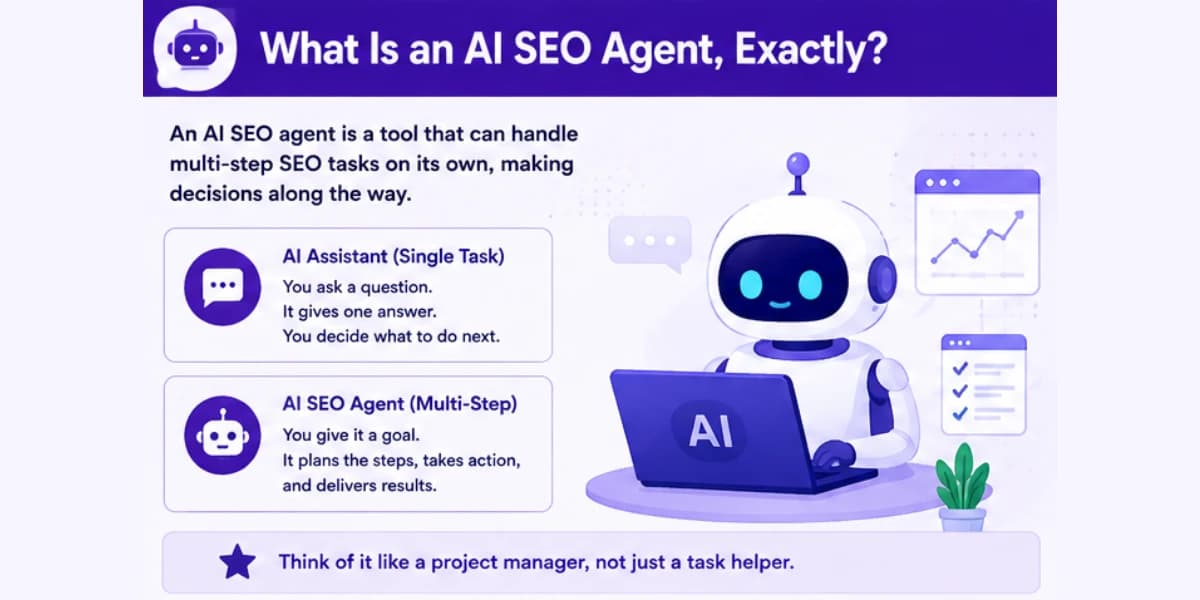
A single task hire does exactly what you ask and stops. A project manager takes a goal, breaks it into steps, and works through those steps with less hand holding, checking in with you mainly at key decision points rather than after every tiny action.
That distinction matters more than it might first seem, because it changes what kind of trust you need to place in the tool.
A single task hire is easy to evaluate, since you can check the one thing they produced against what you asked for.
A project manager needs a different kind of trust, built up over time as you watch how they handle the smaller decisions along the way, not just the final result they hand back to you.
Most AI SEO agents on the market today are built around this same basic idea, chaining together research, analysis, writing, and sometimes publishing into one connected process, with the AI making a series of smaller decisions along the way instead of waiting for a person to approve each one.
How much freedom that chain of decisions is given, and how carefully the results get checked before anything goes live, is really the heart of the whole discussion in this article.
For a complete overview of how AI fits into every stage of search engine optimization, read our complete AI SEO guide. It covers how AI tools handle everything from keyword research to technical audits.
How AI SEO Agents Work Under The Hood
It helps to know the basic mechanics, because that knowledge is what lets you judge if a specific agent is likely to work well for your situation or not.
Most agents are built on top of a large language model, the same kind of AI system behind popular chat tools, but wrapped with extra structure that lets the model take actions rather than just generate text.
That extra structure usually includes access to tools like a web search function, a way to pull data from your site's analytics, a way to check current rankings, and sometimes a way to publish directly to your content management system.
The agent is typically given a goal and a set of available tools, and it plans out a sequence of steps on its own to reach that goal.
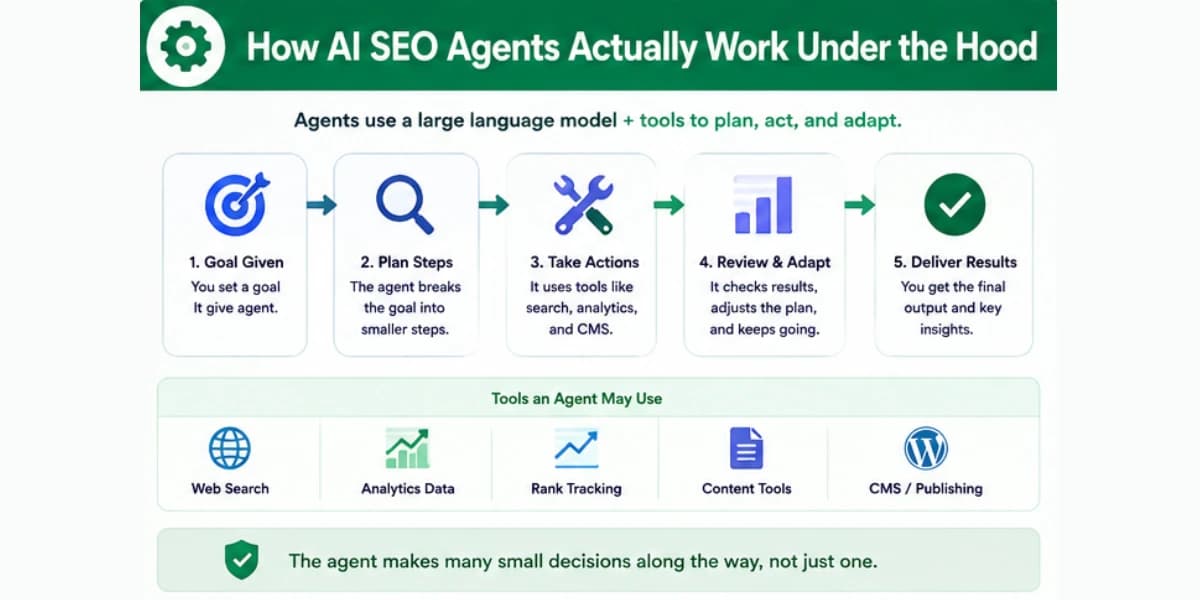
After each step, it looks at the result and decides what to do next, adjusting its plan based on what it finds.
If a keyword research step comes back with fewer good opportunities than expected, for example, a well built agent might automatically broaden its search rather than getting stuck, while a poorly built one might just continue on a weak path without noticing anything went wrong.
That self correcting loop is genuinely useful when it works well, since it means the agent is not just following a rigid script.
It also means the results can be less predictable than a single, well crafted prompt, since the agent is making a chain of small decisions that compound as the task moves forward, and small mistakes early in that chain tend to get carried into every later step.
Learning prompt engineering for SEO helps you write the kind of clear, specific instructions that give agents a much better starting point for their work.
A Simple Example Of An Agent In Action
Picture a mid-sized site covering outdoor gear, with around three hundred published articles.
The site owner sets up a monitoring agent with access to their analytics, their rank tracker, and a list of every published page.
Every Monday, the agent scans all three hundred pages and compares this week's ranking positions and traffic against last week's numbers.
It flags four pages that dropped more than five positions and pulls up what changed on each one, checking if a competitor recently updated their own page for the same keyword.
For one flagged page, the agent notices that a competing article now includes a comparison table the site owner's page does not have.
For another, it notices the page mentions a product that appears to have been discontinued based on a quick check of the product's current listing.
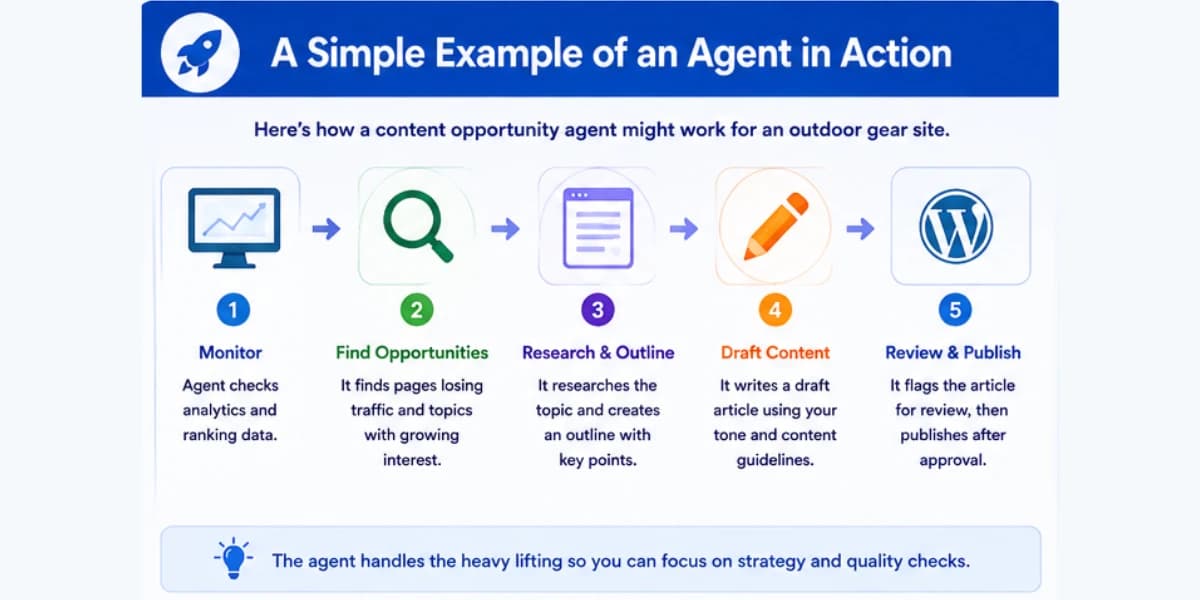
The agent compiles all of this into a short summary and sends it to the site owner rather than making any changes on its own.
The site owner reads through the summary in about ten minutes, confirms both findings, and schedules updates for those two pages that week.
The other two flagged pages turn out to be normal seasonal fluctuation, not a real problem, and the owner dismisses those flags after a quick look.
That scenario is roughly what a well scoped agent looks like in daily use, handling the tedious scanning and flagging while leaving the actual decisions in human hands.
Different Types Of AI SEO Agents
Not every product calling itself an AI SEO agent works the same way, and it helps to know the rough categories before evaluating any specific tool.
Research and analysis agents focus narrowly on gathering and organizing information, like pulling keyword data, clustering it, and identifying content gaps across a large site.
These tend to be the most reliable category, since the tasks involved are closer to structured data processing than open ended creative decision making.
Content drafting agents go a step further, taking a brief or a keyword and producing a full article draft with minimal input, sometimes pulling in research, structuring an outline, and writing the full piece in one continuous process.
These are more powerful but also carry more risk, since a mistake early in the research phase tends to show up as a factual error somewhere in the final draft.
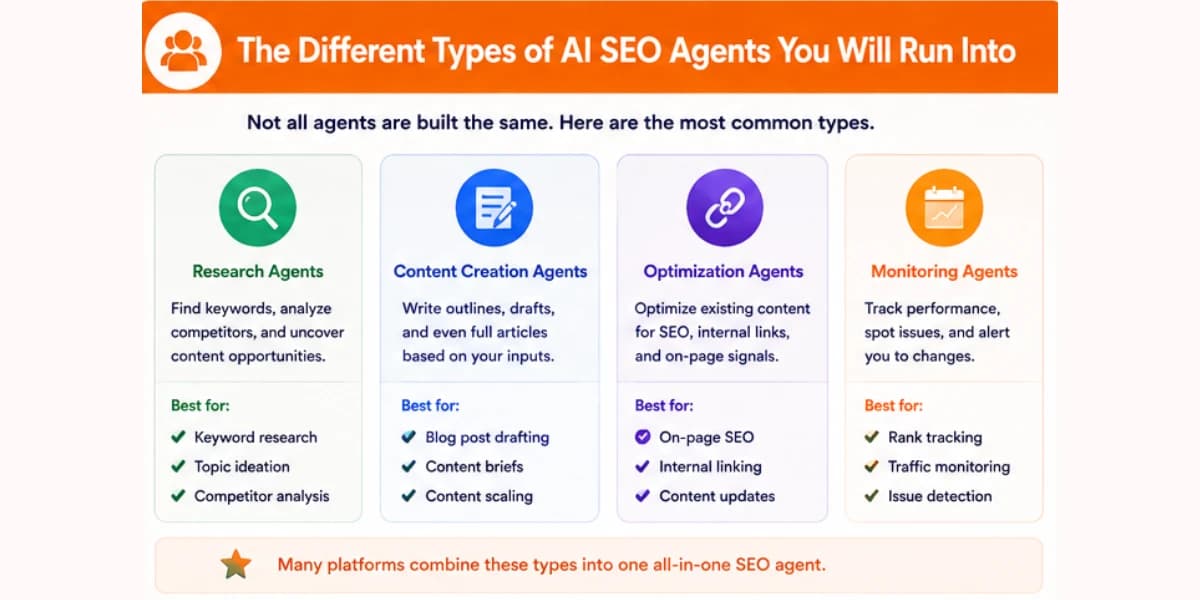
Full workflow agents attempt to handle an entire content pipeline from research through publishing, including tasks like adding internal links, generating meta descriptions, and pushing the finished piece live on your site.
These are the most ambitious category and, honestly, the least reliable one as of now, since they stack several error prone steps together and compound the risk at each stage, and a single early mistake can quietly ride along through every step that follows without anyone catching it until the piece is already live.
Monitoring and maintenance agents run in the background, checking rankings, flagging pages that appear to be losing traffic, and sometimes suggesting or even drafting fixes automatically.
These sit somewhere in the middle in terms of reliability, since the detection part tends to work quite well, while the automatic fix suggestions still benefit from a careful human review before going live.
For a complete overview of how AI fits into every aspect of search engine optimization, including content audits, read our AI content audit guide to understand how to find what's underperforming on your site.
Where AI SEO Agents Genuinely Save Time
It is worth being specific about the real wins here, since the marketing around these tools tends to promise more than what actually holds up in daily use.
Large scale research tasks are a genuine strength.
Asking an agent to scan a thousand keywords, cluster them by intent, and flag the ones with weak competing content is exactly the kind of task that would take a person days to do carefully by hand.
An agent can chew through that volume in a fraction of the time, and the structured nature of the task means there is less room for the kind of judgment error that trips up agents on more open-ended work.
Repetitive maintenance checks are another strong use case.
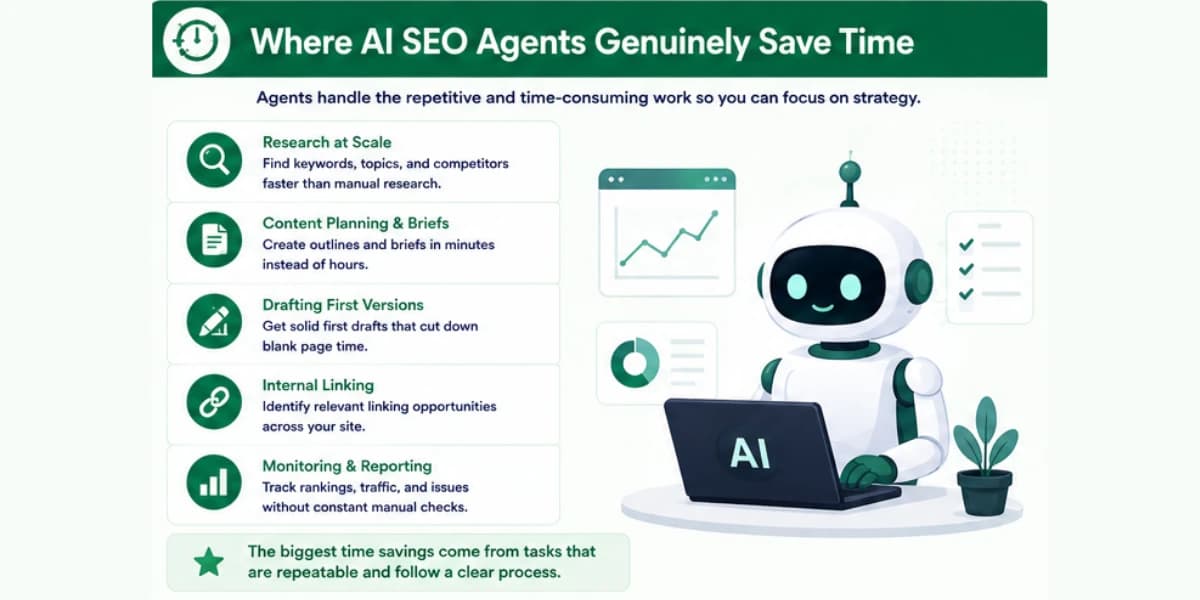
Having an agent regularly scan your published content for outdated pricing mentions, broken affiliate links, or pages that have dropped in ranking saves a huge amount of manual checking that most site owners simply do not have time to do consistently on their own, especially once a site grows past a size where any one person can reasonably keep every page in their head.
First draft generation for lower stakes content can also work reasonably well, especially for straightforward informational pieces where factual accuracy requirements are lower and a human editor is still going to review everything before it goes live anyway.
Using an agent to produce a rough first pass, then having a person tighten it up, often beats staring at a blank page yourself.
Connecting multiple data sources into one view is another underrated strength.
An agent that can pull from your analytics, your rank tracker, and your content inventory all at once, and summarize the whole picture in plain language, saves the tedious work of manually checking three or four separate dashboards and mentally piecing the story together yourself.
Learning how to do keyword research properly helps you understand the kind of structured data agents work with best, so you can set them up for success from the start.
Where AI SEO Agents Tend To Fall Short
The honest picture also includes real limitations, and knowing these ahead of time saves you from a rough surprise after you have already invested time setting one up.
Compounding errors are the biggest structural problem.
Because an agent chains several steps together, a small mistake early on, like misreading a competitor's pricing or picking a slightly wrong keyword cluster, tends to ripple through every step that follows, sometimes producing a final result that looks polished but is quietly built on a shaky foundation.
Strategic judgment remains weak across nearly every agent currently available.
An agent might correctly identify that a keyword has high search volume without grasping that it does not actually fit your business, or it might suggest publishing content on a topic that would cannibalize an existing high performing page on your site.
These are exactly the kind of decisions that need a person who sees the bigger picture, not just the immediate data in front of them.
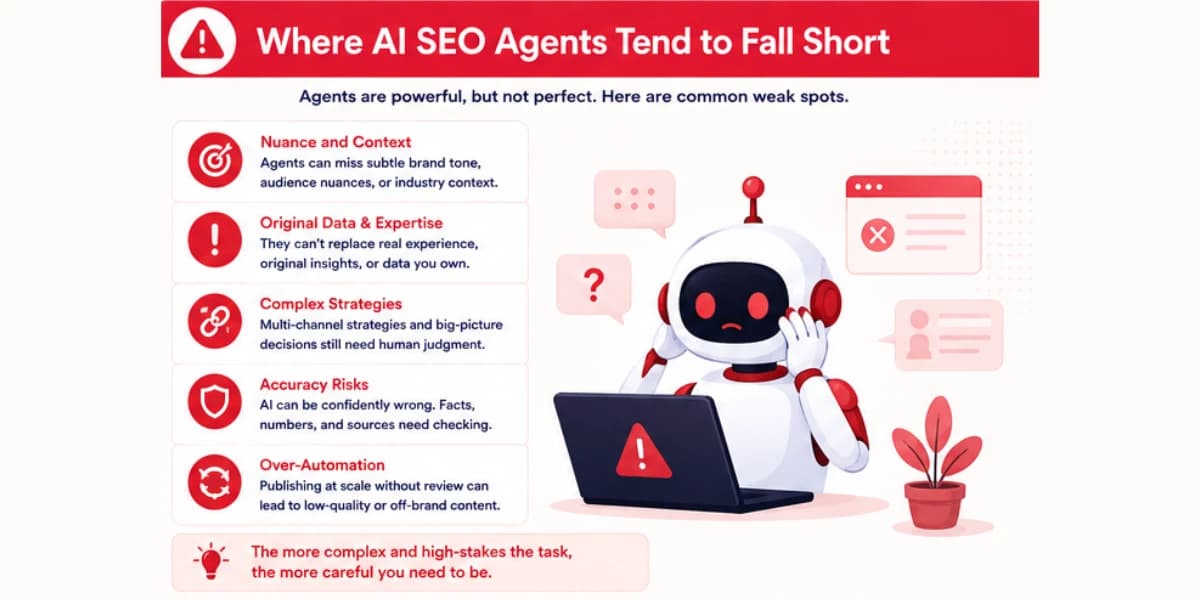
Full automation from research to publishing without any review step is genuinely risky.
Even agents marketed as fully autonomous tend to make factual mistakes, produce generic sounding content, or occasionally publish something that just does not fit your brand voice, and catching that after it is already live costs far more time than a quick review would have.
Cost and complexity can also add up quickly.
Agents that call multiple tools and make several AI requests per task tend to cost noticeably more to run than a single prompt to a chat tool, and setting one up properly, with the right guardrails and review steps, takes real time investment upfront that is easy to underestimate when you are only looking at a monthly subscription price on a pricing page.
For a complete overview of how AI fits into every aspect of search engine optimization, including content workflows, read our AI content refresh workflow guide to understand how to keep your content current and competitive.
Setting Up Guardrails Before You Turn One Loose
If you decide to try an agent, putting a few guardrails in place from the start makes a huge difference in how safely it operates on your site.
Give it a narrow, clearly defined scope rather than broad, open ended permission.
An agent told to monitor these forty specific pages and flag pricing changes is much easier to trust than one told to manage my whole site, since the narrow version has far fewer ways to go wrong and far fewer decisions it needs to make without your input.
Keep publishing permissions separate from research and drafting permissions, at least at first.
An agent that can research and draft freely but needs a person to click publish adds almost no delay to your workflow while removing the single riskiest failure point, which is bad content going live without anyone checking it first.
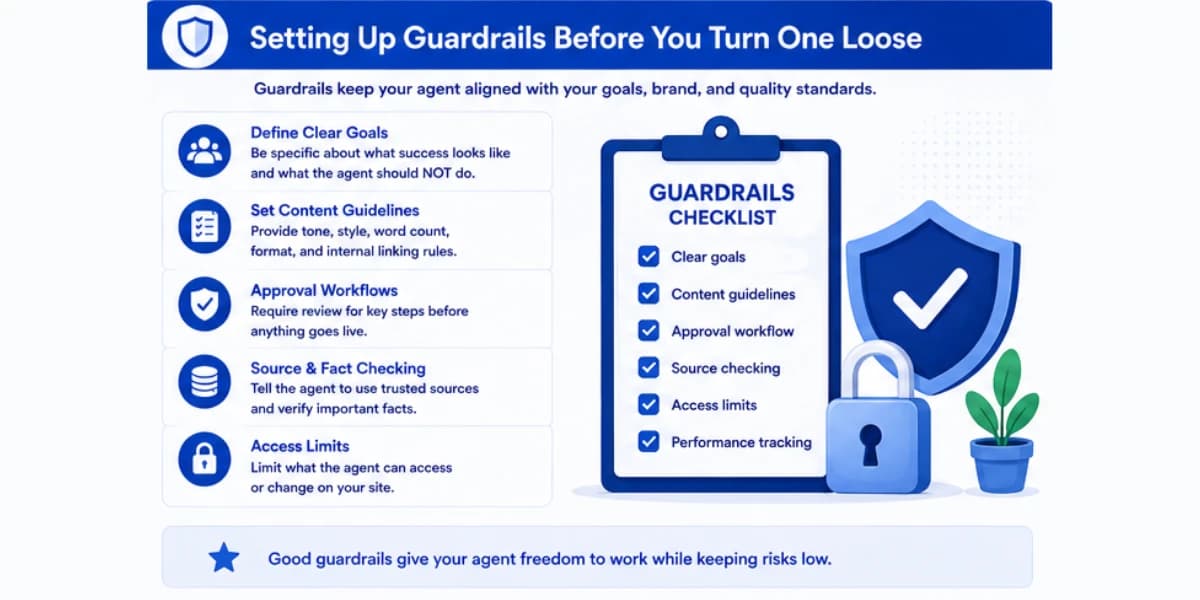
Set clear limits on spending if the agent runs on a pay per use model, since a poorly scoped task or an unexpected loop in the agent's process can rack up a surprising number of tool calls before anyone notices.
Most platforms let you set a budget cap, and it is worth using that feature from day one rather than after a surprising bill shows up.
Build in a regular check in schedule, even once the agent has proven itself reliable for a while.
Weekly or biweekly reviews of what the agent has been doing catch small drifts in quality or behavior before they turn into a bigger problem, since these tools can sometimes shift in subtle ways as the underlying model or the tool's own settings get updated behind the scenes.
For a complete overview of how AI fits into every aspect of search engine optimization, read our AI internal linking guide to understand how link structures support your content strategy.
Real Costs To Consider Beyond The Subscription Price
The sticker price of an agent platform rarely tells the full story of what it actually costs to run one well.
Setup time is the first hidden cost. Connecting an agent to your analytics, your content management system, and your other tools properly takes real hours, and getting the configuration right on the first try is uncommon.
Budgeting a few days of setup and testing time before expecting smooth results is more realistic than expecting it to work perfectly right out of the box.
Review time is the second hidden cost, and it is easy to underestimate.
Even a well behaved agent needs a person checking its output regularly, and that review time needs to be built into your workflow rather than treated as an afterthought squeezed in whenever someone has a spare moment.
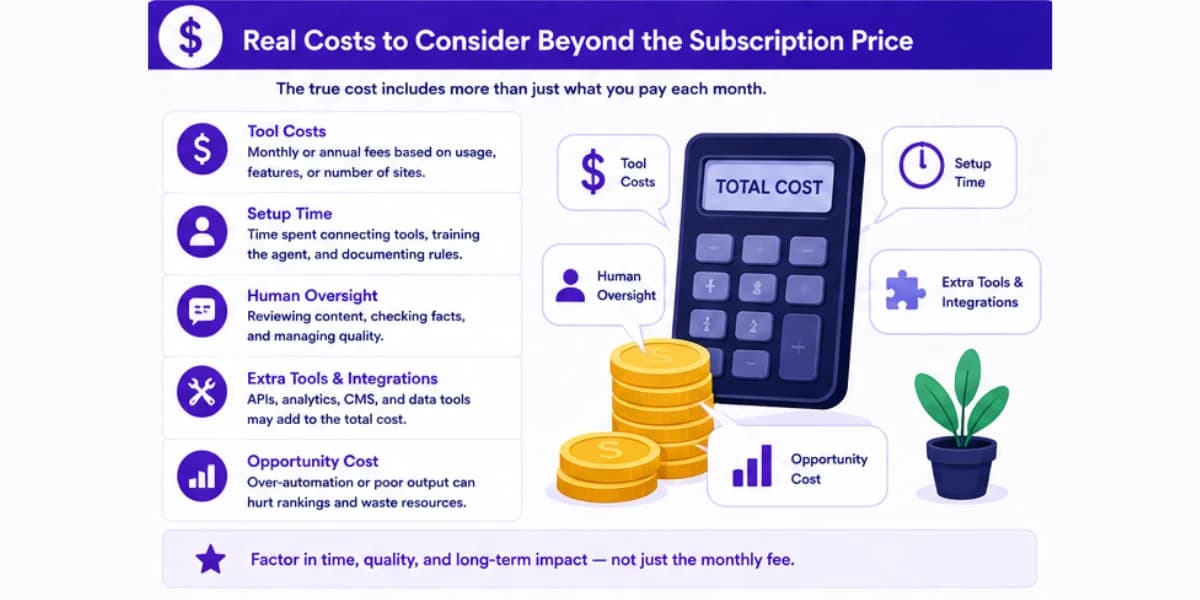
Tool call costs can add up in ways that are hard to predict ahead of time, especially for agents handling complex, multi step tasks that involve several rounds of research, drafting, and self correction.
Running a handful of real tasks through a trial period before committing to a larger rollout gives you a much clearer sense of actual monthly cost than any pricing page alone can.
Correction costs are the least visible but sometimes the most expensive.
If an agent publishes something with a factual error or a strategic misstep that goes unnoticed for a while, fixing the downstream damage, like a correction to readers, a lost sale, or a ranking drop that takes months to recover from, can end up costing far more than the time the agent originally saved.
Using the right SEO plugins for your website can help you manage and monitor your content alongside other on-page optimization tasks.
Common Signs An Agent Setup Is Working Well
A handful of practical signals tend to show up when an agent is genuinely earning its place in your workflow rather than just creating extra work in a new form.
The time you spend reviewing its output steadily drops as you build trust in specific types of tasks, while the quality of what it produces stays consistent or improves.
If review time stays just as high months into using the tool as it was on day one, something about the setup likely needs adjusting.
The agent flags genuine uncertainty rather than confidently guessing through ambiguous situations.
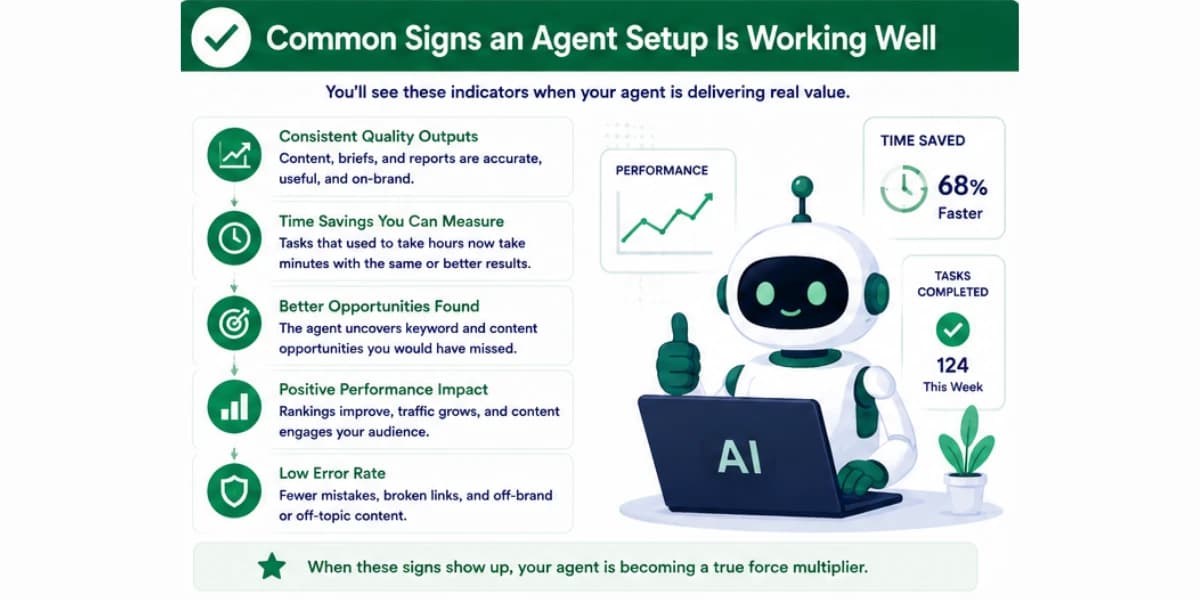
A tool that occasionally says this pricing page shows two different numbers and I am not sure which applies is behaving more trustworthily than one that always picks a number and states it with total confidence.
You can trace a clear line from what the agent found to what action you took, rather than feeling like you are just rubber stamping whatever it produces without really engaging with the details.
If reviews start feeling like a formality rather than a genuine check, that is often a sign oversight has quietly slipped, not a sign the agent has become more reliable.
Do You Actually Need One
Here is the honest answer. It depends heavily on your site's size, your current workflow, and how much of the process you are already handling well without one.
If you run a small site with a handful of articles published each month, a full agent setup is probably more complexity than you need.
A simpler workflow using a regular AI assistant for research, drafting, and editing, guided by clear prompts, will likely get you similar results with far less setup time and far more control over the final output.
If you manage a large site with hundreds or thousands of pages, especially one that needs regular maintenance checks across all of that content, an agent focused specifically on monitoring and flagging issues can genuinely save meaningful time, since the volume of manual checking involved would otherwise eat up a large chunk of a team's week.
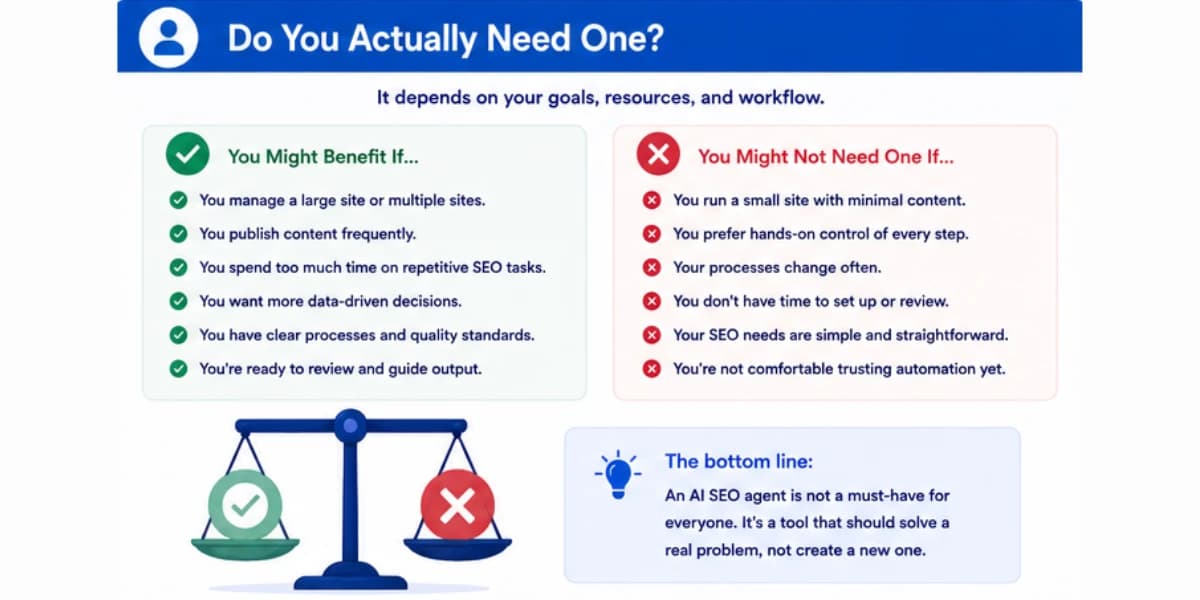
If your team already has a solid, working content process and you are mainly looking to speed up one specific bottleneck, like research or first draft generation, a narrow agent built for that specific task tends to work better than a full end to end system trying to handle everything at once.
Narrow, focused agents are simply easier to trust and easier to catch mistakes from, since there are fewer steps where something could quietly go wrong.
If you are drawn to the idea of a fully hands off content pipeline that requires almost no oversight, it is worth being realistic about where the technology actually stands right now.
That level of automation exists in demos and marketing materials more reliably than it exists in results you would be comfortable publishing without a careful review first.
Building topical authority in a niche depends heavily on keeping your content accurate and current, since search engines use freshness signals to determine which pages deserve to rank.
A Practical Way To Evaluate Any AI SEO Agent
If you are considering adding one to your workflow, running it through a few practical checks before committing saves you from a costly mistake.
Start small before going all in. Run the agent on a narrow, low stakes task first, like researching keywords for a single topic cluster, rather than handing it your entire content calendar on day one.
That approach lets you see how it actually performs on your specific niche before trusting it with anything bigger.
Check its work carefully during this trial period, comparing what it produces against what you would have found or written yourself.
Look specifically for factual errors, missed context about your business, and any strategic suggestions that do not actually fit your goals, since these are the exact areas where agents tend to struggle most.
Ask what happens when something goes wrong partway through a task.
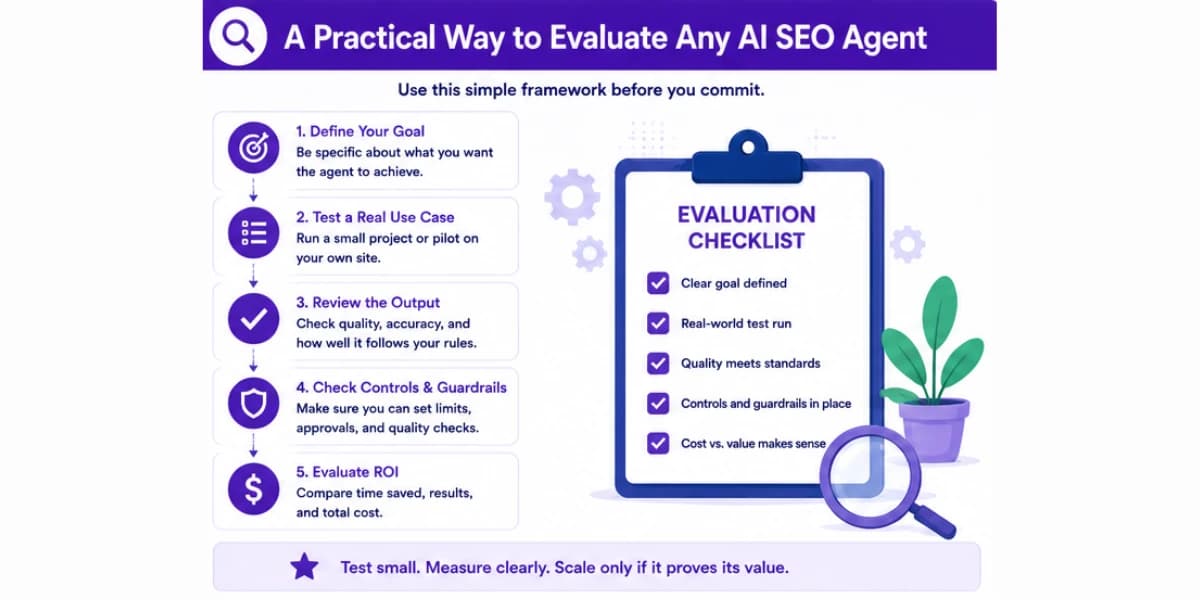
A good agent should flag uncertainty or stop and ask for input when it hits a genuinely ambiguous decision, rather than confidently pushing forward with a guess.
An agent that never expresses uncertainty about anything is a bit of a red flag, since real SEO work is full of genuinely ambiguous calls that even experienced humans disagree on.
Look closely at the cost structure before scaling up usage.
Some agents charge based on the number of steps or tool calls involved in a task, which can add up fast on complex, multi step workflows, so it is worth running a few real tasks through the tool and checking the actual cost against the time it saved you.
Finally, keep a human checkpoint somewhere in the process, even after you trust the tool.
The sites that get burned by AI agents are almost always the ones that removed every review step entirely, rather than the ones that kept a quick human glance in place before anything goes live.
Understanding how your content fits together is essential for effective workflows. Our guide on what content clusters are explains how pillar pages and supporting articles work together to build topical authority.
What The Next Few Years Likely Look Like
It is reasonable to expect these tools to keep improving steadily, since the underlying AI models they are built on keep getting better at reasoning through multi-step tasks and catching their own mistakes along the way.
Some of the compounding error problems described earlier will likely shrink as models get better at self checking their work mid process rather than confidently pushing forward on a flawed early step.
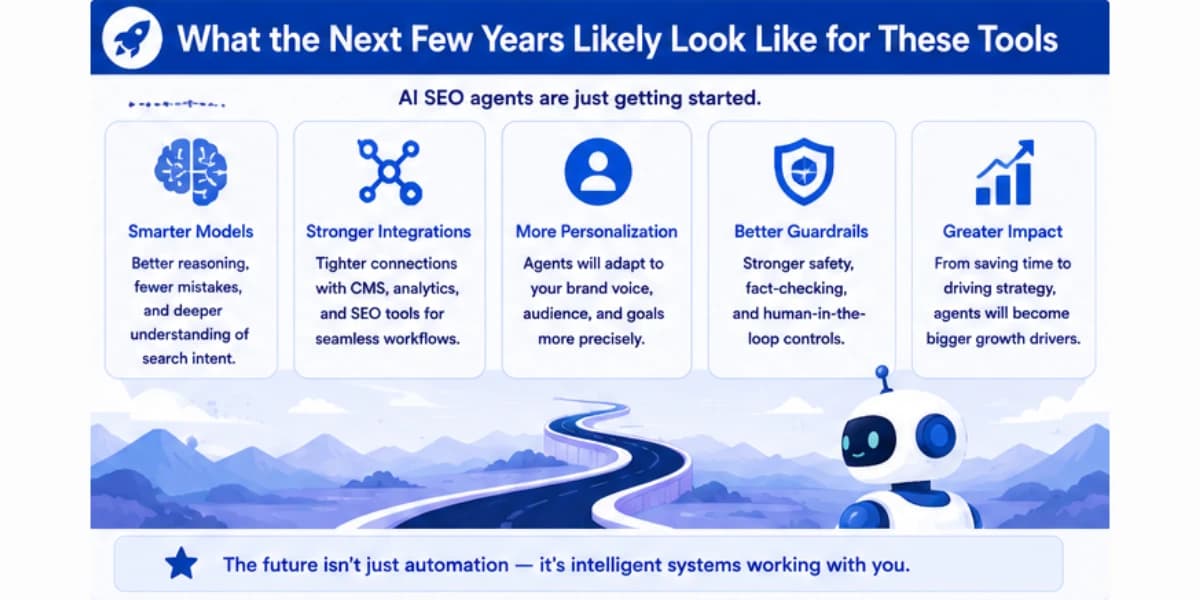
That said, the strategic judgment piece is likely to remain the hardest gap to close, since it depends on business context, brand voice, and genuine market knowledge that lives outside the data any agent has direct access to.
A useful way to think about where things are headed is that the mechanical, data heavy parts of SEO work will keep getting more automated and more reliable, while the parts requiring real judgment about your specific business will likely still benefit from a human in the loop for a good while longer.
Creating content that stays relevant for years requires a different approach than chasing trends. Our article on creating evergreen content explains how to write articles that continue driving traffic long after publication.
How Agents Differ From Older SEO Automation Tools
SEO has had automation tools for years, from rank trackers that email you a weekly report to plugins that automatically generate meta descriptions based on a fixed template.
It helps to see clearly how AI agents differ from these older tools, since the word automation gets applied to both in a way that blurs an important distinction.
Older automation tools follow fixed rules set up in advance by a person.
A plugin that generates a meta description might always follow the same template, filling in the page title and a generic phrase, regardless of what the page actually covers.
That kind of tool is reliable and predictable precisely because it never deviates from its rules, but it also never adapts to a situation the rules did not anticipate.
An AI agent, by contrast, makes judgment calls within a broader goal rather than following a fixed template.
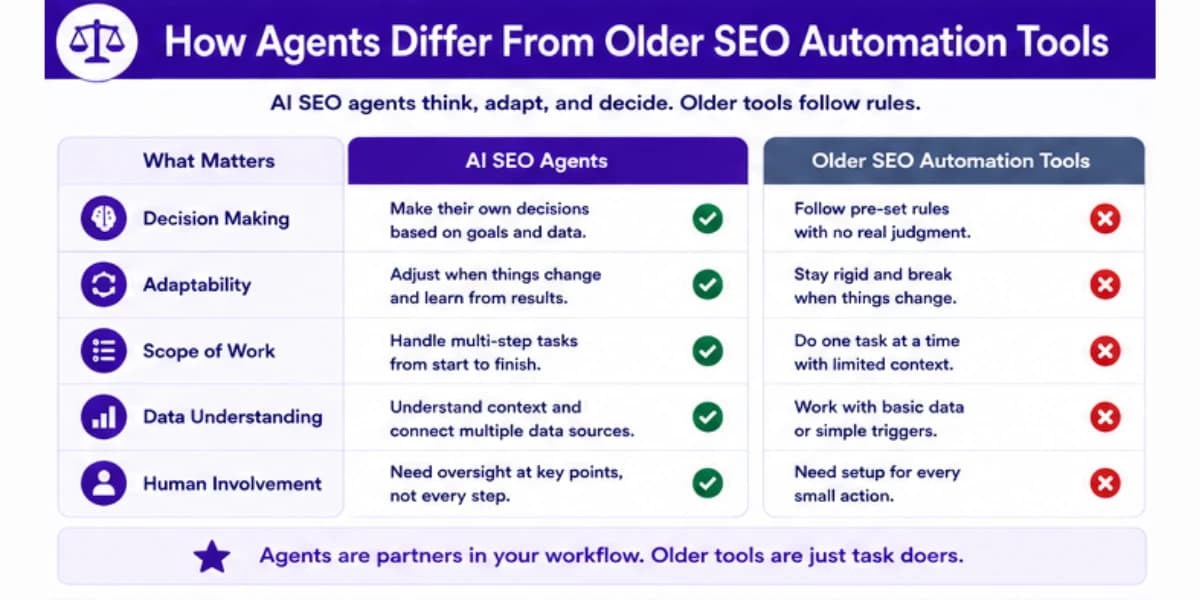
Ask it to write meta descriptions for fifty pages and it will genuinely read and respond to what each individual page covers, producing more relevant and varied results than a rule based tool ever could.
That flexibility is the whole appeal, but it also means the results are less perfectly predictable from one run to the next, since the agent is reasoning through each page rather than mechanically filling in a template.
Neither approach is strictly better in every situation.
Rule based automation still makes sense for genuinely simple, repetitive tasks where consistency matters more than nuance, like formatting dates or applying a standard disclaimer across a set of pages.
Agent based tools make more sense for tasks that benefit from actual judgment applied to varied content, like drafting a summary that genuinely reflects what a specific page discusses rather than a generic template phrase.
If you need help finding where to add links in your existing content, try our internal link opportunity finder tool. It scans your pages and highlights where new internal links would add the most value.
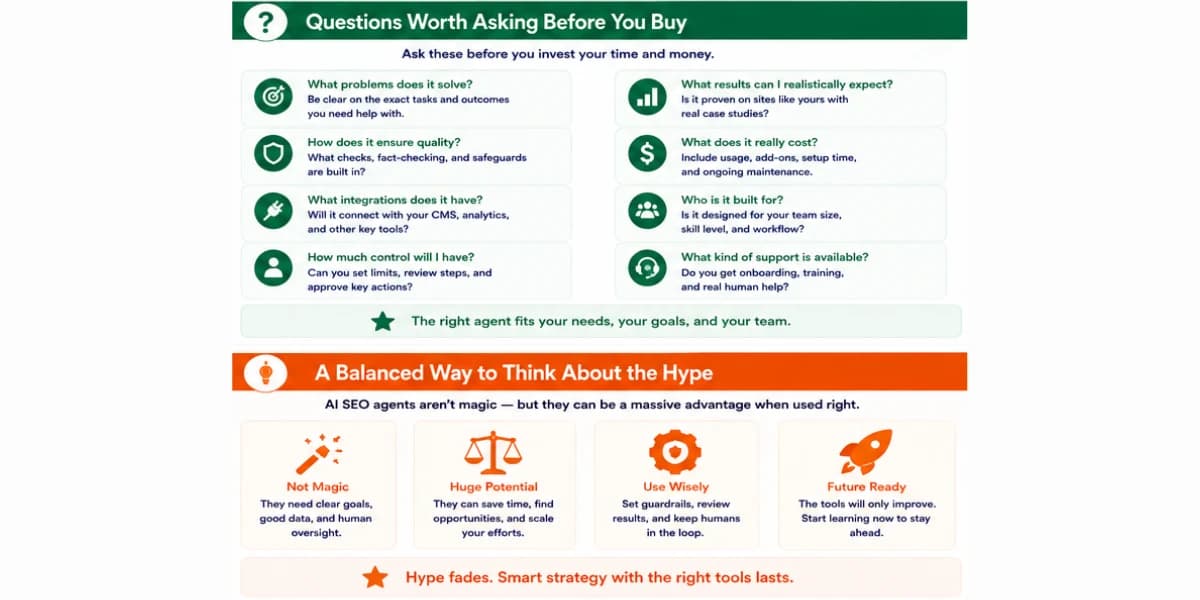
Questions Worth Asking Before You Buy
A short list of honest questions to ask yourself, or ask a vendor directly, before committing to an agent platform tends to save a lot of regret later.
Ask what happens to your data.
Agents that connect to your analytics, your content management system, and sometimes your customer information need to be trusted with real access to sensitive systems, so it is worth knowing exactly how that data is stored, if it is used to train any underlying models, and how you can revoke access if you decide to stop using the tool.
Ask how the agent handles a task it cannot complete confidently.
A tool that always produces a confident sounding answer, even for genuinely ambiguous situations, is more likely to quietly produce wrong results than one that is willing to say it is unsure and ask for more direction.
Ask for real examples of the tool working on a site similar to yours, not just a polished demo built around a best case scenario.
Demos are, understandably, built to show a tool at its best, and real world performance on a messy, imperfect site with years of inconsistent content often looks noticeably different from a clean demo environment.
Ask what the actual monthly cost looks like at your real content volume, not the volume shown in a sales pitch.
A tool that looks affordable when processing ten pages a month can look very different once you scale it up to the two hundred pages your site actually needs it to handle regularly.
Ask if you can start with a limited trial before committing to an annual contract.
Vendors confident in their product are usually willing to offer some kind of trial period, and hesitation here is worth noticing as a signal in itself.
Turning your keyword research into a consistent publishing schedule is easier when you have a solid plan. Our guide on how to create a content plan for affiliate marketing walks through exactly how to structure your workflow.
A Balanced Way To Think About The Hype
There is a lot of excitement, and honestly a fair amount of exaggeration, surrounding AI SEO agents right now.
Some of that excitement is well earned, since these tools genuinely do things that were not practically possible even a couple of years ago, particularly around processing large amounts of data and connecting insights across multiple sources automatically.
At the same time, a healthy amount of skepticism serves you well here.
Plenty of products marketed as fully autonomous still need meaningful human oversight to produce results you would actually want to publish, and the gap between a polished demo video and daily performance on your specific, messy, real world site is often bigger than marketing materials suggest.
The most useful mindset is treating these tools as genuinely powerful assistants that still need a person setting direction and catching mistakes, rather than as a replacement for the strategic thinking that made your site successful in the first place.
Sites that adopt this balanced view tend to get real, lasting value out of these tools. Sites that buy into the fully hands off promise too quickly tend to get burned by a factual error or a strategic misstep that slips through unnoticed until it has already done some damage.
Building a topical map for AI SEO gives you the content structure that makes audit decisions much easier, since you already know which pages should support which others.
Final Thoughts On AI SEO Agents
AI SEO agents are a real step forward from simple chat based prompting, genuinely useful for large scale research, ongoing maintenance checks, and speeding up first drafts of lower stakes content.
They are not, at least not yet, a reliable replacement for human judgment on the strategic decisions that actually determine if an SEO effort succeeds.
The honest answer to if you actually need one comes down to your specific situation. A small site with a simple workflow probably does not need the added complexity.
A larger site drowning in manual maintenance work might see a real return from a focused monitoring agent.
Whatever your situation, starting small, checking the work carefully, and keeping a human checkpoint in place will serve you far better than diving straight into full automation and hoping for the best.
The tools themselves will keep changing, likely for the better, over the coming years.
The value of a person who genuinely understands your business, your readers, and your goals sitting somewhere in the loop, making the final call on the decisions that actually matter, is unlikely to change nearly as fast.
Build your workflow around that idea, and whichever specific tool you end up choosing will serve you well.
Frequently Asked Questions
1. Are AI SEO agents the same as just using ChatGPT for SEO tasks?
No. A regular AI chat tool responds to one request at a time and waits for you to guide the next step. An agent is built to chain several steps together on its own, making a series of decisions toward a broader goal with less manual guidance along the way.
2. Is it safe to let an agent publish content directly to my site without review?
Generally not recommended. Even well built agents can make factual mistakes or produce content that does not quite fit your brand voice, and catching those issues after publishing costs far more time than a quick review step would have.
3. Do I need technical skills to set up an AI SEO agent?
It depends on the specific tool. Many newer agent platforms are built with a simple interface that does not require coding knowledge, while more advanced or custom setups may need some technical comfort to connect properly to your analytics, content management system, or other tools.
4. Can a small blog with limited resources benefit from an AI SEO agent?
Sometimes, particularly for a narrow task like ongoing rank monitoring, but a small site often gets similar value from a well built prompting workflow using a regular AI assistant, at a fraction of the cost and complexity of a full agent setup.
5. What is the biggest mistake people make when adopting an AI SEO agent?
Removing human review too early, before the tool has proven itself reliable on their specific site and niche. Starting with a small, low stakes trial and gradually expanding trust based on actual results tends to work out far better than diving straight into full automation.
6. Will AI SEO agents eventually replace SEO strategists entirely?
That seems unlikely in the near term. These tools are increasingly good at handling the mechanical, data heavy parts of the job, but deciding what actually matters for a specific business, knowing brand voice, and making judgment calls about strategy still benefit from a person who genuinely sees the bigger picture.