Instant Approval Affiliate Programs: What Exists And What To Watch For
You want to start earning, and waiting for a stranger to review your blog feels like a bad deal. So you search for instant approval affiliate programs and hope for a quick yes.
Here is the honest answer. Some programs do approve people right away, but the words instant approval hide a few details that matter.
The six steps below cover what the phrase means, which programs approve fast, what to check first, the scams, how to prepare for manual reviews, and how to earn while you wait. Common mistakes and a short FAQ follow.
Disclosure: Some of the links I share might be affiliate links. If you click on one and make a purchase, I may earn a small commission as a thank you. But don’t worry, it won’t cost you anything extra. I only recommend stuff I genuinely believe in. Your support helps me keep creating awesome content. You can read my full affiliate disclosure in my disclaimer page.
Search 1,500+ affiliate programs in the Blogsepaise Program Database and filter them by category, network and commission type, then go straight to each program's signup page. The Link Health Monitor then checks your posts for broken, redirected and untagged affiliate links.
Why Beginners Search For Instant Approval
A new site has no traffic, no history, and often no more than a handful of posts. A reviewer at a big program may see that and say no.
Getting a no on your first try hurts. It makes people look for programs with no approval at all, which sounds like the perfect fix.
The trouble is that easy to join and good to join are two different things. Searches such as affiliate programs with instant approval mix good options with bad ones, so your job is to sort them before you put a link on your site.
Our guide on how to get approved for affiliate programs covers the manual route in depth. The article you are reading focuses on the fast route and its traps.
Think of instant approval as a way to practice, not a way to get rich. You learn how tracking, links, and payouts work while the slower applications sit in a queue.
Speed should never be your only filter. A slow yes from a strong brand is worth more than a fast yes from a weak one.
Step 1: Learn What Instant Approval Really Means
Instant approval can mean three different things, and lists rarely say which one they mean. Sort them out first.
The first meaning is an auto-approved sign-up, where you fill in a form and the system creates your account. The second is an auto-approved partnership, where you pick one product or brand, click a button, and your link appears right away.
The third is a manual review that happens to be fast. A person looks at your application and says yes quickly, which feels instant but is not.
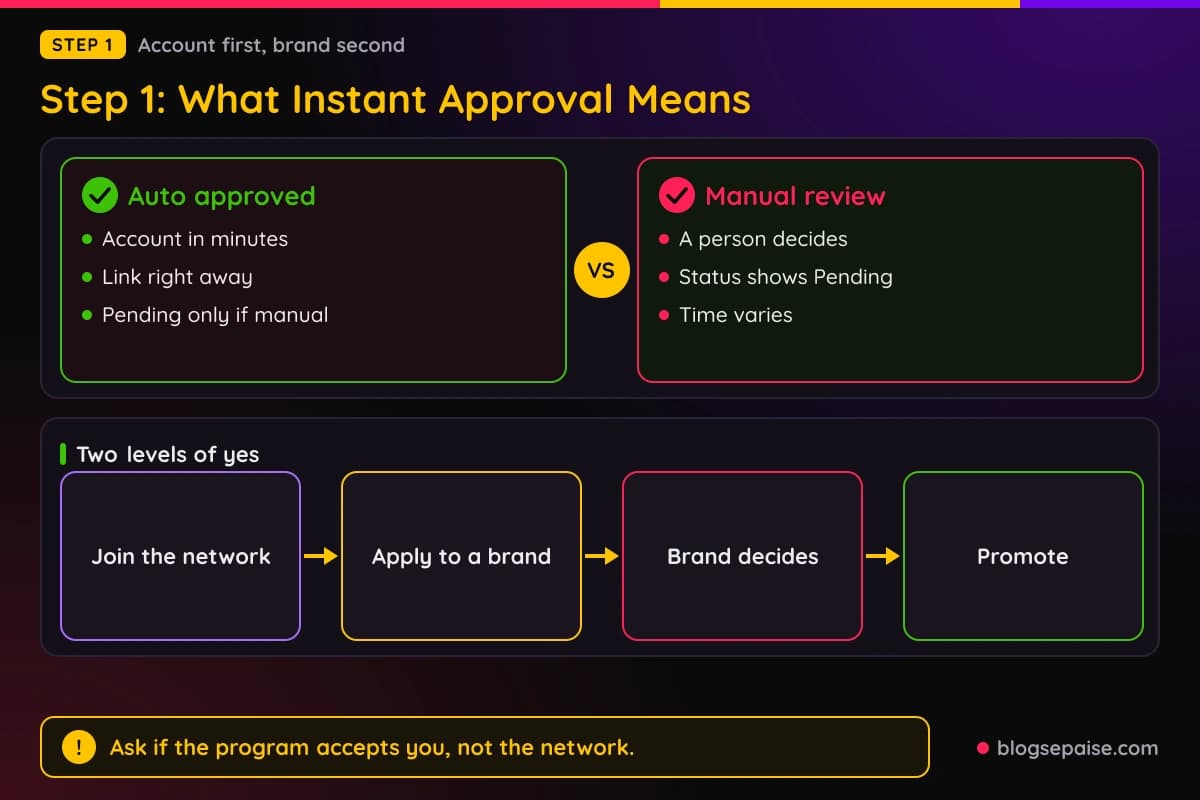
An account and a partnership are separate levels. A network can accept you and still leave every brand inside it free to say no.
Awin works this way. Its help center says that when you apply to an advertiser program, the application stays pending until the advertiser or their Awin Account Manager reviews it, and approval times vary by advertiser. Source: Awin help, joining an advertiser programme.
CJ Affiliate follows a similar pattern. CJ's Junction blog says advertisers see hundreds, if not thousands, of publisher applications in a week, so you apply to the advertisers you plan to promote. Source: CJ Junction, get accepted into more programs.
That means the question to ask is never just if a network is instant. Ask if the program you want to promote accepts you right away.
Check three places before you apply: the sign-up page, the help center, and the program's own terms. Our page on how to read affiliate program terms shows which clauses to look for.
When a program publishes no approval policy, treat it as manual. Send the brand a short email before you apply and ask how long approval takes and what they check.
Also separate approval from earning. Approval gets you a link, but a commission only appears after a real customer buys.
Step 2: Find Programs That Approve Right Away
Here is what each program publishes about its own approval. Read each line as a starting point, then confirm on the official page before you apply.
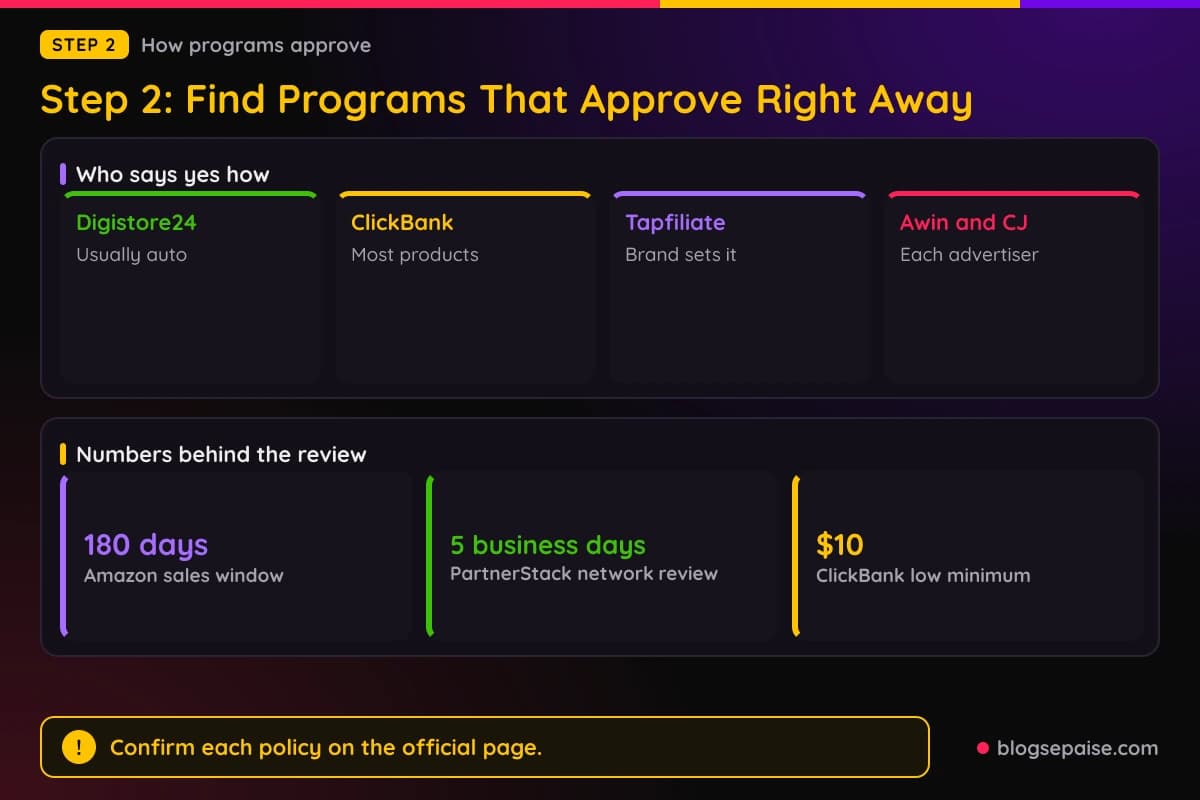
Digistore24 is a clear fast example. Its help center says a request to promote a product is usually accepted automatically, which starts the partnership at once, while some vendors check requests by hand.
ClickBank sellers can turn on a setting called Affiliates Require Approval. ClickBank's support center says that when it is on, the marketplace will not issue a tracking link until the seller approves you, and ClickBank's blog says most products are ready to promote right away.
ClickBank also says it offers a minimum payout of just $10, and that sellers can pay up to 75% standard commissions. The product still has to sell.
Software tools that run programs for brands come next. Their approval depends on each brand, since the brand owns the settings.
FirstPromoter's help center describes an auto-approve option for each campaign, and a campaign can be private so its sign-up page is hidden. Tapfiliate describes an auto-approve affiliates switch in its program settings too.
So you will see some programs accept you in a minute and others hold you in a queue, even though they use the same software. Brands choose the setting.
Gumroad sellers add affiliates manually, and sellers choose a commission between 1% and 75%, according to Gumroad's help center. A purchase within 30 days of the click credits the affiliate.
Amazon Associates sits in the middle. You sign up and get an account, but Amazon's help page says the team checks your application once you have driven qualified sales, and it requires at least three within the first 180 days.
Amazon's homepage says you can earn up to 10% in commissions, with rates that vary by product category. Its help center says commission income is paid about 60 days after the end of the month in which it was earned.
The PartnerStack network works differently. PartnerStack's support center says its Network team usually reviews network applications within 5 business days, and each program then has its own review.
PartnerStack also says partners who fill out their profile are 75% more likely to be accepted into programs. That is the company's own figure.
Awin lists every application as pending until the advertiser reviews it, and CJ leaves the decision to each advertiser. If you want a longer tour of networks and how they compare, read our guide to affiliate marketing platforms.
You can test an approval policy in a simple way. Click join on a product page and see if you get a link or a Pending status, then write the result in a small spreadsheet.
Step 3: Weigh The Catch Before You Sign Up
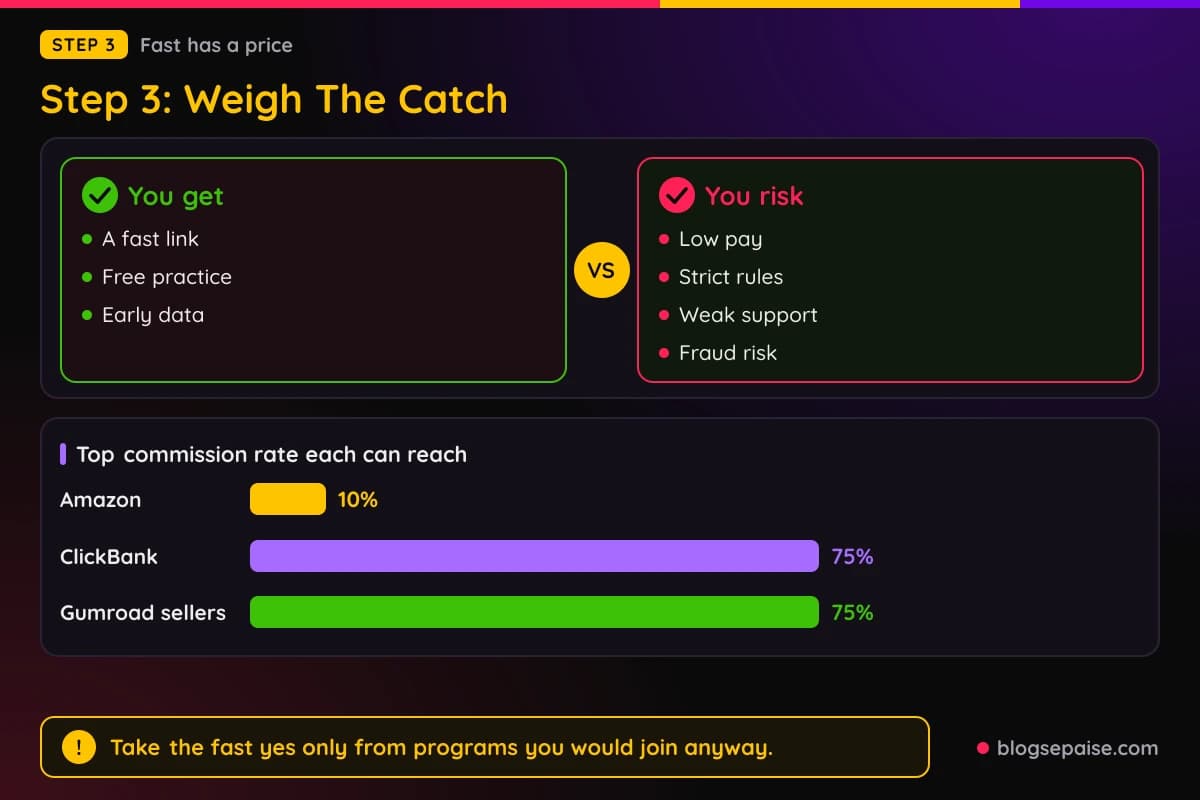
Fast approval can come with trade-offs, and they are rarely on the sign-up page. You have to look for them.
Check the pay first. Compare the commission rate, the minimum payout, and how long a commission stays pending.
Check the rules next. Programs set their own limits on things like your own purchases, traffic sources, and coupon sites, and Amazon, for example, does not pay on purchases that come through ads you bought.
Check the support and the payout record too. If you cannot find a contact address or a payout schedule, treat that as a warning.
Look at the product itself. If you would not buy it or recommend it to a friend, do not put your name on it.
A fast yes can also lock you into a niche you do not care about. Pick a program that fits the topics your site already covers.
Check the cookie window, which is how long a click counts toward a sale. Gumroad's help center says purchases within 30 days of the click credit the affiliate, and other programs set their own numbers.
Our article on how to avoid getting banned from affiliate programs lists the rule breaks that cost people their accounts. Skim it before you start posting links.
The rule is simple. Take the fast yes, but only from programs you would still join if approval took two weeks.
Look at the refund terms as well. A product with a long refund period can reverse your commission after the sale.
Step 4: Spot Red Flags And Scams
Searches for no approval programs also attract people who want your money. Scams look friendly, and they use the word instant a lot.
The biggest flag is an upfront fee. A real affiliate program pays you, so it should not ask you to pay to join, and if a site charges you for a membership first, ask what you are buying.
The second flag is an income promise. Lines such as earn $500 a day or make money while you sleep describe nobody's guaranteed results.
The third flag is a program with no product. When the only way to earn is to recruit more people, the real product is the recruiting.
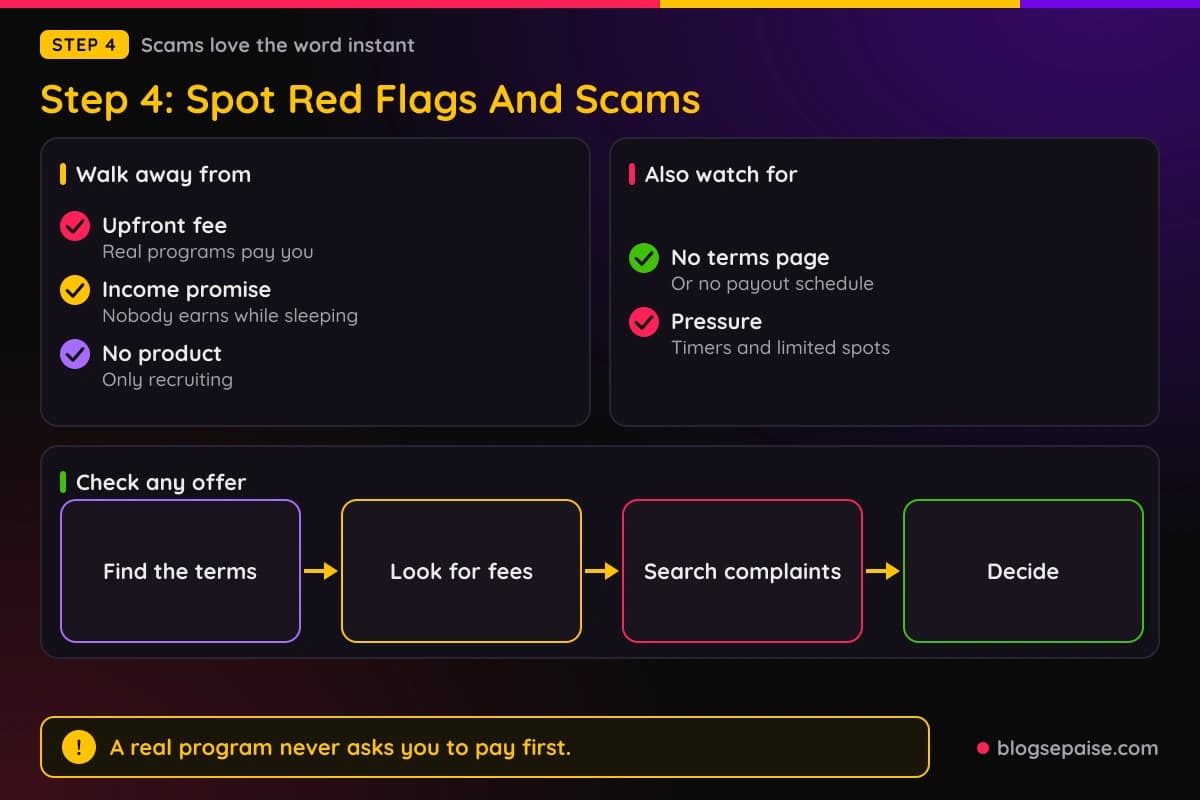
The fourth flag is missing terms. A real program has a terms page, a payout schedule, and a contact address you can find in two clicks.
The fifth flag is pressure. Countdown timers, limited spots, and a push to buy a course today are tools for selling to you, not for paying you.
Scammers can copy the look of real networks, so type the address yourself instead of clicking a link in an email or a chat. Search the program's name plus the word complaints, and look for a pattern of unpaid commissions.
Our page on red flags in affiliate marketing goes through more warning signs. If you have already paid for something doubtful, contact your card company or payment service quickly and keep screenshots of the offer and your receipt.
Step 5: Prepare An Application For Manual Programs
Instant programs are only half of your plan. The better programs still review people, so prepare while the fast ones run.
Start with your site. Publish real posts on one topic and add an about page, a contact page, and a privacy policy.
Add a clear affiliate disclosure near your links. Our page on how to get approved for affiliate programs lists the trust pages reviewers look for.
Finish your profile on every network. PartnerStack says partners who fill out their profile are 75% more likely to be accepted, and CJ's Junction blog says CJ requires a minimum of 250 characters in the profile description.
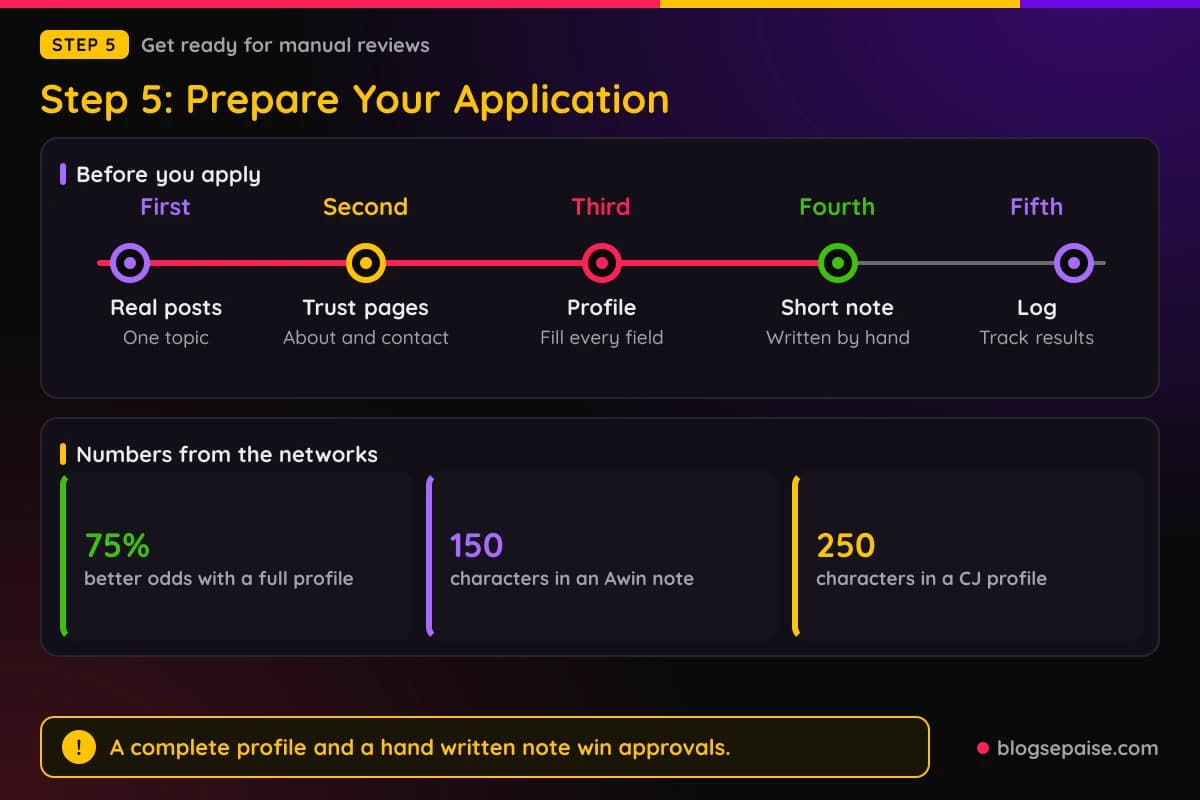
Awin's help center says you can add an optional introduction of up to 150 characters when you apply to an advertiser. Use it to say who you are and how you will promote the brand.
Write that note by hand for each program. A copy and paste line gives the reviewer nothing to approve.
Apply only to programs that fit your site. CJ says advertisers see hundreds, if not thousands, of applications in a week, so a short list of good matches beats a long list of random ones.
Be honest in your application. List every site or channel you really use and the real ways you plan to promote.
PartnerStack's support center says it usually reviews network applications within 5 business days. It also says a business name that matches your email domain helps, so use an address on a domain you own when you can.
Make sure the site you list is live, and keep a simple log of each application, the date, and the result. Our guide on traffic requirements for affiliate networks explains why many networks care about quality.
Step 6: Use Instant Programs To Earn While You Wait
Now put the fast programs to work. Treat them as a training ground while the slower applications are in review.
Pick one or two instant programs, not ten. Too many links make a site look spammy, and you will never learn which ones work.
Choose products that match your best existing posts. A link inside a post that already gets visitors will teach you more than a link in a new post that nobody reads.
Add links where readers need them, such as inside a tutorial step or a short comparison. Put a plain note near the link that says you may earn a commission.
Test every link yourself. Click it from a clean browser, check that it lands on the right page, and confirm that the dashboard counts your click.
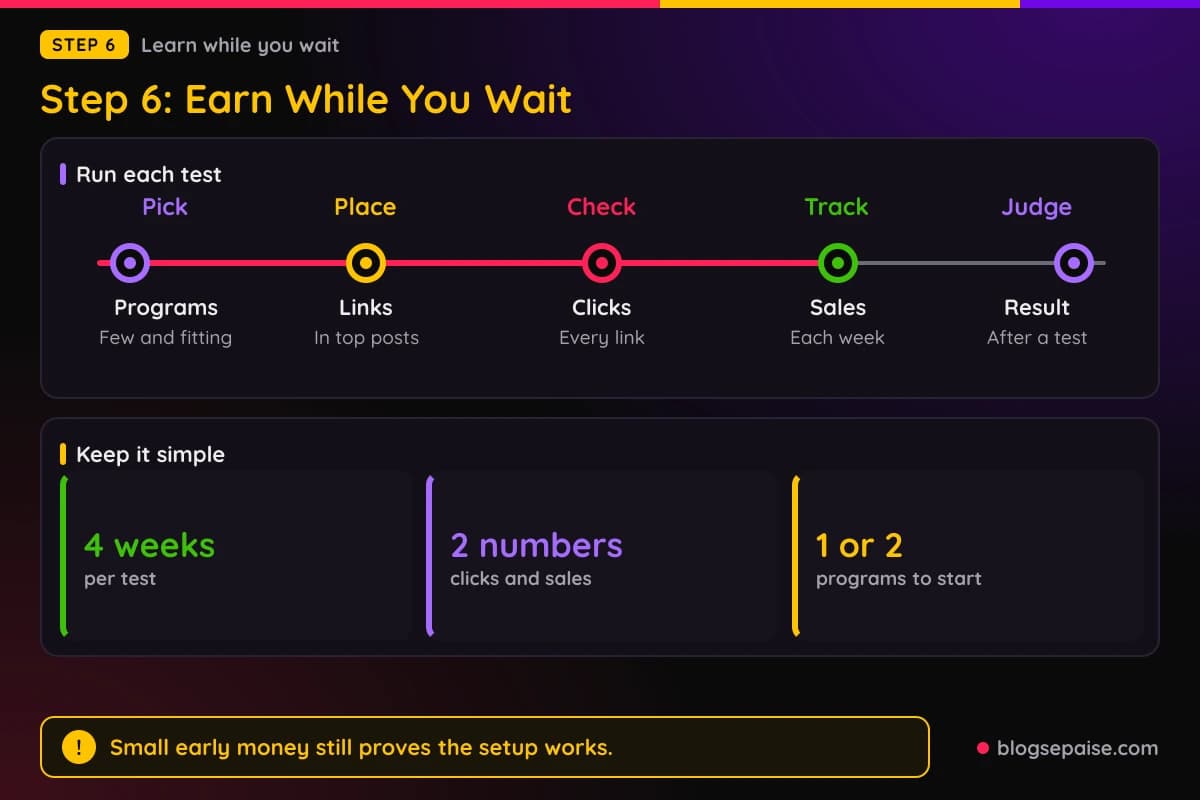
Track two numbers each week: clicks and sales. Clicks tell you if the post draws interest, and sales tell you if the product fits your readers.
Give each test about four weeks before you judge it. A single slow week proves little on a small site.
Do not rely on one program for all your income. Programs can change their terms, and Amazon's help page says it requires at least three qualified sales within the first 180 days.
When the better programs accept you, move your best content to them. Our guide on affiliate marketing platforms can help you choose the next network to add.
Write one post built around the product, such as a how-to that uses it from start to finish. A useful tutorial earns more trust than a list of links.
If a program pays nothing after a couple of months, remove its links. A clean site with fewer links beats a crowded one.
Common Mistakes With Instant Approval Affiliate Programs
Most mistakes come from rushing. People want the quick yes so badly that they skip the checks that protect them.
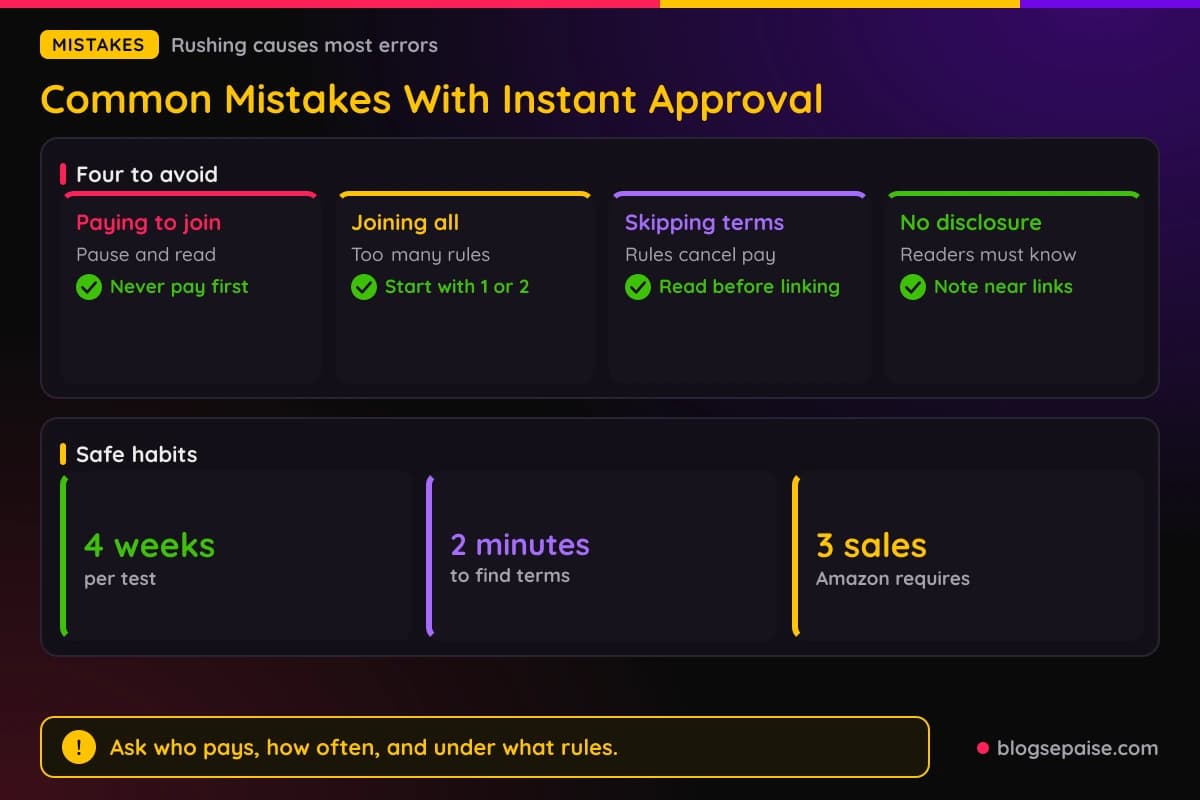
The first mistake is paying to join. Any fee before your first commission is a warning, and you should pause and read the terms.
The second mistake is joining everything. Ten open programs at once means ten sets of rules to follow, and you will break one of them.
The third mistake is ignoring the terms. Programs set rules on things like your own purchases and traffic, and a break can cost you commissions.
The fourth mistake is promoting products you have not looked at. If the product disappoints readers, they stop trusting your recommendations.
The fifth mistake is skipping the disclosure. Readers deserve to know that you may earn a commission, and programs require disclosure.
The sixth mistake is mixing up the account and the partnership. Getting into a network does not mean a brand has accepted you.
The seventh mistake is quitting the slow programs. A no today is not always a no forever, so improve your site and apply again where the program allows it.
The eighth mistake is making your own purchases through your links. Amazon says personal orders do not qualify toward the three sales, and other programs may cancel them too.
The ninth mistake is trusting a list that was never updated. Policies change, so confirm every program on its official page on the day you apply.
A good habit fixes most of this. Before you click join, ask who pays, how often, and under what rules.
If you cannot find those answers in two minutes, move on. The last mistake is judging a program by its first week, so give each test four weeks before you decide.
Final Thoughts
Instant approval is real, but it is narrower than the lists suggest. Some programs approve you automatically, many accept you at the account level only, and the best ones still review each person.
Use the fast yes as a training tool. Join one or two programs that fit your topic, learn how links and dashboards work, and watch for the early signs that readers click.
Stay alert for upfront fees, income promises, and programs with no product. A real affiliate program pays you and does not ask you to pay first.
At the same time, keep building the site that the better programs want to see. Real posts, trust pages, a complete profile, and a short honest application will do more for you than any list of no approval programs.
For more on staying in good standing once you are in, read our page on how to avoid getting banned from affiliate programs.
Frequently Asked Questions
1. What are instant approval affiliate programs?
They are programs that accept your sign-up with no manual review, so you get a working link quickly. Digistore24, for example, says a request to promote a product is usually accepted automatically.
2. Are there affiliate programs with no approval at all?
Some products approve almost anyone. ClickBank's blog says most products are ready to promote right away, but sellers can turn approval on, so check each product.
3. Which networks approve you right away?
No network approves for every brand. Awin and CJ leave each decision to the advertiser, while Digistore24 and ClickBank accept many requests with some exceptions.
4. Does Amazon Associates approve instantly?
Not on the first day. You get an account when you sign up, but Amazon's help page says the team checks your application once you have driven qualified sales, and it requires at least three within the first 180 days.
5. Is instant approval a sign of a scam?
No, but it is a reason to check. Look for upfront fees, income promises, and missing terms before you trust any program.
6. Do I need a website to join?
Many programs ask where you will share links, so check each program's terms. Amazon's help page says it reviews all the Sites you provide, including websites, mobile apps, social network pages, and Alexa skills.
7. How long does a manual review take?
It varies. PartnerStack says its Network team usually reviews network applications within 5 business days, and Awin says approval times vary by advertiser.
8. Why was my application declined?
Programs decide for their own reasons, so read any reply you get. Improving your site and applying only to good matches can help.
9. Can I promote with a free blog or a social page?
Some programs allow it and some do not. Read the terms before you place a link, and ask support when a rule is unclear.
10. How much can I make with instant programs?
Expect small amounts at first. Rates differ, from Amazon's rates of up to 10% to ClickBank sellers who can pay up to 75%.
11. Should I pay for an affiliate program?
No. A real program pays you, so a fee to join is a sign to stop and check.
12. What should I do while I wait for approval?
Keep publishing helpful posts, finish your profile, and test one or two instant programs. That way you have data to include in your next application.
13. Can I be removed after instant approval?
Programs can end a partnership under their terms, so keep reading them.
14. Is it okay to join many instant programs?
It is better to start with one or two. Too many links on a small site make it hard to learn and easy to break a rule.
15. What is the difference between a network and a program?
A network is a platform that connects you with many brands, such as Awin or CJ. A program is a single brand's affiliate offer, and it often has its own approval step.
16. Can a new site with no traffic get approved?
It depends on the program. Each advertiser decides for itself, so build real posts while you test the open ones.