Do Affiliates Get Paid For Clicks? 4 Pay Models Explained
Short answer first. In most affiliate programs, a click on your link does not earn you anything by itself.
You get paid when a reader does something the company wants, like buying a product, joining a list, or starting a free trial. The click is the road that gets them there.
Pay per click does exist, but affiliate glossaries describe it as the less common model. Beginners hear the phrase and mix it up with ads, which is an easy mistake to make.
The steps below explain pay per sale, pay per lead, pay per click, and recurring pay in plain words. You will also see how CPA and CPS differ, what EPC means, and how click fraud rules work.
A mistakes section and a short FAQ close the page. Terms change by program, so always check the current rules before you join.
Disclosure: Some of the links I share might be affiliate links. If you click on one and make a purchase, I may earn a small commission as a thank you. But don’t worry, it won’t cost you anything extra. I only recommend stuff I genuinely believe in. Your support helps me keep creating awesome content. You can read my full affiliate disclosure in my disclaimer page.
If you want to save a lot of hours searching for high-paying affiliate programs, check out our exclusive list of 2500+ affiliate programs. You’ll find all the information about the programs inside the list. This list is perfect for affiliate bloggers and influencers.
Do Affiliates Get Paid For Clicks? The Short Answer
Usually not. Affiliates get paid when a visitor completes a result that the company wants, and a click alone does not count.
A company runs an affiliate program to win customers. It pays you for the customer, not for the visit.
Think of a click as a door opening. The company only pays when someone walks through the door and does the thing it hoped for.
That result can be a purchase, a form fill, a free trial, or an app install. Each one is a different pay model with its own name and its own math.
Some programs do pay per click. Glossaries call it the less common model, so read the terms closely if you see one.
So the honest answer has two parts. Most affiliates earn from sales, leads, and actions, while click based payouts are the exception.
Beginners often hear pay per click and think of ads. Search ads work that way, where the advertiser pays the platform for each click.
Affiliate marketing is different. The advertiser pays you after a result, and that is why a thousand clicks can earn you nothing.
Earning nothing from a thousand clicks stings the first time it happens. It teaches a useful lesson about what a link is really worth.
Your goal is to send readers who are ready to act. A hundred right-fit readers can pay more than a thousand random ones.
Our guide on what is affiliate marketing covers the basics if you are brand new. Come back here when you want the pay details.
A good test is simple. Before you join, ask what exactly must happen for the company to pay you.
Why Most Affiliate Programs Do Not Pay For Clicks
Companies pay for results they can measure and value. A click tells them very little about how much you helped their business.
Clicks are also easy to fake. A script or a bot can create a lot of clicks quickly.
If a company paid for every click, it could end up paying for traffic that never buys anything.
Results are harder to fake. A real order needs a real payment, and a real lead needs a working email address or phone number.
Companies also want the math to work. If a customer is worth a set amount to the business, it can share part of that, but it may not afford to pay for every curious visitor.
Paying on results shifts the risk to you. If your readers do not act, you earn nothing, and the company loses nothing.
That trade is why affiliate marketing is called performance marketing. You are paid for performance, not for effort.
Some companies may pay for clicks in special cases. If they do, expect them to watch the traffic closely.
Low quality clicks can be rejected, so read the terms for how they are judged.
Think about it from the company's side. Every dollar it pays out must come back as profit.
Amazon shows the standard way. It pays a commission on qualifying purchases, with standard rates in its fee table that run up to 10% depending on the product category.
A click on an Amazon link pays nothing by itself. You earn on qualifying items after the customer buys.
The same logic shows up in many programs. Learn the logic once and every program gets easier to read.
Step 1: Learn The Four Main Ways Affiliates Get Paid
Programs tend to fit into four pay models. Pay per sale, pay per lead, pay per click, and recurring pay cover the main ones.
Pay per sale gives you a share of an order. The share is a percentage of the price or a fixed amount for each sale.
Pay per lead gives you a fixed fee when a reader hands over contact details. A quote request or an email sign-up are common examples.
Pay per click gives you a fee for each click. Affiliate glossaries describe it as the less common model, and it is the one many people ask about.
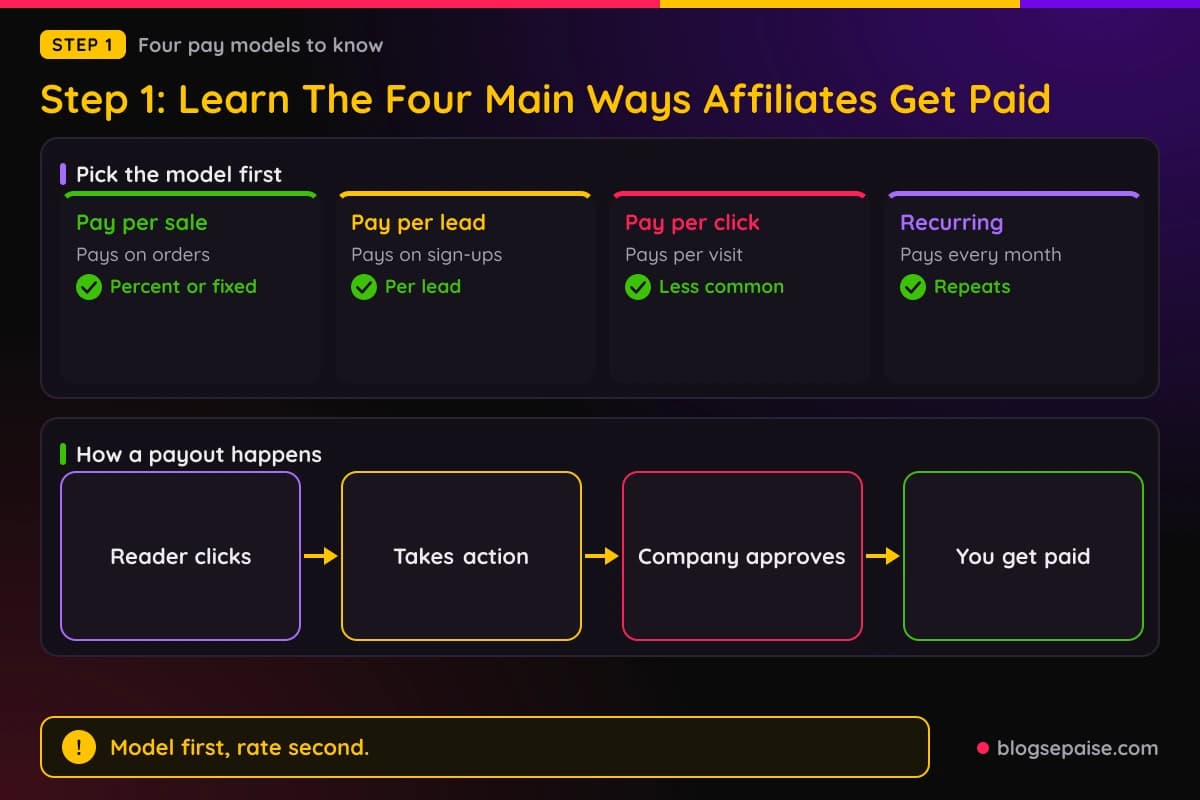
Recurring pay gives you a share of every payment a customer makes. It can show up with software that bills each month or each year.
Some programs mix models. A company might pay a flat fee for a free trial and a bonus if the person later buys.
You may also see pay per install, which pays when someone installs an app, and pay per call, which pays when someone phones a business. Both are close to pay per lead.
The model sits in the program terms, usually near the commission rate. Look for words like per sale, per lead, per action, or recurring.
Networks use short names for these models. CPS means cost per sale, CPL means cost per lead, CPC means cost per click, and CPA means cost per action.
Cost is the advertiser's view of the deal. For you, the same number is your payout.
Pick programs by model before you pick them by rate. A high rate on a model your readers cannot trigger is worth nothing.
Write the model next to each program in your notes. It takes a minute and saves you from mixing offers up later.
Our page on recurring vs one-time commissions goes deeper on the fourth model.
Step 2: Pay Per Sale Explained
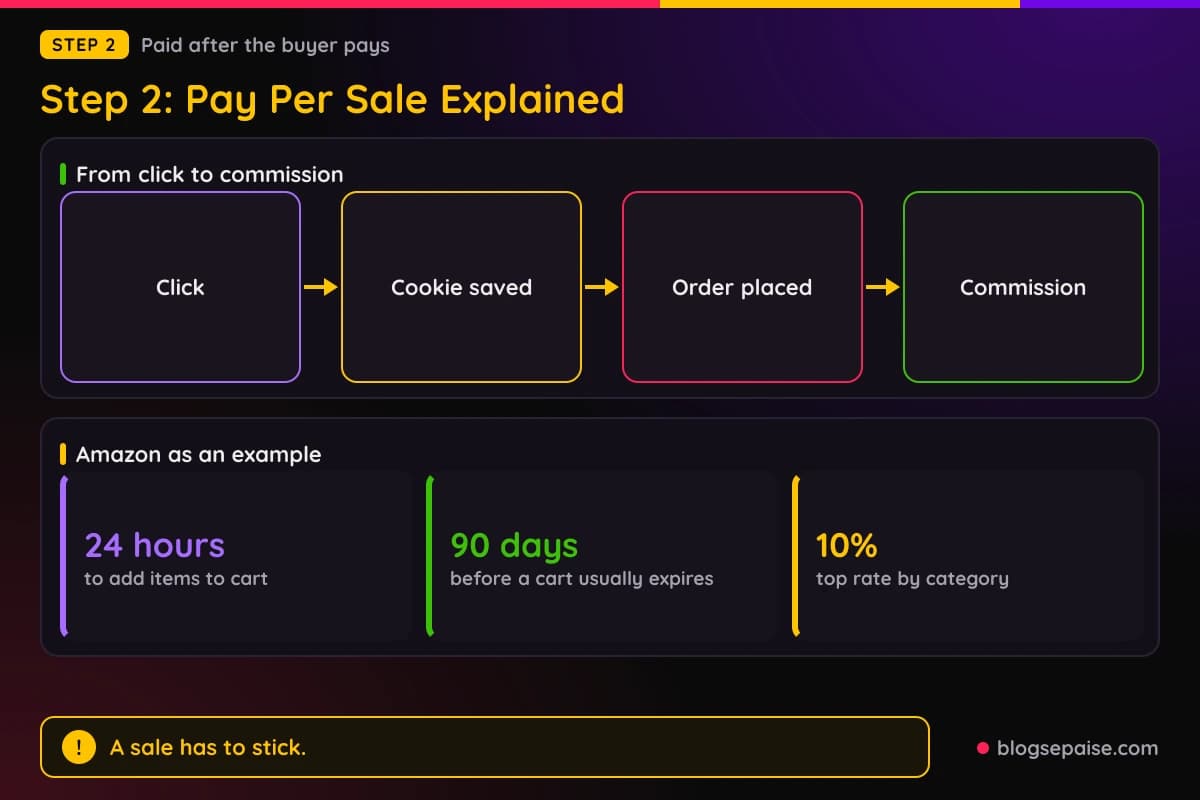
Pay per sale is the most common model in affiliate marketing. You send a reader, the reader buys, and you earn a commission.
The commission can be a percentage of the sale price. For example, a program that paid 8% on an $80 order would pay $6.40.
Some programs use a flat amount instead. You earn the same fixed fee on every sale, no matter the price.
The sale has to stick. If the buyer returns the item or cancels, most programs take the commission back.
Our post on returned items and affiliate commissions explains how those reversals work. Read it before you count any money as yours.
Some programs also set a lock period, the time when a sale can still be reversed. Pay arrives after that period ends.
A click starts the process, but a cookie keeps track of the buyer. If the buyer comes back within the cookie window and buys, you may still earn.
Amazon uses a short window. You earn on qualifying items that a customer places in the shopping cart within 24 hours of arriving through your link, and Amazon says the cart expires usually after 90 days.
Other programs use different windows. The window is written in the program terms, so read it.
Pay per sale suits readers who are close to buying. Reviews, comparisons, and best-of lists attract those readers.
Pay per sale ties your pay to a real purchase. Check the terms to see how the company treats its affiliates.
The downside is patience. You can send a lot of traffic and see nothing until readers decide to buy.
Step 3: Pay Per Lead Explained
Pay per lead pays you when a reader becomes a lead. A lead is a person who gives a company a way to contact them.
A lead might be an email sign-up, a quote request, a demo booking, or a filled form. The company decides which actions count.
Payouts for leads can be a fixed amount. For example, a program might pay $4 for each valid lead, no matter what the person buys later.
Lead deals can fit fields where a sale takes a long time, such as insurance or education. Check the program terms to see what counts as a lead.
Lead programs have rules about quality. A lead with a fake email or a repeat sign-up from the same person is rejected.
The upside is speed. A reader can finish a form in a minute, so you see results faster than with a sale.
The downside is lower pay per action. A lead pays less than a sale, so you need more volume to hit the same income.
Lead programs can have rules about where traffic comes from. Read the terms for banned sources before you promote.
Free trials sit between a lead and a sale. Some software companies pay when someone starts a trial, and others wait until the person pays.
Pay close attention to who counts as a valid lead. Some programs only accept leads from certain states or countries.
Keep your promises clear on the page. If a form says free quote, the reader should not meet a surprise sales call.
Step 4: Pay Per Click Explained
Pay per click means the company pays you for each click on your link. It does not matter if the visitor buys or leaves.
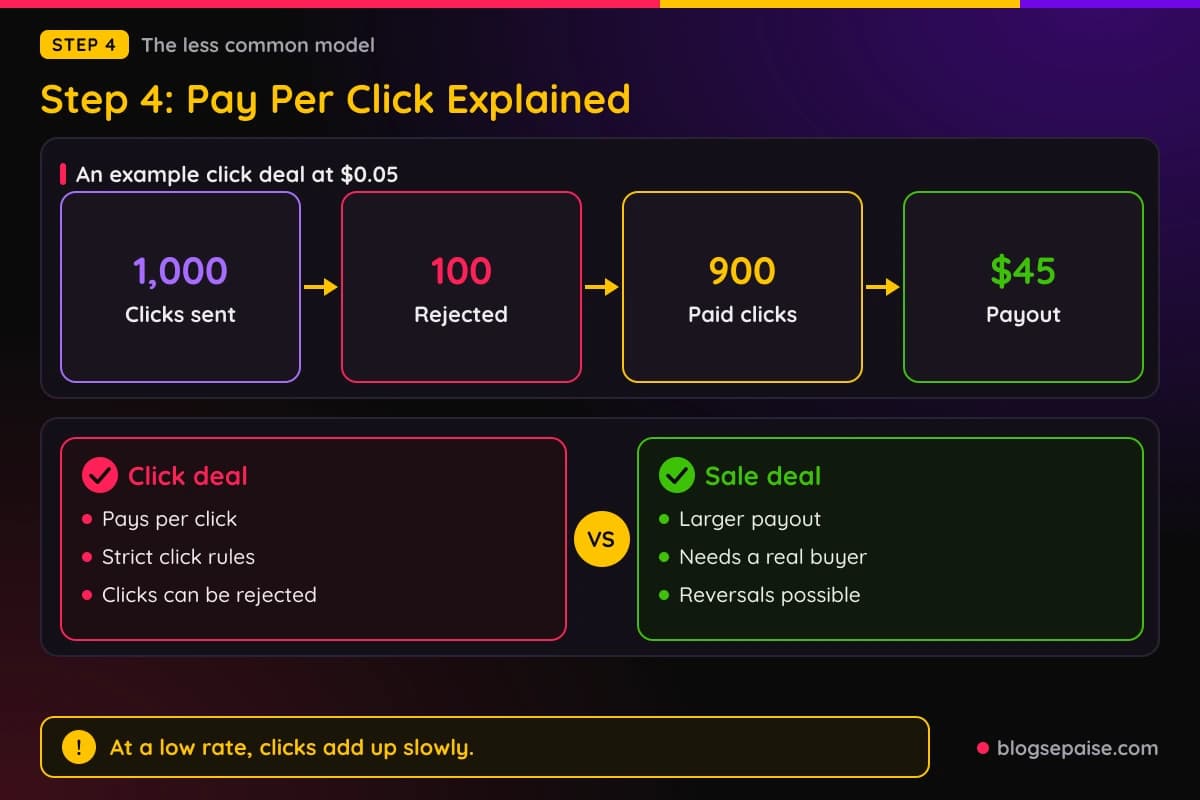
Click rates are set by each program. As an example, a deal that paid $0.05 per click would pay $50 for 1,000 clicks.
Clicks must be real people, and the program decides which ones count. Read the click rules before you agree to anything.
Companies can cap or reject clicks they dislike. In our example, if 100 of 1,000 clicks were flagged as invalid, you would be paid for 900, which is $45 at five cents.
Ad networks that pay publishers per click are not affiliate programs. Ads on your page pay by click or by view, and that is a separate income stream.
Be careful with sites that promise easy money for every click on a short link. Check who runs the site and read the terms before you share anything.
A real pay per click affiliate deal comes from a company you can name. It has a contract, clear click rules, and a payout date.
Even then, expect the company to track what the clicks do. If clicks never turn into any action, it may change the deal.
Pay per click may fit when a new company wants awareness and pays for traffic from sites it trusts.
For a beginner, it can be a weak starting point. The rules can be tight and the payout per click is usually small compared with a sale.
You will earn more by picking a sale or lead program and learning to send ready buyers.
Keep records of every deal you accept. Save the terms, the rate, and the date, so you can settle any dispute later.
If a click deal ever asks you to pay first, walk away. Real partners pay you, not the other way around.
Step 5: Affiliate Pay Per Click Vs Pay Per Sale
Affiliate pay per click vs pay per sale comes down to risk and reward. Who carries the risk, and who gets the bigger reward?
With pay per click, you carry little risk. You get paid for the visit even if nobody buys.
The reward per click is small compared with a sale in our example. A low rate will not grow into real income unless you have a lot of traffic.
With pay per sale, you carry more risk. You earn nothing until a reader buys.
The reward is larger. One sale can pay what hundreds of clicks would pay.
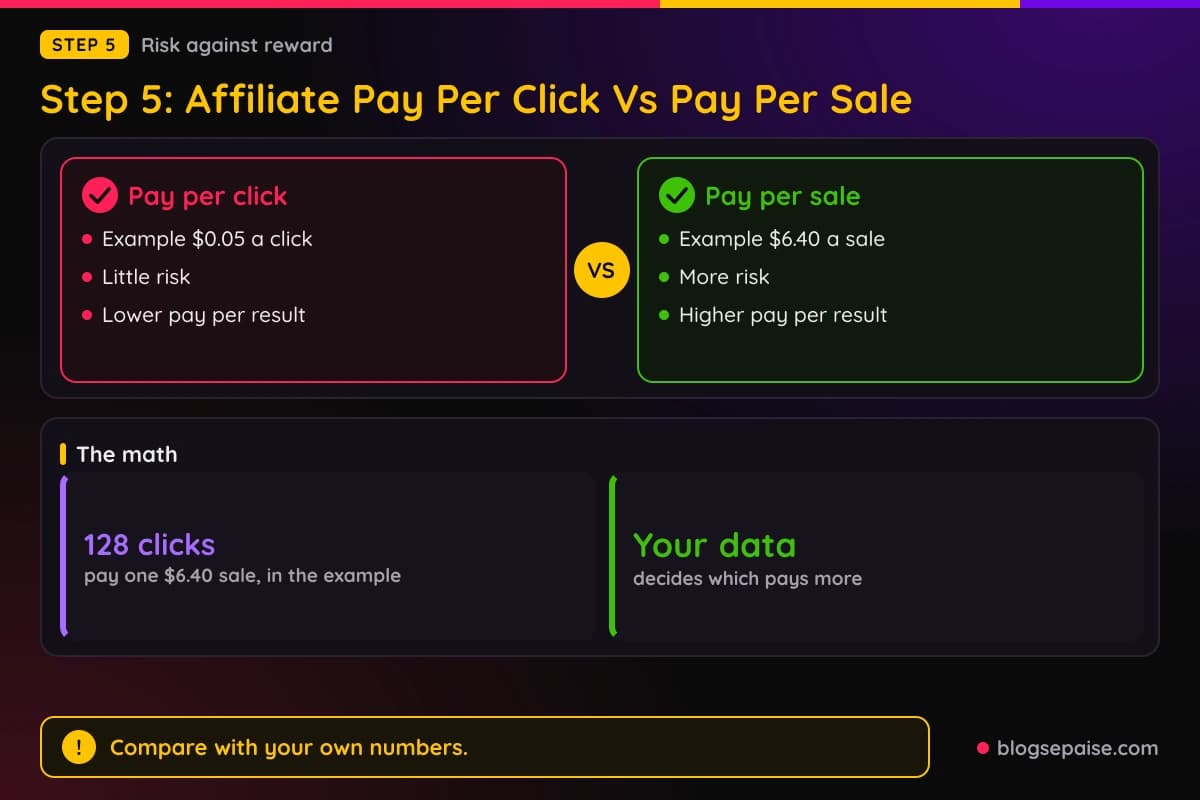
Look at the numbers in plain terms. A $6.40 commission equals the pay from 128 clicks at five cents each.
If one in 50 clicks becomes a sale, the sale model pays more in this example. If fewer than one in 128 clicks becomes a sale, the click model pays more.
Buy rates differ by niche and by site. Our guide to affiliate conversion rate benchmarks shows how to judge yours.
Pick pay per sale when your content helps people choose. Pick pay per click only when a partner offers it and the terms are clear.
Step 6: CPA Vs CPS In Affiliate Marketing
CPA vs CPS can be confusing at first. The letters stand for cost per action and cost per sale.
CPS pays when a sale happens. A shopper buys, and you earn a percentage or a fixed fee.
CPA pays when a set action happens. The action can be a sale, but it can also be a sign-up, an install, or a free trial.
So CPS is one kind of CPA. Affiliate glossaries describe CPA as the wider label and CPS as the narrow one.
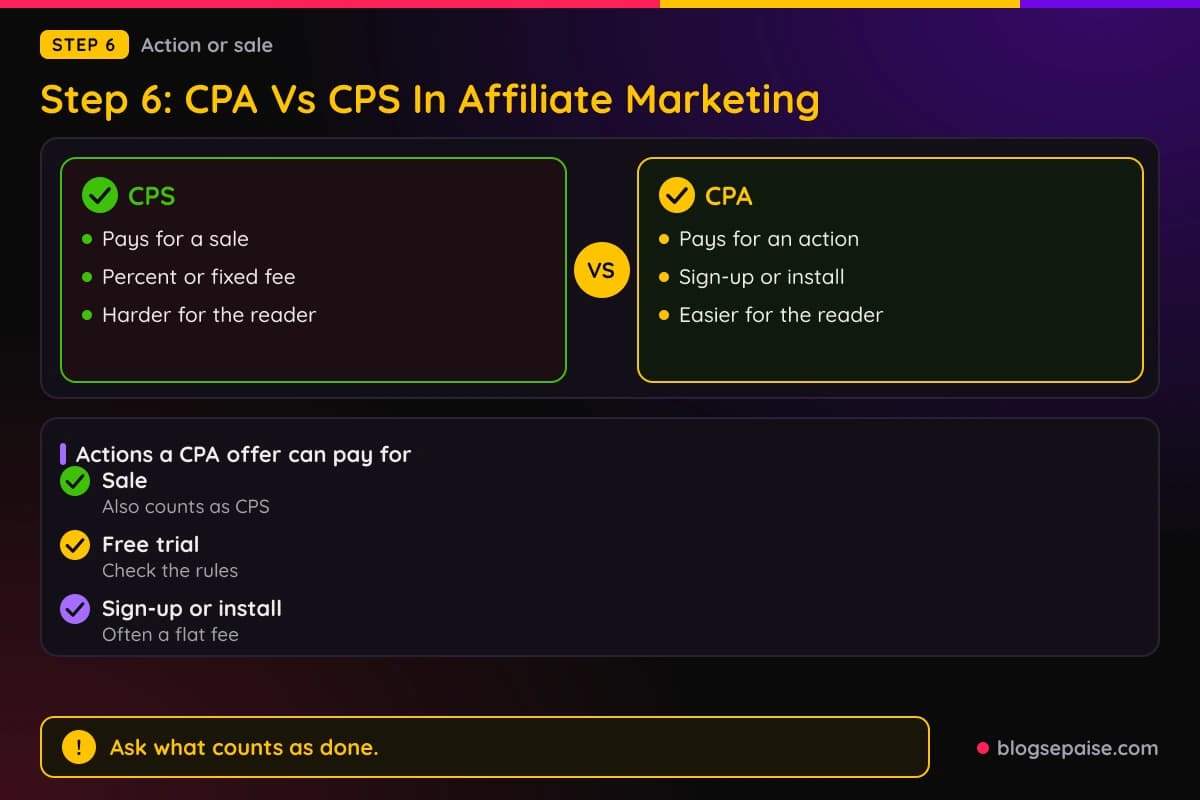
Other networks use CPA to mean a flat fee per action, and CPS to mean a percentage of a sale. Check how the network you use defines each word.
Fixed fee CPA offers are easy to model. You know you will earn the same amount every time the action happens.
Percentage CPS offers grow with the cart. A bigger order pays you more, so high priced products can pay well.
CPA actions are usually easier for the reader. Signing up for a free trial takes less courage than spending money.
CPS actions are harder for the reader but pay more. You need readers who are ready to spend.
Hybrid deals reward the first action and the later sale. Check the terms for how each part is paid.
Read the action definition closely. A trial might need a credit card, a minimum use time, or a verified email before it counts.
A good rule is to ask what the company counts as done. If you cannot find the answer, email the affiliate manager.
Step 7: Read EPC The Right Way
EPC stands for earnings per click. It is a number, not a payment.
You find it by dividing your total earnings by your total clicks. If you earned $128 from 1,000 clicks, your EPC is about $0.13.
Networks and programs show EPC to help you compare offers. A higher EPC means each click has earned more, on average.
People mix EPC up with pay per click. The two share a word, but they point in opposite directions.
Pay per click is what the company pays you for a click. EPC is what your clicks ended up earning.
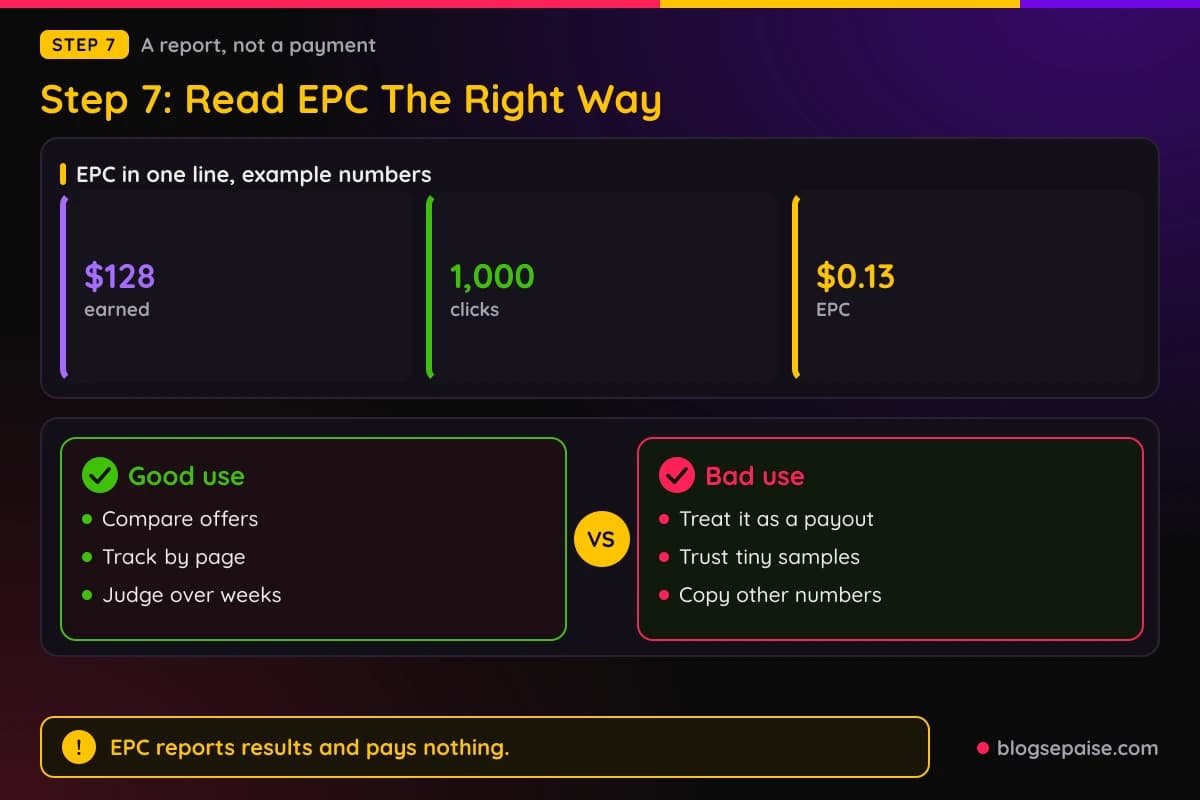
EPC helps you compare different pay models fairly. A lead offer and a sale offer have different payouts, but EPC puts them on the same scale.
Say a lead offer earns you $0.24 per click and a sale offer earns $0.13. The lead offer is better for your traffic, even though a sale looks bigger on paper.
Be careful with EPC figures that other affiliates report. They come from different traffic, and networks define EPC a little differently, so check the definition in your network's help center.
A tiny sample also misleads. If a few clicks led to one big sale, the EPC looks great but means little.
Use EPC over weeks, not days. A small number of clicks can mislead you.
Track your own EPC by page. A post with a high EPC deserves more traffic, and a post with a low EPC deserves a rewrite.
Our commission earnings estimator can help you run quick math on clicks and rates.
Step 8: See How A Click Turns Into A Sale
A click is the first link in a chain. Following the chain shows you where money can leak out.
First, a reader clicks your link. The link carries your affiliate ID, so the company knows who sent the visitor.
Second, the site stores a cookie in the reader's browser. The cookie remembers you for a set time, called the cookie window.
Third, the reader browses, compares, and maybe leaves. Some readers come back later.
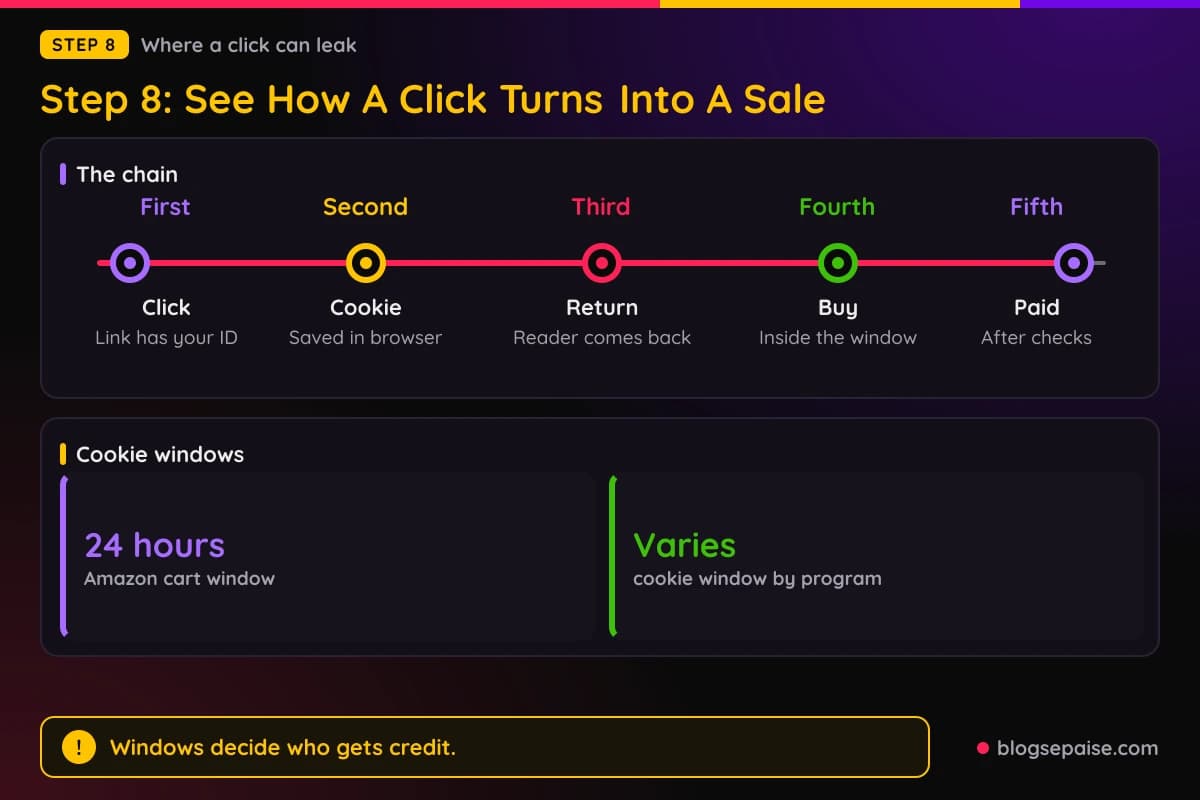
Fourth, the reader buys within the window. The system reads the cookie and credits you with the order.
Fifth, the company checks the order. It waits for payment, delivery, and the end of the return period.
Last, the commission is approved and paid on a schedule. Payout schedules differ by program.
Cookie windows differ by program. Short windows reward fast buyers, and long windows reward slow shoppers.
Our guide on why cookie windows matter shows how window length changes your income.
Some clicks never get credited. A browser that blocks cookies, a reader who switches devices, or a coupon site can all break the chain.
That is normal, so treat reports as a good estimate, not a perfect record.
Amazon shows how strict a window can be. Under its cart rule, an item has to be in the cart within 24 hours of the click.
A longer window gives you more room. A short one means your content must push readers to decide quickly.
Step 9: Know The Click Fraud Rules
Click fraud means creating clicks that are not real interest. Bots, click farms, and tricks that force clicks all count.
Companies dislike it because it costs them money. They put rules in their terms to stop it.
Never click your own affiliate links to earn. Even one test click can look odd if it comes from your own device.
Do not buy through your own link either. Amazon, for example, says personal orders do not qualify.
Do not pay people to click or buy. Check each program's terms, since reward schemes for clicking can break the rules.
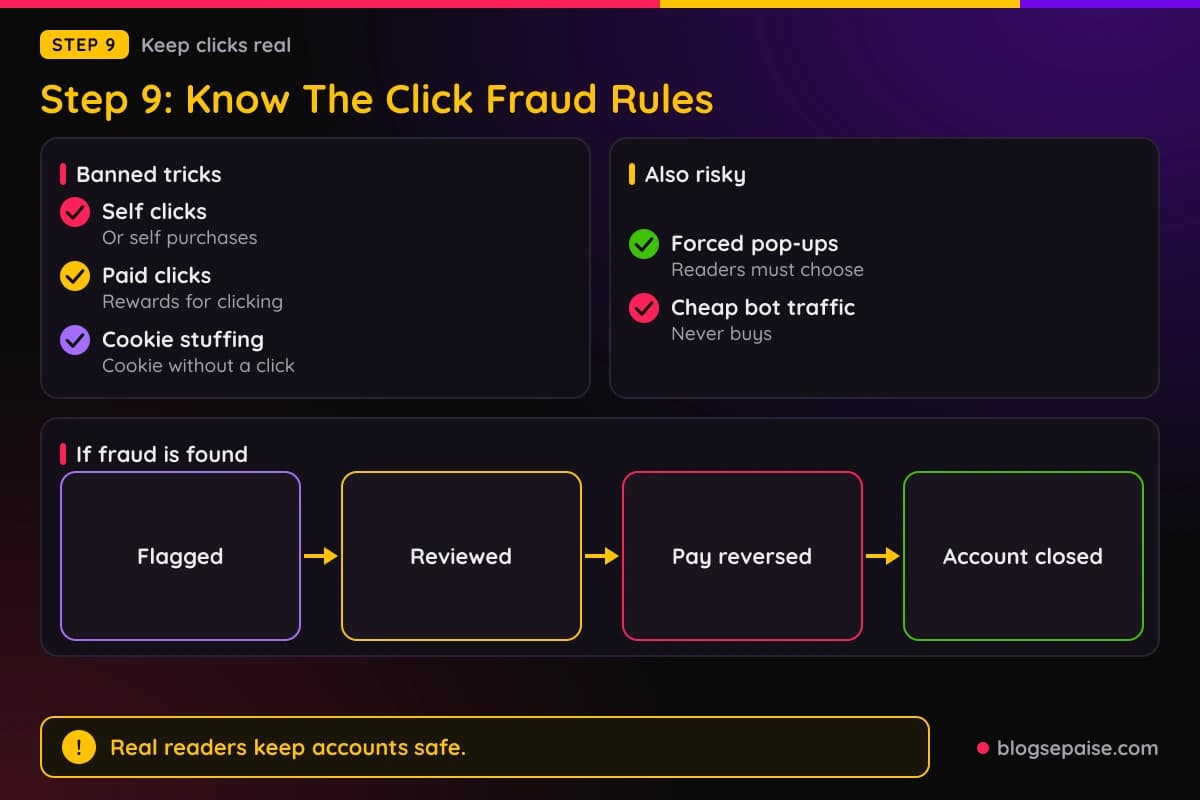
Cookie stuffing is another banned trick. It drops your cookie on a visitor who never clicked anything.
Hidden links, auto-redirects, and pop-ups that force a click also break the rules. Readers must choose to click.
Networks may watch for odd patterns. Thousands of clicks with zero buyers, or many clicks from one address, can look like fraud.
When a program finds fraud, it can reverse commissions, hold payments, or close the account. The terms spell out what it does.
Honest affiliates can get hurt by bad traffic too. If you buy cheap traffic, you may pay for bots without knowing.
Stay safe by using real readers from real content. Read the traffic rules of each program before you promote.
Our page on how to avoid getting banned from affiliate programs lists the habits that keep an account healthy.
Clean traffic is also better for your income. Real readers can click, read, and buy, and fake ones cannot.
Step 10: Pick The Right Pay Model As A Beginner
Choose a model that fits how your readers behave. The best model for you is the one your content can trigger.
If you write product reviews, start with pay per sale. Readers of a review may be closer to buying.
If you write how-to guides for software, look at recurring pay. A guide can bring a reader who stays a customer for months.
If you write about money, school, or services, check pay per lead. Some readers in those topics may want a quote or a call, not a cart.
Skip pay per click as your main plan. Keep it as a side option if a partner offers a clear deal.
Compare programs by EPC and by the full terms. A lower rate with a better buy rate can beat a high rate no one hits.
Check the cookie window and the reversal rules. A long window and fair rules make the same traffic worth more.
Look at payment terms. Minimum payouts, schedules, and fees can slow your money.
Start with two or three programs, not twenty. A small test teaches you more than a big list.
Run each test for a month or two. Then keep the models that pay and drop the ones that do not.
Check affiliate network traffic requirements before you apply, since some programs want a certain level of traffic.
Write down your results each month. A simple sheet of clicks, actions, and earnings is enough.
Talk to the affiliate manager when you can. A short email about your site often gets you better terms or tips.
Common Mistakes About Affiliate Pay
The biggest mistake is expecting pay for traffic. Readers who click and leave earn you nothing in most programs.
Another mistake is chasing the highest rate. A 50% commission on a product no one buys pays less than 5% on a product everyone wants.
A common slip is ignoring the cookie window. A short window can hide lost sales.
Be wary of sites that promise pay for clicks. Check who runs the site and read user reviews before you share anything.
Others confuse EPC with a payout. EPC is a report on your results, not money the company owes you.
Buying cheap traffic is another trap. Low cost clicks can come from bots, and a bot never buys.
Skipping the terms causes plenty of pain. One banned traffic source can cost you a month of commissions.
People also forget about reversals. Counting money before the lock period ends leads to nasty surprises.
A final mistake is quitting too early. Results can take a few months of content.
Some people judge a program by one bad week. Give each offer enough clicks to show a real pattern, then decide.
Fix these habits early and the rest gets easier. Keep a simple log and read your program terms every few months.
Final Thoughts
So, do affiliates get paid for clicks? Rarely, so a click deal is a shaky base for a plan.
Most affiliates earn from sales, leads, actions, or recurring payments. The click starts the path, and the result pays the bill.
Learn the four models, read the terms, and watch your EPC. Those three habits keep you from chasing the wrong offers.
Pick a pay model that fits your readers and test it for a month or two. Let the numbers tell you what to keep.
Keep your traffic clean and your links honest. Real readers make real money, and fake clicks make trouble.
Next, read about recurring vs one-time commissions to see which pay style builds income over time.
Keep this page handy when you compare programs. The four models and the EPC math will save you hours.
Frequently Asked Questions
1. Do affiliates get paid for clicks?
Most do not. Programs usually pay for sales, leads, or actions, and click based deals are the exception.
2. How do pay per click and pay per sale differ?
Pay per click pays for each visit, while pay per sale pays after a purchase. Compare the real numbers for each offer to see which pays more.
3. How does CPA differ from CPS?
CPS pays for a sale, and CPA pays for a set action such as a sign-up or install. Many networks treat CPS as one kind of CPA.
4. Does Amazon pay affiliates for clicks?
No. Amazon pays a commission on qualifying purchases, with standard rates up to 10% by category.
5. How much does a click pay when a program does pay for clicks?
Each program sets its own rate, and the company may reject clicks it sees as invalid.
6. How do I read EPC?
EPC is total earnings divided by total clicks, though networks define it a little differently. Use it to compare offers, but judge it over weeks, not days.
7. Is pay per lead better than pay per sale for beginners?
Leads and sales pay differently, so the better pick depends on your readers. Test both and compare your own numbers.
8. Can I get banned for fake clicks?
Yes. Programs can reverse commissions and close accounts when they find bots, self clicks, or forced clicks.
9. How long does an affiliate cookie last?
Cookie windows differ by program. Amazon uses a 24 hour window for items placed in the cart.
10. Does recurring pay count as pay per sale?
It is a cousin of pay per sale. You earn a share each time the customer pays, not just once.
11. Why did my clicks earn nothing?
Clicks only earn when readers complete the paid action. Check the cookie window, the action rules, and the match between your traffic and the offer.
12. How do I pick a pay model?
Match the model to your content. Reviews fit pay per sale, software guides fit recurring pay, and service topics fit pay per lead.