Recurring Vs One-Time Commissions: Which Payout Model Fits You
Two affiliate offers can look equal on the surface and pay you in very different ways. One gives you a flat $60 when a reader buys.
The other gives you 20 percent of a $30 monthly plan, which is $6 every month for as long as that customer stays.
Which one is better? The honest answer is that it depends on how long customers stay, how fast you need cash, and what the program rules say about cookies, holds, and payout minimums.
A big percentage on a sign-up page tells you very little by itself.
In this guide you will follow seven steps to compare payout models and pick which one to promote first.
You will learn the two models in plain words, map when the money really arrives, check cookie windows, read payout thresholds and hold periods, do the lifetime value math, compare lifetime and limited recurring deals, spot the times a one-time offer wins, and make a first pick.
One note before we start. Program terms change, and they differ a lot from one company to the next.
Every dollar figure below is a round number picked to make the math easy to follow, so treat each one as a worked sample and check the current terms of any real program before you plan around it.
If you are still new to the whole space, our guide to your first 30 days in affiliate marketing is a good warm-up.
When you are ready to run your own numbers, the commission earnings estimator can help you test a few cases.
Disclosure: Some of the links I share might be affiliate links. If you click on one and make a purchase, I may earn a small commission as a thank you. But don’t worry, it won’t cost you anything extra. I only recommend stuff I genuinely believe in. Your support helps me keep creating awesome content. You can read my full affiliate disclosure in my disclaimer page.
If you want to save a lot of hours searching for high-paying affiliate programs, check out our exclusive list of 2500+ affiliate programs. You’ll find all the information about the programs inside the list. This list is perfect for affiliate bloggers and influencers.
The Two Payout Models In Plain Words
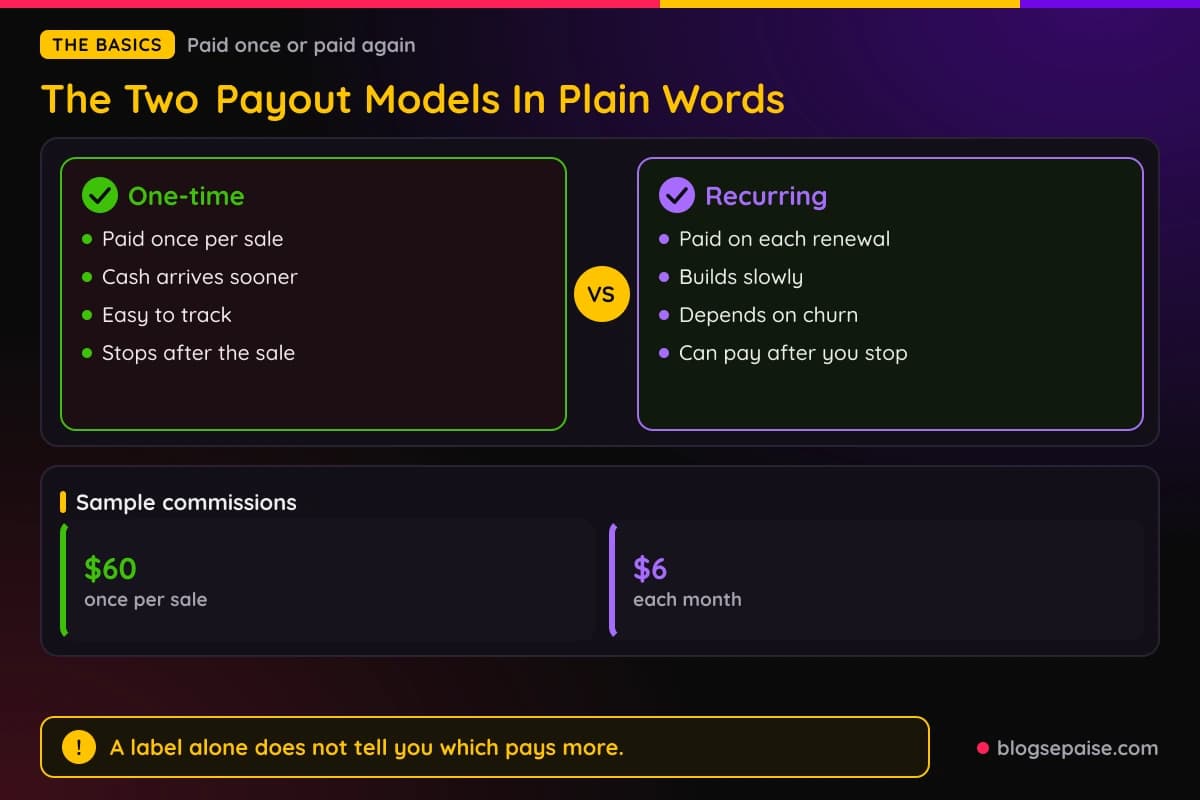
A one-time commission pays you once per sale. A reader clicks your link, buys, and you earn a flat amount or a percentage of that first order.
If the same person buys again later, you may or may not earn again, and the program terms say which.
A recurring commission pays you again each time the customer pays.
It shows up most often with software and other subscription products, such as email tools, hosting, design apps, or online courses billed monthly.
You may also hear it called subscription affiliate commissions, since the payout follows the subscription.
Some people call the one-time kind a flat payout and the other kind a recurring payout. When you see the phrase flat vs recurring payout, it just means a single payment versus a stream of smaller ones.
Both are real, and neither is a trick.
Here is the simple picture. A one-time offer is like selling a lamp.
You hand it over, you get paid, and the story ends. A recurring offer is like renting a room.
The income is smaller each month, but it keeps arriving while the tenant stays.
Notice that the label alone does not tell you which pays more. A $60 flat payout can beat a $6 monthly payout for the first nine months and then lose after that, depending on how long people stay.
Your job is to find the point where the lines cross for your own audience.
There are also mixed models. Some programs pay a bigger first commission and a smaller one on renewals.
Others pay recurring only for a set number of months, and a few pay for the life of the account. We will cover those later, since they change the math in a big way.
Another detail matters early. Annual plans can count as recurring too, yet they pay once a year.
A program that renews yearly will feel much more like a one-time deal for the first twelve months, so always check how often the customer is billed.
Finally, remember that a product can be one-time for the customer and still be recurring for you, or the other way around. A course sold once might pay you once.
A tool billed every month might pay you every month. Read the affiliate terms, not just the product page, because the terms are what pay you.
Step 1: Map When The Money Actually Arrives
The first thing most beginners check is the rate. A better first check is the calendar.
Money that arrives in six weeks and money that arrives over two years feel very different when you have bills to pay.
Start by tracing one sale from click to bank account. A reader clicks your link, buys, and the sale is tracked.
Then the program usually waits through a validation or hold period, in case the buyer asks for a refund. After that, the money moves into your balance, and then it waits for the next payout date.
Let us put sample numbers on it. Say the hold is 30 days and the program pays on a monthly cycle.
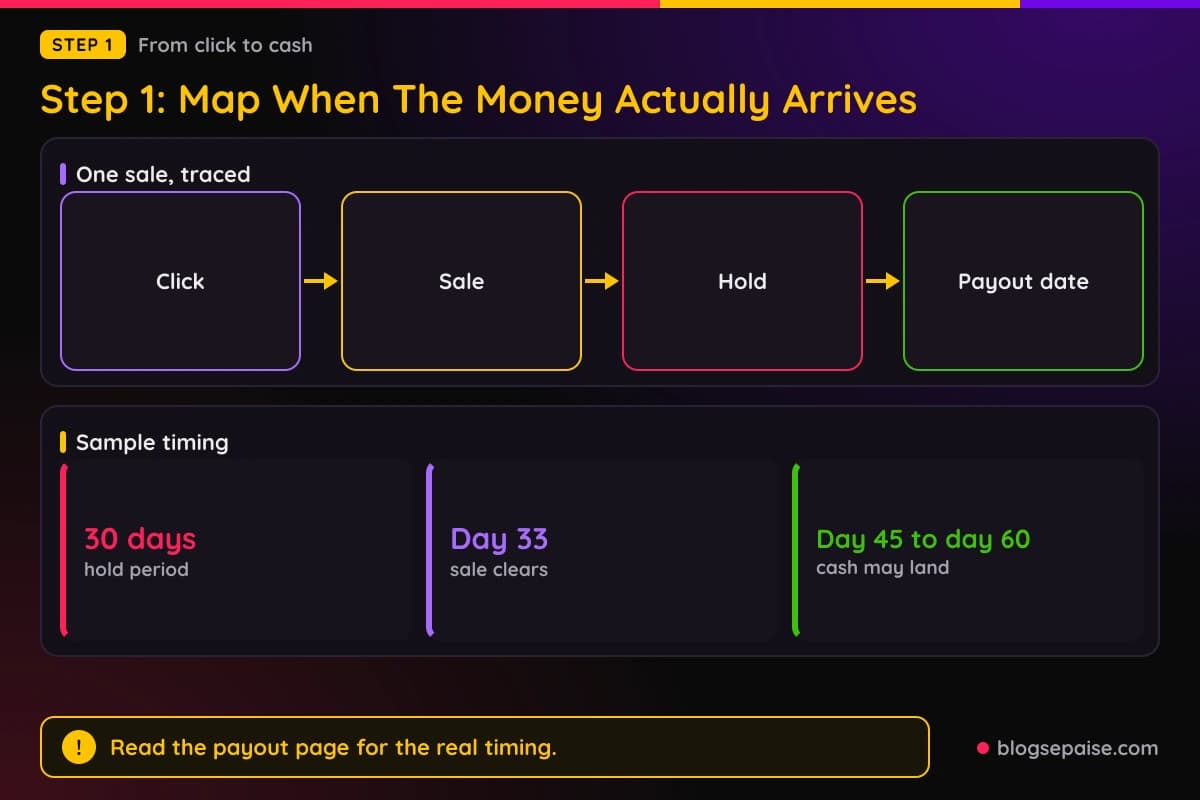
A sale on day 3 clears on day 33, and it may then wait for the next payout date, so you might see cash around day 45 to day 60. Real programs vary, so read the payout page for the real timing.
For a one-time commission, that is the whole story. You earn the full amount once, and it lands after the hold and the payout cycle.
If you stop writing tomorrow, you still got paid for that sale.
For a recurring commission, the first payment follows the same path, but it is smaller. Then each renewal triggers its own small payment, and each one has its own hold and payout timing.
The stream is slow at the start and builds as more customers pile in.
That slow start matters. If you have one recurring sale in month one, your balance is tiny.
If you have one one-time sale in month one, your balance may already hit the minimum. That gap is the main reason beginners feel discouraged by recurring offers early on.
On the other side, recurring income can smooth out your months. A site that has earned 40 recurring customers over a year has a base of payments before it writes a single new post.
A one-time site resets to zero every month and has to sell again.
Write down your own cash need. If you want to cover a hosting bill within three months, you probably want at least one offer that pays up front.
If you can wait a year, a recurring offer can build a base that keeps paying.
Many successful publishers mix both. They promote a one-time offer for quick wins and a recurring offer for the long game.
We will come back to that mix in the last step.
Also keep in mind that traffic builds slowly for new sites. Our post on the slow start mentality explains why the first months rarely look like the later ones, and that fits the recurring story well.
Step 2: Check Cookie Windows And Attribution
A cookie window is the time between a click on your link and a purchase that still pays you. If the window is 30 days, a reader who clicks today and buys on day 29 counts.
A reader who buys on day 31 does not, unless something else ties the sale back to you.
Windows vary a lot. Some programs offer a day or two, some a few weeks, some 60 or 90 days, and some track by account instead of by cookie.
Never assume. The cookie length sits in the program terms, and it can change.
Why does this matter for the payout model? Recurring offers usually rely on the first click only to start the relationship.
After the customer signs up, the program ties that account to you, so you keep earning on renewals even when the cookie is long gone. Check that the terms say so in plain words.
One-time offers often rely on the cookie for the entire sale. If your readers take a week or two to decide, a short window can quietly cost you commissions.
Expensive products usually have longer decision times, so a short window hurts more on big purchases.
Think about how your readers behave. A person choosing a free trial of an email tool may sign up the same day.
A person choosing a course that costs hundreds of dollars may read three more posts first. Match the window to the buying habit.
Cookies can also be lost. Readers switch devices, clear data, or use browsers that limit tracking.
A phone click followed by a laptop purchase is a classic way to lose credit. A longer window helps a little, yet it does not fix every case.
Look for a few other rules while you are here. Some programs credit the last click, so a coupon site that gets the last click can take the credit from you.
Others credit the first click. The wording is usually in the terms under attribution or tracking.
Our guide to attribution models explains first click and last click in more detail. Read it if you have ever wondered why a sale you expected did not show up.
For your comparison sheet, write three things per program. Write the cookie length, if renewals are tied to the account, and what happens if the customer upgrades or downgrades.
These three answers tell you how safe the stream is.
Also check what happens if the customer first signs up for a free trial. Some programs pay on the trial start, some pay only after the first real payment, and some drop the link if the trial lapses.
The difference can be large for software offers.
Step 3: Read Payout Thresholds And Hold Periods
A payout threshold is the minimum balance you must reach before the program pays you. A hold period is the waiting time before a commission becomes payable.
Both can slow you down more than the commission rate does.
Let us use a sample threshold of $50 to see the effect. A one-time commission of $60 clears the threshold with a single sale.
A recurring commission of $6 a month needs about nine paid customer months to reach $50. That could be nine customers in one month or three customers over three months.
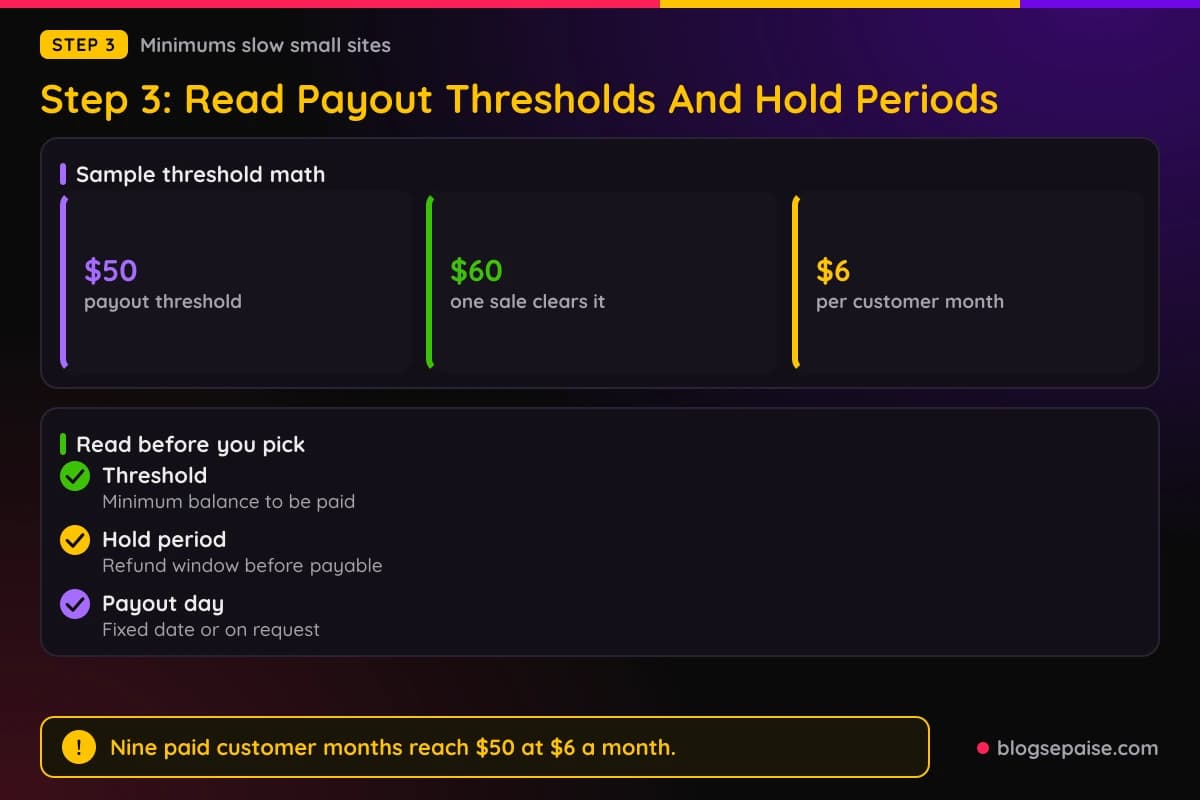
If you are small, that gap shows up quickly. Your first recurring customer may not get you a payout for most of a year, while your first one-time sale may pay you in two months.
The money is still yours in both cases, but it is stuck.
Hold periods exist because of refunds. A program wants to be sure the customer kept the product before it pays you.
Common holds are in the range of a few weeks to a couple of months, though they vary by program and sometimes by network.
Refunds can also reverse a commission. If a customer asks for money back, the program may take your commission back, or it may never pay it.
With a recurring deal, a refund on the first month ends the stream before it starts.
Next, look at how you get paid. Programs may pay by bank transfer, a payment service, or a platform balance.
Fees and minimums for the payout method can eat into small amounts, so a payout of $50 may arrive as less than $50.
Look at the payout day too. Some programs pay on a fixed day each month, some pay when the validation period ends, and some pay when you request it.
Knowing the day lets you plan, and it stops you from checking your balance every morning.
Another thing to check is what happens to a balance that stays under the threshold. Most programs just let it roll over to the next month.
A few have expiry rules for inactive accounts. Scan the terms for words such as inactive, dormant, or forfeit.
Keep a short list of these rules for each program you consider.
We cover the full habit of reading terms in our guide to what affiliate networks look for before you apply, and the same sheet works for payout rules.
In short, a low threshold and a short hold help small sites most. If a recurring program has a high threshold and a long hold, the first year may feel like working for free.
That does not make it a bad offer, but it makes it a slow one.
Step 4: Do The Lifetime Value Math
Lifetime value is the total you expect to earn from one referred customer. For a one-time offer, it is the flat payout.
For a recurring offer, it is the monthly commission times the number of months the customer stays.
The tricky part is the number of months. Customers cancel, and the share who cancel each month is called churn.
If 10 percent of customers cancel every month, then on average a customer stays about ten months. The rule is simple: average months equal one divided by the monthly churn rate.
Run the sample. A $6 monthly commission with 10 percent churn gives about 10 months, so the lifetime value is about $60.
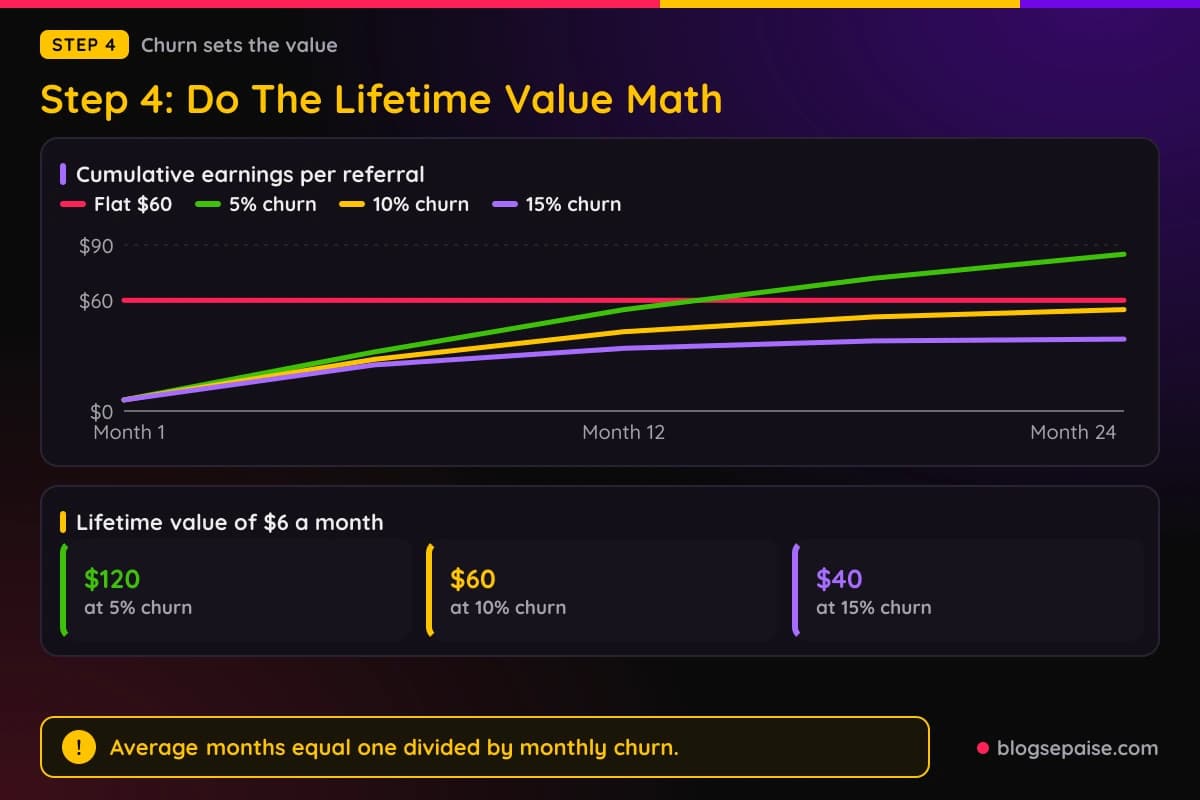
That matches the flat $60 offer. With 5 percent churn, customers stay about 20 months, and the lifetime value is about $120.
With 15 percent churn, they stay about 6.7 months, and the value drops to about $40.
Look at what changed. Nothing about the commission rate moved, yet the value of one referral moved from $40 to $120 because customers stayed longer.
Retention is the lever, and you rarely control it.
Time matters too. Even at 5 percent churn, you do not collect $120 right away.
After a year you have collected about $55, and after 18 months about $72. The recurring stream passes a $60 flat offer around month 14 in that case, and after two years it sits near $85.
At 10 percent churn, the stream reaches about $43 after a year and about $55 after two years. It gets closer to $60 but never passes it.
At 15 percent churn, you reach about $34 after a year and about $39 after two.
Where do you find a churn number? Often you cannot, at least not exactly.
Some companies publish retention hints, some brag about long-time customers, and many say nothing. Do not invent a number.
Use a range, such as 5, 10, and 15 percent, and see how your pick holds up across all three.
A few clues help you guess. Tools that sit deep in a customer workflow, such as accounting, email lists, or hosting, tend to lose fewer customers because switching is a pain.
Tools that people use for a single project, such as a one-month design push, tend to lose them quickly.
Seasonal products churn fast after the season. Low-priced plans often churn more than higher priced plans.
Products with free tiers can also bounce users around. No single point is a rule, but each one nudges your guess in a direction.
Use the same method for one-time offers by asking one more question: will this person buy again?
A kitchen gadget with a refill, a course with a sequel, or a service with add-ons can pay you a second time. If the terms give credit for repeat orders, count that too.
If they do not, count zero.
Our commission earnings estimator lets you test sales volume and rates, and you can add the churn step by hand.
Take any program you like, run the three churn cases, and write the three results next to each other.
Step 5: Compare Lifetime And Limited Recurring Deals
Not every recurring deal lasts as long as the customer does. Some programs pay for the life of the account, which people often call lifetime recurring.
Others pay for a set time, such as the first 12 months, and then stop.
The difference changes the math. Keep the same $6 a month and 10 percent churn.
For the life of the account, the value is about $60. If the deal stops after 12 months, the value is about $43.
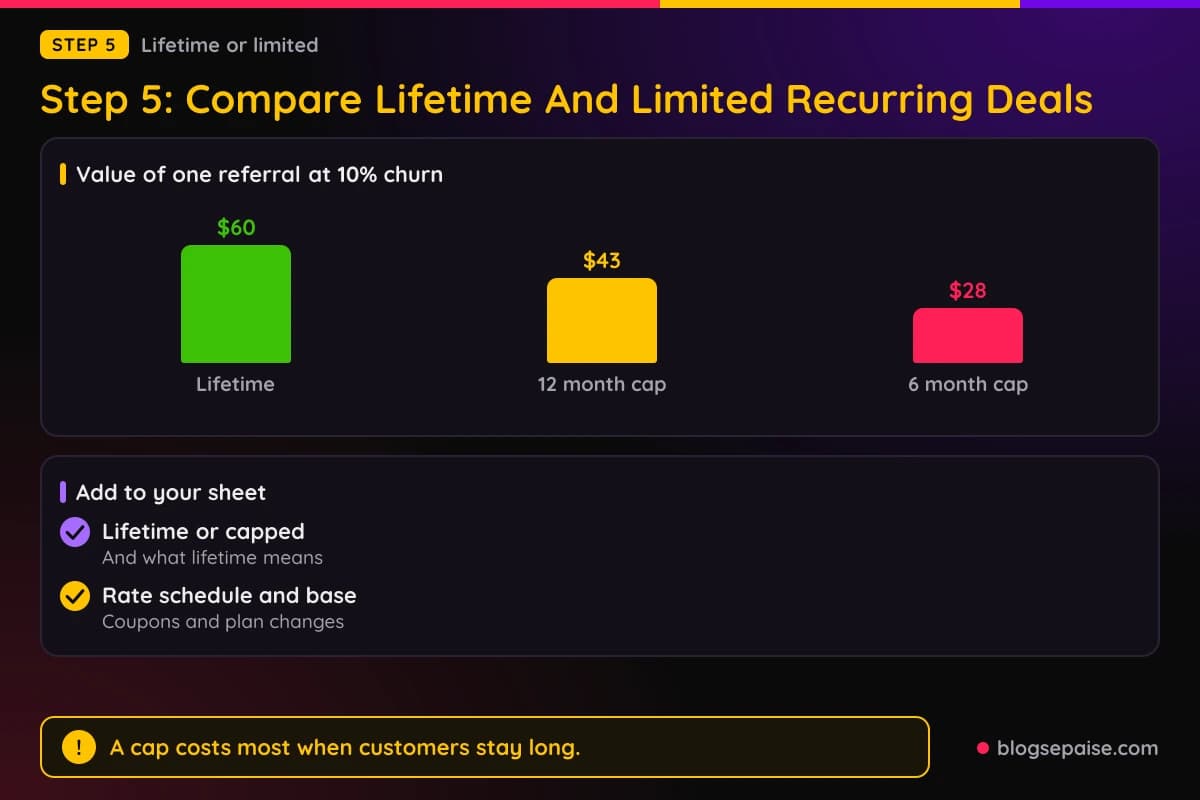
If it stops after 6 months, the value is about $28.
A cap hurts most when customers stay long. At 5 percent churn, a lifetime deal gives about $120, and a 12 month cap gives about $55.
The longer people stay, the more you give up by taking a capped deal.
Capped deals are not always worse. A capped deal may pay a higher rate, such as 30 percent instead of 20 percent, and that can make up for the cutoff.
Run both versions through the same table before you decide.
Also check for rate steps. Some programs pay a higher rate on the first payment and a lower rate afterward.
Others lower the rate after a set time. The terms should list the schedule, and a good sheet records each step.
Watch the word lifetime closely. It can mean the lifetime of the customer, the lifetime of the program, or the lifetime of your account.
These are very different promises. A program can end, change its terms, or close your account for a rule break, and the stream ends with it.
That brings up risk. A recurring stream depends on the company staying in business, keeping the program open, and keeping the terms.
Spread your risk by not tying all your income to one program, and by reading change notices when the company sends them.
Also look at what happens when a customer changes plans. A customer who upgrades may raise your commission, and a customer who downgrades may lower it.
Some programs do not pay on add-ons or taxes. Those small rules decide how big your stream really gets.
One more detail is coupons. If the customer uses a discount code, the base price may be lower, and so is your percentage.
Some programs also pay on the discounted price for every renewal. Read how the commission base is defined.
For your sheet, add four lines per recurring offer: lifetime or capped, the rate schedule, how plan changes are handled, and the commission base. Then compare the offers in plain numbers.
Step 6: Know When A One-Time Offer Wins
Recurring income gets a lot of praise, but a one-time offer is the better choice in many situations. The best publishers do not pick a side by habit.
They pick by facts.
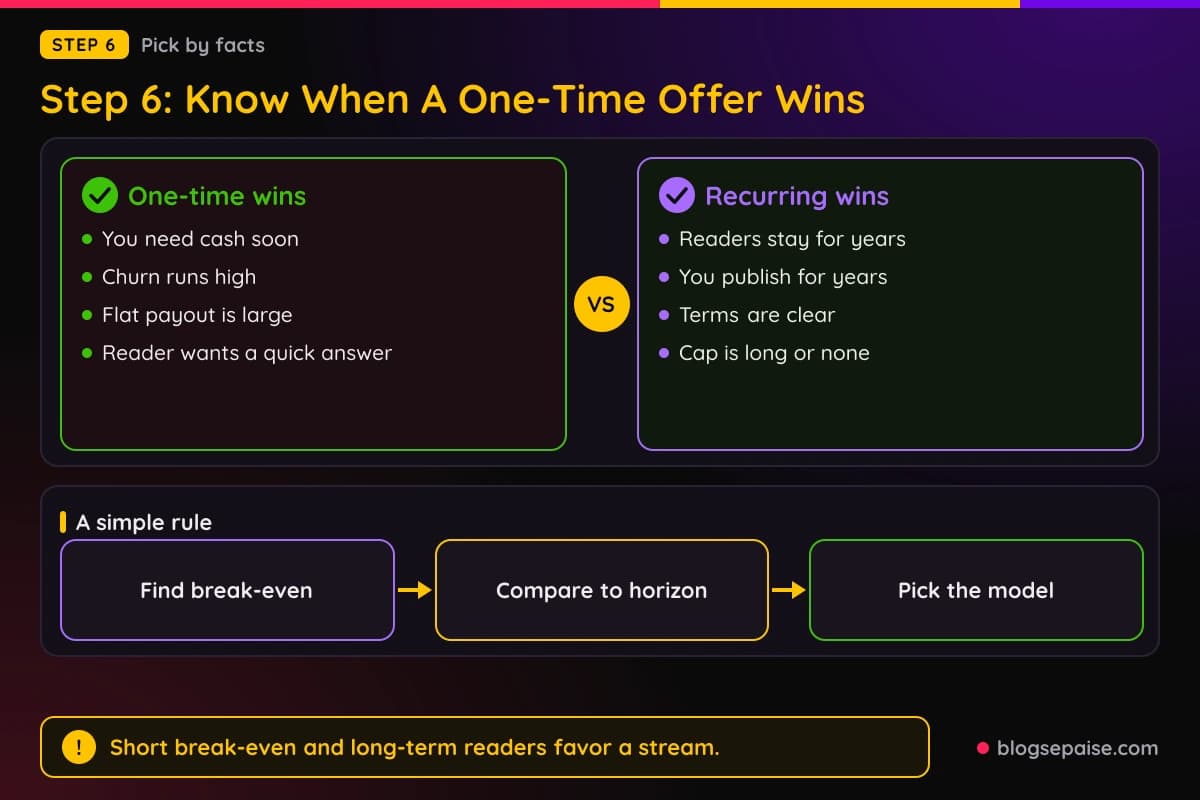
A one-time offer wins when you need cash soon. A single sale can clear a threshold and arrive in a couple of months.
A recurring stream may take most of a year to reach the same place.
It also wins when the product has high churn or a short life. A tool people use for one project will not renew for long.
Taking a big payout up front beats waiting on a stream that fades.
A one-time offer wins when the flat payout is large for the price. Some programs pay a high flat amount on expensive products.
If the flat payout is bigger than the realistic lifetime value of a recurring deal, the choice is easy.
Another win is simplicity. One-time offers are easier to track, easier to explain to readers, and easier to put in an income report.
You can see what each post earned, which helps you decide what to write next. Our guide to tracking affiliate income when starting shows a simple way to do that.
It also wins when your content is a quick answer. A reader who wants the best deal this week, or the best tool for a single job, is not going to stay for years.
Your page matches the one-time model better than a long relationship.
Last, a one-time offer can win when the recurring program is unclear. If you cannot find the churn clues, the cap, or the commission base, the recurring promise is a guess.
A clear flat payout beats a fuzzy stream.
That said, do not ignore the reverse case.
A recurring offer wins when your content brings readers who already plan to use the tool for a long time, such as people building a business, a list, or a site.
They are the customers most likely to stay.
It also wins when you plan to keep publishing for years. A stream built over three years can pay you while you sleep, which is the best reason to love recurring deals.
For a reality check on that idea, read our post on the truth about passive income for affiliates.
A simple rule helps. If the break-even time is longer than your honest planning horizon, take the flat payout.
If the break-even is short and your readers are long-term users, take the stream.
Step 7: Pick Your First Offer And Test It
Now you can pick. Make a shortlist of two to four programs, including at least one of each model if you can find them.
Record the cookie length, hold period, threshold, payout schedule, cap, and commission base for each.
Run the three churn cases for any recurring offer and write the break-even month. Then score each program for fit.
Ask if your readers would truly use the product, if you would use it yourself, and if the page you plan to write answers a real question.
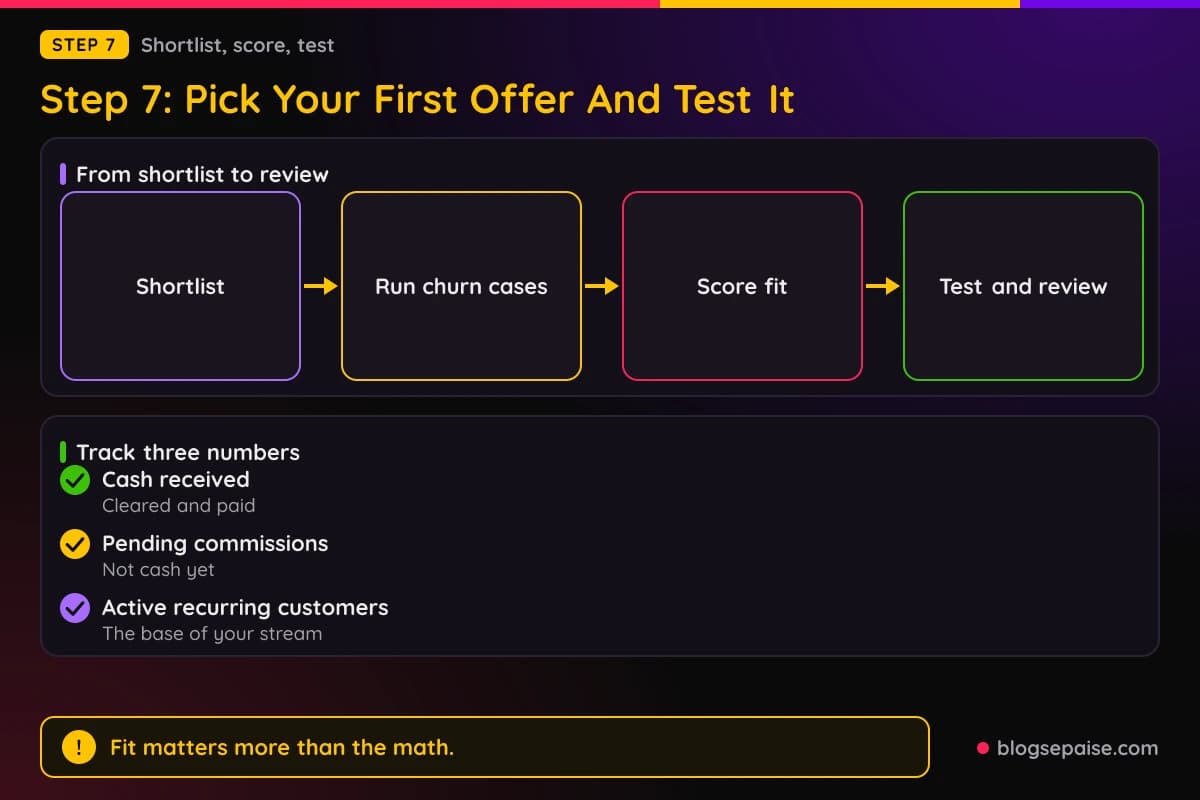
Fit matters more than math. A great payout on a product your readers do not need will earn nothing.
A modest payout on a product that solves a real problem will earn steadily.
For a new site, a good starting plan is to promote one program that pays soon and one that pays over time. Put the quick payer in your most direct pages, such as a how-to for a single task.
Put the stream builder in your pages for long-term users.
Sources for programs are easy to find. Many software programs are listed on networks such as PartnerStack and Awin, and each program on them sets its own commission style.
Check the listing for a recurring or one-time label, and then read the full terms before you apply.
Our page on high quality affiliate programs is a decent place to browse for ideas, and the affiliate programs index gives more choices. Use them as a starting list only, since terms change.
Give each test enough time. A single month of data tells you little.
Give each offer a few posts and a few months, and then compare clicks, sales, and cash received. Keep notes so that you do not rely on memory.
When you review results, look at three numbers. Look at cash received, at pending commissions, and at the number of active recurring customers.
The third one is the base of your stream, and it grows quietly.
Last, set a review date. Every quarter, reread the terms, check for rate changes, and compare your real results with the numbers on your sheet.
If a program changes its terms for the worse, you will catch it early.
A Worked Example: Maya Chooses Between Two Offers
Take Maya, who runs a small blog about budgeting apps. She has two offers in front of her.
Offer A is a budgeting course that pays $60 once per sale. Offer B is a budgeting app that pays 20 percent of a $30 monthly plan, which is $6 a month for the life of the account.
Maya expects about four sales a month from either offer over her first six months, which adds up to 24 sales. She has no churn data for the app, so she uses 10 percent as a middle guess.
She also has a $50 payout threshold on both programs and a 30 day hold.
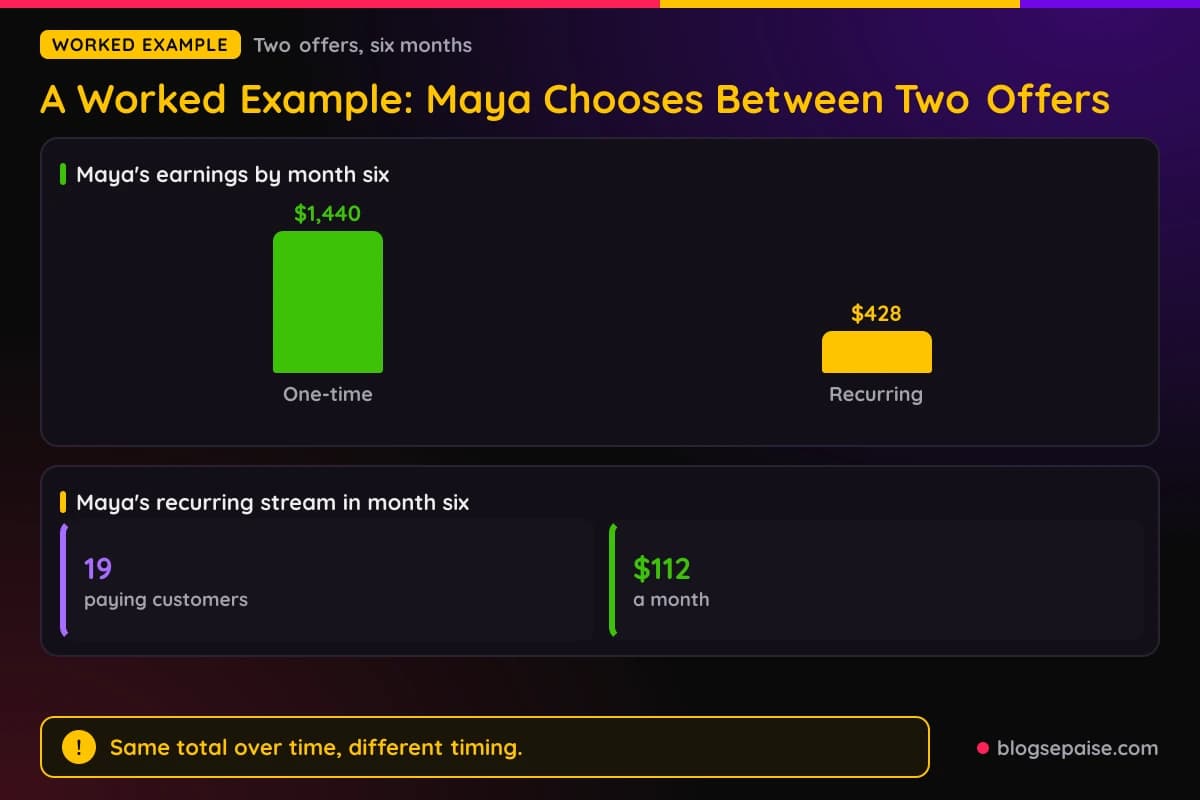
First she checks the flat offer. Twenty four sales at $60 gives $1,440 over six months.
Her first sale clears the threshold on its own, and she sees her first payout around day 45 to day 60.
Then she checks the recurring offer. With 10 percent churn, her expected earnings over those same six months are about $428.
That is far less than $1,440, and her balance stays under $50 for the first few weeks.
The picture flips in the long run. By month six, she has about 19 active paying customers, which brings in about $112 a month.
If she stopped writing on that day, the stream would still pay her about $1,012 over the next months as customers drift away.
Add the two parts for the recurring offer and you get about $1,440, the same as the flat offer. The totals match because 10 percent churn gives the same lifetime value as the flat payout.
Timing is the difference. One pays early, and the other pays late.
So what does Maya do? She needs money to cover her hosting and tools, so she puts Offer A in her best how-to post first.
She also writes one post for long-term budgeters and links Offer B there, because those readers are the ones most likely to stay.
She writes down her plan for review. If real churn on the app looks better than 10 percent, Offer B moves up.
If it looks worse, she keeps it as a side offer. Either way, she is making the call with numbers and not with a hunch.
Notice what Maya did not do. She did not chase the biggest percentage, she did not trust a promise she could not check, and she did not drop one model for the other.
She kept both and gave each a job.
Common Mistakes When Comparing Payout Models
The first mistake is judging by the headline rate.
A 40 percent commission on a cheap one-time product can pay less than 10 percent on a pricey product, and a high rate on a short capped deal can lose to a lower rate for life.
Always convert to dollars.
The second is ignoring churn. Beginners often assume that customers stay forever, which turns every recurring offer into a dream.
Test with a range of churn rates and take the middle case seriously.
The third is skipping the hold period and the threshold. A stream you cannot cash out is not much help to you.
Count the months to the first payout for each offer.
The fourth is picking an offer you would never use. Readers can tell when a recommendation is hollow, and trust is your real asset.
Promote only what you would honestly suggest to a friend.
The fifth is relying on a single program. Programs can cut rates, close, or ban accounts for a small slip.
Keep a few streams going. Our guide to affiliate marketing red flags also helps you spot offers that hide their terms.
The sixth is forgetting disclosure. With a one-time or a recurring commission, readers should see a clear note about your links before they click.
Keep the note near the top of the page.
The seventh is never reviewing. Rates, caps, and cookie windows change.
If you check your sheet only once, it will go stale. A quarterly review takes an hour and can save you from a bad surprise.
The eighth is mixing up booked and paid money. Pending commissions are not cash.
Count only what has cleared and been paid, and treat the rest as a maybe until the hold ends.
Final Thoughts
Recurring and one-time commissions are tools, and each one fits a different job. A flat payout gives you cash sooner and a clear result for each post.
A recurring payout builds a base that can keep paying after the work is done.
To choose well, follow the steps.
Map the cash flow, check the cookie window, read the threshold and hold, do the lifetime math across a range of churn rates, compare lifetime and capped deals, and know when a flat payout wins.
Then pick one offer for quick results and one for the long game.
Keep your numbers honest and your sheet dated. Programs change, and the best choice today may not be the best choice next year.
If you stay curious and keep testing, the right mix will show itself.
Start small. Pick two programs this week, fill in your sheet, and run the three churn cases.
In an hour you will know more about your options than most new affiliates ever learn.
Frequently Asked Questions
1. What is the difference between recurring and one-time affiliate commissions?
A one-time commission pays once per sale. A recurring commission pays again each time the customer pays, usually every month or year, for as long as the program terms say.
2. Are recurring commissions always better?
No. They build slowly and depend on how long customers stay.
A one-time offer can win when you need cash soon, when churn is high, or when the flat payout is large.
3. What is churn and why does it matter?
Churn is the share of customers who cancel each month. Higher churn means shorter streams and a lower lifetime value, so it changes which payout model pays more.
4. How do I estimate lifetime value for a recurring offer?
Multiply the monthly commission by the average months a customer stays. Average months equal one divided by the monthly churn rate, so 10 percent churn means about ten months.
5. What is a payout threshold?
It is the minimum balance you must reach before the program pays you. Small recurring amounts can take a while to reach it, so check it before you choose.
6. What is a hold period?
It is the waiting time before a commission becomes payable, often tied to the refund window. Lengths vary, so read the terms for each program.
7. Do cookie windows matter for recurring deals?
They matter for the first click. After sign-up, many programs tie the account to you, but confirm that in the terms before you count on renewals.
8. Is lifetime recurring really for life?
Not always. It can depend on the customer staying, the program staying open, and your account staying in good standing.
Read the exact wording.
9. Can I promote both models at the same time?
Yes. Many publishers use a one-time offer for quick wins and a recurring offer for long-term income.
Just give each a clear job and keep your disclosure visible.
10. How often should I review program terms?
Check at least once a quarter. Rates, caps, and cookie windows can change, and a dated note shows you if your facts are fresh.