How To Negotiate Better Affiliate Rates When The Program Is Not Public
Most affiliate programs print their commission rate on a public page, and most beginners treat that number as final. It looks like a price tag, so nobody thinks to ask if it can move.
Some programs do have room to move. A partner who sends steady, high quality customers is worth more than the average partner, and a few companies keep private deals for exactly that kind of person.
The rate is one lever among several. Cookie windows, bonuses, coupon codes, payout terms, and recurring length can all change, and each can be worth more than a few percentage points.
Learning to negotiate affiliate commission matters most for bloggers who already send sales. A small improvement on a program that already works for you pays off on every sale from then on.
A polite, well-prepared ask costs you nothing. In most cases the worst answer is a no, and you keep your standard terms either way.
Preparation decides how it goes. A message with real numbers gets read, and a message that says please pay me more gets ignored.
Results vary a lot from program to program. Some programs have fixed terms and will decline, and nothing in a message can change that.
Disclosure: Some of the links I share might be affiliate links. If you click on one and make a purchase, I may earn a small commission as a thank you. But don’t worry, it won’t cost you anything extra. I only recommend stuff I genuinely believe in. Your support helps me keep creating awesome content. You can read my full affiliate disclosure in my disclaimer page.
If you want to save a lot of hours searching for high-paying affiliate programs, check out our exclusive list of 2500+ affiliate programs. You’ll find all the information about the programs inside the list. This list is perfect for affiliate bloggers and influencers.
Why A Public Rate Is Not Always The Final Rate
A public commission rate is the rate that works for the average partner. It is set to be simple, so it can fit thousands of affiliates on one page.
Programs often keep room to pay more. A partner who brings a lot of sales is worth extra attention, and some companies act on that.
Nothing guarantees it, though. Plenty of programs publish one rate, pay everyone the same, and have no process for exceptions.
Private deals tend to show up in a few places. Larger partners, long-running partners, and partners with a strong audience in the product's exact niche are the usual candidates.
Some programs say so outright. Their terms mention custom rates, private offers, or a partner manager, and that wording tells you the door may be open.
Other programs say nothing, and you only find out by asking. That is the situation this guide covers, where the program is not public about how flexible it is.
Think about it from the company's side. A partner manager has a budget and a goal, and a good partner helps them reach that goal.
If you bring sales they would not otherwise get, a small raise costs them little. The extra commission comes out of revenue that you created.
That logic falls apart when you have no results. A request for a higher rate before you have sales gives the manager nothing to weigh.
So the whole process is about evidence. You show what you bring, you ask for something specific, and you leave the company an easy way to say yes.
Be ready for a no. Some answers will be a flat refusal, and that is a normal outcome and not an insult.
Rates and rules differ by program, so check each program's current terms before you plan around any figure. Nothing here is legal or financial advice.
If you have not read your standard agreement yet, start with our guide on how to read affiliate program terms. You need to know what the default deal says before you try to change it.
Step 1: Check That Negotiation Is Realistic
Negotiation works best after you have proof. Before you write a single message, ask yourself if you have sales to show.
A brand new site with no clicks has nothing to bring to the table. You can still ask, but you are asking for a favor, and favors from strangers are hard to get.
Most programs care about sales more than page views. Traffic is nice, yet a manager will look first at how many paying customers you sent.
No magic number gets you a deal. Each program has its own view, so check the public terms and your partner dashboard for any hints about tiers or custom rates.
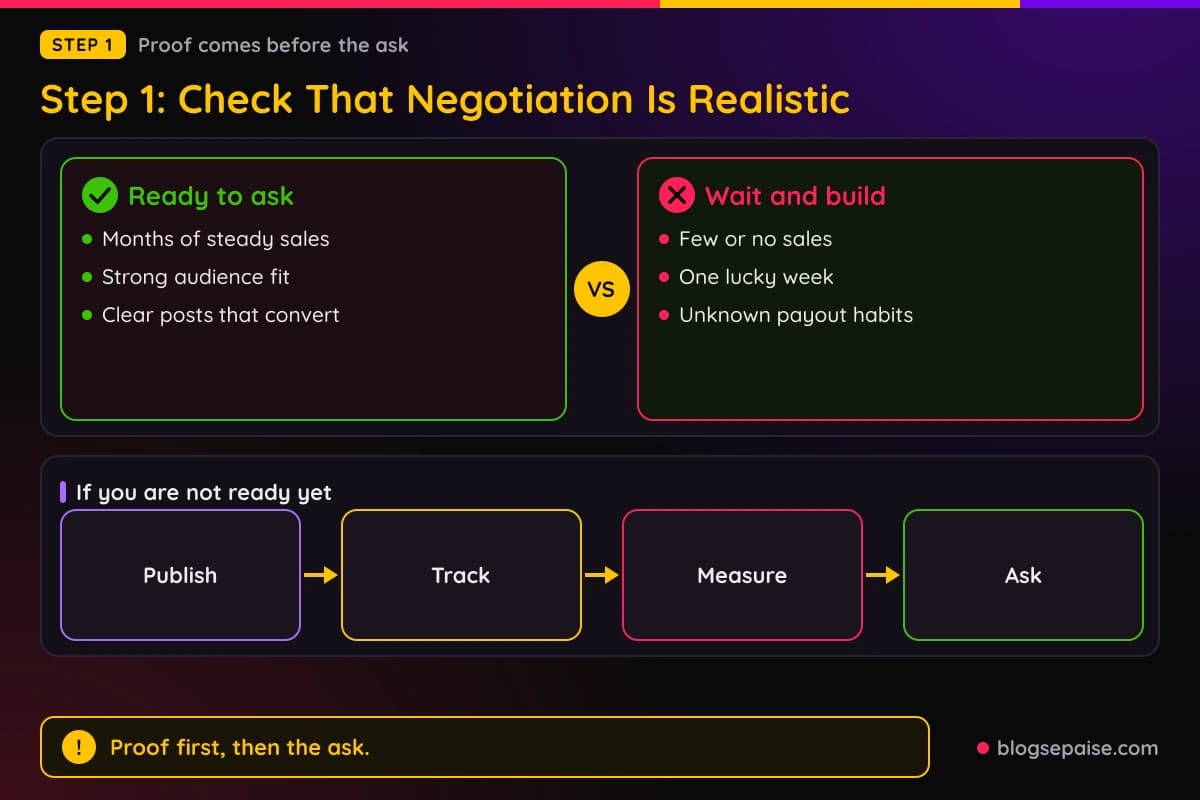
A useful rule of thumb is to wait until you have a few months of steady data. One lucky week does not show a pattern, and managers know that.
Look for signs that your results are better than average. If your readers buy more often than you would expect from the program's other visitors, that is your strongest argument.
Some dashboards show network or program averages, which you can compare with your own conversion rate. If yours is clearly higher, say so in your message.
Fit matters as much as volume. A small blog with a tight audience that matches the product can be worth more to a manager than a huge site with random traffic.
Check how you promote the product too. Do you feature it in posts that rank and get read, or did you mention it once in a long list?
Also look at what the program has said in public. If the terms mention tiers, bonuses, or custom rates, your odds are better, because the structure already exists.
If the program looks fixed and strict, adjust your goal. You might ask for a small extra such as a longer cookie window instead of a higher rate.
Know when to wait. If your numbers are thin, spend the next month publishing, improving the posts that sell, and tracking results, then come back to the idea.
Hold back if the program is still new to you. Learn its normal payout speed and approval habits first, since a partner who has not been paid yet is not ready to renegotiate.
Answer a few honest questions before you move on. Do you have sales, a steady pattern, a good audience fit, and a reason the company should care about you?
If you can say yes to most of them, you are ready for the next step. If not, the best use of your time is more content and better tracking.
Step 2: Measure Your Own Numbers Before You Ask
Your numbers are your bargaining power. Without them you are guessing, and a manager can tell.
Start with the basics that your affiliate dashboard shows. Clicks, sales, and commission earned over a clear date range are the minimum.
Pick a period long enough to be fair. Three months is a common choice, because it smooths out both a slow week and a lucky one.
Next, work out your conversion rate. Divide sales by clicks, so 3 sales from 100 clicks is a conversion rate of 3 percent.
Then work out your earnings per click. If those 3 sales paid $6 each, you earned $18 from 100 clicks, which is $0.18 a click.
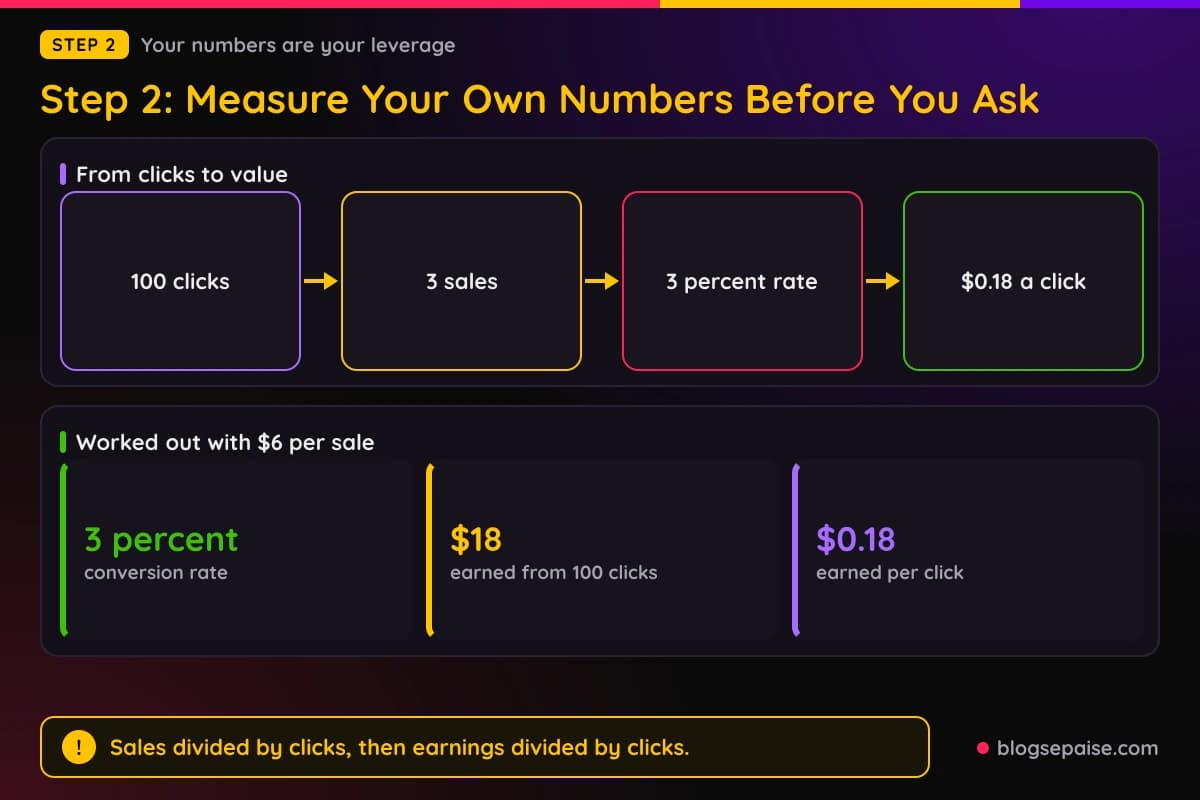
Those two figures tell a manager what your traffic is worth. A visitor from your site who is worth $0.18 is a clear number they can compare with other partners.
Look at the quality of your sales too. Refunds, cancellations, and chargebacks matter, because a program that sees many reversals will not want to pay you more.
If your dashboard shows it, note how long customers stay on recurring plans. Strong retention makes a long recurring window much easier to argue for.
Record which posts drive the sales. A short list of your top three pages shows the manager where the results come from and that they are not random.
Add context around the numbers. Your monthly visitors, your email list size, and how often you plan to publish about the product all help paint the picture.
Keep the figures honest and do not round anything in your favor. If a manager checks and finds a number was off, the whole message loses credibility.
If you track income in a spreadsheet already, this step takes minutes. Our guide on how to track affiliate income when you are starting out shows a simple setup.
Your monthly report is another source. Our explainer on the affiliate income report shows how to read clicks, conversions, and pending versus paid commissions.
Put the results on one page. A tidy summary with your best three numbers, a date range, and a short note on where your traffic comes from is all you need for the later steps.
Save a copy of the page with the date on it. If the conversation drags on for weeks, you can show exactly which numbers you started with.
Step 3: Find The Right Contact
A great message sent to the wrong inbox goes nowhere. Finding the right person is half the work.
Start inside the program. Your affiliate dashboard may list an affiliate manager, a partner manager, or a support email, so check there before you search anywhere else.
Look at your welcome email next. Some programs send a note from a named person when you join, and replying to that thread is often the easiest route.
If the program runs on a network, see what the dashboard offers. Networks such as Awin and PartnerStack usually give you some way to message a program, so look for a contact or messaging option.
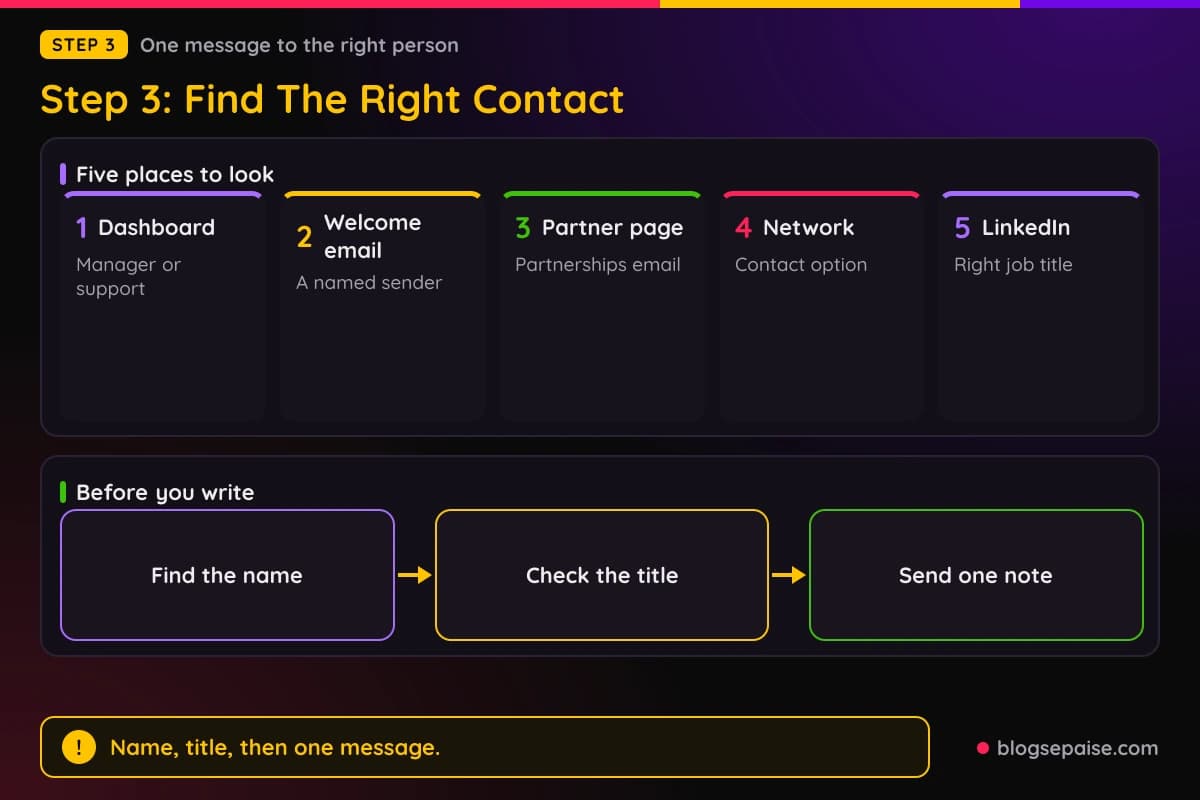
Programs with a page for partners often list a partnerships email. Look in the footer for words like partners, affiliates, or business development.
LinkedIn is a fair place to find the right job title. Search the company name along with partnerships, affiliate manager, or growth, and read the profile before you decide.
Skip the founder's personal inbox for a first try, unless the company is tiny. A small company may have no partner team at all, and then the founder is the right person.
Choose the channel that fits. A dashboard message or a dedicated partner email feels natural, while a cold direct message on social media can feel out of place.
Avoid mass blasts. A note sent to six people at the same company looks careless, and it can create awkward overlap.
Check if you already have a human contact. Someone who answered a support ticket or approved your application is a warm lead, so reply to that person.
If an agency runs the program, the contact may sit outside the company. The terms or the program page often say who manages it.
Write down the person's name and title. Addressing the right person by name shows that you did your homework.
If you cannot find anyone, use the general support address and ask to be passed along. Keep that note short and say it is a partner question, so it lands with the right team.
Wait for the first reply before you go looking for a second contact. One clear thread is easier to manage than three half-started ones.
Step 4: Decide What To Ask For Besides The Rate
Most people think of a higher percentage first, and that is a fair ask. It is also the one most programs guard closely, since it affects every sale.
Other terms can be easier to win and worth just as much. Decide your priorities before you write, so you know what to trade later.
The cookie window is a strong candidate. It sets how long after a click you still get credit for a sale, and a longer window helps when your readers take time to decide.
Ask for a longer window if your readers buy slowly. Products with a big price tag or a team approval step often need more days.
Bonuses are another option. A program may pay a fixed amount once you reach a sales goal, which suits you if you send steady volume.
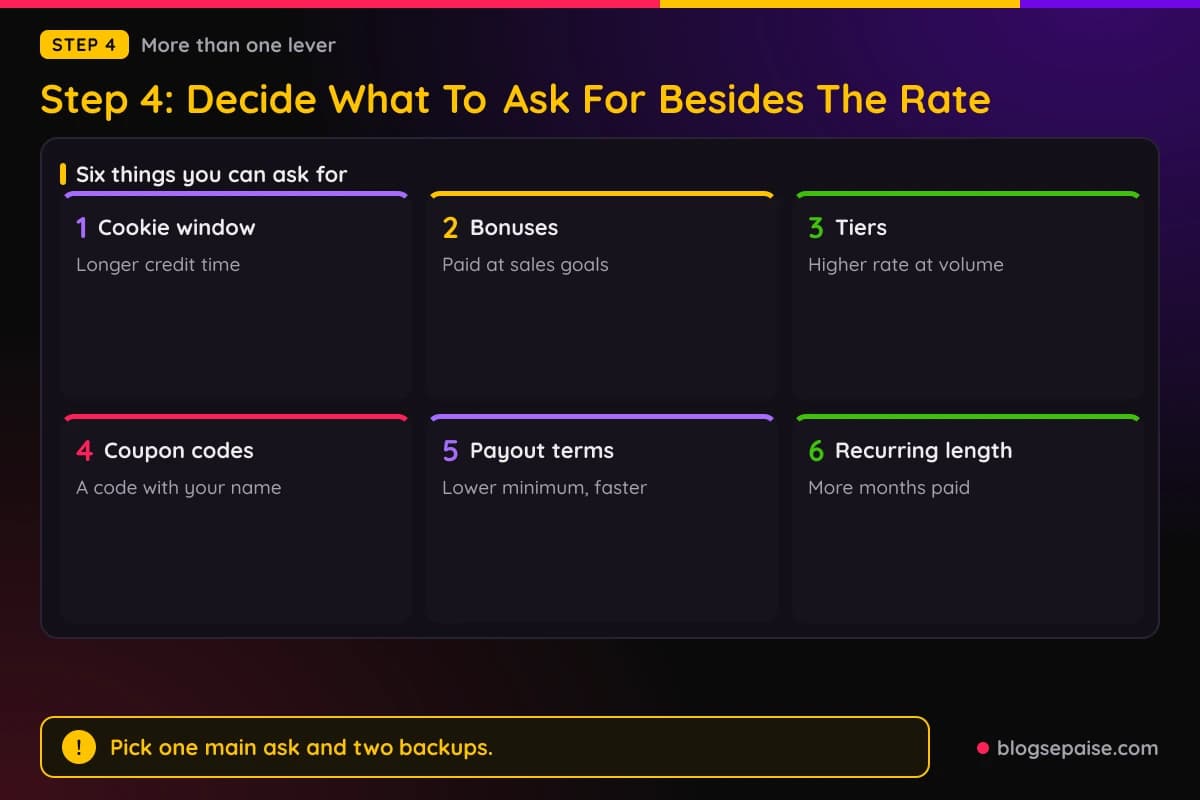
Tiers work in a similar way. Ask if a higher rate applies once you pass a set number of sales in a month or a year, and how the program counts those sales.
Custom coupon codes can help conversions. A code with your name on it gives readers a reason to buy now, and it can also help the program credit you correctly.
Check the coupon rules first. Some programs let a code override a cookie, so ask how a code and a link work together.
Payout terms are easy to overlook. You can ask for a lower payout minimum, a shorter delay before commissions become final, or a different payment method.
Faster payouts do not raise your rate, but they ease your cash flow. That matters more when your income is small.
Recurring length is a big lever on subscription products. If the program pays for the first 12 months of a customer's plan, you might ask for longer.
Our page on recurring versus one-time commissions shows how much that choice can change your income. A longer recurring window often beats a small rate bump over time.
You can also ask for early access. News about new features, launch dates, or sales events helps you plan content ahead of your readers.
Some partners ask for a dedicated contact. Having one person to email about problems saves time when tracking goes wrong.
Rank your list. Pick one main ask and two backup asks, because a message with ten requests feels like a shopping list.
Match each ask to your data. If your sales are high, ask for a rate or a tier, and if your readers buy slowly, ask for a longer cookie window.
Keep your asks reasonable for the program's size. A small company may have little room on rate but could be happy to give you a custom code or a faster payout.
Step 5: Write The First Message
Your first message should be short, specific, and polite. A manager reads dozens of notes, so make yours easy to scan and easy to answer.
Open with who you are and where you stand. Give your name, your site, and the fact that you are already an approved partner.
Next, share your results. Give two or three real numbers from your own report, such as sales, conversion rate, and the date range.
Then name the ask. Say exactly what you want, such as a higher rate, a longer cookie window, or a bonus tier, and keep it to one main request.
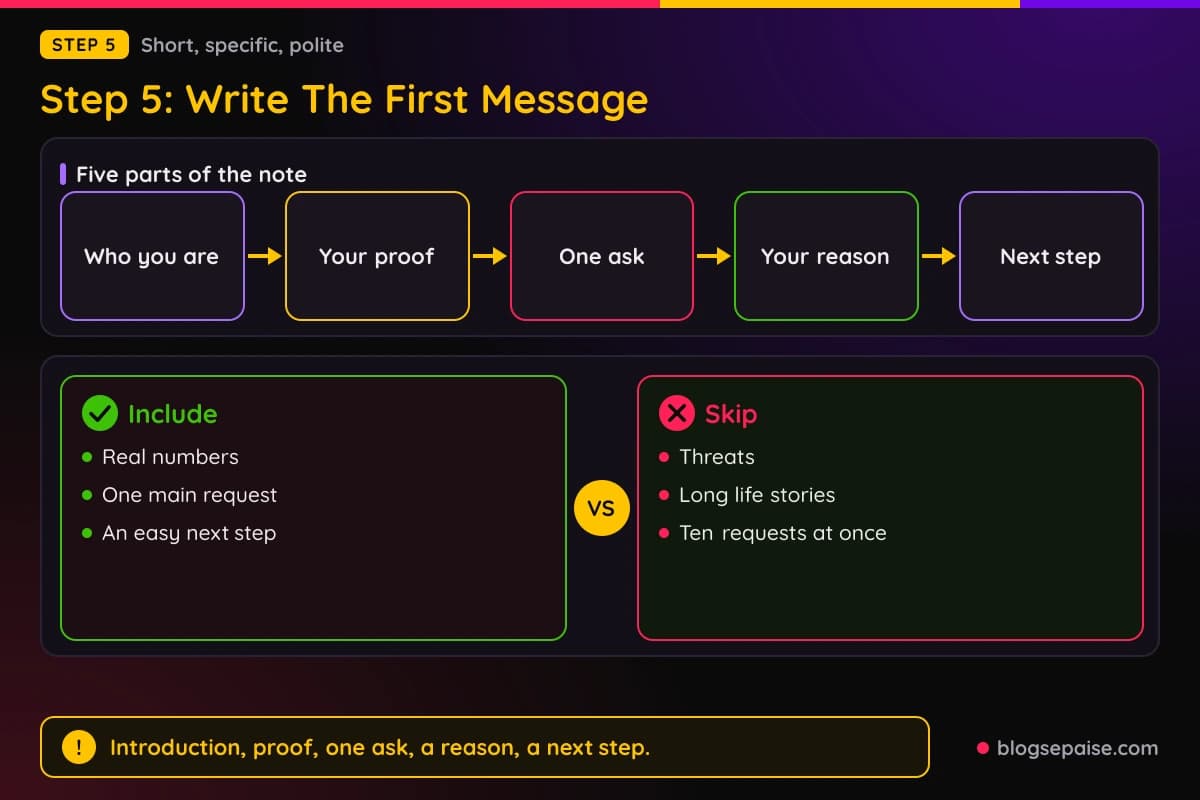
Give a reason that benefits them. Explain what you plan to publish next, such as a comparison post or a video, and how a better deal would let you promote the product more.
Be honest that the standard terms are fine. You are not complaining, and you are asking if a custom arrangement is possible for a partner like you.
Close with an easy next step. Offer a short call or ask them to reply by email, and thank them for their time.
Keep the tone friendly and plain. Skip pressure, threats about moving to a competitor, and long stories about your life.
Do not attach a pile of files. A short summary in the body, with a link to a simple report if they ask, is enough.
Pick a clear subject line. Something like Partnership question from an approved affiliate tells them what to expect.
Send it on a weekday. A message that arrives early in the working week has a fair chance of being seen.
Here is a short sample you can adapt with your own numbers. Swap the brackets for real details from your report.
Subject: Partnership question from an approved affiliate
Hi [Manager name],
I run a [topic] blog and have been an approved partner in your program since [month]. Over the last 90 days my readers sent [number] clicks and [number] paid signups, a conversion rate of [number] percent.
I plan to publish a detailed comparison post next month and an email series after that. A longer cookie window and a higher rate on sales above a set level would let me give the product much more space.
Would you be open to a custom arrangement for partners at my level? I am happy to share my full report or jump on a quick call.
Thanks for your time, and for running a great program. [Your name and site]
Notice the structure. The note has an introduction, proof, one ask, a reason, and a next step, all in a handful of short paragraphs.
Before you send it, read it once as the manager. Ask if the message makes a yes easy, and cut anything that does not.
Proofread names and numbers twice. A wrong company name is the fastest way to look careless.
Step 6: Handle A Counter Offer
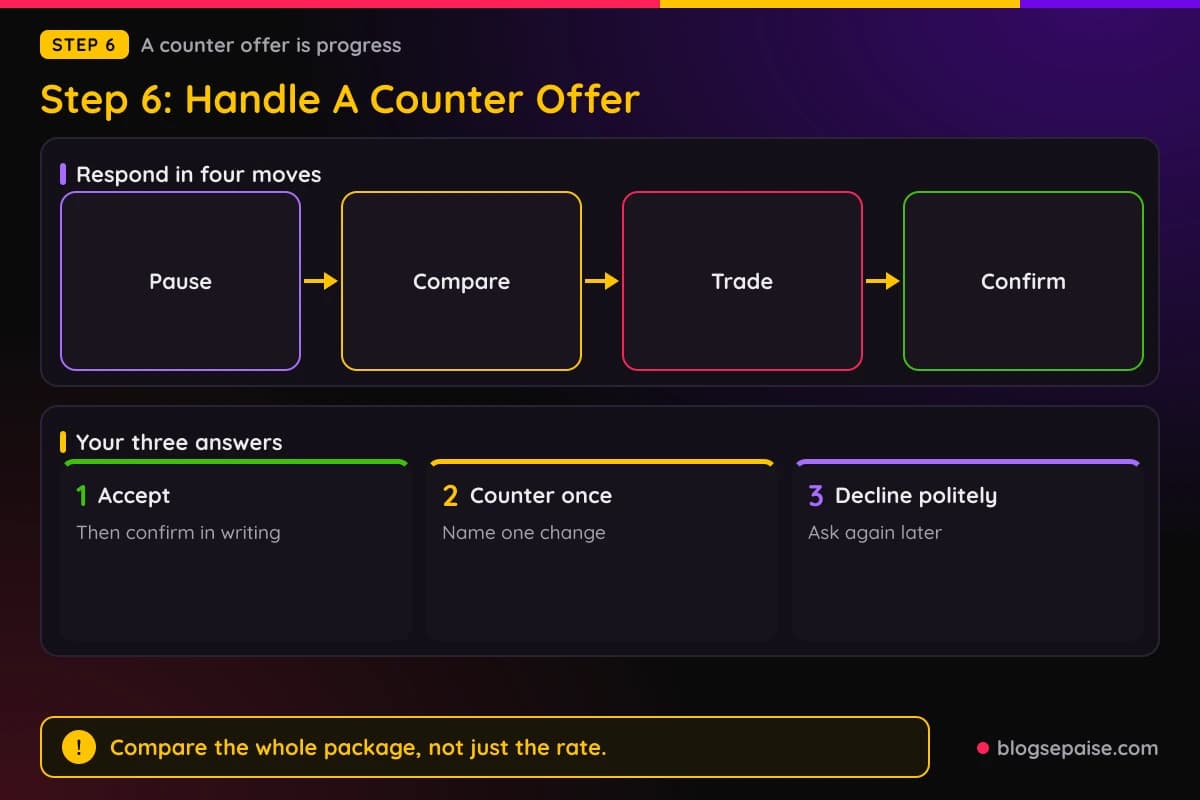
A reply with a counter offer is good news. It means the company is willing to talk, and you are now in a real negotiation.
Do not answer on the spot. Thank them, say you will review the details, and give yourself a day to think.
Compare the offer to your numbers. Work out what the new terms would have paid on your last three months of data.
Look at the whole package and not just the rate. A smaller bump with a longer cookie window may beat a bigger bump with a short one.
Check the conditions. Some offers come with sales targets, exclusivity, or limits on how you promote, so read each line against the standard terms.
Exclusivity deserves extra care. Agreeing not to promote competitors can cut your income and limit your reviews, so weigh it before you say yes.
Our guide on reading affiliate program terms explains how those clauses work. Read the exact wording before you agree to anything.
Ask about duration. A deal that lasts three months and then resets is worth less than one that lasts a year, so find out how long it holds and what triggers a review.
Trade instead of just pushing. If they will not move on rate, ask for something else from your list, such as a bonus or a longer window.
You can counter once, politely. Say what works, name the one change that would make it a yes, and give a reason.
Avoid ultimatums. Threatening to leave rarely helps, and it can end a relationship you want to keep.
If the answer is no, accept it gracefully. Ask if they would revisit after another quarter of results, and thank them for the reply.
A no today is not a no forever. Programs change budgets and priorities, so you can ask again when your numbers have grown.
If you get a yes, confirm it in writing before you celebrate. Reply with a short summary of what you understood and ask them to confirm.
Silence happens too. Wait about a week, send one polite follow-up, and leave it there if there is still no answer.
Step 7: Document The Deal
A deal that lives in a chat message is easy to lose. Write it down in a form both sides can point to later.
Ask for the terms in writing from the program. An email that lists the rate, cookie window, start date, and duration is a good start, and a formal addendum is better.
Check that the tracking side matches the promise. The program may need to flag your account, and a rate that exists only in an email can fail to show up in your dashboard.
After the first payout cycle, compare the dashboard to your deal. Confirm that sales are credited at the new rate, and report any gap quickly.
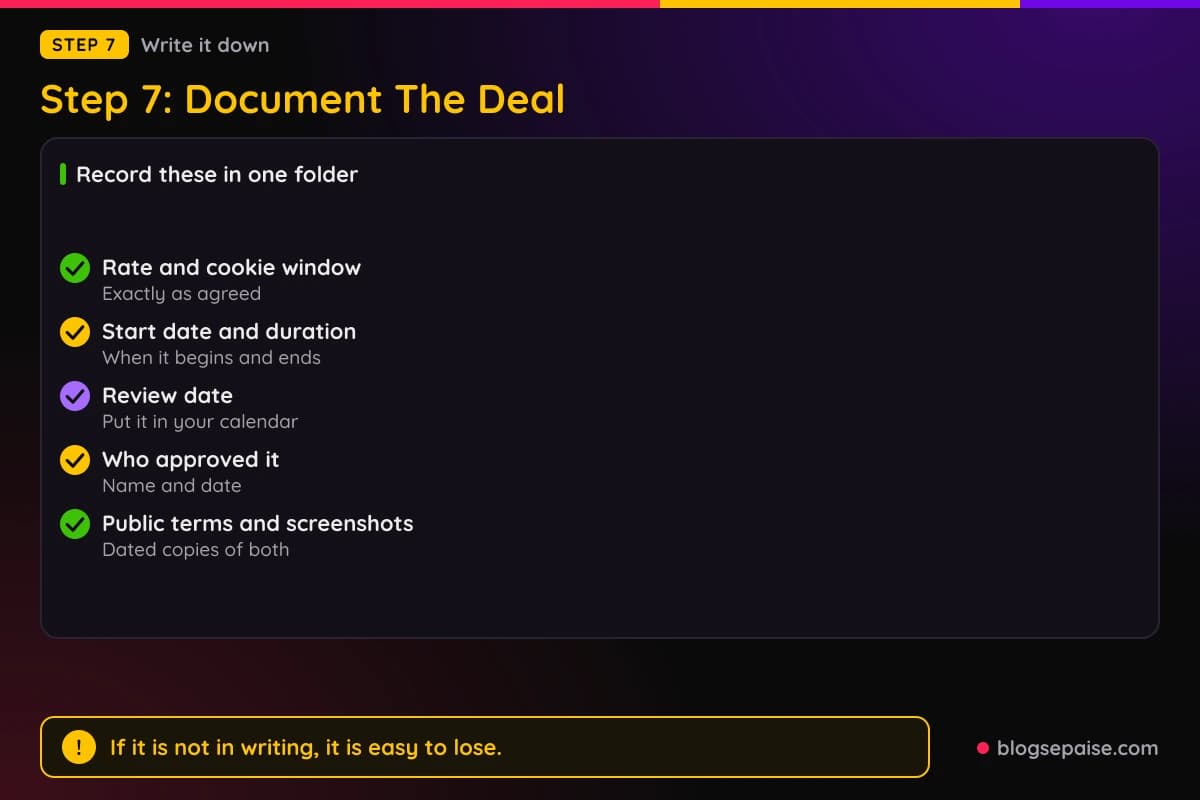
Save everything with dates. Keep the emails, the original public terms, and screenshots of your dashboard in one folder.
Write a one page summary for yourself. List the rate, cookie length, payout terms, any targets, and the date of the next review.
Put the review date in your calendar. Many custom deals come with a review point, and missing it can mean a quiet return to the standard rate.
Note who agreed to it. If your contact leaves the company, the name and date of the approval help you explain the deal to their replacement.
Keep an eye on the public terms. If the program updates its agreement, ask if your custom arrangement still applies.
Be careful about sharing details. Some managers prefer that custom rates stay private, so ask before you mention numbers in public posts or groups.
The disclosure rules do not change. You still need a clear note about your relationship on every page where you recommend the product.
Add the deal to your income tracking. Log the commission by program, so you can see what the change did to your results.
Compare results after three months. Look at conversion rate, earnings per click, and total commission against the numbers you started with.
Step 8: Keep The Relationship After The Deal
Negotiation is the start of a working relationship and not a single event. How you behave after the deal matters for the next one.
Say thanks. A short message of appreciation once the deal is set makes you easy to remember.
Deliver on what you said. If you promised a comparison post or an email series, publish it and send the link.
Share results every quarter. A brief update with clicks, signups, and a line on what is working keeps you on their radar.
Pass on useful feedback. If readers keep asking a question about the product, tell the manager, since that helps the company and builds trust.
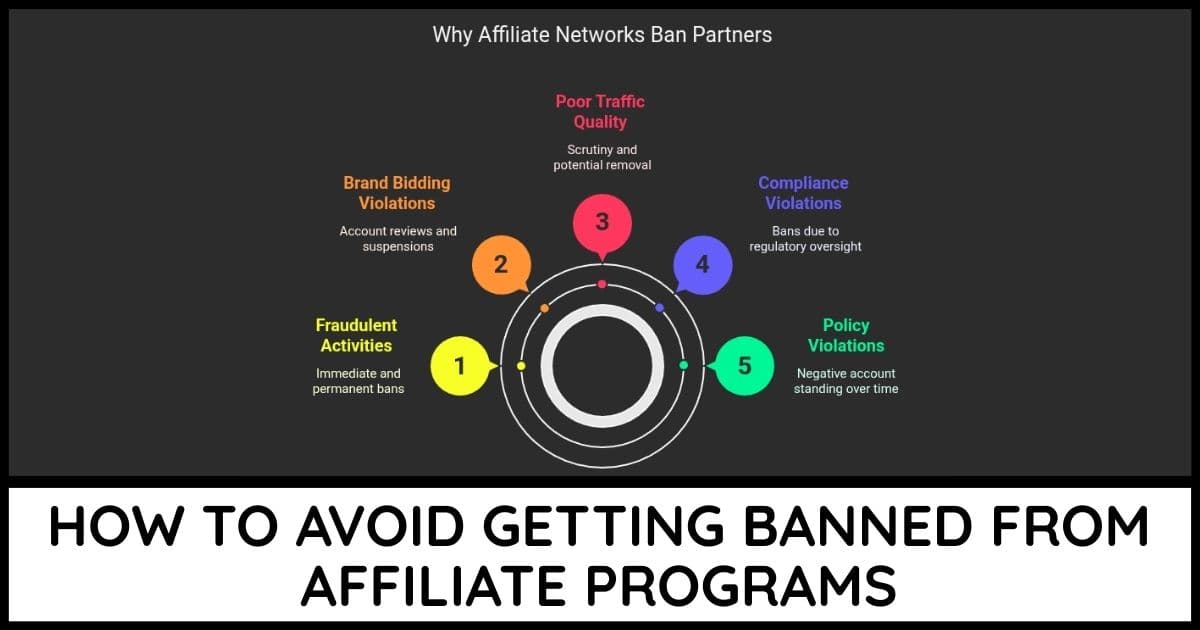
Stay within the rules. Follow the agreement, disclose clearly, and read our page on how to avoid getting banned from affiliate programs, because one violation can erase a lot of goodwill.
Keep the tone warm. Talk to your contact like a colleague and not like a customer service line.
Do not ask for something new every month. Space your requests, and ask again only when your numbers have clearly changed.
Ask for introductions when it makes sense. A good manager might point you to a beta feature, a launch, or a related program.
Think about spreading your income. A deal with one company is great, but a single program should not carry your whole business.
Keep learning from each negotiation. Write a short note about what worked and what did not, and use it next time.
Be fair if things change. If the company cuts the deal because of budget, ask for a clear date to revisit and keep the relationship friendly.
A Worked Example: Dana Asks For A Better Deal
Dana runs a budgeting blog and promotes a project planning tool through its public affiliate program. The standard terms pay 20 percent of the plan price for 12 months, with a 30 day cookie.
After three months she has clear data. Her posts sent 1,200 clicks and 48 paid signups, a conversion rate of 4 percent.
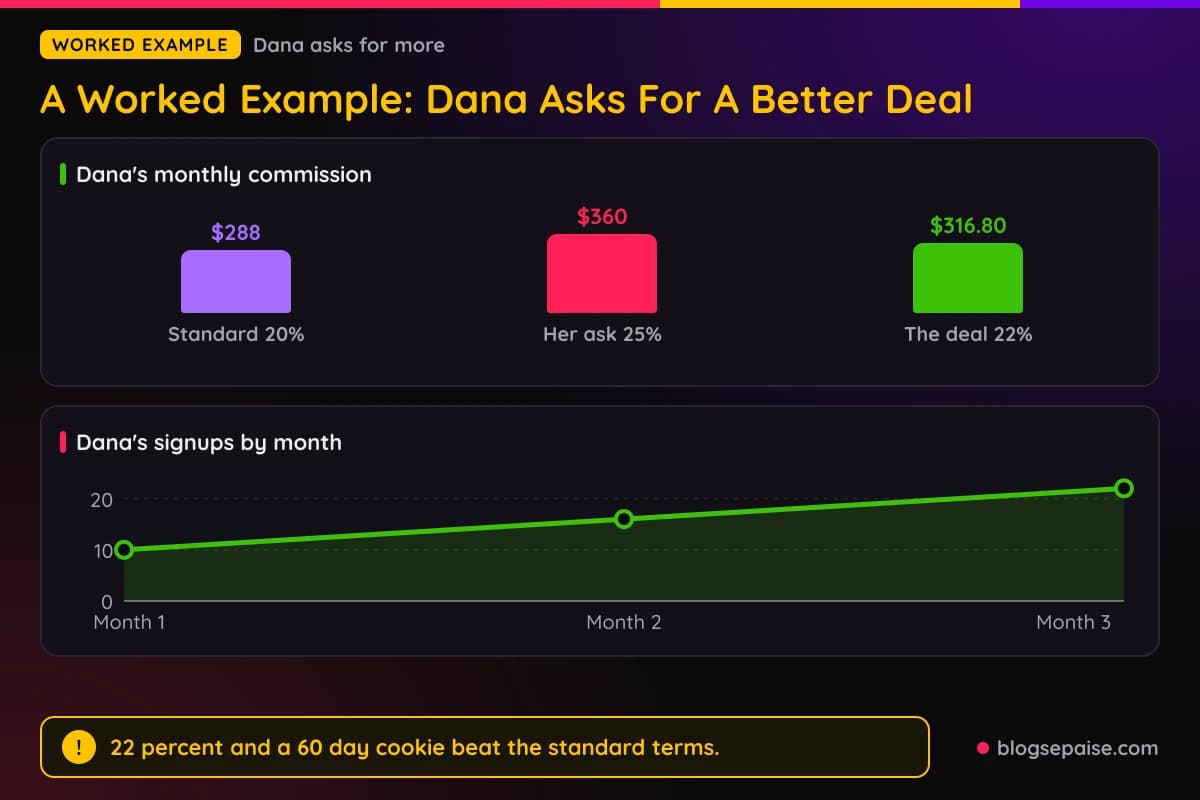
Her signups arrived in a rising pattern. She had 10 in the first month, 16 in the second, and 22 in the third.
The plan costs $30 a month, so each signup pays her $6 a month at the standard rate. Her 48 signups add up to $288 a month in commission.
Across 1,200 clicks, that works out to $0.24 for each click. Dana saves these figures in a one page summary with the date on top.
She also notices that her readers take a while to decide. The 30 day cookie is her biggest worry, since some of her readers come back to the post weeks later.
Dana picks her asks. Her main ask is a rate of 25 percent, and her backup asks are a 60 day cookie and a review in six months.
At 25 percent, each signup would pay $7.50 a month, so her 48 signups would bring $360 a month. She expects a counter, so she decides in advance what she can accept.
She finds the partner manager's name on the program's partner page and confirms the title on LinkedIn. Then she sends a short message with her numbers, her next two posts, and one clear ask.
Three days later the manager replies. The company can offer 22 percent and a 60 day cookie, with a review after six months.
Dana runs the math. At 22 percent, each signup pays $6.60 a month, so her 48 signups bring $316.80 a month.
That is $28.80 more every month than the standard terms. If every customer stayed for all 12 months, which will not happen, it would add up to $3,801.60 against $3,456.
She also values the longer cookie, since her readers decide slowly. She accepts, and asks the manager to confirm the terms by email.
The manager sends a short email listing the rate, the cookie window, the start date, and the review date. Dana saves it with a copy of the public terms and a screenshot of her dashboard.
After the first payout cycle she checks that her sales show at the new rate. They do, so she sends a thank-you note with a link to her next post.
Results vary, and Dana's deal is a single outcome. A different program might have said no, and she would have kept the standard terms and tried again after another quarter of results.
Common Mistakes When You Negotiate Affiliate Rates
The first mistake is asking too early. With no sales to show, a manager has no reason to say yes.
Another mistake is asking for a number with no reason. A higher rate needs a story, and the story is your results and your plans.
Vague notes get vague answers. A message that only asks to increase my commission invites a one word reply.
Some people bury the ask under a long background story. Put the request in the first few short paragraphs, where the manager is sure to see it.
Demanding or threatening to leave for a rival usually backfires. Managers talk to many partners, and a calm tone gets better results.
Ignoring the rest of the terms is risky. A higher rate means little if a new clause bans a method you use or locks you out of competing programs.
Many affiliates forget to put the deal in writing. A spoken yes can vanish when a contact changes jobs.
Skipping the follow-up on results is another slip. If you never report back, the company has no reason to keep the deal after the first review.
Asking too often wears people out. Space your requests and wait until your numbers have clearly grown.
Inflated numbers hurt you the most. A manager can see the same data, and a gap between your claim and the dashboard ends the talk.
Finally, do not treat a no as the end. Stay friendly, keep working, and ask again later.
Final Thoughts
You can negotiate affiliate commission even when a program does not advertise that it is possible. The key is to go in with proof and a clear, modest ask.
The path is short. Check that you are ready, measure your numbers, find the right contact, pick your asks, write a short message, handle the reply, document the deal, and keep the relationship warm.
Remember that results vary. Some programs will say no, and that is fine, because you keep your standard terms and a friendly contact for later.
Rate is a single piece of the deal. A longer cookie, a faster payout, a custom code, or a longer recurring window can add real money.
Keep your records tidy and your tone kind. Both make the next conversation easier.
When you want to pick where to spend your effort next, our page on high quality affiliate programs is a good place to start. Better programs give you more to negotiate with.
Frequently Asked Questions
1. Can you really negotiate affiliate commission rates?
Sometimes, yes. Some programs have room to move for partners who send steady sales, and others have fixed terms and will say no.
The only way to find out is to ask politely with real numbers behind you.
2. How many sales do I need before I ask?
There is no standard number, because each program sets its own view. A few months of steady sales and a strong conversion rate give you a much better case than one good week.
Check your dashboard and the program's public terms for hints.
3. Is it rude to ask for a higher rate?
No. Partner managers expect questions about terms, and a polite message with clear numbers is a normal part of the job.
Rudeness comes from demands and threats, and you can avoid both.
4. Who should I contact first?
Start with the affiliate or partner manager named in your dashboard or welcome email. If you cannot find one, use the partnerships email on the company's site or the general support address.
Send one message to one person at a time.
5. Which terms can I ask for besides a higher rate?
You can ask for a longer cookie window, bonuses, tiers, a custom coupon code, better payout terms, or a longer recurring period. Early access to news and a dedicated contact are fair requests too.
Pick one main ask and a couple of backups.
6. Should I worry if the program says no?
Thank them and keep your standard terms. Ask if they would revisit after another quarter of results, and then go back to publishing.
A no today does not close the door for good.
7. Should I accept an offer that includes exclusivity?
Think hard before you do. Exclusivity can limit your reviews and your income, so compare it with what you would give up.
Read the exact wording, and if it could cost you real money, ask a lawyer who handles contracts.
8. Do I need the deal in writing?
Yes. An email that lists the rate, cookie window, start date, and review date is a minimum, and a formal addendum is better.
Save it with the public terms and a dated screenshot of your dashboard.
9. How long should I wait for a reply?
About a week is reasonable. Send one polite follow-up after that, and if there is still no answer, let it rest and try again later.
Do not send repeated messages in a row.
10. How often can I ask again?
Wait until your numbers have clearly changed, such as after another quarter of stronger results. Asking every month wears out goodwill.
Track your progress so you have fresh proof when you do ask.