The Slow Start of Affiliate Marketing: Staying Sane When Earnings Are Zero
You publish your first post, check your dashboard, and see a row of zeros. Then you publish a second post, check again, and see the same zeros.
Almost every affiliate meets a quiet start like this. The silence is loud, and it can make smart people quit before things begin to move.
Zero earnings early on is common, and it does not by itself mean you are failing. The hard part is staying steady while the numbers catch up with your effort.
So we built an eight step plan for the quiet stretch. It covers the real order of events, goals you can control, a routine that runs without motivation, and clear rules for when to stay and when to change course.
If you want a week by week start, our guide to the first 30 days of affiliate marketing pairs well with this one. You can also read why most new affiliate sites fail.
Disclosure: Some of the links I share might be affiliate links. If you click on one and make a purchase, I may earn a small commission as a thank you. But don’t worry, it won’t cost you anything extra. I only recommend stuff I genuinely believe in. Your support helps me keep creating awesome content. You can read my full affiliate disclosure in my disclaimer page.
If you want to save a lot of hours searching for high-paying affiliate programs, check out our exclusive list of 2500+ affiliate programs. You’ll find all the information about the programs inside the list. This list is perfect for affiliate bloggers and influencers.
The Short Answer: Zero Is Normal At First
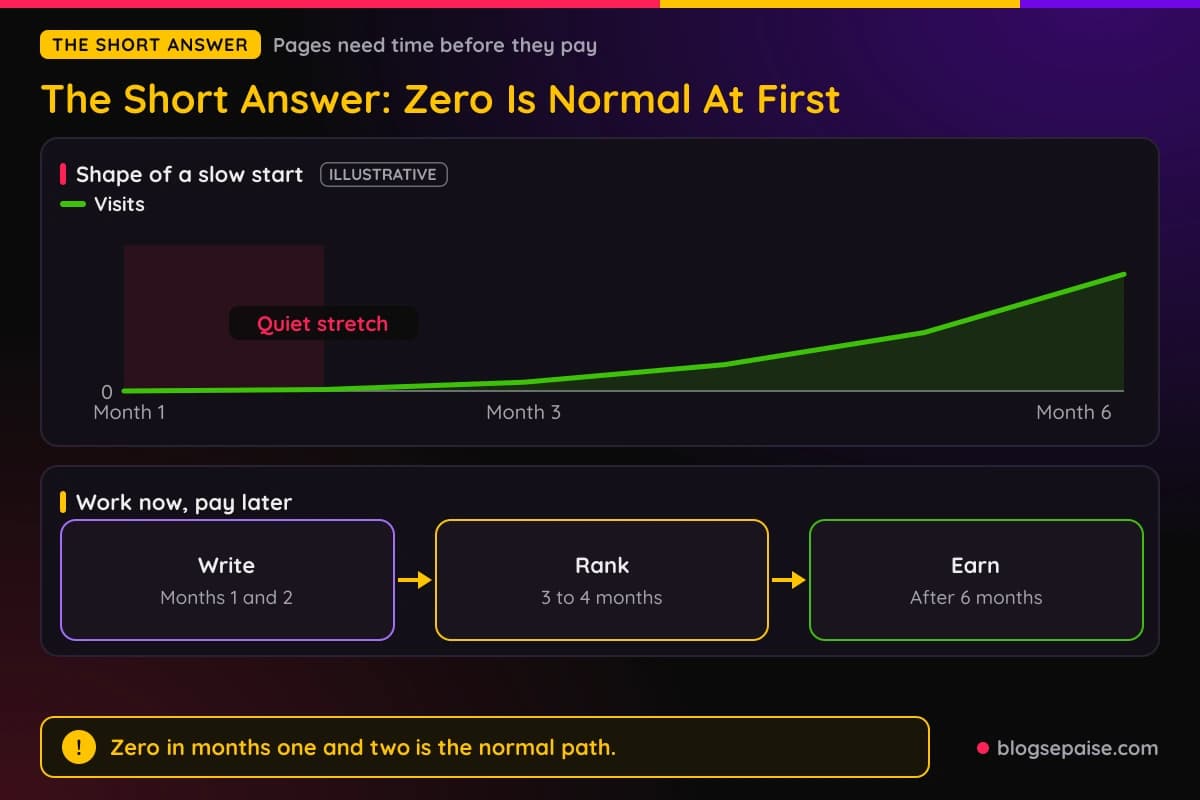
Search engines need time to find and rank new pages, so early zeros are common. Google says that changes to a site can take effect in a few hours, while others could take several months.
Ahrefs studied 1 million random URLs and found that only 1.74% of newly published pages reached the top 10 of Google within a year, while a second sample of 2 million English language pages put the figure at about 6.11%. Sources: Google Search Central and Ahrefs.
That gap between work and pay is where many people give up. The model is not broken, because it simply pays late.
Think about how other slow trades work. A baker does not sell bread on the day the oven arrives, and a student does not get paid on the first day of class.
Affiliate marketing has a lag too, and it comes from three places. You need time to write, search engines need time to trust you, and readers need time to find you.
There is also a mind game at play. Early on you have the most energy and the least proof, so doubt has plenty of room to grow.
Your job in the quiet stretch is not to force results. Your job is to keep the habits going until the results have time to arrive.
Step 1: Learn The Real Order Of Events
Most frustration comes from a wrong picture of how things unfold. If you expect money in week two, every quiet week feels like a failure.
A more honest picture has four stages. First you plant by publishing, then your pages start getting found, then readers click your affiliate links, and later your older pages keep working.
Visits come first, clicks come second, and commissions come last. If you can name which stage you are in, the zeros stop feeling personal.
A page cannot earn a click until someone sees it, and nobody sees it until a search engine shows it. A commission needs one more step after the click, because the reader has to decide to buy.
The timing of these stages varies by site and topic. Be careful with outside timelines too, since stories of a fast first sale often come from an existing audience.
Our look at the three phases of an affiliate career explains how the early quiet phase fits into the long game.
Write the stages on a sticky note and keep it near your desk. When a bad week hits, ask which stage you are in, not why you are not rich yet.
Your first posts are also your practice. Your tenth post will be better than your first, and that growth in skill is real progress even when it shows up nowhere on a chart.
Step 2: Set Goals You Control
An earnings goal sounds exciting, but you do not control it. A reader decides if a link is worth a click, a brand decides if a sale gets approved, and a search engine decides where to rank you.
An input goal is different because it belongs to you. You can control the number of posts you publish, the hours you work, and the pages you improve.
Compare a goal that says earn a set amount this month with a goal that says publish a set number of posts and update a couple of old ones. The first can end in disappointment even when you worked hard, while the second can end in a win because you decide the outcome.
Pick a few input goals for each month, such as posts published, hours worked, and older posts improved. Keep the numbers small enough to hit, since missing a goal by a mile teaches you to stop setting goals.
Output goals still have a place. Keep a long range earnings target in the background, and let the input goals run your week.
Share your input goals with one person you trust. Saying out loud what you will publish this month makes you more likely to do it.
Step 3: Build A Routine That Does Not Need Motivation
Motivation comes and goes, so it makes a poor engine. A routine keeps running on days when you feel nothing.
Start with a number of weekly hours you can keep up for a full year. A smaller number you keep is better than a big one you drop.
Split that time between writing, research, improving older posts, links and sharing, and reviewing your numbers. Put those blocks on your calendar at the same times each week, so you spend less energy arguing with yourself.
Make the first step tiny on bad days. Tell yourself you will open the document and write one paragraph.
Also plan for missed weeks. When you miss one, restart at the next block and do not try to double up.
Build a small list of post ideas so you never face a blank page. When you finish a post, add one new idea to the list.
Step 4: Track Small Wins That Show Progress
Money is the last signal to show up, so you need earlier signals to read. Small wins tell you the work is moving even when the bank account is not.
Start with the count of posts live. After that, watch for the first time a page appears in search results, the first visit from search, and the first click on an affiliate link.
Write down the date each one happens, because those dates make a record you can look back on during a low week. Celebrate each win in a tiny way, such as a walk or a favorite snack.
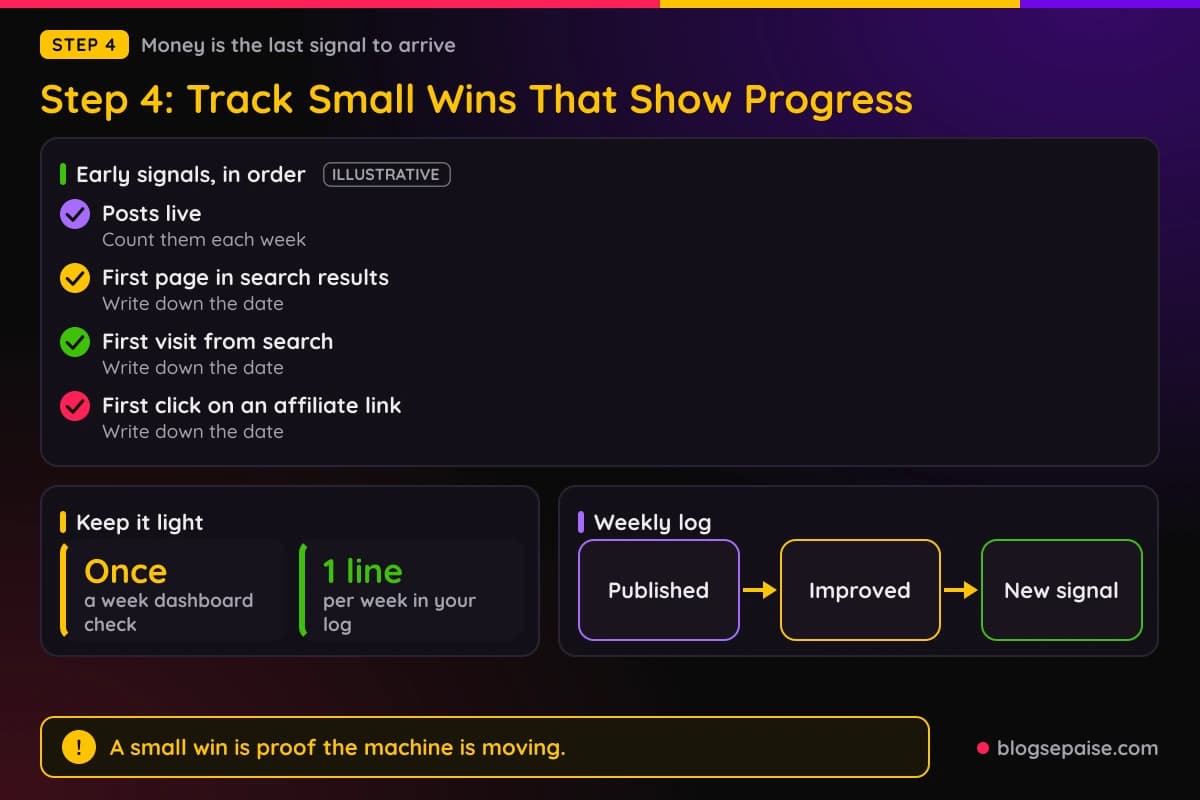
Keep a simple log with one line per week. Note what you published, what you improved, and any new signal you saw.
Our guide on how to track affiliate income when starting shows a clean setup for this. A basic sheet is enough, and you do not need a paid tool.
Avoid checking your dashboard every day. Check once a week at the same time and write the number down, because a weekly view keeps your mood steadier.
Step 5: Protect Your Energy And Your Budget
Slow results get expensive when you answer them with spending. Many beginners buy a new course or tool every time the numbers stay flat.
Set a hard monthly spending cap before you need it, and spend only on things that help you publish or measure. Our piece on affiliate marketing on a tight budget shows how to cover the basics cheaply.
If you need a place to check search volume, a keyword tool can help you pick topics with real demand. Pick one tool and learn it well instead of collecting several.
Energy needs a cap too. Plan rest as part of the work, because a pace you cannot keep will end the project sooner than the slow start would.
Watch out for the sunk cost feeling. If you have spent money, you may feel you must keep spending to justify it, so each month ask if the next dollar helps you publish or measure.
Also keep your day job or main income steady while the site grows. Treat affiliate work as a slow build and not as a rescue plan for next month's bills.
Step 6: Handle Doubt And The Comparison Trap
Doubt is likely to show up at some point, so expect it and name it. Write the doubt down and look at it the next morning with your weekly log beside you.
Comparison is the second trap. Online, you see other people's best months, screenshots, and wins, but you rarely see their early quiet stretch.
Limit how much income content you read at the start. A small dose can motivate you, but a large dose can make your own numbers feel tiny.
Find one or two people at your own stage to compare notes with. Someone who is also new understands your zeros better than someone years ahead.
Our article on the truth about passive income for affiliates is a good dose of realism when the hype gets loud.
Last, be kind to yourself in the language you use. Saying I am behind is a harsh story, while saying I am in the planting stage is simply accurate.
Step 7: Run A Monthly Review With Clear Rules
A monthly review turns worry into a plan. Pick one day at the end of each month and sit down for about 30 minutes with your log.
Ask four plain questions. Did I hit my input goals, which new signal showed up, which post got the most attention, and what will I change next month.
Keep the review about facts. If you missed your goals, find the cause, such as a busy week or a task that took longer than planned.
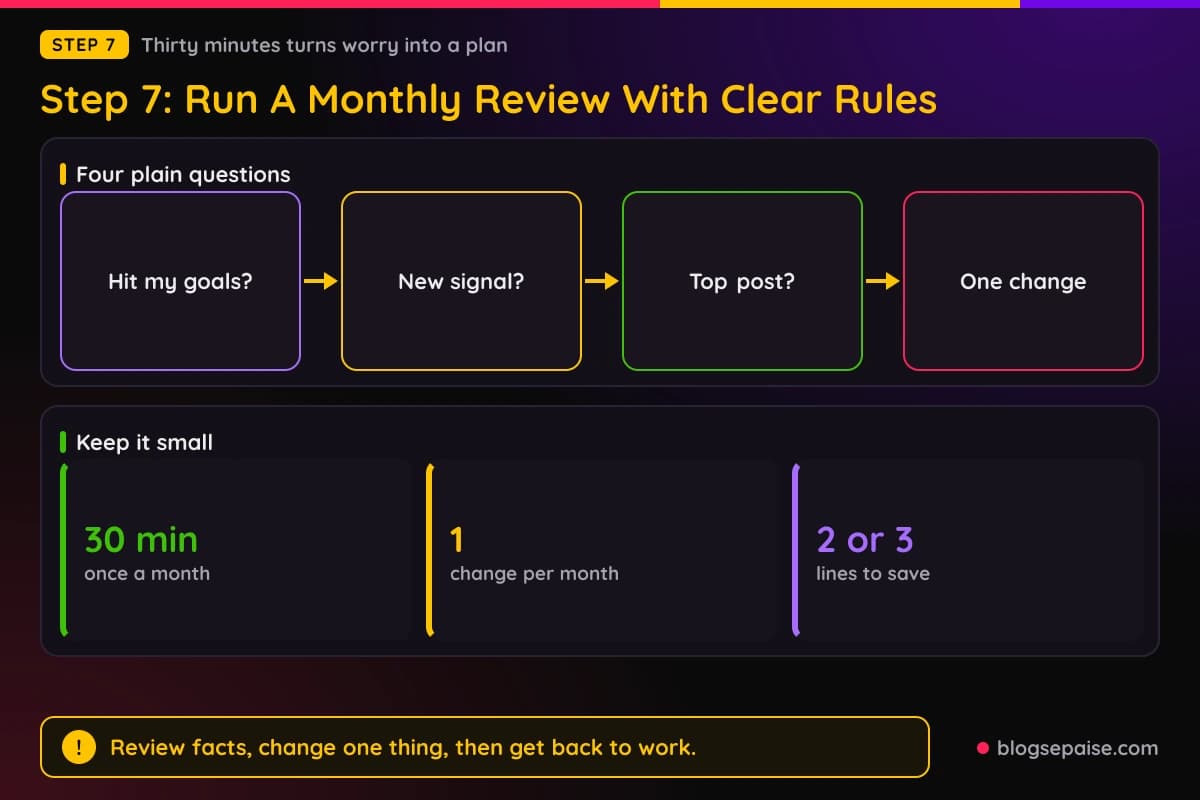
Change one thing per month. If you change your topic, your schedule, and your writing style all at once, you will never know which change helped.
Write the review in two or three lines and save it with your log. End by writing the single task you will start with next week, because a clear next step is the best cure for feeling stuck.
Step 8: Know When To Stay And When To Change Course
Staying steady does not mean staying blind. You need a few clear rules so that you quit for good reasons and not for bad days.
Stay the course when your inputs are on track and the early signals are moving. That means posts are going live, pages are showing in search, and visits are slowly rising, even if money is still zero.
Change course when something concrete is wrong. A topic with almost no search demand, offers that pay nothing, or no visits after a long stretch of steady work are all real warning signs.
Even then, the fix is usually a change, not an exit. You might move to a topic with buyer searches, improve weak posts, or pick better offers.
Set your decision date ahead of time, and pick it based on your own plan. Before that date, do not quit over a bad week, and after it, decide with numbers and not with a mood.
If you do decide to stop, stop on purpose. Affiliate marketing is not right for every person, and ending a project after an honest test is a fine choice.
Common Mistakes During The Slow Start
The first mistake is judging the site too early. Pages are still being discovered, so the numbers say little.
The second mistake is changing topics every few weeks. Each switch resets the clock, and a site with no clear topic is harder to build trust for.
The third mistake is buying tools to fix a mood problem. A new course will not make search engines move faster.
The fourth mistake is hiding from the data. Some people stop checking because it hurts, and then they cannot tell a slow start from a real problem.
The fifth mistake is working in bursts. A steady weekly rhythm gives a site more than a big push followed by weeks of nothing.
The sixth mistake is telling nobody. Doubt gets bigger in silence, so share your plan with a friend or a small group who will ask how it is going.
Another mistake is skipping the older posts. Once a month, pick your oldest posts and ask how a new reader could get more from them.
The last mistake is treating the slow start as proof of personal failure. Chasing quick money on the side can also cost you trust and time, and it pulls attention away from the pages that will pay you later.
Final Thoughts
Staying sane while earnings are zero comes down to a few habits. Learn the real order of events, set goals you control, and run a routine that does not rely on mood.
Track small wins, cap your spending, and protect your energy. Review once a month, change one thing at a time, and set a date for the big decision.
The quiet stretch is not wasted time. It is the part of the work where the pages you write today earn the trust that may pay you later.
If today is a hard day, do the smallest piece of work you can. Write one paragraph, fix one title, or add one link.
Frequently Asked Questions
1. Is it normal to earn nothing for the first few months in affiliate marketing?
It is common. Ahrefs found that only 1.74% of newly published pages reached the top 10 within a year in one sample, so early zeros are not unusual.
2. How long does it take to make the first affiliate commission?
It varies. It depends on your topic, your offers, and how steady your publishing is.
3. How do I stay motivated when nobody is visiting my site?
Focus on input goals and small wins, not on money. A weekly log of posts, updates, and early signals shows progress that your dashboard cannot.
4. How many hours a week should I work at the start?
Pick a number you can keep for a year. A smaller number you keep is better than a big one you drop.
5. Should I quit if I have no earnings after a few months?
Not yet if your inputs are on track. Wait for your planned decision date and decide with numbers.
6. Should I spend money on a course to speed things up?
Usually not at the start. Set a monthly cap, and spend only on things that help you publish or measure.
7. How often should I check my affiliate dashboard?
Once a week is plenty. Daily checks turn slow growth into constant small letdowns.
8. How do I handle comparing myself to successful affiliates?
Remember that you see their best moments, not their early quiet stretch. Compare yourself to your own log from last month instead.
9. Is it a bad sign if I get traffic but no clicks on my links?
Not at first. Check that your links sit near the part of the post where readers make decisions, and that the offers match what the post promises.
10. What if I miss a week of work?
Restart at the next block and keep going. One missed week barely changes a long plan, but quitting after it changes everything.
11. When is it right to change my niche or approach?
Change course when something concrete is wrong, such as no search demand, weak offers, or no visits after a long stretch of steady work. A bad week is not a reason.