Prompt Engineering For SEO: Prompts That Actually Work
Ask ten different SEOs how they prompt AI tools for keyword research or content briefs, and you will probably get ten different answers, and most of them will be a little disappointing.
A lot of people type something short like write me a blog post about running shoes and then wonder why the output feels flat, generic, and full of the same tired phrases you can spot from a mile away.
That gap between what people expect from AI tools and what they actually get almost always comes down to the prompt itself, not the tool.
The same AI model can produce a flat, forgettable paragraph or a genuinely useful, specific one, depending entirely on how clearly the request was written.
Good prompting is not a magic trick.
It is closer to giving clear directions to a new employee who is smart but has zero context about your business, your audience, or what you actually need. The better the directions, the better the work that comes back.
This guide walks through exactly how to write prompts for the SEO tasks you actually do every week, with real examples you can copy, adjust, and use right away.
We will cover prompts for keyword research, content briefs, drafting, editing, internal linking, meta descriptions, content audits, and a few other common tasks that show up in nearly every SEO workflow at some point.
Along the way, we will also look at why certain prompts fail and how small changes fix them.
Disclosure: Some of the links I share might be affiliate links. If you click on one and make a purchase, I may earn a small commission as a thank you. But don’t worry, it won’t cost you anything extra. I only recommend stuff I genuinely believe in. Your support helps me keep creating awesome content. You can read my full affiliate disclosure in my disclaimer page.
If you want to save a lot of hours searching for high-paying affiliate programs, check out our exclusive list of 2500+ affiliate programs. You’ll find all the information about the programs inside the list. This list is perfect for affiliate bloggers and influencers.
Why Most SEO Prompts Fail
Before getting into the good stuff, it helps to understand why so many prompts produce weak results. Most failed prompts share one or more of these problems.
The first problem is vagueness.
A prompt like write an article about coffee makers gives the AI almost nothing to work with. It has no idea who the article is for, how long it should be, what angle to take, or what already exists on this topic elsewhere.
The AI fills in every gap with its own guess, and those guesses tend to land on the most generic, average version of whatever you asked for.
The second problem is missing context.
If you ask an AI to write a product comparison but never tell it who your competitors are, what makes your product different, or who your actual readers are, you get a comparison that could have been written for any random reader anywhere.
Context is what turns generic output into something that actually fits your site and your audience.
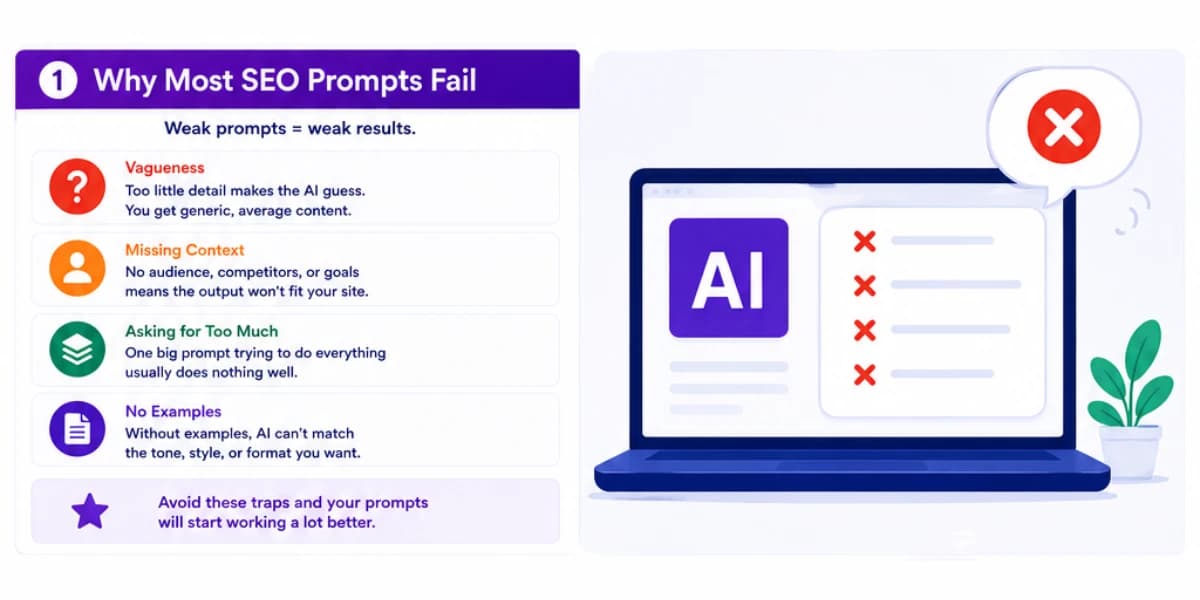
The third problem is asking for too much in one shot.
A single prompt that tries to handle keyword research, content structure, writing, and SEO optimization all at once usually produces mediocre results across the board.
Breaking a big task into smaller, focused prompts almost always beats one giant prompt trying to do everything.
The fourth problem is no examples. AI tools are very good at matching a pattern once you show them one.
If you want a specific tone or format, showing a short example is far more effective than trying to describe that tone or format in words alone.
Once you understand these four traps, writing strong prompts becomes a lot easier, because you are simply avoiding these patterns rather than guessing blindly.
For a complete overview of how AI fits into every stage of search engine optimization, read our complete AI SEO guide. It covers how AI tools handle everything from keyword research to technical audits.
The Building Blocks Of A Strong SEO Prompt
Every strong prompt tends to include a handful of core pieces, even if the exact wording changes from task to task.
Knowing these pieces makes it much easier to build a good prompt from scratch for any task you run into.
The role tells the AI what kind of expert it should act as.
Something like act as an experienced SEO strategist who specializes in local service businesses sets a clear frame for how the response should sound and what kind of advice it should lean toward.
The task states exactly what you want done, stated plainly and specifically rather than in vague terms.
Instead of help me with keywords, a clear task might read find fifteen long tail keyword opportunities related to home water filtration systems that have low competition and clear buying intent.
The context gives background the AI needs but would otherwise have to guess at, including your target audience, your existing content, your competitors, or any constraints like word count or tone.
The format tells the AI exactly how you want the answer structured, such as a table, a numbered list, a specific set of headings, or plain paragraphs matching a certain style.
The examples, when relevant, show a sample of the tone, structure, or quality level you are aiming for, which is often the single most effective addition you can make to a prompt.
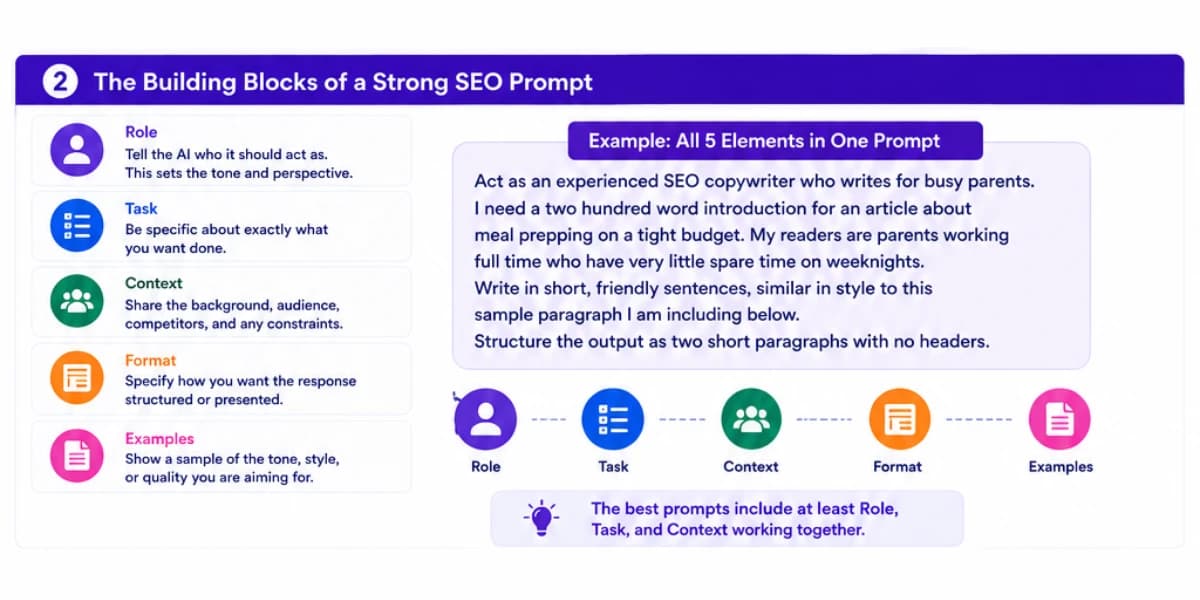
You do not need every single piece in every prompt, but the strongest prompts almost always include at least role, task, and context together.
It helps to see these pieces stacked together in one full example rather than described separately.
Here is a single prompt using all five pieces at once.
Act as an experienced SEO copywriter who writes for busy parents. I need a two hundred word introduction for an article about meal prepping on a tight budget. My readers are parents working full time who have very little spare time on weeknights. Write in short, friendly sentences, similar in style to this sample paragraph I am including below. Structure the output as two short paragraphs with no headers.
Reading through that example, you can see the role sets the voice, the task states exactly what is needed, the context explains who the reader is, the example paragraph anchors the tone, and the format spells out exactly how the output should look.
Leaving out any one of these pieces usually means the AI has to guess at that piece on its own, and its guesses are rarely as good as what you actually had in mind.
Understanding how your content fits together is essential for effective workflows. Our guide on what content clusters are explains how pillar pages and supporting articles work together to build topical authority.
Using Follow Up Prompts To Get Closer To What You Want
A single perfect prompt on the first try is rare, and that is completely normal. The real skill in prompting often shows up in the follow up messages, not just the first one.
Treating a prompt like the start of a conversation rather than a one shot request tends to produce noticeably better final results.
A good follow up prompt is specific about exactly what needs to change, rather than a vague request like try again.
If the first draft of a product description felt too salesy, a follow up like that sounds a bit too much like a sales pitch, tone it down and focus more on practical details a shopper would actually want to know gives the AI clear direction on exactly what to fix, rather than forcing it to guess what went wrong.
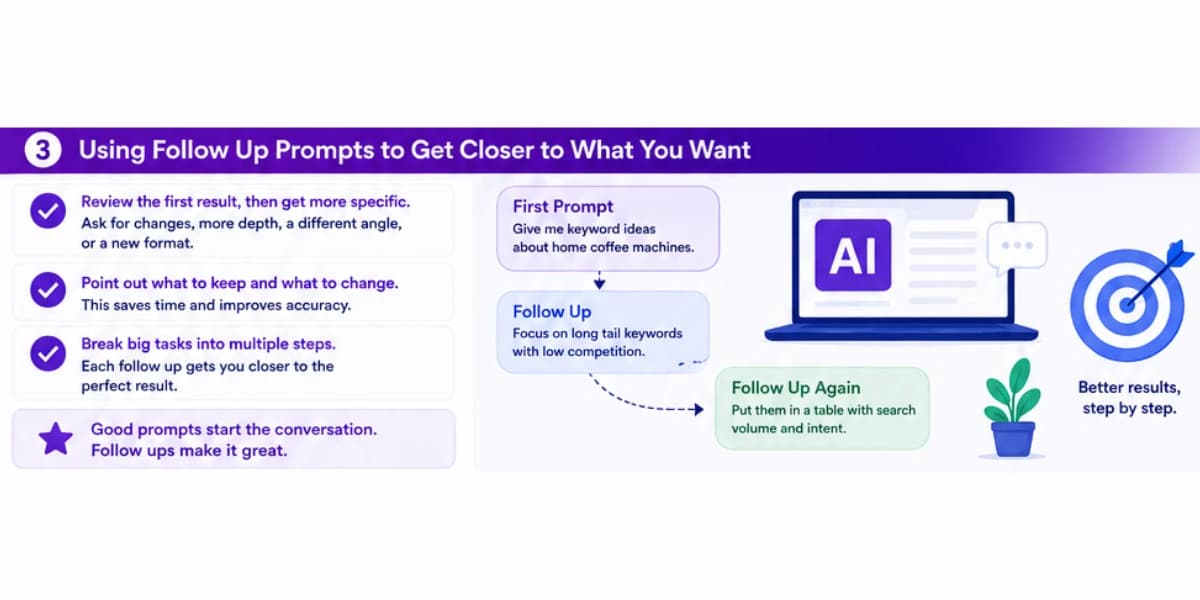
It also helps to build on good parts rather than starting over completely.
If a first draft nailed the opening paragraph but fell apart in the middle, a follow up like keep the first paragraph exactly as it is, but rewrite everything after that to focus more specifically on installation steps saves you from losing the parts that were already working well.
Over several rounds of this kind of back and forth, most people find they land on a result that fits their needs far better than anything a single first prompt could have produced, no matter how carefully that first prompt was written.
Prompts For Keyword Research
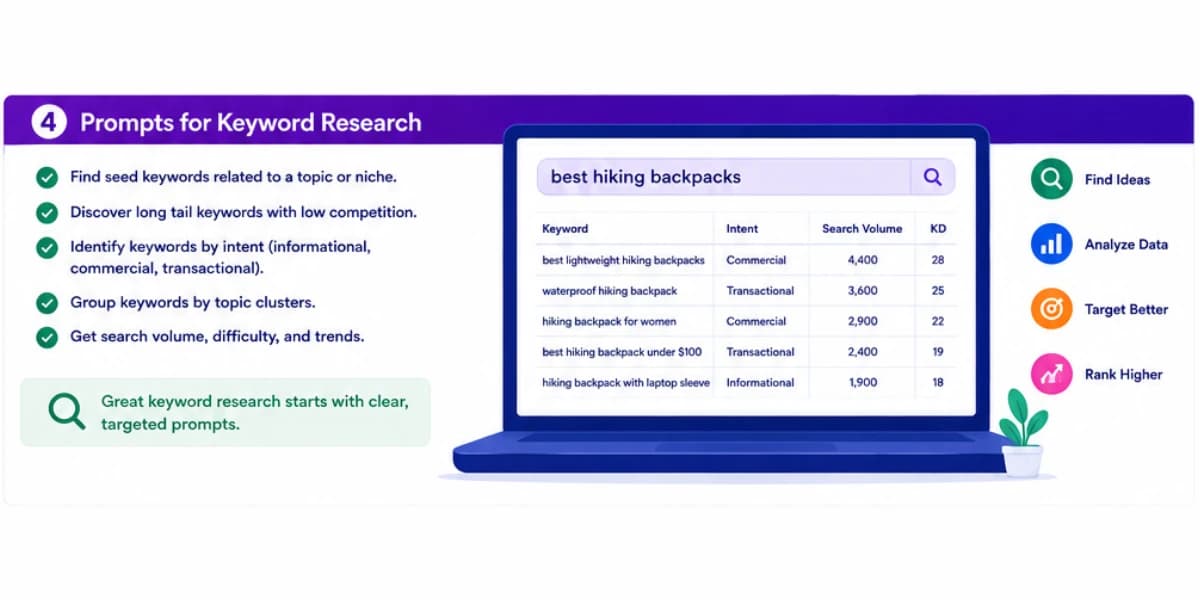
Keyword research prompts tend to fail when they are too broad. Asking for keywords about fitness will give you a flood of generic terms you could have found yourself in thirty seconds.
A better approach narrows the request significantly.
Here is a prompt that works well for finding keyword clusters around a specific topic.
Act as an SEO strategist. I run a website about home gym equipment for small apartments. Give me twenty keyword ideas related to compact home gym setups, grouped by search intent into informational, commercial, and transactional categories. For each keyword, note the likely intent behind the search and suggest what kind of page would satisfy that search best.
Notice how specific this is. It names the niche, asks for a specific number, asks for grouping by intent, and asks for reasoning behind each suggestion rather than just a bare list of words.
That last part matters a great deal, since knowing the intent behind a keyword is often more useful than the keyword itself.
Here is another prompt useful for finding content gaps.
Act as an SEO content strategist. Here is a list of articles already published on my site about home gym equipment for small apartments, followed by a list of keywords I want to rank for. Compare the two lists and tell me which keywords have no matching content yet, and suggest a title and content angle for each gap.
A prompt like this works best when you actually paste in your list of existing content and your target keywords directly into the prompt, since the AI can then compare them accurately rather than guessing at what you already have published.
Skipping this step and just describing your site in general terms tends to produce a much weaker, less accurate gap analysis.
A third useful prompt for keyword research focuses on competitor analysis.
Act as an SEO researcher. I am competing against these three websites for the keyword best budget treadmills under five hundred dollars. Look at what these pages likely cover based on this keyword and my notes below, and suggest specific subtopics or angles my article should include to be more thorough and useful than a typical article on this topic.
Learning how to do keyword research properly helps you map which pages should target which queries, so you can spot cannibalization issues before they become structural problems.
Prompts For Content Briefs
A content brief prompt should produce something a writer could actually use without needing to ask a bunch of follow up questions.
Vague briefs lead to vague articles, so the prompt itself needs to be detailed.
Here is a solid brief generating prompt.
Act as a content strategist creating a brief for a freelance writer. The target keyword is best air purifiers for pet owners. The target reader is someone who owns at least one dog or cat and is concerned about pet hair, dander, and odor in their home. Create a brief that includes a suggested title, a short summary of the article's purpose, a list of subtopics to cover in a logical order, and three specific questions the article should answer that a typical competing article probably misses.
The phrase that a typical competing article probably misses is doing real work in that prompt.
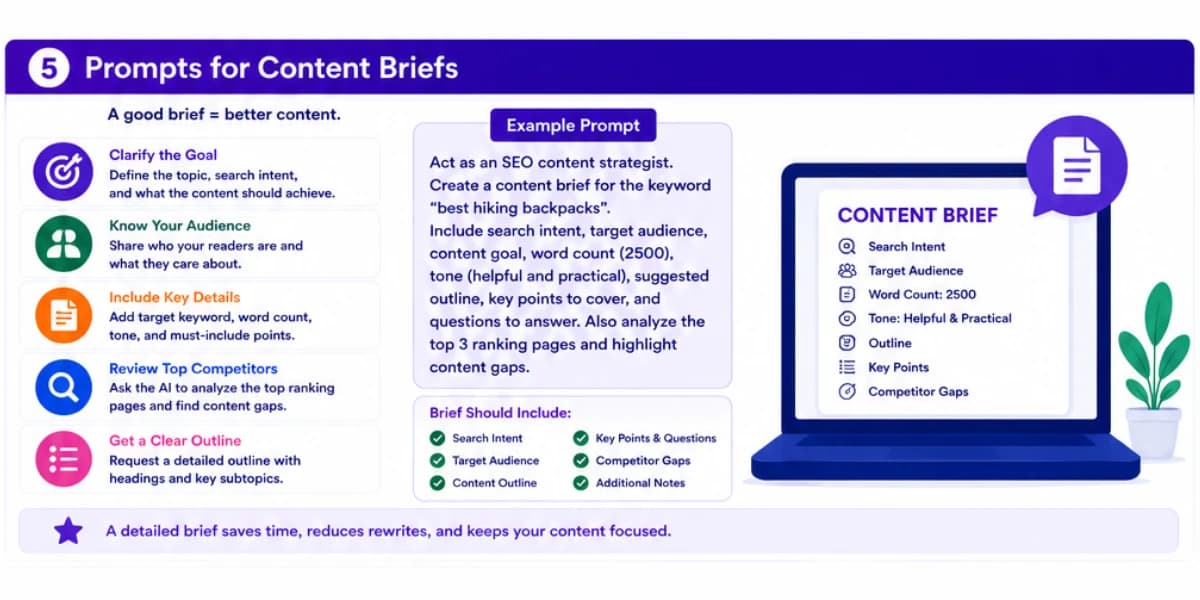
It pushes the AI toward genuinely useful, differentiated suggestions rather than a generic outline that looks like every other article on the same topic.
For product comparison content specifically, a brief prompt might look like this.
Act as a content strategist. Create a brief for a comparison article between three specific robot vacuum brands, focused on helping a reader with hardwood floors and a shedding dog decide which one fits their situation best. Include a suggested comparison table structure with the exact criteria that matter most for this reader, along with a suggested final recommendation format.
Asking for a suggested comparison table structure with specific criteria forces the AI to think through what actually matters to that particular reader, rather than defaulting to generic comparison points like price and rating that show up in nearly every comparison article regardless of the product category.
Turning your keyword research into a consistent publishing schedule is easier when you have a solid plan. Our guide on how to create a content plan for affiliate marketing walks through exactly how to structure your workflow.
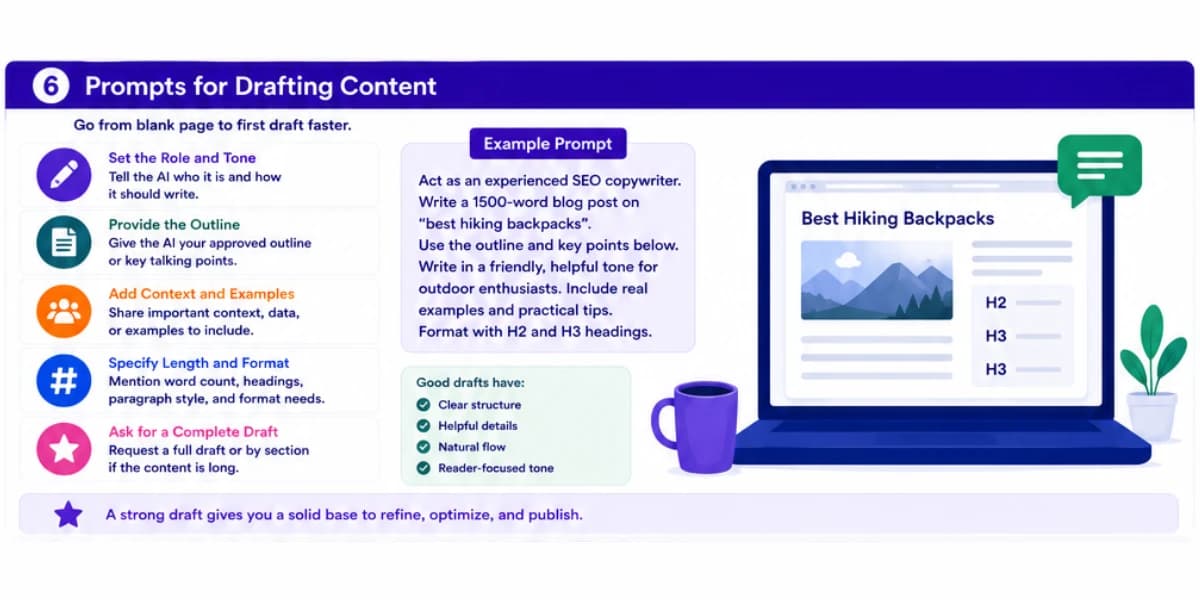
Prompts For Drafting Content
Drafting is where a lot of people get lazy with their prompts, typing something short and then feeling disappointed with generic sounding output.
The fix almost always involves giving the AI a clear voice to follow and specific facts to work with rather than asking it to invent everything from scratch.
Here is a strong drafting prompt built around a sample of your own writing.
Act as a writer matching the tone and style shown in the sample paragraph below. Write a three hundred word section explaining why HEPA filters matter for pet owners specifically, using a friendly, conversational tone similar to the sample. Include the specific fact that true HEPA filters capture at least ninety nine point nine seven percent of particles at zero point three microns in size.
Giving the AI a specific fact to include, rather than asking it to research and state facts on its own, removes a major source of factual mistakes in AI generated drafts.
It also produces text that reads more specifically and less like generic filler, since specific numbers and facts naturally make writing feel more grounded.
For longer sections, breaking the draft into smaller chunks tends to produce better results than asking for an entire article in one go.
A prompt like write the introduction only, in a friendly and direct tone, no more than one hundred fifty words, focused on the biggest pain point pet owners have with dander and odor, followed later by a separate prompt for the next section, generally produces a more consistent and higher quality result than one massive prompt trying to generate the whole article at once.
It also helps to explicitly ask the AI to avoid common filler phrases that tend to show up in AI generated writing, since these phrases are exactly what makes content feel flat and recognizable as machine written.
A line at the end of your prompt like avoid generic filler phrases and get straight to specific, concrete points can noticeably tighten up the output, especially when paired with a real sample of your own writing style for the AI to match instead.
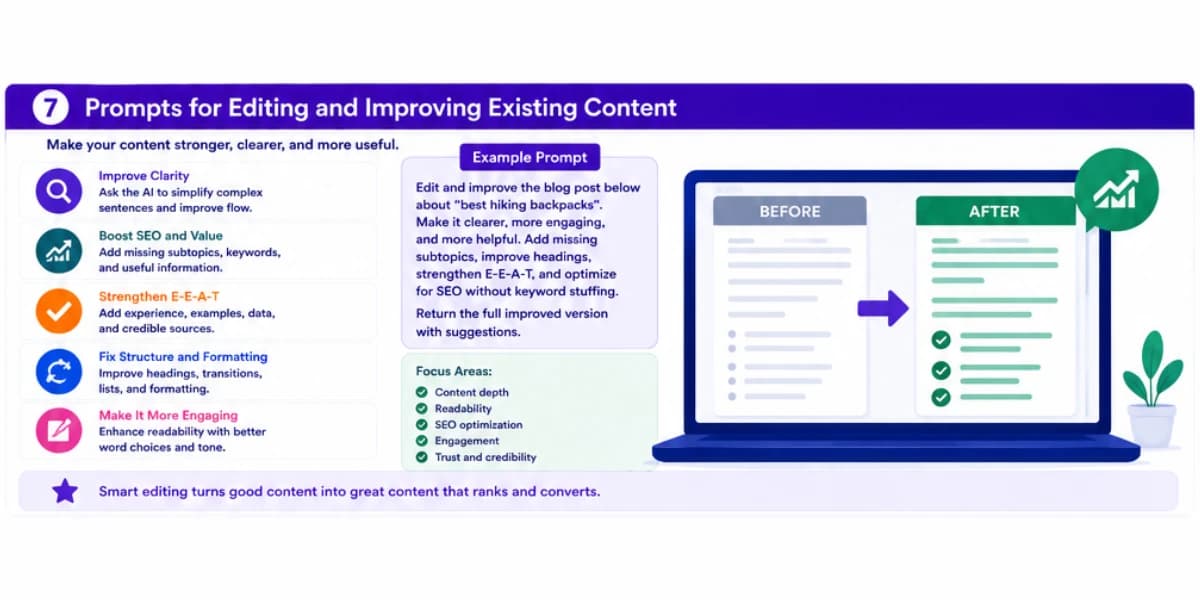
Prompts For Editing & Improving Existing Content
Editing prompts work best when they are narrow and specific about exactly what needs fixing, rather than a broad request like make this better, which gives the AI no clear direction on what better actually means for your specific goals.
A useful editing prompt for tightening up writing looks like this.
Here is a paragraph from my article. Rewrite it to be more direct and remove any repeated phrases or unnecessary filler words, while keeping every fact exactly the same. Keep the tone friendly but cut the length by about twenty percent.
Asking for a specific percentage reduction gives the AI a clear target, rather than a vague sense of shorter, and tends to produce a more disciplined edit as a result.
For checking factual accuracy in an existing piece, a prompt like this works well.
Here is a paragraph mentioning pricing and features for three products. Check each specific claim against current publicly available information about these products and tell me clearly which facts appear outdated or incorrect, along with what the correct current information seems to be.
That kind of prompt is especially useful during a content refresh, since it turns a slow manual fact check into something much faster, provided you still verify anything important before publishing.
For improving readability specifically, try a prompt like this.
Rewrite this paragraph so a high school student could easily understand it, using shorter sentences and simpler words, while keeping the same meaning and any technical facts fully intact.
Creating content that stays relevant for years requires a different approach than chasing trends. Our article on creating evergreen content explains how to write articles that continue driving traffic long after publication.
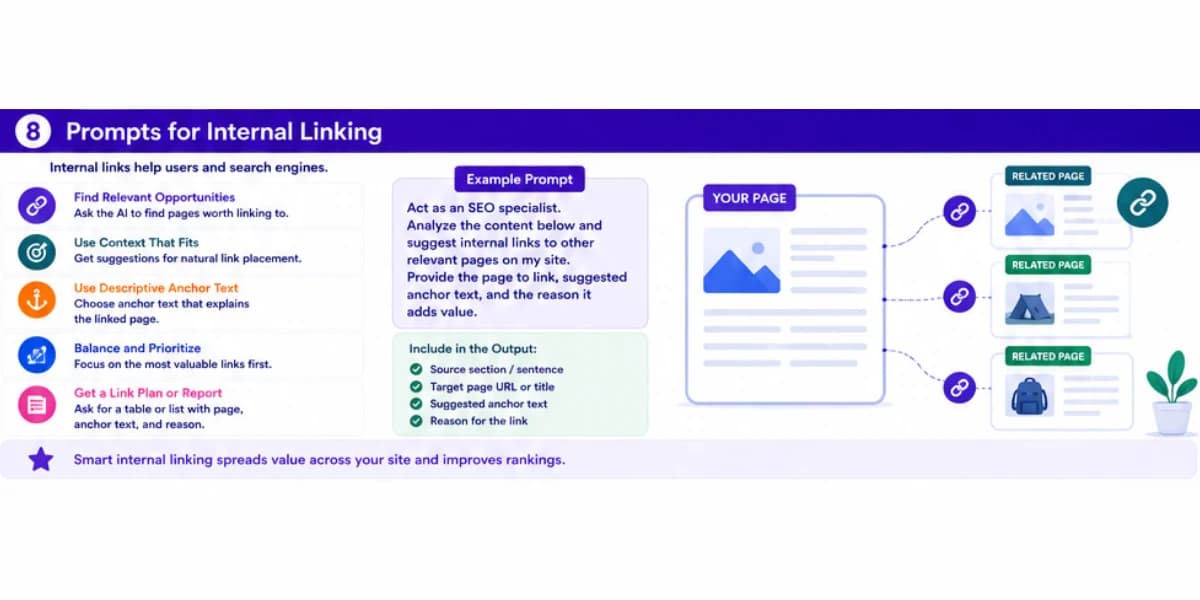
Prompts For Internal Linking
Internal linking prompts tend to work best when you give the AI a clear list of your existing pages rather than expecting it to somehow already know your site's content.
A solid internal linking prompt looks like this.
Here is the text of an article I am publishing about choosing a mattress for side sleepers. Below that is a list of other pages already published on my site, with a short description of each. Suggest three to five places in the article where a link to one of these existing pages would genuinely help the reader, and suggest natural sounding anchor text for each one drawn from the surrounding sentence rather than a generic phrase.
Asking specifically for anchor text drawn from the surrounding sentence, rather than a generic exact match phrase, tends to produce much more natural sounding suggestions that do not feel forced when you actually read them in context.
For a broader internal linking audit across many pages, a prompt like this can help spot bigger patterns.
Here is a list of forty pages on my site with short descriptions of each. Identify any pages that appear to have very few or no natural connections to other pages on this list, and suggest two or three pages each of these under linked pages could reasonably connect to.
For sites with a clear pillar and cluster structure, a more targeted prompt can help maintain that structure over time.
Here is my pillar page about choosing running shoes, along with descriptions of twelve supporting articles I have published on related subtopics. Check if each supporting article currently links back to the pillar page based on the descriptions given, and flag any that seem to be missing this connection.
A check like this is easy to overlook once a site grows past a handful of articles, and running it every few months catches gaps before they quietly hurt the pillar page's ranking potential.
If you need help finding where to add links in your existing content, try our internal link opportunity finder tool. It scans your pages and highlights where new internal links would add the most value.
Prompts For Meta Titles & Descriptions
Meta title and description prompts often fail because people ask for something generic like write a meta description for this page, which produces the same flat, forgettable style you see across most of the internet.
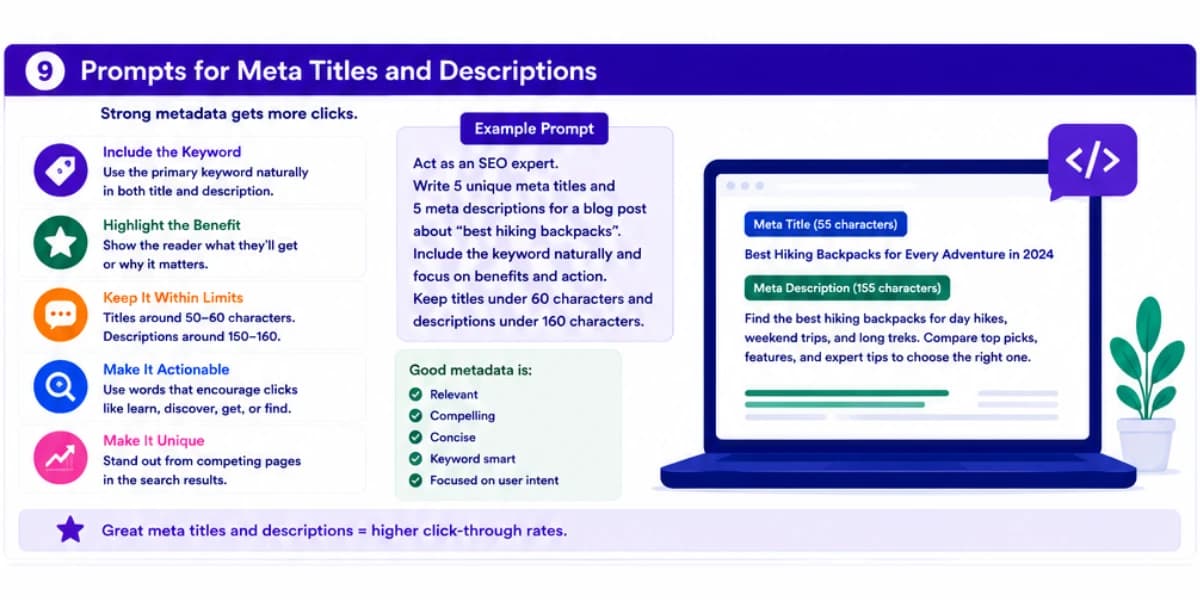
A better prompt gives clear constraints and a specific goal.
Write five different meta description options for a page about the best hiking boots for wide feet. Each one should be under one hundred fifty five characters, include the phrase wide feet naturally, and use a different angle, such as focusing on comfort, focusing on avoiding blisters, or focusing on a specific brand comparison, so I have real variety to choose from.
Asking for multiple distinct angles instead of one single answer is a small change that makes a big difference, since it gives you actual choices to compare rather than one option you either accept or have to fix yourself.
Using the right SEO plugins for your website can help you manage and monitor your meta titles and descriptions alongside other on-page optimization tasks.
Prompts For Content Audits
Content audit prompts benefit enormously from having real data pasted directly into the prompt, since an AI tool cannot analyze performance it has never been shown.
A useful audit prompt looks like this.
Here is a spreadsheet of forty of my articles with their current monthly traffic, ranking position for their target keyword, and the date they were last updated. Identify which pages look like they are underperforming relative to how long ago they were published, and suggest a likely reason for each one, such as outdated content, weak competition from newer articles, or a possible mismatch between the page and its target keyword.
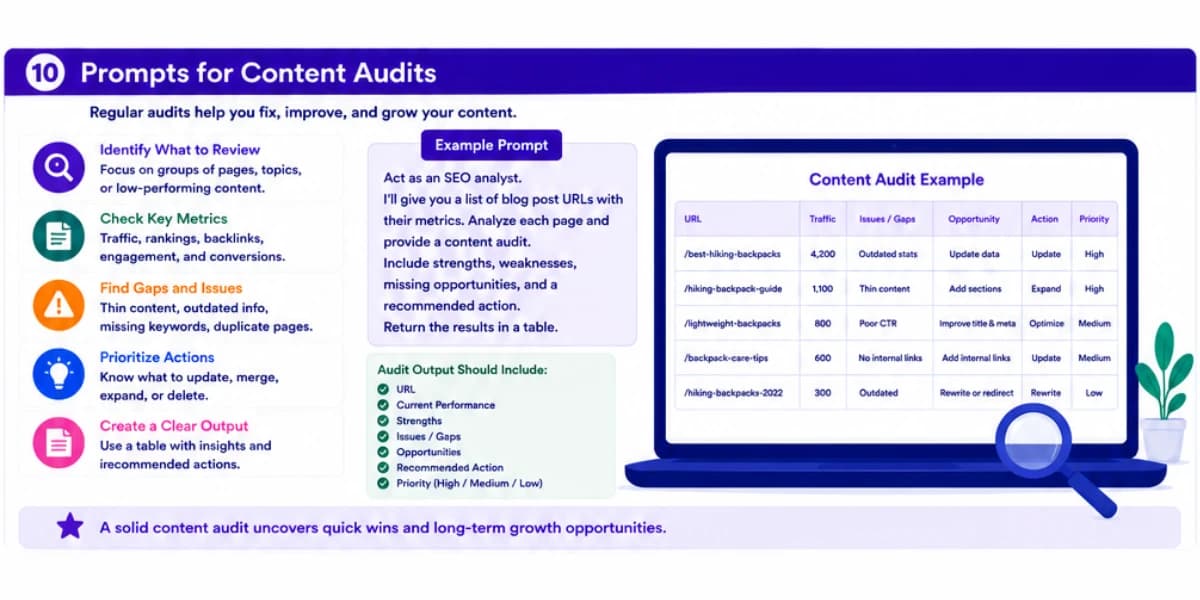
Giving the AI the actual data, rather than asking it to guess at general audit advice without any numbers in front of it, is the difference between a genuinely useful audit and a generic list of things every website should probably check.
For a complete overview of how AI fits into every aspect of search engine optimization, including content audits, read our AI content audit guide to understand how to find what's underperforming on your site.
Prompts For FAQ Sections & Structured Content
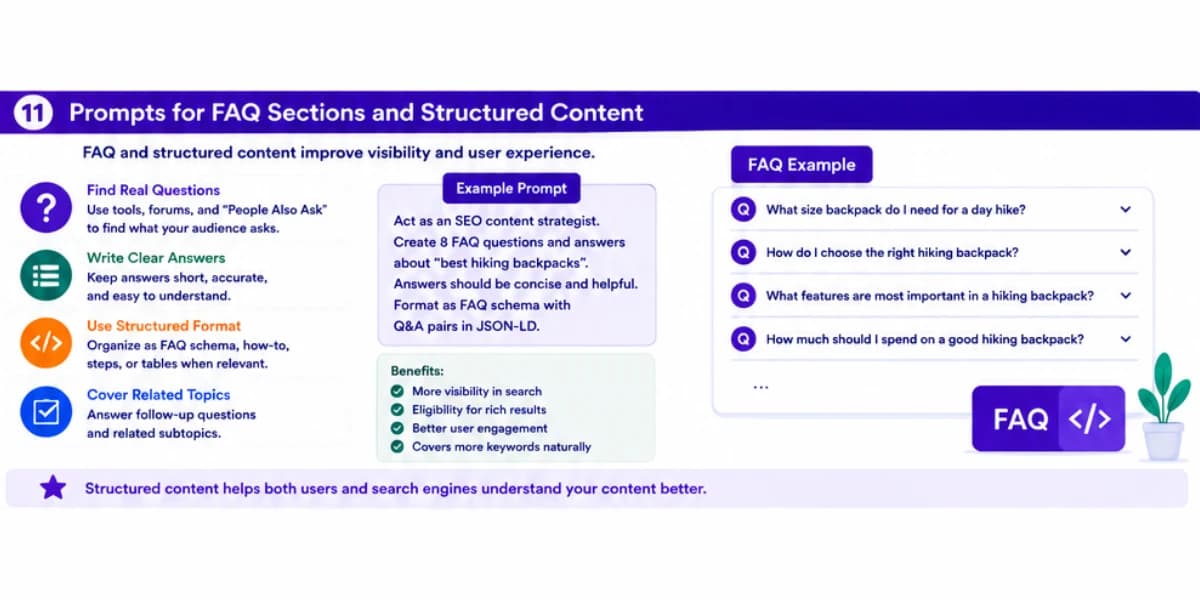
FAQ sections are an easy win for AI assistance, since the format is naturally structured and repetitive in a way that suits how these tools work.
The trick is asking for genuinely useful questions rather than obvious ones nobody actually searches for.
A prompt that works well here looks like this.
Act as an SEO content writer. Write eight frequently asked questions and short answers for an article about choosing a mattress for side sleepers. Base the questions on what real shoppers actually search for and ask salespeople, not generic questions like what is a mattress. Keep each answer under sixty words and written in a friendly, direct tone.
The line about basing questions on what real shoppers actually search for, rather than generic textbook questions, pushes the output toward something genuinely useful rather than filler content that technically fills an FAQ section without adding real value.
For structured comparison content, like a table comparing several products, a prompt like this helps.
Create a comparison table for four robot vacuum models, with columns for price, battery life, noise level in decibels, and if each one works well on both carpet and hardwood floors. Use the product details I am pasting below rather than guessing at specifications, and flag clearly if any information is missing rather than making up a number.
Asking the AI to flag missing information rather than filling in a guess is a small addition that prevents a common and embarrassing mistake in AI assisted content, which is a confidently stated but completely made up specification.
Troubleshooting When Prompts Are Not Working
Sometimes a prompt that should work well still produces disappointing results, and it helps to have a quick troubleshooting process rather than just giving up or accepting weak output.
If the output feels too generic, the most common fix is adding more specific context about your actual audience and situation.
A prompt about running shoes becomes much stronger once it specifies that the reader is training for their first marathon and has flat feet, rather than staying at the level of a generic running shoe buyer.
If the output feels factually shaky, the fix is almost always giving the AI the actual facts to work with rather than asking it to recall or find them on its own during the writing process.
Pasting in verified numbers, current pricing, or specific product details before asking for a draft removes most of the risk of made up details slipping into your content.
If the tone feels off, even after describing the tone you want in words, switching to a sample paragraph usually solves it faster than more detailed description ever could.
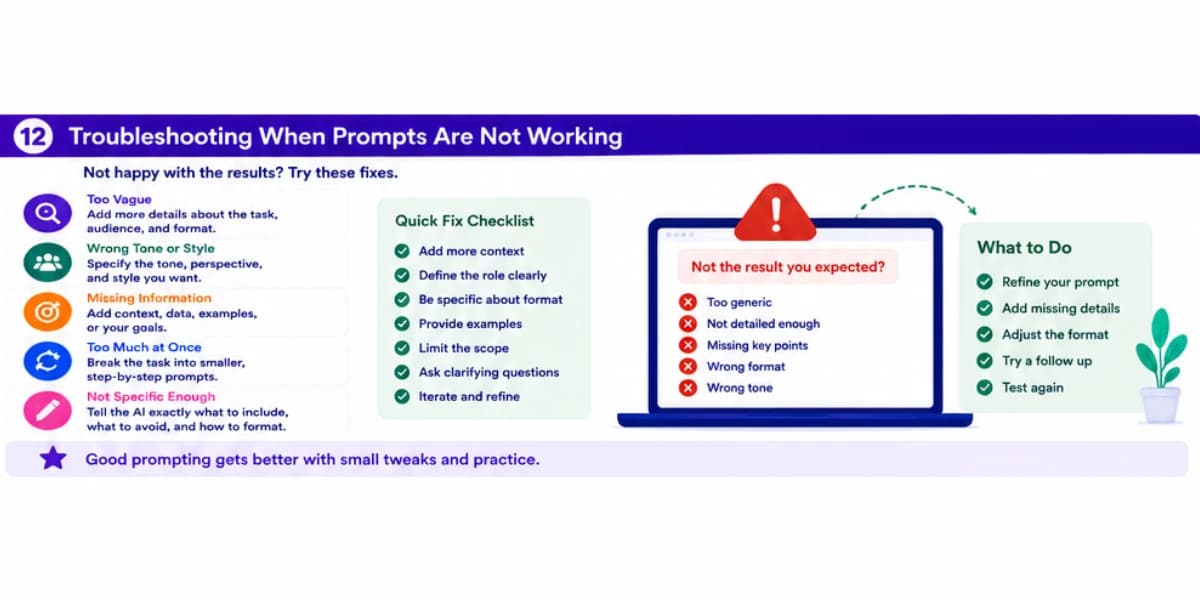
AI tools tend to match a real example far more reliably than they match an adjective like casual or professional, since those words mean slightly different things to different people and the AI has to guess at your specific version of casual.
If the structure comes back wrong, the fix is usually being more explicit about format in the original prompt rather than fixing it after the fact.
Spelling out exactly how many sections you want, how long each one should be, and if you want headers, bullet points, or plain paragraphs removes most of the guesswork that leads to a mismatched structure in the first place.
If you have tried all of these fixes and the output still is not working, it sometimes means the task itself needs to be broken into smaller pieces.
A single prompt trying to research, structure, and write a full article at once is asking a lot in one shot, and splitting that into three separate prompts, a first for research, a second for structure, and a third for writing, often solves problems that no amount of tweaking the original single prompt would have fixed.
Common Prompting Mistakes To Avoid
A frequent mistake is assuming the AI remembers earlier context from a different conversation or session.
Every new conversation typically starts fresh, so anything important from an earlier session, like your brand voice guidelines or your list of existing content, needs to be included again if you want the AI to use it.
Keeping a saved document with your key context, like your audience description and a sample of your writing style, makes it easy to paste that information into a fresh conversation in seconds instead of retyping it from memory every time.
Another common mistake is accepting the first response without pushing further.
If a first draft feels close but not quite right, a simple follow up like that's a good start, but make the tone a bit more casual and cut the second paragraph in half often gets you a noticeably better result in one more round rather than starting completely over.
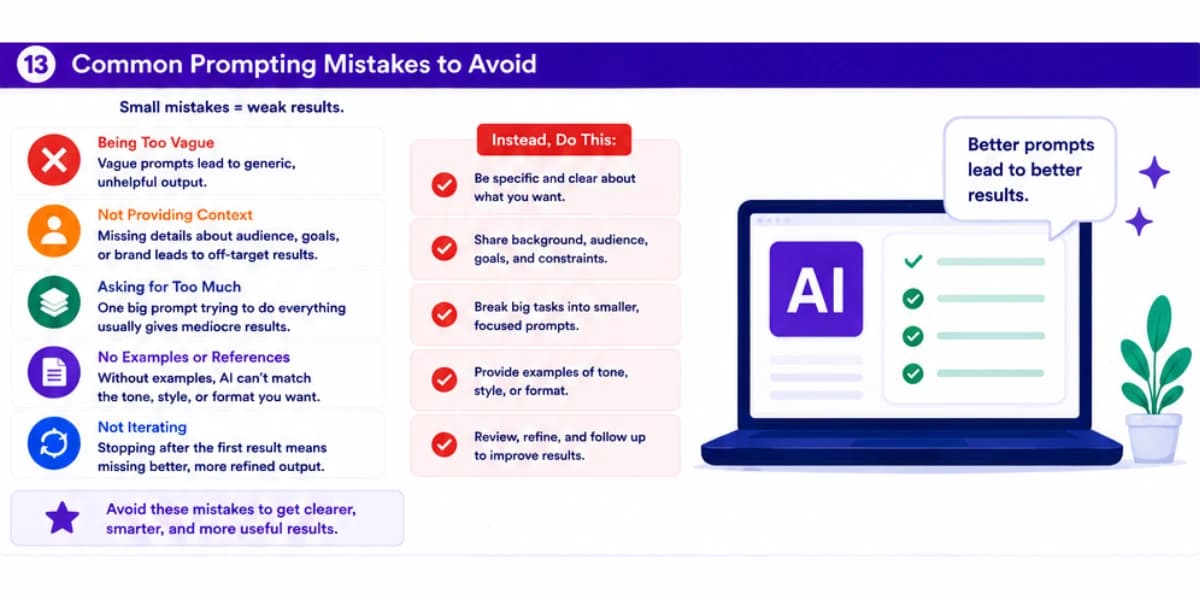
A third mistake is being too polite and indirect instead of being specific and direct.
Phrases like maybe you could possibly try to make it a little better tend to produce vague results, since the AI has very little concrete direction to act on.
Being direct and specific, even if it feels a bit blunt, almost always produces stronger output, and it saves both you and the AI several rounds of back and forth that a clearer first request would have avoided entirely.
A fourth mistake, and a subtle one, is forgetting to ask for reasoning when it matters.
If you want to understand why the AI suggested a particular keyword or structure, simply ask for a brief reason for each of your top three suggestions.
That small addition often reveals if a suggestion is actually well thought out or just a plausible sounding guess.
Building topical authority in a niche depends heavily on keeping your content accurate and current, since search engines use freshness signals to determine which pages deserve to rank.
Building Reusable Prompt Templates
Once you find a prompt structure that consistently works well for a specific task, it is worth saving it as a template you can reuse with small changes each time, rather than rewriting a fresh prompt from scratch every single time you need it.
A simple way to do this is keeping a document with your best performing prompts for each common task, written with clear blanks where you fill in the specific details each time.
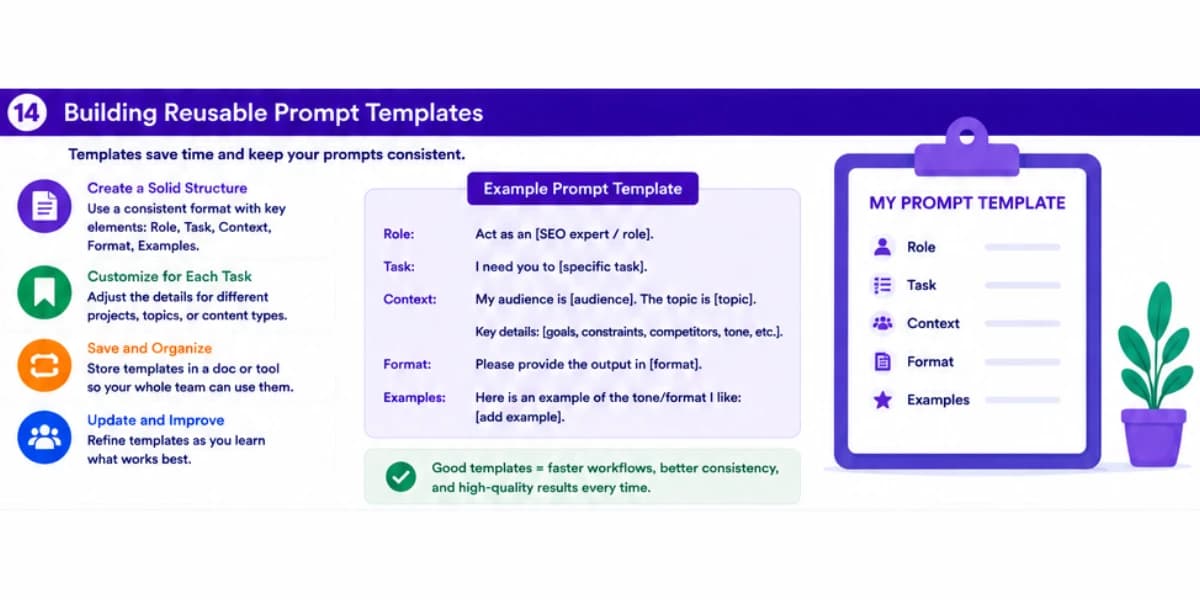
For example, your keyword research template might always start with act as an SEO strategist for a website about (fill in niche), followed by the rest of the proven structure you already know works.
Over time, this collection becomes a real asset for your team.
New writers or team members can pick up your proven prompts immediately instead of guessing at what works through trial and error, which saves a surprising amount of time once you have several of these templates built out for your most common recurring tasks.
Testing & Refining Your Prompts Over Time
Prompting is not something you get perfect on the first try and never touch again.
The AI tools themselves change over time, and your own sense of what output you actually want tends to sharpen the more you work with these tools.
A simple habit worth building is keeping notes on which prompts produced genuinely useful output versus which ones needed heavy editing afterward.
Over a few months, clear patterns tend to emerge.
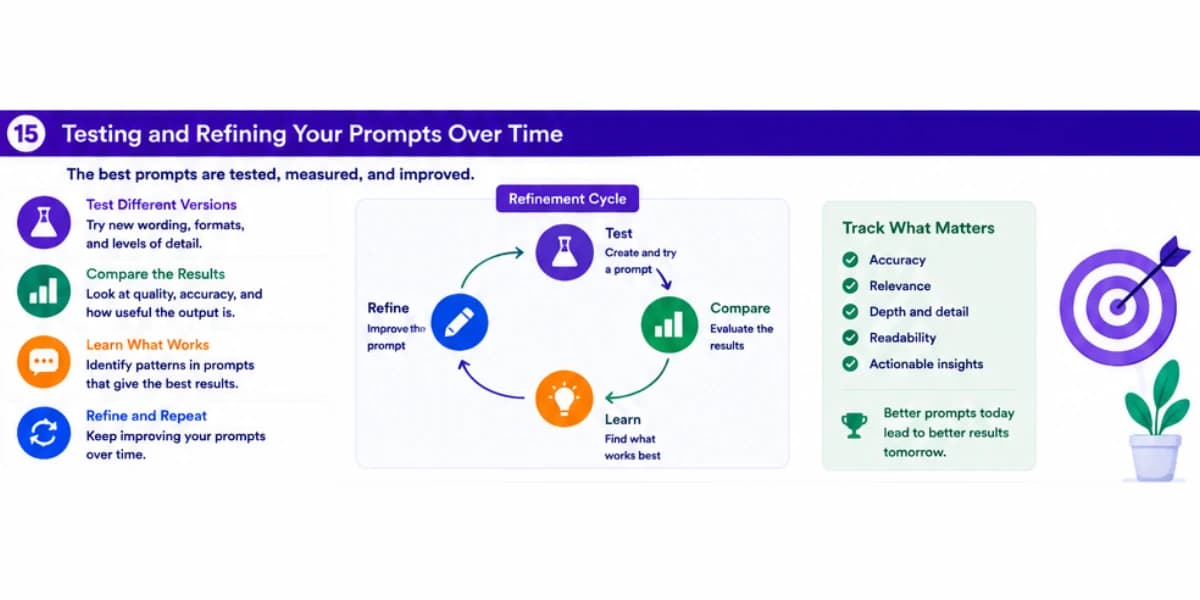
Maybe you notice that prompts asking for a specific word count always produce better structured drafts than prompts that leave length open ended.
Maybe you notice that giving three example sentences of your brand voice works better than describing that voice in words.
These small lessons add up into a genuinely better prompting habit over time, far more effectively than reading a single article and trying to apply every tip at once.
For a complete overview of how AI fits into every aspect of search engine optimization, read our AI internal linking guide to understand how link structures support your content strategy.
Final Thoughts On Prompt Engineering For SEO
Strong prompting for SEO work is not about memorizing a secret formula.
It comes down to being specific about what you want, giving the AI real context instead of leaving it to guess, breaking big tasks into smaller focused requests, and showing examples whenever tone or format matters.
Every prompt example in this article follows that same basic pattern, adjusted for the specific task at hand.
Start by picking one task you do often, like keyword research or content briefs, and try rewriting your usual prompt using the pieces covered here.
Add real context, get specific about the format you want, and see how much the output improves.
Once that feels natural, move on to the next task, and slowly build out a full set of go to prompts for every recurring piece of your SEO workflow, from research all the way through publishing.
Within a few weeks of doing this consistently, prompting well stops feeling like a special skill and starts feeling like just another normal part of how you work.
Keep a simple record of your best prompts as you go, since the ones that work well for your specific niche and audience are worth reusing again and again rather than reinventing from scratch every time a similar task comes up.
A small library of proven prompts, built up gradually over real projects, ends up being far more valuable than any general list of tips, including this one, because it reflects exactly what works for your own content and your own readers.
For a complete overview of how AI fits into every aspect of search engine optimization, including content workflows, read our AI content refresh workflow guide to understand how to keep your content current and competitive.
Frequently Asked Questions
1. Do longer prompts always produce better results?
Not always, but more specific prompts almost always beat vague ones, and specificity often does require a bit more length. A short but highly specific prompt will usually beat a long, rambling one that never quite states what you actually want.
2. Should I use the same prompt structure for every AI tool?
The core principles like being specific, giving context, and providing examples work across most AI tools, though some tools respond better to very structured prompts with clear labeled sections, while others work well with more natural, conversational requests. A bit of testing with your specific tool will show you which style it responds to best.
3. How do I stop AI generated content from sounding generic?
Give it real facts to include instead of asking it to invent them, provide a sample of your actual writing style to match, and avoid overly broad requests that leave too much open to guesswork. Editing the output afterward to add your own specific observations also helps a great deal.
4. Is it worth writing very long, detailed prompts for simple tasks?
Not usually. A quick meta description request does not need the same depth as a full content brief. Matching the effort you put into a prompt to the actual complexity of the task saves time without sacrificing quality on the simpler requests.
5. Can good prompting fully replace an SEO strategist?
No. Prompting well helps you get much better raw output from AI tools, but deciding what to prioritize, knowing your actual audience deeply, and making final judgment calls about strategy still requires a person who knows your specific business and goals.
6. What is the single biggest improvement I can make to my prompts today?
Add real context. Most weak prompts are simply missing the background information the AI would need to give a genuinely useful answer, and adding even a sentence or two of context, like who your reader is or what makes your product different, tends to improve results more than any other single change you can make.