Affiliate Marketing For Under 18: Can You Sign Up Yourself?
Most teens who search for affiliate marketing hit the same wall. The sign-up form asks for an age, and the answer decides everything that follows.
The short answer is yes, a teen can do affiliate marketing. The longer answer is that most programs want an adult on the account.
That sounds like bad news, but it is not a dead end. A parent or guardian can hold the account while you build the content, the audience, and the skills.
The guide below shows how the age rules work in real programs. You will see the exact wording Amazon Associates, Awin, Rakuten Advertising, Tradedoubler, TikTok Shop, and Google AdSense use.
You will also see how payouts work for people under 18, which platforms allow teens, and which rules apply to your content. The FTC disclosure rules and the children's privacy law both matter here.
The tax section covers the one number every young earner should know. After that, the steps tell you what to do first, second, and third.
If you are brand new to the topic, read our guide on what affiliate marketing is first. Then come back here for the age rules.
Think of it as a map of the rules, not legal or financial advice. Talk to a parent or guardian before you sign anything.
Disclosure: Some of the links I share might be affiliate links. If you click on one and make a purchase, I may earn a small commission as a thank you. But don’t worry, it won’t cost you anything extra. I only recommend stuff I genuinely believe in. Your support helps me keep creating awesome content. You can read my full affiliate disclosure in my disclaimer page.
Search 1,500+ affiliate programs in the Blogsepaise Program Database and filter them by category, network and commission type, then go straight to each program's signup page. The Link Health Monitor then checks your posts for broken, redirected and untagged affiliate links.
Can You Do Affiliate Marketing Under 18?
Yes, you can promote products and write about them at any age. The sticking point is the agreement you accept when you join an affiliate program.
An affiliate program is a contract. You agree to follow the rules, and the company agrees to pay you commissions.
Contracts need two sides who can legally agree. That is where age comes in.
Cornell Law School's legal reference notes that contracts entered by minors are voidable because there is a presumption that the minor did not have the capacity. In plain words, a minor can usually back out later.
Companies know that. So they set a minimum age and say so in their terms.
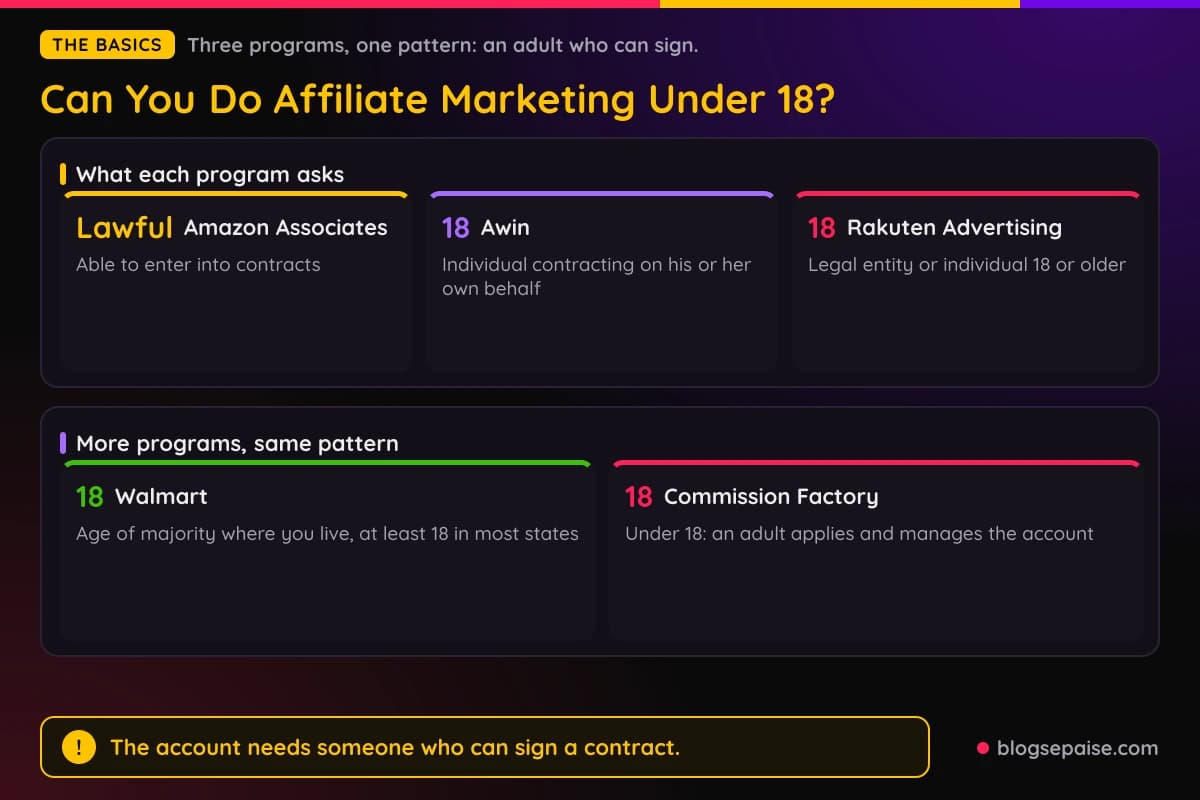
Amazon Associates requires members to be lawfully able to enter into contracts. Its agreement gives "you are not a minor" as an example of someone who cannot.
Awin, an affiliate network, puts it in a single sentence. An individual contracting on his or her own behalf warrants that he or she is aged 18 or over.
Rakuten Advertising asks publishers to be a legal entity or an individual 18 years or older. Walmart's affiliate terms ask for the age of majority where you live, which is at least 18 in most states.
Put those together and the pattern is clear. Most large programs and networks expect a person who can sign a contract on their own.
That does not mean affiliate marketing is closed to you. It means the account needs to belong to someone who can sign.
The rest of this guide shows how families handle that. Each step builds on the one before it.
Step 1: Learn What The Age Rules Cover
The age rule is not about your talent. It touches three practical things that every program has to handle.
The first is the contract, which the last section covered. A company cannot be sure a contract with a minor will hold up.
The second is money. Programs pay commissions, and they need a payout method that works for the person receiving the money.
Awin's terms tie payment to bank and tax information on the account. Awin pays subject to minimum payment thresholds and to correct bank and tax details being shown on its platform.
The third is tax reporting. Amazon's agreement says it may withhold taxes it is legally required to deduct, and it may hold commission income until a member provides tax information.
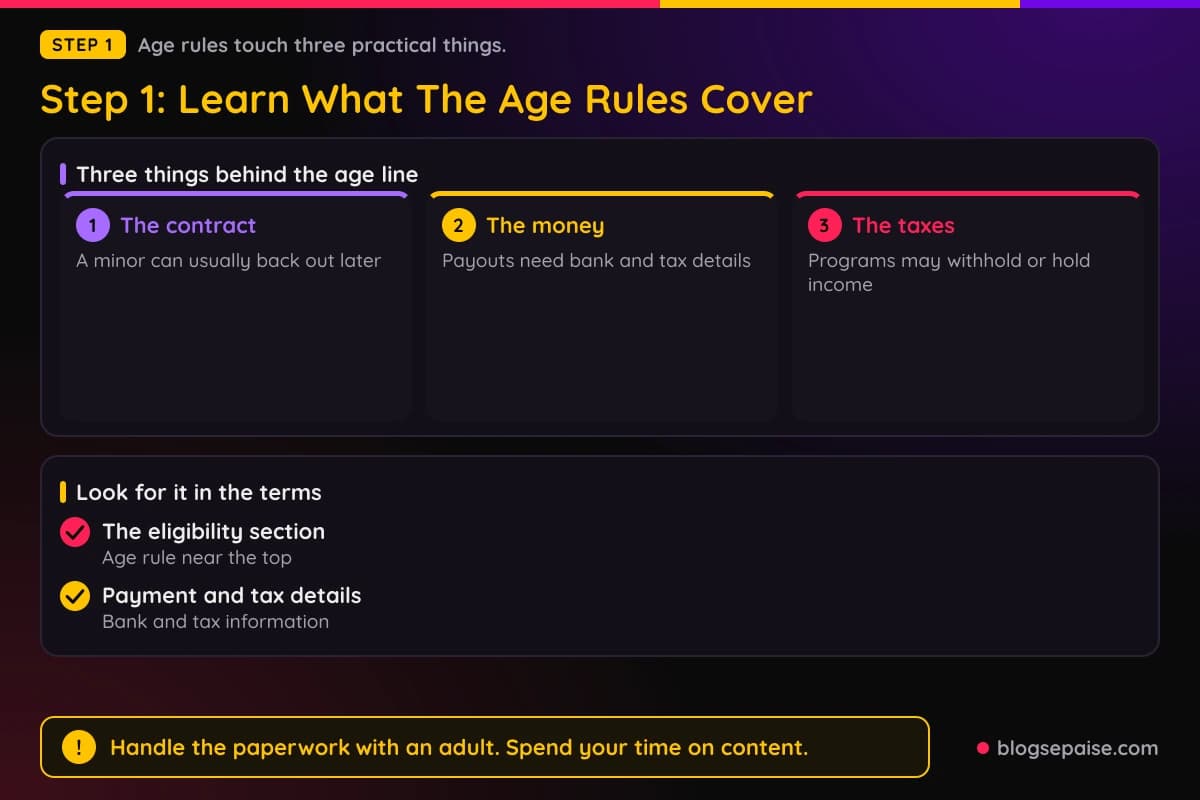
None of those three problems has anything to do with your writing skill. They are about paperwork.
Once you see that, the plan gets easier. Your job is to find a way to handle the paperwork with an adult, so your time goes to the content.
Keep in mind that each program writes its own rules. A rule that applies to one program does not automatically apply to the next.
That is why the next step is to read the terms of every program you want to join. Never guess the age rule.
Our guide on reading affiliate program terms shows where to look. The age rule usually sits near the top, in the eligibility section.
Reading terms is also a good habit for the rest of your affiliate career. Programs change their rules, and the people who read them avoid the surprises.
Step 2: Check The Age Rule Of Every Program
Here is how the age rule reads in real programs. These come from each company's own terms and help pages.
Amazon Associates asks for contract capacity rather than a number. Its agreement requires you to be lawfully able to enter into contracts.
Awin's publisher terms say an individual signing for himself or herself must be aged 18 or over. The same clause says anyone who fills out the application for a publisher must have the authority to bind that publisher.
Rakuten Advertising's Publisher Membership Agreement lists the requirement as "be either a legal entity or an individual 18 years or older." The line is short and clear.
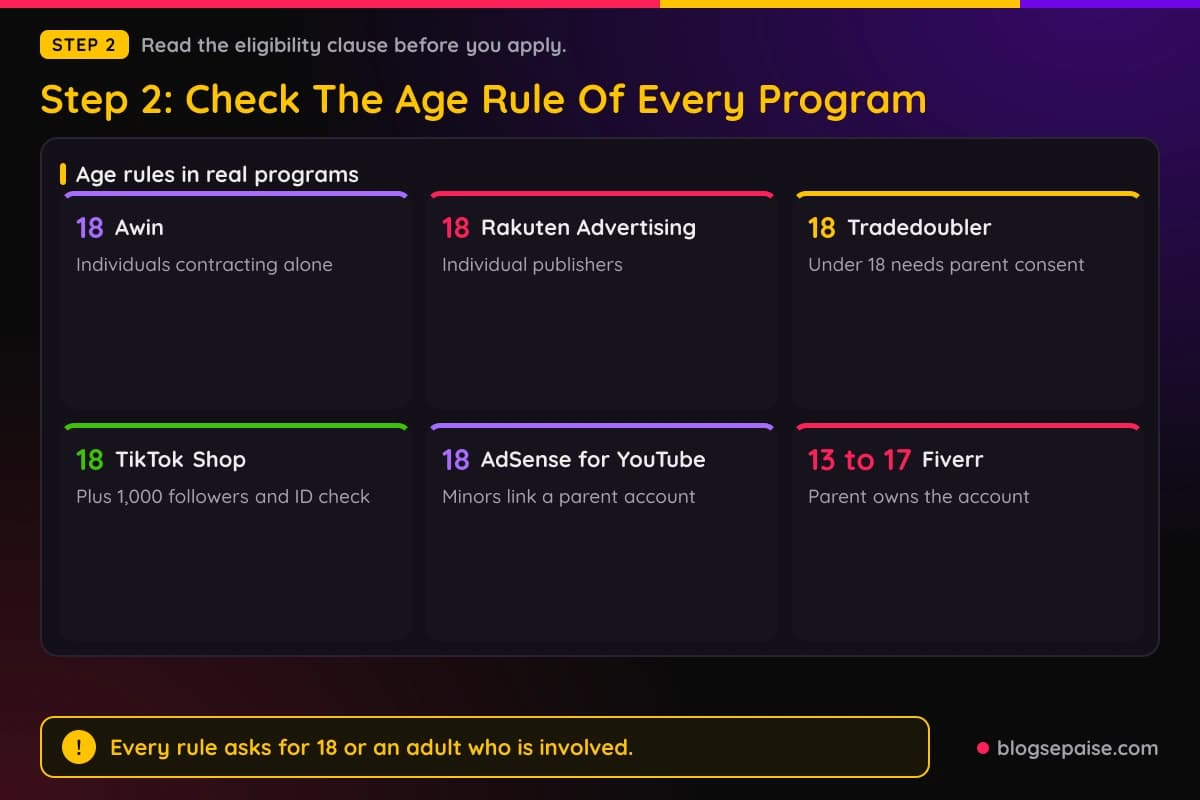
Tradedoubler is the interesting one for families. A private individual must be at least 18 years of age.
If the publisher is under 18, a parent must give consent to the registration. Tradedoubler's agreement says registration of a publisher below 18 without parental consent is ineffective.
Commission Factory takes a similar approach. It recommends that anyone who applies to the network is at least 18.
If you are under 18, an adult aged 18 or over should submit the application. That adult should also manage the account once it is approved.
Walmart's affiliate terms ask you to be of majority age in the place you live. They add that this is at least 18 years or older in most states.
TikTok Shop's Creator Eligibility Policy requires creators to be at least 18 years old. Affiliate Creators also need at least 1,000 followers and must pass identity verification.
Creators with fewer than 5,000 followers start in a 30-day pilot program with limited features. They must meet performance criteria to reach full access.
PartnerStack is a different case. Its partner terms set no age rule of their own and describe partners as individuals, consultants, or companies.
Programs that run on PartnerStack can still set their own rules for who may join. Check the program's page, and not just the network's.
Fiverr is a freelance marketplace rather than an affiliate network, but its teen policy shows the same pattern.
Users between 13 and 17 can use the platform only with a parent or guardian's permission. The adult must create and own the account.
The adult also completes ID verification using their own government-issued ID. Fiverr bars minors from offering some services, including modeling and dance lessons.
Google handles YouTube earnings the same way. The minimum age for AdSense for YouTube is 18, and the only route for a minor is a channel linked to an approved account owned by a parent or guardian over 18.
Look at the whole list again. Every program on it either asks for 18 or asks for an adult who is involved.
No rule in that list lets a teen skip the adult. So the next step is about setting up the right adult arrangement.
Step 3: Set Up A Parent Or Guardian Arrangement
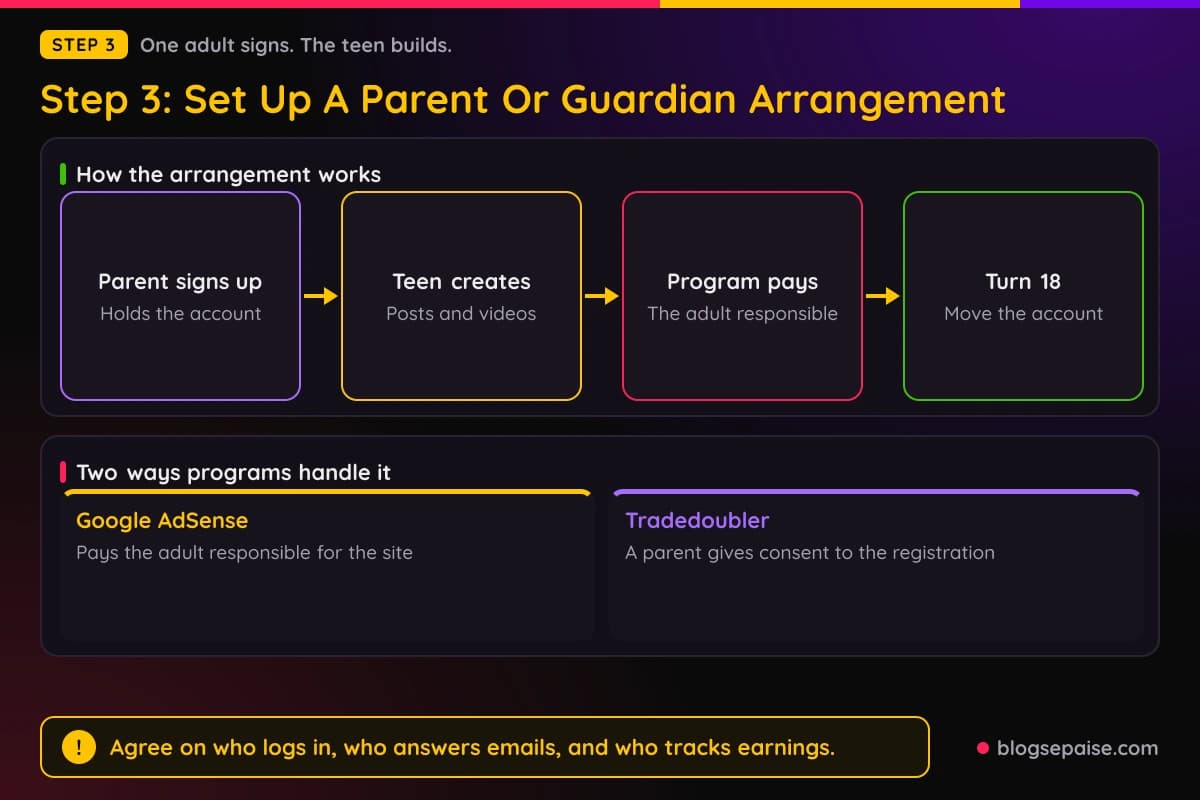
The common workaround is simple. A parent or guardian signs up for the program with their own details.
You create the content and run the day to day work. The adult holds the account and agrees to the program's terms.
Google describes this exact setup for AdSense. If a parent's account is approved, payments go to the adult who is responsible for the site.
Commission Factory spells out the same idea. An adult submits the application and manages the account after approval.
Tradedoubler sets out a different path. The teen registers, and a parent gives consent, otherwise the registration does not count.
Because the setups differ, ask before you apply. Read the program's terms with your parent or guardian, and look for the words that cover minors.
An adult who signs also takes on responsibility. They agree to the rules, they receive the payments, and the program may treat them as the account holder.
That is a real commitment, so have an honest talk first. Agree on who handles which job, from posting content to checking the dashboard.
A short written plan keeps things clear. It can name the person who logs in, the person who answers program emails, and the person who tracks earnings.
Do not borrow an account that belongs to an adult who does not know about it. Do not use a false age or a made-up birthday either.
Programs can close accounts that break their terms, and the money you earned may be held back. Our guide on how to avoid getting banned from affiliate programs covers the common causes.
Honest sign-ups protect you, too. Fiverr restricts an account when a minor's ID is submitted, until a parent or guardian verifies it with their own ID.
When you turn 18, the arrangement can change. Fiverr tells teens who turn 18 to contact support about moving account ownership.
Venmo's teen accounts work the same way at 18. A teen can switch to a personal account, and the parent loses visibility into it.
Plan for that day now. Write down how you will move the account, the payout details, and the tax records when you become an adult.
Step 4: Pick A Safe Way To Get Paid
Earning a commission is the fun part. Getting it into the right account is the part that needs a plan.
PayPal is a common payout method for affiliates. For a U.S. account, the user agreement asks individuals to be at least 18 or the age of majority in their state.
That rule means a teen cannot open a regular PayPal account alone. Do not try to get around it.
Venmo is owned by PayPal and has a separate teen option. A Venmo Teen Account is for people aged 13 to 17.
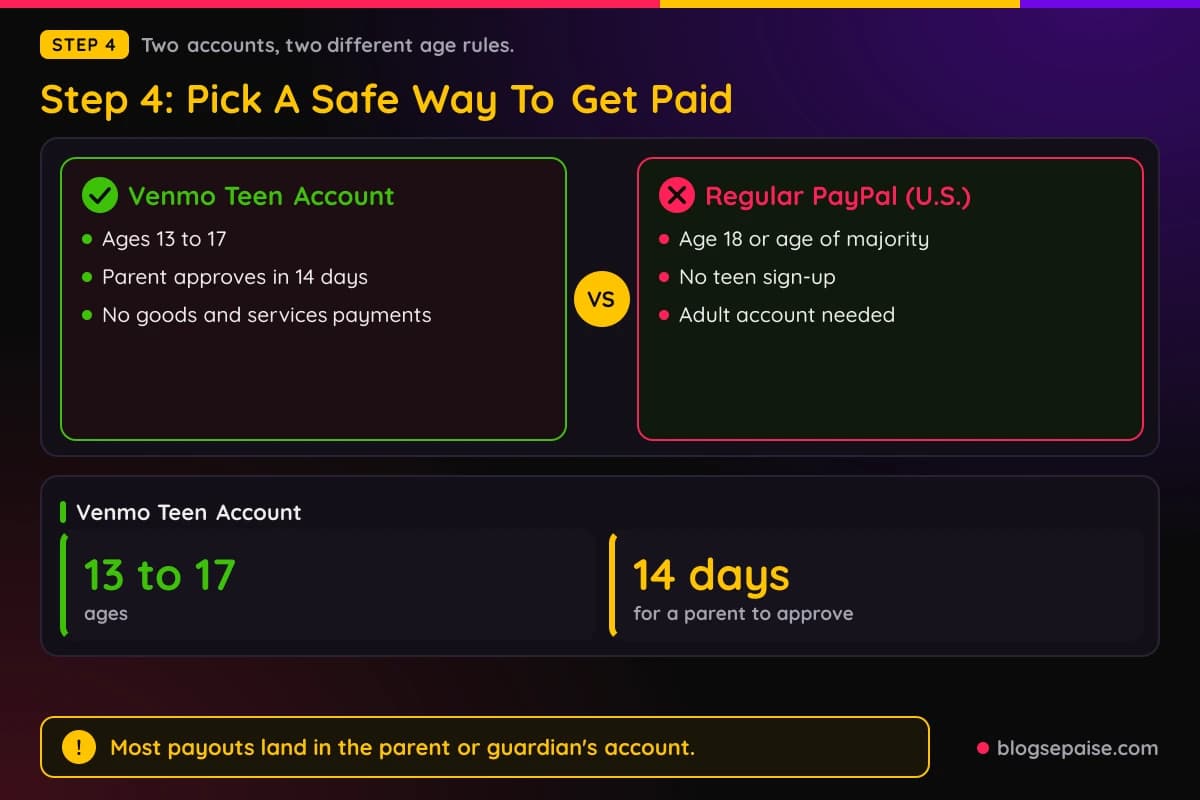
The teen can start the setup, but a parent or guardian must approve it within 14 days. The parent needs a verified Venmo account in good standing, and cannot already manage 5 teen accounts.
A teen account comes with limits that matter for affiliates. It cannot receive payments for goods and services, and it cannot create a business profile.
So a Venmo Teen Account is a handy place for allowance and friend payments. Treat it as a poor match for affiliate payouts.
Bank accounts are the usual answer. The FDIC explains that no federal law prohibits minors from having savings accounts.
Minors can open custodial or joint accounts with an adult, and some may open accounts in their own name. State law and each bank's own policy decide which choices exist.
Some banks require a custodian, which is a parent or guardian who co-owns the account. Others let people over a certain age open an account in their own name.
A custodial account is another route. Under the Uniform Transfers to Minors Act, an adult manages the money for a child until the child reaches the age of majority.
Money placed in a custodial account is an irrevocable gift to the child. That means the adult cannot take it back later.
Those accounts are better suited to saving and investing than to receiving affiliate payments. Ask your bank which account type fits.
In most cases the payout lands in the parent or guardian's account, because the parent holds the affiliate account. Then the family decides how to move the money to you.
Keep records of every payout from day one. Write down the date, the program, and the amount.
Those records help at tax time, and they help you see which programs are worth your effort. Our guide on how affiliate commissions are paid explains payout schedules and thresholds.
Step 5: Follow The FTC Disclosure Rules
Affiliate links are a paid relationship. The FTC calls that a material connection, and it has rules for telling your audience.
The rules apply to anyone who endorses a product through social media. Your age does not change what the FTC asks you to say.
A material connection includes a financial relationship, such as getting paid when someone buys through your link. A brand giving you free or discounted products counts too.
You need to disclose that connection whenever you mention the product. You also need to disclose it if you believe your review is unbiased.
Where you put the disclosure matters. It has to be with the endorsement, in a spot that is hard to miss.
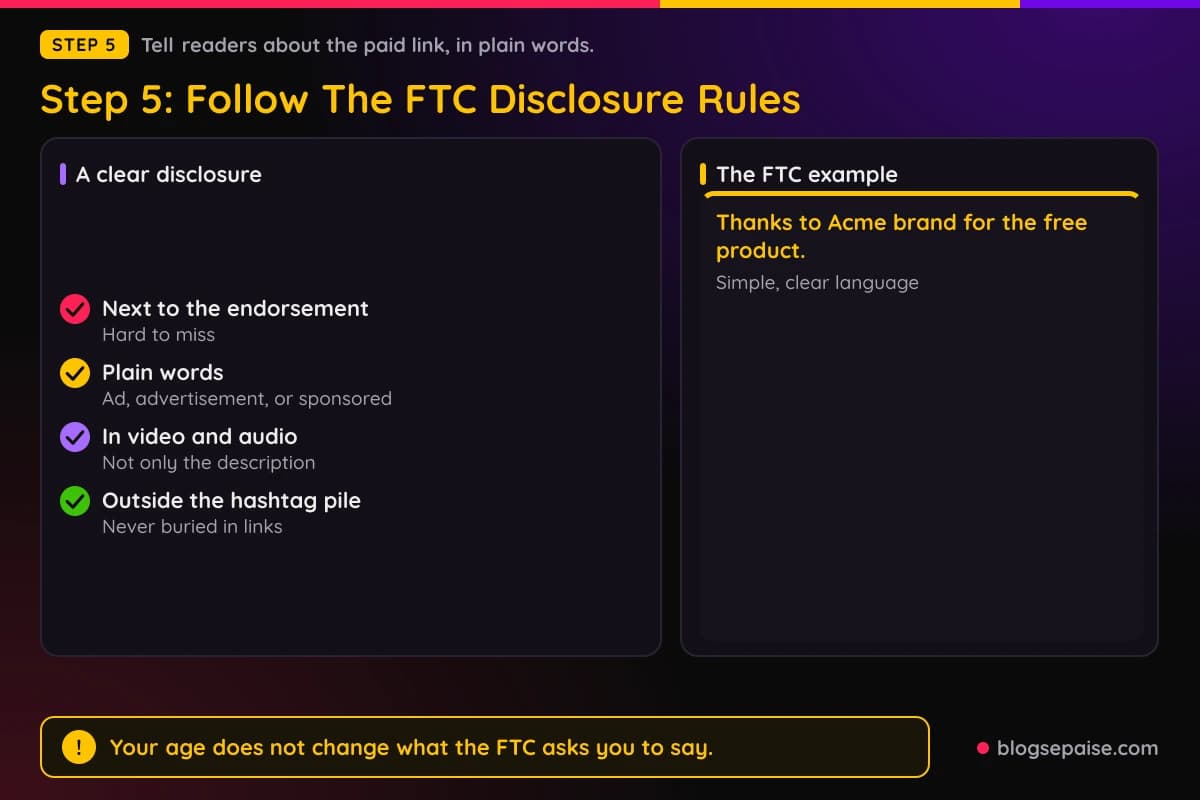
Profile pages, the end of a post, and "more" links are easy to overlook. A disclosure buried in a pile of hashtags or links also fails the test.
For videos, the disclosure belongs in the video and in the audio, and not just in the description. For live streams, repeat the disclosure from time to time.
For images and stories, put the words on the image and leave enough time for viewers to read them. Simple, plain language works best.
The FTC's own example reads "Thanks to Acme brand for the free product." Words like "ad," "advertisement," and "sponsored" also work.
Short codes do not work well. Terms like "sp," "spon," "collab," "thanks," and "ambassador" on their own are vague.
Hashtags such as #ad are acceptable, but the FTC says they are not required. Do not hide the notice inside a group of other tags.
Write the disclosure in the same language as your endorsement. Platform tools that label a post as paid can add to your disclosure, but they should not replace it.
If you run a blog, put a disclosure near the top of every post that has affiliate links. Our legal disclosures guide shows how to word it.
The affiliate disclosure generator can draft a clean statement in seconds. Have your parent read it before you publish.
Step 6: Protect Your Privacy And Follow COPPA
Teens who build a blog, a channel, or an email list need to think about privacy. Two groups need protecting, you and your readers.
Start with yourself. The FTC's advice for young people is to never post personal information online.
That includes your cell phone number and home address. It also covers your location, which you should share only with friends you trust and know in person.
Photos, videos, and messages can reach a wider audience than you expect. Think twice before you post them.
Never give your family's personal or financial information in response to an unexpected message.
Affiliate marketing can put your name on public pages. A pen name or a brand name can help, and our guide on affiliate marketing without showing your face covers that approach.
Now think about your readers. A law called COPPA, the Children's Online Privacy Protection Act, protects children under 13.
COPPA covers websites and online services directed to children under 13 that collect personal information. It also covers general audience sites that have actual knowledge they collect personal information from children under 13.
The FTC's list of personal information is long. It includes names, home addresses, email addresses, and screen names that work as contact information.
It also includes persistent identifiers such as cookies, IP addresses, and device identifiers. Photos, videos, and audio recordings of a child count, and so does precise location.
Collecting does not mean only forms. Asking for information, even as an option, counts, and so does tracking a child in the background.
Companies covered by COPPA must get verifiable parental consent before they collect, use, or share a child's personal information. The method has to be reasonably designed to confirm that the person is the parent.
That is a heavy burden for a small site. So the simplest path is to write for teens and adults, not for young children.
If your niche draws children under 13, talk to your parent before you add email sign-ups, comment forms, or tracking tools. Those features collect the kinds of data COPPA covers.
The FTC says a site that mixes audiences can limit COPPA protections to users under 13. To do that, it must first collect age information or use another reasonable method to spot child users.
A privacy policy is a good habit for any site. Our privacy policy generator gives you a starting point to review with your parent.
Step 7: Know How Taxes Work For Teen Earners
Money from affiliate marketing is income. It does not matter how old you are.
Many affiliates report commissions as self-employment income. The IRS says you are generally self-employed if you run your own business part-time, including as an independent contractor or gig worker.
The IRS also says you have to file an income tax return if your net earnings from self-employment were $400 or more. Self-employment tax pays for Social Security and Medicare, and it is reported on Schedule SE.
That $400 line is the number to remember. It stays the same for a teen as for an adult.
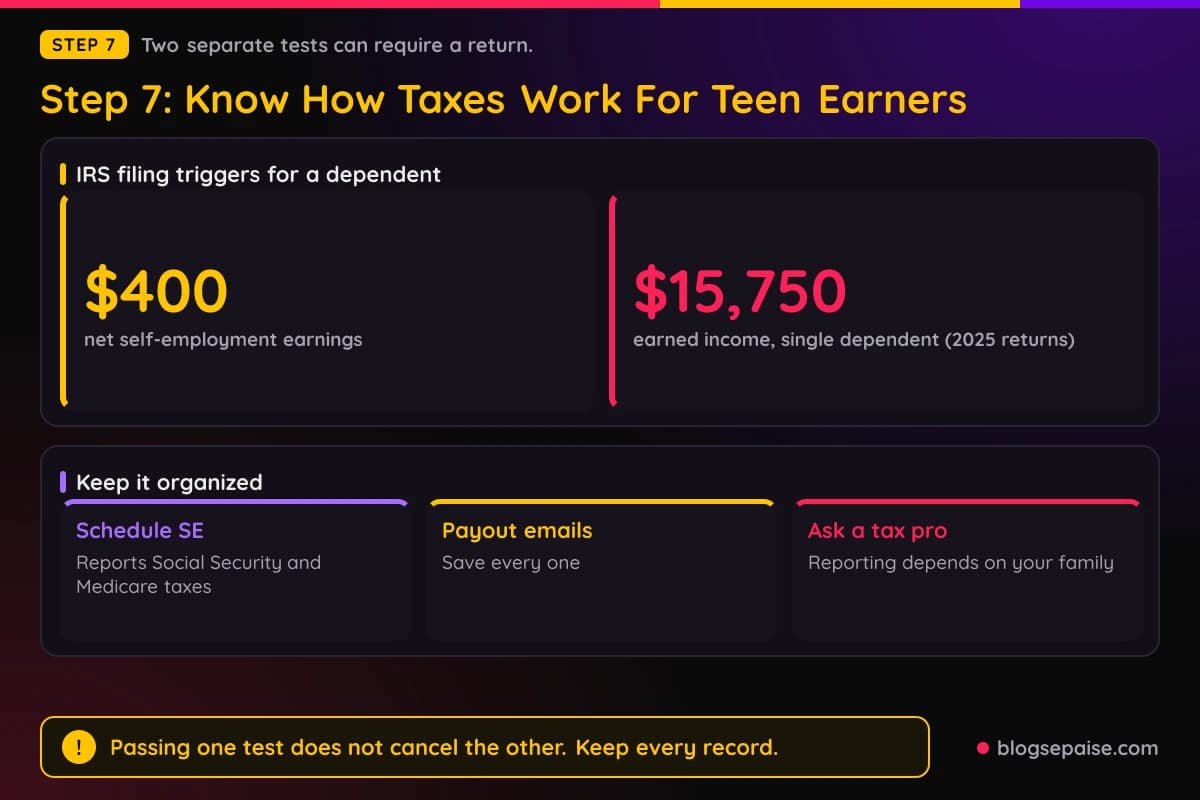
IRS Publication 501 covers dependents, which includes many teens. It says a dependent must also file if net earnings from self-employment reached at least $400.
A dependent can have a second test as well. For 2025 returns, a single dependent under 65 who is not blind must file if earned income was more than $15,750.
Earned income in that table includes salaries, wages, tips, and professional fees. The two tests are separate, so passing one does not cancel the other.
The IRS notes that, generally, you do not have to withhold or pay any taxes on payments to independent contractors. The person who earns the money still has to report it.
Keep every record. Save payout emails, commission reports, and notes on what you spent to run your site.
Because a parent usually holds the affiliate account, the earnings may show up under the parent's name and tax number. How to report them depends on your family's situation.
That is a question for a tax professional. Do not guess, and do not skip it.
Amazon's agreement says it may hold commission income until you provide tax information. Providing it early avoids delays.
Step 8: Build Your Audience While The Account Gets Ready
Applying to programs takes time, and some will say no. Use that time to build something real.
Affiliate programs reward people who bring in readers. So the first job is to create content that helps someone.
Pick a topic you know well from your own life. Games, school tools, sports gear, and hobbies are natural places to start.
Choose a format you can keep up. A blog, a short video channel, or a newsletter all work, and you do not need all three.
If video is your format, know the bar for the YouTube Partner Program. A channel needs 1,000 subscribers and 4,000 qualified public watch hours in the last 12 months.
The other route is 1,000 subscribers and 10 million qualified Shorts views in the last 90 days. The Google Account also needs 2-Step Verification, and the channel needs a linked AdSense account.
Meeting the numbers does not guarantee acceptance. The whole channel goes through a review that typically takes about a month.
For a teen, that linked AdSense account belongs to a parent or guardian. Ad revenue and affiliate commissions are separate income streams, so keep records for each.
Most platforms set their own minimum ages. The FTC notes that most social platforms are only for people who are at least 13 years old.
That means a 12-year-old should talk with a parent about a different plan. A blog run by a parent, with your articles on it, is one option.
Write reviews from real use. Only talk about products you have tried, because the FTC guidance says you cannot talk about your experience with a product you have not tried.
That rule is a good one for trust, too. Readers can tell when someone is guessing.
Our beginner plan, your first 30 days in affiliate marketing, gives a daily plan for a new site. It works for teens with an adult helping on the account side.
If money is tight, start with free tools. Our guide on affiliate marketing with no money covers the options.
Learn how links work before you add them. The guide on how affiliate marketing works explains tracking and commissions.
Keep a simple notebook of what you publish. Write the date, the topic, and the link you used.
When a program approves your parent's account, you will be ready. You will have posts live and a clear idea of which products fit.
Do not rush to hit a number. Readers and search engines need time to find new pages.
Common Mistakes Teens Make With Affiliate Marketing
Most mistakes come from rushing past the rules. A few of them can cost you the account.
The first is lying about your age. A false birthday can break the program's terms.
Commission Factory, for one, may suspend or remove accounts that do not comply. Amazon may hold unpaid commission after termination.
The second is skipping the parent talk. An adult who signs up for you takes on the responsibility, so they need to know what they agreed to.
The third is leaving out disclosures. The FTC says to disclose every material connection with the endorsement itself, where it is hard to miss.
The fourth is sharing too much personal information. Keep your address, phone number, and location off public pages.
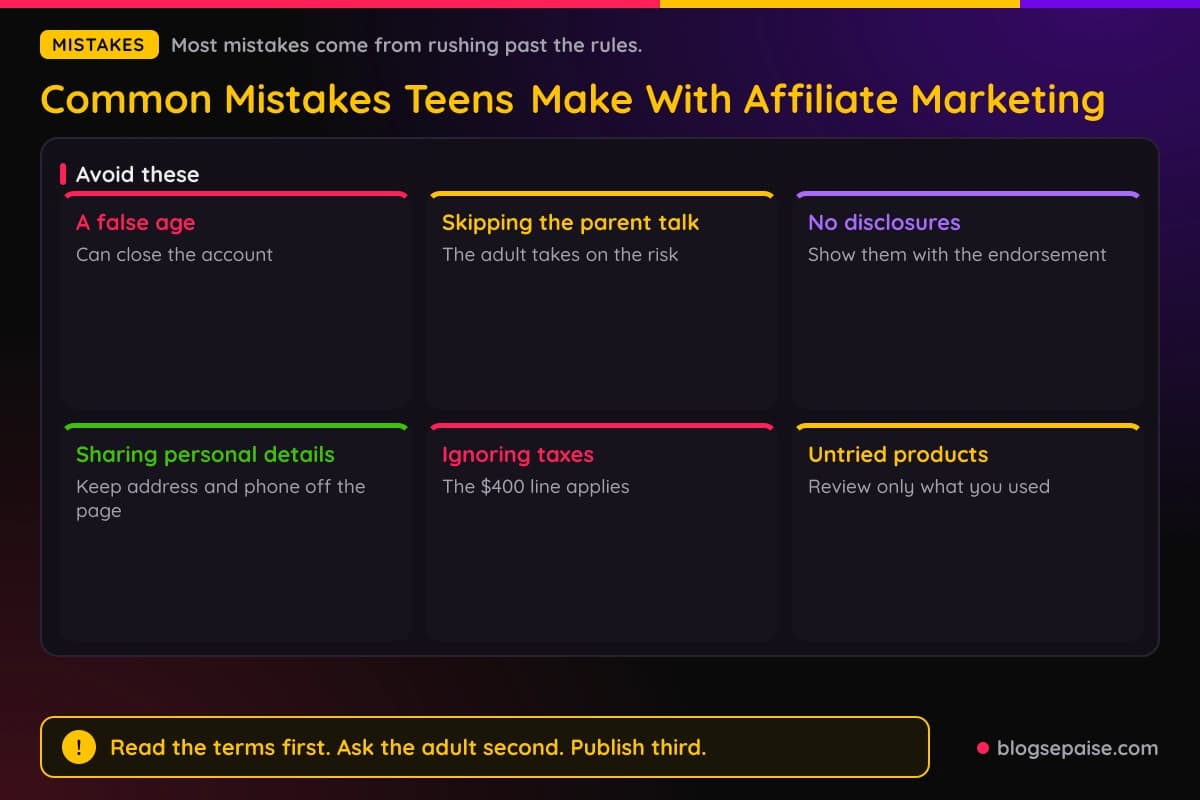
The fifth is ignoring taxes. A $400 line sounds small, but it is the line the IRS uses.
The sixth is promoting products you have not used. Reviews based on guesses hurt trust, and the FTC says you cannot talk about experience you do not have.
The seventh is chasing quick money. Commissions take time, so patience matters more than speed.
The eighth is picking the wrong program. Read the terms first, and check that the program allows your situation.
Programs also differ on what you can promote and who you can promote to. Always read the content rules.
Fiverr bars minors from offering some services. Other programs have their own limits, so look for the content section in the terms.
Do not spend family money on tools you do not need. Free options can take you a long way at the start.
Finally, do not compare your first month to someone else's best month. Everyone starts at zero.
Final Thoughts
Affiliate marketing under 18 is possible, but the account usually belongs to an adult. That one fact shapes every step.
Read the age rule in each program's terms. Amazon, Awin, Rakuten Advertising, Tradedoubler, TikTok Shop, and Google AdSense all point toward an adult or the age of 18.
Work out the parent or guardian arrangement early. Agree on who signs up, who gets paid, and who files the taxes.
Follow the FTC disclosure rules, protect your privacy, and keep tax records from the start. Those habits will help you the day you turn 18.
Use the waiting time to build content that helps real people. That is the part no program can do for you.
If you want a place to start, browse our affiliate tips and read the beginner guides. Pick one program, read its terms, and take the next step with a parent beside you.
Frequently Asked Questions
1. Can you do affiliate marketing under 18?
Yes, but most programs want an adult on the account. A parent or guardian usually signs up while you create the content.
2. What is the minimum age for affiliate programs?
It depends on the program. Awin and Rakuten Advertising ask for 18, Amazon Associates asks that you can lawfully sign contracts, and Walmart asks for the age of majority where you live.
3. Can a 13 year old do affiliate marketing?
A 13-year-old cannot sign up alone for the programs covered here. Fiverr lets users aged 13 to 17 join only through a parent or guardian's account.
4. Can minors get paid for affiliate marketing?
Payments usually go to the adult who holds the account. Google, for example, pays the adult responsible for the site.
5. Can a teen have a PayPal account?
A U.S. PayPal account requires the user to be at least 18 or the age of majority in their state. Venmo offers Teen Accounts for ages 13 to 17, but they cannot receive payments for goods and services.
6. Do teens have to pay taxes on affiliate income?
Net earnings from self-employment of $400 or more mean a return is required, even for a dependent. Ask a parent and a tax professional how your income should be reported.
7. Do teens need to disclose affiliate links?
Yes. Disclose the paid relationship with the endorsement, in a place that is hard to miss.
8. What does COPPA mean for a teen's website?
COPPA covers sites directed to children under 13 and general sites that know they collect data from them. If your readers are young children, talk with a parent before collecting emails or using trackers.
9. Can I use TikTok Shop affiliate under 18?
No. TikTok Shop's creator policy requires creators to be at least 18 years old.
10. What if I turn 18 soon?
Plan the handoff. Move the account, the payout details, and the records into your own name once you are an adult.