Affiliate Marketing Without Showing My Face: 8 Faceless Ways
Affiliate marketing without showing my face is a real option. You can earn commissions through blogs, voiceover video, Pinterest, email, podcasts, and ebooks, and none of them needs you on camera.
Eight faceless ways follow, along with the platform and legal rules that still apply. The FTC, Amazon, YouTube, Pinterest, and Google all publish rules that a faceless brand has to follow.
New to the basics? Start with our affiliate marketing with your phone guide or the first 30 days plan.
Disclosure: Some of the links I share might be affiliate links. If you click on one and make a purchase, I may earn a small commission as a thank you. But don’t worry, it won’t cost you anything extra. I only recommend stuff I genuinely believe in. Your support helps me keep creating awesome content. You can read my full affiliate disclosure in my disclaimer page.
Search 1,500+ affiliate programs in the Blogsepaise Program Database and filter them by category, network and commission type, then go straight to each program's signup page. The Link Health Monitor then checks your posts for broken, redirected and untagged affiliate links.
Can You Do Affiliate Marketing Without Showing Your Face?
Yes. Affiliate marketing does not require a face on camera, and the faceless guides from affiliate networks and software companies all say so.
Katalys answers the question in its FAQ with "Yes, you absolutely can!" Its guide, published February 25, 2026, lists blogging, podcasts, email, online communities, anonymous accounts, faceless video, and paid traffic as ways to do it.
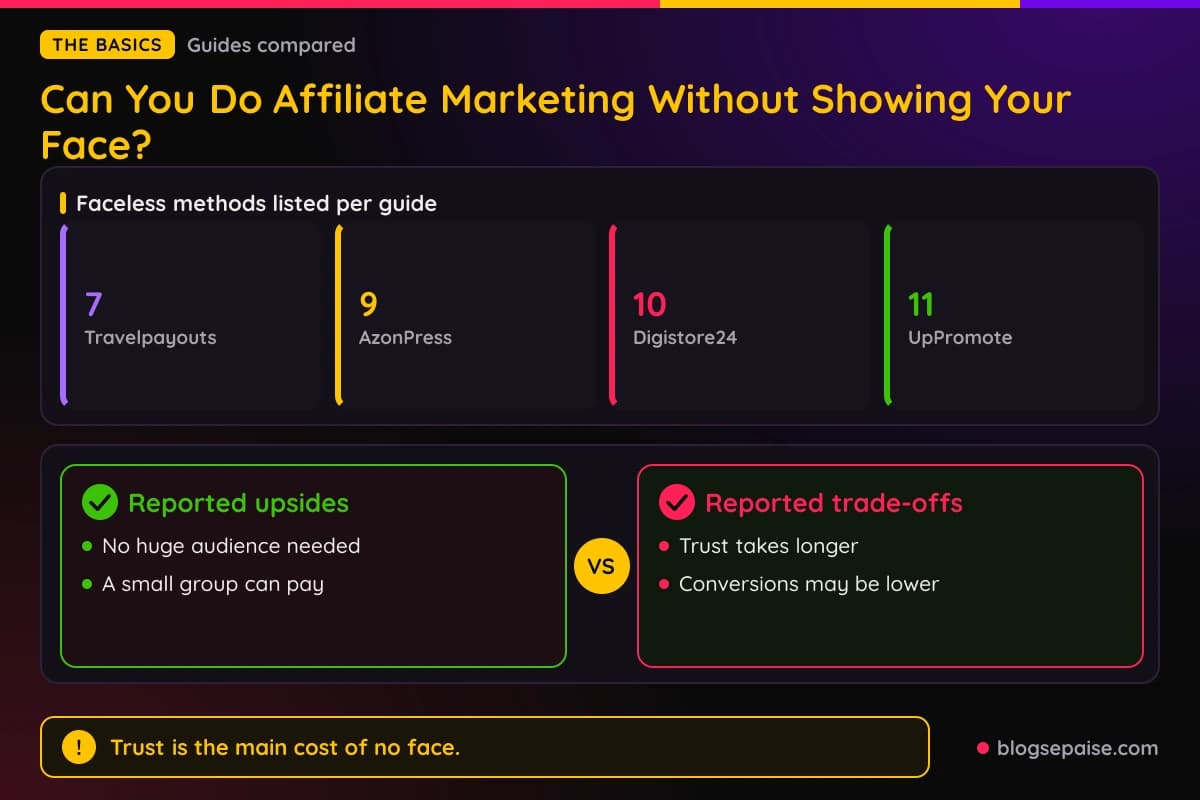
The lists differ in length. Travelpayouts names 7 ways, AzonPress names 9, Digistore24 names 10, and UpPromote names 11.
Blogs, video, Pinterest, email, and podcasts appear in the Travelpayouts, Digistore24, UpPromote, and AzonPress lists. The sections below cover those first, then a few extra options.
One caution comes before the formats. The lists come from affiliate networks and software companies, and Travelpayouts, Involve Asia, and Katalys give no earnings figures for faceless affiliates.
The lists agree on the main trade-off. AzonPress says trust takes longer to build without a face, which may lower conversions, and Katalys lists building trust without a personal touch as a challenge.
Involve Asia takes the other side on audience size. It says you do not need a huge audience to start and that a small, engaged group can generate steady commissions, though it gives no numbers.
Faceless does not mean anonymous to the programs you join or the law. The next section covers what stays on file even when your face stays off screen.
Step 1: Keep Your Face Private, Not Your Identity
Amazon's Operating Agreement requires that the information you give the program is accurate and complete at all times, and you can update it under Account Settings.
Amazon's Program Policies add that the information in your application must be complete, accurate, and up to date, including your email address and site identification.
The policies also say you may not use an Associates tag assigned to anyone other than you.
Tax details are part of the deal. Schedule 3 of the Operating Agreement says Amazon may request tax information from you, and it may hold your commission income until you provide it.
Accounts can end fast. Either side can end the Amazon agreement with 7 calendar days of notice, and Amazon can suspend or terminate immediately for reasons such as material breach or suspected fraudulent activity.
The FTC puts the legal duty on you. Its guide for social media influencers says it is your responsibility to make the disclosures, and you should not rely on others to do it.
The FTC also says U.S. law applies to posts made from abroad when it is reasonably foreseeable that the post will affect U.S. consumers. A faceless brand run from another country still falls under the rule if it reaches American shoppers.
For a faceless setup, the practical split is simple. Your name and tax details go to the programs and payment systems, while your brand name goes on the public site.
If you are still choosing programs, our guide on how to get approved for affiliate programs explains the application side. Our guide to reading affiliate program terms covers the fine print you agree to.
Step 2: Build A Brand Name And An Author Page
A faceless brand needs something to replace the face. Involve Asia suggests one consistent name across profiles, banners, and intros, and it gives BudgetFindsMY and DailyTechPicks as examples.
AzonPress makes the same point with a domain name and a logo that represent your niche. Jivochat adds that credibility can attach to a brand or a consistent persona instead of an individual's face.
Large sites show the model works at scale. EntreResource, in a guide last updated March 28, 2022, calls NerdWallet among the world's most profitable affiliate sites and says it has no face or established authors.
AzonPress cites Wirecutter as an example of anonymous, content-driven reviews at scale. Travelpayouts says Wirecutter posts anonymously on TikTok and Instagram.
Google has its own view of authorship. Its guidance on creating helpful content says visitors should be able to tell who wrote the content, and bylines should link to background on the author and their areas of writing.
Google also warns about invented profiles. It calls fabricated creator profiles, such as AI-generated headshots, invented names, or false credentials, deceptive and a signal of low quality.
The sources disagree on pen names. Jivochat lists a pen name as a trust tactic, while Google flags invented names and false credentials as deceptive.
The two fit together if the brand stays honest. A brand name with a real About page, a contact method, and no fake credentials gives readers someone to hold accountable without a face.
Jivochat recommends exactly that kind of access. It says an email address or a contact page makes you seem more trustworthy.
EntreResource notes one business upside. It says remaining anonymous can make a site easier to sell or outsource, since the business is not tied to you.
Step 3: Pick A Faceless Friendly Niche
Some niches show well without a person. Involve Asia lists tech gadgets, home hacks, travel deals, fashion without a face, skincare close-ups, productivity tools, and digital products.
Its tip is to pick a topic you enjoy or will research regularly. Travelpayouts says to choose a niche as the first step for a blog, and UpPromote says a narrow market makes offers easier to promote.
Google says the content should be written to help the people who visit, and it calls that purpose perhaps the most important question to answer. A niche you can test products in gives you real material.
For help with the pick, read our guide on how to choose a profitable niche. Then check the programs in that niche before you build anything.
Way 1: Start A Faceless Blog Or Review Site
A blog is the format with the least pressure to appear. Travelpayouts lists blogging first, and it suggests choosing a niche, using a pen name, and using an avatar or logo as the profile picture.
The same guide says posts can take time to rank on Google, so a blog needs patience. AzonPress describes the model as traffic, then content, then commission, and says SEO blogs should target buyer-intent keywords.
AzonPress gives sample titles such as "Best Budget Microphones for Beginners Under $50." It names Amazon Associates, SaaS programs, and ShareASale or Impact as ways to earn from those posts.
Google's guidance on product reviews shows what the posts need. It asks for evidence of your own experience, such as visuals, audio, or links, and quantitative measurements across performance categories.
The same page asks you to explain what sets a product apart from competitors and cover comparable options. It also suggests linking to multiple sellers so readers can choose their merchant.
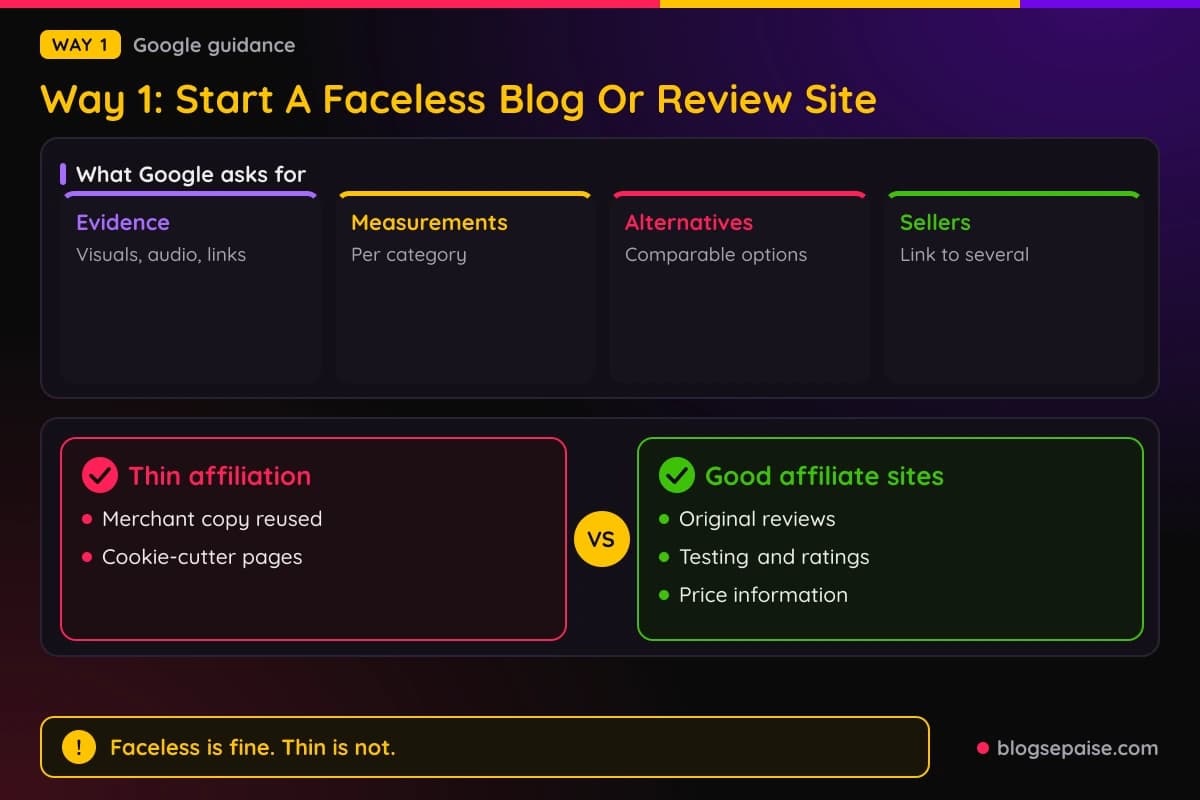
Faceless does not excuse thin pages. Google's spam policies define thin affiliation as affiliate links with descriptions and reviews taken from the merchant without original content or added value.
The policies say good affiliate sites add value through extra price information, original reviews, rigorous testing and ratings, product comparisons, or product and category navigation.
Cookie-cutter sites that copy similar content across a site, domains, or languages count as thin.
Google also says authors should show how many products were tested, the results, the test methods, and supporting evidence such as photos. A faceless reviewer can do all of that with screenshots, charts, and photos of the product in use.
Link attributes matter too. Google's page on qualifying outbound links says to use rel="sponsored" for links that are advertisements or paid placements, and it says nofollow is still acceptable.
If you are building on a free platform first, read our guides on affiliate links on free blogs and affiliate blog traffic. Both explain how readers reach a new blog.
Way 2: Make Faceless YouTube Videos
YouTube supports video without a person on screen. Digistore24 lists screen recordings, synthetic voiceover tutorials, and slide presentations as faceless formats, and Involve Asia adds hands-only unboxing and stock footage.
Digistore24 describes a policy-safe pipeline in its October 20, 2026 guide. Draft or heavily customize the script, choose a natural-sounding synthetic voice and tune its pacing, and use original visuals instead of stock footage.
The policy side deserves attention first. On July 15, 2025, YouTube renamed its repetitious content policy to inauthentic content and clarified that it covers content that is repetitive or mass-produced.
YouTube says that type of content has always been ineligible for monetization. Content that feels interchangeable from video to video, or that appears to use a template, does not qualify.
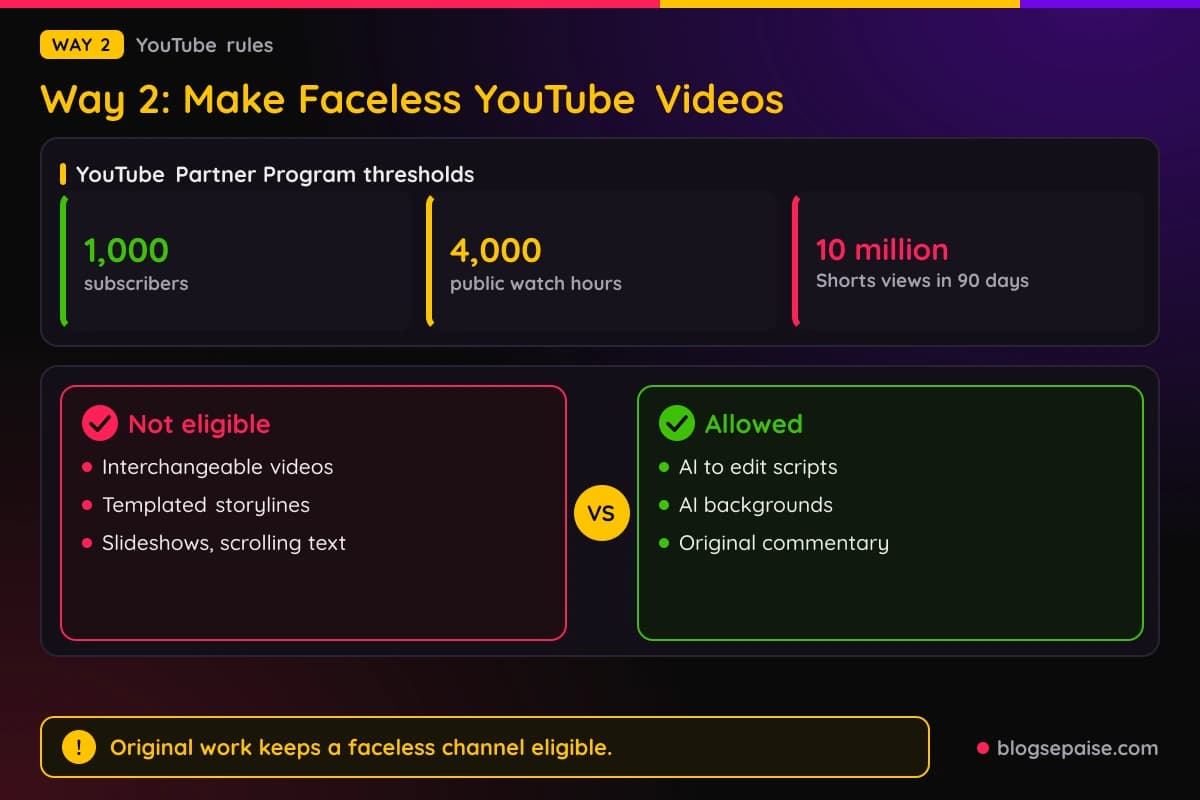
Its examples of ineligible content include image slideshows, templated storylines, and scrolling text with minimal narrative, commentary, or educational value.
AI-generated content is ineligible when it uses generic templates that give the impression of mass production, with no added creator insight.
Reused content has its own rule. YouTube says reusing content already online needs significant original commentary, substantive modification, or educational or entertainment value, and that rule applies to the whole channel.
The rules still allow a faceless channel with real work behind it. YouTube says using AI to help edit scripts or create backgrounds is allowed as long as the final product shows your creative vision.
YouTube's Partner Program page lists 1,000 subscribers plus either 4,000 qualified public watch hours in the last 12 months or 10 million qualified Shorts views in the last 90 days.
Meeting the numbers does not guarantee acceptance. YouTube says channels go through a standard review and decisions typically take about a month.
Digistore24 suggests the primary affiliate link in the first two lines, a second link to a related tool, a three-sentence summary, timestamps, and a resource list.
YouTube's spam policy bans misleading titles, thumbnails, and descriptions that trick users into clicking and then fail to deliver what was promised. Honest packaging protects a faceless channel as much as any other.
For short vertical video, see our guide on affiliate marketing on YouTube Shorts. It covers the Shorts link rules and YouTube Shopping tags in detail.
Way 3: Record Screen Tutorials For Software Offers
Screen recordings suit software offers because the product is the picture. Digistore24 gives a five step process for them, and Travelpayouts lists screencasting for software tutorials as a faceless format.
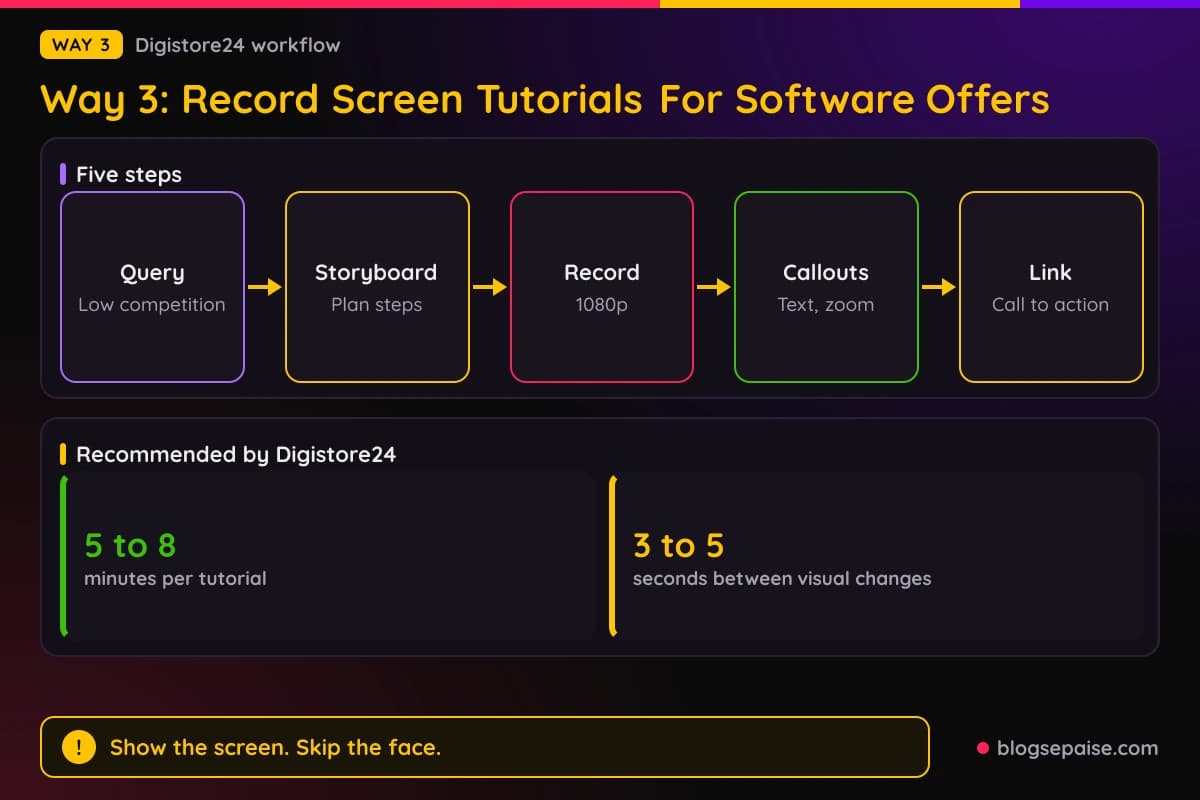
The first step is to pick a specific, low-competition query using keyword research. The second is to draft a visual storyboard of the steps.
The third step is to record the screen at 1080p, cropping out personal files and tabs. The fourth adds on-screen text callouts, arrows, and zoom effects.
The fifth step ends the video with a call to action that points to the affiliate link. Digistore24 names OBS for desktop recording.
Digistore24 recommends tutorials of 5 to 8 minutes and a visual change every 3 to 5 seconds. Those figures are its own recommendations and not platform rules.
Narration is optional. Digistore24 lists a screen recording walkthrough with no voiceover, using on-screen text callouts and background music instead.
Hiring help is an option too. Travelpayouts says freelancers can be hired through Fiverr or Upwork for animated explainers, and EntreResource gives a Fiverr gig for a 30-second TikTok or Instagram Reel at about $15.
The FTC rule about video applies here. In its social media guide, the FTC says a disclosure must be in the video itself, with the description as a backup, using both audio and video when possible because some viewers watch without sound.
Digistore24 also suggests repurposing the script. It says to turn the script into an SEO post with real screenshots and link the channel to a WordPress blog and an email newsletter.
Way 4: Use Pinterest Pins To Send Traffic
Pinterest suits a faceless brand because the content is the image.
Involve Asia lists mood boards and product collections linking to affiliate pages or blog posts, and AzonPress describes search-focused pin graphics that link to blog posts or landing pages.
Digistore24 names Canva for pin templates and Tailwind for scheduling. Katalys says Pinterest has 482 million users who browse for products, though it gives no source for that figure.
Pinterest has written rules for affiliates. Its Commercial and Branded Content Guidelines say affiliate content should be original and add unique value for Pinners.
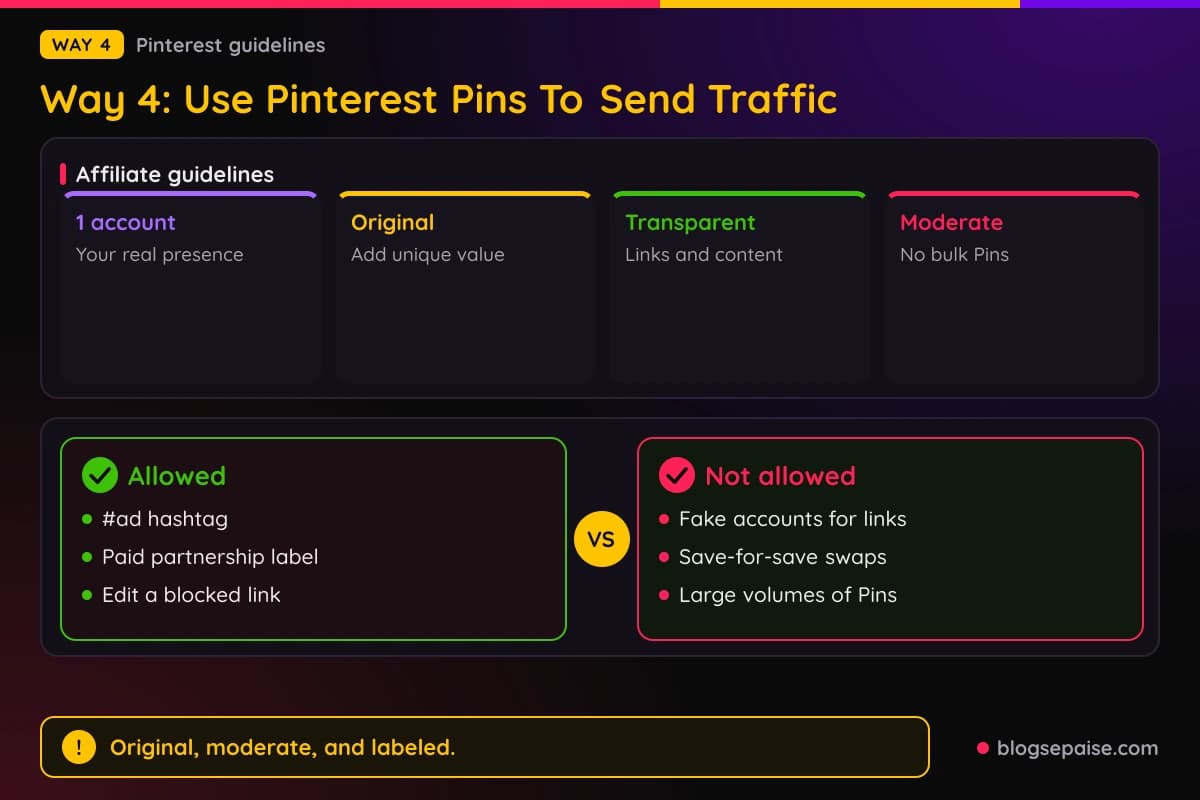
The guidelines also say to operate only one Pinterest account in general and to make it your authentic presence. Using fake accounts to create or save your affiliate links is prohibited.
Asking other users to save your affiliate Pins in a quid pro quo arrangement is not allowed either. Neither is asking other users to create Pins with links that include your affiliate identifier.
Volume has a limit. Pinterest says creating affiliate Pins repetitively or in large volumes violates its spam policy, and it says to use affiliate links in moderation.
The guidelines ask you to be transparent about the commercial nature of your content and about how your links behave. Some link shortener services are not supported, so if a Pin's link is blocked, you edit the link.
For paid partnerships, Pinterest accepts a clear disclosure such as the #ad hashtag or its paid partnership label.
Its Amazon help page says Pins with affiliate links automatically feature an affiliate link disclosure when you tag Amazon products.
That Amazon tagging needs setup. Pinterest says you need a business account, an Amazon Storefront, and participation in the Amazon Influencer Program.
Our full guide to affiliate marketing on Pinterest walks through boards, rich pins, and a weekly workflow. The shorter affiliate links on Pinterest page covers where direct links are allowed.
Way 5: Post Short Videos With Text On Screen
Short video works without a face when text does the talking. Involve Asia lists TikTok product demos, unboxing, close-up reviews, b-roll, and text-on-screen slideshows.
The same guide lists Instagram Reels and carousels with product photos, outfit shots without a face, and text-based reels. Digistore24 names CapCut for editing and says to use links in bio.
Travelpayouts says to identify a pain point and show how the product solves it, with a hook in the first 3 seconds. AzonPress also stresses a strong opening hook and gives formats such as "Best AI tools for students in 2026."
Link placement depends on the platform. Involve Asia puts TikTok and Instagram links in the bio, a link-in-bio page, or a pinned comment.
Disclosure needs extra care on these apps. The FTC's staff answers say that on TikTok, a disclosure in the text description is very unlikely to be clear and conspicuous.
For Instagram video, the FTC says there should be a disclosure in the video, preferably both visually and audibly. Superimposing the words over the picture works for images and Stories if viewers have enough time to read them.
A link-in-bio page helps keep one clean destination. Our guide to a bio link page builder covers how to set one up.
Way 6: Build An Email List Without A Face
Email needs no face at all, and you own the list. AzonPress says that is the difference from social followers, and it suggests a free lead magnet such as a guide, template, or resource list in exchange for sign-ups.
Travelpayouts and Digistore24 describe the same flow. A lead magnet brings sign-ups, then an automated sequence introduces affiliate products over time.
UpPromote recommends a double opt-in signup form. It names GetResponse and ConvertKit for autoresponders and landing pages, with no website needed.
AzonPress cites Omnisend for the claim that email marketing returns $36 to $40 for every dollar spent. The article links to Omnisend as the source.
The law sets a short list of rules for commercial email. The FTC's CAN-SPAM guide says header information must not be false or misleading, and subject lines cannot be deceptive.
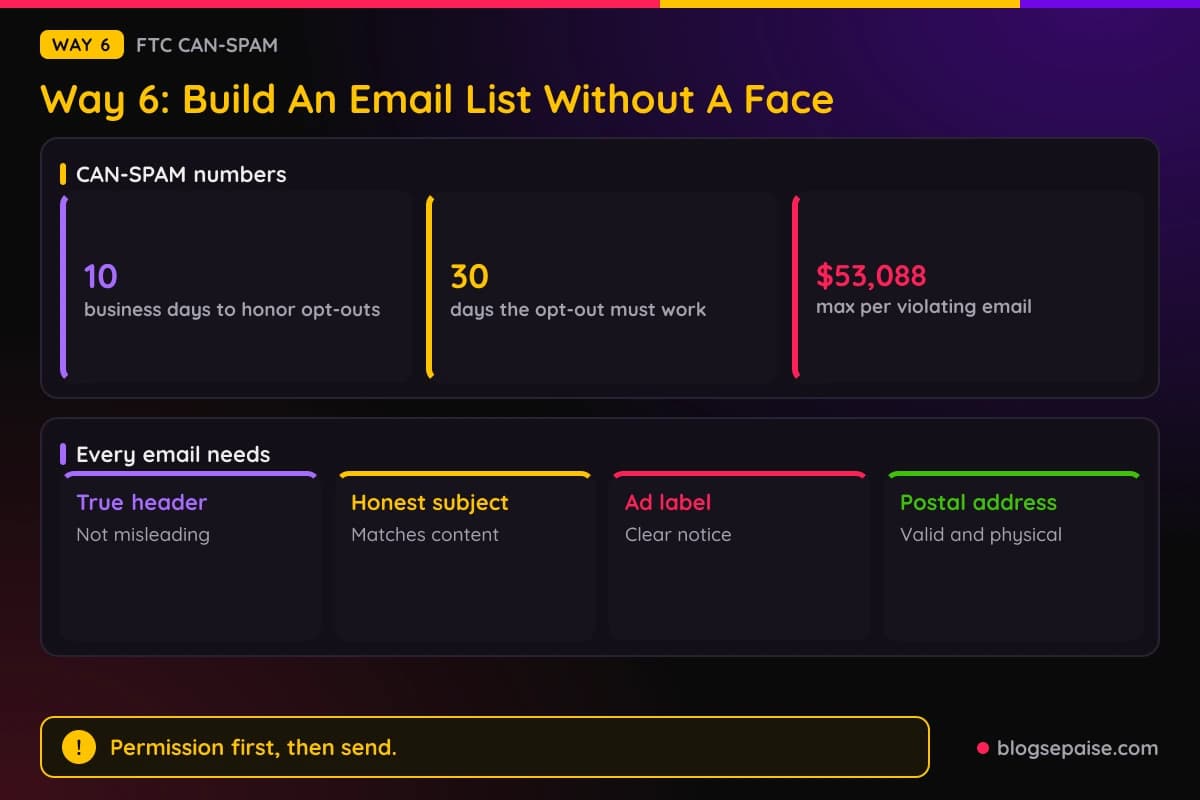
The message must clearly disclose that it is an advertisement, and it must include a valid physical postal address. A street address, a registered post office box, or a registered private mailbox all count.
The message must explain how to opt out of future email. The mechanism must work for at least 30 days after sending, and you must honor requests within 10 business days.
Penalties are steep. The FTC says each separate violating email can carry penalties of up to $53,088.
Email service providers add their own limits. MailerLite's anti-spam policy bans addresses you bought, rented, or scraped from the web, and requires a single-click, clear, and visible unsubscribe link in every newsletter.
MailerLite may suspend an account if spam complaints pass 0.2 percent, bounces pass 5 percent, unsubscribes pass 1 percent, or the open rate falls under 3 percent. Check any provider's policy before you build a list on it.
Amazon's Program Policies allow Special Links in emails, SMS, and direct messaging from your social media sites only when the communications are solicited, meaning opted into by the receiving customer.
The same policies bar Special Links in printed material, ebooks, mailings, or oral solicitation.
Compare tools in our guides to email marketing tools and the email service provider decision. Both help you pick a platform before you write the first email.
Way 7: Start A Podcast Or Audio Show
A podcast needs a voice but not a face. Travelpayouts says to invest in a decent microphone and recording setup, plan topics and recurring segments, and place affiliate links in show notes or on a landing page.
UpPromote suggests a short, memorable title and short, easy-to-remember affiliate links. It names Spotify and Castbox as platforms that allow links in show notes.
Digistore24 lists audio-only product reviews with links in show notes. Katalys adds product discussion and interviews with industry experts.
AzonPress warns that trust is harder to build this way, and it describes podcasts as weaving recommendations into conversation.
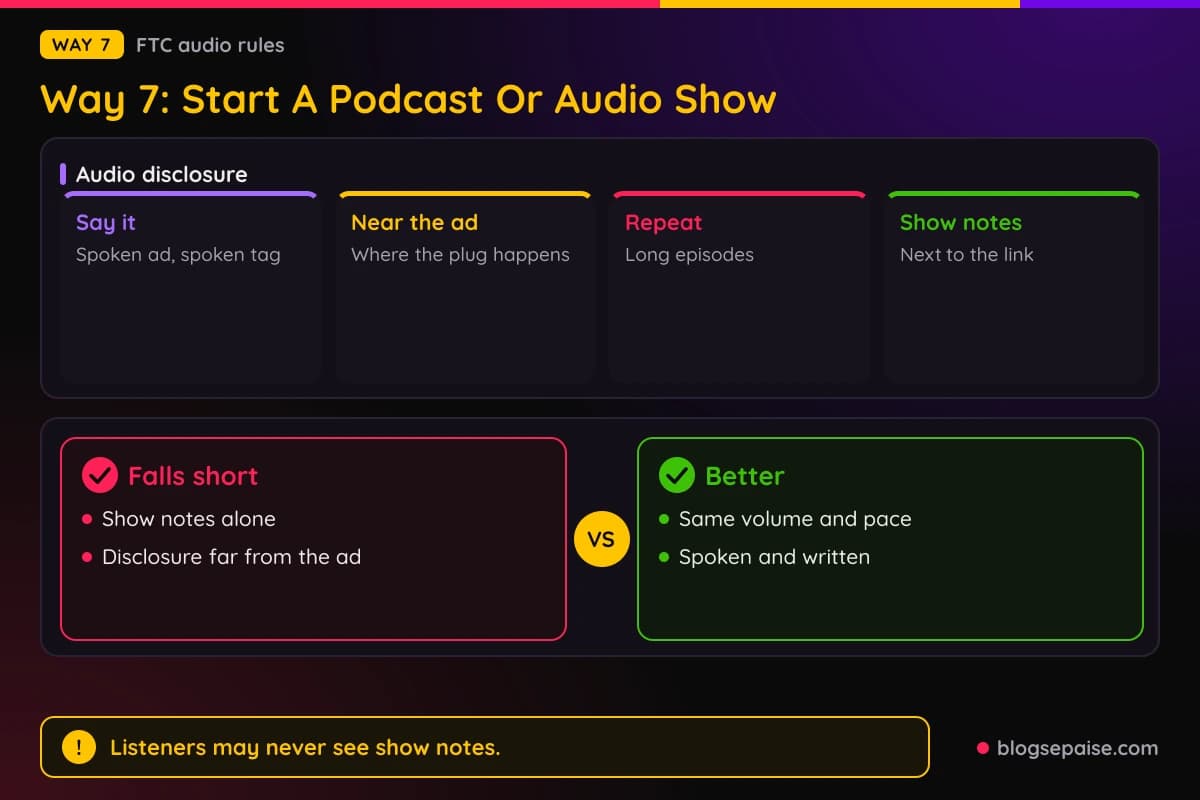
Audio needs spoken words. The FTC's staff answers say that if a representation is made audibly, the disclosure should be made at least audibly.
Promise Legal's July 7, 2026 article on the FTC and audio says show notes alone do not satisfy the rule for a spoken endorsement. Listeners streaming while driving or exercising may never see them.
It says to place the disclosure near the ad and deliver it at the same volume, pace, and cadence as the rest of the spot. On long episodes, it says to repeat the disclosure for listeners who join partway through.
Promise Legal cites 16 CFR 255.0, which defines clear and conspicuous as difficult to miss and easily understandable by ordinary consumers. It says the FTC requires no specific script.
Promise Legal also cites 16 CFR 255.5, Example 11, for affiliate commissions and promo codes. It says to place the disclosure in show notes next to the link and to say it aloud when promoting a code.
The same article says no public FTC action has targeted a podcast host specifically for a disclosure failure. It adds that enforcement has focused on advertisers and influencers, and that hosts remain exposed.
Way 8: Write Ebooks And Free Guides
An ebook is a written product with your brand on the cover and nobody's face. Travelpayouts says to include affiliate links naturally, then sell it on Amazon or give it away on social media.
The same guide names Visme and Canva for design and Designrr for writing the ebook. It suggests promoting the ebook through social media, guest posting, or email.
UpPromote lists e-books and templates that include affiliate products as bonuses, and it names Gumroad and Etsy as marketplaces. It names Canva for creating free e-books.
Amazon's rules limit one version of this idea. Its Program Policies bar Special Links in ebooks, so an Amazon Associates link should live on your site or another allowed place instead.
Free guides also double as email lead magnets. Digistore24 gives a PDF checklist or implementation blueprint as an example for viewers.
Other Faceless Options Worth A Look
Forums and Q and A sites are another route. UpPromote names Quora and Reddit, and it says to answer questions with useful advice to build trust before linking.
It also warns that some communities ban affiliate links, so read each forum's rules first. Our guide on affiliate links on Quora covers that site.
Digistore24 lists Reddit and Quora authority building as a faceless method, with products mentioned only where relevant.
Involve Asia lists Telegram and WhatsApp groups for deals, vouchers, and flash sales, with pinned messages and clearly labeled link posts.
Guest posting borrows another site's audience. UpPromote says to target publications and niche blogs that accept guest contributions and follow each site's style guidelines.
UGC creators make reviews of products they use. UpPromote says authentic reviews of products you actually use make you more credible, and Travelpayouts says to hire UGC creators or influencers.
Online courses are listed by UpPromote and AzonPress. UpPromote says to recommend only products closely tied to the course topic, and AzonPress says narration can be AI-generated.
Digistore24 lists automated DM sequences, with ManyChat named for Instagram and Facebook Messenger bots. Our affiliate links on Facebook guide covers the Facebook side.
Paid ads can run without a personal brand. EntreResource says to send paid traffic to a landing page first to grow an email list, and UpPromote warns that poorly managed campaigns can waste money and effort.
How To Disclose Affiliate Links In Every Faceless Format
Disclosure rules do not change because the creator is faceless. The FTC says to disclose any financial, employment, personal, or family relationship with a brand.
The FTC says the disclosure should be hard to miss and placed with the endorsement message itself. It warns that disclosures on an About Me or profile page, at the end of posts or videos, or behind a More click are likely to be missed.
The agency also says not to mix the disclosure into a group of hashtags or links. It names advertisement, ad, and sponsored as acceptable terms.
For affiliate links on a website, the FTC suggests wording such as "I get commissions for purchases made through links in this post." It says the closer the disclosure is to your recommendation, the better.
Short labels can fail. The FTC says a bare "affiliate link" may not convey that the poster is paid when purchases occur, and a buy now button is also inadequate.
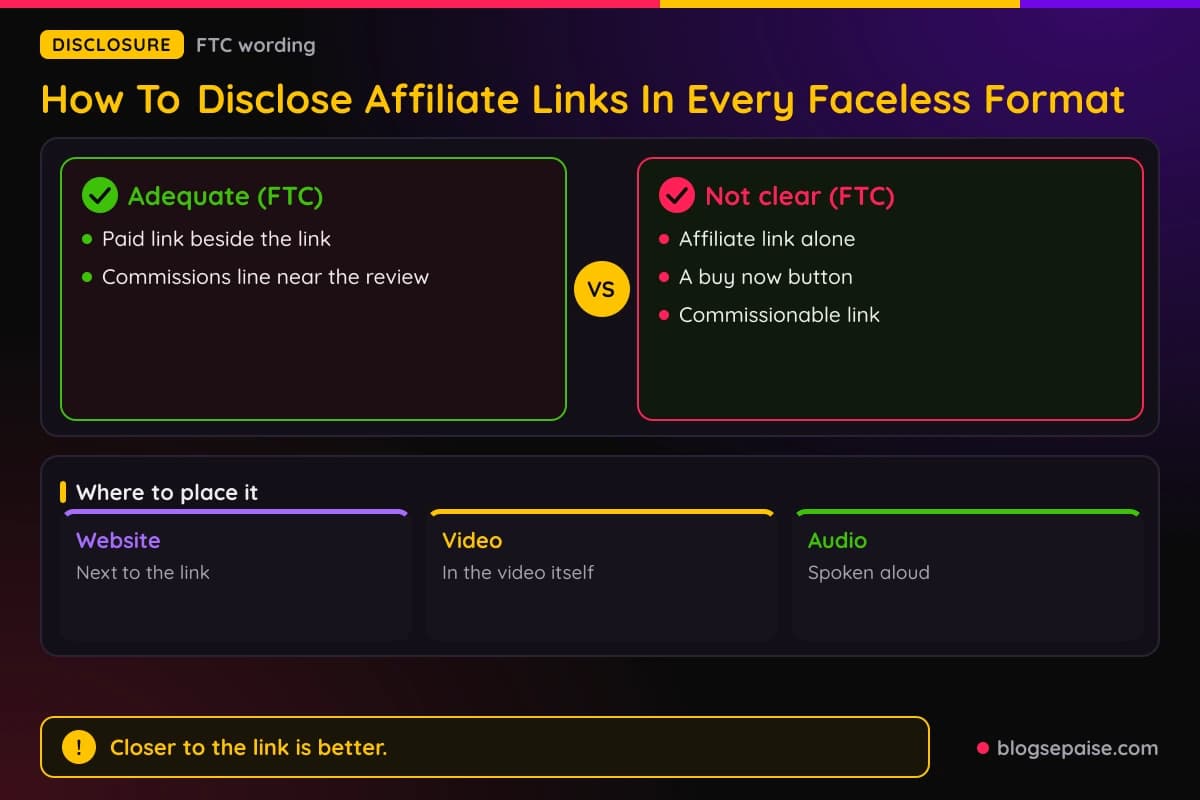
It says "paid link" placed right next to an affiliate link is adequate, and "commissionable link" is probably not a clear disclosure.
The agency says to disclose both in the video and in the description near the links on YouTube.
The FTC also says that relying on a platform's disclosure tool alone is not enough. Use the tool and your own clear disclosure together.
YouTube has its own label. Its Help Center says creators must select the paid promotion button for branded content, sponsorships, endorsements, or other commercial relationships, which adds a disclosure at the beginning of the video.
Amazon sets a separate rule.
Its Program Policies require you to disclose your participation on your site accurately and adequately, and Section 3(b) references the FTC Guides Concerning the Use of Endorsements and Testimonials in Advertising.
Our guides on legal disclosures and the affiliate disclosure generator help you write the wording once and reuse it.
How To Use AI Voices And Avatars Safely
Digistore24 names ElevenLabs for voiceovers and Synthesia for AI avatar presentation videos. Both fall under the rules below.
YouTube requires disclosure of realistic altered or synthetic content in specific cases. These include making a real person appear to say or do something they did not do, and generating a realistic scene that did not occur.
The same YouTube page lists exceptions. Using AI to create or improve a script, outline, thumbnail, title, or infographic does not require disclosure, and neither does cloning your own voice for voice-overs or dubs.
To disclose, you choose Yes under AI use in the Attributes section during upload in YouTube Studio. YouTube says disclosure alone does not limit audience reach or monetization.
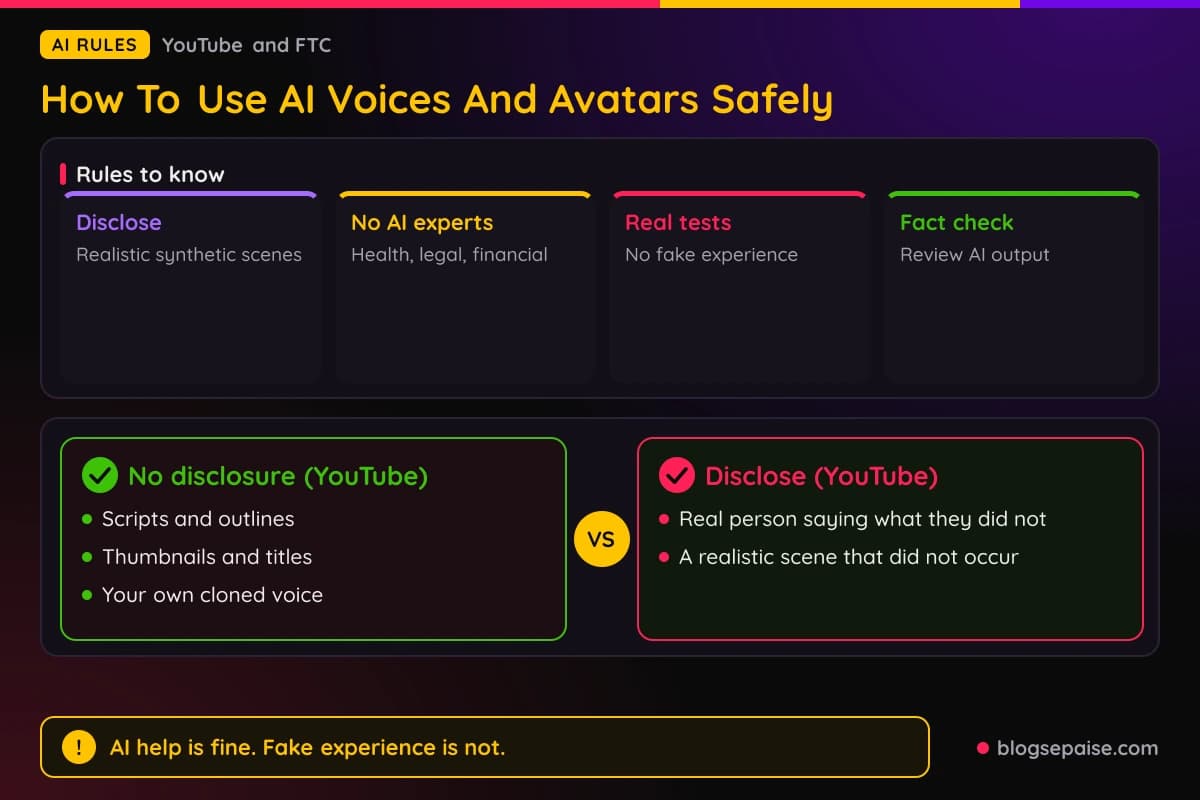
YouTube's monetization policies draw a line on authority.
AI personas presenting as human experts on health, legal, financial, or political topics are ineligible, with an AI doctor or an AI podcast host giving financial advice as examples.
The FTC's Consumer Reviews and Testimonials Rule took effect October 21, 2024. It bans fake or false reviews and testimonials, including misrepresenting someone's experience with a product.
The FTC's Q&A says the rule has no blanket ban on AI avatars. An avatar's testimonial is prohibited only if the underlying testimonial is fake or false.
The FTC's influencer guide says you cannot talk about your experience with a product you have not tried. A faceless review still needs a real test behind it.
Google's guidance on generative AI says to manually fact check and review all AI-generated content before publishing.
It also says that using AI to generate many pages without adding value may violate its policy on scaled content abuse.
Google suggests explaining how content was created when readers would reasonably wonder, including how automation was used. Our guide on AI vs human content covers the quality question in more detail.
Common Mistakes In Faceless Affiliate Marketing
Putting the disclosure only in the description is the easiest mistake to make. The FTC says consumers can easily miss disclosures in a video description and that an in-video disclosure has the best chance of being clear.
Copying merchant descriptions is the next one. Google defines thin affiliation as affiliate links with descriptions and reviews taken from the merchant without added value.
Making one template video over and over is a risk on YouTube. The platform says content that feels interchangeable from video to video does not qualify for monetization.
Posting affiliate Pins in bulk is a risk on Pinterest. The platform says creating affiliate Pins repetitively or in large volumes violates its spam policy.
Sending email without permission is a risk everywhere. MailerLite bans purchased or scraped lists, and the CAN-SPAM rules apply to every commercial message.
Hiding behind invented credentials is a trust risk. Google calls fabricated creator profiles with false credentials deceptive.
Overselling is another trust risk. Jivochat says content that is all ads causes people to stop engaging, and it recommends describing both pros and cons of each product.
Skipping the product test breaks the FTC rule on experience. Jivochat recommends testing what you promote and showing real experience through screenshots or video demos.
Final Thoughts
You can promote products without a face on camera.
Blogs, voiceover or screen recording videos, Pinterest pins, short videos with text, email, podcasts, and ebooks all appear in the faceless guides from Travelpayouts, Digistore24, UpPromote, and AzonPress.
The rules still apply to a faceless brand. The FTC, Amazon, YouTube, Pinterest, Google, and CAN-SPAM all ask for clear disclosure, accurate details, and original work.
Pick one format and build one honest brand around it. Add the disclosure first, test what you recommend, and show the proof with screenshots, charts, and photos.
Frequently Asked Questions
1. Can I do affiliate marketing without showing my face?
Yes. Katalys, Travelpayouts, AzonPress, Digistore24, and UpPromote all describe faceless formats such as blogs, voiceover video, Pinterest, email, and podcasts.
2. Do I have to give my real name to affiliate programs?
Amazon requires application information to be complete, accurate, and up to date, and its Operating Agreement says it may request tax information. Your public brand can use a different name.
3. Do I still need an FTC disclosure if I never appear on camera?
Yes. The FTC says to disclose any financial relationship with a brand, and it says the responsibility to make the disclosure is yours.
4. Where should the disclosure go in a faceless video?
The FTC says it should be in the video itself and the description alone falls short. It prefers both audio and video, since some viewers watch without sound.
5. Is a pen name allowed?
Jivochat and Travelpayouts recommend pen names or brand identities. Google says fabricated creator profiles with invented names or false credentials are deceptive, so keep the brand honest.
6. Can I use an AI voice on YouTube?
YouTube says using AI to help edit scripts is allowed if the final product shows your creative vision, and cloning your own voice for voice-overs does not require disclosure. It also says generic, mass-produced AI content is ineligible for monetization.
7. Do I need the YouTube Partner Program to earn affiliate commissions?
The Partner Program requires 1,000 subscribers plus 4,000 watch hours or 10 million Shorts views. Digistore24 and AzonPress both describe putting affiliate links in video descriptions.
8. Does Pinterest allow affiliate links?
Pinterest has affiliate guidelines that ask for original content, one account, transparency about links, and moderation. Its Amazon help page says affiliate Pins automatically feature a disclosure.
9. Can I put Amazon links in email?
Amazon's Program Policies allow Special Links in emails, SMS, and direct messaging from your social media sites if the communications are solicited. Printed material, ebooks, and oral solicitation are barred.
10. What does CAN-SPAM require?
The FTC lists accurate header information, honest subject lines, ad identification, a valid physical postal address, a clear opt-out, and opt-out requests honored within 10 business days.
11. Is a faceless affiliate harder to trust?
AzonPress and Katalys both say trust takes more work without a face. Jivochat suggests honest pros and cons, real testing, consistency, and a way to contact you.
12. Which format should I start with?
The sources do not rank the formats by results. Start with the one you can finish regularly, and pair it with email, since AzonPress says you own your list unlike social followers.