What Is The Best Affiliate Marketing Niche For Beginners
Search this question and you will find a dozen confident answers. Each one names a different winner, and none of them know you.
Here is the direct answer. The best niche is the one that pays well, has steady demand, leaves room for a new site, and still interests you in month six.
No single niche wins for everyone. A topic that suits a fitness coach can be a poor fit for someone who loves software.
You can score your options with the same five questions. The steps below show the method, and a worked example puts numbers on three candidates.
Along the way you will meet evergreen niches and real programs. The commissions and cookie windows come from each program's own terms.
Disclosure: Some of the links I share might be affiliate links. If you click on one and make a purchase, I may earn a small commission as a thank you. But don’t worry, it won’t cost you anything extra. I only recommend stuff I genuinely believe in. Your support helps me keep creating awesome content. You can read my full affiliate disclosure in my disclaimer page.
If you want to save a lot of hours searching for high-paying affiliate programs, check out our exclusive list of 2500+ affiliate programs. You’ll find all the information about the programs inside the list. This list is perfect for affiliate bloggers and influencers.
The Honest Answer: There Is No Single Best Niche
Lists of the best niches look helpful, but they all share one flaw. They rank topics by how much money exists, and they ignore who is doing the picking.
A huge market means little if five thousand sites already fight over it. A small market can pay well if you are the only careful voice in it.
Your own situation changes the math too. A nurse can write about health with trust that a stranger has to earn for a year.
Think of a niche as a match between four things. Those are the money in the program, the readers who want answers, the rivals you face, and your own staying power.
Take any one of those away and the niche gets shaky. A well paid program with no readers earns nothing, and a loved topic with no buyers stays a hobby.
So the useful question changes. Ask which niche scores best for you, not which niche is best in general.
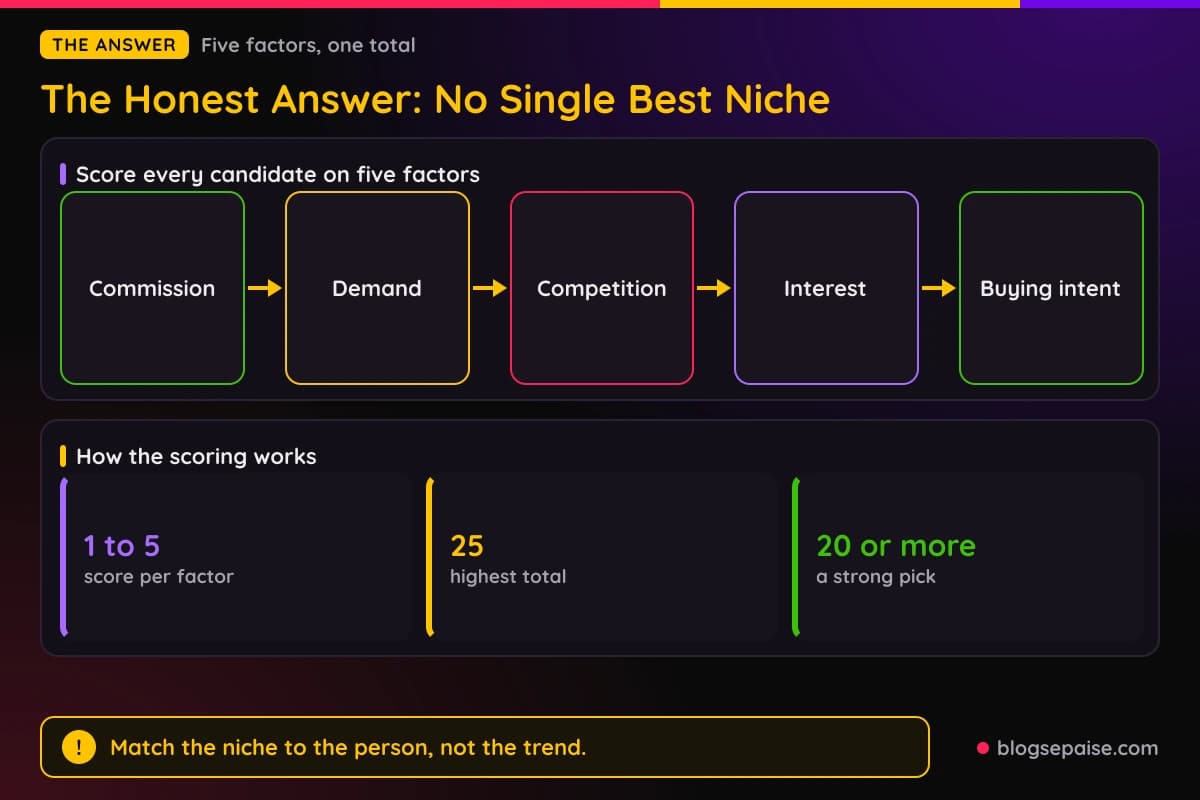
We use five factors to score a candidate. They are commission, demand, competition, your interest, and buying intent.
Commission is how much the program pays and for how long. Demand is how many people search for the topic each month.
Competition is how hard it is to rank next to the sites already there. Interest is how long you can write about it without getting bored.
Buying intent is how close the searchers are to spending money. A person looking up a free recipe is not shopping, while a person comparing two email tools might be.
Each factor gets a score from 1 to 5, and the five scores add up to a total out of 25. You compare totals, then test the winner.
The method is plain on purpose. It replaces gut feeling with a sheet of paper you can read again next month.
Seven steps follow. Each one feeds the next, so do them in order and keep your notes in one place.
If you want a faster check on a single idea, try our niche profitability scorer after you read the steps. It uses a similar idea in a small tool.
Step 1: List Interests And Skills Before You Look At Money
Start with yourself, not the market. The list you make here gives every later step something to test.
Open a blank sheet and write down every topic you could talk about for an hour. Include hobbies, jobs you held, problems you solved, and things you buy often.
Aim for at least ten topics. Do not judge them yet, because a weak idea can lead to a strong one.
Add a second column for skills. Writing, cooking, coding, budgeting, and training a dog all count.
Skills matter because readers can tell when an author has used the product. A review from a person who has done the work reads very differently.
Now mark the topics you would still enjoy in a year. Your first articles are easy, but article forty is where interest decides if the site survives.
Beginners often skip this step and chase money. They pick a topic that pays well on paper, write ten posts, and quit in week six.
Interest is also a ranking factor in a quiet way. Writers who care add detail, examples, and honest limits that bored writers skip.
Cross out anything that feels like homework. Keep the topics where you already have opinions.
You should end with five to eight candidates. A few may feel too broad, like health, and you will narrow them in a later step.
Be careful with topics where bad advice can hurt people, like money, medicine, and legal trouble. You can still write about them, but you need to be sure you are right and honest about what you do not know.
If your list feels thin, look at your bank statement and your browser history. Both show what you spend money and time on.
Our guide on how to choose a profitable niche walks through this brainstorm in more detail. Read it if you get stuck at ten topics.
Save the sheet. Step 2 turns it into a shortlist of topics where people actually pay.
Step 2: Check That People In The Niche Buy Things
A busy topic is not the same as a buying topic. People read about celebrity gossip all day and almost never buy through a link.
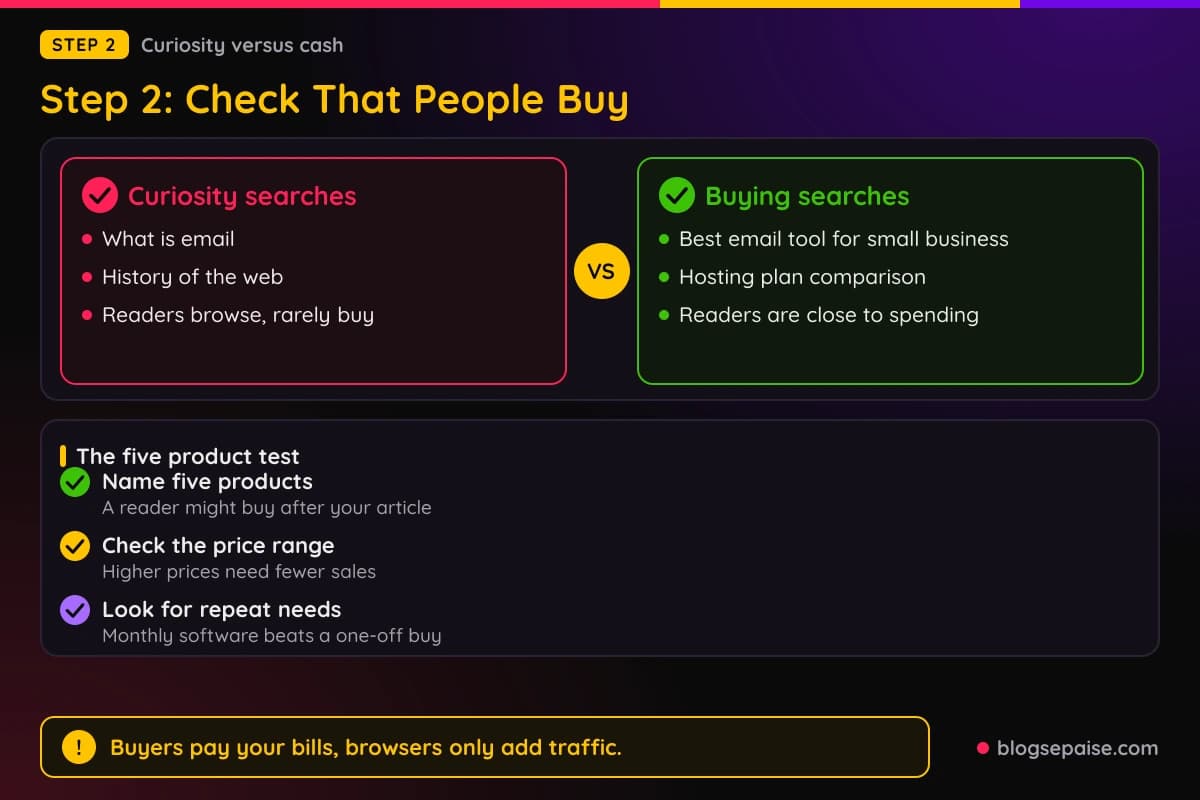
Buying intent is the sign that a reader is close to spending. It shows up in the words people type into search.
Searches like best email tool for small business or hosting plan comparison show intent. Searches like what is email or history of the web show curiosity.
Curious readers are fine for traffic, but only buyers pay your bills. Your niche needs a steady supply of the second group.
Go through your shortlist and ask one test question for each topic. Can I name five products that a reader might buy after reading about this?
If the answer is no, the topic is a weak affiliate niche. It may still work for ads, but links will struggle.
Look for recurring needs too. A person buys a mattress rarely, but pays for email software every month for years.
Check the price range as well. A product that costs five dollars needs huge traffic to matter, while a product that costs two hundred dollars needs far fewer sales.
Search a few buying phrases for each candidate and read the top results. If the pages show product comparisons, reviews, and price tables, buyers are present.
If the pages show only news and opinion, the topic leans toward curiosity. Mark it with a lower buying score for later.
Also look at the ads. When companies pay to show ads on a search, they believe the click leads to a sale.
Evergreen niches are the safest bet here. People need food, money help, health habits, tools for work, and ways to learn, and they will keep needing them.
Trend niches can pay fast and fade fast. Use them for a short push, but build your main site on a topic that will exist in five years.
You can use our guide on validating a niche for a deeper set of checks. For now, a simple five product test is enough.
Step 3: Look Up The Commission And The Cookie Window
Now check what each niche pays. Find two or three programs for every candidate and read their own terms pages.
Do not trust a blog post for the numbers, even this one. Programs change rates, and the program page is the only source that counts.
Three numbers matter most. They are the commission rate, the question of repeat pay, and the cookie window.
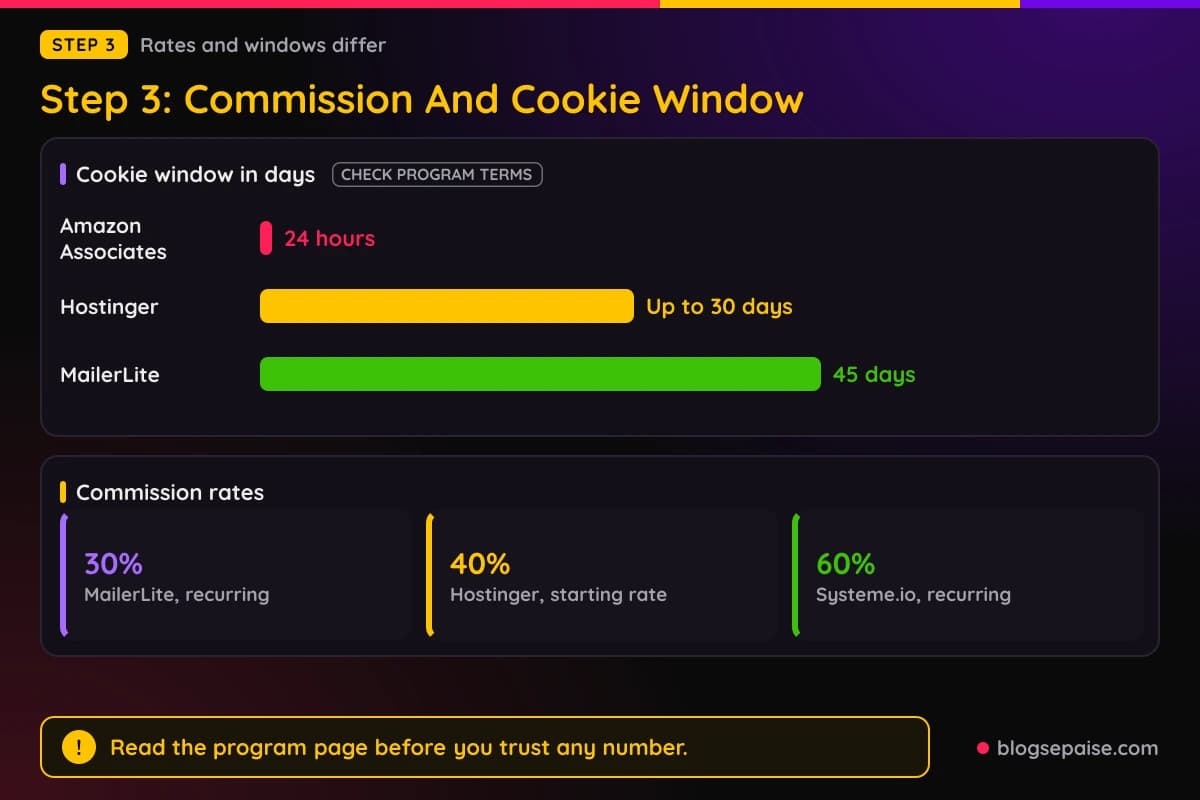
Amazon Associates is the most famous retail program. Its referral cookie lasts 24 hours, and the percent paid depends on the product category.
That short window suits quick buys and punishes slow ones. A reader who clicks today and buys next week may not count for you unless the item sits in their cart.
Compare that with software. MailerLite pays 30 percent of every payment a referral makes for as long as the customer stays subscribed.
Its cookie lasts 45 days, so a reader who signs up within that time still counts when they upgrade later. Our MailerLite review covers the product itself.
Systeme.io lists a 60 percent lifetime recurring commission, and it tags a referral to you permanently instead of using a fixed window. You can read more in our Systeme.io review.
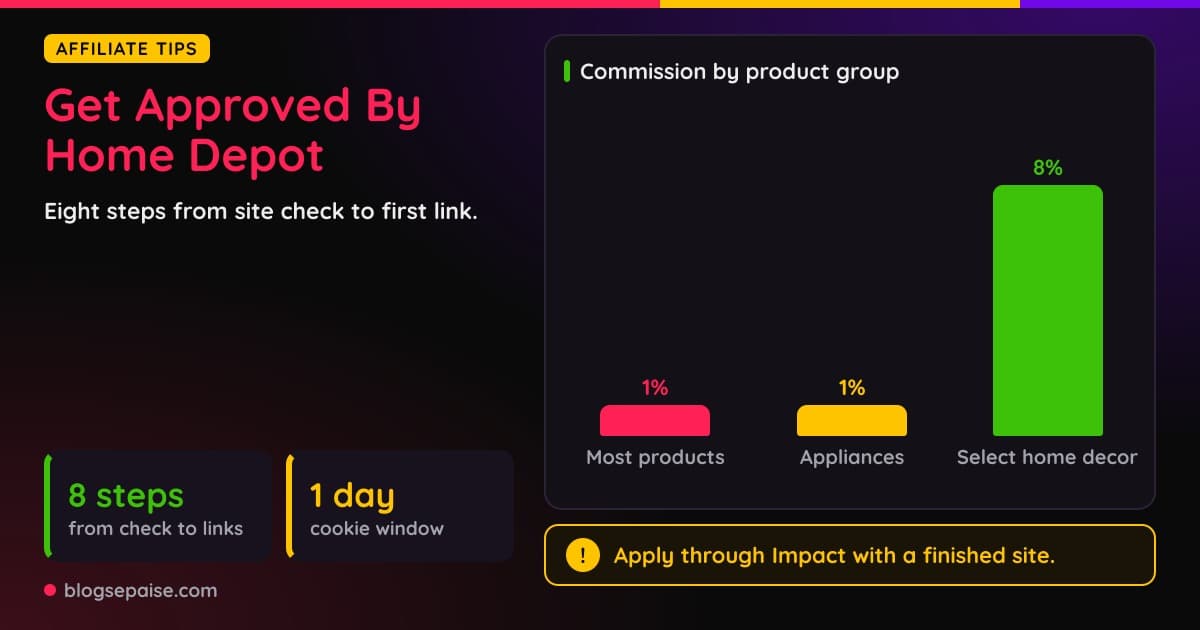
Web hosting works differently. Hostinger starts at 40 percent, tracks a click for up to 30 days, and pays on the first purchase of 12 months or more.
Hostinger also pays nothing on renewals, and it credits no commission if the customer cancels or gets a refund within 45 days. A high rate can come with strings.
So the same effort in three niches can pay in three very different ways. Retail pays small amounts on huge volume, software pays monthly for years, and hosting pays a bigger chunk once.
Recurring pay is worth extra points in your score. Our article on recurring and one-time commissions explains why a smaller monthly check can beat a large single one.
Cookie windows deserve a look too, and we cover them in why cookie windows matter. A long window helps most when your readers take their time.
Score commission from 1 to 5 using three questions. Is the rate decent, does it repeat, and is the window long enough for how your readers buy?
Step 4: Measure Demand With Simple Search Checks
Demand tells you if enough people look for your topic. A niche with no searchers is a quiet room.
You do not need paid tools to check it. A keyword tool, the search box, and a notes sheet will do for a first pass.
Type your topic into a search engine and watch the suggestions. Each suggestion is a phrase real people type often.
Scroll to the bottom of the results page for related searches. Write down any phrase that sounds like a buyer's question.
Then use a keyword tool to see monthly search counts for those phrases. Our list of keyword research tools covers free and paid options.
Count how many buying phrases you can find with at least a few hundred searches a month. Twenty such phrases is a healthy sign for a small site.
Do not chase the biggest numbers. A phrase with 300 searches and a clear buyer can beat a phrase with 30,000 vague searches.
Check the shape of demand over time too. A trend chart that rises and falls like a wave means a seasonal or fading niche.
Flat or gently rising lines are what you want for evergreen topics. They give your articles a long life.
Think about how many products and programs sit inside the topic. A niche with one product runs out of things to write, while a niche with dozens keeps you busy for years.
If you are new to this, our walkthrough on how to do keyword research shows each click. It takes about an hour to learn.
Score demand from 1 to 5. Give a 5 to a niche with many buying phrases and a steady trend, and a 1 to a niche with a handful of weak ones.
Write the score next to the topic on your sheet. You will need it in step 6.
Step 5: Measure The Competition Before You Commit
Competition decides how long you wait for your first sale. A niche can look perfect in steps 2 to 4 and still be out of reach.
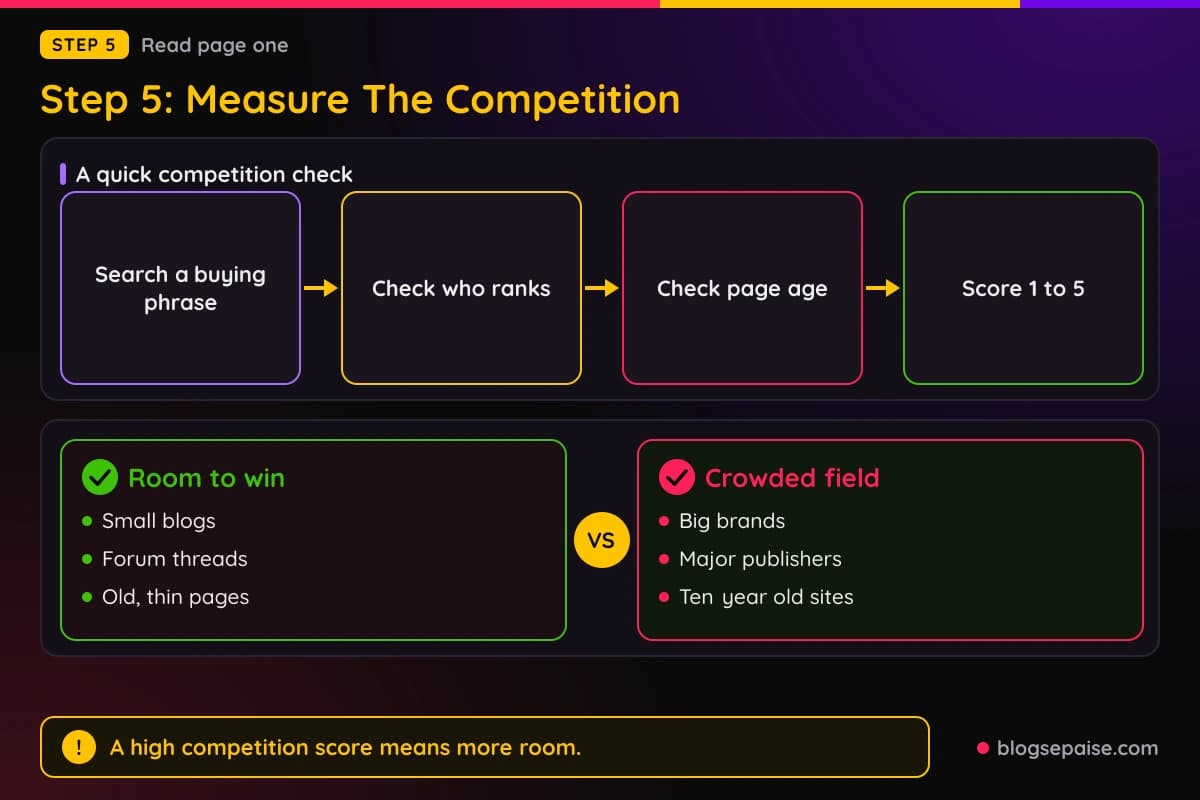
Search the main buying phrase for each candidate and read the first page of results. Look at who ranks, not just what ranks.
Big brands, major publishers, and sites that have run for ten years are hard to beat with a new domain. If the top ten is full of them, mark competition low.
Small blogs, forum threads, and thin pages are good signs. They tell you that search engines have trouble finding strong answers.
Check how old the top pages are. If an article from five years ago still holds first place, nobody has updated it, and you can write a better one.
Our post on the signals a niche has room lists more clues to look for. Use it as a second opinion on your top two.
Narrowing the topic often fixes a crowded niche. Cooking is packed, but cooking for one person on a budget has a much smaller fight.
We cover that trade in niche down or diversify. The short version is that a tight start gives you a place to win.
Also consider the other affiliates. A program with thousands of promoters may share the same readers and the same keywords.
That does not rule it out, but your content has to bring something new. A personal test, a clear comparison, or a real photo can all set you apart.
Competition is scored backward from the other factors. A score of 5 means there is lots of room, and a score of 1 means the field is crowded.
Be honest here. It is tempting to give a loved topic a generous score, and that is how a site stalls in the middle of a crowded page.
When you finish, you will have commission, demand, competition, and buying intent scores for every candidate. Only the interest score is left, and you already know it from step 1.
Step 6: Score Each Niche And Pick Your Top One
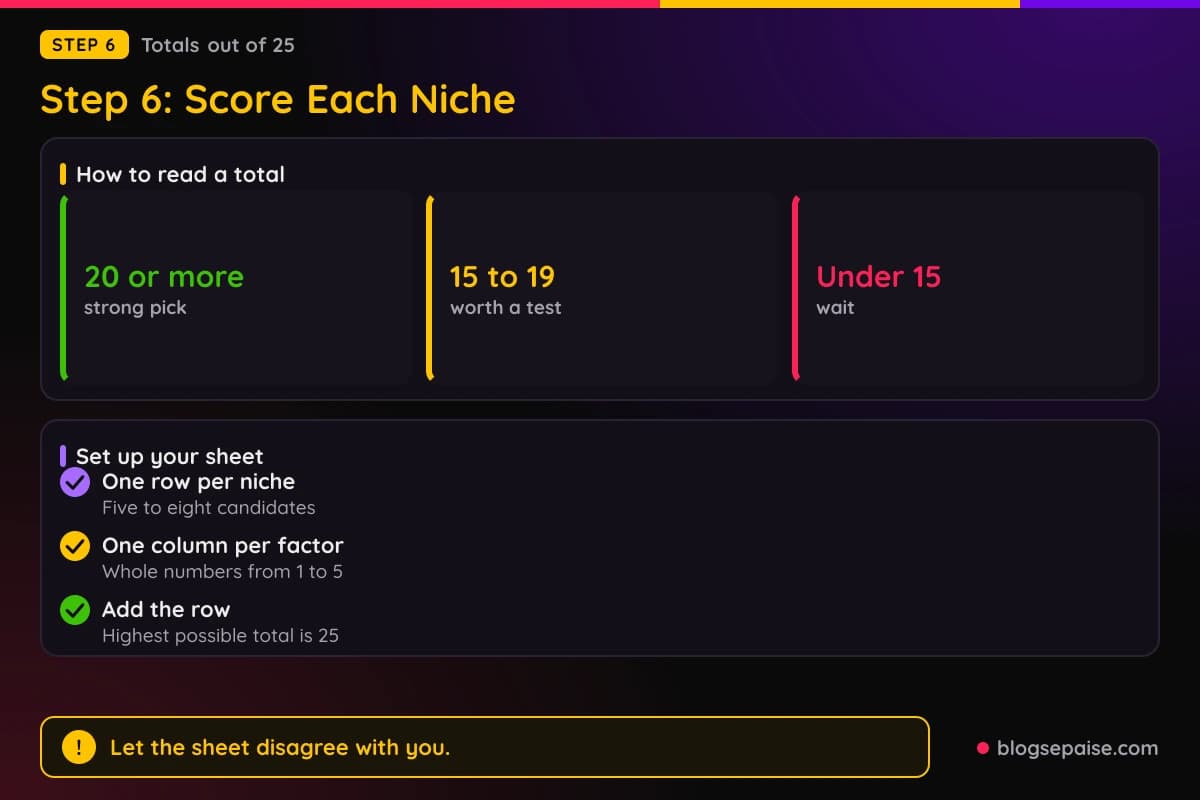
Now bring the numbers together. Make a table on paper with one row per niche and one column per factor.
Fill each cell with a whole number from 1 to 5. Use the scores you wrote down in the earlier steps.
Add the five numbers in each row. The highest possible total is 25, and the lowest is 5.
Treat 20 or more as a strong pick. A total from 15 to 19 is worth a test, and anything under 15 should wait.
These cutoffs are a guide, not a law. They help you see gaps, like a niche with a big commission score and a tiny interest score.
Look at the weak cells inside each total. A single 1 can sink a niche, because it points at a gap you cannot fix with effort.
Competition and buying intent are the hardest gaps to fix. You can learn a topic, but you cannot make rivals vanish or shoppers appear.
If two niches tie, break the tie with interest. The topic you enjoy more will get more articles from you.
If the top niche is still too broad, narrow it. Choose a sub-niche, like email tools for coaches instead of all email software.
You can also use our niche viability scorecard as a second pass on your winner. It asks a similar set of questions in a different order.
Resist the urge to rerun the scores until your favorite wins. The sheet only helps if it is allowed to disagree with you.
Keep your second place niche in your notes. If the first test fails, you will have a ready plan.
Name your pick and write one sentence on why it won. That sentence will keep you steady when a slow month makes you doubt the choice.
Step 7: Test Your Pick With Five Articles
A score is a prediction, and a test is proof. Before you spend months, run a small test.
Write five articles in the niche, each aimed at a buying phrase from step 4. Include at least two product comparisons or reviews.
Use the program links you found in step 3 and place them where a reader would want them. Add a clear disclosure so readers know you earn from links.
Publish all five within a few weeks, and then give them time. New sites often wait months before search engines trust them.
Track three things in a simple sheet. Those are impressions, clicks to your affiliate links, and any sales the program reports.
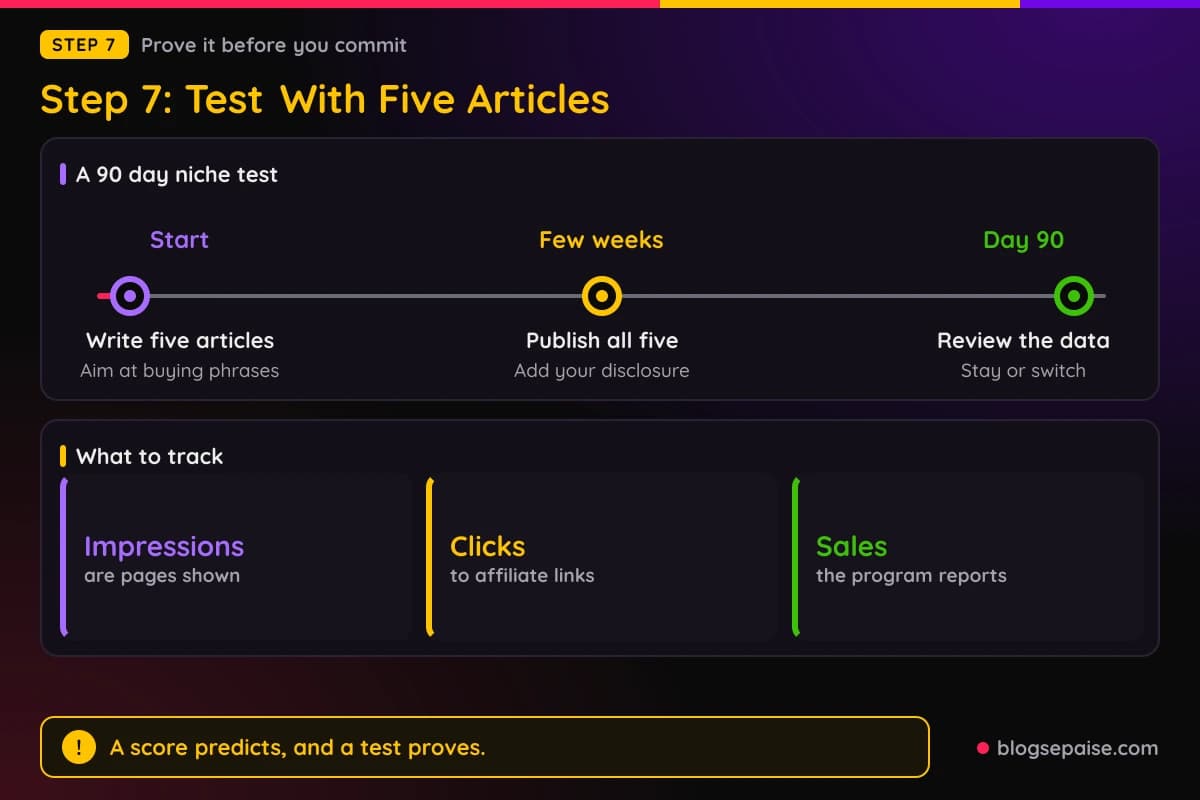
Look at the impressions first, because they show if your pages are being shown at all. Rising impressions with low clicks means your titles or positions need work.
Clicks on affiliate links show if the content moves readers toward the product. If readers visit and never click, the pages may lack a clear next step.
Do not judge the niche by sales in month one. Traffic from search takes time, and your first sale might come from a post you wrote weeks earlier.
Set a review date, like day 90, and write down what would make you stay. For example, stay if impressions grow every month and at least a few clicks reach the program.
If the data looks weak, check the basics before you quit. Look at the page titles, the page speed, and if you answered the actual search question.
If the data is still weak after fixes, switch to your second place niche. You have lost a few weeks, not a year.
If the data looks good, double down. Add more articles around the buying phrases that already show signs of life.
Our guide to getting traffic to a brand new affiliate site helps with the early weeks. Quiet months are normal, and you can speed them up with a few smart moves.
Evergreen Niches With Real Program Examples
Some topics have paid affiliates for as long as the web has existed. They sell to people with needs that do not go away.
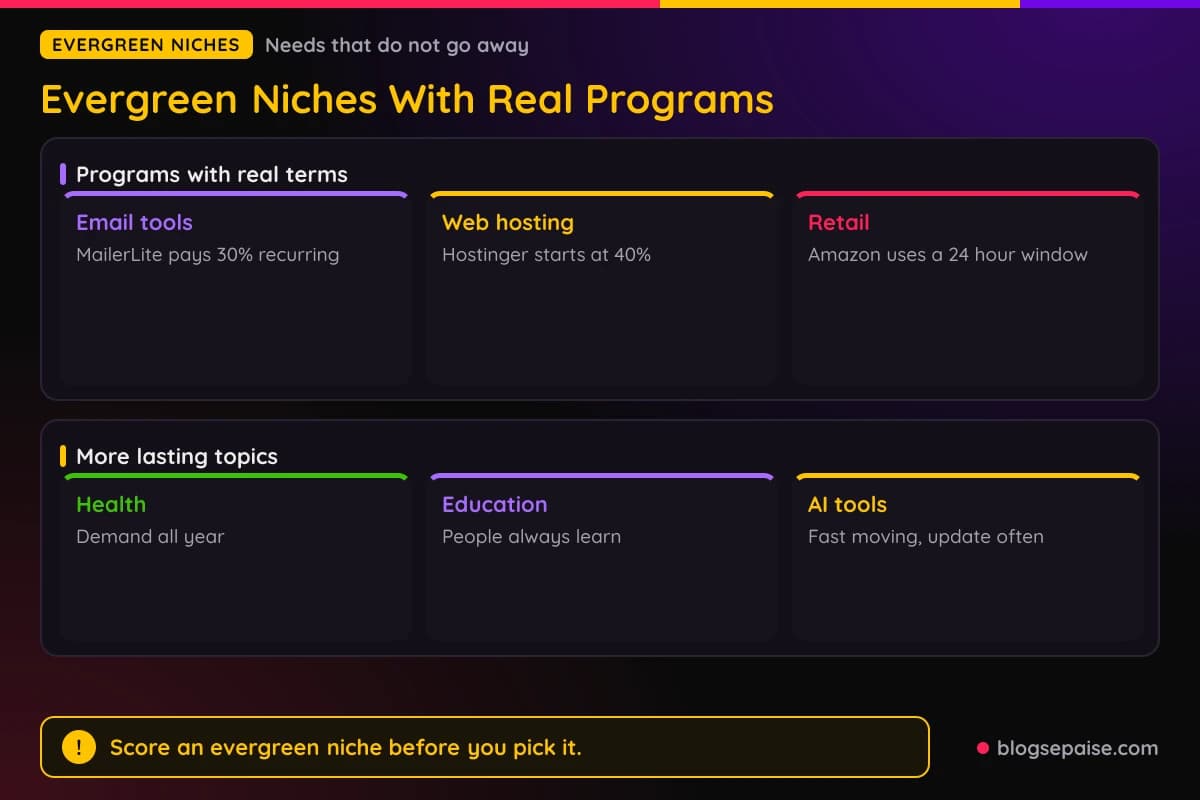
Software and online tools sit near the top for beginners. Programs like MailerLite and Systeme.io pay a share of every monthly payment, so one good article can keep paying.
Our best email marketing affiliate programs list compares more of them. It is a good place to start if software appeals to you.
Web hosting and domains are another steady niche. Anyone who starts a site needs a host, and Hostinger pays from 40 percent on its yearly plans.
The catch is that most buyers purchase once. You need fresh readers all the time, because renewals do not pay.
Retail and home products are the largest group by far. Amazon Associates lets you promote nearly anything, but the 24 hour window and low rates mean you need a lot of traffic.
Health and fitness have strong demand all year, and January is a peak. Our list of best weight loss affiliate programs shows the range of offers.
Be careful with health claims. Stay honest, avoid promises you cannot back up, and never replace a doctor's advice.
Education and online learning also last. People take courses, learn languages, and study for exams all their lives, and you can browse our best education affiliate programs for ideas.
Artificial intelligence tools are newer, but the need for writing, image, and video help keeps growing. Our best AI affiliate programs page lists the main players.
The AI space moves fast, so plan to update your articles often. Tools change names, prices, and features within months.
Personal finance and business services round out the list. They pay well because the products cost more, but they also draw the toughest competition and the strictest rules.
Notice that all of these niches rest on a lasting need. That is what makes them safe starting points, not the size of any one commission.
Pick from this list only after you score it. A niche on an evergreen list can still be a bad fit for you.
A Worked Example: Maya Scores Three Niches
Let us follow Maya, a new blogger who works in an office and likes to cook and organize her work. Her list from step 1 has three strong candidates.
The first is home kitchen gear, which she would promote through Amazon Associates. The second is email tools for small businesses, with MailerLite.
The third is web hosting for first-time site owners, with Hostinger. All three are evergreen, and all three have real programs.
She starts with commission. Amazon gets a 2 because the rate is low and the window is 24 hours, MailerLite gets a 5 for 30 percent recurring with a 45 day window, and Hostinger gets a 4 for 40 percent on a one-time sale.
Demand comes next. Kitchen gear gets a 5 because millions search for it, hosting gets a 4, and email tools get a 3.
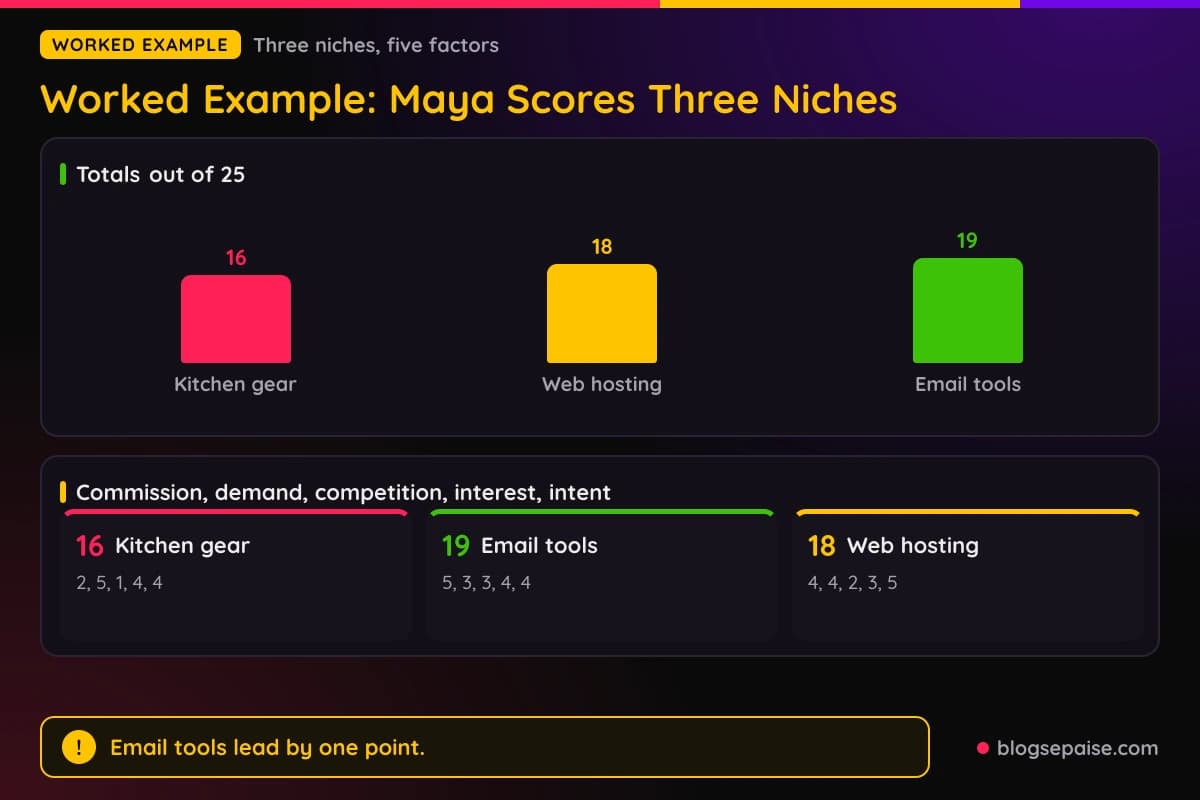
For competition, kitchen gear gets a 1 because the top results belong to big publishers. Hosting gets a 2 and email tools get a 3, since many small sites rank there.
Maya rates her interest honestly. Kitchen gear gets a 4, email tools get a 4 because she runs a newsletter, and hosting gets a 3.
Last is buying intent. Kitchen gear gets a 4, email tools get a 4, and hosting gets a 5 because people searching for a plan are ready to buy.
Kitchen gear adds up to 16, email tools reach 19, and hosting lands at 18. Email tools lead by one point.
Worked Example Part 2: Maya Checks The Money Behind The Scores
The totals are close, so Maya checks the money. She assumes 1,000 clicks on her links in each niche to keep the test fair.
For kitchen gear she assumes a 4 percent buy rate, an $80 item, and a 3 percent commission. That gives 40 sales at $2.40 each, or $96.
For email tools she assumes 2 percent of clicks become paying customers on a $20 monthly plan. That is 20 customers earning $6 a month each at the 30 percent rate.
If 14 customers stay on average through the year, she earns $1,008. That is 14 customers times $6 times 12 months.
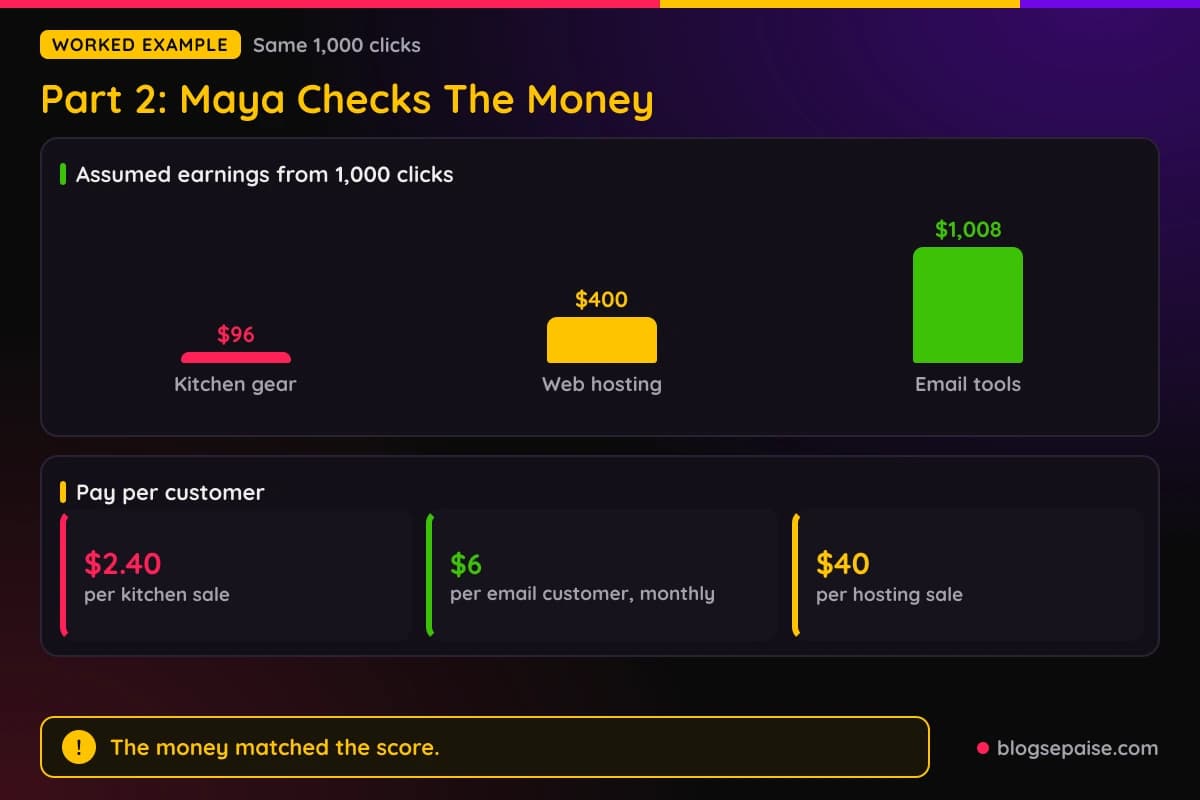
For hosting she assumes 1 percent buy a $100 plan, so 10 customers. At 40 percent, each sale pays $40, and the total is $400 once.
The money check matches the score. Email tools earn $1,008, hosting earns $400, and kitchen gear earns $96 from the same 1,000 clicks.
Maya picks email tools. Hosting becomes her backup, and she keeps kitchen gear as a side topic with low effort.
Her inputs were guesses, and real results will differ. The value of the exercise is that she can swap in real data after her test and see if the winner holds.
You can run the same math with our commission earnings estimator. Enter your own click, buy rate, and commission numbers.
Common Mistakes When Choosing A Niche
The first mistake is picking only for the biggest commission. A 60 percent rate on a product nobody searches for pays 60 percent of nothing.
The second is picking only for traffic. Large audiences without buyers lead to impressive charts and an empty payout page.
Another mistake is ignoring the cookie window. A 24 hour window on a slow-buying product can erase most of your sales.
Many beginners also pick a niche they dislike. They stay for a month, then run out of energy and stop publishing.
Some choose a niche that is too broad, like health or money. A tight sub-niche gives a new site a place to win.
Others copy a niche from a YouTube video without checking competition. By the time a niche is famous, the easy keywords are gone.
Skipping the test is another trap. Scores feel real, but only readers and clicks show the truth.
Quitting too early hurts as well. Search traffic can take months, and judging a niche in week three is like judging a seed on day two.
Switching niches every month is the opposite problem. You never build enough pages to see results.
Finally, many people trust one source for program terms. Rates and rules change, so recheck the program page before every big push.
Avoid these and your pick will likely beat the average. Most failures come from skipped steps, not from bad luck.
Final Thoughts
There is no single best affiliate niche, and anyone who names one for everybody is guessing. The best niche for you is the one that scores well on commission, demand, competition, interest, and buying intent.
Start with a list of your own interests, then check who buys, what the programs pay, and how much room there is. Score each candidate out of 25 and test the winner with five articles.
Evergreen niches like software, hosting, retail, health, and education are safe places to begin. Pick one, verify the program terms, and write your first article this week.
Frequently Asked Questions
1. What is the best affiliate marketing niche for beginners?
There is no single best one. Software, web hosting, health, and education are popular evergreen choices, but you should score each against your own interests and competition.
2. How do I find profitable affiliate niches?
List topics you know, then check for buying searches, program payouts, and competition. Niches where people already buy and rivals are small are the most profitable to start.
3. Should I pick a niche I love or one that pays more?
Aim for both, but do not drop interest. A niche that pays well and bores you tends to stall by month six.
4. How many niches should I score?
Five to eight is plenty. More than that slows you down, and fewer than three leaves you without a backup.
5. Is it better to choose a broad or narrow niche?
Narrow is usually better for a new site. A tight topic gives you less competition and a clearer reader.
6. Do recurring commissions matter when picking a niche?
Yes. Programs like MailerLite pay 30 percent of each payment for as long as the customer stays, so one article can keep earning.
7. Is Amazon Associates a good start for a beginner?
It is easy to join and covers almost every product. The 24 hour referral window and low rates mean you need a lot of traffic.
8. How long should I test a niche before deciding?
Give it about 90 days and at least five articles. Judge by growth in impressions and clicks, not by early sales.
9. Can I run more than one niche at once?
You can, but a beginner usually does better with one. Focus builds trust faster, and you can add a second site after the first earns.
10. Are trending niches worth it?
They can pay quickly and fade just as fast. Use them for short pushes and keep your main site on an evergreen topic.
11. How often should I recheck program terms?
Every few months, and before any big promotion. Rates, cookie windows, and rules can change without much notice.
12. What if my first niche does not work?
Check the basics, then move to your second place niche. A failed test costs weeks, and your notes make the next try faster.