Affiliate Marketing For Retirees: 7 Steps To Start Safely
Affiliate marketing means you recommend a product and earn a commission when someone buys through your link.
You work from home, on your own schedule, with no boss and no commute.
It is also slow. A new site or channel usually earns nothing at first, so this guide keeps the pace gentle and the risks small.
You get seven steps. They cover how the income works, how to pick a topic, where to publish, which programs to join, and how to follow the disclosure rules.
Two steps matter more for retirees than for most beginners. One covers taxes and the Social Security earnings limit, and the other covers scams aimed at older adults.
Nothing here is financial, tax, or legal advice. It describes the rules, and a tax professional or the Social Security Administration can answer for your own case.
If the basics are new to you, start with what affiliate marketing is and how it works.
Then come back and take the steps in order.
Disclosure: Some of the links I share might be affiliate links. If you click on one and make a purchase, I may earn a small commission as a thank you. But don’t worry, it won’t cost you anything extra. I only recommend stuff I genuinely believe in. Your support helps me keep creating awesome content. You can read my full affiliate disclosure in my disclaimer page.
Search 1,500+ affiliate programs in the Blogsepaise Program Database and filter them by category, network and commission type, then go straight to each program's signup page. The Link Health Monitor then checks your posts for broken, redirected and untagged affiliate links.
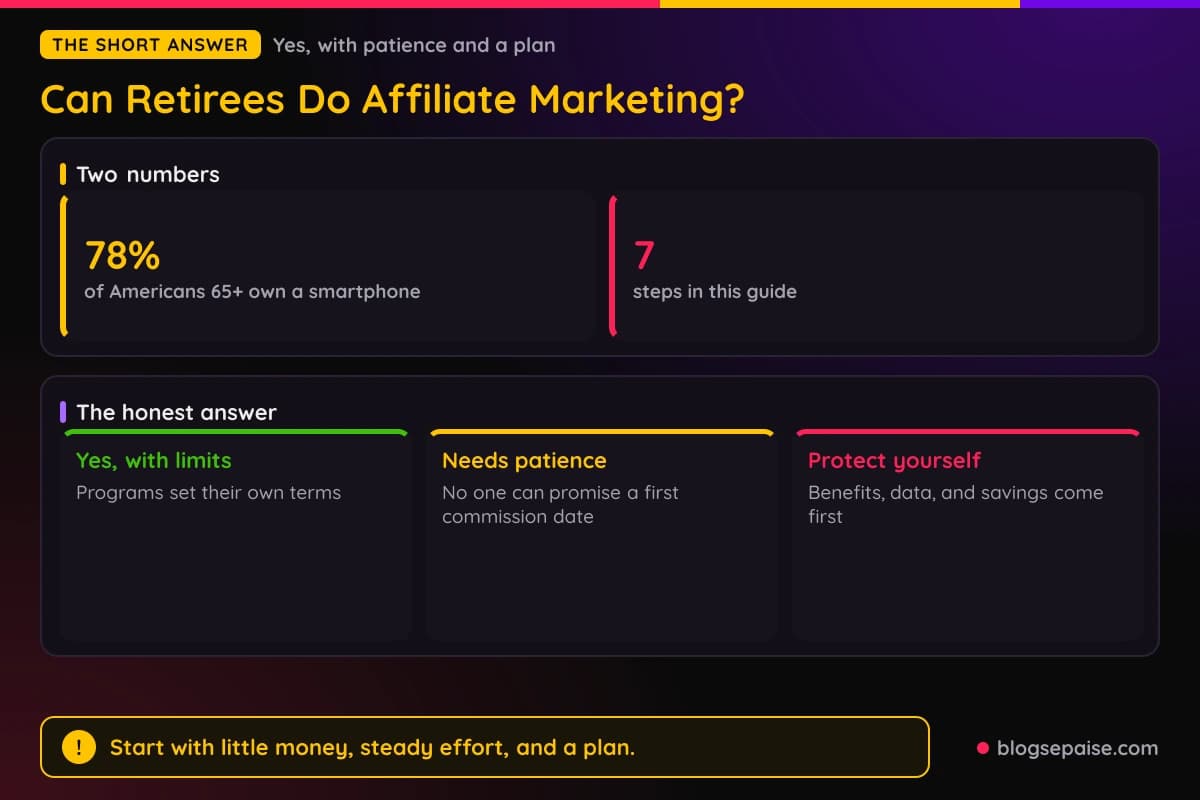
Can Retirees Do Affiliate Marketing?
Yes, retirees can do affiliate marketing. Amazon Associates, for example, requires that you are not a minor or otherwise legally prevented from contracting.
Each program sets its own terms, so read them before you apply. Rules can differ from one program to the next.
Technology is not a barrier you should assume. Pew Research found in 2025 that 78% of Americans 65 and older own a smartphone.
A phone is enough to read a dashboard, check a link, and answer a reader. Our guide on affiliate marketing with your phone shows how far one can take you.
A laptop makes writing easier, but you can begin without one.
The harder part is patience. Nobody can promise you a first commission date or a monthly income.
Anyone who does promise it is selling something. The Federal Trade Commission requires a seller who states how much you can earn to give you an earnings claim statement.
So the honest answer is yes, with limits. You can start with very little money, but you need time, steady effort, and a plan to protect your benefits and your data.
Retirees also bring real strengths. A lifetime of work and hobbies gives you topics you already know, and readers trust people who have used what they recommend.
That trust is what you earn commissions on. Keep it, and everything else gets easier.
If you are over 50 and not yet retired, the same steps apply. The Social Security earnings limit in step 5 only matters if you already collect benefits early.
Step 1: Learn How Affiliate Income Works
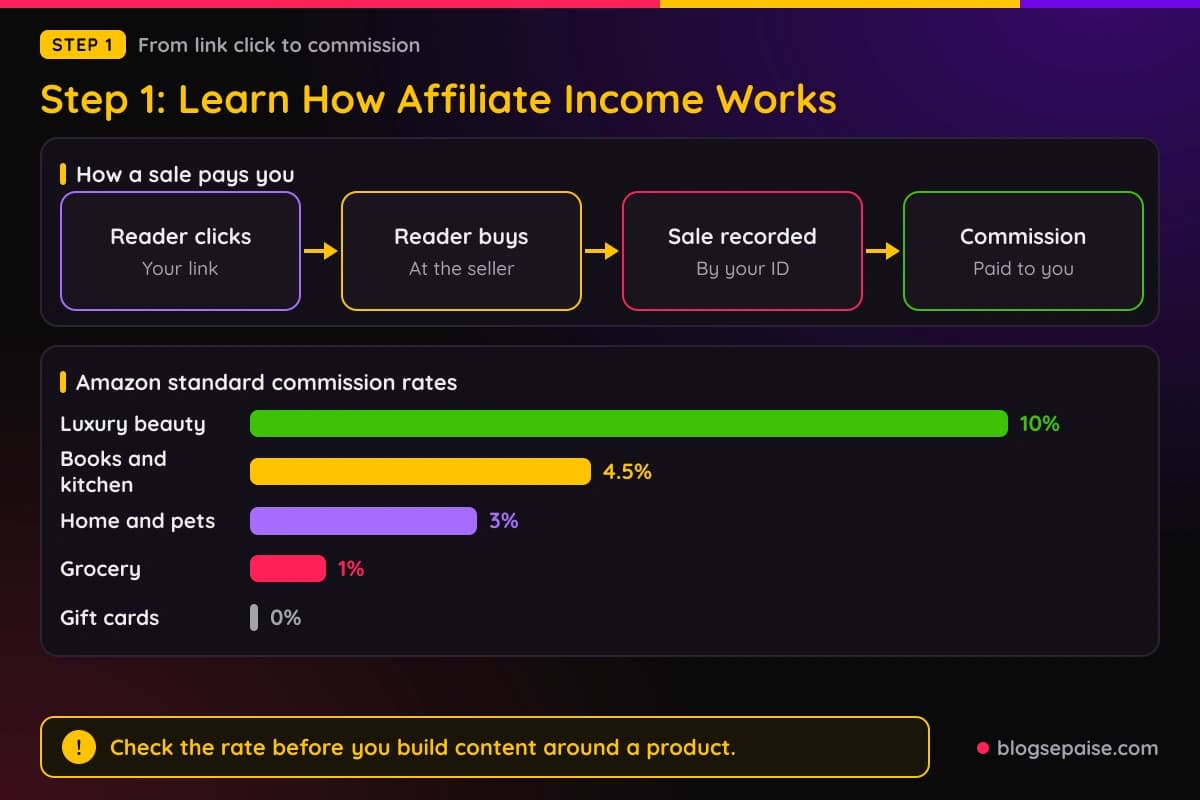
Every affiliate program gives you a special link. The link carries an ID that tells the seller you sent the visitor.
When a reader clicks your link and buys, the program records the sale and pays you a commission. The seller sets the rate, so it differs by program.
Amazon Associates shows how much rates can vary. Its standard table pays 4.5% on physical books and kitchen items, 3% on home, lawn and garden, and pet products, and 1% on grocery.
The top rate in that table is 10%, for categories such as luxury beauty. Most everyday categories pay between 1% and 4.5%, so small sales add up slowly.
Some categories pay 0%, including gift cards. Check the rate before you build content around a product.
Networks work differently. Awin is an affiliate network, which means one account lets you apply to many brands' programs.
Joining Awin starts with a small deposit. Awin's help center lists it as 1 dollar, euro, or pound, depending on your region.
Awin calls it a verification fee. It is credited to your account and paid back with your first commission payment, once you reach the payment threshold.
Amazon adds its own test. A new Associate needs at least three qualifying sales within the first 180 days of applying, or the application can be withdrawn.
Plan for that clock before you apply. Publish a few useful posts or videos first so you have somewhere to send readers.
A commission and a payout are two different things. Programs set payment thresholds, so your first sale does not always mean a deposit right away.
Keep your account active once you join. Amazon's agreement lets it withhold accrued commissions, with 7 days' written notice, if an account shows no substantial activity for at least 3 years.
Keep your expectations plain. Income comes from readers who trust you, and trust builds slowly.
Our guide on the slow start mentality explains why zero is normal at first.
Step 2: Pick A Topic From Your Own Life
Your best topic is one you already know. Years of work, hobbies, home projects, and caring for family all give you knowledge that readers search for.
Start with a plain list. Write down your past jobs, your hobbies, the things you have fixed, and the products you have bought and used a lot.
Then circle the ones you could talk about for months. Interest fades fast when a topic feels like homework.
Next, ask who needs help with each one. A good topic has a reader with a real question and a product that answers it.
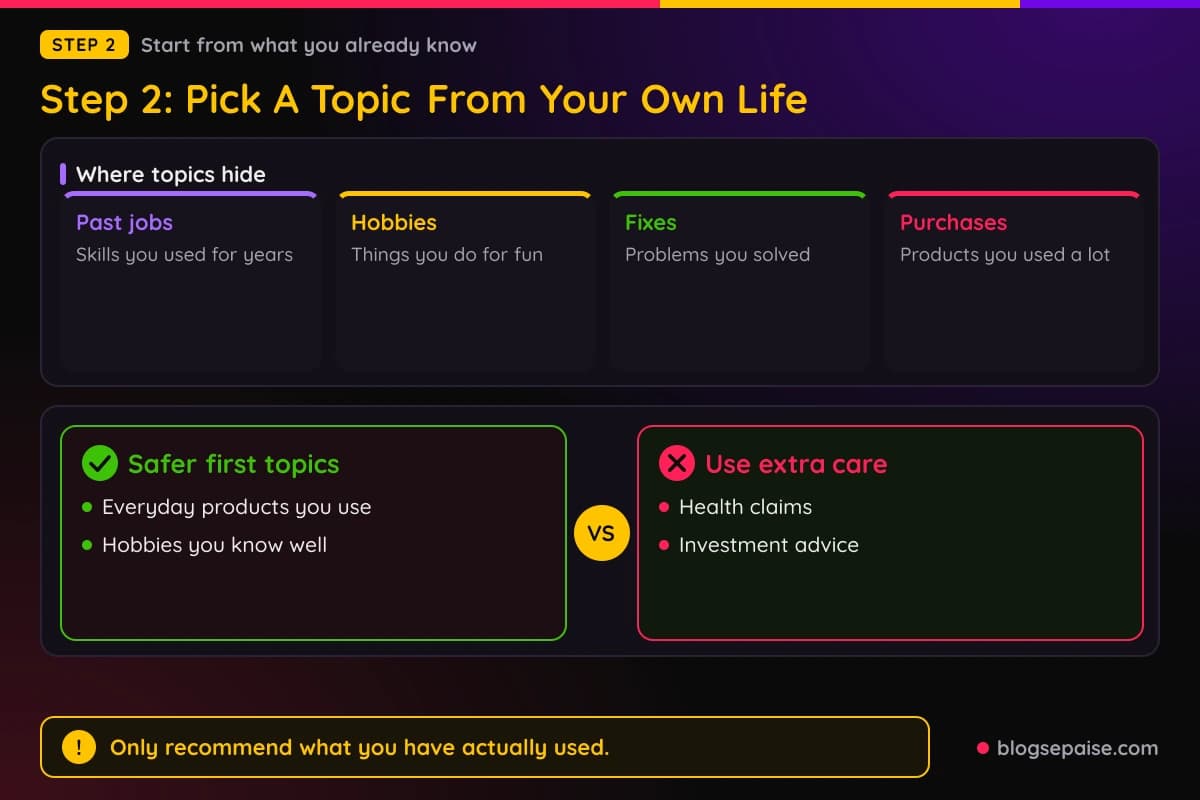
Only recommend products you have used. The FTC says you cannot describe experiences with a product you have not tried.
That rule fits you well, since you can speak from real use. Honest reviews also bring readers back.
Stay careful with health topics. The FTC says you cannot make claims that need proof the advertiser does not have, such as health claims.
Use the same care with money topics. The FTC reports that losses to investment scams among adults 60 and over jumped 42% in 2025, to over $1 billion.
A site that pushes investments invites trouble, so a safer first topic is everyday products you know well.
Add something of your own to every page. Google's spam policies describe thin affiliate pages as ones with product descriptions and reviews copied from the merchant, with no original content or added value.
Your photos, your experience, and your honest pros and cons are the added value. Copying a seller's description is the one thing to avoid.
Our guide to the best affiliate marketing niche shows how to test a topic before you commit to it.
Step 3: Choose One Simple Place To Publish
Pick one place and stay there for a while. Splitting your time across five platforms is a fast way to burn out.
A blog or website gives you a home you control. Readers find your posts through search, and the posts stay up after you publish them.
You can pay for a domain and hosting, or start on a free site builder. Our guide on a website to start affiliate marketing compares the options.
A YouTube channel suits people who like to talk and show things. You can hold a product in your hands, which helps viewers trust you.
YouTube has a paid promotion button in the video details. Selecting it adds a disclosure label at the beginning of your video.
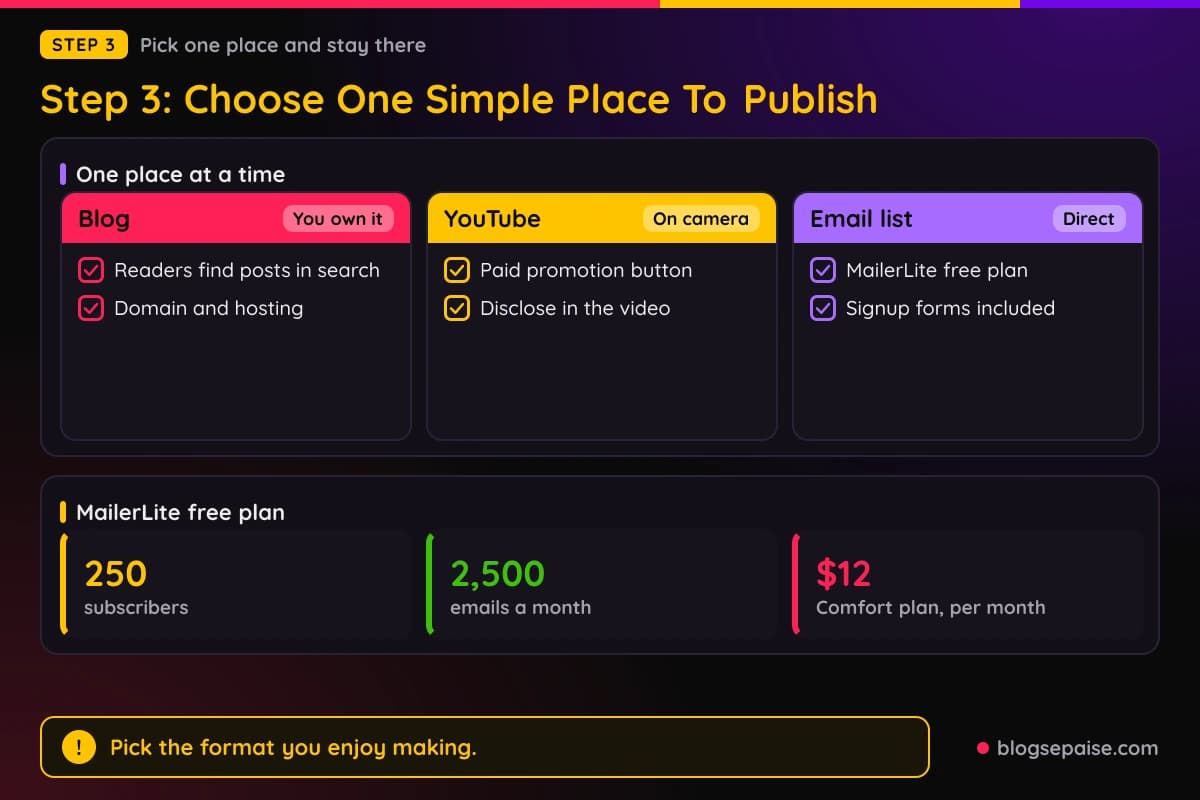
The FTC adds that a disclosure belongs in the video itself, in the description alone. Say it out loud or show it on screen.
An email list lets you reach readers directly. MailerLite has a free plan with 250 subscribers and 2,500 monthly emails.
The free plan includes signup forms, a landing page, and automations. Its Comfort plan starts at $12 a month, so you can stay free until your list outgrows the limit.
Pinterest and short videos can also send readers to your links. See affiliate marketing on Pinterest and affiliate marketing on YouTube Shorts for how each one works.
A Facebook group works when you already have a community. Read the group's rules before you post any link, since each group sets its own.
If you choose email, our guide to email marketing tools compares more services. If you choose a blog, learn how to do keyword research so you write about what readers search for.
Pick the format you enjoy making, because you will make a lot of it. If you want to compare more places, read our overview of affiliate marketing platforms.
Each choice has a different learning curve, and that is fine. Pick the one that feels least like a chore, since you will repeat it every week.
Whatever you choose, keep the first month small. Our first 30 days plan gives you a day by day path.
How To Write A Post Readers Trust
A good affiliate post helps a reader decide. The link comes second, and the help comes first.
Google's guidance asks if content provides original information, reporting, research, or analysis. It also asks if the content goes beyond the obvious.
First-hand use is your biggest advantage here. Google's guidance points to expertise that comes from having actually used a product or service.
Show your work. Reviews are more trustworthy when readers learn how many products were tested and what the results were.
Add photographs of the real product in your own home. Google lists photographs as evidence of the work involved in a review.
Credit to other sources does not replace your own effort. Writing it in your own words from your own use is the safer path.
Put your name on your pages. Google asks if it is clear to visitors who wrote the content, and if pages carry a byline.
Write for people first. Google warns against content made mainly to attract visits from search engines.
Explain who the product suits and who should skip it. Readers value a clear no as much as a clear yes.
Disclose even if you think your opinion is unbiased. The FTC says to make disclosures anyway and not to assume readers already know about your brand relationships.
Before you publish, read the post once as a stranger would. Check that the disclosure sits near the link and that every claim comes from your own use.
Then check each link on a phone and on a computer. A broken link earns nothing and frustrates readers.
Step 4: Join Programs And Follow The Disclosure Rules
Apply after you have something to show. Awin lists an active digital platform among its general requirements.
Start with two or three programs for products you already use and trust. A short list is easier to manage and easier to disclose.
Read each program's terms before you place your first link. Terms cover how links may be used, where they may appear, and which actions earn a commission.
Amazon's agreement requires you to state clearly and prominently: "As an Amazon Associate I earn from qualifying purchases."
Now the law. The FTC requires you to disclose your relationship with a brand when you earn money from a recommendation.
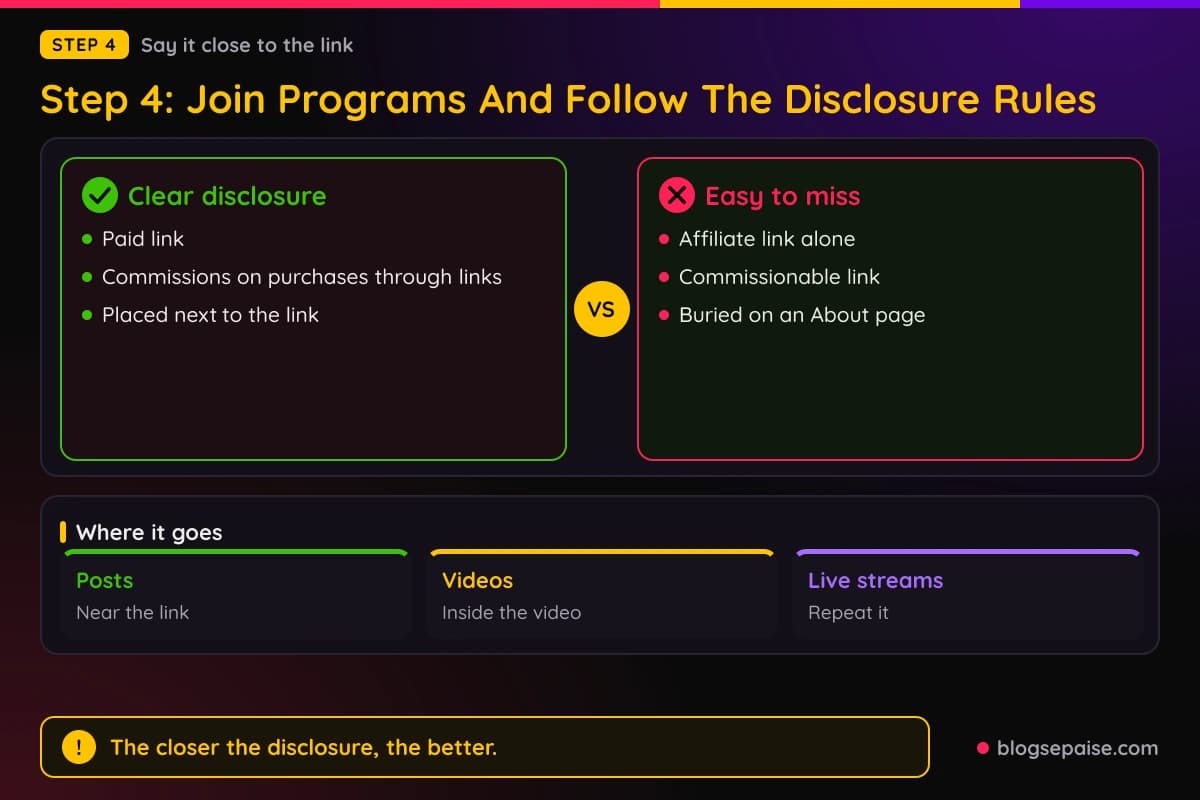
For bloggers, the FTC offers this example: "I get commissions for purchases made through links in this post." Plain words like that work well.
Put the disclosure close to the link. The closer it sits to your recommendation, the better.
Do not bury it. Disclosures on an About page, at the end of a post, or behind a "more" link are likely to be missed.
"Paid link" next to an affiliate link is an adequate disclosure. "Affiliate link" alone may leave readers unsure that you get paid, and "commissionable link" is probably not clear.
Do not count on a platform's tool alone. Use it in addition to your own clear disclosure.
Videos need the disclosure in the video, and live streams need it repeated. Tags, likes, and pins can count as endorsements too.
Our site's affiliate marketing red flags guide covers more signs of programs to avoid.
Check how and when each program pays before you apply. Look for the payment threshold, the payment method, and if the program asks for tax details.
Keep a simple log of every program you join. Note the login, the link rules, the payment threshold, and your disclosure wording.
Need help with the wording? Our affiliate disclosure generator drafts a plain sentence, and our legal disclosures page covers more of the rules.
A notebook or a spreadsheet works fine. Store the passwords in a password manager, which step 6 covers.
Step 5: Know How Taxes And Social Security Apply
Affiliate commissions are income, and income has rules. This step covers the ones that matter most to retirees.
The IRS treats you as self-employed if you are in business for yourself, including a part-time business. Commissions you earn by running your own site or channel usually fall into that group.
A tax professional can confirm how to report yours. Treat the rest of this step as a map, not as advice.
The IRS also runs a self-employed individuals tax center on irs.gov with forms and guidance.
Business income goes on Schedule C. Net profit is your business income minus your business expenses, and the result is included on your Form 1040 or 1040-SR.
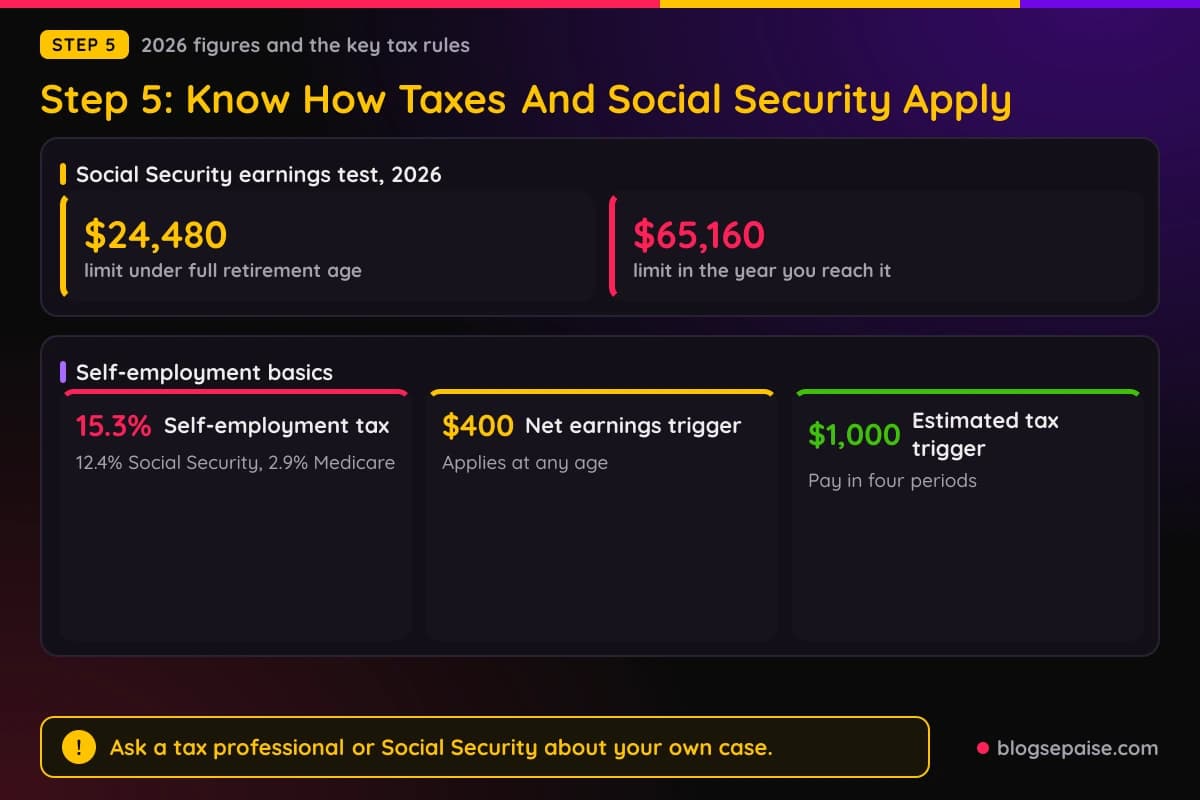
Self-employment tax is separate. The rate is 15.3%, made up of 12.4% for Social Security and 2.9% for Medicare.
It applies when your net earnings from self-employment reach $400 for the year. You report it on Schedule SE.
Age does not exempt you. The IRS states that self-employment tax rules apply no matter how old you are, even if you already receive Social Security or Medicare.
No employer withholds tax from your commissions. Estimated tax is the method used to pay Social Security, Medicare, and income taxes in that case.
You generally must pay estimated tax if you expect to owe $1,000 or more when you file. Payments fall into four periods, and Form 1040-ES has a worksheet and payment vouchers.
You can pay online, by phone, or through the IRS app. If a due date lands on a weekend or holiday, paying the next business day is on time.
A hobby is treated differently. Income from an activity with no profit motive must still be reported on Schedule 1, line 8, and you cannot use a loss from it to offset other income.
The IRS looks at facts such as complete records, changes you make to improve profitability, and the time you put in. That is one more reason to keep good records from day one.
Save your commission reports, payment emails, and receipts for your domain, hosting, and tools. A missing 1099-NEC does not erase income, since some payments need no form but may still be taxable to you.
If you receive Social Security, extra income can make more of your benefits taxable.
Benefits are not taxable unless your modified adjusted gross income plus half your benefits is above the base amount for your filing status.
Other income counts in that test. IRS Publication 915 has the base amounts and the worksheet.
Now the Social Security earnings test. It applies only if you collect retirement benefits before your full retirement age.
The test counts wages and net earnings from self-employment. It does not count pensions, annuities, investment income, interest, or veterans benefits.
In 2026, the limit is $24,480 a year if you are under full retirement age all year. Social Security withholds $1 in benefits for every $2 you earn above it.
In the year you reach full retirement age, the limit is $65,160. Social Security withholds $1 for every $3 above it, and only earnings before the month you reach that age count.
After you reach full retirement age, earnings no longer reduce your benefits. Social Security also increases your monthly benefit permanently to account for the months it withheld.
A special rule helps in your first year. Social Security pays a full benefit for any whole month it considers you retired, no matter your yearly earnings.
Net earnings means profit after expenses, not total commissions. Keep that in mind when you compare your results with the limit.
The limits change each year. Check ssa.gov for the current figures, and ask Social Security or a tax professional how your income counts.
Step 6: Spot Scams And Protect Your Data
Scammers know that many people look for side income. The FTC reports that adults 60 and over reported losing about $3 billion to fraud in 2025, up from about $600 million in 2020.
Investment scams were the largest category, with reported losses of over $1 billion. Consumers often said the scammers reached them on social media.
People 80 and over reported a median loss of $2,000. The numbers are a reminder to slow down and ask for a second opinion.
A real affiliate program pays you for sales. It should not make you pay to work for it.
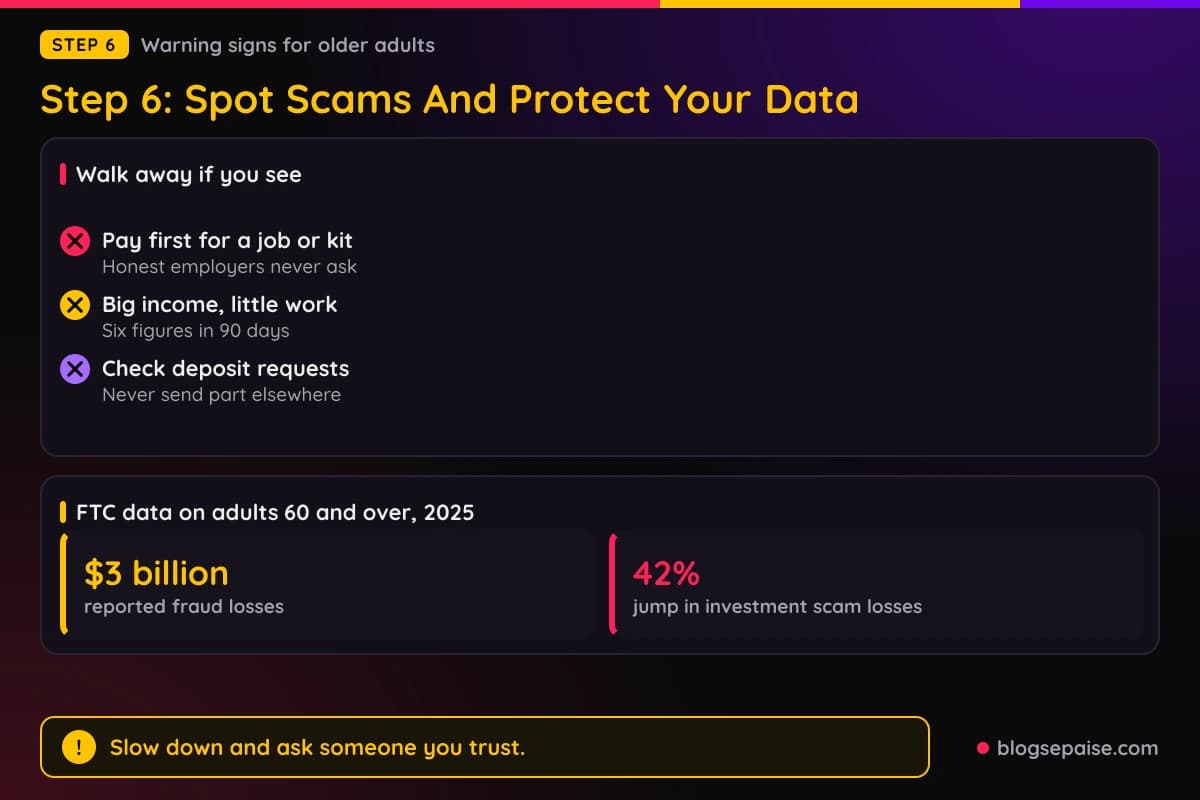
The FTC's job scam advice says honest employers will never ask you to pay to get a job. A refundable verification deposit like Awin's is a different thing from a fee for access.
Starter kits, so-called training, and certifications are another warning sign. The FTC lists paying for useless versions of these as a classic job scam.
Big income promises come next. The FTC warns about claims that you can make a lot of money in a short time with little work.
One FTC case involved a turnkey system that promised six figures in 90 days or less. Another scheme promised thousands of dollars a month in passive income, and most clients did not recover what they paid.
If a seller does state earnings, ask for the paperwork. The FTC says to request the legally required one page disclosure document.
Check that it names the seller, lists any lawsuits, explains cancellation and refund terms, and gives references. Any earnings claim must come with an earnings claim statement.
Scammers often skip blunt claims and use softer promises they cannot keep.
The FTC has put over 1,100 businesses on notice about deceptive money making claims, and sellers must be able to support any earnings claim they make.
Compare what the seller tells you with what the paperwork says. Walk away if anything contradicts the document.
A lack of complaints does not prove a promoter is honest. Search the company or person's name with words like scam or complaint, and talk to someone you trust before you pay.
Never deposit a check for someone and send part of it elsewhere. The FTC also says reshipping goods is never a real job.
Be wary of anyone who wants to move the chat to a private app, or who will not meet on a video call.
Nobody legitimate needs your Social Security number or bank details before you are hired. AARP runs a Fraud Watch Helpline at 1-877-908-3360 if you want a second opinion.
If you lose money, act fast. Contact the company you used to send the money, report the fraud at ReportFraud.ftc.gov, and ask for a reversal.
Now protect your data. Affiliate sign ups ask for tax and payment details, so use only sites you typed or bookmarked yourself.
Phishing messages often tell a story to push you to click. Legitimate companies will not email or text a link to update your payment information.
If a message about your payout looks off, contact the program through a phone number or website you know is real. Do not use the contact details in the message.
Make passwords long. The FTC suggests at least 15 characters or random word passphrases, with a different password for each account.
A reputable password manager keeps track of them. Give the manager a strong password of its own.
Turn on two factor authentication wherever it exists. An authenticator app or a security key is more secure than other methods.
Protect your email most of all. Password reset links go there, so a hacked inbox can open your other accounts.
Turn on automatic updates and back up your computer and phone. Also set privacy settings on your social accounts, and limit online friends to people you know.
For more on spotting bad offers, read is affiliate marketing a pyramid scheme.
Step 7: Build A Slow Weekly Routine
Slow does not mean idle. A small routine you can repeat beats a burst of effort that fades.
Pick a weekly time budget you can keep in your worst week. Goals you control work better than goals you hope for.
Block the same times each week in your calendar. Treat them like appointments.
Give each session one job. Use one for creating, one for learning, and one for checking.
Creating comes first. Publish before you polish, because a finished page beats a perfect draft.
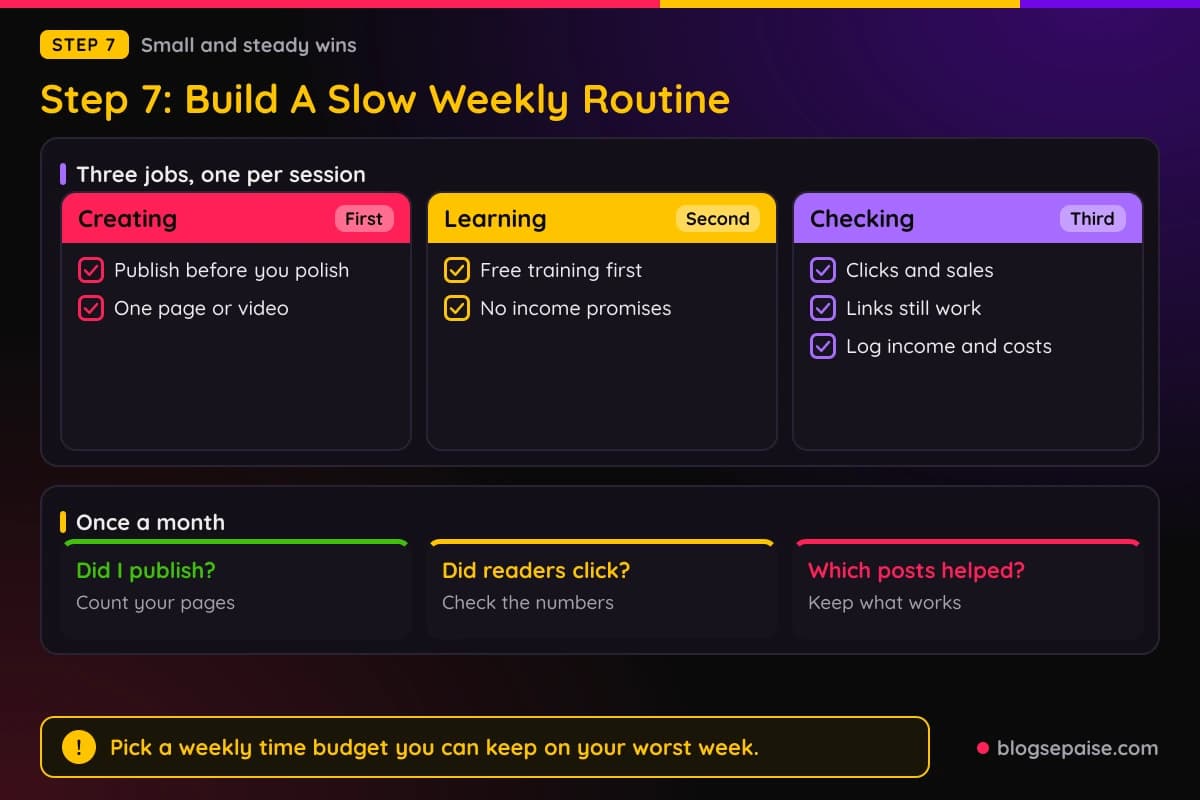
Learning comes second. Start with free affiliate marketing training before you spend a dollar.
Our guide on affiliate marketing on a tight budget shows the order to spend in when you do pay for something.
Checking comes third. Open each program dashboard, note clicks and sales, and make sure your links still work.
Log every commission and every expense as it happens. That makes tax time easier and helps you track your earnings against the Social Security limit.
Once a month, review the numbers. Ask what you published, what readers clicked, and which posts helped.
Keep what works and drop what does not. Small changes add up over many months.
Set a spending rule. Do not buy anything that promises income, and spend only on tools you will use this month.
Say no to pressure. Any offer with a countdown timer or a limited spots banner can wait while you ask someone you trust.
Ask a trusted friend or family member to read your first few pages. A fresh pair of eyes catches broken links, unclear sentences, and a disclosure that is too easy to miss.
Update your older pages on a schedule. Prices change, products get replaced, and a stale recommendation costs you the trust you worked to build.
Track clicks and sales side by side. Plenty of clicks with no sales tells you to improve the page or the product match, not to give up.
Rest is allowed. Missing a week does not erase your progress, so pick up where you left off.
Common Mistakes Retirees Make With Affiliate Marketing
Paying for a course or coaching before publishing anything is the costliest mistake. Free training covers the basics.
Skipping the disclosure is the mistake with legal consequences. Add it from your very first post.
Ignoring taxes until the end of the year is another. Record income as it arrives and ask a tax professional about estimated payments.
Forgetting the earnings test can cost benefits if you collect early. Check your net earnings against the limit during the year.
Reusing one password across accounts puts every program at risk. Use a manager and two factor authentication.
Promoting products you have never used breaks the FTC's rule on endorsements. Stick to what you know.
Spreading across many platforms slows everything. One place, done well, beats five done halfway.
Posting a link with no disclosure on social media is easy to do by accident. Build the habit of writing the disclosure first and the link second.
Expecting fast results leads to quitting. The numbers in your first months are practice, not a verdict.
Final Thoughts
Affiliate marketing can fit retirement well when you keep it slow, honest, and safe. You set the pace, and you choose the topic.
Learn how the income works first. Then pick a topic you know, one place to publish, and a short list of programs.
Disclose every link close to the recommendation. Keep records for the IRS and check the Social Security earnings limit if you collect early.
Treat every offer that asks for money upfront with suspicion. Guard your passwords and your personal details like you guard your savings.
When you are ready to go deeper, follow the 30 day plan and keep going at your own speed.
Frequently Asked Questions
1. Can retirees really make money with affiliate marketing?
Some people do, but nobody can promise a result or a timeline. Income depends on readers who trust you, and that takes time.
2. Does affiliate income affect my Social Security?
It can if you collect retirement benefits before full retirement age. Social Security counts net self-employment earnings in its earnings test, and in 2026 the limit for a full year under that age is $24,480.
3. Do I have to pay taxes on affiliate commissions?
Income is generally taxable. Self-employment tax applies once net earnings reach $400, and a tax professional can tell you how to report yours.
4. How much does it cost to start?
You can begin with very little. MailerLite has a free plan, and Awin's deposit is paid back with your first commission payment once you reach the payment threshold.
5. How do I spot an affiliate marketing scam?
Be wary of any offer that asks for money upfront or promises big income with little work. Ask for the disclosure document and talk to someone you trust before you pay.
6. Is affiliate marketing passive income?
Not at first. Income usually comes after you publish, update, and answer readers for a good while.
7. How many hours a week do I need?
Pick the number you can keep in your worst week. Steady beats big, and our slow start guide explains why.
8. What is the Social Security earnings limit in 2026?
If you are under full retirement age all year, the limit is $24,480. In the year you reach full retirement age, it is $65,160.
9. Is affiliate marketing a scam?
No, it is a way for sellers to pay people who refer customers. Scammers borrow the name, so check every offer before you pay.
10. Where do I report a scam?
Report it to the FTC at ReportFraud.ftc.gov. Also contact the company you used to send the money and ask for a reversal.
11. Do I need a website to start?
No. A YouTube channel, an email list, or a social profile can work, and a website gives you a home you control.