How To Build 10,000 Pages Without Getting Penalized
Building ten thousand pages sounds exciting and scary at the same time. Done right, it can bring in a huge amount of new traffic.
Done wrong, it can get your whole site slapped down by a search engine, sometimes losing traffic on pages that had nothing to do with the new batch.
A project at this scale carries real weight, both in opportunity and in risk.
A ten thousand page project can transform a small site into a major destination for a whole category of searches, but it can also expose weaknesses in your process at a scale that makes them far harder to fix.
Every choice you make early on, from picking your data source to deciding how fast to publish, echoes across every single page in the batch.
The good news is that search engines do not hate large sites. Some of the biggest, most trusted websites in the world have hundreds of thousands of pages.
Search engines really dislike one specific thing: a huge pile of thin, low value pages that offer nothing real to a reader.
This article walks through exactly how to build a large batch of pages the safe way.
I will cover planning, data quality, page design, publishing speed, and the warning signs that tell you something is going wrong before it turns into a real penalty.
By the end, you will have a clear, practical plan for growing your site to ten thousand pages without putting your rankings at risk.
Disclosure: Some of the links I share might be affiliate links. If you click on one and make a purchase, I may earn a small commission as a thank you. But don’t worry, it won’t cost you anything extra. I only recommend stuff I genuinely believe in. Your support helps me keep creating awesome content. You can read my full affiliate disclosure in my disclaimer page.
If you want to save a lot of hours searching for high-paying affiliate programs, check out our exclusive list of 2500+ affiliate programs. You’ll find all the information about the programs inside the list. This list is perfect for affiliate bloggers and influencers.
Why Search Engines Penalize Large Batches Of Pages
Before building anything, it helps to know exactly what search engines are trying to stop.
Knowing this makes every later decision much easier to explain and defend.
Search engines want to show searchers the most helpful page for their question.
A page built purely to grab search traffic, with almost nothing real for a reader to use, works against that goal.
When a site publishes thousands of these thin pages at once, it becomes obvious that the goal was traffic first and readers second.
That imbalance is exactly what search quality systems are built to notice, no matter if it shows up on one page or across an entire large batch.
Search engines also watch for patterns that look like duplicate or near duplicate content.
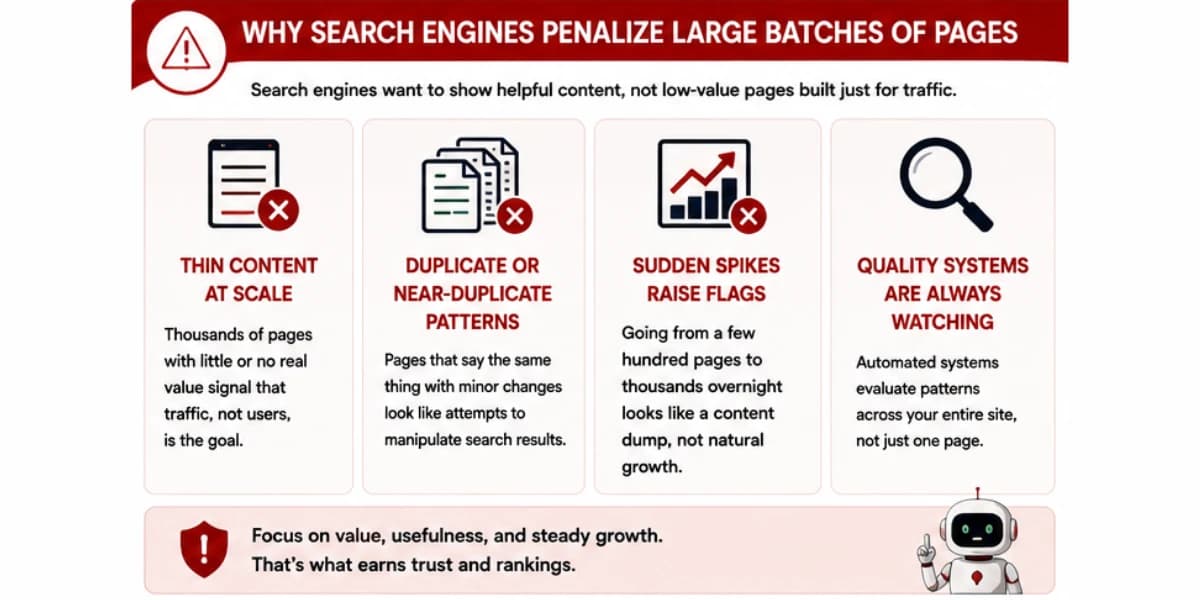
If ten thousand pages all say almost the exact same thing with only a name or number swapped, that pattern gets noticed.
It signals a site trying to fill up search results with copies instead of real, useful pages, and repeated patterns like this are exactly what automated quality systems are designed to catch across a large batch of pages.
A sudden, huge spike in page count can also raise flags on its own.
Search engines are cautious around sites that jump from a few hundred pages to tens of thousands almost overnight, since this pattern often shows up right before a low quality content dump.
A slower, steadier growth curve tells a very different story to a search engine watching your site over time.
None of this means large sites are unsafe. It means large sites need to prove, page after page, that they deserve to exist.
Search engines reward genuine effort and real value at scale. They punish shortcuts and empty pages at scale.
Real Difference Between Safe Large Sites & Risky Ones
A safe large site and a risky large site can look almost identical from the outside, at least at a glance.
The real difference sits underneath, in the quality of the data, the design of the pages, and the care taken during the build process.
Two sites might both show ten thousand pages in a crawl report, yet one earns steady traffic for years while the other quietly fades or gets pushed down in rankings within months.
A safe site answers a real question on every single page. Even if the page follows a shared template, the actual content inside genuinely helps the person who lands on it.
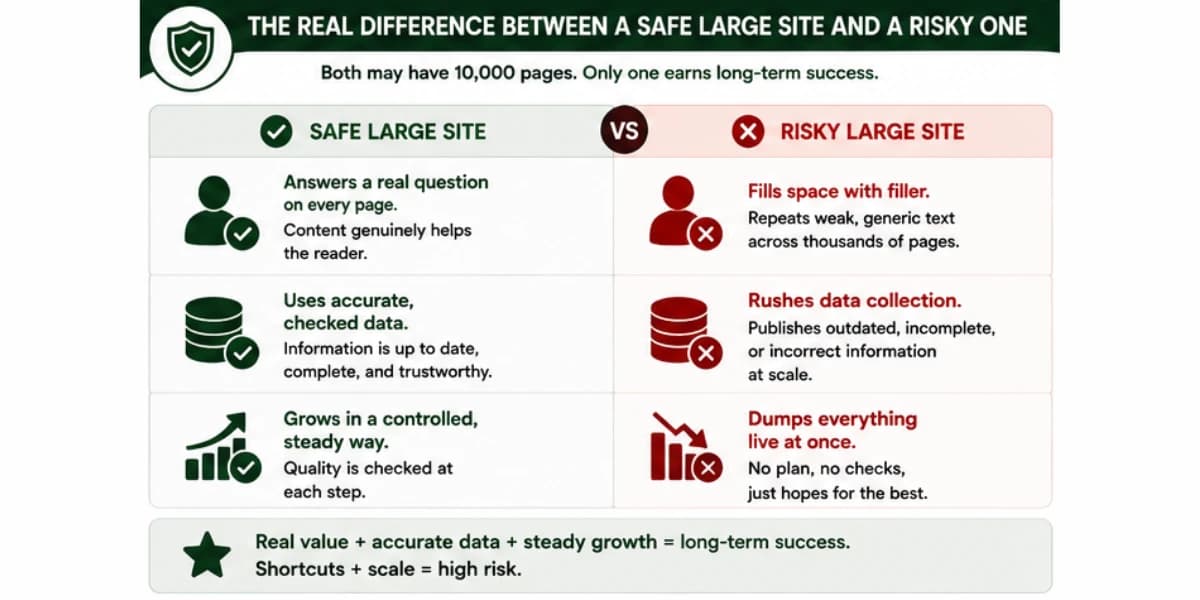
A risky site fills space with filler text and repeats the same weak sentence structure across thousands of pages with almost nothing real changing beneath the surface.
A safe site uses accurate, checked data. A risky site rushes data collection, publishing pages built on outdated numbers, missing details, or plain mistakes that repeat across the whole batch.
A safe site grows in a controlled, steady way, checking quality along the path.
A risky site dumps everything live at once, hoping for the best, with no real plan for catching problems before they spread.
If you are still early in the planning stage, our guide on programmatic SEO explains how large batches of pages fit into a broader scale strategy.
Step One: Confirm Real Demand Before You Build Anything
The very first step toward a safe ten thousand page project is making sure real people really search for this kind of content.
Building pages nobody wants is a waste of effort even before you consider any penalty risk.
Skipping this check is a bit like building a huge store before checking if anyone lives nearby who would ever walk through the door.
Pick a sample of fifty or so page ideas from your planned topic and check real search volume for each one using a keyword tool.
If most of these sample topics show little to no search interest, the whole project might need a rethink before you invest more time.
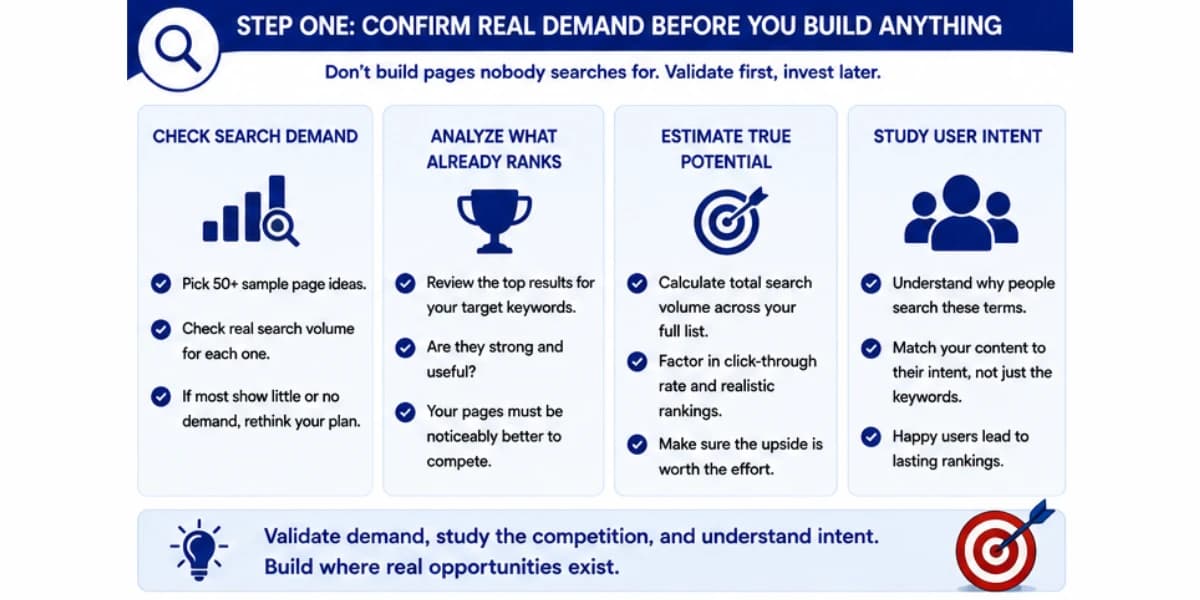
Check what already ranks for a handful of your target keywords.
If the current top results are strong, detailed, and genuinely useful, your planned pages need a real plan for standing out, not just existing.
Estimate the true page count your data can support with real, solid detail behind every entry.
It is far better to plan for six thousand strong pages than to force ten thousand where a third of them are thin because the data simply was not there.
For a deeper look at validating topics before you build content, see our article on how to do keyword research for affiliate blog posts.
Step Two: Build Your Data Foundation Carefully
Weak data is the root cause behind most large scale penalty problems. Getting this piece right protects everything you build on top of it.
Every single mistake you allow into your source spreadsheet has the potential to repeat itself thousands of times over, which is exactly why this stage deserves more caution than any other part of the process.
Gather your data from reliable sources and check it closely before moving forward.
A single wrong number in your source spreadsheet can turn into thousands of wrong pages once it gets copied across your whole batch.
Fill in as many real details as possible for each entry. A row with just a name and one number will always produce a thinner page than a row with five or six specific, useful facts.
Spend real time enriching thin rows before they ever reach your template.
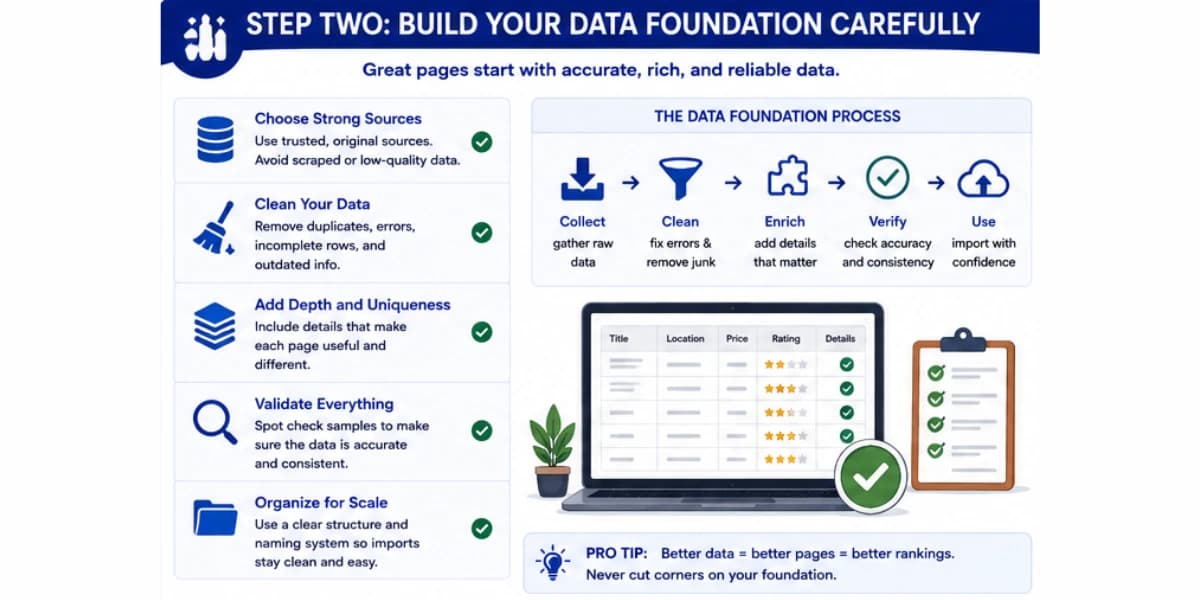
Remove or set aside entries that are too incomplete to support a genuinely useful page.
Publishing every single row just to hit a bigger total page count is exactly the kind of shortcut that leads to trouble later.
A smaller batch of strong pages beats a bigger batch padded with weak ones.
Keep your data organized in a clean, consistent format.
Mixed formats, inconsistent naming, and scattered spreadsheets make every later step harder and increase the chance of small mistakes slipping through unnoticed.
Step Three: Design A Template That Adds Real Value
Your template is the shared skeleton every page in your batch will follow.
A strong template makes the difference between a helpful page and a hollow one, even when both use the exact same underlying data.
Spending extra time here often saves far more time later, since a flawed template forces you to revisit thousands of pages instead of one shared design.
Getting this piece right early saves enormous time later, since every flaw baked into the template gets copied across every single page built from it.
Start by writing down the real question a reader has when they land on this type of page.
Every part of your template should trace back to answering that specific question clearly, not just filling space around the raw data.
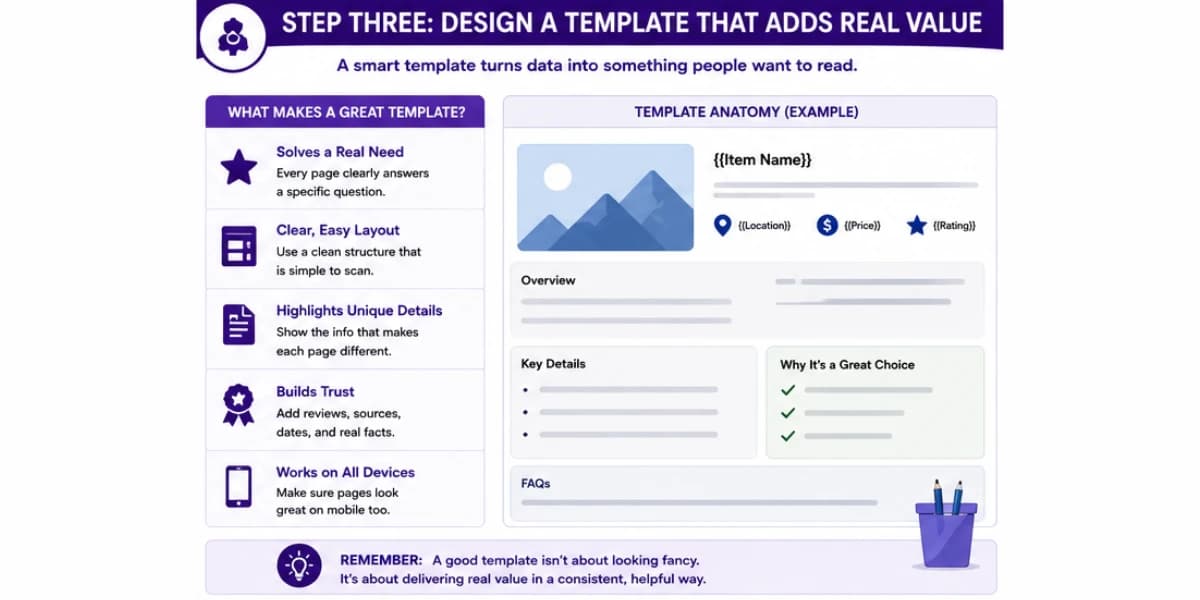
Include a genuine explanation alongside your data, not just the numbers on their own.
A page that pairs a price with a short, useful note about what that price means, or how it compares to similar options, feels far more helpful than a page with bare numbers and nothing else.
Build in spots for real variation between entries, not just a name swap.
Specific local details, specific comparisons, or specific extra facts help each page feel distinct rather than like a copy with one word changed.
Test your template against your weakest data row before finalizing it.
If the page still reads well and feels useful even with your thinnest entry, your template is likely strong enough for the whole batch.
Our article on programmatic SEO using WordPress shows how to turn a well designed template into live pages with a platform most site owners already know.
Step Four: Write Content With Real Care
No matter if you write each page by hand, use AI to help, or mix both approaches, the same core rule applies.
Every page needs enough real, specific substance to justify its own existence.
A page that fails this simple test has no real business being published, no matter how technically correct its template or its formatting turns out to be.
If you are using AI to help generate content, feed it real, specific facts for each entry rather than vague instructions.
Specific input produces specific output. Vague input produces the kind of generic filler that search engines are quick to spot across a large batch.
Vary your sentence structure and wording across pages, even when the underlying facts follow a similar pattern.
Reusing the exact same sentence shape over and over, just with different numbers swapped in, creates the kind of repetitive feel that hurts trust at scale.

Add a small amount of genuinely unique content per page where you can.
A good example might be a specific tip, a specific local detail, or a specific comparison that only applies to that one entry.
Even a short unique paragraph per page adds real weight against a thin content pattern.
Review a real sample of finished pages before scaling up. Read them the way an actual visitor would, not just a quick scan for obvious errors.
Check if the page genuinely feels useful, or if it reads like an empty shell wrapped around a few data points.
If you are generating content at scale with AI, our guide on catching AI hallucinations in SEO content is worth reading before you scale, since a single invented fact repeated across thousands of pages is hard to clean up.
Step Five: Publish In Careful Waves, Not One Giant Dump
Speed feels tempting once your template and data are ready, but publishing everything at once ranks among the riskiest choices in this entire process.
A staged rollout costs a little extra patience, but it buys you the ability to catch and correct mistakes before they touch your entire site.
Start with a small test batch, maybe fifty to one hundred pages. Publish these first and give them a few weeks to settle.
Watch how search engines respond, how many pages really get indexed, and how real visitors interact with them.
If your test batch performs well, expand into a bigger wave, maybe five hundred to a thousand pages.
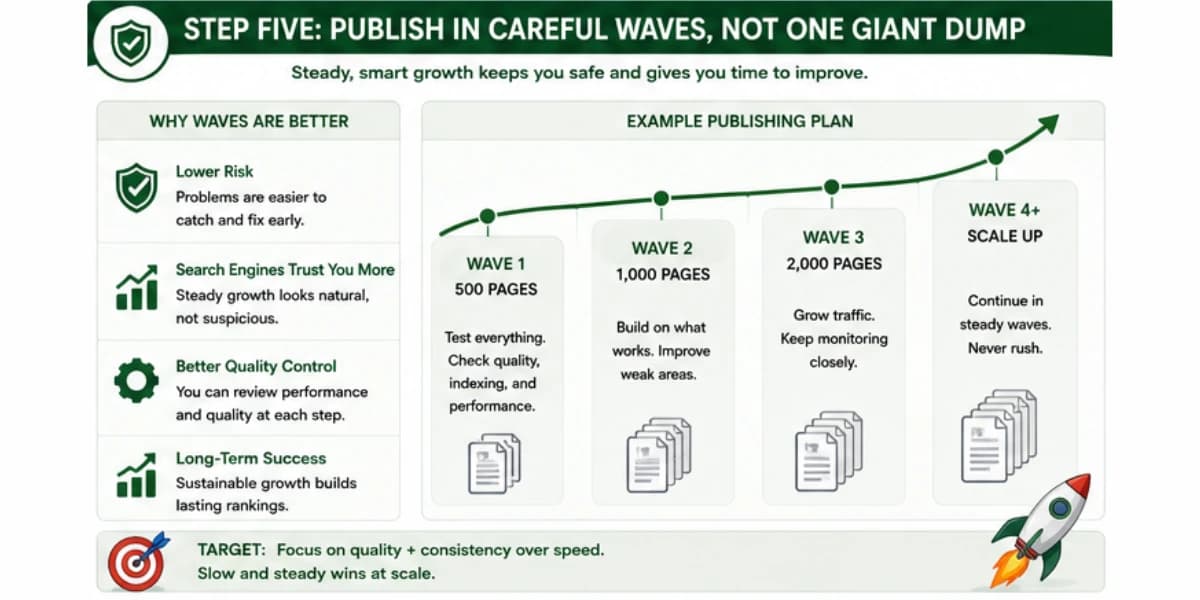
Keep watching results closely at each stage rather than assuming success in the first wave guarantees success at full scale.
Space out your publishing waves over weeks or months rather than dumping everything in a single day.
A steady, controlled growth pattern looks and feels very different to a search engine than a sudden explosion of thousands of brand new pages appearing overnight.
Fix any problems you spot in an early wave before publishing the next one.
If a template flaw or a data mistake shows up in your first batch, correcting it before scaling up saves you from repeating that same mistake across thousands more pages.
Our practical guide on programmatic SEO with AI includes a real workflow for building and publishing batches of pages in controlled stages.
Step Six: Watch For Warning Signs Along The Way
Catching a problem early is far easier than fixing it after it has already spread across a huge batch of live pages.
A few clear warning signs are worth watching closely, and building a habit of checking them regularly protects you from a slow, quiet decline that only becomes obvious once real damage has already been done.
Waiting until the damage is obvious almost always means fixing a much bigger problem than the one you could have caught early.
Watch your indexing rate. If a large share of your new pages never get indexed by a search engine, that is often an early sign the pages are being judged as low value.
A healthy batch usually sees most of its pages indexed within a reasonable window after publishing.
Watch your average ranking position across the batch.
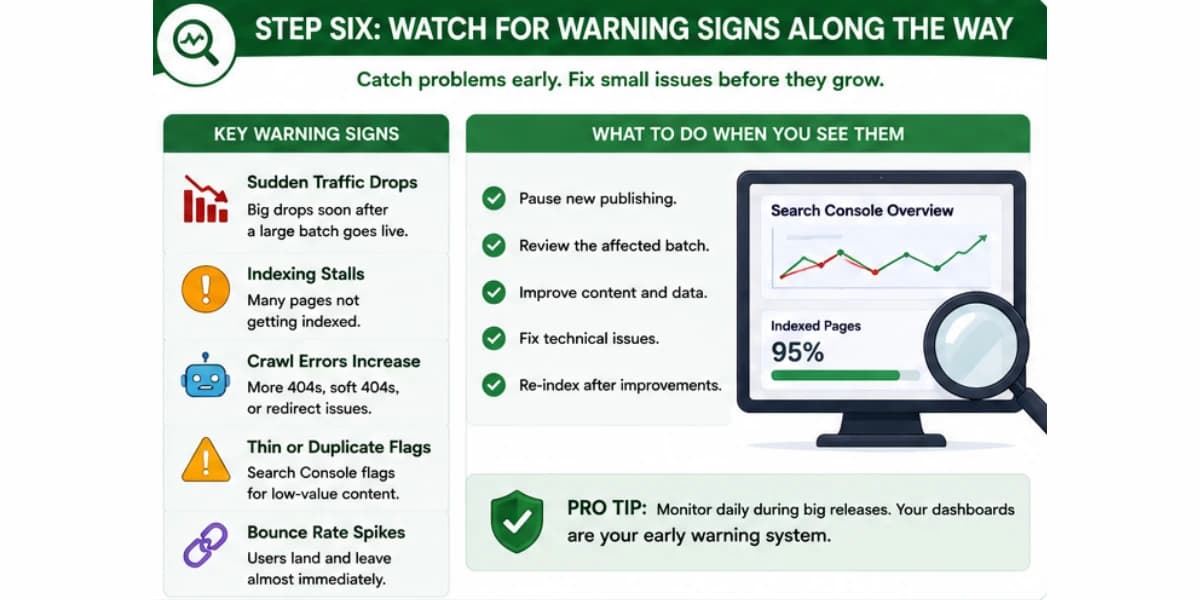
If your pages are indexed but sitting far down in search results with almost no visibility, that can signal the pages are technically live but not viewed as genuinely useful.
Watch your site's overall traffic, not just the new pages. A properly built large batch should add traffic without dragging down your existing, already strong pages.
A drop in traffic to older, previously stable pages after a big new batch goes live is a serious warning sign worth investigating right away.
Watch bounce rate and time on page for a sample of your new pages.
If visitors land and leave almost immediately, that usually means the page is not delivering what the reader expected, even if it technically matches their search.
If you want a quick, structured way to review what is underperforming on a large site, our AI content audit guide explains how to find the weak pages early.
Step Seven: Keep Improving After You Launch
Publishing your batch is not the finish line. A large site needs ongoing care to stay healthy and to keep earning trust over time.
Treating launch day as the end of the project, rather than the beginning of a long term relationship with your content, is a mindset that quietly undermines even the strongest initial rollout.
Refresh your data on a regular schedule. Prices change. Details go out of date.
A page that was accurate on launch day can quietly become wrong and unhelpful months later if nobody goes back to update it.
Remove or improve pages that clearly are not performing, even after giving them a fair amount of time.
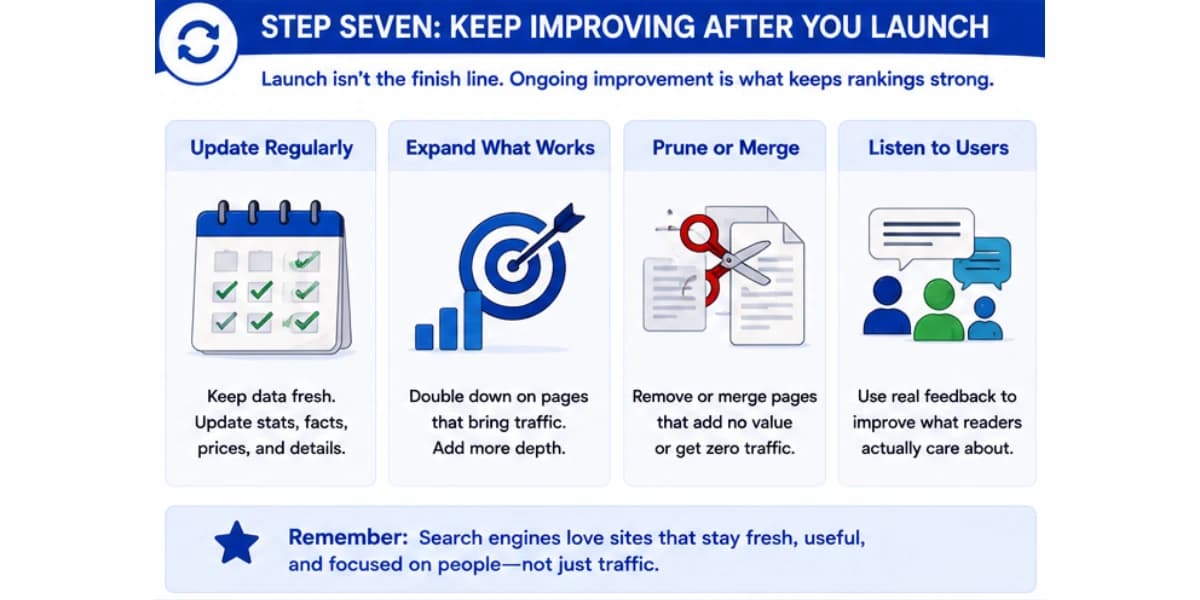
A page sitting with almost no traffic and no ranking after several months might be better trimmed from your site than left as dead weight dragging down your overall quality signals.
Keep adding real, specific improvements to your strongest performing pages.
A page that already ranks reasonably well often responds nicely to small upgrades, like a fresh detail, an updated fact, or a slightly better explanation.
Check your internal links across the whole batch every few months.
As you add new pages over time, make sure older pages link to newer, related ones, and that nothing important sits orphaned with no links pointing to it at all.
For the ongoing upkeep side of large content, our AI content refresh workflow shows how to keep old pages useful and current.
A Real Example Of Getting This Right
Seeing this play out in a real scenario helps tie every step together, so picture a site planning to build ten thousand pages about local moving companies across the country.
The site owner starts by checking search demand for a sample of fifty city pages, confirming most cities show at least some real search volume for moving company searches.
A handful of very small towns show almost no search interest, so those get set aside for now rather than forced into the batch just to hit a bigger number.
Next, the site owner gathers data on moving companies for each city, including names, average prices, service areas, and customer ratings pulled from verified sources.
Cities with very thin data, maybe only one or two companies listed, get flagged for extra research before they qualify for the full batch.
The template gets built around a real reader question, specifically which moving company should I choose in my city.
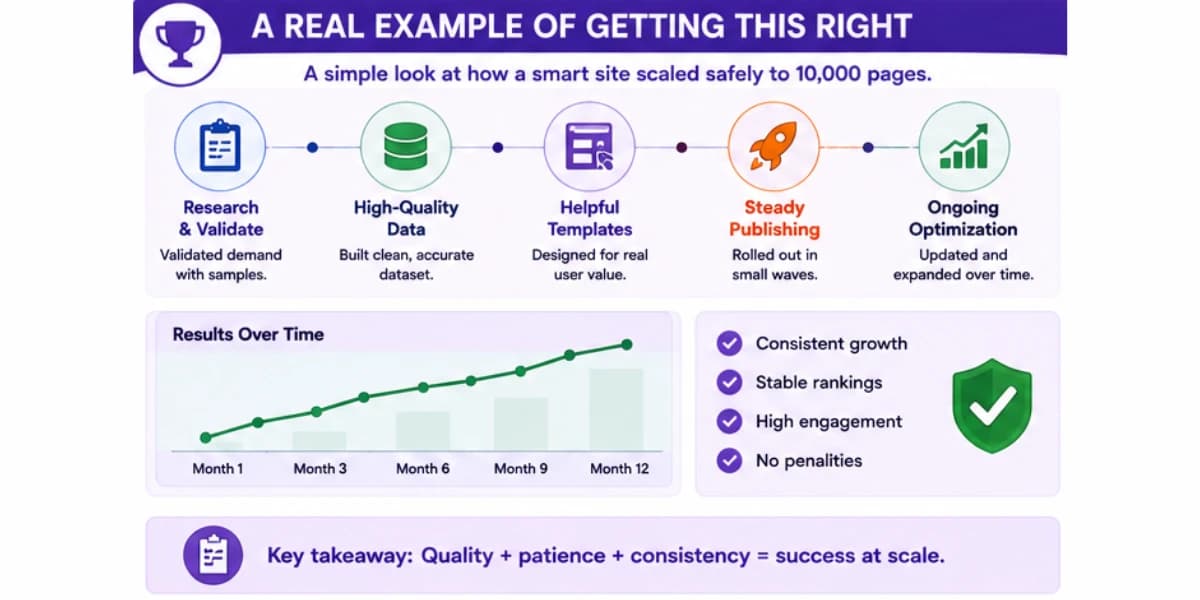
It includes a short paragraph explaining local pricing trends, a table comparing top companies, and a closing section with practical moving tips specific to that city's climate and housing type.
The first wave publishes six hundred city pages, the ones with the strongest, richest data. After three weeks, most pages are indexed and early rankings look reasonable.
A small number of pages show weak performance, and a closer look reveals thinner data behind those specific cities.
The site owner goes back, strengthens that data, and republishes those pages before moving to the next wave.
Over the following four months, the site owner publishes several more waves, watching indexing rates and traffic at each stage.
By the time the full ten thousand pages are live, the site has a track record of steady, controlled growth rather than one risky, sudden jump, and the vast majority of pages carry real, checked, useful information.
Technical Setup Considerations For A Large Batch
Beyond content quality, a handful of technical details matter a great deal once you are dealing with a batch this large.
These details are easy to overlook when the focus stays entirely on content, yet a technical misstep at this scale can create just as much damage as a content quality problem.
Make sure your site can really handle the technical load of ten thousand pages without slowing down.
Slow loading pages hurt both user experience and search rankings, so check your hosting and site speed before publishing at full scale, not after readers start complaining.
Build a clean, logical URL structure across your whole batch.
Consistent, readable URLs help both search engines and real visitors understand how your pages relate to each other, especially across a project this large where organization matters more than usual.
Set up your sitemap to reflect your batch accurately, updating it as new waves go live.
A sitemap that lags behind your actual published pages can slow down how quickly search engines discover and index your newest content.
Watch your crawl budget, especially on a very large site.
Search engines only spend so much time crawling any single site, so a site with tens of thousands of pages needs to make sure its most important pages are easy to find and are not buried under low priority or duplicate content competing for the same limited crawl attention.
A well organized site structure helps search engines spend their limited crawl time on the pages that matter most to your business.
Check for accidental duplicate pages created by technical issues, not just content issues.
Things like different URL versions of the same page, or filter combinations that create near identical pages, can quietly multiply your real page count without adding any real value, which creates the exact kind of pattern that raises concern at scale.
When your batch is ready to go live, our free sitemap validator lets you quickly check that your sitemap is clean before new waves get pushed out.
Common Mistakes That Lead To Penalties
A frequent mistake is rushing the data collection stage just to hit a bigger page count faster.
Thin, inaccurate data almost always shows up later as thin, weak pages, no matter how polished your template looks on the surface.
Another common mistake is copying the same sentence structure across every single page with only the smallest details changed.
Doing this creates an obvious pattern that both readers and search engines pick up on quickly, even across a batch built from technically accurate data.
Publishing everything in one massive wave, with no smaller test batch first, is a mistake that turns a small, fixable problem into a huge, site-wide one.
A flaw caught in fifty pages takes minutes to fix. The same flaw discovered across ten thousand live pages can take weeks to properly clean up.
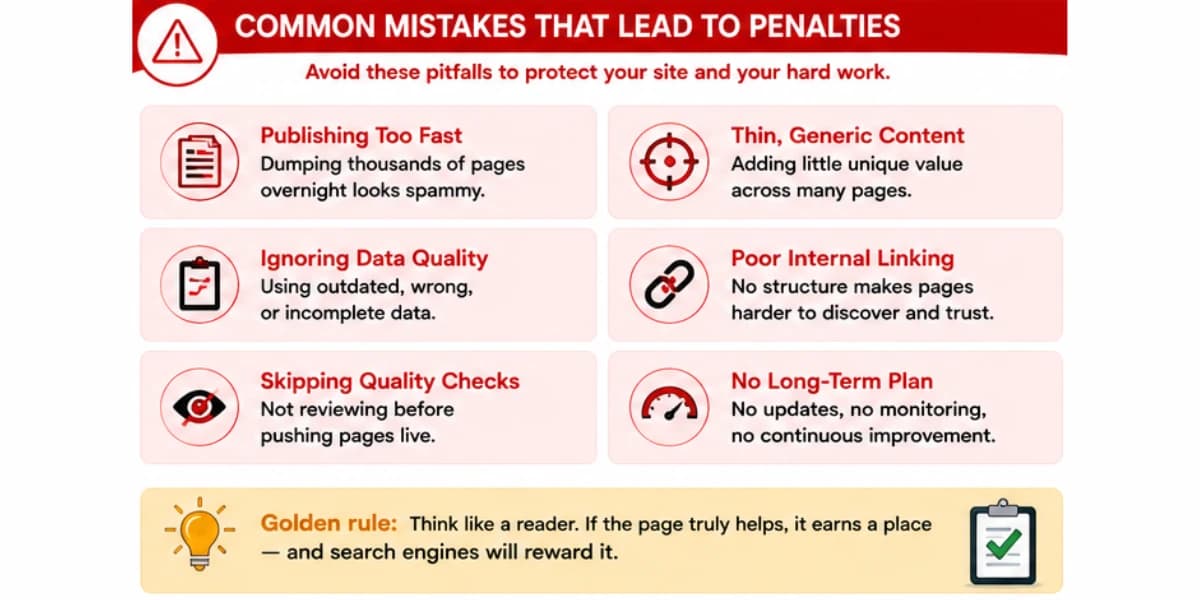
Ignoring early warning signs, like poor indexing rates or falling traffic on older pages, is another serious mistake.
Site owners sometimes push forward with more waves of publishing even as clear signals point to a growing problem, hoping things will simply sort themselves out.
They rarely do without direct action.
Neglecting updates after launch quietly damages a large site over time.
Pages that were solid on day one slowly become outdated, and a site full of stale, unmaintained pages loses trust just as surely as a site that launched thin content from the very start.
The end result looks similar either way, even though the two paths that led there feel very different at the time.
How Big Sites That Did This Successfully Operate
Looking at how large, trusted sites handle this process reveals a clear pattern worth copying.
None of them stumbled into success by accident, and studying their approach gives you a real, proven template rather than a guess at what might work.
They almost always start with genuinely strong, verified data, often sourced directly from official records or carefully maintained databases rather than a rushed, secondhand scrape.
Strong data at the foundation makes every later step easier and safer.
They build detailed, thoughtful templates before scaling, often testing and refining the page structure across a small group of entries before touching their full data set.
Careful early testing like this catches weaknesses before they become site wide problems.
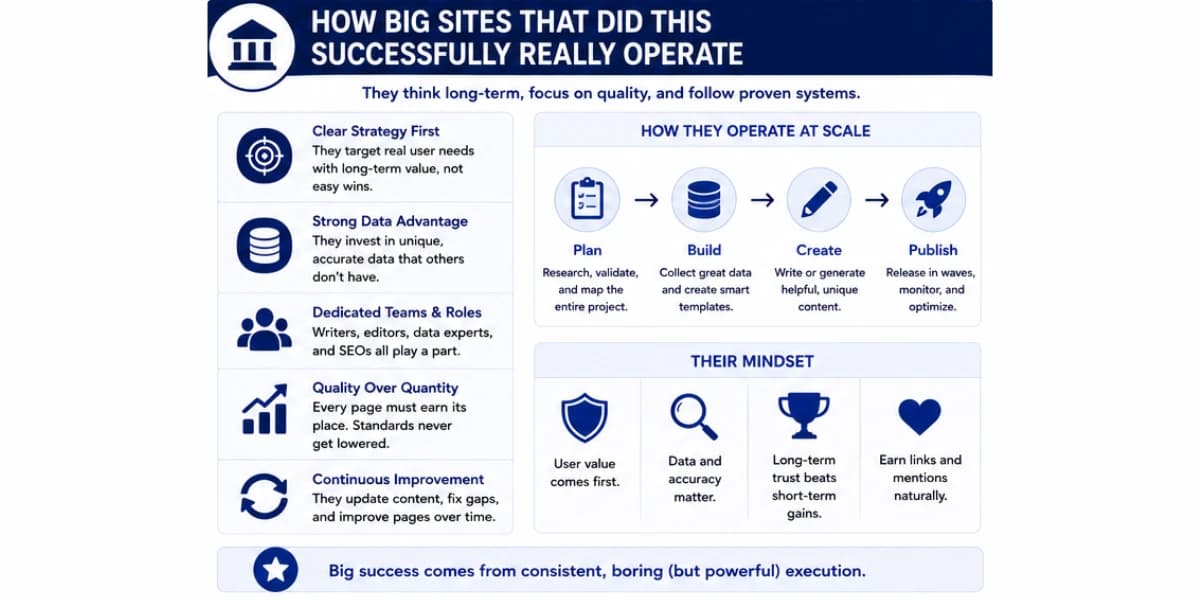
They grow gradually, adding new sections or new batches over months or years rather than dumping everything at once.
That patient pace lets them catch and fix problems early, building trust with search engines step by step instead of hoping for a lucky, sudden jump.
They invest real, ongoing effort into keeping pages updated and accurate long after the initial launch.
Large, successful sites treat their page count as something that needs continued care, not a one time project they can walk away from once it goes live.
Building this kind of steady, organized structure is also central to our guide on building topical authority in a niche, which pairs well with a large scale content project.
What To Do If You Already Have A Penalty
Some readers arrive at this guide after already running into trouble, not before.
If that describes your situation, a different kind of plan applies, one focused on repair rather than building from scratch.
Stop publishing new pages immediately.
Adding more content on top of an existing problem almost never helps and often makes the underlying issue harder to diagnose and fix.
Review your existing batch closely, page by page if needed, to identify the weakest content.
Look for pages with thin data, repetitive wording, or almost no unique value beyond a swapped name or number.
These are usually the pages dragging down trust for the whole group.
Remove or significantly improve the weakest pages first.
Sometimes the fastest path back to health involves cutting a large chunk of low value pages entirely, even if that feels painful after the effort spent creating them.
A smaller, stronger site often recovers faster than one trying to patch every single weak page individually.
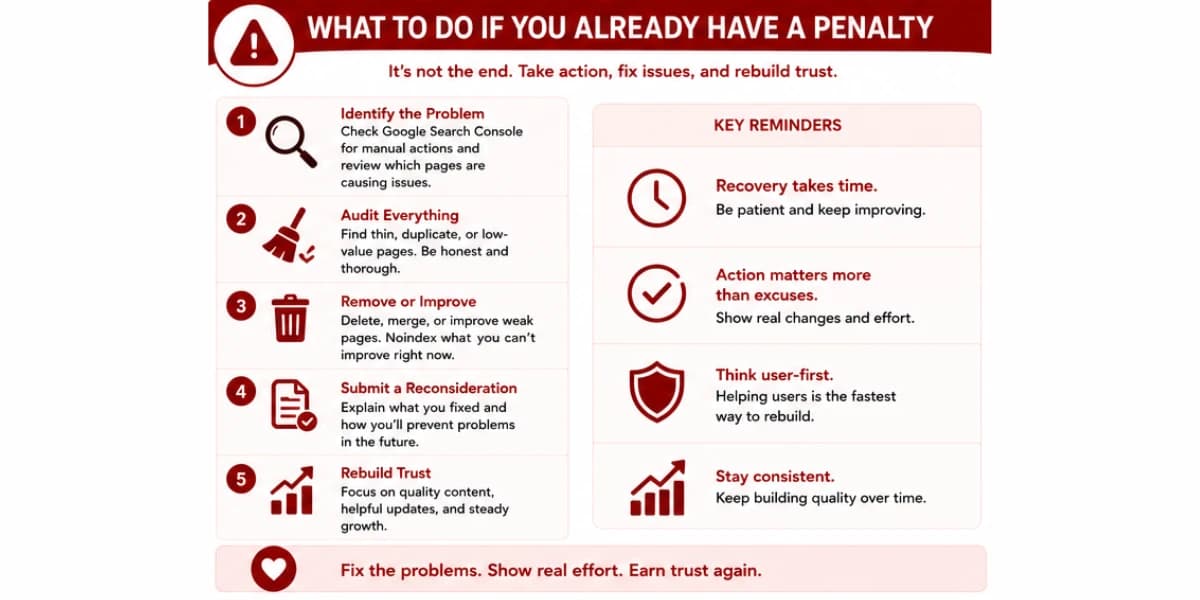
Check for technical duplication issues alongside content issues.
Sometimes what looks like a content quality problem is partly a technical one, like several URLs pointing to what is really the same content, which quietly inflates your page count without adding real value.
Give any changes real time to take effect. Search engines need to recrawl and reassess your site after a cleanup effort, and this process typically takes weeks rather than days.
Patience during this recovery window matters just as much as the cleanup work itself, since rushing to judge the results too early often leads to unnecessary panic or premature further changes.
Once your site shows signs of recovery, like improving indexing rates and stabilizing traffic, resume any new publishing very slowly and carefully, applying every lesson from this guide from the very first new page onward.
Our AI content audit workflow can help you identify which pages on a struggling site are worth keeping versus cutting.
Setting A Realistic Timeline For Your Project
Site owners often underestimate how long a safe, well built ten thousand page project really takes from start to finish, so it helps to set fair expectations from the beginning.
Data gathering and cleaning alone can reasonably take several weeks for a project of this size, especially if your data comes from multiple sources that need to be merged and checked carefully.
Rushing this stage to save time almost always costs more time later, once mistakes start showing up across published pages.
Template design and testing typically takes another week or two, including real review cycles where you read sample pages closely and refine the structure based on what you find.
That stage feels slow compared to the excitement of publishing, but it protects every page that follows.
The publishing and monitoring phase, spread across careful waves, often takes two to six months depending on how large each wave is and how much time you give between waves to properly review results.
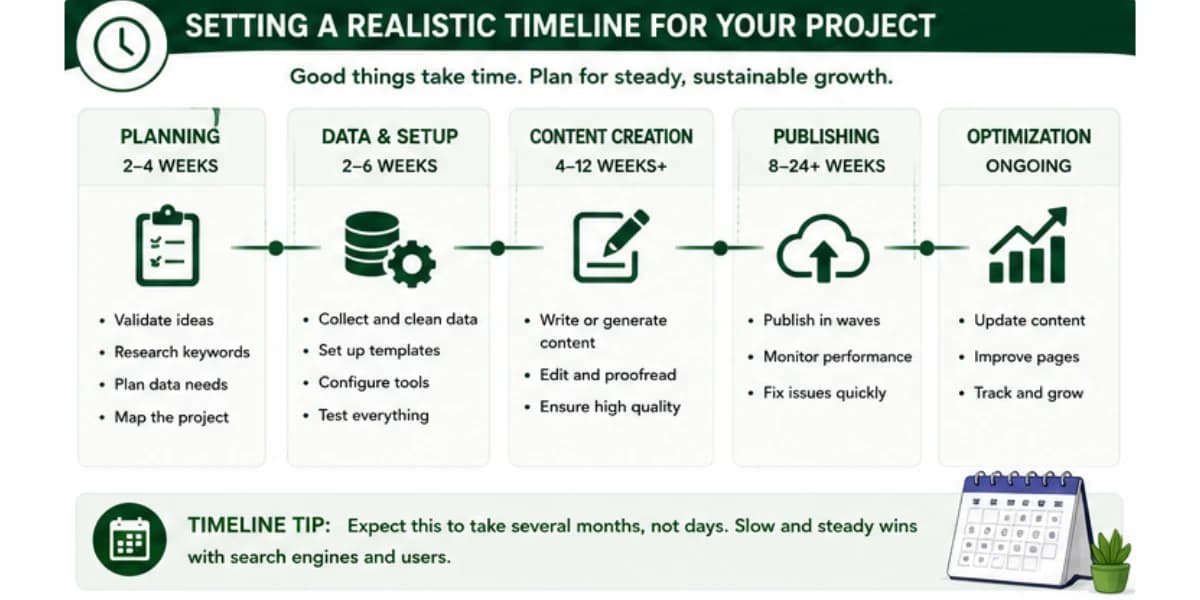
A faster timeline is possible, but it trades away some of the safety that slower, staged growth provides.
Ongoing maintenance never really ends once your batch is live.
Budgeting real, continued time for data refreshes, quality checks, and small improvements keeps your large batch healthy for years rather than just for its first few months.
Adding all of this together, a realistic total timeline for a careful, well executed ten thousand page project often runs somewhere between four and eight months from the very first planning step to a fully published, stable batch.
Projects that try to compress this into just a few weeks tend to be exactly the ones that run into trouble.
A Simple Checklist Before You Scale To Ten Thousand Pages
Before committing to a full ten thousand page rollout, run through a quick, honest self check.
A few minutes spent on this checklist can save weeks of cleanup later if it uncovers a gap you had not fully considered.
Confirm real search demand exists for a solid sample of your planned pages, not just a guess based on how big your data set happens to be.
Confirm your data is accurate, complete, and rich enough to support a genuinely useful page for the vast majority of your entries, not just a technically filled in row.
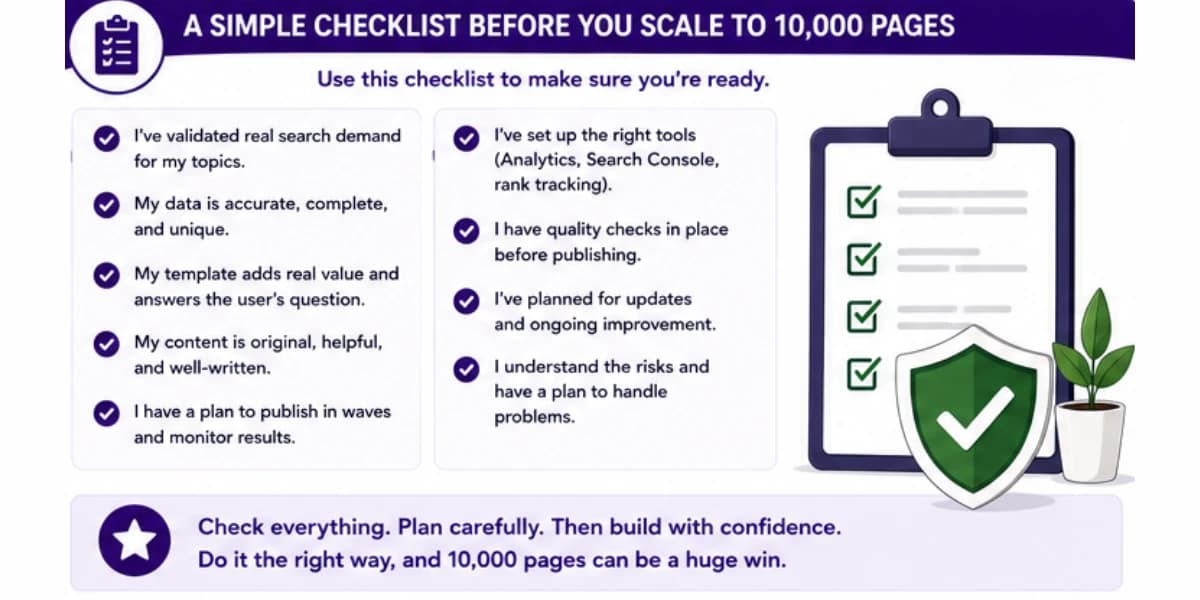
Confirm your template answers a real reader question clearly, and that it still reads well when tested against your weakest data entries.
Confirm you have a clear plan for publishing in smaller waves, with real checkpoints for reviewing quality and performance between each one.
Confirm you have a plan for ongoing updates after launch, since a large site left untouched after publishing tends to decay in quality and trust over time.
If you can answer yes to every point on this list, your project has a strong foundation for growing safely to ten thousand pages and beyond.
Final Thoughts
Building ten thousand pages without getting penalized comes down to treating scale as a responsibility, not just an opportunity.
Strong, accurate data.
A template that genuinely answers a real question.
Careful, staged publishing instead of one giant dump.
Close attention to warning signs along the way.
Ongoing updates after launch instead of walking away once the pages go live.
Follow this path, and a large batch of pages can become among the strongest assets your site has, bringing in steady traffic across thousands of specific searches.
Skip these steps, and that same large batch can just as easily become the reason your whole site loses the trust it took years to build.
The choice, and the outcome, comes down to the care you put into every single page along the way.
None of this requires a massive team or an unlimited budget.
It requires patience, real attention to data quality, and a willingness to slow down at the exact moments when speed feels most tempting.
Site owners who respect that balance tend to build large sites that keep growing steadily for years, while those who chase speed above everything else often end up spending far more time cleaning up problems than they ever saved by rushing in the first place.
Frequently Asked Questions
1. Can a site with ten thousand pages ever be considered spam by default?
No. Page count alone does not determine if a site looks spammy. Search engines evaluate the actual quality and usefulness of each page, not just the total number published. Many trusted, well known sites have far more than ten thousand pages and perform very well, which shows that scale itself is not the problem search engines are trying to solve. The problem shows up only when scale gets paired with weak, thin, or careless content.
2. How fast can I safely grow to ten thousand pages?
There is no single fixed timeline, but spreading growth across several months, with checkpoints along the way, tends to be much safer than trying to publish everything within a few weeks. Watching real performance data at each stage matters more than hitting a specific speed target, and a slower pace that catches problems early almost always beats a faster pace that misses them.
3. Is it safe to use AI to write all ten thousand pages?
AI can genuinely help speed up the writing process, but every page still needs real, checked facts and a real quality review before publishing. Fully unchecked AI content, published at a huge scale with no human review, carries real risk regardless of how good the underlying tool is. The scale of the batch is exactly what turns a small, forgivable AI mistake into a much bigger, harder to fix problem.
4. Which steps should I take if I already published a large batch that seems to be struggling?
Pause further publishing and review your existing pages closely. Check indexing rates, rankings, and traffic on your existing batch. Fix or remove the weakest pages before adding any new ones, since piling more pages on top of an existing problem rarely helps and often makes the underlying issue harder to untangle later.
5. Do all pages in a large batch need to be exactly equal in quality?
Not perfectly equal, but every page needs to clear a real minimum bar of usefulness. A batch where a few pages are excellent and the rest are thin will still struggle, since the weak majority tends to drag down trust for the whole group, even when a handful of top performing pages do beautifully on their own.
6. How do I know if my template is strong enough before scaling up?
Test it against a small, varied sample first, including your richest data entries and your thinnest ones. If the template still produces a genuinely useful page even with weak data, it is likely ready for a larger rollout, and that single test tells you far more than any amount of guessing ever could.
Recommended Resources
Some of the tools and services I trust for large scale content projects are listed below. If you decide to use any of these affiliate links, I may earn a commission at no extra cost to you.
Surfer SEO – Content optimization and on-page scoring
Rank Math – SEO plugin for managing and auditing content
ContentBot – AI writing and content generation at scale
Frase – AI writing assistant and content briefs
Hostinger – Web hosting that can handle a large site
For insights on AI tools that can help with content creation, read our page on AI SEO Agents Explained.