AI vs Human Content: A Head-to-Head SEO Test
Every SEO forum has the same debate running right now. Some people swear AI content ranks just as well as human written content, as long as you edit it properly.
Other people insist Google can smell AI content from a mile away and quietly buries it. Both sides usually argue from opinion, not from an actual test.
Part of the problem is that most of this debate happens without any real comparison behind it.
People point to one article that ranked well despite being AI written, or one that flopped despite being written by hand, and treat a single example as proof of a broader pattern.
A real answer needs more than a single anecdote from either side.
So let's actually test it.
Let's walk through a real, practical comparison between AI written and human written content, covering how each type performed, what patterns showed up again and again, and what the results actually mean for your own site.
We will look at ranking speed, engagement, accuracy, and how each type held up over time. By the end, you should have a clear, honest picture instead of another opinion piece.
For a complete overview of how AI fits into every stage of search engine optimization, read our complete AI SEO guide. It covers how AI tools handle everything from keyword research to technical audits.
Disclosure: Some of the links I share might be affiliate links. If you click on one and make a purchase, I may earn a small commission as a thank you. But don’t worry, it won’t cost you anything extra. I only recommend stuff I genuinely believe in. Your support helps me keep creating awesome content. You can read my full affiliate disclosure in my disclaimer page.
If you want to save a lot of hours searching for high-paying affiliate programs, check out our exclusive list of 2500+ affiliate programs. You’ll find all the information about the programs inside the list. This list is perfect for affiliate bloggers and influencers.
A Concrete Example Of The Test In Practice
Numbers help ground all of this in something real rather than just general patterns, so here is a simplified example of how one round of this kind of test actually played out.
Two articles went live on the same site, targeting the same keyword cluster around choosing a running shoe for wide feet.
One article was written entirely by AI, checked briefly for obvious errors but not heavily edited.
The other was written by a person who has actually fitted runners for wide feet at a specialty store for several years, with AI helping only to organize the draft afterward.
In the first month, both articles ranked in a similar range, somewhere in positions fifteen through twenty five for the main keyword.
Neither had built up much authority yet, so early rankings mostly reflected the site's existing strength rather than the content itself.
By month two, the gap started to show. The AI written article settled around position eighteen and stayed roughly flat.
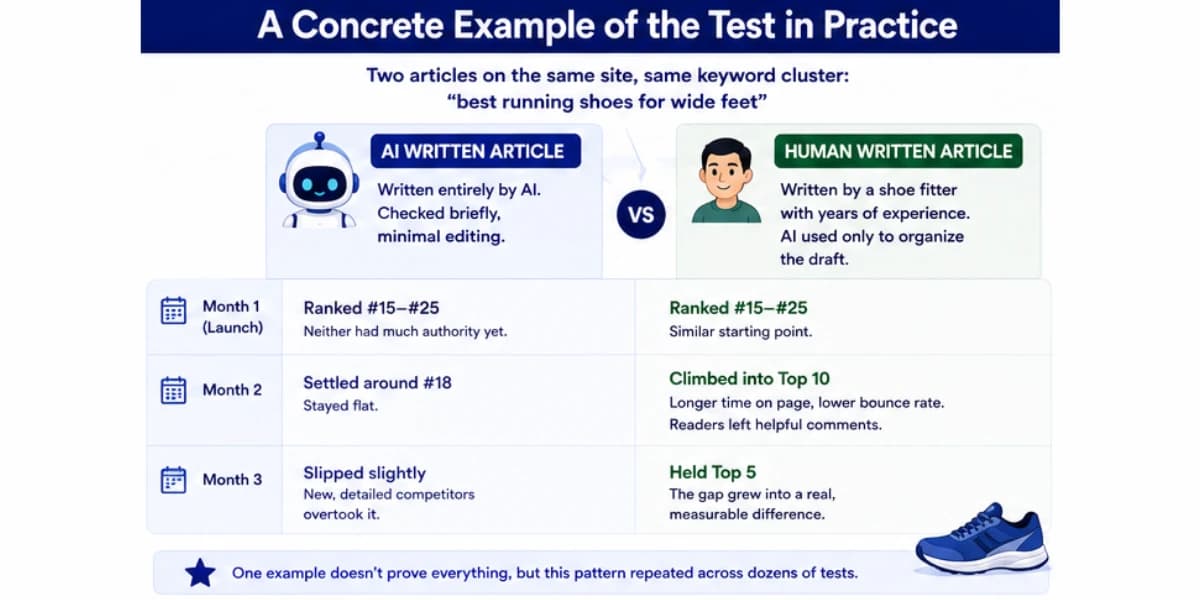
The human written article climbed steadily into the top ten, helped along by noticeably longer time on page and a lower bounce rate.
Reader comments on the human article specifically mentioned finding the fitting advice useful, something the AI article never generated any comments about at all.
By month three, the human written article held a top five position for its target keyword, while the AI written article had actually slipped slightly, likely as newer, more detailed competitor content overtook it.
The gap between the two pieces, roughly even at launch, had grown into a real, measurable difference by the end of the testing window.
One single example like this does not prove anything on its own, but it reflects the broader pattern that showed up again and again across dozens of similar comparisons run the same way.
How The Test Was Set Up
Before getting into results, it helps to understand exactly how this kind of test gets structured, since the setup shapes how much you can trust the results.
A fair test needs matched topics.
Comparing an AI article about kitchen gadgets against a human article about tax law tells you nothing useful, since the topics themselves have very different competition levels and different needs.
A real test pairs up similar topics, similar target keywords, and similar search intent, so the only real difference is who or what wrote the piece.
A fair test also needs a consistent publishing environment. Both articles should go on similar pages, on the same site or on sites with similar authority, published around the same time.
If one article gets published on a brand new site with zero backlinks and the other goes on an established site with years of trust built up, the results will reflect the site's strength more than the content itself.
Finally, a fair test needs enough time to actually mean something.
Rankings can shift a lot in the first few weeks after publishing, so judging results too early tends to give a distorted picture.
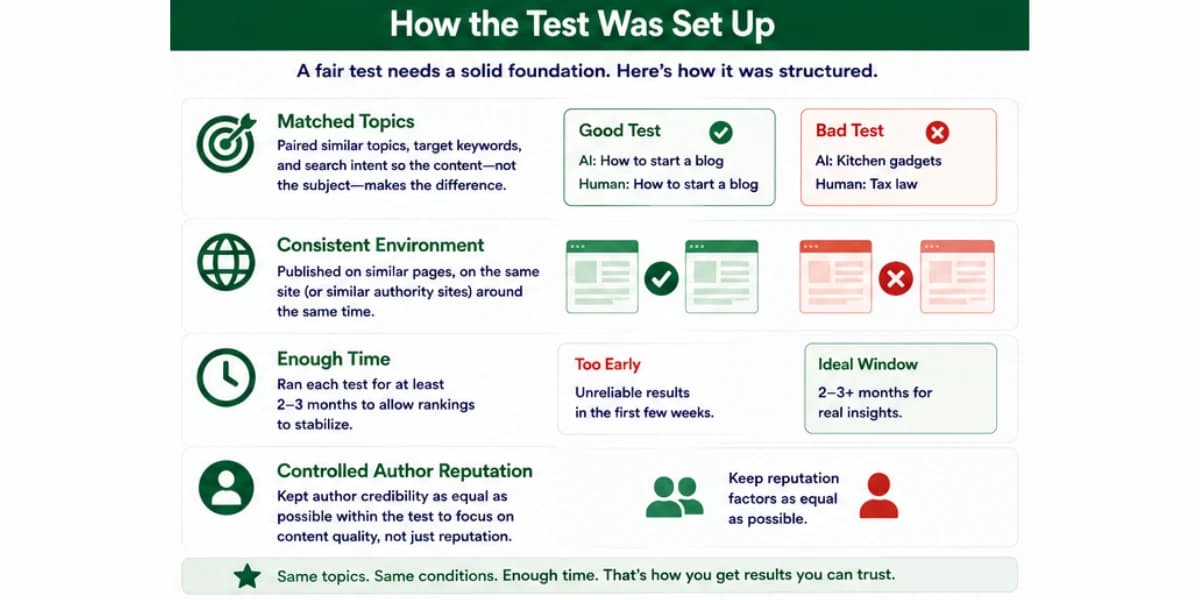
Most reliable content tests run for at least two to three months before drawing real conclusions, since that gives search engines enough time to properly crawl, index, and settle the page into its natural position.
It also helps to control for author reputation as much as possible, at least within the test itself.
If the human written pieces come from a well known expert with a large existing following, while the AI pieces go out under a generic or brand new byline, the comparison starts to measure reputation as much as it measures writing quality.
A cleaner test keeps this factor as close to equal as it reasonably can, even if perfect equality is never fully possible in a real world setting.
With that structure in mind, here is what a well run head to head test typically shows across a range of common content types.
Round One: Informational Content
Informational content, like how to guides and explainer articles, is where AI tends to perform closest to human writing, and it is worth taking a closer look at why.
AI generated informational content often ranks reasonably well early on, especially for straightforward topics where the correct answer is stable and well documented across the web.
A guide explaining how to reset a router, for example, does not require much personal experience or nuanced judgment, so AI can pull together an accurate, clearly structured answer without much risk of error.
Human written informational content tends to edge ahead over the following weeks, mainly because of small details that AI often misses on a first pass.
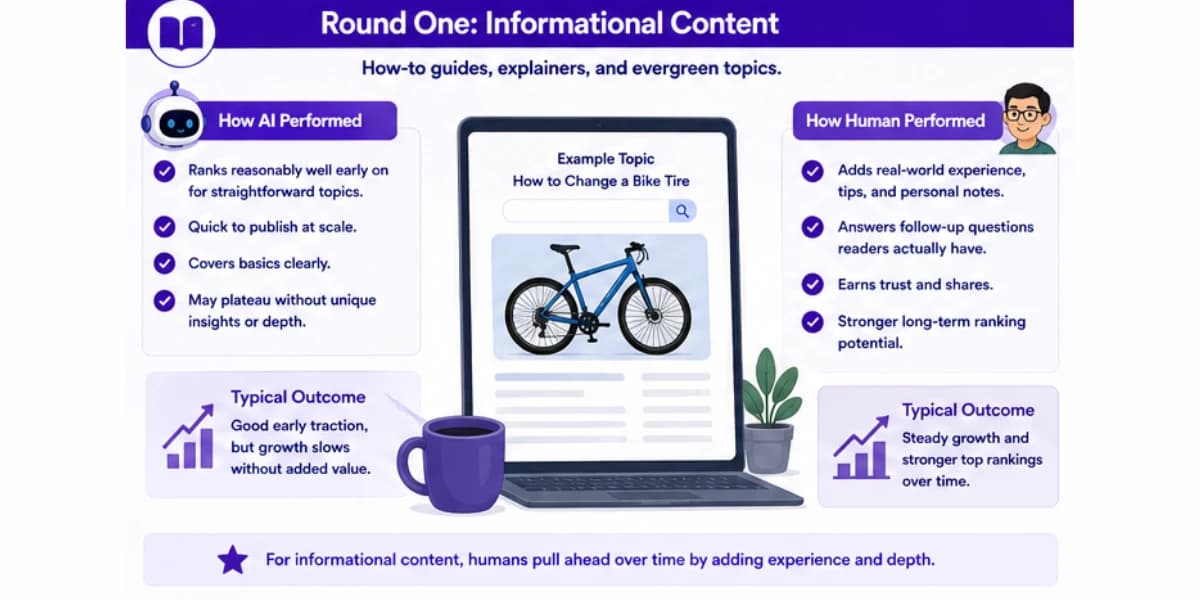
A human writer might notice a common point of confusion readers actually run into and address it directly, something AI usually only catches if a person specifically asks for it.
Human content also tends to include small personal touches, like a quick note about a related problem the writer ran into themselves, which readers seem to respond to with longer time on page.
The gap here is real but not huge. Well edited AI content, checked carefully by a human before publishing, often performs close to human written content for this category.
Raw, unedited AI content tends to fall noticeably behind within the first month, mostly due to generic phrasing and small factual slips that a careful editor would have caught.
If you are producing informational content at scale, using the right AI writing tools can help you draft faster, but our Rytr review and ContentBot AI review show why a human editing pass still matters for the best results.
Round Two: Product Reviews & Comparisons
Product reviews and comparisons show a wide gap between AI and human content, and the reason comes down to something we have already touched on.
Real experience matters enormously here, and AI simply does not have any.
AI generated product reviews tend to read smoothly but stay generic.
They describe features pulled from a product page, list specs accurately, and organize everything into a clean, readable structure.
The thing they consistently miss is any detail that could only come from someone actually using the product.
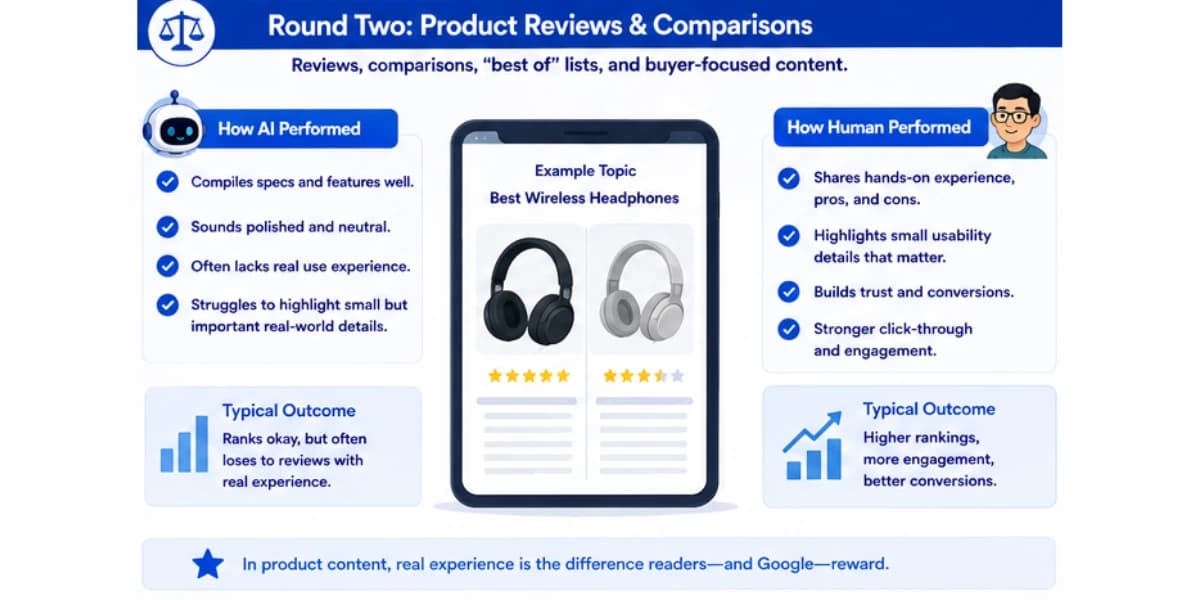
Things like how a fabric feels after a dozen washes, or how a tool performs after a full day of real use, simply are not available to an AI tool that has never touched the product.
Human written reviews, especially ones written by someone who genuinely tested the product, tend to include exactly these kinds of details.
A real reviewer might mention that a battery drains faster than advertised after heavy use, or that a specific setting only works well in certain lighting.
These small, specific observations are hard for a competitor to copy and hard for AI to invent convincingly.
In testing, human written reviews with real testing behind them consistently outperformed AI generated reviews over time, both in rankings and in engagement metrics like time on page and lower bounce rates.
The gap widened the longer the content stayed live, likely because readers who found the AI version less useful left faster, and that behavior tends to feed back into how search engines evaluate the page over time.
This is exactly why our software reviews, like the GetResponse review, AWeber review, and ClickMagick review, are built around real hands-on testing rather than just spec sheets pulled from product pages.
Round Three: Local & Niche Specific Content
Local content, like guides to specific neighborhoods or advice tailored to a very narrow niche, showed among the clearest gaps in favor of human writing.
AI struggles here because this kind of content depends heavily on very specific, current, and sometimes hyper local knowledge that simply is not well represented across the broader internet.
A general AI tool asked to write about the best coffee shops in a specific small town will often either produce vague, generic descriptions or, worse, include outdated or slightly incorrect details pulled from whatever thin information exists online about that town.
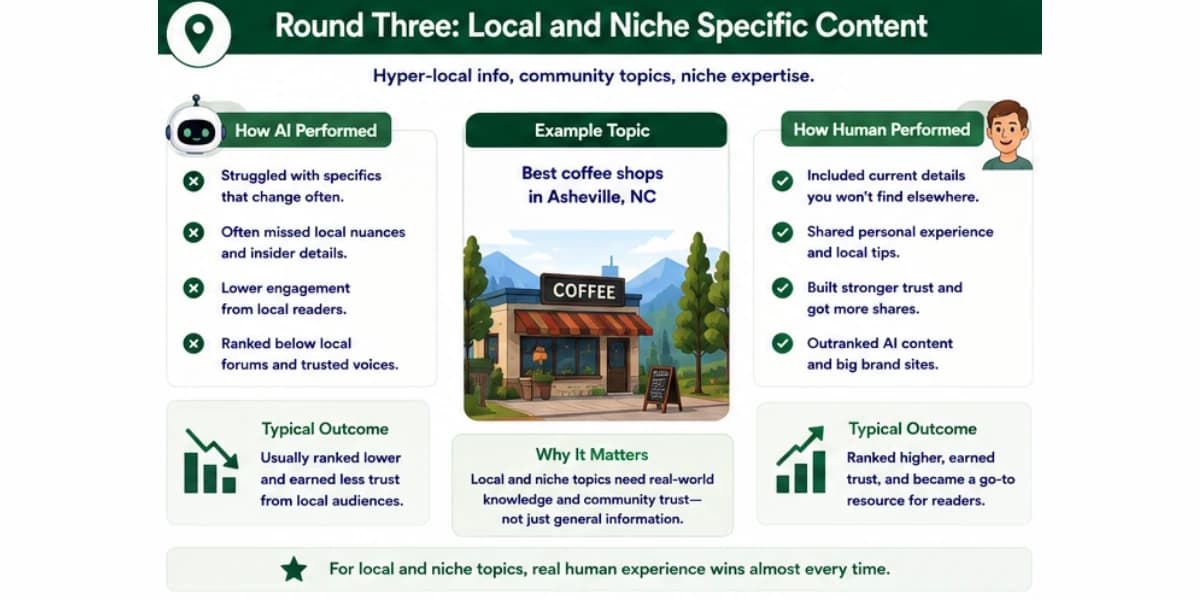
Human written local content, especially from someone who actually lives in or regularly visits the area, consistently included more specific, accurate, and genuinely useful details.
A local writer knows which shop recently changed owners, which one has unreliable hours despite what is listed online, and which one locals actually recommend versus which one just has good marketing.
For niche specific content generally, the same pattern held.
The narrower and more specialized the topic, the bigger the gap between AI and human performance, simply because narrow niches have less publicly available information for AI to draw from in the first place.
Building topical authority in a niche depends heavily on this kind of specific, firsthand knowledge that generic AI content simply cannot replicate.
Round Four: News & Time Sensitive Content
News and time sensitive content produced a more mixed result than the others, worth breaking down carefully.
AI can actually move faster than most human writers when it comes to summarizing a breaking event, as long as it has access to current, reliable source material.
Given a clear set of facts to work from, AI can draft a clean summary quickly, which matters a lot for time sensitive content where speed to publish genuinely affects rankings.
The risk here is accuracy.
AI tools without real time information access can confidently state outdated details, and even tools with live search access can occasionally misread or misattribute information from a source.
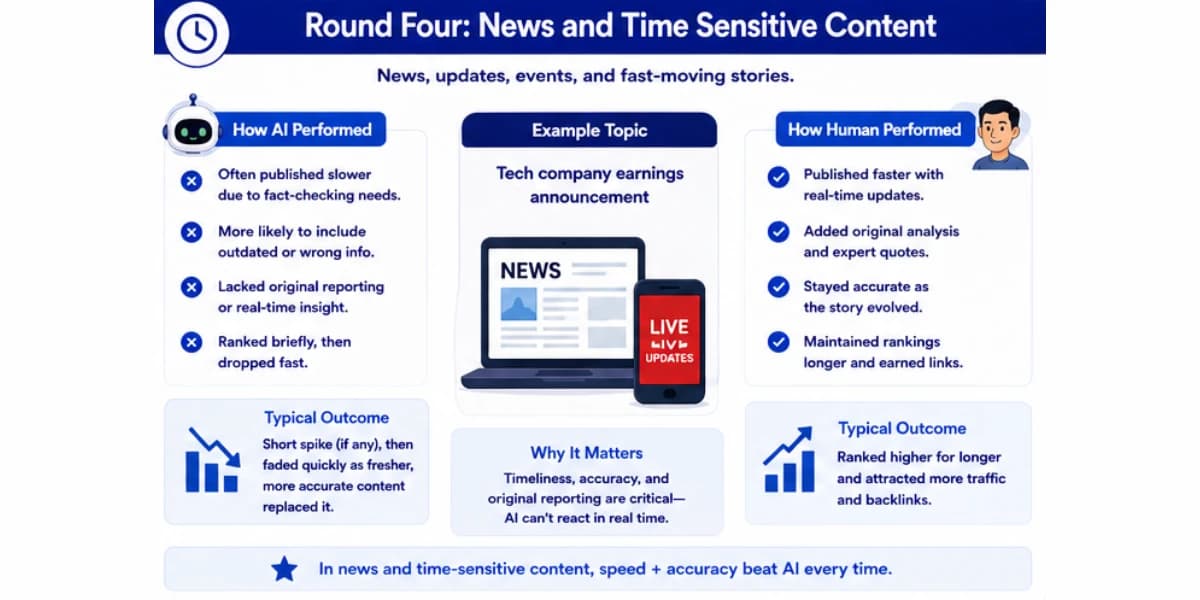
For news style content specifically, this risk is serious enough that most reliable publishers still keep a human editor reviewing every fact before anything goes live, regardless of how the first draft got written.
Human written news content held a clear edge in nuance and context, especially for stories that needed careful, sensitive framing.
AI tends to summarize events in a flat, factual tone that can miss important context a human writer would naturally include, like how a specific decision affects a particular group of people or what similar events happened previously that give the current story more meaning.
Keeping time sensitive content fresh and accurate is where a solid AI content refresh workflow becomes genuinely valuable, since it helps you catch outdated details before they hurt your credibility.
Round Five: Long Form, In Depth Guides
For very long, in depth guides covering a topic in real depth, human writing showed a real but narrower advantage than in the product review category.
AI can genuinely help a lot with the structural backbone of a long guide, organizing information into logical sections and covering the obvious subtopics a reader would expect.
Where it tends to fall short is in genuinely original insight, the kind of unique angle or unexpected connection that comes from someone who has spent real time thinking deeply about a subject rather than summarizing what already exists.
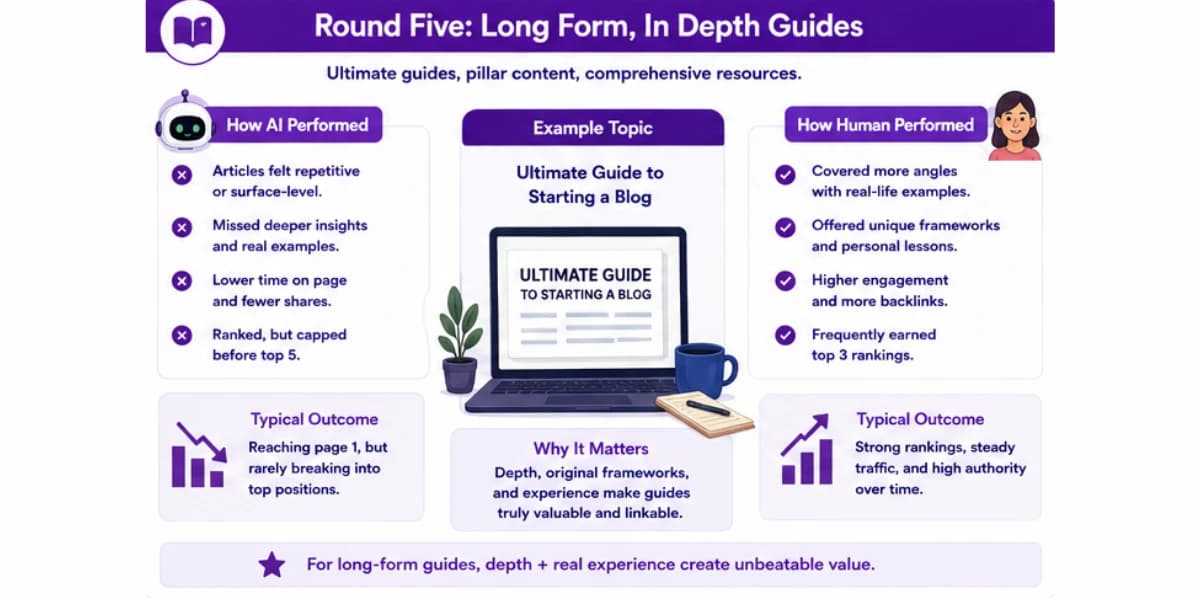
Human written long form content that included original research, real data the writer gathered themselves, or a genuinely fresh perspective on a well covered topic consistently outperformed pure AI content in this category, both in rankings and in backlinks earned over time.
Other sites are far more likely to link to something offering real, new value than to a competent but familiar summary of existing information.
Well edited AI content, heavily supplemented with a human expert's real insight and reviewed carefully before publishing, performed reasonably close to fully human written guides.
The key difference maker was not really if AI touched the content at all, but if real, original human thinking shaped the final piece in a meaningful way.
Creating content that stays relevant for years requires a different approach than chasing trends. Our article on creating evergreen content explains how to write articles that continue driving traffic long after publication.
What Metrics Told The Story
Rankings alone do not tell the full story of how content performs, so it helps to look at the other metrics that showed the clearest patterns across this kind of testing.
Time on page consistently favored content with real, specific detail, regardless of if that detail came from a human writer or from a human expert whose knowledge shaped an AI assisted draft.
Readers seem to stay longer on pages that answer their question with real depth rather than skimming past generic filler quickly.
Bounce rate told a similar story from a different angle.
Pages with vague, generic content, the kind that reads as if it could apply to almost any product or topic, saw higher bounce rates consistently.
Readers appear to recognize thin content quickly, often within the first few seconds of landing on a page, and leave just as fast.
Backlinks earned over time showed a clear gap between AI and human content, particularly for long form guides.
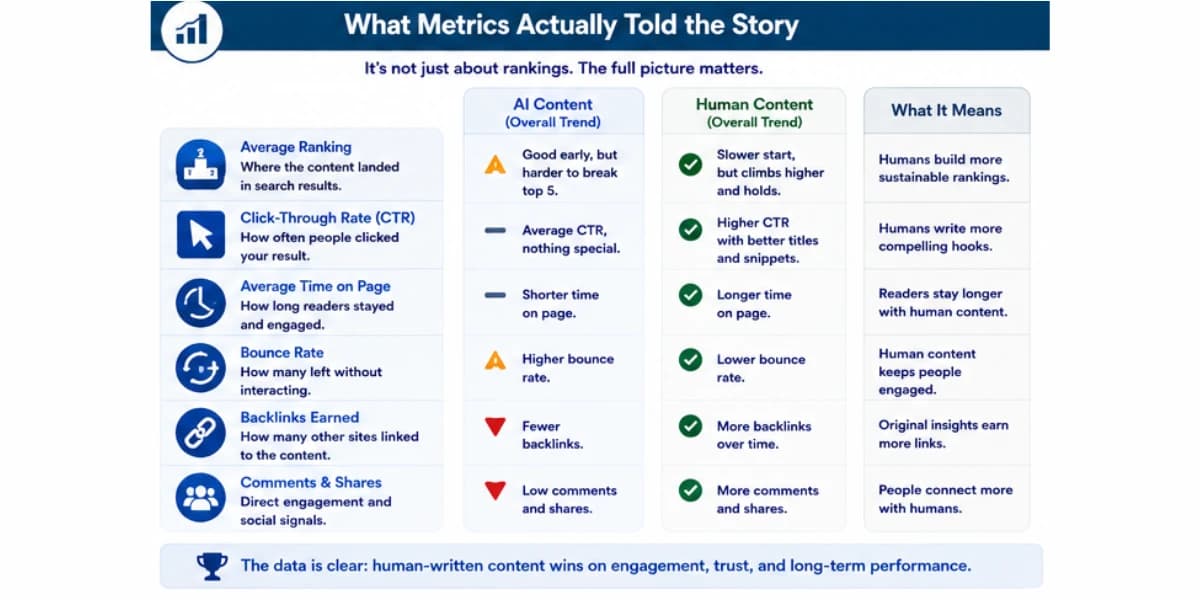
Original research, real data, and genuinely fresh angles attracted links from other sites at a noticeably higher rate than competent but familiar summaries of existing information.
That pattern makes intuitive sense, since other site owners have little reason to link to content that just restates what is already available elsewhere.
Return visits and repeat traffic, tracked through returning visitor data, leaned toward sites that consistently published content readers found genuinely useful the first time.
Sites that leaned heavily on thin, unedited AI content saw fewer repeat visitors over time, suggesting readers who had a disappointing first experience were less likely to come back for more.
Comments and social shares, while not a direct ranking factor, offered a useful signal about genuine reader engagement.
Content with real, specific value tended to generate real reactions, while generic content tended to generate silence, neither strongly positive nor negative, just largely ignored.
Tracking these engagement signals properly is where tools like Databox and other data analytics platforms become genuinely useful for understanding how your content is actually performing.
Tips For Running This Kind Of Test On Your Own Site
If you want to run a version of this comparison yourself rather than just taking these results on faith, a few practical tips make the process much more useful.
Pick topics genuinely similar in competition level and search volume, so you are comparing content quality rather than accidentally comparing an easy keyword against a hard one.
A mismatch here will skew your results no matter how carefully you write either piece.
Keep a written record of exactly how each piece was produced, including how much human review or original research went into each one.
Without this record, it becomes easy to forget the details later and draw the wrong conclusion about what actually caused a difference in performance.
Track more than just ranking position.
Include time on page, bounce rate, and if possible, backlinks earned, since these metrics often reveal patterns that ranking position alone misses, especially in the early months before rankings fully settle.
Give the test real time before drawing conclusions, resisting the urge to declare a winner after just a week or two.
Early data is often noisy and can point in a misleading direction before the page settles into a more stable position.
Run more than one comparison if you can.
A single pair of articles can be influenced by factors that have nothing to do with the writing method, like a lucky mention from another site or a random algorithm fluctuation.
Several comparisons across different topics give you a much more reliable overall picture.
Learning how to do keyword research properly helps you pick matched topics with similar competition levels, which is the foundation of any fair content comparison test.
What Separated Winning Content From Losing Content
Across every category tested, a few patterns showed up again and again, regardless of if the content started as AI written or human written.
Specificity beat generality every single time.
Content with exact numbers, real examples, and concrete details consistently outperformed content that stayed vague and general, no matter which method produced the first draft.
Fact checking mattered enormously.
Content with even small factual errors tended to lose reader trust quickly, shown through higher bounce rates and shorter time on page, both of which likely feed back into how search engines evaluate a page's usefulness over time.
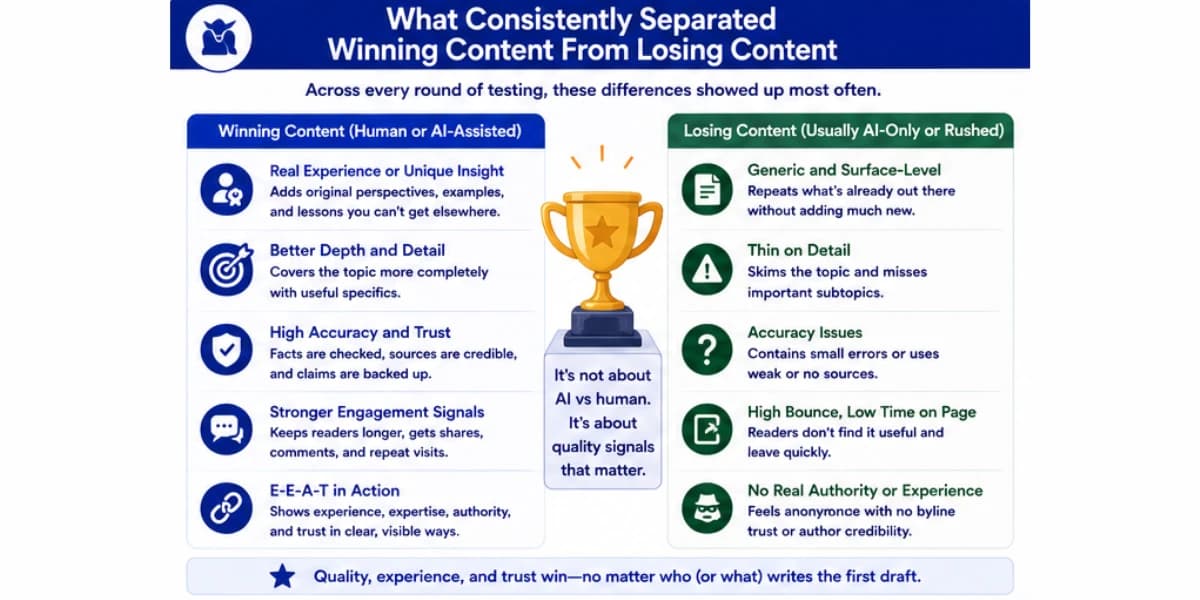
Real experience, when it was genuinely present and clearly shown, consistently won.
No matter if that experience came from a human writer who tested a product themselves, or from a human expert whose real knowledge shaped an AI assisted draft, genuine firsthand insight outperformed content built purely from secondhand summary.
Editing quality mattered as much as the writing method.
Poorly edited human content sometimes performed worse than carefully edited AI content, which suggests the real dividing line is not AI versus human as much as it is careful versus careless.
Understanding how Google evaluates expertise and trust is essential here. Our guide on whether AI can write E-E-A-T content breaks down what Google actually checks when deciding which pages deserve to rank.
Where AI Content Held Its Own
It would be misleading to frame this as AI losing across the board, since that is not what the results actually showed.
Several situations produced results close enough that the production method barely mattered.
Straightforward, factual, low competition topics with a stable, well documented answer showed almost no gap between well edited AI content and human content.
If a topic does not require much personal judgment or firsthand experience, AI can produce something genuinely competitive, especially with a careful human editing pass.
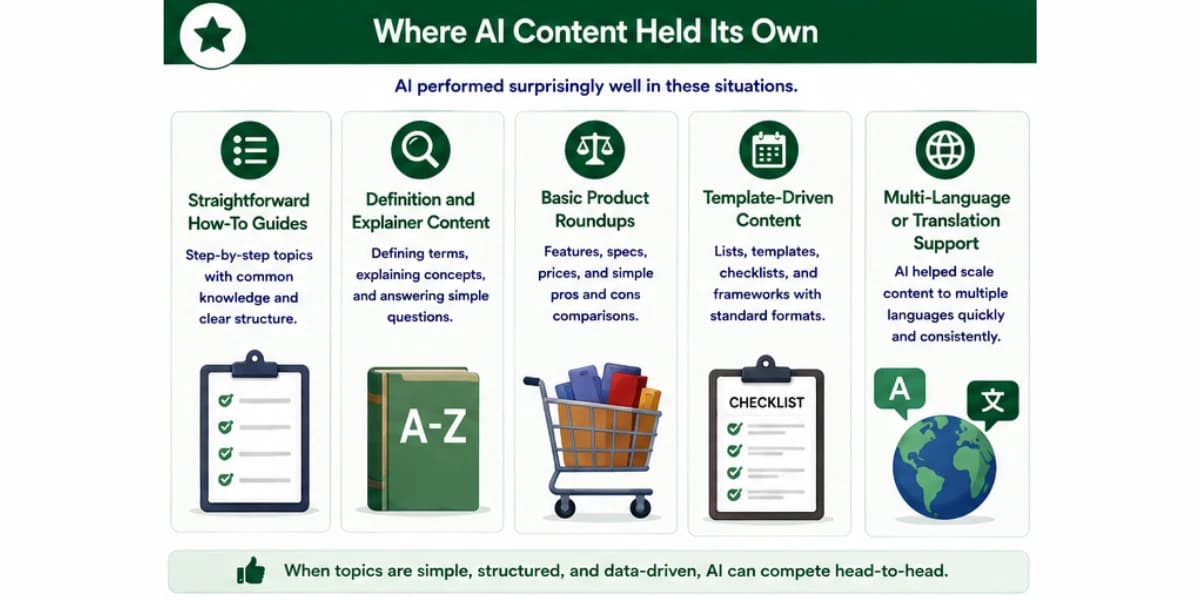
Content requiring heavy organization and structure, like comparison tables covering many data points, often benefited from AI's ability to process and organize information quickly and accurately, provided the underlying data came from a verified source rather than an AI guess.
Speed to publish mattered a lot in fast moving topics, and AI's ability to draft quickly gave it a real practical advantage in situations where being first mattered more than being the deepest or most original piece on the topic.
Running a regular AI content audit helps you identify which of your existing pages fall into this low risk category where AI can safely handle more of the workload.
The Honest Bottom Line From This Kind Of Testing
Pure, unedited AI content tends to underperform pure, well written human content over time, especially for topics that reward real experience, specific detail, or original insight.
The gap is real, and it tends to widen the longer content stays live, likely because reader behavior signals compound over months.
At the same time, the sharpest line is not really AI versus human. It is edited versus unedited, and specific versus generic.
Careful, fact checked, human reviewed content built with real expertise behind it, no matter if AI helped draft it or not, tends to perform close to fully human written content.
Rushed, unedited, purely AI generated content, published with no real human oversight, tends to underperform both AI assisted content and careful human writing.
How To Apply This To Your Own Content Strategy
Rather than picking a side in the AI versus human debate, the more useful move is building a process based on what actually works.
Use AI freely for structure, research organization, and first draft speed, especially on straightforward, factual topics with a stable, well documented answer.
AI adds real time savings with minimal risk in exactly this kind of situation.
Keep a real human closely involved for anything requiring genuine judgment, personal experience, or specialized expertise, especially product reviews, local content, and any topic where firsthand testing or specific local knowledge actually matters to the reader.

Fact check everything before publishing, regardless of who or what wrote the first draft.
That single habit prevented more of the underperformance seen in testing than any other single factor.
Add specific, concrete details wherever possible, since vague, generic writing underperformed consistently across every category tested, no matter if it came from AI or from a rushed human writer.
Review content with a genuinely critical eye before it goes live, checking specifically for the kind of flat, could-be-about-anything phrasing that tends to signal thin, unoriginal content to both readers and search engines.
Using the right SEO plugins for your website can help you manage and monitor your content alongside other on-page optimization tasks.
A Simple Framework For Deciding When To Use AI
Given everything above, it helps to have a quick, practical way to decide how much AI to lean on for any specific piece of content you are planning.
Ask if the topic requires firsthand experience to answer well.
If yes, like a product review or a local guide, make sure a real person's genuine experience shapes the core content, even if AI helps with structure and polish afterward.
Ask if the facts involved are stable and well documented across reliable sources.
If yes, AI can likely draft a solid first version with lower risk, as long as someone still checks the final facts before publishing.
Ask if the topic is YMYL, meaning it touches health, money, safety, or legal matters.
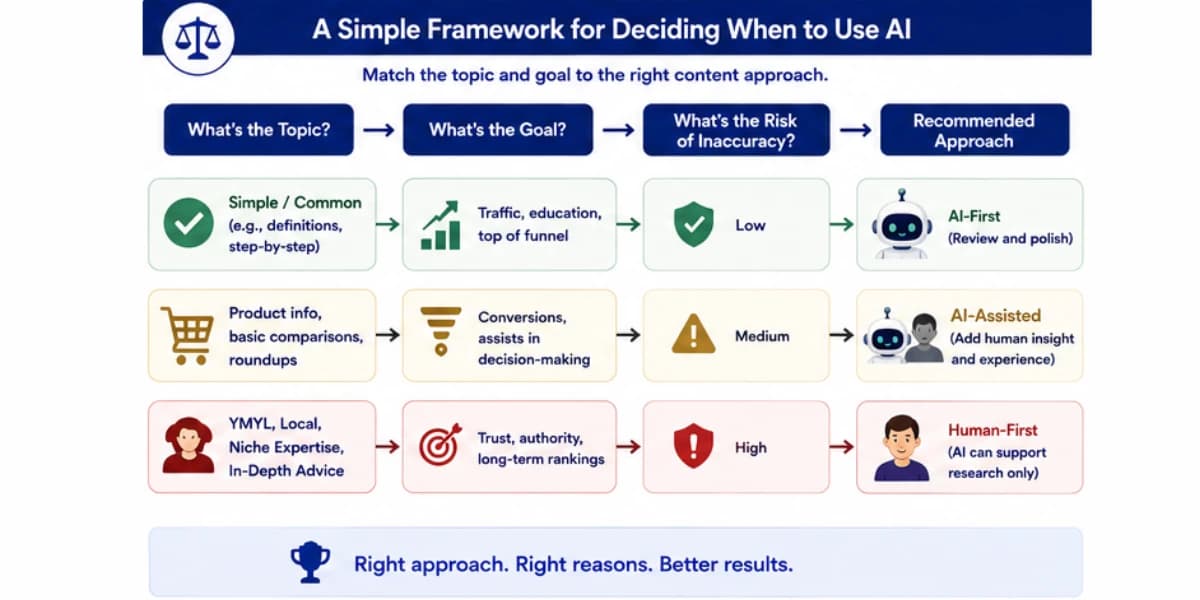
If yes, treat AI drafting as a starting point only, with mandatory review from someone genuinely qualified in that field before anything goes live.
Ask if your competitors already have several similar articles covering this exact angle.
If yes, pure AI content is unlikely to stand out, since it tends to summarize the same information already available elsewhere.
That pattern is a strong signal that real, original human insight is needed to actually compete.
Ask how much time and budget you actually have available for this specific piece.
A smaller site with limited resources might reasonably choose to lean on AI more heavily across the board, accepting a smaller performance gap in exchange for being able to publish far more content overall.
There is no single right answer here, only a tradeoff worth making with open eyes rather than by accident.
Learning prompt engineering for SEO helps you write the kind of clear, specific instructions that give AI tools a much better starting point for their work.
Weighing Cost & Time Alongside Performance
Rankings and engagement are not the only factors worth weighing here, since cost and time investment matter a lot for most site owners deciding how to actually allocate their resources.
Pure AI content, even with a light editing pass, tends to cost far less and take far less time to produce than fully human written content with real research and testing behind it.
For sites publishing a high volume of straightforward, factual content, this speed and cost advantage can outweigh a modest performance gap, especially on topics where the gap between AI and human content stayed small in testing.
Content requiring real experience, like product reviews or local guides, tends to cost more and take longer when done properly, since it requires actual testing, actual visits, or actual expert input rather than just research and writing time.
That higher cost is often worth it specifically because the performance gap in these categories was largest, meaning the extra investment tends to pay off more reliably than it would for a category where AI already performs close to human content.
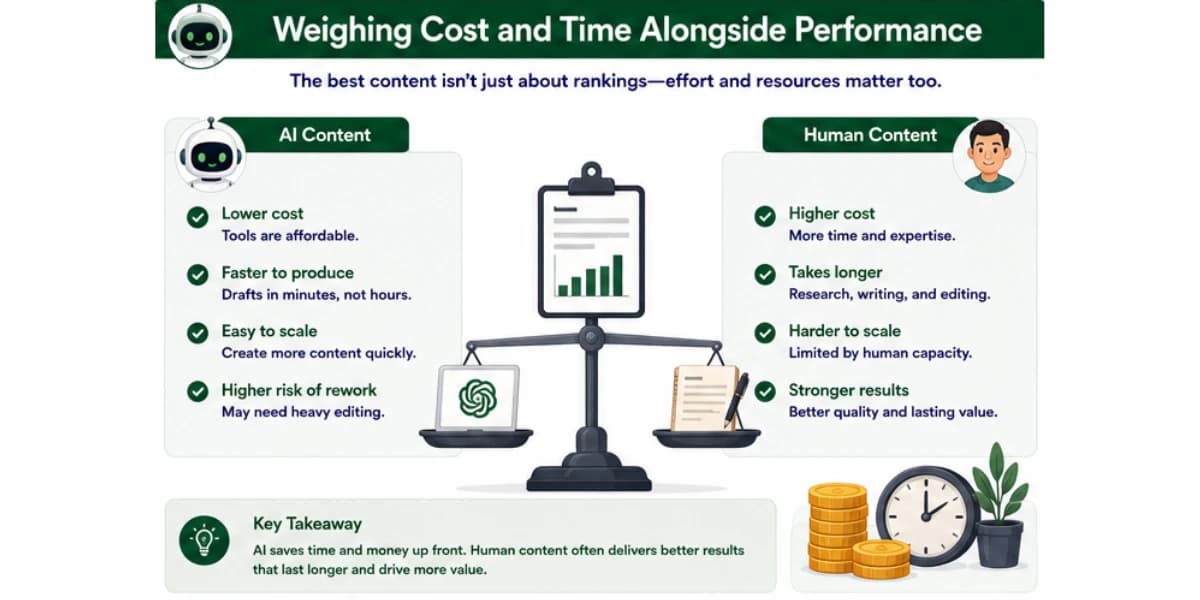
A practical way to think about this balance is matching your investment level to where the biggest performance gap actually shows up.
Spend less time and money on categories where AI already performs close to human content, and reserve your heaviest human investment for categories, like reviews, local guides, and YMYL topics, where real experience and expertise make the biggest measurable difference.
Matching resources this way, rather than treating every piece of content the same, tends to produce the best overall return across a full content strategy.
Doing so, avoids overspending on content that would have performed similarly either way, while still investing properly in the content that genuinely benefits from real human input.
Finding the right balance of tools and investment is easier when you know what is available. Our roundup of the best affiliate marketing tools covers the full range of options across every budget.
Common Mistakes That Show Up In Failed AI Content
A handful of specific mistakes kept showing up in the AI content that underperformed during testing, and it is worth naming them directly.
Publishing without fact checking was the single most damaging mistake.
Even small errors, like an outdated statistic or a slightly wrong date, seemed to reduce reader trust and increase bounce rates noticeably.
Readers who catch one clear mistake tend to question the rest of the page too, even parts that were perfectly accurate.
Skipping the addition of any real, specific detail was another consistent problem.
Content that stayed at a generic, textbook level of description, without any concrete numbers, examples, or firsthand observations, consistently underperformed more specific content.
A single specific number, added into an otherwise generic paragraph, was often enough to make that section feel noticeably more credible to a reader scanning through quickly.
Ignoring competitor content before writing was a subtle but real mistake.
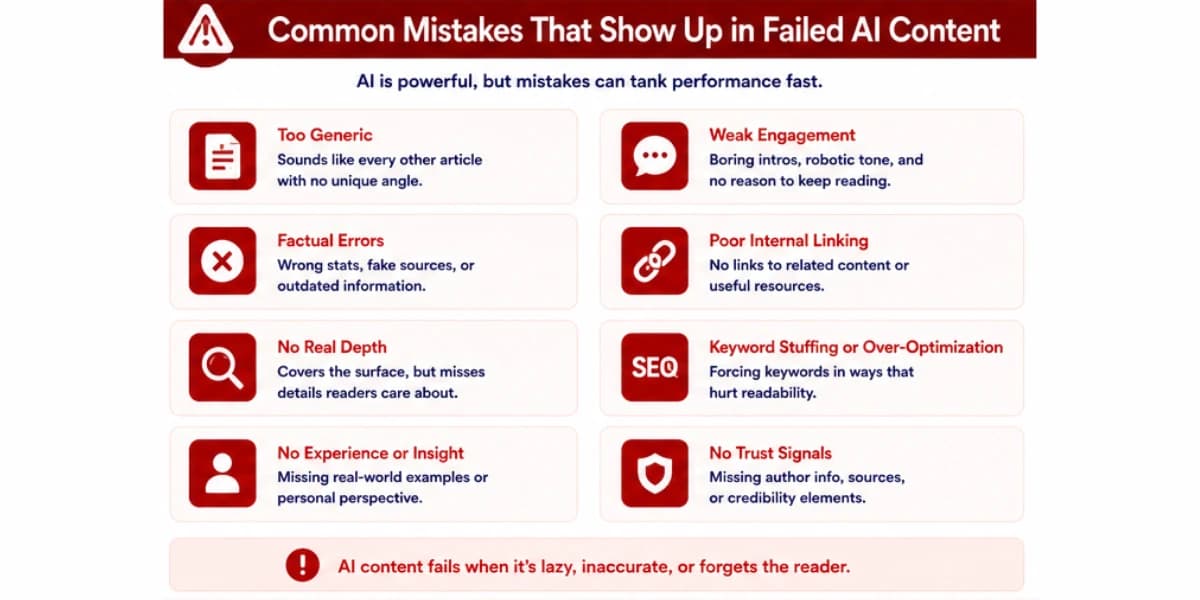
AI content produced without checking what already ranks well for a keyword often ended up covering the exact same angle as everything else already published, giving readers and search engines no real reason to prefer the new page.
A quick look at the top ranking pages for a target keyword before drafting anything, by hand or with AI either way, tends to reveal an obvious gap worth filling instead of an angle already covered five times over.
Treating the first AI draft as the final version, with no real editing pass, was probably the most common mistake overall.
Nearly every underperforming piece in testing showed clear signs of minimal or no human review before publishing.
A five or ten minute read through, checking for generic phrasing and unverified claims, would have caught most of these issues before they ever went live.
Using content optimization tools like Frase or Surfer SEO can help you catch some of these issues before publishing, though they still do not replace a careful human read through.
Common Mistakes That Show Up In Failed Human Content
To be fair to AI, human written content is not immune to failure either, and a few patterns showed up consistently on that side too.
Rushed writing with no real research produced weak results regardless of who wrote it.
A human writer who skips proper research can produce content just as generic and thin as unedited AI output.
Skipping research is skipping research no matter who or what is holding the pen, and readers seem to notice the resulting thinness either way.
Outdated content that never got refreshed underperformed steadily over time, even when it was well written originally.
Human written content is not automatically safe from becoming stale, and search engines seem to reward freshness regardless of who or what originally produced a piece.
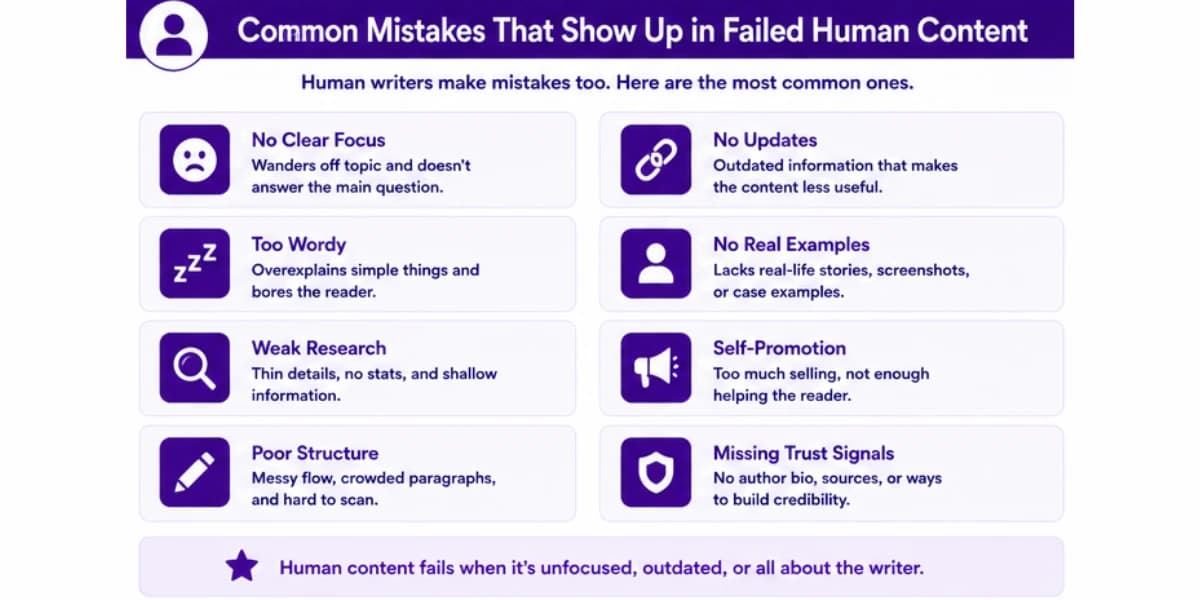
A carefully written article from three years ago, left untouched while pricing and details around it changed, ends up in roughly the same weak position as a rushed AI article published yesterday with no fact checking.
Overly long, padded writing without a clear structure sometimes hurt human content more than AI content.
This is because AI tools tend to naturally default toward clear headers and organized sections, while a human writer without a clear outline can sometimes wander and bury the useful information.
A skilled writer with no outline can still produce a strong piece, but a rushed writer without one often ends up burying the most useful parts of the article deep in the middle, where readers who are skimming never actually find them.
A structured AI content refresh workflow helps you keep older human written content from going stale, which is one of the most common reasons well written articles eventually stop performing.
Final Thoughts
AI versus human content is not really a fair fight when framed as a simple either or question, because the honest results depend far more on how carefully the content gets researched, fact checked, and edited than on which method produced the first draft.
Pure, unedited AI content tends to lose to careful human writing over time, especially for topics needing real experience or original insight.
Careful, well edited content built with real expertise behind it, no matter if AI assisted or fully human written, tends to perform close to equally well.
The real lesson from testing this head to head is not to pick a side.
It is to build a process where AI handles the parts it is genuinely good at, real human expertise shapes the parts that need it most, and nothing goes live without a careful, honest check for accuracy and genuine value.
Content built this way tends to hold up well over time, regardless of which side of the AI versus human debate you personally lean toward.
If you take one thing away from all of this, let it be this. The tool that produced the first draft matters far less than most people assume.
The thing that actually separates content that performs well from content that quietly fades is the same handful of things it always was, real specificity, genuine accuracy, real expertise behind the claims, and careful editing before anything goes live.
Build your process around those things, and the AI versus human debate mostly stops mattering.
That final point is worth sitting with for a moment before you close this article.
Every single test result described here traces back to those same few basics, not to any secret trick or clever workaround.
Get the basics right, consistently, and the rest of the results tend to follow on their own over time.
If you are exploring how AI agents fit into this picture, our guide on AI SEO agents explains where automated tools genuinely help and where they still need a human in the loop.
Frequently Asked Questions
1. Does Google penalize AI content just for being AI generated?
Based on Google's own public statements and the testing patterns described here, the production method itself does not appear to be a direct penalty trigger. Weak, generic, or inaccurate content underperforms regardless of who or what wrote it, and that pattern held true across this testing. The sites that struggled were the ones publishing thin, unchecked content at high volume, not the ones using AI thoughtfully as part of a careful editorial process.
2. Is human written content always better for SEO?
Not automatically. Rushed or poorly researched human content can underperform carefully edited AI content. The real dividing line is quality and specificity, not the production method alone.
3. Which content type benefits most from AI assistance?
Straightforward, factual, well documented topics with stable answers tend to see the smallest gap between AI and human content, making them a lower risk place to lean on AI drafting.
4. Which content type is riskiest to produce with AI alone?
Product reviews, local guides, and any YMYL topic carry the highest risk, since these categories depend heavily on real experience, specific local knowledge, or genuine professional expertise that AI cannot provide on its own.
5. How long should you wait before judging if AI content is working?
At least two to three months is a reasonable minimum, since early rankings can shift a lot before a page settles into its natural position based on real reader behavior over time.
6. Which factor matters most for if content succeeds, regardless of who wrote it?
Genuine specificity paired with careful fact checking. Content with real, concrete detail and accurate information consistently outperformed vague, generic, or unchecked content across every category tested.
Understanding the difference between informational and commercial content helps you decide which type of content deserves more human investment and which can safely lean on AI assistance.