Programmatic SEO vs Traditional Content: Which Wins?
Programmatic SEO and traditional content get compared all the time, and most comparisons pick a side far too fast.
One camp says pages built from a template are the only realistic way to grow a site at scale. The other camp says every page needs a real person behind it or it will never rank.
Both camps hold a piece of the truth, and both leave out something important about how websites really grow.
The answer sits in the middle, and it depends on your data, your budget, your niche, and the hours you can spare each week.
The article below puts both approaches side by side with real numbers, real tradeoffs, and clear answers about where each one pays off.
You will see how each method earns trust with search engines, what each one costs per page, where each one falls apart, and how the strongest sites in almost every niche blend the two together.
You will also get a simple way to measure results on your own site, so the choice stops being a debate and starts being a decision based on your own numbers.
Nobody settles this argument with opinions. Sites win with data, and that data usually points to a mix of both methods instead of one single winner.
Disclosure: Some of the links I share might be affiliate links. If you click on one and make a purchase, I may earn a small commission as a thank you. But don’t worry, it won’t cost you anything extra. I only recommend stuff I genuinely believe in. Your support helps me keep creating awesome content. You can read my full affiliate disclosure in my disclaimer page.
If you want to save a lot of hours searching for high-paying affiliate programs, check out our exclusive list of 2500+ affiliate programs. You’ll find all the information about the programs inside the list. This list is perfect for affiliate bloggers and influencers.
How Each Approach Actually Works
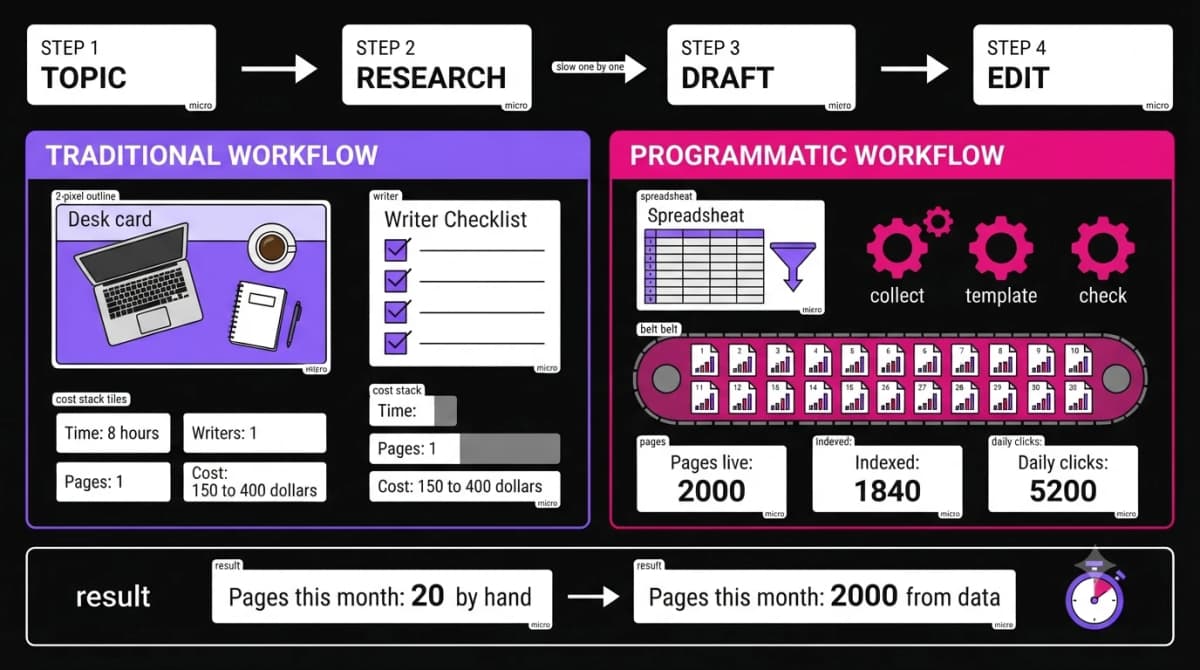
Traditional content starts with a person. Someone picks a topic, studies it, and writes the page from a blank screen, then edits it before it goes live.
Each piece gets its own angle, its own examples, and its own voice. Nothing about it comes from a shared recipe, which is exactly why it takes so long to produce.
Programmatic SEO reverses that flow. A team collects structured data first, designs one strong page template, and then lets that template produce many pages, each filled with different real details.
A page about average rent in every zip code is a common example. The layout stays the same, while the numbers, the place names, and the short local notes change from page to page.
The two methods are not enemies, and they rarely chase the same search result on purpose. They fit different kinds of questions, and they cost very different amounts of money and time.
Our full guide on programmatic SEO explains the whole model in more detail if you want the deeper version before you choose a path.
The Core Difference In One Example
Picture two sites in the same niche, both selling bicycle gear and both starting from zero traffic.
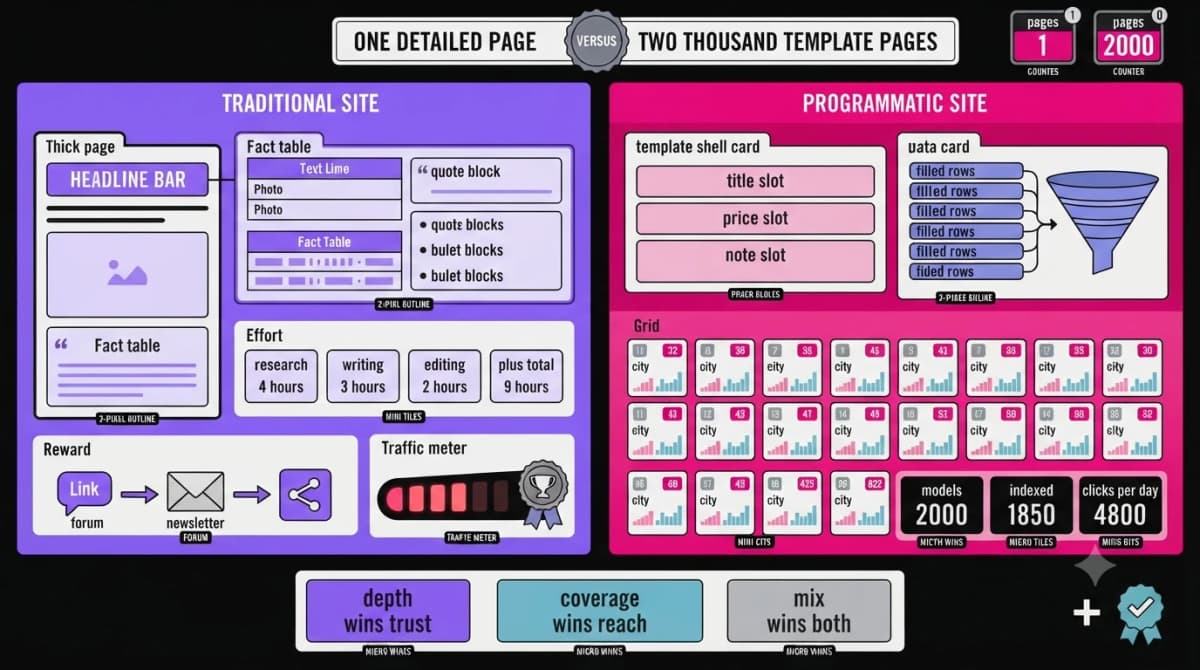
The first site publishes fifty guides over a year, one careful page at a time, each built around a question a rider would type into a search box.
The second site gathers specs, prices, and sizes for two thousand bike models, builds a template, and puts a page live for every single model in about four months.
The first site ends up with fewer pages, and each one carries real weight. Those pages earn links, build a name, and keep pulling traffic with very little upkeep.
The second site covers a range of tiny searches no writing team could ever chase by hand. Most pages bring in a trickle, and a handful break out and bring in a steady stream.
Both approaches can win, and the traffic they pull looks nothing alike. One grows slowly and compounds. The other arrives fast and needs watching, since every page has to stand on its own once the first wave of excitement passes.
How Long Each Method Takes To Show Results
Timing catches people off guard on both sides, so it helps to know what to expect before you start.
A new page written by hand usually needs three to six months to settle into a stable position. Links can speed that up or slow it down, depending on where they come from and how relevant they are.
A brand new site waits longer than an established one. Search engines need time to learn who you are, and a fresh domain has no history to lean on.
Programmatic pages often get indexed within days, and that part feels instant. Rankings still take weeks or months to firm up, especially inside a crowded topic.
Speed of indexing is not the same as speed of traffic. A page can appear in results quickly and sit far down the list for a long stretch before it moves.
Patience gets easier when you track the right numbers. Watch indexing rates and impressions first, then judge clicks and revenue once a fair amount of time has passed.
Keep a simple log as time passes. Note the publish date, the first date a page got indexed, and the date traffic started to move on it.
Patterns jump out of a log like that after a few months. They show which topics move quickly and which ones need a longer runway before they pay off.
Why Hand Written Pages Still Matter
Every method has jobs it handles better than the other one, and writing by hand owns several of them.
Trust, links, depth, and reader loyalty all grow faster from pages a person built with real care. That is not a knock on templates. It is simply where the strengths sit.
How Traditional Content Earns Trust
Search engines reward pages that show real effort, and pages written by hand are built to show it.
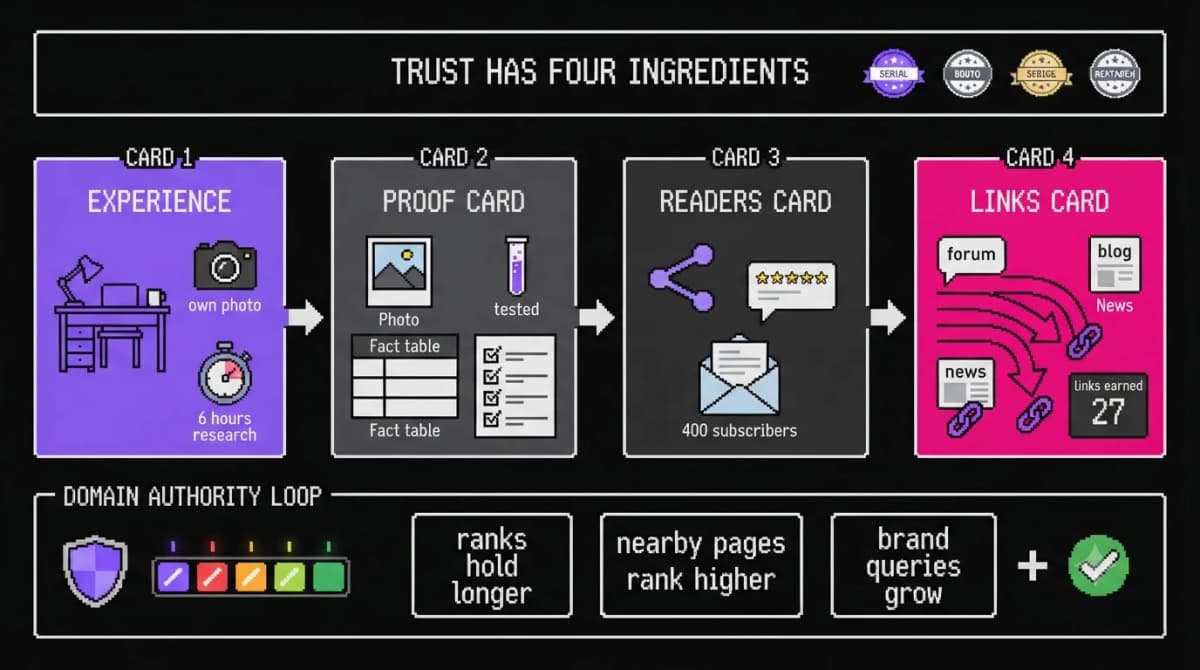
A writer can add firsthand experience, a test they ran, a mistake they made, or a photo from their own kitchen table. Details like those are hard to fake with a template, so they tend to earn links, shares, and readers who come back.
Trust also builds across a whole site. When a few strong guides attract links, the entire domain gains authority, and smaller pages sitting nearby start ranking higher than they could alone.
The cost shows up in time. A solid guide can eat a full day or more, and building a library worth reading can take a year or longer.
That slow pace is the trade. You pay in hours, and you get depth, loyalty, and a base that keeps paying off long after the article goes live.
Tools make this stage lighter. Building a brief in Frase before you write keeps the research, the outline, and the sources in one place, which is where most of that depth comes from.
Our article on creating evergreen content explains how to write pages that keep earning that trust for years.
Where Traditional Content Still Wins
Competitive topics reward depth, and depth is where a strong writer still holds the edge.
When the top results for a keyword are detailed guides with original photos and real testing, a template page cannot catch up by matching their length. Those results need a real argument, and building one takes a person.
Topics tied to health, money, and personal safety usually call for experience and clear opinions. Readers want that guidance to come from someone with a name and a face.
Brand building leans on traditional work as well. A newsletter, a loyal audience, and pages people share on purpose all grow from writing that feels human.
Topics with no reliable data source belong here too. If you cannot find solid facts to fill a template with, writing by hand is the honest option.
Our article on informational and commercial content explains how these two kinds of searches pull readers in at different stages of a decision.
Why Template Pages Scale So Fast
Programmatic pages shine on a different set of jobs, mostly the ones that involve volume and repetition.
Coverage, cost per page, and publishing speed all favor a template fed by clean data. One person with a good spreadsheet can reach ground a writing team would never cover.
How Programmatic SEO Earns Traffic
Programmatic SEO does not chase trust in the same way. It chases coverage.
Thousands of small searches sit unserved because bigger sites cannot justify a full article for each one. A well built programmatic page can claim those searches and quietly own them for years.
Setup cost lands at the front. Data research, template design, and quality checks on a small sample take real effort before a single page goes live.
After that setup, each new page costs very little, and that is where the model gets powerful for long tail growth. One clean data file can support hundreds of pages that each answer a slightly different question.
The risk shows up when the data is thin or the template repeats the same sentence shape on every page. Coverage alone does not hold rankings, and a wide net full of weak pages hurts more than it helps.
AI tools speed up the writing once the data is ready. ContentBot is built for that exact job, turning a clean set of facts into a first draft you can edit instead of a blank page.
If you want to see the whole process from the inside, our guide on programmatic SEO with AI walks through each stage of a real build.
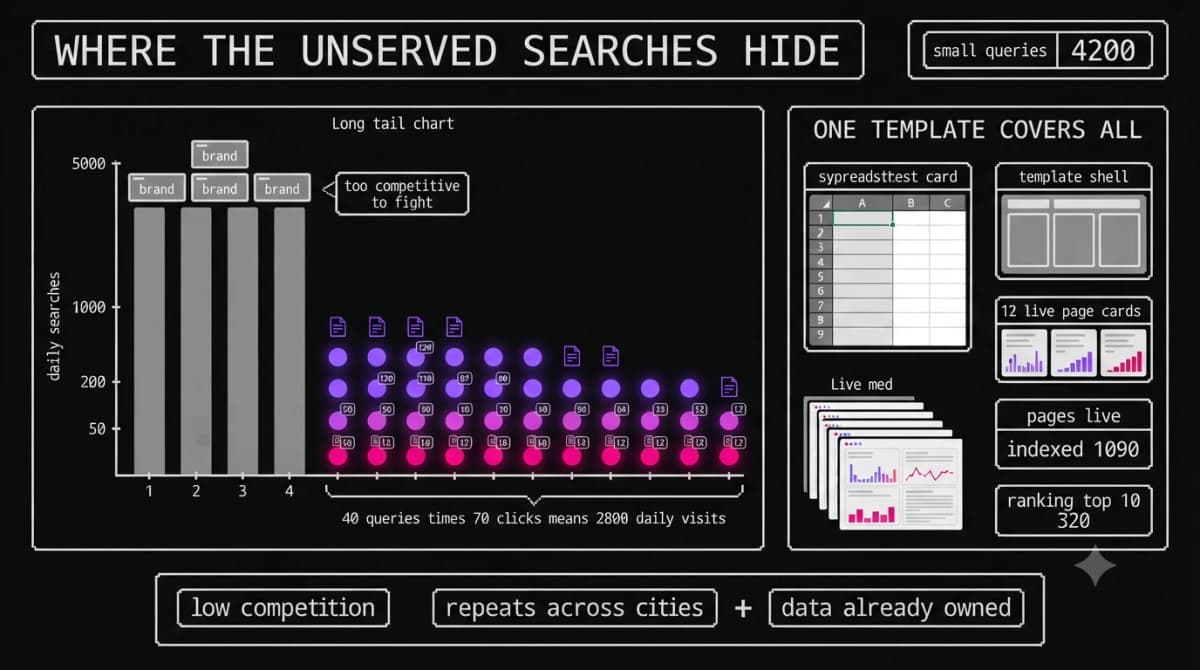
Where Programmatic SEO Wins
Programmatic pages win wherever the same question repeats with small changes.
Locations, product models, sizes, prices, service areas, and simple definitions all fit this pattern. Each version carries its own details, and each one has its own small audience.
The method also wins on coverage speed. One person with clean data and a solid template can cover more ground in a month than a writing team could manage in a year.
Data you already own is the strongest sign to take this route. A spreadsheet of prices, specs, or listings is the hardest part of the job, and plenty of businesses already have one sitting in a folder somewhere.
Smaller searches come with far less competition too, which gives a new project a fair shot at ranking without fighting large brands head to head.
Our walkthrough on programmatic SEO with WordPress shows how to turn a finished template into live pages on a platform most site owners already know.
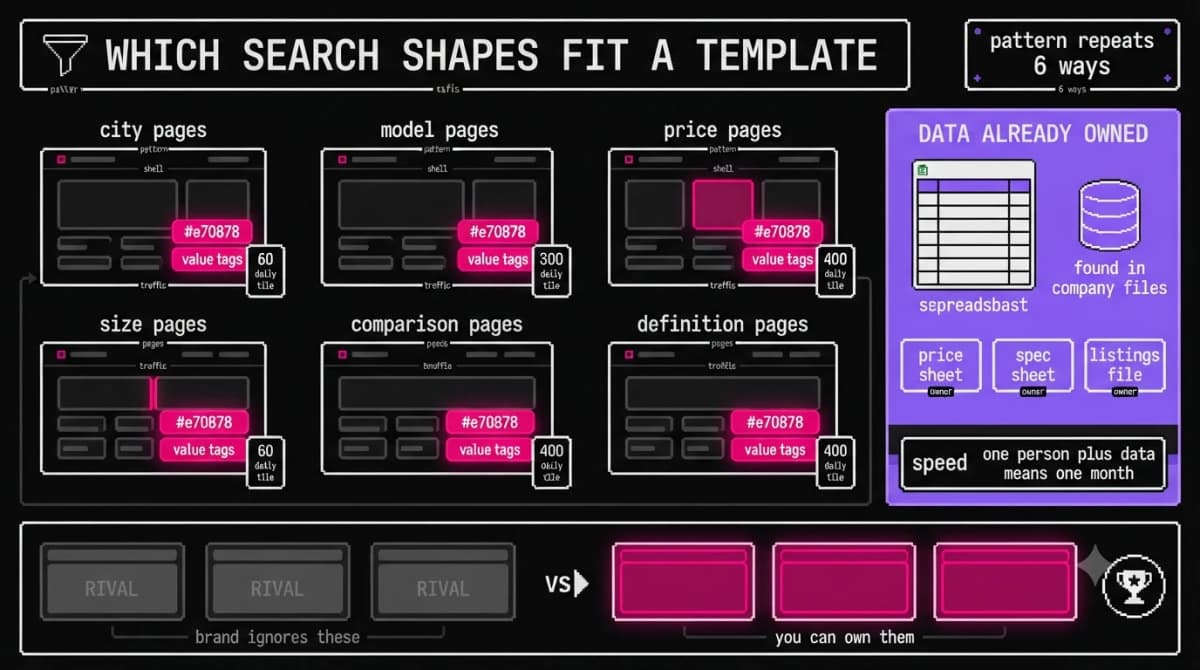
Coverage also compounds in a quiet way. Every new page adds another small entry point into the site, and those entry points keep working while you sleep.
Those gains only hold when each page earns its place. A batch full of empty pages adds entry points nobody clicks and drags the rest of the site down with it.
Head To Head: Which Method Wins Each Round
Four rounds settle most of this debate, and each round has a clear winner for a specific reason.
None of them crown one method for good. They simply show where each one holds the advantage, so you can match the method to your own situation instead of guessing.
Cost And Speed
Cost is the first place the two approaches split, and the numbers surprise most people.
A well written guide often lands somewhere between one hundred and five hundred dollars once you price in research, writing, and editing. Paying more will not change the math much, since cost scales with page count, one page at a time.
A programmatic project pushes its cost to the front instead. Data collection, template work, and quality checks might take a few weeks and a few hundred dollars, and then every new page costs pennies.
Speed follows the same curve. Writers produce pages one by one, while a template can push out hundreds in a single publishing batch.
Judging by cost per page alone misleads people, though. Programmatic pages need checks, refreshes, and fixes down the line, and those hours belong in the math too.
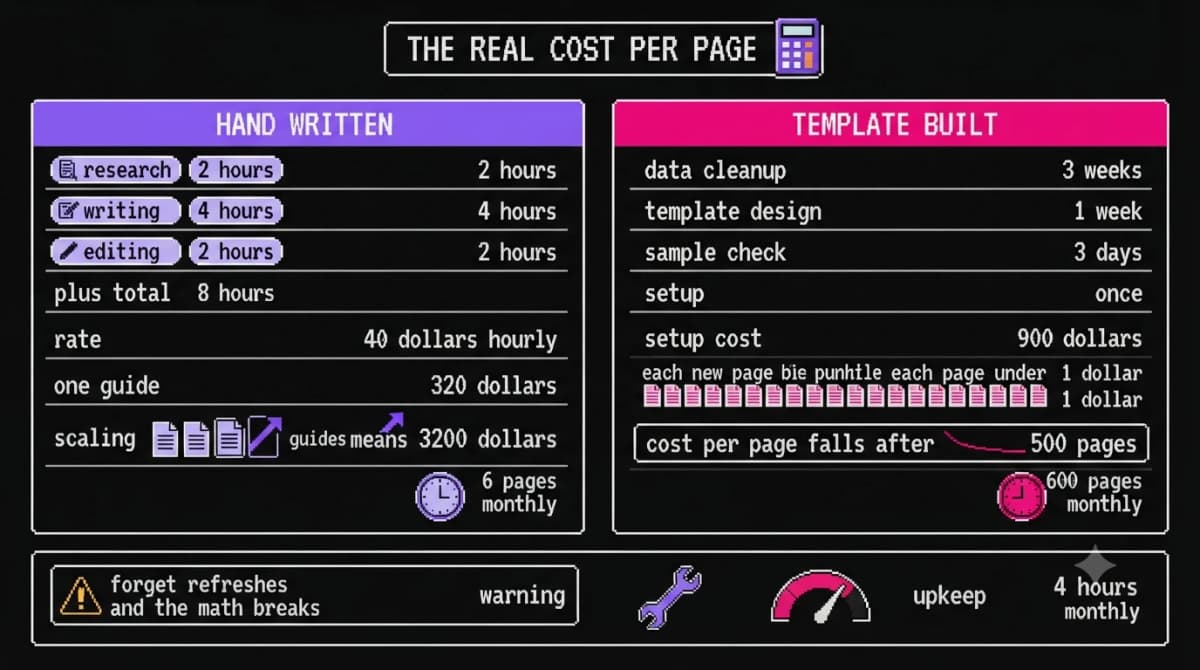
Budget matters most at the start, and it matters less over time. A site with ten strong pages and a small monthly writing budget can still grow at a healthy pace.
A site that spends everything on one giant batch often runs out of money before the refreshes begin, and that is exactly where the real cost tends to hide.
Depth And Trust
Depth is where traditional content usually takes the lead, at least on paper.
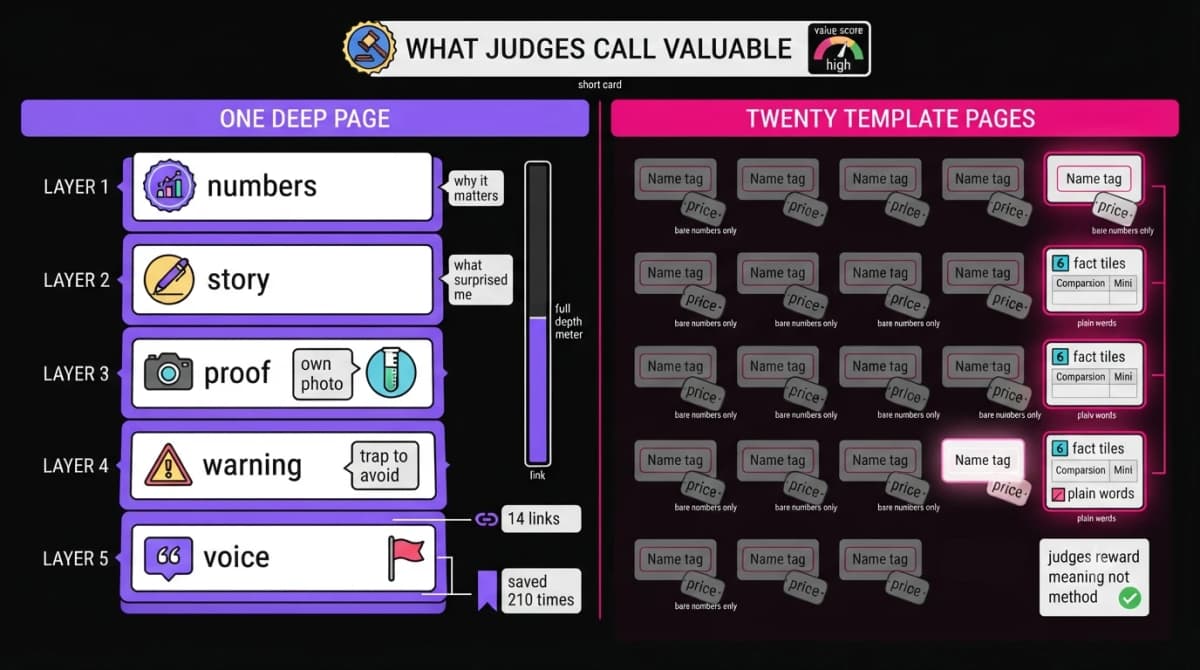
A writer can explain why a number matters, share what surprised them, and warn readers about a trap no data table would ever show.
Programmatic pages can run deep as well, but only when the data behind them is rich. A page with six useful facts, a short comparison, and a clear note about what the numbers mean reads well and helps people.
A page with a name, a price, and nothing else feels empty, even when every field in the spreadsheet was filled in correctly.
Trust follows the same rule. Search engines judge the value sitting on the page, not the method used to build it, so a template page with real substance can earn the same respect as one written by hand.
Scoring a draft against the current top results makes that judgment easier to predict. Surfer SEO does that job well, and it shows you which sections still need more substance before a page goes live.
Scalability
Scalability gives programmatic SEO its clearest win, and the gap is not close.
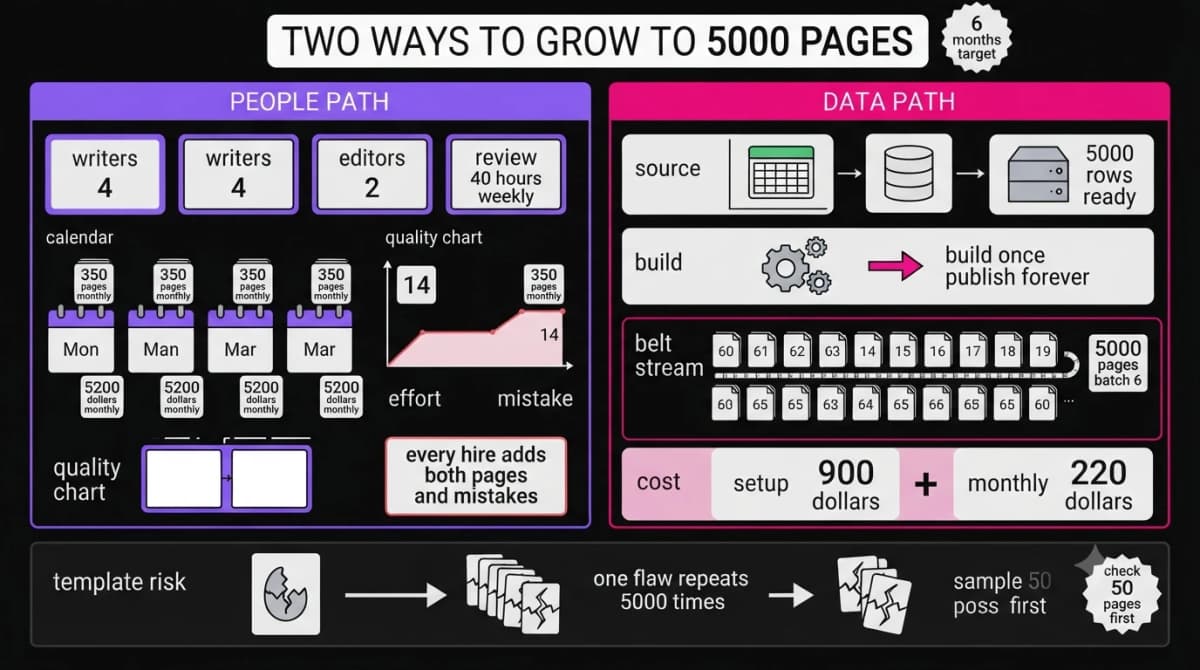
Traditional growth depends on people. Doubling your output means doubling your writers, your editors, and your review time, and quality tends to slip as a team grows fast.
Programmatic growth depends on data and setup. Add rows to a spreadsheet, run the build again, and new pages appear without hiring anyone.
That advantage comes with a limit. A system scales so quickly that any mistake inside the template gets copied onto every page it touches.
A flaw caught in fifty pages takes an afternoon to fix. The same flaw found across five thousand live pages can take weeks, which is why small test batches matter so much.
Ranking Stability Over Time
Rankings fade for everyone eventually, and the two approaches fade at different speeds.
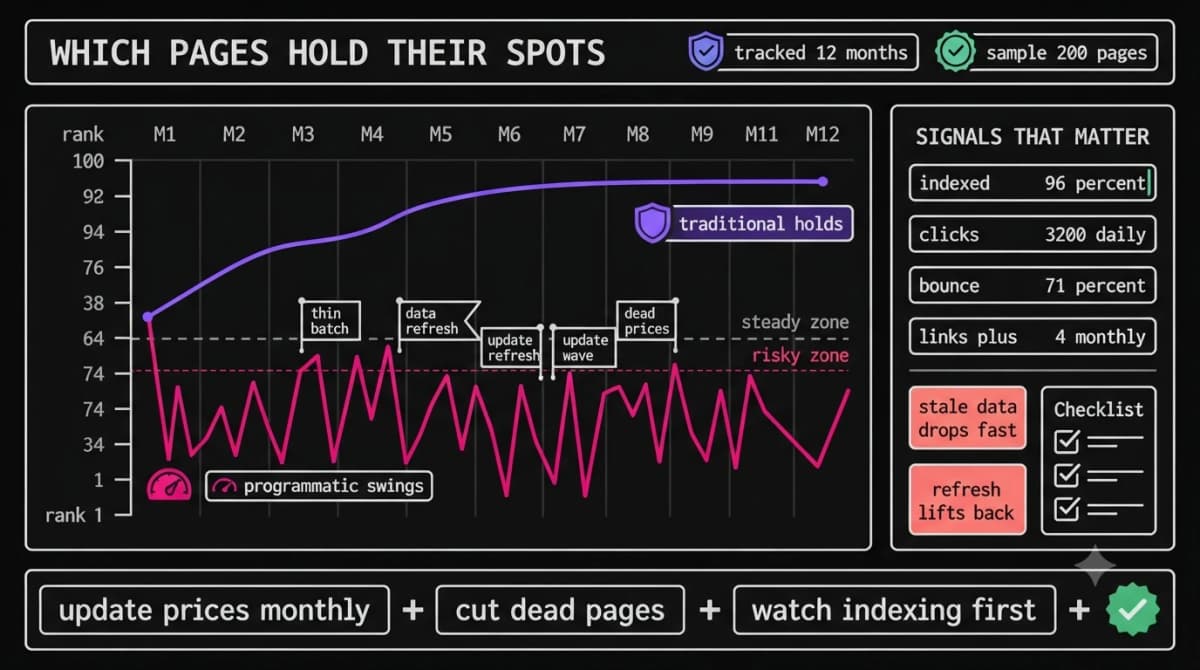
Traditional pages tend to hold their place longer. They collect links, earn repeat visits, and stay useful with little upkeep, so search engines keep trusting them through updates.
Programmatic pages move around more. A batch built on old prices can lose ground in a few months, and a wide set of thin pages can drop hard when an update changes how quality gets judged.
The strongest programmatic pages hold up well when their data stays current and their template answers a clear question. Upkeep is the price of that stability.
Our guide on the AI content refresh workflow shows how to keep a large batch current without rebuilding everything from scratch.
Risks And Weak Data
Both paths carry risk, and most of it hides in places people check last.
Wasted effort and damage to the rest of the site are the two big ones, and weak data deserves its own section since it quietly breaks so many projects.
The Hidden Risk Each Approach Carries
Each method hides a different kind of risk, and both risks shrink with a little planning.
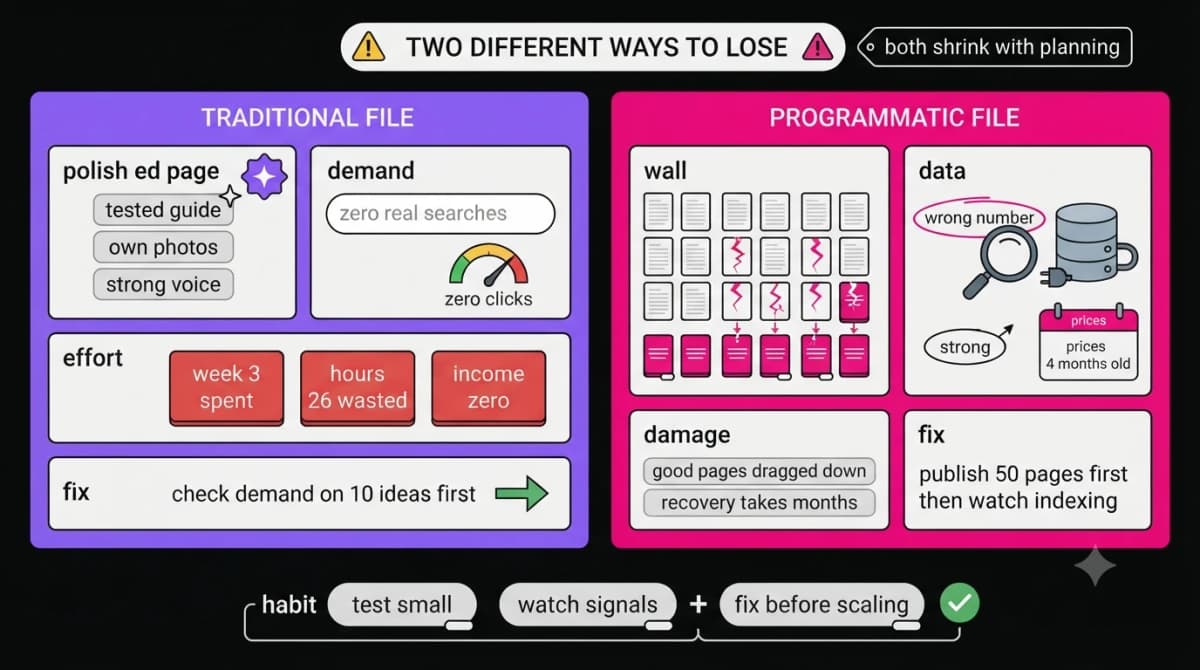
Traditional content risks wasted effort. A beautiful guide on a topic nobody searches for earns nothing, and the hours are gone for good.
The fix is simple enough. Check demand before you write, then test a sample of ten ideas before you commit a month of writing time.
Programmatic SEO risks damage across the whole site. A large batch of thin pages can drag down pages that had nothing to do with it, and recovery takes months of cleanup work.
Programmatic work also leans on a data source. If the file or page your numbers come from breaks, changes, or disappears, your whole batch ages badly.
Our guide on catching AI hallucinations in SEO content covers the version of this risk that shows up when a tool invents a fact and nobody checks it.
When Your Data Is Too Weak
Every project hits the same wall at some point. The data you can find covers half of what your template needs, and the missing half is usually the part readers care about most.
The first move is to trim the scope. Building eight hundred strong pages beats building two thousand where most of them lean on a single weak fact.
The second move is to enrich whatever you keep. Add a short note that explains the number, a comparison to a nearby option, or a plain language takeaway a reader can act on.
The third move is to merge thin entries. If two rows describe almost the same thing, one solid page serves readers better than two nearly empty ones spread across the site.
Manual research fills gaps no feed can close. A few hours spent on official records, local listings, or direct outreach often rescues a whole group of pages at once.
If none of that works, the honest answer is to write the topic by hand. Weak data inside a template produces weak pages, and no design choice can hide that for long.
Choosing The Right Path For Your Site
By now you know how each method performs, so the next step is matching one of them to your own site.
Three short sections cover the signs for each path, plus a fast way to pick your first project without overthinking it.
When To Choose Traditional Content
Traditional content fits best when your site is new and has no data of its own yet.
A fresh site needs a handful of strong pages that prove it deserves to exist. Ten to twenty well written guides on core topics give search engines something solid to judge, and they give you something to link to later.
Take this route whenever a topic needs testing, opinion, or personal experience, like product reviews where you actually used the item.
Competitive keywords belong here as well. If the current top results are excellent, your page needs a reason to exist that a template cannot supply.
Pick traditional content when you want links, loyal readers, and authority that carries the rest of your site.
Start with our guide on how to do keyword research for affiliate blog posts, then pick the topics worth the extra hours.
When To Choose Programmatic SEO
Programmatic SEO fits when the same page shape repeats across hundreds of versions, and real data exists for each version.
Locations, models, comparisons, and simple definitions are the usual starting points. If you can describe your page with one sentence and a blank to fill in, the pattern probably works.
Take this route when your competitors ignore small searches, since those gaps are the easiest place for a new project to pick up steady traffic.
You need an appetite for checks as well. Plan for a sample review, a staged launch, and a refresh schedule before you commit, because a batch without upkeep fades fast.
If you own a clean spreadsheet that nobody has turned into pages yet, that file is often the best sign that programmatic SEO should be your next move.
Our list of the best keyword research tools for affiliates helps you size up those small searches before you build anything.
Choosing Your First Project In Thirty Minutes
If you want a fast way to pick a starting point, this short exercise covers it.
List the topics you could write about well. Then list the search variations that sit under each one, like cities, models, sizes, or years.
Count the variations that have real search demand and solid data behind them. A topic with five hundred of those is a strong programmatic candidate.
A topic with twenty variations, each one needing original testing or opinion, is a strong traditional candidate instead.
Set a small first milestone either way. Fifty written pages or fifty live template pages will teach you more in a month than another month of planning ever will.
Write down what you expect to happen before you publish. Having a prediction on paper makes the results far easier to read later.
The Hybrid Model That Usually Beats Both
Most sites that succeed at scale do not pick one side. They run both, and the two halves support each other.
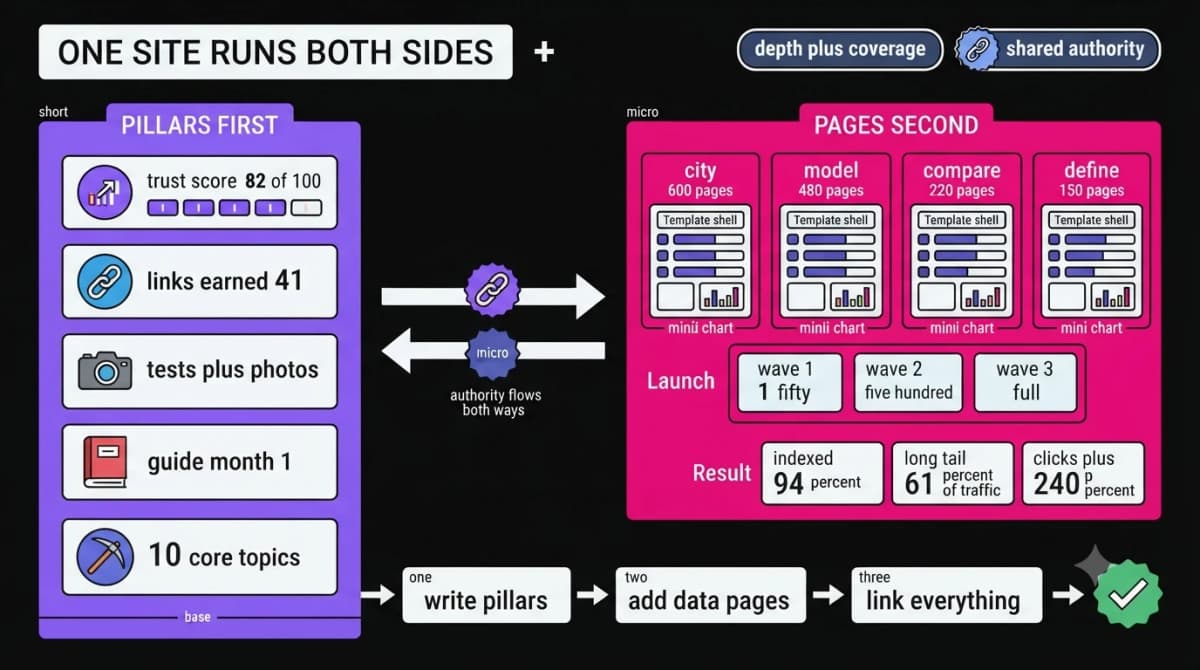
The pattern is easy to copy. Write strong pillar guides by hand for the big, competitive terms, then build programmatic pages for the thousands of small variations underneath them.
Internal links tie the two together. Pillar pages link down to the smaller pages, and those smaller pages link back up, which spreads authority across a section instead of leaving it in one spot.
Order matters too. Pillars come first, since they build trust and give the smaller pages something to lean on. Programmatic pages come second, once you know the topic has real demand.
The mix gives you depth where it counts and coverage where it is cheap, and it gives readers a clear path no matter how specific their question happens to be.
Our guide on building topical authority in a niche pairs well with this plan, and our explainer on content clusters shows how to group the pages once they are live.
A Real Example: Two Sites In The Same Niche
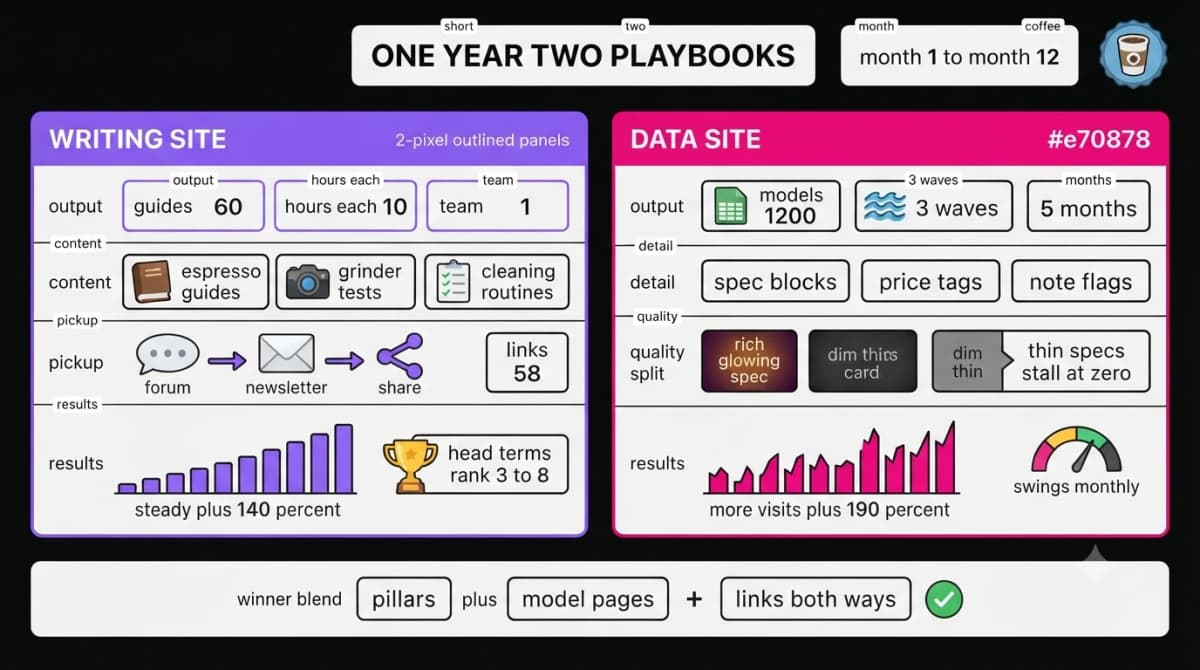
Here is how this plays out in practice, using two sites in the home coffee niche.
The first site writes sixty pages over a year. Espresso guides, grinder reviews, cleaning routines, and a few comparison posts. Each one takes a day or two, and a handful of them get picked up by forums and newsletters.
The second site builds a page for every coffee machine model it can find, about twelve hundred in total. Each page shows specs, price ranges, and a short note about who the machine suits. Those pages go live in three waves over five months.
After a year, the writing site ranks for broad terms and earns most of its traffic from a small set of strong pages. The programmatic site earns more total visits, spread across many pages, with far more ups and downs from month to month.
The pages with thin specs stall early and never recover. The pages with rich specs, a real buying note, and a current price hold steady and pull traffic all year long.
The site that ends up ahead copies the best of both. Pillar guides written by hand, model pages built from data, and internal links running in both directions.
How Search Engines Judge Both Types
Search engines do not hand out credit for the method you used. They judge the page sitting in front of them.
Their guidelines talk about purpose, value, and effort. A page built to help someone ranks. A page built only to collect clicks struggles, and the guidelines call out mass produced pages with little value as a real problem.
That standard applies the same way to a guide written by hand and a page built from a template. Both can pass it, and both can fail it.
Quality across the whole site matters too. A large set of weak pages can pull down the strong pages sitting next to it, which is why the weakest ten percent of a batch deserves as much attention as the best page in it.
Our article on how to build 10,000 pages without getting penalized walks through the publishing and quality checks that keep a large batch on the right side of those guidelines.
How To Measure Which One Wins For You
Testing both methods on your own site beats reading about them in general, and the measurement is easier than it sounds.
Split your pages into two groups, one written by hand and one built from data. Then track clicks, impressions, average position, and conversions for each group over ninety days.
Cost per visit tells a clearer story than cost per page. A cheap page that brings in nothing is expensive, and a costly guide that keeps earning links for three years is a bargain.
Watch indexing rates closely as well. If a large share of your programmatic pages never get indexed, that result says something about quality, and it usually shows up before any ranking drop does.
Keeping that data tidy matters as much as reading it. Rank Math gives you one place to manage titles, descriptions, and content checks across a site with hundreds of pages.
Our AI content audit guide shows a simple way to review a large batch and find the pages worth fixing, improving, or removing.
Mistakes That Sink Each Approach
The mistakes on each side look different, and both sets are easy to avoid with a little patience.
On the traditional side, people write without checking demand first. They also let pages age without updates, chase every topic in their niche, and forget to link new posts to older ones.
On the programmatic side, thin data causes the most damage. A template that only swaps a name, publishing everything in one huge dump, and skipping the sample review round out that list.
Ignoring early warning signs hurts both groups. Falling traffic on older pages and weak indexing rates are messages, not noise, and pushing forward while those numbers slide rarely ends well.
Neglecting updates damages a large site quietly. Pages that were accurate on launch day turn stale, and a site full of old details loses trust just as fast as one that launched weak content from the start.
Hosting deserves a look before any big launch as well. Slow servers hurt every page at once, and Hostinger is an affordable option built to hold a growing site.
If you want a shortlist of tools that help you monitor and audit that work, our roundup of the best SEO plugins for affiliates is a good place to start.
The Verdict: Which One Actually Wins
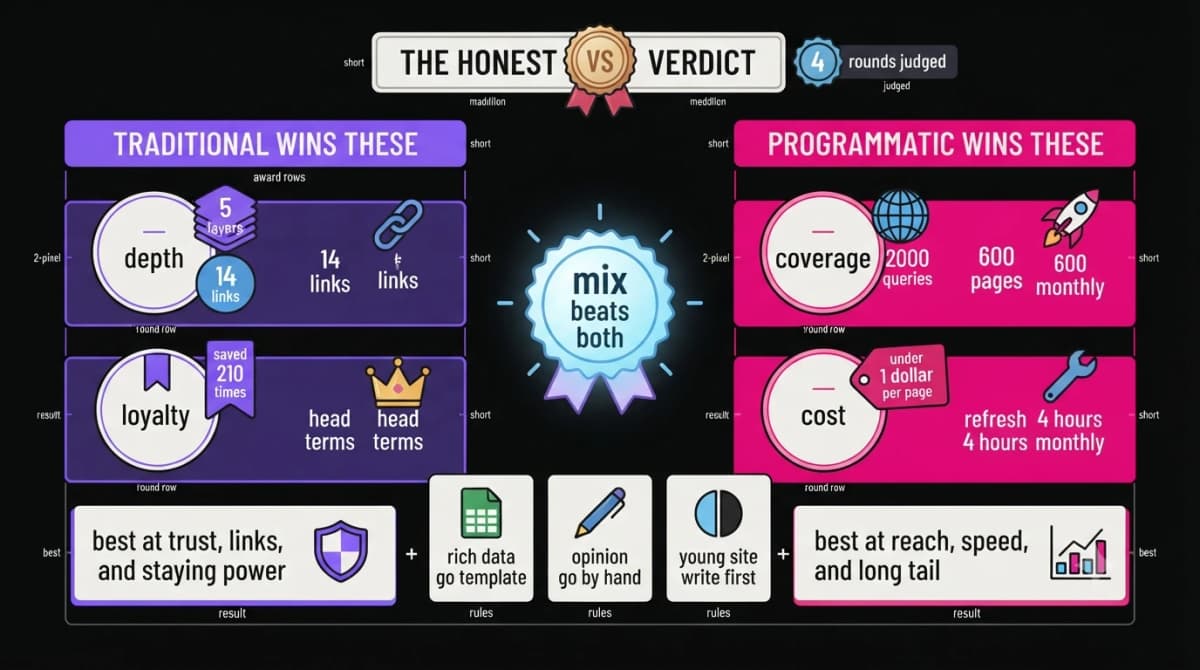
After all of that, the honest answer is that neither method wins everywhere. The mix wins, and the split depends on your situation.
Programmatic SEO wins on coverage, cost per page, and raw speed. It gives you a shot at thousands of small searches no writing team could reach by hand.
Traditional content wins on depth, links, loyalty, and staying power. It builds the authority that makes every other page on your site easier to rank.
For most new sites, traditional content comes first. Ten to thirty strong pages give you a foundation, and programmatic pages can layer on top once demand and data are clear.
For sites that already own rich, unique data, programmatic pages can lead while traditional content supports the big terms and the brand.
One simple rule helps when you feel stuck. If the same page shape repeats hundreds of times and real data exists for each version, go programmatic. If every page needs its own argument, go traditional.
Our AI SEO guide covers where automation fits into that decision and where human judgment still matters most.
For a closer look at the tools that handle parts of this work, our page on AI SEO agents explained covers what they do well today and where a person still needs to step in.
Think of the two methods as tools in one box rather than rivals in a race. Pick the tool that fits the job sitting in front of you.
Sites that survive algorithm updates for years share one habit. They treat every page, no matter how it was built, as something a real person will read and judge.
That single standard settles most of the arguments in this article. Reach matters, depth matters, and the page a reader lands on matters more than both.
A Simple Decision Flow To Follow
When the choice still feels unclear, walk through these questions in order.
Ask if you have structured data that covers hundreds of variations. A yes points toward programmatic pages.
Ask if the top results for your main terms are deep, opinionated guides. A yes points toward traditional writing.
Ask how much upkeep you can handle each month. Programmatic batches need refreshes, and pages written by hand need the occasional edit.
Ask what the site needs most right now. A site with no authority needs a few strong pages first, and a site with authority and clean data can scale fast.
Take the path that answers the most questions with a yes, ship a small first batch, and let your own numbers guide the next move.
Final Thoughts
The debate between programmatic SEO and traditional content usually ends the same way. Each side is right about something the other side undervalues.
Programmatic pages give you reach and speed that hand written content cannot match. Traditional pages give you depth and trust that no template can copy.
Sites that grow for years tend to use both, with clear rules for what gets written by hand and what gets built from data.
Start with a handful of pages that prove your site deserves attention. Add programmatic coverage once you know which searches are worth owning.
Keep your data current, watch your indexing rates, and refresh whatever slips. That habit matters more than any choice between the two methods.
Whichever path you take first, the pages still have to help the person reading them. Get that part right, and the rest follows.
Frequently Asked Questions
1. Is programmatic SEO better than traditional content for a brand new site?
Usually not at the start. A new site has no authority and no track record, so ten to twenty strong pages written by hand give search engines a reason to trust the domain. Once those pages rank and you know which searches matter, programmatic pages become a smart way to expand.
2. Can traditional content compete with thousands of programmatic pages?
Yes, on the terms that matter most. Traditional pages often win the broad, competitive keywords and pull more links. Programmatic pages win the huge number of small searches underneath. Both can sit on the same site without fighting each other for the same result.
3. Does programmatic SEO still work after all the recent quality updates?
It works when the pages hold real value. A template is not the problem, and thin output from a template is. Pages with accurate data, a clear answer, and something unique to say keep earning traffic through updates, while empty pages built only to match a keyword pattern do not.
4. How many traditional pages should I write before adding programmatic pages?
Aim for ten to thirty solid pages on your core topics. That base gives you topical footing, internal links for the new pages to lean on, and real data about which searches are worth scaling into a larger batch.
5. Which approach costs less over the long run?
Programmatic pages cost less to publish and more to maintain. Traditional pages cost more up front and less later. Pick based on how stable your data is and how much upkeep you can honestly handle each month.
6. Can I mix both methods on one site without confusing search engines?
Yes, and most large sites already do. Keep the topics related, link the sections together, and hold every page to the same quality bar. A clear structure is what keeps a mixed site easy to crawl and easy to trust.
For a closer look at how human writing and automated writing divide the work, our article on AI content vs human content covers what each one does better.